Thursday, July 19, 2012

Since Day One of the carbon tax...


From Stephen Koukoulas, who explains:

The post is a simple factually based report and at the moment draws no conclusions on causality, correlations or linkages between the carbon price starting and movements in the various indicators.


Since end June 2012

Official cash rate: No change

Australian dollar (vs USD): +1.8%

10 year govt bond yield: -0.12 percentage points

ASX200: +1.9%

RP Data house prices: +0.6%

Change in Housing Wealth: +$24 billion

Westpac index of Consumer sentiment: +3.7%


Related Posts

. That great big new tax is HOW big?

. The carbon tax will cost how much?

. Carbon tax: We'll wonder what all the fuss was about


Read more >>

Thursday, July 12, 2012

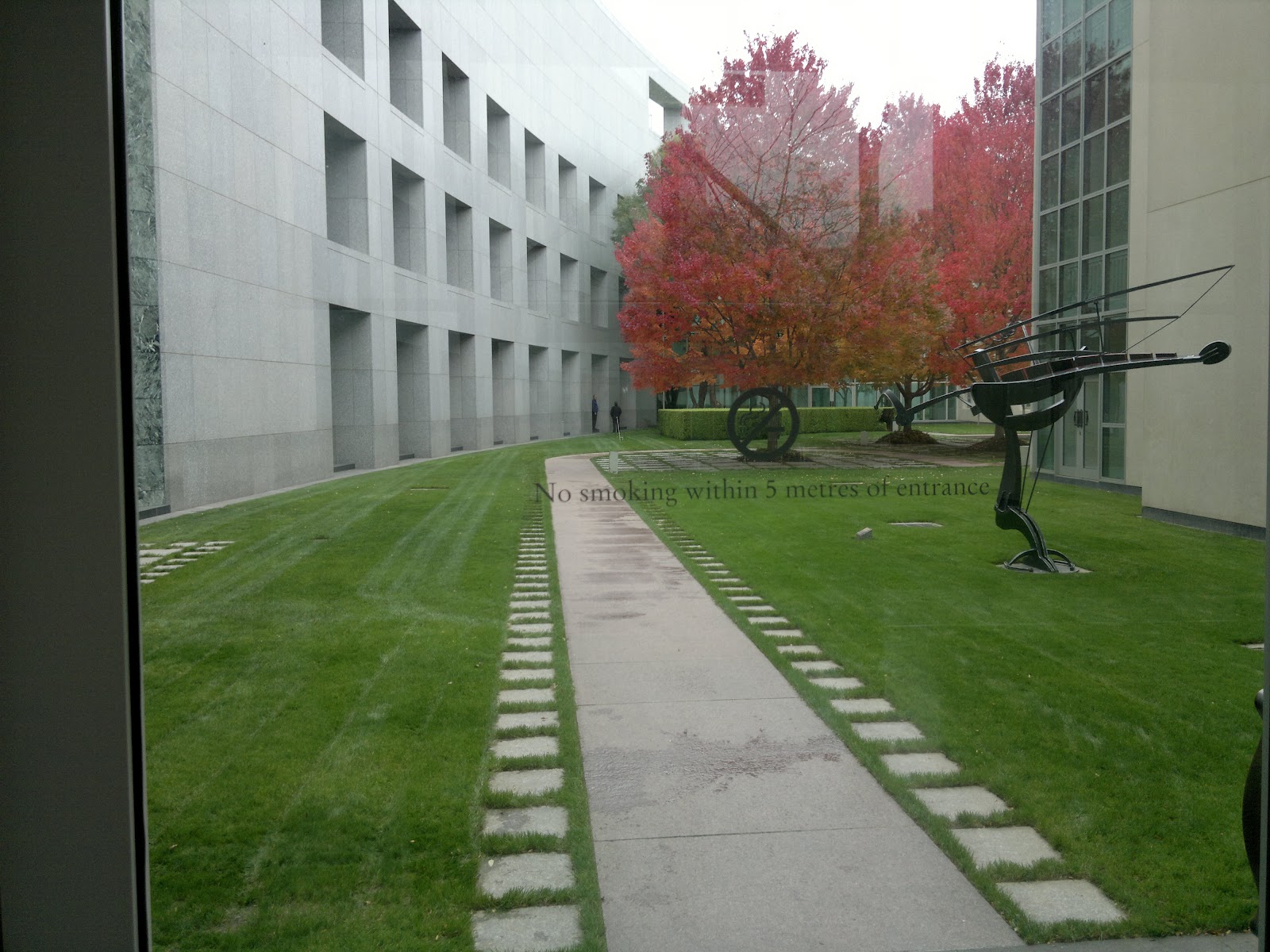
The things I love about Canberra (Warning: Autumn photos)


I'll make a list some day.

Meantime here are some Autumn photos I took in our incredible city before winter set in, mostly in and around parliament house:


Related Posts

. Friday lunch times I'm at the school chess club

. Not leaving Canberra

. Beloved Canberra

Read more >>

Monday, July 09, 2012

Labor is wrong. It is the Greens who are mainstream


Gillard was on about this last year. Remember this crap:

“The Greens will never embrace Labor’s delight at sharing the values of everyday Australians, in our cities, suburbs, towns and bush, who day after day do the right thing, leading purposeful and dignified lives, driven by love of family and nation.”

Here's what I wrote at the time:

My sources were the searchable Essential Report and the Greens' own policies.


Never has it been more important to understand the Greens. Never has a prime minister had less of a clue.

From July the Greens will decide which bills become law and which don’t. The prime minister says they "will never embrace Labor’s delight at sharing the values of every day Australians, in our cities, suburbs, towns and bush, who day after day do the right thing, leading purposeful and dignified lives, driven by love of family and nation”. Maybe, but that’s not what they will be called on to do.

They will be asked to vote on tax bills, on corporate regulation and on all manner of measures relating to economic management.

There are clues as to how they will vote, and if we are to believe her, the prime minister has missed every one.

Gillard thinks the Greens don’t get economics. They “wrongly reject the moral imperative to a strong economy,” she told the Whitlam Institute.

Her sidekick Anthony Albanese says they “tend to be a grab-bag of issues, tend not to have a coherent policy that adds up”.

Her resources minister Martin Ferguson says they want to “sit under the tree and weave baskets with no jobs”.

It's a forgivable impression until you examine what their supporters actually think...


...Asked to rate issues in order of importance in an Essential Media poll in January more Greens rated economic management number one than rated protecting the environment number one.The gap was closer amongst Greens voters than other voters, but the point is there was a difference - Greens put the economy number one.

Polled in November about a specific issue - regulation of the banks, Greens voters were on every measure more closer to economic orthodoxy than Labor voters.

Asked if banks should be restricted to lifting rates only in line with Reserve Bank, 87 per cent of Labor voters said yes. Even amongst Coalition voters 82 per cent said yes. But amongst Greens voters the result was 73 per cent, suggesting they are more likely to have studied economics.

Asked if bank fees should be kept to the cost of providing the service, 93 per cent of Labor and also 93 per cent of Coalition voters agreed. Only 90 per cent of Greens voters thought so.

Asked about a cap on bank salaries 88 per cent of Labor voters were for it. Coalition voters were far less keen at 83 per cent. In the middle, less in favour of hobbling the market than Labor voters although more so than Coalition voters, were the Greens at 86 per cent.

The views of Greens supporters are not outside the mainstream, except that they are likely to be more in touch with orthodox economics than the mainstream.

Greens voters are far more likely than either Labor or the Coalition to support higher taxes on mining profits, a view in line with the International Monetary Fund, the Henry Review and the Australian Treasury.

They are less likely than the majors to be fussed about a return to a budget surplus by exactly 2012-13 (as are orthodox economists although interestingly slightly keener than labor voters on spending cuts in the budget to come.

They are more likely than Labor voters to act against self interest. Only 17 per cent of Labor voters would accept a tax on products purchased online form overseas. A higher 19 per cent of Greens voters would.

And they know more.

An astonishing 10 per cent of Labor voters and 12 per cent of Coalition votes are deluded enough to think half our migration intake is boat people. Only 6 per cent of Greens voters think so.

They are accepting of the mainstream scientific position on climate change - that it is happening and caused by human activity; far more accepting than supporters of either Labor or the Coalition.

And they believe market mechanisms rather than regulations are the best way to get emissions down.

Their tax policies echo those of the Henry Tax Review. Tax breaks for high income earners would go, fringe benefits tax concessions that encourage the needless driving of cars would be scrapped and capital gains would no longer be tax-preferred over other returns from saving.

All income received in whatever form would be taxed at the standard rate and the scales would be rejigged to remove the high effective rates faced by Australians trying to get off welfare.

Henry would do this by flattening the scales and making the first $25,000 earned tax-free.

The Greens aren’t so sure about that, but neither are Labor of the Coalition. The point is that on nearly every area where the Greens diverge from Henry, the Coalition and Labor do too.

On most of the areas where then Coalition and Labor are reluctant to embrace Henry the Greens are keen to.

The big parties won’t touch the Private Health Insurance Rebate. The Greens would kill it, as would Henry.

The big parties aren’t attracted to a death duty. The Henry Review is, and the Greens would bring it in with a threshold of $5 million and an exemption for the family home, farm and small business.

The big parties are grudging about making the mammoth superannuation tax concessions more progressive. Henry isn’t, and the Greens would do it, after a “full review”.

This isn’t an argument in favour of the Greens policies, although as it happens I find them attractive. It is an argument that they fit within the economic mainstream. They are coherent, readily available on the web, and far more than a grab-bag from a “party of protest” that sits “under the tree and weave baskets with no jobs”.

If the Greens have got it wrong on economics, then so too have the economics text books they seem to have read and so too has Ken Henry.

Their real position is important because it is their real position that will determine what gets passed into law in the two to three years ahead, not the misleading dumbed-down characterisations of a prime minister and ministers who should know better.


UPDATE: The latest Essential Report does indeed show Greens supporters out of touch with mainstream Australia on something - asylum seekers. But even here Greens supporters are not as much out of touch as might be imagined. 35 per cent believe the Labor has been too tough on asylum seekers, a surprising 30 per cent believe Labor has not been tough enough.


RECOMMENDED READING:

How can parties that supported things such as carbon trading now oppose them? - NewYorker


Related Posts

. Start your engines. The Newstart inquiry is Go!

. Leigh on the Coalition's hatred of Treasury

. Memo to Julia: You don't have a carbon consensus


Read more >>

Sunday, July 08, 2012

2012-13 Economic Survey. They're optimistic


Tim Colebatch:

Australia is set to do it again. BusinessDay's half-yearly economic survey has found our private sector economists believe the country will grind its way through the 2012-13 financial year to record solid growth, despite risks of Europe's problems deadening the world economy.

Our economists see Australia broadly continuing along its present path, dodging any significant fallout from the eurozone crisis, but divided into two economies travelling at very different speeds. Unemployment will grow.

The panel is hopeful, though far from certain, that the biggest threat to global growth the potential breakup of the eurozone will be averted, or failing that, managed in a way that avoids sparking what Monash University's Jakob Madsen terms "irrational investor behaviour".

Whether Greece remains in the euro or not, most of the panel expects Australia to be largely unaffected by Europe's crisis. Any impact will be swamped by the strength of the mining construction boom, and continued demand for minerals from China and India.

On average, our 22 forecasters predict Australia's gross domestic product will grow by 2.9 per cent in the coming 12 months, within the 2.5 to 3.5 per cent range forecast by the Reserve Bank, although slightly less than the budget forecast of 3.25 per cent as the year average.

They expect global output in 2012 will expand by 3.2 per cent, a bit less than the 3.5 per cent forecast in April by the International Monetary Fund. But many in the panel see global confidence returning in 2013, lifting prices for Australia's mining exports, and reversing the slide in the terms of trade.

Most disregard the forecasts of a further fall in commodity prices, and signals by BHP and Rio that mining projects could be put on hold. They say mining construction work for the next year or two is now locked in, and while prices may have peaked, the peak in mining investment is several years away...


More here.


Related Posts

. December 2011 Economic Survey: We'll do okay, thanks to China

. A normal year ahead? The July 2011 survey

. Before the flood. The December 2010 survey


Read more >>

Thursday, July 05, 2012

Doing it tough? Suddenly we're buying cars big-time, and starting to shop

It seems stimulus stimulates. Details below

Low interest rates and $1 billion of lump sum carbon tax compensation payments propelled consumer spending toward a record high at the end of the financial year making June the biggest month for motor vehicle sales in Australian history.

The Federal Chamber of Automotive Industries says an extraordinary 112,722 new vehicles were sold in June, a jump of 17 per cent on the previous June. Although partly driven driven by end of financial year considerations, the surge wasn’t driven by a desire to beat an impending tax change. In fact the change that took place on July 1 will make buying vehicles even more attractive for small businesses, allowing them to claim up to $5000 as an immediate tax deduction.

Sales of sport utility vehicles surged an astounding 46 per cent between the two Junes, climbing from 20,793 to 30,326 meaning one in every four vehicles sold in June was an SUV.

TD Securities economist Alvin Pontoh said the strong first quarter consumption growth recorded in the national accounts appeared to have continued into the second quarter.

“The Reserve Bank’s rate cuts are gaining some traction. The risk that the Bank will ‘wait and see’ before doing more has increased,” he said.

Carbon tax compensation payments totalling $325 million flowed into the bank accounts of families receiving TAx Benefit A and B in March. A further $700 million in payments to pensioners appeared in bank accounts in June.

Bureau of Statistics retail figures released yesterday show a surge of 0.5 per cent in May after increases of 0.9 and 0.1 per cent in March and April. Retail spending is climbing at a trend rate of 0.4 per cent per month, equating to healthy trend growth of 4.3 per cent per year.

Annual spending growth is exceptionally lopsided. Spending grew 10 per cent in Western Australia, 4.3 per cent in Queensland and just 2.2 per cent in the rest of Australia combined. The 2.2 per cent growth rate is below the rate of inflation implying no real growth in the quantity of goods and services sold out outside of the the two large mining states...

Treasurer Wayne Swan said despite the good national result “parts of our retail sector remain under pressure from changing consumer preferences and more cautious consumer behaviour”.

At one end of the spectrum trend spending on household goods is slipping a that rate of 0.1 per cent per month, despite encouraging signs in May. At the other end of the spectrum spending at cafes and restaurants and on takeaway food is exploding at the trend rate of 1 per cent per month.

Spending in Victoria is scarcely growing, inching ahead at the trend rate of 0.1 per cent per month. NSW spending is climbing at a trend rate of 0.5 per cent per month.

In today's Sydney Morning Herald and Age


Household Assistance Package - Payment Summary


Related Posts

. Rare good news: Ahead of the budget we hit the shops

. Two Australias. One isn't spending

. Why are all those shops turning into cafes?


8501.0 VFACTS
Read more >>

Wednesday, July 04, 2012

Eight graphs, eight stories

Read more >>

There's an NBN information kit. Turnbull opens the box.

Read more >>

Not too hot, not too cold. Why the RBA is done with rate cuts

Simple when you think about it

The Reserve Bank is done with interest rate cuts for the moment, believing Australia has a ‘Goldilocks’ economy that’s neither too hot nor too cold.

Board members attending yesterday's meeting concluded inflation was about where it should be, although there was some concern about the risk of high inflation down the track now that the Australian dollar was no longer climbing. They saw economic growth as close to average and unemployment close to its long-term low, notwithstanding some high profile job losses.

Members took the view that after after eight months of rate cuts totalling 1.25 percentage points board it was time to take stock and wait until there was a clear reason to move rates in either direction.

The Reserve Bank’s measure of discounted home loan rates has fallen from 7.05 per cent to 6.15 per cent. The monthly cost of serving a $300,000 loan has slipped from $2130 to $1960.

Australia’s next cut in interest rates is more likely to be triggered by international than domestic developments... The Bank remains concerned about the strength of the Chinese economy despite better news in the past month. It believes conditions are worsening in both Europe and the United States.

Treasurer Wayne Swan welcomed the decision to keep rates on hold noting that at 3.50 per cent the Bank’s official cash rate remained lower than at any time under the previous Liberal government.

“While some of our sectors face challenging conditions, today’s decision reflects the fundamental strength of the Australian economy amidst international turbulence,” he said. “Of course, we understand there are many Australian families facing financial pressure who feel like it’s someone else’s boom. That’s why at the centre of this year’s budget was a spreading the benefits of the boom package to give every Australian a stake in the mining boom.”

Former Reserve Bank economist Paul Bloxham said the Bank had made it plain it was in no hurry to cut rates again.

“Unless events change, they won’t be rushing to alter monetary policy in the short term at least,’’ he said.‘‘They’d want to see the effect of all the easing that’s happened.’’

Figures on building approvals for private houses released yesterday showed an improvement after the May rate cut, climbing 9 per cent after falling 11 per cent in April. The Bureau of Statistics smoothed measure of continued to slide, slipping a further 1.3 per cent.

In today's Sydney Morning Herald and Age


Household Assistance Package - Payment Summary (2)


Related Posts

. Will the Reserve Bank sit on its hands?

. The June rate cut was closer than we thought

. GDP. We're booming, if you can believe it.


8731.0
Read more >>

Tuesday, July 03, 2012

Jobs growth not as we said - ABS

The Bureau of Statistics has got the official employment figures wrong, and although happy to acknowledge the errors, it won’t correct them in the official record because it would cost too much money.

Officially, employment grew not at all in 2011 after surging 363,500 in 2010. Yesterday in an invitation-only seminar attended by The Age assistant statistician Paul Mahoney said employment probably climbed 30,000 to 35,000 more than officially acknowledged in the first nine months of 2011 and climbed 60,000 to 70,000 less than acknowledged in 2010.

This means official figures overstated the weakness in the labour market that led the Reserve Bank to cut rates at the end of 2011 and overstated the strength that led it to push up rates at the end of 2010.

“We acknowledge we have problems with the way we are benchmarking the labour force at the moment,” Mr Mahoney said. “We are not hiding behind this, we are being very open about it. This is a public seminar, this is going to be repeated a few times.”

The problem arises because in order to convert the results of its door to door employment survey into figures for whole nation the ABS has to estimate the size of the Australian population. Usually it gets the estimate right. But at times when the rate of population growth is changing rapidly it can get it wrong. Instead of revising the official employment figures when more correct population information comes to hand it instead revises its estimate of future population growth. This means incorrect employment figures remain on the public record and future employment growth figures are adjusted in the opposite direction to compensate.

The ABS will attempt to save money by moving its monthly employment survey on line, posting passwords and login codes to the 29,000 households that take part rather than visiting them and following up with phone calls. It will also abolish or make less frequent a number of less-important labour force surveys.

The unemployment rate - presently 5.1 per cent - is unaffected by the Bureau’s problems with its measure of employment.

In today's Canberra Times, Sydney Morning Herald and Age


From the ABS:


UPDATE August 10:

The RBA on the ABS methods in its Quarterly Statement

"When a discrepancy between the official population
estimate and the labour force survey population benchmark
arises, the normal approach for constructing the
population benchmarks removes the difference over
time by forcing the projected population benchmark
to gradually converge toward the expected
official estimate of the population.

[Our] adjusted estimate suggests that employment
growth was around ½ percentage point lower
in 2010 than the published estimate and around
½ percentage point higher over the past year. By
coincidence, this bias has exaggerated the recent
cycle in employment growth."


RBA - How the ABS Labour Force Figures Misrepresent Jobs Growth


Related Posts

. May: Tim Colebatch has cracked it. Why the jobs data is flawed

. January: "For job seekers it was the worst in 20 years"

. November: Standstill. We are no longer making enough jobs


6202.0

Read more >>

Will the Reserve Bank sit on its hands?

23 out of 23 economists say yes.

The Reserve Bank board is considered certain to sit on its hands for the first time in three months today amid signs its previous rate cuts are stabilising property prices.

The RP Data Rismark survey finds Sydney and Melbourne prices bounced back 1 per cent in June after slipping in May 1.2 and 2.7 per cent.

Daily data shows the turnaround began after the Bank’s May 0.50 point rate cut and gathered pace after its June 0.25 point cut.

“Things are improving, but we would need further gains to be assured of a stabilisation in house prices let alone a recovery,” said Westpac economist Matthew Hassan.

The Sydney median price is $541,000, down 2 per cent over the past year. The Melbourne median price is $480,000 - down 6.6 per cent.

Separate figures from mortgage broker AFG show a surge in refinancing to take advantage of the Reserve Bank rate cuts totalling 1.25 percentage points since November...

Two in every five of the new mortgages sold in June were for borrowers wanting to refinance rather than buy. In a sign that borrowers expect further rate cuts this year the popularity of fixed rate loans slumped to its lowest point since September. One in every six home loans were at fixed rates, down from one in every four in March.

Every one of the 23 market economists surveyed by Bloomberg expects the Reserve Bank to stay its hand today - an unusual consensus. Pricing in the futures market which is notorious for overestimating the likelihood of rate cuts puts the probability of a cut today at just just 16 per cent.

AMP chief economist Shane Oliver said a spate of strong employment news since the June board meeting will leave the board feeling it can wait before cutting again.

‘‘I tend to think because they cut at two meetings in a row, and because the growth and employment figures surprised on the upside, they would probably be inclined to sit back and wait and see,’’ he said.

Deutsche Bank economist Adam Boyton said he thought the Bank would cut again later this year.

‘‘Consumer confidence is lower now than when the Bank started to move at the end of last year. In an environment where the terms of trade are declining, even economic growth of the sort we have had isn’t going to be enough to stop unemployment from drifting up.’’

In today's Sydney Morning Herald and Age


Related Posts

. The June rate cut was closer than we thought

. GDP. We're booming, if you can believe it.

. Carbon tax angst. It's worrying the Reserve Bank


Read more >>

Monday, July 02, 2012

July 1: It's not just the carbon tax


Also from July 1...

PAY RISE $17.10 per week for low-paid workers

TAX FREE THRESHOLD No tax until $18,200

TAX CUTS For everyone up to $80,000

PENSION INCREASE 1.7% from May 2013

FAMILY TAX BENEFIT BOOST $300 per child

DOUBLE NSW FIRST HOME BUYERS GRANT $15,000 for purchase of new home

CREDIT CARD LENDERS Forced to clear high interest debts first

TICK AND FLICK BANK SWITCHING Sign one form once

TOUGHER MEDICARE LEVY SURCHARGE 1.25% to 1.5% for high earners without private insurance

LOWER PRIVATE HEALTH INSURANCE REBATE 10% to 20% instead of 30% for high earners

INSTANT ASSET WRITE-OFF Up to $6500 per small business

MINERALS RESOURCE RENT TAX To raise to $3 billion in its first year


Swamped in the talk about the carbon tax are a raft of other changes beginning this week overwhelmingly positive for middle to low earners.

From today low paid workers will get an extra $17.10 per week as a result of the national wage decision. Around 1.4 million workers get the extra 2.9% which is likely to flow on to others through enterprise bargaining.

The tax-free threshold will jump from $6000 to $18,200 meaning Australians returning to work part-time and starting part-time work will pay no tax.

New tax scales will give every worker earning up to $80,000 a tax cut - typically worth $300 per year. No-one will face an income tax increase.

Other carbon tax compensation measures will permanently boost pensions and family tax benefits 1.7 per cent. Worth up to $338 per year for single pensioners and up to $110 per child for families that receives Family Tax Benefit A some of the increases have been paid up front. The rest will paid fortnightly on an ongoing basis from March 2013. Families receiving Tax Benefit A will also get an extra $300 per child per year as part of the Spreading the Benefits of the Boom mining tax package...

In NSW the first home buyers grant will be doubled to $15,000 but for the first time restricted to buyers of new homes. Anyone who buys a new home worth up to $650,000 will get a grant of at least $5000. Stamp duty will be cut for first home buyers spending up to $650,000.

Dealing with banks will also become easier. They will prevented from sending out unsolicited offers of higher credit card limits and required to use credit card payments to clear the highest interest rate debt first. Switching banks will be a matter of signing one form once, easier than it has ever been before.

High income earners will find the changes more costly. Taxpayers earning more than $97,000 who choose not to take out private health insurance will be hit with a Medicare levy surcharge of 1.25 to 1.5 per cent instead of the present 1 per cent. Those earning up to $83,000 will get a smaller Private Health Insurance Rebate. Those earning more than $129,000 will lose the Private Health Insurance Rebate.

In today's Age


Related Posts


. What'll change from July 1? (apart from the carbon tax)

. The carbon tax will cost how much?

. That great big new tax is HOW big?

Read more >>

That great big new tax is HOW big?

Read more >>

Friday, June 29, 2012

Where to search for work - the Good, the Bad, the Ugly

The latest stats say one place is much better than the others

The gap between the employment conditions in the west and the rest of the nation has dramatically widened.

New Bureau of Statistics figures show Western Australia by far the best place to look for work with just 1.7 unemployed locals for each vacant job in May - a ratio that means anyone looking for a job has a better than even chance of getting one.

By contrast in NSW there were roughly four unemployed locals fighting for each vacant job, in Victoria five, and in Tasmania almost eight - a ratio that made finding a job unlikely.

So large has the pool of unfilled jobs in Western Australia grown it is now almost as big in Victoria, a state with twice the population. Queensland now has more unfilled jobs than Victoria and almost as many as NSW.

But although Australia’s mining states have by far the best employment markets, comparatively few of Australia’s 172,000 vacant jobs jobs are in mining itself... The ABS reports 9600 unfilled jobs in mining, 12,000 in manufacturing, 13,000 in health care and social assistance, 14,000 in retail and 18,000 in administrative and support services.

Two fields related to mining report big demand for workers. The construction industry is attempting to fill 20,000 vacancies and the scientific and technical services industries another 20,000.


Related Posts

. It's raining men in the West, 'cos the rest of us won't go there

. What's your chance of getting that job?

. This is what a dead industry looks like.... mining vacancies expand 20%


6354.0
Read more >>

Swan in China. With Rudd, Peacock and Downer?

If they say yes

Treasurer Wayne Swan has invited an unlikely series of travelling companions on his trip to Beijing next month, among them Andrew Peacock, Alexander Downer and Kevin Rudd.

What they have in common is serving as Australian foreign minister during the 40 years Australia has had an embassy in Beijing.

Until December 1972 Australia refused to recognise the communist Chinese government headquartered in Beijing, preferring to recognise instead the non-communist government in exile in Taiwan.

When Labor opposition leader Gough Whitlam flew to Beijing in 1971 to meet with Chinese leaders Australia’s prime minister William McMahon accused him of being soft on Communism. But a year later US President Richard Nixon himself flew to Beijing, Gough Whitlam became Australia’s first Labor prime minister in a generation and both nations recognised what has since become Australia’s most important trading partner.

To celebrate 40 years of Australian presence in Beijing Mr Swan has quietly asked each of the surviving former ministers who served foreign minister during that time to join him on the trip...

The complete list is Andrew Peacock, Tony Street, Bill Hayden, Gareth Evans, Alexander Downer and Kevin Rudd.

In parliament yesterday Mr Swan celebrated the $4 billion listing on the Australian stock exchange of the Chinese-owned coal miner Yancoal. He said the record investment in Australia’s resource industries was a vote of confidence in Australia’s future. The coal industry was set to expand, notwithstanding talk from the leader of the opposition about how next week’s carbon tax would kill it stone dead.

Mr Swan leaves for Hong Kong and Beijing with a delegation of business leaders on July 10.

In today's Age


Related Posts

. New destinations. We are choosing the future

. Our coking coal. India's next - RBA

. Surprised by Joy. How Treasury underestimated China


Read more >>

All that talk about affordable housing was just...

Five years ago in the lead up to the election that swept him to power Kevin Rudd called a housing summit. He promised to make affordable housing a top priority and in office set a series of targets for the Council of Australian Governments.

Today in a damning assessment of progress the COAG Reform Council will report it finds “no indication” overall affordability has improved.

The annual assessment finds rental affordability has worsened, especially for those on the lowest incomes.

Households are said to be in rental stress when rent takes up more than 30 per cent of their gross income. The report says Labor took office with 49 per cent of Australia's poorest households in rental stress. By 2009-10, the most recent year for which figures were available, 61 per cent of those households were in rental stress.

In NSW and Victoria more than two-thirds of very low income households were in rental stress - the worst results in the nation. In the ACT only 38 per cent faced rental stress.

“We are talking about the Australians who can least afford the extra financial burden,” said Council chairman Paul McClintock ahead of the release of today’s report.

“The more money these households have to spend on rent, the less they have for other basic necessities.”

In every state and every capital buying a home became less affordable for low income Australians between 2009-10 and 2010-11... Mortgage rates climbed, low income levels were little-changed and house prices stayed fairly steady. Perth is the least-affordable city for low-income Australians, Canberra the most affordable. (The Council's figures fail to take account of the very recent falls in house prices and interest rates.)

“The Commonwealth, state and territory governments all committed to make housing more affordable,” Mr McClintock said. “None of the indicators we are able to report show any progress toward achieving this objective.”

Mission Australia executive Eleri Morgan-Thomas described the findings as “eye-opening”.

“Measured against the aims of the affordable housing agreement - for example, that people are able to rent housing that meets their needs - this report clearly shows there has been no progress, and in some cases we’ve gone backwards,” she said.

“What is eye-opening is the enormity of the rental affordability problem when captured in black and white, particularly in our major capital cities. To have people who can least afford it experience a 12 per cent increase in housing stress is extremely alarming.”

In today's Age


Related Posts

. Why Labor's housing summit will fail

. Why Labor's Housing Summit left me optimistic

. Our houses are emptying, as are our dreams of owning them outright

Read more >>

Thursday, June 28, 2012

Dumb, and Dumber. Why on earth did Australia sign ACTA?

A treaty signed by the Australian government that could have made it illegal to link to or mention on the web other websites that breached copyright law has been struck down by an all-party parliamentary committee.

The so-called Anti-Counterfeiting Trade Agreement would have also broadened the definition of the term “counterfeiting” to call into question the legality of manufacturing generic medicines.

Negotiated largely in secret, and signed by trade minister Craig Emerson in Tokyo the agreement was sent to the treaties community for examination prior to ratification.

Usually the committee gives a tick to such agreements. Yesterday in a unanimous report signed by Labor, Green and Coalition members of the parliament the committee said no.

“During the life of this committee we have recommended the ratification of hundreds of treaties,” chairman Kelvin Thomson said yesterday. “It has only been a handful that we have recommended anything other than ratification. This is one of those exceptions.”

The committee found the wording of the treaty vague with terms such as “aiding and abetting”, “piracy”, “counterfeiting” and “intellectual property” dangerously open-ended.

The agreement was “significantly more stringent and rights-holder friendly” than the earlier Agreement on Trade-Related Aspects of Intellectual Property Rights to which Australia is already a party. On “frequent occasions” it criminalises behaviour “without including safeguards for defendants"...

The committee has asked for an independent assessment of the economic and social benefits and costs of the treaty and for the final report of the Law Reform Commission’s inquiry into copyright and the digital economy before the considers ratifying the treaty.

The Law Reform Commission is not due to report until late 2013. The committee was concerned that ratifying the treaty might make its findings redundant.

“We should also have regard to what is going on overseas,” Mr Thomson said. “There is a rebellion in Europe. Germany, Switzerland, the Netherlands and Poland are all putting the thing on hold. There was a vote in the European parliament’s international trade committee last week in which ACTA went down 19 to 12. Even the US has not ratified it. We should not be out ahead of the places where the whole thing originated.”

Greens senator Scott Ludlam said the treaty seemed to be a foundation agreement for a serious crackdown on file sharing.

“The wording is broad, but you can see where it is going to end up,” he said.

In today's Sydney Morning Herald and Age


Related Posts

. Why do we negotiate free trade agreements in secret?

. Why treat downloaders worse than speeding drivers?

. What extending the copyright term exterminates

Read more >>

How do I rate South Australia's economy?

Me on ABC Adelaide ABC 891 June 28, 2012

55 minutes, play or RIGHT CLICK to download mp3


With

. Peter Vaughan, CEO Business SA

. Jane Kittel, Managing Director, Bank SA

. John Spoehr, Executive Director, Australian Institute for Social Research

. Dick Blandy, Adjunct Professor of Economics, School of Management, Uni SA


The SA Report, now its second year, encourages healthy debate and discussion about our State. 891 ABC Adelaide and ABC Local Radio are inviting South Australians to join the discourse during a special day of broadcasting on Thursday June 28.


"If I could pick only one economic statistic to give me a picture of a state’s economic health I would use the unemployment rate. South Australia’s has been hovering around 5% for eight months. That’s a good sign in itself. But what’s even better is that it is almost exactly in line with what’s been happening to the nation. Despite all the talk about a “two-speed” Australian economy dispersion of unemployment rates across the nation is close to the lowest it has ever been. That’s because Australia (including South Australia, at the vangarde of demographic change) is running low on workers.

Yes, manufacturing firms are closing. But that’s been happening for a long time. And many of the workers in those firms are reaching retirement age. So too are teachers. The state Education Department has traditionally been the state’s biggest employer. South Australia is likely to be low on workers from here on.

If Olympic Dam gets the go-ahead, that will be an economic plus (although not necessarily an environmental plus). If it doesn’t, there are other smaller mining projects on the drawing board and even if they don’t all go ahead the rising tide of national demand for workers will lift the South Australian boat.

Weak GST revenues make things difficult for the state government, but it made the right decision in forgoing its top credit rating rather than savagely cutting spending.

South Australia’s fortunes are tied to Australia’s fortunes. It is a linkage many other parts of the world would love to have.
"

Peter Martin's score out of ten for South Australia’s economic prospects: 8/10


Related Posts

. The paradox of mining

. Extraordinary. The boom is spreading job prospects more evenly

. The way we divide the GST cake is a scandal


Read more >>

Wednesday, June 27, 2012

Start your engines. The Newstart inquiry is Go!

Government and opposition senators have sided with the Greens to bring on an inquiry into Australia’s $35 per day Newstart unemployment allowance, one of the lowest in the developed world.

To report by November, the inquiry will examine the adequacy of the allowance as an income support payment and as means of funding jobsearch. It will also examine the gap between Newstart and the pension which has swelled to the point where Newstart is just 70 per cent of the pension and is on track to slide to 50 per cent.

Newstart is increased twice-yearly in line with the consumer price index, the pension is increased in line with average male earnings. Each pension increase is now more than twice each Newstart increase.

“The review is long overdue,” said Greens Senator Rachel Siewert who herself attempted to live on $17.15 per day earlier this year, her calculation of the Newstart allowance after rent.

“We haven’t had anything like this since the Henderson Poverty review in the 1970’s. It will examine some of core assumptions of including whether widening the gap between the payment and the minimum wage has really been an effective incentive into work.”

“We need to identify the failings of a system that sees around two thirds of people on Newstart stay on it for more than a year. Central to this is the adequacy of the payment itself.”

The move for an inquiry was carried on the voices.. with neither Labor nor Coalition senators prepared to object. In the past the Labor has taken a hard line on Newstart, arguing it is a temporary payment with a low rate designed to encourage people to get off it.

Senator Siewert said the inquiry would examine whether the low rate encouraged Newstart recipients to instead have themself classified as disabled to get the much higher disability pension.

The five-month inquiry will also examine allowances tied to Newstart including those for students and carers.

In today's Sydney Morning Herald and Age


Terms of Reference

Inquiry into the adequacy of the allowance payments system

That the following matters be referred to the Employment, Education and Training References Committee for inquiry and report by 1 November 2012:

A) The adequacy of allowance payment system for jobseekers and others, with particular reference to;

i) The adequacy of the Newstart payment as an income support payment for jobseekers and the adequacy of all other allowance payments that support a range of recipients who study or provide care;

B) The appropriateness of the allowance system as a support into work, with particular reference to;

i) The effectiveness of the payment as an incentive into work;
ii)The effectiveness of the allowance payment system in facilitating transitions between working and other activities such as studying, caring and retirement or in the event of illness or disability and in helping or hindering recipients to overcome barriers to employment
iii)The impact of the differences between pensions and allowances on the transition between working and other activities;

C) The impact of the changing nature of the labour market, particularly the rise of insecure work and decline of unskilled jobs, on the;

i) Nature and frequency of individual interaction with the allowance payment system;
ii) Over and underpayment of allowances to recipients.


Australian Greens Newstart Background Briefing


Related Posts

. How bad are Australia's unemployment benefits? Bad and getting worse.

. Try living on NewStart. It's getting harder. ABS figures show so.

. Newstart is so low we don't think we could live on it

. Newstart won't even pay the rent

Read more >>

What'll change from July 1? (apart from the carbon tax)

Me on ABC Adelaide 891 June 20, 2012

14 minutes, play or CLICK, THEN CLICK AGAIN to download mp3


What we know, from July 1:

MORE FOR HOUSEHOLDS

HIGHER INCOME TAX-FREE THRESHOLD Earnings of up to $18,200 tax-free (previously $6000)

INCOME TAX CUTS Every worker earning up to $80,000 will pay less tax.
Current scale Starting July
From $6001 15% From $18,201 19%
From $37,001 30% From $37,001 32.5%
From $80,001 37% From $80,001 37%
From $180,001 45% From $180,001 45%

LOW INCOME SUPER TAX RELIEF: A payment of up to $500 a year will effectively mean no tax is paid on compulsory super contributions for workers earning up to $37,000 a year.

SCHOOLKIDS BONUS Worth $410 per annum for each primary school student and $820 for each secondary school student for families on Family Tax Benefit A. To be paid each January and July from January 2013. An early full-year payment was made this month.

EXTRA FAMILY TAX BENEFIT Families receiving the maximum rate of Family Tax Benefit Part A with two or more children will receive an extra $300 a year if they have one child, $600 a year for two or more children. Families receiving the base rate will get $100 a year if they have one child, $200 if they have two or more children.

LUMP SUM SUPPLEMENTARY ALLOWANCE $210 a year for singles or $350 a year for couples receiving benefits such as Newstart, Youth Allowance, Austudy and Parenting Payment.

CLEAN ENERGY SUPPLEMENT equal to a 1.7 per cent increase in pensions, allowances and family payments, worth up to $338 per year for single pensioners and self-funded retirees, up to $510 per year for pensioner and self-funded retiree couples, up to $110 per child for a family that receives Family Tax Benefit Part A. Paid fortnightly from March or July 2013. Advance payments were made in May and June.

LOW INCOME SUPPLEMENT $300 per year for low income households who do not receive sufficient levels of assistance through tax cuts or other carbon compensation payments

ESSENTIAL MEDICAL EQUIPMENT PAYMENT $140 per year to people who experience additional energy costs from the use of essential medical equipment

FLOOD LEVY The flood levy used to help rebuild flood-affected areas in Queensland – paid by people earning more than $50,000 - will no longer apply...


LESS FOR HOUSEHOLDS

EXTRA SUPER TAX FOR HIGH INCOME EARNERS Australians earning more than $300,000 will pay 30% tax on super contributions (up from 15%)

LOWER CAP ON EXCESS SUPER CONTRIBUTIONS For most people the cap will fall from $50,000 to $25,000. Extra contributions of more than $25,000 will be taxed at 31.5 per cent in addition to the 15 per cent superannuation contribution tax.

MEANS-TESTED PRIVATE HEALTH INSURANCE REBATE Individuals earning more than $84,000 and families earning more than $168,000 will have their rebates cut 10 percentage points. (For instance those under 65 will get a rebate of 20% instead of a 30% rebate.) Individuals earning more than $97,000 and families earning more than $194,000 will have their rebates cut 20 percentage points. Individuals earning more than $130,000 and families earning more than $260,000 will get no rebate.

MEDICARE LEVY SURCHARGE Currently 1% for individuals earning more than $84,000 and families earning more than $168,000 who do not take out private health insurance, the surcharge will climb to 1.25% for individual incomes of $97,001 to $130,000 and family incomes of $194,001 to $260,000. It will climb to 1.5% for individual incomes above $130,000 and family incomes above $260,000.

NET MEDICAL EXPENSES TAX OFFSET INCOME TEST Individuals earning more than $84,000 and families earning more than $168,000 will have to spend $5000 on out-of-pocket medical expenses before they are eligible to claim the offset ($2,120 next year) and will only be able to claim 10% of what is spent (normally 20%).

GOLDEN HANDSHAKES FOR EXECUTIVES Tax breaks will only apply to first $180,000 of the departure payment


MORE FOR BUSINESSES

LOSS CARRY-BACK: Companies will be able to uses losses of up to $1 million to get a refund of tax previously paid.

INSTANT ASSET WRITE-OFF: Small businesses will be able to immediately write off eligible assets costing less than $6500

ACCELERATED DEPRECIATION: Small businesses will be able to claim up to $5000 as an immediate deduction for motor vehicles purchased from 2012-13


LESS FOR BUSINESSES

CARBON TAX – Almost 300 heavy carbon emitters to pay $23 a tonne for every tonne of carbon they release.

MINERALS RESOURCES RENT TAX – Iron ore and coal miners to pay 30 per cent mining tax.


Related Posts

. Politically, this is brilliant. Carbon Tax and Dry Cleaners

. VIDEO. The compensation payment that dare not speak its name

. The carbon tax will cost us how much?


Read more >>

NBN Shmen-BN - we're connecting to the net as never before

And we're doing it through broadband

The national broadband network may be a decade away, but already 91.2 per cent of Australian businesses are connected to the net. Of those, an impressive 99.1 per cent connect by broadband rather than dial-up.

Even in the agriculture sector, where a lower 88.5 per cent of businesses use the net, 98.3 of them do it via broadband.

The annual Bureau of Statistics survey finds Australia’s smallest businesses the least connected. So-called micro businesses employing four or fewer people have an 89 per cent connection rate (99 per cent via broadband). Mid-sized businesses employing up to 19 people are 93 per cent connected (99.2 per cent via broadband). Big business employing 200 or more are all connected (99.7 per cent by broadband).

Five years earlier when the then Labor opposition was drawing up its plans for the national broadband network only 81 per cent of businesses were connected to the net, although even then 82.5 per cent did it via broadband.

The big change has been in the use of the net...

Five years ago only 30 per cent of Australian businesses had websites. Today it is 42 per cent. Among businesses employing 20 or more people it is 74 per cent. Five years ago only 37 per cent of businesses placed orders via the net. Today it is 51 per cent.

The proportion of businesses capable of receiving orders via the web climbed from 21 to 28 per cent. A record $189 billion of orders were taken by the web during 2010-11, up $46 billion on 2009-10.

The sectors making the most use of the web for taking orders are wholesale trade and manufacturing, where more than 50 per cent of businesses engage in e-commerce. The sectors using the web least for transactions are agriculture and health care and social assistance. But even in those legard sectors e-commerce is far more prominent. Five years ago just 2 per cent of health care and social assistance businesses took orders via the web. Today it is 13 per cent.

The ABS measure of orders taken by the web is conservative, excluding regular orders made via the internet for which the original commitment to purchase was made using other means.

In today's Sydney Morning Herald


Related Posts

. Build the NBN if you must, but please don't destroy working assets

. NBNCo. Don't say you weren't warned

. We're spending a fortune on new wires. In case you don't want them, we'll disconnect the ones you have


8166.0
Read more >>

Tuesday, June 26, 2012

Politically, this is brilliant. Carbon Tax and Dry Cleaners:

Read more >>

Don't blame the dollar, you were sinking anyway - tough love from Gary Banks

This graph suggests he has has a point:

The high exchange rate, the mining boom and the global financial crisis are not to blame for the decline of manufacturing. It was suffering anyway.

So says Gary Banks, head of the Productivity Commission, who is even prepared to put a number on what the recent upheavals have done to Australian manufacturing. He says they’ve advanced its long-term trend decline one-and-a-half to two years.

“The boom has just compounded the longer-term trends that we see in every OECD country,” he told a Deakin University seminar at parliament house in Canberra yesterday.

“Manufacturing has been shrinking relative to the rest of the economy for decades. In absolute terms it hasn’t shrunk much, but as other parts of the grow it has to shrink as a proportion. We can’t add up everything to more than 100 per cent I am afraid - that’s just the way the arithmetic pans out.”

Mr Banks said the main way in which the mining boom has hurt manufacturing been by making Australians more wealthy. Australians have more to spend, especially on services, meaning other goods have to “make way”.

“The rising exchange rate has simply been a facilitator of that,” he said.

“It has made Australia’s traded goods relatively more expensive. In the old days that would have happened through inflation... which would have led to greater unemployment and it would have been very disruptive.”

“So the exchange rate - which is getting a bad name for appreciating - is actually delivering adjustment more painlessly than was ever the case in Australia in the past in response to the kind of structural pressures that we are seeing.”

“In relation to manufacturing the boom and the GFC have merely accelerated the longer term trend decline in the share of manufacturing by one-and-a-half to two years.”

“That impact has not been uniform. The biggest job losses have been where the activities have been the least competitive. These also happen to be the most highly assisted parts of manufacturing.”

Further assistance could actually compound the problems for manufacturing, the Productivity Commission chairman said. To the extent that it helped manufacturers export or cut imports it would push up the dollar further.

Assistance for innovation was “okay,” but “everything gets tries to be called innovation for that reason”.

Assistance to help displaced workers was “a good idea,” but it should be directed at the workers not their employers.

In today's Sydney Morning Herald and Age


Related Posts

. Mining hurts us more than we think

. How the high dollar hurts

. We're working, but differently


Read more >>