Showing posts with label tax. Show all posts

Tuesday, April 09, 2024

How about this time we try, just try, to report on budgets and tax differently?

There are just five weeks until the budget, and the usual lists of winners and losers.

Among last year’s winners were said to be single parents, renters and first home buyers. Among the losers were said to be vapers, truckies and consultants.

It’s also how we talk about tax: winners and losers.

On budget night when the changes to the Stage 3 tax cuts are re-announced, we will be told they will make Australians earning less than A$146,000 better off than they would have been, and Australians earning more than that worse off.

It’s terribly predictable, but it’s also worse than that.

It’s part of a way of thinking and reporting that makes changes that could actually help us all but impossible.

Making that point passionately in Canberra last week (and apologising for his own role in it) was Ken Henry, the government’s chief economic advisor as head of the treasury between 2001 and 2011, and the head of the 2009 Henry Tax Review.

Confessions of a gun for hire

Here’s Henry’s confession. Shortly after he joined the treasury as a tax expert in the lead up to the 1985 tax summit convened by Treasurer Paul Keating and Prime Minister Bob Hawke, he was taken aside by his treasury bosses and told that arguments about making Australia better weren’t going to fly.

His bosses told him:

all anybody would want to know is what was in it for them, how many dollars they were going to get – and that’s also all the newspapers would want to know, that’s what they would be printing on their front pages.

What would matter would be the immediate “overnight” estimates of who would win and who would lose. Beyond not costing the government money, nothing else would matter – not how the changes would affect society by funnelling people into doing some things and not others, and not what they would do over time to the people who won or lost on the night.

So, presumably with a heavy heart, Henry developed a computer model that spat out nothing more than immediate winners and losers and ignored what the changes would do to Australia over the longer term.

Winners and losers are (almost) beside the point

Henry says looking back it is easy to understand “why we did what we did”.

“But I can’t escape the sense that, in developing the tools that facilitated squabbles over the distribution of gains and losses among the households of Australia in 1985, we were participating in a conspiracy against future Australian households.”

Henry did it again in 1991, helping build a much more precise version of the model whose exaggerated precision was used by Keating as prime minister to kill off Opposition Leader John Hewson’s plan for a raft of tax changes including a 15% goods and services tax and to end Hewson’s political career.

But it worried Henry. He says Hewson’s package was a genuine attempt to break out of the winners and losers mindset and argue for changes on the basis they would benefit society.

Then in the late 1990s Henry dusted off the model again and used it in the opposite way – to help the Howard government get its 10% GST over the line.

‘A conspiracy against future Australians’

Henry’s confessions tell us about more than the flexibility needed to serve the government of the day. They tell us the thing that matters most, making Australia work better, can’t really be spoken about.

And the more it is not spoken about – the more people are merely told what’s in it for them – the harder that is to change.

Here’s what Henry says really matters, and what he says he tried to address in his 2009 tax review.

The things we ought not to celebrate, and ought to tax heavily, are plunder, dumb luck, and a “finders keepers” approach to resources, including mineral resources.

The things we ought to avoid taxing are income from work, the normal rates of return for businesses, and transactions. They are the things we need more of to build our living standards.

We need less tax on wages and ordinary profits, and more on unreasonably large profits, windfall capital gains, wealth and the use of land and natural resources.

By lightly taxing the things that take from the rest of us (such as the superprofits earned by companies with some sort of monopoly) and heavily taxing the things that give to the rest of us (such as the effort put in by workers and businesses) we are bequeathing to our children a weaker Australia.

What’s winning matters as much as who’s winning

As Henry puts it, Australia’s young people are being screwed – not necessarily by what the tax system is doing to them today (although what negative gearing and capital gains tax breaks are doing to home prices can’t be helping) but by the way we are choking attempts to build the economy they’ll inherit.

He says we’ve got to level with them and level with ourselves, which is also the argument of Mixed Fortunes, the book detailing the history of tax reform in Australia by former treasury official Paul Tilley that Henry launched.

It’s an argument the journalists in the audience (I am one) and the lone politician in the audience (Assistant Treasury Minister Andrew Leigh) should take to heart. I’ll still report on winners and losers next month, but I’ll also aim to go deeper – to report on what’s winning as well as who.The Conversation

This article is republished from The Conversation under a Creative Commons license. Read the original article.

Read more >>

Wednesday, March 29, 2023

Inheritance taxes, resource taxes and an attack on negative gearing: how top economists would raise $20 billion per year

Asked to find an extra A$20 billion per year to fund government priorities like building nuclear submarines and responding to climate change, Australia’s top economists overwhelmingly back land tax, increased resource taxes, an attack on negative gearing and extending the scope of the goods and services tax.

The 59 leading economists surveyed by The Conversation and the Economic Society of Australia were asked to pick from a list of 13 options (many of them identified in the government’s 2022-23 Tax Expenditures and Insights Statement) and reply as if political constraints were not a problem.

The economists chosen are recognised as leaders in their fields, including economic modelling and public policy. Among them are former International Monetary Fund, Treasury and OECD officials, and a former member of the Reserve Bank board.

Asked to choose tax measures on the basis of efficiency – minimising the economic damage the extra taxes or tightening of tax concessions would do – 40% chose increased or new taxes on land, while 39% choose increased resource taxes.


International consultant Rana Roy said every major economist in every strand of modern economics had found taxes on the use of land and natural resources to be the least damaging way of raising money.

This was confirmed in Hong Kong, which charged for the use of crown land; in Norway, which heavily taxed oil and gas resources; and in countries such as Australia, which charge for the use of broadcast spectrum.

Former OECD official Adrian Blundell-Wignall said Australia’s natural resources were the birthright of every Australian. It was time for a resource rent tax along the lines of the one introduced by the Rudd and Gillard governments and abolished by the Abbott government in 2014.

Blundell-Wignall said politicians should ignore the usual hysteria that arose whenever the idea was discussed.

Centre for Independent Studies economist Peter Tulip said he would lump income from inheritances in with income from changes in land value. In both cases the income was unexpected, undeserved, and not compensation for sacrifice. And it disproportionately went to the already fortunate.

Negative gearing an ‘easy win’

A quarter of those surveyed backed winding back the ability to negatively gear (write off against tax) expenses incurred in owning investment properties, a concession costed by Tax Expenditures Statement at $24.4 billion per year.

Blundell-Wignall said negative gearing should have been wound back years ago. Few other countries allowed it, and it contributed to the build up of exposure to property in Australia’s banking system and financial risk as interest rates climbed.

University of Sydney economist James Morley described getting rid of negative gearing as an “easy win”. There were better ways to support home building.

Independent economist Saul Eslake said while he was inclined to extend capital gains tax to the sale of high-end family homes, the problem with the idea was that it might allow owners to write off against tax their mortgage payments (as is the case for investors who negatively gear), encouraging even larger mortgages.

One quarter of those surveyed wanted to broaden the scope of the goods and services tax (at present it excludes spending on education, health, childcare and fresh food) and one fifth wanted to increase the rate, pointing out that a 10%, it was low by international standards.

‘Unfair’ super concessions and tax-free inheritances

Asked to choose measures on the basis of equity – not treating similar people differently – 52% backed inheritance taxes, 37% backed winding back superannuation tax concessions and 32% backed increased resource taxes.

None would broaden the GST on equity grounds, and only 3.4% would increase its rate on equity grounds.


Grattan Institute chief executive Danielle Wood said two-thirds of the value of super tax breaks went to the top fifth of income earners, who are already saving enough for their retirement and would do so without tax concessions.

Wood said the government should go further than the measures taken against super accounts worth more than $3 million announced in February.

The University of Adelaide’s Sue Richardson said super concessions had a negative impact on budget revenue, amounting to tens of billions per year. They were used for tax minimisation by high earners who obtained expensive advice.

Missing fixes: Stage 3 and a carbon tax

Guyonne Kalb of the University of Melbourne said the most important tax measure for fairness was one not listed as an option: scrapping the legislated “Stage 3” tax cuts for high earners, due to take effect in 2024.

The tax cuts scheduled for people earning between $120,000 and $200,000 would not have much or any positive impact on Australia’s labour supply and would cost the budget more than $100 billion in their first seven years.

Three panellists, Frank Jotzo, Michael Keating and Stefanie Schurer, said they would have selected “carbon pricing to raise revenue” had it been an option.

Jotzo said if Australia fully taxed emissions at $100 per tonne, the revenue would be around $15 billion per year from electricity, $18 billion from industry, and $9 billion from transport – very large sums in relation to other options.

Schurer would also take away all subsidies to fossil fuel industries. In 2021-22 measures that wholly, primarily or partly assisted fossil fuel industries cost federal, state and territory governments $11.6 billion.

If the government needed $20 billion per year, it could raise around half from fossil fuel subsidies alone.


Individual responses:

The Conversation

This article is republished from The Conversation under a Creative Commons license. Read the original article.
Read more >>

Wednesday, March 16, 2022

It’s hard to find a case for a cut in petrol tax – there are other things the budget can do

Cutting petrol tax to bring down the cost of living used to be the political version of a joke. Failed US presidential candidates John McCain and Hillary Clinton both tried it in 2008. Their bipartisan advocacy of a “summer gas tax holiday” was derided as dumb, a turkey and a “metaphor for the entire campaign”.

When 230 economists released a letter opposing it in 2008, Clinton said: “I’ll tell you what, I’m not going to put my lot in with economists”.

Her opponent for her party’s nomination, Barack Obama, labelled it a gimmick and went on to win both the nomination and the presidency.

But it isn’t a joke now. There’s talk about it in the US, New Zealand has just cut in its fuel excise 25 cents to ease cost of living pressures, and Australia is considering a budget measure along the same lines.

What has happened to the price of petrol is shocking. In capital cities the unleaded price is about A$2.18, up from $1.60 at the start of the year. That means that whereas it might have cost $80 to fill up a Toyota Corolla at the start of the year, it now costs one third as much again – $109.

If you fill up fortnightly, as many people do, the extra impost is greater than if the Reserve Bank lifted its cash rate by 0.25% and pushed up the cost of payments on your mortgage.

If you own an SUV, by now Australia’s biggest selling type of new car, the extra impost will be greater. And (as with interest rates) there’s every chance petrol prices will climb further.

In New Zealand, where petrol costs more than NZ$3 per litre (A$2.80) the government has cut petrol excise by 25 cents per litre for three months, in the hope that by then the worst effects of the Russia-Ukraine war will have passed.

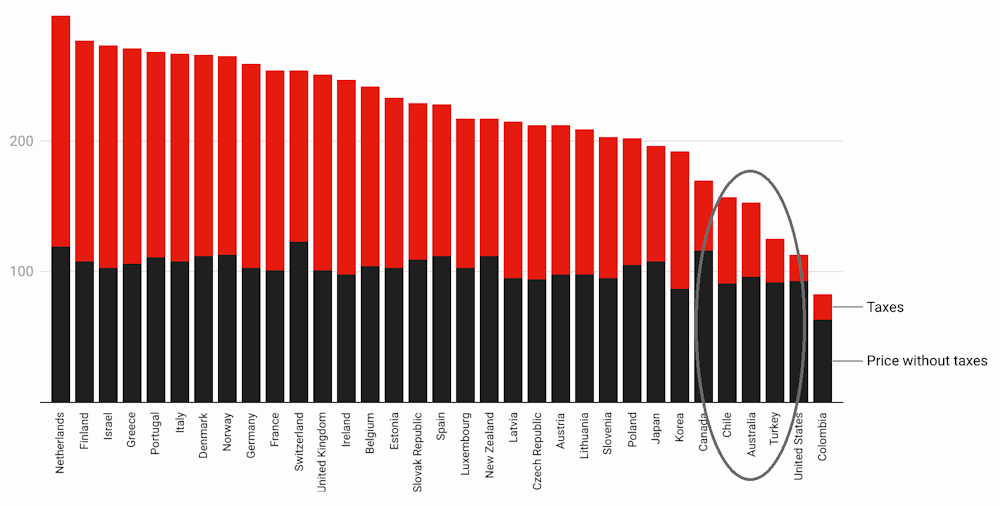
Australia taxes petrol lightly

Eagle-eyed readers will have noticed that even with the cut, New Zealand petrol prices will still be way above Australia’s. That’s because, like most developed nations, New Zealand charges more in tax for using roads than does Australia.

Until the cut on Tuesday, New Zealand petrol excise was a touch over NZ$0.77 per litre (A$0.72) compared to around A$0.43 in Australia.


Low by international standards

Retail unleaded price (Australian cents per litre) Department of Industry, Science, Energy and Resources

The goods and services tax charged on top of that in both nations brings the NZ excise to about NZ$0.89 per litre (A$0.83) compared to Australia’s A$0.48.

If these figures sound low, it’s because the price of petrol has soared. One of the peculiarities of taxes that are set in cents per litre (climbing only with inflation) is that when the petrol price jumps, the tax as a proportion of the total price shrinks.

A year ago fuel excises accounted for 40% of the cost of New Zealand petrol, and 35% of the cost of Australian petrol. At 28% and 22%, they’ve become self-cutting.

If we abolished fuel excise altogether, cutting the Australian unleaded price 22%, we would only bring the price back to where it was five weeks ago.

And then (as I imagine will happen in New Zealand after three months) the government would find it hard to reintroduce it.

It is finding it difficult to end the $1,080 low and middle earner tax break that was meant to finish two years ago.

The mess it has got itself in to both by hinting that it will cut the excise and by not ending the A$7.8 billion per year low and middle earner offset hints at a way out.

The offset is poorly designed. It is paid out as a tax refund after the end of each financial year, making it the opposite of the “stimulus measure” Treasurer Josh Frydenberg said it was when he last extended it. If he extends it again for the coming financial year, it won’t get paid out until the second half of 2023.

The petrol component of the fuel excise brings in A$5.8 billion per year. The government might be able to hang on to that and use the A$7.8 billion that would have been spent on the offset to support people now when they need it and when petrol prices are high, rather than a year into the future when they might not be.

The A$7.8 billion would be directed to Australia’s lowest earners, the ones who are being hit hardest by the horrendous petrol prices. Low earners (the bottom 40%) on average spend more than 3% of their income on petrol. High earners spend less than 2%.

Support shouldn’t be tied to petrol use

The support to low earners should be delivered in cash rather than as a subsidy to petrol prices. Recipients would be able to spend it on petrol should they need to, but would be able to spend it on other things.

If it was delivered as a petrol subsidy it would go disproportionately to the highest earning households for whom high petrol prices are a mere annoyance. High-income households spend more on petrol in absolute terms (on average 50% more) than low-income households.

If it is delivered as cash rather than a petrol subsidy it won’t blunt the push that high prices give for people will switch to more efficient cars and use petrol less by doing things such as working more from home.

It’s hard to find a case for a cut in Australia’s petrol tax, but it is easy to create a mechanism to help the people high prices are hurting. The budget is due in a fortnight.

Peter Martin, Visiting Fellow, Crawford School of Public Policy, Australian National University

This article is republished from The Conversation under a Creative Commons license. Read the original article.
Read more >>

Wednesday, July 21, 2021

When COVID is behind us, we're going to have to pay more tax

The biggest unstated message from the intergenerational report released during the lull between lockdowns is that we will need more tax.

Not now. At the moment it’s a matter of throwing everything we’ve got at getting on top of the COVID outbreaks and worrying about how to (and the extent to which we will need to) pay for it later.

But when the economy is healthy again, taxes are going to have to rise, big time.

That the intergenerational report doesn’t say so explicitly might be because the government is sticking with its arbitrary and implausible guarantee that tax collections will never climb above 23.9% of GDP, which is the average between the introduction of the goods and services tax and the global financial crisis.

Or it might be because what’s needed sits oddly with legislated high-end tax cuts likely to cost $17 billion per year from 2024-25.

Among the drivers of increased government spending identified by the report is spending on health, at present 4.6% of gross domestic product, and on the report’s projections set to climb to 6.2% over the next 40 years.

We’ll want better health

To fund that alone the government will need to collect 6% more tax in 2061 than had spending on health stayed where it was as a proportion of GDP.

Perhaps surprisingly, most of the extra spending on health won’t be a direct result of the population ageing. It’ll be because health technologies are getting better and becoming much, much more expensive (à la the COVID vaccines). And because incomes are rising.

Rising incomes, the report explains, are the largest driver of government spending on health internationally.

That’s because for some things, including the provision of hospitals, private spending can’t cut it, no matter how well off you are.

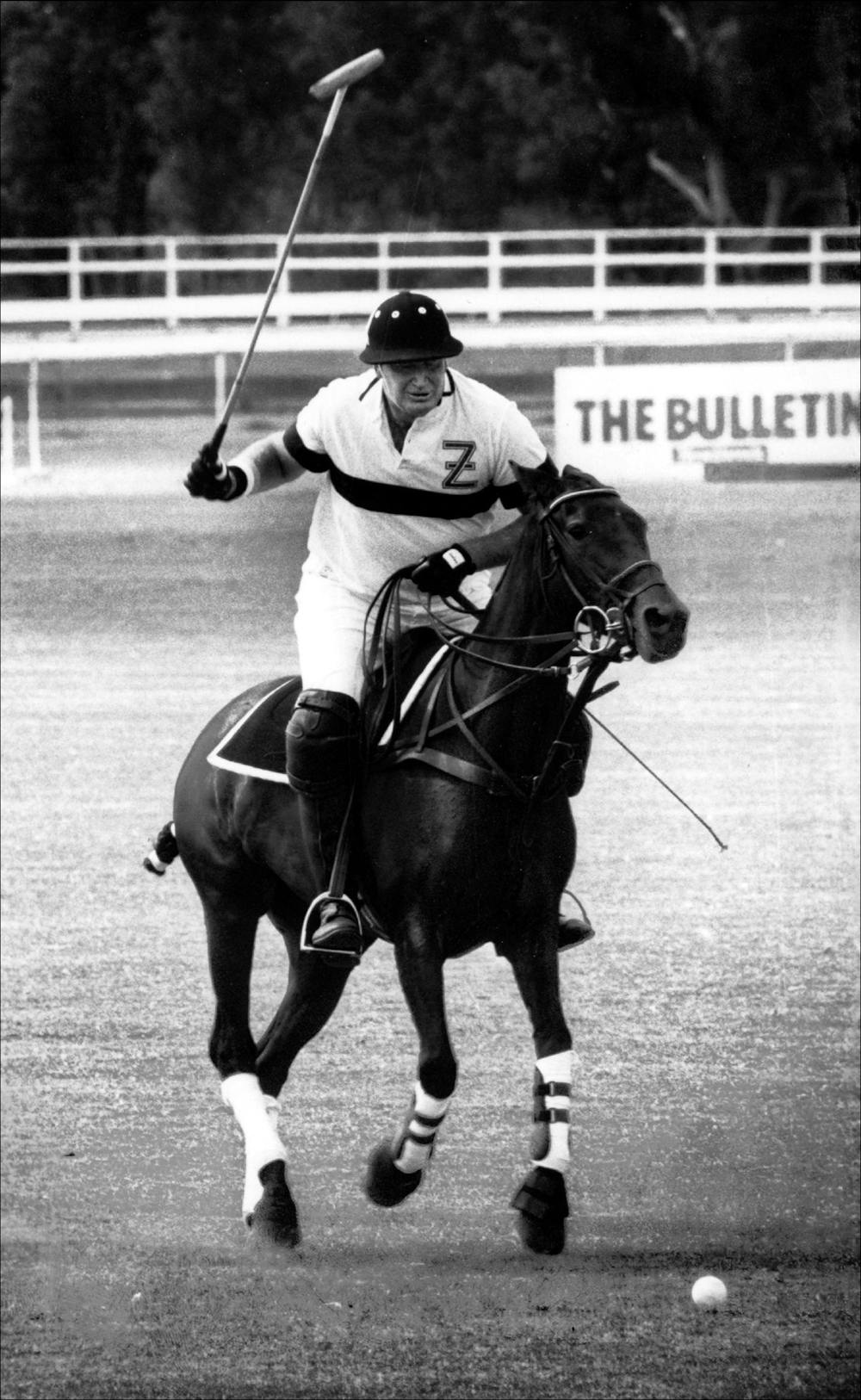
After billionaire Kerry Packer suffered a massive heart attack while playing polo in 1990, he was rushed to Sydney’s Liverpool Hospital.

When the ANU election survey began in 1990, 54% of Australians surveyed regarded health as “extremely important” in determining their vote. It’s now 70%. In 1990 11% regarded health as “not very important”. It’s now just 2%.

The intergenerational report has spending on aged care climbing from 1.2% to 2.1% of GDP, which by itself means the tax take will have to be 4% higher than otherwise, but it was prepared ahead of the government’s final response to the aged care royal commission.

The interim response had 14 (mostly expensive) recommendations subject to “further consideration”.

The National Disability Insurance Scheme already accounts for one in 20 tax dollars collected and is set to overtake Medicare.

The report says the government’s response to the royal commission into disability care presently underway is likely to place “additional pressure” on costs.

We’ll need to spend more than projected

None of this extra spending is bad if it delivers value for money, and it’s what the public wants. But it is hard to reconcile with official projections in the report showing government spending climbing only 2.5% per year in real terms over the next 40 years, compared to 3.4% per year in the past 40.


Read more: Intergenerational report to show Australia older, smaller, in debt


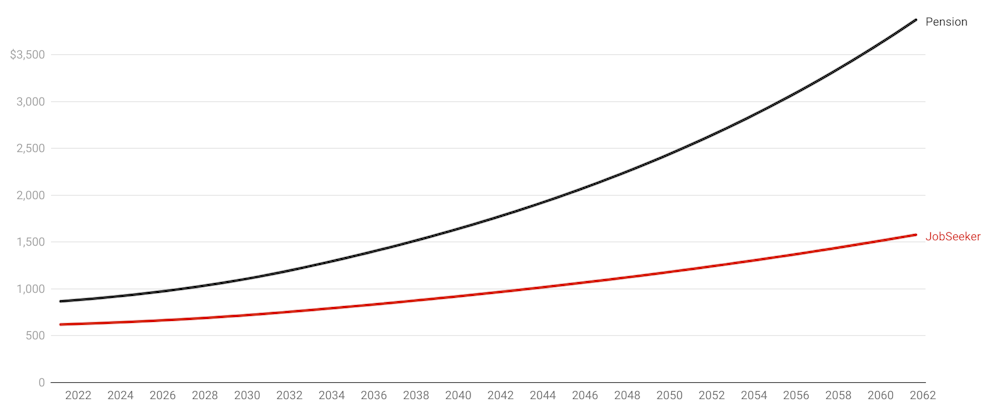
The report gets there in part by an outrageous sleight of hand. It says JobSeeker and other payments will become tiny as a proportion of GDP because they will only climb with inflation (which is typically low) rather than wage growth or GDP growth (which is typically higher, and lines up with how the pension grows).

A moment’s reflection would show that if that actually happened for 40 years — which is what the treasury’s report assumes — JobSeeker would fall from 70% of the single age pension to a hard-to-justify 40%.


JobSeeker and age pension as projected in intergenerational report

Payment for a single, dollars per fortnight. JobSeeker indexed to IGR inflation projections, pension indexed to IGR wage projections.

We know it won’t happen because it hasn’t happened.

JobSeeker was boosted this year after only 20 years rather than 40 in order to make sure that sort of thing wouldn’t happen.

And we know there’s nothing to stop an intergenerational report using more realistic assumptions.

The 2015 report, released at a time when the Abbott government planned to adjust the pension in line with the more miserly JobSeeker formula, relaxed the assumption after 13 years because if it left it in place the pension would slide untenably below community expectations.

We’ll easily be able to afford more tax

There’s nothing wrong with paying more tax if it’s for things we want, like better health care, better aged care, better disability care and benefits we can live on.

The intergenerational report has government spending climbing by four percentage points of GDP between now and 2061. But it also has real GDP per person almost doubling, climbing 80%.

Even if that’s an overestimate and GDP per person grows by, say, 50%, and the need for tax grows by more than four points, we’ll easily be able to afford the extra tax, and we’ll want what that tax will buy. Expectations climb with income.

The present government will be long gone by the time the tax to GDP ratio reaches its “cap” of 23.9% of GDP (which the report expects in 2035).

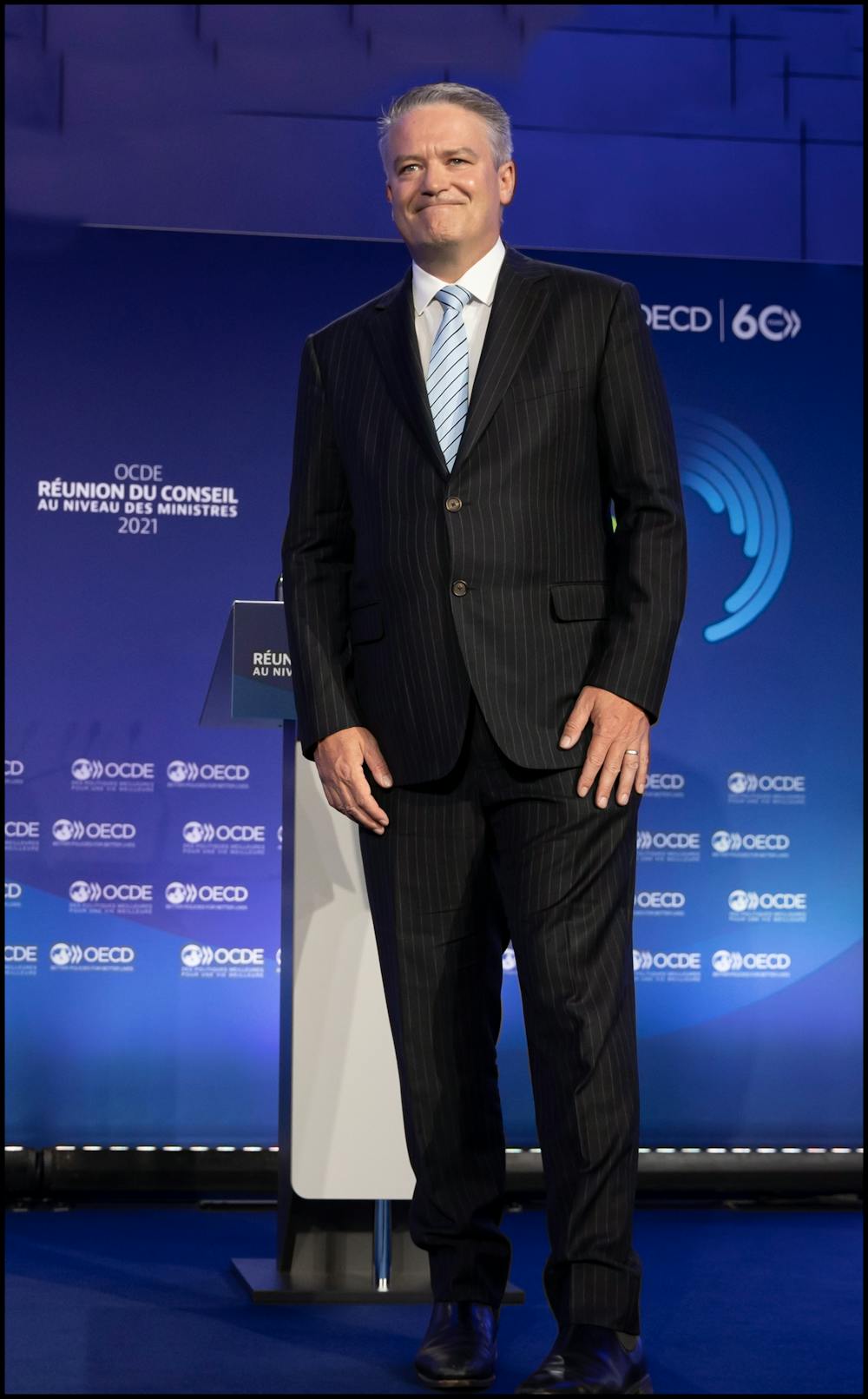
The finance minister who came up with the cap, Mathias Cormann, is now head of the Organisation for Economic Co-operation and Development, in which the average tax take is 34% of GDP.

An obvious place to look for the tax is high-income senior citizens, at present enjoying tax-free super, refundable franking credits and special tax offsets.

Grattan Institute calculations suggest an older household earning $100,000 pays less than half the tax of a working-age household on the same amount.

Like the households of less well-off seniors, those households are highly likely to use the services tax provides.

To say we’ll need more tax is not to say the government needs to fund all of its spending with tax.

It is projecting budget deficits for the next 40 years. Budgets have been in deficit for all but a few of the past 100 years.

But it will need to cover much of it with tax to keep the economy in check. If we want what tax provides, we’ll be prepared to pay it.

Peter Martin, Visiting Fellow, Crawford School of Public Policy, Australian National University

This article is republished from The Conversation under a Creative Commons license. Read the original article.
Read more >>

Wednesday, June 09, 2021

Other Australians earn nothing like what you think. If you're on $59,538, you're typical

I’m guessing you earn less than A$200,000.

And I’m guessing you think you’re missing out. People keep telling you so.

On one side of politics Labor leader Anthony Albanese says anyone earning $200,000 dollars a year “can’t be described as being in the top end of town”.

On the other, Prime Minister Scott Morrison parries with interviewers when asked whether people on $180,000 to $200,000 (the biggest beneficiaries of his planned 2024 Stage 3 tax cut) are “high income”.

“They’re hardworking people working out on mines and difficult parts of the country,” he says. “They deserve a tax cut.”

Hardworking or not, Australians on more than $200,000 are rare. And an awful lot of them don’t work at all.

$200,000 is unusual

I’ve never quite understood why politicians are so keen to tell us such incomes are normal. It might be because they are on them. Each backbencher gets $211,250 plus a $32,000 electorate allowance (boosted by $19,500 if they turn down the use of a private-plated vehicle) plus home internet and travel allowances.

Very detailed tax office figures (updated on Monday) tell us what the rest of us earn, all 14.3 million of us.

Only 2% of those required to pay tax earned more than $211,365. Only 3% earned more than $188,667.

Everyone else — the other 97% — earned less than $188,667, most of them a good deal less, and many more earned even less and weren’t required to pay tax.

The typical taxable income (typical in the sense that half earned more than it, half less) was $59,538. If that’s what you’re on, you’re more likely to find people who earn close to what you do than anyone who earns more or less.

We can get an idea of how lonely it is at the top by examining the top 1%, those Australians with a taxable income of greater than $350,134.

There aren’t many of them, just 110,613 — 82,258 men and 28,355 women.

Only 39,209 have taxable incomes of more than $500,000, and of these only 14,467 have taxable incomes of more than $1 million.

Life at the top needn’t be taxed

You’re probably thinking there’s a difference between taxable incomes and actual incomes, and the tax office figures show you’re right.

15,358 Australians reported total incomes of more than $1 million. By the time they had applied legitimate tax deductions, the number had shrunk to 14,467.

Some of these million-dollar earners were able to shrink their taxable incomes very low indeed. 45 cut their taxable incomes to less than the tax-free threshold of $18,200 — meaning they didn’t have to pay anything, not even the Medicare levy.

Another eight managed to escape the Medicare levy even though their taxable incomes were above $18,200, and another 21 escaped income tax while paying the Medicare levy.


Read more: Yes, some millionaires pay no tax, but crimping deductions mightn't help


Many of these millionaires weren’t “hardworking” in the sense Morrison meant. Only 9,144 of the 14,467 Australians on taxable incomes of more than $1 million worked. Only 17,883 of the 57,120 Australians on more than $250,000 worked.

Only nine of the 45 million-dollar earners who cut their taxable incomes to less than the tax-free threshold worked. 27 received so-called franked dividends from companies that had paid tax, enabling them to cut their own tax bills or receive rebates from the tax office. On average, each received dividends of $2.25 million.

Many who aren’t taxed are generous

Seventeen of the 45 million-dollar earners received capital gains, on average $6.4 million each. 38 received interest, averaging $290,000 each.

Against that were set expenses, small and large. Three claimed for work-related car expenses averaging $27,340 each, 13 claimed expenses averaging $57,200 for assistance with tax affairs, eight claimed for previous losses from farms averaging $684,000 each, and eight for losses from other businesses averaging $408,000.

But by far their biggest expense was donations. 14 gave away a total of $161 million in gifts or tax-deductible donations — an extraordinary average of $11.5 million each.

Most of us aren’t like these people.

Most of us claim more modest deductions

Three-quarters of Australians in the tax system earn less than $89,173.

Those on that income typically claim between $1,500 and $1,900 in deductions (men claim more than women) and, thanks to negative gearing, claim losses on properties of between $1,800 and $2,600 (again, men claim more than women).

Such Australians typically report between $1,200 and $2,100 in capital gains (more for women than for men).

If higher-earning Australians are unaware of how most of us live, it’s understandable. Surgeons mix with other surgeons. On average each of Australia’s 4150 surgeons earns $394,303, making surgery our highest-paying occupation.

We mix with, and marry, people like us

And they increasingly marry each other. In 2010 the Productivity Commission found that 68% of Australia’s high earners were married to other high earners. A decade earlier it was 49%.

And high earners live near each other. The average income in Sydney’s Double Bay (Australia’s highest-earning suburb) is $202,598. The average income in Ruse in Sydney’s Campbelltown is $55,100.

People in Double Bay don’t drive through Ruse on their way to the city.


Read more: The Low and Middle Income Tax Offset has been extended yet again. It delivers help neither when nor where it's needed


In the United States it is often the other way around. There, low-income suburbs are more likely to be near the city, meaning that high-income Americans at least see them as they go in to town.

That most of us have little idea of what others earn suits those in charge when they propose tax cuts skewed to high earners.

They can con us that most of us will be better off, and those on high incomes can con themselves they are not already better off.

Peter Martin, Visiting Fellow, Crawford School of Public Policy, Australian National University

This article is republished from The Conversation under a Creative Commons license. Read the original article.
Read more >>

Monday, September 28, 2020

Top economists back boosts to JobSeeker and social housing over tax cuts in pre-budget poll

Overwhelmingly, Australia’s leading economists want the budget to boost social housing and the JobSeeker unemployment benefit rather than bring forward personal income tax cuts.

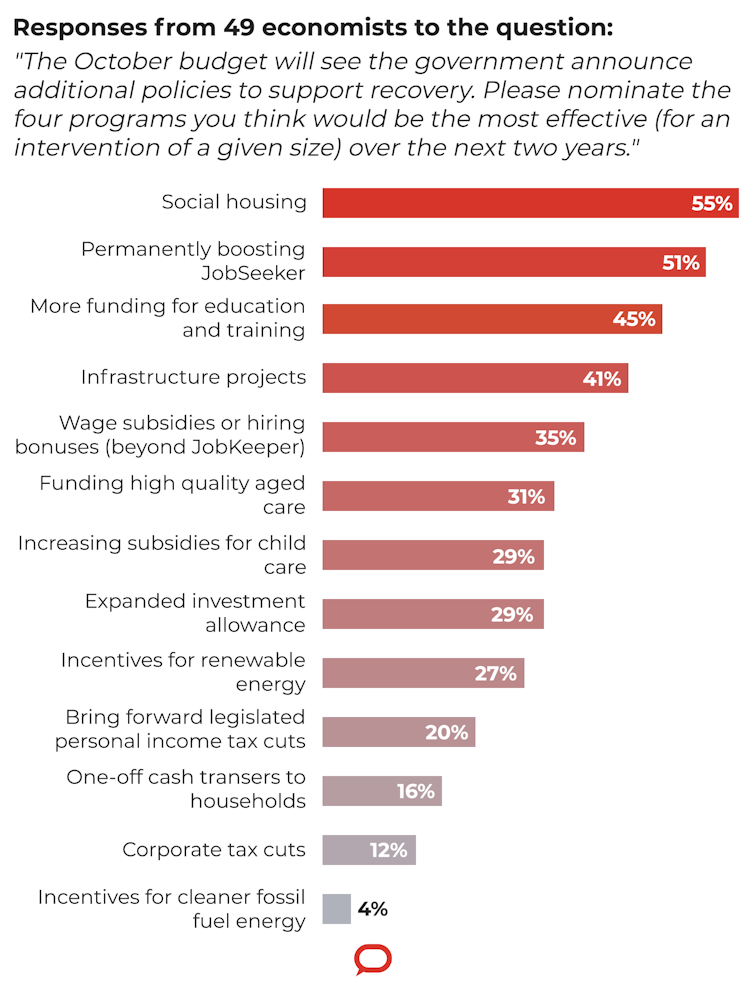
The 49 eminent economists who responded to Conversation-Economic Society of Australia pre-budget survey were asked to rate 13 options in terms of “bang for the buck” – effectiveness in boosting the economy over the next two years.

Among the options offered were boosting JobSeeker (previously called Newstart), wage subsidies beyond the expiry of JobKeeper, one-off cash payments to households, big infrastructure spending, bringing forward the personal income tax cuts, and company tax cuts.

The options were selected by a committee of the central council of the Economics Society and were presented to each surveyed economist in a random (shuffled) order.

The economists surveyed are Australia’s leaders in the fields of microeconomics, macroeconomics, economic modelling and public policy. Among them are former and current government advisers, former heads of statutory authorities, and a former member of the Reserve Bank board.

Each was asked to nominate the four most effective options for boosting the economy.


Economic Society of Australia/The Conversation, CC BY-ND

The most popular option, endorsed by 55% of those surveyed, was boosting spending on social housing.

Monash University econometrician Lisa Cameron said the budget provided an unusual opportunity to fix things for the long term while boosting the economy.

Social housing would leave us with something worthwhile (as did the school hall building program during the global financial crisis) in addition to providing work for the building industry. Alleviating homelessness would be a lasting benefit.

If it goes to the unemployed, it will be spent

The second most popular option, endorsed by 51%, was permanently boosting JobSeeker, previously known Newstart. The temporary boost in the A$282.85 per week payment was wound back last week and will end in December.

Melbourne University economist John Freebairn pointed out that with no real increase in Newstart since 1993 and many on it in demonstrable poverty, every extra cent spent on it will be spent rather than saved.

Supported by fewer than half of those surveyed, but third most popular at 45%, was more funding for education and training.


Read more: Should the government keep running up debt to get us out of the crisis? Overwhelmingly, economists say yes


Flinders University labour market specialist Sue Richardson said education was labour-intensive, which would help with employment, and would assist young people severely hit by the pandemic to get the skills they would need to get jobs rather than stay unemployed.

Matthew Butlin, who heads the South Australian Productivity Commission, said the decimation of income from student fees means universities will have less money to subsidise research. There was a case for more direct funding of university research in the form of competitive grants for projects with practical applications.

The fourth most popular option was infrastructure spending, supported by 41%.

Why not a Hoover Dam, a new Opera House?

Many made the point that the projects chosen would have to be worthwhile in their own right, and feared this might not be the case. Others looked to big “nation building” projects along the lines of the Hoover Dam in the United States which was built during the Great Depression and employed 21,000 people.

“Why not building a massive dam in Australia? Why not building a new Sydney Symphony Orchestra building like the Berlin Philharmonie? Why not expand the National Parks? Why not building green libraries all over Australia?,” asked Sydney University’s Stefanie Schurer.


Read more: Homelessness and overcrowding expose us all to coronavirus. Here's what we can do to stop the spread


Done right, like the Sydney Harbour Bridge which was completed during the Great Depression, big imaginative projects could leave us with something valuable.

There was less enthusiasm for continued wage subsidies (35%) and an expanded investment allowance (29%) with University of NSW economist Gigi Foster saying investment allowances could be replaced with income-contingent loans along the lines of the Higher Education Contributions Scheme.

That way businesses could borrow to invest, with an obligation to repay if the investment paid off.

If it goes on tax cuts, it might not be spent

The same approach was taken by some to funding higher quality aged care (supported by 31%) and increasing subsidies for child care (29%).

Economic modeller Warwick McKibbin suggested funding child care through income-contingent loans (repayable on the basis of income) rather than subsidies.

Bringing forward the leglislated personal income tax cuts as proposed by the government and cash payments to households were relatively unpopular, supported by 20% and 16%.

Saul Eslake said that while he agreed with the treasurer that early tax cuts would “put money in people’s pockets”, there was no guarantee the high earners “into whose pockets most of that money would be put”, would take it out and spend it in sufficient quantity.


Read more: Frydenberg is setting his budget ambition dangerously low


Eslake suggested that rather than supporting households with cheques as happened during the financial crisis, households could be handed time-limited tradeable vouchers that could be spent in areas hurt by restrictions, such tourism and the arts, or used for other worthwhile purposes such as childcare or reskilling.

Among those who did support bringing forward the tax cuts was John Freebairn, who said that although presented as cuts, what was proposed would do little more than restore what had been lost to bracket creep, keeping income tax steady.

Company tax cuts an also-ran

Company tax cuts, once touted by former prime minister Malcolm Turnbull as the key to jobs and qrowth garnered minimal support, being backed by just six of the 49 economists surveyed.

The least popular option, backed by only two economists surveyed, was government support for cleaner fossil fuels such as natural gas, as the prime minister is promising. In contrast 13 (26%) backed support for renewable energy.


Individual responses

The Conversation

Peter Martin, Visiting Fellow, Crawford School of Public Policy, Australian National University

This article is republished from The Conversation under a Creative Commons license. Read the original article.

Read more >>

Monday, April 29, 2019

Election tip: 23.9% is a meaningless figure, ignore the tax-to-GDP ratio

Expect to hear a lot about tax during the coming leaders’ debates.

Which is why it’s important to get two things straight.

The first is that you can’t argue against a tax by pointing out that it will take money from people.

By all means, use that as an argument against taxes in general. It’s true – taxes take money from people. But to oppose better taxing capital gains or tightening up on dividend imputation refunds because they will take money from people is to leave unexplored the more important question of whether those particular tax measures are better or worse than the alternatives.

You can’t escape that question by just saying that all taxes are bad – that we ought to collect less. For any amount of tax collected, the next most important question is the way in which it is collected.

Low tax and high spending can be the same thing

And the second thing we ought to get straight is that talk about one side of politics being “low tax” and the other being “high tax” tells us next to nothing.

To see this, consider Bill Shorten’s childcare policy announced on Sunday. Labor has promised to spend A$1 billion a year in subsidies to cut the cost of childcare for every family with a combined income of up to $175,000 and to make it free for working families earning up to $69,000.

But what if, instead of subsidies, it had promised to deliver the $1 billion via tax rebates, to be paid to parents on proof of their use of childcare?

The effect would be same, although the method of payment would be more complicated.

Childcare would be just as supported, and just as supported from the public purse, but one policy would be called “big spending”, while the other would be called “low tax”.

Take the quiz

Here’s a quiz: is the Private Health Insurance Rebate a tax break (and counted in the budget as a contribution toward lower taxes and smaller government) or is it a spending measure (and counted in the budget as boosting the size of government)?

What about the Family Tax Benefit? Or the film industry tax rebate or the seniors And Pensioners Tax Offset or the Low Income Tax Offset or the existing Child Care Rebate?

It’s okay. You’re not expected to know. The answer varies from case to case. The point is that it is silly to claim that tax cuts are good, and government spending is bad, when in many cases each could be easily classified as the other.

The signature measure in the April budget is a case in point. It’s a tax offset of up to $1,080 per person to be paid out with tax returns after July 1. It’ll push billions into the economy, just as the Rudd government’s cash bonuses during the global financial crisis did. But Rudd’s payments were categorised as spending; these payments will be categorised as tax cuts, which means they will keep down the tax-to-GDP ratio.

Which means it is silly to talk about the tax-to-GDP ratio, as the government insists on doing.

That speed limit, where did it come from?

Labor was keen enough to do it while it was in office, boasting in its final budget in 2013 that its tax-to-GDP ratio was lower than in the Howard years, and lower than it had been before the global financial crisis, as if that was an achievement to be proud of. It wasn’t. The ratio was lower than during the mining booms because fewer tax dollars were rolling in, and it was lower than before the financial crisis because the economy was weaker.

The Coalition has hardened the tax-to-GDP ratio into a target. As treasurer, Scott Morrison spoke last year of “a speed limit on taxes in our budgets, that requires that taxes do not grow beyond 23.9% of our economy”.

Why 23.9%? Well, in the Coalition’s first budgets it wasn’t a target at all, merely an operating assumption used by the treasury for long-term forecasting. As it explained in the 2017 budget papers:

A tax-to-GDP “cap” assumption is adopted for technical purposes and does not represent a government policy or target. It is based on the average tax-to-GDP ratio over the period from the introduction of the GST and to just prior to the global financial crisis.

Treasurer Josh Frydenberg and Finance Minister Mathias Cormann have begun talking about 23.9% as if it’s a commitment, a pledge, even though it would be hard to keep if the economy picked up (and probably unwise to keep), and even though it is fairly meaningless given the ease with which changes in spending can be classified as changes in tax and the other way around.

Treasury makes pretty clear what it thinks about the measure in the back of Budget Paper 1. That’s where it sets out the history of the important budget measures and its forecasts for the future. You won’t find the tax-to-GDP ratio in the first two tables. Instead, it details “revenue to GDP”, which is a much more relevant measure because it includes income from all sources – fees as well as taxes, and income from Future Fund earnings which are revenue too.

Think like treasury

Early in his time as time as shadow treasurer, Labor’s Chris Bowen bought into tax-to-GDP debate, challenging the Coalition to keep the ratio below such and such per cent. He isn’t doing so now.

It’d be wise to ignore talk of the tax-to-GDP ratio in the coming leaders’ debates

Focus instead on what they’re planning to do and how they are planning to pay for it. You’ll get a handle on how to vote.


Read more: It’s the budget cash splash that reaches back in time The Conversation


Peter Martin, Visiting Fellow, Crawford School of Public Policy, Australian National University

This article is republished from The Conversation under a Creative Commons license.

Read the original article.

Read more >>

Friday, April 05, 2019

What just happened to our tax? Here's an explanation you'll understand

With all the announcements on tax over the past few days it’s hard to keep track. So here goes.

A year ago the then treasurer Scott Morrison unveiled a “seven year personal tax plan.”

Some of it involved tax cuts way out into the future, in 2022 and 2024, with which we needn’t concern ourselves – there’ll be two, maybe more, elections before then.

The bit that was to start in mid 2018 (and did) wasn’t a tax cut at all, strictly speaking. It was an “offset” with an ungainly name: LMITO – the Low and Middle Income Tax Offset.

A standard tax cut, applying to any rate, would save money to all taxpayers on that rate and rates above it, including those on very high incomes. It couldn’t be directed to just low and middle earners, which is what the Coalition wanted.

What’s on offer isn’t really a tax cut

So the Coalition designed an offset, to be paid as a lump sum after the end of each tax year, after returns had been submitted and only to those taxpayers whose returns showed they weren’t high earners.

The full offset was A$530 per year, paid only to taxpayers who earned between $48,000 and $90,000. Taxpayers who earned more than $90,000 would lose 1.5 cents of it for each dollar they earned above $90,000, meaning no-one who earned more than $125,333 would get any of it.

(Taxpayers earning more than $125,333 wouldn’t go home completely empty handed - they would benefit from an increase in the point at which the the second highest rate came in, worth a barely consequential $135 a year.)


Read more: It’s the budget cash splash that reaches back in time


Taxpayers who earned less than $37,000 would get $200 off their tax, climbing to $530 for taxpayers earning $48,000.

It was ungainly – it was better described as a series of annual lump sum payments than a tax cut – and Labor embraced it entirely.

In 2018 Labor trumped it

Except that Labor supercharged it. Under Labor it was to operate in exactly the same way, except that each payment would be 75% bigger: the Coalition’s $200 became Labor’s $350, the Coalition’s $538 became Labor’s $928 and so on.

Labor outbid the Coalition.

And these things stayed, for almost a year, except that it was all a bit academic.

Labor wasn’t in government, and the leglislated offsets weren’t to put the lump sums in pockets until after the end of June 2019.

In 2019 the Coalition trumped Labor

It allowed the Coalition to sneak in before them in Tuesday’s budget and double the maximum lump sum: $538 became $1,080, a promise Bill Shorten matched in his budget reply speech on Thursday night.

But for some reason the Coalition didn’t double everything: $200 only became $255, rather than the $350 Labor had already promised.

On Thursday night Shorten confirmed the $350 promise.

He is able to offer the 3.6 million Australians earning less than $48,000 more than the Coalition – in most cases an extra $95 more: $350 instead of $255.

Now Labor has trumped the Coalition

Shorten says it’ll cost an extra $1 billion over four years, which is a mere fraction of the money Labor believes it will have that the Coalition won’t, because of its crackdowns on negative gearing, capital gains tax concessions and dividend imputation.

As Shorten put it on Thursday night:

Labor will provide a bigger tax cut than the Liberals for 3.6 million Australians all-told, an extra $1 billion for low income earners in this country. Here’s the simple truth - 6.4 million working people will pay the same amount of income tax under Labor as the Liberals. Another 3.6 million will pay less tax under Labor.

In fact they’ll pay just as much tax from payday to payday, but they’ll get back more at the end of the year, in most cases $95 more.

So here’s the scorecard: The Conversation

Peter Martin, Visiting Fellow, Crawford School of Public Policy, Australian National University

This article is republished from The Conversation under a Creative Commons license.

Read the original article.

Read more >>

Tuesday, April 02, 2019

It’s the budget cash splash that reaches back in time

Talk about retrospective. In his determination to quickly inject money into the economy (for economic as well as political reasons), Treasurer Josh Frydenberg has reached back in time to give us an extra tax cut on income already earned during the financial year that’s about to finish.

Almost a year ago, in May 2018, Frydenberg’s predecessor, Scott Morrison, promised a “sort-of” tax cut for the financial year beginning in July 2018. People earning between A$48,000 and A$90,000 would get a tax offset – a bonus – of $530 as part of their tax return.

People earning more, or less, would get lesser amounts but would still get something, right up to a cutoff of $125,333.

The arrangement meant they wouldn’t get the money until the following financial year, the one beginning this July, after they submitted their tax forms.

Labor trumped him within days, announcing a bigger offset in its budget reply speech.

Not only bigger, but backdated

Now Frydenberg has trumped Labor and Morrison, announcing a rebate of almost twice the original size — $1,080 — to be paid out after the end of the financial year.

But, in an innovative piece of policy, he is applying the increased offset to the financial year that’s almost over, as well as the ones to come. It means that after submitting their tax forms for the financial year that’s about to end, most Australians will get $1,080 back for the work they did during 2018-19, instead of the $530 that was promised at the time (assuming the measure is enacted).

It will work the same way as the Rudd government’s “cash splash” during the global financial crisis. It’ll be paid into bank accounts within weeks, providing near-instant, much-needed spending power.

The fact that it will be bigger than the first Rudd government cash splash (which was $800 for qualifying taxpayers) is probably no bad thing.

It’s what we need, unfortunately

Consumer spending is much weaker than was expected in the December budget update just five months ago, and a lot weaker than was expected in Morrison’s last budget as treasurer a year ago.

Morrison expected consumer spending to climb 2.75% for 2018-19. Frydenberg cut that forecast to 2.5% in December and to 2.25% today.

Morrison expected consumer spending to climb 3% in 2019-20, and Frydenberg held the line in December. Now he has marked down the 2019-20 forecast to 2.75%. He has also marked down (yet again) the forecasts for wage growth and economic growth.


Home prices, not explicitly forecast in the budget, are also lower than was expected in the last budget and budget update. Along with lower-than-expected wage growth, this is depressing consumer spending.

The markdowns in spending, wage growth and economic growth have started to hurt revenue forecasts, but the damage isn’t yet apparent because at the same time dramatically higher iron ore prices have been pouring more money into the budget than was expected.

When iron ore prices fall, we’ll be exposed

When, for whatever reason, the higher iron ore prices recede (and that’s what the Treasury says it is expecting), the budget will look much worse. Unless consumer spending and wages pick up, which is also what the Treasury says it is expecting, in the face of evidence to the contrary.

That’s what makes Frydenberg’s cash splash so important. It will push an extra $3.5 billion into the economy within weeks. On top of it will be an extended instant asset write-off for small and medium-sized businesses, the operative word being “instant”.

From now on, businesses with a turnover of up to $50 million (up from $10 million) will be able to buy equipment worth up to $30,000 (previously $25,000) and deduct the full cost from the tax they will owe from July.


Read more: Iron ore dollars repurposed to keep the economy afloat in Budget 2019


The measure won’t cost the government money until next financial year, but it will inject money into the economy from Wednesday in the 14 weeks before that financial year starts, as as many as 22,000 previously ineligible businesses spend up to $30,000 on equipment (even cars) and then spend it again and again without limit.

A peculiarity of the instant asset write-off is that businesses can spend as much as they like and get it all back, as long as it is broken up into parcels of less than $30,000. In an example quoted in the budget papers, a previously ineligible food manufacturing business buys ten new commercial ovens, each for $12,000. The entire $120,000 can be written off within weeks, helping the business “invest, grow, and employ more workers”.


Frydenberg would probably prefer it if the measures weren’t called “stimulus” measures, but that’s what they are. And they are needed, for economic reasons as well as for political ones.

The economists surveyed in January for this year’s Conversation economic survey assigned a 25% probability to a recession within the next two years. The downward revisions in the budget have done nothing to change that assessment.

The government elected in May will inherit a fragile economy in need of help.

Frydenberg has demonstrated that he is just as prepared as was Kevin Rudd during the global financial crisis to provide it.The Conversation


Peter Martin, Visiting Fellow, Crawford School of Public Policy, Australian National University

This article is republished from The Conversation under a Creative Commons license. Read the original article.
Read more >>

Monday, June 18, 2018

Work to barely pay for returning mothers, inquiry told

The third and final stage of the government's proposed income tax cuts would overwhelmingly benefit men, late evidence presented to the Senate inquiry shows.

The inquiry will report on Monday that calculations prepared by the Parliamentary Budget Office show 1.894 million men would benefit from the final flattening of the tax scales and only 767,000 women.

The third stage lifts the threshold for the top rate from $120,000 to $200,000 and removes the 37 per cent rate, producing a flat marginal rate of 32.5 per cent between $41,001 to $200,000.

The PBO has previously told the inquiry the final stage would deliver $30.35 billion to men over four years and $11.25 billion to women.

It finds that the impact of the first two stages is much more even.

In a second piece of late evidence requested by the committee, Melbourne University tax expert Miranda Stewart reports that the effective marginal tax rate facing women considering returning to work after having children would remain as high as 95 per cent even after all three stages of the tax cuts and the changes to child care benefits due to begin on July 1.

Effective marginal rates include tax, the Medicare levy, lost family benefits and the cost of the childcare needed to return to work after government subsidies.

On July 1 the two existing childcare subsidies will be rolled into one providing a means tested subsidy of up to $11.77 per hour at an extra cost to the budget of $4 billion over four years.

Professor Stewart said at the moment the effective marginal tax rate for a second earner with two young children paying for childcare at that rate was 65 per cent when returning to work one day a week, 85 per cent on the second day, 95 per cent on the third day and 140 per cent and 160 per cent on days four and five, meaning those families lost income when mothers moved from working part time to full time.

"It was extraordinary that second earners went back to work full time at all," she said. "The reality has been that a proportion of women do go back to work, and the family is essentially bearing the net cost, unless they can use grandparents or friends for care or a cheaper option such as family day care.

The combination of the new childcare system and the first wave of the promised tax cuts would bring down the effective marginal rates to 45 per cent for day one, 65 per cent for day two, 90 per cent for day three, 95 per cent for day four and 90 per cent for day five.

"It means the returning mother will still only be able to keep $10 out of every $100 earned on day three, $5 on day four, and $10 out on day five," Professor Stewart said.

"It will certainly be worthwhile for a second earner, usually a mother, returning to work with young children to go back two days a week; however, for her to work three, four or five days a week would produce a negligible financial benefit."

A separate report to be released by the Australia Institute on Monday finds that since the tax changes that accompanied the introduction of the goods and services tax in 2000-01, most taxpayers have had all of so-called bracket creep returned in periodic tax cuts, whether bracket creep is calculated with reference to the consumer price index or the wage price index.

In real terms, high earners on $200,000 were up to $10,000 per year better off, low to middle earners on $40,000 up to $2000 better off, and middle earners on $70,000 only a few hundred dollars a year better off.

In The Age and Sydney Morning Herald
Read more >>

Thursday, June 14, 2018

Pink vs blue tax: the case for taxing women lightly

If women were to be taxed differently to men, it wouldn’t be the first time.

Treasurer Scott Morrison says the idea is absurd.

“You don’t fill out pink forms and blue forms on your tax return. It doesn’t look at what your gender is any more than it looks at whether you are left-handed or right-handed,” he said last week.

He even said, wrongly, that Labor has been suggesting it.

But such a move has happened before.

In Britain right up until 1971, wives weren’t usually taxed on their income; their husbands were. A wife’s income was deemed to be “stated and accounted for by her husband”. It wasn’t until 1950 that wives ceased to be classified for tax purposes as incapacitated along with “infants, lunatics, idiots and the insane”.

South Australia broke ranks early, in 1884, taxing married women as individuals and giving them the right to own property. By the time the Commonwealth introduced national income tax in 1915, all the states had fallen into line.

What possible modern-day reason could there be for taxing women differently to men, as mentioned by Melbourne University tax expert Miranda Stewart in evidence to the Senate last week?

Morrison himself provided a clue while ridiculing the idea. He said the Tax Act was designed “to treat people’s income the same, and so you pay tax according to what you earn”.

But we don’t. Someone who earns $1000 from wages pays twice as much as someone who earns $1000 by making a capital gain selling an asset. Income from capital gains is taxed more lightly in accordance with what’s known as optimal taxation theory. It suggests taxing heavily things that tax is unlikely to stop, such as work, and taxing more lightly things that tax is more likely to stop, such as the movement of capital. It’s the basis of the argument for a lower company tax rate as well as a lower capital gains tax rate.

The concession isn’t “fair”, but it’s efficient.

As would be the logical extension, which is to tax female wages more lightly than male wages. Male work turns out to barely react to after-tax pay. Most men will continue to work full-time regardless of what happens to what they take home, regardless of how much they grumble.

Some will work a bit less if their take-home pay falls, because they are offered less of a reward. Others will work a bit more in order to get back the income they lost. On balance the “price elasticity” of their labour is close to zero.

Women are different. Most European and American estimates put the price elasticity of their labour between 0.4 and 1, meaning a 10 per cent boost in their take-home pay will lift their hours of work by between 4 per cent and 10 per cent.

The most efficient way to tax labour would be to heavily tax generally unresponsive male work and more lightly tax generally highly responsive female work, depending on elasticities. Economists Alberto Alesina from Harvard University and Andrea Ichino from the University of Bologna in Italy believe women should be taxed at no more than 80 per cent of male rates in the US, at no more than 68 per cent in Italy and no more than 91 per cent in Norway.

And there’s another argument for discriminating on the basis of gender. It’s that, for most of us, gender is innate. We won’t change it. Tax theorists say that, ideally, we should be taxed on our underlying ability to earn an income rather than the income itself. Otherwise some of us with ability will avoid tax by avoiding earning an income. Although the ability to earn is hard to measure, markers for it are easy to measure, such as height.

In a half tongue-in-cheek paper entitled The Optimal Taxation of Height, Harvard economists Gregory Mankiw and Matthew Weinzierl note that someone who is 183 centimetres tall can expect to earn $US5500 ($7300) more per year than someone 165 centimetres tall. They say tall people should pay several thousands more in tax than short people on the same income. It’s a way of getting at their earning capacity, as would be a higher tax on the earnings of men.

And there’s yet another practical reason to tax women more lightly. The withdrawal of family benefits and the imposition of childcare costs as mothers return to work mean some face extraordinarily high “effective” marginal tax rates of up to 90 per cent. If ever there were people who ought to be affected by high tax rates, it’s returning mothers.

But here’s what’s odd. Australian mothers are hardy. When the Productivity Commission recommended a new, simpler and more generous formula for childcare support along the lines of the one introduced in this year’s budget, it found it would boost employment by just 15,000 full-time worker equivalents in a workforce at present growing by hundreds of thousands per year. More than mothers in the United States, Germany and Britain, Australian mothers seem undaunted by tax rates. The case for treating them gently is strong in theory, weak in practice.

In The Age and Sydney Morning Herald
Read more >>

Thursday, May 17, 2018

Here's my big dangerous tax idea: let us keep our money

Suddenly we’ve wised up. As far back as any of us can remember, all the way back to the beginning of income tax, we’ve been easy to bribe.

Here’s how it has worked in every election and in almost every budget: “You’ve been working hard and paying too much tax. We feel your pain. We’ve magically found some money from somewhere. We’re pulling a tax cut out of a hat. You can thank us later.”

That the rabbit was our own money, taken from us in ever-increasing amounts through an automatic process known as bracket creep, and then only partly returned, was the trick we weren’t invited to dwell on.

Here’s how it will work this time. In the year ahead wages will probably climb 2.1 per cent. It’ll push a greater proportion of our pay into the highest rate of tax we pay. All by itself that will push up the total amount of tax we pay by around $6 billion, even though our actual buying power, our inflation-adjusted wages, might not much change. The budget tax cuts will give us back some of it: around $4.4 billion.

Hey presto. We’re supposed to be awed.

Even after 10 years, after the third and most expensive phase of the Morrison tax cuts announced on budget night, middle earners will still find themselves paying 3 per cent more of their income in tax than they do right now: 18 per cent instead of 15 per cent, according to the Grattan Institute. Only the very highest earners - the top 10 per cent - will get their bracket creep back.

(We need to rely on organisations such as the Grattan Institute and the Parliamentary Budget Office for the calculations because the government won’t provide them for us. It wants us to be in awe of the trick without seeing how it's done.)

It helps that bracket creep isn’t widely understood, certainly not by shock jocks such as Sydney’s Ray Hadley (“it simply means that people who were formerly taxed at the lower income rate through no fault of their own go on to the next income rate”), Nor, on the face of it, by the Treasurer himself, who on Monday said that the third and final stage of his plan that levelled the tax rate between $41,001 and $200,000 meant that “for most Australians, who will earn over their lifetime somewhere between $40,000 and up to $200,000, they will never face bracket creep again”.

Bracket creep happens even if you don’t change brackets. Whenever your income climbs, a greater proportion of it ends up in your highest tax bracket, leaving a lower proportion of it in your lower brackets and beneath the tax-free threshold.

Imagine you had been earning $75,000 and inflation pushed up your wage to $77,000. Your buying power wouldn’t much improve and you wouldn’t change tax brackets, but your tax bill would climb from $15,922 to $16,572. The chunk of your salary lost in tax would climb from 21.2 per cent to 21.5 per cent. A lower proportion of it would be protected by the tax-free threshold.

It’d be easy to fix. You would index the tax-free threshold and each of the other thresholds to the general rate of wage increases, or to the general rate of inflation, both of which at the moment are near 2.1 per cent. So the $18,200 tax-free threshold would climb to $18,582 and then to $18,972 and so on.

It would be devastating for the budget and devastating for politicians. Without automatic tax increases they would no longer be able to announce regular 'tax cuts' that only partly returned our money in return for applause.

But the applause has stopped. This week’s Fairfax-Ipsos poll found that 57 per cent of voters didn’t want the cuts they were offered. They would have rather had the money used paying off government debt. Only 37 per cent wanted the tax cuts, and many of them would have regarded them as unsurprising. It’s probably Peter Costello’s fault. By repeatedly cutting tax rates under prime minister John Howard, he destroyed the magic.

Indexation would make the magic real. And it would make budget choices real.

At the moment we grant the government leeway for indulgences such as spending $50 million commemorating the voyage of Captain Cook, or $247 million keeping chaplains in schools. If those indulgences meant an explicit increase in tax rates we would indulge our politicians less.

As it stands, most of the promised $80 billion cut in the company tax rate is to be funded by bracket creep. If indexation removed that option it would have to be funded by an explicit increase in income tax or another tax, and we would be less accommodating.

On the other hand, we would become keener to accept tax increases where they were the only way of getting things we wanted, such as they were with the National Disability Insurance Scheme. Without bracket creep, if we wanted more spending on something like health we would have to agree to pay for it. Or disagree, in which case we wouldn’t get it. We would become prepared to pay more tax where we had to, and keener on getting value for what we paid.

We would start treating our money as if it was ours.

In The Age and Sydney Morning Herald
Read more >>