The personal income tax cuts promised in the budget will cost A$17.8 billion over four years.
The measures aimed at supporting businesses – the temporary instant tax write off of capital investments, the temporary ability to use losses to reduce previous tax payments, the JobMaker hiring credit and the enhanced apprentice wage subsidy — will cost $26.7 billion, $4.8 billion, $4 billion and $1.2 billion.
That’s a total of $36.7 billion — a subsidy for private businesses without precedent.
Driving private sector-led growth doesn’t quite make sense, but it’s easy to get a handle on what it means.
By itself, business isn’t in a position to drive much.
Even with the budget measures – even with the Australian Taxation Office allowing most businesses to write off everything they spend on equipment over the next two years – non-mining business investment is expected to collapse 14.5% this financial year and bounce back only 7.5% the next.
The JobMaker hiring credit is intended to be a smarter version of the JobKeeper wage subsidy, which was wound back at the end of September, and will be wound back again after Christmas, before vanishing at the end of March.
Instead of helping pay the wages of all employees in businesses affected by the pandemic – the budget papers say right now it is helping pay 3.5 million wages, more than a quarter of the workforce – it’ll help pay the wages only of extra employees taken on.
JobKeeper replaced with something weaker
And only if they are aged between 16 and 35 and have previously been on JobSeeker or a related payment.
It’ll last for just a year and be worth only $100 or $200 a week, depending on the age of the person hired.
The government says it will support 450,000 positions.
But because a much larger subsidy for millions of positions will be withdrawn, there’s a risk employment will collapse as businesses especially affected by the pandemic (in industries such as tourism) find they can no longer afford to keep the staff they’ve got, let alone take on new ones.
It makes the budget a statement of faith, or hope.
Tax cuts in the hope we spend
There’s also hope we’ll spend the tax cuts that have been brought forward.
As of the start of this this financial year (it’ll be backdated), you can earn up to $45,000 instead of $37,000, paying just 19 cents in the dollar tax and nothing on the first $18,200.
High earners can keep paying 32.5 cents in the dollar right up to $120,000 instead of $90,000.
Low earners will get an offset of up to $700, middle earners an offset of up to $1,080 for another year.
Pensioners and recipients of carer payments and family tax benefits will get two extra cash payments of $250, on top of the two of $750 each earlier this yer, to be delivered in December and March.
The government is hoping the payments and the tax cuts will keep the slump in consumer spending to 1.5% this year, followed by a rebound of 7% next financial year.
All being well, unemployment will fall
It expects the unemployment rate to peak at 8% in the last three months of this year and then to fall to 6.5% by mid-2022.
It says the “effective unemployment rate”, which counts as unemployed people who are working zero hours (because of JobKeeper or other reasons) peaked at close to 15% in April, before sliding to around 9.25%.
The economy is expected to grow a larger than normal 4.75% next financial year and then to grow by 3% after falling 1.5% this financial year.
While not returning to surplus at any time in the next ten years, the budget deficit is expected to shrink from an eye-watering $213.6 billion this financial year (11% of gross domestic product) to -11.0 to $66.9 billion in 2023-24 (3% of GDP).
It’ll do it as spending returns to normal, which it might, if everything turns out as assumed.
A lot needs to go right
But the budget says, in words stronger than those used previously, “outcomes could be substantially different to the forecasts, depending upon the extent to which these assumptions hold.”
Those assumptions are that from here on, localised outbreaks of COVID-19 occur but are largely contained, a population-wide vaccination program is fully in place by late 2021, general social distancing restrictions continue until that happens and Victoria’s special restrictions and state border restrictions are lifted by the end of the year — except for Western Australia’s which will be lifted by April 2021.
There are other assumptions.
International travel is expected to remain low until late next year and then climb, allowing net overseas migration to reach 201,000 by 2023-24, still less than the 271,000 per year that was common.
For this year and next year, net overseas migration will be negative, as we lose more people to overseas than we gain from overseas.
Only a (somewhat diminished) birth rate will stop the population shrinking.
A lot could quickly date
The government’s most-recent economic statement, in July, was rendered out of date within days as Victoria went into stage 4 lockdown.
Anything could happen to render the budget forecasts redundant, and probably will.
From my standpoint, the government is putting too much store on businesses driving the recovery after JobKeeper has been wound back.
But if businesses don’t, it has given every indication it is prepared to do more. It’s hard to fault much of what its done. It has certainly shown its willingness to be flexible.
One of the dominant ideas buzzing around the internet is that there’s little we can do to escape the prospect of more frequent and worse bushfires - ever.
That’s because there’s little we can do to slow or reverse the change in the climate.
Australia accounts for just 1.3% of global emissions. That’s much more than you would expect on the basis of our share of world’s population, which is 0.33%. But even if we stopped greenhouse gas emissions as soon as we could and started sucking carbon back in (as would be possible with reafforestation) it’d make little difference to total global emissions, which is what matters – or so the argument goes.
But this argument ignores the huge out-of-proportion power we have to influence
other countries.
Garnaut conducted two climate change reviews for Australian governments, the first in 2008 for the state and Commonwealth governments, and the second in 2011 for the Gillard government.
In the second, he produced two projections of China’s emissions, based on what was known at the time.
One was “business as usual”, which showed continued very rapid increases. The other took into account China’s commitments at the just-completed 2010 United Nations Cancun climate change conference.
China’s annual emissions matter more than those of any other country – they account for 27% of the global total, which is a relatively new phenomenon.
The bulk of the industrial carbon dioxide already in the atmosphere was put there by the United States and the Soviet Union, who have been big emitters for much longer.
Egged on by the US Obama administration and by governments including Australia’s under Julia Gillard, China agreed at Cancun to slow its growth in emissions, and at the Paris talks in 2015 hardened this into a commitment to stabilise them by 2030.
The extraordinary graph
Garnaut’s 2011 projections showed growth moderating as a result of China’s commitment, which was at the time a cause for optimism.
When he returned to the numbers in 2019 to prepare his book, he was stunned. Egged on by the example of countries including the US and Australia, China had done far, far better than either “business as usual” or its Cancun commitments. Instead of continuing to grow rapidly, or less rapidly as China had said they would, they had almost stopped growing.
The graph, produced on page 29 of Garnaut’s book, is the most striking I have seen.
Since 2011, China’s emissions have been close to spirit-level flat. They climbed again only from 2017 when, under Trump in the US and various Coalition prime ministers in Australia, the moral pressure eased.
From the start of this century until 2011, China’s consumption of coal for electricity climbed at double-digit rates each year. From 2013 to 2016 (more than) every single bit of China’s extra electricity production came from non-emitting sources such as hydro, nuclear, wind and sun.
There are many potential explanations for the abrupt change. Pressure from nations including the US and Australia is only one.
What happened once could happen again
And there are many potential explanations for China’s return to form after Trump backslid on the Paris Agreement and Australia started quibbling about definitions.
An easing of overseas pressure is only one.
But, however brief, the extraordinary pause gives us cause for hope.
Australia can matter, in part because it is hugely respected in international forums for its technical expertise in accounting for carbon emissions, and in part because of its special role as one of the world’s leading energy exporters.
Garnaut’s book is about something else – an enormous and lucrative opportunity for Australia to produce and export embedded energy sourced from wind and the sun at a cost and scale other nations won’t be able to match.
Some of it can be used to convert water into hydrogen. That can be used to turn what would otherwise be an intermittent power supply into a continuous one that enables around-the-clock production of the green steel, aluminium, and other zero-emission products Japan, Korea, the European Union and the United Kingdom are going to be demanding.
It wouldn’t have been possible before. It has been made possible now by the extraordinary fall in the cost of solar and wind generation, and by something just as important – much lower global interest rates. Solar and wind generators cost money upfront but cost very little to operate. Interest rates are the cost of the money upfront.
There’s much that needs to be done, including establishing the right electricity transmission links. But Garnaut believes it can all be done within the government’s present emissions policy, helping it achieve its emission reduction targets along the way.
What’s relevant here is that moving to ultra-low emissions would do more. It could give us the kind of outsized international influence we are capable of. It could help us make a difference.
Four years ago in December 2015, every member of the United Nations met in Paris and agreed to hold global temperature increases to 2°C, and as close as possible to 1.5°C.
The bad news is that four years on the best that we can hope for is holding global increases to around 1.75°C. We can only do that if the world moves decisively towards zero net emissions by the middle of the century.
A failure to act here, accompanied by similar paralysis in other countries, would see our grandchildren living with temperature increases of around 4°C this century, and more beyond.
I have spent my life on the positive end of discussion of Australian domestic and international policy questions. But if effective global action on climate change fails, I fear the challenge would be beyond contemporary Australia. I fear that things would fall apart.
There is reason to hope
It’s not all bad news.
What we know today about the effect of increased concentrations of greenhouse gases broadly confirms the conclusions I drew from available research in previous climate change reviews in 2008 and 2011. I conducted these for, respectively, state and Commonwealth governments, and a federal cross-parliamentary committee.
But these reviews greatly overestimated the cost of meeting ambitious reduction targets.
There has been an extraordinary fall in the cost of equipment for solar and wind energy, and of technologies to store renewable energy to even out supply. Per person, Australia has natural resources for renewable energy superior to any other developed country and far superior to our customers in northeast Asia.
Australia is by far the world’s largest exporter of iron ore and aluminium ores. In the main they are processed overseas, but in the post-carbon world we will be best positioned to turn them into zero-emission iron and aluminium.
In such a world, there will be no economic sense in any aluminium or iron smelting in Japan or Korea, not much in Indonesia, and enough to cover only a modest part of domestic demand in China and India. The European commitment to early achievement of net-zero emissions opens a large opportunity there as well.
Converting one quarter of Australian iron oxide and half of aluminium oxide exports to metal would add more value and jobs than current coal and gas combined.
A natural supplier to the world’s industry
With abundant low-cost electricity, Australia could grow into a major global producer of minerals needed in the post-carbon world such as lithium, titanium, vanadium, nickel, cobalt and copper. It could also become the natural supplier of pure silicon, produced from sand or quartz, for which there is fast-increasing global demand.
Other new zero-emissions industrial products will require little more than globally competitive electricity to create. These include ammonia, exportable hydrogen and electricity transmitted by high-voltage cables to and through Indonesia and Singapore to the Asian mainland.
Australia’s exceptional endowment of forests and woodlands gives it an advantage in biological raw materials for industrial processes. And there’s an immense opportunity for capturing and sequestering, at relatively low cost, atmospheric carbon in soils, pastures, woodlands, forests and plantations.
Modelling conducted for my first report suggested that Australia would import emissions reduction credits, however today I expect Australia to cut domestic emissions to the point that it sells excess credits to other nations.
The transition is an economic winner
Technologies to produce and store zero-emissions energy and sequester carbon in the landscape are highly capital-intensive. They have therefore benefited exceptionally from the historic fall in global interest rates over the past decade. This has reduced the cost of transition to zero emissions, accentuating Australia’s advantage.
In 2008 the comprehensive modelling undertaken for the Garnaut Review suggested the transition would entail a noticeable (but manageable) sacrifice of Australian income in the first half of this century, followed by gains that would grow late into the second half of this century and beyond.
Today, calculations using similar techniques would give different results. Australia playing its full part in effective global efforts to hold warming to 2°C or lower would show economic gains instead of losses in early decades, followed by much bigger gains later on.
If Australia is to realise its immense opportunity in a zero-carbon world, it will need a different policy framework. But we can make a strong start even with the incomplete and weak policies and commitments we have. Policies to help complete the transition can be built in a political environment that has been changed by early success.
Three crucial steps
Three early policy developments are needed. None contradicts established federal government policy.
First, the regulatory system has to focus strongly on the security and reliability of electricity supplies, as it comes to be drawn almost exclusively from intermittent renewable sources.
Second, the government must support transformation of the power transmission system to allow a huge expansion of supply from regions with high-quality renewable energy resources not near existing transmission cables. This is likely to require new mechanisms to support private initiatives.
Third, the Commonwealth could secure a globally competitive cost of capital by underwriting new investment in reliable (or “firmed”) renewable electricity. This was a recommendation by the Australian Competition and Consumer Commission’s retail electricity price inquiry, and has been adopted by the Morrison government.
We must get with the Paris program
For other countries to import large volumes of low-emission products from us, we will have to accept and be seen as delivering on emissions reduction targets consistent with the Paris objectives.
Paris requires net-zero emissions by mid-century. Developed countries have to reach zero emissions before then, so their interim targets have to represent credible steps towards that conclusion.
Japan, Korea, the European Union and the United Kingdom are the natural early markets for zero-emissions steel, aluminum and other products. China will be critically important. Indonesia and India and their neighbours in southeast and south Asia will sustain Australian exports of low-emissions products deep into the future.
For the European Union, reliance on Australian exports of zero-emissions products would only follow assessments that we were making acceptable contributions to the global mitigation effort.
We will not get to that place in one step, or soon. But likely European restrictions on imports of high-carbon products, which will exempt those made with low emissions, will allow us a good shot.
Movement will come gradually, initially with public support for innovation; then suddenly, as business and government leaders realise the magnitude of the Australian opportunity, and as humanity enters the last rush to avoid being overwhelmed by the rising costs of climate change.
The pace will be governed by progress in decarbonisation globally. That will suit us, as our new strengths in the zero-carbon world grow with the retreat of the old. We have an unparalleled opportunity. We are more than capable of grabbing it.
Ross Garnaut conducted the 2008 and 2011 climate reviews for the Rudd and Gillard governments. His book Superpower – Australia’s Low-Carbon Opportunity, is published today by BlackInc with La Trobe University Press.
On Friday Treasurer Josh Frydenberg said he expected a final report by June, just seven months after the issues paper he wants it to deliver by November.
The deadline is tight for a reason. In recommending the inquiry in its report on the (in)effeciency of Australia’s superannuation system this year, the Productivity Commission said it should be completed “in advance of any increase in the superannuation guarantee rate”.
In other words, in advance of the next leglislated increase in compulsory superannuation contributions, which is on July 1, 2021.
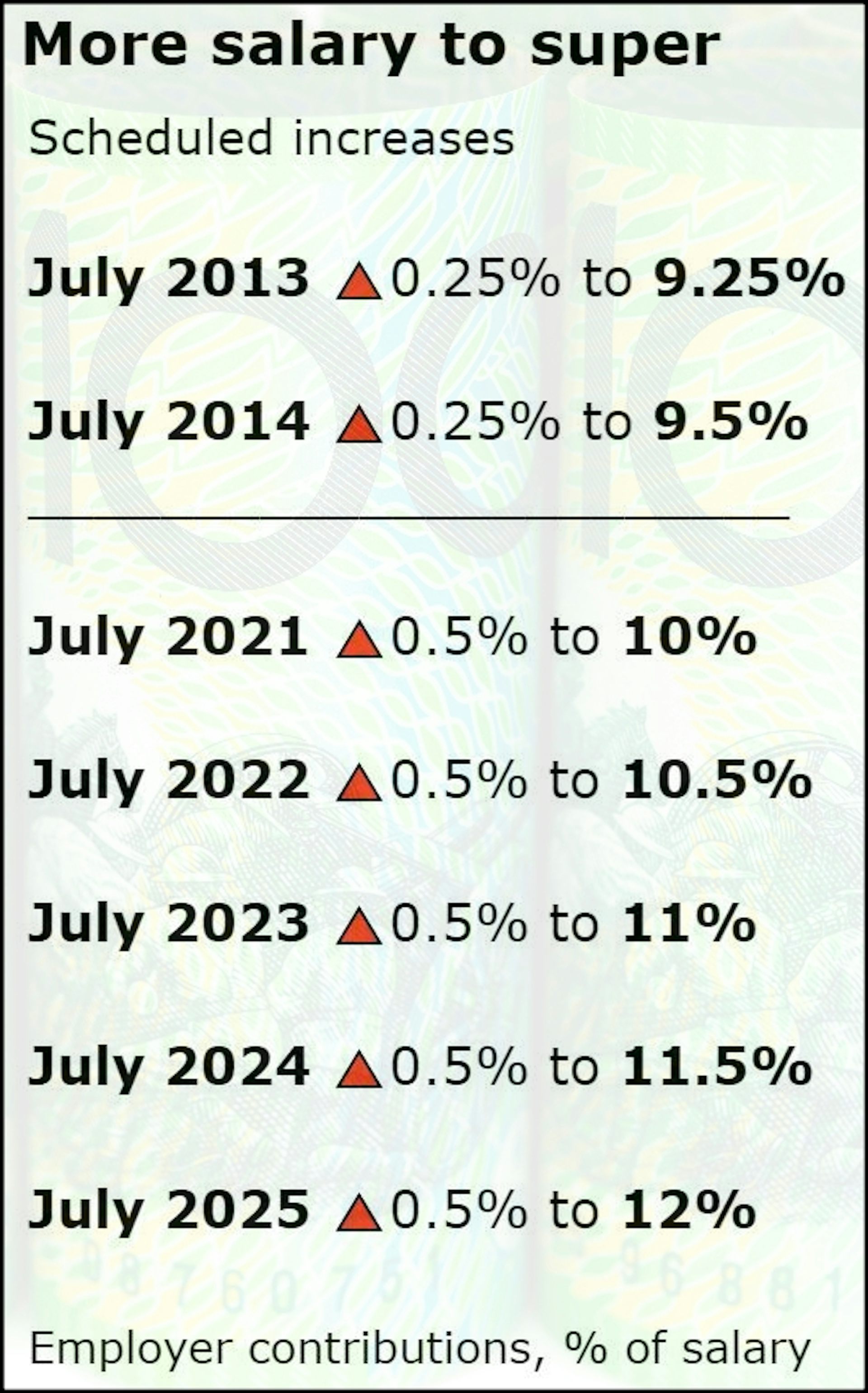
The next increase (actually, the next five increases) will hurt.
The last two, on July 1 2013 and July 1 2014, took place when wage growth was stronger. In 2013 wages growth was 3% per year.
And they were small – an extra 0.25 per cent of salary each.
The next five, to be imposed annually from July 1 2021, are twice the size: 0.5% of salary each.
If taken out of wage growth, they’ve the potential to cut it from its present usually low 2.3% per annum to something with a “1” in front of it, pushing it below the rate of inflation, for five consecutive years.
If we were going to do that (even if we thought the economy and wage growth could afford it) it would be a good idea to have a good reason why. After all, compulsory superannuation is the compulsory locking away of income that could otherwise be spent or used to pay down debt or saved through another vehicle, regardless of the wishes of the person whose income it is.
Question 1. What’s it for?
Fortunately, the new inquiry doesn’t need to do much work on this one.
For most of its life compulsory super hasn’t had an agreed purpose. At times it has been justified as a means of restraining wage growth, at times as means of restraining government spending on the pension, at times as means of boosting national savings.
In 2014, more than 20 years after compulsory super began, the Murray Financial System Review asked the government to set a clear objective for it, and two years later the government came up with one, enshrined in a bill entitled the Superannuation (Objective) Bill 2016.
The bill lapsed, but the objective at its centre lives on as the best description we’ve come up with yet of what compulsory super is for:
to provide income in retirement to substitute or supplement the age pension
Which raises the question of how much we need. For compulsory super, the answer is probably none. People who want more than the pension and their other savings can save more through voluntary super. People who don’t want more (or can’t afford to save more) shouldn’t.
Question 2. How much do people need?
Assuming for the moment that how much people need in retirement is relevant for determining how much compulsory super they need, the inquiry will need to examine what people need to live on in retirement.
The “standards” prepared by the Association of Superannuation Funds of Australia are loose. The more generous of the two allows for overseas travel every two or so years, A$163 per couple per fortnight on dining out, $81 on alcohol “or equivalent spent
with charity or church”.
It isn’t a reasonable guide to how much people need to live on, and certainly isn’t a reasonable guide for how much the government should intervene to make sure they have to live on. They are standards it doesn’t intervene to support while people are working.
And there’s something else. Super isn’t what will fund it. Most retirement living is funded outside of super, either through the age pension, private savings, or the family home (which saves on rent). Most 65 year olds have more saved outside of super than in it, and a lot more than that saved in the family home.
It’s a slight of hand to say that retirees need a certain proportion of their final wage to live on and then to say that that’s how much super should provide.
Question 3: Does it come out of wages?
The best guess is that, although paid by employers in addition to wages, compulsory super comes out of what would otherwise have been their wage bill.
Though compulsory superannuation guarantee contributions are paid by employers, wage setting generally takes into account all labour costs. As such, it is widely accepted that employees bear the cost of higher superannuation guarantees in the form of lower take home pay.
The inquiry will probably make its own determination. If it finds that extra contributions do indeed come out of what would have been pay rises, it will have to consider the tradeoff between lower pay rises (and they are already very low) and the compulsory provision of more superannuation in retirement.
Question 4: Does it boost private saving?
It’d be tempting to think that the compulsory nature of compulsory superannuation meant that each extra dollar funnelled into it increased retirement savings by an extra dollar. But it doesn’t, in part because wealthy Australians who are already saving a lot have the option of offsetting it by saving less in other ways.
For them, the increase in saving isn’t compulsory.
For financially stretched Australians unable to afford to save (or for Australians at times in times life when they can’t afford to save) the compulsion is real, and unwelcome.
The inquiry will have to make its own assessment, updating Reserve Bank research which found in 2007 that each extra dollar in compulsory accounts added between 70 and 90 cents to household wealth.
Question 5: Does it boost national saving?
Boosting private saving (at the expense of people who are unable to escape) is one thing. Boosting national savings (private and government) is another. The tax concessions the government hands out to support superannuation are expensive. The concession on contributions alone is set to cost $19 billion this year and $23 billion in 2022-23, notwithstanding some tightening up. It predominately benefits high earners, the kind of people who don’t need assistance to save.
On balance it is likely that the system does little for national savings, cutting government savings by as much as it boosts private savings. But because the question hasn’t been asked, not since the Fitzgerald report on national saving in 1993 shortly after compulsory super was introduced, we don’t know.
It’ll be up to the inquiry to bring us up to date.
During the election we were promised jobs and growth. But in 2019-20 The Conversation’s forecasting panel is predicting an economic growth rate as weak as any since the financial crisis, as well as dismal consumer spending, no improvement in unemployment or wage growth, and an increased chance of recession.
As in January, The Conversation has assembled a forecasting panel of 20 leading economists from 12 universities across six states. Among them are macroeconomists, economic modellers, former Treasury, IMF, OECD and Reserve Bank officials, a former government minister and a former member of the Reserve Bank board.
Whereas in January only three members of the 20-person panel expected the Reserve Bank to cut interest rates, and most expected an economic growth rate approaching 3% (which is the Treasury’s estimate of the best that can be achieved on a sustained basis), this time all but two expect the bank to cut again, and most expect a growth rate closer to 2% – one of the most anaemic since the financial crisis.
On the upside, the panel expects iron ore prices to stay higher for longer than did the budget, it expects home prices to stabilise, and it is predicting the lowest government bond rate on record, making it cheaper than ever before for the government to borrow and spend its way out of trouble.
The panel predicts a surplus in name only in 2019-20, and overwhelmingly believes the government should be prepared to abandon it if it has to in order to keep the economy growing.
Economic growth
The panel’s average forecast for year-on-year growth is 2.1%. Year-on-year growth is the measure used in the budget. It compares economic activity throughout all of one financial year with activity throughout all of the previous financial year. The budget forecast for 2019-20 is 2.75%.
Respected forecasters including former Reserve Bank board member Warwick McKibbin and former OECD director Adrian Blundell-Wignall expect much lower growth than 2.1%. McKibbin expects 1.8%; Blundell-Wignall expects 1.5%. Only three of the panel’s 20 forecasts are close to Treasury’s. The rest are lower.
Some panellists submitted forecasts for Chinese economic growth under sufferance. They made it clear they were forecasting “official” growth, not actual growth which they think is much lower. Even so, most expect official growth to slow as the trade war between the United States and China intensifies. Nigel Stapledon says unless it is reined in (and he thinks it will be) it could bring on recessions.
Other panellists including Rebecca Cassells say the impact of US tariffs on Chinese goods has so far been positive for Australia. China has responded by investing in infrastructure projects that need Australian iron ore and coal. This, together with reduced competition from other suppliers of iron ore after the collapse of a tailings dam and mine closures in Brazil, has lifted the price and volume of Australian exports to levels not seen for some time.
The panel expects robust United States growth of 2.6% in 2019, although many members are concerned about the year that will follow. The only panellist to forecast low US growth in this year (1%) is Blundell-Wignall, who until last year analysed world economies in his role as special advisor to the OECD secretary general.
Living standards
Jobs growth will disappoint both the Treasury, which has forecast unemployment of 5% by the end of the financial year, and Reserve Bank Governor Philip Lowe, who has adopted a target of “4 point something”.
All but three of the 20-person panel expect the rate to stay above 5%. The average forecast is 5.3%, which is close to the present 5.2%.
Stapledon says Australia’s recent strong employment growth has been “out of kilter” with slower GDP growth and the winding down of housing construction, meaning jobs growth is set to slow down, pushing up unemployment.
Brendan Coates says underemployment is also climbing as more people work fewer hours than they would like, making it harder for them to push for wage rises. Rebecca Cassells points out that full-time employment has grown almost twice as fast among women than men, which, given the low rates of pay in the industries that traditionally employ women, is likely to further depress average wages.
The headline measure of living standards, GDP per capita, has been falling, but a better measure, real net disposable income per capita, which takes better account of buying power, has been continuing to climb. The panel expected to climb a further 1% over the year to June 2020, after climbing 1.3% in the year to March.
Nominal GDP, which takes full account of mining revenue and drives company profits and the budget revenue, has grown 5% over the past year and is expected to grow 3% in the year ahead.
The risk of recession
The panel regards a recession as more likely than it did in January, assigning a 29% probability to a conventionally defined recession in the next two years, up from 25%.
Economic modeller Janine Dixon says the bulk of Australia’s recent economic growth has come from higher commodity prices via exports.
She says without them, Australia would be reliant on weak wage and consumption growth, although she believes high population growth will be enough to ensure economic activity doesn’t shrink for two consecutive quarters which would be the conventional definition of a recession.
Former Treasury and ANZ Bank economist Warren Hogan says with consumers tightening their belts, an external shock could easily knock Australia into a recession.
Julie Toth, an economist at the Australian Industry Group who has also worked for the Productivity Commission, says with growth already low, it won’t take much to turn it negative.
Debt theorist Steve Keen, who assigns a 95% probability a recession (as he did in January) says Australia escaped that fate during the global financial crisis in part by boosting grants to first home buyers, which made Australian households among the most indebted in the world and “put off the day of reckoning” when those debts would be unwound.
Through a mix of good luck and good management, Australia has avoided a recession during three global downturns since the early 1990s: the 1997 Asian economic crisis, the early 2000s dotcom collapse, and the 2007-09 global financial crisis. If it succeeds again it will enter its fourth decade recession-free in this term of government in mid-2021.
Wages and prices
The panel expects continued historically wage growth of only 2.2% in 2019-20, slightly weaker than the latest reading of 2.3% and well short of the budget forecast of 2.75%. If that average forecast is right, it will be the seventh consecutive year in which wage growth has fallen short of the budget forecast.
The good news (for wage earners) is that even that unusually low rate of wage growth would be well above the rate of inflation, which is expected to be only 1.5%, or 1.4% on the so-called “underlying” basis watched closely by the Reserve Bank.
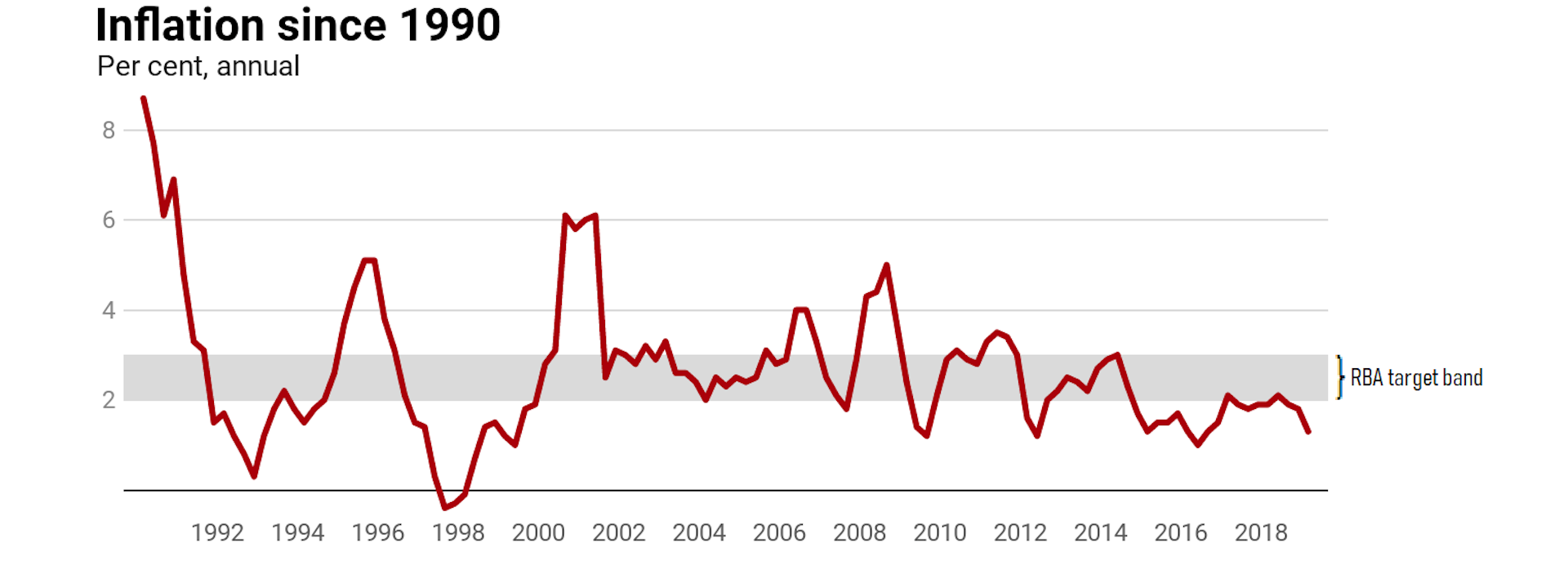
The bad news for the Reserve Bank is that it will put inflation well outside the bank’s target band of 2-3% for the fifth consecutive year, raising questions about whether there is any point to the band.
For years now, inflation has mostly been below the band.ABS 6401.0
Mark Crosby, Warren Hogan and Adrian Blundell-Wignall suggest broadening the target band to 1-3%. Tony Makin and Nigel Stapledon suggest cutting it to 1-2%.
Richard Holden and Warwick McKibbin suggest ditching it altogether and replacing it with a target for nominal GDP growth. McKibbin suggests a nominal GDP target of 6%, which given the present forecast for weaker nominal GDP growth would mean interest rate cuts. In better times it would mean rate rises.
Chris Edmond and Craig Emerson defend the 2-3% inflation target saying that what is really concerning is the bank’s preparedness to stay beneath the target band for extended periods.
Home prices
The panel expects only modest falls in Sydney and Melbourne house prices of 2-3% in each city after falls of 10% over the past year. It is more optimistic on home building than is the Treasury, expecting housing investment to fall by 4.9% rather than the budget forecast of 7%.
Business
None of the panellists expects household spending to grow by the 2.75% forecast in the budget. On average, the panel expects spending growth of just 1.9% in 2019-20, which is little better than the present 1.8% and only few points above population growth.
Janine Dixon blames continuing weak growth in wages and incomes. Nigel Stapledon says much of it flows from the weaker housing market. Household furnishings drive household spending growth. Household spending drives GDP growth, accounting for more than half of it.
In better news, the panel expects mining investment to rebound after sliding for most of the last five years. Its forecasts of growth in mining investment of 4.4%, and growth in non-mining investment of 4%, are in line with budget forecasts.
Interest rates and the budget
Perhaps surprisingly given its forecasts for weak employment growth, weak economic growth and weak inflation, the panel’s average forecast for interest rates is for just one more cut, perhaps as soon as July 2, but some time in the second half of the year.
Only five panellists expect a followup cut in the first half of next year, but among them are Craig Emerson, Richard Holden and Steve Keen, who were the only three to correctly) forecast in January that there would be a rate cut at all this year.
Holden expects two further rate cuts in the second half of this year, taking the Reserve Bank cash rate to 0.75%, and then a further two in the first half of next year, taking it to just 0.25%. Keen expects one further cut on the second half of this year and another two in the first half of next year, taking it to 0.5%.
Warwick McKibbin is the only panellist expecting the Reserve Bank to change course, expecting one further cut this year and then a series of increases as ballooning debt makes the Reserve Bank and other central banks realise they cut too far, pushing the cash rate back up to 1.5%.
The panel expects a government 10-year borrowing rate of just 1.5%, which is about the lowest it has ever been. A year ago the 10-year bond rate was 2.7%. The ultra low rate will both make it easier for the government to borrow and cut the cost of servicing its existing debt as loans are rolled over.
In further good news for the budget, the panel expects a substantially higher spot iron ore price than does the government, of US$95 a tonne by mid next year instead of the fall to US$55 assumed by the Treasury.
The forecast is somewhat above the Department of Industry’s new July forecast of US$95 a tonne by the end of this year trending down to US$61 by the end of 2020, but are way in excess what was forecast in the budget. A sensitivity analysis included in the budget said that for every US$10 that the iron ore price was higher than budgeted, the government’s tax take would be A$1.1 billion higher in 2019-20 and A$3.7 billion higher in 2020-21.
The panel expects the Australian dollar to remain broadly where it is at just below 70 US cents as the upward push from strong commodity prices offsets the downward push from domestic economic weakness.
Yet despite the iron ore price and lower borrowing costs the panel expects a much weaker budget outcome than the A$7.1 billion surplus forecast in April.
Its average forecast is for a surplus of only $1.7 billion, which is a mere sliver of GDP (0.1%), practically indistinguishable from a deficit of the same amount.
The forecasts come after Finance Department figures for May released on Friday raised the possibility of an early return to surplus in 2018-19. They suggest that surplus is at risk in 2019-20 and beyond, both because of economic weakness and an because of an increasingly urgent need to respond to that weakness through spending or further tax cuts.
Asked whether should the government strive to continue to deliver its promise of a surplus if economic growth remains weak or weakens further, former OECD director Adrian Blundell-Wignall replied bluntly, “of course not”.
The only panellists prepared to defend the continued pursuit of a surplus in the economy remained weak or weakened were Ross Guest, who said it was a worthwhile aim given the steady rise in government debt to GDP ratio, and Tony Makin, who qualified his reply by saying the surplus should be achieved by pruning unproductive expenditure such as industry assistance rather than deferring tax cuts.
Former government minister Craig Emerson regretfully forecast that the government would deliver a surplus whatever the economic circumstances, for political reasons.
Albo, or Plibersek, or whoever turns out to be the next Labor leader, might have had a lucky accident. Usually, it’s Labor that inherits an economy turning down.
This time, it’s the Coalition. And because of regular updates from the Reserve Bank and the Bureau of Statistics strikingly at odds with their public position that the economy is strong, they ought to be finely attuned to it.
Economic growth, the catch-all that is supposed to show us where the economy has been and where it is headed, is frighteningly small.
The Treasury’s best estimate of potential growth – how strongly the economy could be growing over time if things were well managed – is 2.75% per year.
The reality, for the two most recent quarters for which we have data, is 0.3% and 0.2%.
The economy is anaemic, despite the crowing
If you add those two numbers together and multiply by two you discover that for six months the economy has been growing at an annualised pace of just 1% – way, way short of its potential.
Stripping out population growth and minimal price growth, real living standards have been going backwards.
The bank says consumption growth has slowed most noticeably for discretionary items that tend to have the strongest relationship with home buying, such as furnishing and household equipment. It says growth in other types of discretionary spending, such as eating out, has also slowed. Consumption of so-called “essential” items is holding up.
We’re going to need a boost
It means we can’t rely on household spending to revitalise the economy (although the government will give it a go, stumping up a bonus of as much as $1,080 to be delivered with each tax return from July in a much-needed boost that will be disguised as a tax cut rather than spending).
Household spending accounts for three-fifths of gross domestic product. The bank identifies uncertainty over household spending, which itself derives from uncertainty over income growth, as a “key risk” for economic growth:
Should households conclude that low income growth will be more persistent than previously expected, households may adjust their spending by more than currently projected and consumption growth could remain weak for a longer period.
Labor would have helped stabilise uncertainty over income growth by immediately intervening before the Fair Work Commission to get higher wages, directing it to draw up a long-term strategy for higher wages, restoring cut penalty rates, and funding the increases of some childcare workers itself.
Having won an election opposing those things, the Coalition will have to try other things, perhaps even bigger and earlier tax cuts.
Prayer would help – prayer that international commodity markets remain strong, that the Reserve Bank cuts rates on June 4 (it is practically certain to), that it cuts them again before the end of the year (financial markets are literally 100% certain that it will) and that home prices stabilise.
Perhaps a very big boost
On the face of it, none of these would be enough to force economic growth back up. If it falls even further and continues to fall, Australia will enter a recession within this term of government, an outcome to which the academic economists polled by The Conversation in January assigned a 25% probability.
So far employment growth has been the economy’s brightest light, but in its quarterly update released a week before the election the Reserve Bank pointed out that employment growth can lag economic growth by up to nine months, meaning it might be about to turn down, although it added that it was not unusual for “trends in GDP growth and the labour market to diverge for sustained periods”.
If employment growth does turn down (and the bank says “near-term leading indicators of labour demand have softened”) it is likely to happen first in the construction and retail industries. The construction jobs will come again (and the government is doing its best to bolster them with promises of spending on infrastructure) but the retail jobs might never return, the nature of retailing having changed.
The economy matters more than the surplus
If needed in order to avoid a recession the government will have to be prepared to abandon its promised 2019-20 budget surplus. If the prospect of a recession does loom, it’ll have the political cover. And if it looms early in its term, it might still be able to deliver a budget surplus by the end.
Scott Morrison and his treasurer, Josh Frydenberg, were elected to manage the economy, and that means doing whatever is needed to avoid a recession and the long-term damage to lives and living standards it would deliver.
Speaking personally, I’ve no doubt they are up to the task, just as Labor would have been. In a way it’s a pity they didn’t adopt one of Labor’s key economic promises, which was to have a new budget in August, to refresh things.
And it matters more than superannuation
And they’ve got to focus on lifting living standards over the longer term where, conveniently, they have a big advantage over Labor.
Labor has a blindspot when it comes to superannuation. It wants to lift compulsory contributions from 9.5% of salary to 10% on July 2021, and then by another 0.5% the next year and another 0.5% the next year and so on for five consecutive years, apparently regardless of what it will do to incomes now.
It’s a good thing that, unlike Labor, the Coalition will be relaxed about pushing out the timetable if the economy can’t stand it, as it has done before.
Before the election it was preparing to respond to the landmark Productivity Commisson report that found that unintended multiple accounts and the defaulting of new workers into entrenched underperforming funds were costing members an extraordinary A$3.8 billion per year.
The Coalition can set up super for the future
Weeding out the chronic underperformers, clamping down on unwanted multiple accounts and insurance policies, and letting workers choose funds from a short menu of good funds and stay in them for life would give the typical worker entering the workforce an extra A$533,000 in retirement.
The Coalition is running out of time to do worthwhile things.
Facing overwhelming odds of defeat in the election due within weeks, one of its last throws of the dice should be to do something Labor would never do, but which is urgently needed and would set us on the right course for the future.
It’d also cause some trouble for Labor along the way.
It is to launch a full-blown inquiry into the superannuation system Labor has lumbered us with.
It’s urgent because compulsory super contributions are scheduled to climb from the current 9.5% of salary to 12%, beginning with an increase of 0.5% in July 2021, followed by an extra 0.5% in 2022, 2023, 2024 and 2025.
Under the schedule imposed by Labor when it was last in office compulsory contributions were to climb by 0.25% of salary in each of 2013 and 2014 and then at twice the rate, by 0.5%, in each of the five years after that.
Compulsory super is set to jump..
The Coalition hit pause after 2014 just before the rate accelerated, postponing the series of five much bigger increases until 2022, when it might have hoped that wage growth would be robust enough to cope with it, or when it would have been someone else’s problem.
Labor says it will stick to that schedule, presumably regardless of wage growth or other economic conditions or the need for extra super contributions at the time.
Asked, ahead of the release of the Productivity Commission’s report on how to make super funds more efficient, whether Labor would reconsider the schedule if the Commission found other ways to boost retirement incomes, Labor Treasury spokesman Chris Bowen said it would not.
It’s almost as if – to Labor – lifting compulsory super contributions has the status of a holy writ; perhaps because it would “complete the work” of Labor elder statesman Paul Keating who introduced compulsory super, or perhaps because so many union officials are tied up with the running of the funds that would benefit from the schedule of increases.
In the event the Productivity Commission report released on January 10 found ways to massively lift retirement incomes without lifting super contributions.
…whether we need it or not
It found unintended multiple accounts and the defaulting of new workers into entrenched underperforming funds were costing members an astonishing A$3.8 billion per year.
Weeding out the chronic underperformers, clamping down on unwanted multiple accounts and insurance policies, and letting workers choose funds from a short menu of good ones and stay in them for life would give the typical worker entering the workforce an extra A$533,000 in retirement.
Even a typical worker aged 55 today would get an extra A$79,000 in retirement.
What the Commission’s report couldn’t say, but stongly implied, was that if the Commission’s recommendations were adopted an increase in costly compulsory contributions might not be necessary.
Its terms of reference limited it to assessing the “efficiency and competitiveness” of what happened to the contributions that were collected.
Henry was unconvinced
Another inquiry – less hamstrung – was the Henry Tax Review. It found no need to increase contributions. Labor treasurer Wayne Swan dishonoured its findings by announcing the proposed increase in contributions on May 2, 2010, the day he released its report.
But super wasn’t the main focus of the Henry Review. In the 25 year history of compulsory super, there has never been an inquiry into what the rate should be and what the system has achieved. It’s as if governments of both types have been keen to govern blindly.
So in January the Productivity Commission tentatively ventured beyond its brief, in a recommendation Treasurer Josh Frydenberg has promised to respond to before the election.
It is Recommendation 30, for an independent inquiry into the entire system.
The independent inquiry would determine whether or not the system we’ve had for the past 25 years has boosted national or even private savings rates, as well as who it has hurt and who it has helped.
They are the type of questions you would think a government would want to answer before lifting compulsory contributions further from 9.5% of salary to 12%.
Frydenberg could show leadership…
Indeed, Recommendation 30 explicitly asks that the inquiry “be completed in advance of any increase in the superannuation guarantee rate”.
It is possible to guess what the inquiry would find:
that almost all increases in employers’ compulsory super contributions come out of what would have been wages, depressing workers take home pay, a finding that will not be seriously disputed
that the system hasn’t boosted national savings - the increase in private savings has been offset by the decrease in government savings brought about by the use of the super tax concessions
that the increase in private savings has come almost entirely from the middle to low earners who have been unable to escape the impact of the levy, because they have had no other savings they could cut. They are the people who could least afford to save more at the time they were forced to
the tax benefits have gone overwhelming to the high earners who are saving no more than they would have without them, and without compulsion
In sum, the inquiry is likely to find that the system is regressive and cruel. Or perhaps not. We won’t know until it is held.
It ought to be conducted by an expert panel whose members are highly respected and who will amass evidence the next government won’t be able to ignore.
…ensuring Labor does more than look after mates
Frydenberg ought to appoint the panel now, or within weeks, so that an incoming Labor government can’t dismantle it.
It would be one of his most important legacies. And would give him something to press the next government about should he be in opposition.
In time an incoming Labor government might thank him.
At present, without the scheduled increases in compulsory super, wage growth is just 2.3%. With the scheduled increases of 0.5 percentage points per year, wage growth might fall below the rate of inflation, for five consecutive years.
No sensible treasurer would allow that happen. By doing what’s right, Frydenberg might be giving Bowen an out.
Newspapers need to economise on words. Television and radio reporters need to economise on seconds. So they use shorthand: words like “dividend imputation”, “franking credits”, and yes, “retiree tax”.
Which is fine if you already know what they mean, and pretty fine if you don’t, because you probably don’t need to. They speed things along.
Until now. Suddenly, because of their prominence in the upcoming election campaign, we are going to have to know what they mean. We are even going to have to know that one of them doesn’t mean what it seems to mean. The election might depend on it.
So here goes:
Taxable profits
If a company’s income exceeds its expenses, it has made a profit, which in ordinary circumstances is taxed at the legislated rate, which for big companies such as Telstra and the big banks is 30 cents in the dollar.
Dividends
After the tax is taken out, companies can pay some of what’s left to shareholders as a dividend, one for each share.
Last September Telstra paid shareholders a dividend of 15.5 cents per share. The previous March it was 11 cents.
Income tax
Australians pay tax on what they earn, unless the income is classified as not taxable or is below the A$18,200 tax-free threshold. The marginal rate (the rate on extra income) climbs with income, so that anyone earning more than A$180,000 (the top threshold) pays 45 cents on each extra dollar earned.
Dividends are taxable and so are taxed along with other income.
Dividend imputation
In 1987 in what he hailed as a world first, Labor treasurer Paul Keating introduced a rebate for each each tax-paying dividend recipient.
Taken off their tax would be the company tax the company had paid on the part of the profit that had been handed to them as a dividend.
It would greatly reduce the existing bias in the tax system which
taxed interest income once, but dividend income twice.
Here’s how it would work at today’s tax rates.
Jill owns 1,000 Telstra shares
Over the period of a year she gets dividends of A$265
To provide them, Telstra made a profit of A$379 on which it paid A$114 tax
Jill pays tax on the full $379 but gets a credit of A$114 that can be taken off any other tax she owes that year
As with other tax credits, it can be used to cut Jill’s tax bill as far as zero, but not to turn it negative. It can’t be handed to her in cash.
As Keating put it, the tax paid at the company level would be imputed, or allocated to shareholders by means of imputation credits.
But not to all of them. Non-resident (overseas) shareholders couldn’t get them, and nor could shareholders whose dividends hadn’t been franked.
Franking credits
As Keating explained, the tax credit only applied to the extent to which full Australian company tax had been paid; to the extent to which the dividends had been franked (stamped) to indicate that tax had been paid.
Not every company pays the full 30 cents in the dollar in every year. Often it is carrying forward previous losses. Only dividends from profits on which full tax had actually been paid were to be marked “fully franked”. Dividends on which tax had been partly paid were to be marked “partly franked”.
Fully franked dividends became sought after, because they brought with them the biggest franking credits. In a useful side effect, dividend imputation encouraged companies that wanted to look after their shareholders to pay full tax.
Refunds to non taxpayers
Although the particular Australian design arguably was a world first, dividend imputation or something similar is not unusual. Many countries have systems in place that to a greater or lesser degree ensure company profits are taxed only once – among them Canada, New Zealand, Chile, Mexico, Malaysia and Singapore, whose system is called “one-tier” tax.
Many that did adopt it later moved away from it, using the money saved to cut headline tax rates; among them Britain, Ireland Germany and France.
What is unusual is what Australia did next. In 2001 after more than a decade of dividend imputation, the Howard government supercharged it, paying out franking credits in cash to shareholders who didn’t have any or enough tax to offset.
From the point of the view of these non-taxpayers, dividend imputation became a negative income tax: instead of them paying the government money, the government paid them money.
As far as is known, it is an enhancement that has not been copied anywhere.
On one hand, it makes sense because it treats non-taxpayers the same as taxpayers by refunding them the same amount of company tax.
On the other hand, it does not make sense because it means that instead of being taxed once (at either the company or the personal level) as was the original intention, company profits can escape tax altogether.
Untaxed super
From 2007 the change mattered to many more retirees.
The Howard government’s “Simplified Superannuation” package made super benefits paid from a taxed source (that’s most super benefits outside of the public service) tax free when paid to people aged 60 and over.
A quirk in the wording of the Act went further. Not only did super withdrawals become tax free, they also became no longer included in “taxable income” and so didn’t need to be declared on tax forms.
This meant that many retirees on reasonable super incomes were no longer taxed at reasonable rates on their other income, including income from shares which could be untaxed if it fell below the tax free threshold.
And because of the 2001 decision to send dividend imputation cheques to shareholders who were untaxed, these retirees who suddenly found themselves untaxed also got imputation cheques mailed to them from the government.
Self-managed super funds, whose income is tax exempt in the retirement phase, also got imputation cheques.
In July 2017 the Turnbull government wound back tax free super by placing a limiting it to accounts with less than A$1.6 million. The restriction was to hit 1% of super-fund members.
Labor’s proposal
Treasury’s 2015 tax discussion paper prepared for the Abbott government referred to “revenue concerns” about dividend imputation cheques.
They cost the budget just A$550 million in the year the Howard government introduced them, but A$5 billion per year by 2018 and were on track to cost A$8 billion.
Labor’s proposal, announced in mid March 2018, was to return the divided imputation system to where it had been before Howard changed it in 2001, and to where it still is elsewhere. Tax credits could be used to eliminate a tax payment but not to turn it negative.
Labor allowed exceptions for tax exempt bodies such as charities and universities who would continue to receive imputation cheques alongside dividends.
Pensioner guarantee
Two weeks later, in late March, Labor amended its policy by adding a “pensioner guarantee”. Pension and allowance recipients, even part pensioners, would be exempt from the changes and would continue to receive cash payments.
Also exempt would be self-managed super funds with at least one member who was receiving a government pension or part-pension at the date of Labor’s announcement, 28 March 2018.
The change cost relatively little (the budget saving over the next four years fell to A$10.7 billion from A$11.4 billion) because most of the imputation cheques go to Australians with too much wealth to get even a part pension.
Self Managed Super Funds
Retail and industry super funds pool their members contributions, and so almost always have tax to reduce, meaning most would be unaffected by the withdrawal of cash credits.
Self Managed funds usually represent just one person, or a couple; their funds aren’t pooled with anyone else’s. This means that in the retirement phase, where fund earnings are untaxed, most do not have enough tax to reduce. So they get imputation cheques, which they would no longer get when Labor’s policy was implemented.
There is no such thing. The phrase is shorthand for Labor’s proposal to withdraw dividend imputation cheques from dividend recipients who are outside the tax system.
The Australian economy will remain healthy for long enough to enable the government to claim it as a strength in the lead-up to the May election, but the first Conversation Economic Survey points to a fairly flat outlook beyond that, with a 25% chance of a recession in the next two years.
The Conversation has assembled a forecasting team of 19 academic economists from 12 universities across six states. Among them are macroeconomists, economic modellers, former Treasury and Reserve Bank economists, and a former member of the Reserve Bank board.
Taken together their forecasts point to no recovery in the share market during 2019, no recovery in wage growth, no further improvement in the unemployment rate, further modest home price falls in Sydney and Melbourne, and to a budget deficit next financial year despite the official forecast of a surplus and Treasurer Josh Frydenberg’s commitment that the government will fight the election continuing to forecast a surplus.
Weighing heavily on Australia’s economy during 2019 will be a much weaker US economy, with what the forecasting team says is the possibility of a US recession, and weaker growth in China. Australian consumer spending is forecast to continue to grow during 2019, but no faster than it did during 2018. The best measure of living standards is forecast to advance at a crawl.
Most of the team expect the Reserve Bank to sit on its hands throughout all of 2019, leaving its cash rate unchanged at the all-time low of 1.5% for what will be a record 40 months.
Economic growth
The panel expects the Australian economy to grow more slowly in the year ahead, by 2.6%, down from recent annual growth of 2.8% and 3.1%. None of the panel expects growth to exceed 3%. One, Steve Keen, formerly of the University of Western Sydney and now at University College London, expects growth of only 1%.
Most of the panel expect China’s growth to continue to slow, from the annual growth of 6.7% typical over recent years to just 6.2%, the weakest growth since the 2008 global financial crisis and the weakest calendar year growth since 1990.
Former Treasury economist Nigel Stapledon now at the University of NSW nominates China as the biggest threat to Australian and global growth. He says it has a good record of stimulating its economy to get out of difficult corners but one day it might get it wrong.
The panel expects US economic growth to hold up at 2.8% during the year ahead but to weaken or go into reverse by year’s end as the “sugar hit” from the Trump tax cuts goes into reverse.
Former Treasury and International Monetary Fund economist Tony Makin points to US high public debt that will need to be rolled over, soaking up funds that could have been more productively used for investment, to higher US interest rates imposed by a central bank concerned about inflation, and to the escalating trade war with China.
ANU modeller and former Reserve Bank board member Warwick McKibbin says the US economy is “very likely” to begin to go backwards towards the end of the year. Craig Emerson, a former Australian trade minister now with Victoria University, says the US is likely to enter a recession in 2020. Former Treasury economist Mark Crosby at Monash University says if there is a US recession, it won’t hit until late 2019, with the impact greatest in 2020.
Rebecca Cassells from the Bankwest Curtin Economics Centre says a lot depends on the outcome of the US-China trade war: “The two biggest economies are going head to head, but both are almost as reliant on the other to sustain their growth trajectories,” she says.
Australia should look to other parts of the world to drive its economic growth. “India is one of them, and is rising rapidly with no downgrading of its growth trajectory of 7.75% for 2019.”
Living standards
Nominal GDP, the money earned in Australia unadjusted for price changes, is forecast to grow more slowly in 2019, by 4.5%, down from recent growth in excess of 5%, reflecting weaker iron ore prices.
The best measure of living standards, real net disposable income per capita, is expected to barely grow, climbing just 1% over the year to December, much less than recent growth in excess of 3%, but much more than its performance in the dismal years between 2012 and 2016 when it went backwards.
Forecasts for the unemployment rate cluster around its present 5.1%, with only four below 5% and one above 6%.
Wages and prices
Wage growth is forecast to climb no further in 2019, finishing the year at its present 2.3% instead of climbing to 2.75% on its way to 3% by mid 2020 as forecast in the budget update.
Rebecca Cassells points out that much of the increase we have had has been driven by the Fair Work Commission’s decision to lift the minimum wage 3.5% from June 2018, suggesting very low growth elsewhere. Disturbingly, she says more and more enterprise bargains are being terminated, with employees falling back on awards.
Overwhelmingly, our panel is of the view that the only thing that will lift wage growth out of its slump (and budgets have been incorrectly forecasting a bounce out of the slump for eight years now) is higher productivity: producing more per worker.
Victoria University economic modeller Janine Dixon notes that the December budget update actually downgraded its forecast of productivity growth, from 1.5% to 1%, and so is not optimistic.
She says even if productivity growth did pick up, excessive market power in some industries combined with weakness in labour market institutions means it might not easily be passed on to workers.
Tony Makin, a supporter of company tax cuts, says the best thing to lift productivity would be new (perhaps foreign) investment embodying productivity-enhancing technology.
The saving grace for workers facing yet another year of historically-low wage growth is that price increases will also remain low.
Inflation has been right at the bottom of (or below) the Reserve Bank’s 2% to 3% target band for four years now, meaning that even at the continuing low rates of wage growth forecast, wages should continue to climb just faster than prices.
The panel expects consumer spending to climb by only 2.5% in real terms in 2019, most of which will reflect population growth of 1.6%.
The average forecast for inflation is at the very bottom of the Reserve Bank’s target band. Only two panel members expect inflation to edge back up to the middle of the band. They are Warwick McKibbin and former Treasury and ANZ Bank chief economist Warren Hogan, at the University of Technology Sydney.
Interest rates and the budget
Without either a lift in inflation or a substantial weakening in the economy there is little reason for the Reserve Bank to move interest rates in either direction.
Governor Philip Lowe took the job in September 2016, just after the board cut the cash rate to a record low of 1.5%. He hasn’t moved the cash rate since, although on several occasions he has said the next move is most likely to be up.
Five of the panel do expect at least move up this year, including the two who think inflation might approach the bank’s target. Three expect cuts, taking the rate below 1.5%.
The remaining eleven expect no change, all year.
The government says it will deliver a budget surplus next financial year, of A$4.1 billion, the first surplus in a decade.
The panel doesn’t think so, all but one member predicting a lower budget surplus than the government, and seven predicting deficits. The average forecast is for a deficit of A$3.5 billion rather than a surplus of A$4.1 billion.
Monash University macroeconomist Solmaz Moslehi identifies optimistic wage growth, weaker than expected mining investment and a hit to consumer spending from the housing downturn as the biggest risks to the forecast surplus.
Julie Toth, adjunct professor at Deakin University’s Master of Business Administration program and chief economist at the Australian Industry Group, says the latest indicators suggest that neither employment nor wage growth will accelerate by as much as the government expects.
Michael O’Neil from the South Australian Centre for Economic Studies says the biggest immediate risk to the forecast surplus is thermal coal prices, given China’s efforts to cut coal imports and the shift to renewables in China and India.
The biggest long term risk is the scale of the company tax cuts and the ongoing shift of income from highly-taxed labour to more lightly-taxed capital.
Margaret McKenzie of Federation University identifies the biggest risk to the surplus as a change of government, something she says she welcomes because with extensive idle capacity and underemployment, a surplus would be unhelpful.
Home prices
The panel expects Sydney home prices to fall by another 5.8% and Melbourne prices by another 5.1% in 2019, taking the slides over two years to 14.7% and 12.1%.
Only Macquarie University and former Reserve Bank economist Jeffrey Sheen expects prices to move back up throughout 2019, by 2% and 3%.
Reassuringly, none of the forecast falls are bigger than 10%. The biggest are predicted by Steve Keen, Tony Makin, Margaret Mckenzie and Craig Emerson.
The lower prices will be accompanied by much slower growth in housing investment, expected to climb only 2.1% in 2019 after climbing more than 7% in the year to September 2018.
Business
Non-mining business investment is forecast to grow more slowly this year, by 5.7% instead of 11.4%, and mining investment is expected to keep sliding, losing a further 3.4% after losing 11.2% last year rather than climbing as the government’s budget update predicts.
Five of the team believe that mining investment to turn the corner in line with the budget forecast. Nine expect it to fall further.
The Australian share market will for practical purposes not grow not at all during 2019 according to the average forecast, which is for barely perceptible growth of 0.1%. A steady share market would come as a relief to super funds and share owners after last year’s slide of about 7%.
The range of forecasts for the ASX 200 is wide, from slides of more than 6% to gains of more than 6%.
Markets
Fortunately for a government the panel expects to need to continue to borrow more in order run continued budget deficits, what it pays for to borrow via the 10-year bond rate is expected to remain little changed at 2.6%. Only Warwick McKibbin expects a much higher bond rate, of 3.5%.
The panel’s average forecast is for an broadly unchanged Australian dollar, of around 70.5 US cents. The highest forecast is for US$0.80, the lowest for US$0.62.
The iron ore price, at present close to US$74 a tonne, is expected to fall to around US$64. Only one panelist, Warwick Mckibbin, expects it to stay near where it is, at US$75. The government itself is cautious, using a price of US$55 in its budget forecasts, a number it might lift in the April budget, allowing it to forecast more revenue.
The risk of recession
On average, the panel believes there is a 25% chance of a conventionally-defined recession within the next two years.
Half of the probability estimates are between 20% and 30%. Averaging all of them together other than Steve Keen’s estimate of 95% produces an estimate of 22%.
A recession is conventionally defined as two consecutive quarters in which gross domestic product falls instead of rises. Australia hasn’t had two consecutive quarters of negative growth since 1991.
The most recent negative quarter was in September 2016. Before that there was one in March 2011, and before that in during the global financial crisis in December 2008.
Ross Guest of Griffith University makes the point that his estimate of 20% should be considered low. There will always be a risk of a recession. By itself two quarters of negative growth needn’t be a disaster. The impacts on the government and on consumer and business confidence would be more important than the downturn itself.
Guay Lim of the Melbourne Institute of Applied Economic and Social Research assigns the lowest probability of any of our panel to a recession, 5%, saying the most likely catalyst would be a global trade war.
Warren Hogan assigns the highest probability to a recession after Steve Keen, 40%, saying Australia is facing the end of a major construction boom and has heavily indebted households. It will be vulnerable to any negative shocks and especially vulnerable to higher inflation and interest rates.
Steve Keen says the only thing that has kept Australia afloat since the China boom has been the housing bubble, which the banking royal commission has been discovering was built on fragile, and in places fraudulent, foundations.
Nigel Stapledon says the biggest drag on the economy will be the collapse in the construction of residential investment units. Labor’s proposed increase in capital gains tax will make it worse, notwithstanding Labor’s decision to exempt new construction from its crackdown on negative gearing.
Rebecca Cassells says on the bright side Australia is set to become the world’s biggest exporter of liquefied natural gas, the biggest exporter of iron ore to India and the world’s biggest producer of lithium, needed for batteries.
And if there is a global economic downturn within the next few years, she says another positive is that Labor is likely to be in power, making the successful deployment of a stimulus package more likely than if the Coalition had been in office.