Showing posts with label super. Show all posts

Tuesday, February 28, 2023

Tax-free super for the super rich is a bad deal for the rest of us – and Morrison said it first

You’d be forgiven for thinking Treasurer Jim Chalmers had done something dramatic.

From 2025 he will double the tax rate on earnings from superannuation balances above A$3 million, lifting it from 15% to 30%.

Only 80,000 Australians have accounts that large, and many of them who have retired have shoved the maximum permissible $1.7 million into a separate so-called retirement account whose earnings are entirely tax-free.

That’s right. Retirees with $1.7 million in retirement accounts pay nothing whatsoever on what those accounts earn, which in normal years amounts to $85,000.

By way of comparison, wage earners on $85,000 get taxed $18,000.

But though you’d never know it from some of the “socialist tax grab” commentary around this week, Chalmers isn’t the first treasurer to act on this rort. Scott Morrison got there first.

Howard’s super deal for the richest 1%

In 2006, in what economist Saul Eslake describes as one of the worst taxation decisions in modern times (an honour for which he says there’s a fair bit of competition), then Prime Minister John Howard exempted from tax withdrawals from super for Australians aged 60 and over.

By itself, this was unremarkable. We don’t tax withdrawals from bank accounts, because the interest they earn has been taxed within the account.

But Howard left in place a preexisting exemption from tax for earnings within the retirement accounts of Australians aged 60 and over.

This meant the earnings on the sometimes very large accounts of retirees aged 65 and over weren’t taxed at all. Not at the normal super tax rate of 15%, not at any rate – without limit, no matter how much was earned, merely because the person owning the account was aged 65 or over and had retired.

Morrison wound Howard’s policy back

In office, the Labor governments of Kevin Rudd and Julia Gillard didn’t touch the open-ended opportunity to earn unlimited amounts from super tax-free. Instead, we had to wait a decade, until Prime Minister Malcolm Turnbull and his Treasurer Scott Morrison wound it back in 2016.

Facing off against critics in his own party, Morrison cut the amount that could be transferred from an ordinary super account into a tax-free “retirement” super account to $1.6 million, a ceiling that is adjusted every few years with inflation.

“If you’ve got more than $1.6 million in a superannuation account, you’re in the top 1% and you’ve worked hard to get there, that’s fabulous,” Morrison said at the time. “But that $1.6 million is the limit.”

The seeds of Chalmers’ new plan

They were words echoed by Chalmers on Tuesday, who said his change would only affect half of the top 1%. If people had done well, that was “a good thing”.

But Chalmers said the system should be fairer.

And I think for any objective observer, the idea that ordinary working people subsidise incredibly generous tax breaks for people with millions and millions of dollars in superannuation doesn’t stack up.

Chalmers did more than channel Morrison’s language. The idea of a 30% super tax rate isn’t new.

Most Australians pay 15% on contributions, but in 2016 then treasurer Morrison expanded a 30% contributions rate from Australians with combined incomes and super contributions exceeding $300,000 to Australians with incomes and contributions exceeding $250,000.

And Chalmers received encouragement from another source.

In last year’s pre-budget submission, the Association of Superannuation Funds (ASFA) pointed the new treasurer to 11,000 super accounts holding more than $5 million, some of them holding hundreds of millions, “well in excess of retirement needs”.

The peak body for super funds called on the then Morrison government to end super tax concessions when accounts grew to $5 million, an amount it said could not “reasonably be justified as necessary to support a comfortable lifestyle in retirement”.

On Tuesday Chalmers picked up the idea – an idea that came from the super industry itself – but made the limit $3 million, instead of $5 million.

As ASFA proposed, that ceiling won’t climb over time with inflation, meaning over time more and more Australians will be taxed at 30%.

You don’t need millions for a comfortable retirement

There are two points worth noting. One is that the quoted tax rate of 30% won’t work out at 30%. The best guess within the industry is that few pay anything like 15%. They are able to use concessions on capital gains and dividend imputation to drive down the tax actually paid to something nearer 7%.

The other is most Australians don’t need anything like what $3 million would buy in retirement – or even the $1.7 million they are allowed to use tax-free.

The ASFA retirement income standard has a “comfortable” retirement costing $48,266 per year (or $68,014 for a couple).

ASFA defines comfortable to mean $90 per month on broadband, $80 in alcohol, $46 in Netflix-like services, $258 dining out, top-flight private health insurance, and one domestic flight per year and an international flight every seven years.

It’s a level of largess not bestowed on many of us while working. If it was felt necessary in retirement (and doubtless many wealthy retirees do feel it is necessary) there’s no reason to expect them to get it all from super.

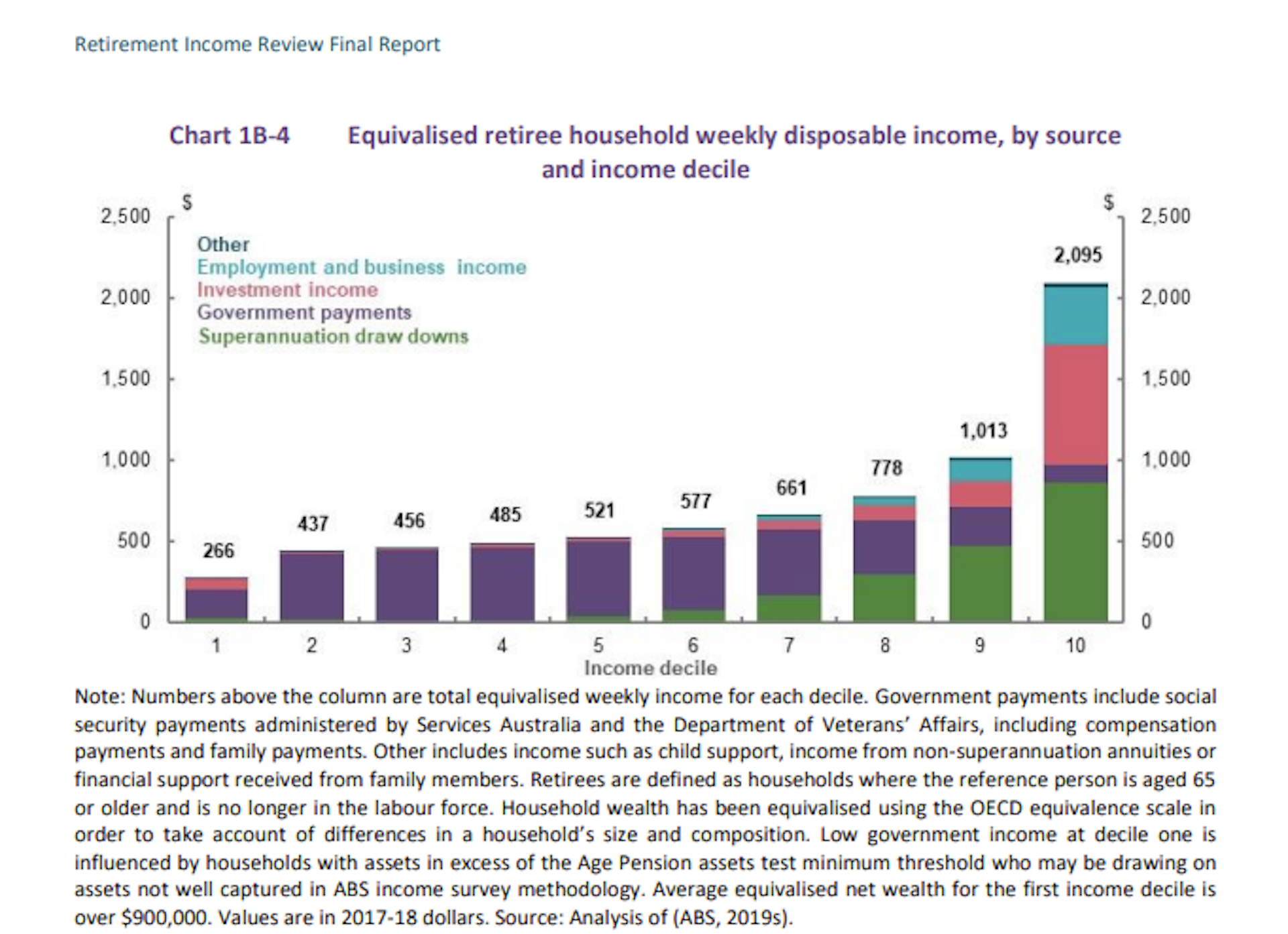
The government’s 2020 retirement income review found high-income Australians earned as much again from investment income outside super as they made from withdrawals from it. They do alright.

Scott Morrison, much criticised for the generosity to high income earners of his Stage 3 tax cuts, moved in the right direction on super. Jim Chalmers is picking up where he left off.The Conversation

This article is republished from The Conversation under a Creative Commons license. Read the original article.

Read more >>

Tuesday, July 26, 2022

Labor is winding back reforms meant to hold super funds accountable to their members

Who could even question a requirement that super funds act in the best financial interests of their members?

Labor’s new assistant treasurer Stephen Jones, that’s who.

While the treasurer himself has been working on Thursday’s major economic statement, Jones has asked the treasury to consider concerns relating to the “regulatory complexity” of a requirement that funds act in their members best financial interests – a requirement that on the face of it is straightforward.

Oddly, he titled the announcement “Review to strengthen super,” a title he might need to rework if the review finds the duty should be weakened.

The Coalition strengthened the requirement a year ago as part of a suite of reforms called “Your Future, Your Super”, changing it from a duty to act in the “best interests” of members to the best “financial” interests of members.

The difference between the two is that whereas spending members funds on things such as corporate hospitality or wellbeing services or news websites might arguably be in the best interests of members, it need not be in the best financial interests of members.

And that’s what superannuation funds are meant to be for – to grow rather than spend the trillions entrusted with them for workers’ retirements.

To make sure the funds do it, the Coalition reversed the onus of proof. If questioned, fund directors needed to be able to demonstrate that their spending was in the best financial interests of their members, or at least in what they thought at the time would be their members best financial interests.

‘Best financial interests’ up for review

That might be the “regulatory complexity” the assistant treasurer is referring to –a requirement directors use their members funds to grow their members funds, and be able to demonstrate that’s what they were attempting if asked.

It’s good news for members, whose compulsorily-acquired funds the directors are managing, but troubling for some directors (in industry funds most directors are union and employer representatives), and Jones listened to the directors.

He has backed them on another concern.

The Coalition’s regulations require funds to itemise their spending on political donations and payments to related parties and industrial bodies, as well as their spending on marketing, in a statement to members before each annual meeting.

Jones has drafted regulations that remove the requirement for itemisation while leaving in place the requirement for funds to report the totals to members.

It won’t save the funds work (they still have to itemise each payment in order to prepare the totals), but it will save them embarrassment.

And he is tampering with perhaps the most important super reform of them all.

Performance test up for review

Last year for the first time each of the 80 MySuper funds (the funds into which new employees can be defaulted) was graded on its performance.

Thirteen failed. They weren’t being graded on absolute returns. That would have been unfair. They were graded on returns over the past seven years given their stated investment strategy.

If their strategy had been to (say) invest all of their members funds in shares, and shares did badly, that would be fine so long as the fund’s shares didn’t do significantly worse than the share market as a whole over seven years, which is a way of saying it is a hard test to fail.

Under the Your Future, Your Super rules the 13 funds that failed were required to write to their members telling them they had performed badly and suggesting they switch to a better-performing product.

The second test will be this year. Any funds that fail two years in a row get banned from accepting new members.

Not that it’s likely to come to that. Eleven of the 13 have merged or are in the process of merging with better funds, which is how the system is supposed to work. It is weeding out dud funds, advancing members interests.

Even the fear of failing is advancing members interests. Industry observers say funds likely to fail are cutting their fees to ensure they don’t. The performance test is on returns net of fees.

Twelve month pause

From next year the test was to be extended to all super funds, whether default or not, so it could really weed out the duds. The Productivity Commission found non-default funds performed notably worse than default funds.

But Jones says he’ll stop the extension – “pause” is his word – for 12 months while the treasury rechecks the system for “unintended outcomes”.

Hundreds of funds (some of them bad) will be given a reprieve, something that was itself unintended when the system was set up.

There are genuine concerns about the test. It is backward looking, as it has to be, and funds in difficulty will have it made worse by an exodus of members when the results are published.

But these are concerns for the directors of the funds, not their members. And Australians put more of their money into super than anything other than housing.

A landmark 2018 Productivity Commission inquiry found much of the system was a “mess” that allowed poorly performing funds to produce $660,000 less in retirement than well-performing funds.

Your Future, Your Super was the government’s response to that. It’s already achieved a lot. Until the new minister hit pause, it was about to achieve more.The Conversation

This article is republished from The Conversation under a Creative Commons license. Read the original article.

Read more >>

Wednesday, April 06, 2022

The super giveaway that gives more to the already-wealthy, tax-free

One of the strangest, certainly one of the hardest to justify, measures in last week’s budget was called “supporting retirees”.

A better title would have been “supercharging the wealth of those retirees who already have more than enough to live on”.

It flies in the face of the findings of the government’s own retirement income review and legislation it introduced partly in response earlier this year.

It happens not to support the living standards of retirees at all. It will enable some to spend less on themselves than they would have, while enabling those with serious wealth to accelerate the accumulation of even more, tax-free.

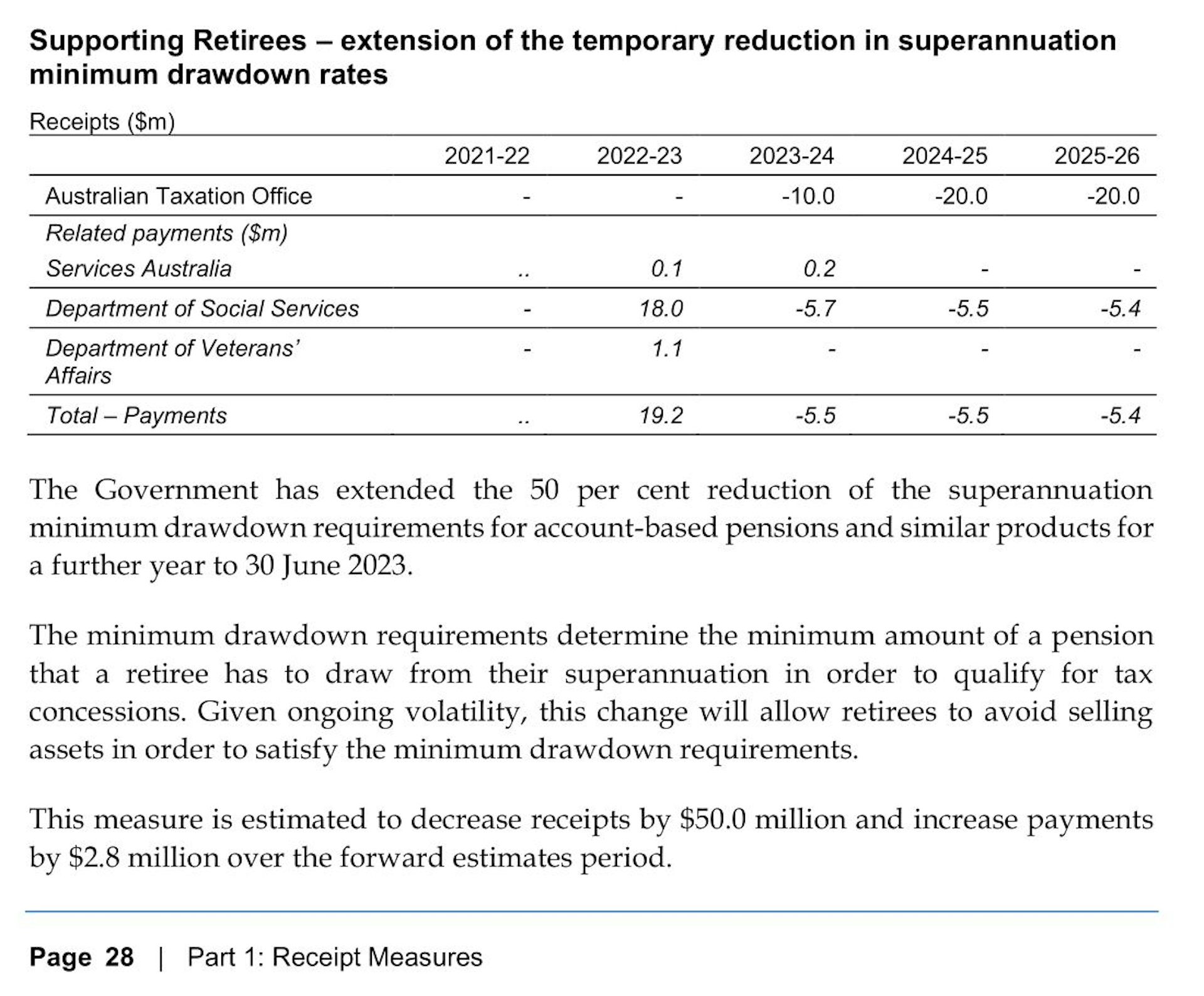
What the measure does is extend a temporary COVID relaxation of the rules requiring retirees to actually withdraw a minimum amount from their super each year, introduced in March 2020 when financial markets were in free-fall.

All retirees are required to withdraw a minimum amount from super each year in order to ensure it isn’t simply used as a vehicle to accumulate tax-free savings that aren’t used.

Retirees have to withdraw a minimum per year

For retirees aged 65-74 the regulated minimum is 5% per year, for those aged 75-79 it is 6% per year and so on, up to retirees aged 95 and over, who are required to withdraw at least 14% per year.

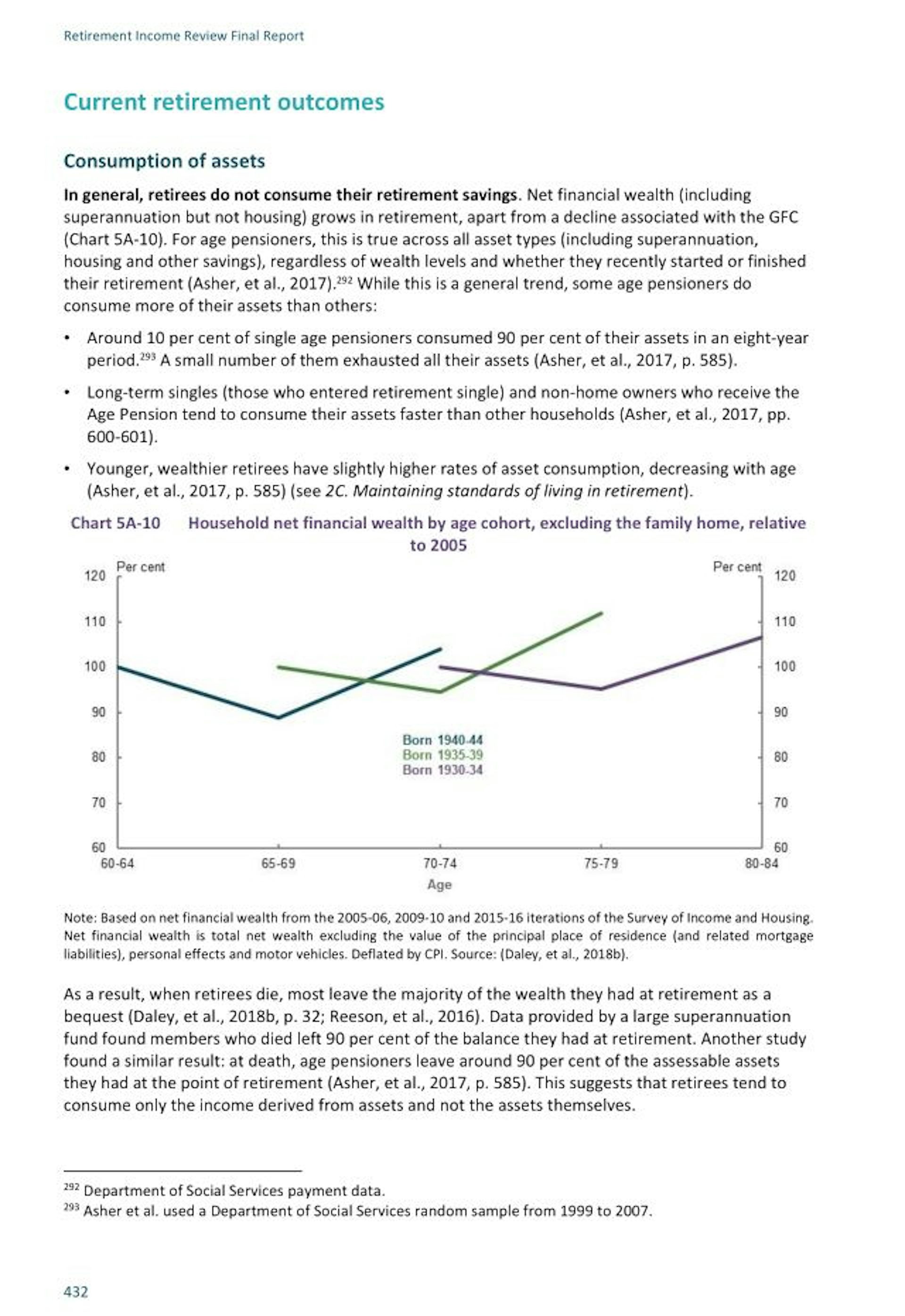
Nothing stops retirees withdrawing more than the regulated minimum, but the review found that in practice the typical withdrawal rate is just above the minimum, because people use it as an “anchor” or guide to what to do.

It identifies the most common misconception about super being that

“the minimum drawdown rate is what the government recommends”

It says another is: “I should only draw down the income earned on my assets, not the capital”. Both set up retirees for a much lower standard of living than they could get.

The review finds that if a middle earner drew down an optimum amount rather than the minimum required, his or her super income would be 20% higher.

Instead, most retirees “die with the bulk of their wealth intact”. One fund told the review its members who died left 90% of the balance they had at retirement.

Most die with most intact

It’s at odds with the purpose of super, defined by the government as to provide “income in retirement”. In February the government legislated to help make sure this is what funds did. From July they will be required to present to their members with an income strategy, for which bequests “should not be an aim”.

Things changed when the Australian share market collapsed 30% between mid-February and mid-March 2020 as coronavirus took hold.

As a “temporary” measure, Treasurer Josh Frydenberg halved the drawdown requirements, in order to enable retirees to better build up their balances after the storm passed. A similar measure was introduced during the global financial crisis.

The storm passed quickly. Markets began climbing back the day the treasurer made the announcement, and then kept climbing. SuperRatings says in the past year the median balanced super fund has grown 13.4%.


Yet oddly, the government extended the measure in May last year when the market was soaring to new heights, in order to “make life easier for our retirees” and then extended it again on budget night in order to “recognise the valuable contribution self-funded retirees make to the Australian economy”.

It is as if the government has junked the idea that super should actually be used to provide income to the people who accumulate it.

As it happens there is nothing in the drawdown requirements that forces retirees to spend on themselves (and nor could there be). All they do is force retirees to withdraw a minimum amount from the generally tax-free environment that is retiree super, and have it treated like other people’s investments and savings.

Earnings in retiree super untaxed

If retirees aren’t forced to withdraw a minimum, in the words of the retirement income report to the treasurer, large amounts will be held in super “mainly as a tax minimisation strategy, separate to any retirement income goals”.

The only justification offered in budget papers (a weak one) refers to “ongoing volatility” and the need to “allow retirees to avoid selling assets”.

But markets are generally volatile, and it is usually super funds that sell assets, not retirees. It’s as if the measure is directed at self-managed super funds, some of which are rich beyond most of our wildest dreams, certainly far too rich to need to pay out anything but a tiny percentage of their holdings to their members.

A freedom of information request by the Australian Financial Review has revealed that 27 such funds hold more than A$100 million each. Its best guess is they are owned by Australia’s wealthiest families.

Of course, most retirees have much lower balances, and are reluctant to withdraw funds for another reason. Perhaps surprisingly, studies examined by the review find that main reason isn’t a desire to pass on an inheritance to their children.

Overwhelmingly, retirees are concerned about “outliving their savings”.

Frightened of outliving savings

The prospect of inferior aged care or a late health emergency compels most retirees to save far more than they are likely to need, just in case.

Many are unaware of how little end-of-life aged and health care can cost (“especially given the complexity of aged care means-testing arrangements”) and many more want to buy their way out of standard care because of the awful things they have heard, some of it in the aged care royal commission.

It makes Labor’s budget reply promise of more money for aged care and a nurse on each site 24/7 doubly attractive. It might stop us hanging on to absurd amounts of our super out of fear.

It might allow us to relax and enjoy what could be the best decades of our lives.

Peter Martin, Visiting Fellow, Crawford School of Public Policy, Australian National University

This article is republished from The Conversation under a Creative Commons license. Read the original article.

Read more >>

Wednesday, September 01, 2021

My super fund just failed the APRA performance test. What’s next?

Failure is only the beginning.

Thirteen of Australia’s 80 closely-regulated MySuper superannuation funds have failed the APRA performance test.

There’s a fair chance you are among the one million people in them.

The results were made public on Tuesday and handed to the funds on Monday. From here on — for the people who run those funds — it’s about to get worse.

APRA is the Australian Prudential Regulation Authority. Landmark reforms introduced in response to a devastating Productivity Commission report into the “mess” that is much of Australia’s super industry require APRA to rate each MySuper fund (and from next year most other funds) with a pass or a fail according to how they have managed their members’ money.

To fail — as one in six funds have — would require the fund to have for seven or eight years managed its members’ funds so badly that when judged by its own stated investment strategy, those members would have been better off investing in the broad categories of assets themselves and paying the managers to stay away.

Under the rules, which go by the name Your Future, Your Super, funds can only be given a “pass” or a “fail”. Those that fail are required to write to their members.

Letters humbling

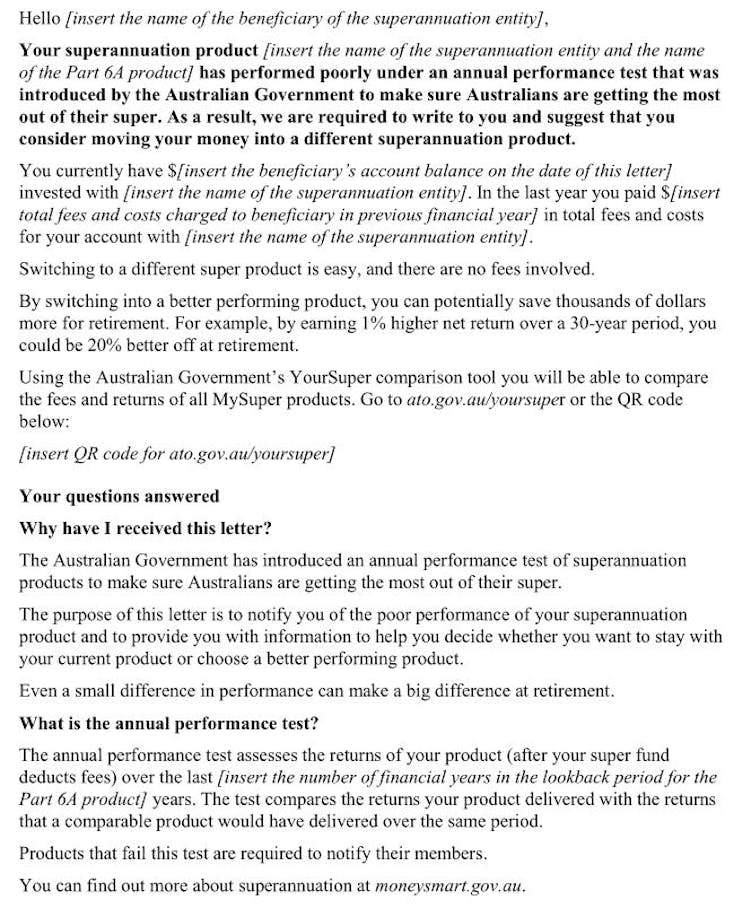
The letters, which have to be delivered within 28 days, and which APRA will check, are humiliating.

“Hello [fund member],” they begin. “Your superannuation product has performed poorly under an annual performance test”.

As a result, we are required to write to you and suggest that you consider moving your money into a different superannuation product.

By switching into a better performing product, you can potentially save thousands of dollars more for retirement. For example, by earning 1% higher net return over a 30‑year period, you could be 20% better off at retirement.

At the bottom of each letter is a QR code members can use to go to ato.gov.au/yoursuper to compare funds’ performance. If members log in with their MyGov account they will be told exactly what super they have and where it is (I’ve tried it and it works) and get a comparison tailored to their circumstances.

The 13 funds forced to send out these letters will be lucky to see out the year. Once a fund suffers withdrawals and has to pay out members it performs even worse. Within months, many will be taken over.

Killing season

Those that remain are unlikely to last a second year. Once a product fails for two consecutive years (most that fail in the first year are expected to fail in the second) it will be prohibited from accepting new members, which means it’ll be killed.

It may or may not be relevant, but the driving forces behind the revolution are women. Women typically do much worse out of super than men.

Karen Chester chaired the Productivity Commission inquiry that quantified the hundreds of thousands of dollars lost in retirement by each worker who stays in a dud fund, and came up with the first draft of the performance test.

Kelly O'Dwyer, as financial services minister championed it, as did her successor Jane Hume.

In charge of policing the rules is APRA executive board member Margaret Cole, who was known as the “enforcer” during her time as director of enforcement and financial crime at the UK Financial Services Authority.

On Friday she declared bluntly that Australia had too many funds, too many persistently underperforming funds and too many with fees that remain too high.

Industry funds among those failed

Among the chronic underperformers now facing a death spiral are five industry funds — two of them run by members of Industry Super Australia, the organisation that represents funds set up “only to benefit members”.

Rather, they were members. Maritime Super left just ahead of the results. LUCRF, originally set up by what is now the United Workers Union, was terminated on the release of the results. Industry Super scrubbed it from its website.


Australian Prudential Regulation Authority

The other industry funds that failed the performance test are run by the Australian Catholic Superannuation and Retirement Fund, Christian Super and the Victorian Independent Schools Super Fund.

Among the for-profit failures are funds run by Westpac (BT Super) and the Commonwealth Bank (Colonial First State).

The banking royal commission found that funds run by banks often pay money to other parts of the bank for services such as buying and selling bonds, rather than doing it themselves or through brokers who would get better prices.

In the dark, until now

Super customers needn’t know what happens. They don’t get bills.

Whereas electricity bills hurt when they are delivered and have to be paid, the bills for super fees (and hidden fees in the form of relentless underperformance) aren’t seen, and don’t have to be paid — the fees come out of the funds.

And the funds grow every year, even where they are squandered. Compulsory super throws in a fresh 10% of salary each year.

The aim of what’s happened this week is to make visible what is normally invisible, and to prod people into action.

An act of faith… in competition

The government could have gone down a different track.

Peter Costello, the long-serving Coalition Treasurer who now heads the Future Fund which manages government investments, wanted his successor to create a government super fund (run by his Future Fund) which it would default new workers into.

The Future Fund would have protected workers, but to do it, would have played safe. As it became dominant it would have stifled competition and the promise of better returns. Or that was the thinking.


Read more: Super funds have been working for themselves when they should have been working for us. That's about to change


Chester, O'Dwyer, Hume and Treasurer Josh Frydneberg decided instead to supercharge competition — to make crystal clear which are the funds to run from and the funds to run to. They are making running as easy as two clicks.

One in every 11 dollars we earn is funneled into superannuation. Legislated increases mean it will soon be one in nine.

It’s important it’s looked after.The Conversation

Peter Martin, Visiting Fellow, Crawford School of Public Policy, Australian National University

This article is republished from The Conversation under a Creative Commons license. Read the original article.
Read more >>

Wednesday, March 24, 2021

Super funds have been working for themselves when they should have been working for us. That’s about to change

Have you ever wondered why your super fund rarely sends you mail?

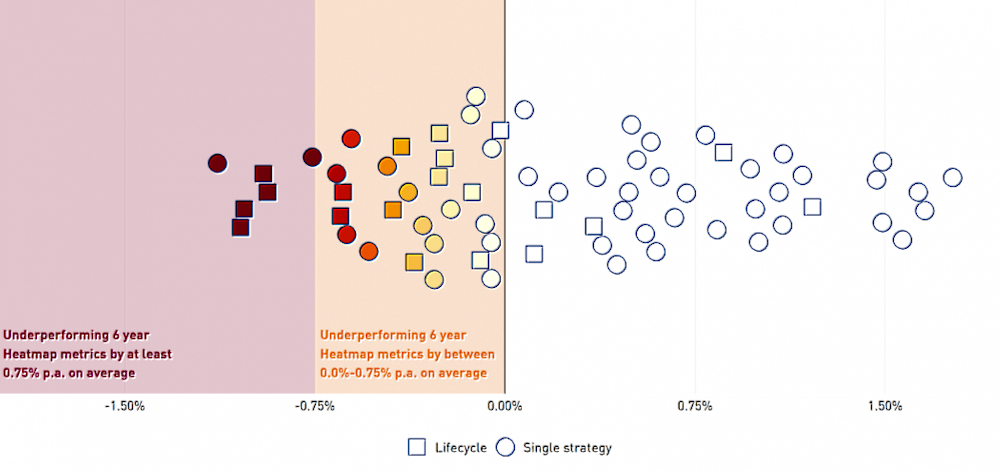
It could be because it is one of the 36 funds that perform badly, or one of the six funds that perform extraordinarily badly. As of mid last year those six funds managed the retirement savings of 900,000 Australians.

Not that you would know it from their communications. The wonder of a system that pours a fresh 9.5% of your salary into super each year is that your fund is able to show an upward graph of the amount you’ve got saved even if it is managing those savings badly. You might think it was performing well.

Or your fund might have a more straightforward reason for avoiding mail.

The head of Australia’s biggest super fund, Australian Super with 2.4 million members, spelled it out in an appearance before the banking royal commission.

He said “a direct mail-out – a one-off direct mail-out to Australian Super’s members — costs $2.3 million”.

A million here, two million there…

Chief executive Ian Silk was trying to put into context the $2 million Australian Super threw at the startup news site New Daily throughout 2012 and 2013. He said the $2 million (long gone) wasn’t an investment in the financial sense of the term, but an investment in communications, “a tool to enhance the fund’s engagement with members”.

It’s an investment that will be illegal from July under the government’s proposed Your Future, Your Super law, along with those rather odd TV advertisements implying improbably that unless the government lifts compulsory super contributions, people might lose their houses.

It will be illegal for funds to spend money on these things even if they route the payments through a third party such as the super-fund-owned Industry Super Australia, as they now are.


Read more: That extra you're about to get in super, most of it will come from you, but don't expect the ads to tell you that


The new laws, which flow from the royal commission and a Productivity Commission inquiry, will require every cent of super fund spending (without “any materiality threshold”) to be directed to the best financial interests of members.

What’s different is the addition of the word “financial”. Previously funds were only required to act in the “best interests” of the members.

Until now (and this is an example used in the explanatory memorandum) it might have been OK for a fund to spend member contributions on “well-being and counselling services, due to its preference for providing beneficiaries with a holistic retirement experience”.

Services, seats at the Australian Open

It won’t be legal after July. Spending will have to be in the best “financial” interests of members.

And the onus of proof will be reversed. If challenged, funds will have to demonstrate that their decisions were indeed in the best financial interests of their members, rather than regulators demonstrating that they were not.

Which it should be. It’s our (mainly conscripted) money that they are spending. If they can’t make out a case for the way they are spending it, they might be acting as if it’s their own.

Shockingly, when in 2017 the Productivity Commission inquiry into super asked all 208 funds regulated by the Prudential Regulation Authority for information about their spending and net returns and fees by asset class, 94 didn’t respond.

A cavalier approach to finances

Of the 114 funds that did respond, 26 left blank all of the bits of the form that asked about assets, net returns and investment management costs.

When the commission tried again the following year, 13 of the 136 funds that responded provided no information about expenses at all. It was as if they either didn’t know about their expenses, or felt it was their business and no one else’s.

Time and time again the commission heard about bank-operated funds buying products from other parts of the bank at high prices.

The banking royal commission heard of hundreds of thousands of dollars spent by just one (industry) fund on corporate hospitality at the Australian Open.

It heard of directors of a retail fund who decided against putting their members into lower-priced products when they became available, overruling a lone director who protested, using capital letters

in what circumstances would it NOT be in a client’s best interest to transfer to the new pricing if it was lower than their existing pricing?

Spending on advertising would still be permitted under the draft legislation, but only where it was in the best financial interests of members. If it was aimed at grabbing members from other funds it probably would pass the test, because when funds get bigger the costs per member can shrink.

But the guidance note makes it clear that the costs per member would need to actually shrink, along with the charges to members, or there would need to be a documented case prepared as to why they should have shrunk.


Read more: Yes, women retire with less than men, but boosting compulsory super won't help


Vanity advertising, or advertising for a group of funds, or advertising aimed at influencing public opinion won’t cut it.

And nor will indifferent performance. The law will require the Prudential Regulation Authority to annually test the performance of funds against objective, consistently-applied benchmarks, different benchmarks for different stated investment strategies.


Early MySuper test results

Five-year performance as at June 30 2020, the darkest coloured funds are the poorest performers. APRA

Funds that fail the test will be required to notify their members in writing. Funds that fail two years in a row will be closed to new members.

Most of us probably have no idea that we spend more on super investment and administration fees each year than we do on gas and electricity combined.

And when the performance is lousy (the difference between a good and bad fund can be $660,000 in retirement) we often don’t find out until it’s too late.

Our funds are about to have to work for us first, and no-one else.

Peter Martin, Visiting Fellow, Crawford School of Public Policy, Australian National University

This article is republished from The Conversation under a Creative Commons license. Read the original article.

Read more >>

Wednesday, February 10, 2021

That extra you're about to get in super, most of it will come from you, but don't expect the ads to tell you that

There’s something odd about those television and internet advertisements telling us we are getting more super.

The money seems to come from nowhere.

“Pretty soon,” explains the woman getting onto an escalator, “the amount of super paid on top of our wages will go up”.

Fair enough, but the increases in compulsory super contributions will come out of the same bucket as wages – so-called on-costs which employers use to pay wage cheques, workers compensation, payroll tax, employees pay-as-you-go tax, and employees super contributions, which is also known as the “super guarantee”.


Read more: Retirement incomes review finds problems more super won't solve


The ad is a bit like those promising buyers of mobile phones the “free gift” of an accessory. It has to be paid for somehow, and it’s usually out of the purchase price.

Paul Keating, prime minister when compulsory super was introduced in 1992, put it this way in a reflection on the history of modern superannuation in 2007

the cost of superannuation was never borne by employers. It was absorbed into the overall wage cost

Last year’s retirement income review examined every study that had ever been conducted on the topic and concluded that the “weight of evidence suggests the majority of increases in the super guarantee come at the expense of growth in wages”.

A more informative advertisement would have referred to super “paid on top of our wages, at the expense of our wages”.

The ads are funded by Industry Super, which represents the big funds that want to manage the extra super. There’s no reason for them to tell the whole story.

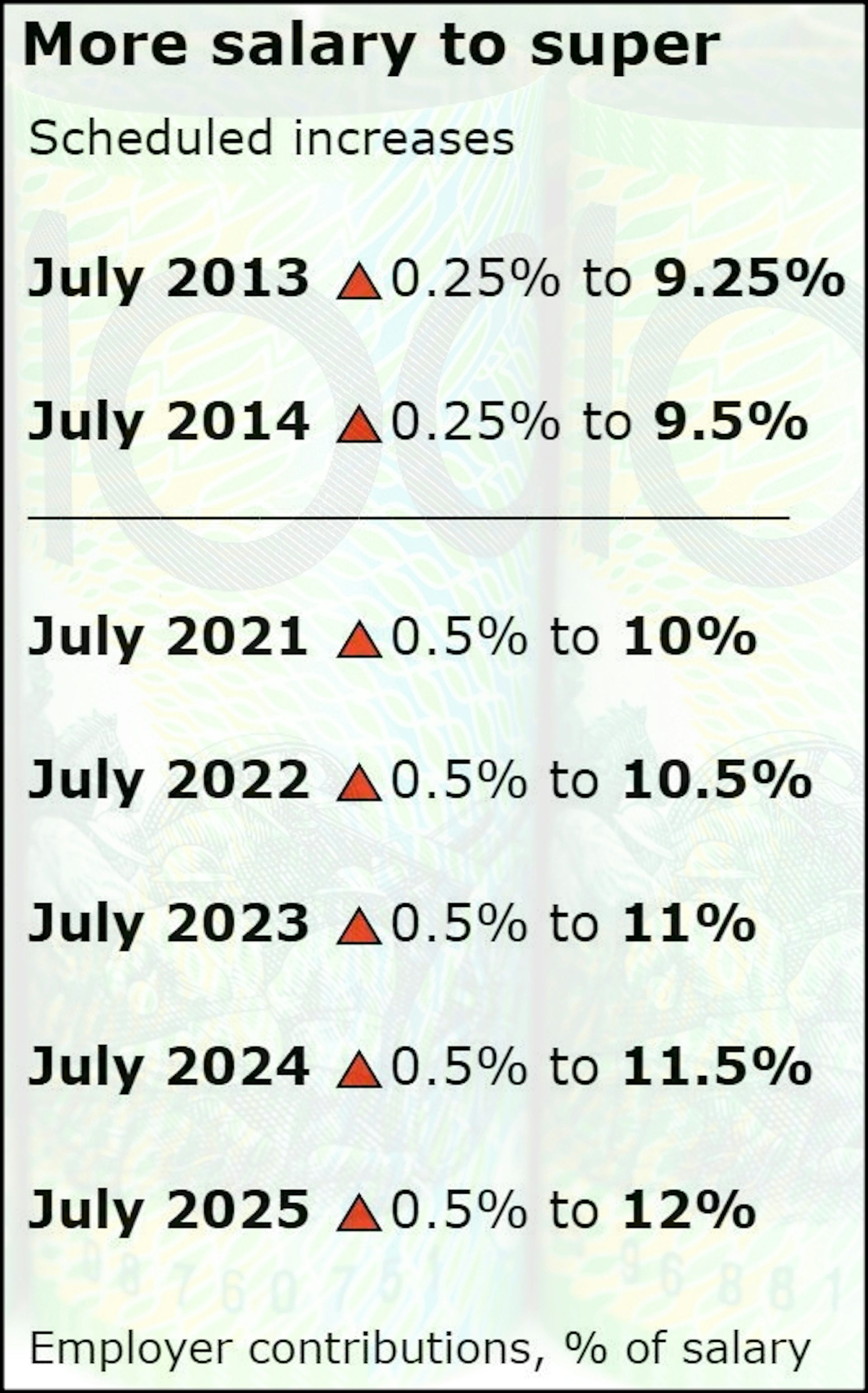
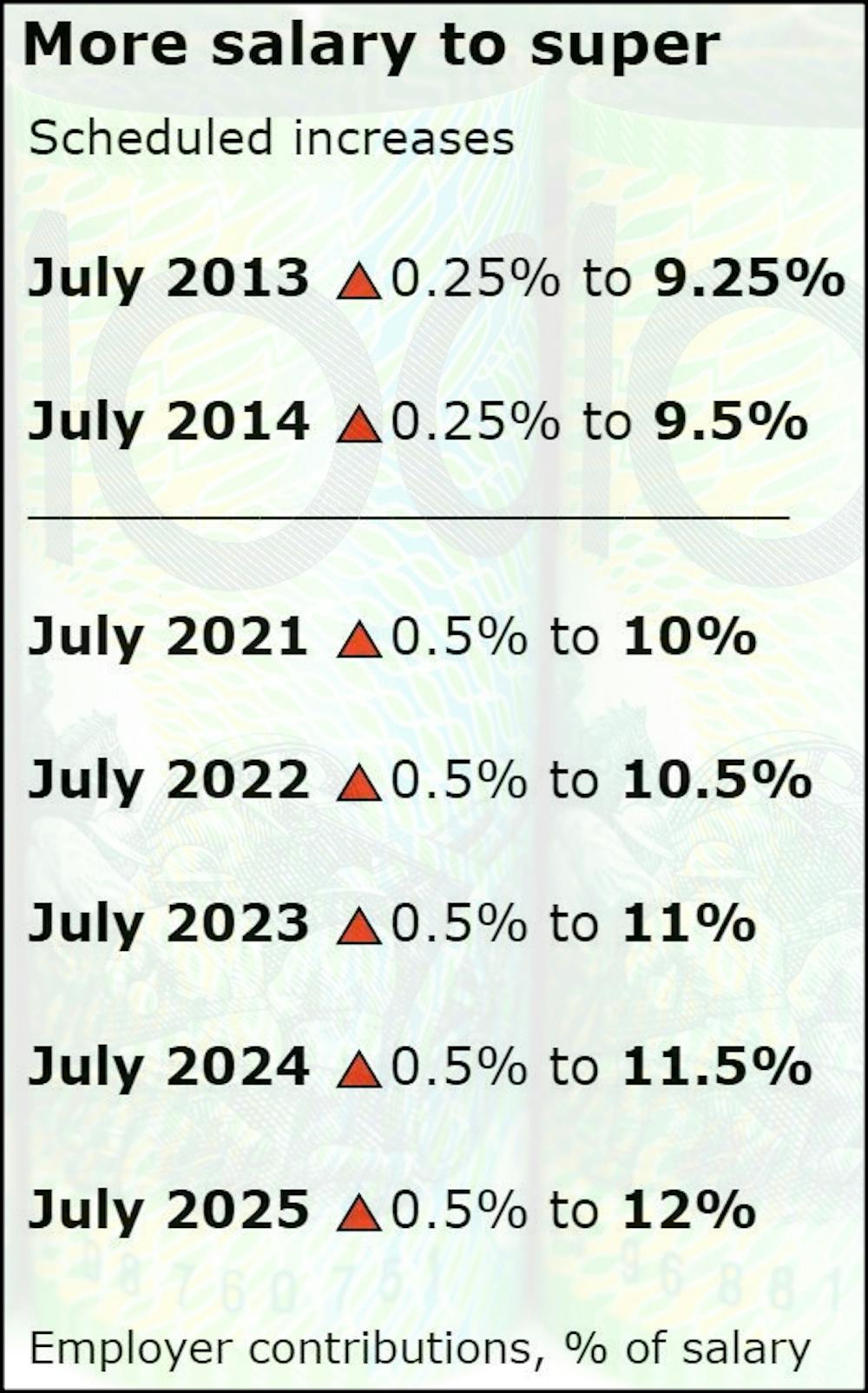
They’re the start of a campaign to get the government to actually deliver the five legislated increases of 0.5% of salary starting in July that are scheduled to take compulsory super from 9.5% of salary to 12% over five years, and they are about to get more aggressive.

An extra half a percent of salary into super each year for five years culminating in an extra 2.5% would be a big ask at any time, but in the present circumstances it is worth considering how a COVID-affected employer might respond.

That employer has choices. It could shave each of the next five annual wage increases so that it won’t end up paying out more than it would have.

Or it could eat into profits (which is difficult if it is barely surviving), or attempt to put up prices (which is also difficult at the moment) or it could shave its wage bill by letting go of staff.


Read more: Australia's top economists oppose the next increases in compulsory super: new poll


In normal circumstances the first is the most likely, although in the circumstances we are in, and given the scale of the increases proposed, economists don’t rule out some of the last - letting go of staff.

The less employers expand employment or the less they increase wages, the less will be spent on their products, giving them even less money for wages. Household saving is already at unprecedented highs.

Most of us save enough, some too much

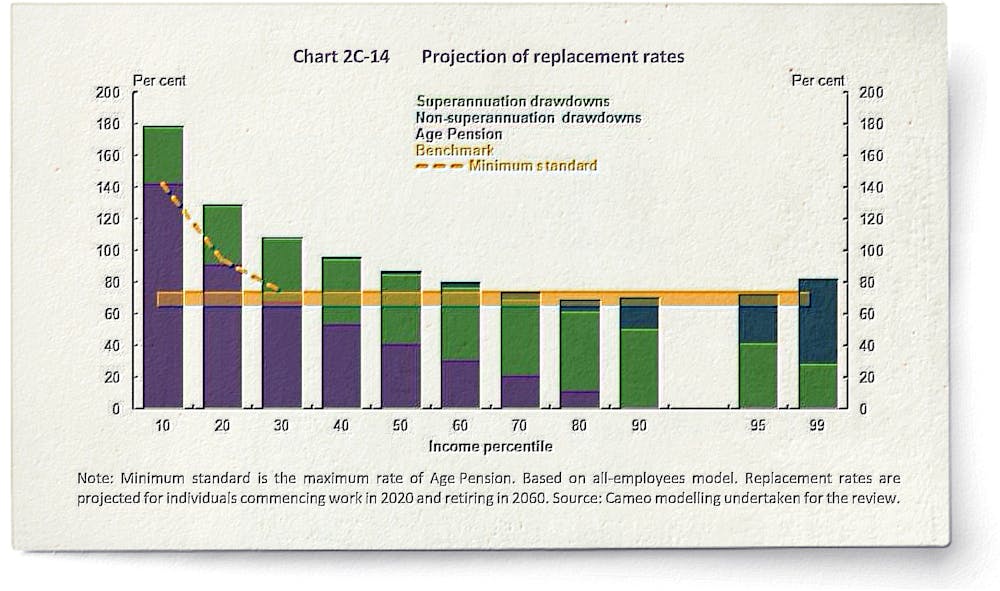
These downsides might be worth putting up with if we needed the extra super, but the November retirement income review found that – to the surprise of some – we don’t.

High earners have always saved enough for retirement, originally outside of super and now inside of it, making very large extra contributions on top of what’s compulsory in order to take advantage of the tax benefits.

Low earners earn so little while working that the cocktail of super, the pension and private savings gives them about as much or more per year in retirement as they got while working, albeit partly funded at the expense of wages while they are working.


Read more: Home ownership and super are far more entwined than you might think


The review found that if the increases in compulsory super proceed as planned, the bottom one third of retirees will get more than they got while working.

International benchmarks suggest most non-renters need only 65-75% of what they got while working, because they face far fewer of the costs they faced in their working lives including paying off a home, saving for retirement, raising and educating children, and commuting.

If the legislated increases in compulsory super go ahead, an astounding two-thirds of Australian retirees will get more than that benchmark. They will have been enriched in retirement at the expense of their living standard while working.

Retirement Income Review

So where does the target of 12% salary locked away in super come from? You might be forgiven for thinking it was adopted after an independent review, and you’d be partly right.

The 2009 retirement income system review conducted as part of the Henry Tax Review examined the right amount of super and concluded that “the superannuation guarantee rate should remain at 9 per cent”.

Yet as the review’s final report endorsing that conclusion was being released on May 2, 2010 Prime Minister Kevin Rudd and Treasurer Wayne Swan announced that “the superannuation guarantee will be gradually increased to 12 per cent, implying that decision derived from the review.

12% is not what was recommended

It didn’t derive from the review, but the hubbub over the mining tax announced at the same time meant that few people noticed.

The best thing to do would be to abandon the 12% target. It’s neither something we need nor something that would help us at the moment.

But if the super lobby makes that hard, I’ve another idea. It’s to allow the increase to proceed - an extra 0.5% of salary from each employer per year, amounting to 2.5% of salary after five years - but to give workers the option of having it directed instead to their wage account. For an employer, it’ll make no difference which account it goes to.

For Australians short of income at the time they need it, and an economy needing wages and spending, it might make a difference.

Peter Martin, Visiting Fellow, Crawford School of Public Policy, Australian National University

This article is republished from The Conversation under a Creative Commons license. Read the original article.
Read more >>

Friday, November 20, 2020

Retirement review finds problems more super won’t solve

It would be a waste if the Friday’s mammoth Retirement Incomes Review was remembered only for its finding that increases in employers compulsory superannuation contributions come at the expense of wages.

That has long been assumed, and is what was intended when compulsory super was set up.

Compulsory super contributions are set to increase in five annual steps of 0.5% of salary between 2021 and 2025.

These are much bigger increases than the earlier two of 0.25% in 2012 and 2013.

And the wage rises they will be taken from will be much lower. The latest figures released on Wednesday point to shockingly low annual wage growth of 1.4%.

Should each of the scheduled increases in employers compulsory super knock 0.4 points off wage growth (which is what the review expects) annual wage growth would sink from 1.4% to 1%.


Read more: Workers bear 71% to 100% of the cost of increases in compulsory super


Private sector wage would sink from 1.2% to 0.8%, in the absence of something to push it back up.

Because inflation will almost certainly be higher than 1%, it means the buying power of wages would go backwards, all for the sake of a better life in retirement.

The review presents the finding starkly. Lifting compulsory super contributions from 9.5% of salary to 12% will cut working-life incomes by about 2%.

And for what? It’s a question the review spends a lot of time examining.

Most retirees have enough

The review dispenses with the argument that the goal of a retirement income system should be “aspirational”, or to provide people with higher income in retirement than they had in their working lives.

It finds that for retirees presently aged 65-74 the replacement rates for middle to higher income earners are generally adequate.

Many lower-income earners get more per year in retirement than they got while working.

If the increases in compulsory super proceed as planned, this will extend to the bottom 60% of the income distribution.

They’ll enjoy a higher standard of living in retirement than while working (and will enjoy a lower standard of living while working than they would have).

Most retirees die with most of what they had when they retired, leaving it as a bequest. They are reluctant to “eat into” their super and other savings because of concerns about possible future health and aged care costs, and concerns about outliving savings.

The review quite reasonably sees this as a betrayal of the purpose of government-supported super, saying

superannuation savings are supported by tax concessions for the purpose of retirement income and not purely for wealth accumulation

It’s the pension that matters

The pension does what super cannot. It provides a buffer for retirees whose income and savings fall due to market volatility, and for those who outlive their savings. 71% of people of age pension age get it or a similar payment. More than 60% of them get the full pension.

If there’s one key message of the review, it is this: it is the pension rather than super that matters for maintaining living standards in retirement, which is what the review was asked to consider.

It is also cost-effective compared to the growing budgetary cost of the super tax concessions.


Read more: Why we should worry less about retirement - and leave super at 9.5%


The age pension costs 2.5% of GDP and is set to fall to 2.3% of GDP over the next 40 years as the super system matures and tighter means tests bite.

Treasury modelling prepared for the review shows that if more money is directed into super and away from wages as scheduled, the annual budgetary cost of the super tax concessions will exceed the cost of the pension by 2050.

There’s a real retirement income problem

A substantial proportion of Australians, about 30%, are financially worse off in retirement than while working, and they are people neither super nor the pension can help.

Mostly they are older Australians who have lost their jobs and cannot get new ones before they before eligible for the age pension or become old enough to get access to their super. Often they’ve left the workforce due to ill health or to care for others and are forced to rely on JobSeeker, which is well below the poverty line.


Read more: Forget more compulsory super: here are 5 ways to actually boost retirement incomes


It’s much worse if they rent privately. About one quarter of retirees who rent privately are in financial stress, so much so that the review finds even a 40% increase in the maximum Commonwealth Rent Assistance payment wouldn’t be enough to get them a decent standard of living in retirement.

No recommendations, but findings aplenty

The review was not asked to produce recommendations. Instead, while noting that much of the system works well, it has pointed to things that need urgent attention.

It finds that pouring a greater proportion of each pay packet into the hands of super funds is not the sort of attention needed, and in the present unusual circumstances could cost jobs as employers who can’t take the extra cost out of wages take it out of headcount.

The government will make a decision about whether to proceed with the legislated increase in compulsory super in its May budget, just before the first of the five increases due in July.The Conversation

Peter Martin, Visiting Fellow, Crawford School of Public Policy, Australian National University

This article is republished from The Conversation under a Creative Commons license. Read the original article.

Read more >>

Monday, August 31, 2020

Australia's top economists oppose the next increases in compulsory super: new poll

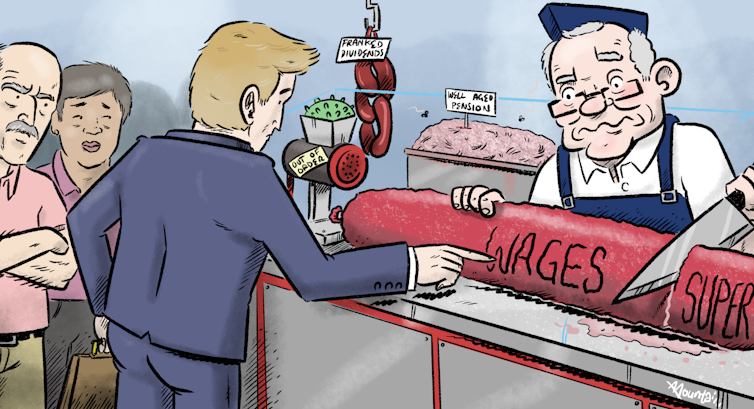
The five consecutive hikes in compulsory super contributions due to start next July should be deferred or abandoned in the view of the overwhelming majority of the leading Australian economists surveyed by the Economic Society of Australia and The Conversation.

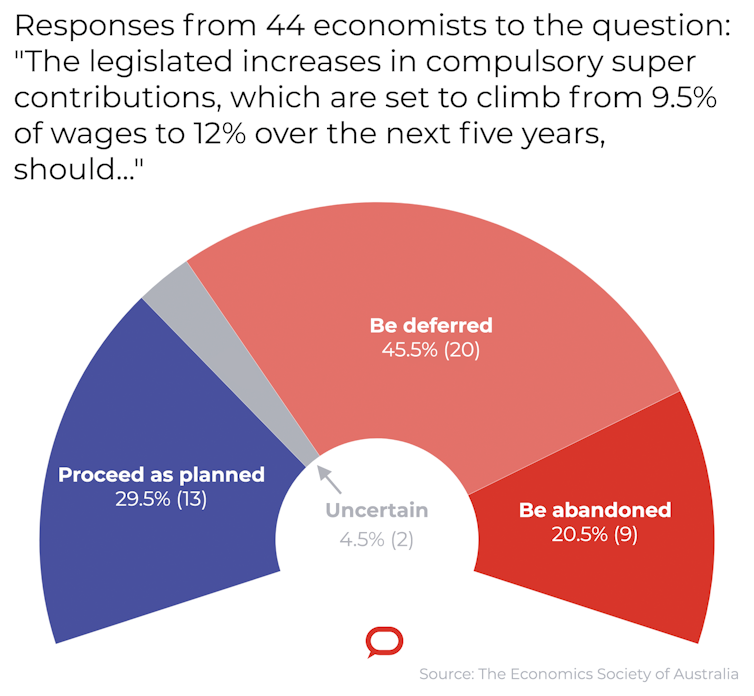
Two thirds – 29 of the 44 surveyed – want the increases deferred or abandoned. Only 13 think they should proceed as planned.

An even larger majority, including some economists who want the increases to proceed, believe they will hit wage growth. Several are concerned they will hit employment.

Compulsory superannuation contributions are paid by employers.

But ahead of the most recent increase in compulsory super, from 9% of salaries to 9.5% in 2013 and 2014, the then Labor superannuation minister Bill Shorten said the increase would cost employers nothing because it would be taken from wage rises.


“A portion of what would have been employees’ increases will go into compulsory savings,” he said.

That conventional wisdom has since been challenged in work funded by the superannuation industry and has been examined extensively in the retirement income review at present with the government.

The two most recent increases in compulsory superannuation in 2013 and 2014 were small by design – 0.25% of salary each.

The next five increases, originally due to due to begin in 2015 but postponed to start in July 2021, are much bigger – 0.5% of salary each – at a time when wage growth is much smaller.

In 2012 Shorten was expecting wage increases of 3-4% and “assuming that a quarter of a per cent of that 3% to 4% may well go into your compulsory savings”.

Wage growth has since slipped to 1.8%, the lowest on record. If the best part of 0.5% is taken out of that each year for the next five years it is unlikely to climb.


Wage growth has slipped to 1.8%

Wage Price Index annual growth, public and private, all industries, seasonally adjusted. ABS 6345.0

The 44 members of the Economic Society’s 57-member panel who responded include Australia’s preeminent experts in the fields of microeconomics, macroeconomics economic modelling, labour markets and public policy.

Among them are former and current government advisers and a former head of the Australian Fair Pay Commission and member of the Reserve Bank board and a former member of the Fair Work Commission’s minimum wage panel.


Read more: 5 questions about superannuation the government's new inquiry will need to ask


Each was asked whether the legislated increases in compulsory super contributions should proceed as planned, be deferred or be abandoned.

Only 13 of the 44 thought the increases should proceed as planned. 29 thought they should be deferred or abandoned, nine of them preferring they be abandoned altogether.


Charts showing that of 44 economists asked

Those who thought they should be deferred argued that now is “not a time to encourage saving”. In the current circumstances we should be “far more worried about spending power today than in the golden years of present-day workers”.

Economist Saul Eslake said he had changed his mind. The latest evidence (which will be updated in the retirement income review) suggests that the current 9.5% so-called super guarantee will be enough to provide most people with an adequate income in retirement .

“In saying that I acknowledge that there is still a significant problem with regard to the adequacy of superannuation savings for women relative to men, but I don’t see how raising the super rate for everyone to 12% solves that problem,” he said.

“Not a time to encourage saving”

Economic modeller Janine Dixon said it was not clear that the optimal contribution was 12% rather than 9.5%. The increase would force some households into greater debt. While this would pose a risk to economic stability at any time, Australia could “not afford to let the household sector weaken further at present”.

Economist Geoffrey Kingston said anyone who felt 9.5% was not enough remained “free to make voluntary contributions”.

Among those believing the increases should proceed as planned were two former politicians, Labor’s Craig Emerson and former Liberal leader John Hewson.

Emerson said 9.5% was “considered inadequate by the burgeoning retiree population”. Without an increase, that population “would successfully demand increased pension levels from the Commonwealth”.

Opponents more confident

Hewson said compulsory super had become a fundamental part of an effective retirement incomes strategy and, COVID and economic collapse notwithstanding, we should “finish the job”.

Sue Richardson, a former member of the Fair Work Commission’s wage panel, believed any deferral might lead to another deferral and be “hard to recoup”.

The economists were asked to rate their confidence in their responses on a scale of 1 to 10.

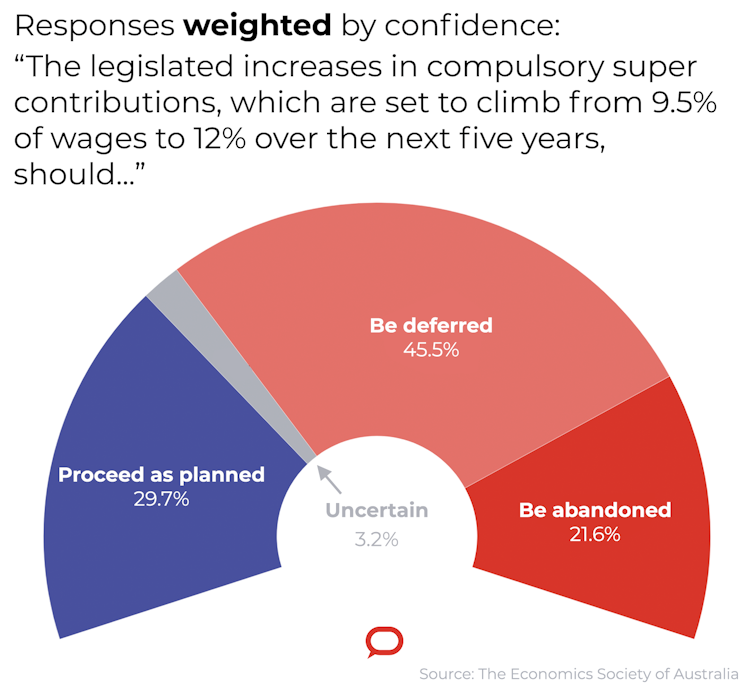
Unweighted for confidence, 20.5% of those surveyed wanted to abandon the increases altogether. When weighted for confidence, that proportion climbed to 21.6%. The proportion that wanted the increases either deferred or abandoned climbed to 67.1%


Weighted responses to the question,

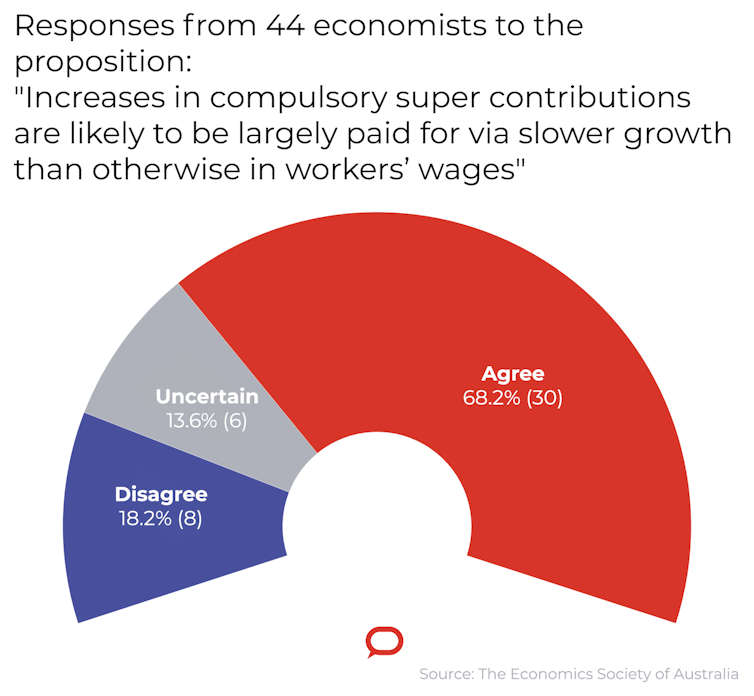
Asked whether the increases were likely to be largely paid for via slower wage growth than otherwise, 30 of the 44 economists agreed. Only eight disagreed.

Economist Nigel Stapledon said this “should not be controversial”.

Private sector economist Michael Knox said: “unless one lives in an unreal world, increases in superannuation guarantees are funded by employers out of the total wage the worker might otherwise receive”.

Super and wages come from the same pool

Several enterprise bargains explicitly make a trade-off between wages and superannuation, providing for wage increases that will be 0.5 points higher should compulsory super contributions not climb by 0.5 points.

Economist Alison Booth said if employers weren’t able to trim wage rises to pay for the scheduled increases in super contributions, they might “attempt to adjust on other margins”.

In a recession, when workers lack bargaining strength, “employers could coerce them to accept other adjustments to their contracts”.


Responses from 44 economists to the proposition:

Two of the eight economists who disagreed with the proposition that the increases in compulsory super would come at the expense of wages thought that employers wouldn’t grant wage rises anyway. Increases in super contributions might be one way for employees to get something.

A concern among both those who agreed and disagreed was that if the increase didn’t come at the expense of wages, it would push up the cost of hiring and come at the expense of jobs.

“Inflation is very likely to be very, very low and wages to be sticky,” said government advisor Matthew Butlin.

A drag on jobs if not wages

“Higher superannuation payments in an environment where wages are unlikely to rise and cannot fall will raise real labour costs and reduce the incentive to employ.”

Economic modeller Janine Dixon said that while over time the increase in contributions would probably come from wages, the immediate impact would be to increase the cost of hiring, “which is an unacceptably large risk in the present climate”.

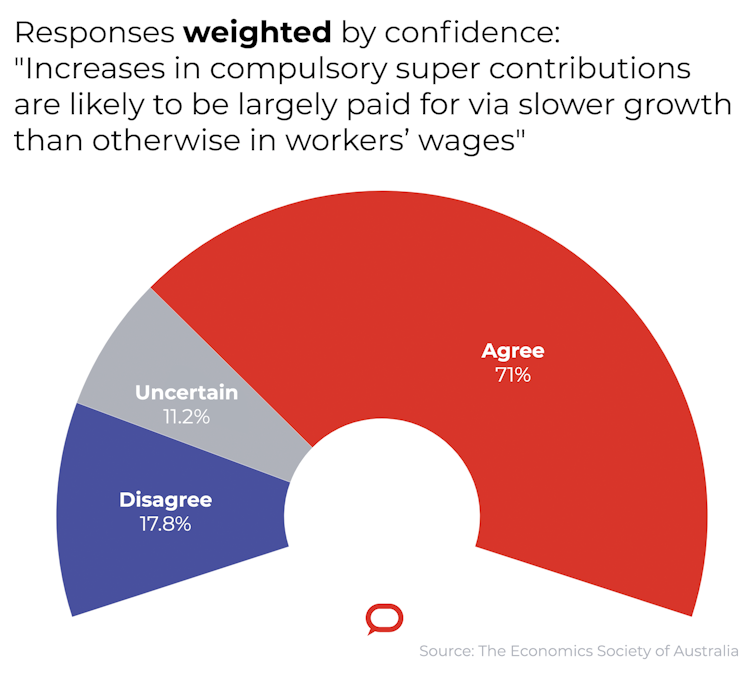
When adjusted for confidence, the proportion of those surveyed expecting the increases to largely paid for via slower wage growth climbed from 68.2% to 71%. The proportion disagreeing fell from 18.2% to 17.8%.


Weighted responses to the proposition:


Individual responses

The Conversation

Peter Martin, Visiting Fellow, Crawford School of Public Policy, Australian National University

This article is republished from The Conversation under a Creative Commons license. Read the original article.

Read more >>

Monday, September 30, 2019

5 questions about superannuation the government's new inquiry will need to ask

The government’s new retirement incomes review will need to work quickly.

On Friday Treasurer Josh Frydenberg said he expected a final report by June, just seven months after the issues paper he wants it to deliver by November.

The deadline is tight for a reason. In recommending the inquiry in its report on the (in)effeciency of Australia’s superannuation system this year, the Productivity Commission said it should be completed “in advance of any increase in the superannuation guarantee rate”.

In other words, in advance of the next leglislated increase in compulsory superannuation contributions, which is on July 1, 2021.


Read more: Government retirement incomes inquiry puts superannuation in the frame


The next increase (actually, the next five increases) will hurt.

The last two, on July 1 2013 and July 1 2014, took place when wage growth was stronger. In 2013 wages growth was 3% per year.

And they were small – an extra 0.25 per cent of salary each.

The next five, to be imposed annually from July 1 2021, are twice the size: 0.5% of salary each.

If taken out of wage growth, they’ve the potential to cut it from its present usually low 2.3% per annum to something with a “1” in front of it, pushing it below the rate of inflation, for five consecutive years.

If we were going to do that (even if we thought the economy and wage growth could afford it) it would be a good idea to have a good reason why. After all, compulsory superannuation is the compulsory locking away of income that could otherwise be spent or used to pay down debt or saved through another vehicle, regardless of the wishes of the person whose income it is.

Question 1. What’s it for?

Fortunately, the new inquiry doesn’t need to do much work on this one.

For most of its life compulsory super hasn’t had an agreed purpose. At times it has been justified as a means of restraining wage growth, at times as means of restraining government spending on the pension, at times as means of boosting national savings.

In 2014, more than 20 years after compulsory super began, the Murray Financial System Review asked the government to set a clear objective for it, and two years later the government came up with one, enshrined in a bill entitled the Superannuation (Objective) Bill 2016.

The bill lapsed, but the objective at its centre lives on as the best description we’ve come up with yet of what compulsory super is for:

to provide income in retirement to substitute or supplement the age pension

Which raises the question of how much we need. For compulsory super, the answer is probably none. People who want more than the pension and their other savings can save more through voluntary super. People who don’t want more (or can’t afford to save more) shouldn’t.

Question 2. How much do people need?

Assuming for the moment that how much people need in retirement is relevant for determining how much compulsory super they need, the inquiry will need to examine what people need to live on in retirement.

The “standards” prepared by the Association of Superannuation Funds of Australia are loose. The more generous of the two allows for overseas travel every two or so years, A$163 per couple per fortnight on dining out, $81 on alcohol “or equivalent spent with charity or church”.


Read more: Why we should worry less about retirement - and leave super at 9.5%


It isn’t a reasonable guide to how much people need to live on, and certainly isn’t a reasonable guide for how much the government should intervene to make sure they have to live on. They are standards it doesn’t intervene to support while people are working.

And there’s something else. Super isn’t what will fund it. Most retirement living is funded outside of super, either through the age pension, private savings, or the family home (which saves on rent). Most 65 year olds have more saved outside of super than in it, and a lot more than that saved in the family home.

It’s a slight of hand to say that retirees need a certain proportion of their final wage to live on and then to say that that’s how much super should provide.

Question 3: Does it come out of wages?

The best guess is that, although paid by employers in addition to wages, compulsory super comes out of what would otherwise have been their wage bill.

Treasury puts it this way:

Though compulsory superannuation guarantee contributions are paid by employers, wage setting generally takes into account all labour costs. As such, it is widely accepted that employees bear the cost of higher superannuation guarantees in the form of lower take home pay.

The inquiry will probably make its own determination. If it finds that extra contributions do indeed come out of what would have been pay rises, it will have to consider the tradeoff between lower pay rises (and they are already very low) and the compulsory provision of more superannuation in retirement.

Question 4: Does it boost private saving?

It’d be tempting to think that the compulsory nature of compulsory superannuation meant that each extra dollar funnelled into it increased retirement savings by an extra dollar. But it doesn’t, in part because wealthy Australians who are already saving a lot have the option of offsetting it by saving less in other ways.

For them, the increase in saving isn’t compulsory.

For financially stretched Australians unable to afford to save (or for Australians at times in times life when they can’t afford to save) the compulsion is real, and unwelcome.

The inquiry will have to make its own assessment, updating Reserve Bank research which found in 2007 that each extra dollar in compulsory accounts added between 70 and 90 cents to household wealth.

Question 5: Does it boost national saving?

Boosting private saving (at the expense of people who are unable to escape) is one thing. Boosting national savings (private and government) is another. The tax concessions the government hands out to support superannuation are expensive. The concession on contributions alone is set to cost $19 billion this year and $23 billion in 2022-23, notwithstanding some tightening up. It predominately benefits high earners, the kind of people who don’t need assistance to save.


Read more: Myth busted. Boosting super would cost the budget more than it saved on age pensions


On balance it is likely that the system does little for national savings, cutting government savings by as much as it boosts private savings. But because the question hasn’t been asked, not since the Fitzgerald report on national saving in 1993 shortly after compulsory super was introduced, we don’t know.

It’ll be up to the inquiry to bring us up to date.The Conversation


Peter Martin, Visiting Fellow, Crawford School of Public Policy, Australian National University

This article is republished from The Conversation under a Creative Commons license. Read the original article.
Read more >>