Showing posts with label energy. Show all posts

Monday, November 07, 2022

Leading economists back federal government action to curb rising gas and electricity prices

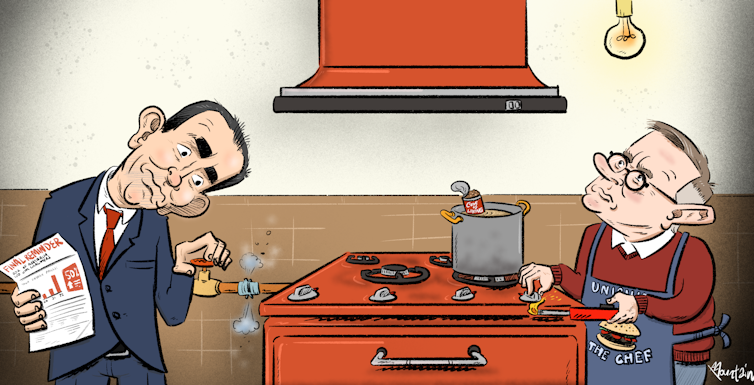
Wes Mountain/The Conversation, CC BY-ND

Australia’s top economists have overwhelmingly endorsed intervention to restrain gas and electricity prices, with only three of the 47 leading economists surveyed believing the best thing the government can do is to leave things to the market.

The 47 economists surveyed are members of a panel selected by a committee of the Economic Society of Australia for its expertise in fields including public policy and economic modelling. Among its members are former Reserve Bank, Treasury and OECD officials, and a former member of the Reserve Bank board.

Previously unpalatable options

Told that Treasurer Jim Chalmers is examining options that until recently would have “not have seemed palatable” in the wake of forecast retail electricity and gas price increases of 56% and 44% over the next two years, the panel was presented with a list of options and asked to choose the most valuable.

Only three ticked the option titled “government should not intervene”.



Two-thirds of those surveyed picked options that would cap domestic gas prices, use an extra tax on the profits of gas exporters to subsidise energy prices, or reserve gas that would otherwise be exported for domestic use.

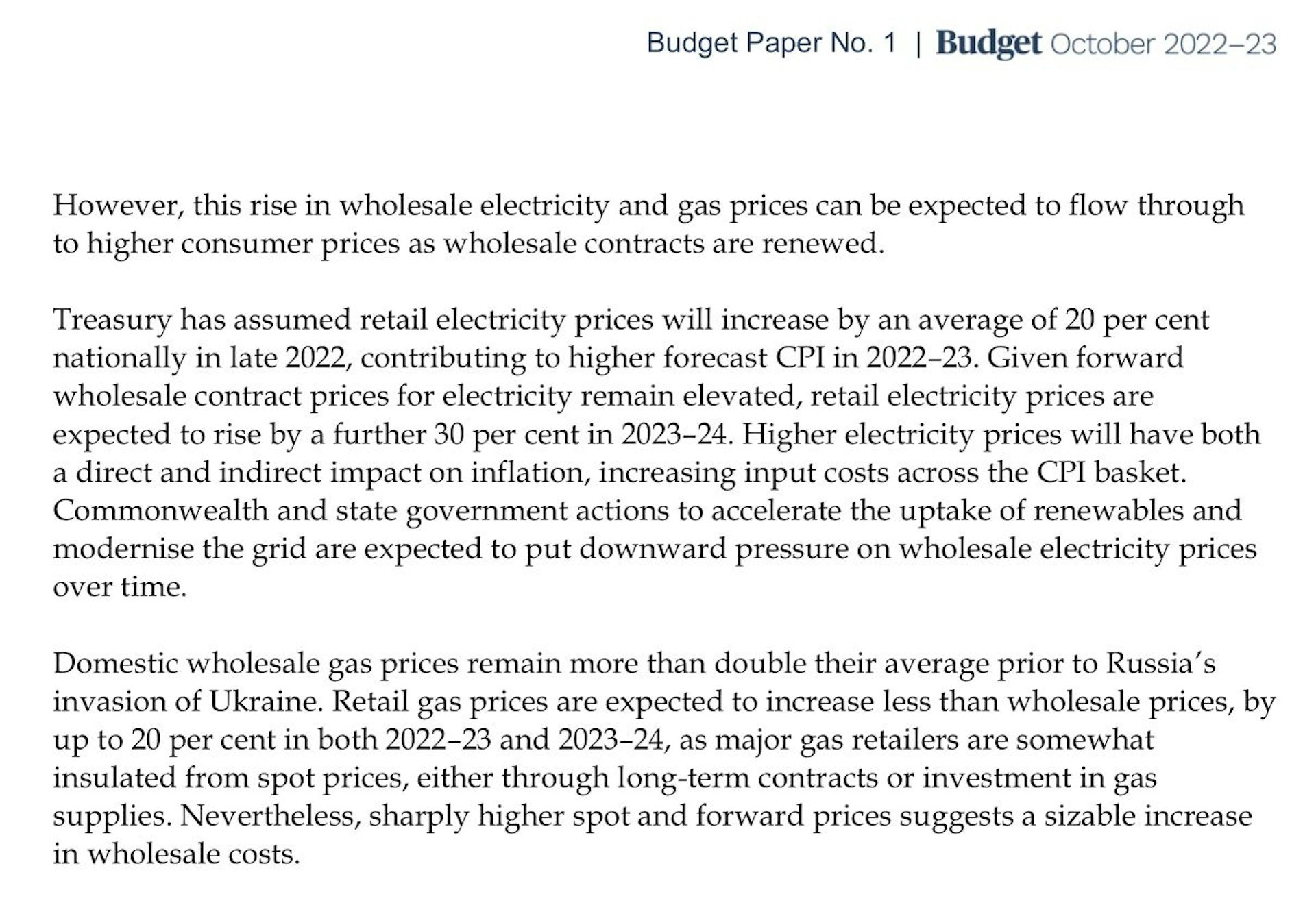
Gas prices feed into electricity prices because gas generators are usually the last to be turned on after cheaper options have been exhausted, meaning they determine the price for which extra wholesale electricity is sold.

Tax excess profits

The measure that attracted the most support (13 out of the 47 economists) was increasing the tax of the “resource rents” enjoyed by gas producers, and using proceeds to cut electricity and gas prices.

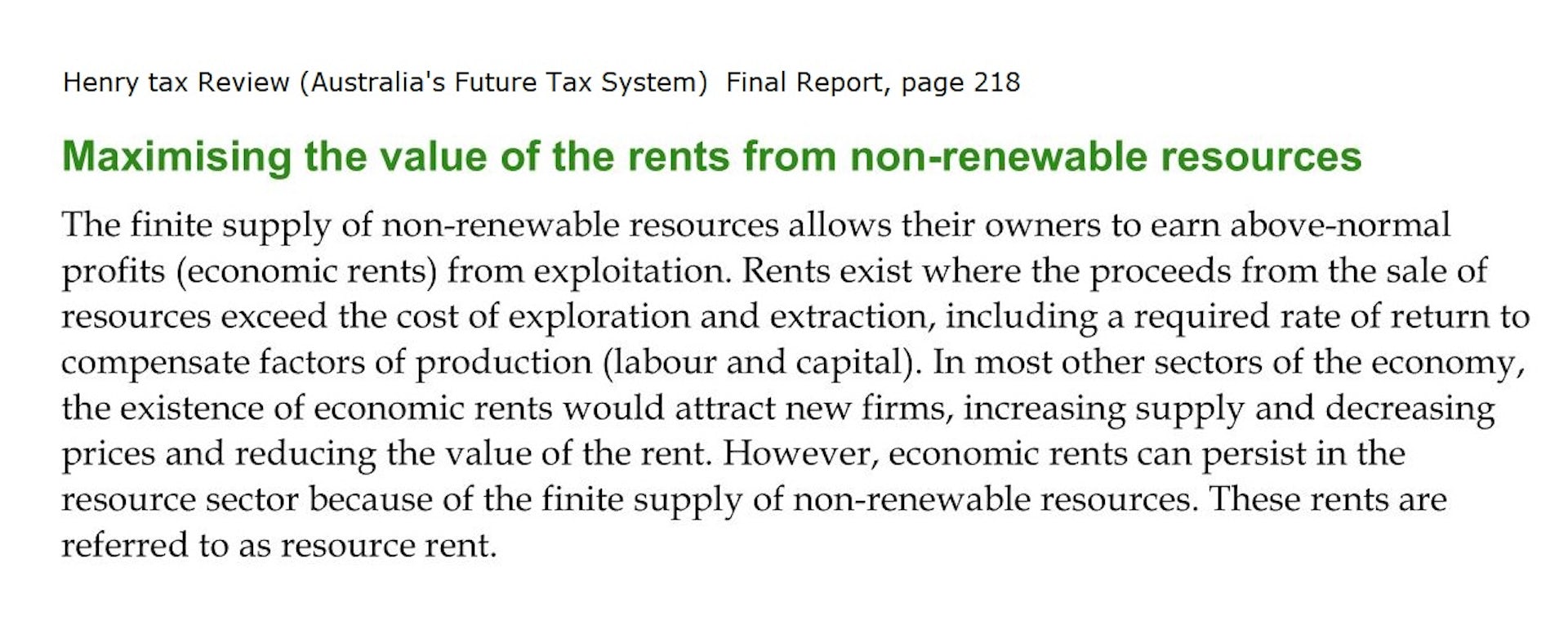
Resource rents are the excess profits earned from the sale of resources that flow from the sellers’ exclusive access to the resource.

Australian gas producers already face a special resource rent tax, but weaknesses in its design mean that, even at the present unprecedentedly-high gas prices, it is expected to bring in just A$2.6 billion in 2022-23, falling to $2 billion by 2025-26.

Innovation expert Beth Webster from Swinburne said the windfall gains to gas exporters flowing from Russia’s invasion of Ukraine should not go to shareholders, many of whom were foreign, but to national priorities such as price relief for Australians on low incomes.

Independent economist Rana Roy said while energy prices had traditionally been too low to cover the society-wide costs of producing the energy, at the moment prices were, in many instances, “well above” the social cost.

Help low earners first

Six of the 13 economists who backed an increased resource rent tax wanted the proceeds directed to assisting lower-income energy consumers before others.

Another six wanted targeted subsidies for low-income consumers even if they weren’t funded by increased resource rent taxes.

Offered the option of picking a measure not on the list, two of the 47 picked “unrestricted cash transfers”. They made the point that lower retail prices would have the unhelpful side effect of encouraging the continued use of gas, whereas cash payments would enable consumers to cut their use of gas while banking the cash.

Reserve gas for locals

Eleven of those surveyed wanted the government to reserve gas equivalent to 15% of each eastern state liquefied natural gas (LNG) export project for use in Australia, as happens in Western Australia.

Former senior Organization for Economic Co-operation and Development official Adrian Blundell-Wignall said the requirement seemed to be “tried and tested” and was the best of a list of uncomfortable choices.

Curtin University economist Harry Bloch said while reserving 15% of the output of LNG projects would change the conditions under which they were licensed, the operators applied for the licences at a time when expected prices were lower.

Ken Clements of the University of Western Australia strongly disagreed, saying Western Australia’s 15% reservation policy should be scrapped. It operated as an export tax and shielded West Australians from the high prices needed to encourage conservation and look after the environment.

Curtin University’s Margaret Nowak said it was “too late” to hit the the eastern state exporters with licence restrictions after the licences had been granted.

The best that could be done was to ask the eastern state exporters to supply more gas to Australians, as the government has done, and to impose a price cap on those sales that was closer to the pre-invasion price than to the present international price.

Cap prices for agreed supply

Six of the 47 economists supported a cap on the price at which producers can sell what they have already agreed to supply domestically, even though several would normally “be hesitant to promote this type of intervention”.

Grattan Institute chief executive Danielle Wood said the magnitude of the internationally-driven price hikes constituted an exceptional circumstance that justified a time-limited fix.

So long as regulators picked a reasonable benchmark for the price cap, such as the pre-invasion price, producers would continue to earn healthy returns.

Boost supply longer term

Two of the economists surveyed nominated an item not on the list – encouraging the development of gas fields to boost supply – that would be unlikely to have an immediate impact on prices.

Of the three who picked “government should not intervene” one (Gigi Foster) said measures to restrain prices would get in the way of “basic economics”, which required consumers to cut back on their use of energy as prices rose.

Another (John Freebairn) said he nevertheless supported a higher resource rent tax to increase the government’s share of the above-normal profits generated by corporations granted licences to mine Australian-owned deposits.

Treasurer Chalmers said on Thursday he expected to produce a costed plan for restraining energy prices by Christmas.


Detailed responses:

The Conversation

This article is republished from The Conversation under a Creative Commons license. Read the original article.

Read more >>

Wednesday, May 26, 2021

Going electric and banning new petrol-powered cars could be Australia’s next big light bulb moment

In 2007 Malcolm Turnbull turned off an industry’s life support without blinking.

The industry made light bulbs, of the traditional kind; so energy-inefficient they lost most of it as heat.

“A normal light bulb is too hot to hold — that heat is wasted, and globally represents millions of tonnes of carbon dioxide that needn’t have been emitted,” he explained.

From February 2009 it became illegal to import the traditional pear-shaped globes, while from November that year it became illegal to sell them.

It was a world-first, announced by Turnbull as environment minister and sanctioned by his prime minister John Howard.

The European Union followed, and then, some years later, China.

Globally, electric lighting generated emissions equal to 70% of those from cars. Australia’s switch cut emissions by an estimated 4 million tonnes per year.

Turnbull was able to do it because Australia no longer made light globes.

There was no domestic industry — and no jobs — to protect.

Australia stopped making cars in 2017. The thousands of workers who used to assemble cars in Australia no longer have those jobs.

Which means there’s no car industry to protect.

We have the opportunity to do to traditionally-powered cars what we did to incandescent light bulbs.

And the need. We’ve all but committed ourselves to net-zero emissions by 2050.

In a landmark report released last Tuesday, the International Energy Agency said the path to net-zero by 2050 was narrow and extremely challenging, requiring governments to “take action this year and every year after so that the goal does not slip out of reach”.

Many of the 400 or so milestones it set out are challenging for Australia, among them no new coal mines or mine expansions from this year, and the closure of almost all of Australia’s coal-fired power stations by the end of this decade.

But one of the milestones ought to be easy.

It’s no new sales of internal combustion cars by 2035.

The rest of the world is racing ahead

As a step along the way, the agency wants two-thirds of all new cars sold to be petrol-free by 2030. Australia, with no vehicle production industry to care about, ought to get there sooner.

Norway has promised no new petrol car sales by 2025; Denmark, the Netherlands, Ireland and Israel by 2030; and California and the United Kingdom by 2035, a target the UK has brought forward from 2040.

In addition, the European Union is imposing manufacturer-specific emissions targets, which will force each one to either sell a greater proportion of non-petrol vehicles or make the ones they do sell much more efficient.


Read more: Costly, toxic and slow to charge? Busting electric car myths


Manufacturers are getting in early. Honda says it will sell only electric and hybrid vehicles in Europe starting in 2022, three years earlier than previously planned. Volvo says 50% of its worldwide sales will be fully electric by 2025 and the rest hybrids.

Like the transitions to colour TV, automatic car windows, automatic transmissions and transistor radios, the shift will be one way. When production lines are retooled, there will be no turning back.

Moving quickly would do more than help Prime Minister Scott Morrison produce a credible roadmap to take to Glasgow climate talks in November.

It would enable us to avoid becoming a dumping ground for the dirtier, more polluting vehicles that can’t be sold elsewhere while the changeover is underway.

Switching soon would save us money

And it would save the government money. It has just committed to pay up to A$2 billion to keep Australia’s two remaining oil refineries open until 2027.

Without the payments, Ampol might have closed Lytton in Queensland (it was weighing up doing so) and Viva Energy refinery might have closed its loss-making refinery at Geelong.

While both have accepted the money, Ampol has unveiled plans to test the production of solar-powered hydrogen on its site at Lytton and Viva Energy is planning a solar farm on its site at Geelong.

Most of Australia’s petrol is imported, much of it from Singapore, meaning little would be lost if Australia’s refineries closed.

The Australian-produced fuel is dirtier than the imported fuel, something the Australian government promised to fix this month by paying Australia’s plants to make the ultra-low sulphur petrol the rest of the world switched to years ago.

If a ban on imports of petrol-powered cars wouldn’t much hurt Australia’s reluctant refiners, it might hurt petrol stations, but not much.

Australia’s service stations are in large measure retail convenience stores. They try to maximise “basket size”. Ampol plans to turn the petrol side of the business into a recharge and refuelling network for electric and hydrogen vehicles.

Mechanics would lose jobs

The much-larger industry at risk from a switch to electric vehicles is car maintenance. The Bureau of Statistics counts 352,200 automotive and engineering trades workers, almost all of them male and full time.

That a switch to low-maintenance electric vehicles would shrink their industry is unfortunate for them, but inevitable. Propping up their industry by delaying the transition would only encourage more young people into jobs with limited futures.

When Australia switched from valve to transistor-operated TV sets in the 1970s, an army of “television repair men” was thrown out of business, along with their vans and two-way radios.

Most of them stayed in the workforce doing things we needed.

To have kept using sets requiring maintenance just to have kept them in work would have been an insult to them and us.

And while Australia’s switch away from incandescent globes was problematic (many of us liked the yellowish glow we’d become used to) the switch to electric cars is looking positively joyous.

Crikey/Coal Miners Driving Teslas

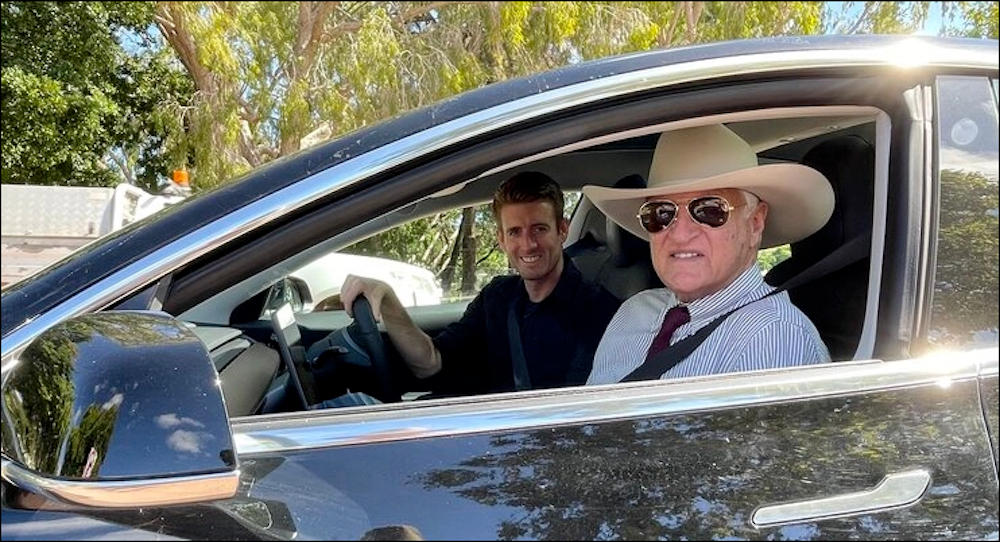
This week Crikey pointed to a video in which the Queensland MP Bob Katter gets his first taste of a Tesla as it accelerates from zero to 100 kilometres per hour in just over three seconds.

Yeehaw!” he yells. “This is so exciting.”

Australians usually embrace the future. At times we’ve been ahead of it.


Read more: International Energy Agency warns against new fossil fuel projects. Guess what Australia did next?


Peter Martin, Visiting Fellow, Crawford School of Public Policy, Australian National University

This article is republished from The Conversation under a Creative Commons license. Read the original article.

Read more >>

Wednesday, March 17, 2021

Electricity is a jigsaw. Coal can't provide the missing pieces

There’s something the energy minister said when they announced the early closure of Victoria’s second-biggest coal-fired power station last week that was less than complete.

Yallourn, in the Latrobe Valley, provides up to 20% of Victoria’s power. It has been operating for 47 years. Since late 2017 at least one of its four units has broken down 50 times. Its workforce doubles for three to four months most years to deal with the breakdowns. It pumps out 3% of Australia’s carbon emissions.

On Wednesday Energy Australia gave seven years notice of its intention to close it in mid-2028, four years earlier than previously announced, a possibility for which regulators had been preparing.

In what might have been a rhetorical flourish, Energy Minister Angus Taylor warned of “price spikes every night when the sun goes down”.

Then he drew attention to what had happened when two other coal-fired power stations closed down — Victoria’s Hazelwood and South Australia’s Northern (South Australia’s last-remaining coal-fired generator).

He said “wholesale prices skyrocketed by 85%”.

And there he finished, without going on to detail what really mattered. South Australia and Victoria now have the lowest wholesale power prices in the National Electricity Market — that’s right, the lowest.

Coal-fired plants close, then prices fall

Before Northern closed, South Australia had Australia’s highest price.

Five years after the closure of Northern in 2016, and four years after the closure of Hazelwood in 2017, South Australia and Victorian have wholesale prices one-third lower than those in NSW and two-fifths lower than those in Queensland.

Something happened after the closure (largely as a result of the closure) that forced prices down.

South Australia became a renewables powerhouse.

The Australian National University’s

Hugh Saddler points out that renewable-sourced power — wind and grid solar — now accounts for 62% of power supplied to the South Australian grid, and at times for all of it.

Much of it is produced near Port Augusta, where the Northern and Playford coal-fired power stations used to be, because that’s where the transmission lines begin.

Being even cheaper than the power produced by the old brown-coal-fired power stations, there is at times so much it that it sends prices negative, meaning generators get paid to turn off in order to avoid putting more power into the system than users can take out.

It’s one of the reasons coal-fired plants are closing: they are hard to turn off. They are just as hard to turn on, and pretty hard to turn up.

Coal can’t respond quickly

There are times (when the wind doesn’t blow and there’s not much sun, such as last Friday in South Australia) when prices can get extraordinarily high.

But coal-fired plants, especially brown-coal-fired plants such as Victoria’s Hazelwood and Yallourn and Victoria’s two remaining big plants, Loy Yang A and B, are unable to quickly ramp up to take advantage of them.

Although “dispatchable” in the technical meaning of the term used by the minister, coal-fired stations can’t fill gaps quickly.


Read more: The death of coal-fired power is inevitable — yet the government still has no plan to help its workforce


Batteries can respond instantly to a loss of power from other sources (although not for very long), hydro can respond in 30 to 70 seconds, gas peaking plants can respond within minutes.

But coal can barely move. As with nuclear power, coal-fired power needs to be either on (in which case it can only slowly ramp up) or off, in which case turning it on from a standing start would be way too slow.

What was a feature is now a bug

That’s why coal-fired generators operate 24-7, to provide so-called base-load, because they can’t really do anything else.

Brown coal generators are the least dispatchable. Brown coal is about 60% water. To make it ignite and keep boiling off the water takes sustained ultra-high temperatures. Units at Yallourn have to keep burning coal at high output (however low or negative the prices) or turn off.

In the days when the other sources of power could be turned on and off at will, this wasn’t so much of a problem.

Hydro or gas could be turned on in the morning when we turned on our lights and heaters and factories got down to business, and coal-fired power could be slowly ramped up.

At night, when there was less demand for coal-fired power, some could be created by offering cheap off-peak water heating.

But those days are gone. Nationwide, wind and solar including rooftop solar supplies 20% of our needs. It turns on and off at will.

Wind often blows strongly at night. What was a feature of coal — its ability to provide steady power rather than fill gaps - has become a bug.

Gas and batteries can fill gaps coal can’t

It’s as if our power system has become a jigsaw with the immovable pieces provided by the wind and the sun. It’s our job to fill in the gaps.

To some extent, as the prime minister says, gas will be a transition fuel, able to fill gaps in a way that coal cannot. But gas has become expensive, and batteries are being installed everywhere.

Energy Australia plans to replace its Yallourn power station with Australia’s first four-hour utility-scale battery with a capacity of 350 megawatts, more than any battery operating in the world today. South Australia is planning an even bigger one, up to 900 megawatts.


Read more: Huge 'battery warehouses' could be the energy stores of the future


Australia’s Future Fund and AGL Energy are investing $2.7 billion in wind farms in NSW and Queensland which will fill gaps in a different way — their output peaks at different times to wind farms in South Australia and Victoria.

Filling the gaps won’t be easy, and had we not gone down this road there might still have been a role for coal, but the further we go down it the less coal can help.

As cheap as coal-fired power is, it is being forced out of the system by sources of power that are cheaper and more dispatchable. We can’t turn back.

Peter Martin, Visiting Fellow, Crawford School of Public Policy, Australian National University

This article is republished from The Conversation under a Creative Commons license. Read the original article.
Read more >>

Friday, December 25, 2020

What’s the best way to boost the economy? Invest in high-voltage transmission lines

When, in the midst of the pandemic, the Economic Society of Australia invited 150 of Australia’s keenest young thinkers to come up with “brief, specific and actionable” proposals to improve the economy, amid scores of ideas about improving job matching, changing the tax system, providing non-repayable loans to businesses and accelerating telehealth, two proposals stood out.

They were actually the same proposal, arrived at independently by two groups of “hackers” in the society’s annual (this time virtual) “hackathon”.

I was one of the judges.

The mentors who helped test and guide the proposals were some of the leading names in economics, among them Jeff Borland, John Quiggin, Gigi Foster, Deborah Cobb-Clark, Peter Abelson and John Hewson.

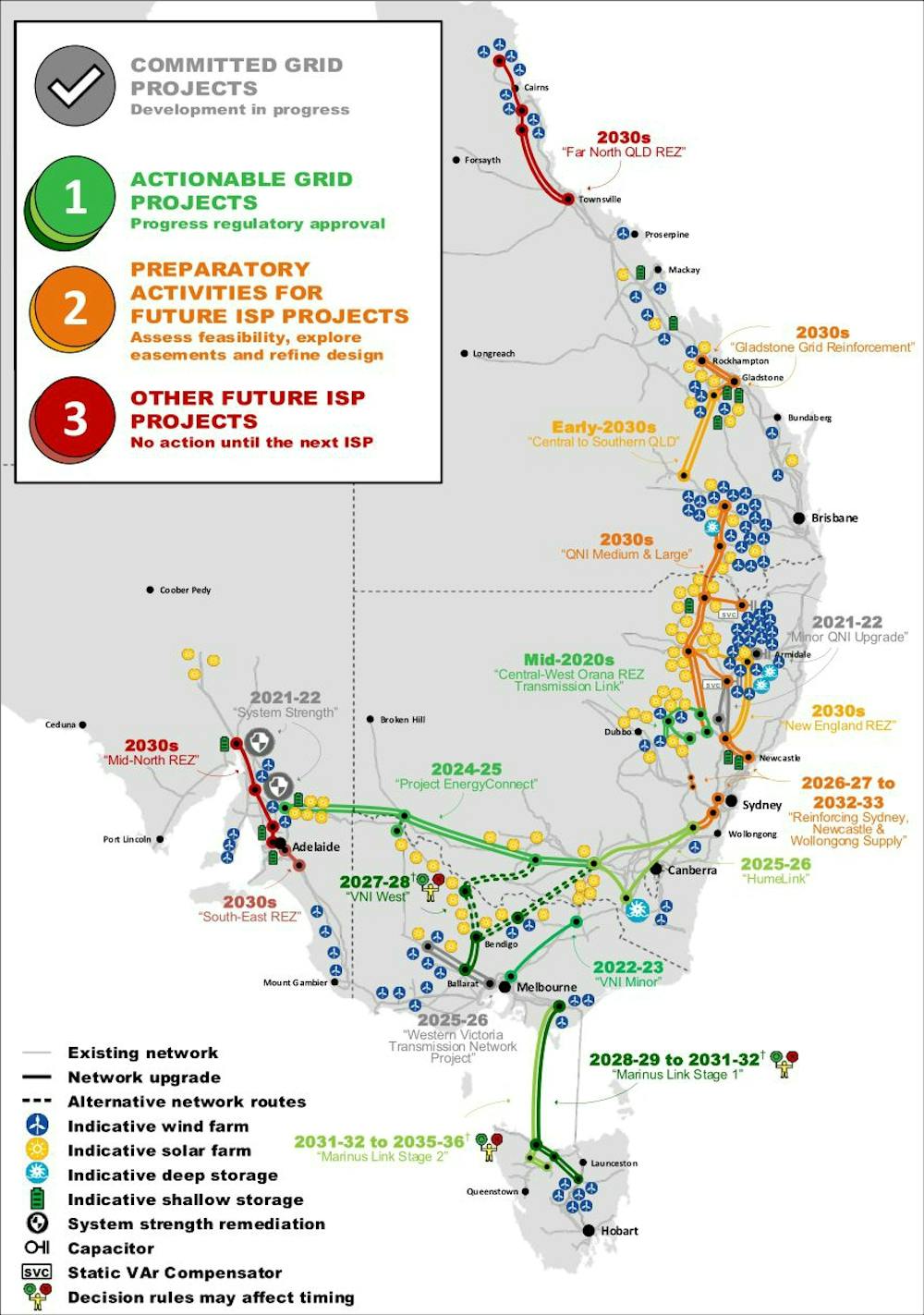
The proposal is to fast track the 15 or more projects already identified by the Australian Energy Market Operator as essential to meet the electricity grid’s transmission needs over the next 20 years.

Starting them immediately, when business investment is weak and there’s a need for jobs and governments can borrow at rates close to zero, will bring forward all of the benefits of being able to bring ultra-cheap power from the places it will be made to the places it will be needed as expensive fossil-fuel generators bow out or are out competed.


Read more: Explainer: what is the electricity transmission system, and why does it need fixing?


Judges Alison Booth, Jeremy Thorpe and I noted that policy hacks were the most useful where neither the market nor the government was getting the job done.

The proposal would help ensure renewables can connect to the grid, something “neither the market nor the government is managing to do quickly”.

A few weeks later Labor leader Anthony Albanese used his budget reply speech to propose the same thing – a Rewiring the Nation Corporation to turn the projects identified in the Energy Market Operator’s integrated system plan into reality.

Here is what is proposed in the winners’ own words:

Accelerating priority transmission projects

Nick Vernon, Agrata Verma, Bella Hancock

Investment in new renewable generators in Australia sank 40% in 2019. A major factor holding them back is grid access. The best locations for wind and sun often have poor access to the cables that transport electricity to consumers.

Our near-term recommendation is to guarantee Project EnergyConnect, a 900-kilometre cable between NSW and South Australia due to begin construction next year. The network operators got approval in January, but there is now uncertainty over whether they will get the funding.


Read more: 'A dose of reality': Morrison government's new $1.9 billion techno-fix for climate change is a small step


We propose that the two state governments agree to cover the shortfall between approved revenues and realised costs (up to a pre-determined limit) to ensure construction starts on time in 2021.

Medium-term, we recommend the Australian Energy Regulator conduct the regulatory investment test and revenue adjustment processes for all priority projects in parallel to condense approval timelines and that the Commonwealth and state governments underwrite priority projects’ early works.

This would allow service providers to commission new transmission lines sooner after regulatory approval.

AEMO Integrated System Plan

The case for fast tracking transmission

Patrick Sweeney, Sam Edge, Elke Taylor, Jacob Keillor, Timothy Fong

Currently valued at A$20 billion, the Australian transmission network was designed for a centralised 20th century power mix and suffers from aging infrastructure.

The $6 billion upgrade we propose would have as its centrepiece 15 projects the Energy Market Operator has already identified as essential.

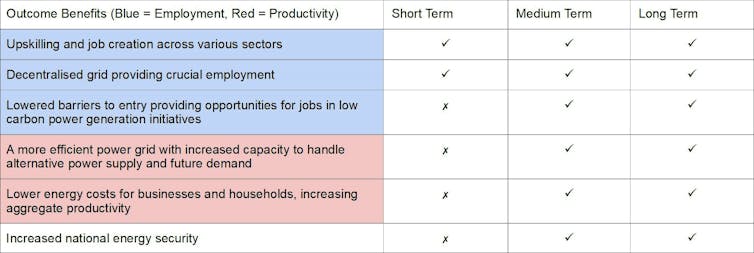
Fast-tracking these projects has the potential to generate 100,000 jobs, to bring about strong private investment in low-carbon power production, and to place downward pressure on wholesale power prices, producing $11 billion in benefits.

A national taskforce consisting of the department of energy and the market operator would oversee a project of a similar size to the Snowy Mountains scheme, which itself created more than 100,000 jobs during its lifecycle.


Read more: The verdict is in: renewables reduce energy prices (yes, even in South Australia)


The government would procure the funds by issuing bonds, with recent rates indicating the yield payable will be less than the rate of inflation.

Firms that tendered for the work would be evaluated on their capacity to upscale production to meet milestones and on their plans to generate long-term, sustainable employment.

Peter Martin, Visiting Fellow, Crawford School of Public Policy, Australian National University

This article is republished from The Conversation under a Creative Commons license. Read the original article.

Read more >>

Wednesday, January 08, 2020

In fact, there's plenty we can do to make future fires less likely

One of the dominant ideas buzzing around the internet is that there’s little we can do to escape the prospect of more frequent and worse bushfires - ever.

That’s because there’s little we can do to slow or reverse the change in the climate.

Australia accounts for just 1.3% of global emissions. That’s much more than you would expect on the basis of our share of world’s population, which is 0.33%. But even if we stopped greenhouse gas emissions as soon as we could and started sucking carbon back in (as would be possible with reafforestation) it’d make little difference to total global emissions, which is what matters – or so the argument goes.

But this argument ignores the huge out-of-proportion power we have to influence other countries.

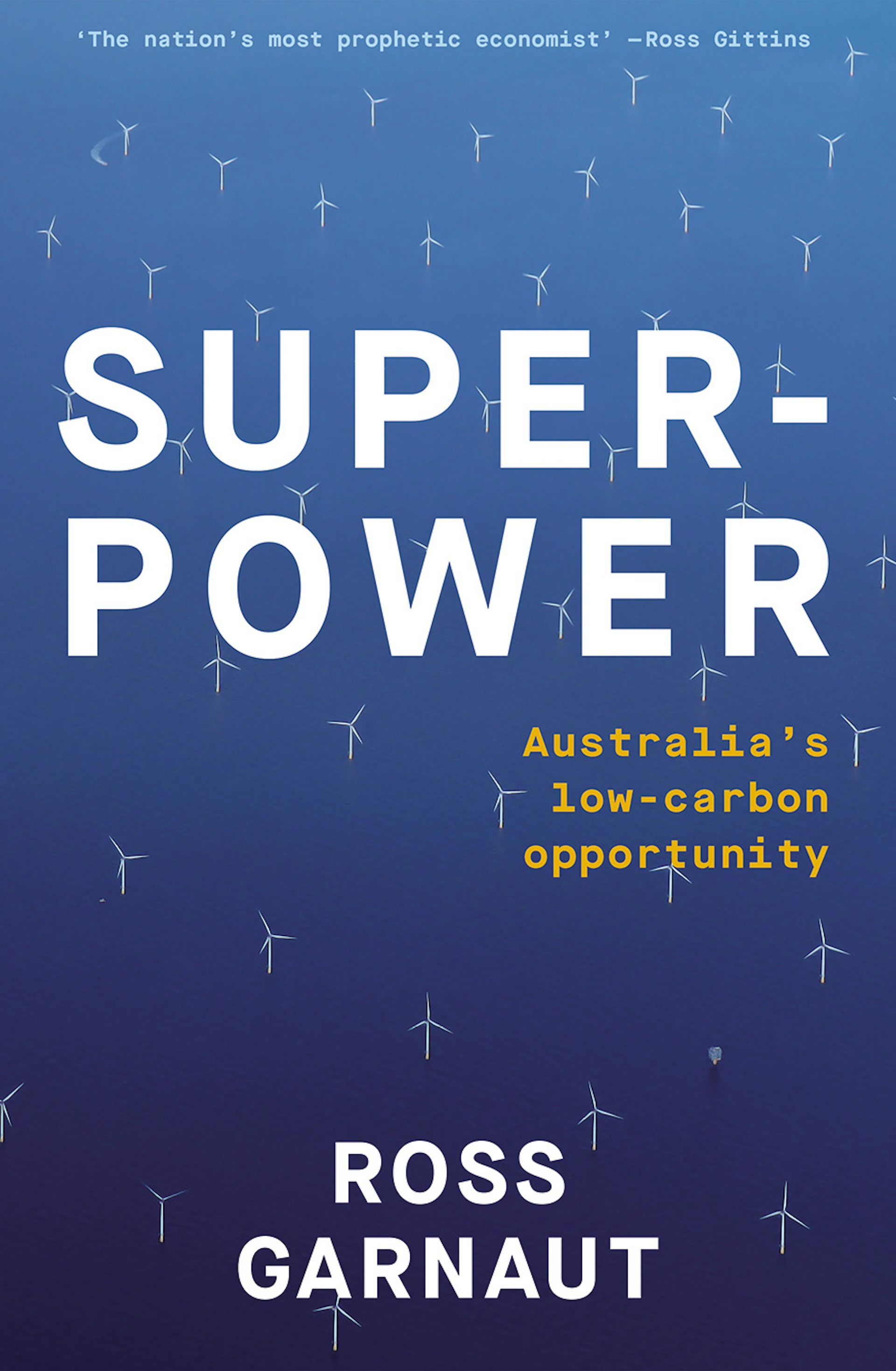
There’s no better indicator of that than in Ross Garnaut’s new book Super-power: Australia’s low-carbon opportunity.

We’re more important than we think

Garnaut conducted two climate change reviews for Australian governments, the first in 2008 for the state and Commonwealth governments, and the second in 2011 for the Gillard government.

In the second, he produced two projections of China’s emissions, based on what was known at the time.

One was “business as usual”, which showed continued very rapid increases. The other took into account China’s commitments at the just-completed 2010 United Nations Cancun climate change conference.

China’s annual emissions matter more than those of any other country – they account for 27% of the global total, which is a relatively new phenomenon.

The bulk of the industrial carbon dioxide already in the atmosphere was put there by the United States and the Soviet Union, who have been big emitters for much longer.

Egged on by the US Obama administration and by governments including Australia’s under Julia Gillard, China agreed at Cancun to slow its growth in emissions, and at the Paris talks in 2015 hardened this into a commitment to stabilise them by 2030.

The extraordinary graph

Garnaut’s 2011 projections showed growth moderating as a result of China’s commitment, which was at the time a cause for optimism.

When he returned to the numbers in 2019 to prepare his book, he was stunned. Egged on by the example of countries including the US and Australia, China had done far, far better than either “business as usual” or its Cancun commitments. Instead of continuing to grow rapidly, or less rapidly as China had said they would, they had almost stopped growing.

The graph, produced on page 29 of Garnaut’s book, is the most striking I have seen.


Since 2011, China’s emissions have been close to spirit-level flat. They climbed again only from 2017 when, under Trump in the US and various Coalition prime ministers in Australia, the moral pressure eased.

From the start of this century until 2011, China’s consumption of coal for electricity climbed at double-digit rates each year. From 2013 to 2016 (more than) every single bit of China’s extra electricity production came from non-emitting sources such as hydro, nuclear, wind and sun.

There are many potential explanations for the abrupt change. Pressure from nations including the US and Australia is only one.

What happened once could happen again

And there are many potential explanations for China’s return to form after Trump backslid on the Paris Agreement and Australia started quibbling about definitions. An easing of overseas pressure is only one.

But, however brief, the extraordinary pause gives us cause for hope.

Australia can matter, in part because it is hugely respected in international forums for its technical expertise in accounting for carbon emissions, and in part because of its special role as one of the world’s leading energy exporters.

Garnaut’s book is about something else – an enormous and lucrative opportunity for Australia to produce and export embedded energy sourced from wind and the sun at a cost and scale other nations won’t be able to match.


Read more: Australia could fall apart under climate change. But there's a way to avoid it


Some of it can be used to convert water into hydrogen. That can be used to turn what would otherwise be an intermittent power supply into a continuous one that enables around-the-clock production of the green steel, aluminium, and other zero-emission products Japan, Korea, the European Union and the United Kingdom are going to be demanding.

It’s a vision backed by Australia’s chief scientist.

It wouldn’t have been possible before. It has been made possible now by the extraordinary fall in the cost of solar and wind generation, and by something just as important – much lower global interest rates. Solar and wind generators cost money upfront but cost very little to operate. Interest rates are the cost of the money upfront.

At least three consortia are drawing up plans.

There’s not much to lose

There’s much that needs to be done, including establishing the right electricity transmission links. But Garnaut believes it can all be done within the government’s present emissions policy, helping it achieve its emission reduction targets along the way.

What’s relevant here is that moving to ultra-low emissions would do more. It could give us the kind of outsized international influence we are capable of. It could help us make a difference.The Conversation


Peter Martin, Visiting Fellow, Crawford School of Public Policy, Australian National University

This article is republished from The Conversation under a Creative Commons license. Read the original article.

Read more >>

Wednesday, November 06, 2019

Super power - Australia's low carbon opportunity

Ross Garnaut, University of Melbourne.

Four years ago in December 2015, every member of the United Nations met in Paris and agreed to hold global temperature increases to 2°C, and as close as possible to 1.5°C.

The bad news is that four years on the best that we can hope for is holding global increases to around 1.75°C. We can only do that if the world moves decisively towards zero net emissions by the middle of the century.

A failure to act here, accompanied by similar paralysis in other countries, would see our grandchildren living with temperature increases of around 4°C this century, and more beyond.

I have spent my life on the positive end of discussion of Australian domestic and international policy questions. But if effective global action on climate change fails, I fear the challenge would be beyond contemporary Australia. I fear that things would fall apart.

There is reason to hope

It’s not all bad news.

What we know today about the effect of increased concentrations of greenhouse gases broadly confirms the conclusions I drew from available research in previous climate change reviews in 2008 and 2011. I conducted these for, respectively, state and Commonwealth governments, and a federal cross-parliamentary committee.

But these reviews greatly overestimated the cost of meeting ambitious reduction targets.

There has been an extraordinary fall in the cost of equipment for solar and wind energy, and of technologies to store renewable energy to even out supply. Per person, Australia has natural resources for renewable energy superior to any other developed country and far superior to our customers in northeast Asia.


Read more: Australia's hidden opportunity to cut carbon emissions, and make money in the process


Australia is by far the world’s largest exporter of iron ore and aluminium ores. In the main they are processed overseas, but in the post-carbon world we will be best positioned to turn them into zero-emission iron and aluminium.

In such a world, there will be no economic sense in any aluminium or iron smelting in Japan or Korea, not much in Indonesia, and enough to cover only a modest part of domestic demand in China and India. The European commitment to early achievement of net-zero emissions opens a large opportunity there as well.

Converting one quarter of Australian iron oxide and half of aluminium oxide exports to metal would add more value and jobs than current coal and gas combined.

A natural supplier to the world’s industry

With abundant low-cost electricity, Australia could grow into a major global producer of minerals needed in the post-carbon world such as lithium, titanium, vanadium, nickel, cobalt and copper. It could also become the natural supplier of pure silicon, produced from sand or quartz, for which there is fast-increasing global demand.

Other new zero-emissions industrial products will require little more than globally competitive electricity to create. These include ammonia, exportable hydrogen and electricity transmitted by high-voltage cables to and through Indonesia and Singapore to the Asian mainland.

Australia’s exceptional endowment of forests and woodlands gives it an advantage in biological raw materials for industrial processes. And there’s an immense opportunity for capturing and sequestering, at relatively low cost, atmospheric carbon in soils, pastures, woodlands, forests and plantations.

Modelling conducted for my first report suggested that Australia would import emissions reduction credits, however today I expect Australia to cut domestic emissions to the point that it sells excess credits to other nations.

The transition is an economic winner

Technologies to produce and store zero-emissions energy and sequester carbon in the landscape are highly capital-intensive. They have therefore benefited exceptionally from the historic fall in global interest rates over the past decade. This has reduced the cost of transition to zero emissions, accentuating Australia’s advantage.

In 2008 the comprehensive modelling undertaken for the Garnaut Review suggested the transition would entail a noticeable (but manageable) sacrifice of Australian income in the first half of this century, followed by gains that would grow late into the second half of this century and beyond.

Today, calculations using similar techniques would give different results. Australia playing its full part in effective global efforts to hold warming to 2°C or lower would show economic gains instead of losses in early decades, followed by much bigger gains later on.

If Australia is to realise its immense opportunity in a zero-carbon world, it will need a different policy framework. But we can make a strong start even with the incomplete and weak policies and commitments we have. Policies to help complete the transition can be built in a political environment that has been changed by early success.

Three crucial steps

Three early policy developments are needed. None contradicts established federal government policy.

First, the regulatory system has to focus strongly on the security and reliability of electricity supplies, as it comes to be drawn almost exclusively from intermittent renewable sources.

Second, the government must support transformation of the power transmission system to allow a huge expansion of supply from regions with high-quality renewable energy resources not near existing transmission cables. This is likely to require new mechanisms to support private initiatives.

Third, the Commonwealth could secure a globally competitive cost of capital by underwriting new investment in reliable (or “firmed”) renewable electricity. This was a recommendation by the Australian Competition and Consumer Commission’s retail electricity price inquiry, and has been adopted by the Morrison government.

We must get with the Paris program

For other countries to import large volumes of low-emission products from us, we will have to accept and be seen as delivering on emissions reduction targets consistent with the Paris objectives.

Paris requires net-zero emissions by mid-century. Developed countries have to reach zero emissions before then, so their interim targets have to represent credible steps towards that conclusion.

Japan, Korea, the European Union and the United Kingdom are the natural early markets for zero-emissions steel, aluminum and other products. China will be critically important. Indonesia and India and their neighbours in southeast and south Asia will sustain Australian exports of low-emissions products deep into the future.

For the European Union, reliance on Australian exports of zero-emissions products would only follow assessments that we were making acceptable contributions to the global mitigation effort.

We will not get to that place in one step, or soon. But likely European restrictions on imports of high-carbon products, which will exempt those made with low emissions, will allow us a good shot.


Read more: Labor's reset on climate and jobs is a political mirage


Movement will come gradually, initially with public support for innovation; then suddenly, as business and government leaders realise the magnitude of the Australian opportunity, and as humanity enters the last rush to avoid being overwhelmed by the rising costs of climate change.

The pace will be governed by progress in decarbonisation globally. That will suit us, as our new strengths in the zero-carbon world grow with the retreat of the old. We have an unparalleled opportunity. We are more than capable of grabbing it.

The Conversation


Ross Garnaut conducted the 2008 and 2011 climate reviews for the Rudd and Gillard governments. His book Superpower – Australia’s Low-Carbon Opportunity, is published today by BlackInc with La Trobe University Press.

This article is republished from The Conversation under a Creative Commons license. Read the original article.

Read more >>

Thursday, January 11, 2018

Coal is now the biggest threat to energy security

Worried the electricity system won't keep up over summer? Worry about coal. Seriously.

One of the four giant units at Victoria's ageing Loy Yang A power station broke down on Tuesday night at 11.05, taking out 230 megawatts, and then at 1.10 on Wednesday morning after being partially restarted, taking out what by then was 161 megawatts.

When demand soared during Sunday's heatwave, the Eraring plant on Lake Macquarie in NSW lost 275 megawatts. A few minutes later, Loy Yang A lost 264 megawatts.

On New Year's Day, unit 1 of Millmerran in Queensland stalled, taking out 156 megawatts. On December 28, unit 2 of Tarong in Queensland stalled, taking out 314 megawatts. On Boxing Day, unit 4 at Loy Yang stalled, taking out 528 megawatts. On Christmas Day, unit 1 at Gladstone stalled, taking out 230 megawatts, then unit 1 at the Tallawarra gas plant in NSW, taking out 187 megawatts. And so on, back to the start of summer.

When unit 3 at Loy Yang shut down without warning on December 14 taking out 560 megawatts and imperilling the entire system, the new Tesla battery 1000 kilometres away in South Australia sprang into action ahead of the coal-fired power station that was contracted to restore stability. It proved to be "dispatchable" in a way coal-fired power stations are not.

Age, heat and the steady encroachment of renewables are destroying the only advantages coal-fired power stations ever had.

When Treasurer Scott Morrison stood up in Federal Parliament and waved around a lump of coal in a stunt unworthy of his office, he said coal was an important part of ensuring a "more certain" energy future.

But he was speaking about the past.

Coal-fired power stations didn't used to get critically hot as often as they do now. The February 2017 heatwave that took out 2438 megawatts in one day in NSW might have once been a once-in-500-year event. Now it's a once-in-50-year event and perhaps soon a once-in-five-year event. The calculations are by the Australia Institute's Mark Ogge and Hannah Aulby in a study of the risks to energy security entitled Can't Stand the Heat. Ogge is the person who has been keeping a record of power station outages.

When temperatures in control rooms get as high as 50 or 60 degrees the electronic control systems buckle and the boilers leak. Failures are inevitable, although unfortunately not predictable.

Wind power and solar power are in large part predictable. Yes, they are intermittent, but it is usually possible to tell a day or two ahead of time when and where the wind will blow and the sun will shine. There's time to put batteries, hydro and gas on standby.

But in summer it's becoming impossible to know when and where coal-fired power stations will blow. They are becoming unpredictably intermittent, all the more so each year they age.

And standby power is costly. Tony Wood of the Grattan Institute helped run Origin Energy for 14 years. He says the industry standard is to have as much back-up as the biggest independent unit, so that if it drops out it can be instantly replaced. But the biggest independent coal units are huge. They require big back-up.

The biggest wind and solar farms are much smaller. While they require storage and gas peaking plants to fill in overnight and when the wind's not blowing, they don't need anything like as much back-up for when mechanical problems knock them out of service.

There are caveats. Independent turbines can stop blowing at once, and sometimes unpredictably. That's because most are located together in South Australia and Victoria, where the wind systems are synchronised. It would be better to have more wind farms in NSW, where the weather cycle is different. At times cloud cover is also unpredictable.

A future without coal-fired power stations is inevitable, and entirely manageable. Wind accounts for 40 per cent of South Australia's electricity supply, 8.5 per cent of Victoria's supply, and 2.8 per cent of the NSW supply. One of the many reasons no new coal-fired power stations will be financed or built is they are not well-suited to filling in gaps.

They are good at providing always-on baseload power, but that's not needed in the middle of the night when the wind is blowing a gale and providing all of a system's need for virtually nothing. They are not as good at turning on or ramping up quickly when the wind stops blowing. If they are used repeatedly to do that, they break down sooner.

The Turnbull government's proposed national energy guarantee would require retailers to ensure that a certain amount of the electricity they line up is dispatchable. Critics took this to be a code word for coal, but it can't be, not unless Turnbull wants to misuse the word. Battery storage, pumped hydro, molten salt solar plants that can fire up overnight, and gas peaking plants are far more dispatchable.

And they are more reliable. The more we move away from coal the more secure our power system becomes.

In The Age and Sydney Morning Herald
Read more >>

Thursday, November 02, 2017

It's time (to take Labor seriously)

The shape of the next Labor government is becoming clearer.

This week we learnt that it will end the practice of signing Australia up to trade agreements that haven't survived a benefit-cost analysis.

Seriously. Korea, Japan, China. None of the three big agreements boasted about by Tony Abbott and Malcolm Turnbull has been subjected to an independent assessment of its benefits and costs. And nor has the far bigger, 5600-page, Trans-Pacific Partnership agreement signed by trade minister Andrew Robb shortly before he resigned and took up a position with the Chinese investor that runs the Port of Darwin.

Nor have any of Australia's agreements ever had to face official scrutiny after the event. "Not that I am aware of," were the words used by a foreign affairs official at a parliamentary hearing.

The US-Australia free trade agreement at least faced an unofficial analysis about the time of its 10th birthday in 2015. An economic modeller from the Australian National University applied the framework developed by the Productivity Commission and found it had cut rather than boosted trade between Australia and the US and the rest of world. Trade between Australia and the US also slid, but for other reasons.

It's easy to see why it cut trade with the rest of the world. Like most exclusive agreements it gave special access to exports from its members. Here's how it would have worked with the 12-nation Trans-Pacific Partnership (had Donald Trump not pulled the pin): Vietnam would have been a member but Thailand would not have been. The US-based Peterson Institute for International Economics has found that Vietnam would have exported more to Australia (which would have boosted its economy) in place of Thailand, which would have exported less (which would have harmed its economy).

And Australia would have had to change the way it made things, cutting inputs from countries such as Thailand and Indonesia under complex "rules of origin" if it wanted special access to the US, even where that meant much higher costs. The Korea-Australia agreement included 5200 rules of origin.

It's little wonder that the business organisation closest to the action, the Australian Chamber of Commerce and Industry, finds its members less than keen to use the agreements trumpeted by the Coalition. Only 15 per cent use and understand the Australia-US Free Trade Agreement, 5 per cent use it without understanding it, 17 per cent understand but don't use it, and 22 per cent neither understand nor use it. Another 41 per cent say it's not relevant to them.

The chamber hosted Labor's policy launch on Monday because it has long argued that a body such as the Productivity Commission should run the ruler over future agreements and should review existing ones every 10 years, both of which Labor would do.

Labor would also tear up what has come to be seen as a cosy relationship between the government and Treasury forecasters, handing responsibility for official forecasts to the independent Parliamentary Budget Office. It would make "convenient" forecasts such as the pick-up in wage growth in this year's budget less suspicious. The Treasury would also lose responsibility for preparing the five-yearly Intergenerational Report, a document so debased by politics in its latest iteration that Treasury staff distance themselves from it when giving public presentations.

And it would make explicit the trade-off between cutting personal income tax and cutting company tax, in part by publishing 10-yearly projections for the cost of budget measures and in part by not proceeding with the unlegislated part of the company tax cut in order to deliver relief to ordinary taxpayers first.

It has consulted widely about its plans, receiving detailed input from 20 economists.

Negative gearing would be limited to new homes, and the capital gains tax discount that makes it attractive would be halved. Payouts from discretionary trusts would be taxed at the company tax rate. Deductions for the "cost of managing tax affairs" would be limited to $3000. "Junk" health insurance policies would no longer be eligible for the rebate, and the rebate along with the Medicare levy surcharge would be frozen for five years.

Labor is inclined to accept the Coalition's proposed national energy guarantee, ending the climate policy wars by keeping the framework (subject to seeing it) and adjusting the emissions target as needed.

Although critical of the Turnbull government's cut-price national broadband network, Labor won't fully return to its original very expensive plan to deliver fibre to 93 per cent of households and businesses. It would aim for a touch under 40 per cent, a step up from the Coalition's 20 per cent but nowhere near as expensive as would be rewiring most urban addresses in the nation.

It would keep offshore asylum seeker processing, but it would aim to process claims within 90 days instead of indefinitely and would set up an independent body to oversee Australian-funded detention centres.

The policies are not all to everyone's liking, but at least they are set down on paper. Unless things change, this time next year we will be faced with a choice between a government that makes things up as it goes along and a government in waiting that knows what it wants to do.

In The Age and Sydney Morning Herald
Read more >>

Tuesday, September 26, 2017

No easy answers as the world's second biggest gas exporter prepares to run short

Surely the world's second biggest exporter isn't about to run short of gas?

We are, according to the Australian Competition and Consumer Commission, although not for the reasons that are widely believed.

The conventional wisdom has been that when three big exporters opened six big liquification plants at Gladstone in Queensland and locked themselves into long-term supply contracts with Japan that they couldn't fulfil they had to commandeer gas that the rest of us would have used.

That did happen, but it's not the main reason we're about to run short of gas. It's that the exporters also shipped a lot of extra gas overseas, in addition to the gas they were contractually obliged to export.

It's easy to understand why. They spent billions building the liquification plants and they are trying to get a return. The ACCC has a particularly good insight into their thinking. It's used compulsory information-gathering powers to amass a trove of 20,000 industry board papers and reports.

The commission says next year the big three are planning to export 64.3 petajoules of gas that they are not contractually required to export. One petajoule is enough to supply the residential needs of a city like Warrnambool, Wollongong or Penrith for a year; or enough to supply one very big industrial user.

It says coincidentally 64.3 petajoules "accounts for the entire expected gas supply shortfall".

Next year's expected gas supply is 1901 petajoules. Domestic users – industry, business and households – will need only 642 petajoules. But the exporters are planning to ship out more than all of the rest: 1314 petajoules, resulting in a shortfall of 55 petajoules. (A worse-case scenario, also modelled by the commission, is a shortfall of 110 petajoules).

The ACCC says it would be possible for the exporters to ship out less than they are planning to without breaking contracts, and although they've made some moves in that direction, it is "unclear" why they haven't done more.

In the meantime, in a disturbing development for the businesses that rely on gas, many are being offered blind auctions. Rather than being given a price, they are are being asked how much they would be prepared to pay to keep the gas on. It's a one-shot game. If they don't offer enough they miss out.

One offered 20 per cent more than it had been paying and missed out. Those that get offers are being given very short deadlines to accept, often just two to five days, a "significant constraint for many large users who are required to obtain approval from company boards and executive management". Even when they accept offers, some have them withdrawn.

One A third of the commercial and industrial users the commission spoke to were considering either winding back production or closing down.

So it's understandable that Prime Minister Malcolm Turnbull is considering "pulling the trigger", using the new powers granted to him by Parliament to restrict exports from next year.

He hasn't pulled it yet because he would prefer persuasion. So would the commission. It points out that the big exporters are also big producers. If forced to wind back exports the big three might respond by winding back production. We'd be no better off.

In The Age and Sydney Morning Herald
Read more >>

Thursday, September 21, 2017

Death Spiral. Why electricity prices are set to climb

What's most terrifying the electricity industry isn't the threat of price control or a clean energy target or even being forced to keep open power stations that have long since ceased to work properly.

It's not even the government's inability to come up with a clear set of rules.

It's a fear more primal – the same one gripping the national broadband network, public schools, and private health funds.

Analysts at AGL Energy call it "the death spiral".

US economist Craig Severance popularised the term six years ago.

"In this nightmare, a utility commits to build a very expensive new power plant," he wrote. "However, when electric rates are raised to pay for the new plant, the rate shock moves customers to cut their use. The utility then has no way to pay for the new power plant unless it raises rates even higher – causing a further spiral as customers cut their use even more or walk away.

"In the final stages of that death spiral, the utility's more affluent customers have drastically cut purchases by implementing efficiency and on-site (solar) power, but the poorest customers have been unable to finance such measures. The utility is then left attempting to collect higher and higher rates from poorer and poorer customers."

It's been playing out in Australia since the late 2000s.

Most of each electricity bill is the cost of the network – poles, wires and transformers. The companies that own them are necessarily monopolies, often government-owned. What they can charge is regulated, but since the late 2000s, regulated to their extraordinary advantage.

It's a cost-plus arrangement. The monopolies forecast demand every five years, estimate how much they will need to spend to meet it, add a margin, and get a tick from the Australian Energy Regulator. If it doesn't give them a tick, they can appeal to the Australian Competition Tribunal which has given them more on 31 out of 52 occasions and has never given them less.

At the very end of the 2000s the network monopolies forecast big increases in demand and even bigger increases in their investment programs to cope, so-called "gold plating". It allowed them to demand big price rises. That mightn't have been that much of a problem had demand actually climbed as they forecast. Instead, in 2010, for the first time in history, electricity use fell. At first it looked like a response to the global financial crisis, but it wasn't limited to industry and it didn't stop. In 2010 demand per residential customer slid 4.4 per cent in NSW and 0.7 per cent in Victoria. Then 2.1 per cent and 5.4 per cent, and so on.

Seven years on, NSW consumers use 17 per cent less than they did in 2009, Victorian customers 15 per cent less.

The curious rules governing the regulator allow the monopolies to charge more per customer each time their customers use less, to recover the same amount. We've not only been switching to fewer devices, we've also been putting in solar panels and, increasingly, batteries. So far few of us have left the grid completely, but a downward spiral could start nonetheless.

Economists call it "adverse selection". The customers that remain are more likely to be poor, either renters or owners without easy access to finance. As prices rise and even those without good finance find it worthwhile to escape, those who remain get poorer still, and are charged still more.

Tony Wood of the Grattan Institute, who wrote a report on this in 2013, says there's no obvious way out. In a proper market, a business that produced such appallingly inaccurate and self-serving forecasts would fail and be taken over by firms that could charge less. But there's nothing free about the market facing the monopolies, as Energy Minister Josh Frydenberg knows full well. He is trying to abolish their right to appeal to the tribunal, which would be a start.

Competition and Consumer Commission chief Rod Sims told the Press Club on Wednesday that network charges were by far the biggest driver of electricity price increases, accounting for 41 per cent. Retail margins account for 24 per cent, generation 19 per cent, and green schemes 16 per cent. Yet it's the green schemes about which our leaders most often speak. Getting to grips with adverse selection is hard, but essential.

The national broadband network is about to face it big time. Costing billions to build and having to charge billions to break even, for many city users it'll be uncompetitive with 4G and 5G. As they go wireless, it will have to charge more to those who remain, and so on. It's a design flaw. Private health funds face adverse selection too. As their fees go up, they lose healthy customers who find them poor value, and have to charge even more to the less healthy, who also leave, and so on.

And public schools. They're losing the good students, leaving behind those that are harder to teach, making classes harder to teach and encouraging still more good students to leave. It's not only the electricity industry that wants a way out.

In The Age and Sydney Morning Herald
Read more >>

Sunday, September 17, 2017

Chill. Electricity isn't that expensive, really

So you reckon you're paying too much for electricity. What if I told you that at the latest official count you spent no more on it than you would have in 1984?

Back then the expenditure survey showed the average household spent 2.9 per cent of its budget on electricity and gas. Three decades on, in the updated survey released this week, the figure is unchanged: 2.9 per cent.

Electricity and gas amount to just $41 of our total weekly spending of $1425.

So why the anguish? The size of the bill has been climbing (it had fallen as low as 2.6 per cent) and it climbed further in July, after the survey was conducted.

But even so, it isn't particularly big and it hasn't climbed dramatically. Compare it to "communication", a category that encompasses phones and the internet. That amounted to just 1.8 per cent of household spending in 1984. Now it's almost double: 3.3 per cent; bigger than electricity.

Compare it to housing. Rents, rates and mortgage payments amounted to 12.8 per cent of household spending in 1984. Now they're 19.6 per cent. Combined, the increases in what we are spending on housing and communications are three times what we're paying for energy.

And we're (apparently happily) spending more on other things as well. Education made up just 0.9 per cent of spending in 1984. Now it's three times that, and more than electricity at 3.1 per cent. In the early 1980s university was free and only one quarter of us sent our children to private schools. Now it's more than one third.

We spend more on health, up from 3.9 per cent to 5.8 per cent. It's now twice what we spend on energy. Some of it is because we are getting older. The above 65s spend 8.3 per cent. The above 75s spend 11 per cent.

And just about everywhere else we are spending far less. Food took up about 20 per cent of our budgets in 1984. Now it's 17 per cent. Alcohol has dwindled to 2.2 per cent, tobacco to 0.9 per cent. The money we've saved on those three combined are twice what we pay for electricity.

We're saving more than our entire energy bills on shoes and clothes. Their share of spending has halved from 6.5 per cent to 3.1 per cent. And we're saving more on household furnishings. Their share has shrunk from 7.7 to 4.1 per cent. We're even saving on transport. Fares, tolls and fuel are now 14.5 per cent of our budgets, down from 16.3 per cent.

So why the anguish about electricity? Why is the prime minister concerned that the bills could bring him down? It could be because, unlike communications bills, we can't see what we are getting for electricity bills. Since 1984 our communications spending has given us the world wide web, Snapchat and mobile phones. It's the same with houses. They're bigger than they were, and their rapidly rising prices buy increasingly valuable nest eggs. Bigger education bills buy us slots in private schools, which for some reason more and more of us seem to want.

It could be because electricity is invisible: like petrol, a grudge purchase. And it could be because we've become dramatically sensitised to its price. Until recently we didn't much seem to mind. For more than a century through two World Wars and the Great Depression we consumed more of it each year than the year before. Then from 2010 (well before the introduction of the carbon price) the price became suddenly visible, and for the first time in living memory we cut back.

Tony Abbott had sounded the alarm about a "great big new tax on everything". The Sunday roast was going to cost $100, Whyalla​ was going to be wiped out. Politics became about electricity prices. And it didn't stop.

In The Age and Sydney Morning Herald
Read more >>

Thursday, September 14, 2017

Power problem. Trust neither the generators nor the Prime Minister

In the lead-up to the 2010 election Tony Abbott managed to produce a climate change policy that was almost, but not entirely, unrelated to climate change.

It was to investigate moving high voltage power cables underground.

It was attractive (to people who don't like cables) and it may well have garnered votes, but it had almost nothing to do with climate change.

Now Malcolm Turnbull's doing it. Faced with a report from the energy market operator pointing to the need for more "dispatchable capacity" after the big Liddell power station closes, he has talked instead about the need for "baseload power", sometimes using the terms as if they are interchangeable.

They're not.

Dispatchable power can be quickly turned on and then off when the demand for electricity surges or at those times when the wind's not blowing. It's best provided by hydro-electricity, or gas.

Baseload power (usually provided by coal) isn't particularly dispatchable. It's always on, whatever the need. It's one of the reasons off-peak power is cheap overnight. Baseload generators needed to get rid of the stuff. As the energy market operator put it in the letter to minister Josh Frydenberg that Turnbull claimed to be acting on, baseload power is in general "not well suited to respond to rapidly varying energy system needs".

Turnbull said the closure of the Liddell plant in 2022 would create a huge gap in baseload power, something he would not allow to occur. The market operator's head, Audrey Zibelman, speaking to an industry audience only a few hours before Turnbull on Tuesday, said her job was to provide reliable power whether or not Liddell closed.

Nearly half a century old, Liddell is a special case. It's not even dispatchable in the narrow sense of the word. During this year's February heatwave as the temperature soared above 40 degrees, much of it broke down. It suffered "unforeseeable boiler tube leaks". Were it not for solar and wind, NSW would have suffered even bigger blackouts. In fact Liddell has been operating at about 50 per cent capacity all year, much the same as wind. Whether it fires up when needed is partly a matter of luck.

But, like burying cables underground, extending the life of an aging plant that's anything but agile is easy to understand. Most people get the concept of baseload. What they don't get is that new sources of intermittent power have made it less relevant. What's desperately needed is something that can fill the gaps when the wind's not blowing and the sun's not shining, something that invariant coal-fired power is bad at doing.

AGL, Liddell's owner, recognises this. It's planning to replace Liddell with wind, solar, gas, pumped-hydro and battery plants, the last three of which are eminently dispatchable. Some will be on the same site, which makes sense because that's where the cables lead. If the prime minister manages to bully AGL into keeping Liddell open, it won't happen as quickly.

And it will sweep under the carpet serious problems with the market that keep power prices high. Sun Metals refines zinc. When the wind drops or demand surges it is perfectly able to turn off its smelters for five minutes in order to help out. It'd like to be paid for doing that, in the same way as dispatchable generators are paid for helping out. That way we wouldn't need as much dispatchable generation. But it couldn't turn off its smelters for 30 minutes; its zinc would turn solid. Battery farms would like to do the same thing, but while they could run full-bore for five minutes, many couldn't do it for 30.

At the moment power is priced only every 30 minutes. Generators bid to supply power and are offered contracts every five minutes, but the price they are paid is only set every 30 minutes. It's an average of each five-minute block.

The energy market commission has agreed to scrap the 30-minute rule, but in deference to the squeals of suppliers, it won't do it until 2021.

The suppliers have good reason to like things as they are. It makes sense for them to withhold power, demanding extraordinary high prices, for the first five minutes of each half-hour block and then supply much more at genuinely competitive lower prices for the rest. That way they can get an unreasonably high average price for the entire half hour as well as big volumes. Sometimes they manipulate the price of the last five-minute block.

Until now, evidence that this happens has been largely circumstantial.

But for the past two years economists Mardi Dungey and Ali Ghahremanlou at the University of Tasmania have been examining five years worth of incredibly opaque bidding data and have determined that it happens, big-time. They're about to publish their findings.

"It's like in the US bond markets after the Salomon Brothers scandals in the 1990s," Professor Dungey says. "Traders were forced to provide data, but it took a long time for researchers to match it and work out what was really going on."

The industry has been claiming it's competitive. So far Dungey has only looked at the behaviour of individual generators. She is about to examine the behaviour of the corporations that own more than one - whether bid strategically with one generator in order to influence the price received by another. She says while such behaviour isn't illegal, it might be widespread.

In The Age and Sydney Morning Herald
Read more >>