Showing posts with label trade. Show all posts

Wednesday, August 18, 2021

Australia is at risk of taking the wrong tack at the Glasgow climate talks, and slamming China is only part of it

Buried within the prime minister’s response to the latest report from the Intergovernmental Panel on Climate Change is just about everything we’re at risk of getting wrong at the Glasgow climate talks in October.

After slamming China — whose emissions per person are half of Australia’s — for not doing more to cut emissions, Scott Morrison said the Glasgow talks were the “biggest multilateral global negotiation the world has ever known”.

If he treats the talks as just another (big) negotiation, we’re in trouble.

The way the Department of Foreign Affairs and Trade usually treats negotiations is hold something back, hold out the prospect of “giving it up,” and then only make the concession if the other side gives something in return. Even if holding back damages Australia.

Cars are a case in point. From an economic point of view, there is no reason whatsoever to continue to impose tariffs (special taxes) on the import of cars — none, not even in the eyes of those who support the use of tariffs to protect Australian jobs. Australia no longer makes cars.

Yet the tariff remains, at 5%, making it perhaps A$1 billion harder than it should be for Australians to buy new cars (although nowhere near as hard as it was in the days when the tariff was 57.5%).

The tariff seems to be in place largely to give the Department of Foreign Affairs and Trade something to negotiate away in trade agreements: for use as what the Productivity Commission calls “negotiating coin”.
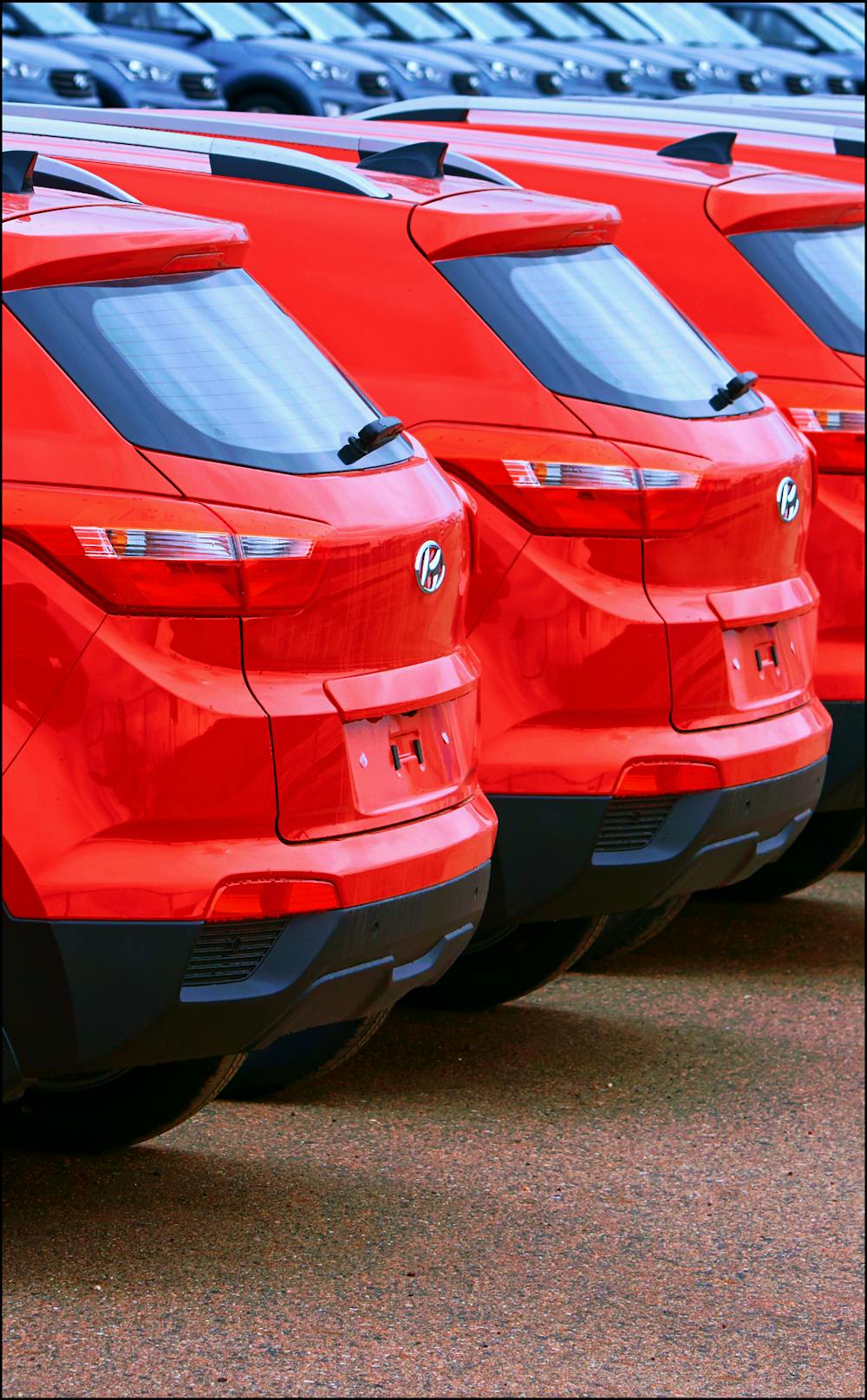
Here’s how it worked in the 2014 Australia-Korea Free Trade Agreement. Australia agreed to remove the remaining 5% tariff on Korean cars, “with consumers and businesses to benefit from downward pressure on import prices”.

But Australia didn’t remove the tariff on car imports altogether, which would have given us a much bigger benefit but denied the department negotiating coin.

The next year the department did it again, agreeing to give up the tariff on imported Japanese cars in the Japan-Australia Economic Partnership Agreement (but not on other cars) so Australians could “benefit from lower prices and/or greater availability of Japanese products”.

Two years later, it did it again, with cars from China.

When the UK and European agreements are negotiated, it’ll do it there too.

Australia holds back reforms

Eventually Australians will get what they are entitled to. But the point is that rather than advancing the cause of free trade, the department has held back, treating a win for the other side as a loss for us, when it wasn’t.

The Centre for International Economics believes the much bigger earlier set of tariff cuts lifted the living standard of the average Australian family by A$8,448.

Had our trade negotiators been in charge, we would still be waiting. Instead the Hawke and then the Keating governments pushed through unilateral reductions, asking for nothing in return.


Read more: This is the most sobering report card yet on climate change and Earth's future. Here’s what you need to know


As former Trade Minister Craig Emerson put it, this gave Australia “credibility in international trade negotiations way beyond the relative size of our economy”.

Does that sound like the sort of thing Australia might need at Glasgow, to have enough credibility to urge even bigger emitters to deliver the kind of cuts on which our futures and future temperatures depend?

It won’t work with China

The prime minister is right to say that China is the world’s biggest greenhouse gas emitter, even though its emissions per person are low. Its high population means it accounts for 28% of all the greenhouse gases pumped out each year. The next biggest emitter, the United States, accounts for 15%

But China’s status is new. Until 2006 it pumped out less per year than the United States. Because the US has had mega-factories and heating and so on for so much longer, it is responsible for by far the biggest chunk of the greenhouse gasses already in the atmosphere: 25%, followed by the European Union with 22%.
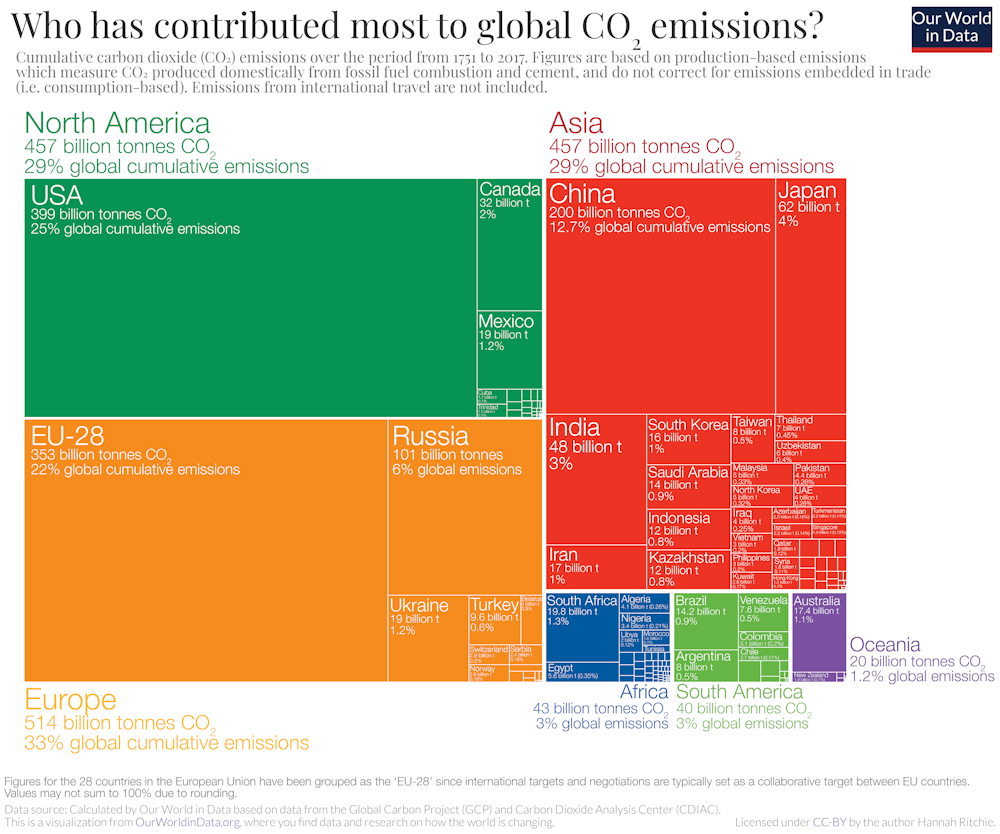


China might reasonably feel that countries like the US that have done the most to create the problem should do the most to fix it.

Like Australia, the US pumps out twice as much per person as China and has much more room to cut back.

On the bright side, China knows that being big means it is in a position to make a difference to global emissions in a way that other countries cannot on their own. And that’s a position that can benefit its citizens.

China’s latest five-year plan, adopted in March, commits it to cut its “carbon intensity” (emissions per unit of GDP) by 18%. If it beats that five-year target by just a bit (and it has beaten its previous five-year targets) its emissions will turn down from 2025.

It is aiming for net-zero emissions by 2060.

Australia needs China’s help

The Intergovernmental Panel on Climate Change finds that Australia is especially susceptible to global warming. We’re facing less rain in winter, longer heatwaves, drier rivers, more arid soil and worse droughts.

We are right to want China to do more, but the worst way to achieve it is to say “we won’t lift our ambition until you lift yours”.

Hardly ever a worthwhile strategy, it is particularly ineffective when we don’t have bargaining power.


Read more: Climate change has already hit Australia. Unless we act now, a hotter, drier and more dangerous future awaits, IPCC warns


The only power we’ve got is to set an example, unilaterally, as we did with tariffs. And to ramp up our ambition.

If Australia said it would do more, and didn’t quibble, it might just count for something.

It’s all we can do, and it’s the very best we can do.

Peter Martin, Visiting Fellow, Crawford School of Public Policy, Australian National University

This article is republished from The Conversation under a Creative Commons license. Read the original article.

Read more >>

Tuesday, September 03, 2019

After 44 years of deficits, we've a current account surplus. What went so right?

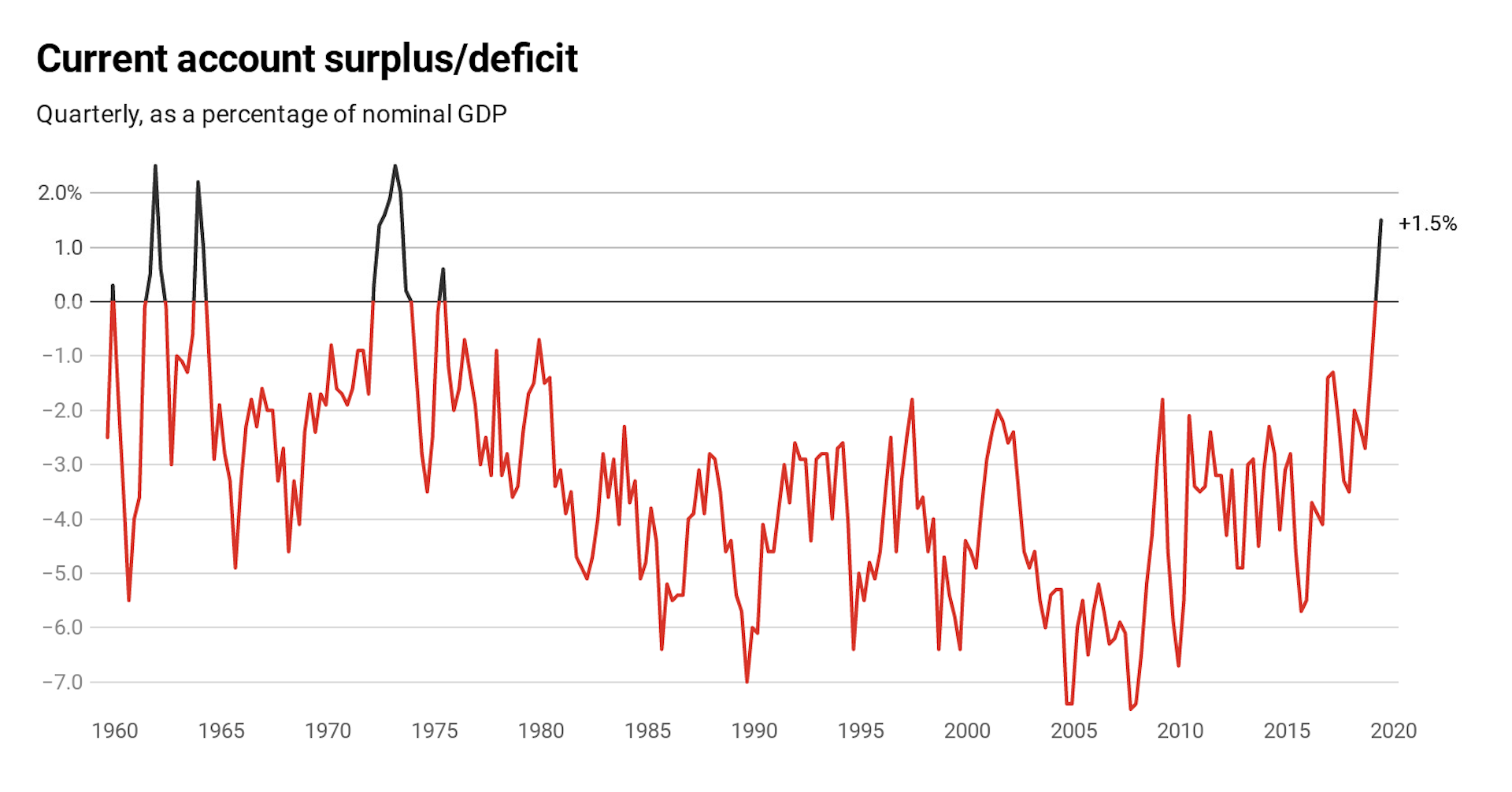
Australia has been in a current account deficit – paying more money out to the rest of the world than it took in – for 44 straight years, since September 1975.

Until today. The update from the Bureau of Statistics released on Tuesday shows that in the three months to June Australia actually took in more from the rest of the world than it paid out: A$5.9 billion more, after what for most Australians (most are under the age of 40) was a lifetime of paying out more.


Why has it happened, and how did we get away with doing the opposite for so long?

First, the long-term story. It couldn’t happen to an individual. No one person can get away with taking more in from the rest of the world than they pay out for long.

It was the idea that a nation is like an individual that allowed the then treasurer Paul Keating to spend a good deal of the 1980s arguing that Australia was living beyond its means.

As the drumbeat of a steadily growing current account deficit grew louder and it approached 5-6% of GDP, on May 14, 1986, he infamously told radio presenter John Laws that Australia was in danger of becoming a banana republic:

I get the very clear feeling that we must let Australians know truthfully, honestly, earnestly, just what sort of international hole Australia is in. It’s the prices of our commodities — they are as bad in real terms (as) since the Depression.

If this government cannot get the adjustment, get manufacturing going again, and keep moderate wage outcomes and a sensible economic policy, then Australia is basically done for. We will just end up being a third-rate economy … a banana republic.

To get spending down, and thus reduce the current account deficit, he tightened the budget and encouraged the Reserve Bank to push interest rates to stratospheric levels. The cash rate hit 18% before helping push Australia into recession .

And for what? The current account deficit continued. It averaged 4% of GDP throughout the 1990s and 2000s. But life went on. The economy recovered, the Bureau of Statistics stopped publishing monthly current account figures (moving to quarterly), the figures became little watched and the pundits and politicians turned their attention elsewhere.


Read more: Cabinet papers 1990-91: lessons from the recession we didn’t have to have


With the benefit of hindsight it is clear that the deficits weren’t because of any deficiency on the part of Australians. Reserve Bank deputy governor Guy Debelle explained last week that Australians weren’t spending an unusual amount compared to what they earned. They were “about on par with many other advanced economies”.

The current account deficits were largely the result of money flowing out as returns on investments in Australia. Australia had “a lot of profitable investment opportunities”. Foreigners either lent to Australian businesses or invested in Australian businesses and returns flowed out each month, as they should have.

It came to be known as the “consenting adults” theory of international finance. It’s practical message was: “nothing to see here, move along”.

So what’s changed?

In 2017 and 2018 the current account deficit shrank to around 2% of GDP. We now know that in the three months to June this year it moved into surplus.

Much of it is because we’ve been earning more from mining exports. We’re both exporting more tonnes and getting paid more for each one.

And just lately mining has helped in another way. The so-called mining investment boom is winding up. We are no longer importing enormously expensive machines to build gas terminals and the like.

And it’s more than mining. Export income from services such as education and tourism now accounts for 21% of all exports, up from 17% in the 1980s. Purists will complain that education and tourism aren’t actually exported, but as far as the national accounts are concerned, they are. Even though the teaching and hospitality takes place in Australia, it is paid for in foreign dollars that bring more money into the country relative to what is going out.

And there’s something else.

We are becoming like the US

As popular as Australia remains as a destination for foreign investment, since 2013 Australians have been investing even more in foreign businesses than foreigners have been investing in Australian businesses.

It is superannuation that’s done it: a record A$2.9 trillion worth.

Debelle put it this way:

This largely reflects the significant allocation to foreign equity by the Australian superannuation industry together with the fact that the superannuation sector is relatively large as a share of the Australian economy.

Australia has become a net foreign investor rather than a net recipient of foreign investment, almost certainly for the first time ever.

Debelle says it has made Australia come to resemble the United States. We receive more in dividends from overseas than we pay out in dividends to overseas share holders.

We’re still a magnet for foreign dollars

We are still a huge destination for foreign lending, increasingly in the form of lending to the Australian government rather than to Australian companies, as safety-conscious foreigners push locals out of the way to buy more and more Australian government bonds.

Foreign ownership of Australian government bonds has climbed from around 40% to 60% since the early 2000s.

The interest rate foreigners are prepared to accept in order to hold Australian 10 year bonds has fallen below 1% (which in its own way assists in keeping the current account deficit low).


Read more: Revisiting the banana republic and other familiar destinations


How long the current account surplus lasts will depend on the investment policies of our super funds (the better the prospects are overseas, the higher the surplus will be), the strength of our economy (the weaker is consumer spending, the higher our current account surplus will be) and export prices and volumes (which are mainly beyond our control).

Yes, we’ve current account surplus. It would have once been a cause for celebration. Now that we’ve got it, it’s not looking that special.The Conversation


Peter Martin, Visiting Fellow, Crawford School of Public Policy, Australian National University

This article is republished from The Conversation under a Creative Commons license. Read the original article.

Read more >>

Wednesday, January 24, 2018

How about showing us the TPP we're about to sign?

What's in the revised Trans-Pacific Partnership deal for Australia? There's no way to tell until we've seen the text, and we won't see it until after it's signed, in Chile on March 8. Really. That's the way things normally work.

After that, there's still time to back out if we don't want to ratify it, and there's a precedent. All 12 would-be members signed up to the original Trans-Pacific Partnership in February 2016. Barack Obama found himself unable to get it through Congress and Donald Trump didn't try.

As best as we can tell, the new deal, TPP-11, is the old one with fewer bad bits. Twenty of the most contentious provisions included at the insistence of the US have been "suspended" until the US decides to join. They include enforced protections for the owners of pharmaceutical patents and extensions to copyright law.

There's no guarantee they would come back if the US did decide to join. Each of the 11 other members would have to agree.

Still in the agreement, although somewhat weakened, are the investor-state dispute settlement provisions insisted on by the US and Korea. They will allow private companies to sue national governments in extraterritorial tribunals, as Philip Morris did over Australia's tobacco plain-packaging laws using the terms of an obscure Hong Kong investment agreement.

John Howard successfully resisted having them in the US-Australia agreement and the Abbott government managed to avoid them in the Australia-Japan agreement, but we have apparently agreed to them now, for Japan, Korea and eight other nations.

The upside is that our companies will also be able to sue governments.

The best guess as to what the trade and investment concessions do for Australia financially, from the respected Peterson Institute, is "not much". Australia's national income would eventually be 0.5 per cent higher, a gain of less than half of one-tenth of a per cent per year.

The Productivity Commission wants to do the numbers itself, performing a proper cost-benefit analysis. Under Labor it would, for all future agreements. It's hard to think of a good reason why it shouldn't do it now.

In The Age and Sydney Morning Herald
Read more >>

Thursday, November 02, 2017

It's time (to take Labor seriously)

The shape of the next Labor government is becoming clearer.

This week we learnt that it will end the practice of signing Australia up to trade agreements that haven't survived a benefit-cost analysis.

Seriously. Korea, Japan, China. None of the three big agreements boasted about by Tony Abbott and Malcolm Turnbull has been subjected to an independent assessment of its benefits and costs. And nor has the far bigger, 5600-page, Trans-Pacific Partnership agreement signed by trade minister Andrew Robb shortly before he resigned and took up a position with the Chinese investor that runs the Port of Darwin.

Nor have any of Australia's agreements ever had to face official scrutiny after the event. "Not that I am aware of," were the words used by a foreign affairs official at a parliamentary hearing.

The US-Australia free trade agreement at least faced an unofficial analysis about the time of its 10th birthday in 2015. An economic modeller from the Australian National University applied the framework developed by the Productivity Commission and found it had cut rather than boosted trade between Australia and the US and the rest of world. Trade between Australia and the US also slid, but for other reasons.

It's easy to see why it cut trade with the rest of the world. Like most exclusive agreements it gave special access to exports from its members. Here's how it would have worked with the 12-nation Trans-Pacific Partnership (had Donald Trump not pulled the pin): Vietnam would have been a member but Thailand would not have been. The US-based Peterson Institute for International Economics has found that Vietnam would have exported more to Australia (which would have boosted its economy) in place of Thailand, which would have exported less (which would have harmed its economy).

And Australia would have had to change the way it made things, cutting inputs from countries such as Thailand and Indonesia under complex "rules of origin" if it wanted special access to the US, even where that meant much higher costs. The Korea-Australia agreement included 5200 rules of origin.

It's little wonder that the business organisation closest to the action, the Australian Chamber of Commerce and Industry, finds its members less than keen to use the agreements trumpeted by the Coalition. Only 15 per cent use and understand the Australia-US Free Trade Agreement, 5 per cent use it without understanding it, 17 per cent understand but don't use it, and 22 per cent neither understand nor use it. Another 41 per cent say it's not relevant to them.

The chamber hosted Labor's policy launch on Monday because it has long argued that a body such as the Productivity Commission should run the ruler over future agreements and should review existing ones every 10 years, both of which Labor would do.

Labor would also tear up what has come to be seen as a cosy relationship between the government and Treasury forecasters, handing responsibility for official forecasts to the independent Parliamentary Budget Office. It would make "convenient" forecasts such as the pick-up in wage growth in this year's budget less suspicious. The Treasury would also lose responsibility for preparing the five-yearly Intergenerational Report, a document so debased by politics in its latest iteration that Treasury staff distance themselves from it when giving public presentations.

And it would make explicit the trade-off between cutting personal income tax and cutting company tax, in part by publishing 10-yearly projections for the cost of budget measures and in part by not proceeding with the unlegislated part of the company tax cut in order to deliver relief to ordinary taxpayers first.

It has consulted widely about its plans, receiving detailed input from 20 economists.

Negative gearing would be limited to new homes, and the capital gains tax discount that makes it attractive would be halved. Payouts from discretionary trusts would be taxed at the company tax rate. Deductions for the "cost of managing tax affairs" would be limited to $3000. "Junk" health insurance policies would no longer be eligible for the rebate, and the rebate along with the Medicare levy surcharge would be frozen for five years.

Labor is inclined to accept the Coalition's proposed national energy guarantee, ending the climate policy wars by keeping the framework (subject to seeing it) and adjusting the emissions target as needed.

Although critical of the Turnbull government's cut-price national broadband network, Labor won't fully return to its original very expensive plan to deliver fibre to 93 per cent of households and businesses. It would aim for a touch under 40 per cent, a step up from the Coalition's 20 per cent but nowhere near as expensive as would be rewiring most urban addresses in the nation.

It would keep offshore asylum seeker processing, but it would aim to process claims within 90 days instead of indefinitely and would set up an independent body to oversee Australian-funded detention centres.

The policies are not all to everyone's liking, but at least they are set down on paper. Unless things change, this time next year we will be faced with a choice between a government that makes things up as it goes along and a government in waiting that knows what it wants to do.

In The Age and Sydney Morning Herald
Read more >>

Monday, October 30, 2017

Labor to open free trade agreements to scrutiny

All future free trade agreements would be vetted by the Productivity Commission and re-examined every 10 years under a new Labor policy that has won endorsement from business organisations.

Unveiling the policy at a function hosted by the Australian Chamber of Commerce and Industry, Labor trade spokesman Jason Clare said the public was sceptical about the China, Korea and Japan trade agreements in part because they hadn't been subject to an independent arms-length assessment outlining what they would mean for jobs and incomes.

"At the moment, once a free trade agreement is signed a report is prepared by the Department of Foreign Affairs and Trade outlining why it is in Australia's national interest. That's it," he said.

"Given all the scepticism that exists, I don't think it's good enough to rely on a report from the same people who negotiated the deal. It should be independently assessed."

Australia signed the giant 12-nation Trans Pacific Partnership Agreement with the United States without the benefit of any independent analysis of its economic effects. The government published a report commissioned by the Department of Foreign Affairs on the combined economic effects of China, Korea and Japan free trade agreements, but did not allow other parts of government to independently analyse them.

The Productivity Commission has been scathing about the latest series of agreements, arguing that they grant legal rights to foreign investors not available to Australians, expose the government to potentially large unfunded liabilities and impose extra costs on businesses attempting to comply with them.

The Commission says that by favouring some countries over others and excluding firms sourcing substantial inputs from overseas, they "add to the complexity of international trade and investment, are costly and time-consuming to negotiate and add to the compliance costs of firms and administrative costs of governments."

Appearing before a parliamentary inquiry, Commission chairman Peter Harris said without a genuinely independent analysis before deals were signed, the consensus in favour of open trade would crumble.

The analysis should first identify the problem that the trade agreement was designed to solve, find the lowest-cost means of solving that problem and then make clear the costs the proposed agreement would impose on business.

It should be conducted before negotiations begin, and again in the four or so months after they have concluded but before the deal is ratified.

The Korea-Australia agreement included 5200 separate so-called rules of origin delineating which inputs could be included in an export in order for it to have preferential treatment. It was "red tape, growing at a very healthy rate," Mr Harris said.

Mr Clare also promised that the Commission would conduct an independent review of each agreement ten years after ratification. The department told the parliamentary inquiry that to the best of its knowledge none of the agreements signed by Australia had been assessed by Australia after the event. A review of the US-Australia agreement conducted by the Australian National university 10 years after ratification found it had not boosted trade at all.

The Chamber's director of international trade, Bryan Clark said Labor had embraced, not only the Chamber's position but also the recommendations of the parliament's joint standing committee on treaties and the Senate foreign affairs and trade committee. The Business Council said Labor's proposal was "worth considering".

Trade Minister Steven Ciobo said Australia already had measures in place to test the effectiveness of its agreements. There was rigorous oversight by the joint standing committee on treaties, which included Labor politicians.

In The Ag e and Sydney Morning Herald
Read more >>

Thursday, February 02, 2017

High prices hurt. Why Sinodinos is under pressure over books

Strong governments stand up for little people.

In working-class Brisbane in the early 1970s, no one stood up for the Chesters.

"Working parents, three kids. My mother had been squirrelling away money for two years to afford a return flight to Perth to visit her mother," daughter Karen told a conference late last year.

"The price of domestic air travel at the time was in real terms over fourfold what it is today. The price of clothing, with tariffs north of 40 per cent – think President Trump – was also more than threefold higher in real terms than today. And three kids, each five years apart in age, experienced a simultaneous exponential growth spurt."

"A perfect storm for my mother, who ended up raiding the squirrel tin to re-clothe us. No flight to Perth. She never saw her mother again."

By the early 80s, Chester was studying economics at the University of Queensland. She'd wanted to get into law, but didn't get the marks. One day in the second semester, during microeconomics, what had happened to her family began to become clear. Punitive tariffs on clothes and the two-airline policy had prevented her mother getting to Perth.

Four years further on, hired as an economics graduate at the Department of Prime Minister and Cabinet, a 20-something Chester was sitting in prime minister Bob Hawke's office taking notes.

He asked the assembled officials to tell him why he should cut tariffs.

"Because tariffs screw workers," Chester mumbled, in a voice she had hoped was too quiet to be heard.

But it was heard. Hawke asked the officials to explain how, asked for modelling on exactly how much they hurt workers, and started to drive tariffs down.

Twenty years on, after some years away in the private sector, Chester found herself back in government chairing a Productivity Commission inquiry into (among other things) the price of books.

So-called parallel import restrictions make it illegal for booksellers to import from wholesalers, except in limited circumstances. Forced to go through Australian publishers, even for the big name foreign books by authors such as JK Rowling or Elena Ferrante, the bookshops can be hit up for more and made to charge their customers more.

Except that the Booksellers Association and the Publishers Association told Chester it didn't happen. The booksellers prepared a chart of the price of 75 books in Australia, the US and the United Kingdom and argued there was little difference. The publishers compared 200 titles and said most were cheaper in Australia.

But Chester noticed that the samples were limited, in odd ways. And the booksellers' list compared the price of Australian paperbacks to foreign hardbacks, even where Australian hardbacks were available and more expensive.

She commissioned her own higher-quality survey of the price of 1000 identically matched books from the top 5000 titles sold in Australia and the UK and found the pre-tax Australian prices exceeded the prices charged in the UK by a staggering 20 per cent.

Worse still, limiting her comparison to just the majority of books that were more expensive in Australia (which is what's relevant for examining the effect of trade restrictions) she found the average difference was 30 per cent.

Despite their protestations, the Australian publishers seemed fully aware that they charged more for overseas books than was charged overseas, because they argued before her that they used those profits to subsidise the production of Australian books. But when she asked them for details about the cross-subsidy none returned with an answer, although several promised to.

It's the same argument that was used by Australian record labels right up until 1998, when John Howard (with Arthur Sinodinos as his chief of staff) extended Hawke's program of trade liberalisation by allowing the free import of compact discs. It was going to kill Australian music.

Two decades on, it's an easy claim to assess. Back in 1998 the Triple J Hottest 100 contained 42 Australian recordings, an all-time record. By this Australia Day it contained 66. The industry tally of all genres finds that back in 1998 Australian recordings accounted for 1 in every 5 recordings bought here. After two decades of open trade, it's 1 in every 3.

Sinodinos is now industry minister, and says he is as committed now as he was then to blasting away rules that hurt consumers. "Protection stops you being lean, it leads to companies padding themselves out," he told Fairfax Media this week. He has before him Chester's report, and he wants responses within a fortnight.

The Harper competition review has already recommended removing the remaining import restrictions on books, as has the Competition and Consumer Commission, the old Prices Surveillance Authority and a Senate inquiry. The government accepted Harper's recommendation and asked Chester's inquiry how to do it. She's recommended an immediate end in December this year, with no phase out.

Labor, shamefully, is backing continued high prices as it did for compact discs two decades ago. This time it wants to "support Australian stories".

Chester wants to support Australian consumers. She says there's $15 million to $25 million in it on just the 1000 titles she examined, depending on freight costs. Sinodinos will have to decide whether to back us.

In The Age and Sydney Morning Herald
Read more >>

Tuesday, January 24, 2017

TPP was never that good for jobs, never that good for growth

If the Trans-Pacific Partnership was really as good for jobs and growth as Malcolm Turnbull says it was, he would be able to point to a study saying so.

He might have even commissioned one. Instead, despite the Productivity Commission practically begging for the role, his government has been resolute in its determination not to subject the 12-nation treaty that Donald Trump just dumped to independent analysis.

An earlier analysis of three landmark trade agreements that the government did commission found that, combined, the Japan, Korea and China agreements were set to create a total of 5434 extra jobs by 2035.

That's 5434 extra jobs after 20 years. According to the Bureau of Statistics, employment is growing at a trend rate of 8200 per month, meaning the extra jobs will amount to less than a month's worth, after 20 years.

The government-commissioned study found that, combined, the agreements would boost exports 0.5 to 1.5 per cent while boosting imports 2.5 per cent, which means they would send Australia's trade balance backwards.

In the absence of an Australian analysis of the agreement Turnbull insists would have produced jobs and growth, one by World Bank found that 15 years on, it would have bolstered Australia's economy just 0.7 per cent, which amounts to 0.05 per cent per year, somewhat less than measurement error.

It's easy to conclude Turnbull is talking up the TPP because he has not much else to talk up.

In any event, it's dead. Its rules say it can only come into force if it is ratified by members accounting for 85 per cent of its combined gross domestic product, which means it can only come into force if it is ratified by the United States, something President Trump has ruled out.

Part of the problem with it, and part of the problem with reviving something like it without the United States, is that it's so darn complicated. That's because in the assessment of James Pearson, head of the Australian Chamber of Commerce and Industry, "so-called free trade agreements never seek free trade".

Much of the TPP dealt with things such as copyright terms, patent protection for drugs, and so-called investor-state dispute settlement procedures that would have allowed foreign corporations to sue sovereign governments. It took a decade to negotiate.

Pearson says if free trade agreements genuinely sought free trade "they would be simple, stating that the parties agree there shall be no restrictions on trade, investment or movement of people between the two countries, full stop".

When even the potential beneficiaries are questioning the value of ever more complex trade agreements, it could be time to take stock.

In The Age and Sydney Morning Herald
Read more >>

Wednesday, November 09, 2016

Donald Trump could be disastrous for the Australian economy

President Donald Trump will declare economic war on our biggest customer, wipe unprecedented amounts off global stock markets, usher in extraordinary financial instability, and risk turning the world's biggest economy into a basket case by pushing its national debt past 100 per cent of GDP.

And that's just what's known about his economic program. The Economist observed in the leadup to the election that while his policies were unusually short on detail, their direction "could not be clearer".

China takes 1 in every 3 shiploads of Australian exports, more than any nation has since Britain in the 1950s according to consultant Saul Eslake. Even small variations in what it wants sends our budget into conniptions.

Trump has promised from "day one" to designate China a "currency manipulator". That would allow him to whack a giant 45 per cent tariff on everything it tries to sell to the US, a prospect he has mentioned with relish. The US is China's biggest market, taking 18 per cent of everything it sells. China would have to retaliate (somehow), raising the prospect of a trade war that would damage both China and the US. War gaming by the respected Peterson Institute says it could push the US into recession by 2019. The last time that happened, during the global financial crisis, Australia avoided recession with help from China. We mightn't get it a second time.

In answer to questions after his first speech as Reserve Bank governor last month, Philip Lowe described the prospect of a Trump presidency as less than benign.

"We don't have a Trump plan," he added. "What we do is have a generic response plan to a whole range of shocks."

Financial markets lost $US2.5 trillion on Wednesday as it became apparent Trump was likely to win, just as they slid on each of his successes and surged on each of his setbacks throughout the campaign. US-Australian economist Justin Wolfers and his colleague Eric Zitzewitz have used those gyrations to put numbers to the Trump effect. They say a Trump win will knock 15 to 30 per cent off the value of the US stock market (during the global financial crisis it lost 50 per cent) and do much the same to other markets. US interest rates will climb 0.25 points.

It wasn't all bad for Australia on Wednesday. Shares in the gold miner Newcrest shot up 9.8 per cent.

Importantly Wolfers and  Zitzewitz say markets will become far more volatile, making it harder to plan, in what appears to be a first for a Republican win. They've analysed the market reaction to every presidential election going back to 1880 and found either a Republican "premium" or a "discount" whenever there was a significant move.

This is the first Republican discount, or as they call it, "Trump discount", a result all the more remarkable because Trump's policies are explicitly pro-business. Trump has promised to cut the US company tax rate from 35 per cent (a good deal higher than Australia's 30 per cent) to just 15 per cent.

But he'll spend big. The National Australia Bank and the US Tax Policy Centre say his promises will add $US7 trillion to US government debt over the first decade. His expansion of the military alone will add $US450 billion. Clinton's would have added just $US200 billion. The Economist describes her budget plans as "fiddly". It describes his as "absurd". The Committee for a Responsible Federal Budget says after 10 years US national debt will hit 105 per cent of GDP under Trump. Under Clinton, it would hit 86 per cent.

In an open letter, 77 US Nobel Prize winners have condemned Trump's platform, 20 of them winners of the Nobel for Economics. They are concerned about more than trade and more than recession. Trump says he will walk away from the hard-won consensus on the need to tackle climate change, describing global warming as a hoax "created by and for the Chinese". Australia's commitment to adjust its emission targets in line with those of its trading partners is about to become less onerous.

And he intends to build a wall along the Mexican border at a cost of $US5 to $US10 billion (funded by Mexico) in order to keep out illegal immigrants. Those already in the US would be deported (as happens here) rather than periodically made legal (as has happened in the US up until now).

On election eve the Economics Society and the Monash Business School polled 36 leading economists on whose presidency would be best for Australia. Thirty said Clinton, none said Trump.

One of the most stridently anti-Trump was 89-year old Max Corden, the doyen of Australian economists who is still working at Melbourne University. He said Trump would be a disaster for the world, "like another Hitler or Mussolini".

Unlike many who evoke Hitler, Corden has experience of him. He remembers the excitement when as a tiny boy in Germany he snuck out of his home to wave at Hitler's motorcade. He remembers his dad being interned in a concentration camp, and he remembers the incredible good fortune that allowed him to escape to Australia.

In The Age and Sydney Morning Herald
Read more >>

Sunday, November 06, 2016

And you thought the TPP was secret. The RCEP is even worse

There's another massive deal you've never heard of. The Trans-Pacific Partnership – negotiated in secret between Australia and 11 other nations over 10 years – appears to be dead.

It would have allowed US corporations to sue Australian governments in offshore tribunals, as they have long wanted to do, effectively trumping our own High Court. Donald Trump himself opposes it (bless him) as does Hillary Clinton, although she once helped to draw it up.

Whoever is elected president on Wednesday has pledged to abandon it.

So you would think we would be safe. Except that, in what The Wall Street Journal calls a long-shot, Barack Obama is going to attempt to push it through in the so-called lame duck weeks between Wednesday and the inauguration of his successor in January. Hundreds of economists and law professors have urged him not to, saying the provisions of the TPP would allow foreign investors – and foreign investors alone – to bypass "the basic procedures of the US justice system".

US corporations can't do it to us at the moment because the Howard government refused to include those provisions in the Australia-US Free Trade Agreement.

Right now, if US corporations want to sue us and don't find our court system to their liking, they have to pretend to be headquartered somewhere else, as the Philip Morris tobacco company did when it purported to move ownership of its Australian operations to Hong Kong in order to take advantage of the provisions of an obscure Australia-Hong Kong treaty after losing its case against our plain packaging laws in the High Court.

So far that case cost us more than $50 million to defend, and although we successfully fended off Philip Morris, we are yet to be awarded costs. It's a prospect that would terrify a smaller country.

Now there's a fresh move to have us face it time and time again, even if Obama fails to revive the Trans-Pacific Partnership. The TPP would have had 12 members. The lesser known RCEP – the Regional Comprehensive Economic Partnership – would have 16 members including China, accounting for one half of the world's population.

Leaked chapters of the draft agreement contain the same sort of investor-state dispute settlement procedures as the TPP. Although the Foreign Affairs website doesn't say so, our assistant trade minister Keith Pitt slipped into the Philippines on Friday to advance the negotiations.

Whereas in the TPP, Australia's delegations took community as well as business groups into its confidence, so far with the RCEP it's only been business groups. Patricia Ranald of the Fair Trade and Investment Network says that might be because, at least to start with, the US is excluded. It's a relatively open democracy. China, Indonesia, Malaysia and other RCEP members are not.

Just as with the TPP, our negotiators are releasing no texts and submitting none of what's proposed to cost-benefit analysis. There's every chance it will cut across rather than intermesh with the TPP and our other trade agreements. There's every chance we won't be told until it's too late.

In The Age and Sydney Morning Herald
Read more >>

Monday, October 17, 2016

ACCI comes out swinging against the aspects of TPP

Australia's biggest business organisation has distanced itself from claims the proposed Trans Pacific Partnership will create hundreds of thousands of jobs and be a "gigantic foundation stone" for Australia's future.

The claims, made by Prime Minister Malcolm Turnbull in Washington and in Canberra in an attempt to win support for the 12-nation deal, were dismissed by the Australian Chamber of Commerce and Industry (ACCI) in evidence to a Parliamentary inquiry on Monday.

ACCI argued the agreement did not mandate free trade and had not been assessed by an independent authority such as the Productivity Commission.

ACCI's director of trade Bryan Clark told the hearing the deal with Australia, the United States and 10 other nations was a "preferential" rather than a "free" trade agreement, and would add to rather than remove the complex web of rules that distorted international trade.

"There are now over 450 such agreements around the world," he said. "Each one taken in isolation may have benefits to the parties involved, but in aggregate they form the noodle bowl of complex trading terms that business has to navigate."

If it didn't mesh with the proposed separate Regional Comprehensive Economic Partnership with ASEAN nations – China, India, Japan, South Korea and New Zealand – there was a risk that the "noodle bowl" could "spill over into the services, intellectual property and e-commerce areas".

Agreements were inconsistent partly because they were negotiated behind closed doors.

"With the exception of some relatively superficial information on the Department of Foreign Affairs and Trade website, it is difficult to know the detail of what is being negotiated in our national interest," Mr Clark said.

"There is little academic study of the technical components of what is being negotiated, nor study of the outcomes of past negotiations to ensure the intended goals were achieved."

Despite strong representations from the chamber and the Productivity Commission, no arm's-length study had been conducted of the cost and benefits of the agreement from an Australian perspective.

The best the inquiry could do was hold hearings and undertake a popularity contest that would "ultimately divide along party lines", Mr Clark said.

The ACCI was forced to support the implementation legislation because all that it did was reduce tariffs, as the rest of the deal didn't require enabling legislation.

But the chamber wanted the inquiry to note that the deal would "further complicate compliance and costs for business" and had not been subjected to an independent Australian economic analysis.

It should also be concerned about the potential for "regulatory chill" from the clauses that would prevent further liberalisation of Australia's intellectual property and labour laws after it had been ratified.

Although both US presidential candidates opposed the deal, President Barack Obama was considering putting it to Congress in the so-called lame duck period between the presidential election in November and the swearing-in of the new president in February.

He might seek to take advantage of provisions that gave the United States the ability to change aspects of the deal after it had been signed, as it did with the Australia-US free trade agreement in 2005.

In The Age and Sydney Morning Herald
Read more >>

Thursday, July 07, 2016

The campaign's other big lie: 'export agreements'

Here's another lie. Our trade agreements boost exports. Malcolm Turnbull and Scott Morrison said so repeatedly during the campaign on the basis of next to no evidence, rebadging their agreements with Japan, Korea and China "export agreements".

Even on election night the Foreign Minister Julie Bishop used the line, castigating its biggest election winner, South Australia's Nick Xenophon, for expressing scepticism.

"He is against free trade agreements," she told the ABC. "South Australia is the state that will benefit enormously from the free trade agreements the Coalition have signed."

Xenophon isn't against trade agreements. He wants the Productivity Commission to run benefit-cost studies on what they actually achieve, something the Coalition has resisted at every turn.

There's no evidence that South Australia or any other state will "benefit enormously from the free trade agreements the Coalition has signed", in large part because the Coalition has ensured there isn't.

It refused outright to commission a cost-benefit analysis on the giant Trans-Pacific Partnership deal it signed in February which is yet to be ratified. More than a decade after it negotiated the US-Australia Free Trade Agreement it hasn't looked back to find out what happened. A prospective study it did commission on the new Japan, Korea and China agreements found that taken together they will boost our exports 0.5 to 1.5 per cent, while boosting our imports 2.5 per cent, which means they will send our trade balance backwards.

Rather than being "export agreements", the deals for which we have data are better described as import agreements. In every case for which we have clear evidence, our trade agreements seem to have boosted imports more than exports.

Until 2003 we only had one, with New Zealand. We preferred to cut tariffs unilaterally and argue for global free trade rather than play favourites. In the 13 years since then we've added, or are adding, 13.

After the first new-style agreement with Singapore in 2003 our exports climbed much as before while imports (goods and services) surged. After the 2005 free trade agreement with the United States, both imports and exports continued on the trend lines set previously with imports climbing faster than exports, as they did for Chile and Malaysia and as they will for China, Japan and Korea.

Which isn't to say imports aren't welcome. Increased imports lift our standard of living. And while they can lead to the closure of old Australian industries, such as the car industry, they can boost new ones by ensuring the supply of cheap inputs.

But that isn't an argument for our never-ending pipeline of trade deals. We could get the same cheap imports more quickly by cutting all of our tariffs to zero. Seriously. We could do away with much of our mammoth self-perpetuating trade negotiating bureaucracy and trade more simply.

The Treasurer himself provided an unintentional window into how complex these trade agreements have become when during the campaign he lauded "export trade deals that generate some 19,000 new export opportunities".

What were these 19,000 new export opportunities, I asked one of his staff. The number refers to the count of specific line items in the China, Korea and Japan free trade agreements. That's how complicated they've made trade.

A huge chunk of the traders surveyed by the Australian Chamber of Commerce and Industry don't use them.

"In my experience, they have been a waste of time, particularly Thailand. The paperwork to qualify was so onerous it wasn't worth the effort," says one member.

"I know we have one with the US and I know there is one now with Japan and Korea. Is that correct?" says another.

Using the agreements costs more than time. In order to get low-tariff entry into a market such as the United States, an Australian company has to comply with "rules of origin", which means it needs to ensure that no more than a certain percentage of its inputs is sourced from countries outside of Australia and the United States, sending up costs. In 2010 the Productivity Commission found these extra costs amounted to as much as 8 per cent per shipment.

Where exporters attempt to apply with the rules, they shrink trade. One of the few studies of the impact of the US-Australia Free Trade Agreement found it shrank both nations trade with the rest of the world.

That agreement had 980 rules of origin. One of our latest, with Korea, has 5205. The Trans-Pacific Partnership has even more. And because the agreements are not always consistent with each other, the "noodle bowl" of overlapping requirements makes attempting to trade using the new agreements harder still.

Which would be bad enough, were Australia not negotiating more. In the early stages of negotiation are agreements with India, Indonesia, the European Union and a Regional Comprehensive Economic Partnership linking us separately to China, Japan, Korea, Singapore, New Zealand, Thailand, Malaysia, India and Indonesia.

The Productivity Commission wants to take stock, and from here on have it or the Treasury examine whether the deals are actually worth doing. A government genuinely concerned about making things easy for business would have agreed long ago. Xenophon, the Greens and Labor are about to make it see sense.

In The Age and Sydney Morning Herald
Read more >>

Thursday, March 03, 2016

TPP: Would anybody mind if the deal fell over?

Hillary Clinton is misguided. Her opposition to the Trans-Pacific Partnership is based on "misinformation". Malcolm Turnbull's new trade minister says so.

Within hours of being sworn two weeks ago, Steven Ciobo eschewed the traditional approach of getting up to speed and consulting widely, and blundered into the US presidential race.

"I am not surprised that the trade union movement and, of course, the political arm of the Australian Labor Party is on a similar platform to, for example, Hillary Clinton," he told the Financial Review. "They both derive their key support from the union movement."

The woman most likely to be the next US president, the former secretary of state who ran America's missions abroad, the woman who criss-crossed the world pressing flesh about the Trans-Pacific Partnership, knows less about it than Steven Ciobo.

Asked directly whether he thought her opposition to the TPP was based on misinformation, he replied: "Absolutely".

And he was going to clear it up. "I will not take a backwards step in terms of putting forward the clear truthful situation in the face of an ongoing campaign of misinformation," he said.

So what is the clear truthful situation? What is it that Clinton (and also Trump) are failing to grasp? The awful truth is that Ciobo's department isn't particularly keen on finding out.

Back in 2010 the Productivity Commission found little evidence that Australia's trade agreements to that point had "provided substantial commercial benefits". It recommended the government first work out what it wanted to achieve, review its goals annually, and enter into trade negotiations only if they were likely to meet those goals and only after examining alternatives, including the alternative of "no further specific action".

The examination would be independent and made public. When the agreement was complete and about to be signed it would be examined again by an independent body which would produce a public assessment of the costs and benefits.

None of those things have happened with the Trans-Pacific Partnership, the biggest trade deal in Australia's history. Set to take in nearly 40 per cent of the world's economy including Australia, Canada, Singapore, Brunei, New Zealand, Chile, Mexico, the United States, Japan Malaysia, Peru and Vietnam, it will encourage us to buy and sell from each other rather than the rest of the world, and it will tie us to common (largely US-driven) standards.

Former trade minister Andrew Robb signed it in Auckland last month without commissioning any outside analysis. His department's so-called national interest analysis, required by law, ran to just 19 pages, most of which merely summarised the 6000 page agreement. New Zealand's national interest analysis ran to 277 pages.

Robb's department turned down an offer from the Productivity Commission to do the job properly, observing that modelling such an agreement was "very, very difficult to do"...

The modelling that's been done overseas finds the benefits for Australia close to non-existent. The World Bank finds that after 14 years the agreement will have boosted Australia's GDP by 0.7 per cent. Depending how you round it, that's a boost of either 0.0 or 0.1 per cent per year. A separate study by Tufts University in the US concurs, but says the growth will come at the expense of jobs, around 39,000 after 10 years. The agreement won't exactly "drive jobs and growth".

Willful blindness over the benefits wouldn't matter so much if there wasn't also wilful blindness to the costs. The Department of Foreign Affairs and Trade appears to have never examined any of Australia's 18 free trade agreements after the event, but the Australian National University has. Ten years after the US-Australia free trade agreement it found it had cut rather than boosted trade.

That's because free trade agreements help and hinder trade. By rewarding trade within a group they penalise trade outside the group, even the use of foreign-tainted inputs which can see entire classes of exports labelled non-compliant. Businesses find it easier not to import from outside, or not to use the agreement.

And they miss out on getting benefits they could have had years ago. The TPP promises tariff cuts worth $135 million over four years. But they could have been delivered without the TPP had the government not held them back, possibly in order to have tariffs to negotiate away.

Because we've comparatively few barriers to negotiate away we've been under pressure to agree to other things, like tighter copyright rules and extra-territorial tribunals to which foreign firms (but not our own firms) can take the Australian government after losing their case in Australian courts.

It may be that these concessions are worthwhile. It would be good to know, and it's not too late. The TPP may have been signed, but it won't come into force until at least half of its members have ratified it, including Japan and the United States. The parliament's treaties committee is examining it now and is accepting submissions until Friday March 11.

I'd feel better about the whole process if I didn't have a sneaking suspicion that leaders, including our prime minister, know full well that its not such a great deal and wouldn't much mind if the US kicked it over.

In The Age and Sydney Morning Herald

Read more >>

Monday, January 11, 2016

Trans-Pacific Partnership will barely benefit Australia, says World Bank report


Australia stands to gain almost nothing from the mega trade deal sealed with 11 other nations including United States, Japan, and Singapore, the first comprehensive economic analysis finds.

Prepared by staff from the World Bank, the study says the so-called Trans-Pacific Partnership would boost Australia's economy by just 0.7 per cent by the year 2030.

The annual boost to growth would be less than one half of one 10th of 1 per cent.

Other members of the TPP stand to benefit much more, according to the analysis. Vietnam's economy would be 10 per cent bigger by 2030, Malaysia's 8 per cent bigger, New Zealand's 3 per cent bigger, and Singapore's 3 per cent bigger...

Australia and the United States benefit the least from the Trans-Pacific Partnership. The study says it would boost the US economy by only 0.4 per cent by 2030.

Non-members would suffer as members directed trade to other members. The biggest loser would be Thailand, whose exports are set to fall 2 per cent while Vietnam's grow 30 per cent.

The study explains that highly developed nations such as Australia are either relatively reliant on things other than trade for economic growth or are already fairly free of trade restrictions.

Since sealing the deal in October the Australian government has been reluctant to commission an economic analysis of its effects, turning down an offer from the Productivity Commission.

Prime Minister Malcolm Turnbull described the deal as a "gigantic foundation stone", saying it would deliver "more jobs, absolutely".

It opens up trade between members but makes trade more difficult with non-members through a process known as "cumulative rules of origin" where members lose privileges if they source inputs from countries outside the TPP.

The Productivity Commission has been strongly critical of the provisions saying that they turn so-called free trade agreements into "preferential" agreements.

The Partnership also requires members to sign up to tough intellectual property provisions and to submit to investor-state dispute settlement procedures administered by outside tribunals.

World Trade Online says the negotiating parties are planning to sign the agreement in New Zealand on February 4. It says Chile has confirmed the date and some trade ministers have already made arrangements to travel to Auckland, but it says New Zealand has yet to issue formal invitations.

The deal will not come into place until it has been ratified by at least 6 of the 12 signatories representing 85 per cent of their combined gross domestic product. 

President Obama is expected to use Tuesday's State of the Union address to push for US ratification.

Australia has to table the agreement in Parliament for 20 joint sitting days and consider a report from the joint standing committee on treaties before it can ratify the agreement.

Labor has yet to announce its position. It has said previously that it opposes investor-state dispute settlement procedures but has agreed to them in the Korea and China free trade agreements.

A spokeswoman for Trade Minister Andrew Robb said the agreement would deliver enormous benefits by driving integration in the fast-growing Asia-Pacific, and establishing one set of trading rules across 12 countries.

"The World Bank report demonstrates that all 12 member countries – representing around 40 per cent of global GDP – will experience economic growth and increased exports," she said.

In The Age and Sydney Morning Herald


Read more >>

Tuesday, October 13, 2015

Trans-Pacific Partnership: we're selling sovereignty for little return

Now Malcolm's sucked in.

Hot on the heels of his predecessor, who labelled the China-Australia Free Trade agreement an "export agreement" (when his own modelling showed it would boost imports more than exports), and claimed it would create hundreds of thousands of jobs (when his modelling said it wouldn't even create tens of thousands), Turnbull says the 12-nation Trans-Pacific Partnership will be a "gigantic foundation stone" for Australia's future.

Pressed by an eager Neil Mitchell on Radio 3AW last week for details about the jobs it would create, he said: "More jobs, absolutely. Australian jobs depend upon open markets and free trade".

Which is a pity, because the only economic modelling we have shows it won't create jobs. It'll boost the Australian economy (slightly) by shifting workers away from some jobs towards others, but it will replace rather than add jobs, in the same way as things that are modelled usually do.

Our own Productivity Commission is itching to model the effects of the Trans-Pacific Partnership. It's the sort of task it was set up to do. But for some reason governments don't ask it to, so in this case we have to rely on the work of the prestigious Peterson Institute for International Economics in the United States. It is a supporter of the TPP. One of its blog posts is called "The Case for TPP". Another is titled: "A Convincing Case for Passing the TPP". Yet it finds the economic benefits are slight.

It says 10 years on, the United States economy will be 0.4 per cent bigger as a result of the TPP. That's it. It isn't a boost in economic growth of 0.4 per cent a year (which would be substantial), it's a total boost of 0.4 per cent after a decade, brought about by a barely perceptible lift in economic growth.

The effect on employment is zilch. "Expecting normal US employment then, we do not calculate any increase in the number of people at work," the authors say.

But about one-half of 1 per cent of the US workforce will move from import-competing jobs (typically in manufacturing) to exporting jobs (typically in services) where they will better paid. It's that, and cheaper imports, that drives the small increase in living standards.

Some countries do much better. Japan boosts its income by 2 per cent, according to the model; Malaysia by 5.6 per cent; and Vietnam by 10.5 per cent. But Australia fares much the same as the US. Our economic boost after 10 years is 0.5 per cent. Our manufacturing and mining industries shrink as a result of the deal and our agricultural and service industries grow. The net effect isn't big...

So why do it?

Free trade agreements give us special access to markets that others don't have. Whereas other countries would face tariffs or quotas if they attempted to sell to TPP members, as a member country we would face lower or zero tariffs. We would be inside the castle rather than out, a bit like members of the European Union.

And by cutting our own tariffs (albeit for imports from inside the castle rather than out), we would get cheaper goods. Of course we could (and should) cut all our tariffs, but that wouldn't be playing the trade agreement game. We wouldn't then be able to offer privileged access.

And that's where the problems start. Treating outsiders as worse than importers stuffs up trade. Here's an example. Under the TPP, Japan gets special access to the US car market, but only if its cars are "Japanese". More than a certain proportion of Chinese parts, and there's no special access. So Japan is discouraged from sourcing parts from the most efficient supplier. It means that, like most so-called "free trade" agreements, the TPP is anti-trade. A study of the US-Australia agreement 10 years on found it had rather than boosted trade with the rest of the world.

Much of the TPP deals with services. It'll be easier for Australian-registered architects, lawyers and engineers to get work in other TPP countries, just as it'll be easier for professionals from those other countries to bid for work here. It's the part of the agreement Trade Minister Andrew Robb describes as "truly transformational".

But it comes at a cost. The cost is standardisation. In almost every case the TPP nations will be locked into the US way of doing things and denied the freedom to move to anything else. Copyright is an example. Right now the Productivity Commission is examining whether Australia's copyright term really needs to last until 70 years after the death of the author. Regardless of what it finds, we will be locked into 70 years by the TPP (as well as by the US-Australia Free Trade Agreement). When Robb says the agreements require no changes to our intellectual property laws, he is telling only half the story. They also prevent changes to our intellectual property laws. They lock us into American standards.

We managed to escape a US demand that we give drug manufacturers longer monopoly rights that would have cost our Pharmaceutical Benefits Scheme $100 million a year, but the agreement has locked us into the monopoly rights we do grant. Our rules will be overseen by a TPP Commission to prevent backsliding.

And we are locked into a US-style investor-state dispute settlement scheme that will allow foreign companies (other than tobacco companies) to sue our governments in extraterritorial tribunals.

US-style rules will also be imposed in a range of ways we would probably support. Labor laws in the TPP states will have to outlaw child slavery, environmental laws will have to fight wildlife trafficking, and so on. To prove we are open for e-commerce, we will be unable to pass laws requiring Australian data to be kept within Australia.

Is it all a fair price to pay? On balance I'd say not. But then I am particularly keen on economic sovereignty. The agreement we are about to sign sells it, for not that much in return.

In The Age and Sydney Morning Herald


Read more >>

Friday, September 25, 2015

Australia heads to Atlanta for last-ditch talks to revive the Trans-Pacific Partnership

The stalled Trans-Pacific Partnership negotiations will be restarted next week, with the possibility of an agreement by the week's end.

"There are some unresolved issues, but I don't believe they are intractable," Trade Minister Andrew Robb said as Australian officials prepared to travel to Atlanta, where officials from 12 nations including the United States, Japan and Singapore will meet to narrow down differences before ministerial talks due later in the week.

Talks aimed at creating the world's biggest free-trade zone broke down in Hawaii in August, with disputes over medicines, cars and dairy products the main stumbling blocks.

Mr Robb is understood to have withstood enormous pressure from the US to extend the period of so-called data protection for new biotech medicines known as biologic drugs. The US wanted 12 years in which drug companies could be able to charge high prices, Australia wanted no more than the present five.

It had been thought that an agreement would be impossible once the Hawaii talks broke up, because of the start of the US election season and an election in Canada. US President Barack Obama is keen to land the deal before he leaves office in January 2017.

The fresh round of talks begins in Atlanta on Monday, and then if progress is made ministerial talks including Mr Robb will begin on Wednesday.

The timetable means a deal could be sealed by Sunday, creating a new trade zone that would encompass 40 per cent of the world's economy...

It could only be done if the US, Japan, Mexico and Canada reach agreement on market access for agriculture and vehicles in separate talks that will take place in Atlanta as officials are meeting.

Mr Robb said he remained committed to playing a constructive role to help conclude a high quality TPP.

All going well he would be in the US next week.

More than 150 health experts including 60 professors of medicine have written to Mr Robb calling on him to remain firm in opposing measures that would add hundreds of millions of dollars to the cost of the Pharmaceutical Benefits Scheme.

They are also opposed to so-called investor-state dispute settlement mechanisms that would allow foreign corporations to sue Australian federal, state and local governments over policies to protect health that are seen to hurt foreign investment.

"We understand that the government's agreement with the ISDS clause is dependent on both the adequacy of health and the environmental safeguards," the letter says. "However, we believe the safeguards are insufficient to prevent corporations from using ISDS to challenge legitimate health and environmental measures."

The Australian Fair Trade and Investment Network has sought a meeting with Prime Minister Malcolm Turnbull to argue that Australia should continue to oppose stronger monopolies on biologic medicines, draconian copyright rules and foreign investor rights to sue governments.

In The Age and Sydney Morning Herald
Read more >>

Tuesday, September 15, 2015

Eleventy. The arithmetic mistake that made them think ChAFTA would boost jobs

Suddenly, it's all about jobs. Hundreds of thousands of jobs, according to the Trade Minister Andrew Robb. "Literally".

And exports. So unimportant have imports apparently become in the China-Australia free trade agreement that it's now been christened the "export agreement" by enthusiastic (or anxious) government MPs.

Robb and his colleagues used the new phrase an impressive 14 times in question time last Thursday. They referred to "jobs" an astounding 59 times - almost once every minute.

In politics you need to keep repeating something until you vomit, one of its practitioners once told me. Only then does it begin to sink in. So Robb and his colleagues would want to be sure of the facts they were repeating ad nauseam, wouldn't they? They would want to be sure the agreement really will create "hundreds of thousands of jobs".

It won't. It will create only a few thousand, according to government's own modelling, conducted by the Canberra-based Centre for International Economics. But you wouldn't know it from the way the modelling has been mangled and butchered by the government.

It began ahead of its release. The Trade Minister sent journalists "highlights" of modelling, but not the modelling itself. Added to an otherwise faithful reproduction of its executive summary were these words: "The modelling shows that between 2016 and 2035 there will be 178,000 additional jobs as a result of the free trade agreements; an average of almost 9000 extra jobs per year."

Which is odd, because nowhere in the report itself is there a mention of 178,000 additional jobs. The report says that by 2035 the agreements will have produced a total of 5434 additional jobs, a long way short of 178,000 ...

And that figure is a grand total, applying to all three North Asia free trade agreements; those covering Japan and Korea as well as China. Rather than "hundreds of thousands", the total is expected to not quite reach 6000.

By way of comparison, each month the employment total moves up or down by around 10,000 or 20,000 or 30,000; 6000 after 20 years will be something less than a rounding error.

By 2035 Australia's workforce will exceed 15 million. An extra 6000 will be less than one-half of one-tenth of 1 per cent.

But the agreement is all about jobs.

How could the government get its own report so ridiculously wrong? It added up each of the gains reported to employment for each of the years between now and 2035. In 2016 the number is 7925; in 2017 it's 11,119; and so on. By 2020 it peaks at 14,566, and then falls, so that by 2035 it's only 5434 extra.

But these aren't extra jobs per year, they are totals achieved by that year, as the appendix to the report makes clear.

Each of those numbers is already a total. By totalling the totals, Robb and his ministers have been double, triple, quadruple counting, right up to the power of 20.

And there's no doubt that's what they've done. Here's employment minister Eric Abetz in Parliament last Tuesday: "These trade deals will create almost 9000 jobs per year and create 178,000 jobs by the time all the agreements come into full force in 2035. This is visionary, this is wealth and job creating. This is providing a real, positive future for job seekers."

It's nothing of the sort according to the government's own modelling, and the reason it's not is that jobs can't be really be created by trade deals, not in general equilibrium modelling anyway.

The models assume that employment always moves back to its long-run non-inflationary equilibrium, regardless of the new projects and new agreements that are flung at it. Too much of a boost to jobs from a new agreement, and the Reserve Bank will push up interest rates to wind back inflation. Too little a boost and the bank will cut rates to boost jobs.

Trade agreements have little to do with jobs, whatever our ministers (and their soon-to-be-launched advertising campaign) say. And this one has relatively little to do with exports, despite their poll-driven rechristening of it as the "China-Australia export agreement".

Treasurer Joe Hockey told Parliament last week that China spends twice as much on Australian exports as Australia spent on Chinese imports. "It works in our favour by two to one," he said. "The trade agreement that we have with China today is going to make that even better."

No it won't. The modelling says the three agreements taken together will boost total Australian exports by 0.5 per cent. They'll boost imports 2.5 per cent. They are more like "import agreements" than export agreements. They will make Australia better off by encouraging more imports, but on the government's own figures they will send the trade balance backwards.

The modelling finds some industries will do well from the deal - dairy, meat and sugar among them. Others, mainly manufactures, will go backwards. It's worth doing if labour market protections can be built into proposals to import Chinese workers. But there's far less to it than we are being told. Twenty years on, we'll be glad it's in place, but we'll scarcely notice.

In The Age and Sydney Morning Herald
Read more >>

Tuesday, September 08, 2015

China-Australia Free Trade Agreement: the collision course that's a distraction

We're in the middle of a phony war. Labor and the Coalition are saying diametrically opposed things about the China-Australia Free Trade Agreement. Few of us have time to work out who's right.

When pressed, both sides of politics agree about the details. Mind you, they need to be pressed.

Labor says the new investment facilitation agreements provided for in a memorandum of understanding negotiated alongside the free trade agreement could allow Chinese-owned firms to bring in their own workers for middle-sized and big projects worth more than $150 million without first asking whether there are Australians who can do the jobs.

The Coalition says that's not true. Labour market testing is "mandated by government policy". The problem for the Coalition in making that claim is the stark words in the memorandum itself: "There will be no requirement for labour market testing to enter into an investment facilitation agreement."

The words are clear, but they are not the end of the story. The Coalition insists that the operative words in that sentence are "to enter into". After a Chinese firm running a project worth more than $150 million enters into a facilitation agreement it might find itself required to test the labour market later, at the time it or its contractors are ready to find workers.

The memorandum itself confirms this, saying contractors can seek approval to sponsor temporary skilled workers, subject to requirements "including any requirements for labour market testing". It seems like a safeguard for Australian workers, and the department of immigration is keen to outline the labour market testing it requires.

Except that it doesn't have to require it. The requirements aren't enshrined in law. A departmental spokesperson conceded to ABC Fact Check that "in unique and exceptional circumstances" the requirements could be waived...

They can't be waived for ordinary imported workers, those on so-called 457 visas. Section 140GBA of the Migration Act requires labour market testing for most types of workers, but only for a class of employers defined in the regulations. The regulations impose the requirement on ordinary employers taking in a worker at a time, but not to employers using investment facilitation agreements to import them in bulk.

The Coalition says they are Labor's rules, and it is right. But what's proposed now is to apply those rules to workers from China, a nation with serious money, more than capable of mounting multiple major projects and importing its own workers and paying them in yuan.

John Holland Constructions is now 100 per cent Chinese-owned. If down the track it required the import of Chinese workers in return for committing to a major project or in order to escape industrial strife, the government of the day would have it in its power to agree.

Other Australian companies could set up projects in which a Chinese firm has, say, a 30 per cent stake, in order to take advantage of the loophole. A 30 per cent stake would be enough to allow them to apply for an investment facilitation agreement.

Trade minister Andrew Robb insists that those who do won't be able to import foreign workers without first offering jobs to Australians.

"Every person who comes in under those agreements, it will have to be demonstrated that they've done labour market testing and there aren't Australians available," he told Barrie Cassidy on Insiders program on Sunday. "That is clear as crystal in all the material that's gone out, it's government policy".

But it isn't required by law.

It would take just a simple amendment to Section 140GBA to require it absolutely without even the possibility of an exemption.

Former trade minister Craig Emerson has suggested something more mild: an amendment to 140GBA which would require the parliament rather than the bureaucracy to approve exemptions.

Either could be done without touching the China-Australia Free Trade Agreement or the memorandum of understanding that accompanies it.

(Separate measures within the free trade agreement itself would have to go through to the keeper. They extend downwards the skill level of contract workers Chinese firms can import one at a time using 457 visas, but they only apply to workers brought in one at a time.)

Labor isn't saying whether it will oppose the free trade agreement outright if its demands aren't met, but it needn't get that far. A quick agreement to legislate for the labour market testing both sides say they want would end the impasse.

Labor is required to make it look as if it might oppose the entire deal outright because that's the only weapon it has. In the Australian system the content of free trade agreements is kept secret until just after they are signed, when it's too late to change.

It's a bizarre topic to be debating. Its hard to believe that China is that fussed about being able to import workers for major Australian projects. Emerson says when he was negotiating the free trade agreement Chinese officials never raised it with him (although he says Chinese firms were interested).

What China did want was to be able to buy Australian land. It wanted the same $1.023 billion threshold the United States had. Labor might have agreed. The Coalition, mindful of its National Party constituency, said no, and cut rather than raised the threshold for foreign investment in agriculture.

It might have offered China easier access for its workers as a compromise.

In The Age and Sydney Morning Herald
Read more >>