Showing posts with label employment. Show all posts

Saturday, August 12, 2023

We can and should keep unemployment below 4%, say top economists

Australia’s leading economists believe Australia can sustain an unemployment rate as low as 3.75% – much lower than the latest Reserve Bank estimate of 4.25% and the Treasury’s latest estimate of 4.5%.

This finding, in an Economic Society of Australia poll of 51 leading economists selected by their peers, comes ahead of next month’s release of a government employment white paper, and an expected direction from Treasurer Jim Chalmers that the Reserve Bank quantify its official employment target.

Asked what unemployment rate was most consistent with “full employment” under present policy settings, the 46 respondents who were prepared to pick a number or range picked an average rate of 3.75%.

The median (middle) response was higher, but still below official estimates – an unemployment rate of 4%.


Significantly, only two of the economists surveyed picked an unemployment rate of 5% or higher, which is where Australia’s unemployment rate has been for most of the past five decades.

The 3.75% average implies either that the Reserve Bank and government have lacked ambition on employment for much of the past half-century, or that the sustainable unemployment rate has fallen.

Australia’s unemployment rate dived to 3.5% in mid-2022 and has remained close to that long-term low since.

The survey result suggests the government can lock in the present historic low and need not – and should not – allow unemployment to climb too far from its present rate.


Many of the experts surveyed questioned the idea of a “magic number” or non-accelerating inflation rate of unemployment (NAIRU) used by the Treasury and the Reserve Bank as a guide to how low unemployment can go without feeding inflation.

Former OECD official Adrian Blundell-Wignall said the concept was not helpful “even in the short run, and certainly not the long run” because NAIRU kept changing depending on what else was going on in the domestic and global economy.

Any rate of unemployment would have a different implication for inflation depending on what the government was doing with tax and spending policy.

Geopolitical events and climate change have probably pushed up the rate of inflation to be expected from any given domestic unemployment rate.

3.5% unemployment, yet falling inflation

Craig Emerson, a former minister in the Rudd and Gillard governments, said NAIRU was best described as the lowest unemployment rate consistent with inflation not taking off. Given Australia’s inflation rate is now coming down, NAIRU is clearly below the present unemployment rate of 3.5%, he argued.

The University of Queensland’s John Quiggin said Australia can be considered to have full employment when the number of job vacancies matches the number of unemployed people. This is the case at present, suggesting “full employment” means an unemployment rate of 3.5%.


Alison Preston from the University of Western Australia said industrial relations changes have given workers much less power to obtain higher wages than before, suggesting the “non-inflation accelerating rate of unemployment” was either lower than before or an irrelevant concept.

Curtin University’s Harry Bloch says there will always be a mismatch between the jobs on offer and the skills available – an academic can’t do the work of a plumber, or vice versa, for instance. But even so, he says it ought to be possible to get unemployment down to the 2% achieved repeatedly during the 1950s and 1960s.

Consulting economist Rana Roy says in normal times “full employment” probably meant an unemployment rate near 1%, but the business cycle meant there would always be brief – “and I stress brief” – periods when governments might have to accept an unemployment rate of nearer 2%.

Fix education, job-matching and childcare

Asked to select the three measures from a list of 11 that would do the most to bring down the sustainable rate of unemployment, the 51 experts overwhelmingly backed improving the quality of school education (55%), followed by improving employment services (39%) and cutting out-of-pocket childcare costs (39%).

There was also strong support for relaxing industrial relations to give employers greater flexibility (33%) and winding back taxes and regulations facing businesses (24%) as well as boosting enrolments in tertiary education (27%).

There was very little support for cutting immigration or the JobSeeker payment.


Labour market specialist Sue Richardson said a high-quality job-matching service would both reduce unemployment and boost productivity because Australians would be matched to jobs for which they were best suited.

The unemployed who would benefit the most would be those further down the queue who were the least successful in finding jobs.

Industry economist Julie Toth said digital technologies and working from home were already making it easier to match Australians with jobs across a range of industries, and it was important to preserve these recent gains.

One of the panellists, Peter Tulip from the Centre for Independent Studies, rejected all the options offered for lowering the achievable unemployment rate, and said the only one that might have some effect was restraint when increasing minimum wages.

Another, Brian Dollery from the University of New England, said much of Australia’s unemployment had been generated by unemployment benefits that were too high.

Together, the results of the survey call for the government and the Reserve Bank to be ambitious about unemployment, and not to accept a rate above 4%.

The government’s employment white paper is due by the end of September.


Individual responses. Click to open:

The Conversation

This article is republished from The Conversation under a Creative Commons license. Read the original article.

Read more >>

Tuesday, August 01, 2023

Australia is about to set its first full employment target – and it will define people’s lives for decades

Stand by for one of the most important decisions Treasurer Jim Chalmers and the Albanese government will make.

That decision is to commit future governments and the Reserve Bank to full employment, and, more importantly, spell out what that means.

The Australian government hasn’t wholeheartedly and publicly committed itself to full employment since the 1945 Full Employment White Paper, released as the second world war was drawing to a close and Australia was gearing up for peace.

The definition Chalmers chooses – whether it specifies an unemployment rate of 3.5%, 4.5%, or the more ambitious target of 3% I would most like – could reverberate for as many decades as the white paper did in 1945.

Tuesday’s Reserve Bank decision not to increase interest rates further makes it more likely we could end up with a more ambitious target.

Australia’s daunting post-war challenge

The 1945 white paper was prepared for Prime Minister John Curtin by a committee led by the head of post-war reconstruction HC “Nugget” Coombs.

In the 20 years leading up to the war, more than 10% of workforce had been out of work, climbing to 25% during the depression. The committee wanted the all-out mobilisation necessitated by war to be continued into the peace.

Their challenge was to find jobs for the 1 million defence staff who would be returning to civilian life.

Achieving that would require governments to actively stimulate private spending, through their own spending and through monetary and other policies “to the extent necessary to avoid unemployment and the consequent waste of resources”.

That was an idea accepted by both Labor and Coalition governments right through to the 1970s, where unemployment remained as low as 2%. It was also one Coombs himself adopted as the first head of the Reserve Bank of Australia from 1960.

But the employment target Coombs helped write in to the Reserve Bank Act was fuzzy: it simply committed the bank to “the maintenance of full employment in Australia”.

Finally setting a jobs target

Fast forward to March 2023, when the treasurer was handed the review of the Reserve Bank, An RBA fit for the future.

That final report pointed out the bank’s target for inflation is specific – defined in a written agreement with the treasurer as “2-3% on average, over time”.

In contrast, the bank’s target for employment has no numbers attached – resulting in inflation getting prioritised.

While it is true that putting a number on a target doesn’t guarantee an outcome, the number put on the inflation target does seem to have helped bring it down.

The RBA review recommended the treasurer’s agreement with the bank be updated, requiring it to adopt an explicit target for “full employment”. That would most likely be expressed via a range of indicators, including the unemployment rate, the underemployment rate, and the tenure of employment.

Chalmers says he will update the agreement and issue the direction by the end of the year. Before then, next month he will make public his own target for full employment via his employment white paper, now being prepared by the treasury.

Moving unofficial targets of the past

The numbers that the treasurer and the Reserve Bank adopt will matter enormously. And it’s worth clarifying that the target can’t be an unemployment rate of zero.

There will always be some temporary unemployment as people move between jobs. That’s also the case when people leave industries that are no longer needed – such as thermal coal mining in the years ahead, as our energy mix changes – and go on to retrain for jobs in emerging industries.

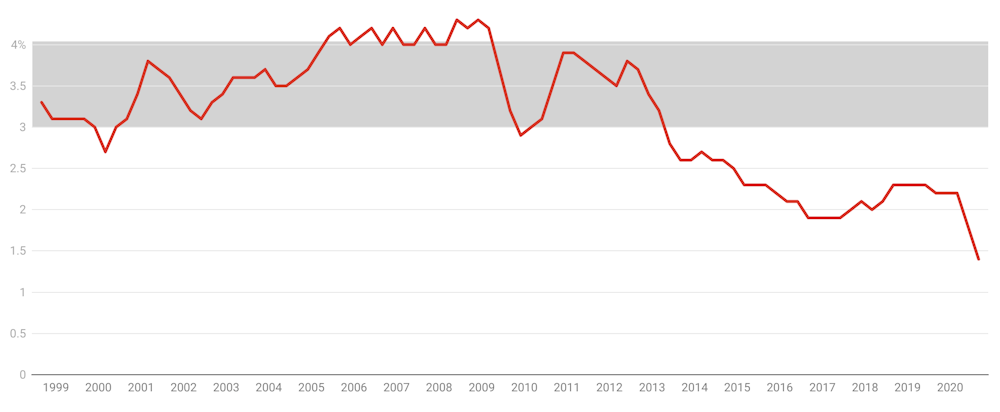
For a while in the 1990s, the Reserve Bank acted as if full employment meant an unemployment rate of 7%. That was its estimate of the “non-accelerating inflation rate of unemployment” (also known as NAIRU), the rate needed to stop shortages of useful workers pushing up inflation.

In 2017, the bank cut that estimate to 5% and then 4.5% in 2019. Then, about a year after COVID hit, it appeared to cut it further when Governor Philip Lowe said in 2021 there was a chance Australia could achieve and sustain an unemployment rate in the “low fours”, although only time would tell.


The lower our target, the more secure we will be

The unemployment rate is now 3.5% – a near five-decade low.

If the government and the bank choose to adopt 3.5% as a target, it would put 150,000 more Australians into work than would a higher unambitious target of 4.5% – in perpetuity.

A lower target of 3% (not too far above the 2% Australia achieved from 1940 to 1974) would do much more than put people into jobs and better use our resources.

It would also help us adapt to change in the way we are going to need to.

Creating confidence to face change

The 1945 white paper was on to this, at another time of massive transition when the wartime industries were dying and the peacetime industries emerging.

It said an assurance of full employment would

assure workers that the community has need of their services somewhere, and will restore the basic sense of security without which new risks will not readily be undertaken.

It’s a point echoed by Prime Minister Bob Hawke’s former economic advisor, Ross Garnaut, in an address to the Australian Conference of Economists last month.

He said unless there was confidence in high employment, every time an industry or employer was threatened with closure, there would be a cry of “jobs, jobs, jobs” as workers fought to protect what they had.

Garnaut told me it was a lesson he learned from Hawke when he signed on with the prime minister in 1983. Hawke agreed with him that the economy would have to change and some industries would have to die. But Hawke told him he wasn’t going to bring on those changes until unemployment was clearly coming down.

When people knew they could get another job, they would accept change.

Now, as in the 1940s and 1980s, we need that confidence. If Chalmers and the Reserve Bank adopt an ambitious target, they’ll create it and set us up for the challenges ahead.The Conversation

This article is republished from The Conversation under a Creative Commons license. Read the original article.
Read more >>

Wednesday, April 13, 2022

Forget the election gaffes: Australia’s unemployment rate is good news – and set to get even better by polling day

When Labor leader Anthony Albanese couldn’t say whether the unemployment rate was 5% or 4% on Monday, he might have had a point.

It’s 4%. But for a decade – the entire decade leading up to COVID – it never strayed too far from five-point-something per cent.

Melbourne University labour market specialist Jeff Borland points out that in March 2010, Australia’s unemployment rate was 5.4%. Ten years later, before COVID changed things in March 2020, it was 5.3%.

In the years between, it briefly dipped to 4.9% (three times), climbed slowly as the mining boom wound down, edged above 6% in 2014 as the newly-elected Coalition government cut spending, and then fell back slowly towards what the Treasury then regarded as the long-term sustainable rate of 5%.

For much of Albanese’s time in parliament, from 1996 to now, it has been 5-6%.


And a case can be made that it is 5% right now.

Independent economist Saul Eslake says what he calls the “effective” rate of unemployment is indeed 5%. To the 607,900 officially unemployed Australians in February 2022 (the lowest slice of the population in decades), Eslake adds the historically high:

  • 72,000 people who were counted as employed despite working zero hours, for what the Bureau of Statistics called “economic reasons” including being stood down or because there was insufficient work

  • 59,000 people who were counted as employed despite working zero hours for reasons “other than economic”, including being on leave

The result is an unemployment rate of 5%, which doesn’t count as unemployed the 221,000 employed Australians who worked zero hours due to illness or injury – twice as many as before COVID.

The figures point to something real

But even Eslake’s effective rate of 5% is lower than before COVID.

The massive 26,000-household survey of employment conducted each month by the Bureau of Statistics is pointing to something real.

To get an idea of the scale of the bureau’s survey, compare it to the Essential and Newspoll surveys used to indicate how people are going to vote in the election. Essential surveys 1,000 people each time, Newspoll about 1,500.

The bureau surveys 26,000 households every month to obtain information on the employment status of about 50,000 people aged 15 and over. The scale of the operation is exceeded only by national elections every three years and the census every five years.

Australia’s biggest survey

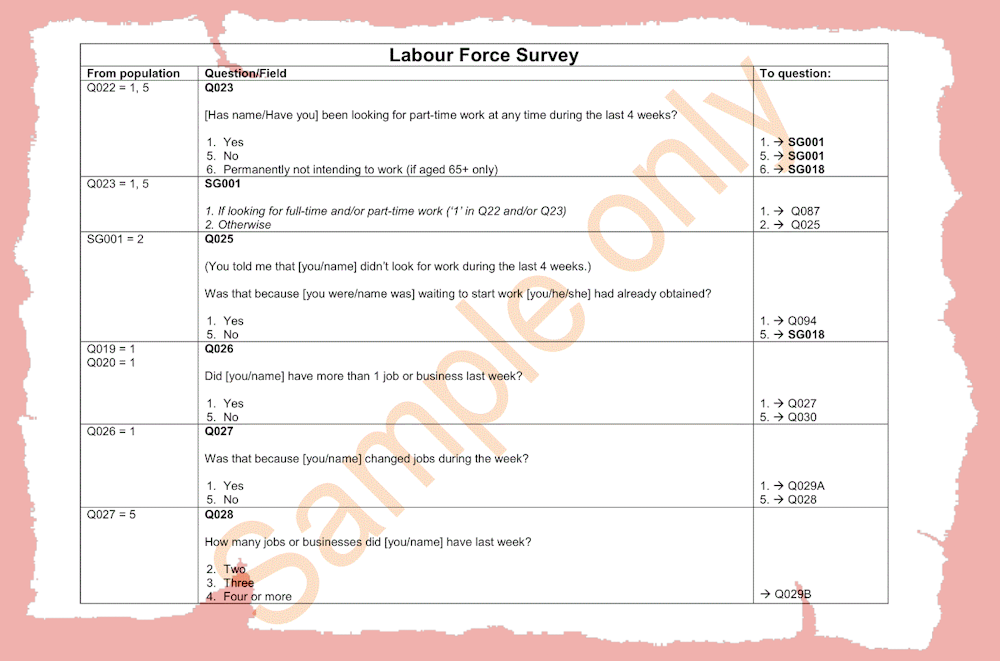
The survey asks first whether those surveyed worked in the previous week, then whether they were employed but away from work because of holidays, sickness or another reason. Then it asks about hours. Less than one hour (unless it was due to time off) counts as not working.

It is this definition (one hour a week = work) that generates so much of the mistrust of unemployment figures.

The bureau uses one hour per week as the cutoff because it has to use something and because every other comparable country has used it, since 1982.

Some of the questions asked in the ABS labour force survey

Fewer than 50 of the 50,000 people surveyed each month report working only one hour, meaning the cutoff makes little difference.

If the bureau used a different cutoff, such as three hours per week, its employment numbers would be moving in the same direction.

It defines being unemployed as not being employed and looking for work. If you are not looking, you are “not in the labour force” and not counted as unemployed.

This is a problem when times are tough and people don’t bother to look (or can’t easily look, such as during lockdowns) and can mean that genuine unemployment is higher than the figures suggest.

More jobs on offer than ever before

But that isn’t a problem at the moment. So many jobs are on offer (423,500 – far more than ever before) that people who want work know it is worth looking.

More of the population aged 15 and over is in work than ever before. And almost all of the new jobs are full-time.

As would be expected given the shift to full–time work, casual employment (defined by the bureau as employment without paid leave) has fallen in recent years, rather than climbed as the opposition leader’s material suggests.


Women have benefited more from the improved jobs market than men, getting 240,000 of the 395,000 new places created over the past year. Every age group up to 65 has more work than it did before.

We will get an inkling as to whether things will keep getting better on Thursday when the bureau releases the employment figures for March, and again just two days before the May 21 election, when it releases the figures for April.

The Treasury and the Reserve Bank are cautious, expecting unemployment to settle at 3.75% before (in Treasury’s case) gradually climbing back to 4.25%.

But private forecasters are bolder. Westpac is forecasting an unemployment rate of 3.25% by year’s end. Citibank is forecasting 3.3% by the end of this year and an extraordinary 3% by the end of 2024 – which would be a 60-year low not seen since 1974.

How to keep creating jobs with reopened borders

It is tempting to say what has happened with unemployment is the result of closed borders and slower population growth during COVID (more jobs per worker than there would have been). But the banks making those bold forecasts know the borders have been reopened.

New Zealand has enjoyed faster (although still slowed) population growth than Australia over a year in which its unemployment rate has slid to 3.2%.

What New Zealand, Australia and the other nations now enjoying unusually low unemployment have in common is out-sized government spending and record low interest rates during COVID to keep the economy afloat.

Spending and ultra low rates create jobs. If we keep them in place right up to the point where we create worrying inflation, we will be able to get even more Australians into jobs and, all being well, keep them there.

It’s the most important thing to grasp from what’s happened. More important than the exact rate of unemployment.

Peter Martin, Visiting Fellow, Crawford School of Public Policy, Australian National University

This article is republished from The Conversation under a Creative Commons license. Read the original article.

Read more >>

Wednesday, February 16, 2022

Australia cut unemployment faster than predicted – why stop now?

If you told someone a year ago unemployment was about to dive below 5%, to just above 4%, they wouldn’t have believed you.

If that person was an expert, and you said it would happen despite a Delta outbreak and lockdowns in our two biggest states, they might have said you had little idea of how the economy worked.

At the beginning of last year, The Conversation asked 21 of Australia’s leading economists what would happen in 2021 and 2022. At the time, the published unemployment rate was 6.6%.

None of them thought it would slip below 5% in 2021 or 2022.

Asked when the unemployment rate might eventually even touch 5%, none nominated 2021. Only two nominated 2022. The rest picked dates years into the future. Three picked “not for the foreseeable future”.

Six months later unemployment was 4.9%, six months after that it was 4.157%.

And yet many experts – many of whom use the models that failed to foresee how quickly unemployment would fall – are now using the same models to warn against doing too much to push it down further.

Experts concerned

They are worried about absurdly high inflation along the lines of the 7.5% now being experienced in the United States and the danger that authorities will push up interest rates too late and too hard to crush it, bringing on a recession.

In their sights are the Reserve Bank’s ultra-low cash rate and the government’s A$7 billion per year tax offset, introduced in 2018 to provide tax relief ahead of the more comprehensive tax cuts now in effect, then extended twice to support the economy during COVID.

Removing them – removing the economic support set to push it down to where it hasn’t been in half a century – is said to be essential in order to bring down government debt and avoid disastrous inflation.

Governor relaxed

Reserve Bank Governor Philip Lowe dealt quickly with the idea of cutting back government support to reduce government debt on Friday.

He told a parliamentary committee that while this was an option “conceptually”, a better idea would be to use government spending to grow national income quickly so the debt-to-income ratio shrank.

That’s the way the debt-to-income ratio has been shrunk in the past – by expanding national income through, among other things, putting more people into jobs.

Dr Lowe also has ideas about tightening settings to stymie inflation, which don’t accord with those of the experts who warn of a US-style takeoff in inflation if we eat further into unemployment.

The case for caution was summed up this way by economist Andrew Charlton on Radio National’s Saturday Extra a few weeks back:

Running the economy is a bit like driving a car around a racetrack. You want to go as fast as you can, but you don’t want to go too fast or you will crash.

Go too fast and you’ll get rising inflation, authorities will be forced to lift interest rates quickly, and you’ll bring on a recession. Ease off on boosting employment – be less ambitious – and you won’t crash.

It’s the way many of those who responded to The Conversation’s survey see it. It’s the way many economists with eyes on the US see it. But it isn’t the way the governor sees it.

Dr Lowe told parliament last week that Australia was not the United States.

Australia is not the US

In the US, utility prices jumped 25% over the past year. In Australia it was 2%. In the US new car prices jumped 12%. In Australia it was 6%. The US price increases are largely one-offs caused by shortages. In Asia, inflation has scarcely moved.

In Australia wage growth is no higher (at 2.2%) than it was before COVID, even though unemployment is dramatically lower. That’s because, unlike the US, Australia kept workers in their jobs through JobKeeper and measures to keep jobs safe. Employers haven’t had to offer more to get workers back.

The Reserve Bank’s model says inflation should be climbing much higher than it is with unemployment as low as it is. That that hasn’t happened suggests the model is wrong.

On Friday, Reserve Bank chief economist Luci Ellis said if there was a floor under unemployment that couldn’t be breached without setting off an inflationary spiral, that floor was not “set in stone”.

One of the reasons is that as people previously unemployed become employed, the floor of people employers regard as unemployable sinks.

The longer the Reserve Bank and the government’s budget keeps supporting the economy, the lower the floor will sink and the fewer Australians will be kept unemployed.

Dr Ellis said while her model was telling her the floor under unemployment was 5%, it was not “the right way to think about it”. The floor might be four-point something, it might be three-point something. Until we get there, we won’t know.

Given that we are in uncharted territory we owe it to ourselves to chart it. This is the Reserve Bank’s view, and it might well be the government’s view.

We owe it to ourselves to see just how low unemployment can be.

Peter Martin, Visiting Fellow, Crawford School of Public Policy, Australian National University

This article is republished from The Conversation under a Creative Commons license. Read the original article.
Read more >>

Wednesday, February 02, 2022

Unemployment below 3% is possible – if Australia budgets for it


What’s the boldest thing the Morrison government could do in next month’s budget?

It would be to forecast an unemployment rate below 4% (a rate of three-point-something), then to pledge to go further, to two-point-something.

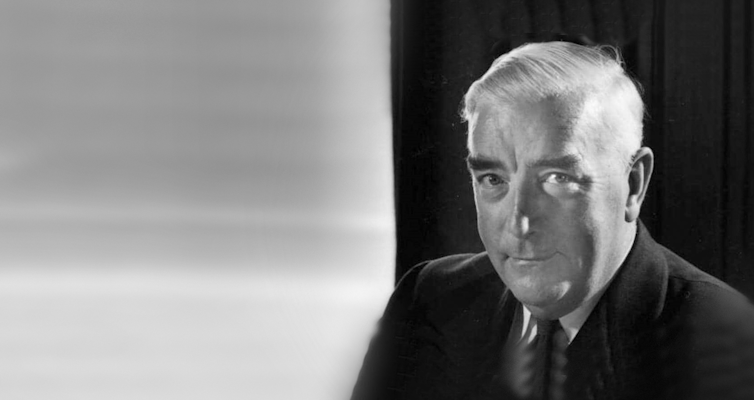
Neither have happened for half a century; not since the long Coalition reign of Robert Menzies and his successors from the 1950s to the early 1970s, when unemployment was between 2 and 3%.

Astoundingly, both are now within Treasurer Josh Frydenberg’s reach in a way they weren’t mere weeks ago.

This time last year, the official budget strategy (its formal title is fiscal strategy) pledged to maintain economic support until the unemployment rate was “comfortably below 6%”.

Frydenberg ditched that target on the ground it was unambitious in the May budget, replacing it with a commitment to spend until the recovery was “secure and the unemployment rate is back to pre-crisis levels or lower”.

But – even projecting forward all the way out to 2025 – Frydenberg couldn’t promise an unemployment rate below 4%. There wasn’t the demand for workers to support it.

Suddenly, below 4% is possible

Even as late as December last year in the mid-year budget update, the best the treasury could forecast was an unemployment rate of 4.25%, which wouldn’t be reached until mid-2023 and wouldn’t be bettered in forecasts stretching out to mid-2025.

Then in January, we learnt that in December itself the unemployment rate had dipped below the forecast to 4.2% a year and a half early.

And it was the real thing. The unemployment rate hadn’t been cut artificially by people withdrawing from the search for work because of lockdowns (as had happened temporarily earlier in the year). Unemployment fell by 62,200 in December because an extra 64,800 people found work.


Unemployment touching 4% once more

Unemployment rate, seasonally adjusted from 1978. ABS labour force, ABS labour force historical timeseries

The proportion of the population aged 15 and over in work is the truest measure of employment, because it’s unaffected by whether or not someone calls themselves unemployed. In December last year, that had climbed to 63.3% – a record high.

Several countries, including Singapore, South Korea and New Zealand, do even better, suggesting we can push employment higher still.

And the jobs have come with hours. All but a few of the extra jobs created over the past year have been full-time. In December the total number of hours worked hit an all-time high. The proportion of workers underemployed (not getting the hours they want) sank to a 13-year low.

The 50-year low is closer than it seems

The unemployment rate was better than it looked. Calculated to several decimal places rather than the usual single place, the December rate was 4.157% – within a hairsbreadth of the historic low of 3.981% achieved in February 2008 at the height of the mining boom; the only time in the modern era the rate slipped below 4%.

To get below 4% from here on, and to get below the previous long-term low, would only require an extra 25,000 people in jobs.

That’s what makes a budget forecast of an unemployment rate beginning with a “3” – the first since the 1970s – suddenly plausible. On Tuesday the Reserve Bank governor and the prime minister said they expected it this year.


Vacancies abound

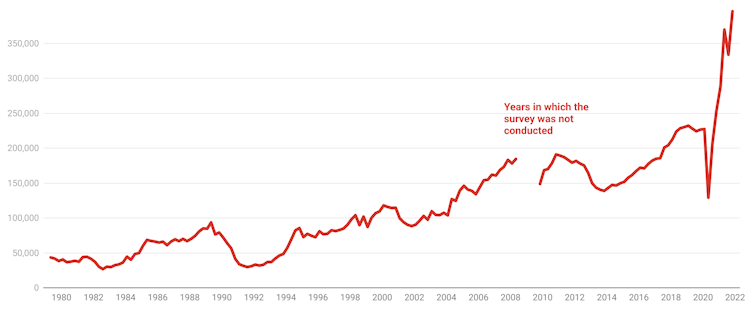
ABS job vacancies, seasonally adjusted

Making something much better plausible – what until recently was a barely imaginable unemployment rate beginning with “2” – is the number of vacant jobs on offer.

In November, the Bureau of Statistics survey found a record 396,100 jobs on offer, so many as to mean one job for every 1.7 people looking. The more usual ratio, back in the days before COVID, was one vacancy for every three unemployed people looking.

Below 3% is within reach

If half of those job vacancies (198,000) were filled by someone presently unemployed, the unemployment rate would fall to 2.7%.

Which is another way of saying an unemployment rate lower than 3% – an unemployment rate beginning with “2” – is within reach.

A budget that forecast a rate lower than 4%, but adopted as a target or stretch forecast an unemployment rate lower than 3%, would make history.

It would have to set out the means to achieve it, one of which would be to adopt a new fiscal strategy that committed the government to “invest in a stronger economy” (the words in the existing fiscal strategy) until unemployment is between 2% and 3%.

The existing strategy commits the government to invest in a stronger economy until unemployment is down to “where it was prior to the pandemic or lower”.

What’s missing? A target and more help for job-seekers

The target would delay budget repair by only a few years, and it would make that repair quicker when it started because hundreds of thousands more Australians would be paying tax and no longer claiming JobSeeker.

And it would lock in an expectation of permanently lower unemployment, in the same way as the Reserve Bank’s success in crushing inflation in the 1990s locked in an expectation of permanently low inflation.

If the government articulated the target, the Reserve Bank would be likely to assist. Full employment is the second of the three goals spelled out in its charter.

The government would also have to do much more of what it started in its last budget, which is to set up programs to make unemployed workers more job-ready and make employers more likely to hire them.

It’s within reach for Labor, or the Coalition

Some of that is already happening as the large number of vacancies and low number of unemployed forces employers to take on people they wouldn’t have before. Many will be glad.

Often the only thing that’s “wrong” about a worker who has been out of work for a long time is that they have been out of work for a long time. As employers discover that, they are likely to find it is easier to fill vacancies than they thought.

An unemployment target of 2-3% would be game-changing, and it’s within reach. The last side of politics to preside over ultra-low unemployment was the Coalition, making it natural that Morrison and Frydenberg should take up the mantle of Robert Menzies and his treasurer Harold Holt.

If they won’t, it’s an opening for Labor. There’s a chance to all but eliminate unnecessary unemployment in Australia. Not in 50 years have we been this close.

Peter Martin, Visiting Fellow, Crawford School of Public Policy, Australian National University

This article is republished from The Conversation under a Creative Commons license. Read the original article.

Read more >>

Wednesday, November 10, 2021

2022 looks like an ideal time for a government to land re-election

At the risk of being political – and politics is important, it will determine how we are governed for the next three years – economic conditions could scarcely be better for a government seeking re-election.

The economic things that matter most to most people are, in my view:

  • jobs – if employment is climbing rather than falling, most people are not at much risk of losing their job

  • economic growth and wages growth – if things are getting better rather than worse, even in small ways, people feel better about the future

  • the ability to buy a home – if it is getting hard, even for other people or for their children, they are concerned about what the future will become

  • mortgage rates – as long as rates stay low they know their own personal budget won’t go out of whack

Other things are said to matter, but I am less than convinced; among them are the state of the federal budget (whether it is “back in the black”), tax cuts (once granted they are forgotten – Julia Gillard gave back more than the carbon tax and wasn’t thanked for it) and esoteric concepts such as government debt.

Jobs aplenty

Earlier this year, just before the eastern states went into lockdown, more of Australia’s population was employed than ever before, more hours were worked than ever before and more jobs were on offer than ever before.

Total hours worked fell during the lockdown months. But in those states without long lockdowns (those other than NSW, Victoria and the ACT) hours worked kept climbing to still-higher all-time highs. It’s an indication of what’s likely in NSW and Victoria now their lockdowns are over, something the Reserve Bank says it can already see happening in NSW.

The proportion of those working who say they’re underemployed (working fewer hours than they want) dived to an eight-year low before the mid-year lockdowns.

I haven’t mentioned the unemployment rate (officially 4.6%) because at the moment the rate can’t be taken seriously.

It is that low mainly because to be counted as unemployed you need to be actively looking for work, and many workers stood down during the lockdowns and available to work were not searching, and also because of an oddity in the way the Bureau of Statistics counts non-resident workers.

Regardless, absent any lockdowns, in practical terms it is set to be easier to keep and find a job than it has been for a long time going into an election.

Wage growth climbing

Last year’s recession brought with it a collapse in wage growth as employers froze or cut wages, something that’s now being unwound as the economy picks up, albeit, as the Reserve Bank notes with apparent disapproval, “weighed down by more muted public sector wages growth”.

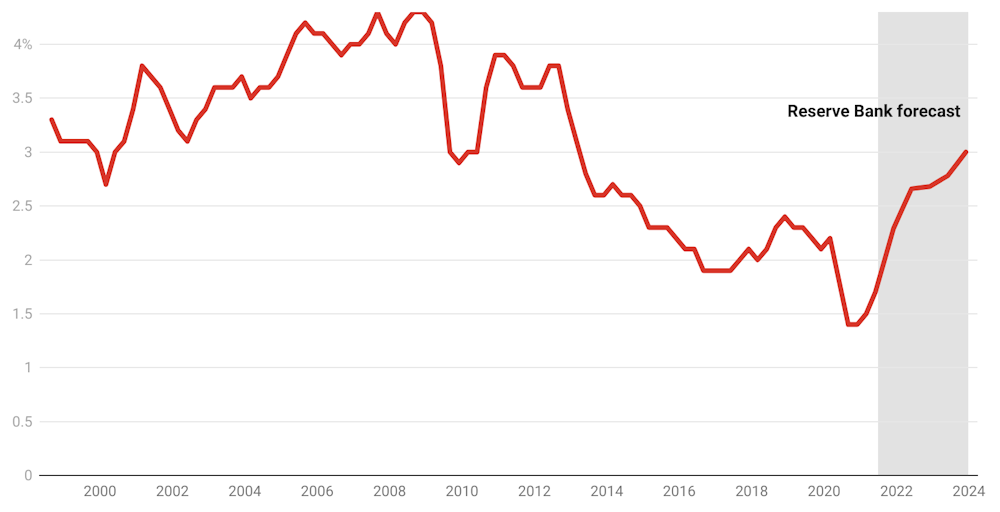
The bank’s latest forecasts, released on Friday, have wage growth climbing from 1.7% to almost 3% over the next two years, which will be the fastest growth in a decade.


Actual and forecast wages growth

Annual growth in ABS wage price index, excluding bonuses and commissions. RBA, ABS

Three per cent is still lower than the wage growth we had come to expect before it fell off a cliff with the end of the 2010s resources boom, and it’s still lower than the Reserve Bank needs to sustainably meet its inflation target.

But it holds out the prospect of an improvement at a time when private sector wages are already improving, which is what matters for the way people feel.

Forecasts have consequences

Economic growth – the catch-all measure for what’s happening in the economy – is set to climb out of the lockdown slump and accelerate throughout next year before settling back to the 2-3% that was common before the recession.

It also won’t be good enough, but it will be moving in the right direction, and accelerating strongly next May, at the time we are likely to be asked to vote.

These forecasts matter because similar ones (prepared by the Treasury instead of the Reserve Bank) will underpin the economic statement or budget released before the election and the Pre-election Economic and Fiscal Outlook released by departmental secretaries without political input during the campaign.

They will become the accepted narrative.

Easier home price growth

After soaring a frightening 21% in the past year to barely affordable highs, there’s every chance home prices will ease off. On Melbourne Cup Tuesday, the Reserve Bank withdrew its support for the near-zero three year bond rate that banks had been using to fund ultra-cheap fixed rate mortgages.

It’s no longer possible to get a three-year fixed rate mortgage for less than 2%.

A few weeks earlier the Australian Prudential Regulation Authority instructed lenders to refuse mortgages to borrowers who couldn’t withstand an increase in mortgage rates of three percentage points (such as an increase from 3% to 6%).

APRA expects the instruction to cut the maximum that can be borrowed by 5%. By election day price rises might have slowed or stopped.

And low rates for some time yet

Higher variable mortgage rates would unsettle Australians (even though many are finding it easier to make their payments than they have in years).

The good news is that on Friday the Reserve Bank nominated 2024 as the year it expects to begin to lift the record-low cash rate that sets the price of variable rate mortgages.

2024 is half a political cycle away.

Even if the first hike comes sooner (and financial markets expect it to come sooner) it won’t be imminent at the time we will be asked to vote.

All sorts of things determine election outcomes.

The economy is only one. But right now, next year’s economy is looking good.

Peter Martin, Visiting Fellow, Crawford School of Public Policy, Australian National University

This article is republished from The Conversation under a Creative Commons license. Read the original article.
Read more >>

Thursday, April 29, 2021

Exclusive. Top economists back budget push for an unemployment rate beginning with ‘4’

Australia’s top economists have overwhelmingly backed a decision by Treasurer Josh Frydenberg to reset the budget strategy so that it prioritises achieving an unemployment rate of between 4% and 5% over reducing debt.

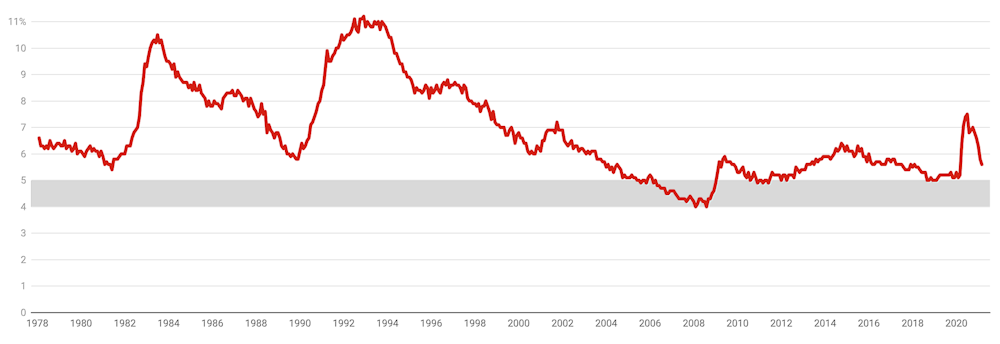
Australia hasn’t had an unemployment rate below 5% since 2011.

It hasn’t had an unemployment rate below 4% since the early 1970s.


Unemployment rate, per cent

ABS labour force survey

The new wording of the fiscal strategy required in the budget as part of the Charter of Budget Honesty will commit the government to quickly drive down unemployment until the unemployment rate is between 4% and 5%.

Only when the unemployment rate is sustainably within that band will the strategy switch to a focus on reducing government debt as a share of GDP.


Read more: Josh Frydenberg has the opportunity to transform Australia, permanently lowering unemployment


The existing wording, introduced in last year’s budget in response to the COVID crisis, only commits the government to drive down unemployment until the rate is “comfortably below 6%”.

Treasurer Frydenberg spelled out the new strategy in an address to the Australian Chamber of Commerce and Industry on Thursday saying both the treasury and the Reserve Bank now believed the so-called non-accelerating inflation rate of unemployment was lower than 5%.

“In effect, both the bank and treasury’s best estimate is that the unemployment rate will now need to have a four in front of it,” he said.

Like it was under Menzies

The Reserve Bank was limited in its ability to cut interest rates further, meaning greater weight would have to be placed on the budget to bring unemployment down to between 4% and 5%.

The exact wording of the new strategy will be unveiled on budget night, May 11.

The increased ambition means the government plans to usher in an era of sustained low unemployment not seen since the prime ministerships of Robert Menzies, Harold Hold, John Gorton and William McMahon.

Backed by 6 in 10 leading economists

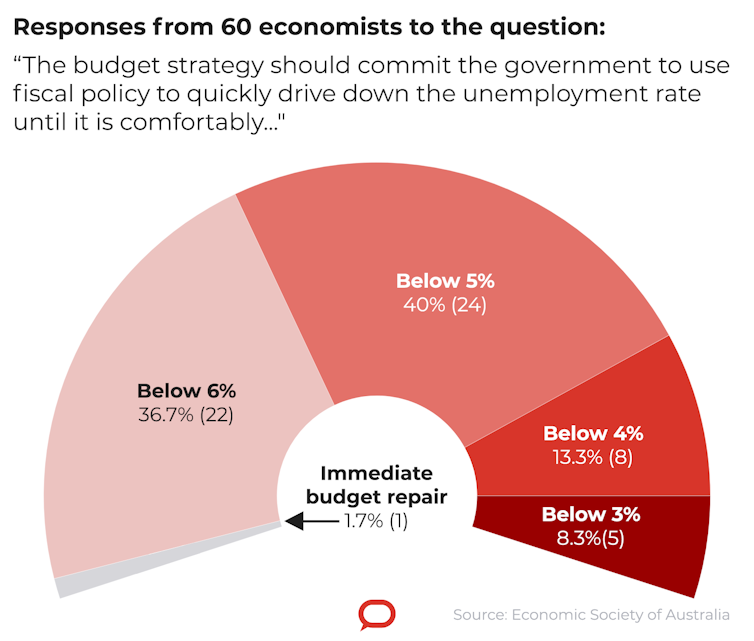
Of the 60 leading Australian economists surveyed by the Economic Society of Australia and The Conversation ahead of the announcement, more than 60% wanted the target strengthened to an unemployment rate below 5%.

Some 21% (13 of the 60 surveyed) want the target strengthened to an unemployment rate below 4%.

Five want the target strengthened to an unemployment rate below 3%.


The Conversation, CC BY-ND

Only one of the 60 top economists surveyed wanted an immediate tightening of the budget regardless of the unemployment rate.

Tony Makin, a former International Monetary Fund and treasury economist who was critical of Australia’s stimulus program during the global financial crisis says the present ultra-low interest rate settings are more than enough to drive unemployment as low as it can get without stoking runaway inflation.

He says the extra government debt that would be created by a push for even lower unemployment would put Australia’s credit rating at risk and push up interest rates and the Australian dollar, making Australian exports less competitive.

‘Unusual opportunity’

The economists chosen by the Economic Society to take part in the survey are recognised leaders in fields including microeconomics, macroeconomics, economic modelling and public policy.

Among them are former and current government advisers, former heads of government departments and agencies, and a former member of the Reserve Bank board.

Labour market specialist Sue Richardson said Australia faced an unusual opportunity to test how low unemployment can go before a tight labour market produces unacceptable stresses.

US unemployment got down to 3.5%

The combination of reduced temporary migration, very low inflation and inflation expectations and a relaxation in the focus on containing the size of government debt made this a rare moment.

Consultant Nicki Hutley said if the experience of the United States before COVID was any guide, Australia might be able to get its unemployment rate down to 3.5% without stoking accelerating inflation.

With interest rates at such low levels, investing in Australia’s economic future could not be a better decision.

Taking pressure off the Reserve Bank

Economist Saul Eslake said it wasn’t unreasonable for the treasurer to have proposed a threshold of an unemployment rate “comfortably below 6%” before beginning budget repair last year, given that at that time the conventional wisdom was that unemployment was headed to 10%.

But now both the Treasury and the Reserve Bank have made it clear unemployment can be forced lower without stoking inflation, “four point something” is realistic.

Inflation figures released on Wednesday showed one of the most reliable measures of inflation, known as the “trimed mean”, at an all-time low.


Read more: Jobs for men have barely grown since the COVID recession. What matters now is what we do about it


Another reason for the government to delay winding back debt was that it would give the Reserve Bank an opportunity to lift interest rates sooner, giving it greater ability to cut interest rates to fight downturns in the future.

A report released by the Parliamentary Budget Office on Wednesday said reducing the government’s debt-to-GDP ratio to pre-pandemic levels would take decades, “even under relatively optimistic scenarios”.

But it added that debt servicing costs should remain subdued as the existing debt was borrowed at historically low interest rates.


Read more: Should the government keep running up debt to get us out of the crisis? Overwhelmingly, economists say yes


Macquarie University’s Geoffrey Kingston said it was the wrong time to be thinking about either an unemployment or a debt target. What mattered, this year more than most, was the composition of government spending.

This meant better supplies of the Pfizer and Moderna vaccines, more facilities for mass vaccinations and safer quarantine.

Peripheral programs such as subsidising airfares to holiday destinations at a time when it remained imprudent to encourage air travel were much less important — even if they helped fight unemployment.


Peter Martin, Visiting Fellow, Crawford School of Public Policy, Australian National University

This article is republished from The Conversation under a Creative Commons license. Read the original article.
Read more >>

Wednesday, April 21, 2021

Jobs for men have barely grown since the COVID recession. What matters now is what we do about it

Of all the weak targets ever adopted by Australian governments, one of the weakest has to have been an unemployment rate “comfortably below six per cent” in last year’s budget.

At the time the budget was delivered on October 6, the published unemployment rate had already fallen to 6.8%.

“Comfortably below six per cent” mattered because it formed part of the “fiscal strategy” required in each year’s budget as part of the Charter of Budget Honesty.

The strategy sets out the circumstances in which the government will tighten or loosen its purse strings.

The October 2020 strategy had two phases. The first required loose purse strings in order to “quickly drive down the unemployment rate”.

It would remain in place until the unemployment rate was comfortably below 6%. In the second phase the government would “shift its focus towards stabilising and then reducing debt as a share of the economy”.

The budget jobs target is comfortably weak

On the very harshest reading, the strategy requires Treasurer Josh Frydenberg to start winding back support for the economy when the unemployment rate falls to comfortably below 6%, as it arguably already has — last week’s reading was 5.6% and heading down.

But that’s probably too harsh. The words “comfortably below” might mean “way below”, and the figure of 6% mightn’t have meant much at all.

As the pandemic gathered pace the treasury was predicting an unemployment rate of 15% - the worst since the Great Depression.

It might have picked 6% as a pseudo target merely because it was something to aim for, and it might not have put much store in what was at the time a one-off result of 5.8% because unemployment rates can bounce around.

We’re about to get an update

Frydenberg says he’ll update the target in a speech to be delivered soon.

Disturbingly, he has defined the present strategy of comfortably below 6% as meaning “around 5.25% or around 5.5%”, which is pretty close to where we are. If he wants to go further, he’ll have to adopt a more ambitious target.

The difference between 6% and 5% is 138,000 unemployed Australians. The difference between 6% and 4% is 277,000 unemployed Australians.


Read more: Josh Frydenberg has the opportunity to transform Australia, permanently lowering unemployment


That’s an extra 138,000 to 277,000 Australians working for us and paying tax; and 138,000 to 277,000 fewer people claiming JobSeeker.

The Reserve Bank governor believes Australia can “achieve and sustain an unemployment rate in the low 4s”.

A good target would approach 4%

The governor makes the point that over the past decade, the estimate of the unemployment rate associated with full employment has been “repeatedly lowered”. The target Frydenberg adopts will tell us a lot.

Because it’s been a year since COVID-19 took off in Australia, it’s possible to get an idea of who’s suffered the most in terms of jobs by comparing March 2021 with March 2020.

The broad-brush Australian Bureau of Statistics labour force survey turns up the surprising result that, in terms of jobs, women have done better than men.

So far, the recovery has been pink-tinged

It’s a surprising outcome because of what was said midway through last year about a pink-tinged recession.

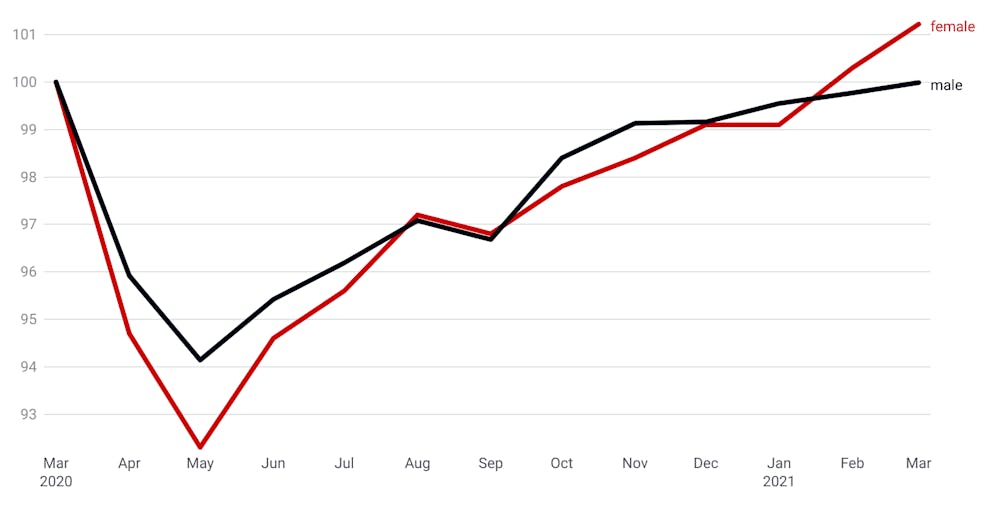
At the time women had indeed suffered more than men. In May, in the depths of the downturn, women were down 471,000 jobs and men down 401,000. But from then on, as things improved, the gap narrowed.

By August women were no worse off than men. By March this year women were 74,940 jobs better off than before the recession, men 650 jobs worse off.


Male versus female employment, March 2020 to March 2021

Index numbers, March 2020 = 100. ABS Labour Force, Australia

For full-time jobs, the divide is starker. Men are 47,420 full-time jobs worse off, and women 44,870 full-time jobs better off.

We can get much more detail (than ever before) by examining the newly available payroll data extracted from real-time records of more than 10 million Australians, as opposed to the answers of the 50,000 who take part in the labour force survey.

Women have proved more adaptable

Amongst women, the biggest gains are in the “public administration and safety” industries, where the number of women employed is 13% higher than before the pandemic.

The biggest losses for women are in “accommodation and food services” (which means hospitality and tourism) where female employment remains down 14% on the start of the pandemic.

For men, the biggest — although much smaller — gains have also been in “public administration and safety”, where male employment is up 8% since the start of the pandemic, and in “financial and insurance services”, where male employment is up 6%.

For men, employment in “accommodation and food services” remains down 15%.

The data paint a picture of women being more adaptable than men — having suffered worse than men in the early months of the recession and then refashioning themselves into different types of workers.

Among women it is only the youngest ten-year age bands that remain worse off.

Every age band above the age of 30 is ahead.


Read more: The successor to JobKeeper can't do its job. We'll need JobMaker II


For men the damage is more widespread, and perhaps longer lasting. Only in the age bands above 50 are men better rather than worse off.

There’s an awful lot we need to do, and we have discovered during the pandemic we are more than capable of doing it.

We’ll know soon whether the government’s ambition is high or low.

Peter Martin, Visiting Fellow, Crawford School of Public Policy, Australian National University

This article is republished from The Conversation under a Creative Commons license. Read the original article.
Read more >>

Wednesday, March 03, 2021

Josh Frydenberg has the opportunity to transform Australia, permanently lowering unemployment

Josh Frydenberg has the opportunity to become a transformational Australian treasurer. He has been bequeathed a set of circumstances that comes along rarely.

He has already shown himself able to shift the debate on important topics in order to achieve the previously unthinkable.

Most recently he did it with Google and Facebook, getting them to pay news providers for content using legislation that led the world in its breadth and force.

It’s actually the second time Frydenberg has taken on big tech. As assistant treasurer in 2015 he championed a “Netflix tax” on overseas-based suppliers of online services. They would be required to collect and pass on goods and services tax, just like Australian retailers.

It was a tax experts told him big tech might never pay.

Frydenberg has shown boldness before

Opportunities like the much bigger one in front of him now don’t come along often because Australia isn’t in recession often. Three decades ago in the early 1990s Australia’s then Reserve Bank governor Bernie Fraser seized its mirror side.

In the wake of an appalling recession that had destroyed both jobs and inflation, Fraser opted to finish the job and drive a stake through the heart of inflation.

A biography of then treasurer Paul Keating quotes Fraser as saying “we’ve got the inflation rate down and we are damn-well going to keep it down”.

At the first hint of a resurgence in inflation as the economy got back on its feet Fraser rammed up interest rates an extraordinary 0.75 percentage points in August 1994, then another 1.00 percentage points in October, and a further dizzying 1.00 percentage points in December.

Job finished, inflation has remained tamed ever since, never again returning to the 8% and 10% common in the 1980s.

Recessions create opportunities

Frydenberg’s opportunity is to drive a stake through the heart of unemployment.

From the end of the second world war right through to the mid 1970s Australia’s unemployment rate averaged just 2%. From then onwards until today it has averaged 6.8%, an embarrassment in a country capable of much, much better.

How much better?

The Reserve Bank’s pre-COVID estimate of Australia’s so-called non-accelerating inflation rate of unemployment (NAIRU) was 4.5%. NAIRU is the rate below which it is thought inflation and wage growth might start to climb.


Read more: Why the unemployment rate will never get to zero percent – but it could still go a lot lower


If correct, the estimate means there is no danger whatsoever in pushing Australia’s unemployment rate down from its present 6.4% to 4.5%, or lower. We won’t know how much lower until we try. Pre-COVID, US unemployment got to 3.5%.

Far from danger, there would be a huge payoff in permanently lowering the rate of unemployment Australia regarded as acceptable.

At an unemployment rate of 4.5%, an extra 255,800 Australians would be in work and earning money, providing services and paying tax. The government could save $4 billion per year in JobSeeker payments.

We could go for broke

Frydenberg should actually aim for a much-lower unemployment rate than 4.5%.

Reserve Bank Governor Philip Lowe does not say 4.5% would accelerate inflation, he says he doubts whether anything above 4.5% would accelerate inflation.

And Lowe says this notwithstanding the view of the secretary to the treasury that the recession has pushed up NAIRU to around 4.75% to 5% as people who have lost their jobs have become less employable.

But here’s the thing. NAIRU is the non-accelerating inflation rate of unemployment — the rate that keeps inflation and wage growth constant.

Wage growth, at 1.4% and inflation, at 0.9% are too low. We need them to accelerate. Frydenberg and the Reserve Bank have agreed to target inflation of 2-3%. It’s a target that would normally mean wage growth of 3-4%, where wage growth hasn’t been for the best part of a decade.


Wage growth below par for years

Wage price index, total hourly rates of pay excluding bonuses, private and public, annual. ABS

To get inflation and wage growth back up to where we want them we are going to need an unemployment rate well below the oddly-named NAIRU — well below 4.5% — for quite some time.

In his new book Reset, economist Ross Garnaut says we should be aiming for an unemployment rate of 3.5%.

He says on the way down there would be time to adjust the target “up when high and accelerating inflation becomes a matter of concern, or down (further) if we approach 3.5% without inflation accelerating dangerously”.

As in the US, we don’t yet know how low we can safely push unemployment, but it might turn out to be very low indeed.


Read more: The reset to lift us out of the COVID recession has to be bold: returning to where we were is nowhere near good enough


To get there Australia’s government will have to keep spending, and learn to live with big budget deficits and big debt.

Garnaut says to not do so would be a false economy, condemning us to “endless increases in our public debt-to-GDP ratio because we wouldn’t be producing the GDP we were capable of”.

The government would fund the crushing of unemployment by selling bonds to the Reserve Bank directly, bypassing financial markets in order to avoid putting further upward pressure on the dollar.

Low risk, long payoff

To the extent that the continuing flood of bonds further eased mortgage interest rates (which it mightn’t much, because the bonds would be long-term) the Prudential Regulation Authority would have to crack down on investor and interest-only loans as it did successfully before the COVID crisis in order to restrain house prices.

Garnaut believes there will also be a need for less-pleasant reforms to restore the prosperity Australia is capable of, but he says they will only gain widespread acceptance if it is known that anyone who wants a job can get a job — whether that’s at an unemployment rate of 3.5%, the 2% Australia once had or the 1% New Zealand had.

The COVID recession and rapid recovery from it have handed Frydenberg an opportunity to relentlessly drive down and crush unemployment — to finish the job.

If he grabs it he will be remembered as the treasurer who changed Australia, perhaps forever.

Reducing unemployment for good with Peter Martin. Democracy Sausage with Mark Kenny, March 4, 2021 107 MB (download)

This article is republished from The Conversation under a Creative Commons license. Read the original article.
Read more >>

Wednesday, February 03, 2021

Governor not for turning. No rate hike until unemployment near 4.5%

Reserve Bank governor Philip Lowe’s message to the nation today through the National Press Club is that he means it.

He isn’t intending to push up interest rates – he most probably isn’t intending to even think about pushing up interest rates – until 2024, at the earliest.

That’s a full three years from now, at a time when, maybe, inflation will be strong enough to be “sustainably within” the Reserve Bank’s target band.

That’s the new benchmark, adopted by the bank in November.

It replaced an earlier loophole-ridden benchmark of “progress towards” an inflation rate of 2% to 3%, something that could have meant almost anything.

The bank will now need to see actual, sustainable, inflation of 2% to 3%, something those of us wanting some inflation haven’t seen for a decade.

Ultra-low rates til unemployment hits 4.5%

After the press club event I asked him what sort of unemployment rate we would need to see for that to happen. Was it still the 4.5% the bank has nominated in the past, or had COVID pushed it up?

Might less ambitious progress on unemployment do the trick?

He told he thought not. While it is impossible to be sure, something seemed to have changed around the world over the past ten years meaning it has become much harder to create inflation. He doubted whether an unemployment rate above 4.5% could do the trick.


Read more: The Reserve Bank might yet go negative


Lowe told the press club that while unemployment had come down far more quickly than the bank expected when it produced its previous set of forecasts in November, its new forecasts had unemployment slipping only from 6.6% to 6% over the course of this year, and then taking another 18 months to reach 5.25%

An unemployment rate below 5% is beyond the bank’s forecasting horizon.

That’s why it has undertaken to buy as many government bonds as are needed to keep the three-year bond rate at the bank’s current cash rate target of 0.10%, to make it clear that the cash rate will “be where it is for the next three years”.

‘Creating money electronically’

And there’s another reason for buying government bonds – to restrain the Australian dollar. On Tuesday Lowe announced plans to use a separate program to buy an additional A$100 billion of bonds between April and September.

Combined, the two bond-buying programs will depress Australian long-term interest rates and make foreigners less likely to buy Australian dollars to take advantage of higher rates here than overseas.

Asked directly whether the bank was printing money in order to buy government bonds, Lowe said it was, with the caveat that the modern way of doing things means the bank “creates the money electronically”.


Read more: A little ray of sunshine as 2021 economic survey points to brighter times ahead


While Lowe accepts that the JobKeeper wage subsidy will end at the end of March (“the government made it clear this was a temporary program”) he is extremely keen for governments at all levels to keep spending on infrastructure, saying if weren’t for public projects, non-mining investment would be bad indeed.

While the economy is recovering, and the bank is forecasting slightly stronger economic growth than The Conversation forecasting panel of 3.5% this year and the next, the economy is unlikely to return to the trajectory it was on before the crisis, perhaps ever.


Reserve Bank GDP forecasts, February 2021 and February 2020

Index numbers, December 2019 = 100. RBA, ABS

The bank is envisaging an economy 4% smaller than it would have been. As Lowe put it: “it’s a big number, there’s a big gap there”.

The governor isn’t worried by a likely “blip” in unemployment when JobKeeper comes off in March, but he is worried about what will happen to employment beyond that. The unemployment rate is “higher today than it has been for almost two decades and many people can’t get the hours of work they want”.

Even when the unemployment rate was low (in NSW it got “as it was in 1973” before the crisis) wage growth was weak.

JobSeeker a"fairness issue"

It would help to permanently lift the rate of the JobSeeker unemployment benefit on which a million Australians rely and which is due to return to the poverty-line level of $40 per day in April, although Lowe sees that not so much as an economic question but as a “fairness issue”.

“Different people legitimately have different views on the level of support stopping - my own view is that some increase is justifiable,” he told the press.


Read more: Vital Signs: Any talk about raising interest rates is a huge mistake


The levers he can control, interest rates, will say low for as long as is necessary.

He isn’t “guaranteeing” to keep them low until 2024 or beyond, but he is guaranteeing to keep them low until inflation is sustainably near 3%, something he doesn’t think will happen until unemployment touches 4.5%, something he thinks is most unlikely to happen before 2024.

“I’m not pledging”, he told the national press, “but I am giving you my best guess”.The Conversation

Peter Martin, Visiting Fellow, Crawford School of Public Policy, Australian National University

This article is republished from The Conversation under a Creative Commons license. Read the original article.
Read more >>