Showing posts with label reserve bank. Show all posts

Wednesday, June 08, 2022

Expect the RBA to go easy on interest rate hikes from now on – we can’t afford rates to climb as steeply as the market expects

By lifting its cash rate by 0.5 points, from 0.35% to 0.85%, the Reserve Bank has added about another $120 per month in payments for a A$500,000 mortgage.

If financial markets are to be believed, by the end of this year it will have added a total of $800 per month – and, by the end of next year, a total approaching $1,000 per month.

Those figures are for variable mortgages, but homeowners on fixed rates won’t escape them long. Those rates are typically fixed for up to three years.

Many of the fixed-rate mortgages were taken out during COVID at annual rates as low as 2%. When those fixed rates end (and many will end in the next year or so) those homeowners will find themselves paying 5% or 6% per year, shelling out as much as $3,000 per month instead of $2,000.

Unless financial markets are wrong. The good news is, I think they are.

The pricing of deals on the futures market factors in an increase in the Reserve Bank’s cash rate from 0.10% to 3.5% by June next year, enough to push up the standard variable mortgage rate from around 2.25% to 5.65%.

We couldn’t afford the rates the market expects

One reason for suspecting it won’t happen is that many homeowners simply couldn’t afford the extra $1,000 per month. Most of us don’t have that much cash lying around.

US President Richard Nixon had an economic adviser by the name of Herbert Stein with an uncommonly-developed sense of common sense. In his later years he wrote an advice column for Slate magazine.

To a reader wanting a cure for unrequited love, he wrote that the best solution was “requited love”. To a reader concerned about her inability to make small talk, he wrote that what people want most is a “good listener”.

In economics, Stein is best known for Stein’s Law, which says: “if something cannot go on forever, it will stop”.

Mortgage rates can’t keep climbing to the point where homeowners pay an extra $1,000 per month.

For new homeowners, it’s worse. The typical new mortgage taken out to buy a home in NSW has climbed to $700,000. In Victoria, it has climbed to $585,000. These people will be paying a good deal more than an extra $1,000 per month if the bets on repeated rate hikes made on the futures market come to pass.

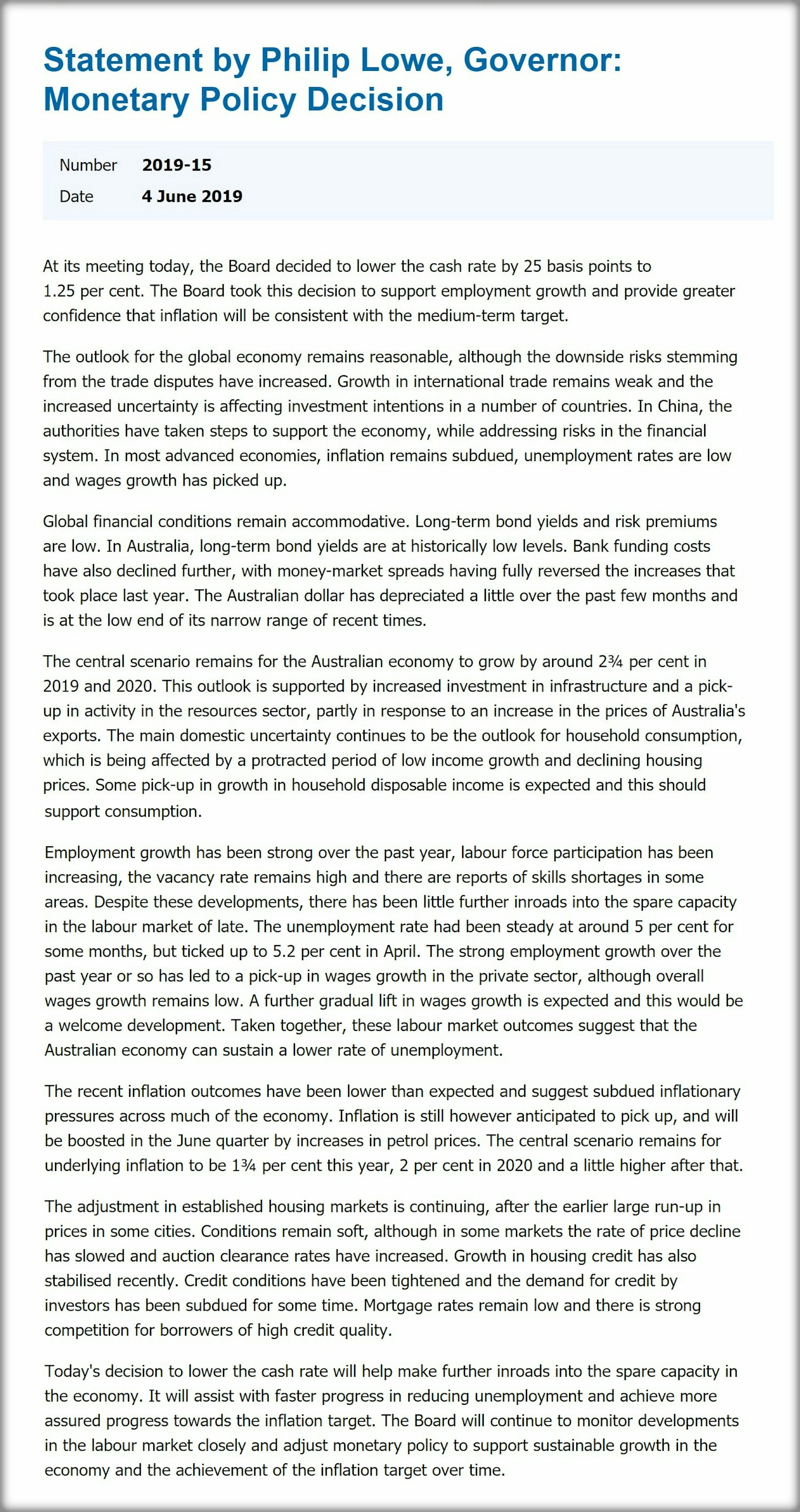
The Reserve Bank says it lifted its cash rate from 0.35% to 0.85% today to withdraw the “extraordinary monetary support” put in place during the pandemic.

But the bank says from here on it will be guided by data, and, in a nod to homeowners concerned about continual rate hikes, said it expected inflation to climb just a bit more before declining back towards its target next year.

The bank will be guided by data

Financial markets don’t see it that way. They have priced in (in other words, bet money on) rate hikes in July, August, September, October, November, December, February, March, April and May.

But there are reasons to believe the bank is right about inflation.

It doesn’t seem that way with electricity prices set to climb 8-18% in NSW, 11% in Queensland, 5% in Victoria, and as much as 20% in South Australia. (The only jurisdiction without an increase in prospect is the Australian Capital Territory, which has 100% renewables and fixed long-term contracts.)

Fortunately for overall inflation, electricity accounts for less than 3% of the typical household budget. Gas accounts for less than 1%. Even low earners spend little more than 4% of their income on electricity.

While the price of vegetables is soaring (heads of lettuce are selling for $10), we spend less than 1.5% of our income on vegetables.

The best measure of overall price increases remains the official one of 5.1% for the year to March, calculated by the Bureau of Statistics.

It is a more alarming increase in inflation than Australians are used to. But what matters for the Reserve Bank is whether the 5.1% is set to turn down and head back towards the target of 2-3%, or climb further away from it.


Australia is almost uniquely disadvantaged among developed nations in getting a handle on what’s happening to inflation, being one of only two OECD members (the other is New Zealand) to compile its consumer price index quarterly, instead of monthly.

By the time Australia’s index is published, several of the measures in it are months old, and they don’t get updated for another three months.

It has been said to make the bank’s job like driving a car looking through the rear-view mirror.

Using our rear-view mirror, with caution

Fortunately the Bureau of Statistics is gearing up to produce a monthly index. Meanwhile, in the United States – which is subject to the same international price pressures as Australia – most measures of inflation eased in April.

Wages growth, which the Reserve Bank said last month seemed to be “picking up”, remained dismal in the figures released a few weeks later – at just 2.4% in the year to March. That was well short of the 2.7% forecast in the budget for the year to June, and not enough to do anything to further fuel inflation.

Australia has a history of aggressive interest rate hikes to tame inflation.

In 1994, Reserve Bank Governor Bernie Fraser rammed up the cash rate from 4.75% to 7.5% in a matter of months. But that was when wage growth was well above inflation and the bank was trying to dampen “demands for wage increases” to prevent a wage-price spiral.

We don’t even have the beginnings of that yet. Unless the bank wants to needlessly impoverish Australians, and keep going until it pushes them out of work, it will increase rates cautiously from here on.The Conversation

Peter Martin, Visiting Fellow, Crawford School of Public Policy, Australian National University

This article is republished from The Conversation under a Creative Commons license. Read the original article.


Read more >>

Wednesday, February 16, 2022

Australia cut unemployment faster than predicted – why stop now?

If you told someone a year ago unemployment was about to dive below 5%, to just above 4%, they wouldn’t have believed you.

If that person was an expert, and you said it would happen despite a Delta outbreak and lockdowns in our two biggest states, they might have said you had little idea of how the economy worked.

At the beginning of last year, The Conversation asked 21 of Australia’s leading economists what would happen in 2021 and 2022. At the time, the published unemployment rate was 6.6%.

None of them thought it would slip below 5% in 2021 or 2022.

Asked when the unemployment rate might eventually even touch 5%, none nominated 2021. Only two nominated 2022. The rest picked dates years into the future. Three picked “not for the foreseeable future”.

Six months later unemployment was 4.9%, six months after that it was 4.157%.

And yet many experts – many of whom use the models that failed to foresee how quickly unemployment would fall – are now using the same models to warn against doing too much to push it down further.

Experts concerned

They are worried about absurdly high inflation along the lines of the 7.5% now being experienced in the United States and the danger that authorities will push up interest rates too late and too hard to crush it, bringing on a recession.

In their sights are the Reserve Bank’s ultra-low cash rate and the government’s A$7 billion per year tax offset, introduced in 2018 to provide tax relief ahead of the more comprehensive tax cuts now in effect, then extended twice to support the economy during COVID.

Removing them – removing the economic support set to push it down to where it hasn’t been in half a century – is said to be essential in order to bring down government debt and avoid disastrous inflation.

Governor relaxed

Reserve Bank Governor Philip Lowe dealt quickly with the idea of cutting back government support to reduce government debt on Friday.

He told a parliamentary committee that while this was an option “conceptually”, a better idea would be to use government spending to grow national income quickly so the debt-to-income ratio shrank.

That’s the way the debt-to-income ratio has been shrunk in the past – by expanding national income through, among other things, putting more people into jobs.

Dr Lowe also has ideas about tightening settings to stymie inflation, which don’t accord with those of the experts who warn of a US-style takeoff in inflation if we eat further into unemployment.

The case for caution was summed up this way by economist Andrew Charlton on Radio National’s Saturday Extra a few weeks back:

Running the economy is a bit like driving a car around a racetrack. You want to go as fast as you can, but you don’t want to go too fast or you will crash.

Go too fast and you’ll get rising inflation, authorities will be forced to lift interest rates quickly, and you’ll bring on a recession. Ease off on boosting employment – be less ambitious – and you won’t crash.

It’s the way many of those who responded to The Conversation’s survey see it. It’s the way many economists with eyes on the US see it. But it isn’t the way the governor sees it.

Dr Lowe told parliament last week that Australia was not the United States.

Australia is not the US

In the US, utility prices jumped 25% over the past year. In Australia it was 2%. In the US new car prices jumped 12%. In Australia it was 6%. The US price increases are largely one-offs caused by shortages. In Asia, inflation has scarcely moved.

In Australia wage growth is no higher (at 2.2%) than it was before COVID, even though unemployment is dramatically lower. That’s because, unlike the US, Australia kept workers in their jobs through JobKeeper and measures to keep jobs safe. Employers haven’t had to offer more to get workers back.

The Reserve Bank’s model says inflation should be climbing much higher than it is with unemployment as low as it is. That that hasn’t happened suggests the model is wrong.

On Friday, Reserve Bank chief economist Luci Ellis said if there was a floor under unemployment that couldn’t be breached without setting off an inflationary spiral, that floor was not “set in stone”.

One of the reasons is that as people previously unemployed become employed, the floor of people employers regard as unemployable sinks.

The longer the Reserve Bank and the government’s budget keeps supporting the economy, the lower the floor will sink and the fewer Australians will be kept unemployed.

Dr Ellis said while her model was telling her the floor under unemployment was 5%, it was not “the right way to think about it”. The floor might be four-point something, it might be three-point something. Until we get there, we won’t know.

Given that we are in uncharted territory we owe it to ourselves to chart it. This is the Reserve Bank’s view, and it might well be the government’s view.

We owe it to ourselves to see just how low unemployment can be.

Peter Martin, Visiting Fellow, Crawford School of Public Policy, Australian National University

This article is republished from The Conversation under a Creative Commons license. Read the original article.
Read more >>

Monday, November 15, 2021

Top economists see no prolonged inflation, no rate hike next year

Despite appearances – especially in the United States – the era of high inflation isn’t set for a comeback in the view of Australia’s leading economists, and most see no need for the Reserve Bank to lift interest rates next year.

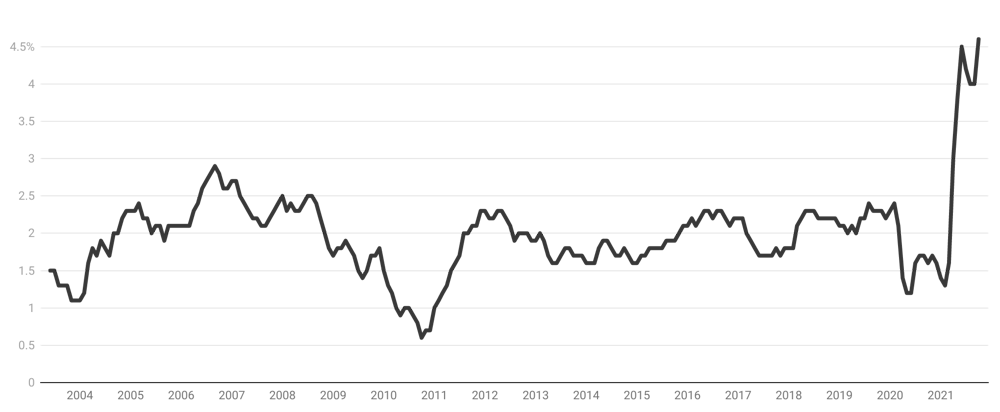
In the US, figures released last week showed the consumer price index surged 6.2% in the year to October, the most since 1990. So-called “core” inflation (which excludes volatile prices) climbed 4.6%, also the most for 30 years.


US underlying inflation

US consumer price index for all urban consumers, all items less food and energy, city average. US Bureau of Labor Statistics, St Louis Fed

Former US treasury secretary Larry Summers is talking about a jump to 11% as over-heating becomes entrenched, necessitating rate hikes in the United States, Britain and Australia.

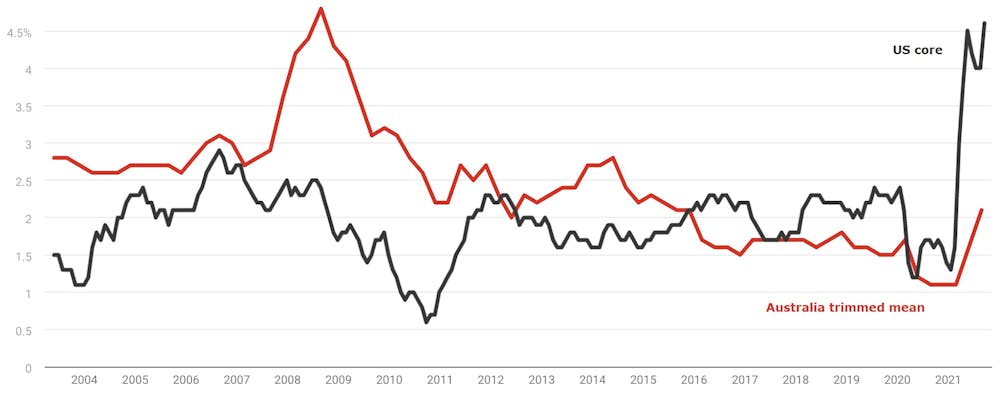
But the 55 leading Australian economists surveyed by the Economic Society of Australia and The Conversation this week aren’t buying it. They point out that Australia’s underlying inflation rate (while climbing) is much lower, at 2.1%.


US and Australian underlying inflation

Australian Bureau of Statistics, US Bureau of Labor Statistics

Whereas in the US wages climbed 4.6% in the year to September, in Australia they climbed 1.7% in the year to June, an official figure that will be updated with readings from the September quarter on Wednesday.

32 of the 55 top economists surveyed by the Economic Society of Australia rejected the proposition that the current combination of Australian fiscal and monetary policy posed “a serious risk of prolonged above-target inflation”.

Only 12 supported it. When weighted by the confidence of respondents expressed on a scale of 1-10, backing for the proposition shrank from 22% to 20%.


Independent economists Nicki Hutley and Saul Eslake said fiscal policy (government spending) was set to tighten as COVID spending programs expired, making projected high inflation unlikely.

Harry Bloch said the prices of Australian services were predominantly determined here, by Australian wage rates, which were held back by the bargaining strength of unions and government wage setting policies.

Big inflation would require wage inflation

Matthew Butlin, until this year South Australia’s Productivity Commissioner, said prices were rising quickly in asset markets such as those for land and shares.

“The pressure simply to recover the real value of wages, let alone increase their real value, will be significant,” he said. Australia risked a wage-price spiral.

Rana Roy foresaw temporary high inflation until high energy prices and supply chain disruptions passed, but “temporary” in the sense that the hyperinflation in Germany’s Weimar Republic was temporary, lasting from 1921 to 1923.

Suppressing the higher inflation would require deliberate corrective action.

Higher rates, but not yet

Asked when the Reserve Bank would next lift its cash rate to combat inflation, most nominated 2023. Only 15 of the 52 economists who answered the question expected a hike next year, putting the majority at odds with financial market pricing which backs in several hikes during 2022.

Reserve Bank Governor Philip Lowe said earlier this month he didn’t expect to have to lift the cash rate until 2024, a proposition backed by only 10 of the 52 economists who tackled the question.


Most (33 of the 55) believed the Reserve Bank had managed the economy well during the past five years, effectively used the tools available to it to achieve its goals of maintaining the stability of the currency, ensuring full employment and furthering the “economic prosperity and welfare of the people of Australia”.

Only 15 believed the bank had managed things badly.


Fabrizio Carmignani said it could be argued the bank had kept its cash rate too low for too long and also argued that it had failed to get inflation up to its target band, two apparently contradictory positions.

Paul Frijters said that by targeting the underlying inflation rate as calculated by the Bureau of Statistics, which excludes much of housing, the bank had “cooked the books” to avoid having to increase interest rates.

John Quiggin said the bank should abandon its inflation target of 2-3% and instead target nominal GDP growth, doing whatever was needed to get the economy to grow at a nominal rate of 6-7%.

No clear case for an inquiry

The economists surveyed were divided about the need for an independent review of the Reserve Bank after next year’s election.

The Organisation for Economic Co-operation and Development and the International Monetary Fund have backed a review of the kind proposed by Labor, which would examine the bank’s mandate, board structure, and hiring and communication processes.


Asked about the idea in the survey, former Labor minister Craig Emerson said the bank had consistently undershot the 2% lower bound of its inflation target, causing unnecessarily high unemployment and low wages growth in part because it had targeted projected rather than actual inflation, and its projections had fallen short.

In October last year Governor Philip Lowe announced the bank would switch to targeting actual inflation, saying it would not be lifting its cash rate “until actual inflation is sustainably within the target range”.

Other panellists including Joaquin Vespignani argued that by targeting only measured inflation the bank had created “a bubble in the housing market which is not consistent with economic prosperity”.

More economists on the RBA board

Panellists including Ken Clements argued there was a case for appointing more board members with the economic expertise needed to challenge bank officials.

Former OECD official Adrian Blundell-Wignall argued the bank’s structure and goals were the broadly right ones. We should “not try to fix what isn’t broken”.

James Morley was concerned an independent commission of inquiry might be “highly politicised and lead to unrealistic expectations about what monetary policy can and should do”.

The Bank of Canada reviewed its performance and frameworks in cooperation with the federal government every five years, a practice that would work well in Australia.


Detailed responses:

Peter Martin, Visiting Fellow, Crawford School of Public Policy, Australian National University

This article is republished from The Conversation under a Creative Commons license. Read the original article.
Read more >>

Wednesday, November 10, 2021

2022 looks like an ideal time for a government to land re-election

At the risk of being political – and politics is important, it will determine how we are governed for the next three years – economic conditions could scarcely be better for a government seeking re-election.

The economic things that matter most to most people are, in my view:

  • jobs – if employment is climbing rather than falling, most people are not at much risk of losing their job

  • economic growth and wages growth – if things are getting better rather than worse, even in small ways, people feel better about the future

  • the ability to buy a home – if it is getting hard, even for other people or for their children, they are concerned about what the future will become

  • mortgage rates – as long as rates stay low they know their own personal budget won’t go out of whack

Other things are said to matter, but I am less than convinced; among them are the state of the federal budget (whether it is “back in the black”), tax cuts (once granted they are forgotten – Julia Gillard gave back more than the carbon tax and wasn’t thanked for it) and esoteric concepts such as government debt.

Jobs aplenty

Earlier this year, just before the eastern states went into lockdown, more of Australia’s population was employed than ever before, more hours were worked than ever before and more jobs were on offer than ever before.

Total hours worked fell during the lockdown months. But in those states without long lockdowns (those other than NSW, Victoria and the ACT) hours worked kept climbing to still-higher all-time highs. It’s an indication of what’s likely in NSW and Victoria now their lockdowns are over, something the Reserve Bank says it can already see happening in NSW.

The proportion of those working who say they’re underemployed (working fewer hours than they want) dived to an eight-year low before the mid-year lockdowns.

I haven’t mentioned the unemployment rate (officially 4.6%) because at the moment the rate can’t be taken seriously.

It is that low mainly because to be counted as unemployed you need to be actively looking for work, and many workers stood down during the lockdowns and available to work were not searching, and also because of an oddity in the way the Bureau of Statistics counts non-resident workers.

Regardless, absent any lockdowns, in practical terms it is set to be easier to keep and find a job than it has been for a long time going into an election.

Wage growth climbing

Last year’s recession brought with it a collapse in wage growth as employers froze or cut wages, something that’s now being unwound as the economy picks up, albeit, as the Reserve Bank notes with apparent disapproval, “weighed down by more muted public sector wages growth”.

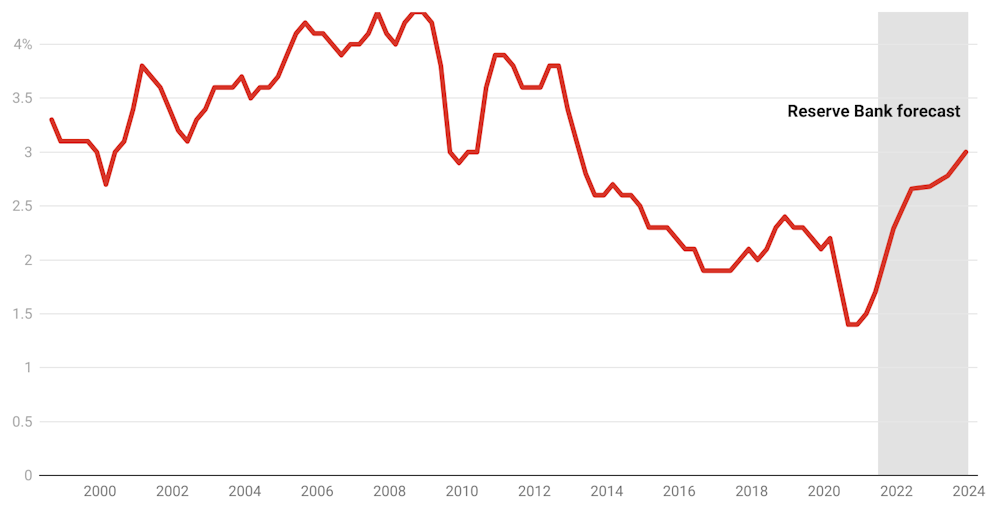
The bank’s latest forecasts, released on Friday, have wage growth climbing from 1.7% to almost 3% over the next two years, which will be the fastest growth in a decade.


Actual and forecast wages growth

Annual growth in ABS wage price index, excluding bonuses and commissions. RBA, ABS

Three per cent is still lower than the wage growth we had come to expect before it fell off a cliff with the end of the 2010s resources boom, and it’s still lower than the Reserve Bank needs to sustainably meet its inflation target.

But it holds out the prospect of an improvement at a time when private sector wages are already improving, which is what matters for the way people feel.

Forecasts have consequences

Economic growth – the catch-all measure for what’s happening in the economy – is set to climb out of the lockdown slump and accelerate throughout next year before settling back to the 2-3% that was common before the recession.

It also won’t be good enough, but it will be moving in the right direction, and accelerating strongly next May, at the time we are likely to be asked to vote.

These forecasts matter because similar ones (prepared by the Treasury instead of the Reserve Bank) will underpin the economic statement or budget released before the election and the Pre-election Economic and Fiscal Outlook released by departmental secretaries without political input during the campaign.

They will become the accepted narrative.

Easier home price growth

After soaring a frightening 21% in the past year to barely affordable highs, there’s every chance home prices will ease off. On Melbourne Cup Tuesday, the Reserve Bank withdrew its support for the near-zero three year bond rate that banks had been using to fund ultra-cheap fixed rate mortgages.

It’s no longer possible to get a three-year fixed rate mortgage for less than 2%.

A few weeks earlier the Australian Prudential Regulation Authority instructed lenders to refuse mortgages to borrowers who couldn’t withstand an increase in mortgage rates of three percentage points (such as an increase from 3% to 6%).

APRA expects the instruction to cut the maximum that can be borrowed by 5%. By election day price rises might have slowed or stopped.

And low rates for some time yet

Higher variable mortgage rates would unsettle Australians (even though many are finding it easier to make their payments than they have in years).

The good news is that on Friday the Reserve Bank nominated 2024 as the year it expects to begin to lift the record-low cash rate that sets the price of variable rate mortgages.

2024 is half a political cycle away.

Even if the first hike comes sooner (and financial markets expect it to come sooner) it won’t be imminent at the time we will be asked to vote.

All sorts of things determine election outcomes.

The economy is only one. But right now, next year’s economy is looking good.

Peter Martin, Visiting Fellow, Crawford School of Public Policy, Australian National University

This article is republished from The Conversation under a Creative Commons license. Read the original article.
Read more >>

Wednesday, February 03, 2021

Governor not for turning. No rate hike until unemployment near 4.5%

Reserve Bank governor Philip Lowe’s message to the nation today through the National Press Club is that he means it.

He isn’t intending to push up interest rates – he most probably isn’t intending to even think about pushing up interest rates – until 2024, at the earliest.

That’s a full three years from now, at a time when, maybe, inflation will be strong enough to be “sustainably within” the Reserve Bank’s target band.

That’s the new benchmark, adopted by the bank in November.

It replaced an earlier loophole-ridden benchmark of “progress towards” an inflation rate of 2% to 3%, something that could have meant almost anything.

The bank will now need to see actual, sustainable, inflation of 2% to 3%, something those of us wanting some inflation haven’t seen for a decade.

Ultra-low rates til unemployment hits 4.5%

After the press club event I asked him what sort of unemployment rate we would need to see for that to happen. Was it still the 4.5% the bank has nominated in the past, or had COVID pushed it up?

Might less ambitious progress on unemployment do the trick?

He told he thought not. While it is impossible to be sure, something seemed to have changed around the world over the past ten years meaning it has become much harder to create inflation. He doubted whether an unemployment rate above 4.5% could do the trick.


Read more: The Reserve Bank might yet go negative


Lowe told the press club that while unemployment had come down far more quickly than the bank expected when it produced its previous set of forecasts in November, its new forecasts had unemployment slipping only from 6.6% to 6% over the course of this year, and then taking another 18 months to reach 5.25%

An unemployment rate below 5% is beyond the bank’s forecasting horizon.

That’s why it has undertaken to buy as many government bonds as are needed to keep the three-year bond rate at the bank’s current cash rate target of 0.10%, to make it clear that the cash rate will “be where it is for the next three years”.

‘Creating money electronically’

And there’s another reason for buying government bonds – to restrain the Australian dollar. On Tuesday Lowe announced plans to use a separate program to buy an additional A$100 billion of bonds between April and September.

Combined, the two bond-buying programs will depress Australian long-term interest rates and make foreigners less likely to buy Australian dollars to take advantage of higher rates here than overseas.

Asked directly whether the bank was printing money in order to buy government bonds, Lowe said it was, with the caveat that the modern way of doing things means the bank “creates the money electronically”.


Read more: A little ray of sunshine as 2021 economic survey points to brighter times ahead


While Lowe accepts that the JobKeeper wage subsidy will end at the end of March (“the government made it clear this was a temporary program”) he is extremely keen for governments at all levels to keep spending on infrastructure, saying if weren’t for public projects, non-mining investment would be bad indeed.

While the economy is recovering, and the bank is forecasting slightly stronger economic growth than The Conversation forecasting panel of 3.5% this year and the next, the economy is unlikely to return to the trajectory it was on before the crisis, perhaps ever.


Reserve Bank GDP forecasts, February 2021 and February 2020

Index numbers, December 2019 = 100. RBA, ABS

The bank is envisaging an economy 4% smaller than it would have been. As Lowe put it: “it’s a big number, there’s a big gap there”.

The governor isn’t worried by a likely “blip” in unemployment when JobKeeper comes off in March, but he is worried about what will happen to employment beyond that. The unemployment rate is “higher today than it has been for almost two decades and many people can’t get the hours of work they want”.

Even when the unemployment rate was low (in NSW it got “as it was in 1973” before the crisis) wage growth was weak.

JobSeeker a"fairness issue"

It would help to permanently lift the rate of the JobSeeker unemployment benefit on which a million Australians rely and which is due to return to the poverty-line level of $40 per day in April, although Lowe sees that not so much as an economic question but as a “fairness issue”.

“Different people legitimately have different views on the level of support stopping - my own view is that some increase is justifiable,” he told the press.


Read more: Vital Signs: Any talk about raising interest rates is a huge mistake


The levers he can control, interest rates, will say low for as long as is necessary.

He isn’t “guaranteeing” to keep them low until 2024 or beyond, but he is guaranteeing to keep them low until inflation is sustainably near 3%, something he doesn’t think will happen until unemployment touches 4.5%, something he thinks is most unlikely to happen before 2024.

“I’m not pledging”, he told the national press, “but I am giving you my best guess”.The Conversation

Peter Martin, Visiting Fellow, Crawford School of Public Policy, Australian National University

This article is republished from The Conversation under a Creative Commons license. Read the original article.

Read more >>

Tuesday, November 03, 2020

5 ways the Reserve Bank is batting for us like never before

The most important of the five measures the Reserve Bank announced on Tuesday is the one that won’t whirr into place for a very long time.

Others start immediately. On Thursday the bank will wade into the market and start buying up bonds issued by Australian governments.

It’ll buy Commonwealth government bonds with five to seven years left to run on Mondays, Commonwealth bonds with seven to ten years left to run on Thursdays, and bonds issued by state governments on Wednesdays.

It’ll spend about A$5 billion a week, every week for six months until it has unloaded $100 billion.

1. $5 billion per week, week in, week out

As before, when it did this on a more limited scale, it won’t be buying the bonds from the governments that issued them, but from third parties such as super funds and investment managers.

What’s (very) different is that it will be forcing a particular sum of money into their hands.

Its earlier bond buying program (which will continue) spent only as much as was needed to achieve an interest rate target.

The new program will spend a particular sum of created money (the Reserve Bank creates it out of nothing) every week for six months, whatever happens to rates.


Read more: The government has just sold $15 billion of 31-year bonds. But what actually is a bond?


It’ll be true “quantitative easing”, in that it’s the quantity of money that will matter, not the price.

Once in the hands of investors who would really rather own bonds, they’ll have to do something with it, such as investing in a business that employs people. That’s the theory.

As well, with bonds harder to find in Australia, fewer foreigners will move money here to buy them propping up the Australian dollar. That should allow the Australian dollar to fall, making local businesses more competitive against those from overseas. That’s the other part of the theory.

2. Cash rate near zero

And that’s just one of five measures Reserve Bank Governor Philip Lowe announced on Tuesday.

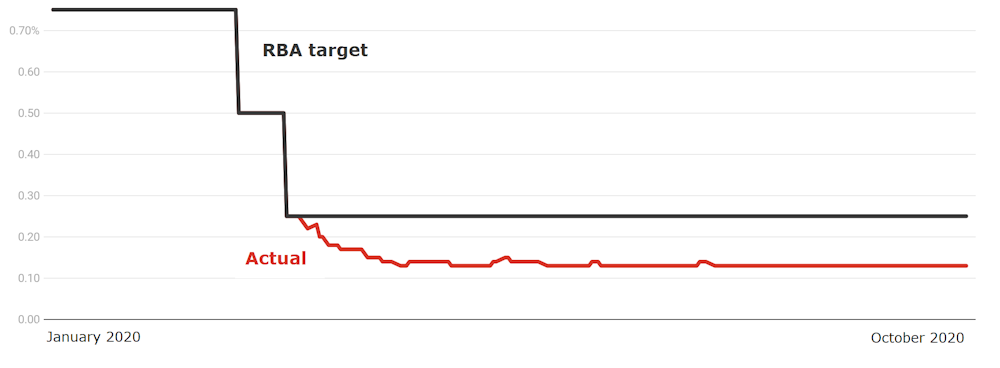
The once-watched cash rate which is the interest rate on unsecured overnight loans between banks, was cut to 0.25% in March amid hope that 0.25% was so low it wouldn’t need to be cut further.

Within days the actual cash rate at which banks transact business had fallen a good deal lower because, at 0.25%, many more of them wanted to lend than borrow.


Target cash rate versus actual

Reserve Bank of Australia

When it settled at about 0.14% the Reserve Bank didn’t bother to intervene to push it back up.

The new target of 0.10% will give banks almost no return for lending to each other and make borrowing from each other almost costless.

The separate rate for cash on deposit with the Reserve Bank will fall from 0.10% to as good as zero, 0.01%


Read more: More than a rate cut: behind the Reserve Bank's three point plan


If the cuts were passed on in full to bank customers they would cut the standard variable mortgage rate from around 3.2% to 3%.

The rate on new mortgages would slide from 2.7% to 2.5%. The rates on customer’s deposits, already near zero, would fall further.

3. Bond rate to 0.10%

The Reserve Bank had been targeting a three-year bond rate of 0.25%, buying as many bonds as were needed to keep it there. It’ll cut that target to 0.10% in line with its cut in the cash rate, buying as many bonds as are needed to get and keep the rate at 0.10%.

Three-year bonds are used to fund fixed three-year mortgages and personal and business loans. All will become even cheaper.

This bond-buying program, which will target the rate, is completely separate from, and additional to, the $5 billion per week the bank will spend buying longer-term bonds week in, week out.

4. Near-free loans to banks

Since March the government has been advancing money to private banks for three years for just 0.25%.

The more they expand their lending to business (and especially to small and medium sized business) the more it will it will advance them in accordance with a formula.

The formula won’t change but the rate will. From Thursday new loans under the program will be offered to banks for just 0.10%.

5. A commitment with teeth

Until now, the bank has been fuzzy about the circumstances in which it will eventually change course and start pushing rates back up.

Its commitment was weaker than it sounded

the board will not increase the cash rate target until progress is being made towards full employment and it is confident that inflation will be sustainably within the 2–3 per cent target band

Whether or not “progress is being made” is subjective.

The commitment allowed the bank to assert that progress was being made and reverse course at its convenience.

Whether or not the bank was “confident” that inflation would be sustainably within its target band was even more subjective.

One word, big change

On Tuesday, Governor Philip Lowe ditched the fuzziness and replaced it with something measurable.

The board will not increase the cash rate until “actual inflation” is sustainably within the 2% to 3% target range.

“For this to occur, wages growth will have to be materially higher than it is currently. This will require significant gains in employment and a return to a tight labour market.”

So prepared is the bank to bat for Australia that it won’t stop until there’s a “tight labour market”.

And it has used the word “actual”.

No longer will the bank need to merely see “progress towards” an inflation rate of 2% to 3%. It will have to be faced with an “actual” inflation rate of 2% to 3%.

Low rates for a long, long time

Australia’s inflation rate hasn’t been sustainably between 2% and 3% for more than half a decade, and it is likely to be at least that long again until it gets back there, if ever.

Governor Lowe said the bank’s forecasts, to be published this Friday, will put the inflation rate at 1%. It’ll put wage growth at the lowest on record, less than 2%.

By tying the future of the cash rate to an actual inflation rate rather than a feeling about the inflation rate, Governor Lowe is tying the bank to a cash rate of close to zero for as far anyone can see.

It means that not only will it be as cheap as it has ever been to borrow (for a mortgage, a business, for anything) it means there’s no risk of that suddenly changing because the bank gets rush of blood to the head. It’s about the future, but it matters now.The Conversation

Peter Martin, Visiting Fellow, Crawford School of Public Policy, Australian National University

This article is republished from The Conversation under a Creative Commons license. Read the original article.

Read more >>

Monday, March 16, 2020

Reserve Bank and government prepare fresh emergency measures as markets tumble

The government is planning to deliver a second coronavirus economic support package within days, and the Reserve Bank will announce “further policy measures” to support the economy on Thursday.

The bank sometimes uses the phrase “policy measures” to describe adjustments to its “policy rate”, the so-called cash rate from which most other rates are priced.

Two weeks ago it cut the cash rate to 0.50%, a record low that is only 0.25 points above what Governor Philip Lowe has described as the effective lower bound of 0.25%, beneath which the bank would need to engage in “unconventional monetary policy” which would involve buying government bonds, residential mortgage bonds and perhaps corporate bonds to force a suite of longer-term interest rates lower.

At Thursday’s announcement Governor Lowe is also likely to take the opportunity to set out in detail how unconventional measures would be applied.


Reserve Bank cash rate


The Australian share market crashed 9.7% on Monday in its worst one-day sell-off since 1987.

In an emergency meeting earlier on Monday New Zealand’s Reserve Bank slashed its cash rate by 0.75 points from 1.00% to 0.25% and said it will remain at that level for at least the next 12 months.

Should it need to do more, it would turn to unconventional measures along the lines of those being planned for in Australia and implemented in the United States and Europe.

On Sunday, the US Federal Reserve cut its benchmark interest rate to zero and launched a new round of unconventional measures saying it would buy US$700 billion of government, corporate and mortgage-backed securities.


Read more: Now we know. The Reserve Bank has spelled out what it will do when rates approach zero


Mid-Monday Australia’s Reserve Bank and the Council of Financial Regulators which is made up of the bank, the Prudential Regulation Authority, the Securities and Investments Commission and the Commonwealth Treasury, announced a series of measures to keep financial markets working after investors turned away from both shares and government bonds.

Normally when investors desert shares they buy government bonds, forcing down the interest rates quoted on the bonds.

Reserve Bank to buy bonds as needed

But in both the US and Australia, investors have sold bonds as well, pushing up the rate (almost doubling the yield on a 10 year Australian government bond from 0.6% last Monday to 1.1%) and starving the market of buyers at any price, a phenomenon the council of regulators describes as a deterioration in liquidity.

The Reserve Bank has acted to inject liquidity by promising to buy unlimited amounts of one-month and three-month securities until further notice.


Read more: We're staring down the barrel of a technical recession as the coronavirus enters a new and dangerous phase


The Australian Prudential Regulation Authority said it would ensure banks take advantage of the injection of liquidity to support their customers.

Both the Authority and the Securities and Investments Commission will be flexible in applying rules where those would cause hardship to businesses and customers.

In particular, each agency will, where warranted, provide relief or waivers from regulatory requirements. This includes requirements on listed companies associated with secondary capital raisings, annual general meetings and audits.

The Tax Office earlier announced a series of administrative measures to assist people and businesses in difficulty as a result of the coronavirus including deferring the payment date of amounts due through the business activity statement and income tax assessments by up to four months.

The government’s second coronavirus support package follows a package of A$17.6 announced on last Thursday.


Read more: This coronavirus share market crash is unlike those that have gone before it


It will be aimed at shoring up business and households affected by new travel and isolation rules announced on Sunday.

A skeleton parliament will meet for a few hours next week to approve measures announced in the first and possibly the second stimulus package. Members will be paired to ensure that only those needed for quorums will be present.The Conversation

Peter Martin, Visiting Fellow, Crawford School of Public Policy, Australian National University

This article is republished from The Conversation under a Creative Commons license. Read the original article.
Read more >>

Wednesday, July 03, 2019

Ultra-low unemployment is in our grasp. How Philip Lowe became the governor who lifted our ambition

Rarely does a Reserve Bank governor get to remake Australia.

HC “Nugget” Coombs, the first Reserve Bank governor, did.

As director general of the Department of Post-War Reconstruction from 1943, he was instrumental in creating the White Paper on Full Employment in Australia that was adopted as a guide by prime ministers from Chifley to Menzies to Whitlam.

He ensured the objective of full employment became part of the charter of the Reserve Bank when he became its first governor in 1960, moving over from the then government-owned Commonwealth Bank, which had performed the Reserve Bank’s functions up to then.

After once again cutting interest rates to a new record low at a special Reserve Bank board meeting in Darwin on Tuesday, his latest successor Philip Lowe will travel to Yirrkala in Arnhem Land to visit the site where some of the Coombs ashes were buried.

HC Coombs gave us full employment

On Tuesday night in Darwin, he paid tribute to Coombs. He said that in his dual roles as governor of the Reserve Bank and chair of the Council for Aboriginal Affairs, he was a strong advocate for land rights and the preservation of cultural values and traditions.

Another governor who remade Australia was Bernie Fraser, head of the treasury when Prime Minister Paul Keating made him governor of the Reserve Bank in 1989 – shortly before Australia plunged into recession.

He cut rates dramatically from early 1990, as might have been expected in order to bring about a recovery. But then, well before the recovery was complete (and the unemployment rate was still about 10%), he stopped cutting and started pushing rates back up – much to Keating’s displeasure.

Bernie Fraser gave us low inflation

His rationale appears to have been to salvage something out of the unusual circumstances in which Australia found itself. With inflation on the ropes because of the recession, he decided to keep it there – to squeeze out high inflation forever. With one temporary exception during the introduction of the goods and services tax in 2000 it never again returned to the rates of 5% or more that had been common.

He did it not because of an unusual opportunity, and changed Australia forever.

And so to Philip Lowe, who on Tuesday night in Darwin indicated that he too was taking advantage of an unusual opportunity and would probably change Australia forever.

Until a few years ago, it was thought that Australia’s rate of “full unemployment” – the rate below which unemployment couldn’t stay without stoking inflation – was touch over 5%. As it has fallen to 5% in the past year without stoking either inflation or much-wanted wage growth, the bank has come to revise its view.

It now thinks something has changed and the “full employment” is probably 4.5% or lower, a low that was reached during the peak of the mining boom but hasn’t been sustained since the early 1970s. Aiming for an unemployment rate of 4.5% instead of 5% would get 69,000 more people into work.

Lowe wants unemployment lower

Lowe could have ignored the opportunity to push unemployment down that far, to a low that hasn’t been sustained since the 1970s. Instead, in Darwin on Tuesday night, he embraced the opportunity, saying his board was:

prepared to adjust interest rates again if needed to get us closer to full employment and achieve the inflation target in a way that supports the collective welfare of all Australians

Governor Lowe plans to usher in the lowest unemployment target in half a century. He believes the economy can sustain it. He said several times on Tuesday that he would prefer the government to help out with infrastructure projects and the like, but if it won’t, he is “prepared to adjust interest rates again if needed to get us closer to full employment”.

He is doing it because the opportunity is there, as did Coombs and Fraser before him.

There’s no telling (yet) how far rates will have to fall to achieve it. Without setting out to, Lowe is remaking Australia.


Read more: Buckle up. 2019-20 survey finds the economy weak and heading down, and that's ahead of surprises The Conversation


Peter Martin, Visiting Fellow, Crawford School of Public Policy, Australian National University

This article is republished from The Conversation under a Creative Commons license. Read the original article.

Read more >>

Tuesday, June 04, 2019

The Reserve Bank will cut rates again and again, until we lift spending and push up prices

The Reserve Bank cut interest rates on Tuesday because we aren’t spending or pushing up prices at anything like the rate it would like. And things are even worse than it might have realised.

As the board met in Martin Place in Sydney, in Canberra at 11.30 am the Bureau of Statistics released details of retail spending in April, one month beyond the March quarter figures the bank was using to make its decision.

They show the dollars spent in shops fell in April, slipping 0.1%, notwithstanding weakly growing prices and a more strongly growing population.

The March quarter figures the board was looking at were adjusted for prices. They show that the volume of goods and services bought, but not the amount paid for them, fell in seasonally adjusted terms during the March quarter.

Adjusted for population, the volume bought would have fallen further.

We’ll know more on Wednesday

The Bureau of Statistics will release population-adjusted figures as part of the national accounts on Wednesday.

The figures for the September quarter show that income and spending per person barely grew. The figures for the December quarter show income and spending per person fell.

A second fall in the March quarter will mean two in a row – what some people call a per capita recession.


Australian National Accounts

Even unadjusted for population, economic growth is dismal.

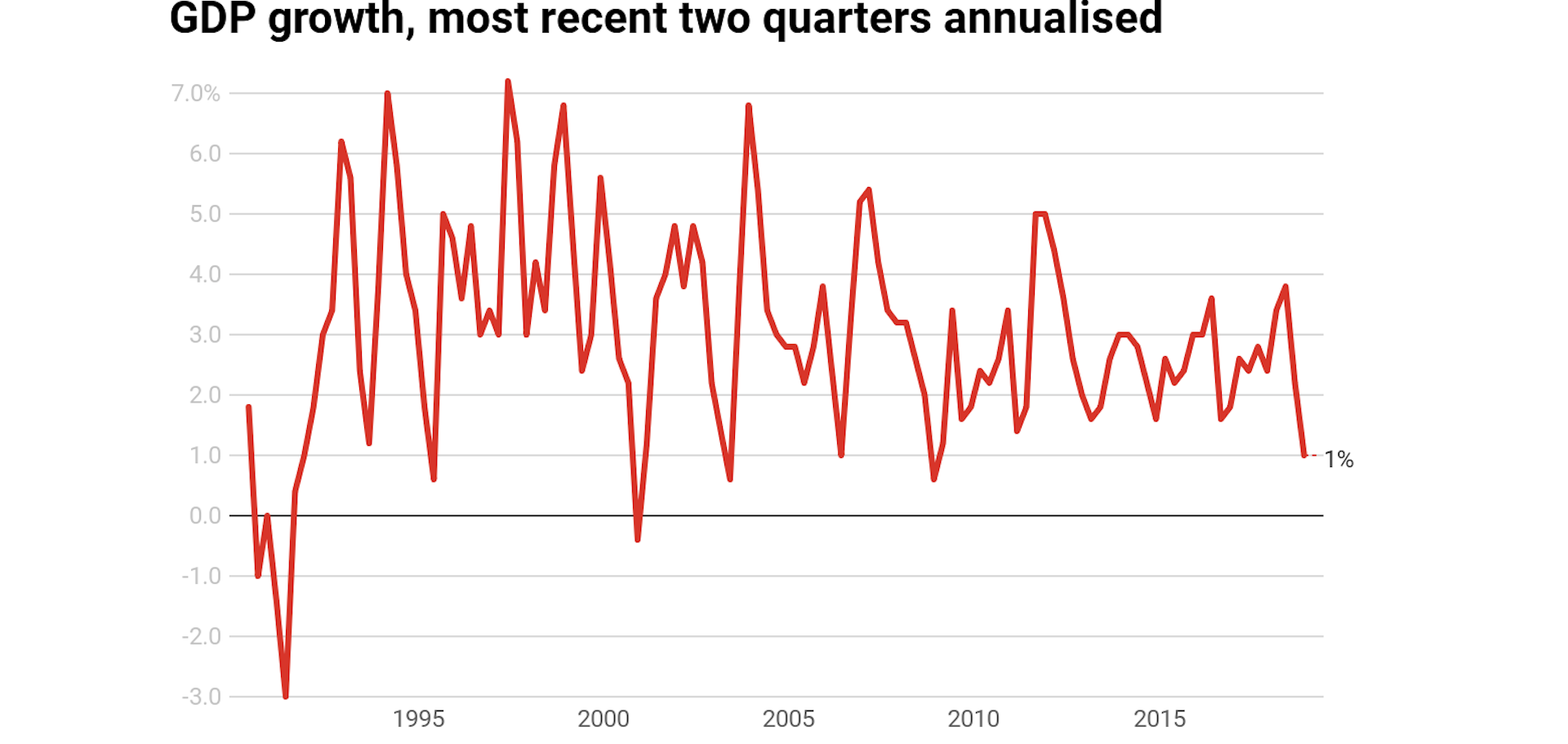
During the September and December quarters the economy grew just 0.3% and 0.2% – an annualised rate of just 1%.

That’s well short of the 2.75% the treasury believes we are capable of, and the lower than normal 2.25% it has forecast for the year to June.


Australian National Accounts

We’ve been doing it by ourselves. As Reserve Bank Governor Philip Lowe said in announcing the rates decision on Tuesday:

The main domestic uncertainty continues to be the outlook for household consumption, which is being affected by a protracted period of low income growth and declining housing prices.

The bank wants both inflation and employment higher, and it wants us to spend more in order to do it. Lower rates should help, although not for everybody.

Lowe acknowledged this in a speech to a Sydney business audience on Tuesday night, but he said households paid two dollars in interest for every one dollar of interest they received. So while rate cuts hurt savers, they benefit borrowers by more, and over time should benefit all households by boosting the economy. They also drive the dollar lower, making Australian businesses more competitive.

Tuesday’s cut should free up an extra A$60 a month for a typical mortgage holder. Another one will free up a total of A$120.

It’s not much, and there’s doubt about whether it will do much, but interest rates are about the only tool the Reserve Bank has.

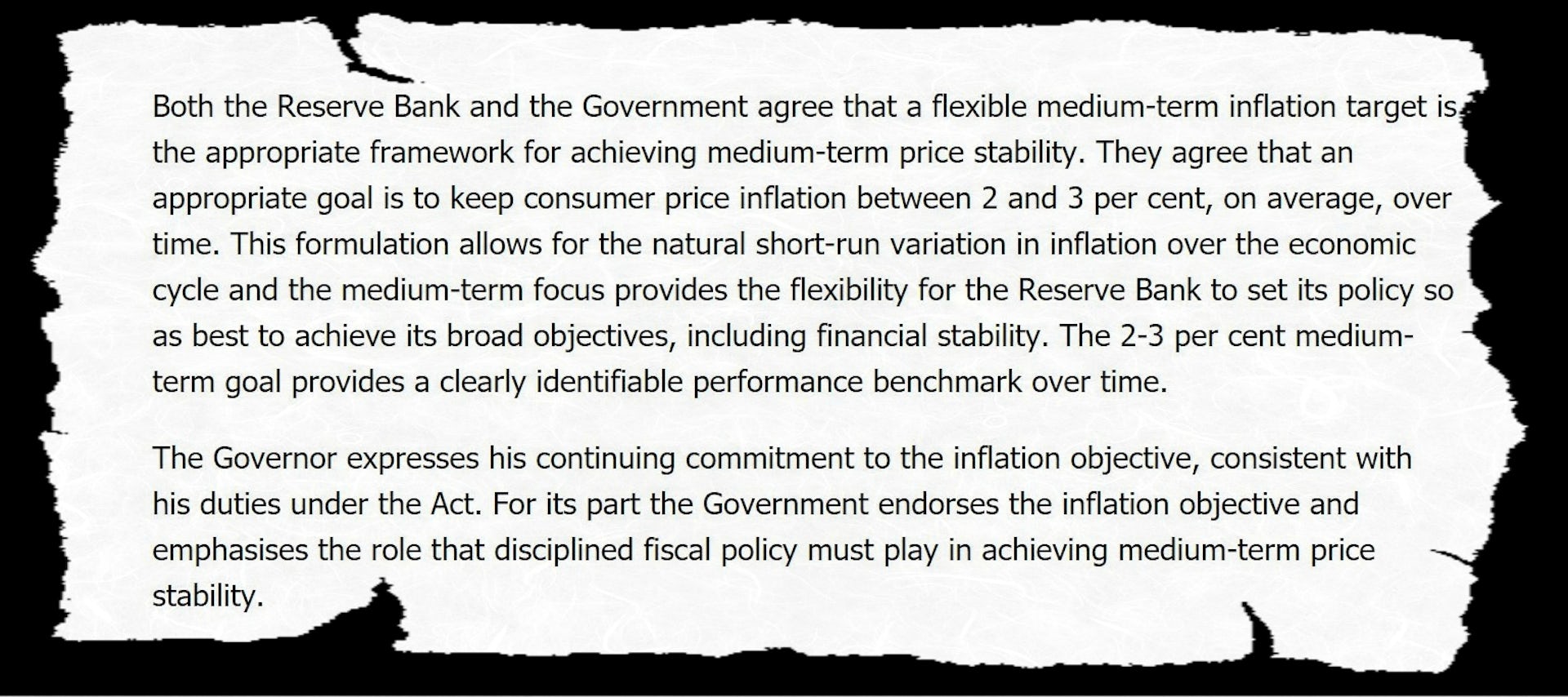
It is required by its agreement with the government to aim for an inflation rate of between 2% and 3%, “on average, over time”.

Reserve Bank of Australia

Uncomfortably for Governor Lowe, underlying inflation (abstracting from unusual moves which are quickly reversed) has been below 2% ever since he was appointed governor in late 2016.

Explaining his push for higher inflation to a business audience in Sydney on Tuesday night he said that while adherence to the target was intended to be flexible, that flexibility was “not boundless”.

If inflation stays too low for too long, it is possible that inflation expectations move lower – that Australians come to expect sub-2% inflation on an ongoing basis. If this were to happen, it would be harder to achieve the medium term inflation goal. So we need to guard against this possibility.

He is also required to aim for full employment.

He told the business audience that while for some years the bank and others had thought full employment meant an unemployment rate of 5%, the absence of inflation at 5% and the persistence of underemployment (where people wanted more hours) meant it could and should go lower.

Our judgement now is that we can do better than this – that we can sustain an unemployment rate of 4 point something.

Lower interest rates should help by making it easier for businesses to borrow to expand, and giving consumers something in their pockets to buy from them.

If you don’t succeed…

If that doesn’t happen, the bank will cut again.

Tuesday’s statement as good as said so:

The board will continue to monitor developments in the labour market closely and adjust monetary policy to support sustainable growth in the economy and the achievement of the inflation target over time.

Tuesday’s cut and the next will take the bank into uncharted waters, where its so-called cash rate – what it pays to banks to deposit money with it overnight – is close to zero.

As far as can be discerned it has never been that low in the 100+ years the Reserve Bank has been in operation, originally as the Commonwealth Bank of Australia.


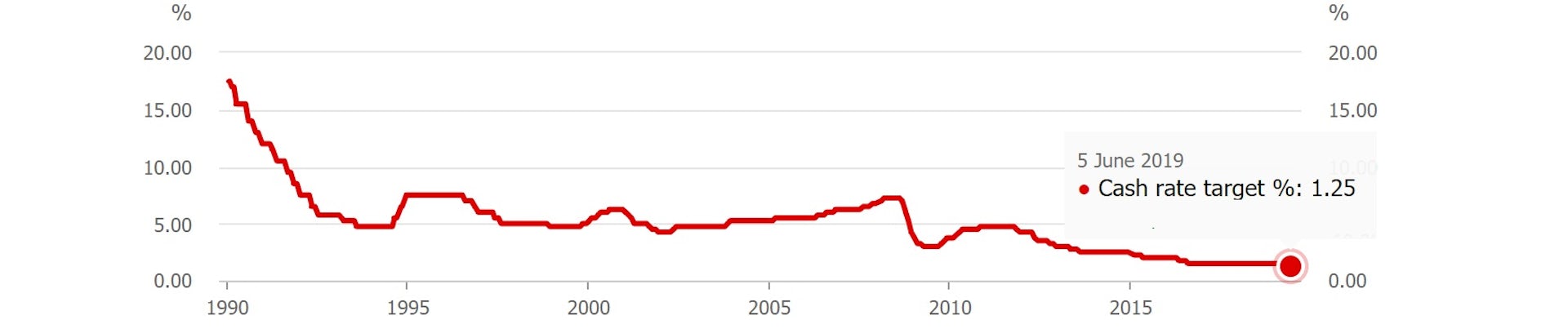
Reserve Bank cash rate since 1990
Reserve Bank of Australia

Should inflation still not pick up and employment still not fall as far as it believes it could, it will have to effectively cut its cash rate below zero, forcing cash into the hands of banks by aggressively buying government bonds, giving them little choice but to lend it to households and businesses, in a process known as quantitative easing. It has been done in the United States, Europe, the United Kingdom and Japan, and is by now anything but unconventional.

Governor Lowe would prefer the government to pull its weight by cutting tax and boosting spending, especially on infrastructure, and by policies that make Australia more productive.

He said so on Tuesday night

the best approach to delivering lower unemployment and a stronger economy is through structural policies that support firms expanding, investing, innovating and employing people. As we ease monetary policy, it is in the country’s interest that other policy options are considered too.

Treasurer Josh Frydenberg gets it.

He pointed out on Tuesday that the yet-to-be-approved tax offsets in the budget will give Australians on up to A$126,000 a cash bonus of up to A$1,080 when they submit this year’s tax return, far more than the rate cut.

His biggest concern, and the biggest concern of the governor, might be that they don’t spend it. Another concern would be that the banks don’t pass the rate cut on.

The ANZ has said it will only cut mortgage rates by 0.18 points instead of the full 0.25, a decision Frydenberg said “let down” customers. Westpac has cut by only 0.20 points. The National Australia and Commonwealth banks have passed on the cut in full.

On Tuesday night in Sydney Governor Lowe addressed the question of whether the banks should have passed on the full cut head on:

My usual practice in answering this question has been to explain that there are a range of other factors that influence mortgage pricing, and then say “it all depends”.

Today, though, I would like to break with my usual practice and provide a clearer answer. And that is: Yes. There has been a substantial reduction in the cost of banks raising funds in wholesale markets. Average rates on retail deposits have also come down.

This means that the lower cash rate should be fully passed through into standard variable mortgage rates. Full pass-through would also mean that the economy receives the full benefit of today’s policy decision.

The Governor is concerned that, for their own reasons, lenders such as ANZ and Westpac are forcing him to cut rates lower than he should and making an already difficult job harder.

If he has to cut further he will, but with the cash rate at just 1.25%, he would dearly love not to have to.

Reserve Bank of Australia

Read more: Cutting interest rates is just the start. It's about to become much, much easier to borrow The Conversation


Peter Martin, Visiting Fellow, Crawford School of Public Policy, Australian National University

This article is republished from The Conversation under a Creative Commons license. Read the original article.

Read more >>

Thursday, April 19, 2018

Reserve Bank might fund mortgages: bank official

A senior Reserve Bank official has raised the prospect of buying mortgages to keep the economy afloat during the next recession.

Leon Berkelmans monitors financial markets for the bank and shared what he said were his personal thoughts at a conference in Canberra organised by the Melbourne Institute of Applied Economic and Social Research.

The bank has kept its cash rate steady at an all-time low of 1.5 per cent for a record 20 months, leaving it little room to cut further should the economy turn down.

Dr Berkelmans said it might be possible to cut the cash rate below zero, as central banks had done in Japan and Europe. But cutting too far below zero would see retail banks withdrawing their funds from the Reserve, leaving its cash rate impotent.

Central banks in the United States, Britain, Japan and mainland Europe had pumped cash into their economies by buying government and corporate bonds when they could no longer cut interest rates, a process known as quantitative easing.

As a “thought experiment” he outlined the options available to the bank, although he stressed it had no official position and to the best of his knowledge hadn’t wargamed what it might do.

“Let me be very clear,” he said. “The Reserve Bank is not planning on engaging in quantitative easing anytime soon, so please do not form the impression that at the next board meeting they will be discussing it. They will not.”

“But, just as a thought experiment, the bank would need to buy securities.”

Japan’s central bank owned securities worth 90 per cent of an entire year’s gross domestic product. The European Central Bank had securities worth around 40 per cent of gross domestic product. The US Federal Reserve owned securities worth 30 per cent of GDP.

The Reserve Bank of Australia only owned securities worth about 10 per cent of Australia’s GDP.

“Let's engage in a thought experiment. Again, this is just a thought experiment,” he said. “This is not the what the Reserve Bank is thinking of doing right now.”

“Suppose that we wanted to engage in episode of quantitative easing that would result in the bank’s balance sheet going up as much as did the European Central Bank’s; to 40 per cent of GDP. We would need securities worth another 30 per cent of GDP.

“What would 30 percentage points look like? In net terms the entire stock of Australian government bonds in the market amount to 30 percentage points of GDP.

“We would need to go out and buy every single Australian government security, and there are many reasons why we might not want to.

“So again, in the spirit of a thought experiment, what else could we go out and buy?

“There are asset-backed securities, primarily residential mortgage backed securities.”

The US Federal Reserve bought residential mortgage backed securities during the financial crisis of 2008 to 2009.

It ensured the mortgage market continued to function and gave cash to the institutions that sold that they were able to use elsewhere. It meant the Federal Reserve rather the previous owners became entitled to the mortgage payments that lay behind the securities, effectively making it a mortgage funder.

There was a risk that Australian wouldn’t have enough residential mortgage backed securities on offer for the bank to buy. There were half as many as before the financial crisis. But overseas experience had showed that the central bank was a buyer more were created, making mortgages more available and supporting the economy.

Dr Berkelmans stressed that the bank had no official position on what it might do.

His idea was quite distinct from a proposal floated by the Australian Greens for Reserve Bank to provide residential mortgages. Mortgages would be bought at the wholesale level rather provided at the retail level.

Board minutes released on Tuesday said it was more likely the next move in the bank’s cash rates “would be up, rather than down” depending on further progress cutting the unemployment rate and boosting the inflation rate. Figures released on Thursday showed the unemployment rate steady at 5.5 per cent in March for the third consecutive month.

In The Age and Sydney Morning Herald
Read more >>

Friday, January 12, 2018

Axe negative gearing, boost GDP - RBA conference paper

Axing negative gearing would lift home ownership to as much as 72.2 per cent of households, cut home prices by just 1.2 per cent and lift rents "only marginally", a study shown to the Reserve Bank of Australia has found.

Preliminary results from the economic modelling exercise, believed to be the first of its kind in Australia, were presented to a RBA workshop last month and released on Friday.

Melbourne University researchers Yunho Cho, Shuyun May Li and Lawrence Uren conclude that eliminating negative gearing entirely would lead to an overall welfare gain of 1.5 per cent of GDP, making three quarters of the population better off.

The figure compares to a Treasury prediction of welfare gain of 1.2 per cent from Turnbull government's plan to cut the company tax rate.

Speaking after the release of the paper, Dr Uren stressed the research was incomplete and said it was possible the size of the lift in home ownership could be revised down. But he said the directions of change and magnitudes were unlikely to change much.

An ownership rate of 72 per cent would be the highest since 1991, before 1999 when the Howard government cut the headline rate of capital gains tax making negative gearing more attractive. It currently stands at 66.7 per cent.

During the 2016 election campaign Prime Minister Turnbull said a Labor plan to wind back but not eliminate the negative gearing tax concession would "smash up home values", and "pull the rug out from under the property sector".

The claims were at odds with advice to the government at the time released on Monday under Freedom of Information laws that characterised the likely impact of Labor's proposals as "relatively modest".

Negative gearing allows investors in housing and other assets to deduct investment losses from their wage incomes for the purpose of calculating taxable income. The losses can be recouped later when the asset is sold for a profit, which is taxed at only half the rate of wage income.

Treasury found the arrangement predominantly helped high income families, with more than half of the benefit going to the top 20 per cent of earners.

Dr Uren said his modelling examined only what would happen after a transition process that might take several years.

Renters and owner-occupiers would be the biggest beneficiaries. Landlords, especially young, high earning landlords, would be the biggest losers.

Renters would benefit because although rents would climb by 2.4 per cent, the government would be in a position to compensate them and others with the extra $2 billion it would make in increased tax revenue.

"We are comparing two small changes," Dr Uren said. "One would be a small price change for renters and the other would be a small increase in transfers."

Young owner-occupiers would benefit from the lower house prices "as they can move up a housing ladder more easily".

Landlords who rely on borrowings would be "driven out of the market for investment properties".

Most are "young, but rich enough to afford the downpayment requirement for their investment". Other landlords would also scale back their holdings.

Thirty per cent of rental properties would be freed up and bought by Australians who would have otherwise rented. Almost every income group and every age group would increase its home ownership rate.

Acting Treasurer Kelly O'Dwyer disparaged the paper as "preliminary and incomplete", prepared by university academics.

She said Labor should not boast about a finding that house prices would go down and rents go up. It should "be of concern to every Australian, whether they're a prospective first home buyer who rents or they own their own home".

Labor Treasury spokesman Chris Bowen said it supported the direction of Labor's reforms and showed they would boost home ownership.

In The Age and Sydney Morning Herald
Read more >>