Showing posts with label wages. Show all posts

Wednesday, June 05, 2024

Spare us the talk about a wages explosion. There’s nothing wrong with lifting Australia’s lowest wages in line with inflation

What is it with the Coalition and wages?

When, in the final days of the 2022 election campaign, the then opposition leader Anthony Albanese backed an increase in award wages to keep pace with inflation, his opposite number in the Coalition, Prime Minister Scott Morrison called him a “loose unit”.

“He just runs off at the mouth, it’s like he just unzips his head and lets everything fall on the table,” Morrison said.

Allowing the wages of low-paid Australians to climb with inflation would

make interest rates rise even higher, it would threaten the strong growth we have had in employment, and ultimately it would force small businesses, potentially, out of business altogether.

Now, two years on, after yet another Fair Work Commission decision that lifted award wages in line with inflation, the Coalition has returned to the fray.

On Monday, Shadow Finance minister Jane Hume asked Treasury Secretary Steven Kennedy at a Senate hearing how he could support a wage increase linked to inflation at a time when productivity growth was uncertain.

She was, she said, just asking for treasury’s position.

The Fair Work Commission had just given Australia’s lowest-paid workers 3.75%.

The approach goes back some time. In 2014 the Coalition’s recently-installed industrial relations minister Eric Abetz warned of something akin to the “wages explosions” of the 1970s and early 1980s unless “weak-kneed” employers stood up to unions.

At the time, only 17% of Australian workers were members of unions, down from more than half in the early 1980s. It’s now just 12%.


Far from setting off a wages explosion, increases in award wages (those awarded by the Fair Work Commission to predominately low-paid workers) appear to barely move the dial at all.

Last year the Commission awarded low-paid workers 5.75%. In the year that followed, overall wages climbed 4.1%. The previous year the Commission awarded 5.2%. In the year that followed, overall wages climbed 3.7%.

Overall wages – those received by the three quarters of workers who aren’t paid by awards – have been climbing by less than awards, and for most of the past three years, by less than the rate of inflation.

Conditions were ripe for pay rises

It isn’t because the conditions haven’t been right. For the past two years, unemployment has been lower than it has been in the previous four decades.

From 1974 right through until 2022 unemployment never fell below 4%, and rarely fell below 5%. Yet the past two years haven’t sparked a wages explosion.

It should have been one of the easiest times in our lives to walk into a new higher-paying job, yet the share of us doing that has dived from almost 20% per year at the start of the 1990s to less than 10% today.


At the peak of what was then the biggest mining boom in a century in 2012, only 6,200 Australians were crossing the Nullarbor to live in Western Australia. Five times as many new arrivals were pouring into Western Australia from overseas.

In the past year, in the midst of a new and bigger mining boom, only a net 11,200 Australians have moved west for a better life.

Our remarkable passivity when it comes to moving to earn more and our lack of interest in joining unions has collided with a wage-setting system that for those of us not on awards makes it easy for employers to resist paying more.

Workers are finding it hard to bargain

Individual contracts are usually offered on a take-it-or-leave-it basis. Those of us not interested in leaving (most of us) take them.

Enterprise bargains typically last three years. When they expire there is nothing to stop employers stringing negotiations out or simply not commencing them, leaving their workers on so-called “zombie agreements”.

The Business Council says they can “act like a wage freeze”.

Australia’s total wage bill has been climbing much more slowly than prices. In part this is because decisions on awards, like the ones handed down this week, apply only to awards.

Awards, applying mainly to low-wage jobs, make up only 11% of the total wage bill.

Services inflation is high for other reasons

It is true, as several senators said on Monday, that inflation in the price of services is now greater than inflation in the price of goods. But Treasury Secretary Kennedy doesn’t think that’s because of excessive wage growth.

He said inflation took off as economies ran short of goods when they restarted after closing down in the first wave of COVID. Then Russia invaded Ukraine, pushing up the prices of oil and food.

Inflation in the prices of those goods has receded, but goods are an input to services. Kennedy says what’s happening to the price of services is an echo of what happened earlier to the price of goods.

It will take a while for that to flow through, and for services inflation to follow goods inflation down.

As unthreatening as the latest 3.75% increase in award wages is to inflation, it’ll be welcome to those who receive it.

The national accounts released on Wednesday are likely to show living standards as measured by GDP per person have gone backwards for four consecutive quarters, the first time that’s happened in 40 years. The extra pay will help.The Conversation

This article is republished from The Conversation under a Creative Commons license. Read the original article.

Read more >>

Tuesday, November 29, 2022

‘Zombie’ wage deals have hurt Australians for years. Here’s how new industrial relations laws could finally end your wage pain

Imagine you were trying to design a system that would hold back wages. You would design one pretty much like the one we’ve got today.

That’s why the government wants to change it.

Those of us on enterprise bargaining agreements get our wage rises locked in only every three or so years. If we didn’t lock in enough in last year’s agreement to cover this year’s sudden outbreak of inflation, there’s nothing much we can do about it for another two or so years.

It’s a built-in inertia identified by financial services firm JP Morgan in its attempts to explain to foreign clients why Australian wages growth is so low.

Australian enterprise agreements, JP Morgan explains in a note to clients, both delay wages growth and trim its peaks.

Here’s how that came about – and how the Albanese government’s new industrial relations law might finally end Australians’ pay freeze.

Wages used to be mostly set by awards

For nearly a century, Australian wages were generally set by judges in state and federal industrial relations tribunals. They had the power to intervene and set an “award” wage for an industry or occupation in which there was a dispute. And it was easy enough for unions and employers to create disputes.

Because they almost always intervened, the tribunals got to ensure that wages didn’t move too much relative to each other, and it got an insight into the state of the economy from the government, which made submissions.

From one point of view, the strength of this peculiarly Australian system of setting wages was that each employer covered by a decision was compelled to deliver the same increase as its competitors, meaning none were disadvantaged.

From another point of view, this strength was becoming a weakness. The weak firms as well as the strong had to pay the increases, whether it was easy or not.

Enterprise agreements unleashed productivity

In the early 1990s, perhaps with an eye to the possibility that an incoming Coalition government might make even greater changes, the Keating Labor government changed the law to channel the workers and employers within each workplace into enterprise bargaining.

The tribunals would have a more limited role, checking that each enterprise agreement passed a “better off overall” test, and continuing to set awards that became more like backstops, slipping below what most workers (usually through their unions) were able to negotiate with individual employers.

Workers and unions did well at first, because they were able to get together with employers and nut out ways to save money to pay for wage rises – something they had had little incentive to do when wages were set centrally.

And it was something that could only really be done at the level of each enterprise, because each was different, and it was the workers on the ground who knew how to make it better.

Zombie agreements and frozen wages

But productivity couldn’t be unleashed in the same way forever. After a while, the easy gains had been had. Workers got good pay rises in return for streamlining unwieldy processes at the start, then had few unwieldy processes left to streamline.

Productivity surged during the first decade, until the early 2000s. Then employers became more cautious about granting pay rises, and by the 2010s became good at stringing out negotiations or letting agreements expire, which meant they rolled over as “zombie agreements” without an increase.

As the Business Council explained in a report on the state of enterprise bargaining in 2019, agreements that had lapsed but were still operational came to act “like a wage freeze for some employees”.

With union membership down from 40% of workers when enterprise bargaining began, to just 14% in 2020, there was little workers on frozen agreements could do to get more, other than fall back on awards, which at least usually climbed with inflation.

It means the system has come to work in a way hardly anyone actually intended. It is acting as a brake on pay rises, while becoming more centralised.

The Reserve Bank says it can see some signs that wages growth is picking up, even in new enterprise agreements, but that it will take some time to flow through to all agreements in general because of the “multi-year duration” of the agreements.

How the new law could break the pay freeze

What the Albanese government has proposed – and is about to finally get through the Senate with the help of the Greens and independent David Pocock – is an attempt to bust the inertia.

Expanding multi-employer bargaining will allow employers to bargain knowing their competitors will have to pay what they pay.

Air-conditioning manufacturers have already begun talks with the Australian Manufacturing Workers Union in a bid to drive up workplace standards and pay in a way they know won’t be undercut by cheaper competitors.

Allowing employers with genuine ongoing enterprise agreements to escape multi-employer bargaining will encourage more genuine agreements.

And loosening the “better off overall” test will make it easier to get agreements of all kinds registered.

Particularly helpful will be “supported bargaining”, in which the Fair Work Commission will sit around the table with workers in fields such as childcare, who have traditionally found it hard to bargain. Where necessary, the commission will pull in outside funders (such as the government for childcare) for talks.

None of it will work miracles. But it should help. And it’s unlikely to hurt.The Conversation

This article is republished from The Conversation under a Creative Commons license. Read the original article.

Read more >>

Tuesday, August 23, 2022

If the PM wants wage rises, he should start with the 1.6 million people on state payrolls

If Prime Minister Anthony Albanese really wants to boost wage growth, there’s a simple way to do it.

And if he did that one simple thing, analysis prepared for The Conversation shows some of our most trusted but least well-paid workers – teachers and nurses – could be among the wage winners.

During the election campaign, the Labor leader made a public push for wages growth. He held aloft a $1 coin and said that’s what his government would be asking for: a boost in the minimum wage from $20.33 an hour to $21.36, which would lift it 5.1%, which was the inflation rate at the time.

After the election that’s what the government asked for. The Fair Work Commission delivered slightly more for Australia’s lowest-paid – an increase of 5.2% – and somewhat less for higher earners: an increase of 4.6%.

Then the inflation rate climbed to 6.1%. That figure, for the year to June, far eclipsed total wage growth of 2.6% over the same period and rendered even what the commission had delivered out of date, sending real (inflation adjusted) wages backwards by the most in 25 years.

Next week’s Jobs Summit is, in part, an attempt to do something about wages. But the issues paper released ahead of the summit is curiously bereft of ideas about how.

The paper says wages have traditionally climbed with labour productivity (which is output per hour worked) and that productivity growth has fallen to its lowest in 50 years.

It says if businesses invested more in labour-saving technology and workers got a better mix of skills, productivity growth would climb, but (and it’s a big but) that growth would only flow through to wages “over the medium term”.

Which leaves… not much happening for wages in the meantime.

Silent on what the states should do

The other things the paper notes are that fewer workers are covered by enterprise agreements and more by Fair Work Commission awards (presumably because enterprise agreements have expired, or aren’t high enough) and that 23% of workers are casuals (a figure that hasn’t changed much in 20 years).

What the summit paper doesn’t mention, but ought to, is that governments set wages – the wages of their own employees.

The lowest-paid quarter of the workforce has its wages set by the Fair Work Commission, either via the minimum wage or awards.

The Fair Work Commission looks after these people by usually increasing their wages in line with the consumer price index, and often by more.


Private employers are offering more, where they can

Most of the rest of the workforce gets only what their employers agree to, and the good news here is that, increasingly, employers are offering more.

Two years ago, as COVID took hold, the private employers who did lift wages offered an average of 0.8%. One year later, in the year to June 2021, they offered 2.7%. In the year to June this year they offered 3.8%.

Of course many private employers can’t offer much. They are small, and are being squeezed by soaring costs.

But governments budget in billions, and can afford to offer whatever they think they should, covering it with tax or borrowing.

The Commonwealth government, under Albanese, employs one quarter of a million Australians. The states, with whom Albanese could have a word, employ 1.6 million – many of them teachers and nurses.

Yet far from increasing their wages in line with inflation, or even in line with private sector increases, Australia’s states have been extraordinarily stingy.

Governments are offering as little as 1.5%

Victoria’s wages policy, announced in January, is for a cap on annual increases of 1.5%. Western Australia, despite its large budget surplus, was limiting increases to 2.5%. In July it lifted the offer to 3% with a one-off $2,500 cost of living payment.

NSW has a ceiling of 3%, which falls back to 2.5% after two years. (And the NSW ceiling is lower than it seems. It includes employers’ super contributions, which are to climb by 0.5 percentage points a year for the next few years, making the quoted ceiling of 3% a ceiling of 2.5% for take-home pay.)

Using Bureau of Statistics figures to examine the increases actually paid (as opposed to offered) shows Western Australian public sector wages climbed just 1.1% in the year to June. South Australian public sector wages climbed 1.7%.

In Victoria and NSW, the increases were 2% and 2.1%. Only Queensland, which shelled out 4%, paid anything approaching the rate of inflation.

Nurses and teachers hit hard

This stinginess hits most the two biggest groups of state government employees: teachers and nurses.

Whereas public wages as a whole climbed 2.4% over the past year, the wages of public education and training workers climbed 2.2%.

A Bureau of Statistics breakdown prepared for The Conversation shows that in NSW and Victoria those workers (mainly teachers) got just 2%. In Victoria, health care and social assistance workers (largely nurses) got 1.7%.

Economic research suggests the states are stingy, in part because they can be. They are the only big employer of nurses, teachers, police and public servants.

The PM could have a word

If Albanese means what he says about wages keeping pace with inflation, his next step should be to ask his mates in the states to do more. Most of the premiers are from his side of politics. All of them will be at the Jobs Summit.

There are signs he is putting his own house in order. His departments have been told not to enter into new agreements while the previous penny-pinching wages policy is under review, and he has backed a big rise for aged care workers (whose wages the Commonwealth funds) in a submission to the Fair Work Commission.

But going easy on the states, as he has so far, while telling private sector employers with far smaller financial resources to lift wages, makes it look as if he is not serious.

If he genuinely believes wages ought to keep pace with inflation, he ought to name and shame his Labor mates.The Conversation

This article is republished from The Conversation under a Creative Commons license. Read the original article.

Read more >>

Wednesday, May 25, 2022

Lifting the minimum wage isn’t reckless – it’s what low earners need

Stand by for something “reckless and dangerous”.

That’s what former prime minister Scott Morrison said Prime Minister Anthony Albanese would be if he asked the Fair Work Commission to grant a wage rise big enough to cover inflation. It would make Albanese a “loose unit” on the economy.

Yet Albanese and his industrial relations spokesman Tony Burke are preparing to do just that ahead of the commission’s deadline of June 7, in time for the increase to take effect on July 1.

The increase would amount to a dollar an hour, lifting Australia’s minimum wage from A$20.33 an hour to A$21.36. New Zealand has just lifted its minimum from NZ$20.00 to NZ$21.20.

Despite what Morrison and his team said about in the campaign about previous governments avoiding recommending specific recommendations, Morrison’s predecessors Fraser, Hawke and Howard did it for years, and state governments are still doing it.

Back in March, when Australia’s official inflation rate was 3.5%, before it had climbed to 5.1%, Victoria recommended 3.5%.

And the government of which Morrison was a part wasn’t shy about telling employers what to pay.

In 2014 its employment minister Eric Abetz counselled “weak-kneed” employers against “caving in” to union demands, setting off a “wages explosion”.

Of course, there’s no guarantee that the Fair Work Commission will heed the new government’s push for a $1 an hour increase.

The commission is perfectly capable of determining what wage rises to grant, after taking into account all submissions. In all but one of the past ten years it has granted more than the prevailing rate of inflation at the time.


Whether it will do that again remains to be seen next month. But to get ahead of that announcement, here’s how the commission explained its thinking in its most recent decision in June last year.

Most workers aren’t on awards

In ruling on a minimum wage increase, what matters most to the commission is employers’ ability to pay (the profits share of national income had climbed during five years in which the wages share had shrunk) and the living standards of Australia’s lowest paid.

Only the lowest paid 2% of workers get the national minimum wage, and a further 23% get the minimum award rates the commission adjusts at the same time.

Last year, the commission found some households on the minimum wage had disposable incomes below the poverty line, and it was reluctant to see them fall further.

It was also reluctant to grant a flat dollar increase that would boost the position of low earners relative to higher earners, saying past flat dollar increases “compressed award relativities and reduced the gains from skill acquisition”.

A percentage rather than a flat increase would particularly benefit women, because, at higher levels, women were “substantially more likely than men to be paid the minimum award rate” and less likely to be paid via contract or an enterprise bargain.

In deciding what percentage increase to award, it gave considerable weight to the most recent increase in the consumer price index (CPI). Right now, that’s 5.1%.

The Commission dismissed suggestions, put forward again in the context of the latest 5.1% increase in the CPI, that it should use the separately calculated “employee living cost” index, which has come in at 3.8%.

The employee living cost index has been climbing by less than the CPI because it includes mortgage rates, which have been falling, whereas the CPI does not.

Low earners aren’t mortgagees

The commission made the point that low-paid workers were less likely to own a home than higher-paid workers, making the CPI a better measure for them.

But not a perfect measure. The Australian Bureau of Statistics has begun dividing the CPI into “discretionary” (non-essential) purchases and other, essential, purchases.

The commission says low income households spend more of their income on essentials than higher earning households, making “non-discretionary” inflation especially relevant. Non-discretionary inflation is running at 6.6%.


The commission rejected suggestions the increase it proposed could push Australians out of work or make it harder for young Australians to find work.

Which isn’t to say that couldn’t happen. During the 1970s and 1980s high wage growth fed both high inflation and high unemployment, so-called stagflation.

Wages aren’t destroying jobs

But back in the 1970s and 1980s, wages were climbing faster than the combination of price growth and productivity growth, making increases hard for employers to pay. Of late, the profits share of national income has been climbing rather than falling, giving employers an increasing ability to pay.

And whereas back then most workers were paid via the awards set by the commission, today most are paid via enterprise agreements negotiated firm by firm, meaning increases in awards only flow through to workers on agreements to the extent that they and employers are able to agree on them.

And what the government is proposing is not an increase markedly greater than inflation, of the kind that fed stagflation though the 1970s and early 1980s, but an increase in line with prices – even though employers might be able to pay more.

If what the government is proposing strikes the commission as reckless or dangerous, it will reject it. The increases it has granted to date have added to neither unemployment nor (particularly) to overall wages growth.

Low earners versus homeowners

The commission will certainly reject any suggestion that it ignore the next increase in compulsory superannuation contributions, due to lift employers’ contributions from 10% of salary to 10.5% in July.

The contributions are a cost to employers and a benefit to employees. It has taken them into account in the past.

And it should reject, as repugnant, Morrison’s suggestion that it should clamp down on wage rises for Australia’s least paid, so homeowners can continue to enjoy historically unprecedented low mortgage rates.

Homeowners, almost all of them, are much better off than Australia’s least paid.The Conversation

Peter Martin, Visiting Fellow, Crawford School of Public Policy, Australian National University

This article is republished from The Conversation under a Creative Commons license. Read the original article.

Read more >>

Wednesday, April 27, 2022

The 4 economic wildcards between now and election day

There are four economic wildcards between now and the election, and we know exactly when each will be played.

The first is this Wednesday at 11.30am eastern time, when we get the official update on inflation. We’re likely to see a figure so large it will take many of us back to the 1990s, to a time before anyone under 30 was born.

With the exception of a short-lived blip following the introduction of the goods and services tax in 2000, inflation has scarcely been above 5% since 1990.


After a series of extremely large interest rate hikes in the early 1990s succeeded in taming inflation, it has been close to the Reserve Bank target of 2-3% ever since – so much so that even those of us who remember the 8% inflation of the 1980s and the 18% in the 1970s have come to regard fairly steady prices as normal.

When ABC Vote Compass asked voters to name the issue of most concern to them in the 2016 election, only 3% picked “cost of living”.

Only 4% picked “cost of living” in 2019. With inflation so low it had dropped below the Reserve Bank target band, and a good deal below slow-growing wages, there was nothing much to be concerned about.

Suddenly, the cost of living matters

That was until the last few months. Suddenly, the latest Vote Compass finds “cost of living” is voters’ second biggest concern, behind only climate change.

This election, 13% of voters – one in eight – regard the cost of living as the most important concern of the lot, ahead of accountability, defence, health, education and COVID.

It has happened because prices are climbing like they haven’t in years. The official inflation rate for December (the most recent we’ve got) had prices climbing at an annual rate of 3.5%.

Led by petrol and food, they climbed an awful lot more in the lead-up to March, with the figures to be released on Wednesday likely to show annual inflation approaching 5%.

While that’s some way short of the 6.7% inflation in Canada, the 6.9% in New Zealand, the 7% in the United Kingdom, and the 8.5% in the United States, each of these countries has begun increasing interest rates as a result, some quite aggressively.

A high inflation rate on Wednesday will confirm what the public suspects: that prices really are climbing at a pace without modern precedent, and that for those who rely on wages, it is sending their living standards backwards.

It will also encourage the Reserve Bank to begin to push up interest rates in line with its contemporaries throughout the English-speaking world, eating into the living standards of Australians on mortgages.

The second wildcard: rising interest rates

That’s when the second election wildcard gets played, next Tuesday May 3, at 2.30pm eastern time, after the Reserve Bank board’s May meeting.

If inflation is especially high, there’s a chance the bank will announce it is pushing up rates, lifting its cash rate from its present all-time low of 0.10% to 0.25% or to 0.50%, and holding an afternoon press conference to explain why.

If fully passed on, an increase to 0.50% would add an extra $100 to the monthly cost of paying off a $500,000 mortgage.

The increase, and the explanation that it was much higher prices that brought it about, would be crushing for a government campaigning on what it is doing to address the cost of living. It would help Labor, which has made the cost of living a key plank of its campaign.

There ought to be no doubt that if the bank decides it needs to raise rates at its meeting next Tuesday, it will do it then, rather than wait a month until the campaign is over. It pushed up rates during the 2007 campaign, three weeks before John Howard was swept from power.

But if inflation isn’t ultra-high but merely high, and not necessarily sustainably high, the bank is likely to wait for another piece of evidence before acting.

After its last meeting it said it wouldn’t lift rates until it saw “actual evidence” that inflation was “sustainably” within the 2-3% target range.

The wages wildcard – 3 days before polling day

To get that evidence, the board would need either very high inflation, or evidence that wage growth was high enough to sustain what might otherwise be short-lived high inflation, caused by a spike in the oil price (which has since retreated 16%).

That official word on wages is the third economic wildcard, arriving at 11.30am eastern time on Wednesday May 18, three days before voting day.

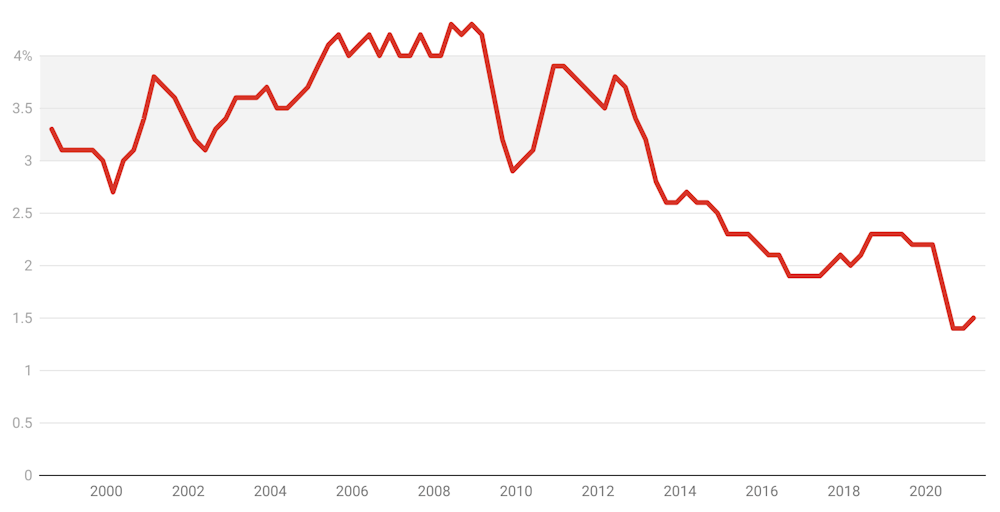
To date wage growth has been frustratingly low: at 2.3% in the year to December, well below what is needed to maintain living standards in the face of inflation, and well below what would normally be needed to make high inflation self-sustaining.

High official wage growth in the year to March could make a post-election interest rate hike all but certain, if rates haven’t already gone up ahead of the election.

Continued demonstrably weak wage growth – which is probably more likely – will officially confirm that prices are racing ahead of wages, just before polling day.

The poll-eve jobs wildcard

Which leads on to the fourth economic wildcard, to be delivered the next day, two days before polling day on Thursday May 19 – about the only piece of economic news ahead that’s likely to play well for the government.

Ultra-low interest rates and massive government stimulus, originally designed to keep people in jobs during COVID but continued beyond that, have delivered an unemployment rate that rounds to 4% but is actually a touch below it at 3.95%, the lowest since November 1974, almost 50 years ago.

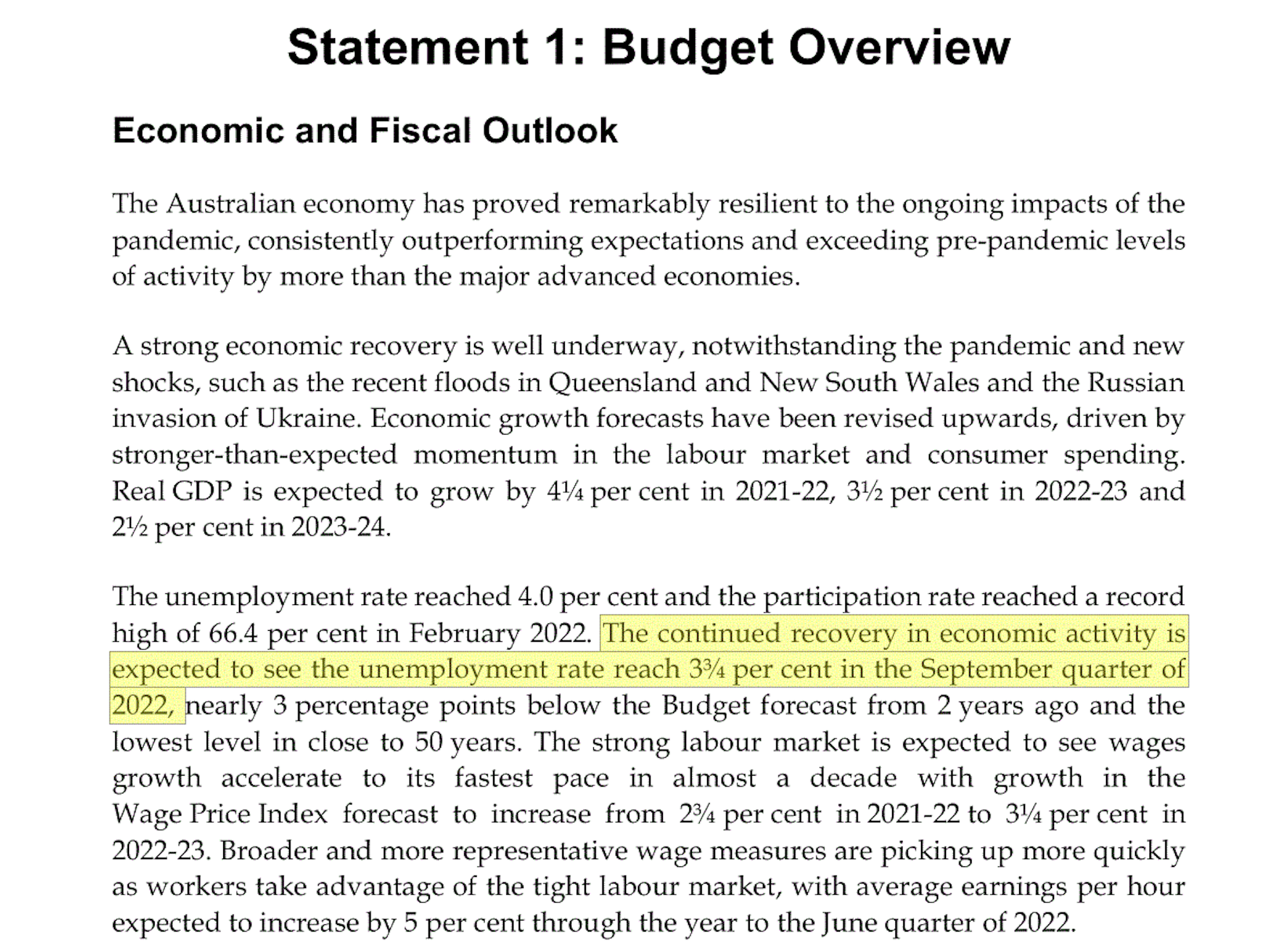
There’s every chance the April unemployment rate will be even lower, perhaps the 3.75% the treasury expects later in the year. If it is, the Coalition will deserve and will claim a lot of the credit. Labor will be left to talk about the cost of living.

Peter Martin, Visiting Fellow, Crawford School of Public Policy, Australian National University

This article is republished from The Conversation under a Creative Commons license. Read the original article.
Read more >>

Monday, November 15, 2021

Top economists see no prolonged inflation, no rate hike next year

Despite appearances – especially in the United States – the era of high inflation isn’t set for a comeback in the view of Australia’s leading economists, and most see no need for the Reserve Bank to lift interest rates next year.

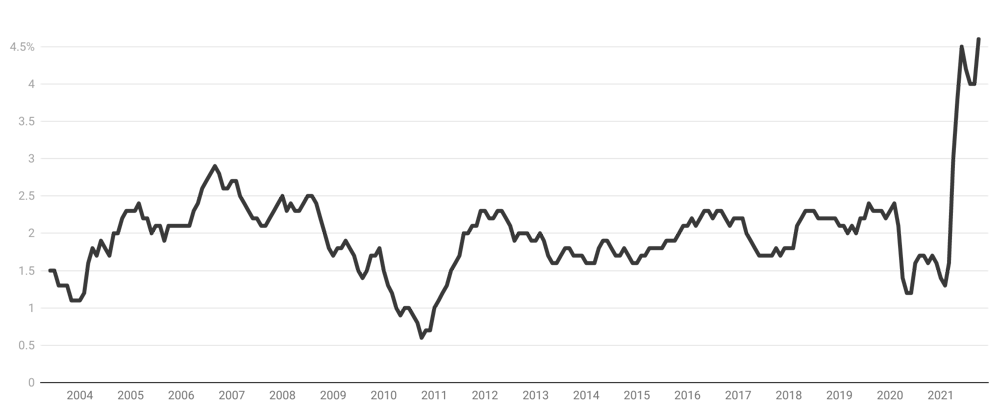
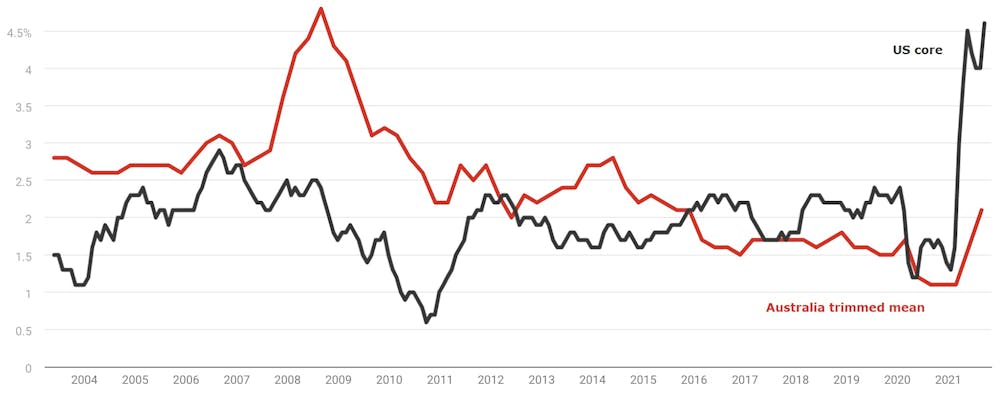
In the US, figures released last week showed the consumer price index surged 6.2% in the year to October, the most since 1990. So-called “core” inflation (which excludes volatile prices) climbed 4.6%, also the most for 30 years.


US underlying inflation

US consumer price index for all urban consumers, all items less food and energy, city average. US Bureau of Labor Statistics, St Louis Fed

Former US treasury secretary Larry Summers is talking about a jump to 11% as over-heating becomes entrenched, necessitating rate hikes in the United States, Britain and Australia.

But the 55 leading Australian economists surveyed by the Economic Society of Australia and The Conversation this week aren’t buying it. They point out that Australia’s underlying inflation rate (while climbing) is much lower, at 2.1%.


US and Australian underlying inflation

Australian Bureau of Statistics, US Bureau of Labor Statistics

Whereas in the US wages climbed 4.6% in the year to September, in Australia they climbed 1.7% in the year to June, an official figure that will be updated with readings from the September quarter on Wednesday.

32 of the 55 top economists surveyed by the Economic Society of Australia rejected the proposition that the current combination of Australian fiscal and monetary policy posed “a serious risk of prolonged above-target inflation”.

Only 12 supported it. When weighted by the confidence of respondents expressed on a scale of 1-10, backing for the proposition shrank from 22% to 20%.


Independent economists Nicki Hutley and Saul Eslake said fiscal policy (government spending) was set to tighten as COVID spending programs expired, making projected high inflation unlikely.

Harry Bloch said the prices of Australian services were predominantly determined here, by Australian wage rates, which were held back by the bargaining strength of unions and government wage setting policies.

Big inflation would require wage inflation

Matthew Butlin, until this year South Australia’s Productivity Commissioner, said prices were rising quickly in asset markets such as those for land and shares.

“The pressure simply to recover the real value of wages, let alone increase their real value, will be significant,” he said. Australia risked a wage-price spiral.

Rana Roy foresaw temporary high inflation until high energy prices and supply chain disruptions passed, but “temporary” in the sense that the hyperinflation in Germany’s Weimar Republic was temporary, lasting from 1921 to 1923.

Suppressing the higher inflation would require deliberate corrective action.

Higher rates, but not yet

Asked when the Reserve Bank would next lift its cash rate to combat inflation, most nominated 2023. Only 15 of the 52 economists who answered the question expected a hike next year, putting the majority at odds with financial market pricing which backs in several hikes during 2022.

Reserve Bank Governor Philip Lowe said earlier this month he didn’t expect to have to lift the cash rate until 2024, a proposition backed by only 10 of the 52 economists who tackled the question.


Most (33 of the 55) believed the Reserve Bank had managed the economy well during the past five years, effectively used the tools available to it to achieve its goals of maintaining the stability of the currency, ensuring full employment and furthering the “economic prosperity and welfare of the people of Australia”.

Only 15 believed the bank had managed things badly.


Fabrizio Carmignani said it could be argued the bank had kept its cash rate too low for too long and also argued that it had failed to get inflation up to its target band, two apparently contradictory positions.

Paul Frijters said that by targeting the underlying inflation rate as calculated by the Bureau of Statistics, which excludes much of housing, the bank had “cooked the books” to avoid having to increase interest rates.

John Quiggin said the bank should abandon its inflation target of 2-3% and instead target nominal GDP growth, doing whatever was needed to get the economy to grow at a nominal rate of 6-7%.

No clear case for an inquiry

The economists surveyed were divided about the need for an independent review of the Reserve Bank after next year’s election.

The Organisation for Economic Co-operation and Development and the International Monetary Fund have backed a review of the kind proposed by Labor, which would examine the bank’s mandate, board structure, and hiring and communication processes.


Asked about the idea in the survey, former Labor minister Craig Emerson said the bank had consistently undershot the 2% lower bound of its inflation target, causing unnecessarily high unemployment and low wages growth in part because it had targeted projected rather than actual inflation, and its projections had fallen short.

In October last year Governor Philip Lowe announced the bank would switch to targeting actual inflation, saying it would not be lifting its cash rate “until actual inflation is sustainably within the target range”.

Other panellists including Joaquin Vespignani argued that by targeting only measured inflation the bank had created “a bubble in the housing market which is not consistent with economic prosperity”.

More economists on the RBA board

Panellists including Ken Clements argued there was a case for appointing more board members with the economic expertise needed to challenge bank officials.

Former OECD official Adrian Blundell-Wignall argued the bank’s structure and goals were the broadly right ones. We should “not try to fix what isn’t broken”.

James Morley was concerned an independent commission of inquiry might be “highly politicised and lead to unrealistic expectations about what monetary policy can and should do”.

The Bank of Canada reviewed its performance and frameworks in cooperation with the federal government every five years, a practice that would work well in Australia.


Detailed responses:

Peter Martin, Visiting Fellow, Crawford School of Public Policy, Australian National University

This article is republished from The Conversation under a Creative Commons license. Read the original article.
Read more >>

Wednesday, November 10, 2021

2022 looks like an ideal time for a government to land re-election

At the risk of being political – and politics is important, it will determine how we are governed for the next three years – economic conditions could scarcely be better for a government seeking re-election.

The economic things that matter most to most people are, in my view:

  • jobs – if employment is climbing rather than falling, most people are not at much risk of losing their job

  • economic growth and wages growth – if things are getting better rather than worse, even in small ways, people feel better about the future

  • the ability to buy a home – if it is getting hard, even for other people or for their children, they are concerned about what the future will become

  • mortgage rates – as long as rates stay low they know their own personal budget won’t go out of whack

Other things are said to matter, but I am less than convinced; among them are the state of the federal budget (whether it is “back in the black”), tax cuts (once granted they are forgotten – Julia Gillard gave back more than the carbon tax and wasn’t thanked for it) and esoteric concepts such as government debt.

Jobs aplenty

Earlier this year, just before the eastern states went into lockdown, more of Australia’s population was employed than ever before, more hours were worked than ever before and more jobs were on offer than ever before.

Total hours worked fell during the lockdown months. But in those states without long lockdowns (those other than NSW, Victoria and the ACT) hours worked kept climbing to still-higher all-time highs. It’s an indication of what’s likely in NSW and Victoria now their lockdowns are over, something the Reserve Bank says it can already see happening in NSW.

The proportion of those working who say they’re underemployed (working fewer hours than they want) dived to an eight-year low before the mid-year lockdowns.

I haven’t mentioned the unemployment rate (officially 4.6%) because at the moment the rate can’t be taken seriously.

It is that low mainly because to be counted as unemployed you need to be actively looking for work, and many workers stood down during the lockdowns and available to work were not searching, and also because of an oddity in the way the Bureau of Statistics counts non-resident workers.

Regardless, absent any lockdowns, in practical terms it is set to be easier to keep and find a job than it has been for a long time going into an election.

Wage growth climbing

Last year’s recession brought with it a collapse in wage growth as employers froze or cut wages, something that’s now being unwound as the economy picks up, albeit, as the Reserve Bank notes with apparent disapproval, “weighed down by more muted public sector wages growth”.

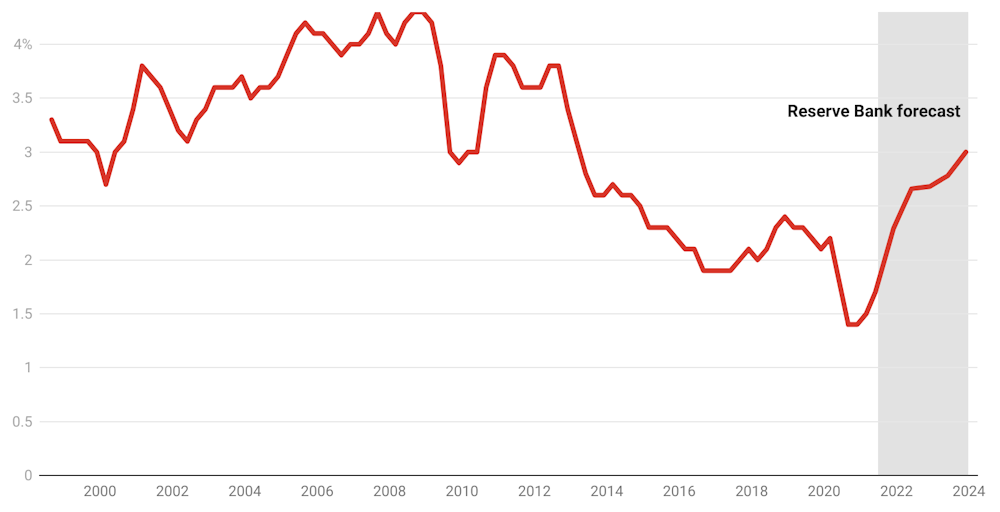
The bank’s latest forecasts, released on Friday, have wage growth climbing from 1.7% to almost 3% over the next two years, which will be the fastest growth in a decade.


Actual and forecast wages growth

Annual growth in ABS wage price index, excluding bonuses and commissions. RBA, ABS

Three per cent is still lower than the wage growth we had come to expect before it fell off a cliff with the end of the 2010s resources boom, and it’s still lower than the Reserve Bank needs to sustainably meet its inflation target.

But it holds out the prospect of an improvement at a time when private sector wages are already improving, which is what matters for the way people feel.

Forecasts have consequences

Economic growth – the catch-all measure for what’s happening in the economy – is set to climb out of the lockdown slump and accelerate throughout next year before settling back to the 2-3% that was common before the recession.

It also won’t be good enough, but it will be moving in the right direction, and accelerating strongly next May, at the time we are likely to be asked to vote.

These forecasts matter because similar ones (prepared by the Treasury instead of the Reserve Bank) will underpin the economic statement or budget released before the election and the Pre-election Economic and Fiscal Outlook released by departmental secretaries without political input during the campaign.

They will become the accepted narrative.

Easier home price growth

After soaring a frightening 21% in the past year to barely affordable highs, there’s every chance home prices will ease off. On Melbourne Cup Tuesday, the Reserve Bank withdrew its support for the near-zero three year bond rate that banks had been using to fund ultra-cheap fixed rate mortgages.

It’s no longer possible to get a three-year fixed rate mortgage for less than 2%.

A few weeks earlier the Australian Prudential Regulation Authority instructed lenders to refuse mortgages to borrowers who couldn’t withstand an increase in mortgage rates of three percentage points (such as an increase from 3% to 6%).

APRA expects the instruction to cut the maximum that can be borrowed by 5%. By election day price rises might have slowed or stopped.

And low rates for some time yet

Higher variable mortgage rates would unsettle Australians (even though many are finding it easier to make their payments than they have in years).

The good news is that on Friday the Reserve Bank nominated 2024 as the year it expects to begin to lift the record-low cash rate that sets the price of variable rate mortgages.

2024 is half a political cycle away.

Even if the first hike comes sooner (and financial markets expect it to come sooner) it won’t be imminent at the time we will be asked to vote.

All sorts of things determine election outcomes.

The economy is only one. But right now, next year’s economy is looking good.

Peter Martin, Visiting Fellow, Crawford School of Public Policy, Australian National University

This article is republished from The Conversation under a Creative Commons license. Read the original article.
Read more >>

Wednesday, August 25, 2021

The official figures say wages aren’t growing — here’s why they’re wrong

Have you heard about the latest wage figures? I hope not. They’re meaningless.

What the widely quoted measure of average weekly earnings purports to show is that wages grew a mere 0.1% over the year to May. It’s not true. It’s not what happened. For most of us, wages grew by much more.

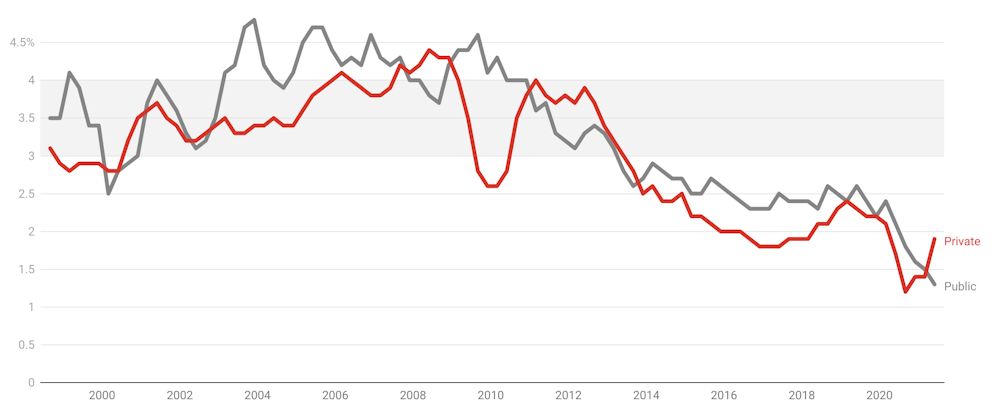
That’s not to say wage growth has been high — the best estimate is that private sector wages have climbed 1.9% over the past year and public sector wages a record low 1.3% — but both are still well above nothing, and generally well above our near-record low rates of consumer price inflation.

A check-in with reality would tell you that mid last year the Fair Work Commission lifted award wages 1.75%. Mid this year it lifted them 2.5%.

So how could it be that the official figures, published by a trusted organisation, the Australian Bureau of Statistics, show average earnings static, climbing just 0.1%?

The first thing to say is that the bureau is probably embarrassed by the figures.

They are “not designed to produce movement in earnings data” it says on its website, before acknowledging that’s exactly what they are used for.

‘Not designed’ to measure wage growth

Australia’s pensions are adjusted twice a year in accordance with a formula that includes average weekly earnings.

The figure is built into private contracts. If it wasn’t published, many contracts wouldn’t work.

To create it, the bureau surveys about 5,130 employers every six months, asks what they are paying their workers, and uses the answers to calculate an average female wage, an average male wage, an average part-time wage, an average full-time wage, and a lot of other averages besides.

The ‘average wage’ isn’t typical

One problem is that averages are not representative. The survey suggests the average full-time wage is A$90,330, whereas in reality six in ten earn less.

The mid-way (median) full-time worker earns $10,000 less. The average is boosted by a few enormously high earners and can’t be taken seriously.

An entirely separate problem arises when you try to use averages to calculate growth. The average is only an average of what’s averaged, and that can change.

When low-wage workers lose jobs…

Here’s an example. What would happen if a recession caused everyone working only four hours per week to lose two hours? It would push their earnings down and push down average weekly earnings, which would be about right.

But what if each of those people lost a further two hours, taking their hours down to zero. Their low hours would no longer be included in the total to be averaged, and (without them in it) average earnings would climb.

…the average wage goes up

That’s what happened a bit over a year ago. The bureau says COVID restrictions “led to a large decrease in the number of jobs, people employed and hours worked, with lower-paid jobs and industries particularly impacted, including jobs in accommodation and food services, arts and recreation services”.

The loss of those lower-paid and low hours jobs in catering, the arts and other industries “had the effect of increasing the value of average weekly earnings”.

Layoffs pushed the average wage up.

Fortunately, the bureau says by November many of the low-wage workers laid off got some hours back, depressing growth in the average wage (but not growth in any actual wages) resulting in recorded growth of just 0.1% in the year to May.

Many have probably since lost hours with this year’s renewed lockdowns, pushing average wages (but not actual wages) higher again.

It’s enough to make you think the legislation and contracts should switch from a measure that’s close to worthless to one that actually measures wage growth.

The bureau offers such a measure. It’s called the wage price index, and the bureau has been trying to encourage people to switch to it since 1998.


Read more: Other Australians don't earn what you think. $59,538, is typical


It is also built around a survey of employers, but rather than asking how much they pay each worker, it asks how much they pay for each job title and classification. The bureau calculates growth by comparing like with like, regardless of how many people were employed in each classification at the time.


Wage Price Index

Annual growth in total hourly rates of pay excluding bonuses, public sector and private sector. ABS

The results are believable: private sector like-for-like wages climbed 1.9% over the past year, and public sector wages 1.3%.

But even they are not right when it comes to the wage growth of individuals.

Individuals get promoted, and (much less often) demoted. They change jobs, usually for better ones.

People aren’t positions

So if you were trying to use the recent like-for-like wage growth of around 2% per year as a guide to what will happen to your own wage (in order, for instance, to work out whether you could afford a mortgage) you would probably guess too low.

It’s why many Australians — those who’ve got not only regular pay rises but also promotions — wonder what the fuss about low wage growth is about.


Read more: Top economists say cutting immigration is no way to boost wages


A good measure of the actual wage growth of Australians doesn’t yet exist, although it might soon. The bureau is working on tracking individuals through the use of payroll data reported to the tax office.

In the meantime the (HILDA) Household, Income and Labour Dynamics in Australia survey that tracks 17,000 Australians over time finds that the actual wage growth of full-time workers is indeed higher than the like-for-like figure suggests (which might help explain soaring home prices) although it too is weakening.

Part time workers don’t seem to get the same benefit.

As Mark Wooden, director of the HILDA survey puts it, “Australians in full-time work are doing pretty well – provided they remain in employment”.The Conversation

Peter Martin, Visiting Fellow, Crawford School of Public Policy, Australian National University

This article is republished from The Conversation under a Creative Commons license. Read the original article.
Read more >>

Monday, August 02, 2021

Top economists say cutting immigration is no way to boost wages

Australia’s top economists have overwhelmingly rejected cuts to either permanent or temporary migration as a means of restoring lost wage growth.

The 56 leading economists polled by the Economic Society and The Conversation include a former head of the Fair Pay Commission and a former expert member of the Fair Work Commission’s minimum wage panel.

Among the experts, selected by their peers, are specialists in economic modelling and the economics of labour markets from both the private and public sectors.

All but five rejected cuts in temporary migration as a means of boosting wage growth. All but three rejected cuts in permanent migration.

The results put the economists at odds with Reserve Bank Governor Philip Lowe, who last month drew a link between temporary migration and weak wage growth saying employers had been using overseas hires to fill gaps that would have been filled by locals, diluting “upward pressure on wages in these hotspots”. He said this might have spilled over to rest of the labour market.

Cutting temporary and cutting permanent migration were the first two of ten options for boosting wage growth presented to the panel of economists. The panel rated them third last and second last. Only “holding back growth in female and older worker participation” was marked down more.

Each economist was asked to pick three of the ten options. The most popular, picked by 78.2%, was measures to boost productivity growth. The next most popular, picked by 50.9%, was measures to boost business investment.


Michael Keane of The University of NSW said the idea that population growth and increased labour supply were constraining wage growth was “so naive as to not really be worthy of comment”.

Consultant Rana Roy said only a “cultivated amnesia” could ignore the near-uninterrupted growth in real wages in US, industrialised Europe and Australia amid record inbound immigration in the decades after the second world war.

Gabriela D'Souza of the Committee for Economic Development of Australia said the idea owed much to a “one dimensional view of the world” that took account of only the direct impact of immigrants on particular wages and not the impact of their demand for goods and services on a broader range of wages.

Dozens of studies had identified the overall impact as “near zero”.

Productivity ‘almost everything’

Robert Breunig of the Australian National University said immigrants appeared to add to productivity rather than detract from it, meaning slowing down immigration could slow down rather than add to productivity and growth.

Three quarters of the panel nominated productivity growth as the most important precondition for higher wages growth, endorsing the conclusion of Nobel Prize winning economist Paul Krugman that “productivity isn’t everything, but in the long run it is almost everything.”

Krugman famously added that a country’s ability to improve its standard of living over time depended “almost entirely on its ability to raise its output per worker”.


Wages growth is way below the Reserve Bank’s +3% target

Total hourly rates of pay excluding bonuses, seasonally adjusted. Change from corresponding quarter of previous year. ABS Wage Price Index

Ian Harper, a former head of the Howard government’s Fair Pay Commission and a current member of the Reserve Bank board, said that without productivity growth, any boost in wages growth that was delivered was likely to be nominal — matched by inflation — rather than real, delivering higher living standards.

One of the best tools for lifting production per worker was business investment.

One of the five economists who thought immigration hurt wages growth, Macquarie University’s Geoffrey Kingston, said it seemed to do it by thinning investment per worker. In the 1980s, under Prime Minister Bob Hawke, increased immigration helped push down real wages for five years in a row.

Several of those surveyed said wage growth needed investment in more than machines. Griffith University’s Fabrizio Carmignani said what also mattered was investment in “human capital” via education and research and development.


Read more: Exclusive. Top economists back unemployment rate beginning with '4'


Adrian Blundell-Wignall, a former division chief at the Organisation for Economic Co-operation and Development, said reforming the education system and getting rid of elitism had to be part of the plan.

“That the best predictor of how well you do at school is how rich your parents are and where they went to school is a national tragedy,” he said. “The entitlement and club economy that comes with this permeates politics, business, and who gets the best jobs after completing school.”

Former Rudd and Gillard government minister Craig Emerson said while measures to boost productivity growth were essential, even if implemented soon, they would take years to flow through into higher wages.

It’s how you divide the pie

Saul Eslake said whether or not higher productivity growth actually delivered higher real wages would depend on the division of the fruits of that growth between wages and profits.

John Quiggin said nearly every reform of Australia’s industrial relations system since 1975 had acted to reduce the bargaining power of unions. All ought to be reviewed with a “presumption in favour of repeal”.

Mala Raghavan of the University of Tasmania said wage growth had become uneven. Wages for a small number of managers had soared while wages for others — especially casual workers — had barely moved.


Read more: Top economists want JobSeeker boosted $100+ per week, tied to wages


The Australian National University’s Emily Lancsar saw a triple benefit from reforming the industrial relations system to support higher wage decisions: it would increase wages directly, it would put money that would have been paid out as profits in the hands of people likely to spend it, and the increases would flow through to workers not directly affected by the decisions.

Labour market specialist Jeff Borland added that there was a case for strengthening the ability of unions to obtain gender pay equity in female-dominated occupations.

None of those surveyed were optimistic about the prospect of quickly lifting wages growth. The Reserve Bank said in July it wasn’t planning to lift interest rates until aggregate growth exceeded 3%.


Detailed responses:

Peter Martin, Visiting Fellow, Crawford School of Public Policy, Australian National University

This article is republished from The Conversation under a Creative Commons license. Read the original article.

Read more >>

Monday, June 08, 2020

Economists back wage freeze 21-19 in new Economic Society-Conversation survey

Australian economists narrowly back a wage freeze in the minimum wage case now before the Fair Work Commission, a freeze that could flow through to millions of Australians on awards and affect the wages of millions more through the enterprise bargaining process.

The annual case is in its final stages after having begun before the coronavirus crisis and been extended to take account of its implications.

In its submission, the Australian government called for a “cautious approach”, prioritising the need to keep Australians in jobs and maintain the viability of businesses.

The minimum wage was last frozen in 2009 amid concern about unemployment during the global financial crisis.


Read more: Economists back social distancing 34-9 in new Economic Society-Conversation survey


The Economic Society of Australia and The Conversation polled 42 of Australia’s leading economists in the fields of microeconomics, macroeconomics, economic modelling and public policy.

Among them were former and current government advisers, a former and current member of the Reserve Bank board, and a former head of the Australian Fair Pay Commission.

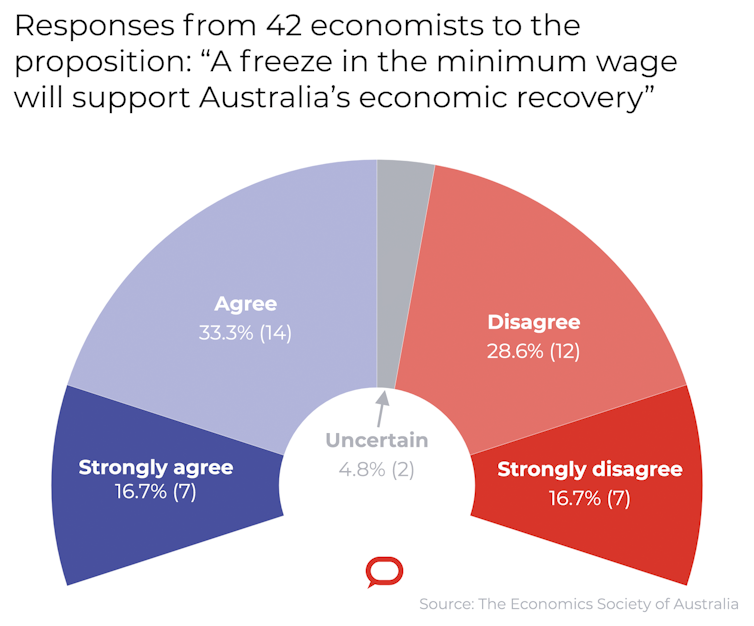
Each was asked whether they agreed, disagreed, or strongly agreed or strongly disagreed with this proposition:

A freeze in the minimum wage will support Australia’s economic recovery

Each was asked to rate the confidence they had in their opinion, and to provide reasons, which are published in full in The Conversation.

Half of those surveyed – 21 out of 42 – backed the proposition, seven of them “strongly”.

Nineteen disagreed, seven strongly. Two were undecided.

The Conversation, CC BY-ND

The minimum adult wage is A$19.49 per hour.

There was agreement among most of those surveyed that, in normal times, normal increases in the minimum wage have little impact on employment – a view backed by Australian and international research.

But several of those surveyed pointed out that these are not normal times.

Bad times for employers…

Gigi Foster said many businesses were operating closer to the margin of profitability than ever before, and were likely to stay that way for many months.

Rana Roy quoted one the pioneers of modern economics, Joan Robinson, as observing in 1962 that the misery of being exploited by capitalists was “nothing compared to the misery of not being exploited at all”.

John Freebairn argued that a freeze of labour costs, together with very low expected inflation, could provide a key element of certainty in the uncertain world facing households, businesses and governments.

Robert Breunig and Tony Makin suggested that with prices stable or possibly falling, a freeze in the minimum wage might cost workers little or nothing in terms of purchasing power.

Guay Lim and several others said if the government wanted the economic stimulus that would come from an increase in the minimum wage, it had other ways of bringing it about without making conditions more difficult for employers.

…and bad times for workers

Those supporting an increase saw it as a way to bolster consumer confidence and redress unusually weak worker bargaining power.

Wage growth before the coronavirus hit was historically low at close to 2%, an outcome so weak for so long that in 2018 and 2019 the Commission awarded much bigger increases in the minimum wage, arguing employers could afford them.

James Morley was concerned that a freeze in the minimum wage would “mostly just lock in” inflation expectations that were already too low.

Peter Abelson said labour productivity rose with respect for workers and fell with disrespect. A wage freeze would disrespect workers.

Saul Eslake proposed a middle way, deferring a decision rather than granting no increase. He said the increase that was eventually granted should do no more than keep pace with inflation.


Read more: Why the coronavirus shouldn't stand in the way of the next wage increase


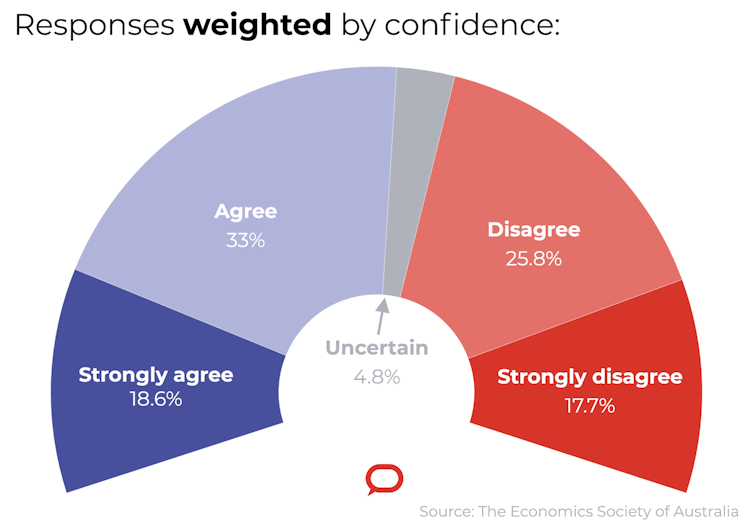
The economists were asked to rate their confidence in their responses on a scale of 1 to 10.

Unweighted for confidence, 45.3% of those surveyed opposed a wage freeze. When weighted for (relatively weak) confidence, opposition fell to 43.5%.

The Conversation, CC BY-ND

Unweighted for confidence, half of those surveyed supported the proposition that a freeze in the minimum wage would assist Australia’s economic recovery.

Weighted for confidence, support grew to 51.6%

The Fair Work Commission is required to complete its review by the end of this month.


Individual responses

The Conversation

Peter Martin, Visiting Fellow, Crawford School of Public Policy, Australian National University

This article is republished from The Conversation under a Creative Commons license. Read the original article.

Read more >>