Showing posts with label immigration. Show all posts

Monday, August 29, 2022

Is education or immigration the answer to our skills shortage? We asked 50 economists

Wes Mountain/The ConversationCC BY-ND
Investing in Australians’ education is far more important than immigration in resolving the nation’s skills shortages, according to leading economists surveyed in the lead-up to this week’s jobs and skills summit.

The 50 top Australian economists polled by the Economic Society of Australia and The Conversation are recognised by their peers as leaders in their fields, including economic modelling, labour markets and public policy.

Asked to select from a list of topics to be discussed at the summit, and which offered the most promise of delivering better outcomes, two-thirds picked “education and skills”. Only one-third picked “migration policy”.



The biggest concerns among those who picked “education and skills” relate to school and vocational education.

The Australian National University’s Bruce Chapman, who designed Australia’s higher education loans scheme (HECS) in the late 1980s, described funding for vocational education as a “mess”.

Vocational training is a “mess”

“There are up-front fees alongside no-charge regimes, both of which are poor and inequitable,” Chapman said. “A small number of courses offer income-contingent loans along the lines of the university scheme, but most do not.”

Universities have income-contingent loans that don’t require payments until the recipient’s income climbs above A$48,361.

If applied to all vocational education courses (including TAFE courses), it would allow reasonable charges and protect students from hardships and default.

“Governments should have been aware of this for the 34 years that HECS has existed, but have shown no leadership in the area,” Chapman said.

High school outcomes remain poor

Saul Eslake said all levels of Australian education – from primary school, up to vocational education and universities – are “failing to equip Australians with the skills required for the jobs of both today and the future”.

Among the many causes of that failure were inequities in how education funding is distributed, which have led to sustained gaps between Australia’s high and low socio-economic students’ results.

Paul Frijters suggested levelling the playing field between private and public schools by ditching subsidies to private schools, banning mobile phones in schools, and allowing children with low grades to repeat years instead of setting standards so low they were generally promoted.

Almost half of those surveyed wanted measures to promote productivity. Julie Toth, formerly with the Australian Industry Group and now with the digital property settlement company PEXA, suggested shifting governments’ focus away from “creating local jobs” to automating tasks wherever possible.

“We should be aiming to reduce the need for lower-skill and lower-value tasks and jobs, rather than simply seeking more bodies to do them,” she said.

Full working rights for refugees

Of those who nominated “migration policy” as a priority, two warned against using more migration to fix skills shortages. Labour market economist Sue Richardson said she knew of no evidence that migration increased either productivity or the living standards of pre-existing Australians.

“It does increase aggregate gross domestic product,” she said. “But that is just because the population is bigger”. It enabled Australia to avoid a close examination of why it did not generate the skills it needed itself.

Margaret Nowak of Curtin University pointed to the absurdity of not giving refugees and those awaiting determination an unfettered right to work. She said it would be an “easy early win”.

“We already have in this country a ready and willing supply of labour,” Nowak said. “We should get rid of the paranoia and ideology inherent in the current administration of the policy and welcome our resident refugees into full participation and education rights.”

Many economists also nominated workforce participation, care jobs and equal pay for women as key priorities for the summit.

Calibrating care

Several, including RMIT University’s Leonora Risse, called for more accurate measurement of the benefits generated by the care sector, “in the same way as we compute the cost/benefit dividend of government investments in other infrastructure”.

Risse said a proper measure of the economy-wide value of the care sector could be factored into the budget, and used to provide a mechanism to lift the wages and status of care workers.

Macquarie University’s Lisa Magnani said the pandemic had shown Australia has a crisis of care work “manifested in the shortage of teachers, in overworked hospital workers, in exhausted parents”. Traditional measures of labour productivity failed to capture the impact of care jobs on wellbeing, as well as their economic value.

Alison Preston of The University of Western Australia said health care and social assistance had become Australia’s biggest employing industry, eclipsing retail and construction.

Specific measures to assist the health care and social assistance sector’s 76% female workforce included extending parental leave, minimising the need to hold multiple jobs, and setting and monitoring employment standards.

One of the 50 surveyed economists nominated a summit priority that was not on the proffered list. John Quiggin of the University of Queensland nominated “full employment”, which he thought had been the original idea for the summit.

Regardless of the present state of the labour market it was important to renew to full employment in the 1945 Employment White Paper, and to consider measures along the lines of the proposed Green New Deal in the United States.


Detailed responses:


This article is republished from The Conversation under a Creative Commons license. Read the original article.

Read more >>

Monday, February 21, 2022

Lets open up big: economists say we need more migrants

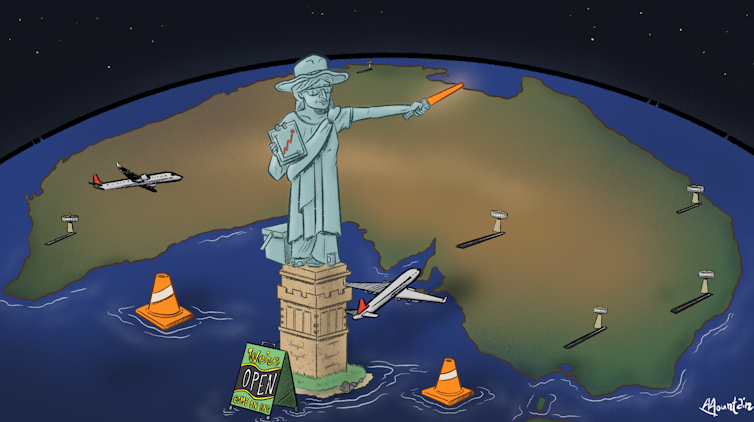
Wes Mountain/The Conversation, CC BY-ND

Australia’s leading economists have overwhelmingly endorsed a return to the highest immigration intake on record, saying Australia should aim for at least 190,000 migrants per year as it opens its borders, up from the target of 160,000 per year set ahead of COVID.

More than a third of those surveyed believe 190,000 isn’t enough, arguing that a “catch up” will show Australia is open to the world.


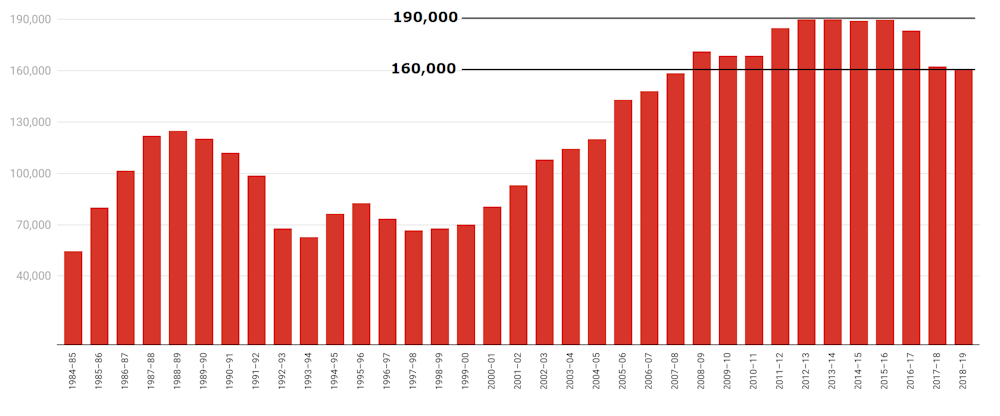
Prime Minister Scott Morrison cut Australia’s migration ceiling from 190,000 to 160,000 places per year in March 2019, in order to “tackle the impact of increasing population in congested cities”.

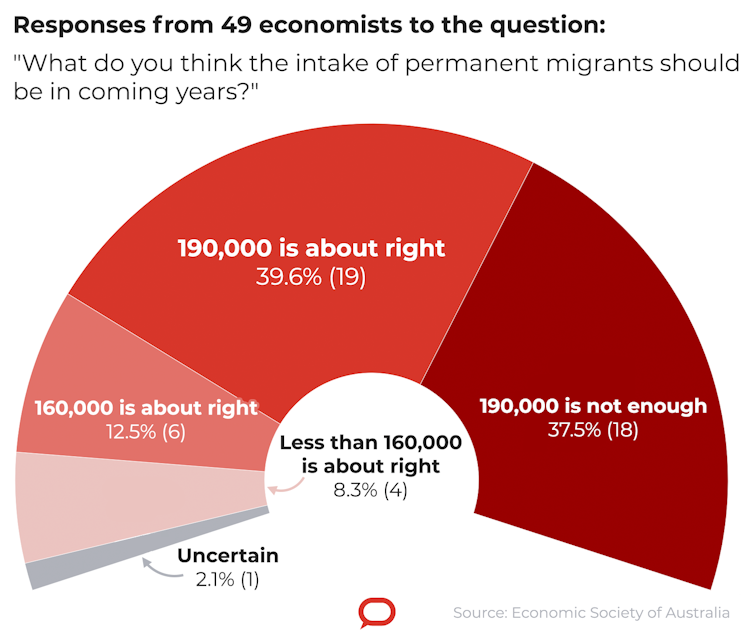
The 49 economists who took part in the Economics Society of Australia poll were selected by their peers for their expertise in macroeconomics, microeconomics and economic modelling. One is a member of the Reserve Bank board.

Ahead of COVID, Australia’s permanent intake has only been as high as 190,000 on five occasions, during the five years 190,000 was the official target.


Annual migrant intake in the years leading up to COVID

Parliamentary Library 2021

The government’s intergenerational report released mid last year assumed a return to an intake of 190,000 per year in 2023-24.

Only four of the 49 economists surveyed by The Economic Society and The Conversation wanted less migration than Australia had going into COVID.

Their concerns were that growing population numbers put pressure on “fragile resources and infrastructure”. Slower population growth would “ease pressures on the environment, housing prices, infrastructure and emissions”.

Adelaide University labour market specialist Sue Richardson said there was no evidence high levels of migration raised GDP per person, as opposed to GDP.

Congestion and the environment matter

“In terms of living standards, it is the per capita measure that matters,” she said. “And it should be adjusted for increased traffic congestion, urban density and pressures on the health and other important social systems.”

The six economists who thought an annual intake of 160,000 was about right made the point that what mattered more was the composition of the intake. There should be less unskilled migration, more skilled migration and a “decent humanitarian program”.

The 19 economists who went for 190,000 argued less would show a “lack of ambition” for lifting economic growth.

Helen Silver, chief general manager at Allianz Australia and a former head of Victoria’s Department of Premier and Cabinet said a higher target would be both a “catch up” and would act to symbolise Australia was more open to the world.

Australia benefits from being open

Any target would need to be flexible and responsive to the capacity of Australia’s heath and other systems given the ongoing pandemic.

Melbourne University economist John Freebairn said a larger population would enable Australia to capture economies of scale and fill gaps in high skill and low skill jobs caused by labour market rigidities and failures in training systems.

It would increase the government’s tax take net of spending and help build a more dynamic and interesting society, as it had in the past.

The 18 economists (37.5% of the total) who said 190,000 was not enough argued that Australia’s status as a nation of immigrants gave it a formidable advantage.

190,000 could be considered a floor

UNSW economist Gigi Foster said in the wake of Australia’s responses to COVID its challenge was not so much what target to set, but rather how to convince immigrants to come here.

Melbourne University ‘s Chris Edmond said if Australia had the same per capita target as Canada it would have a permanent intake of 250,000 per year.

The University of Sydney’s James Morely said 190,000 was less than 1% of the population and was in any event not a target for net migration as that would be determined by the number of Australians who left and returned, and the number who came in temporarily under other schemes.

Given low birth rates and a need for a balanced age profile Australia should probably target permanent visas of 320,000 - 1.25% of the current population.

RMIT’s Leonora Risse said what mattered was that the migration intake was accompanied by policies designed to ensure migrants reached their potential.

When considering an upper limit on migration, we should keep in mind that 30% of all Australians were born overseas. For 20% of Australians, one or both parents were born overseas. Australia would not be what it was were it not for migration.

Notably absent from most of the 49 responses was discussion of the impact of migration on wages and the employment of locals.

The experts surveyed seemed to regard these impacts as not particularly big in either direction compared to the impacts of migration on dynamism, Australia’s place in the world, and its environment, infrastructure and social cohesion.


Detailed responses:

Peter Martin, Visiting Fellow, Crawford School of Public Policy, Australian National University

This article is republished from The Conversation under a Creative Commons license. Read the original article.
Read more >>

Monday, August 02, 2021

Top economists say cutting immigration is no way to boost wages

Australia’s top economists have overwhelmingly rejected cuts to either permanent or temporary migration as a means of restoring lost wage growth.

The 56 leading economists polled by the Economic Society and The Conversation include a former head of the Fair Pay Commission and a former expert member of the Fair Work Commission’s minimum wage panel.

Among the experts, selected by their peers, are specialists in economic modelling and the economics of labour markets from both the private and public sectors.

All but five rejected cuts in temporary migration as a means of boosting wage growth. All but three rejected cuts in permanent migration.

The results put the economists at odds with Reserve Bank Governor Philip Lowe, who last month drew a link between temporary migration and weak wage growth saying employers had been using overseas hires to fill gaps that would have been filled by locals, diluting “upward pressure on wages in these hotspots”. He said this might have spilled over to rest of the labour market.

Cutting temporary and cutting permanent migration were the first two of ten options for boosting wage growth presented to the panel of economists. The panel rated them third last and second last. Only “holding back growth in female and older worker participation” was marked down more.

Each economist was asked to pick three of the ten options. The most popular, picked by 78.2%, was measures to boost productivity growth. The next most popular, picked by 50.9%, was measures to boost business investment.


Michael Keane of The University of NSW said the idea that population growth and increased labour supply were constraining wage growth was “so naive as to not really be worthy of comment”.

Consultant Rana Roy said only a “cultivated amnesia” could ignore the near-uninterrupted growth in real wages in US, industrialised Europe and Australia amid record inbound immigration in the decades after the second world war.

Gabriela D'Souza of the Committee for Economic Development of Australia said the idea owed much to a “one dimensional view of the world” that took account of only the direct impact of immigrants on particular wages and not the impact of their demand for goods and services on a broader range of wages.

Dozens of studies had identified the overall impact as “near zero”.

Productivity ‘almost everything’

Robert Breunig of the Australian National University said immigrants appeared to add to productivity rather than detract from it, meaning slowing down immigration could slow down rather than add to productivity and growth.

Three quarters of the panel nominated productivity growth as the most important precondition for higher wages growth, endorsing the conclusion of Nobel Prize winning economist Paul Krugman that “productivity isn’t everything, but in the long run it is almost everything.”

Krugman famously added that a country’s ability to improve its standard of living over time depended “almost entirely on its ability to raise its output per worker”.


Wages growth is way below the Reserve Bank’s +3% target

Total hourly rates of pay excluding bonuses, seasonally adjusted. Change from corresponding quarter of previous year. ABS Wage Price Index

Ian Harper, a former head of the Howard government’s Fair Pay Commission and a current member of the Reserve Bank board, said that without productivity growth, any boost in wages growth that was delivered was likely to be nominal — matched by inflation — rather than real, delivering higher living standards.

One of the best tools for lifting production per worker was business investment.

One of the five economists who thought immigration hurt wages growth, Macquarie University’s Geoffrey Kingston, said it seemed to do it by thinning investment per worker. In the 1980s, under Prime Minister Bob Hawke, increased immigration helped push down real wages for five years in a row.

Several of those surveyed said wage growth needed investment in more than machines. Griffith University’s Fabrizio Carmignani said what also mattered was investment in “human capital” via education and research and development.


Read more: Exclusive. Top economists back unemployment rate beginning with '4'


Adrian Blundell-Wignall, a former division chief at the Organisation for Economic Co-operation and Development, said reforming the education system and getting rid of elitism had to be part of the plan.

“That the best predictor of how well you do at school is how rich your parents are and where they went to school is a national tragedy,” he said. “The entitlement and club economy that comes with this permeates politics, business, and who gets the best jobs after completing school.”

Former Rudd and Gillard government minister Craig Emerson said while measures to boost productivity growth were essential, even if implemented soon, they would take years to flow through into higher wages.

It’s how you divide the pie

Saul Eslake said whether or not higher productivity growth actually delivered higher real wages would depend on the division of the fruits of that growth between wages and profits.

John Quiggin said nearly every reform of Australia’s industrial relations system since 1975 had acted to reduce the bargaining power of unions. All ought to be reviewed with a “presumption in favour of repeal”.

Mala Raghavan of the University of Tasmania said wage growth had become uneven. Wages for a small number of managers had soared while wages for others — especially casual workers — had barely moved.


Read more: Top economists want JobSeeker boosted $100+ per week, tied to wages


The Australian National University’s Emily Lancsar saw a triple benefit from reforming the industrial relations system to support higher wage decisions: it would increase wages directly, it would put money that would have been paid out as profits in the hands of people likely to spend it, and the increases would flow through to workers not directly affected by the decisions.

Labour market specialist Jeff Borland added that there was a case for strengthening the ability of unions to obtain gender pay equity in female-dominated occupations.

None of those surveyed were optimistic about the prospect of quickly lifting wages growth. The Reserve Bank said in July it wasn’t planning to lift interest rates until aggregate growth exceeded 3%.


Detailed responses:

Peter Martin, Visiting Fellow, Crawford School of Public Policy, Australian National University

This article is republished from The Conversation under a Creative Commons license. Read the original article.
Read more >>

Thursday, March 15, 2018

There's a case for immigration, and it's not about us

It’s great that we are talking about immigration. But could we talk about immigrants as well?

I’ve never met one who wasn’t delighted to have made it here.

To conduct the debate as the ABC did on both Four Corners and Q&A on Monday night, as if it was only about us, leaves out half the picture.

People come here to get a better life, and they generally do. Those who don’t, leave.

If we can lift the living standard of people who would like to come here, without much harming (or even while enriching) our own, why shouldn’t we?

Here’s a quick run-through of some of the things that have been said about the harm immigration is supposed to have done to our prosperous country.

Tony Abbott says it has held down wages. Indeed, “It is a basic law of economics that increasing the supply of labour depresses wages.”

It would have held down wages, had it not lifted the demand for labour at the same time, which is what happens when the population grows.

To see that this is true, imagine an Australia with only half its present population. Would wages be much different? Or imagine an Australia with the population it has now, but cut in two along a line separating Victoria, South Australia, Western Australia and Tasmania from NSW, Queensland and the Northern Territory. Each half would have roughly half Australia’s present population, but would its wages change much?

The Productivity Commission examined every piece of international evidence it could and found only “small (either positive or negative) effects”. Its own Australian modelling found only a “negligible” impact overall, but allowed for the possibility that immigration would make some workers worse off and some better off.

In the United States, leading immigration economist George Borjas has found persuasive evidence that it’s the least skilled who have been made the worst off and the most skilled the best off. But when Australian National University economists Robert Breunig, Nathan Deutscher and Hang Thi To set out to replicate his work in Australia they found no such thing. Which isn’t surprising. The US immigration program is skewed towards low-skilled arrivals, while the Australian program is skewed towards the high end.

They examined 40 different skill groups and found “no evidence” that immigration damaged the labour market outcomes of pre-existing Australians.

“If anything, there is some evidence for small positive associations,” they wrote.

It shouldn’t be surprising. Migrants bring with them, or make, money, which they use to buy houses, start businesses and educate their children. They employ people.

What if we don’t want all that activity? What if we want a more peaceful life with fewer traffic jams and shorter commutes?

It’s a future we would be denying would-be migrants, who often come from places far more crowded than Australia. That there are places worse than Australia suggests that Australia isn’t yet populated enough compared with the rest of the world. Anyone who gets out of our cities and looks at our coastline will have to agree.

The "problem" is that immigrants want to settle in cities, and who could blame them? (Although it must be acknowledged that many settled in Western Australia during the mining boom at a time when existing Australians would not). They make our existing cities bigger rather than help us create new ones.

Building a new city is hard. Australia has only successfully done it once, in Canberra. But the second-best options aren’t bad.

This month’s Grattan Institute report says it wouldn't be that hard to build all of the extra homes we will need within our existing cities, so long as we get used to the idea of living closer together. It would bring us benefits. Berlin, Rome and Toronto are each more densely populated than Sydney and Melbourne, and easier to get around. Dense populations can make proper public transport worthwhile.

Sydney is leading the way, creating dense corridors along major roads, while leaving the suburbs surrounded by those corridors untouched. Canberra is doing it by stealth. Each ACT suburb has within it randomly distributed "Mr Fluffy" houses, contaminated by loose asbestos. The ACT government has bought each one, demolished it and resold the site on the condition that it can be used for multiple dwellings, whatever the zoning. Every suburb, leafy or not, will get used to denser living. When the existing residents sell, they too will want the right to have their blocks divided.

We’ve a right not to choose this future - one where, with good planning, there’s a chance our cities will work. We’ve a right not to be confident enough in our governments to do it. But only up to a point. The rest of the world has granted us a licence to use this continent on the implicit understanding that we populate it.

Most of the people we are populating it with are like us. They are us. One in every four of us is a migrant. Almost one in every two lives in a migrant family. We already allow New Zealanders free access. The biggest gyrations in our population result not from the actions of others but from locals either changing how they return home or leave. There’s no longer an us and them.

In The Age and Sydney Morning Herald
Read more >>

Thursday, July 27, 2017

Foreign is what Australia is

Australia is overwhelmingly foreign. Half of us were either born overseas or have an overseas-born parent. Many, many more (like the Coalition's unfortunate Matt Canavan) have at least one overseas-born grandparent.

A section of the Constitution that prevents an Australian being elected to the Australian Parliament because they happen to also be a "citizen of a foreign power" makes no sense given the number of forgotten foreign passports lying unused in sock drawers.

It ought to be enough that you've been declared Australian, made to pay Australian taxes and forced to vote.

It made just as little sense back when the Constitution was being drafted in the 1890s. Back then, as now, around a third of the population was born overseas. But in those days most were born in Britain which wasn't counted as a foreign power. Since a High Court decision in 1998, it has been.

We're a blended mob. And we are continually reblending in new and enchanting ways.

If you marry, there's a one-in-three chance that (like me) you'll marry someone born overseas. If you were born in Australia of two Australian-born parents there's a one-in-three chance that (like me) your children won't be. And they'll look delightful.

Yet, by quite a huge margin, we dislike immigration.

An Essential survey finds 59 per cent of us think there's been too much immigration. And it isn't a result driven by locally-born Australians. Among migrants the proportion is 60 per cent.

Central to these concerns are crowded cities, and jobs.

Inside Story's Tim Colebatch finds that between 2008 and 2016 Australia's labour market created an extra 474,000 full-time jobs. But only 74,000 went to people born in Australia. The bulk (400,000) went to migrants. Around 364,000 went to migrants who had arrived here since 2001.

You'd be forgiven for thinking these migrants had elbowed longer-term locals to get the extra jobs, and you would be right. But that's only part of the story; the part we can see. The part we can't see is where those extra jobs came from.

Most came from migration.

Calculations unveiled by Professor Peter McDonald at last week's Melbourne Institute economic outlook conference suggest that, without migration, total employment would have grown by just 126,000 between 2011 and 2016. With migration, it grew 739,000.

Migrants create jobs because they spend (often spending more than they earn at first if they brought money with them) and borrow to buy houses.

Bob Gregory from the Australian National University says they boost the demand for workers as well as the supply.

"There is no sense in assuming, as many people do, that they add only to supply," he says. "There is no sense in assuming that if you removed the migrant, the job would stay and go to a local."

It's easy to see, if you imagine excising half of Australia. Half of the people competing for jobs would go, but so too would roughly half the jobs. It might be slightly more than half of the jobs that go, it might be slightly less, but the number of jobs per job seeker would change little.

Gregory thinks it would change for the worse. Australia's highly selective program brings in migrants with money to spare (as well as temporary workers such as backpackers and students who do the jobs many of us won't). The skilled workers lift the skills profile of the entire workforce, boosting productivity and wages, which itself creates the demand for more workers.

Even the partners of skilled migrants are more skilled than the rest of us. A conference paper by Melbourne University economist Barbara Broadway revealed that 55 per cent of the female partners of skilled migrants have university degrees, compared to 30 per cent of women already here.

If it's true that migrants on balance help the labour market, and a study just published in Economic Record reaches similar conclusions, we should be importing more of them when we want to boost someone's chance of getting a job, and importing fewer when the jobs market is hot, rather than the other way around.

The idea that migrants boost rather than hurt the economy shouldn't be surprising. Opponents of high immigration often complain about the extra cars on the road and the extra houses and schools and teachers that are needed and the extra freeways and transport links that will have to be built to cope.

These complaints are inconsistent with those about migrants taking jobs.

And migrants are Australian. We used to think of Scott Ludlam as an Australian before we discovered that he was born to the south-east; we used to think of Larissa Waters as Australian before she discovered she was born to the north-west. We almost always thought of Julia Gillard and Tony Abbott as Australian (the accents!) even though both were born in Britain.

We're all of us a bit foreign, apart from the few First Australians whose families have avoided intermarriage. There's room for debate about the size of Australia's population, but not room for debate about whether we are Australian.

In The Age and Sydney Morning Herald
Read more >>

Wednesday, January 25, 2017

Turnbull's fearful, pessimistic vision for Australia

Malcolm Turnbull and Donald Trump might be at loggerheads over the Trans-Pacific Partnership, but in other respects they're in sync.

Trump's inaugural address focused on what he was against: elites, Islamic terrorism, crime and gangs.

Turnbull's remarkably dark new year message was about economic challenges, international conflict and "Islamist terrorists". It was about fighting things rather than doing things.

We expect it of Trump. He seems to need to be against things. But Turnbull promised something grander.

Tackling Tony Abbott for the leadership in 2015 he acknowledged challenges, but spoke of "enormous opportunities".

"We need a style of leadership that explains those challenges and and how to seize the opportunities," he said at the time. "Our values of free enterprise, of individual initiative, of freedom; this is what you need to be a successful, agile economy.

"What we have not succeeded in doing is translating those values into the policies and the ideas that will excite the Australian people and encourage them to believe and understand that we have a vision for their future."

The people who were most excited by that promise have been disappointed ever since.

At its best the Turnbull government has been about administration, at its worst its been about opposing things: Labor, the unions, external threats and the previous government.

In welcoming the 16,000 people who will become Australians on Thursday his Immigration Minister, Peter Dutton, made only a perfunctory reference to the good they would do and spoke instead of "unprecedented security threats from terrorists, extremists and criminals who seek to exploit migration pathways to citizenship for their own ends".

"The lesson of terrorism here and in Europe is that we must prevent foreign extremists from arriving in the first place, and remove them once detected."

As a vision for the future, it was fearful.

Turnbull's Human Services Minister speaks rarely about services but often about fraud. His Trade Minister talks about Labor almost as often as he does about trade. His Energy Minister is as likely to score political points as he is to talk about energy. His Attorney-General spent much of last year feuding with the Solicitor-General while his Deputy Prime Minister was moving a division of his department into his electorate.

It's anything but a vision, but I don't think it's entirely Turnbull's fault.

Whether he realises it or not, Turnbull (like Trump) might be in tune with the times.

Australia was indeed bold and optimistic when he was growing up. In 1966, the year decimal currency was introduced, half the population was aged under 30. Only 7 per cent were 65 or older.

Today it's double that: 15 per cent are 65 and older. Seven per cent are 75 and older.

As we get older we usually become less adventurous, more fearful and more inward looking. There's every reason to believe it's the same with populations.

The $2, $5, $10 and $20 notes introduced with decimalisation were vibrant – in your face greens, blues, lilacs and pinks.

When they were replaced with plastic notes a generation later in 1992 the new designs were more muted, the colours more pastel.

In the next upgrade to incorporate new security features another generation later in 2016 the designs changed little. Queen Elizabeth lives on the new $5 note, perhaps because removing her would be controversial.

By 2060 when almost a quarter of the population, and almost half the voting age population, will be 65 and over the designs are likely to be more muted still.

We are already becoming more timid and inward looking. Parliament House is now patrolled by police with machine guns. A 2.6 metre fence is about to go up on top of it to keep terrorists away from the lawns.

Radio Australia is about to turn off the shortwave service used to broadcast emergency information to remote Pacific islanders. Our foreign aid budget has been slashed by 16 per cent during three years in which our defence budget has grown 26 per cent.

And care for ourselves, should we become sick, has become our No.1 priority. The ANU election survey finds that in 1990 only 9 per cent of us nominated health as the top political priority, far fewer than >nominated unemployment or taxation. By 2016 it was 24 per cent, more important than any other priority including the economic ones.

It's natural to want to care for ourselves as we get older, just as it's natural to invest more conservatively. Developing a city from scratch, as we did with Canberra a century ago, or the developing the Snowy Mountains Scheme as we did half a century ago, becomes less attractive the older we get.

We'd welcome vision of course. Some of us felt nostalgic when Turnbull talked about it. But what's becoming really important to us is preserving what we've got. Promising to keep us safe might be almost enough.

Not for all of us of course. But fearless, outward looking Australians are becoming lonelier. Like other ageing nations before us, we are becoming more cautious.

In The Age and Sydney Morning Herald
Read more >>

Thursday, September 15, 2016

The real cost of offshore detention: $573,100 is just the start

What if our government really wanted to save money?

As well as going after $6.7 billion in its omnibus savings bill, it could go after the billions more it costs to run our immigration detention centres: $9.2 billion in the past three years, $3.9 billion to $5.5 billion in the next four, according to the most complete accounting yet of the costs normally hidden in inaccessible parts of the the budget.

It comes as an Audit Office report identifies the cost per offshore detainee: a gobsmacking $573,100 per year.

For that price – $1570 per day – we could put them up in a Hyatt and pay them the pension 15 times over.

It costs less than half that, $200,000 a year, to house a typical onshore prisoner; a mere fraction of that, $72,000 including super, to pay a typical full-time worker, and just $20,700 a year to pay a full pensioner.

Ninety-nine per cent of the population don't come anywhere near $573,100 a year in income or cost. The census stops asking when income sails past $156,000.

But the comparison with wages isn't strictly valid. It understates the outrageousness of the $573,100 price tag. The $573,100 isn't being paid in return for a detainee's labour, in return for a contribution to society, as are wages. It is being paid to prevent the detainee contributing to society. It is what economists call a deadweight loss. We get nothing in return for it, apart from less of what we could have had.

And perhaps because it is not meant to make economic sense (and perhaps because the Department of Immigration and Border Protection has operated as something of a law unto itself), it hasn't even made financial sense.

The Audit Office says the department breached public service guidelines by not conducting proper tenders for the contracts to provide services to Manus Island and Nauru, at times falsely claiming it faced urgent and unforeseen circumstances.

"The available record does not indicate that urgent or unforeseen circumstances existed," the Audit Office says. "The record suggests that the department first selected the provider and then commenced a process to determine the exact nature, scope and price of the services to be delivered."

The department's approach to selecting one provider to service both centres from 2014 "removed competition from the outset". There is no record of staff completing conflict-of-interest declarations, no record of the checks that would have discovered that a director of one of the subcontractors had faced bribery charges and was later acquitted.

After being selected without a proper tender, the new provider extracted an extra $1.1 billion from Australian taxpayers, which was agreed to without going back to the contractors who had just been sacked. The price per detainee shot up from $201,000 to $573,100.

Astonishingly, the report says the department didn't tell its minister at the time, Scott Morrison, that the deal required the Commonwealth to pay a "significant premium over and above the historical costs". Nor did it tell him the price per head.

The department was not only shielded from public accountability, it also managed to hide things from its minister.

UNICEF and Save the Children get the $9.2 billion figure in their report At What Cost? from the numbers scattered around various parts of the official record. They say there are less specific other costs they haven't included, among them regular independent and senate inquiries, the defence of High Court challenges, and compensation for detention centre employees who have suffered as a result of what they have been exposed to.

Intriguingly, the cost of boat turnbacks, the part of the government's policy that has probably been the most effective in deterring asylum seekers, is tiny by comparison: just $295 million over three years, compared with $9.2 billion for continuing to hold asylum seekers in detention.

And there's a whole other set of costs, which At What Cost wrongly labels non-economic, hidden from the public by gag clauses: self-harm, suicide attempts and mental deterioration, especially among children. Economists would say they destroy human capital. Adam Smith, the father of modern economics, titled his magnum opus An Inquiry into the Nature and Causes of the Wealth of Nations because he had discovered that that's what gave nations wealth – not gold or notes or coins, but human beings who could provide goods and services.

Deliberately or carelessly deprecating human capital is perhaps the worst crime against humanity. The Commonwealth Treasury thinks so. Chief among the goals in its wellbeing framework is giving people "substantive freedom to lead a life they have reason to value".

It has fallen to Malcolm Turnbull to end a system that has passed its use-by date. Even criminals aren't locked up indefinitely on the pretence that their cases are being "processed". The decision of Papua New Guinea to close the Manus Island detention centre makes a decision more urgent. On Friday he meets the president of the Human Rights Commission, Gillian Triggs, to discuss the way forward. She says we should move from deterrence to prevention. It would cost so much less.

In The Age and Sydney Morning Herald
Read more >>

Tuesday, November 17, 2015

Immigration: The economic case for open borders

This is about the worst time to write that we should open our borders.

One of the suicide bombers who took part in the Paris attacks was a refugee, or at least had the passport of someone who was let in as a Syrian refugee.

The assistant speaker of the NSW Parliament has called on the Prime Minister to close our borders to Islamic refugees, at least until we have a better idea of who we are letting in. Yet, the case for opening our borders, as part of a staged process, in concert with other countries, is extraordinarily strong.

Worldwide, the best guess is that if all borders were opened and people could move where they liked, global income would double. By way of comparison the gains from removing barriers to trade such as tariffs amount to only a few per cent of global GDP.

Harvard economist Lant​ Pritchett says even if the barriers to immigration were loosened just a bit (enough to boost the US labour force by 1 per cent) global income would grow by more than all the world's official foreign aid combined. US economist Alex Tabarrok​, writing in the October issue of the The Atlantic, describes immigration as the greatest anti-poverty program ever devised. 

But what would freer immigration do for us, at the receiving end? We can take it as read that it would improve the lives of those who moved here. That's why they'd do it.

In a draft report released on Friday, the Productivity Commission presented the preliminary results of modelling it is conducting on the effects of immigration on income per head. It said that without any further immigration, Australia's real income per head would climb 42 per cent by 2060. With immigration, continued at its present rate, income per head would climb 50 per cent.

Immigration makes us richer. Without further immigration the proportion of the population aged 65 and older would swell from 14 to 28 per cent and the number of workers would shrink. Continued at present levels, immigration would hold the proportion at 22 per cent.

Australian National University professor Bob Gregory believes the government's first intergenerational report got immigration wrong. It said that immigration was of little use in stopping the population from aging, because immigrants themselves aged. Gregory says while this is true in the very long-term, from decade to decade the effect is enormous...

Immigrants are typically young, but not too young, between the ages of 18 and 40 – exactly the age range in which they are the least likely to use government services and most likely to pay for them.

So big has been the economic boost from increased immigration over the past decade that Gregory compares it to the mining boom. He says it eclipses the potential boost from lifting productivity, except while the mining boom came and went, the boost from increased immigration will last.

It is already beyond our control. Immigration soared way beyond what planners expected in the first half of the last decade, and then dived at the start of this one, making a mockery of the former prime minister John Howard's famous declaration that we would decide who came here and the circumstances in which they came.

New Zealanders can move here without limit under an agreement signed decades ago. In better times, 45,500 a year moved here. Now, with the New Zealand economy looking better and ours worse, it's only half that.

An astounding 345,600 foreign students live here with the ability to work (down from 434,000 when times were better), 188,000 workers live here on temporary 457 visas (down from 202,000), and 143,900 work here while on holidays.

All of these programs are uncapped, all give the people who use them the inside running on permanent migration, and all eat away at the fiction that we control our borders. Loosening control further is likely to help, rather than harm us, so long as it boosts immigration.

It's true that immigrants put a greater strain on our cities and on our environment, but we have scarcely begun to manage those things properly. Charging for road use and carbon emissions would be a start. And by contributing to Australia, immigrants give us the resources to build more infrastructure and protect our environment, if we have the will to do so.

Immigration boosts incomes because it allows people to move to where they can reach their full potential. Imagine a world in which the citizens of Ballarat were walled in and prevented from taking advantage of the opportunities in Melbourne. Imagine that the citizens of Melbourne gave them aid and bombed their enemies, telling them they would do anything to help them, other than letting them in.

Even worse, imagine that we locked up the citizens of Ballarat who tried to reach Melbourne, preventing them working, deliberately wasting the greatest resource on earth.

When the father of modern economics, Adam Smith, wrote The Wealth of Nations, he was referring not to wealth in the form of gold or silver, but to the wealth embodied in people able to exercise their full potential.

Yes, we would need to free up immigration slowly in concert with other countries, perhaps as part of trade agreements, and yes, we would need to be on the lookout for terrorists and criminals, just as we need to be on the lookout at home.

But the benefits of freeing up immigration dwarf those of anything else imaginable. In time, I think we'll see these benefits.

In The Age and Sydney Morning Herald


Recommended reading

. The real benefits of migration - Tim Harford, Financial Times, October 27, 2015

. The Case for Getting Rid of Borders—Completely - Alex Tabarrok, The Atlantic, October 10, 2015

. If People Could Immigrate Anywhere, Would Poverty Be Eliminated? - Shaun Raviv, The Atlantic April 26, 2015

. Economics and Emigration: Trillion-Dollar Bills on the Sidewalk? - Michael A Clemens, Journal of Economic Perspectives, Summer 2011

. Let Their People Come: Lant Pritchett, Center For Global Development, Washington 2006

. What makes a terrorist? - Alan B. Krueger, Vox, 11 September, 2007

. Open Borders: The Case website


Read more >>

Thursday, September 05, 2013

Mostly False. Asylum seekers and traffic conjestion


Asylum seekers are a "hot topic here because our traffic is overcrowded"

Fiona Scott, Liberal candidate for Lindsay, Monday, September 2, 2013

First, asylum seekers were blamed for jumping queues, now they are blamed for joining them.

Liberal candidate Fiona Scott this week infamously linked asylum seekers to traffic congestion in western Sydney and then to overcrowding in hospitals.

She later said she had been misunderstood. She was merely acknowledging the concerns of other people in suburbs at the foot of the Blue Mountains.

As she told Four Corners: “Go and sit in the emergency department of Nepean Hospital or go and sit on the M4 and people see 50,000 people come in by boat; that's more than twice the population of Glenmore Park where we just were”.

Supporting evidence

Taking up her challenge Politifact took a look at the live traffic camera feed. The M4 isn't pretty.

It also had a quick look at the NSW Health website showing the number of patients waiting in the Nepean Hospital’s emergency department. At 2.40 pm, there were four people waiting.

Of course not all of the 50,000 boat people who have arrived since 2008 have come to Lindsay. The Refugee Council says the suburbs surrounding the Nepean Hospital - Blacktown, Hawkesbury, Penrith and Blue Mountains – took in 161 asylum seekers last year. They hold 618,000 people.

And not all of those asylum seekers drive. Paul Power of the Refugee Council says if anything the electors of Lindsay might have noticed "a modest increase in footpath traffic".

Very modest. Lindsay takes in fewer immigrants than most electorates. Three quarters of its residents were born in Australia, compared with 70 per cent nationally.

But it has taken an especial interest in the subject. In 2007 what the Liberal Party described as some “over enthusiastic” members distributed fake pamphlets purporting to be from an Islamic group urging a vote for Labor. The Liberal Party lost the seat, the members were expelled and Labor took office.

Does it stack up?

In her clarifying remarks, it not to Four Corners itself, Scott was careful to say she was not describing reality, only representing how people in the area felt.

They can make up their own minds on Saturday whether she is a suitable person to do so.

Finding

Politifact rates Scott’s claim mostly false.

In Politifact and The Sydney Morning Herald


Related Posts

. Why we face a flood of economic refugees: We can't control our borders

. What Labor's asylum seeker policy says about Labor

. Locking up asylum seekers costs how much?

Read more >>

Wednesday, August 22, 2012

Why we face a flood of economic refugees: We can't control our borders.

Australia is facing a flood of economic refugees. But the big numbers aren’t from the north, they are from the across the Tasman where Statistics New Zealand yesterday announced the biggest exodus to Australia on record.

An extraordinary 53,900 New Zealanders moved to Australia in the year to July - around the entire population of New Plymouth, New Zealand’s eleventh biggest city.

The number dwarfs the 9607 asylum seekers who arrived in Australian waters by boat.

The record emigration of 53,900 is a dramatic increase from the same period a year before when 46,450 New Zealanders moved to Australia - itself a record at the time.

“These are economic refugees,” New Zealand Council of Trade Unions secretary Peter Conway told The Age.

New Zealand’s unemployment rate is 6.8 per cent, little changed since the economic crisis. Australia’s is 5.2 per cent, well down on the peak of 5.9 per cent reached during the crisis.

“New Zealand was hit much harder than Australia,” Mr Conway said. “We didn’t have the big boost in government spending you had that pushed unemployment back down. Before the crisis our unemployment rate was briefly the best in the OECD. It is now mid-range, much worse than yours.”

New Zealand wages are around 20 per cent lower than Australia's when measured in terms of purchasing power.

The Closer Economic Relations agreement with New Zealand means Australia is unable to control its trans-Tasman border. It is required to accept as permanent or long-term residents as many of New Zealand’s 4.4 million residents as want to move here...If present trends continue Australia’s annual intake from New Zealand will exceed 100,000 within five years.

New Zealand’s immigration minister was himself in Australia yesterday. Nathan Guy told The Age he didn’t normally comment on external migration as his role was looking after people coming to the country.

The Statistician says New Zealand has had no net arrivals over the past year. It has taken in 14,000 migrants from the United Kingdom, its biggest source of arrivals, and 14,000 from Australia, almost all of them returning New Zealanders, resulting in a net outflow of 3800 and a net outflow to Australia of 39,800.

In today's Canberra Times and Age


Related Posts

. "Lets be more like New Zealand" - Abbott

. The New Zealanders are back

. What if Australia moved east?


Read more >>

Monday, May 28, 2012

Why is Gina importing workers direct? Because we won't go there

COMMENT

Why was Gina Rinehart given special government approval to bring around 1700 foreign construction workers to Western Australia’s remote Pilbra? Because Australians won’t go there - not in big numbers, no matter how big the mining boom.

The Bureau of Statistics says in the past financial year a net 6163 Australians crossed the Nullarbor to live in Western Australia. That’s a trickle of just 18 Australians per day - slap bang in the middle of the biggest mining boom in a century.

By contrast a net 30,800 overseas migrants streamed into Western Australia - 84 per day. The new workers servicing Western Australia’s mining boom overwhelmingly come from overseas, not because Australians can’t move to Western Australia (there are no legal restrictions on movement between states) but because Australians won’t.

So fast is direct overseas migration to Western Australia swelling that in the most recent quarter for which figures are available Western Australia welcomed almost as many net migrants as NSW, Australia’s traditional gateway.

Asked Friday why when workers were being laid off in eastern states there was any need for Western Australia to import its own an exasperated special minister of state said he would “love workers to come to Western Australia from across the Nullarbor”...

Sadly, “the reality of the Western Australian resources sector is we tend to carry out more successful recruitment across the Indian Ocean than we do across the Nullarbor,” said Gary Gray.

Before taking up his current role as special minister of state Mr Gray was the parliamentary secretary for western and northern Australia. In 2010 he presented the report that recommended the creation of Enterprise Migration Agreements.

The problem it found was huge undersupply of the skilled workers needed to build resource projects, made all the worse because Australians were reluctant to head west. Enterprise Migration Agreements weren’t a particularly important part of the solution. The important things were skilling up Australians, funding a fly-in fly-out coordinator and building affordable housing.

For most projects the existing so-called 457 visas worked well in sourcing skills from overseas. But for a small number of “mega” projects an enterprise agreement struck ahead of time could ensure there was a project at all.

Gina Rinehart’s Roy Hill project is the first. It is unlikely to deprive Australian workers of their jobs.

In today's Sydney Morning Herald and Age


Me on JJJ Hack, Monday May 28:

6 minutes, play or CLICK THEN CLICK AGAIN to download mp3


Related Posts

. It's raining men in the West. 'Cos the rest of us won't go there.

. Go West! But we're not. And it's surprising.

. We Need More Migrants - Treasury

3101.0
Read more >>

Monday, September 05, 2011

What Labor's asylum seeker policy says about Labor

The woman who oversaw it, prime minister Julia Gillard, was for two years Labor's shadow immigration minister. Yes - for two years from 2001 in the wake of the Tampa and the children overboard affair she was responsible for immersing herself in immigration and drawing up policy.

It looks as if she merely skimmed the surface, metaphorically slacked off and concentrated on politics rather than designing policies that would work.

I am thinking about this because she joins a long list of shadow ministers who seem to have used their time as shadow ministers to do bugger all.

I wrote about this in response to the George Megalogenis Quarterly Essay Trivial Pursuit: Leadership and the End of the Reform Era. George's essay was published in November, my response in March.

There are exceptions. Philip Ruddock used his time as shadow immigration minister very wisely. He understood everything. David Connolly used his as time as shadow superannuation minister wisely. He knew everything. So too did Nick Sherry as shadow superannuation minister, which is why he removed. He knew boosting the superannuation guarantee was a bad idea. I imagine Barry Jones really knew everything as shadow science minister.

But these are exceptions.

Too many - most - of Labor's ministers appear to have collected their pay but not worked while they were shadow ministers.

Here's what I wrote for Quarterly Essay:


Rudd may as well have had the attention span of a five year old.

Megalogenis berates Rudd (and Howard) for spending far too much time feeding the media.

And he is right. With Rudd in office, not a Sunday morning passed without an email alert as I left church outlining the preprepared "announcement" for later in the day. Those emails have stopped.

Megalogenis says because there was "no grand narrative" to connect the announcements, the bewildering changes of direction left voters confused.

But the deeper problem is they would have been confused in any event.

All that Rudd's flitting from subject to subject and focus on the polls did was draw attention away from the hollowness at the core of his program.

Looking back it is apparent Rudd never had a coherent program going into the 2007 election.

I found myself forgiving him case by case.

The claimed benefits of the National Broadband Network were recycled selective quotations from a woefully dated document Labor hadn't read.

(I know this because Labor was unable to track down the source when I asked and seemed alarmed when I tried.)

The computers for schoolchildren push showed every sign of being thought up at the last moment (if was certainly announced at the last moment) and was presented without clear supporting evidence that it would help, perhaps because there is no such clear evidence.

The Education Tax Rebate further complicated a tax system Labor later said it wanted to simplify and incentivised parents to do the kind of spending most were doing anyway.

Affordable housing was more of a question than an answer, perhaps because presenting an answer would upset existing homeowners and mortgagees. Social inclusion was an idea in need of definition. The Emissions Trading Scheme was what Howard was having.

Swan's policies were particularly poorly thought out.

His First Home Owner Savings Account was so badly designed it would have delivered the highest benefits to the highest earners. After it was redesigned and introduced, Treasury reported in documents released under the Freedom of Information Act "no-one uses it."

Swan's tax policy, pinched from the Coalition and sold as creating an "incentive to people out there who will work additional hours" had the perverse effect of pushing up the tax penalty for average earners considering extra work more by 4 cents in the dollar.

It was tempting to cut Labor slack. The Howard government had been becoming increasingly becoming erratic and Rudd and Gillard had been leading Labor less than a year.

But Swan had held the Treasury portfolio for three years, Macklin had held portfolios including health, education and social security for a decade.

Labor had had years to assemble policies which would make sense and work and hadn't done it.

In contrast John Howard brought to the 1996 election policies he seemed to have thought about. Freedom to choose your super fund, government support if you took out private health insurance... these were ideas you mightn't have liked, but you could tell where they were coming from.

I date the beginning of the end of serious policy effort to 1998. Two years after its election an energetic Coalition was building the case for replacing the Wholesale Sales Tax with a Goods and Services Tax, working on the detail of who would be hit and how they would be compensated in order to put the idea to a new election.

Leader Kim Beazley and his Treasury spokesman Gareth Evans unveiled their long-awaited response. They would leave the wholesale tax in place, making just three adjustments - fruit juice would become untaxed and caviar and business jets would face a luxury tax. That was it. When you looked behind the symbolism there was nothing, merely the merest pretense of being fit to govern.

Labor continued like that, Howard got worse, and Abbott appears to have applied it as a rulebook for opposition.

Need to address climate change? Promise to put electric wires underground. Need to respond to a natural disaster? Talk about building dams.

I agree with Megalogenis about the violence done to the political process by the mining industry's assault on an elected government mid last year, although I am less sure it would have had an effect if we had known what the government stood for in the first place and had had it patiently explained.

Within days of the ministerial reshuffle that followed the election I asked one of the winners who had received a portfolio they sought what they wanted to achieve in the job.

I didn't get a direct answer, merely talk about handling the responsibility well. I was disappointed, but not surprised.


Related Posts

. Locking up asylum seekers costs how much?

. The ABC's word cloud on Julia Gillard's first year in office

. Wednesday column: The great superannuation swindle


Read more >>

Thursday, September 01, 2011

Locking up asylum seekers costs how much?

Here's John Menadue in The Drum, May 17:


Counting the cost of immigration detention

Next year (2011-12) the Government will spend $709 million in asylum seeker detention and related costs. This is up $147 million on this year (2010-11) and amounts to about $90,000 for every asylum seeker that comes to Australia.

The abolition of mandatory detention of asylum seekers, which means mainly boat people, could save between $150 and $425 million per annum.

In chiding the Chinese about their human rights, Julia Gillard said that ‘we believe (in human rights) … it is us. It’s an Australian value.’ How can she say this when we have 6,819 asylum seekers in detention in Australia who are entitled to our legal protection and hopefully, our compassion?

They have this human right because in 1954 the Menzies Government brought into Australian law the Refugee Convention of 1951 followed by the protocol of 1967...

Australia is quite exceptional with its mandatory detention policy.

Over 80 per cent of those in detention in Australia will be recognised anyway as genuine refugees.

It varies over time, but the Australian Parliamentary Library advises that in most years 70 per cent to 97 per cent of asylum seekers come by air. It was 84 per cent in 2008-09 and 53 per cent in 2009-10. Yet very few of them are detained. In March this year, 6,507 boat arrivals were in detention, but only 56 were unauthorised air arrivals. With so many coming by air, many of whom are Chinese, it is noteworthy that they are living in the community. Somehow we remain fixated on the relatively small number of boat people...


Related Posts

. Reopening Manus?

. Please. Don't reopen Nauru.

. Woomera was worse, much worse than you imagine


Read more >>

Saturday, August 13, 2011

Reopening Manus?


Here's background.

My colleague Olivia Rousset travelled to Manus Island in PNG in 2004 to report The Last Man on Manus

The transcript is below.

Click on the picture above to see what she found.

And click on the Related Posts below see what our other detention facilities do to our guests and those of us who work there.


Last Man on Manus Island

The last time Dateline sent a reporter to investigate Australia's immigration detention centre on remote Manus Island, he got as far as Port Moresby before being marched back to the airport by PNG officials. Like Nauru, Manus was clearly off limits to the media and anyone else wanting to pry into Australia's island detention system. Now, there's only one detainee left on Manus, but the Australian Government is still paying a small fortune to keep it open. The PNG Government has now allowed Olivia Rousset to visit the centre's lonely inmate.

REPORTER Olivia Rousset: I'm flying to remote Manus Island in Papua New Guinea. Along with Nauru, it's one of the two processing centres set up for asylum seekers under the Howard Government's Pacific Solution. Deliberately placed far from human rights workers, lawyers and the media, for a long time it was almost impossible for an outsider to visit here.

PNG GUIDE: This is the gate, be aware of that gun pointing at you on the right. Good morning. SBS.

PNG OFFICER: OK, we'll have to direct you down to the commander officer and we go down there and you will see him and talk to him. I will come with you.

Since September 2001, asylum seekers have been brought to the Lombrum Naval Base, where they're guarded by the PNG military at Australia's request. But now there is only one person left here, a 25-year-old Palestinian refugee from Kuwait - Aladdin Sisalem.

REPORTER: Hello, Aladdin. Olivia, nice to meet you.

Aladdin has been here for 15 months, he's been alone for the past seven. I am his second visitor in that time...

ALADDIN SISALEM: All that I can do now is remember things. Remember that some people were with me here and just to forget that I am living here alone.

Aladdin's solitary confinement has cost the Australian taxpayer about $5 million dollars so far. The detention centre can house around 1,000 asylum seekers. It has gym, a mess area, a children's playground, and even a makeshift mosque. But most of Aladdin's day is spent in his room, plotting his escape on the computer.

ALADDIN SISALEM: The Internet is the only window I can look out from this detention centre. So I spend all my day inside the room. Finding research for information, trying to find help outside, that's all that I can do here.

When Aladdin first arrived, there were about 150 people here.

ALADDIN SISALEM: They are in Auckland now. This is in Auckland as well, New Zealand.

Of all the asylum seekers brought to Manus, Aladdin was the only one to have actually made it to Australia. But he was also the only one left behind when his friends departed.

ALADDIN SISALEM: This is when the first group of New Zealand was going.

REPORTER: How did you feel when they left? Did you think that you would go soon?

ALADDIN SISALEM: I just felt happy for them. I just wished that some day I would leave like them.

The guards are discouraged from talking to the sole inmate here so his only company is a stray cat - Honey.

ALADDIN SISALEM: Hi, Honey. Give me your hand.

Aladdin's prolonged incarceration has had a heavy impact on his state of mind. He used to take five different pills daily, until the psychiatrist and the doctor left along with the rest of the asylum seekers.

ALADDIN SISALEM: I told them don't stop this medicine because they tried to stop it.

Now a guard gives him just one anti-anxiety tablet each afternoon. Even so, he's still plagued by thoughts of suicide.

ALADDIN SISALEM: I don't see the government planning for any end for my situation. Only just to maybe they want me to end it myself. And I can't. I don't have the courage to do that. And I won't do it. And I need my rights to live. And I want to live. I don't want to be forgotten here until I make my own decision. I don't want that. I can't do it.

ERIC VADARLIS, ALADDIN’S LAWYER: There is no doubt in my mind that Aladdin is really stuck between a hard place and a rock. He's not in a place of his own choosing, he came here because he believes that Australia was a free country, you know, signatory to the convention on refugees, obligated to give refuse to those people seeking asylum and unfortunately he was wrong because we're a hard-arsed country here.

Eric Vadarlis is a prominent Melbourne solicitor who's taken on Aladdin's cause. He says that in 27 years of practising law, he's never seen a case like this.

ERIC VADARLIS: He is a classic refugee. He's a classic person for whom the convention was created back in 1947. Classic. And yet, he comes here, he's stateless, he's a Palestinian, he's got no travel documents, he really can't be anywhere. I mean, he can't go to Mars, and yet they put him on Manus Island.

How Aladdin ended up on Manus Island is an extraordinary story. He was born in Kuwait but as the son of a Palestinian refugee he didn't have automatic right to residency. Unable to work legally and harassed by the police, he left three years ago after getting a tourist visa to Indonesia. When he arrived in Jakarta he applied for asylum with the United Nations High Commission for Refugees, or UNHCR. But after a year of living on the streets and no progress with his application, he set off for Papua New Guinea.

ALADDIN SISALEM: I come with the ship from Java, Indonesia...

Aladdin got a ship to Indonesian West Papua and travelled through dense jungle to the border with PNG.

ALADDIN SISALEM: This is the closest point between Indonesia and PNG and I arrive at about here.

After trekking for two weeks through the rainforest with no food, he arrived in Kiunga, Papua New Guinea. When he requested asylum he was told to walk back through the jungle to West Papua. Aladdin refused to go. He was jailed for illegal entry and says he was beaten in prison.

ALADDIN SISALEM: I spent seven months in Port Moresby trying with the immigration department...

When he was told that PNG doesn't take asylum seekers from terrorist countries, he finally decided to try his luck in Australia.

ALADDIN SISALEM: So I flew from Port Moresby to Daru Island, this one here, Daru Island, PNG, Daru island. You see the border, it is close. And this is Saibai Island, Australia's Saibai Island. It's not far from the PNG border.

A fisherman took Aladdin to Australia's Saiwai Island in the Torres Strait. At this critical moment he says he approached local immigration officers and asked for asylum. He was then flown to Thursday Island where officials in Canberra interviewed him by telephone. Aladdin thought his 2-year journey was finally over.

ALADDIN SISALEM: And in the morning they come, the immigration officers, the same ones they come and took me to the airport. I said "What's happening? Where we going?" They said "We're going to Manus Island." I said "Why?" They said "It's Australian centre, immigration centre. We'll put you there and process your case."

Aladdin waited here in the detention centre for nearly two months to hear about the processing of his case. But no-one approached him about it.

ALADDIN SISALEM: I see them come and talk to the other asylum seekers, told them about their situation but nobody tell me about my case. So I feel confused. And they told me - the immigration officer said to me - the same one who interviewed me for my asylum claim - he said to me "We don't have an asylum application for you." Now I start to understand the situation. I start to find it's getting serious.

As a signatory to the UN refugee convention, Australia is obliged to grant asylum to anyone who lands in the migration zone, if they ask for it, and are found to be a refugee. Since arriving on Manus, Aladdin has been granted refugee status by the UNHCR. So what about Australia's obligation to him, given that he sought asylum in Australian territory? The Government says he didn't ask for the right form.

ALADDIN SISALEM: I didn't want Australia to ask for tourist visa. I mean, I didn't risk my life to enter some remote Australian remote island because I want - I am economy migrant or something like this. I needed help. I went there and first thing I asked, I asked for asylum. I was interviewed. I mean, if Australian immigration does not consider me as an asylum seeker why they ask me about the harms I suffered in Kuwait and the persecution? Why they ask me about that, if they don't want to process my application for asylum?

REPORTER: Minister, can you tell me what someone's required to do once they land within the Australian migration zone to ensure that a visa application for asylum is under way?

SENATOR AMANDA VANSTONE, MINISTER FOR IMMIGRATION: Well, look, if someone wants some advice on how to make an asylum claim they should get it from the Immigration Department.

REPORTER: But if someone - if a refugee, say, lands within the migration zone of Australia, what do they need to do?

SENATOR AMANDA VANSTONE: As I say, if someone wants some advice on the legal requirements for making a claim, they can get that from the Immigration Department.

REPORTER: But if there's someone who has -

SENATOR AMANDA VANSTONE: You've asked me that twice and I've given the same answer twice. I know why you've asked me that twice and I'm going to give you the same answer every time.

ERIC VARDARLIS: There's no special way for a person to claim asylum. I mean logic helps because this guy landed on Saibai Island, in northern most part of Australia on his own and he's a Palestinian and he sought asylum. I mean he says "I sought asylum" they said "No, you didn't because you didn't fill out the form."

When Aladdin did submit a written claim for asylum he received this letter from the Department of Immigration.

DEPARTMENT OF IMMIGRATION, LETTER: Dear Mr Sisalem, Australia does not have an obligation to extend protection to a person who is outside Australia. You are currently in Papua New Guinea and have applied for asylum there. Papua New Guinea is a signatory to the UN convention relating to the status of refugees.

ERIC VADARLIS: When this hit my desk the first time around I looked at it and I thought somebody must have ticked the wrong box for this man to be in the position he's in today. I thought it was a simple misunderstanding that it would be sorted out fairly quickly.

Eric Vadarlis will be representing Aladdin in a Federal Court case next month, attempting to prove Aladdin is Australia's responsibility.

ERIC VADARLIS: I think we need to go back a step and work out how Aladdin got there. Aladdin didn't get there because he bought a ticket to Manus Island. He was taken there by the Australian Government, specifically taken and dumped there. Now whose problem is he? So, you know, is the Australian Government into the slave trade? Do they pick people up and just take them off to Manus Island and drop them there and say they are someone else's problem?

In fact this is precisely what the Minister for Immigration and Multicultural Affairs claims.

SENATOR AMANDA VANSTONE: Well, you've asked me this a couple of times, I've indicated to you Mr Sisalem is not the responsibility of the Australian Government.

REPORTER: It just doesn't seem very clear that the PNG Government says that as far as they're concerned the detention centre is Australian property, it's virtually Australia. You've got a guy who entered the migration zone here and was flown by Australian authorities to Manus Island detention centre where he's being looked after by people who are paid by the Australian Government, how can he not be Australia's responsibility?

SENATOR AMANDA VANSTONE: Well, as I've indicated to you he's not the Australian Government's responsibility. I understand that's agreed. I'm not privy...

With Aladdin's court case pending, Immigration Minister Amanda Vanstone refuses to discuss his case in detail. While Aladdin sits alone, the locals enjoy a Sunday soccer match just outside the fence of the detention centre. As no-one can visit him, they know nothing about him.

GIRL (Translation): We've heard that he's married to a Papua New Guinean woman so he comes out, he walks around...

In fact, Aladdin hasn't left the centre since early February when he was taken out for a couple of hours escorted by guards. He no longer wants to go outside, he's afraid that Australia is pressuring PNG to give him asylum and based on prior experiences, he's terrified he'll be killed.

ERIC VADARLIS: I think Aladdin is very scared at the moment. He really doesn't know what's going on. It's all a bit beyond him. And frankly I don't blame him. He's been imprisoned by the PNG system, so really he wouldn't have very much faith in the process and I don't blame him.

Aladdin says the manager of the camp knows he's in danger.

ALADDIN SISALEM: He told me, he agreed with me that if I left PNG authorities my body would be in the jungle and he said "That's why I don't want you out of here." But he's still pushing me to get out.

The Papua New Guinean Foreign Minister Sir Rabbie Namaliu wants to close the gates when the lease comes up at the end of this year.

SIR RABBIE NAMALIU, PNG FOREIGN MINISTER: Well, our feeling is that the detention centre has probably served its purpose. There's only one soul left at the centre, and if that is going to be the case, we feel there is no point in continuing with the centre.

For the time being, Australia is happy to keep the camp open with Aladdin as its sole occupant, at a cost of $23,000 a day.

ALADDIN SISALEM: There is not any reason to keep me on my own here, OK. What between them and Australia and the PNG government, this is their own business, their own work. Myself, I need my right for freedom and safety.

ERIC VADARLIS: The way things look he's going to be there forever, in a sort of Gilligan Island's scenario. We're just going to sit out and wait. So there's a human being involved and he ought to be processed in accordance with the law and promptly.

REPORTER: There's someone who for seven months has been alone and has only had two visitors in that time and is slowly going mad from that experience. Do you feel sorry for him as a genuine refugee who's tried for two years to get asylum in Indonesia, then Papua New Guinea and then Australia and has found himself sort of in this detention centre all on his own not knowing what's going on?

SENATOR AMANDA VANSTONE: With respect, I might have some different information from that which you have and no, I cannot say that I have any sorry for Mr Sisalem's position.

REPORTER: You don't feel sorry for a stateless refugee?

SENATOR AMANDA VANSTONE: You've just asked me a question and I've answered it.

Aladdin is allowed only two phone calls each month. He's calling his family in Kuwait where they live as refugees.

ALADDIN SISALEM (Translation): The whole world is talking about it, but it's no use.

His father hasn't left the house in 15 years and recently had a stroke brought about by the stress of Aladdin's perilous journey.

ALADDIN SISALEM (Translation): Look after my father, all right? Look after my father.

REPORTER: Do they worry about you?

ALADDIN SISALEM: They just feel helpless. They feel helpless. They have their own problems to worry about. They have a lot. So actually, I am the one who worries about them.

REPORTER: What do they say to you?

ALADDIN SISALEM: Don't give up.


Related Posts

. Please. Don't reopen Nauru.

. WEEKEND READING: Woomera was worse, much worse than you imagine

. Asylum seekers: Bring them here, please


Read more >>