Showing posts with label stimulus. Show all posts

Wednesday, March 03, 2021

Josh Frydenberg has the opportunity to transform Australia, permanently lowering unemployment

Josh Frydenberg has the opportunity to become a transformational Australian treasurer. He has been bequeathed a set of circumstances that comes along rarely.

He has already shown himself able to shift the debate on important topics in order to achieve the previously unthinkable.

Most recently he did it with Google and Facebook, getting them to pay news providers for content using legislation that led the world in its breadth and force.

It’s actually the second time Frydenberg has taken on big tech. As assistant treasurer in 2015 he championed a “Netflix tax” on overseas-based suppliers of online services. They would be required to collect and pass on goods and services tax, just like Australian retailers.

It was a tax experts told him big tech might never pay.

Frydenberg has shown boldness before

Opportunities like the much bigger one in front of him now don’t come along often because Australia isn’t in recession often. Three decades ago in the early 1990s Australia’s then Reserve Bank governor Bernie Fraser seized its mirror side.

In the wake of an appalling recession that had destroyed both jobs and inflation, Fraser opted to finish the job and drive a stake through the heart of inflation.

A biography of then treasurer Paul Keating quotes Fraser as saying “we’ve got the inflation rate down and we are damn-well going to keep it down”.

At the first hint of a resurgence in inflation as the economy got back on its feet Fraser rammed up interest rates an extraordinary 0.75 percentage points in August 1994, then another 1.00 percentage points in October, and a further dizzying 1.00 percentage points in December.

Job finished, inflation has remained tamed ever since, never again returning to the 8% and 10% common in the 1980s.

Recessions create opportunities

Frydenberg’s opportunity is to drive a stake through the heart of unemployment.

From the end of the second world war right through to the mid 1970s Australia’s unemployment rate averaged just 2%. From then onwards until today it has averaged 6.8%, an embarrassment in a country capable of much, much better.

How much better?

The Reserve Bank’s pre-COVID estimate of Australia’s so-called non-accelerating inflation rate of unemployment (NAIRU) was 4.5%. NAIRU is the rate below which it is thought inflation and wage growth might start to climb.


Read more: Why the unemployment rate will never get to zero percent – but it could still go a lot lower


If correct, the estimate means there is no danger whatsoever in pushing Australia’s unemployment rate down from its present 6.4% to 4.5%, or lower. We won’t know how much lower until we try. Pre-COVID, US unemployment got to 3.5%.

Far from danger, there would be a huge payoff in permanently lowering the rate of unemployment Australia regarded as acceptable.

At an unemployment rate of 4.5%, an extra 255,800 Australians would be in work and earning money, providing services and paying tax. The government could save $4 billion per year in JobSeeker payments.

We could go for broke

Frydenberg should actually aim for a much-lower unemployment rate than 4.5%.

Reserve Bank Governor Philip Lowe does not say 4.5% would accelerate inflation, he says he doubts whether anything above 4.5% would accelerate inflation.

And Lowe says this notwithstanding the view of the secretary to the treasury that the recession has pushed up NAIRU to around 4.75% to 5% as people who have lost their jobs have become less employable.

But here’s the thing. NAIRU is the non-accelerating inflation rate of unemployment — the rate that keeps inflation and wage growth constant.

Wage growth, at 1.4% and inflation, at 0.9% are too low. We need them to accelerate. Frydenberg and the Reserve Bank have agreed to target inflation of 2-3%. It’s a target that would normally mean wage growth of 3-4%, where wage growth hasn’t been for the best part of a decade.


Wage growth below par for years
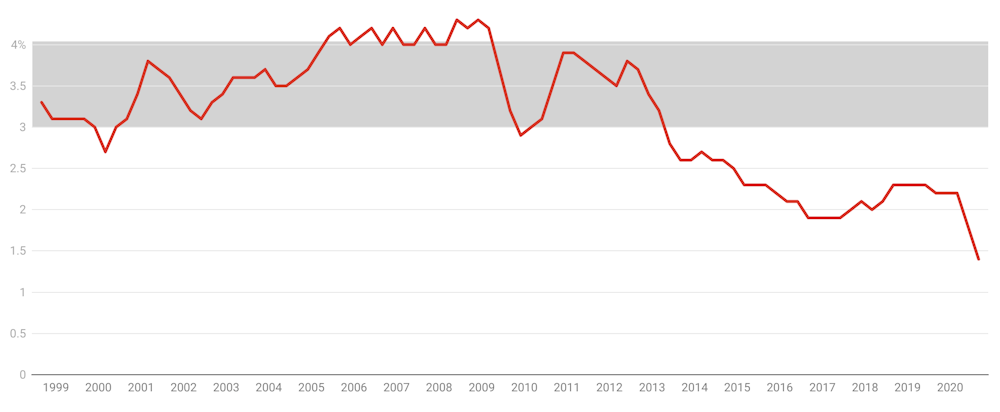
Wage price index, total hourly rates of pay excluding bonuses, private and public, annual. ABS

To get inflation and wage growth back up to where we want them we are going to need an unemployment rate well below the oddly-named NAIRU — well below 4.5% — for quite some time.

In his new book Reset, economist Ross Garnaut says we should be aiming for an unemployment rate of 3.5%.

He says on the way down there would be time to adjust the target “up when high and accelerating inflation becomes a matter of concern, or down (further) if we approach 3.5% without inflation accelerating dangerously”.

As in the US, we don’t yet know how low we can safely push unemployment, but it might turn out to be very low indeed.


Read more: The reset to lift us out of the COVID recession has to be bold: returning to where we were is nowhere near good enough


To get there Australia’s government will have to keep spending, and learn to live with big budget deficits and big debt.

Garnaut says to not do so would be a false economy, condemning us to “endless increases in our public debt-to-GDP ratio because we wouldn’t be producing the GDP we were capable of”.

The government would fund the crushing of unemployment by selling bonds to the Reserve Bank directly, bypassing financial markets in order to avoid putting further upward pressure on the dollar.

Low risk, long payoff

To the extent that the continuing flood of bonds further eased mortgage interest rates (which it mightn’t much, because the bonds would be long-term) the Prudential Regulation Authority would have to crack down on investor and interest-only loans as it did successfully before the COVID crisis in order to restrain house prices.

Garnaut believes there will also be a need for less-pleasant reforms to restore the prosperity Australia is capable of, but he says they will only gain widespread acceptance if it is known that anyone who wants a job can get a job — whether that’s at an unemployment rate of 3.5%, the 2% Australia once had or the 1% New Zealand had.

The COVID recession and rapid recovery from it have handed Frydenberg an opportunity to relentlessly drive down and crush unemployment — to finish the job.

If he grabs it he will be remembered as the treasurer who changed Australia, perhaps forever.

Reducing unemployment for good with Peter Martin. Democracy Sausage with Mark Kenny, March 4, 2021 107 MB (download)

This article is republished from The Conversation under a Creative Commons license. Read the original article.

Read more >>

Monday, March 30, 2020

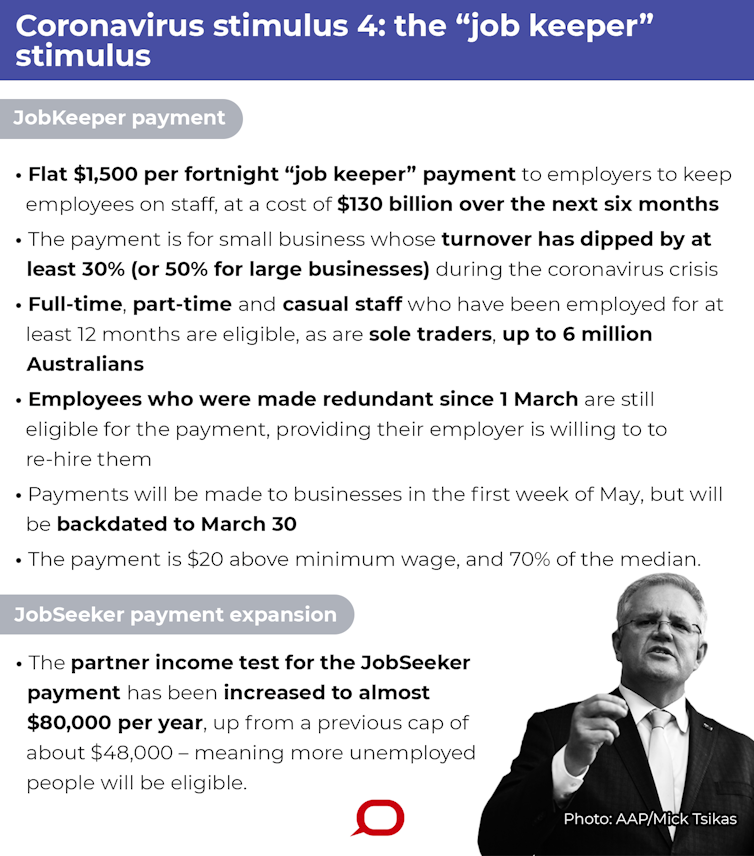
The key to the success of the $130 billion wage subsidy is retrospective paid work

The secret sauce in the government’s A$130 billion JobKeeper payment is that it will be retrospective, in the best possible way.

It’ll not only go to employers who have suffered losses and had employees on their books tonight, March 30, but to employers who have suffered losses and had workers on their books as far back as March 1.

This means employers who have sacked (“let go of”) workers at any time in the past month can travel back in time, pay them as if they hadn’t been sacked, and nab the A$1,500 per employee per fortnight payment.

As the official fact sheet puts it, “the JobKeeper Payment will support employers to maintain their connection to their employees”.

This retrospective connection will add new meaning to the term “revision” when the March unemployment numbers are released.

Not only will the March numbers be liable to being revised a month later as is normal in the light of extra information, but many Australians who were unemployed in March will retrospectively turn out not to have been unemployed.

They will have been retrospectively in paid work.


Read more: Modelling suggests going early and going hard will save lives and help the economy


(And if they have applied for the Centrelink payment of Newstart plus $550 per fortnight, they’ll have to un-apply to avoid what the prime minister referred to as “double counting” rather than the more loaded “double dipping”.)

It gets better. If you have been part-time, or for some other reason on less than $1,500 per fortnight, “your employer must pay you, at a minimum, $1,500 per fortnight, before tax”.

This means you’ll get a pay rise, for the six months the scheme lasts.

The Conversation, CC BY-ND

If you’ve been let go and then retrospectively un-sacked, you are also guaranteed to get at least $1,500 per fortnight, which in that case might be less than you were being paid, but will be more than the $1,115 you would have got on Newstart (which has been renamed JobSeeker Payment).

If you remain employed, and are on more than $1,500 per fortnight, the employer will have to pay you your full regular wage. Employers won’t be able to cut it to $1,500 per fortnight.


Read more: Which jobs are most at risk from the coronavirus shutdown? 


To get it, most employers will have to have suffered a 30% decline in their turnover relative to a comparable period a year ago. Big employers (turnover of $1 billion or more) will have to have suffered a 50% decline. Big banks won’t be eligible.

Self-employed Australians will also be eligible where they have suffered or expect to suffer a 30% decline in turnover. Among these will be musicians and performers out of work because large gatherings have been cancelled.

Half the Australian workforce

The payment isn’t perfect. It will only be paid in respect of wages from March 30, and the money won’t be handed over until the start of May – the Tax Office systems can’t work any faster – but it will provide more support than almost anyone expected.

Its scope is apparent when you consider the size of Australia’s workforce.

Before the coronavirus hit in February, 13 million of Australia’s 25 million residents were in jobs. This payment will go to six million of them.


Read more: Coronavirus supplement: your guide to the Australian payments that will go to the extra million on welfare


Without putting too fine a point on it, for the next six months, the government will be the paymaster to almost half the Australian workforce.

Announcing the payment, Prime Minister Scott Morrison said unprecedented times called for unprecedented action. He said the payment was more generous than New Zealand’s, broader than Britain’s, and more comprehensive than Canada’s, claims about which there is dispute.

But for Australia, it is completely without precedent.


Read more: Australia's $130 billion JobKeeper payment: what the experts think The Conversation


Peter Martin, Visiting Fellow, Crawford School of Public Policy, Australian National University

This article is republished from The Conversation under a Creative Commons license. Read the original article.

Read more >>

Sunday, March 22, 2020

Scalable without limit: how the government plans to get coronavirus support into our hands quickly

The government says its second stimulus package – the second in ten days – is temporary and targeted, but that’s not really true.

What it is is big, automatic, and infinitely increasable.

The first package, released ten days ago, cost A$17.6 billion. This one costs an extra $66.1 billion. (It’s best not be be too distracted by the claim that the total is $189 billion, almost 10% of GDP – it includes an element of double counting.)

The government has doubled, and then doubled again, what it intends to spend, and has made it easy to spend much, much more.

Automaticity is the key

Josh Frydenberg’s first assignment on being appointed parliamentary secretary to Prime Minister Tony Abbott in 2013 was to cut red tape.

The fewer needless procedures that people and businesses have to comply with (and the fewer forms and multiple forms they need to complete) the better everything can work.

In good times, it’s a good idea. In bad times, it’s essential.

As treasurer, nine months ago he set up a deregulation taskforce staffed by a dedicated unit within treasury.

Its work has infused the government’s second response.

An extra $550 per fortnight

The government has effectively doubled Newstart (which, in an unrelated previously-announced move, changed its name to “JobSeeker Payment” on Friday).

The maximum rate for a single recipient without dependants is $565.70 per fortnight.

For the next six months from April 27 the government will boost that by $550 per fortnight.

Importantly, the extra $550 will go to all recipients, including those who get much less than $565.70 because they have assets or have found a few hours of part-time work.

It’ll also go to both existing and new recipients of the Youth Allowance Jobseeker payment, Parenting Payment, Farm Household Allowance and Special Benefit.

The asset test for JobSeeker Payment, Youth Allowance Jobseeker and Parenting Payment will be waived for the duration of the boost.


Read more: The coronavirus stimulus program is Labor's in disguise, as it should be


What really matters is that it will be paid automatically. Recipients will receive the full $550 on top of their regular payment without asking for it. No forms, and an extra 5,000 Services Australia staff (previously called Centrelink staff) to make sure it happens.

The government says the boost is temporary, a claim that is not credible. The government can and will extend it for the duration of the crisis, and even after the crisis has ended will find it impossible to fully dismantle.

Recipients who have become used to receiving $1,115.70 per fortnight will not take kindly to suggestions they should be busted back to $565.70.

A “grandfathering” provision that let existing recipients keep getting $1,115.70 while forcing new recipients on to $565.70 would be almost as unrealistic.

Household support

Ten days ago the government announced a support payment of $750 to social security, veteran and other income support recipients and eligible concession card holders. It was to be paid automatically from March 31.

The new announcement is for an extra $750 to be paid to those people, other than the subset who will be getting the extra $550 per fortnight. About half of them are pensioners.

It will be paid “automatically from July 13, 2020”.

Early access to super

Anyone made redundant because of the coronavirus, or who has their hours cut by 20% or more because of the coronavirus (for sole traders, has their revenue cut by 20% or more) will be able to get early access to up to $10,000 of their super during the current financial year (the one that ends on July 30) and a further $10,000 during the first three months of 2020-21 (July 1 to September 30).

Frydenberg believes the funds will find this easy to manage:

the super funds last year had about $300 billion in cash, so they have the ability to provide what treasury estimate to be about a $27 billion injection into the economy.

He makes the point super belongs to the owners, and was saved with the intention that it be available for use on a rainy day:

this is the people’s money, and this is the time they need it most.

Withdrawals will be tax-free and will not affect Centrelink or veterans payments.

The process will be close to frictionless. Rather than approaching their fund, “eligible individuals will be able to apply online through myGov”.

When approved, the fund will “make the payment to you, without you needing to apply to them directly”.

Lower deeming rates

Pensioners with income-producing assets will find the pension rules adjusted so that they are assumed to earn 0.25% less than had previously been the case, in line with last week’s emergency Reserve Bank rate cut.

Again, it will happen automatically, from May 1, 2020.

Up to $100,000 per business

From April 28 employers will receive payments of 100% of the salary and wages they hand over to the tax office (up from 50% in the first package) plus an additional payment calculated using the same formula on July 28.

Worth up to $100,000 per business (with a minimum payment of $20,000) it will partially compensate them for hanging on to staff, and the announcement says they won’t need to do a thing.

The payments are tax free, there will be no new forms, and payments will flow automatically through the Australian Tax Office.

Going guarantor

The government will guarantee 50% of any new loans to small and medium sized businesses up to a maximum of $20 billion, which will support $40 billion in loans.

This way it’ll be the banks doing the assessments (the government won’t require the paperwork that would be involved in “picking winners”) but it’ll pick up the tab, without the businesses needing to do anything extra.

Indefinitely increasable

The government has found it relatively simple to plonk this $66.1 billion package on top of the previous $17.6 billion package. It has used the same or pre-existing foundations to scale up amounts and extend time periods.

This means it can get money out quickly and for as long as it needs to, in the main putting it into people’s hands automatically.

There is no practical constraint on its ability to do so. It has delivered what is almost certainly Australia’s biggest economic stimulus package, and will increase it as needed.

It can “find the money” by issuing bonds, effectively IOUs, to investors. If the investors want to offload them, or even if they don’t, the government-owned Reserve Bank has said it will buy them from investors without limit in order to prevent interest rates from rising.

The government’s financial measures are scalable without limit.


Read more: The case for Endgame C: stop almost everything, restart when coronavirus is gone The Conversation


Peter Martin, Visiting Fellow, Crawford School of Public Policy, Australian National University

This article is republished from The Conversation under a Creative Commons license. Read the original article.

Read more >>