Showing posts with label coronavirus. Show all posts

Wednesday, September 15, 2021

Delta is tempting us to trade lives for freedoms — a choice it had looked like we wouldn’t have to make

Last year COVID-19 seemed simple. It was horrific, but the arguments about what to do were fairly straightforward.

On one side were people rightly horrified by its rapid spread who wanted us to stay at home and stay away from school and work and socialising in order to save lives.

On the other side were people concerned about the costs of those measures — to jobs, to education, to freedom, to mental health, and to other lives (because if we used too much of our health system fighting COVID-19, other lives might fall through the cracks).

And through it all came a kind of consensus.

The concern about non-COVID deaths turned out to be overblown. Last year Australia recorded fewer than normal doctor-certified deaths, in part because the COVID restrictions stopped deaths from influenza, and in part because they snuffed out COVID-19 early, ensuring hospitals weren’t overwhelmed.

Last year, we didn’t have to choose

Concern about jobs also turned out to be overblown. By locking down hard and early, and paying employers to keep on staff (through JobKeeper) we ensured the lockdowns would be short-lived, with light at the end of the tunnel.

In none of the states for which there is data was there an increase in suicides.

The insurance company ClearView told a parliamentary committee this June its research found things were better than expected in part because of the universal nature of the pandemic. Everyone knew “everyone was in this together”.

Another reason was telehealth. It was easier to get help than before.


Read more: 7 lessons for Australia's health system from the coronavirus upheaval


And students returned to school sooner than they would have had the lockdowns had been weaker or started later, leaving much of their education intact.

The consensus was that by locking down hard and early we got the best of both worlds — near-elimination of COVID-19 and a quick return to normal life. Anyone who remembers Christmas last year remembers how normal it felt.

Economics is called the dismal science in part because it is about hard choices — situations where we can’t have our cake and eat it too. Last year it seemed as if COVID wasn’t one of them. Starving the virus early gave us both one of the world’s lowest death tolls and one of its shortest recessions.

Hard choices are back in sight

And then came Delta.

Far more contagious than the original, and with fewer immediate symptoms (making it harder to trace) the Delta variant became almost impossible to get on top of in the two big states where it took hold.

And without very high vaccination rates — in the view of the Grattan Institute significantly higher than either the NSW, Victorian or Commonwealth governments are targeting — it became all but impossible to reopen without condemning Australians to COVID deaths.

The new reality is plunging us back toward the territory economists call their own — the world of hard choices.

If the lockdowns don’t end (and there is no sign they can end any time soon without costing lives) education and mental health and jobs will indeed suffer.

There’s only so long businesses can hang on without pulling the pin.

We are getting closer to having to trade off lives against freedoms; getting closer to having to decide how many COVID deaths and how much COVID illness we are prepared to live with in order to return to something more like normal living.

Last week’s NSW “roadmap to freedom” implicitly made those tradeoffs.

Calculations prepared by the Treasury and the Grattan Institute make them more explicit.

There are few important things to note.

One is that we might yet be able to get the best of both worlds. We might yet be able to effectively eliminate the delta strand, restoring both health and freedoms (as we did with the earlier strand).

It won’t happen if we ease restrictions before transmission has stopped, as some states are planning to.

Lockdowns without end are unsustainable

Another is that unending lockdowns are untenable. While last year’s lockdowns didn’t do the psychological and health and educational damage that was feared, lockdowns without end would.

One type of damage clearly evident in the comprehensive report on last year’s lockdowns from the Australian Institute of Health and Welfare is family and domestic violence. The longer lockdowns continue, the longer elevated violence is likely to continue.

And another thing to note is that in a world where we have to make tradeoffs there are no particularly good options. Allowing the disease to spread in order to restore freedom of movement would itself curtail freedom of movement.


Read more: Economists back social distancing 34-9 in new poll


An analysis across US states suggests 90% of last year’s collapse in face-to-face shopping was due to fear of COVID rather than formal COVID restrictions. That fear will grow if we lift restrictions and COVID spreads.

The Grattan Institute would lift lockdowns only when 80% of the entire population has been double vaccinated (not 70-80% of people aged 16+ as the NSW and national plans envisage, which amounts to 56-64% of the population).

Grattan believes its plan would cost 2,000-3,000 lives per year; a cost it believes the public would accept because it is similar to the normal toll from flu.

The NSW and national plans (Victoria’s isn’t spelled out) would cost much more.

No option is particularly good

The Commonwealth Treasury finds, perhaps counter-intuitively, that an aggressive lockdown strategy that saved more lives would impose lower economic costs (about A$1 billion per week lower) in part because it would end up producing fewer lockdowns.

They are the sort of calculations we hoped never to have to make.

There’s still a chance we might not. With a Herculean effort NSW and Victoria could yet join Taiwan, New Zealand and every other Australian state in being effectively COVID-free. But they are running out of time.


Read more: NSW risks a second larger COVID peak by Christmas if it eases restrictions too quickly


Peter Martin, Visiting Fellow, Crawford School of Public Policy, Australian National University

This article is republished from The Conversation under a Creative Commons license. Read the original article.


Read more >>

Wednesday, June 16, 2021

The end of JobKeeper wasn’t a blip. It might have cost nearly 100,000 jobs

At its peak, more than 3.8 million Australians were on JobKeeper — three in every ten Australian workers.

Adding in those workers already employed by government, it meant four in every ten received a paycheck that originated from government, more than in Russia.

Yet when JobKeeper ended at the end of March, it looked like a mere blip in employment. The unemployment rate actually fell, for the sixth consecutive month.

The Bureau of Statistics said the cutoff had no “discernible impact”.

Treasurer Josh Frydenberg went further. The economy had “strengthened, even after the end of JobKeeper”.

Since the end of JobKeeper 132,000 people had come off income support.

The treasurer is right. After March the number of Australians on JobSeeker and related payments fell 9%.

Changed rules pushed people off benefits

But it’s possible for people to come off benefits at the same time as people are losing jobs, especially if something else is driving them off, as it was at the end of March.

At the end of March the coronavirus supplement that topped up unemployment benefits stopped. The payment dropped from $715.70 to $620.80 per fortnight.

And job seekers were once again required to search for a minimum of 15 jobs a month, climbing to 20 from July.


Read more: New finding: jobseekers subject to obligations take longer to find work


While burdensome for employers (if all of Australia’s job seekers actually apply for those jobs, employers will be lumbered with 17 million applications per month, climbing to 23 million) it’s also unhelpful for job seekers.

There’s evidence to suggest job seekers get real jobs sooner if they don’t have to go through charades.

The “dob in a job seeker” hotline will have further dissuaded them from applying for benefits.

These changes make the drop in the number of claimants understandable, much more so than the suggestion they got jobs, which in net terms they did not. Employment fell after the end of March, by 30,600 according to Bureau of Statistics figures which will be updated on Thursday.

As many as 97,000 fewer workers?

How is a drop in employment consistent with a drop in the unemployment rate?

The unemployment rate fell to 5.5% in April not because employment grew, but because 33,600 people who had previously identified themselves as unemployed dropped out of contention, changing their status to “not in the labour force”.

Had they continued to not work but continued to describe themselves as “unemployed”, the unemployment rate would have been 5.7%.

And it would have been higher still if those shifted to zero or reduced hours with the end of JobKeeper had been called unemployed. Employment fell 0.2%, but hours worked fell 0.7%.


Read more: Josh Frydenberg has the opportunity to transform Australia, permanently lowering unemployment


My rough maths suggests this means the number of Australians actually working might have fallen by 94,100.

An analysis prepared by Melbourne University employment specialist Jeff Borland for the Fair Work Commission puts the number of jobs lost between 45,000 and 97,000.

He gets 45,000 by comparing the number of people who left employment between March and April this year with the number who left between March and April in previous years.

He gets 97,000 by comparing the average (rapid) growth over the previous four months as we emerged from recession with the growth between March and April.

One in 11 JobKeeper jobs

A touch over one million Australians remained on JobKeeper to the end, suggesting that as many as ten in every 11 of them kept their jobs when JobKeeper ended. One in every 11 might have lost their jobs.

The Australians most knocked around were the youngest. Since the end of JobKeeper, women under the age of 30 have on balance lost jobs while women over that age have continued to gain jobs.

Men under the age of 40 have lost jobs while men over that age have gained them.

The treasury’s deepest concern about jobs since the start of COVID (it mentions it right at the top of that section of the budget) has been scarring.

The unlucky young people who happen not to secure jobs during downturns can fail to secure them for years, being passed over by newer, fresher young people who are barely affected.

Even where these people get jobs, if they enter the market when the youth unemployment is five percentage points higher than normal, they can expect to earn roughly 8% less in their first year, and 3.5% less after five years. It takes about a decade for the effect to fully disappear, and it’s worse for women than men.

Vacancies, plus mismatch

Australia’s record-high vacancy rate (2% of all jobs were vacant at the end of March) makes it look as if scarring needn’t be much of a concern. But jobs are vacant for reasons.

It might be that the mix of jobs we will need is changing, or that employers can for the moment no longer rely on migration to give them the mix of skills they want. Or it might simply be that the general bounceback in jobs has been so fast that the right employers and the right workers are still working out how to find each other.


Read more: The four GDP graphs that show us roaring out of recession pre-lockdown


Many businesses will die as a result of the end of JobKeeper. Businesses are forever dying. Some have been kept alive for longer than they would have been, and some have exited JobKeeper into a changed environment.

We’ve managed to end JobKeeper without a catastrophe, but that doesn’t mean there hasn’t been damage, and it doesn’t mean young lives won’t be scarred.

After a textbook exit from a recession — the sharpest V-shaped recovery ever — it would be awful if we left a slice of young Australia behind.

Peter Martin, Visiting Fellow, Crawford School of Public Policy, Australian National University

This article is republished from The Conversation under a Creative Commons license. Read the original article.

Read more >>

Wednesday, May 19, 2021

The GFC provided the secret sauce we used to ward off the COVID recession

We got an awful lot right during the COVID crisis — an awful lot that we couldn’t have got right just a few years earlier.

Which is another way of saying we were incredibly lucky.

Had COVID attacked during the 1980s there would have been no way to make a messenger RNA vaccine, not even for animals.

The national broadband network wouldn’t have been thought of. It wasn’t complete until 2020.

Even three years earlier, in 2017, the NBN reached only half of Australia’s 10 million households.

Had COVID struck then, before the broadband network was complete, working from home, telehealth and home schooling might have been impossible for many Australians, with devastating educational and other consequences.

And had it struck just a few years earlier still, we wouldn’t have learnt from the global financial crisis.

War Games

Australia’s handling of the GFC was exemplary, as evidenced by the fact that in much of the rest of the world it isn’t called the GFC, but The Great Recession.

Getting that crisis right owed something to a happy accident, as Ken Henry, head of the treasury at the time, explained on Monday at a seminar organised by the Institute of Public Administration.

A few years before the crisis in 2004 he was sitting in a room with senior officials discussing “some macroeconomic topic” when his deputy Martin Parkinson, sitting on his right, poked him with his left elbow.

“Martin said: you know it’s just occurred to me that you and I are probably the only people in this room who have ever experienced a recession — maybe we should have a workshop on that, what we would do if there was another crisis”.

The early 1990s recession was handled badly

Parkinson and treasury secretary Henry had worked for the Hawke and Keating governments during the early 1990s recession which scarred the Australians who it threw out of work for a decade.

In a series of “war games” held away from the treasury building, they and other officials determined that next time they should advise the government to quickly abandon budget discipline and fight what was coming with overwhelming force.

As Henry put it: “no matter how great the importance of fiscal discipline in establishing policy credibility, it is nothing compared to the loss of credibility associated with a recession”.

If the treasury didn’t tell the government this, the government would catch on anyway and sideline it for advisers who would.

Megan Aponte-Payne, Steven Kennedy, David Gruen, Ken Henry, Malcolm Edey, Meghan Quinn and David Tune at the GFC seminar. Isabelle Franklin

“I came out of those discussions determined that if Australia were to confront a large negative shock during my tenure as secretary, the treasury would seek to put itself front and centre in advising the government,” Henry said.

“We would not be taking seats in the back row by counselling a government to rely on monetary policy, the exchange rate, or automatic stabilisers.”

As for the idea of “proportionate response”, which was still being counselled by some in the early stages of COVID last year, Henry said the word “proportionate” could be applied to a response, but never to preemption.

Preemption is not proportionate

“If you want to preempt something, you don’t talk about being proportionate,” he said. “I remember some commentators saying you should wait until you see the ‘whites of the eyes’ before taking action. "I wouldn’t know what action to take at that stage, presumably it would be to run as fast as you could, I just don’t know.”

The key thing was to get money into Australian’s hands immediately. Spending on infrastructure (spending on almost anything other than households) would take too long.

During the financial crisis Labor got money into households’ hands by handing out cheques. During COVID the Coalition did it by doubling benefits and routing payments through employers and calling them JobKeeper.

Bandwidth matters

Henry, and David Tune who was in the department of prime minister and cabinet at the time and later headed the department of finance, told the conference that attempting to do other things while getting money out the door got in the way, among them insulating homes and building school halls.

Governments have limited “bandwidth” or “thinking space”, and during the GFC the Rudd government was also considering taking over hospitals, taxing carbon, reforming the tax system and building the NBN.

The Morrison government seems to have learnt that lesson, but it doesn’t seem to have learnt another, which is that the Commonwealth isn’t good at managing projects.

The Commonwealth can’t run projects…

Whether it’s vaccinations or quarantine or insulating homes, projects are best managed by state governments who have actual experience of running things.

Another important lesson, reinforced during COVID is that in practical terms the ability of the Reserve Bank to support the government in keeping a recession at bay might be unlimited.

The Reserve Bank deputy governor at the time Malcolm Edey told the conference that the next step after low interest rates and buying government bonds is direct “money-financed fiscal expansion”, where the bank creates money for the government to spend.

…but its financial power is unlimited

With all of the government’s borrowing now in Australian dollars, and most private overseas borrowing effectively in Australian dollars because it has been hedged against exchange rate movements, and with the debt ceiling gone, there’s no limit to the force and speed with which the government can stave off a recession.

The current treasury secretary Steven Kennedy conceded that in one way fighting the COVID recession had been easier than fighting the GFC.

COVID had a clear start date. The GFC had a rolling series of starts that made it hard to be sure the worst hadn’t passed.


Read more: Frydenberg spends the bounty to drive unemployment to new lows


And perhaps because of that, we discovered what Australians can do.

Treasury Deputy Secretary Meghan Quinn praised the banks for deferring payments on $250 billion of loans, Coles and Woolworths for working together to stock each other’s stores and the private and public health systems for working together in a way that wouldn’t have been thought possible before the pandemic.

We read the GFC playbook, then went further.

Peter Martin, Visiting Fellow, Crawford School of Public Policy, Australian National University

This article is republished from The Conversation under a Creative Commons license. Read the original article.

Read more >>

Monday, December 21, 2020

Book chapter: Australia had sound economic leadership through the crisis, the challenge now is managing the recovery

Of all the baseless claims made as coronavirus struck, the most dangerous was that there was a trade-off between lives and the economy.

The Conversation’s cartoonist Wes Mountain illustrated it perfectly.  

The idea, raised early and not so much later on, was if we did too much to save lives from coronavirus, we would damage others in ways that were harder to see.

It was wrong in part because lives are what the economy is. 

Australia’s treasury, using a framework developed by Nobel Prize winner Amartya Sen, describes the aim of economic policy as maximising a person’s “freedom to lead a life they have reason to value”.

Deaths destroy that freedom. Deaths matter for economics.


The idea was also wrong because it failed to take account of the pernicious way the virus spreads. Assessing a lockdown is not simply a matter of weighing up lives saved versus lives disrupted. It is a matter of adding to those lives saved all of the future disruptions that will be avoided and the future lives that will be saved if the lockdown stops the virus spreading.

The government rightly imposed huge and otherwise unconscionable costs on the economy in order to get on top of the virus.

Each time it backed them with support for the people and businesses those measures would hurt.

Mid-March 2020, as the government banned public gatherings of more than 500 people (killing the Grand Prix and the footy) it doubled JobSeeker and related payments and gave Australians in need early access to their super.

In late March, as it tightened the limit on gatherings to just two people (forcing much of the population to stay at home), it unveiled JobKeeper, guaranteeing to pay the wages of millions whose jobs were at risk until at least September.

It would be wrong to say all the costs were government-imposed. Well before the big lockdown in late-March 2020 large numbers of Australians were staying away from restaurants, cinemas and the like of their own accord. The recession began during the months those venues were free to trade.

In the face of an unavoidable reality the government decided it was responsible to spend as much as was needed to survive with the least possible damage.

Gone was the carping about the “debt and deficit” Labor ran up to get us out of the global financial crisis.

When he was parliamentary secretary to Prime Minister Tony Abbott in 2014, Josh Frydenberg berated Labor for “intergenerational theft”. It had saddled “every man, woman and child” with thousands of dollars in government debt.

As treasurer, in a crisis on his own watch, Frydenberg doubled government debt with scarcely a mention of children.

His finance minister Mathias Cormann said the strategy was to deal with debt by running up more debt.

As he put it, “the way to get on top of this debt is by growing the economy more strongly and by creating more opportunity for Australians to get ahead, get into jobs, get into better paying jobs. Stronger growth leads to more revenue and lower welfare payments. That’s the way we can go back to where we were.”

We’ve known this works for more than half a century. Government debt was more than 100% of gross domestic product at the end of the second world war. It came down each year as a proportion of GDP, not because the Commonwealth ran budget surpluses it could use to pay it down (with one exception it ran deficits all the way through to the 1980s), but because GDP grew, fuelled in part by annual budget deficits that necessitated more borrowing.

The best way to grow GDP is to avoid or escape a recession. If it achieves that, borrowing can pay for itself.

Borrowing to pay interest on debt can be bad advice for a household, but for the Australian government it is different, especially in an crisis.

Reserve Bank Deputy Governor Guy Debelle resorted to an equation to explain the mechanism at a seminar organised by the Economic Society in June.

He said so long as the interest rate charged (r) was less than the future economic growth rate (g), the burden of interest payments would shrink as a proportion of GDP over time.

Australia’s average rate of real economic growth has been more than 2% per year. More importantly, over the past decade actual annual growth (not adjusted for inflation, which is what matters for debt repayments) has averaged 4.5%.

Right now the government can borrow for ten years at 0.9% per year. In late July it issued a rare 31-year bond that won’t have to be repaid until the middle of the century. It locked in 1.94%, for $15 billion. It had $36.8 billion of bids.

It has arranged interest payments that are likely to be much less than the annual growth in its ability to pay them.

Foreign and Australian investors including super funds are bidding against each other for the right to lend for next to nothing in return for a guaranteed government income.

And the government would have no problem financing its coronavirus programs even if they were not.

Erased from the consciousness of mainstream economists from the 1990s onwards has been the knowledge that governments such as Australia’s can fund as much of their spending as they want by issuing currency – “printing money”.

Britain, Japan, the United States and Europe resumed doing it during and after the global financial crisis. Australia held out for longer, clinging to the myth that the only ways governments could fund programs were taxing and borrowing.

It’s been a useful myth for those wanting to restrain government spending. Martin Wolf of the Financial Times talked about the value of propagating the myth this year when he wrote that while the myth was wrong, once politicians believed it was wrong it would “prove impossible to manage the economy sensibly”.

A branch of economics with strong roots in Australia’s Newcastle and Adelaide universities never doubted that it was wrong. It’s called “modern monetary theory”, which is odd because it is neither modern, nor a theory. It’s reality. Governments can fund spending by creating money – the only real downside being the risk of inflation, which isn’t a risk during a recession.

Since March the Reserve Bank has been doing it by buying government bonds. A bond is a piece of paper on which is written a promise to repay and to pay interest.

The bank has been paying for those bonds by creating Australian dollars, literally, through a process known as balance sheet expansion. On one side of its balance sheet it records the bond it has bought as an asset, on the other it records a matching liability, which is the deposit it has placed into the account of the institution it has bought it from.

To put some (largely cosmetic) distance between creating money and funding government spending, the bank has promised to buy only as many bonds as are needed to keep bond rates low, and to buy them from intermediaries rather than from the government itself. But the effect is the same as if it had handed the newly-created dollars directly to the government, except that it hasn’t needed to do it much.

So keen have been private investors to buy government bonds that, apart from creating and spending $50 billion early on to show that it could, the bank has been able to sit back and watch other investors fund the government, and outbid each other in order to do it.

Despite the government’s (probably premature) announcement of plans to wind back JobKeeper and JobSeeker at the end of the year, there’s no sign of big spending stopping.

After the coronavirus crisis has passed the government will need to spend still more to fund the recovery.

Borrowing at way less than the predicted rate of economic growth means it can fund projects whose prospects were once considered poor, such as high speed rail and widespread tax cuts. But it remains important to pick projects wisely.

The best ones will set Australia up to thrive in the decades to come, decades marked by climate change and (quite possibly) repeated pandemics.

Rarely has a government had such an opportunity to shape Australia.

It has handled the crisis well. The next test will be sculpting the recovery

Chapter in 2020: The Year That Changed UsThe Conversation, Edited by Molly Glassey

Read more >>

Monday, May 18, 2020

Economists back social distancing 34-9 in new Economic Society-Conversation survey

Australian economists overwhelmingly back social distancing measures that slow the spread of coronavirus over the alternative of easing restrictions and allowing the spread of the disease to pick up.

But a significant minority, 9 of the 47 leading economists polled in the first of a series of monthly surveys, say they would support an easing of restrictions even if it did allow the spread to accelerate.

The Economic Society of Australia-Conversation monthly poll will build on national polls conducted by the Economic Society, initially in conjunction with Monash University, since 2015.

The economists chosen to take part are Australia’s leaders in fields including microeconomics, macroeconomics, economic modelling and public policy. Among them are former and current government advisers and a former and current member of the Reserve Bank board.

Their responses are given weight by statements explaining their views published in full on The Conversation website and by a requirement that they rank the confidence they have in their responses on a scale of 1 to 10.

What matters is R

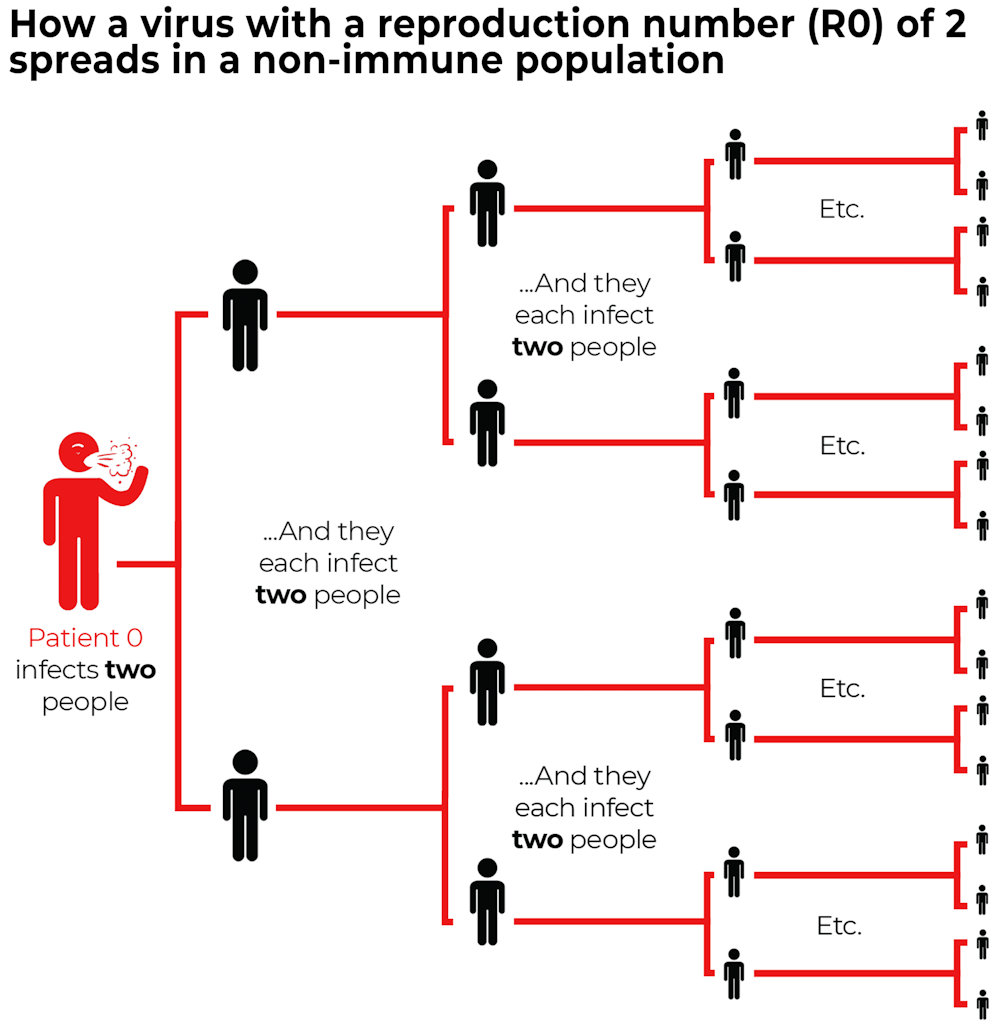
R, which is also referred to as R0, R₀, and Rt is the reproduction number of the virus. It a measure of the average number of other people that any person with it will directly infect.


The Conversation, CC BY-ND

An R of 2 means that on average each person with the virus will directly infect two other people in a process that will escalate increasingly quickly until after four sets of contacts 16 people have it, and after 20 sets of contacts more than one million people have it.

This snowballing effect is a property of any R above 1.

At an R below 1 the spread decelerates until very few people have it.

In the early days of the outbreaks, Australia’s value of R was well above 1.

The lockdowns and other restrictions have helped push it down to about 1.

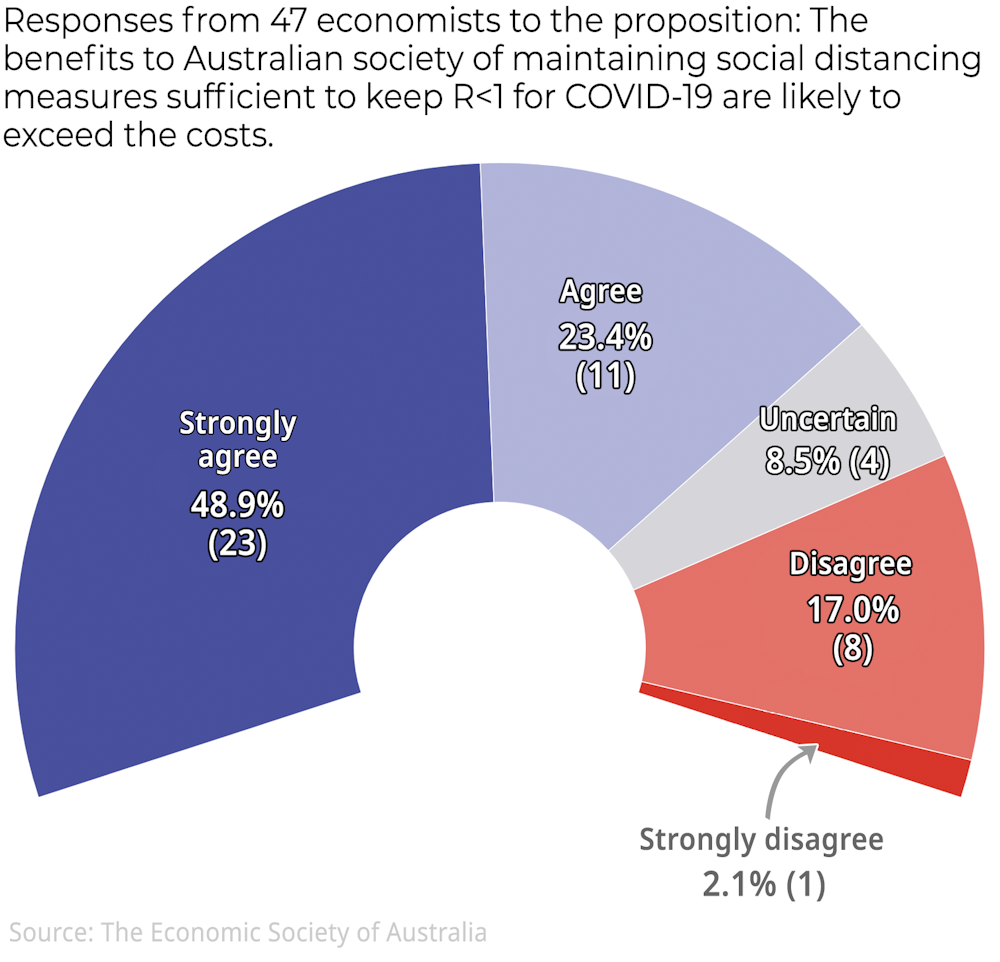
The 47 leading Australian economists selected by the Economic Society of Australia were asked whether they agreed, disagreed, or strongly agreed or strongly disagreed with this proposition:

The benefits to Australian society of maintaining social distancing measures sufficient to keep R less than 1 for COVID-19 are likely to exceed the costs.

The proposition suggests that in the present context it is likely to be worthwhile to continue to maintain the restrictions that are needed to push R below 1 and keep it there.

Almost three quarters of the economists surveyed – 34 out of 47 – backed the proposition, 23 of them “strongly”.

Only nine disagreed, and only one strongly.


The Conversation, CC BY-ND

The arguments put for the worth of maintaining social distancing measures sufficient to keep R below 1 include avoiding “tens or hundreds of thousands of avoidable deaths” (John Quiggin) and allowing the economy to return to normal sooner than otherwise by escaping the need for “repeated lockdowns” that might be needed if the disease got out of control again (Ian Harper).

Chris Edmond uses the analogy of the Phillips Curve that is meant to show the the tradeoff between levels of inflation and unemployment.

Although it shows a tradeoff in the short term (more inflation results in lower unemployment) in the longer term it finds no such tradeoff. More inflation simply leads to higher prices with unemployment being no lower.


Read more: Eradicating the COVID-19 coronavirus is also the best economic strategy


“In a similar way, there is no long-run trade off between public health and the health of the economy in responding to the COVID-19 crisis,” he says.

Lifting restrictions “risks the worst of all worlds, compromising our public health goals and at the same time not getting a proper economic recovery”.

Stefanie Schurer quotes a German proverb: better a painful ending than an endless pain.

Lifting restrictions “worst of all worlds”

She says a short and medium term failure to eliminate, or at least slow down, the spread of COVID-19 would entail significant longer-run political, economic and social costs.

Renee Fry-McKibbin points out that that even if the deaths from reopening economic activity turn out not to be high, we have no idea yet of the long term health consequences of exposing more people to COVID-19.

“Will people suffer from respiratory issues going forward requiring ongoing medical attention?” she asks. “We have incomplete information on the actual costs and benefits.”

Saul Eslake, who can see the worth of continued restrictions that keep R below 1, cautions that the longer they remain in place, the more the case for reopening will grow.

Yet the costs of restrictions are growing

Craig Emerson says keeping R below 1 should be merely a “guiding principle” rather than a binding constraint.

“The longer the restrictions are in place, the greater will be the likelihood of links being broken - leading to severe economic hardship, business failures, mortgage defaults, domestic violence, mental health problems, suicide and long-term unemployment, particularly for the young,” he says.

Gigi Foster says, in retrospect, the best thing for Australia to have done would have been to have never had an enforced lockdown, but to have encouraged people to continue to behave as normally as possible while taking precautions, as in Sweden, allowing young and healthy people to acquire immunity in order to protect more vulnerable people, in this and in future waves of the virus.

She suspects the costs of continued restrictions that keep R below 1 outweigh the benefits, including benefits measured in quality-adjusted life years saved.


Read more: COVID lockdowns have human costs as well as benefits. It's time to consider both


Hugh Sibley says that by making progress towards eliminating the virus we have eliminated the option of acquiring the mass immunity that would make it easier to live with it.

“We have, in effect, dug ourselves into a hole,” he says. “And we are now congratulating ourselves how deep that hole is. Too few people are asking how we get out.”

Supporters more certain than opponents

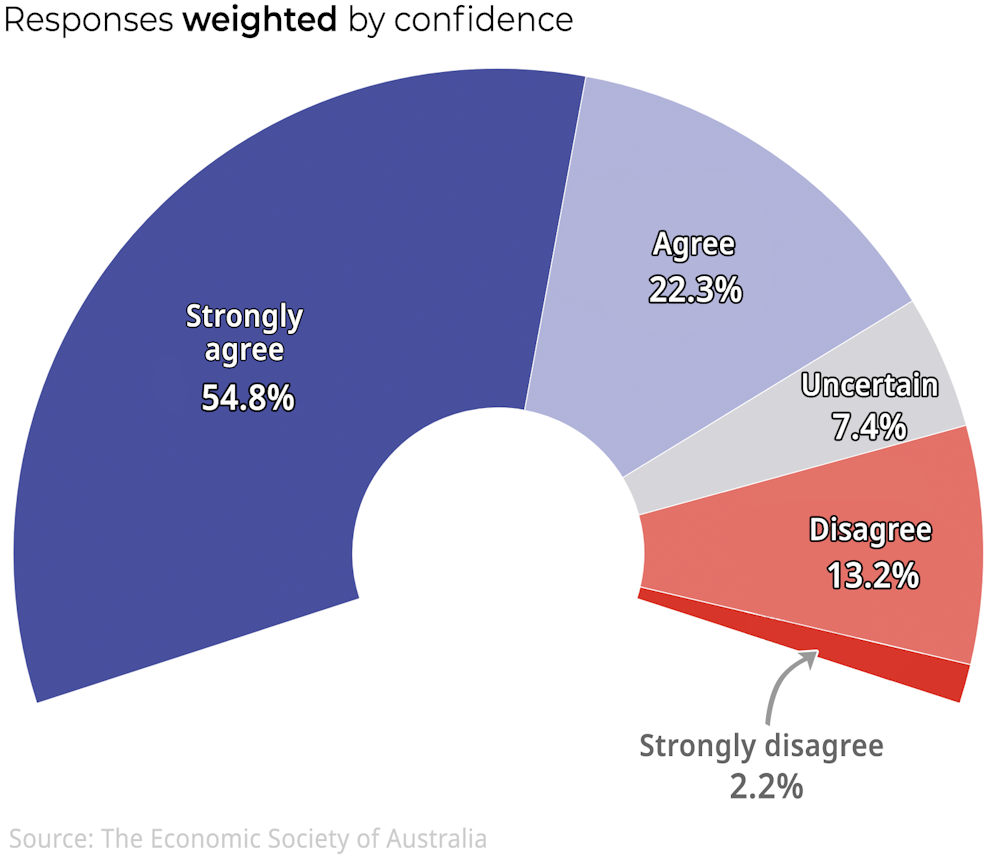
When responses to the survey are weighted by the confidence respondents have in them, opposition to restrictions weakens.

Unweighted for confidence, 19% of respondents oppose the proposition that restrictions that keep R below 1 are likely to be value for money.

Weighted for (lack of) confidence, opposition falls to 15.4%.


The Conversation, CC BY-ND

Unweighted for confidence, 72.3% support the proposition that restrictions that keep R below 1 are likely to be value for money.

Weighted for confidence, that support grows to 77.1%

The proportion strongly agreeing with the proposition grows from 48.9% to 54.8%

Put another way, when weighted for confidence, a clear majority of the economists surveyed strongly support the proposition that the benefits to society from maintaining social distancing measures sufficient to keep R less than 1 are likely to exceed the costs.


Individual responses

The Conversation


Peter Martin, Visiting Fellow, Crawford School of Public Policy, Australian National University

This article is republished from The Conversation under a Creative Commons license. Read the original article.

Read more >>

Monday, March 30, 2020

The key to the success of the $130 billion wage subsidy is retrospective paid work

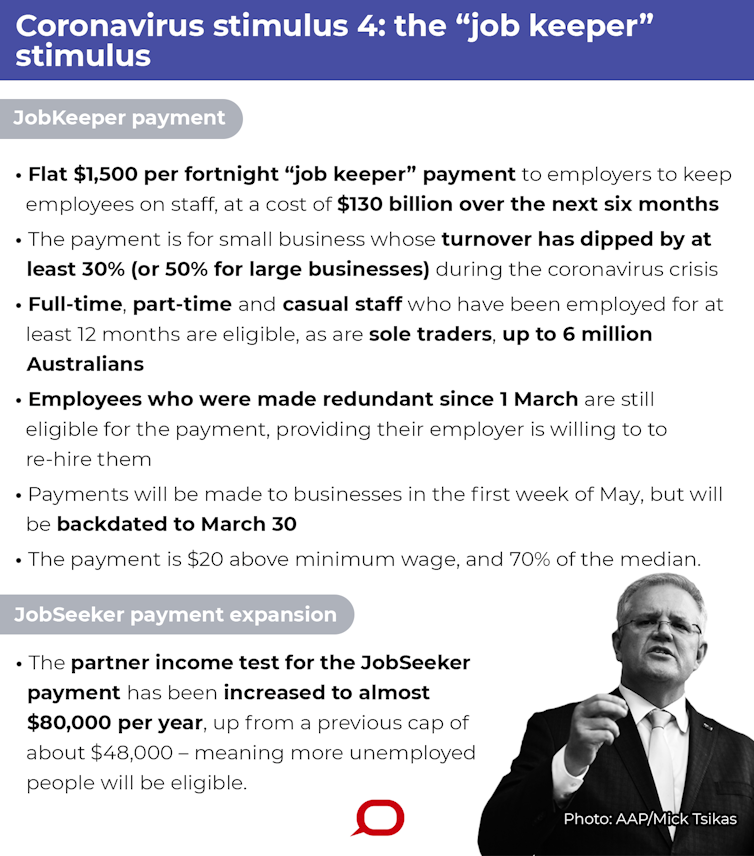
The secret sauce in the government’s A$130 billion JobKeeper payment is that it will be retrospective, in the best possible way.

It’ll not only go to employers who have suffered losses and had employees on their books tonight, March 30, but to employers who have suffered losses and had workers on their books as far back as March 1.

This means employers who have sacked (“let go of”) workers at any time in the past month can travel back in time, pay them as if they hadn’t been sacked, and nab the A$1,500 per employee per fortnight payment.

As the official fact sheet puts it, “the JobKeeper Payment will support employers to maintain their connection to their employees”.

This retrospective connection will add new meaning to the term “revision” when the March unemployment numbers are released.

Not only will the March numbers be liable to being revised a month later as is normal in the light of extra information, but many Australians who were unemployed in March will retrospectively turn out not to have been unemployed.

They will have been retrospectively in paid work.


Read more: Modelling suggests going early and going hard will save lives and help the economy


(And if they have applied for the Centrelink payment of Newstart plus $550 per fortnight, they’ll have to un-apply to avoid what the prime minister referred to as “double counting” rather than the more loaded “double dipping”.)

It gets better. If you have been part-time, or for some other reason on less than $1,500 per fortnight, “your employer must pay you, at a minimum, $1,500 per fortnight, before tax”.

This means you’ll get a pay rise, for the six months the scheme lasts.

The Conversation, CC BY-ND

If you’ve been let go and then retrospectively un-sacked, you are also guaranteed to get at least $1,500 per fortnight, which in that case might be less than you were being paid, but will be more than the $1,115 you would have got on Newstart (which has been renamed JobSeeker Payment).

If you remain employed, and are on more than $1,500 per fortnight, the employer will have to pay you your full regular wage. Employers won’t be able to cut it to $1,500 per fortnight.


Read more: Which jobs are most at risk from the coronavirus shutdown? 


To get it, most employers will have to have suffered a 30% decline in their turnover relative to a comparable period a year ago. Big employers (turnover of $1 billion or more) will have to have suffered a 50% decline. Big banks won’t be eligible.

Self-employed Australians will also be eligible where they have suffered or expect to suffer a 30% decline in turnover. Among these will be musicians and performers out of work because large gatherings have been cancelled.

Half the Australian workforce

The payment isn’t perfect. It will only be paid in respect of wages from March 30, and the money won’t be handed over until the start of May – the Tax Office systems can’t work any faster – but it will provide more support than almost anyone expected.

Its scope is apparent when you consider the size of Australia’s workforce.

Before the coronavirus hit in February, 13 million of Australia’s 25 million residents were in jobs. This payment will go to six million of them.


Read more: Coronavirus supplement: your guide to the Australian payments that will go to the extra million on welfare


Without putting too fine a point on it, for the next six months, the government will be the paymaster to almost half the Australian workforce.

Announcing the payment, Prime Minister Scott Morrison said unprecedented times called for unprecedented action. He said the payment was more generous than New Zealand’s, broader than Britain’s, and more comprehensive than Canada’s, claims about which there is dispute.

But for Australia, it is completely without precedent.


Read more: Australia's $130 billion JobKeeper payment: what the experts think The Conversation


Peter Martin, Visiting Fellow, Crawford School of Public Policy, Australian National University

This article is republished from The Conversation under a Creative Commons license. Read the original article.
Read more >>

Thursday, March 12, 2020

Morrison's coronavirus package is a good start, but he'll probably have to spend more

What makes the prime minister confident most households will spend A$750 delivered in cash, when they mostly wouldn’t spend the A$1,080 delivered in the form of bonus tax refunds after last year’s budget?

Experience.

Here’s how he put it on Thursday, announcing the economic response to the coronavirus:

Australians will be getting a cheque for $750. Now it’s not for us to tell those Australians how to spend their money, but what we do know from experience is that they will spend that money, and that money will encourage economic activity.

That experience was Labor’s.

On October 11, 2008, Labor announced cash payments totalling between $1,000 and $1,400 per eligible household to stave off a retail recession.

It offered still more in February 2009.


Read more: The coronavirus stimulus program is Labor's in disguise, as it should be


The first cheques went out in December. Spending surged 4% that month after scarcely growing all year. A year on, spending was 5.4% higher than before the cheques went out.

In Japan, the United States, Canada and Germany where stimulus packages were not targeted at consumers, retail spending slipped by 2-3%. In Australia, it surged 5%.

So big was the effect that the payments were staggered by region to ensure cash delivery trucks could top up the automatic teller machines first.

The statisticians collecting retail sales data at the Bureau of Statistics abandoned their usual practice and stopped drawing a trend line.

The jump was impossible to reconcile with the pre-existing trend.

ABS retail trade release, May 2009

The Treasury had searched the economic literature and determined that cash payments were more likely to be spent than tax cuts, and could be delivered much more quickly.

Six million Australians receive government benefits of some sort, whether they think of themselves as on welfare or not. As recipients of family allowance, childcare support, the pension or even the seniors health card, they are on Centrelink’s books. (Centrelink recently changed its name to Services Australia.)

The payment machine that delivered robodebt can just as easily deliver “robocheques”.


Read more: Cash handout of $750 for 6.5 million pensioners and others receiving government payments


Treasury Secretary Steven Kennedy, who advised Prime Minister Scott Morrison and Treasurer Josh Frydenberg to give households cash this time instead of tax refunds, saw the effect at first hand. He was working in Prime Minister Kevin Rudd’s office as the good news came through.

If there is an important criticism of the Morrison government’s (first) coronavirus stimulus package, it would be that it doesn’t concentrate on households enough.

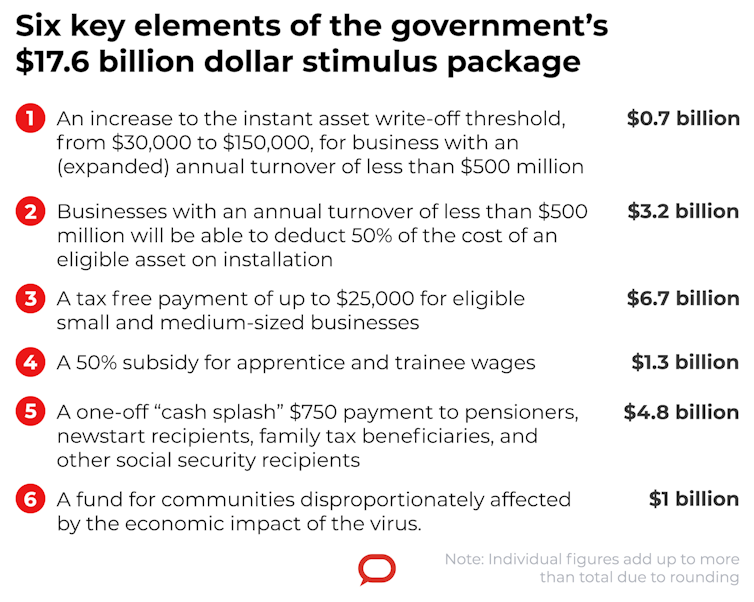
Household spending accounts for 55% of Australia’s gross domestic product, yet payments directed to households make up only 27% of the $17.6 billion the government is spending.

The package has two primary aims. One is to ensure that spending and production don’t shrink in the June quarter after shrinking in the March quarter, triggering what, for better or worse, people call a technical recession.

The Treasury expects it to boost economic activity by 1.5% in the June quarter.

If it does, it should be enough to compensate for the downturn we would have without it, always remembering that we don’t yet know how bad things will get in the three months to June - how many schools and public gathering places will be closed, and how many workers will have to stay home to care for children who can’t go to school or family members who are ill.


Read more: When it comes to sick leave, we're not much better prepared for coronavirus than the US


The second aim is to stop the unemployment rate climbing. When it climbs more than a few points it tends to keep going. In the early 1990s recession it climbed from 6% to 10% in a matter of months.

People who entered the labour force and couldn’t get work were scarred for years.

Labor’s most enduring achievement during the global financial crisis in 2008 and 2009 was to stop unemployment climbing above 6%.

That’s what the government’s $11.8 billion of payments to businesses are aimed at, whether delivered in the form of a boosted instant asset writeoff (available only until June 30), accelerated depreciation, payments to cover salaries, or wage assistance for apprentices and trainees.

Morrison wants businesses in the best possible position to hold onto their workers. He wants them to display “patriotism”.The Conversation

Peter Martin, Visiting Fellow, Crawford School of Public Policy, Australian National University

This article is republished from The Conversation under a Creative Commons license. Read the original article.
Read more >>