Showing posts with label petrol. Show all posts

Thursday, March 24, 2022

Cut emissions, not petrol tax. The budget economists want

Overwhelmingly, Australia’s top economists would rather the budget funds measures to cut carbon emissions than cuts income tax or company tax.

They are also dead against rumoured cuts to petrol tax and the tax on beer.

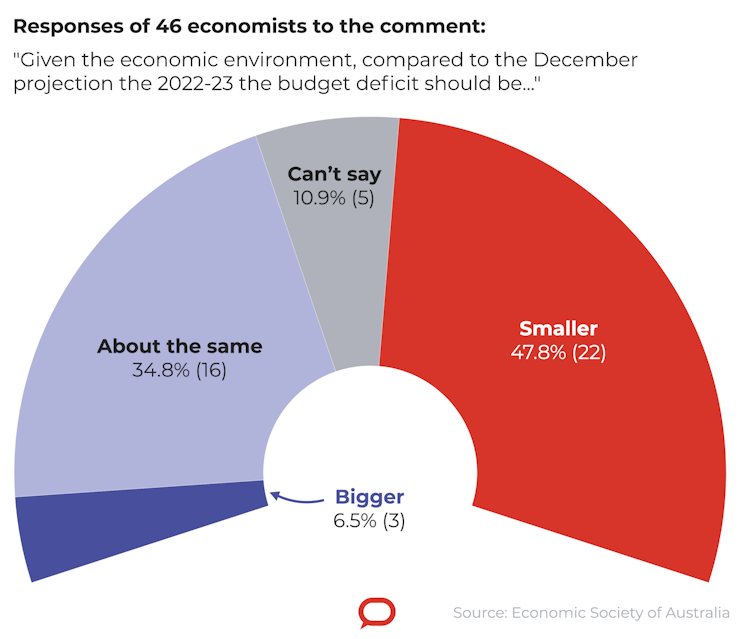
The Conversation’s pre-budget survey of a panel of 46 leading economists selected by the Economic Society of Australia finds almost half want a budget deficit smaller than the A$99.2 billion expected for 2021-22 and the $98.9 billion forecast for 2022-23 in the December budget update.

Higher commodity prices and lower than expected unemployment – which is lifting tax revenue while also cutting spending on benefits – is set to produce a deficit tens of billions of dollars lower, perhaps as low as $65 billion, absent new spending.

But a substantial chunk of those surveyed (41%) want an unchanged or bigger deficit to boost spending in other areas, including an accelerated transition to net-zero carbon emissions and Australia’s defence.


Arguing for a deficit about as big as last year’s, former OECD official Adrian Blundell-Wignall said while spending on defence was important, so too was spending on supply lines to make Australia less dependent on other countries. Events in the Ukraine showed supply chains were as important as weapons.

Curtin University’s Margaret Nowak said the huge reconstruction needs following the floods in NSW and Queensland suggested there was no potential to reduce the deficit and good reasons why it might climb.

Arguing with the majority in favour of a lower deficit, independent economist Nicki Hutley said the government should bank rather than spend any improved psoition to reduce debt ahead of higher interest rates. It would need “reserves at the ready” to deal with economic and geopolitical uncertainty.

James Morley of the University of Sydney said with the economy on the road to recovery, more government handouts would be likely to be inflationary, making it harder for the Reserve Bank to keep inflation within its target band.



Asked to pick up to two spending or tax bonus measures from a list of twelve that would most deserve a place in the budget, more than 60% of those surveyed nominated spending on the transition to net zero carbon emissions.

University of Adelaide economist Sue Richardson said if she had the option, she would have picked “remove all subsidies to fossil fuels”. More than 90% of Australia’s energy now comes from fossil fuels. Reducing that – as the government has said it expects to do to get to net zero emissions by 2050 – will require a massive effort, “made much harder by starting so late”.

More than 32% of those surveyed backed increases subsidies for childcare, in part because it would allow more parents to do more paid work. More than 26% supported a temporary boost to JobSeeker and other payments; 13% supported increased defence spending; and 10.9% supported infrastructure spending and investment in domestic manufacturing.

Asked which of the measures should not be adopted, almost half (45%) picked a reduction in beer tax, and almost 35% nominated a reduction in fuel excise.


Saul Eslake said “gimmicks” such as cuts in beer or petrol excise failed to address the reality that Russia’s invasion of Ukraine had serious economic consequences for Australia, including reducing national income. Governments can’t “pretend this hasn’t happened”.

Instead, what governments could do was ensure Australia’s lowest earners don’t bear the brunt of that economic pain.

The best ways to do this were temporary increases in social security payments, or a one-off special payment, and tax rebates for genuine low earners.

Eslake would fund them from the extra tax that will flow from the companies and shareholders who will benefit from the higher commodity prices following Russia’s invasion.

UNSW Sydney’s Nigel Stapledon was sceptical about higher social security payments. Given Australia’s experiencing a near five-decade low in unemployment, and unprecedentedly high number of job vacancies, he said it was hard to justify a higher rate of JobSeeker.

Also high on the list of measures panellists felt should not be adopted were further company tax cuts (21.7%) and bringing forward the Stage 3 tax cuts income tax cuts directed at high earners and due to start in July 2024 (21.9%).

The budget will be delivered on Tuesday night.


Individual responses:

Peter Martin, Visiting Fellow, Crawford School of Public Policy, Australian National University

This article is republished from The Conversation under a Creative Commons license. Read the original article.

Read more >>

Wednesday, March 16, 2022

It’s hard to find a case for a cut in petrol tax – there are other things the budget can do

Cutting petrol tax to bring down the cost of living used to be the political version of a joke. Failed US presidential candidates John McCain and Hillary Clinton both tried it in 2008. Their bipartisan advocacy of a “summer gas tax holiday” was derided as dumb, a turkey and a “metaphor for the entire campaign”.

When 230 economists released a letter opposing it in 2008, Clinton said: “I’ll tell you what, I’m not going to put my lot in with economists”.

Her opponent for her party’s nomination, Barack Obama, labelled it a gimmick and went on to win both the nomination and the presidency.

But it isn’t a joke now. There’s talk about it in the US, New Zealand has just cut in its fuel excise 25 cents to ease cost of living pressures, and Australia is considering a budget measure along the same lines.

What has happened to the price of petrol is shocking. In capital cities the unleaded price is about A$2.18, up from $1.60 at the start of the year. That means that whereas it might have cost $80 to fill up a Toyota Corolla at the start of the year, it now costs one third as much again – $109.

If you fill up fortnightly, as many people do, the extra impost is greater than if the Reserve Bank lifted its cash rate by 0.25% and pushed up the cost of payments on your mortgage.

If you own an SUV, by now Australia’s biggest selling type of new car, the extra impost will be greater. And (as with interest rates) there’s every chance petrol prices will climb further.

In New Zealand, where petrol costs more than NZ$3 per litre (A$2.80) the government has cut petrol excise by 25 cents per litre for three months, in the hope that by then the worst effects of the Russia-Ukraine war will have passed.

Australia taxes petrol lightly

Eagle-eyed readers will have noticed that even with the cut, New Zealand petrol prices will still be way above Australia’s. That’s because, like most developed nations, New Zealand charges more in tax for using roads than does Australia.

Until the cut on Tuesday, New Zealand petrol excise was a touch over NZ$0.77 per litre (A$0.72) compared to around A$0.43 in Australia.


Low by international standards

Retail unleaded price (Australian cents per litre) Department of Industry, Science, Energy and Resources

The goods and services tax charged on top of that in both nations brings the NZ excise to about NZ$0.89 per litre (A$0.83) compared to Australia’s A$0.48.

If these figures sound low, it’s because the price of petrol has soared. One of the peculiarities of taxes that are set in cents per litre (climbing only with inflation) is that when the petrol price jumps, the tax as a proportion of the total price shrinks.

A year ago fuel excises accounted for 40% of the cost of New Zealand petrol, and 35% of the cost of Australian petrol. At 28% and 22%, they’ve become self-cutting.

If we abolished fuel excise altogether, cutting the Australian unleaded price 22%, we would only bring the price back to where it was five weeks ago.

And then (as I imagine will happen in New Zealand after three months) the government would find it hard to reintroduce it.

It is finding it difficult to end the $1,080 low and middle earner tax break that was meant to finish two years ago.

The mess it has got itself in to both by hinting that it will cut the excise and by not ending the A$7.8 billion per year low and middle earner offset hints at a way out.

The offset is poorly designed. It is paid out as a tax refund after the end of each financial year, making it the opposite of the “stimulus measure” Treasurer Josh Frydenberg said it was when he last extended it. If he extends it again for the coming financial year, it won’t get paid out until the second half of 2023.

The petrol component of the fuel excise brings in A$5.8 billion per year. The government might be able to hang on to that and use the A$7.8 billion that would have been spent on the offset to support people now when they need it and when petrol prices are high, rather than a year into the future when they might not be.

The A$7.8 billion would be directed to Australia’s lowest earners, the ones who are being hit hardest by the horrendous petrol prices. Low earners (the bottom 40%) on average spend more than 3% of their income on petrol. High earners spend less than 2%.

Support shouldn’t be tied to petrol use

The support to low earners should be delivered in cash rather than as a subsidy to petrol prices. Recipients would be able to spend it on petrol should they need to, but would be able to spend it on other things.

If it was delivered as a petrol subsidy it would go disproportionately to the highest earning households for whom high petrol prices are a mere annoyance. High-income households spend more on petrol in absolute terms (on average 50% more) than low-income households.

If it is delivered as cash rather than a petrol subsidy it won’t blunt the push that high prices give for people will switch to more efficient cars and use petrol less by doing things such as working more from home.

It’s hard to find a case for a cut in Australia’s petrol tax, but it is easy to create a mechanism to help the people high prices are hurting. The budget is due in a fortnight.

Peter Martin, Visiting Fellow, Crawford School of Public Policy, Australian National University

This article is republished from The Conversation under a Creative Commons license. Read the original article.
Read more >>

Wednesday, March 02, 2022

As petrol prices rise, will carbon emissions come down?

No one likes paying A$1.80 per litre for petrol. But amid forecasts of prices climbing to $2.10 as Russian’s invasion of Ukraine drags on, it’s possible some good could come of that pain – including greater energy independence and a faster path to net-zero emissions.

Two months ago, at the start of 2022, the typical Sydney and Melbourne unleaded price was $1.60 a litre. A year earlier, at the start of 2021, it was $1.20.

That increase – from $1.20 to $1.80 in just 14 months – is a jump of 50%.

Estimates of the price elasticity of demand for petrol prepared by Paul Burke of the Australian National University and Shuhei Nishitateno of Kwansei Gakuin University in Japan come up with the number 0.3. Other estimates are higher.

A price elasticity of 0.3 means that for each 10% a price climbs, demand for the product falls 3%.

In the case of petrol, where the price has climbed a phenomenal 50% in the past 14 months, demand for it should fall 15%, a fall big enough to make a dent in Australia’s greenhouse gas emissions.

There’s been nothing like such a drop, and what drop there has been can be explained by COVID measures such as lockdowns and working from home.

The high price needs to last to have an effect

There hasn’t been a big drop because the elasticity estimates are long term. Those of us who drive cars don’t (and often can’t) react straight away.

Sure, we can delay filling up if the price is high, or drive from one station to another, but in the short term we have no choice but to buy petrol.

Longer term, if we think the price is going to stay high, we will change our behaviour. Burke and Nishitateno’s calculations suggest that each 10% increase in the price of petrol that lasts boosts the average fuel efficiency of new cars by 2%.

It’s an average figure. Some of us will go electric altogether, and be freed of petrol bills, others will do nothing, and others will buy smaller cars or hybrids.

Petrol prices change what we buy

This is how things have played out. When prices shot up in the 1970s we switched to smaller cars, most of which weren’t made in Australia, and helped trigger the decline of the Australian car industry. When prices fell after a spike around 2008 we moved to gas-guzzling SUVs.

So what will matter for our demand for petrol (and our emissions) is whether the higher prices last. There’s no doubt we are paying attention.

We spend almost as much on alcohol (2.2% of our budgets) as we do on petrol (2.6%) but we notice petrol prices more. In part this because they are displayed prominently in well-lit letters of a regulated height.

As marketing researcher David Chalke put it, “you have to buy it, and there’s a bloody great big sign always there telling you how much it is”.

In the 1970s and early 1980s, Australia was fairly self-sufficient in petrol. There was a lot of oil in the Bass Strait and Australia refined it locally.

Then the wells ran low. These days 60% of our petrol is imported and most of the 40% that is made here is made from imported oil.

Russia is one the big three suppliers

It means our prices move with international prices, which are determined by how much is needed (COVID and the rise of China have big effects) and how much is supplied.

Supply is partly determined by big oil exporting nations that get together and strike agreements with the aim of keeping prices high, but not so high that buyers buy less. The biggest are Saudi Arabia (17% of exported crude oil), Russia (11%) and Iraq (7.7%).

From time to time they break these agreements, as Russia seemed to in 2009 when it sent far more oil into the market than was expected and helped bring about the biggest price collapse on record, pushing down the price from US$140 per barrel to US$40 per barrel, and helping usher in the era of the SUV.

Australian prices are low

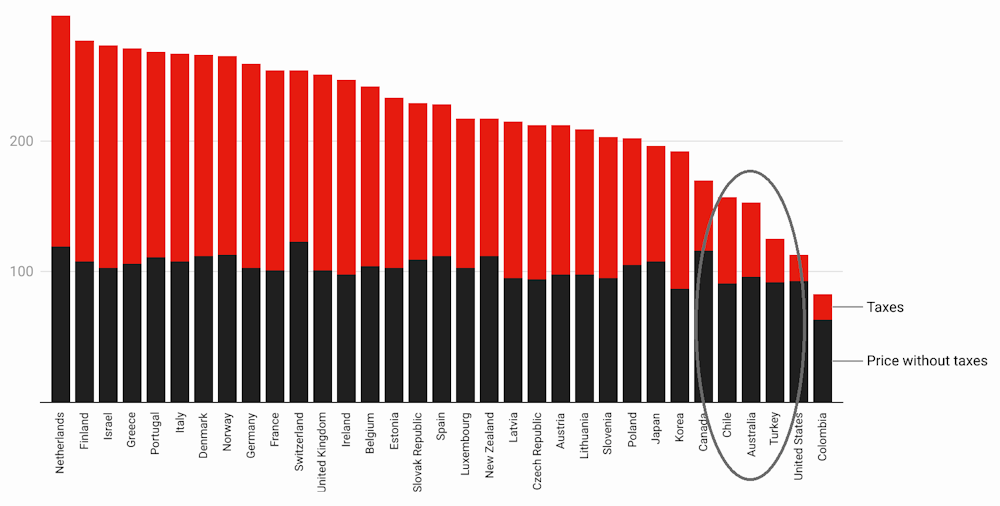
Australian petrol prices are at record highs, but by international standards they are still unusually low; the fourth-lowest among the 33 OECD nations graphed by Australia’s Bureau of Resource & Energy Economics – above only Turkey, the United States and Columbia.

The chief reason is tax, In December taxes (fuel excise plus GST) accounted for only 37% of the price of Australian unleaded petrol, compared to 48% of New Zealand petrol and 60% of German and UK petrol.


Low by international standards

Retail unleaded price (Australian cents per litre) Department of Industry, Science, Energy and Resources

There are good reasons for taxing Australian motorists more. Higher taxes would better reflect the cost of roads and road repair and the environmental damage wrought by cars.

That’s not likely to happen right now – although in 2014 the Coalition reintroduced indexation in the face of surprising opposition from the Greens, ensuring fuel tax at least increased in line with prices. But it suggests there’s little room to cut taxes.

If access to Russian oil remains difficult and prices don’t return to where they were, we will move away from using petrol faster, either by making adjustments such as working more from home or by buying cars that are more efficient or more electric.

It’ll be a bizarre and largely welcome byproduct of war in Ukraine, perhaps the only welcome one. It’ll increase the value of takeover target AGL, Australia’s largest electricity supplier, and speed us on our path to zero emissions and energy independence. It’ll get us where we are going sooner.

Peter Martin, Visiting Fellow, Crawford School of Public Policy, Australian National University

This article is republished from The Conversation under a Creative Commons license. Read the original article.

Read more >>

Sunday, November 02, 2014

Sunday Explainer. Why we will pay more for petrol, even though Parliament said no

The excise on petrol is set to go up in line with inflation despite the government not having taken the policy to the election or having the support of  Parliament. Peter Martin examines the case for and against.

First, the history. Why do we tax fuel at all?

To pay for roads and the costs of maintaining them. We've been doing it since 1929.

Has the money raised actually been spent on roads?

That was the law from 1929 to 1959, but it has been the practice all along. In July the Productivity Commission reported that in 2011-12 total road expenditure by all levels of government amounted to $19.5 billion. The revenue collected from fuel excise, registration charges, driver's licence fees and stamp duty amounted to $16.5 billion.

It's called an excise, not a tax. What's the difference?

A tax is levied on the price of something. The goods and services tax is levied at a rate of 10 per cent. Income tax is levied at rates of 19 per cent, 32.5 per cent, 37 per cent and 45 per cent. An excise is levied on the amount of something. In case of the alcohol in full-strength beer it is $46.30 per litre. In the case of tobacco it is 50.8 cents per gram. In the case of petrol it is 38.1 cents per litre.

As prices go up wouldn't the impact of the excise shrink?

That's why every so often the government used to announce one-off hikes in excise. The typical budget headline read: "Beer, smokes, petrol up". Then, in 1983, prime minister Bob Hawke made the process automatic. From then on, every February and August the excises on tobacco, alcohol and petrol climbed in line with inflation.

Did you say petrol? Did the rate of petrol excise climb with inflation?

It did until 2001 when prime minister John Howard froze it where it was at 38.1 cents per litre. He was trying to head off criticism of his recently introduced GST.

So as a proportion of price the fuel excise has been shrinking?

Too right. When John Howard froze the excise in 2001 the petrol price was $1 a litre making the tax rate 38.1 cents in the dollar. Petrol is now near 150 cents, making the tax rate only 25 cents in the dollar. Unless indexation is reintroduced the tax rate will fall even further.

So the government is undoing a decision of John Howard's and reinstating a decision of Bob Hawke's?

Exactly, and it is happy to sing Hawke's praises. "We have simply done what Bob Hawke did," prime minister Tony Abbott told the parliament on Wednesday. "Bob Hawke was a real Labor leader, Bob Hawke was someone who was prepared to put the national interest ahead of short-term politicking," he told the leader of the opposition.

What about the politicking? How have Labor and the Greens justified opposing the reintroduction of indexation?

They say that it is a new tax, and that Abbott promised no new taxes. And they say that it hits low income Australians the hardest, which is does despite the treasurer's assertion that "the poorest people either don't have cars or actually don't drive very far in many cases". As a proportion of income, low-income Australians spend much more on petrol than high-income Australians.

And the Greens are concerned that the legislation 'sets aside' the extra revenue for spending on roads. But the provision is fairly meaningless. The government spends much more on< roads than the extra revenue already. When the government offered to withdraw the provision the Greens wouldn't budge, so the government left it there and used regulations to get around Labor and the Greens.

What will the regulations do?

The regulations will lift the excise on petrol in line with inflation just as the legislation would have. The regulations will lapse unless they are validated by the parliament within 12 months.

Can the government do that - impose tax increases without the approval of parliament?

Yes. Whenever beer, cigarettes and petrol were slugged in budget nights past, the excise went up at midnight on the night of the budget. A delay would have encouraged a run on supplies. This time the provision isn't being used to stop a run on petrol stations - it is simply being used to get around the parliament.

The increase will take effect on Monday, November 10, so it could be worth filling up the evening before. But it won't be worth much. The first increase will take the excise from 38.1 to 38.6 cents per litre. The November hike will lift the price of a tank of petrol by around 25 cents.

What if the parliament withholds its consent?

After 12 months the money would be returned to the petrol manufacturers and importers.

Is the parliament likely to withhold its consent?

Not likely. It would be hard to justify handing to oil companies money that was effectively collected from their customers.

Does that mean the Senate will cave in and pass the government's legislation?

Not at all. It could simply validate the government's regulation so as not to hand money back to oil companies but still refuse to pass the legislation that would reintroduce indexation. The government would have to regulate one year at a time, with embarrassing consequences. Each year it would be hit with headlines saying "fuel tax up", the sort Bob Hawke's system of automatic adjustments was designed to avoid.

Abbott said after a year it'll cost the average family just 40 cents extra a week. Is he right?

No. He misspoke. It will cost the average household an extra 40 cents per week. But the average family is bigger than the average household. Many households contain just one person. It'll probably cost the average family an extra 55 cents per week.

In The Age and Sydney Morning Herald
Read more >>