Showing posts with label real estate. Show all posts

Tuesday, May 16, 2023

4 ways to bring down rent and build homes faster than Labor’s $10 billion housing fund

Treasurer Jim Chalmers is the first in decades to declare war on what he calls the “pain of rising rents”.

His first budget, in October, and his second, this month, contained a suite of measures designed to stop rents going “through the roof”. By far the biggest of those – the blockbuster – was a A$10 billion Housing Australia Future Fund to finance social and affordable housing.

If you think the idea of building a fund rather than building houses sounds odd, you probably think the same way about the Medical Research Future Fund, the Future Drought Fund, the Disaster Ready Fund or the $250 billion Future Fund itself, which was set up to pay public service and defence pensions.

Those were all previous Coalition government ideas – the likes of which were satirised by ABC TV’s The Hollowmen which in 2008 came up with the idea of a $150 billion National Perpetual Endowment Fund, created for no particular purpose other than “to meet the future challenges of this nation”.

I can think of at least four things that would do more to restrain rents than Labor’s $10 billion fund – and one of them would do it a lot quicker.

$10 billion, but off-budget and largely unspent

The (political) genius of these sorts of funds is they make it look as if you are spending a lot, without the need to spend much at all.

The $10 billion (or whatever that goes into the fund) isn’t actually “spent” as far as the budget is concerned. It doesn’t come off the budget surplus, or add to the budget deficit, because it remains in the government’s hands.

The fund can be thought of as a fiction. The money stays in the government’s hands until some of it is spent, except that while in the government’s hands it is invested in the stock market and other places to try and earn a return. It doesn’t always work. During 2022 the usually successful Future Fund went backwards.


“Rear Vision”, The Hollowmen, ABC.

When Labor came up with the idea of the Housing Australia Future Fund in 2021, it looked a surer bet. Governments could borrow at “ultra-low interest rates” and the returns on investments were good.

To “protect the balance of the fund”, the government has limited withdrawals to $500 million per year, meaning a less-grand-sounding commitment to spend up to $500 million a year would have achieved just as much.

Housing Minister Julie Collins’ counter to that criticism is to say that creating a fund – an “enduring promise” – will protect housing spending from the “whims of future governments”

And yet the legalisation says every piece of spending from the fund will require formal government approval.

Another reason for limiting the amount that can be spent each year (apart from protecting the balance of the fund) is that there are practical limits on how quickly homes can be built.

Limits on how quickly new homes can be built

A truly bizarre and long-established fact of Australian home building is that it never gets done more quickly. If you went back to the 1990s, the 1980s or even the 1970s, you would find that the number of houses completed per quarter was roughly what it is today, between 22,000 and 29,000.


The number of houses under construction varies wildly; at times it has been low, late last year it reached an all-time high. But the number of houses completed seems to chug along at the same rate regardless. All that commencing more builds does is push out construction times.

It’s the same for units, which the Bureau of Statistics classifies as “other residential”. The number being completed per quarter is no higher than it was a decade ago, but the number under construction has climbed much higher.


All that funding more than a small number of extra builds per year would do is push construction costs higher and push out completion times.

The Australian Greens might well be right to oppose the artifice of a “fund,” but they are probably wrong to propose much more spending per year than the $500 million the government is promising and the 30,000 extra homes over five years it says it will deliver.

I can think of at least four things that would restrain rents more than the fund, one of which Chalmers has delivered in the budget, albeit in a small dose.

1. Boost rent assistance

The “largest increase in more than 30 years” in Commonwealth Rent Assistance amounts to $16 per week.

It’ll help the 1.3 million concession card holders who receive it. But it is not much, and not much more in the future, because Chalmers has not acted on the recommendation of his economic inclusion advisory committee to increase it in line with rents actually paid, rather than the consumer price index.

Chalmers might well have been concerned that a bigger increase in rent assistance would have pushed up rents, but there’s a way of dealing with that.

2. Limit rent increases

Price control is anything but uncommon. In most states, increases in the prices we can be charged for electricity, gas and water are limited by regulation. In the Australian Capital Territory, increases in rents are limited by regulation.

The maximum permitted increase is 110% of the most recent annual increase in Canberra rents reported to the Bureau of Statistics. In the year to March, Canberra rents climbed 5.54%, making the maximum permissible increase 6.1%.

It works well, and Canberra landlords don’t seem to have withdrawn from the market. Among Australia’s capitals, Canberra’s rental vacancy rate is the highest.

3. Bribe states and councils to rezone land

Another option is to provide incentive payments to state and local governments that free up their planning systems and build more housing.

Conditional payments are not novel. The Commonwealth provided special payments to states that fell in line with its deregulation agenda for about a decade from the mid-1990s.

4. Restrict negative gearing to new builds

Negative gearing and the concessional rate of capital gains tax that accompanies it drive Australians into becoming landlords. But if they buy existing homes to do it, they do no more than turn owner-occupied homes into rented homes.

Limiting negative gearing to newly-built homes – as Labor promised in 2019 – would get them to fund new builds.

While it’s true that getting more Australians into affordable homes is anything but easy, some of what we need to do is straightforward. We can do better than a grand-sounding big-bucks fund.The Conversation

This article is republished from The Conversation under a Creative Commons license. Read the original article.

Read more >>

Tuesday, April 11, 2023

What made rents soar? It might have been COVID, and pairing off

So, you think you know why rents climbed.

You probably think was skyrocketing interest rates and a tsunami of migration.

It’s true that interest rates have jumped more over the past year than at any time on record, and it’s true that migration has roared back – in the six months to September 2022 (the latest month for which we’ve official figures) arrivals exceeded departures by 170,000.

But here’s the thing. Advertised rents began climbing sharply in late 2021 – six months before the Reserve Bank began pushing up interest rates, and at a time when it was forecast not to.

And “net migration” was negative back when rents were taking off – meaning the number of arrivals didn’t even match the number of departures.

It’s supply and demand

Something else made rents move.

As it happens, there’s no particular reason to think interest rates would have quickly affected rents even if they had been climbing. If higher rates force some landlords to sell, and they sell to other landlords, the number of properties for rent won’t change. If those landlords sell to owner occupiers who would otherwise rent, they cut both the number of rental properties and the number of renters.

What matters for rents, as for any price, is the demand for and the supply of the product being priced. More demand (more renters wanting properties) and the price climbs. More supply (more properties available for rent) and the price falls.

On the face of it, neither demand nor supply was changing much during COVID as rents started climbing. Australia’s population was growing more slowly than at any time in modern history. And, as best as we can tell, the number of properties available for rent was climbing, albeit weakly.

What did change during COVID, according to the research department of the Reserve Bank, was the average number of people per household.

The change doesn’t sound big – the average fell from a bit above 2.6 residents per household to a bit below 2.55 – but applied to millions of households it meant about 140,000 more houses and apartments were needed than would have been.


Average household size (capital cities)
Average number of persons usually resident in an occupied private dwelling, trend and actual. RBA, ABS

The sudden change was awfully for hard for the building industry to respond to, especially when it was laid low by COVID.

Why did we suddenly want to live with fewer people?

The head of the Bank’s economic division, Luci Ellis, thinks it was COVID itself, and lockdowns. We suddenly became more precious about sharing space.

‘Love the one you’re with’

Ellis says proportion of Australians living in group houses declined and stayed low. Faced with the choice of living with a large number of housemates and just one other person, perhaps a romantic partner, a lot of renters left group houses and shacked up with each other.

As she put it last year:

On the question of who you would rather be locked down with, at least some Australians have voted with their removalists’ van, by moving out of their share house and in with their partner.

There’s more to it of course, but where the supply and demand for anything are roughly in balance (rents had been increasing by less than 1% per year in the four years before COVID, and fell in the first year of COVID) any sudden change in either supply or demand can move prices quickly.

Advertised rents aren’t typical …

Having said that, for most renters prices are still moving slowly. Advertised capital city rents are up 13% over the past year, and advertised regional rates up 9%. But average rents (the average of what all renters pay) are up only 4.8%.

The rents charged to ongoing tenants climb much more slowly than the rents charged to new tenants, in part because landlords often like their tenants, and in part because for the first year renters are usually on fixed contracts.

But over time as renters move home, and landlords become less squeamish, more and more renters tend to pay the rents advertised. It makes the increase in advertised rents an unwelcome sign of what’s to come.

… but they’re a sign of rents ahead

And it might get worse. Reserve Bank Governor Philip Lowe says population growth is set to climb to 2% – near the peak reached during the resources boom.

We won’t be able to build houses anything like that fast. Lowe says the last time Australia’s population surged it took about five years for housing supply to fully respond to housing demand.

We’ve ways of dealing with it of course. One is to re-embrace group homes, another is to delay moving out of our partents’ homes, or to move back in.

But even if this does happen, Lowe says, with typical understatement, that rent inflation – ultra-low before COVID – is likely to stay “quite high” for some time.The Conversation

This article is republished from The Conversation under a Creative Commons license. Read the original article.

Read more >>

Wednesday, October 27, 2021

Now it’s Liberals telling us we are going to have to cut the capital gains tax concession if we want to get Australians into homes

NSW is doing what Labor’s Bill Shorten could not – explaining why Australia’s capital gains tax concession is knocking first home buyers out of homes.

Shorten went to the 2016 and 2019 elections with a plan – Labor would halve the capital gains tax concession used by landlords who buy and sell properties.

In much the same way as he was unable to sell his (now modest by international standards) plan to make half of all new car sales electric by 2030, he was pilloried by Morrision and before him Malcolm Turnbull for a policy they said would smash house prices.

All Shorten was proposing was to wind back the capital gains tax exemption (which exempts from tax half of each profit made from buying and sell real estate and other assets) for future transactions only. The exemption would stay in place for everything already bought.

In the face of an overblown debate about whether or not it would smash house prices (Morrison’s department had quietly warned such claims were “not consistent with our advice”) the Labor leader found himself defending modelling about prices rather than outlining what his policy would actually do.

And he lost, twice.

Now, as we prepare for yet another election, the NSW Coalition government has done what Australia’s Labor opposition could not – make a cogent argument for winding back the capital gains tax concession, saying it “pushes first home buyers out of the market”.

Elbowing first home buyers aside

In a submission placed quietly on the federal government’s housing inquiry website late last week the NSW government argued that if the concession was cut, housing would be used “more for accommodation needs than investment needs”.

Here’s the line of thinking it set out, the line Shorten was never able to get across.

The income made from capital gains – from buying something, holding it, then selling it at a profit – is taxed differently from the income made from work or running a business. Only half of it is taxed.

Prime Minister John Howard and his treasurer Peter Costello were responsible for the change, introduced in 1999 in the leadup to the introduction of the goods and services tax in 2000, but with less fanfare.

Before then capital gains were taxed in the same way as other income (what they are subject to is income tax, there is no such thing as a separate capital gains tax).

But before then only the portion of each gain over and above the rate of inflation was taxed, so that people weren’t taxed on a profit that would have no real value.

The change, introduced after an inquiry that found it would “encourage a greater level of investment, particularly in innovative, high-growth companies” was to instead tax only half of each capital gain.

It was sold as a small change. A few years earlier, inflation had been big, around 8% per year, meaning that after five or so years only half of each profit would have been taxed in any event.

But inflation had since dived to a barely-noticeable 2%, where it has stayed for most of the past 20 years, making a guaranteed exemption from tax of half of each capital gain made trading property way over the odds.

It was, as economist Rory Robertson told his clients at the time, “almost as though the Australian tax system has been screaming at taxpayers to gear up to earn increased capital gains rather than to work harder to earn increased wages”.

Instead of pouring into high-growth companies, as Howard’s inquiry said it expected, the money flooded into housing, which was easier to borrow for.

Rushing into real estate rather than shares

As Reserve Bank assistant governor Luci Ellis told a parliamentary inquiry, it was “more profitable to negatively gear property, because you can gear it more”.

To buy properties quickly, real estate investors needed to buy properties that would have otherwise been bought to live in.

It pushed up prices, but that wasn’t all it did.

As the NSW submission to the current housing inquiry says, the most significant impact was “the displacement of owner occupiers (including first home buyers) from home ownership by tax-advantaged investors, predominantly those already on higher incomes”.

In its words

by encouraging investors to buy and hold property, the 50% capital gains discount increases investor demand for housing and pushes first home buyers out of the market

Before capital gains tax was halved and Australians dived into becoming landlords, more than 70% of Australian households owned the home in which they lived and one quarter rented.

At the latest count (itself four years old) only two thirds owned the place in which they lived and one third rented.

Labor has new friends

And properties are less well used. Because income from rent is no longer the chief motivation for holding property (these days most rental properties make a rental loss whereas before the capital gains tax change most made a profit) the NSW government believes more are remaining empty.

Now, when the capital gains from holding properties can be measured in hundreds of dollars per day, it would be an ideal time to wind back the capital gains tax discount. Its absence wouldn’t much hurt.

And it’s easy to forget that wasn’t what Labor was proposing. Shorten (twice) put forward something far more modest – leaving the tax discount for existing investments untouched and halving the discount for future investments.

It’s no longer Labor policy, but it was backed by the head of the Coalition’s Commission of Audit and the head of its financial system inquiry.

And it was of interest to the Business Council of Australia which pointed out that the discount “can distort investor behaviour, particularly at a time of rapid capital gains, such as in a housing or equity boom”.

Morrison’s opposition to it was hard to justify at the time. It’s harder now.

Peter Martin, Visiting Fellow, Crawford School of Public Policy, Australian National University

This article is republished from The Conversation under a Creative Commons license. Read the original article.

Read more >>

Wednesday, October 13, 2021

As home prices soar beyond reach, we have a government inquiry almost designed not to tell us why

Never has an inquiry into the skyrocketing price of homes been more urgent.

Rarely has one been as insultingly ill-suited as the one under way right now.

Midway through last year in the midst of COVID, the average forecast of the 22 leading economists who took part in The Conversation mid-year survey was for no increase in home prices whatsoever in the year ahead (actually for slight falls).

At that time the typical (median) Sydney house price was A$1 million, where it stayed until the end of the year.

Then it took off. In the ten months to the start of this month the typical Sydney house price soared $300,000 to $1.3 million – a breathtaking increase (and an awfully big penalty for delaying buying) of $1,000 each day.

For apartments, the increase isn’t as big, although still extraordinary. The cost of delaying buying a typical Sydney apartment has been $334 each day.

The cost of delaying buying a typical Melbourne house has been close to $600 per day, the cost of delaying buying a typical Melbourne apartment $150 per day.

In that time, in the year in which the typical Australian home price climbed 20.3%, the typical Australian wage climbed just 1.7%

What people stretched to the limit or now locked out of the housing market are desperate to know is

  • why it is happening

  • when it is likely to stop

  • what (if anything) we can do about it.

Instead, we have been given an inquiry into affordability in name only. Seriously. The parliamentary inquiry commissioned by the treasurer in July and chaired by backbencher Jason Falinski is called an inquiry into affordability and supply, but the word “affordability” appears in none of its three terms of reference.

It’s an inquiry into ‘supply’

Instead, the terms of reference refer to the impact of taxes, charges and other things settings on “housing supply”.

I guess the idea is that it is obvious that supply is the key to affordability, but it rather negates the idea of holding an inquiry, and it sits oddly with the explosion in prices we have seen in a year in which building approvals have surged by a near-record 224,000 and our population has as good as stayed still.

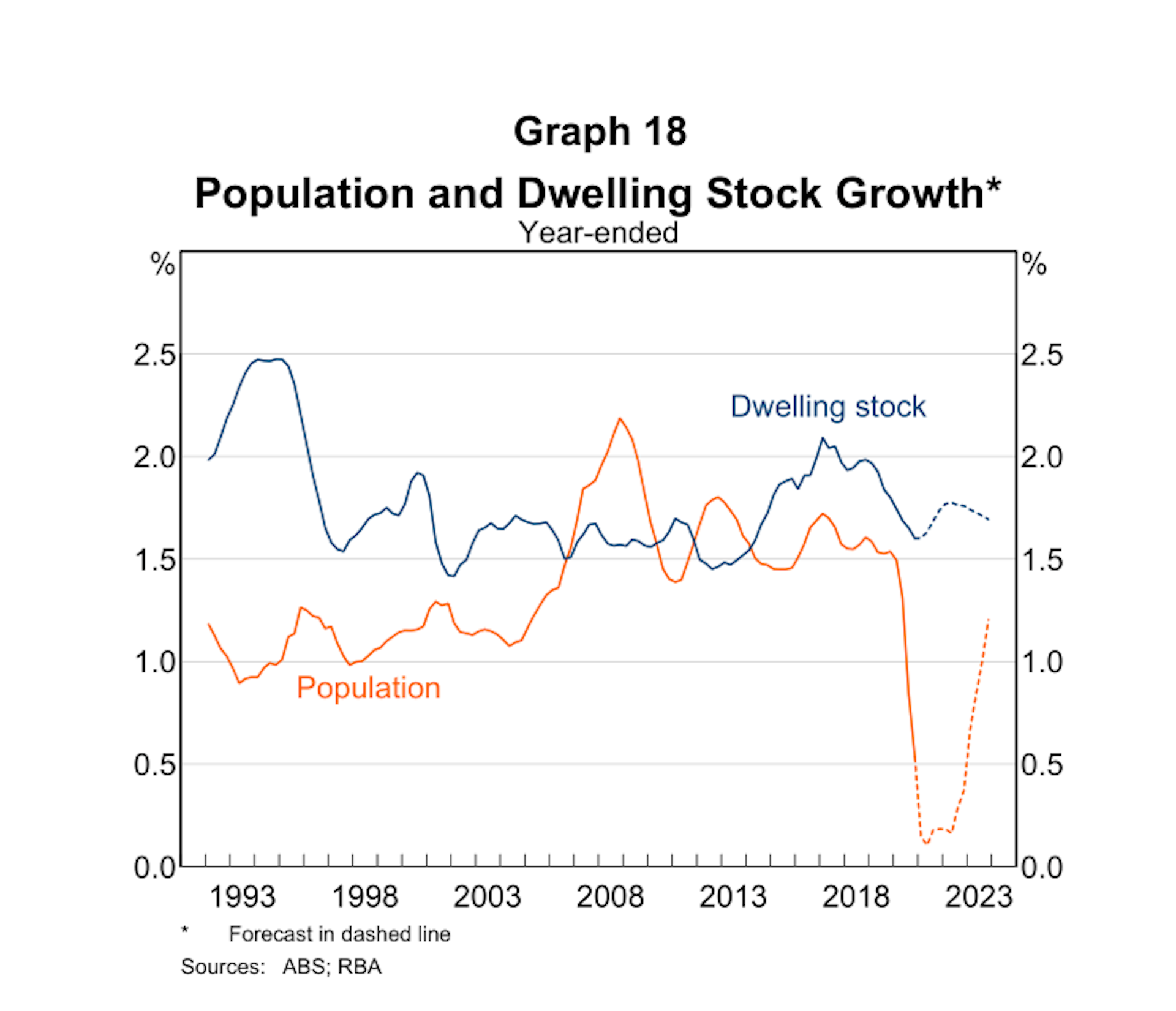
In its submission to the inquiry the Reserve Bank includes a graph showing the supply of housing (the stock of houses and apartments) outpacing population growth for the best part of the decade leading up to the latest price explosion.

Supply has been holding up

But in a sense (and stay with me here) whoever drafted the restricted terms of reference is right. Housing affordability is linked to the supply of housing.

And housing affordability has been doing okay.

In evidence to the inquiry last month Treasury assistant secretary John Swieringa drew a distinction between housing affordability (best measured by the cost of renting housing) and the cost of buying a house, which was partly an investment.

When you are a purchaser of a house you are partly investing in an asset and partly buying dwelling services; whereas when you are renting it’s probably a cleaner read on what cost dwelling services is.

That clean read – rent as a proportion of income – hasn’t much changed in 20 years. For middle earners it has remained comfortably between 20% and 25% of household disposable income.

The Reserve Bank says advertised rents for units in Sydney and Melbourne have drifted down by $30 to $50 per week over the past five years while rents in other places have mostly drifted higher.

As it happens, it says another measure of housing affordability is improving.

The cost of home loan payments as a proportion of income has been falling since the onset of COVID. Dramatically lower interest rates mean payments take up less household disposable income than they did five years ago, even with the much higher prices.

The problem is accessibility

What has worsened is what the Reserve Bank calls “housing accessibility”, to distinguish it from housing affordability.

Accessibility is the ability of a first time owner or renter to get into the market at all by finding the deposit or bond.

Astounding price growth and five years of weak income growth have pushed up the cost of an average first home deposit from 70% of income to more than 80%.

On average it now takes a 24-35 year old nine years of tucking away one fifth of their income each year to save for a typical Sydney deposit, up from five to six years a decade ago.


Average First Home Buyer Deposit

Owner-occupier; estimated as a share of average annual household disposable income using average first home buyer commitment size and assuming 20 per cent deposit. Seasonally adjusted and break-adjusted. RBA, ABS

It’s okay if you have a parent who can get their hands on money, almost impossible if you don’t. In the words of former Reserve Bank official Peter Tulip, it’s making home ownership hereditary.

He’s not the first person to have noticed.

Liberal backbencher John Alexander chaired the Coalition’s 2015 inquiry into home ownership. He said then we were “on track to becoming a Kingdom where the Lords own all the land and the biggest Lord will be King and the enslaved serf tenant is paying rent to the Lord to become wealthier”.

Ownership is becoming hereditary

Prime Minister Turnbull and Treasurer Scott Morrison used the 2016 election (in which they attacked Labor’s plan to limit tax breaks for landlords) to shut down Alexander’s inquiry, and only agreed to restart it with someone else as chair. It had considered 30 hours of evidence.

The chair of this current (limited) inquiry seems unperturbed.

He opened September’s hearings saying no question was off-limits, no idea too stupid, all forms of inquiry were worthwhile. It’d be great if that was true.

Peter Martin, Visiting Fellow, Crawford School of Public Policy, Australian National University

This article is republished from The Conversation under a Creative Commons license. Read the original article.
Read more >>

Wednesday, June 02, 2021

Paying off a home loan used to be easier than it looked. It's now harder. Here's why

So you think it’s the right time to dive in and buy a home.

I can’t tell you you’re wrong. I can tell you it would have been better to do it before prices began soaring, and that if they keep soaring it will get worse still.

When the year began, the typical Sydney price was $872,000. Five months later at the start of June it is $970,000.

That’s a jump of almost $100,000 in a matter of months — an awfully big price for procrastinating.

In Melbourne the typical price has climbed from $682,000 to $740,500. In Perth it has climbed from $471,000 to $521,500, and so on.

And banks are beginning to withdraw the cheapest of their still-very-cheap mortgage rates, at this stage mainly the fixed four-year rates which had been below 2%.

So why on earth wouldn’t you dive in, cut your living expenses to the bare minimum and try and buy a home while it’s the least bit possible?

One (slight) reason to relax is mortgage rates. Despite the increases in fixed four-year rates, three-year rates have barely moved. That’s because the Reserve Bank has promised to hold the three-year bond rate constant at 0.1%.

Buying has become a bigger commitment

The three-year bond rate determines the cost to banks of their three-year fixed rate mortgages.

The Reserve Bank has said it does not expect to lift its 0.1% cash rate until “2024 at the earliest”. Movements in the cash rate determine movements in variable mortgage rates.

But there is another reason for proceeding with caution and taking stock.


Read more: Home prices are climbing alright, but not for the reason you might think


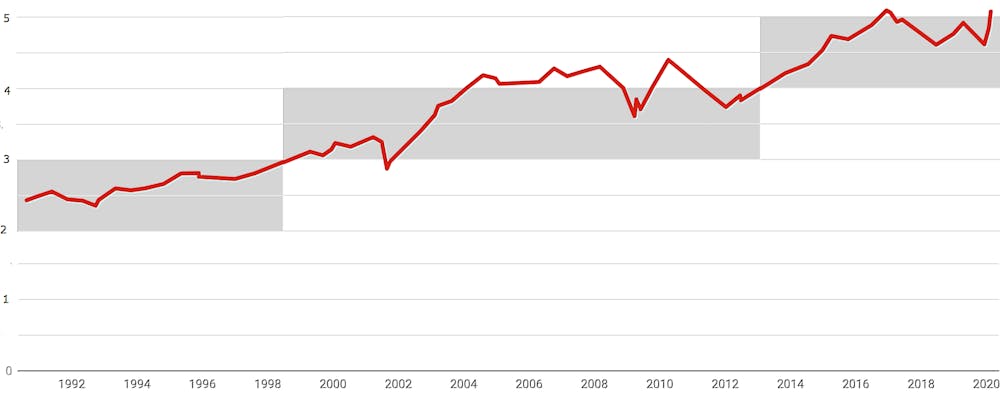
For our parents, buying a home was an exceptionally good deal, not only because homes were cheaper — until the end of the 1990s homes typically cost between two and three times household after-tax income, they now cost closer to five — but also because over time the loan became easier to pay off.


Housing prices as proportion of household disposable income

Household disposable income after tax, before the deduction of interest payments, including income of unincorporated enterprises. Core Logic, ABS, RBA

That isn’t because mortgage rates were coming down — at times they were going up — it’s because during our parents’ times wages (and prices) were climbing.

It meant that even if someone of our parents’ generation just squeaked through one of the bank’s tests about their ability to make payments on a mortgage, a few years and lots of inflation and several big wage rises down the track those mortgage payments shrank compared to everything else.

Once, wage rises took care of repayments

Many of our parents paid off their mortgages early.

One way to look at this is that the bank’s ability-to-repay calculators were set too harshly. They failed to account for future hefty wage rises and inflation.

It’s probably also true that they were set more generously than they might have been in an implicit acknowledgement of what the assistant governor in charge of the Reserve Bank’s economic branch Luci Ellis calls “mortgage tilt”.

The former governor, Glenn Stevens, used another term, “front-end loading”.

Mortgages were ‘front-end loaded’

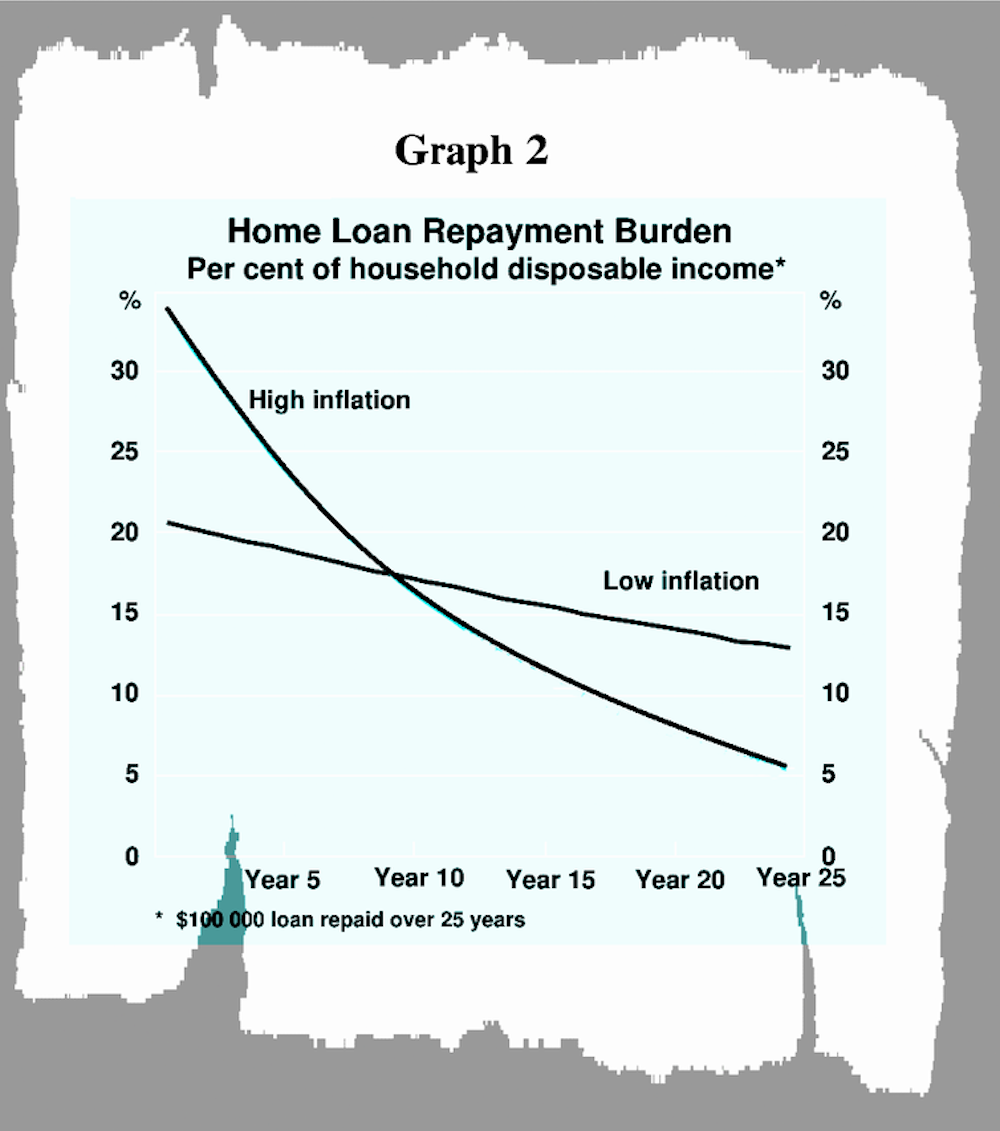
When inflation was high, and as a consequence interest rates were high, wages that climbed rapidly with high inflation made the servicing burden “most acute in the very early phase of a loan, falling over time”.

On a graph (and the former governor presented a graph) the line showing payments as a portion of income tilts down over time.

In a world of lower inflation and interest rates, the tilt becomes flatter.

By now (Stevens published the graph in 1997) the line must be near horizontal.

If wage growth remains near the record lows the treasury is forecasting it will become scarcely any easier to make payments on a home loan over time.

Yet the banks are still handing out loans using the sort of formulas they used to.

If you get a loan you’ll be assessed as being able to (just) make the payments as always, but you’ll be denied the near certainty of being able to more easily meet the payments as time goes on.

Now, we retire mortgaged

This is a different from the risk you’ll also run of today’s ultra-low mortgage rates climbing (which banks do take into account in deciding whether to give you a loan).

The proportion of homeowners reaching retirement age while still paying off their mortgage has doubled in 20 years. Which might be why some banks ask for details of your super before granting you a loan. It isn’t an idle inquiry.

Might things get better? Maybe, if we can get wages moving again.

Evidence given to Tuesday’s post-budget Senate estimate hearing provides cause for hope, and despair.

Super hikes will make things worse

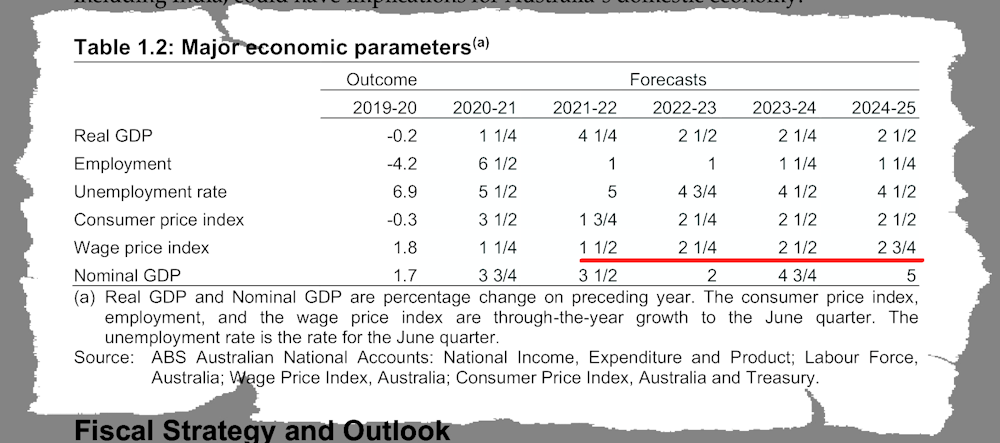
The budget forecasts for wage growth over the next four financial years are incredibly low — 1.5%, 2.25%, 2.5% and 2.75%

On Tuesday Treasury Secretary Steven Kennedy revealed that each would have been higher — 0.4 points higher — had the government not persisted with the five scheduled annual increases in compulsory superannuation contributions of 0.5% of salary starting in July.

The treasury believes each increase will slice 0.4 percentage points from wage growth, on the basis that employers, who are legally required to pay the contributions, will have to find the money somewhere.

Commonwealth budget, 2021-22

It’s the same conclusion reached by the government’s retirement incomes review.

It’s cause for hope because it means that when those five increases stop (in mid-2026, or sooner if the government stops them mid-track) wages might be able to grow more strongly.

It’s cause for despair because if the treasury is right, we are denying ourselves wage rises we could use in return for super we will increasingly use to pay down our mortgages.

Peter Martin, Visiting Fellow, Crawford School of Public Policy, Australian National University

This article is republished from The Conversation under a Creative Commons license. Read the original article.
Read more >>

Wednesday, April 14, 2021

Home prices are climbing alright, but not for the reason you might think

It’s tempting to think home prices are soaring because there aren’t enough homes.

But that can’t explain the sudden takeoff from about the year 2000, the sudden takeoff from about 2013, and again now – against expectations – the stratospheric takeoff in the wake of the COVID recession.

Broadly, we’ve enough homes. The 2016 census found we had 12% more dwellings than households, up from 10% in 2001.

That’s 12% of our houses and apartments empty – used as holiday homes and second homes, or waiting for tenants.

If there really weren’t enough homes for people who wanted them, it would be more than property prices soaring; it would be rents.

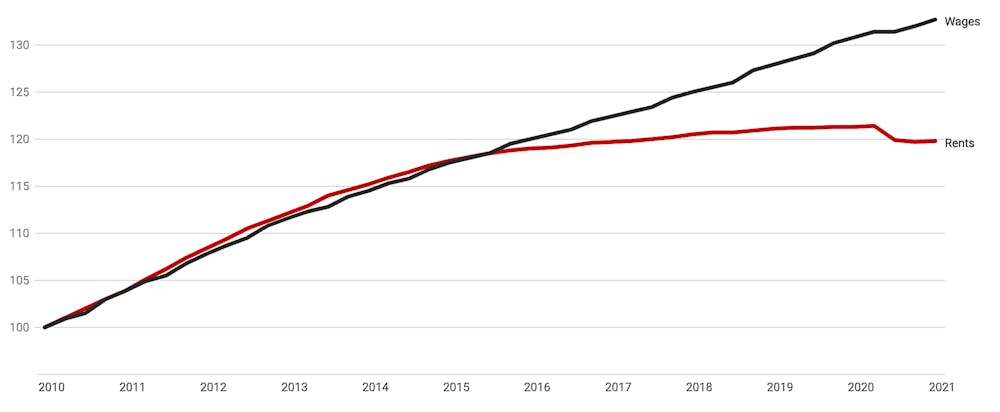
Instead, overall rents have been barely moving – growing even more slowly than wages – for half a decade.


Rent price index versus wage price index

December 2009 = 100. ABS Wage Price Index, Rent Price index from Consumer Price Index

For the half-decade from 2016, a half-decade in which Australia’s population grew by more than one million, Australian rents barely moved.

The supply of places to live in has kept pace with the demand for places to live in, but the supply of places to own has not.

More landlords, more tenants

If that sounds odd, remember people want to own houses for reasons other than living in.

Since about the year 2000, big numbers of Australians (and foreigners) have wanted to buy them to rent them out. They’ve wanted to become landlords.


Read more: Rents, not prices, are best to assess housing supply and demand


Twenty years ago only one in 15 of us were landlords. It’s now one in ten – more than two million of us.

To get those properties (other than where they’ve built them) they’ve had to outbid at auction the people who would have bought them to live in.

They’ve been helping create their own tenants, while pushing up prices.

We’re chipping away at Menzies’ legacy

From when Robert Menzies stepped down as prime minister in 1966 until the end of the 20th century, about 71% of Australian households owned the home they lived in – one of the highest rates in the world.

Since about 2000, owner-occupation has been sliding. The latest figures (themselves some years old) put it at 66%.

Among those aged 35 to 44, it has fallen to 63%

Over that time the cost of buying a home has shot up from two to three years’ household after-tax income to three to four years’ income.


Housing prices as proportion of household disposable income

Household disposable income after tax, before the deduction of interest payments, including income of unincorporated enterprises. Core Logic, ABS, RBA

What appeared to set things off was a decision by Prime Minister John Howard in 1999 to halve the headline rate of capital gains tax. Not that the committee he asked to investigate the idea recognised the possibility at the time.

The Ralph Review recommended that half, rather than all, of each capital gain be taxed, rather than the portion above inflation as had been the case since capital gains were first taxed.

The rationale was that this would “encourage a greater level of investment, particularly in innovative, high growth companies”.

A rush into property rather than high-tech companies

The review was right about the change encouraging investment, but wrong about the sort of investment.

Rather than buy shares in innovative companies, Australians bought rental properties like they never had before.

If they bid enough, they could borrow enough to negatively gear; to make sure their interest charges exceeded their income from rent, giving them annual losses they could offset against wages that would otherwise be taxed at high rates.


Read more: When houses earn more than jobs: how we lost control of Australian house prices and how to get it back


There was nothing new about negative gearing. It had been permitted from the beginning. What was new was the opportunity to later sell the property at a profit, knowing only half of the profit would be taxed.

Investors could offset all of their losses and be taxed only half their eventual gain.

Pretty soon, more than a third of the money lent for housing each month went to landlords. For several dizzying months during 2015 it was 45%. First home buyers struggled to compete.

In 2016 then treasurer Scott Morrison raised the prospect of winding things back, saying negative gearing had led to “excesses”.

APRA cleared up what our leaders could not

Labor went to two elections promising to do just that and the Coalition came out in support of the practice in public.

Behind the scenes, the Australian Prudential Regulation Authority was using its power over lenders to force lending to landlords down, getting it down ahead of COVID to 27% of new housing loans.

APRA succeeded in taking the pressure off prices where politicians couldn’t.

But that’s far from the whole story. There are other more deep-seated reasons why house prices are climbing, and they too have little to do with demand for accommodation.


Read more: Zoning isn’t to blame for Australia’s soaring house prices


Prices took off again from about 2014, shifting up from three to four years’ household income to between four and five years. That time it was Australians getting richer after years of mining booms and being able to borrow more cheaply.

Houses in general mightn’t be a good investment (there being a regularly increasing supply) but houses in prime positions were in fixed supply, there being only so many good locations.

And then it fed on itself. The father of modern economics John Maynard Keynes described investing as a game in which the best strategy is not to put money into what you think is worthwhile, but to put money into what you think other people will think is worthwhile.

It’s happening again

He spoke of a third degree, where “we devote our intelligences to anticipating what average opinion expects the average opinion to be”, and added there might be fourth, fifth and higher degrees.

It’s happening again. With mortgage rates at new extreme lows and wealthier Australians having come out of the crisis with their wealth intact, it makes sense to do what others are doing and push up prices to buy before others push them up further.

It’s nothing to do with a shortage of housing, but for many it will push home prices further out of reach. That’s because in Australia housing is two things: accommodation and a form of speculation.

Peter Martin Saturday AM with Linda Motram April 17 2021.

Peter Martin, Visiting Fellow, Crawford School of Public Policy, Australian National University

This article is republished from The Conversation under a Creative Commons license. Read the original article.
Read more >>

Tuesday, March 13, 2018

Housing risks 'catastrophic': Grattan Institute

Australia’s eight-year house price boom has savaged the living standards of poorer Australians while so far leaving the wealthy untouched, a new Grattan Institute analysis finds.

But the report, to be released on Monday, warns of a “catastrophic” impact on all income groups should mortgage rates rise by more than a few percentage points.

The institute’s chief executive, John Daley, said Australians who already owned their houses had been little affected by soaring prices to date because they had been “hedged”. If they moved, they could buy again for about the price they got when they sold. Property investors had done well out of the explosion in Sydney and Melbourne prices because they had always been planning to sell.

But new buyers had been locked out.

Home ownership had plummeted among Australians aged 25 to 34, sliding from 61 per cent in the early 1980s to just 44 per cent in the most recent census. Ownership among Australians aged 35 to 44 had plunged from 75 to 62 per cent.

Although ownership rates among older Australians had held up to date, outright ownership was slipping. The proportion of Australians aged 55 to 64 who own houses mortgage-free has slipped from 72 per cent to 42 per cent since the late 1990s. The proportion of Australians aged 65 and older who are mortgage free has slipped from 82 to 75 per cent.

“Some of these older households will, quite rationally, use some or all of their superannuation savings to pay off their mortgage debt,” Mr Daley says in the report. “This undermines the intent of the super system, and means that its substantial tax concessions are never used to reduce age pension costs.”

The report finds the bottom fifth of Australian earners are paying 28 per cent of their disposable income in housing costs (either in rent or mortgage payments), up from 24 per cent eight years ago. By contrast, the top fifth are paying 10 per cent, scarcely any more than they were before prices took off.

The unchanged circumstances of high earners reflect much lower interest rates, which until now have offset the effect of higher prices.

Low earners have suffered from a flood of investors into cheaper suburbs where they have pushed up prices in order to take advantage of negative gearing and avoid high land taxes.

Forty-four per cent of low earners are in rental stress, up from 35 per cent eight years ago.

Mr Daley warned that the Australians who had so far escaped higher housing costs were in for a shock when interest rates recovered from their historic lows.

“A 2 percentage point rise would be catastrophic for most new home owners,” he said. “It would be much more catastrophic than in the past, because when you start on a 3.5 per cent interest rate and go to 5.5 per cent, the increase in payments is huge."

In addition, mortgage holders could no longer safely assume that mortgage payments would shrink over time as a proportion of their income as wages grew. Higher mortgage rates combined with much slower wage growth could see them remaining mortgage holders for much longer.

The Howard government’s decision in the late 1990s to halve the headline rate of capital gains tax was responsible for much but not all of the blowout in prices by making negative gearing more attractive. The report recommends that the 50 per cent discount on capital gains tax be  phased down to 25 per cent.

Much of the rest of the blowout was caused by home building falling well behind population growth.

“It’s all very well running a strong migration program,” Mr Daley said. “But if you don’t build enough dwellings to back that up, the price of housing goes up. It’s not surprising.

“For much of the decade from 2005 to 2014, annual housing construction was at or lower than the average of the previous 25 years, but with population substantially higher, around 350,000 per year rather than 220,000 per year,” the report says.

“The share of Australia’s population living in our four largest cities is expected to increase from 58 per cent today to 66 per cent by 2061. The population of Melbourne is expected to climb to almost 8 million by 2051. Sydney’s population could climb to 8 million by 2056.”

Mr Daley said the “first best” policy was to run a strong migration program and build enough extra homes, as had happened in the past. Australia took in a large number of migrants in the 1950s with no material jump in home prices, because it built a lot of houses.

“Right now we are in a third best world, which is to have a really strong migration program while keeping the clamps on planning rules and land release, so that we can’t house them. Our young people are paying for that.”

The report recommends the Commonwealth use ‘carrots and sticks’ to encourage states and local governments to allow much denser housing, especially along transport corridors. Local councils that failed to meet density targets would lose their planning powers.

Residents who opposed denser housing should be told that without it, their children would most likely be unable to buy a home. They should also be told that without denser housing, including denser housing for aged residents, they would have to leave their suburbs when they became infirm.

In a prepared response to the report, Treasurer Scott Morrison seized on the finding that capital gains tax was not the only reason prices had been climbing, saying that Labor’s proposal to wind back the concession was a “blatant tax grab”. His response did not address the findings about planning.

In The Age and Sydney Morning Herald
Read more >>

Thursday, March 09, 2017

Shared equity: The 'socialist' fix for housing

Anyone would think Victoria had single-handedly reignited the housing crisis.

The critics leapt on the weekend announcement of a (small) pilot program in which the government would take an equity share in private homes, saying it would "drive up prices" and force homeowners to borrow from both a bank and the government.

Yet if it's such a bad idea (socialist, even) why was it first proposed by the Liberal Party-aligned Menzies Research Centre, why did Prime Minister John Howard commend it to his home ownership task force, why have both Malcolm Turnbull and Scott Morrison championed it, and why was Tony Abbott an early adopter?

It helps to get some history, from the Menzies Research Centre's 2003 report to Howard.

Private home ownership is relatively new. Up until the late 19th century most families rented from wealthy landlords. They had no hope of buying in their own right and there was no mortgage finance for people like them. Complaints got them evicted. In the United Kingdom, and Australia, it was fertile ground for the Communist movement.

Some countries, such as Sweden, responded by expanding public housing. Australia (and the UK) went in a different direction. They directed their state banks to offer affordable mortgages to ordinary workers. The federal government chipped in with grants to help cover deposits and also instructed the Commonwealth Bank (then part of the Reserve Bank) to lend to homebuyers itself and make sure the private banks did. By the time Robert Menzies stepped down as prime minister in 1966 Australia was said to be the biggest home-owning nation in the world.

Critics at the time might have said that empowering ordinary workers to buy houses pushed up prices, and it probably did.

It's the same with the next revolution, from the mid-1990s. Securitisation allowed non-bank lenders to offer much cheaper loans using funds predominantly sourced from overseas. It made home-owning easier once again, and probably also helped push up prices.

After each revolution we've come to think of where we have landed as normal, but, from a financial perspective, there's nothing normal about the way we fund houses.

"Imagine you are a young doctor who flies frequently," the report to Howard asked. "You wish to do two seemingly straightforward things: first, consume standard flight services; and second, allocate some fraction of your wealth to a collection of related companies. You also consider yourself to be a fairly canny customer, and prefer not to put all your eggs in one basket."

If you had to make the same choice we have to make for housing, you would have to either put most of your wealth into an airline (actually, into one particular plane) or none at all. And you'd have to borrow to do it.

Like the frequent flyer, would-be homeowners face an unusual all-or-nothing constraint. The sensible advice is to spread their investments over a range of assets. Instead they're forced to put more than everything they own into one particular house in one particular location, or nothing at all.

We allow them to insure against their house burning down, but we don't allow them to use diversification to insure against what happens to its price.

Meanwhile super funds can't get access to a class of assets worth three trillion dollars. It's impractical for them to buy a portion of a range of houses in a range of suburbs. Yet at times houses perform better than the assets in which they can invest, and more importantly, they perform differently. In the language of the professionals, their price is "uncorrelated" with other prices, which makes them valuable.

The report to Howard, endorsed by Turnbull as the chairman of the Menzies Research Centre, recommended that institutions be encouraged to enter into silent partnerships with homebuyers where they would own, say, 20 per cent of a property and allow the homebuyer to live in it rent-free in return for, say, 40 per cent of any increase in price when it was eventually sold. They could bundle the contracts and sell them to super funds.

"Homeowners will benefit from a lower cost of home ownership, and institutions will be able to access an enormous, and uncorrelated, asset class," Turnbull wrote.

The then-treasurer Peter Costello couldn't see the point, so the author of the report, Christopher Joye, went out on his own in partnership with the Adelaide Bank and started offering what they called equity finance mortgages. Tony Abbott was one of their early customers. In opposition Scott Morrison championed the idea as shadow minister for housing.

Now Morrison and Turnbull are drawing up a budget with access to housing as its centrepiece. If they make it a Commonwealth scheme, the Commonwealth could hang on to the equity in each house for only a short time before on-selling it. It would signal that the scheme's legit.

Like each of the revolutions before it, it runs the risk of pushing up prices, although only to the extent that it makes housing more attainable. But it would get people into housing and break the historically unusual and unhealthy nexus between investment and roofs over our heads.

In The Age and Sydney Morning Herald
Read more >>

Sunday, March 05, 2017

Cheap stamp duty: Victoria's package looks good

Stamp duty is the worst tax in Australia, so bad that according to calculations by the federal Treasury for the aborted tax white paper, it destroys 70¢ of economic value for each dollar collected. Yet more than most governments, Victoria is addicted to it.

So the state has done the next best thing to axing it. It's cut it where it will most help people get into the housing market, and reimposed it where it's lack has been most hurting them.

Until now there's been a stamp duty exemption for off-the-plan buyers of apartments. From July this will be axed for investors, and available only to buyers who intend to live in the property or are eligible for the first home buyer stamp duty concession.

Cleverly, reimposing stamp duty for off-the-plan investors will raise almost as much as axing stamp duty for low-price first home buyers will cost, leaving the budget little changed.

First home buyers shelling out up to $750,000 will be better able to outbid investors and existing home owners, and investors in off-the-plan units will be less able to outbid them.

Will that extra buying power push up prices? Possibly, but only to the extent that it actually helps first home buyers.

And if it's not enough, the government is also offering HomesVic, a pilot program in which 400 people will get a chance to co-purchase a home with the government, which will take an equity share of up to 25 per cent and get its money back (plus price growth) when the property is eventually sold.

This is modelled on a scheme recommended to prime minister John Howard in 2003 but never adopted.

The 1 per cent tax on vacant properties won't hurt either. It will encourage owners to either sell them or fill them by renting them out.

Premier Daniel Andrews and Treasurer Tim Pallas have paid attention to the needs of renters too, recognising that people who can't buy their own houses need the same sort of security of tenure as those who can.

It's a sign of just how well thought out the Victorian package is that north of the border, NSW Premier Gladys Berejiklian is talking about making parts of it her own.

In The Age and Sydney Morning Herald
Read more >>

Thursday, December 01, 2016

How to help first home buyers, while keeping negative gearing

Malcolm Turnbull made the wrong call defending negative gearing in order to get re-elected. He needs to crawl back slowly. There's no shortage of people on his own side telling him to.

The latest is Jeff Kennett, who was Victorian premier just as negative gearing began to take off at the end of the 1990s. On Wednesday he tweeted: "It is inevitable that the rules affecting negative gearing will change – have a responsible bipartisan discussion in 2017." Victoria's present Treasurer, Tim Pallas, will echo Kennett at a round table of treasurers on Friday.

"It's all very well the feds telling us we need to boost supply, but whenever we do, their negative gearing and capital gains tax rules direct much of it away from first home buyers towards investors," he says he will tell the meeting.

The NSW Coalition Planning Minister and Premier agree with him, saying they can't see why someone buying a second house should get a tax deduction a first home buyer does not.

Graph the proportion of home loans going to investors since the early 1990s (which is as far back as the figures go) and you'll find out it began at 16 per cent, then climbed to almost 40 per cent, before soaring to nearly 50 per cent after the headline rate of capital gains tax was halved and negative gearing exploded. Would-be owner-occupiers (let's call them genuine home buyers) went from having not much competition to having half of all the money lent for housing amassed against them.

Then things improved for a while, especially during the global financial crisis when investors baled out, before lending to investors grew again and soared back way above 50 per cent to a record 55 per cent, at which point the Australian Prudential Regulation Authority (APRA) intervened to impose tougher rules on banks lending to investors, knocking the proportion back to 44 per cent. But it's growing again, and is again approaching 50 per cent.

John Alexander is the Coalition MP who chaired the inquiry in which the Reserve Bank's head of financial stability explained that it was "a truism that if an investor is buying a property an owner-occupier is not".

The inquiry was sidelined in the election campaign but has been reopened and will report by Christmas. Which is where it gets fascinating. Turnbull and Morrison are genuinely concerned about the inability of ordinary Australians to buy houses and are open to ideas.

So long as they can stick to their stated positions that they won't change the capital gains and negative gearing rules, they would be more than happy to introduce changes that would hold back investors and reskew the housing market toward genuine buyers at more reasonable prices, returning the Liberal Party to its historical position of championing a home ownership rate that was the envy of the world.

Within the Coalition's housing work group Alexander has been tossing around an extraordinary scheme derived from the hearings that has the potential to guarantee it the next election.

It's in three parts: The first would require APRA to continually adjust the rules governing how easily banks could lend to investors, each month; just as the Reserve Bank adjusts interest rates each month. But rather than targeting consumer price inflation as the Reserve Bank does, APRA would target house price inflation. Too much – perhaps more than doubling every 10 years – and it would make it harder to lend to investors, too little and it would be more generous. Home price growth would become predictable rather than scary.

The second part would be to advantage genuine buyers. Right now they are required to pump 9.5 per cent of their wages into superannuation. Instead they could allocate that 9.5 per cent to pay off the principal (but not the interest) on home loans, meaning they probably wouldn't need deposits and could start buying early. The usual criticism of any measure that advantages first or genuine homebuyers is that it would push up prices leaving them no better off. But this wouldn't, because of the role of APRA in restraining loans to investors to restrain price rises. It would just tilt the market back towards owner-occupiers.

The super funds would be upset, especially the union-dominated default funds, but they are not the Coalition's concern. The money put into owner-occupied housing instead of super would buy those who chose to do it more security than could super. Which brings us to part three.

Because part of the homes would be owned as "superannuation", that part would count toward the pension means test, keeping a lid on the cost of the pension. And because steadily increasing home prices would be as good as guaranteed, those increases could be borrowed against to fund fortnightly payments in retirement. For someone who bought a house at 25 and then retired at 65, the payments would be big.

It's a genuinely innovative idea, and it needs a lot more discussion. But if Turnbull could pull it off, or something like it, he would stand a chance of becoming the greatest Australian prime minister since Menzies. That's why he is listening.

In The Age and Sydney Morning Herald
Read more >>

Thursday, October 27, 2016

Who's to blame for rising house prices? We are, actually

If only we had a clue why home prices are soaring out of reach. On Monday Treasurer Scott Morrison offered half a clue. He told the Urban Development Institute it was all about supply. The more houses and apartments that developers were allowed to build, he said, the more residents would be able to buy.

That's true, if you avert your eyes from some of the more immediate reasons residents are unable to buy. And they're growing.

Morrison said over the past 20 years the proportion of households either owning outright the homes in which they live or buying them with a mortgage has slid from 71 to 67 per cent. For Australians aged 25 to 34 the proportion has dived from 39 to 29 per cent, and for those aged between 35 and 44, from 63 to 52 per cent. These days only 13 per cent of new home loans go to first home buyers, down from 19 per cent.

So expensive are homes becoming that the share of median household income devoted toon mortgage payments for Australians aged 35 to 44 has more than doubled in 30 years. Incredibly, it's happened at a time when mortgage rates have slid to their lowest on record.

Morrison says more houses and units will solve the problem, but at the rate at which they are being snapped up by investors (more than half the money lent to buy homes each month now goes to investors, up from 15 per cent during the 1990s) they won't help much.

As one of Morrison's colleagues, Liberal backbencher John Alexander, puts it: "It's not much good increasing supply if it's consumed by opportunistic investors."

What matters for a tolerable retirement (far more than superannuation) is owning the home in which you live. If you do, the age pension is enough to get by on. If you don't, you have to pay rent. Morrison's own figures show we are condemning more and more Australians to retirements burdened by rent.

Alexander conducted the inquiry into home ownership that the government seems to have sat on. Thirty hours of expert testimony and scores of submissions have produced nothing, so far. Work more or less stopped when Alexander was moved to another committee a year ago and then the inquiry was allowed to "lapse" after the election.

But looking through the hundreds of pages of transcripts it's possible to get a good idea of why home ownership is shrinking, and the best place to start is the evidence from Morrison's department, treasury, then run by Joe Hockey.

Graph 13 in its submission shows that up until the end of the 1990s the median dwelling price stayed in a tight band of 2.5 to 3 times household after-tax income. Then in the space of three years it shot up to near four times after-tax income and has stayed there ever since.

The graph Treasury provided to the home ownership inquiry.

What happened at the end of the 1990s? In September 1999 the government halved the headline rate of capital gains tax, making negative gearing suddenly an essential tax strategy. Whereas before, renting out a house at a loss for tax purposes had been mainly an exercise in delaying tax, because the eventual profit made selling the property would be taxed at close to the seller's marginal rate; afterwards, with the profit taxed at only half the marginal rate, it became an exercise in cutting tax.

Would-be investors poured into the market. One in every six taxpayers became a landlord. To get there and stay there they've had to outbid would-be residents. As the Reserve Bank's Luci Ellis put it succinctly in evidence to the inquiry: "It is a truism that if an investor is buying a property, an owner-occupier is not."

Far from seeing the explosion in prices as a problem, the Howard government embraced it as a sign of success. "Rising house prices make for happy voters," one of his parliamentary secretaries, Ross Cameron, infamously declared. Howard himself said he had never heard of a voter complaining about rising prices.

The invasion of negative gearers has been followed by an invasion of foreign buyers, who push aside would-be owner-occupiers in exactly the same way. Rather than living in the homes they've bought, they treat them as investments and either leave them empty or rent them out to tenants who would have once had a chance of owning them.

The 2011 census found an extraordinary 12 per cent more dwellings than households, some of them not bought to live in, others bought as holiday homes and second homes.

One of the barely stated reasons why house prices have been climbing out of reach of first home buyers is many of us have been becoming richer, and we seem to want better located and more expensive, and second homes more than anything else.

Reinstating capital gains tax and imposing a land tax would help, as would building more houses. But there is something in our psychology that's doing it as well. We seem to want to push up the prices we complain about. Adding "supply" might do no more than give us something else to bid up.

In The Age and Sydney Morning Herald
Read more >>

Tuesday, October 25, 2016

Liberal MP who wants housing inquiry back

The Coalition backbencher who chaired the stalled inquiry into home ownership has appealed to Prime Minister Malcolm Turnbull to restart it, and says it will address the role of investors sitting on properties that should be going to owner-occupiers.

John Alexander is now chairing an inquiry into the potential for value-capture to fund large infrastructure projects such as high-speed rail.

He said the lapsed housing affordability inquiry – which considered 30 hours of evidence from organisations including the Treasury and Reserve Bank without reporting –  should be taken over and finalised by his committee, because there was no point in using infrastructure such as fast trains to create new affordable housing if it was snapped up by investors.

"We have been told time and time again that supply is the answer," he said. "But it's no good creating cities in the southern highlands and outside of Goulburn and outside of Shepparton if the same game is played time and again where the investor will have an enormous advantage over the homebuyer and then dominate that market.

"If we can build a city near Goulburn using the increase in the value of the land to fund a very fast train that could get homeowners to Sydney in half an hour, we could create affordable housing, so long as we knew it wouldn't be snapped up by investors.

"If you are going to have a complete suite of policies regarding home ownership, you've got to address your supply and you've got to address the opportunity of homebuyers.

"I feel owner-occupiers ought to be put in front of investors, but at the moment there is no restraint on how many [properties] investors can buy, which means they are dominating the market."

Mr Alexander, a former professional tennis player, said would-be owner-occupiers competing against negative-gearers were like ordinary tennis players coming up against Roger Federer.

"If you were to play Roger Federer you would lose," he said. "If you were to play him 1000 times, I promise you you would lose 1000 times, and that's what it's like for the homebuyer against the investor – it's stacked against them.

"The current level of supply is being completely consumed by speculative opportunistic investors who are driving the volatility of the market."

On Monday, Treasurer Scott Morrison told the Urban Development Institute the reason people were being locked out of the housing market was that supply couldn't keep pace with demand.

"The government will therefore also be discussing with the states the potential to remove residential land use planning regulations that unnecessarily impede housing supply," he said.

In evidence to Mr Alexander's inquiry, Reserve Bank official Luci Ellis said investors were themselves constraining supply, noting that "it is a truism that if an investor is buying a property an owner-occupier is not".

Mr Alexander said he had made a formal request for his committee to take over and complete the home-ownership inquiry and that the Prime Minister was supportive.

The decision would have to be signed off by Mr Turnbull. There would be no need to take any further evidence and both reports could be completed by Christmas.

In The Age and Sydney Morning Herald
Read more >>

Policy priority? Housing affordability inquiry scrapped

The government is sitting on hundreds of pages of evidence and scores of submissions about housing affordability it is unable to use because it let its inquiry into the subject lapse.

News of the quashed inquiry emerged as Treasurer Scott Morrison delivered a speech in which he declared housing affordability to be an "important policy focus" of the Turnbull government in the new parliamentary term.

The inquiry was initiated by Morrison's predecessor, Joe Hockey, in April last year. Undertaken by the House of Representatives economics committee and chaired by Liberal backbencher John Alexander, it took evidence from the Treasury, the Reserve Bank, ANZ Bank, the Law Society and housing economists.

Mr Alexander said at the time it painted a picture of a nation turning from a "commonwealth", with huge home ownership, into a "kingdom" made up of landlords and serfs. One of the ideas considered by the committee was a winding back of negative gearing.

He was replaced as chairman by Liberal MP Craig Laundy shortly after hearings concluded in September last year. Mr Laundy has told Fairfax Media he had worked on a draft report with the committee secretariat but wasn't able to put it to the committee before he was promoted to the ministry and replaced with backbencher David Coleman shortly before the election.

Under the rules governing committees, the inquiry "lapsed" with the election, meaning Mr Coleman is unable to restart or conclude it without a fresh referral from Treasurer Scott Morrison.

A Labor member of the committee, Pat Conroy, believes the inquiry was allowed to lapse because its conclusions would not have suited the government.

"There were incredibly strong arguments for reform to the current system of incentives to make housing more affordable," he said. "We got lots of good evidence out of the Reserve Bank and Treasury to that effect, so any balanced report would have had to reflect that testimony."

Opposition Leader Bill Shorten strongly  criticised the government for saying nothing about housing affordability during the election other than to attack Labor's plans to wind back negative gearing and capital gains tax concessions.

"They rubbished Labor's plans," he said. "Now, belatedly they are engaging in a cruel hoax. They are pretending to want to do something about housing affordability, yet all they're proposing is the states make some administrative changes."

Economist Chris Richardson, of Deloitte Access Economics, said young people who were struggling to get into the housing market shouldn't be too worried, because renting made more financial sense at present.

"It makes sense to rent because there are a hell of a lot of people taking a large punt [on buying property]," he said.

While interest rates were unlikely to increase in the short term, Mr Richardson said that inevitably they would have to rise, and at that point house prices would cool and affordability would begin to improve.

On the policy solutions pushed by the two major parties – Mr Morrison's calls for states to ramp up housing supply and Labor's policy of reducing capital gains and negative gearing tax concessions – Mr Richardson said both approaches would have a limited but beneficial impact.

"Doing something on the supply side is good – it's overdue, I'll applaud it," he said. "But it's also hard to do, because you are herding cats; the states and territories and councils have a lot of power, too. These are sensible changes being talked about, but they are not make or break around affordability."

Asked whether the Treasurer would restart the stalled home ownership inquiry, a spokesman for Mr Morrison said there had been "a number of inquiries into this issue".

The government was "able to draw upon the testimonies and reports of those reviews in framing initiatives going forward", he said.

In The Age and Sydney Morning Herald
Read more >>