Showing posts with label capital gains tax. Show all posts

Tuesday, May 21, 2024

Peter Dutton makes Labor’s case. Tax breaks for landlords should be restricted to those who build homes

Opposition Leader Peter Dutton might have done us a favour.

As part of his budget reply speech on Thursday night he promised to stop foreigners buying existing Australian homes.

He didn’t only want to stop foreigners buying existing homes to live in, something they are able to do while here temporarily, as long as they they sell within three months of moving out.

He also wanted to stop them buying existing Australian homes to let to renters. He wanted to stop them being landlords. Not because landlords deprive us of homes to live in (they don’t) but because they deprive us of homes to own.

Every existing home that is owned by a landlord is a home that isn’t owned by an owner-occupier. It’s maths.

Foreign investors outbid residents

It was, Dutton said, pretty unfair to be at an auction “bidding against somebody who has very deep pockets and somebody who’s not an Australian citizen”.

Stopping foreign investors would help restore the “dream of home ownership”.

Here’s the favour. Dutton has pointed out something that’s true for all investors. By bidding against people who want to buy existing homes to live in, they are pushing up the price of those homes. When they succeed in buying an extra home, they ensure an owner-occupier does not.

Dutton has spelled out the maths.

He has acknowledged that, for foreign investors, the numbers aren’t big. It’s already hard for them to buy existing properties. In 2021-22, the most recent year for which we have figures, only 1,339 foreign investors bought existing properties.

But he told 3AW’s Tom Elliott that if there was anything that could be done, no matter how little, he would “jump at it”.

Local investors also outbid residents

There is something much bigger that could be done, which is to extend his idea to all would-be investors – every one of them who turns up at an auction for an existing property and bids against someone who wants to buy it to live in.

It’s hard to think of reasons why investors should be supported to bid against intending homebuyers. In the quarter century since the headline rate of capital gains tax was halved in 1999, investors have been supported by a particularly effective blend of negative gearing and capital gains tax concessions.

An extraordinary 2.2 million Australians now own investment properties – one in every six taxpayers. Thirty percent of them own two investment properties or more.

In the census before the change, 25.5% of households headed by someone aged 35-54 rented. In the most recent census it was 33.7%.

This isn’t because of a shortage of supply. It’s because a bigger chunk of the supply has been grabbed by landlords at the expense of Australians who in earlier years would have owned.

Had that bigger chunk not been grabbed, hundreds of thousands more Australians would own the homes they live in.

No one objects to investors who build new homes, increasing supply – certainly not Dutton. The two-year ban he put forward in his budget reply speech would have only stopped foreign investors buying existing properties. There would be nothing to stop them building and letting out new ones.

That’s how you would design a grander Dutton-style plan that applied to all investors. Labor put one forward at the 2016 and 2019 elections.

Labor had a plan like Dutton’s

Under Labor’s 2019 plan, negative gearing – the tax break that allows investors to write off losses they make from renters against their wage income – would no longer be available to new investors, except those who actually provided new homes.

Labor planned to

put negative gearing to work by limiting it to new investment properties to help boost housing supply and jobs

Negative gearing isn’t being put to work right now.

In March, the most recent month for which we have statistics, only 2,048 of Australia’s 16,948 property investment loans were for building new homes. Most of the rest went to investors who were going to compete against would-be residents to buy existing properties.

Labor says restricting negative gearing is no longer its plan.

On ABC Q&A on Monday Treasurer Jim Chalmers said he “wasn’t attracted” to the idea of changing negative gearing, yet he repeatedly said there was “no substitute for building new homes”

What Labor proposed in 2016 and 2019 would have directed investors towards building new homes.

It’s worth doing both because it would help create new homes and because it would reduce the number of would-be landlords going up against would-be homeowners at auctions.

Q&A. ABC

One of those intending homebuyers, Jessica Whitby, who was outbid at an auction in Chalmers’ electorate, asked him on Monday to “disincentivise people who are purchasing multiple investment properties to assist first home buyers to get into the market sooner”.

Chalmers replied the thing that mattered most was supply, but he didn’t mention that what Whitby was proposing used to be Labor Party policy, didn’t acknowledge that it would encourage supply, and didn’t acknowledge that (in theory at least) Dutton appears to agree.

Support from many quarters

And not only Dutton. Scott Morrison expressed concern about the “excesses” of negative gearing as treasurer in 2016. His predecessor, Joe Hockey, said on leaving parliament that negative gearing should be skewed toward new housing so there was “an incentive to add to the housing stock”.

It’s as if almost everyone can see the sort of thing that needs to be done.

Australia’s negative gearing and capital gains tax concessions are incredibly expensive. The treasury costs negative gearing alone at $2.7 billion per year.

At least in principle, there’s agreement about how to make it work for us.The Conversation

This article is republished from The Conversation under a Creative Commons license. Read the original article.

Read more >>

Tuesday, February 06, 2024

How Albanese could tweak negative gearing to build more new homes

There are two things the prime minister needs to get into his head about tax. One is that saying he won’t make any further changes no longer works. The other is that negative gearing doesn’t do much to get people into homes.

Anthony Albanese seemed to have taken the first point on board when he spoke to The Insiders on Sunday.

Rather than promising flat-out not to change the rules around negative gearing, he merely said he was

supportive of the current rules, we have not considered changes to them

But he was less careful when it came to the virtues of negative gearing. He said there was

a whole lot of analysis that says they encourage investment in housing, the key when it comes to housing is housing supply.

His official advisers in the treasury don’t think negative gearing does much to increase the supply of housing – or, if they do, they omitted it from the six-page briefing note headed “negative gearing”, prepared to help the treasurer answer questions about it in parliament.

Our rules reward bad management

Negative gearing is a particularly Australian tax benefit, which – unlike in other countries – benefits dud landlords: those who can’t make money by renting out properties.

If they lose money (by paying out more in interest, maintenance and other expenses than they are receiving in rent) we let them offset that loss, not only against income from other investments, but also against income from their wage or salary.

It means they can cut their wage for tax purposes, cutting the tax they pay on it. And at the same time, they can hang on to a property they can later sell for a profit, which will be taxed at only half the normal rate, thanks to Australia’s 50% discount on capital gains.

It isn’t allowed in the United Kingdom or the United States. There, if you are a landlord who can’t make money, you can offset your losses against profits from other investments – but not against your wage.

In Canada you can offset rental losses against wages, but there must have been an “an intention to make a profit”. That would probably rule out most Australian negative gearers.

Most gearers don’t build homes

In Australia, an astounding one million of us negatively gear – more than one in nine taxpayers. In 2020-21 they claimed losses amounting to $8.7 billion – 3.5% of the income tax collected – meaning if they didn’t do it (if they didn’t claim for what seem to be deliberate losses) the rest of us could pay less tax.

What Albanese said on the weekend was half right. Negative gearing encourages investment. Most months, more than one in three new home loans is for an investment property.

But most of those loans don’t increase supply – the thing Albanese says matters.

That’s because the overwhelming bulk of investor home loans go to “investors” planning to buy existing homes – to bid against and likely beat would-be owner-occupiers.

In December 2023, only 23% of the loans to investors was used to build a home or buy a newly-built home. In November only 19%.


As a means of getting more homes built, negative gearing leaks like a sieve. As a means of ensuring Australians continue to rent, rather than buy, it’s effective.

In the 20 or so years since the headline rate of capital gains tax was halved, supercharging negative gearing, the proportion of Australian households renting has climbed from 26% to 30%. If those extra renters become owners, an extra 400,000 Australians would be in homes they could call their own.

How to get better value from gearing

The really bizarre thing is that Albanese has it in his power to ensure negative gearing does exactly what he said it did – supercharge the building of houses.

All he would need to do is what Labor promised to do in 2016 and again in 2019. In those elections, Bill Shorten went to voters promising to limit the use of negative gearing to newly-built homes.

As Shorten put it, taxpayers would

continue to be able to deduct net rental losses against their wage income, providing the losses come from newly constructed housing.

The sieve would no longer leak. Every dollar of tax lost to a negative gearer would help build a home.

What would have happened if Shorten had got his way: if Australia both focused the use of negative gearing and cut the capital gains discount as he had proposed?

Modelling just published in Australian Economic Papers finds the share of households who own their home rather than renting it would have climbed 4.7%.

That’s security worth having, especially if it is accompanied by more homes.

An idea whose time is coming?

Australia’s Treasury has begun publishing estimates of the cost of the present unfocused system of negative gearing. Its latest, released last week, puts the cost at $2.7 billion per year, to which should probably be added a chunk of the $19 billion per year lost as a result of the capital gains concession.

The estimates are new. Until Jim Chalmers became treasurer, his department didn’t publish estimates of the cost of rental deductions.

Chalmers is far from the first treasurer to be curious about what the concession does. Scott Morrison expressed concern about the “excesses” of negative gearing.

And Morrison’s predecessor, Joe Hockey, said on leaving parliament that negative gearing should be skewed towards new housing, so “there is an incentive to add to the housing stock rather than an incentive to speculate on existing property”.

Albanese is normally cautious. But as he is showing us right now with his rejigged Stage 3 tax cuts, there are times when he is not.

If he really wants to throw everything he has got at building more homes, he knows what to do.The Conversation

This article is republished from The Conversation under a Creative Commons license. Read the original article.

Read more >>

Tuesday, March 14, 2023

Working Australians pay tax in real-time – now the richest Australians making capital gains should too

In drawing up his plans to more effectively tax large superannuation accounts, Treasurer Jim Chalmers might have stumbled upon a really good idea.

If applied more broadly, it could at last tax rich Australians in something like the same way as the rest of us.

The wealthiest Australians are taxed differently from other Australians, because they earn much of their money in a different way.

Most of us get taxed at standard rates on the only income we have: income from working, and interest on savings in bank accounts.

High-wealth Australians make a lot of their money in other ways: from investments in shares and properties. And while the dividends from shares and the rental income from properties are taxed at standard rates, what happens to profits made by selling those shares and properties is anything but standard.

How capital gains are taxed differently

The profits made from buying and selling shares and properties are called “capital gains”. Until 1985, most of them were untaxed.

Sure, a section of the Tax Act said if you made a profit selling an asset after less than a year you would pay tax – but you could avoid that by waiting for more than a year. It also said if you sold something for the purpose of making a profit you could be taxed, but you could avoid that by saying profit wasn’t your purpose.

The capital gains tax, introduced in 1985, changed that.

Income from the profits made from buying and selling shares and properties was taxed as income – but with two important exceptions.

Rewriting one exception to the rules

One of those exceptions was that less of the income would be taxed than for other types of income. At the moment only half of each capital gain is taxed.

(During its unsuccessful 2016 and 2019 election campaigns, Labor promised to halve the discount, meaning 75% of each gain would be taxed.)

The other exception – the one Chalmers is breaking ground by winding back when it is used by super funds – is that the tax is only due when the asset is sold.

This is quite different to the way tax is charged on interest earned in bank accounts. We pay as the interest accumulates, not years or even decades later when the money is withdrawn.

The 2010 Henry Tax Review saw this special treatment as a problem.

A better deal than most Australians get

The Henry Review said collecting tax only on “realisation” (when assets were sold) rather than “accrual” (as they grew in value) encouraged investors to hold on to shares and property to delay paying tax – a response it called “lock-in”.

All the better for the investors if, when they eventually sold, they had retired and were on a much lower tax rate, meaning they would scarcely pay any tax on decades worth of gains.

During financial crises when prices fell, the rules encouraged investors to do the reverse – to sell quickly to realise tax losses, destabilising markets.

Henry would have preferred tax to be collected as the gains accrued, but said back then that wasn’t practical.

While improvements in technology might improve things, in 2010 it was hard to get a good read on changes in the value of buildings or rental properties until they were sold.

Real-time collection has become easier

Not now. Firms such as CoreLogic revalue property daily, and not just in the general sense. If you want to know what has happened to the value of a three-bedroom home with two bathrooms, on a particular size block of land, in a particular street, CoreLogic can tell you.

And real-time values are being used for all sorts of purposes. Pensioners owning rental properties get their value updated annually for the pension assets test. Services Australia doesn’t wait until they are sold to declare they are worth more.

It is the same with council rates. Property values are updated annually, rather than down the track when they change hands. There’s no longer a practical impediment to doing this, and there’s never been a practical impediment to valuing shares. They are valued daily on the stock exchange.

Finally taxing super funds in real time

That’s the simple approach Chalmers has now taken to valuing super fund income for the purpose of imposing the 15% surcharge on high balances, as announced a fortnight ago.

Rather than taxing capital gains only when assets are sold (as will still happen for the bulk of what’s in super accounts), the surcharge will be calculated by applying a 15% tax rate to the increase in the value of the relevant part of each fund. Super funds are already valued quarterly.

Chalmers isn’t talking about doing it more broadly. But what he is doing shows it would be fairly easy.

An option for Australia

Denmark is planning to do it this year, becoming the first country in the world to introduce what it calls the “mark to market” taxation of real estate capital gains.

Adopting the same approach in Australia would create difficulties that would have to be worked through, perhaps by providing loans. Some property owners wouldn’t have enough ready cash to pay an annual capital gains tax, just as some don’t have enough ready cash to pay rates.

But mark to market taxation of real estate capital gains would have benefits.

It would make investment properties less attractive, putting downward pressure on prices and making it easier for homeowners to buy. And it would make the tax system fairer by preventing wealthy Australians from postponing tax until their tax rate was low, raising much-needed money.

Following Denmark’s lead is not going to happen in a hurry – if at all. But by moving in that direction, Chalmers has brought fairer taxation of capital gains for all Australians a little closer than before.The Conversation

This article is republished from The Conversation under a Creative Commons license. Read the original article.
Read more >>

Wednesday, June 02, 2021

Paying off a home loan used to be easier than it looked. It's now harder. Here's why

So you think it’s the right time to dive in and buy a home.

I can’t tell you you’re wrong. I can tell you it would have been better to do it before prices began soaring, and that if they keep soaring it will get worse still.

When the year began, the typical Sydney price was $872,000. Five months later at the start of June it is $970,000.

That’s a jump of almost $100,000 in a matter of months — an awfully big price for procrastinating.

In Melbourne the typical price has climbed from $682,000 to $740,500. In Perth it has climbed from $471,000 to $521,500, and so on.

And banks are beginning to withdraw the cheapest of their still-very-cheap mortgage rates, at this stage mainly the fixed four-year rates which had been below 2%.

So why on earth wouldn’t you dive in, cut your living expenses to the bare minimum and try and buy a home while it’s the least bit possible?

One (slight) reason to relax is mortgage rates. Despite the increases in fixed four-year rates, three-year rates have barely moved. That’s because the Reserve Bank has promised to hold the three-year bond rate constant at 0.1%.

Buying has become a bigger commitment

The three-year bond rate determines the cost to banks of their three-year fixed rate mortgages.

The Reserve Bank has said it does not expect to lift its 0.1% cash rate until “2024 at the earliest”. Movements in the cash rate determine movements in variable mortgage rates.

But there is another reason for proceeding with caution and taking stock.


Read more: Home prices are climbing alright, but not for the reason you might think


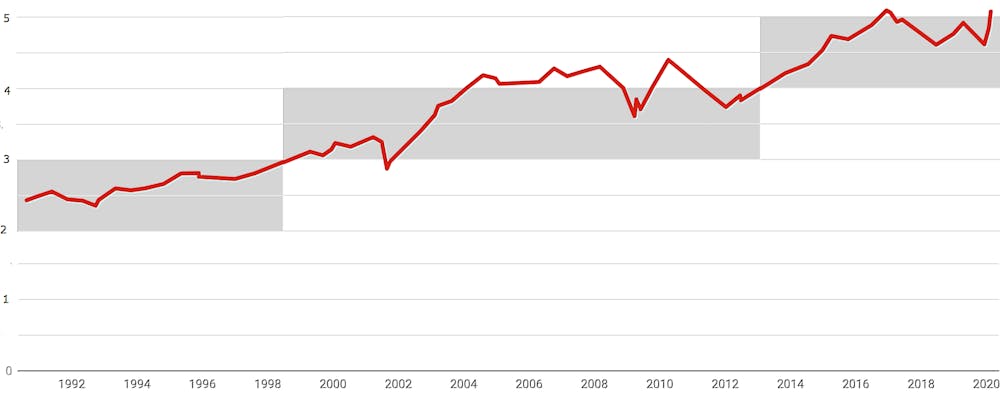
For our parents, buying a home was an exceptionally good deal, not only because homes were cheaper — until the end of the 1990s homes typically cost between two and three times household after-tax income, they now cost closer to five — but also because over time the loan became easier to pay off.


Housing prices as proportion of household disposable income

Household disposable income after tax, before the deduction of interest payments, including income of unincorporated enterprises. Core Logic, ABS, RBA

That isn’t because mortgage rates were coming down — at times they were going up — it’s because during our parents’ times wages (and prices) were climbing.

It meant that even if someone of our parents’ generation just squeaked through one of the bank’s tests about their ability to make payments on a mortgage, a few years and lots of inflation and several big wage rises down the track those mortgage payments shrank compared to everything else.

Once, wage rises took care of repayments

Many of our parents paid off their mortgages early.

One way to look at this is that the bank’s ability-to-repay calculators were set too harshly. They failed to account for future hefty wage rises and inflation.

It’s probably also true that they were set more generously than they might have been in an implicit acknowledgement of what the assistant governor in charge of the Reserve Bank’s economic branch Luci Ellis calls “mortgage tilt”.

The former governor, Glenn Stevens, used another term, “front-end loading”.

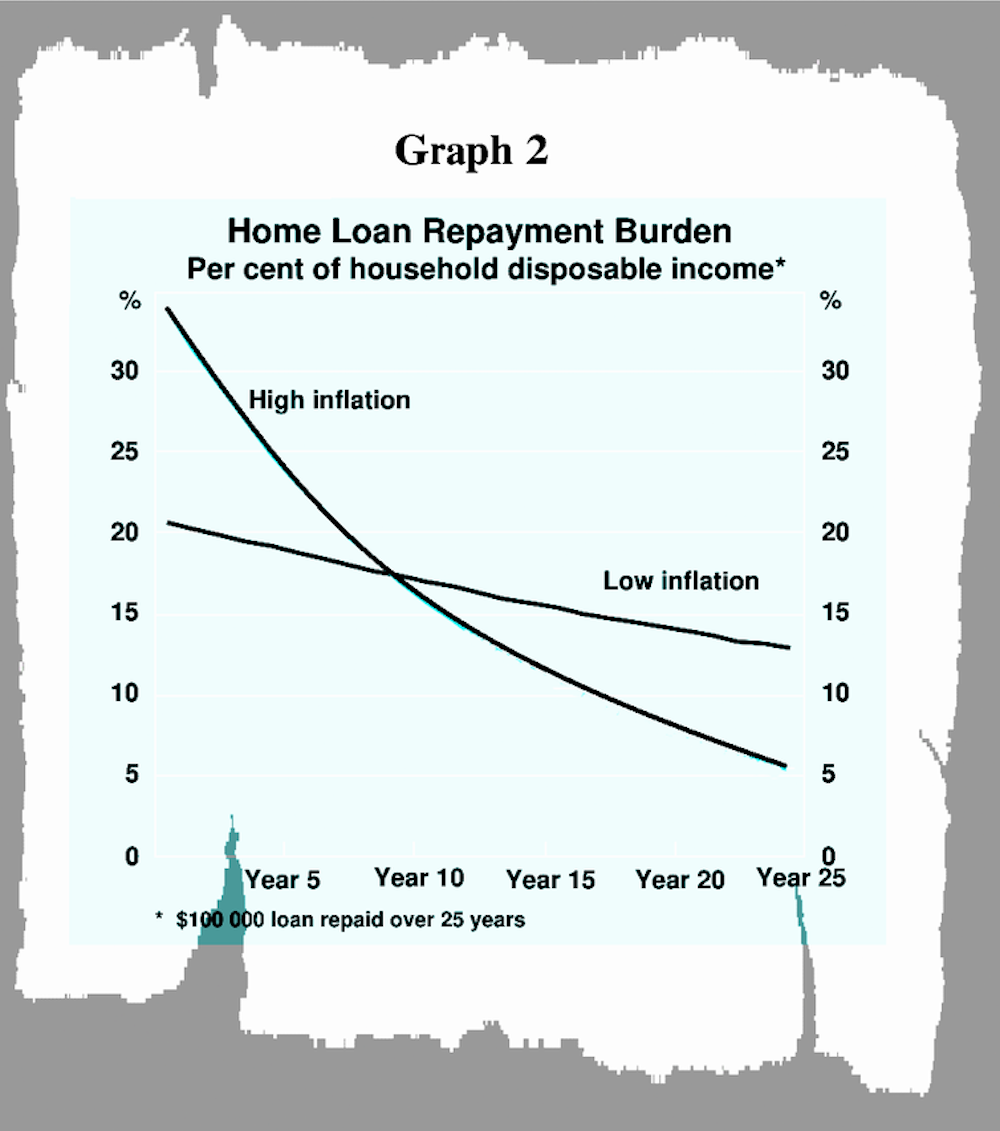
Mortgages were ‘front-end loaded’

When inflation was high, and as a consequence interest rates were high, wages that climbed rapidly with high inflation made the servicing burden “most acute in the very early phase of a loan, falling over time”.

On a graph (and the former governor presented a graph) the line showing payments as a portion of income tilts down over time.

In a world of lower inflation and interest rates, the tilt becomes flatter.

By now (Stevens published the graph in 1997) the line must be near horizontal.

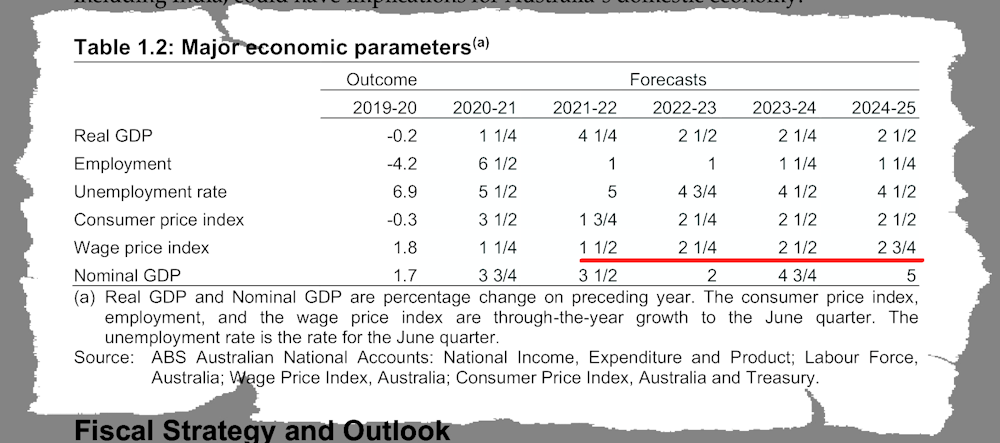
If wage growth remains near the record lows the treasury is forecasting it will become scarcely any easier to make payments on a home loan over time.

Yet the banks are still handing out loans using the sort of formulas they used to.

If you get a loan you’ll be assessed as being able to (just) make the payments as always, but you’ll be denied the near certainty of being able to more easily meet the payments as time goes on.

Now, we retire mortgaged

This is a different from the risk you’ll also run of today’s ultra-low mortgage rates climbing (which banks do take into account in deciding whether to give you a loan).

The proportion of homeowners reaching retirement age while still paying off their mortgage has doubled in 20 years. Which might be why some banks ask for details of your super before granting you a loan. It isn’t an idle inquiry.

Might things get better? Maybe, if we can get wages moving again.

Evidence given to Tuesday’s post-budget Senate estimate hearing provides cause for hope, and despair.

Super hikes will make things worse

The budget forecasts for wage growth over the next four financial years are incredibly low — 1.5%, 2.25%, 2.5% and 2.75%

On Tuesday Treasury Secretary Steven Kennedy revealed that each would have been higher — 0.4 points higher — had the government not persisted with the five scheduled annual increases in compulsory superannuation contributions of 0.5% of salary starting in July.

The treasury believes each increase will slice 0.4 percentage points from wage growth, on the basis that employers, who are legally required to pay the contributions, will have to find the money somewhere.

Commonwealth budget, 2021-22

It’s the same conclusion reached by the government’s retirement incomes review.

It’s cause for hope because it means that when those five increases stop (in mid-2026, or sooner if the government stops them mid-track) wages might be able to grow more strongly.

It’s cause for despair because if the treasury is right, we are denying ourselves wage rises we could use in return for super we will increasingly use to pay down our mortgages.

Peter Martin, Visiting Fellow, Crawford School of Public Policy, Australian National University

This article is republished from The Conversation under a Creative Commons license. Read the original article.
Read more >>

Wednesday, April 14, 2021

Home prices are climbing alright, but not for the reason you might think

It’s tempting to think home prices are soaring because there aren’t enough homes.

But that can’t explain the sudden takeoff from about the year 2000, the sudden takeoff from about 2013, and again now – against expectations – the stratospheric takeoff in the wake of the COVID recession.

Broadly, we’ve enough homes. The 2016 census found we had 12% more dwellings than households, up from 10% in 2001.

That’s 12% of our houses and apartments empty – used as holiday homes and second homes, or waiting for tenants.

If there really weren’t enough homes for people who wanted them, it would be more than property prices soaring; it would be rents.

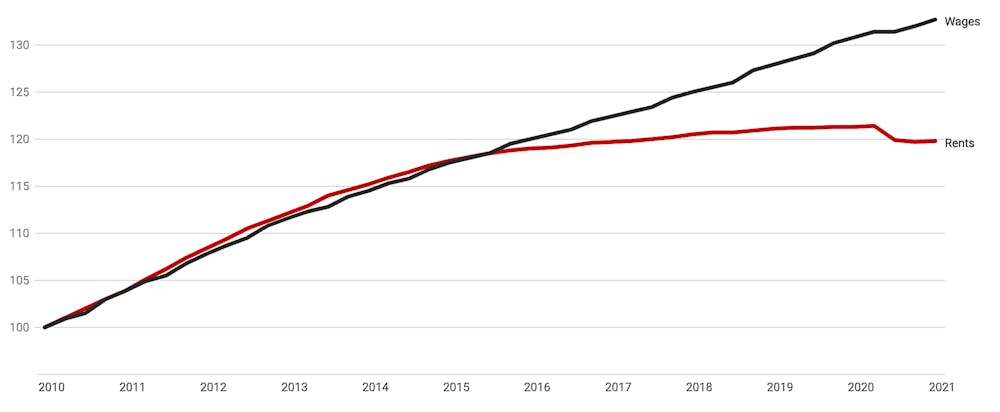
Instead, overall rents have been barely moving – growing even more slowly than wages – for half a decade.


Rent price index versus wage price index

December 2009 = 100. ABS Wage Price Index, Rent Price index from Consumer Price Index

For the half-decade from 2016, a half-decade in which Australia’s population grew by more than one million, Australian rents barely moved.

The supply of places to live in has kept pace with the demand for places to live in, but the supply of places to own has not.

More landlords, more tenants

If that sounds odd, remember people want to own houses for reasons other than living in.

Since about the year 2000, big numbers of Australians (and foreigners) have wanted to buy them to rent them out. They’ve wanted to become landlords.


Read more: Rents, not prices, are best to assess housing supply and demand


Twenty years ago only one in 15 of us were landlords. It’s now one in ten – more than two million of us.

To get those properties (other than where they’ve built them) they’ve had to outbid at auction the people who would have bought them to live in.

They’ve been helping create their own tenants, while pushing up prices.

We’re chipping away at Menzies’ legacy

From when Robert Menzies stepped down as prime minister in 1966 until the end of the 20th century, about 71% of Australian households owned the home they lived in – one of the highest rates in the world.

Since about 2000, owner-occupation has been sliding. The latest figures (themselves some years old) put it at 66%.

Among those aged 35 to 44, it has fallen to 63%

Over that time the cost of buying a home has shot up from two to three years’ household after-tax income to three to four years’ income.


Housing prices as proportion of household disposable income

Household disposable income after tax, before the deduction of interest payments, including income of unincorporated enterprises. Core Logic, ABS, RBA

What appeared to set things off was a decision by Prime Minister John Howard in 1999 to halve the headline rate of capital gains tax. Not that the committee he asked to investigate the idea recognised the possibility at the time.

The Ralph Review recommended that half, rather than all, of each capital gain be taxed, rather than the portion above inflation as had been the case since capital gains were first taxed.

The rationale was that this would “encourage a greater level of investment, particularly in innovative, high growth companies”.

A rush into property rather than high-tech companies

The review was right about the change encouraging investment, but wrong about the sort of investment.

Rather than buy shares in innovative companies, Australians bought rental properties like they never had before.

If they bid enough, they could borrow enough to negatively gear; to make sure their interest charges exceeded their income from rent, giving them annual losses they could offset against wages that would otherwise be taxed at high rates.


Read more: When houses earn more than jobs: how we lost control of Australian house prices and how to get it back


There was nothing new about negative gearing. It had been permitted from the beginning. What was new was the opportunity to later sell the property at a profit, knowing only half of the profit would be taxed.

Investors could offset all of their losses and be taxed only half their eventual gain.

Pretty soon, more than a third of the money lent for housing each month went to landlords. For several dizzying months during 2015 it was 45%. First home buyers struggled to compete.

In 2016 then treasurer Scott Morrison raised the prospect of winding things back, saying negative gearing had led to “excesses”.

APRA cleared up what our leaders could not

Labor went to two elections promising to do just that and the Coalition came out in support of the practice in public.

Behind the scenes, the Australian Prudential Regulation Authority was using its power over lenders to force lending to landlords down, getting it down ahead of COVID to 27% of new housing loans.

APRA succeeded in taking the pressure off prices where politicians couldn’t.

But that’s far from the whole story. There are other more deep-seated reasons why house prices are climbing, and they too have little to do with demand for accommodation.


Read more: Zoning isn’t to blame for Australia’s soaring house prices


Prices took off again from about 2014, shifting up from three to four years’ household income to between four and five years. That time it was Australians getting richer after years of mining booms and being able to borrow more cheaply.

Houses in general mightn’t be a good investment (there being a regularly increasing supply) but houses in prime positions were in fixed supply, there being only so many good locations.

And then it fed on itself. The father of modern economics John Maynard Keynes described investing as a game in which the best strategy is not to put money into what you think is worthwhile, but to put money into what you think other people will think is worthwhile.

It’s happening again

He spoke of a third degree, where “we devote our intelligences to anticipating what average opinion expects the average opinion to be”, and added there might be fourth, fifth and higher degrees.

It’s happening again. With mortgage rates at new extreme lows and wealthier Australians having come out of the crisis with their wealth intact, it makes sense to do what others are doing and push up prices to buy before others push them up further.

It’s nothing to do with a shortage of housing, but for many it will push home prices further out of reach. That’s because in Australia housing is two things: accommodation and a form of speculation.

Peter Martin Saturday AM with Linda Motram April 17 2021.

Peter Martin, Visiting Fellow, Crawford School of Public Policy, Australian National University

This article is republished from The Conversation under a Creative Commons license. Read the original article.
Read more >>

Monday, May 09, 2016

Negative gearing cuts 'a good thing' - RBA

The Reserve Bank has expressed concern about negative gearing and the tax concession for capital gains, saying any change that discouraged negative gearing might be "a good thing" from a financial stability perspective.

Labor has come under sustained attack from the Coalition for promising sweeping changes to Australia's negative gearing and capital gains tax regime to save $32 billion over 10 years.

But an internal bank memo released under freedom of information laws runs counter to Prime Minister Malcolm Turnbull's warnings that Labor's proposal to ban negative gearing except for new properties would deliver "a massive shock" to the property market.

Mr Turnbull repeated those warnings on day one of the campaign, saying that Labor's policy would hold back the Australian economy.

The Reserve Bank memo says negative gearing and capital gains tax rules affect property more significantly is more impacted than other investments by the negative gearing and capital gains tax rules "as it can be purchased with higher leverage than shares".

A move against negative gearing, the memo says, would trigger a large-scale sale of negatively-geared properties "only if the changes were not grandfathered".

Labor's policy plan would grandfather its changes, meaning properties that are negatively geared would remain so until they were sold, ensuring against preventing a rush of sales as negative gearers tried to offload homes.

The memo is a "Q&A" brief dated December 2014, meaning it was written before Labor announced its policy to wind back negative gearing and before the government pledged to continue it.


Extract from RBA memo


Since the December 2014 memo, Sydney house prices have climbed a further 11 per cent. Loans to investors account for 46 per cent of all money lent for housing.

The Coalition has positioned itself as the protector of Australia's existing negative gearing and capital gains tax regime, which it argues is largely used by average "mum and dad" wage earners, and signalled its willingness to launch a scare campaign designed over the issue.

But Labor argues its proposed changes will improve housing affordability, particularly for first homebuyers, while also improving the budget bottom line.

In Brisbane on Monday, Mr Turnbull stepped up pressure over Labor's capital gains tax policy as he described it as an attack on all investments and said it would make Australians invest and employ less.

"Bill Shorten wants to have less investment in Australia, can you believe that? He wants Australians to invest less and if they invest less, they'll employ less," he said.

"That's why he is putting up the tax on capital gains. That's why he is seeking to ban negative gearing, standing in the road of entrepreneurship."

Last week, Mr Shorten said he could not understand why the Turnbull government "was happy to give a tax cut to a millionaire, happy to give a tax cut to a billion-dollar company, happy to die in the ditch over the ability of property speculators to get paid by the taxpayer to subsidise their property investment. But there is no plan for housing affordability."

In Cairns on Monday, Mr Shorten hammered the government for wanting to hand business a $50 billion tax cut over 10 years - a key promise in the budget it released last Tuesday - and argued that more money should instead be spent on education funding.

The Opposition Leader was on the back foot, however, after his candidate in the seat of Melbourne contradicted party policy on turning back asylum-seeker boats and offshore detention, insisting five times that the ALP's policy was clear and would not change.

The Labor policy would restrict future negative gearing to investment income, meaning new investors would still be able to write off losses on properties and other investments, but only against investment income rather than wages.

Investors in new properties would be exempt and the discount on capital gains tax would be cut from 50 to 25 per cent, but only for new investors.

In a boost for the ALP, the bank says in the memo it isn't concerned about negative gearing in its own right, but about its interaction with the capital gains tax discount introduced by the Howard government in 1999.

The change meant "only half of any capital gains are taxed at your marginal rate, however the loss on the investment initially is 100 per cent tax deductible".

The lopsided arrangement "may encourage chasing of capital gains" and "investors bidding up housing prices".

The memo says negative gearers are more of a threat to the stability of the financial system than owner-occupiers because they are more likely to have interest-only loans and so won't have "as much of an equity buffer in the situation where prices fall".

The bank has made its views known previously in submissions to the financial system inquiry and House of Representatives home ownership inquiry, although not in such blunt terms. Q&A briefs are prepared by senior officers to arm officials such as Governor Glenn Stevens with answers to questions likely to be asked in parliamentary hearings or public functions.

A spokesman for Treasurer Scott Morrison said the note cited was a briefing memo, not an official RBA document.

"It was prepared in late 2014, well before the Australian Prudential Regulation Authority instituted measures that slowed housing credit growth considerably," the spokesman said.

"Nowhere has the Reserve Bank endorsed Labor's policy and Bill Shorten and other opponents of mum and dad investors who use negative gearing should be careful not to verbal the RBA."

Touring the inner-Sydney electorate of Grayndler on Monday Greens leader Richard Di Natale said he would go further than Labor and abolish the capital gains tax discount altogether.

In The Age and Sydney Morning Herald
Read more >>

Monday, June 22, 2015

PM's audit chief Tony Shepherd says it's time to better tax super, capital gains

The head of Tony Abbott's Commission of Audit has broken ranks with the Prime Minister on the question of superannuation, saying it's time to ask whether the multi-billion dollar system of tax concessions is achieving its aim.

Tony Shepherd has also called for a doubling in the rate of capital gains to bring it into line with income tax and help bring negative gearing under control.

Mr Shepherd, a former president of the Business Council, was handpicked by Mr Abbott to lead the examination of government spending which recommended Medicare co-payments and tighter eligibility for the pension.

Speaking to the Committee for the Economic Development of Australia in Canberra, Mr Shepherd said the Commission of Audit had not been asked to examine tax, but he said if it had it would have recommended an increase in the rate and coverage of the goods and services tax, something he described as "a no-brainer".

Superannuation tax concessions "definitely" had to be reviewed, he said.

"The idea of these concessions was to lift the rate of self-funded retirees. But it's been stubbornly fixed at 20 per cent for a long time," Mr Shepherd said. "The incentives do not appear to be working to encourage growth in the number of self-funded retirees.

"It is definitely something that has to be reviewed, and I believe that some of those concessions should be modified."

Mr Abbott has promised no changes to superannuation tax concessions in this term of parliament or the next, accusing Labor of wanting to "trouser" superannuation money by winding back concessions.

"I agree that that it should be looked at, and it should be looked at in the context of the whole retirement income question, including age pension," Mr Shepherd said. "You would need to be careful on the incentives side that you didn't deplete the 20 per cent that you've already got."

On capital gains tax, the former head of the business council said the 50 per cent discount should go, pushing the capital gains tax rate up to the income tax rate.

"I'm personally in favour of putting the rate up to the income tax rate," he said. "I can't see any reason for treating it differently, and I think it probably leads in some respects to a greater emphasis on negative gearing. I can't see any reason for treating capital gains any different from income tax."

The headline rate of capital gains tax was cut to half the income tax rate by then prime minister John Howard in 1999. It made negative gearing much more attractive and sparked a climb in house prices.

Mr Shepherd said he thought the budget forecasts for revenue and economic growth were optimistic, adding: "I pray they are correct".

In The Age and Sydney Morning Herald
Read more >>

Wednesday, June 10, 2015

Hockey is wrong, houses are becoming unaffordable

Residents have become a minority in a market they once dominated.

The latest figures released on Tuesday show would-be owner-occupiers accounted for just 48.4 per cent of the money borrowed for home loans in April - the lowest proportion on record.

Investors accounted for the other 51.6 per cent.

The figures were released as the Treasurer Joe Hockey told a Sydney media conference that housing was still affordable, saying if it wasn't, "no one would be buying it".

The figures suggest that housing is becoming increasingly unaffordable for would-be residents who find themselves outbid by investors armed with the tax advantages associated with negative gearing.

As recently as the early 1990s owner-occupiers accounted for 84 per cent of new home lending, leaving investors with less than 15 per cent.

When the Howard government halved the headline rate of capital gains tax in the late 1990s, investors accounted for 33 per cent of the money borrowed.

The tax change made negative gearing much more attractive and brought about a surge in investment which reignited after the global financial crisis. Investment lending overtook residential lending in August 2014.

In April intending residents borrowed $12.6 billion to buy homes while investors borrowed $13.5 billion. The figures exclude refinancing.

They show that it is indeed possible for house prices to climb beyond the level where would-be residents can buy them. And houses are being bought by investors who are betting that prices will climb higher still.

A "bubble" is what happens when prices are driven by speculation about what will happen to prices rather than by what genuine participants are prepared to pay.

The Treasury secretary thinks the Sydney housing market is already in a bubble, as is part of Melbourne.

"It's unequivocally the case in Sydney. Unequivocally," he told the Senate last week.

"Frankly, whatever the data says, just casual observation can tell you it's the case."

Bubbles usually burst. In exceptionally well-managed cases they deflate slowly. Hockey seems keener to deny there's a bubble than to deflate it slowly.

One of the safest ways to deflate the bubble would be adopt the Greens' proposal of denying negative gearing tax deductions to new investors. Existing investors wouldn't stampede for the doors and sell, but new investors would become more scarce, giving genuine residents a chance to get a foot in the door.

The parliamentary budget office says it would save the budget $4 billion a year. No-one who is presently negatively gearing would mind, and air would leave the bubble.

In The Age and Sydney Morning Herald
Read more >>