Showing posts with label ACT. Show all posts

Thursday, June 26, 2014

The Australian Capital Territory is just about the best address on earth - OECD

The Northern Territory is a lot like North Carolina, Queensland like Western Norway and the Australian Capital Territory like New Hampshire. The Organisation for Economic Co-operation has unveiled a massive wellbeing matching machine able to match living standards throughout the world in eight dimensions; among them safety, health, income and access to services.

Australia’s clear cut winner is the Australian Capital Territory, scoring 10 out of 10 for income, 9.6 for jobs and 9.5 for the environment.

The ACT’s average income is the highest of the any of the 300 developed nation regions identified by the OECD.

The matching machine says Australia’s national capital is most like Western Norway, New Hampshire or South East England.

The national capital’s worst score, for education, is 9.1 out of 10. But 9.1 is a far better score than any other Australian state. Victoria scores 7.4 for education, NSW 7.2, Western Australia 7, and Queensland 6.9.

Tasmania’s score for education is 5.6, putting it in the bottom 27 per cent of the OECD’s 300 regions. The ACT is in the top 19 per cent. But Tasmania shines in ‘environment’, scoring 10 out of 10 along with Queensland, NSW and Victoria, putting it in the top 1 per cent of the world’s regions...

“Where people live has a huge effect on their quality of life,” said OECD territorial development director Rolf Alter, launching the website oecdregionalwellbeing.org at a conference in Brussels. “By zooming in like this, we can really see the big differences that exist between regions and work out what local and state governments must do to reduce them.”

The eight well-being factors, shown as different-coloured petals, are based on data such as household income, life expectancy, homicide rates, broadband access and particulate matter in the air.

Victoria and NSW are hard to separate, both scoring highly in most dimensions. NSW does better in income, scoring 7.1, compared to 6.4. Victoria is better for jobs (8.5 compared to 8.3) and safety (9.6 compared to 9.2).

The Northern Territory is the least well-off of Australia’s states, scoring just 4.1 for health and 1.4 for safety. Its health score is in the OECD’s bottom 29 per cent. Its safety score is in the bottom 13 per cent.

Earlier this month the Australian Bureau of Statistics announced that it would abandon its own version of the OCED index, Measures of Australia’s Progress in order to cut costs.

In The Age and Sydney Morning Herald


Related Posts

. Dumbing down the ABS. Like driving at night dimming the lights

. How is Australia the best address on earth? Play with the sliders

. Officially our lives are mostly better - ABS Measures of Australia's progress

Read more >>

Wednesday, March 13, 2013

Why we partied at Canberra's shops

Me, last night -->


"The shops." They matter more in Canberra than in other cities. They are not on main roads, they are either in big town centres or the centre of small surburbs, tucked away in the folds of interlaced roads, unfindable if you were wizzing past in a car.

The local shops are designed as local centres, close enough to walk to. And we do. They are the focal point of each community. Last night each local shops hosted a "Party at the Shops" to celebrate Canberra's centennary. It was as good as you could imagine.

Or maybe you can't imagine, if you haven't lived in Canberra.

More than 40 years ago in Ideas for Australian Cities Hugh Stretton outlined the thinking behind Canberra's shops.

He got it right:


"The city is built of units, neighborhoods that can support a primary school and a walk-in shopping centre. Three or four of them are grouped to share a larger shopping and service centre. Three or four or five of such groups make a district of 60,000-120,000 people with a major town centre. Any number of these can proliferate around the single metropolitan centre, in a pattern usually called a 'metro-politan cluster'. For communications the Canberra cluster would rely chiefly on a network of roads. From the residential cul-de-sac to the freeways which skirt and link the districts, these roads will be more radically differentiated, safer and-faster than any comparable network in Australia.

But the heart of the scheme is not its method of coping with traffic. The heart of the scheme is its use of leasing powers to distribute the city's activities precisely, thus con-trolling the pattern of journeys which the channels have to cope with. For example, for the Canberra population 12 square. feet of shop floor per head is the provision which seems to balance Satisfied customers and prosperous shopkeepers. Each citizen's ration of shop is deliberately distributed 3-1. square feet to the metropolitan centre, 31 to his district centre, 3 to his group centre and 2 to his neighborhood. Some American advisers, used to locating nothing smaller than drive-in supermarkets for no other purpose than retailers' profit, would abolish most of Canberra's neighborhood shops, leaving all the widows and carless housewives to struggle to the super-markets as best they could. But the Canberra planners keep a wary eye on such alien propaganda. They obstinately con-tinue to build the neighborhood centres; and enjoy showing American visitors how they prosper as half their customers arrive on foot and the other half keep their parking spaces as busy as any at the supermarkets.

Commercial office needs are similarly predictable, and government and institutional employments are negotiable. The planners put them where they'll prosper best, and. do most good to the town around them. So also with land uses and employments in industry, service trades and higher education.

Perhaps private enterprise should complain about this tyranny. In practice most private enterprise revels in it, with what adjustments of its enterprising conscience I don't know. Planning reduces many investors' risks. It need not reduce those that are economically and socially productive — risks with new products, processes, methods. But it reduces the useless risks which arise from uncertain forecasting of other people's land uses. There is nothing efficient about a private enterprise that guesses wrong about the future spread of residence, the build-up of rival or complementary businesses near by, the location and timing of public investment in roads, power, water and sewerage. But in Canberra, if private enterprise bids for a site, it knows exactly when its services will be connected, it knows the customers will be housed around it in predictable numbers by predictable dates, and it knows that a watchful (but reasonably incorruptible) eye will limit the release of competing sites to the number the custom can genuinely nourish.

Of course there are policy problems. Producers and consumers sometimes have contrary interests in the level of competition. There are novel business projects for which it is sometimes difficult to provide appropriate land fairly by public auction. In time there will be problems of re-use and redevelopment. So far these problems have been solved in Canberra without impeding innovation — except objectionable innovations, impeded deliberately. Consumers sometimes complain — there's not much chance for any cheap-jack, wild-cat, road-side or tin-shed competition. But the degree of 'producer protection' is no more than a mild case of the general bias of Australian policies towards protected production and employment, at some cost to consumers where ther necessary."


Thank you Hugh. Thank you Canberra's founders.


Read more >>

Wednesday, February 06, 2013

Civilisation. The pop-up coffee shop on my way to work


Yes, it's by the bike track:


Between David Street and Condamine Street, as you approach the Turner School going in.

The sign says "Sly Fox". And it sells watermellon.

#Canberra #Gotaloveit


Related Posts

. The things I love about Canberra (Warning: Autumn photos)

. Friday lunch times I'm at the school chess club

. Public transport, Melbourne style


Read more >>

Friday, January 25, 2013

My Australia Day message. Let's make it January 1


There's something forward-looking about January 1.

That may be why it was chosen as the date for the creation of Australia, from a number of previously separate states, in 1901.

(For a while it looked as if New Zealand was going to become part of Australia. Radiating out as spokes from State Circle in Canberra's heart and pointing to each state's capital are Sydney Avenue, Adelaide Avenue, etc. There's another, originally provisionally entitled Wellington Avenue, just in case. It was later renamed Canberra Avenue. For a while Western Australia was going to stay out - meaning we would have had to rename Perth Avenue.)

The point is that January 1 is when Australia was created. It is a day of which we can all feel proud.

January 26 represents different things to different people, some of them bad indeed. For people outside of NSW it represents very little. My home state of South Australia was created differently, on a different day.

Let's unite around the one day that can unite us.


Related Posts

. The things I love about Canberra (Warning: Autumn photos)

. Not leaving Canberra


Read more >>

Sunday, October 21, 2012

Bugger tax reform. The ACT is like the rest of Australia after all:


If the most educated state in the nation falls for a scare campaign against sensible tax reform, what hope is there for the rest of us?

One in every four citizens of the Australian Capital Territory has a university degree. In the rest of Australia it’s one in seven.

The Labor-Green alliance that runs the ACT took the 2010 Henry Review at its word. It found there was no role for stamp duties in a modern tax system.

“As a tax on transferring land, they discourage land from changing hands to its most valuable use,” the review said. Stamp duties taxed most heavily Australians “who need to move”.

As stamp duties were phased down it suggested land tax be ramped up, in part because this would dampen the effect of lower stamp duties on house prices.

Textbook stuff. Just like the review’s suggestion that mining royalties be replaced by a super profits tax (something which would be assisting the industry right now if it had been fully adopted).

Kevin Rudd and Wayne Swan ran with the super profits tax and were rewarded with a (successful) scare campaign.

Surely it couldn’t happen in the Australian Capital Territory, where voters were likely to actually understand what was going on?

It did. The ACT Liberal Party campaign on one three word warning: ''triple your rates''. On Saturday night it was rewarded with a 6.4 per cent swing and is now set to have more seats in the House of Assembly than Labor (although Labor will retain government with the support of the Greens).

The lesson is being absorbed throughout the nation. Don’t bother with sensible tax reform - no matter who recommends it and no matter who compelling their arguments - if the campaign against it can be reduced to three simple words.


The Labor stronghold of the Australian Capital Territory has swung sharply to the Liberal Party with key Labor ministers including the attorney general at risk of losing their seats.

The 6.4 per cent swing to the Liberal Party will give it eight of the 17 seats in ACT assembly, just one short of the nine it would need to form government. Labor will continue in minority government with the support of the Greens whose numbers have been halved from four to two.

At issue was a decision by Labor and the Greens to phase out real estate stamp duty and replace it with higher rates in accordance with a recommendation of the Henry Tax Review. It allowed the Liberals to campaign on the three word warning: “triple your rates.”

Greens leader Christine Milne said the campaign showed “a simple negative message can cut through”...

Tony Abbott called on the Greens to accept the will of the people and go into coalition with the Liberals. He said the issue was that the ACT rate increase hadn’t been put to an election, just as the carbon tax had not been put to an Australian election.

The narrow result puts the Coalition in a strong position nationally. The ACT had been expected to rally behind Labor fearing public service cutbacks should the Coalition take office federally. It leaves Labor governing in its own right in just one state; South Australia, and leaves it governing with the support of the Greens in only two - the ACT and Tasmania.

With counting not yet finalised, neither the Labor leader, Katy Gallagher, nor the Liberal leader, Zed Seselja, have claimed victory. Mr Seselja, said he was open to negotiating a coalition government with the Greens but said there would be no Greens in his ministry.

In today's Age


Related Posts

. Canberra is not the problem

. Not leaving Canberra

. Henry's great tax forum speech


Read more >>

Thursday, July 12, 2012

The things I love about Canberra (Warning: Autumn photos)


I'll make a list some day.

Meantime here are some Autumn photos I took in our incredible city before winter set in, mostly in and around parliament house:


Related Posts

. Friday lunch times I'm at the school chess club

. Not leaving Canberra

. Beloved Canberra

Read more >>

Tuesday, September 27, 2011

Jenny Macklin is the Labor spokesman on poker machine reform

Here's Stephen Mayne in Crikey:


"Jenny Macklin, the federal minister responsible for implementing the pokies deal with Andrew Wilkie, is complaining that the industry is refusing to offer up any venues that will trial a mandatory pre-commitment system with $1 maximum bets.

Jenny, ask your own party in Canberra. The Canberra Labor Club operates about 500 machines in the ACT and it represents the single largest investment asset owned directly by an ALP branch.

Labor’s role as the only major political party in the world that fundraises through operating gambling venues is just one of many conflicts of interest which dominate the pokies reform debate.
"


Jenny, if you need background, there's some below:


Related Posts

. Our nation's capital is also the nation's poker machine capital

. Labor - whose party is it?

. Ban large political donations. Starting here, starting now.

. The city the poker machines ate.


Read more >>

Thursday, November 11, 2010

Asylum seekers: Bring them here, please


ACT Chief Minister Jon Stanhope:

"I have no objection to sharing this town. And indeed, symbolically it may be appropriate."

Hear him here.

HT: Canberra Times


Meantime, today's High Court decision is typical common sense. Thank heavens.


Related Posts

. Please. Don't reopen Nauru.

. Goodbye Autumn, we loved you. Winter's good too. (Canberra photos)

Read more >>

Saturday, June 12, 2010

Goodbye Autumn, we loved you. Winter's good too. (Canberra photos)

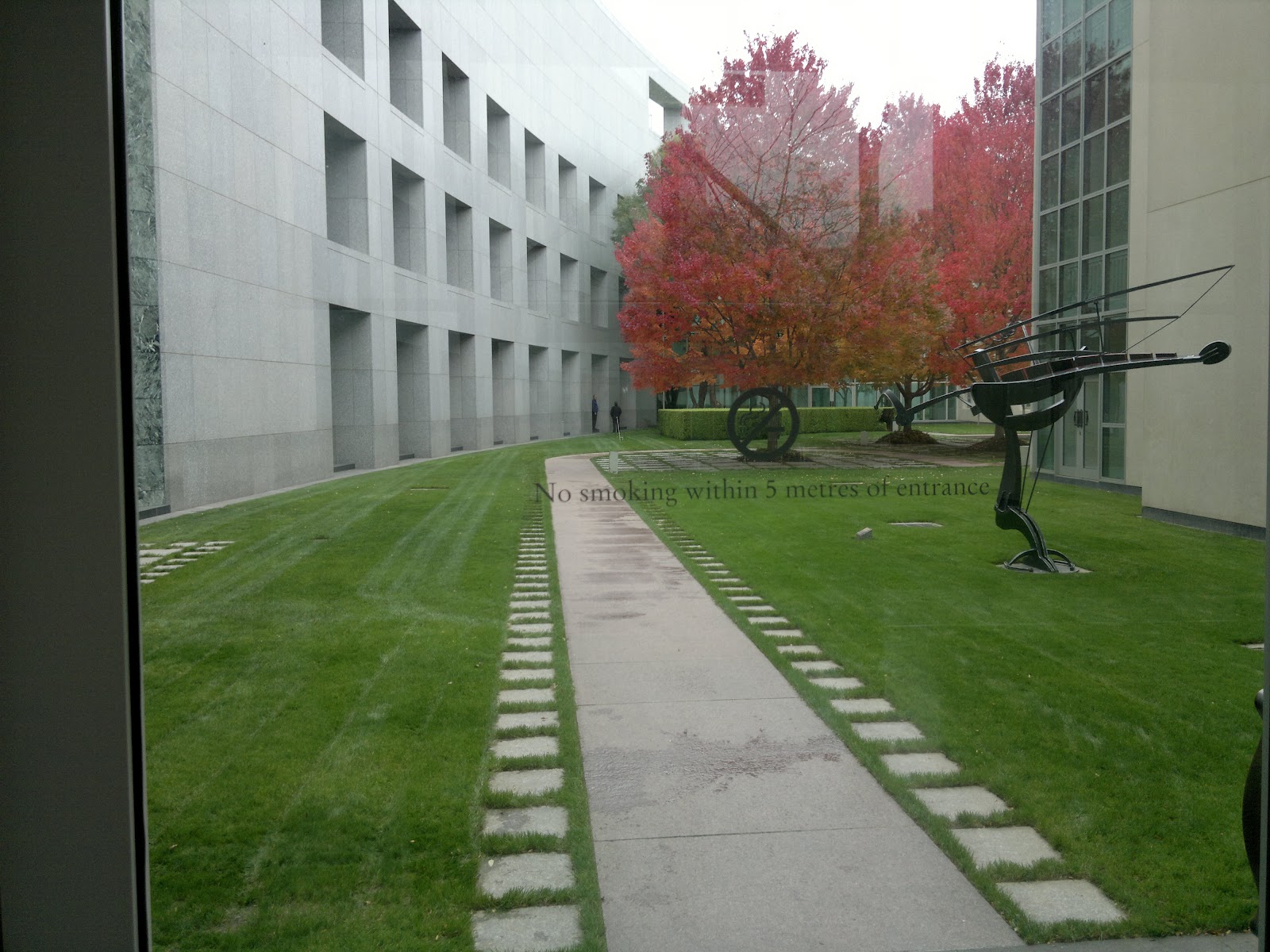
The Senate courtyard, as seen by Bella's iPhone:


Thanks Bella. PS: Canberra is paradise - don't pass it on!


Related Posts

. Canberra in Autumn

. I'm not leaving

. Beloved Canberra


Read more >>

Thursday, October 29, 2009

Canberra is not the problem

Paul Keating says "Canberra was in essence a great mistake".

Malcom Fraser says the new Parliament House should not have been built.

They are both wrong.

Canberra is a nice city, yes. With lovely people and a beautiful environment. But it is not un-Australian.

If anything it is the most Australian of Australia's cities, inland, small, friendly; with big backyards.

Jack Waterford cogently argues that it is not Canberra that is out of touch with the rest of Australia, but Parliament House that is out of touch with Canberra.

I've extracted highlights below the fold.


"My guess is that opposition to shifting the Australian capital to Sydney or Melbourne would be even more fierce today than it was 110 years ago; this time, however, probably joined by the citizens of NSW and Victoria as well as all the other states.

Each of these cities is a beautiful thing, Sydney more organic, for what that is worth, than Melbourne but neither is so well planned or designed that it could easily cope with the transport and other problems of plonking a parliament in a prominent place, let alone the infrastructure, buildings and insignia of a national capital...

When Keating was prime minister he would muse aloud, sometimes, about having the executive government thrown out of Parliament House. It would, he thought, be good for Parliament, as a legislature, and for improving the quality of administrative government.

I think he was right on that. One does not hear him on the subject now but it would be even better if the press gallery was thrown out of Parliament at the same time. Not prevented from reporting Parliament and the politics in and around the building, but forced to headquarter itself elsewhere, in the process being forced to inhale some of the air of Canberra as opposed to the air-conditioning of its mini-city.

Relocating ministers to offices in their departments could serve as a partial antidote to their increasing tendency to see comparatively little of their departmental advisers but to live cheek by jowl with political advisers. Minders themselves spend more time liaising with minders in other political offices than in dealing with departments.

Building, for our Prime Minister, a proper lodge with adequate living quarters and public spaces for entertaining and conducting cabinet, etc, and a reasonable "west wing"-style prime ministerial office, would give the position the dignity it holds in our constitutional system (whether in its present monarchical or later republican form).

Just as importantly, we might get a better parliamentary service from a building no longer so dominated by the "need" to give so much accommodation to ministers or for prime ministers and other ministers to colonise parliamentary spaces for their press conferences and functions, and by the way that ministers feel able to alter parliamentary timetables and routines simply for their personal convenience.

This is not to say that governments would not have the numbers in the Parliament, or be in a position to arrange matters according to the incumbents' view of the world. But a controlled distance between executive and Parliament might increase mutual respect, and, possibly, help restore a few balances.

A part of Keating's lament is that while one is slaving away at Parliament House, a run down to Manuka for some Chinese food does not always seem attractive. No doubt it is different these days in Double Bay, where he presides over coffee and croissants most mornings.

But his comment conceals a truth which reflects on journalists and minders as much as on politicians. Parliament House is a city in itself, down to its own cafes. A good many people who work there leave it only to fall into bed. Or, leaving late, only to go to bars patronised by journalists, minders and politicians, before falling into someone else's bed. The politicians who fly in and out according to the sitting schedule experience very little of Canberra. Those parts of Canberra, chiefly Manuka and Kingston, which were created for this sort of bizarre lifestyle, bear very little relationship to the way most Canberrans live, or the way most Australians live. It may suit politicians to pretend that they hate Canberra and can never wait to leave it, and that leaving Canberra is re-entering the real world.

The unreal world, however, is not "Canberra", but the life of the suitcase, the non-stop meetings, pretending one is living in a university college or boarding school, and the Holy Grail and other such hangouts. Young (mostly) unmarried journalists like to affect the same sort of ennui, anomie and world-weariness, and tend to blame Canberra rather than themselves. Merchant bankers and young lawyers, I am told, have many of the same problems in Sydney, if at about thrice the expense."


Related Posts

. "The young men in Kevin Rudd's office could get old and not even notice"

. Canberra in Autumn

. Not leaving Canberra

Read more >>

Tuesday, October 20, 2009

Why do people have babies? (Caution - baby photos)


Darn good question Joe, Peter...

I wrote about it a bit here in 2005 and here in 2007 after observing that children are very expensive:

"It might be a good thing that most of us don't do the financial calculations. We close our eyes and dive in. We manage by cutting our spending or by extending already impossibly large mortgages.

We sense that children bring benefits that can't be described in financial terms. They give us a sense of purpose - they believe in us, idolise us and depend on us.

It is almost financially impossible, but it's worth it."

Conventional wisdom is that our forebears used to have a lot of children to make money - they could put them to work early and hope that in later life their children supported them.

These days we are not allowed to put children to work, and these days we have pensions, unemployment benefits and super to support us. The conventional view is that change helps explain why we are having fewer children.

But as Bryan Caplan points out, that view is probably wrong:


The flaw in the story is the assumption that things used to be different. In an eye-opening 1996 JEL piece, Ted Bergstrom summarizes evidence showing that even in pre-modern societies, kids did not pay.

Kids did not pay in hunter-gatherer societies:
Among hunter- gatherers, resources flow from older to younger generations and not the other way around. These tribes all had very high average fertility (about eight births per woman), but in each case, children consumed more food than they caught, at all ages from birth until age 18. Grandparents continued to work hard to support their grandchildren and produced more than they ate. At almost no time in their adult lives, did adults produce less than they consumed. When people became too old and frail to work, death followed quickly. Suicide and euthanasia of the enfeebled were frequently reported.
Kids did not pay in agricultural societies:
Calculations by Mueller and by Goran Ohlin (1969) indicate that a parent who gave birth at age 20 and supported a child from age one to age 15 would receive a monetary rate of return of less than one percent on her investment if she retired at age 60 and was supported by the child until age 85 at the level of living that is normal for old people in peasant societies. When one accounts for the probability that either parent or child may die before the parent reaches 85 years of age, the expected rate of return becomes negative. In a peasant society, where land ownership is possible and where there are markets for borrowing and lending, such low rates of return are not likely to be acceptable on purely financial grounds.

An anti-natalist might take this as further proof that breeding is sheer idiocy. To me, though, it confirms that an intrinsic or "consumption" demand for kids is deeply rooted in human nature. It also shows that explaining the long-run decline in family size is harder than it looks. If parents in 1850 were willing to support five or six kids with a negative financial return, why aren't we?


Personally I've long thought of children as "consumption goods" and been ridiculed by non-economists for using the term.

But right now I'm consuming a lot - and loving every second.

Here are some photos:


Lavinia in intensive care, Day 1


Lavinia with Toni, Day 2


Lavinia with Oliver, Day 5


Lavinia at school, Day 9


LETTER TO THE EDITOR, SUNDAY CANBERRA TIMES

Published October 18, 2009

Last Sunday's Canberra Times told us about something that had gone
wrong at Canberra Hospital.

While we don't dispute for a minute the enormity of that tragedy our
experience at the hospital the previous Sunday could not have been
more different.

Without quick thinking from our midwife Ros and dramatic intervention
from a team of six health professionals who burst into our room at the
birth centre our newborn girl would not have lived.

Their thoroughness, caution, commitment and good humor was a tribute
to the Canberra public health system.

We were in very good hands.


Related Posts

. Honey, we can't afford the kids

. Sunday dollars+sense: The dollar cost of having a child

. Australian Costs of Raising Children, by Dr Paul Henman


Read more >>

Saturday, October 10, 2009

Thursday, June 25, 2009

Storm clouds over Canberra

As I walked back from the CEDA conference last week:

Read more >>

Thursday, May 28, 2009

Canberra in Autumn

Here's the way the camera on my mobile phone tells it:


Read more >>

Tuesday, December 02, 2008

Do you live in Canberra?

You are welcome to join my former ABC colleague Maxine McKew as she launches the first novel by my former ABC colleague Lucienne Joy - early Wednesday at 7:30am for 7:45am to 8:30am at the Canberra Museum & Gallery in Civic.

Lucienne talks about her book here.

The complete invite (its open to everyone) is here and below the fold.

I hope to see you there...


CPSU presents Maxine McKew in-conversation with author Lucienne Joy about Ulterior Motives.

CPSU Deputy Secretary Nadine Flood invites CPSU members to this special event, “Lucienne has been active in the CPSU for many years so this event is a terrific opportunity to support a creative & talented union delegate.”

About Ulterior Motives

Lucienne Joy, one of Maxine McKew's electorate officers and a former ABC broadcaster, has published her first novel, Ulterior Motives.

The novel is set in the South of France, where expat Australian journalist, Coco Armstrong, is having the time of her life working on an English-language radio station, when she meets, falls for and marries in lightning-quick order an urbane international lawyer, Jack Villeneuve.

Only then does he reveal a darker side, and slowly but surely introduces her to a world of sexual practices well outside her previous experience, or even imagination.

Against a backdrop of her continuing life as a sort of roving Riviera reporter, Coco struggles to come to terms with the reality of her marriage, as Jack challenges all her beliefs about trust, intimacy, and love itself."

About Lucienne Joy

A well-known broadcaster and journalist, Lucienne Joy has worked for ABC Radio and 2GB in Australia, Radio Riviera in France, and was for a time Head of Radio at the Australian Film, Television and Radio School. Recently, she worked on Maxine McKew's political campaign to win the seat of Bennelong from PM John Howard in the 2007 election. This is her first novel.

Reviews of Ulterior Motives

Lucienne’s interview on ABC Radio National Life Matters with Richard Aedy can be accessed here.

Ulterior Motives review by Cameron Woodhead, The Age, 15/11/2008

“AN AUSTRALIAN journalist living it up in the French Riviera, Coco has everything she could hope for - except good taste in men. She meets Jack Villeneuve, a suave older American who sweeps her off her feet. After a lightning courtship, they marry, and it's only then that the fairytale starts to peel away. One night, Jack provides her with a lurid S&M version of Sleeping Beauty, and it isn't long before the kinky stuff starts… However, her primary interest lies elsewhere. Ulterior Motives isn't really erotica, it's more a confessional novel of sexual betrayal, written in a strong and sophisticated narrative voice.

Book details

Ulterior Motives is available in Smiths Alternative Bookshop, Melbourne Building, 76 Alinga Street, Civic and all good book stores. Ulterior Motives is published by Allen & Unwin, rrp is $32.95 10% discount for CPSU members. (This event has been paid for by Allen & Unwin).

Event details
Venue:Canberra Museum & Gallery - Foyer
Address:Corner of London Circuit & Civic Square, Canberra, ACT, 2600
Date:03 Dec 2008
Time:7:30am for 7:45am start – 8:30am.
Cost:A free event with light refreshments.
Event information:There will be a special 10% discount on Ulterior Motives for CPSU members. RSVP by Mon 1 December to Alison.
Contact:Alison Rahill, CPSU 
6220 9630
alison.rahill@cpsu.org.au


Read more >>

Tuesday, November 04, 2008

Tuesday in Canberra

Wonderful as always, but quiet.

Melbourne Cup day is a Canberra public holiday. Yes, I know. It shouldn't be.

Outside the Treasury building (where I once worked) I noticed hardly any cars - see photo. The first time in a long time.

Things must be settling down.

At the National Museum with the children I took a look at Phar Lap's heart.

Things get busy for me at 2.30 pm.

Wayne Swan has scheduled a press conference for 2.35 pm. Yes really.
Read more >>

Sunday, October 19, 2008

Canberra rejects Labor... and the Liberals too

As today's Canberra Times puts it:

"Canberra has emphatically rejected Labor majority rule, stripping the party of two seats and turning its anger into a historic vote for the Greens.

The ACT Greens will have three seats in the next Assembly - one in each electorate. Labor is left with seven seats, equal with the Liberals. There is still a slight chance the Greens could pick up another seat at the expense of the Liberals.

The Greens will hold the balance of power in the Assembly and the ability to choose the next chief minister."
Read more >>

Saturday, October 11, 2008

Get up to speed on the ACT election

It's next Saturday, and it is likely to further change Australia's political landscape.

On The National Interest, midday Sunday on ABC Radio National Peter Mares will interview both the present Chief Minister - Labor's John Stanhope and his opponent, the Liberal's Zed Seselja. They are good interviews which give a good introduction to the campaign - which you might need because you might have to vote (voting is compulsory, as in all Australian elections).

I know they are good interviews because I have already heard them! - The Natioanl Interest is first broadcast Friday afternoons at 6.00pm - and the audio is already here on the web, available to listen to. You can also download the whole program.

I chaired a community meeting attended by about 20 candidates on Wednesday organised by the Gungahlin Community Council. Jonathon Reynolds has published both the video and the audio on the web here.

I thought the Labor team was tired, dispirited, and I wondered why they even wanted to continue governing. The Liberals were much more together, and most of the smaller party candidates seemed great.

The highlight (for me) was the collection of answers to my question about whether each candidate would support banning political donations of more than a certain size - say $2,000...

Every Labor candidate but one said "no". Every Liberal candidate but one said "yes" (!) and as far as I could make out every other candidate said yes.

Let's hope something happens.

The ACT has multimember electorates, so who you vote for from the party of your choice is important.

My favourites were Mike Hettinger (the only Labor candidate against large political donations), Labor's Andrew Barr, the Liberals Zed Seselja and Clinton White, Frank Pangello and his team, and Democrat Greg Tannahill.

Tannahill particularly impressed me. He "currently works supervising creation of court and parliamentary transcripts". He said that meant he had spent hours listening to ACT Leglislative Assembly debates and had become convinced that he could do better than the members there. My sort of guy.

If you are free this Tuesday lunchtime, attend the Leaders Debate - Seselja vs Stanhope; 12.30 pm to 1.30 pm in the Reception Room, ACT Legislative Assembly, Civic Square, London Circuit, Canberra City. I'll try to be there. After all, I'll have to vote.


Read more >>

Sunday, August 03, 2008

Sunday dollars + sense: Not leaving Canberra

I regard Canberra as something close to paradise. And although I am leaving The Canberra Times I am not leaving Canberra.

I felt that I had found “home” when I arrived here from my original home of Adelaide back at the start of the 1980s.

Canberra seemed to be everything that other parts of Australia were, but more so.

It had more trees, more openness, a greater sense of belonging.

And yet Canberra was Australia's newest city, derided by people in bigger towns who couldn't understand why we would want to be part of the landscape rather than looking away from it towards the sea.

Since returning here to work as The Canberra Times' economics editor two years ago I've noticed that much has changed, some of it for the worse...

The once magnificent ACTION bus service is a parody of what it was. It looks as if more effort has gone into producing the new shiny signs that say we have a bus service than actually providing one.

Self-government was a mistake, but one that's impossible to take back. The Commonwealth won't have us and it would be wrong to hand the home of the Parliament to NSW.

The new substandard housing blocks in Gungahlin appall me. The blunder that deprived them of proper access to the internet is an added insult.

The government is arrogant and at times doesn't even seem interested.

The Live in Canberra campaign is a joke, and a cruel one. It reeks of an inferiority complex. What other Australian city apart from Adelaide would even try such a stunt? Where are the houses that the new arrivals would live in?

But the things that I first fell in love with in Canberra are still here.

On our first morning back two years ago my daughter Grace said “people smile at you here”.

We marveled at the birds, the expanses of (brown) grass, and the relaxed spacious nature of the environment.

We felt wanted, cared for, among friends.

I'll miss the personal contact with readers after I leave The Canberra Times – many of them neighbours, people I see at the shops.

Although I'll be staying in Canberra, I'll be writing for a newspaper far away, with readers in a city in which I don't live.

I'll no longer feel that we are sharing the same things, that we breathe the same air, that we are all part of something really special.

So if you see me on the street, riding my bike or trying to change busses, or picking up the kids, say “hello”. I'm not going anywhere.


This is Peter Martin's last column as Canberra Times economics editor.

Read more >>

Saturday, August 02, 2008

Who owns the land on which Canbera is built?

Canberra may be built on a falsehood – one the Federal Court will be asked to rule on later this month.

The alleged falsehood is that the ACT (and before it the Commonwealth) actually owns the land on which the national capital sits.

When a long-running Indigenous land claim comes to case management on August 28 the barrister representing the claimants George Villaflor will ask the court to make the determination, claiming that the NSW never actually gave the Commonwealth ownership of the Territory, merely the right to govern it.

In his office above a hairdressing shop in Ainslie the pro-bono lawyer said yesterday that the actions of the Stanhope government had left him with little choice.

“They are actively developing land on the Kingston foreshore and legislating for new power stations as if native title isn't an issue here. So I want to ask the court – has native title been extinguished in the ACT.”

He said the argument that the creation of the ACT extinguished native title was wrong.

There was no evidence that NSW ever handed over its title over the land...

Reading from Quick and Garren’s Annotated Constitution of the Australian
Commonwealth published in 1901, he quotes it as concluding that it is clear
from the construction of section 125 that “the Commonwealth acquires under
this section territorial rights only, not proprietorial rights”.

“The second reading speech of the 1909 NSW Seat of Government Surrender Bill
made it clear that NSW still retained the title to the soil.

“While the NSW Premier Charles Wade didn’t actually say that his state still
owned the land, he implied that it did throughout his speeches. There were
a few that said, well if the ACT fails, at least the Commonwealth will have
improved it for us - that sort of thing.”

Mr Villaflor believes that that is the reason that that land has only ever
been leased in the ACT. “To sell it would mean that you owned it,” he says.

But by granting very long leases over the land – 999 years for residential
blocks, the ACT government was essentially alienating the land anyway, in
the full knowledge that the High Court’s Mabo ruling may have restricted its
ability to do so.

Rather than confront the question and seek a determination from a court, the
Stanhope government was continuing to act as if it - alone among all states
and territories - was immune from Native title claims.

Asked in the Legislative Assembly by Liberal MLA Jacqui Burke two years ago
whether the ACT had the authority to grant and dispose of land while Native
title claims were under way, the Chief Minister replied that the ACT’s
authority was “not affected by the existence of Native title claims”.

“If Native title were found to exist in the ACT then the provisions of the
Commonwealth Native Title Act 1993 would have to be complied with,” he said.

“He was saying he would deal with any problems only after the event. He is
pretending for now that they don’t exist,” said Mr Villaflor.

The barrister advised his clients to terminate their private negotiations
with the ACT government some months ago because he did not believe they were
negotiating in good faith.

“On August 28 I will ask the court to join the Commonwealth and NSW as
defendants and to pay for my clients to be represented.”

“I’ve got senior counsel willing to do it. Continuing to drag this out is
just going nowhere,” he said.

Read more >>