Showing posts sorted by date for query drive dollars. Sort by relevance Show all posts

Tuesday, February 28, 2023

Tax-free super for the super rich is a bad deal for the rest of us – and Morrison said it first

You’d be forgiven for thinking Treasurer Jim Chalmers had done something dramatic.

From 2025 he will double the tax rate on earnings from superannuation balances above A$3 million, lifting it from 15% to 30%.

Only 80,000 Australians have accounts that large, and many of them who have retired have shoved the maximum permissible $1.7 million into a separate so-called retirement account whose earnings are entirely tax-free.

That’s right. Retirees with $1.7 million in retirement accounts pay nothing whatsoever on what those accounts earn, which in normal years amounts to $85,000.

By way of comparison, wage earners on $85,000 get taxed $18,000.

But though you’d never know it from some of the “socialist tax grab” commentary around this week, Chalmers isn’t the first treasurer to act on this rort. Scott Morrison got there first.

Howard’s super deal for the richest 1%

In 2006, in what economist Saul Eslake describes as one of the worst taxation decisions in modern times (an honour for which he says there’s a fair bit of competition), then Prime Minister John Howard exempted from tax withdrawals from super for Australians aged 60 and over.

By itself, this was unremarkable. We don’t tax withdrawals from bank accounts, because the interest they earn has been taxed within the account.

But Howard left in place a preexisting exemption from tax for earnings within the retirement accounts of Australians aged 60 and over.

This meant the earnings on the sometimes very large accounts of retirees aged 65 and over weren’t taxed at all. Not at the normal super tax rate of 15%, not at any rate – without limit, no matter how much was earned, merely because the person owning the account was aged 65 or over and had retired.

Morrison wound Howard’s policy back

In office, the Labor governments of Kevin Rudd and Julia Gillard didn’t touch the open-ended opportunity to earn unlimited amounts from super tax-free. Instead, we had to wait a decade, until Prime Minister Malcolm Turnbull and his Treasurer Scott Morrison wound it back in 2016.

Facing off against critics in his own party, Morrison cut the amount that could be transferred from an ordinary super account into a tax-free “retirement” super account to $1.6 million, a ceiling that is adjusted every few years with inflation.

“If you’ve got more than $1.6 million in a superannuation account, you’re in the top 1% and you’ve worked hard to get there, that’s fabulous,” Morrison said at the time. “But that $1.6 million is the limit.”

The seeds of Chalmers’ new plan

They were words echoed by Chalmers on Tuesday, who said his change would only affect half of the top 1%. If people had done well, that was “a good thing”.

But Chalmers said the system should be fairer.

And I think for any objective observer, the idea that ordinary working people subsidise incredibly generous tax breaks for people with millions and millions of dollars in superannuation doesn’t stack up.

Chalmers did more than channel Morrison’s language. The idea of a 30% super tax rate isn’t new.

Most Australians pay 15% on contributions, but in 2016 then treasurer Morrison expanded a 30% contributions rate from Australians with combined incomes and super contributions exceeding $300,000 to Australians with incomes and contributions exceeding $250,000.

And Chalmers received encouragement from another source.

In last year’s pre-budget submission, the Association of Superannuation Funds (ASFA) pointed the new treasurer to 11,000 super accounts holding more than $5 million, some of them holding hundreds of millions, “well in excess of retirement needs”.

The peak body for super funds called on the then Morrison government to end super tax concessions when accounts grew to $5 million, an amount it said could not “reasonably be justified as necessary to support a comfortable lifestyle in retirement”.

On Tuesday Chalmers picked up the idea – an idea that came from the super industry itself – but made the limit $3 million, instead of $5 million.

As ASFA proposed, that ceiling won’t climb over time with inflation, meaning over time more and more Australians will be taxed at 30%.

You don’t need millions for a comfortable retirement

There are two points worth noting. One is that the quoted tax rate of 30% won’t work out at 30%. The best guess within the industry is that few pay anything like 15%. They are able to use concessions on capital gains and dividend imputation to drive down the tax actually paid to something nearer 7%.

The other is most Australians don’t need anything like what $3 million would buy in retirement – or even the $1.7 million they are allowed to use tax-free.

The ASFA retirement income standard has a “comfortable” retirement costing $48,266 per year (or $68,014 for a couple).

ASFA defines comfortable to mean $90 per month on broadband, $80 in alcohol, $46 in Netflix-like services, $258 dining out, top-flight private health insurance, and one domestic flight per year and an international flight every seven years.

It’s a level of largess not bestowed on many of us while working. If it was felt necessary in retirement (and doubtless many wealthy retirees do feel it is necessary) there’s no reason to expect them to get it all from super.

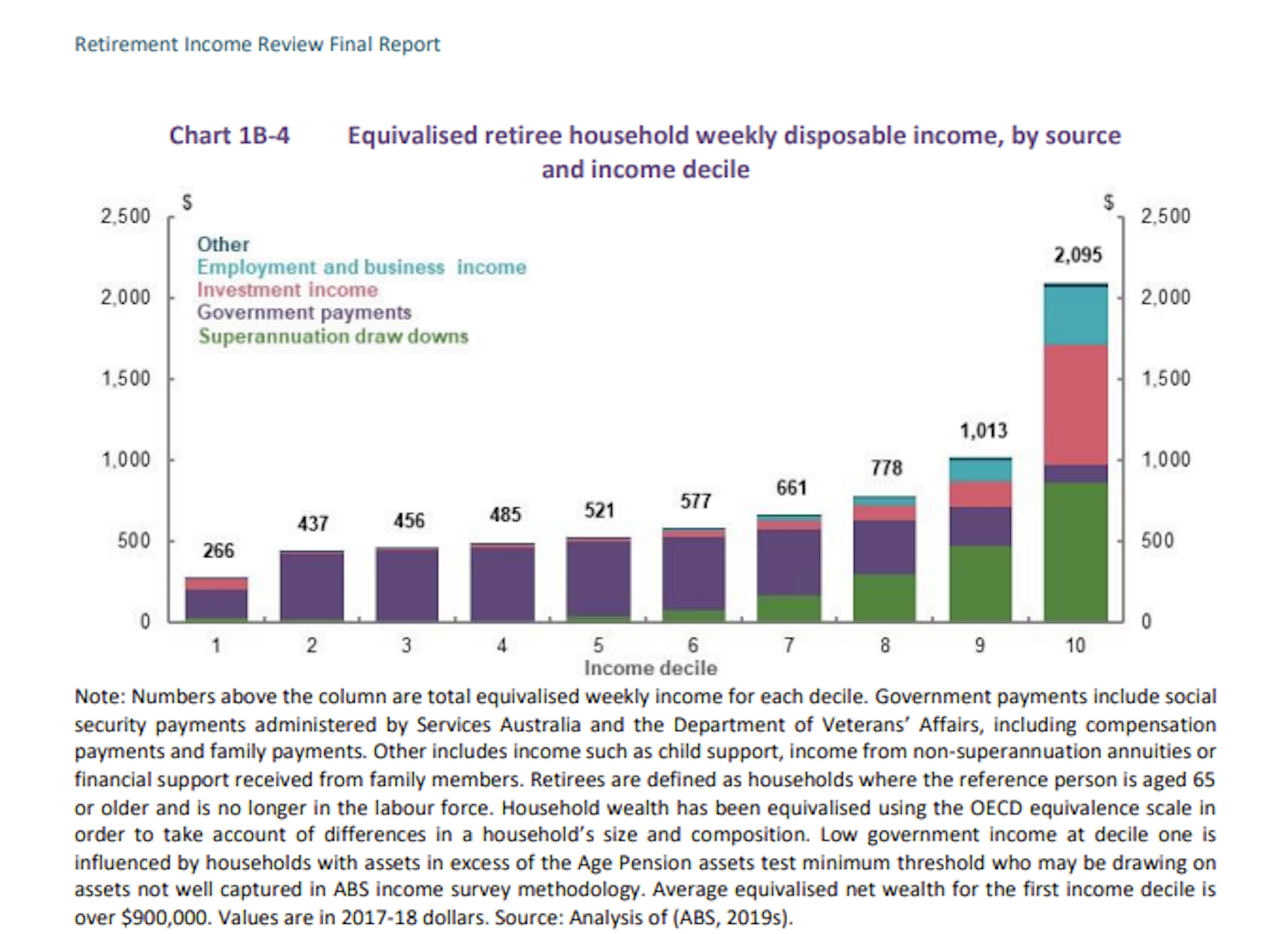
The government’s 2020 retirement income review found high-income Australians earned as much again from investment income outside super as they made from withdrawals from it. They do alright.

Scott Morrison, much criticised for the generosity to high income earners of his Stage 3 tax cuts, moved in the right direction on super. Jim Chalmers is picking up where he left off.The Conversation

This article is republished from The Conversation under a Creative Commons license. Read the original article.

Read more >>

Wednesday, June 09, 2021

Other Australians earn nothing like what you think. If you're on $59,538, you're typical

I’m guessing you earn less than A$200,000.

And I’m guessing you think you’re missing out. People keep telling you so.

On one side of politics Labor leader Anthony Albanese says anyone earning $200,000 dollars a year “can’t be described as being in the top end of town”.

On the other, Prime Minister Scott Morrison parries with interviewers when asked whether people on $180,000 to $200,000 (the biggest beneficiaries of his planned 2024 Stage 3 tax cut) are “high income”.

“They’re hardworking people working out on mines and difficult parts of the country,” he says. “They deserve a tax cut.”

Hardworking or not, Australians on more than $200,000 are rare. And an awful lot of them don’t work at all.

$200,000 is unusual

I’ve never quite understood why politicians are so keen to tell us such incomes are normal. It might be because they are on them. Each backbencher gets $211,250 plus a $32,000 electorate allowance (boosted by $19,500 if they turn down the use of a private-plated vehicle) plus home internet and travel allowances.

Very detailed tax office figures (updated on Monday) tell us what the rest of us earn, all 14.3 million of us.

Only 2% of those required to pay tax earned more than $211,365. Only 3% earned more than $188,667.

Everyone else — the other 97% — earned less than $188,667, most of them a good deal less, and many more earned even less and weren’t required to pay tax.

The typical taxable income (typical in the sense that half earned more than it, half less) was $59,538. If that’s what you’re on, you’re more likely to find people who earn close to what you do than anyone who earns more or less.

We can get an idea of how lonely it is at the top by examining the top 1%, those Australians with a taxable income of greater than $350,134.

There aren’t many of them, just 110,613 — 82,258 men and 28,355 women.

Only 39,209 have taxable incomes of more than $500,000, and of these only 14,467 have taxable incomes of more than $1 million.

Life at the top needn’t be taxed

You’re probably thinking there’s a difference between taxable incomes and actual incomes, and the tax office figures show you’re right.

15,358 Australians reported total incomes of more than $1 million. By the time they had applied legitimate tax deductions, the number had shrunk to 14,467.

Some of these million-dollar earners were able to shrink their taxable incomes very low indeed. 45 cut their taxable incomes to less than the tax-free threshold of $18,200 — meaning they didn’t have to pay anything, not even the Medicare levy.

Another eight managed to escape the Medicare levy even though their taxable incomes were above $18,200, and another 21 escaped income tax while paying the Medicare levy.


Read more: Yes, some millionaires pay no tax, but crimping deductions mightn't help


Many of these millionaires weren’t “hardworking” in the sense Morrison meant. Only 9,144 of the 14,467 Australians on taxable incomes of more than $1 million worked. Only 17,883 of the 57,120 Australians on more than $250,000 worked.

Only nine of the 45 million-dollar earners who cut their taxable incomes to less than the tax-free threshold worked. 27 received so-called franked dividends from companies that had paid tax, enabling them to cut their own tax bills or receive rebates from the tax office. On average, each received dividends of $2.25 million.

Many who aren’t taxed are generous

Seventeen of the 45 million-dollar earners received capital gains, on average $6.4 million each. 38 received interest, averaging $290,000 each.

Against that were set expenses, small and large. Three claimed for work-related car expenses averaging $27,340 each, 13 claimed expenses averaging $57,200 for assistance with tax affairs, eight claimed for previous losses from farms averaging $684,000 each, and eight for losses from other businesses averaging $408,000.

But by far their biggest expense was donations. 14 gave away a total of $161 million in gifts or tax-deductible donations — an extraordinary average of $11.5 million each.

Most of us aren’t like these people.

Most of us claim more modest deductions

Three-quarters of Australians in the tax system earn less than $89,173.

Those on that income typically claim between $1,500 and $1,900 in deductions (men claim more than women) and, thanks to negative gearing, claim losses on properties of between $1,800 and $2,600 (again, men claim more than women).

Such Australians typically report between $1,200 and $2,100 in capital gains (more for women than for men).

If higher-earning Australians are unaware of how most of us live, it’s understandable. Surgeons mix with other surgeons. On average each of Australia’s 4150 surgeons earns $394,303, making surgery our highest-paying occupation.

We mix with, and marry, people like us

And they increasingly marry each other. In 2010 the Productivity Commission found that 68% of Australia’s high earners were married to other high earners. A decade earlier it was 49%.

And high earners live near each other. The average income in Sydney’s Double Bay (Australia’s highest-earning suburb) is $202,598. The average income in Ruse in Sydney’s Campbelltown is $55,100.

People in Double Bay don’t drive through Ruse on their way to the city.


Read more: The Low and Middle Income Tax Offset has been extended yet again. It delivers help neither when nor where it's needed


In the United States it is often the other way around. There, low-income suburbs are more likely to be near the city, meaning that high-income Americans at least see them as they go in to town.

That most of us have little idea of what others earn suits those in charge when they propose tax cuts skewed to high earners.

They can con us that most of us will be better off, and those on high incomes can con themselves they are not already better off.

Peter Martin, Visiting Fellow, Crawford School of Public Policy, Australian National University

This article is republished from The Conversation under a Creative Commons license. Read the original article.

Read more >>

Wednesday, May 19, 2021

The GFC provided the secret sauce we used to ward off the COVID recession

We got an awful lot right during the COVID crisis — an awful lot that we couldn’t have got right just a few years earlier.

Which is another way of saying we were incredibly lucky.

Had COVID attacked during the 1980s there would have been no way to make a messenger RNA vaccine, not even for animals.

The national broadband network wouldn’t have been thought of. It wasn’t complete until 2020.

Even three years earlier, in 2017, the NBN reached only half of Australia’s 10 million households.

Had COVID struck then, before the broadband network was complete, working from home, telehealth and home schooling might have been impossible for many Australians, with devastating educational and other consequences.

And had it struck just a few years earlier still, we wouldn’t have learnt from the global financial crisis.

War Games

Australia’s handling of the GFC was exemplary, as evidenced by the fact that in much of the rest of the world it isn’t called the GFC, but The Great Recession.

Getting that crisis right owed something to a happy accident, as Ken Henry, head of the treasury at the time, explained on Monday at a seminar organised by the Institute of Public Administration.

A few years before the crisis in 2004 he was sitting in a room with senior officials discussing “some macroeconomic topic” when his deputy Martin Parkinson, sitting on his right, poked him with his left elbow.

“Martin said: you know it’s just occurred to me that you and I are probably the only people in this room who have ever experienced a recession — maybe we should have a workshop on that, what we would do if there was another crisis”.

The early 1990s recession was handled badly

Parkinson and treasury secretary Henry had worked for the Hawke and Keating governments during the early 1990s recession which scarred the Australians who it threw out of work for a decade.

In a series of “war games” held away from the treasury building, they and other officials determined that next time they should advise the government to quickly abandon budget discipline and fight what was coming with overwhelming force.

As Henry put it: “no matter how great the importance of fiscal discipline in establishing policy credibility, it is nothing compared to the loss of credibility associated with a recession”.

If the treasury didn’t tell the government this, the government would catch on anyway and sideline it for advisers who would.

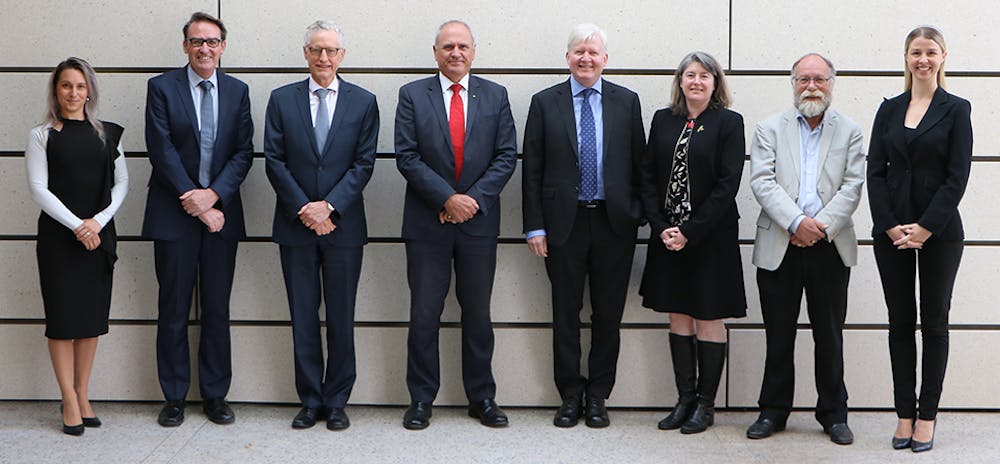
Megan Aponte-Payne, Steven Kennedy, David Gruen, Ken Henry, Malcolm Edey, Meghan Quinn and David Tune at the GFC seminar. Isabelle Franklin

“I came out of those discussions determined that if Australia were to confront a large negative shock during my tenure as secretary, the treasury would seek to put itself front and centre in advising the government,” Henry said.

“We would not be taking seats in the back row by counselling a government to rely on monetary policy, the exchange rate, or automatic stabilisers.”

As for the idea of “proportionate response”, which was still being counselled by some in the early stages of COVID last year, Henry said the word “proportionate” could be applied to a response, but never to preemption.

Preemption is not proportionate

“If you want to preempt something, you don’t talk about being proportionate,” he said. “I remember some commentators saying you should wait until you see the ‘whites of the eyes’ before taking action. "I wouldn’t know what action to take at that stage, presumably it would be to run as fast as you could, I just don’t know.”

The key thing was to get money into Australian’s hands immediately. Spending on infrastructure (spending on almost anything other than households) would take too long.

During the financial crisis Labor got money into households’ hands by handing out cheques. During COVID the Coalition did it by doubling benefits and routing payments through employers and calling them JobKeeper.

Bandwidth matters

Henry, and David Tune who was in the department of prime minister and cabinet at the time and later headed the department of finance, told the conference that attempting to do other things while getting money out the door got in the way, among them insulating homes and building school halls.

Governments have limited “bandwidth” or “thinking space”, and during the GFC the Rudd government was also considering taking over hospitals, taxing carbon, reforming the tax system and building the NBN.

The Morrison government seems to have learnt that lesson, but it doesn’t seem to have learnt another, which is that the Commonwealth isn’t good at managing projects.

The Commonwealth can’t run projects…

Whether it’s vaccinations or quarantine or insulating homes, projects are best managed by state governments who have actual experience of running things.

Another important lesson, reinforced during COVID is that in practical terms the ability of the Reserve Bank to support the government in keeping a recession at bay might be unlimited.

The Reserve Bank deputy governor at the time Malcolm Edey told the conference that the next step after low interest rates and buying government bonds is direct “money-financed fiscal expansion”, where the bank creates money for the government to spend.

…but its financial power is unlimited

With all of the government’s borrowing now in Australian dollars, and most private overseas borrowing effectively in Australian dollars because it has been hedged against exchange rate movements, and with the debt ceiling gone, there’s no limit to the force and speed with which the government can stave off a recession.

The current treasury secretary Steven Kennedy conceded that in one way fighting the COVID recession had been easier than fighting the GFC.

COVID had a clear start date. The GFC had a rolling series of starts that made it hard to be sure the worst hadn’t passed.


Read more: Frydenberg spends the bounty to drive unemployment to new lows


And perhaps because of that, we discovered what Australians can do.

Treasury Deputy Secretary Meghan Quinn praised the banks for deferring payments on $250 billion of loans, Coles and Woolworths for working together to stock each other’s stores and the private and public health systems for working together in a way that wouldn’t have been thought possible before the pandemic.

We read the GFC playbook, then went further.

Peter Martin, Visiting Fellow, Crawford School of Public Policy, Australian National University

This article is republished from The Conversation under a Creative Commons license. Read the original article.
Read more >>

Wednesday, September 04, 2019

GDP. Why we've the weakest economy since the global financial crisis, with few clear ways out

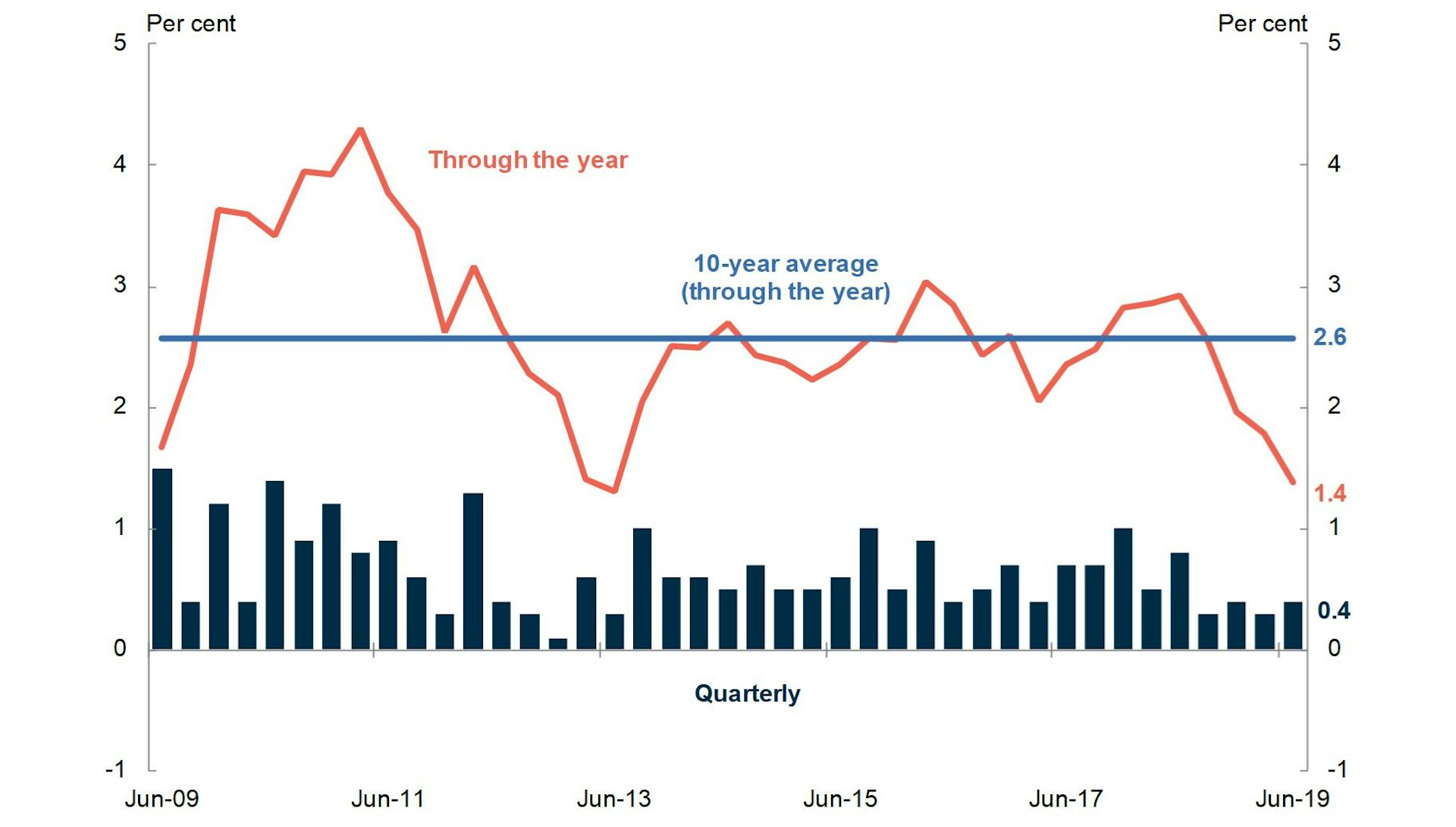
The Australian economy is tepid, with consumer spending the weakest in ten years, business investment shrinking, and economic growth too weak to cover population growth.

Were it not for very strong growth in export income and the biggest surge in government spending in 15 years, the economy would have shrunk.

The Treasury believes the Australian economy is capable of growing at a sustained annual pace of 2.75%. The growth rate in the past financial year of 1.4% reported on Wednesday is only half that.

Not since September 2009 has the gap between what the Australian economy is capable of and what it has been delivering been so wide. 2009 was the year of the global financial crisis.


Real GDP growth


Economic growth has rarely been as low as 1.4% outside of a recession.

When account is taken of population growth, income and production per citizen went backwards. The last time that happened was during the financial crisis. The last time before that was during the early 1990s recession.

Household spending, which accounts for more than half of total spending, also failed to keep pace with population growth. The inflation-adjusted growth rate of 1.4% was also the lowest since the financial crisis.


Growth in household consumption


Other figures released on Tuesday show retail spending dipped a further 0.1% in July.

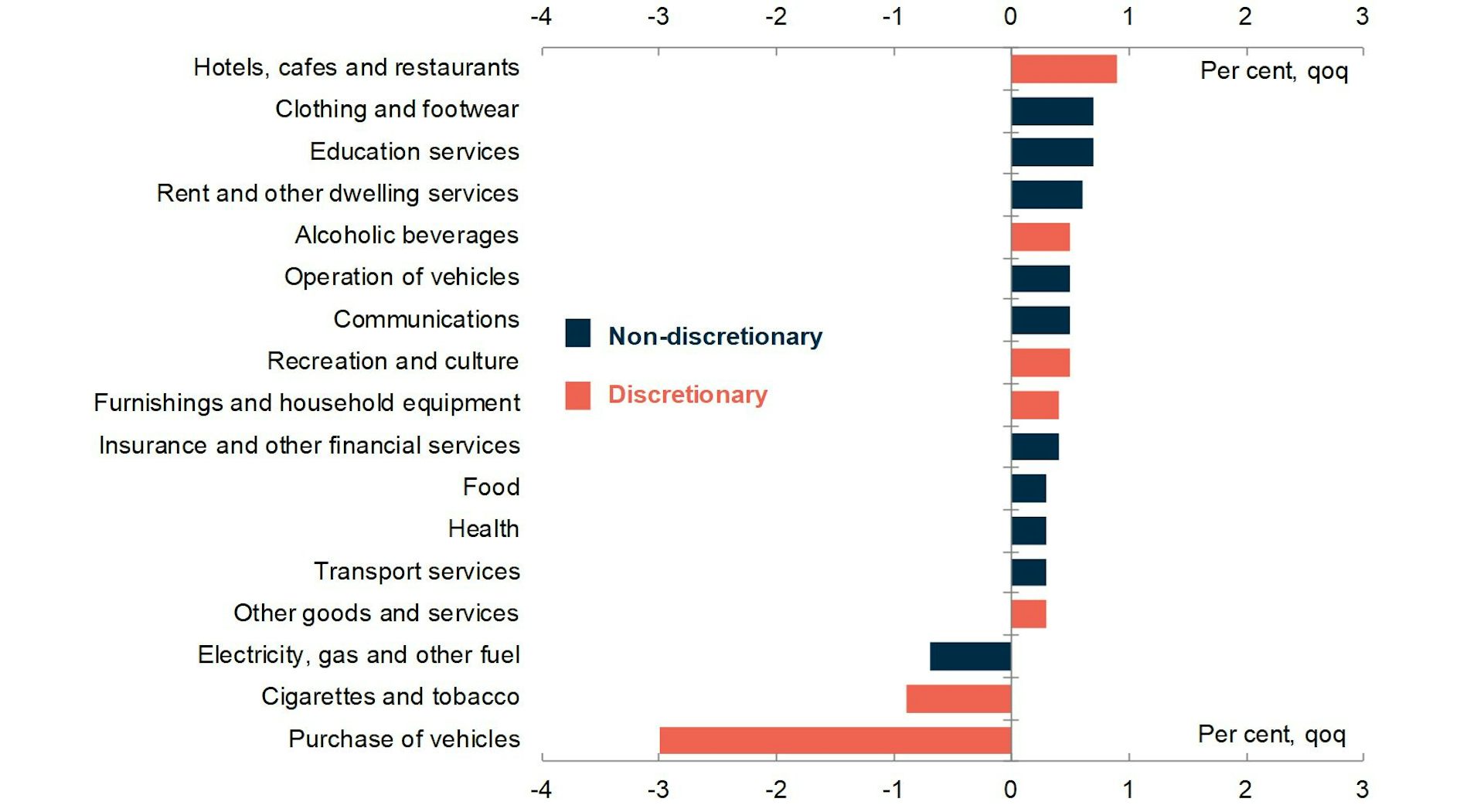
Hardest hit in the 2018-19 financial year was spending on cars. Updated figures released at the same time as the national accounts show sales of new cars down 10% over the year to August.

Treasurer Josh Frydenberg said he preferred to think that households were delaying rather than abandoning purchases of cars, waiting until the economic outlook was clearer.


Growth in consumption by category


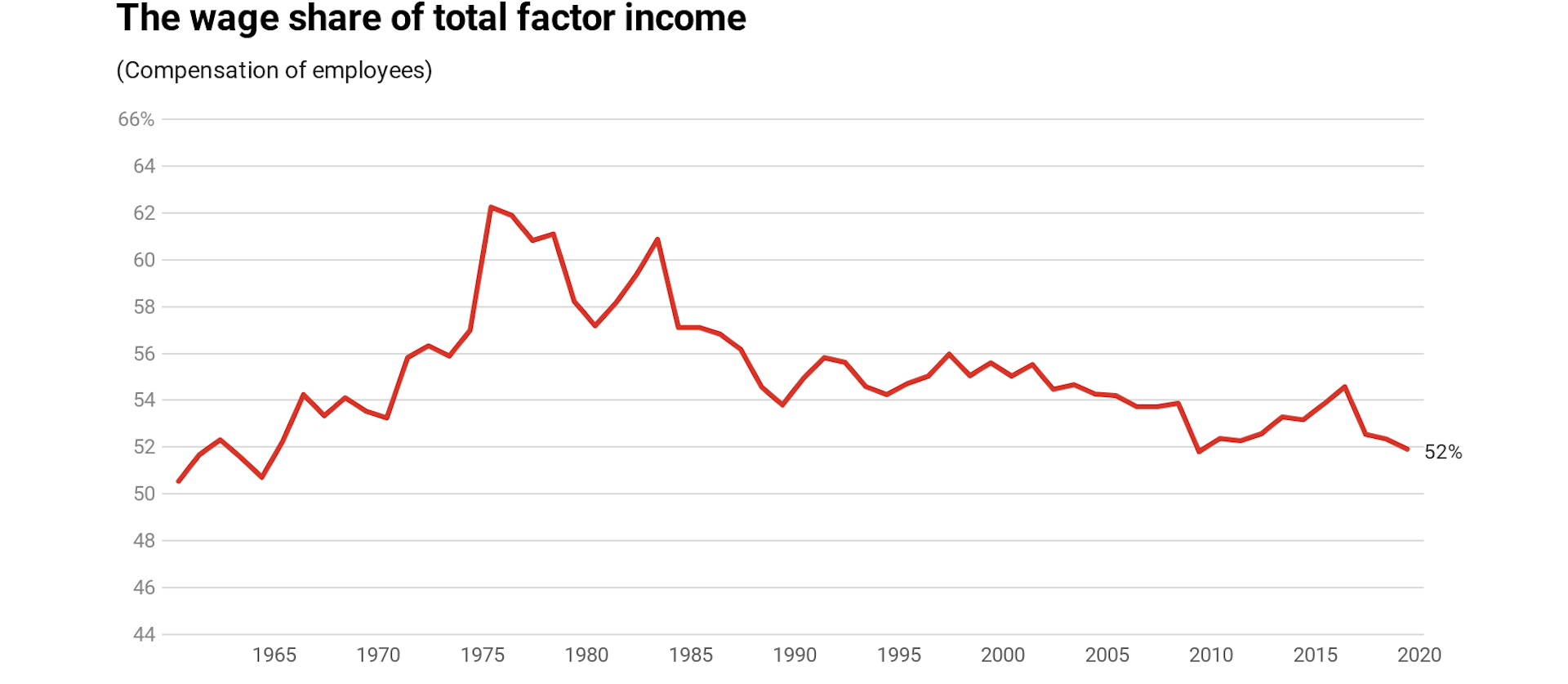
Weighing on consumers is an extended period of unusually low wage growth that the national accounts show has brought the share of national income paid out as wages down to just about its lowest point since 1964.

Although the wage and superannuation bill increased, climbing 5% over the year as employment grew, the share of national income paid out as wages and super fell to 52% – the lowest since the global financial crisis, and before that the lowest since the Beatles toured Australia and Donald Horne published The Lucky Country.


Also weighing on consumers has been housing. Investment in housing (including alterations and additions) was down 9.1% over the year. Business investment fell 10%.

Company profits grew 12.8%, but leaving aside mining companies, whose profits grew strongly on the back of higher prices and export volumes, other profits grew only weakly, climbing 1.8%.

Mining income pushed up nominal GDP (the raw dollars unadjusted for prices that drive nominal incomes) up a healthy 5.4%, probably delivering the government a budget surplus one year earlier than promised, in 2018-19. Frydenberg said he already knew the result and would unveil it in a fortnight. His smiles suggested it’s one he likes.


Nominal GDP growth


Mining income also pushed up what the Reserve Bank regards as the best measure of actual living standards, which (perhaps surprisingly) is not GDP per capita, which is going backwards, but a lesser known and purpose-designed measure known as “real net disposable income per capita”. It grew a healthy 2.65% over the year and a very healthy 1% over the quarter.

It is true that much of it was paid out in mining profits, but it is also true that it isn’t necessarily right to latch on to the cruder measure of GDP per capita and say that living standards are going backwards.

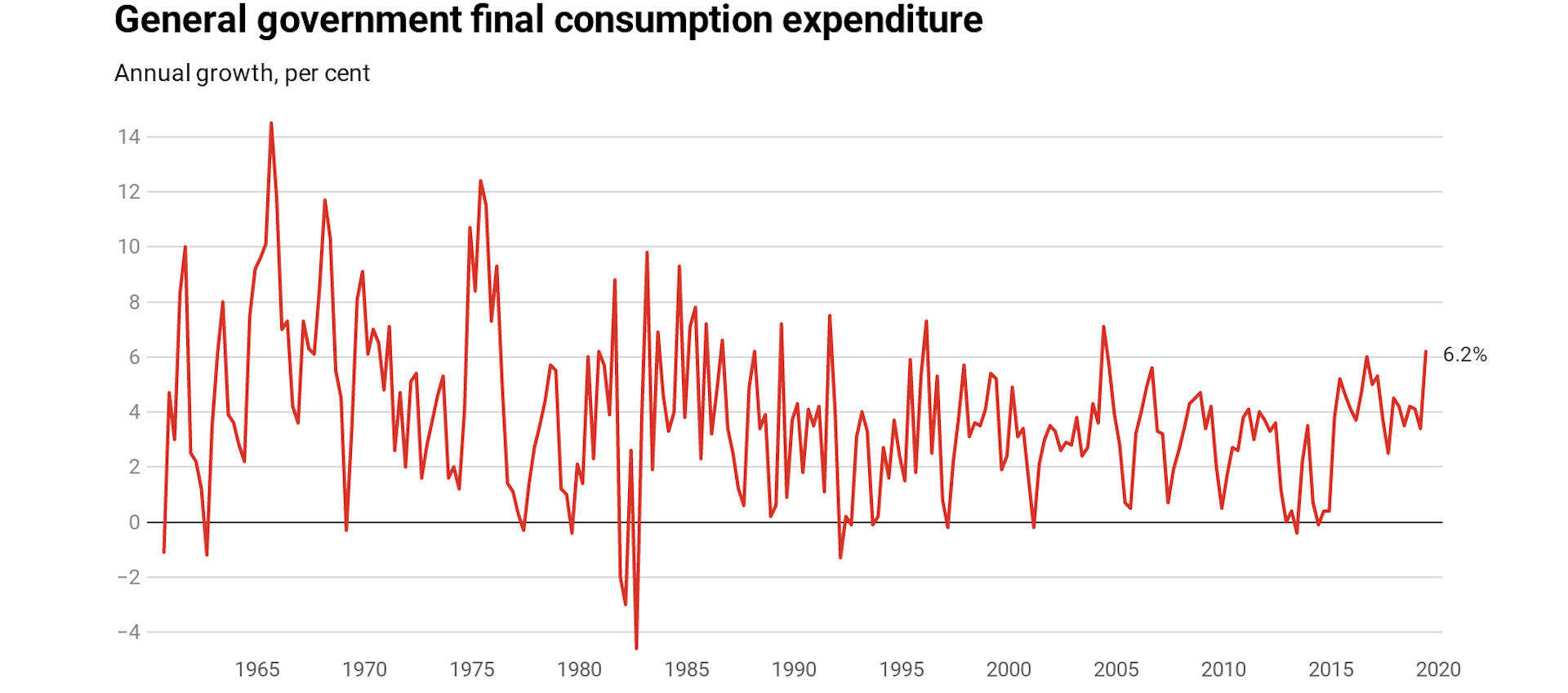
Helping maintain living standards was a very healthy growth in government spending, the highest for some time – not government infrastructure spending, that actually fell over the year as some state projects wound up, but day-to-day spending on things such as the National Disability Insurance Scheme.


Oddly, because of the way the national accounts work, economic growth was also helped by a slump in imports, down 2.8% over the year due largely to a slump in imports of consumer goods.

The economy is in a bad way. Aside from mining and government spending, the only real bright spot is employment growth, and as the Reserve Bank often points out, employment growth doesn’t tell us much about what’s going to happen.

It tends to lag everything else in the economy, by up to nine months. By the time it turns down, other things already have.

Few clear ways out

Frydenberg doesn’t seem too worried. For now he is banking on the tax cuts and the interest rate cuts in June and July to lift investment and spending.

The treasurer has two Plan Bs. One is an aggressive investment allowance for business. He spoke about introducing one last week, but on Wednesday he indicated that he wasn’t planning to do so until next year’s May budget. If needed, he could bring the date forward.

The other is another Reserve Bank rate cut, most likely at the board’s meeting on Melbourne Cup Day, by which time it will have before it an updated set of inflation figures.


Read more: 'Back yourself' Treasurer Frydenberg tells business. But it's not that simple


Frydenberg revealed on Wednesday that he is taking a close look at the government’s contract with the Reserve Bank, a formal written agreement which is renewed after each election.

He has asked the Treasury to look at it to see whether it needs to be tightened to make the bank more responsive to the state of the economy. This would mean more boldly cutting or pushing up rates.

In Britain, if inflation is 1 percentage point above or below the Bank of England’s target, it has to write to the government to explain why.The Conversation


Peter Martin, Visiting Fellow, Crawford School of Public Policy, Australian National University

This article is republished from The Conversation under a Creative Commons license. Read the original article.

Read more >>

Tuesday, June 04, 2019

The Reserve Bank will cut rates again and again, until we lift spending and push up prices

The Reserve Bank cut interest rates on Tuesday because we aren’t spending or pushing up prices at anything like the rate it would like. And things are even worse than it might have realised.

As the board met in Martin Place in Sydney, in Canberra at 11.30 am the Bureau of Statistics released details of retail spending in April, one month beyond the March quarter figures the bank was using to make its decision.

They show the dollars spent in shops fell in April, slipping 0.1%, notwithstanding weakly growing prices and a more strongly growing population.

The March quarter figures the board was looking at were adjusted for prices. They show that the volume of goods and services bought, but not the amount paid for them, fell in seasonally adjusted terms during the March quarter.

Adjusted for population, the volume bought would have fallen further.

We’ll know more on Wednesday

The Bureau of Statistics will release population-adjusted figures as part of the national accounts on Wednesday.

The figures for the September quarter show that income and spending per person barely grew. The figures for the December quarter show income and spending per person fell.

A second fall in the March quarter will mean two in a row – what some people call a per capita recession.


Australian National Accounts

Even unadjusted for population, economic growth is dismal.

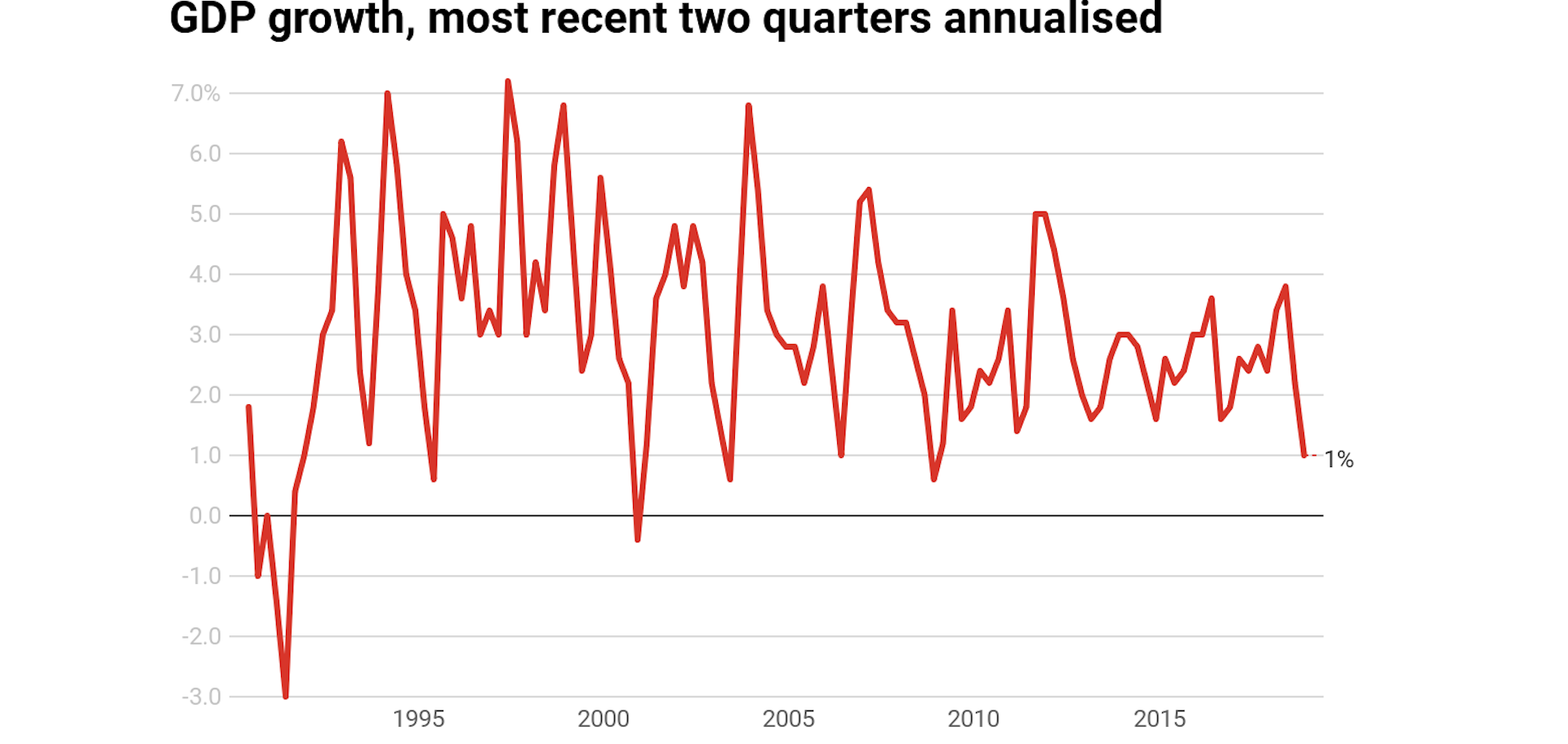
During the September and December quarters the economy grew just 0.3% and 0.2% – an annualised rate of just 1%.

That’s well short of the 2.75% the treasury believes we are capable of, and the lower than normal 2.25% it has forecast for the year to June.


Australian National Accounts

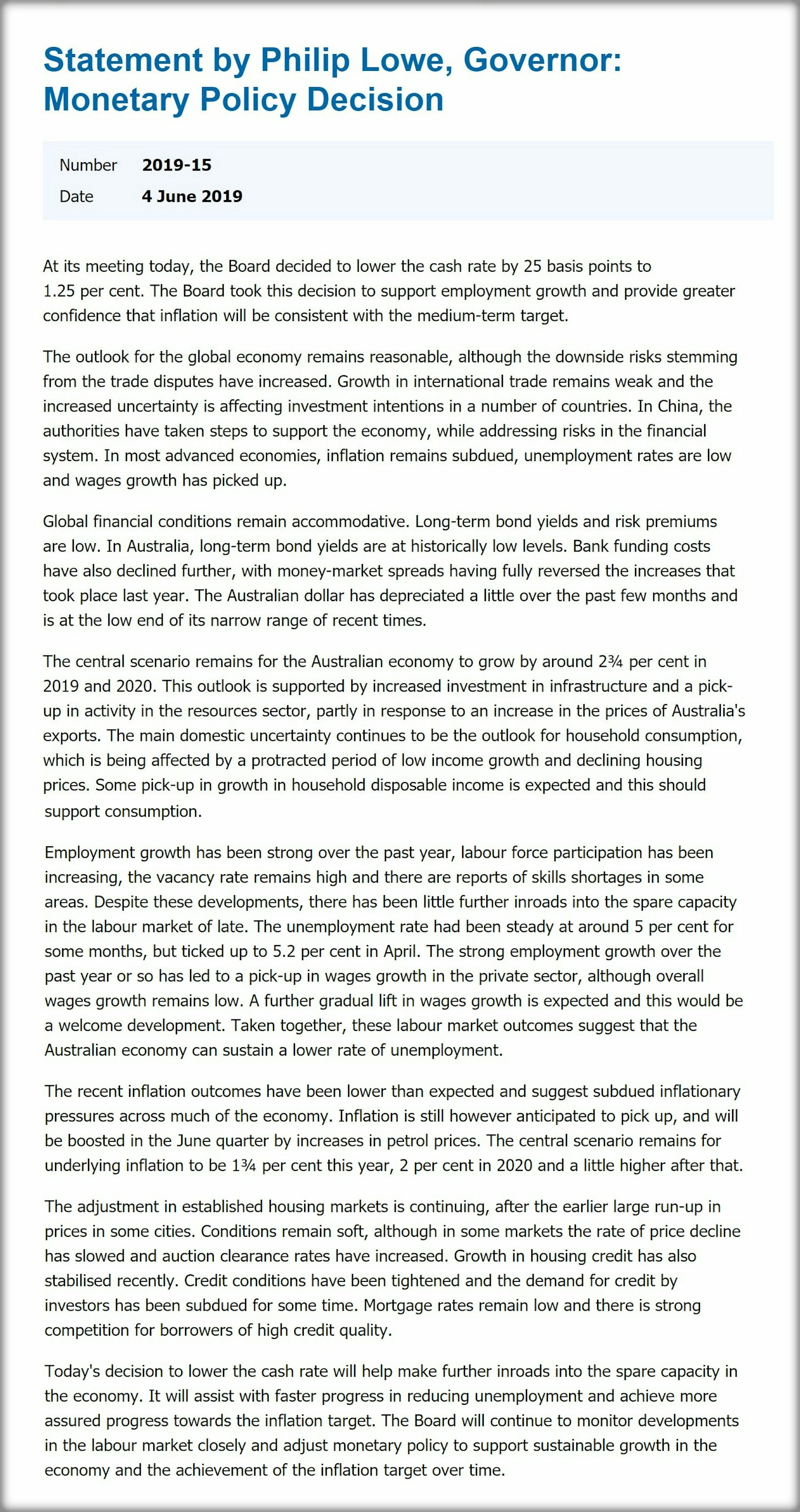
We’ve been doing it by ourselves. As Reserve Bank Governor Philip Lowe said in announcing the rates decision on Tuesday:

The main domestic uncertainty continues to be the outlook for household consumption, which is being affected by a protracted period of low income growth and declining housing prices.

The bank wants both inflation and employment higher, and it wants us to spend more in order to do it. Lower rates should help, although not for everybody.

Lowe acknowledged this in a speech to a Sydney business audience on Tuesday night, but he said households paid two dollars in interest for every one dollar of interest they received. So while rate cuts hurt savers, they benefit borrowers by more, and over time should benefit all households by boosting the economy. They also drive the dollar lower, making Australian businesses more competitive.

Tuesday’s cut should free up an extra A$60 a month for a typical mortgage holder. Another one will free up a total of A$120.

It’s not much, and there’s doubt about whether it will do much, but interest rates are about the only tool the Reserve Bank has.

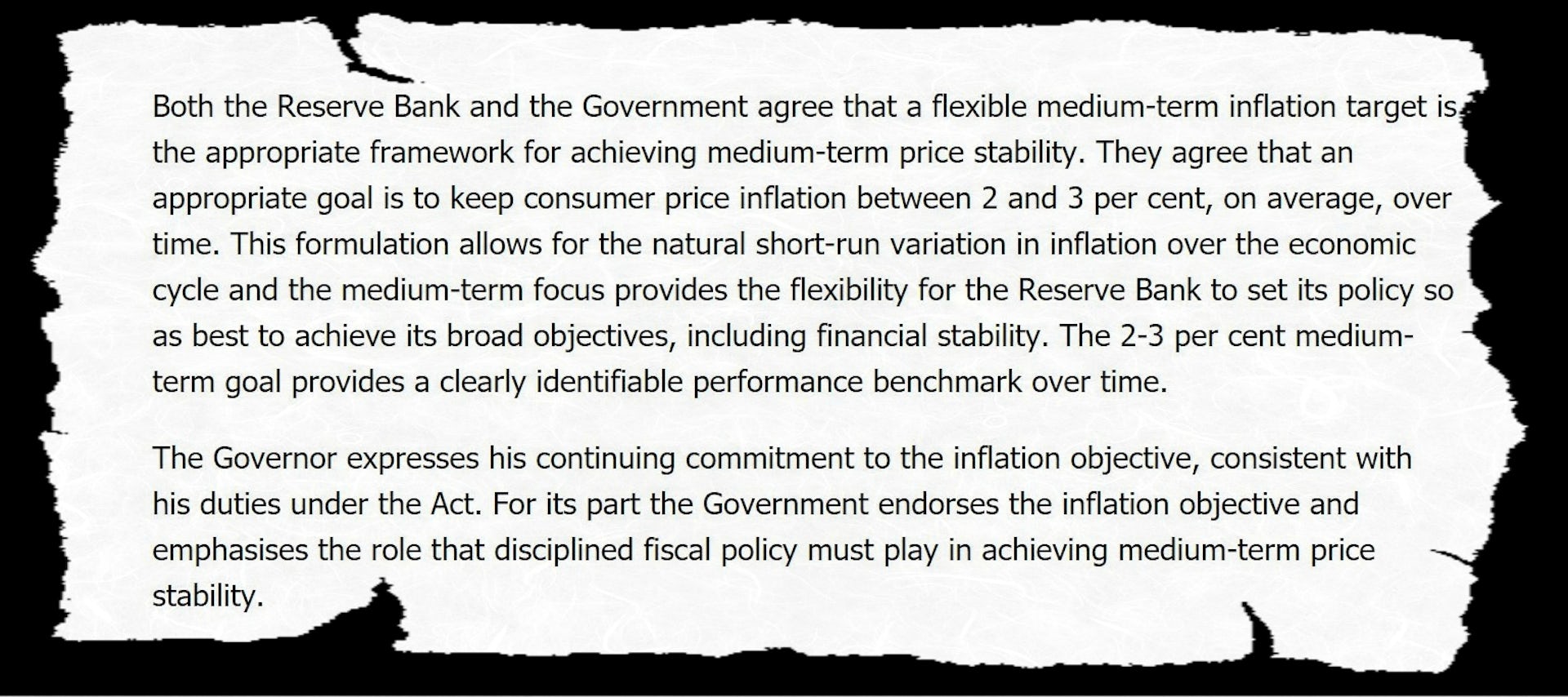
It is required by its agreement with the government to aim for an inflation rate of between 2% and 3%, “on average, over time”.

Reserve Bank of Australia

Uncomfortably for Governor Lowe, underlying inflation (abstracting from unusual moves which are quickly reversed) has been below 2% ever since he was appointed governor in late 2016.

Explaining his push for higher inflation to a business audience in Sydney on Tuesday night he said that while adherence to the target was intended to be flexible, that flexibility was “not boundless”.

If inflation stays too low for too long, it is possible that inflation expectations move lower – that Australians come to expect sub-2% inflation on an ongoing basis. If this were to happen, it would be harder to achieve the medium term inflation goal. So we need to guard against this possibility.

He is also required to aim for full employment.

He told the business audience that while for some years the bank and others had thought full employment meant an unemployment rate of 5%, the absence of inflation at 5% and the persistence of underemployment (where people wanted more hours) meant it could and should go lower.

Our judgement now is that we can do better than this – that we can sustain an unemployment rate of 4 point something.

Lower interest rates should help by making it easier for businesses to borrow to expand, and giving consumers something in their pockets to buy from them.

If you don’t succeed…

If that doesn’t happen, the bank will cut again.

Tuesday’s statement as good as said so:

The board will continue to monitor developments in the labour market closely and adjust monetary policy to support sustainable growth in the economy and the achievement of the inflation target over time.

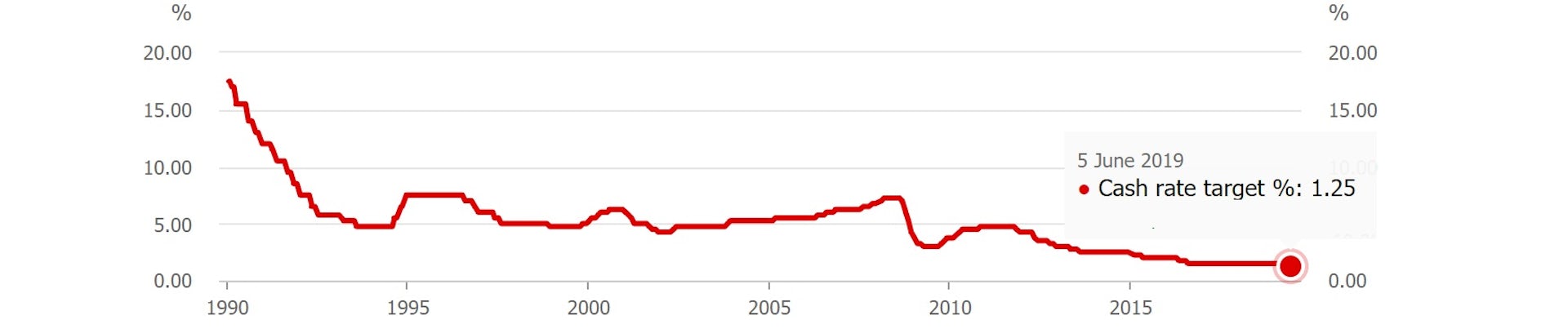
Tuesday’s cut and the next will take the bank into uncharted waters, where its so-called cash rate – what it pays to banks to deposit money with it overnight – is close to zero.

As far as can be discerned it has never been that low in the 100+ years the Reserve Bank has been in operation, originally as the Commonwealth Bank of Australia.


Reserve Bank cash rate since 1990
Reserve Bank of Australia

Should inflation still not pick up and employment still not fall as far as it believes it could, it will have to effectively cut its cash rate below zero, forcing cash into the hands of banks by aggressively buying government bonds, giving them little choice but to lend it to households and businesses, in a process known as quantitative easing. It has been done in the United States, Europe, the United Kingdom and Japan, and is by now anything but unconventional.

Governor Lowe would prefer the government to pull its weight by cutting tax and boosting spending, especially on infrastructure, and by policies that make Australia more productive.

He said so on Tuesday night

the best approach to delivering lower unemployment and a stronger economy is through structural policies that support firms expanding, investing, innovating and employing people. As we ease monetary policy, it is in the country’s interest that other policy options are considered too.

Treasurer Josh Frydenberg gets it.

He pointed out on Tuesday that the yet-to-be-approved tax offsets in the budget will give Australians on up to A$126,000 a cash bonus of up to A$1,080 when they submit this year’s tax return, far more than the rate cut.

His biggest concern, and the biggest concern of the governor, might be that they don’t spend it. Another concern would be that the banks don’t pass the rate cut on.

The ANZ has said it will only cut mortgage rates by 0.18 points instead of the full 0.25, a decision Frydenberg said “let down” customers. Westpac has cut by only 0.20 points. The National Australia and Commonwealth banks have passed on the cut in full.

On Tuesday night in Sydney Governor Lowe addressed the question of whether the banks should have passed on the full cut head on:

My usual practice in answering this question has been to explain that there are a range of other factors that influence mortgage pricing, and then say “it all depends”.

Today, though, I would like to break with my usual practice and provide a clearer answer. And that is: Yes. There has been a substantial reduction in the cost of banks raising funds in wholesale markets. Average rates on retail deposits have also come down.

This means that the lower cash rate should be fully passed through into standard variable mortgage rates. Full pass-through would also mean that the economy receives the full benefit of today’s policy decision.

The Governor is concerned that, for their own reasons, lenders such as ANZ and Westpac are forcing him to cut rates lower than he should and making an already difficult job harder.

If he has to cut further he will, but with the cash rate at just 1.25%, he would dearly love not to have to.

Reserve Bank of Australia

Read more: Cutting interest rates is just the start. It's about to become much, much easier to borrow The Conversation


Peter Martin, Visiting Fellow, Crawford School of Public Policy, Australian National University

This article is republished from The Conversation under a Creative Commons license. Read the original article.
Read more >>

Sunday, August 06, 2017

When it comes to electricity, the joke's on us

There's this joke, told against economists.

Two of them are walking down the street. One points, and says: "Hey look, there's a $20 note on the footpath." The other replies: "Impossible. If there was, someone would have picked it up by now."

Boom tish. My favourite is about a can-opener. And there's another one about sheep. But we'll leave them for another day.

What I'm getting at is that the joke against economists is actually a joke against us, about half of us.

Newgate Research has come up with the numbers in a paper prepared for the Australian Energy Market Commission, quoted by the Prime Minister in his letter to electricity bosses; the one summoning them to a crisis meeting in Canberra on Wednesday.

Roughly half of us haven't switched electricity suppliers in the past five years, and a good many have never switched.

The letter says they are leaving on the table (or on the ground) savings of up to $830 per year in Victoria and $1400 in NSW.

Why do they do it? Most say (just like the economist) that they "generally don't trust energy companies that promise a better deal". Most also say it's too complicated to compare offers and plans, a conclusion I reluctantly came to myself, and I'm normally good at these things.

Curiously, around half say they would rather cut their bill by cutting electricity use than shopping around, and most strangely of all, 39 per cent say the amount of money they could save isn't "worth the time and effort involved in switching".

It's strange, because without investigating switching they can't know how much they could save, and also because the savings would be ongoing, whereas the time and effort would be a one-off.

Newgate dug deeper and asked how much of a saving they would need in order to seriously consider switching. The thresholds were astonishingly high. On average the 2000 householders surveyed said they would need to save 23 per cent of their electricity bills to make the effort worthwhile. That's $82 each quarter in Victoria (more than $300 a year) and $97 each quarter in NSW (almost $400 a year).

If it was petrol, or groceries, we'd drive to the other end of town to save half as much.

And savings available from switching electricity suppliers appear to be bigger. Half of us don't know it because we don't think its worth our while finding out.

Many of us wouldn't know where to start. Asked unprompted to name a government price comparison website, only 2 per cent could. Energymadeeasy.gov.au might as well not exist. Twice as many people used Google to compare suppliers as used a comparison website. Of those that did try to switch, 21 per cent found it difficult, a result much worse than the 15 per cent who found it difficult to switch internet providers, 9 per cent who found it difficult to switch mobile phone companies and 7 per cent who found it difficult to change home insurance. It's about the same as the 20 per cent who find it difficult to switch banks, the best part of a decade after attempts to make it easy.

Partly, the difficulty is intentional. By expressing electricity charges in formulas that are hard to calculate, the retailers hope we'll give up. And I reckon it's also because electricity is dull, and the rewards are delayed. If you get a bargain on an iPad, you feel good straight away. You can take it home and see what you've saved.

But if you get a bargain on electricity, nothing changes: the electrons are the same and you won't see a changed bill for months. It's the same with mortgages: the dollars are identical and the savings take a while to flow through.

We're wired for novelty. If the dollars are dull, we won't pick them up.

In The Age and Sydney Morning Herald
Read more >>

Tuesday, July 18, 2017

Revealed. $8 tolls each way in Sydney's north

Motorists will pay tolls in both directions on the Sydney Harbour Bridge and the Harbour Tunnel under proposals to help cover the $14 billion cost of a 14-kilometre tunnel linking the northern beaches to the city's inner west.

The plans for the new tolls, detailed in cabinet-in-confidence documents, also reveal that motorists will be slugged about $8 (in today's dollars) for a one-way journey by car on the entire length of the proposed Western Harbour Tunnel and Beaches Link.

The analysis assumes tolls will be in place for a 35-year period on the Western Harbour Tunnel from 2023, and the Beaches Link a year later. Charges for trucks will be three times greater than those for cars or light commercial vehicles.

Under the proposals contained in a "Final Business Case", $3 tolls for cars will be placed on northbound trips on the Sydney Harbour Bridge and the Harbour Tunnel from 2022 to make them the same as those on the proposed Western Harbour Tunnel.

The documents show the new tolls on the Harbour Bridge and Harbour Tunnel will help cross-subsidise the third harbour crossing and the Beaches Link, whose tolls will be insufficient to cover the full cost of building, maintaining and operating them.

Cabinet documents seen by Fairfax Media and the ABC have put the cost of the new tunnels at $14 billion, which compares with $16.8 billion for the 33km WestConnex motorway.

Transport authorities believe tolls are necessary to avoid free northbound trips on the Harbour Bridge and Harbour Tunnel undermining the case for a third crossing. A free alternative would discourage motorists from using a tolled Western Harbour Tunnel.

It has also been proposed that tolls will be placed on southbound journeys of the Eastern Distributor. They would be set at half the cost of the existing charge for a northbound journey of $7.02 – or about $3.50 each way.

The $8 toll for the entire length of the proposed roadway is made up of $3 for the new harbour tunnel between the WestConnex interchange at Rozelle and North Sydney, where it will join the Warringah Freeway, and $5 for the Beaches Link to Balgowlah in Sydney's north.

The tolls planned for the new tunnels will be fixed, unlike the distance-based tolls on WestConnex. While tolls on the Western Harbour Tunnel will rise in line with the consumer price index, those on the Beaches Link will increase every year for the first two decades by 4 per cent or at the rate of inflation, whichever is greater.

In an era of low wage growth, the likelihood of tolls rising at a faster rate than inflation means a greater proportion of Sydney motorists' income will go towards paying charges for using motorways.

The NSW government has been opposed to limiting toll increases on Sydney's growing labyrinth of motorways to the rate of inflation because it believes it could push up the initial price of new roads and make it more difficult to attract private investment.

Charges for cars on some of Sydney's largest motorways such as the M2 are, due to contracts signed with private tolling companies, are growing at twice the present annual inflation rate.

Asked about the proposed new tolls, a spokesman for Roads Minister Melinda Pavey said there was "always speculation around major projects".

"As the Premier said when she announced the project, we have commenced a market sounding process to investigate funding options and delivery approaches. That work is not yet complete," the spokesman said.

"We expect to have a detailed plan by the middle of next year."

Surveys for the government have shown a majority of people to be in favour of the new harbour tunnel and Beaches Link. However, they show northern beaches residents are more sensitive to paying to drive on motorways than those from other parts of Sydney because they have had less exposure to toll roads.

Residents in western Sydney are the biggest users of the city's toll roads.

The Berejiklian government faces growing pressure to fully consult communities about its plans for the Western Harbour Tunnel and the Beaches Link, which will require six exhaust ventilation stacks.

Some of the proposed locations of the ventilation towers, each between 20 and 35 metres high, are close to schools.

The cabinet documents show the government plan was for "stakeholder engagement" from late 2016 to the end of this year to focus on "coordinating activities to support the successful announcement" of the two tunnel projects.

And, in countering opposition from residents and councils. the proposed response was to emphasise that the government was announcing a "fresh approach to community engagement and property acquisition".

Likewise, to allay concerns that property prices will be hit, an "awareness campaign" would be rolled out to show the "bounce in local property values once a major transport infrastructure project becomes operational".

In The Age and Sydney Morning Herald
Read more >>

Thursday, March 09, 2017

Shared equity: The 'socialist' fix for housing

Anyone would think Victoria had single-handedly reignited the housing crisis.

The critics leapt on the weekend announcement of a (small) pilot program in which the government would take an equity share in private homes, saying it would "drive up prices" and force homeowners to borrow from both a bank and the government.

Yet if it's such a bad idea (socialist, even) why was it first proposed by the Liberal Party-aligned Menzies Research Centre, why did Prime Minister John Howard commend it to his home ownership task force, why have both Malcolm Turnbull and Scott Morrison championed it, and why was Tony Abbott an early adopter?

It helps to get some history, from the Menzies Research Centre's 2003 report to Howard.

Private home ownership is relatively new. Up until the late 19th century most families rented from wealthy landlords. They had no hope of buying in their own right and there was no mortgage finance for people like them. Complaints got them evicted. In the United Kingdom, and Australia, it was fertile ground for the Communist movement.

Some countries, such as Sweden, responded by expanding public housing. Australia (and the UK) went in a different direction. They directed their state banks to offer affordable mortgages to ordinary workers. The federal government chipped in with grants to help cover deposits and also instructed the Commonwealth Bank (then part of the Reserve Bank) to lend to homebuyers itself and make sure the private banks did. By the time Robert Menzies stepped down as prime minister in 1966 Australia was said to be the biggest home-owning nation in the world.

Critics at the time might have said that empowering ordinary workers to buy houses pushed up prices, and it probably did.

It's the same with the next revolution, from the mid-1990s. Securitisation allowed non-bank lenders to offer much cheaper loans using funds predominantly sourced from overseas. It made home-owning easier once again, and probably also helped push up prices.

After each revolution we've come to think of where we have landed as normal, but, from a financial perspective, there's nothing normal about the way we fund houses.

"Imagine you are a young doctor who flies frequently," the report to Howard asked. "You wish to do two seemingly straightforward things: first, consume standard flight services; and second, allocate some fraction of your wealth to a collection of related companies. You also consider yourself to be a fairly canny customer, and prefer not to put all your eggs in one basket."

If you had to make the same choice we have to make for housing, you would have to either put most of your wealth into an airline (actually, into one particular plane) or none at all. And you'd have to borrow to do it.

Like the frequent flyer, would-be homeowners face an unusual all-or-nothing constraint. The sensible advice is to spread their investments over a range of assets. Instead they're forced to put more than everything they own into one particular house in one particular location, or nothing at all.

We allow them to insure against their house burning down, but we don't allow them to use diversification to insure against what happens to its price.

Meanwhile super funds can't get access to a class of assets worth three trillion dollars. It's impractical for them to buy a portion of a range of houses in a range of suburbs. Yet at times houses perform better than the assets in which they can invest, and more importantly, they perform differently. In the language of the professionals, their price is "uncorrelated" with other prices, which makes them valuable.

The report to Howard, endorsed by Turnbull as the chairman of the Menzies Research Centre, recommended that institutions be encouraged to enter into silent partnerships with homebuyers where they would own, say, 20 per cent of a property and allow the homebuyer to live in it rent-free in return for, say, 40 per cent of any increase in price when it was eventually sold. They could bundle the contracts and sell them to super funds.

"Homeowners will benefit from a lower cost of home ownership, and institutions will be able to access an enormous, and uncorrelated, asset class," Turnbull wrote.

The then-treasurer Peter Costello couldn't see the point, so the author of the report, Christopher Joye, went out on his own in partnership with the Adelaide Bank and started offering what they called equity finance mortgages. Tony Abbott was one of their early customers. In opposition Scott Morrison championed the idea as shadow minister for housing.

Now Morrison and Turnbull are drawing up a budget with access to housing as its centrepiece. If they make it a Commonwealth scheme, the Commonwealth could hang on to the equity in each house for only a short time before on-selling it. It would signal that the scheme's legit.

Like each of the revolutions before it, it runs the risk of pushing up prices, although only to the extent that it makes housing more attainable. But it would get people into housing and break the historically unusual and unhealthy nexus between investment and roofs over our heads.

In The Age and Sydney Morning Herald
Read more >>

Tuesday, April 14, 2015

Superannuation. At last, Hockey takes aim at Costello

Call it karma. It has fallen to Joe Hockey to undo two of the stupidest and potentially most expensive decisions ever made by an Australian government. They were made by the Howard government of which he was a part.

But they were driven by its treasurer Peter Costello, and by the treasury itself.

Costello announced both on budget night 2006 with something of a flourish.

They constituted "the most significant change to Australia's superannuation system in decades".

They would "sweep away the current raft of complexity faced by retirees, increase retirement incomes, give greater flexibility as to how and when superannuation can be drawn down, and improve incentives for older Australians to stay in the workforce".

About the only thing he didn't mention was their long-term cost.

His departmental secretary Ken Henry was proud. They were "as good as anything I've seen the department produce in the 20-odd years of my treasury career," he told his staff.

They showed the treasury shaping "strategic thinking, achieving results, exemplifying drive and integrity, cultivating productive working relationships and communicating with influence".

The first of those decisions made super payouts entirely tax-free for most Australians aged 60 and over. Even lump sums. Economist Saul Eslake described it as "one of the worst taxation policy decisions of the past 20 years". It was worse than it looked. Tax-free payouts are quite sensible in theory. After all, withdrawals from bank accounts are tax-free. That's because the income that goes into the account is already taxed, and the interest earned on the money in the account is already taxed. It's the same for super: tax has been paid as the money is earned and as the returns accrue, albeit at concessional rates.

But the earnings of super accounts stop being taxed when the retiree begins to take money out. Costello insisted (against the against the advice of treasury) that this provision stay, meaning that the earnings of retirees who had turned 60 weren’t taxed at all, regardless of their size. Low and middle income Australians who continued to work into their 60s continued to pay tax. But high income Australians who didn’t need to work paid nothing, if all of their income was channeled through super...

The budget papers had it costing $6.2 billion in its first three years.

But they were silent on what it would happen beyond that as more and more Australians spent their entire working lives in super and their balances swelled. Back then only 18 per cent of the population was aged 60 and over. It's now 20 per cent, on its way to 25 per cent. Costello had opened an ever-widening hole in budget revenue.

But at least it would get people off the pension, right?

It might have, were it not for the second decision.

The pension assets test was to be eased so that instead of losing $3 of fortnightly pension for each $1,000 of assets above the threshold the retiree would lose only $1.50. As before, the family home wouldn't count. It extended the part pension to a new wave of previously-excluded wealthy retirees, and with it the much-prized Seniors Health Card.

Labor's Kim Beazley and then Kevin Rudd backed the changes. Only the Greens said no. When they passed the Senate the assistant treasurer Peter Dutton declared 27 February 2007 "super day". It had ushered in the "the greatest reforms to superannuation in Australia's history". For the first time couples with a million dollars in assets (plus a family home) found themselves eligible for some of the pension and the all-important health card.

So great was the cost that the Abbott government reportedly considered axing the pension extension it in its first budget. As it prepares for its second, the Social Security minister Scott Morrison has is seriously considering a proposal from the Council of Social Service to reign it back in. He has reached out to the Greens and the independents for support. Hockey's tax discussion paper has called into question the worth of the zero tax rate on fund earnings for the over 60s saying it opens up "tax planning opportunities".

Even the Association of Superannuation Funds, as attuned as anyone to the worth of tax concessions, says they go too far for very high earners. It says a small group of 24,000 retires receives average super payouts of $216,000 per year, all tax free. Non-retirees earning a fraction of that income pay tax.  

"It is appropriate for the community to start questioning whether it should fund growing tax concessions on very high balances," it says.

The tide is turning. Hockey will start to clean up Costello mess in the May budget. He'll finish the job after a retirement incomes review later in the year.

In The Age and Sydney Morning Herald


Related Posts

. Advice for Hockey: Slug super and fix the budget in one hit

. Budget 2015. Will Hockey ramp up tax on super contributions?

. Super. Greens offer Abbott $13 billion


Read more >>

Friday, May 02, 2014

Budget explainer: It's the debt, not the spending. Why the budget is bleeding

“Australia has a serious spending problem.” Keep repeating it until you believe it. Joe Hockey has.

The Treasurer was at it again on Friday in the third and final of his scene-setting speeches before the budget.

“The problem at the heart of Labor's legacy was excessive spending,” he told the Australia-Israel Chamber of Commerce .

It’s a good line, but it isn’t true.

Spending is running somewhat higher than it was when the Coalition was last in office, that’s all. On the other hand, government revenue – most of it tax – is far lower.

Australia has a big budget problem – certainly a big revenue problem - but it doesn’t yet have a spending problem.

The figures for the most recent financial year tell the story. Two years beforehand in 2010-11, Treasury forecast revenue equal to 24.1 per cent of gross domestic product by 2012-13. It was a low forecast by the standards of the previous Howard government. But what the Gillard government got was 23.1 per cent of GDP, billions of dollars less.

By a staggering coincidence, government spending that year amounted to exactly 24.1 per cent of GDP, precisely the same figure as the revenue it had expected to get.

If revenue had rolled in as expected, the past financial year’s budget wouldn’t be in deficit in all. Wayne Swan would be crowing about his success in eliminating the deficit on time, as promised.

No one is too sure where the revenue has gone. It’s a murder mystery with multiple suspects.

One is a new style of tax minimisation. Cloud-based corporations such as Google, Apple, Microsoft and Amazon pay far less tax here than their bricks and mortar predecessors used to. Whether it’s Ireland, Singapore, Holland or a more exotic tax haven, they can decide where big chunks of their incomes are meant to reside and shuffle their locations at will. So far we’ve been powerless to stop them.

Another is mining companies. Although big taxpayers because of the size of their operations, they have been paying a much lower proportion of their operating profits as tax than the rest of the corporate sector, about 5 to 10 percentage points less according to Treasury Secretary Martin Parkinson.

“Just to be clear, this is not a judgment about what the effective tax rate paid by mining companies should be,” he told business economists last May. “It is simply a statement of fact.”

Miners have been ramping up their investment spending and writing it off against their incomes quickly for tax purposes.

Another suspect is John Howard. Trapped in a moment of what columnist Annabel Crabb calls “electoral existential panic” over petrol prices in 2001, he froze the fuel excise, abandoning indexation. It hasn’t moved since. It’s still 39.14¢/litre, even though the price of petrol has climbed 60 per cent. The quick fix didn’t cost his budget much at the time but now costs $5 billion per year...

Howard gets fingered again for what economist Saul Eslake describes as “one of the worst taxation decisions made in the past 20 years”. In his last months in office, Howard exempted entirely from tax all superannuation benefits paid to almost all Australians aged 60 and over. Even the interest earned within their funds became tax free. The parting gift cost his budget nothing but crimps revenue more and more as more and more Australians age.

Another suspect is us. At times during the Howard era, households saved nothing. Income was spent as it came in. Now households as a whole save a staggering 10 per cent of their income. Much of it isn’t put in the bank, it’s used to pay down mortgages. We haven’t saved as much since 1986. It’s money largely withdrawn from the economy, money that would have once been spent on businesses that would themselves be taxed and would employ staff who would also be taxed.

And we are changing the way we are spending. More of it is overseas where it escapes the goods and services tax and more is on education and health, also untouched by the GST. The GST is allocated to the states rather than the Commonwealth so the shortfall doesn't have an impact on the Commonwealth directly, but it does put it under pressure to give the states more of its diminished income.

Australia goes into the budget with a projected deficit of $47 billion (a figure inflated by the government’s decision to pay $8 billion to top up the Reserve Bank’s reserve fund).

Each extra year the budget remains in deficit means many more billions the government has to borrow. Net debt is now expected to peak at 16 per cent of GDP, about $280 billion. Two years ago, the forecast was for a peak of just 6 per cent of GDP, about $100 billion.

Although very low by the standards of other developed countries, the forecast is an awful lot bigger than it was.

By itself, the level of debt doesn’t matter much. Government debt is not like household debt. When you or I have a debt it is usually owed to a single institution, the one that provides our mortgage. We have no choice but to pay it off, either by making the payment in full or by dying and having it taken out of our estate.

But governments aren’t like people. They are more like corporations with a multitude borrowings, each paid off when it falls due and each overlapping. There is no such thing as “the” government debt. Instead it is like the water in a bath being kept warm as old water escapes and new water flows in. The volume of water in the bath may not change, but the composition changes all the time. Lenders lend and get repaid continuously. And, unlike people, governments never die. There is never an end point at which “the government debt” has to be extinguished.

And extinguishing it would be a bad idea. In 2002-03, when the Howard government no longer needed government debt, it commissioned a review into whether it should bother continuing to issue government bonds. The review concluded that financial markets need government bonds in order to price private sector loans. Without them, interest rates would be higher. And financial institutions are required by regulators to hold some of their capital in extremely safe assets. Without government bonds they would be struggling. So the Howard government undertook to ensure it always borrowed at least $25 billion whether it needed it or not. It invested what it borrowed in shares and the like, allowing it to boast that it had no net debt while maintaining a gross debt

It’s just as well it did. When the financial crisis hit, the Rudd government decided to borrow big time. Had the Australian government not kept its debt market open it would have found that difficult in the circumstances of the time. Few would now argue the government should be entirely debt free.

A subsequent review found it would be wisest for gross debt to never fall below 12 to 14 per cent of GDP, around $200 billion in today’s dollars. (Today’s gross debt is around $400 billion.)

Although by itself the level of debt doesn’t matter much, it matters for what it does to the annual budget deficit. Once negligible, net interest payments are now about $9 billion. That’s an extra expense the budget didn’t used to have. It is set to climb to $13 billion in two years’ time as more deficits mean more borrowing, which means even bigger interest payments in future budgets.

The scale of the interest bill can be seen by comparing it to other government expenses. At 2.2 per cent of spending, $9 billion is the same as the sum the government spends on non-government schools, on residential aged care and on Newstart. Truly massive in the context of government spending, it’s about one half the size of Medicare and one third  the size of the biggest program of all – the age pension.

Unless something happens to drive that interest bill down, the government will be increasingly constrained in what it can do.

The only way to drive it down (short of a cut in interest rates) is to start running budget surpluses.

That’s why it’s talking about temporary taxes and slowing increases in the pension. It’s why the budget will be unpleasant.

It’s true the problem would disappear if revenue simply snapped back to where it used to be as a proportion of the economy. But this government can no more whistle up Howard-era revenue than could the last one.

Something has changed in the way the economy works and government has to change too.

In The Age and Sydney Morning Herald


Related Posts

. Advice for Hockey: Slug super and fix the budget in one hit

. Worried about government debt? Then don't look at this

. April 2013: Austerity. Why it is suddenly no longer fashionable

Read more >>

Wednesday, December 11, 2013

Inside story. How the Aussie dollar floated, 30 years ago today

1983 was the year

It was Sunday March 6 1983, hours after the election that swept Labor’s Bob Hawke to victory. Australia’s 39-year old Treasurer-elect Paul Keating was pacing a bedroom in Canberra’s Lakeside Hotel greeting his team of would-be economic advisors. Australia’s most powerful bureaucrat, the Treasury boss John Stone was about to present them with the “Red Book”, the incoming government brief that would tell them everything Treasury knew about the state of the budget and the economy.

But the room was too small.

“Keating talked to the manager and said: ‘Look I need some better space’,” remembers Barry Hughes. Hughes was an economics professor who had caught the early flight from Adelaide.

“The manager said there was plenty of room in the lobby, but the lobby was crawling with journalists. The upshot was, it being Sunday and Canberra pubs not open on Sunday, we all went down in the lift right into the basement, went through all the plumbing and ended up in the empty saloon bar. It was about two o'clock in the afternoon.”

Stone opened the conversation not by talking about the Red Book, but by recommending a devaluation - a big one, immediately.

“Stone amazed us by saying he wanted 10 per cent. What was amazing was firstly the amount, and secondly the fact that the Fraser government had been keeping the dollar high as a sort-of anti inflation policy. We had always thought Stone supported it,” Hughes says.

Worried about Australia under Labor, investors had been converting their Australian dollars to US currency and whisking them out of the country. An astonishing $3 billion had left the country in a matter of weeks, the same as $24 billion today.

Short of draconian currency controls the only way to stem the tide was to make converting Australian to foreign dollars more expensive, and the only way to do that was to devalue the Aussie.

But doing it - as Stone had Keating do in his first act as Treasurer (actually it was before he was Treasurer, he had to visit Kirribilli House to ask the outgoing government to do it) only enriched the traders. They were able to convert their US dollars back to Australian dollars at a cheaper price.

Peter Jonson was incensed. By then head of the Reserve Bank’s research department, he couldn’t see the sense in manually adjusting the dollar to staunch such flows. It allowed the speculators to make easy money by punting on near certain outcomes.

Shortly after he joined the Bank in the early 1970s he had asked the then deputy governor Harold Knight why the dollar hadn’t already been floated.

“Harry replied that, like Saint Augustine, he wished to be made pure, but not yet,” Jonson says. “Those were almost his exact words.”

Knight became the governor a few years later and maintained his opposition to a float right up until he left in late 1982, months before Labor came to power. Jonson says his replacement Bob Johnston had no such reservations.

“I kept making the point personally to Johnston and to the treasurer that in effect over that weekend in March 1983 speculators had made $300 million,” he says. “They had done it at the expense of the taxpayer. I left Keating in no doubt as to my view: it wasn’t right that that should happen under a Labor government.”

Jonson had a better idea. He wanted buyers of dollars to negotiate with sellers of dollars and agree on a price. Then they could make money off each other...


Jonson had some experience setting the price of the dollar. By the early 1980s the rate was adjusted weekly and later daily by a committee of four - Stone or his delegate, the Reserve Bank governor or his delegate, and the heads of the finance and prime minister’s departments or their delegates. They posted the result at 9.30 each morning and had to accept whatever foreign exchange would flow in to the country at that price and whatever would flow out for the next 24 hours. For a while Jonson had the related job of determining the “forward rate”, also posted at 9.30 am. It was the rate at which the Australian government agreed buy and sell dollars some time into the future.

“I was feeling comfortable at 9.16 one morning when a colleague told me President Reagan had been shot,” he recalls. We didn’t know whether he would survive. New Zealand had kept its market closed, meaning we would be the first in the world to open. I had to decide whether to close our market or to pick a price and hope it was right.” Jonson sipped his coffee, picked a price and at 9.25 told his colleague to open and make sure Reagan wasn’t dead.

By mid 1983 the entire weight of opinion within the Bank had swung toward a float. Much of the rest of the world had been floating for a decade.

The Bank’s international division undertook “an exercise to look at the options for a more market oriented exchange rate system”. It bundled up the documents in what it called a “War Book” and kept it ready. The then Treasury head John Stone says that he too was in favour of a float by then and points to a memo he sent to Keating in October which supported the Bank “to the extent of agreeing that some change in the system is warranted”. It said the change “should be undertaken in stages”.

Hughes has a different recollection.

“Stone was absolutely adamantly opposed,” he says. “Whatever he says now, he was flatly adamantly opposed to floating the dollar.”

Des Moore was Stone’s deputy at the Treasury. He remains a sceptic. “My scepticism has been reinforced by the difficulties facing smaller nations which have had to go back to a fixed rate or a quasi fixed rate,” he says. “You need a means of protecting the rate from rapid flows.”

In Hawke’s office the newly appointed economics advisor Ross Garnaut pushed for a float. Keating’s office was unanimously in favour. The Reserve Bank had dropped its opposition, and by December foreign money was flowing in to the country as the economy picked up. The government faced the opposite problem. Speculators were punting on the dollar being sharply revalued to stem the flow, increasing the value of the money they had poured in.

The Reserve Bank had turned its back on the daily business of adjusting the rate. On some days Stone did it on his own. Hawke and Keating held a series of private meetings to which they did not invite the Treasury.

On the morning of Friday December 9 in the Cabinet room of the old parliament house Hawke made it official. He was courteous and invited Stone to speak, but Stone says he was “merely going through the motions”.

“Stone used every argument under the sun to delay the float - to delay the freeing of the market,” Hughes says.

“And then Hawke addressed Stone directly.”

“He said to Stone: ‘You have a reputation as a bogeyman amongst my left wing colleagues. Given that it is almost Christmas, in the spirit of Christmas, I wouldn't dare to let them know what you just said and take their boogeyman away from them’.”

Keating had wanted Stone to appear beside him in the historic press conference that followed. He had to make do with Bob Johnston.

Then Johnston flew back to Sydney and directed the Bank to “abolish the foreign exchange control department, today”.

“The relevant officials said we can't do it today,” Peter Jonson recalls.

“And Bob said: Yes, you are going to do it today”.

“Why? So that no-one could turn back.”

“It was like a commander burning the boats to ensure the troops were committed to the battle.”

In the treasury there was confusion about what the decision meant.

“I was responsible for foreign investment,” Moore remembers. “As soon as the decision was made, staff came to me and said: now that the exchange controls have been removed we need to get rid of foreign investment controls”.

“I said, hang on a second, before we do anything like that we need to check with Keating. When we actually got a message to him he said: ‘Wait, I’ll check with my colleagues’, and of course that wasn’t what he wanted.”

The dollar traded uneventfully on Monday December 12. It opened at around 90 US cents and stayed there for six weeks before climbing to a peak of 96 US cents, and then diving and at times climbing in the decades that followed, never again returning to those opening heights until the most recent mining boom.

The movements have enriched traders, at times impoverished and revitalised exporters, and alternately cut and swelled Australian’s buying power.

Going back to having the price set by manually seems unthinkable. And yet...

Peter Jonson spent a decade building the case for a float and much of the subsequent two decades singing its virtues.

Long since retired from the Bank and from a career working in financial markets he wonders now whether Australia shouldn’t be aggressively intervening to drive the dollar down.

“The currency is way too high,” he says. “It is making Australia’s costs too high - you are seeing it with Holden and Qantas. We will need to either bring the dollar down or suffer a recession which will do it for us”.

Johnson suggests a tax on capital inflows.

“John Howard famously said: ‘we will decide who comes to this country and the circumstances in which they come’. It is equally clear we have the right to discourage the excess capital that is flowing in and creating the high exchange rate that’s putting excess pressure on Australian industries.”

Barry Hughes, never a doubter about the worth of floating the dollar, can also see the case for limits.

“I like to think of it as ‘wide tramlines’ around a floating figure. You may not be able to work out exactly what the fair value is, but you should at least be able to work out fair value to within plus or minus 15 per cent,” he says.

The float as we have known it isn’t completely fixed, just as the dollar was never completely fixed. The one constant still with us is the spirit of continual reassessment which brought about the float thirty years ago this week.

Peter Martin worked in the Treasury in 1983.

In The Sydney Morning Herald and The Age


Related Posts

. 'Twas the dollar that killed Holden

. How the high dollar hurts

. If I hear one more person tell me to bring down the dollar

Read more >>