Sunday, March 22, 2020

Scalable without limit: how the government plans to get coronavirus support into our hands quickly

The government says its second stimulus package – the second in ten days – is temporary and targeted, but that’s not really true.

What it is is big, automatic, and infinitely increasable.

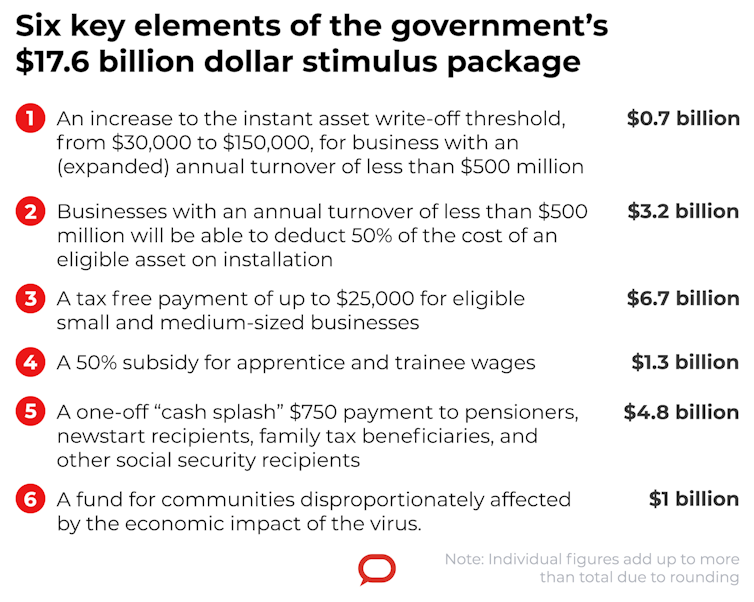
The first package, released ten days ago, cost A$17.6 billion. This one costs an extra $66.1 billion. (It’s best not be be too distracted by the claim that the total is $189 billion, almost 10% of GDP – it includes an element of double counting.)

The government has doubled, and then doubled again, what it intends to spend, and has made it easy to spend much, much more.

Automaticity is the key

Josh Frydenberg’s first assignment on being appointed parliamentary secretary to Prime Minister Tony Abbott in 2013 was to cut red tape.

The fewer needless procedures that people and businesses have to comply with (and the fewer forms and multiple forms they need to complete) the better everything can work.

In good times, it’s a good idea. In bad times, it’s essential.

As treasurer, nine months ago he set up a deregulation taskforce staffed by a dedicated unit within treasury.

Its work has infused the government’s second response.

An extra $550 per fortnight

The government has effectively doubled Newstart (which, in an unrelated previously-announced move, changed its name to “JobSeeker Payment” on Friday).

The maximum rate for a single recipient without dependants is $565.70 per fortnight.

For the next six months from April 27 the government will boost that by $550 per fortnight.

Importantly, the extra $550 will go to all recipients, including those who get much less than $565.70 because they have assets or have found a few hours of part-time work.

It’ll also go to both existing and new recipients of the Youth Allowance Jobseeker payment, Parenting Payment, Farm Household Allowance and Special Benefit.

The asset test for JobSeeker Payment, Youth Allowance Jobseeker and Parenting Payment will be waived for the duration of the boost.


Read more: The coronavirus stimulus program is Labor's in disguise, as it should be


What really matters is that it will be paid automatically. Recipients will receive the full $550 on top of their regular payment without asking for it. No forms, and an extra 5,000 Services Australia staff (previously called Centrelink staff) to make sure it happens.

The government says the boost is temporary, a claim that is not credible. The government can and will extend it for the duration of the crisis, and even after the crisis has ended will find it impossible to fully dismantle.

Recipients who have become used to receiving $1,115.70 per fortnight will not take kindly to suggestions they should be busted back to $565.70.

A “grandfathering” provision that let existing recipients keep getting $1,115.70 while forcing new recipients on to $565.70 would be almost as unrealistic.

Household support

Ten days ago the government announced a support payment of $750 to social security, veteran and other income support recipients and eligible concession card holders. It was to be paid automatically from March 31.

The new announcement is for an extra $750 to be paid to those people, other than the subset who will be getting the extra $550 per fortnight. About half of them are pensioners.

It will be paid “automatically from July 13, 2020”.

Early access to super

Anyone made redundant because of the coronavirus, or who has their hours cut by 20% or more because of the coronavirus (for sole traders, has their revenue cut by 20% or more) will be able to get early access to up to $10,000 of their super during the current financial year (the one that ends on July 30) and a further $10,000 during the first three months of 2020-21 (July 1 to September 30).

Frydenberg believes the funds will find this easy to manage:

the super funds last year had about $300 billion in cash, so they have the ability to provide what treasury estimate to be about a $27 billion injection into the economy.

He makes the point super belongs to the owners, and was saved with the intention that it be available for use on a rainy day:

this is the people’s money, and this is the time they need it most.

Withdrawals will be tax-free and will not affect Centrelink or veterans payments.

The process will be close to frictionless. Rather than approaching their fund, “eligible individuals will be able to apply online through myGov”.

When approved, the fund will “make the payment to you, without you needing to apply to them directly”.

Lower deeming rates

Pensioners with income-producing assets will find the pension rules adjusted so that they are assumed to earn 0.25% less than had previously been the case, in line with last week’s emergency Reserve Bank rate cut.

Again, it will happen automatically, from May 1, 2020.

Up to $100,000 per business

From April 28 employers will receive payments of 100% of the salary and wages they hand over to the tax office (up from 50% in the first package) plus an additional payment calculated using the same formula on July 28.

Worth up to $100,000 per business (with a minimum payment of $20,000) it will partially compensate them for hanging on to staff, and the announcement says they won’t need to do a thing.

The payments are tax free, there will be no new forms, and payments will flow automatically through the Australian Tax Office.

Going guarantor

The government will guarantee 50% of any new loans to small and medium sized businesses up to a maximum of $20 billion, which will support $40 billion in loans.

This way it’ll be the banks doing the assessments (the government won’t require the paperwork that would be involved in “picking winners”) but it’ll pick up the tab, without the businesses needing to do anything extra.

Indefinitely increasable

The government has found it relatively simple to plonk this $66.1 billion package on top of the previous $17.6 billion package. It has used the same or pre-existing foundations to scale up amounts and extend time periods.

This means it can get money out quickly and for as long as it needs to, in the main putting it into people’s hands automatically.

There is no practical constraint on its ability to do so. It has delivered what is almost certainly Australia’s biggest economic stimulus package, and will increase it as needed.

It can “find the money” by issuing bonds, effectively IOUs, to investors. If the investors want to offload them, or even if they don’t, the government-owned Reserve Bank has said it will buy them from investors without limit in order to prevent interest rates from rising.

The government’s financial measures are scalable without limit.


Read more: The case for Endgame C: stop almost everything, restart when coronavirus is gone The Conversation


Peter Martin, Visiting Fellow, Crawford School of Public Policy, Australian National University

This article is republished from The Conversation under a Creative Commons license. Read the original article.

Read more >>

Thursday, March 19, 2020

More than a rate cut: behind the RBA's three point plan

Today’s cut in the Reserve Bank’s cash rate to 0.25% brings it a new all-time low and the floor below which it plans to cut no more.

It means the rates set by the Reserve Bank of Australia, the United States Federal Reserve, the Bank of England and the Reserve Bank of New Zealand are all effectively 0.25%.

But it is just the beginning.

Importantly, in his statement today Governor Philip Lowe said the Reserve Bank’s cash rate would stay at 0.25% for… well, for a very long time.

The board will not increase the cash rate target until progress is being made towards full employment and it is confident that inflation will be sustainably within the 2% to 3% target band.

Governor Lowe has previously described the bank’s estimates for full employment as being centred around 4.5%, meaning that, if interpreted literally, he is saying the cash rate will stay at its new all-time rock-bottom low until unemployment turns back down instead of climbing from its present 5.1% (as the coronavirus restrictions mean it is certain to do).

1. Rates at rock bottom for the duration

And he is saying he won’t lift the cash rate from that all-time rock-bottom low until until he is confident that inflation confident that inflation will be back sustainably within the 2% to 3% target band, somewhere it hasn’t been or seven years and shows no sign whatsoever of reaching.

His commitment amounts to a commitment to keep rates at effective zero (the bank believes 0.25% is effective zero, the effective lower bound) for at least three years, maybe even the best part of a decade, or as he put it late today, an “extended period of time”.

For anyone thinking of borrowing at the ultra-low rates , it provides something close to a guarantee of no upward surprises for as far as the eye can see. For homeowners, that’ll mean a mortgage rate below 3% for as far as the eye can see, and for businesses, a bank loan with a base rate of 5%.

2. Cheap money for banks

To make sure banks can get money at that rate, the Reserve Bank is going to hand it to them.

It will provide a three-year funding facility to authorised deposit-taking institutions (banks and financial institutions that are similar to banks) at a highly-concessional fixed rate of 0.25%.

At first, it’ll provide 3% of their existing loan book.

Then it’ll give them extra “additional funding” on one condition: that they increase lending to business this year, especially to small and medium-sized businesses.

The payoff to banks for increasing lending to small and medium sized businesses is generous indeed.

For every extra dollar lent to large business, lenders will have access to an additional dollar of funding from the Reserve Bank. For every extra dollar of loans to small and medium-sized businesses, they will have access to an additional five dollars.

The funds can be drawn on until the end of March next year. There is no extra borrowing allowance for additional housing loans.

It’ll cost the Reserve Bank north of A$90 billion.

Separately, the government – through the treasury and its Australian Office of Financial Management (AOFM) – will advance $15 billion of its own money to enable smaller lenders to continue to lend to consumers and small businesses, bringing the total cost to more than $100 billion.


Read more: 'Yield curve control': the Reserve Bank's plan for when cash rate cuts no longer work


It’s a departure for the AOFM. Usually, it borrows on behalf of the government. Now it’ll be lending on behalf of the government, something it has done before, including during the global financial crisis, but that isn’t its core business.

3. Forcing money into investors hands

And, as long-expected, from tomorrow it’ll begin so-called quantative easing, buying government bonds from investors to force cash into their hands (and force down a range of long-term rates as a by-product).

It’ll buy “government bonds and semi-government securities across the yield curve” meaning it won’t be picky. If it can buy Commonwealth 10-year bonds, it’ll do it. If it can buy NSW Treasury Corporation 5-year bonds, it’ll do it. If it can buy local government bonds, it’ll do it.

If a particular part of the market isn’t working well, the bank might choose to focus on it, Dr Lowe said late on Thursday.

It will announce what it intends to buy each morning at 11.15 am.

The aim will be to get money into the hands of the investors that owned them (it will only buy from investors, not from the government) and to get money into the economy.

Regularly updated targets

To give it guidance, it will have a target. That target will be force the yield on a 3-year Commonwealth government down to 0.25% from its present 0.50%.

As Zac Gross explained in The Conversation on Tuesday, it won’t be about the 3-year rate as such, but about using rate that to give it (and us) a guide as to whether it is doing not enough, or too much.

It is likely to regularly publish its 3-year bond yield target (and later, perhaps its 10-year bond yield target) so we can see what it is doing, in much the same way as it has published its cash rate target up until now.

Its cash rate target is likely to remain 0.25% for years to come. From now on we will be focusing on other targets for other rates, and that’s what its monthly announcements will concentrate on.The Conversation

Peter Martin, Visiting Fellow, Crawford School of Public Policy, Australian National University

This article is republished from The Conversation under a Creative Commons license. Read the original article.

Read more >>

Monday, March 16, 2020

Reserve Bank and government prepare fresh emergency measures as markets tumble

The government is planning to deliver a second coronavirus economic support package within days, and the Reserve Bank will announce “further policy measures” to support the economy on Thursday.

The bank sometimes uses the phrase “policy measures” to describe adjustments to its “policy rate”, the so-called cash rate from which most other rates are priced.

Two weeks ago it cut the cash rate to 0.50%, a record low that is only 0.25 points above what Governor Philip Lowe has described as the effective lower bound of 0.25%, beneath which the bank would need to engage in “unconventional monetary policy” which would involve buying government bonds, residential mortgage bonds and perhaps corporate bonds to force a suite of longer-term interest rates lower.

At Thursday’s announcement Governor Lowe is also likely to take the opportunity to set out in detail how unconventional measures would be applied.


Reserve Bank cash rate


The Australian share market crashed 9.7% on Monday in its worst one-day sell-off since 1987.

In an emergency meeting earlier on Monday New Zealand’s Reserve Bank slashed its cash rate by 0.75 points from 1.00% to 0.25% and said it will remain at that level for at least the next 12 months.

Should it need to do more, it would turn to unconventional measures along the lines of those being planned for in Australia and implemented in the United States and Europe.

On Sunday, the US Federal Reserve cut its benchmark interest rate to zero and launched a new round of unconventional measures saying it would buy US$700 billion of government, corporate and mortgage-backed securities.


Read more: Now we know. The Reserve Bank has spelled out what it will do when rates approach zero


Mid-Monday Australia’s Reserve Bank and the Council of Financial Regulators which is made up of the bank, the Prudential Regulation Authority, the Securities and Investments Commission and the Commonwealth Treasury, announced a series of measures to keep financial markets working after investors turned away from both shares and government bonds.

Normally when investors desert shares they buy government bonds, forcing down the interest rates quoted on the bonds.

Reserve Bank to buy bonds as needed

But in both the US and Australia, investors have sold bonds as well, pushing up the rate (almost doubling the yield on a 10 year Australian government bond from 0.6% last Monday to 1.1%) and starving the market of buyers at any price, a phenomenon the council of regulators describes as a deterioration in liquidity.

The Reserve Bank has acted to inject liquidity by promising to buy unlimited amounts of one-month and three-month securities until further notice.


Read more: We're staring down the barrel of a technical recession as the coronavirus enters a new and dangerous phase


The Australian Prudential Regulation Authority said it would ensure banks take advantage of the injection of liquidity to support their customers.

Both the Authority and the Securities and Investments Commission will be flexible in applying rules where those would cause hardship to businesses and customers.

In particular, each agency will, where warranted, provide relief or waivers from regulatory requirements. This includes requirements on listed companies associated with secondary capital raisings, annual general meetings and audits.

The Tax Office earlier announced a series of administrative measures to assist people and businesses in difficulty as a result of the coronavirus including deferring the payment date of amounts due through the business activity statement and income tax assessments by up to four months.

The government’s second coronavirus support package follows a package of A$17.6 announced on last Thursday.


Read more: This coronavirus share market crash is unlike those that have gone before it


It will be aimed at shoring up business and households affected by new travel and isolation rules announced on Sunday.

A skeleton parliament will meet for a few hours next week to approve measures announced in the first and possibly the second stimulus package. Members will be paired to ensure that only those needed for quorums will be present.The Conversation

Peter Martin, Visiting Fellow, Crawford School of Public Policy, Australian National University

This article is republished from The Conversation under a Creative Commons license. Read the original article.

Read more >>

Thursday, March 12, 2020

Morrison's coronavirus package is a good start, but he'll probably have to spend more

What makes the prime minister confident most households will spend A$750 delivered in cash, when they mostly wouldn’t spend the A$1,080 delivered in the form of bonus tax refunds after last year’s budget?

Experience.

Here’s how he put it on Thursday, announcing the economic response to the coronavirus:

Australians will be getting a cheque for $750. Now it’s not for us to tell those Australians how to spend their money, but what we do know from experience is that they will spend that money, and that money will encourage economic activity.

That experience was Labor’s.

On October 11, 2008, Labor announced cash payments totalling between $1,000 and $1,400 per eligible household to stave off a retail recession.

It offered still more in February 2009.


Read more: The coronavirus stimulus program is Labor's in disguise, as it should be


The first cheques went out in December. Spending surged 4% that month after scarcely growing all year. A year on, spending was 5.4% higher than before the cheques went out.

In Japan, the United States, Canada and Germany where stimulus packages were not targeted at consumers, retail spending slipped by 2-3%. In Australia, it surged 5%.

So big was the effect that the payments were staggered by region to ensure cash delivery trucks could top up the automatic teller machines first.

The statisticians collecting retail sales data at the Bureau of Statistics abandoned their usual practice and stopped drawing a trend line.

The jump was impossible to reconcile with the pre-existing trend.

ABS retail trade release, May 2009

The Treasury had searched the economic literature and determined that cash payments were more likely to be spent than tax cuts, and could be delivered much more quickly.

Six million Australians receive government benefits of some sort, whether they think of themselves as on welfare or not. As recipients of family allowance, childcare support, the pension or even the seniors health card, they are on Centrelink’s books. (Centrelink recently changed its name to Services Australia.)

The payment machine that delivered robodebt can just as easily deliver “robocheques”.


Read more: Cash handout of $750 for 6.5 million pensioners and others receiving government payments


Treasury Secretary Steven Kennedy, who advised Prime Minister Scott Morrison and Treasurer Josh Frydenberg to give households cash this time instead of tax refunds, saw the effect at first hand. He was working in Prime Minister Kevin Rudd’s office as the good news came through.

If there is an important criticism of the Morrison government’s (first) coronavirus stimulus package, it would be that it doesn’t concentrate on households enough.

Household spending accounts for 55% of Australia’s gross domestic product, yet payments directed to households make up only 27% of the $17.6 billion the government is spending.

The package has two primary aims. One is to ensure that spending and production don’t shrink in the June quarter after shrinking in the March quarter, triggering what, for better or worse, people call a technical recession.

The Treasury expects it to boost economic activity by 1.5% in the June quarter.

If it does, it should be enough to compensate for the downturn we would have without it, always remembering that we don’t yet know how bad things will get in the three months to June - how many schools and public gathering places will be closed, and how many workers will have to stay home to care for children who can’t go to school or family members who are ill.


Read more: When it comes to sick leave, we're not much better prepared for coronavirus than the US


The second aim is to stop the unemployment rate climbing. When it climbs more than a few points it tends to keep going. In the early 1990s recession it climbed from 6% to 10% in a matter of months.

People who entered the labour force and couldn’t get work were scarred for years.

Labor’s most enduring achievement during the global financial crisis in 2008 and 2009 was to stop unemployment climbing above 6%.

That’s what the government’s $11.8 billion of payments to businesses are aimed at, whether delivered in the form of a boosted instant asset writeoff (available only until June 30), accelerated depreciation, payments to cover salaries, or wage assistance for apprentices and trainees.

Morrison wants businesses in the best possible position to hold onto their workers. He wants them to display “patriotism”.The Conversation

Peter Martin, Visiting Fellow, Crawford School of Public Policy, Australian National University

This article is republished from The Conversation under a Creative Commons license. Read the original article.

Read more >>

Thursday, March 05, 2020

Economic growth near an end as Treasury talks of prolonged coronavirus downturn

Australia’s three-decade run of near continuous economic growth is set to end, with treasury warning of a hit to growth of “at least” 0.5% in the first quarter of this year, potentially followed by a “prolonged downturn”.

If it came to pass, treasury’s preliminary assessment would most likely mean economic growth vanished and went backwards for several quarters, producing what is commonly known as a “technical recession” – two quarters or more in which income and spending shrink.

Providing the assessment to a Senate estimates committee on Thursday morning, treasury secretary Steven Kennedy said the COVID-19 coronavirus would take “at least half a percentage point” from economic growth during the current March quarter and more beyond that.

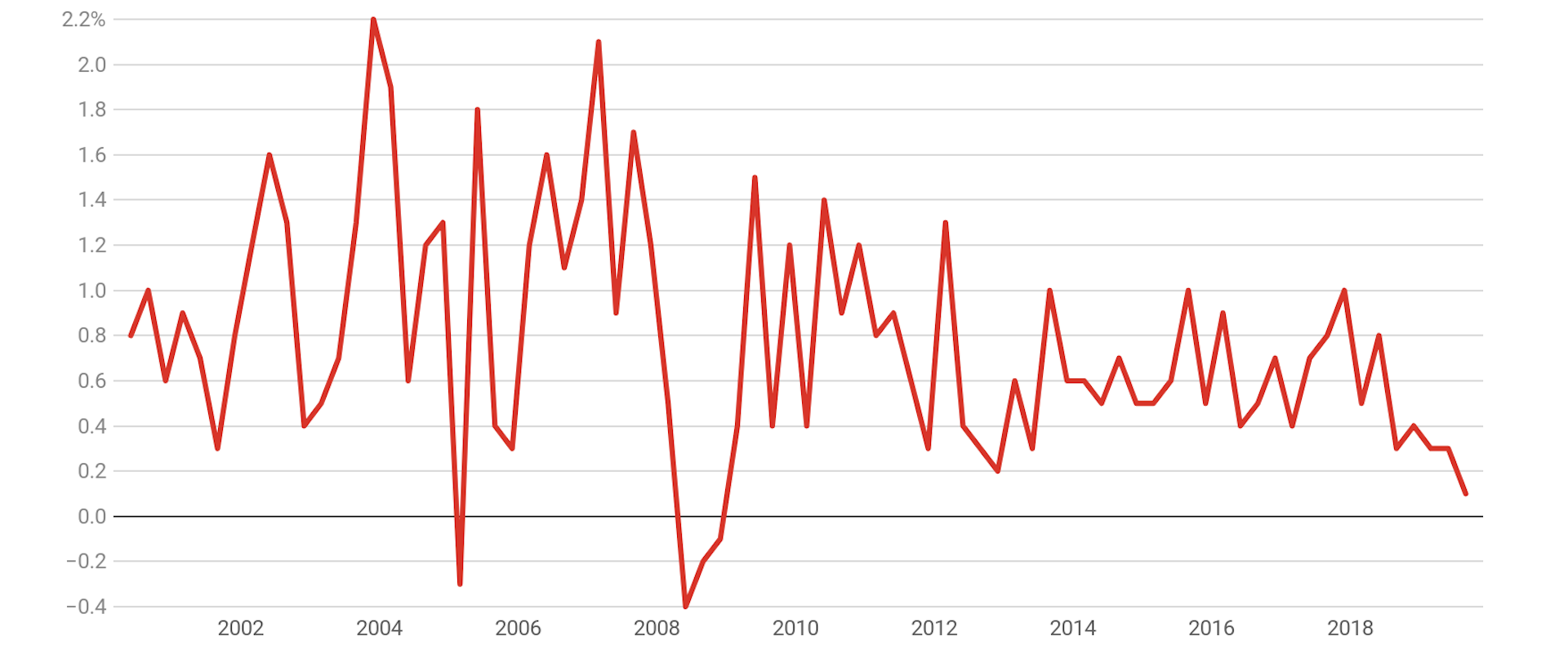
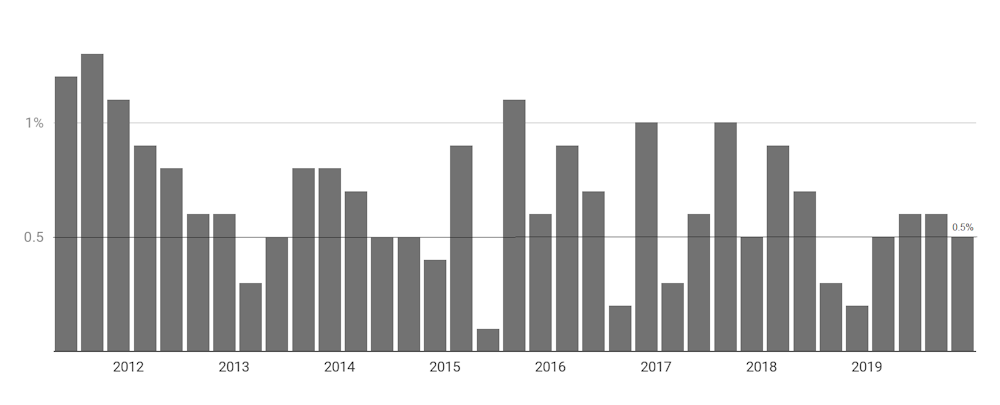
In recent quarters economic growth has been about half a percentage point.


Quarterly GDP growth

Source: ABS 5206.0

Treasury’s preliminary estimate of a hit of at least half a per cent took into account only the direct impacts of the virus on tourism and education, and some exchange rate effects.

It did not take into account broader economic effects or the impact of the coronavirus on supply chains.

The half a percentage point hit to growth would come on top of a hit of 0.2% from the summer bushfires, most of which would be felt in the March quarter.


Read more: Support package gains shape as GDP turning point swamped


Dr Kennedy, a former nurse who retrained as an economist, stressed that the impact of the bushfires would extend well beyond the immediate hit to economic growth.

“Evidence from past episodes suggest bushfires can lead to long-lasting physical and mental health effects and destroy cultural heritage,” he said.

“Research by the University of Melbourne after the Black Saturday bushfires in 2009 found mental health problems continued for three to four years.”

The bushfires made clear the increased probability of such events in a world of climate change.

“The CSIRO predicts climate change will make bushfires more likely, as fire weather patterns worsen as a result of an increase in weather patterns with hot and dry winds and fuel becoming drier.”

Deeper, wider and longer lasting than SARS

As of Wednesday there had been 91,868 confirmed COVID-19 cases worldwide and 3,131 deaths, most in China. COVID-19 had spread to 77 countries.

When the virus first emerged in China in December, the treasury saw it through the lens of the 2002-04 Severe Acute Respiratory Syndrome (SARS) pandemic.

It was now clear COVID-19 would be different.

The impact of SARS took on a V shape, a relatively contained reduction in activity, mostly in Asia, followed by a quick bounce back.

The economic impact of COVID-19 is likely to be deeper, wider and longer when compared with SARS.

It will create more risk of a prolonged downturn, and fiscal support will be needed to accelerate the recovery of the economy, especially once the health and health management effects of COVID-19 begin to fade.

The first phase of the economic support package to be delivered next week would target assistance to the businesses and sectors most affected in order to keep people in jobs.

After that, support for aggregate demand (overall spending) would become more important.


Read more: The first economic modelling of coronavirus scenarios is grim for Australia, the world


“A very substantial part of the impact is actually confidence among consumers and the business sector because of the uncertainty,” Dr Kennedy said.

“Frankly, effective health management will be very important. The economy is actually quite solid. One of the key things will be to to explain to the community how well placed the economy is to manage such a short-term shock.”

The shock would last for some time but the economy would “recover on the other side”.

Keeping workers employed would be very important.The Conversation

Peter Martin, Visiting Fellow, Crawford School of Public Policy, Australian National University

This article is republished from The Conversation under a Creative Commons license. Read the original article.

Read more >>

Wednesday, March 04, 2020

Support package gains shape as GDP turning point swamped

The good news is our economy was performing better than had been thought in the lead-up to the bushfires and coronavirus.

Updated figures in Wednesday’s national accounts show the economy grew 0.6% in the three months to September, rather than the 0.4% previously reported, and a healthier-than-expected 0.5% in the three months to December.

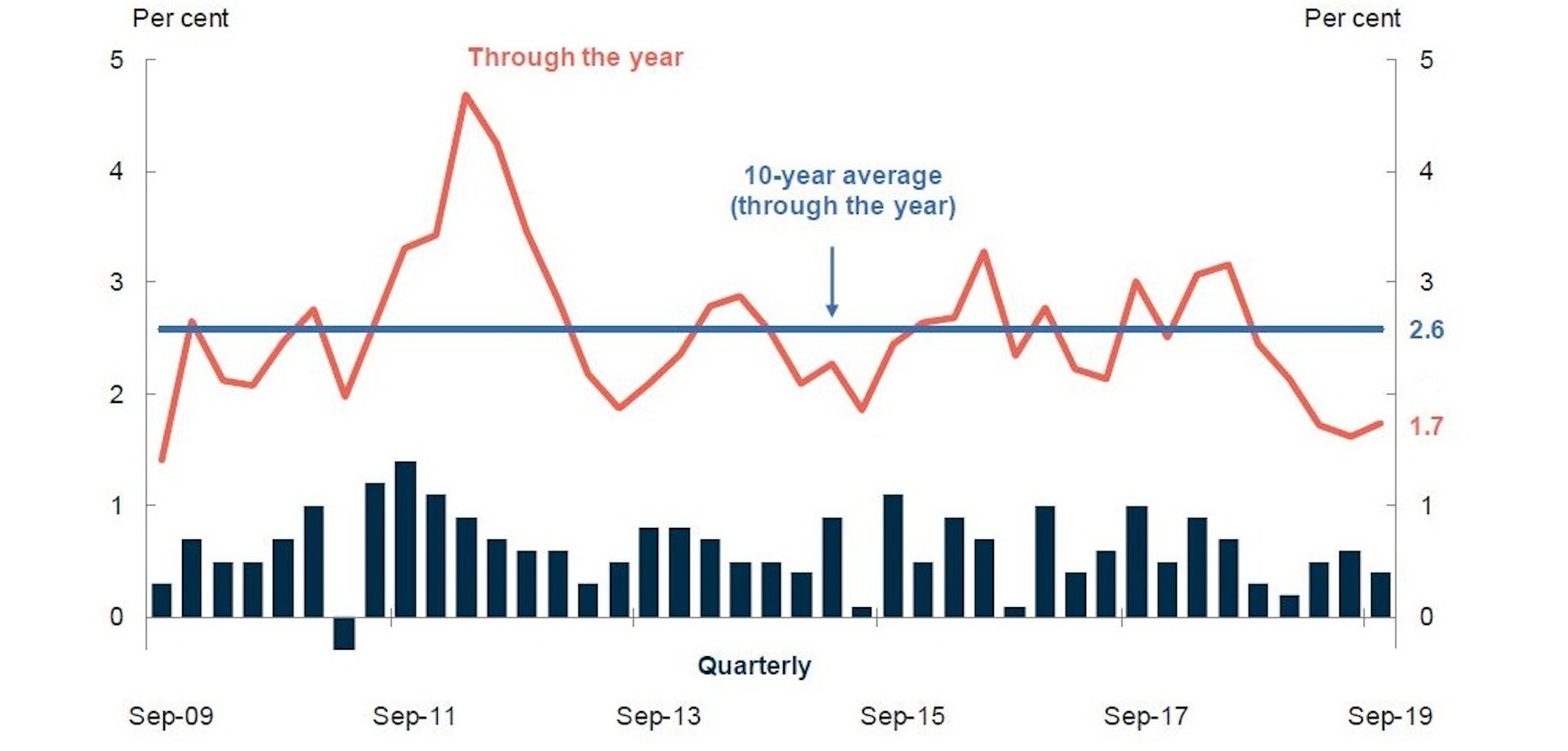
Combined, these figures pushed annual economic growth up above 2% to 2.2% for the first time in a year in which it had been below 2% for the longest period since the global financial crisis.


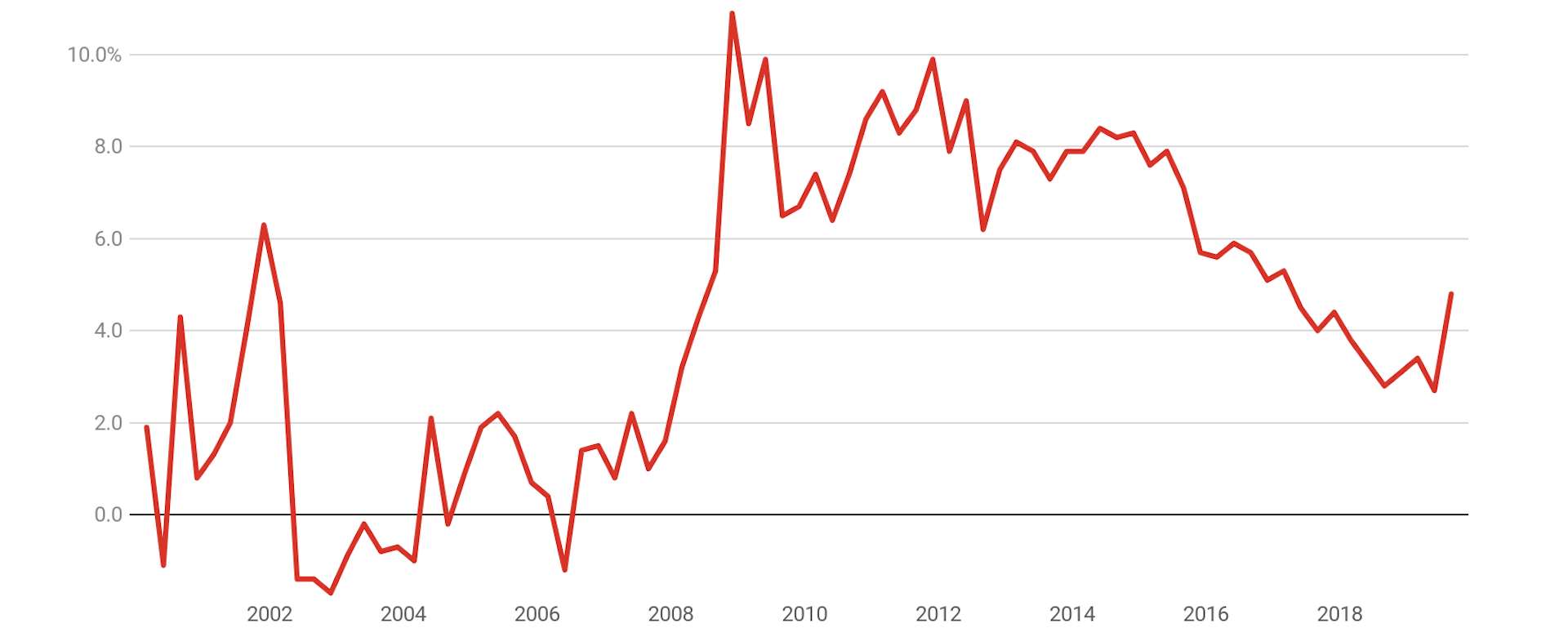
Annual GDP growth

Through-the-year economic growth by quarter. Source: ABS 5206.0

Not to put too fine a point on it, it looks as if we were actually experiencing the the “gentle turning point” repeatedly promised by Reserve Bank Governor Philip Lowe.

As Lowe put it during the second half of last year:

After having been through a soft patch, a gentle turning point has been reached. While we are not expecting a return to strong economic growth in the near term, we are expecting growth to pick up.

The figures show the economy began (gently) picking up after the Reserve Bank began cutting rates in June. Counting this week’s latest interest rate cut, it has cut four times.

But the coronavirus and the bushfires have consigned the turning point to history.

Negative growth now possible

Not for a minute does Treasurer Josh Frydenberg believe the economy continued to improve this quarter, the March quarter.

Reminded that the support package promised by the prime minister will come too late for the three months to March, and reminded that many businesses haren’t been able to trade much, Frydenberg was asked to assess the risk the economy might now be going backwards, a state of affairs that if it continued long enough would be a recession.


Read more: We're staring down the barrel of a technical recession as the coronavirus enters a new and dangerous phase


He replied that the Treasury believes the bushfires alone will shave 0.2 points from growth in the March quarter. Added to that will be the risk from the spread of the coronavirus, which he believes will be “substantial”.

Tonight (Wednesday) Frydenberg and Treasury officials will take part in a phone hookup with other members of the International Monetary Fund to discuss developments including interest rate cuts in both Australia and the United States.

Treasury update on Thursday

The Treasury will finalise its estimate of the impact of the coronavirus on March-quarter GDP later in the evening and report it to a Senate estimates hearing beginning at 9am Thursday.

It means we will know the likely impact at about the same time as the treasurer.

To support retirees hurt by four near-consecutive rate cuts, the treasurer is considering cutting the deeming rate – the rate investments are deemed to have earned for the purposes of the pension income test. It’ll be the second deeming rate cut in the space of a year and will make it easier for retirees earning very little to remain on the pension.


Read more: They've cut deeming rates, but what are they?


The focus of the support package will business investment, which slid an unexpected 1.1% in the final three months of the year and 3.4% over the course of the year in defiance of budget forecasts it would climb.

Standard of living slipping

Although not ruling out support for householders, Frydenberg said mortgage holders had done well out of the past four rate cuts. Households with A$400,000 mortgages could soon be paying $3,000 less per year than they had in June.

Living standards, as measured by the Reserve Bank’s preferred measure, real net national disposable income per capita, went backwards in the December quarter, slipping 1.3%. Over the year, it climbed just 1.2%.


Read more: The first economic modelling of coronavirus scenarios is grim for Australia, the world


Household spending recovered somewhat, climbing 0.4% in real terms in the December quarter after inching ahead only 0.1% in the September quarter.

Throughout the year to December, real household spending grew 1.2% at a time when Australia’s population grew 1.5%. This means the consumption of goods and services per person went backwards.

Government spending provided substantial support. Over the year to December public spending on infrastructure grew 4.1% in real terms.

Deputy Prime Minister Michael McCormack said on Wednesday he would try and boost that by asking state and local governments to bring forward whatever projects they could, to start work in the next three to six months.

Recurrent government spending grew 5%.The Conversation

Peter Martin, Visiting Fellow, Crawford School of Public Policy, Australian National University

This article is republished from The Conversation under a Creative Commons license. Read the original article.
Read more >>

Tuesday, March 03, 2020

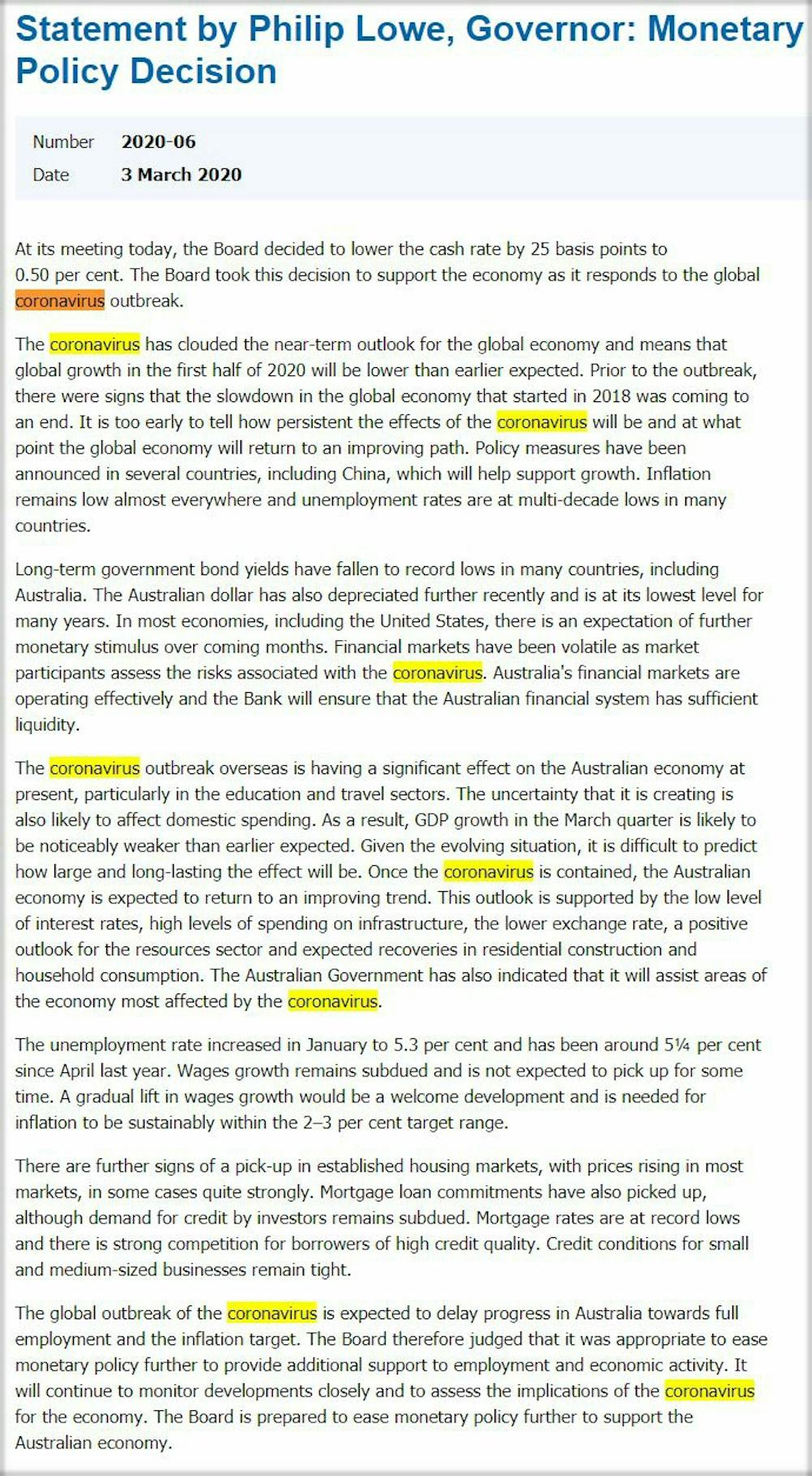
One word repeated 9 times explains why the Reserve Bank cut: it’s ‘coronavirus’


Never has a virus featured so prominently in a Reserve Bank statement.

The word “coronavirus” is mentioned nine times in the governor’s seven-paragraph statement.

His board cut the cash rate from an all-time low of 0.75% to a new all-time low of 0.50% “to support the economy as it responds to the global coronavirus outbreak”.

Up until the coronavirus, it had looked as if “the slowdown in the global economy that started in 2018 was coming to an end”.

The coronavirus has “clouded” that outlook.

It is “too early to tell how persistent the effects of the coronavirus will be and at what point the global economy will return to an improving path”.

Financial markets have been volatile “as market participants assess the risks associated with the coronavirus”.

In most economies, including the United States, there is an expectation of further rate cuts.

The coronavirus is having a “significant effect” on Australia’s real economy, particularly in the education and travel industries.


Read more: The first economic modelling of coronavirus scenarios is grim for Australia, the world


The uncertainty is “also likely to affect domestic spending”.

GDP growth in the March quarter (but not the December quarter whose figures will be released on Wednesday) is likely to be “noticeably weaker than earlier expected”.

Once the coronavirus is contained, the Australian economy is expected to return to an improving trend.

But given the evolving situation, it is difficult to predict how large and long-lasting the effect will be.

Summing up, the bank says the global outbreak is “expected to delay progress in Australia towards full employment and the inflation target”.

It decided to cut rates to provide “additional support to employment and economic activity”. Importantly, it will continue to monitor developments closely with a view to doing more.

The final sentence, the one which usually carries the key message, says: “the board is prepared to ease monetary policy further to support the Australian economy”.

Would it have cut without the coronavirus?

It probably wouldn’t have cut without the coronavirus. It most likely would have had to cut at some point because the economy is weak. We will get an update about how things were in the three months to December on Wednesday, but the news up to the end of September was awful.

Household spending, which accounts for more than half of gross domestic product, barely budged. Over the year to September it grew just 1.2% in real terms, the least since the global financial crisis. Australia’s population grew 1.6% in that time, meaning the volume of goods and services bought per person went backwards.

Early figures on private new capital expenditure which will be incorporated into the national accounts released on Wednesday show business investment went backwards over the December quarter (down 2.8%) and over the entire year (down 5.8%).

The May budget and the December budget update forecast a jump in business investment, which it is hard to see happening.


Read more: Now we know. The Reserve Bank has spelled out what it will do when rates approach zero


Governor Philip Lowe has been reluctant to cut in part because he is running out of traditional ammunition.

He has said that for practical purposes the next step – 0.25% – is zero, a point beyond which he would need to use unconventional measures (which have been used so much overseas they are no longer that unconventional) to stimulate the economy further.

The most likely one is buying government and mortgage bonds from investors in order to force money into their hands, making the cash rate graph the bank has been updating for 30 years now no longer relevant as an indicator of what it is doing to stimulate the economy.


Reserve Bank cash rate


He has decided to cut because he is contractually obligated to do what he can to contribute to “the economic prosperity and welfare of the people of Australia”, which is at risk.

What good will the cut do?

Westpac and the Commonwealth Bank announced they were passing the cut on to borrowers straight away after an appeal by Prime Minister Scott Morrison to their better natures.

The government would absolutely expect the four big banks to come to the table and to do their bit in supporting Australians as we go through the impact of the coronavirus. I don’t see it any different to what Qantas did when we called out to Qantas and we said, we need your help, we need to get some people out of China.

Before today’s decisions the average standard variable mortgage rate was 4.7% The average basic variable mortgage rate was 3.05%. Today’s cuts will take it to 2.8%.

They will save many mortgage holders an extra A$30 per month on repayments on top of the $150 saved since June. That will allow them to spend more or to borrow more by extending their mortgages, further increasing the financial attractiveness of investments such as solar panels or home insulation, and perhaps further supporting home prices which have turned up since the bank began cutting.

Where mortgage holders direct the proceeds of the cuts to Australian businesses, it’ll help keep them afloat or give them the confidence to borrow for expansion at record low interest rates.

Although it is often said that interest rate cuts have less effect when interest rates get low, there is no particular reason to believe this is the case. There is reason to believe interest rate cuts have little effect when consumers and businesses have other reasons for not borrowing or spending much, which might well be the case at the moment.

What will the government do?

The government is drawing up a stimulus plan. Just don’t call it that.

Morrison says it will:

be a targeted plan, it will be a measured plan, it will be a scalable plan, we will ensure that we do not make the same mistakes of previous stimulus measures that have been put in place.

That probably means he won’t be delivering cheques to households as Labor did during the global financial crisis. The Coalition tried something similar, delivering out-sized tax refund cheques after the May budget, and it didn’t work that well.

He’ll almost certainly announce new investment allowances for businesses; if necessary, ones that effectively pay them to borrow.

And he and his ministers will be surveying the economy sector by sector.


Read more: We're staring down the barrel of a technical recession as the coronavirus enters a new and dangerous phase


He has spoken personally with the bosses of Coles and Woolworths seeking assurances they won’t run low on supplies. He says if necessary they can talk to each other, something normally not allowed by competition rules.

They have already talked to Kimberly Clark, which manufactures toilet paper. It has set up a line of production in South Australia to ensure shops don’t run out.The Conversation

Peter Martin, Visiting Fellow, Crawford School of Public Policy, Australian National University

This article is republished from The Conversation under a Creative Commons license. Read the original article.

Read more >>

Tuesday, January 28, 2020

2020 survey: no lift in wage growth, no lift in economic growth and no progress on unemployment in year of low expectations

2020 is shaping up as a dismal year for the economy, with no progress on many of the key measures that matter for Australians.

Unemployment will stay above 5% and probably rise rather than fall.

Economic growth will continue to have a “1” in front of it, instead of the “2” or “3” that used to be common, and living standards will grow more slowly.

Wage growth, forecast in the budget to climb to 3%, will instead remain stuck near 2.2%, where it has been for half a decade.


Read more: We asked 13 economists how to fix things. All back the RBA governor over the treasurer


Those are the central forecasts of a panel of 24 leading economists from 15 universities in six states assembled by The Conversation to review the year ahead, a year they expect to be marked by one only more interest rate cut, more modest growth in house prices, and a return to slower growth in the share market.

The panel comprises macroeconomists, economic modellers, former Treasury, IMF, OECD, Reserve Bank and financial market economists, and a former member of the Reserve Bank board. Combined, their forecasts are more likely to be correct than those of any individual member. One-third are women.

They expect the long-promised budget surplus to all but disappear as a result of responses to the bushfires and weaker-than-predicted economic growth.

Economic growth

The Treasury believes the Australian economy is capable of growing at a sustained annual pace of 2.7%, but it hasn’t grown that fast since mid-2018. Growth slipped below 2% in March 2019 and hasn’t recovered. It now has been below 2% for three consecutive quarters, the longest period since the global financial crisis.

The panel’s central forecast is for economic growth to stay at or below 2% for at least another year, producing the longest period of low economic growth since the early 1990s recession. The average forecast for the year to December is 1.9%.

Panellist Saul Eslake says it will be the result of persistently slow growth in household disposable incomes, reflecting “very slow growth in real wages, the increasing proportion of gross income absorbed by tax, and weakness in property income (interest and rent) as well as (at the margin) the impact of the drought on farm incomes”.

It will be domestic rather than overseas conditions that hold back Australian growth. US economic growth is expected to remain little changed at 2.1% notwithstanding trade friction with China, and China’s officially reported growth is expected to ease back only slightly from 6% to 5.8%.


Living standards

One of the best measures of overall living standards (the one the Reserve Bank watches) is real net national disposable income per capita, which takes better account of buying power than gross domestic product does. In the year to September it climbed an unusual 3.3%, pushed up by a resurgence in iron ore export prices.

The iron ore price has since slid from US$120 a tonne to around US$90 a tonne, and the panel’s average forecast is for it to fall further.

As a result it expects growth in living standards to slow to 2.4% in 2020, a result that will still be better than between 2012 and 2016 when a dive in export prices sent it backwards.


Read more: Why we've the weakest economy since the global financial crisis, with few clear ways out


Growth in nominal GDP, the raw total unadjusted for inflation, is also expected to slow, slipping from 5.4% to 4.4% as export prices weaken, producing a decline in revenue growth the government has already factored in to the budget.

The unemployment rate is expected to end the year near the top of the 5%-to-5.5% band it has been stuck in for the past two years, rather than falling to the 5% forecast in the budget or towards the 4.5% the Reserve Bank believes is possible.

Only one of the panel, Warren Hogan, expects the unemployment rate to end the year below 5%.


Wages and prices

The panel’s central forecast is for inflation to remain below the bottom of the Reserve Bank’s 2-3% target band, where it has been for most of the past five years.

One panellist, Margaret McKenzie, breaks ranks. She expects the drought and bushfires and floods to sharply push up the cost of food and essential items including energy, quickly pushing inflation into the range the authorities have long wanted, but not for the reasons they wanted.

“I don’t think people have thought about it, because there hasn’t been inflation for so long,” she says. “The problem is that the fires are likely to contract an already weak economy, impelling the Reserve Bank to cut interest rates further, even though its inflation targeting regime would tell it not to.”

Wage growth is forecast to be well below the highest inflation forecast and only a little above the central forecast, resulting in continued low real wage growth and seeing the budget miss its wage growth target for the eighth year in a row.


Business

Household spending barely grew in the year to September, inching ahead by a shockingly low 1.2%, the least since the financial crisis, and not enough to account for population growth.

The panel’s central forecast is for a recovery in spending growth to a still-low 2.4%, with spending held back by low consumer confidence and what former Organisation for Economic Co-operation and Development director Adrian Blundell-Wignall calls a “sense that we are living on borrowed time”.


Read more: GDP update: spending dips and saving soars as we stash rather than spend our tax cuts


“China is slowing, bank-financed housing has been pushing the envelope and is very expensive, and the governments have never had a plan for the next phase of sustainable growth,” he says. “This perception of no confidence in the government has not been helped by the bushfire events.”

There are few signs of a recovery in business investment, notwithstanding record-low interest rates.

The panel’s average forecast is for investment by mining and non-mining companies to grow by only 1.7% and 1.9% in 2020, which will represent a turnaround for mining, in which investment fell 11.2% in the year to September.


Markets

Financial markets should provide less support to households in the year ahead, with the ASX 200 share price index expected to climb only 6.4% after soaring 20% in the year just ended.

None of the panellists expect last year’s growth to continue.

The Australian dollar is expected to end the year at 68 US cents, close to where it is at present. The iron ore price is expected to fall to US$75, a smaller slide than was assumed in the budget.


Home prices

Housing investment (homebuilding) is expected to stabilise in 2020, falling only slightly from here on, after sliding 9.6% in the year to September 2019.

Sydney and Melbourne home prices are expected to continue to recover, growing by 5% in 2020.

Panellist Nigel Stapledon says the higher home prices will in time boost perceptions of wealth, opening up the possibility that consumer spending will “surprise on the upside”.


Interest rates and budget

The panel’s central forecast is for only one more cut in the Reserve Bank’s cash rate this year, in the first half, followed by no further cuts in the second half. This would allow the bank to avoid so-called unconventional monetary policy or “quantitative easing” in which it forces down longer-term rates by buying government and private bonds, an option Governor Philip Lowe said it would only resort to after it had cut its cash rate to 0.25%.

The single cut would take the cash rate to an all-time low of 0.5%. In anticipation the ANZ cut its online saver account rate from 0.1% to 0.05% on Thursday.


Read more: Now we know. The Reserve Bank has spelled out what it will do when rates approach zero


The cut could come as soon as next week when the board holds its first meeting for the year on February 4. Governor Lowe has scheduled an address to the National Press Club for the following day.

Most of the panel think quantitative easing will not be needed and many question its effectiveness, saying the government could achieve much more by fully abandoning its commitment to surplus in order to stimulate the economy.

The panel expects the government’s 10-year bond rate to remain historically low at 1.3%. That makes it about as cheap as it has ever been for the government to borrow for worthwhile purposes.


Treasurer Josh Frydenberg has abandoned his absolute commitment to return the budget to surplus this financial year, saying his first priority is “meeting the human cost of the bushfires”.

The 2019-20 surplus was forecast at A$7.1 billion in the May budget and then downgraded to $5 billion in the December update.

The panel’s average forecast is for a bushfire-ravaged $2.2 billion.


Most of the panel believe that with good management the government can avoid a recession for another two years, propelling the Australia economy into what will be its 30th straight year of expansion.

On average they assign a 27% probability to a recession within the next two years, down from their average forecast of 29% in June.

Several point out that, whereas the main risks to continued growth come from overseas, China appears to be managing its slowing economy better than expected, although the emergency triggered by the new and deadly Wuhan coronavirus might change that.


Read more: Their biggest challenge? Avoiding a recession


Among those who do fear a home-bred recession is Julie Toth who has lifted her estimate of the likelihood of a recession from 25% to 50%, saying growth is already so weak that it won’t take much to send it backwards.

“The bushfire disaster presents the real and immediate possibility of two quarters of negative growth for the fourth quarter of 2019 and the first quarter of of 2020,” she says.

“Even if disaster relief and fiscal stimulus are delivered swiftly, resource constraints (a lack of skilled tradespeople, water, equipment and appropriate building materials) mean reconstruction will be very slow.”


The panel began compiling its responses when the bushfires weren’t as bad as they subsequently became and before the emergence of the Wuhan coronavirus.

It delivered its final forecasts on January 20 when the worst of the bushfires appeared to have passed but before the coronavirus had spread to Australia.

The effects of both won’t be known for some time.

2020 is turning out to be a year of uncertainty, as well as low expectations.


The Conversation 2020 Forecasting Panel

Click on economist to see full profile.


Read more: Buckle up. 2019-20 survey finds the economy weak and heading down, and that's ahead of surprises The Conversation


PDF OF RESULTS


Peter Martin, Visiting Fellow, Crawford School of Public Policy, Australian National University

This article is republished from The Conversation under a Creative Commons license. Read the original article.
Read more >>

Wednesday, January 08, 2020

In fact, there's plenty we can do to make future fires less likely

One of the dominant ideas buzzing around the internet is that there’s little we can do to escape the prospect of more frequent and worse bushfires - ever.

That’s because there’s little we can do to slow or reverse the change in the climate.

Australia accounts for just 1.3% of global emissions. That’s much more than you would expect on the basis of our share of world’s population, which is 0.33%. But even if we stopped greenhouse gas emissions as soon as we could and started sucking carbon back in (as would be possible with reafforestation) it’d make little difference to total global emissions, which is what matters – or so the argument goes.

But this argument ignores the huge out-of-proportion power we have to influence other countries.

There’s no better indicator of that than in Ross Garnaut’s new book Super-power: Australia’s low-carbon opportunity.

We’re more important than we think

Garnaut conducted two climate change reviews for Australian governments, the first in 2008 for the state and Commonwealth governments, and the second in 2011 for the Gillard government.

In the second, he produced two projections of China’s emissions, based on what was known at the time.

One was “business as usual”, which showed continued very rapid increases. The other took into account China’s commitments at the just-completed 2010 United Nations Cancun climate change conference.

China’s annual emissions matter more than those of any other country – they account for 27% of the global total, which is a relatively new phenomenon.

The bulk of the industrial carbon dioxide already in the atmosphere was put there by the United States and the Soviet Union, who have been big emitters for much longer.

Egged on by the US Obama administration and by governments including Australia’s under Julia Gillard, China agreed at Cancun to slow its growth in emissions, and at the Paris talks in 2015 hardened this into a commitment to stabilise them by 2030.

The extraordinary graph

Garnaut’s 2011 projections showed growth moderating as a result of China’s commitment, which was at the time a cause for optimism.

When he returned to the numbers in 2019 to prepare his book, he was stunned. Egged on by the example of countries including the US and Australia, China had done far, far better than either “business as usual” or its Cancun commitments. Instead of continuing to grow rapidly, or less rapidly as China had said they would, they had almost stopped growing.

The graph, produced on page 29 of Garnaut’s book, is the most striking I have seen.


Since 2011, China’s emissions have been close to spirit-level flat. They climbed again only from 2017 when, under Trump in the US and various Coalition prime ministers in Australia, the moral pressure eased.

From the start of this century until 2011, China’s consumption of coal for electricity climbed at double-digit rates each year. From 2013 to 2016 (more than) every single bit of China’s extra electricity production came from non-emitting sources such as hydro, nuclear, wind and sun.

There are many potential explanations for the abrupt change. Pressure from nations including the US and Australia is only one.

What happened once could happen again

And there are many potential explanations for China’s return to form after Trump backslid on the Paris Agreement and Australia started quibbling about definitions. An easing of overseas pressure is only one.

But, however brief, the extraordinary pause gives us cause for hope.

Australia can matter, in part because it is hugely respected in international forums for its technical expertise in accounting for carbon emissions, and in part because of its special role as one of the world’s leading energy exporters.

Garnaut’s book is about something else – an enormous and lucrative opportunity for Australia to produce and export embedded energy sourced from wind and the sun at a cost and scale other nations won’t be able to match.


Read more: Australia could fall apart under climate change. But there's a way to avoid it


Some of it can be used to convert water into hydrogen. That can be used to turn what would otherwise be an intermittent power supply into a continuous one that enables around-the-clock production of the green steel, aluminium, and other zero-emission products Japan, Korea, the European Union and the United Kingdom are going to be demanding.

It’s a vision backed by Australia’s chief scientist.

It wouldn’t have been possible before. It has been made possible now by the extraordinary fall in the cost of solar and wind generation, and by something just as important – much lower global interest rates. Solar and wind generators cost money upfront but cost very little to operate. Interest rates are the cost of the money upfront.

At least three consortia are drawing up plans.

There’s not much to lose

There’s much that needs to be done, including establishing the right electricity transmission links. But Garnaut believes it can all be done within the government’s present emissions policy, helping it achieve its emission reduction targets along the way.

What’s relevant here is that moving to ultra-low emissions would do more. It could give us the kind of outsized international influence we are capable of. It could help us make a difference.The Conversation


Peter Martin, Visiting Fellow, Crawford School of Public Policy, Australian National University

This article is republished from The Conversation under a Creative Commons license. Read the original article.

Read more >>

Wednesday, December 04, 2019

GDP update: spending dips and saving soars as we stash rather than spend our tax cuts

Australians saved rather than spent most of the budget tax cuts, almost doubling the proportion of household income saved, leaving spending languishing.

The September quarter national accounts show that in the first three months of the financial year real household spending grew by just 0.1%, the least since the global financial crisis.

Over the year to September, inflation-adjusted spending grew by a mere 1.2%, also the least since the financial crisis. Australia’s population grew by 1.6% in that time, meaning the volume of goods and services bought per person went backwards.


Quarterly growth in household spending


Separate figures released by the Federal Chamber of Automotive Industries on Wednesday show November new car sales were down 9.8% on November 2018.

By the end of November the Tax Office had issued more than 8.8. million tax refunds totalling A$25 billion, 30% more than a year before.

Instead of being largely spent, they were mostly saved, pushing up the household saving ratio from 2.7% to 4.8%, its highest point in more than two years.


Household saving ratio


Treasurer Josh Frydenberg put the best face on the result, saying whether they had been spent or saved, the cuts had put households in a stronger position.

The government’s goal has always been to put more money into the pockets of the Australian people, and it’s their choice as to whether they spend or save that money

Separately calculated retail figures show that in the three months to September the volume of goods and services bought fell 0.1%.

The disposable income households had available to spend grew an outsized 2.5%, driven by what the Bureau of Statistics said were the budget tax cuts.

Growth at GFC lows

The Australian economy grew just 0.4% in the three months to September, down from 0.6% in the June quarter, and 0.5% in the March quarter.

Over the year to September it grew 1.7%, well short of the budget forecasts, which in year average terms were 2.25% for 2018-19 and 2.75% for 2019-20.


Real GDP growth


After taking account of population growth, GDP per person grew not at all in the September quarter. Over the year to September living standards grew a bare 0.2%.

Gross domestic product per hour worked, which is a measure of productivity, fell 0.2% during the quarter and fell 0.2% over the year.

Company profits were up 2.2% in the quarter and 12.7% over the year. Wage and superannuation payments grew at about half those rates: 1.2% and 5.1%.

Housing investment was down 1.7% over the quarter and 9.6% over the year.

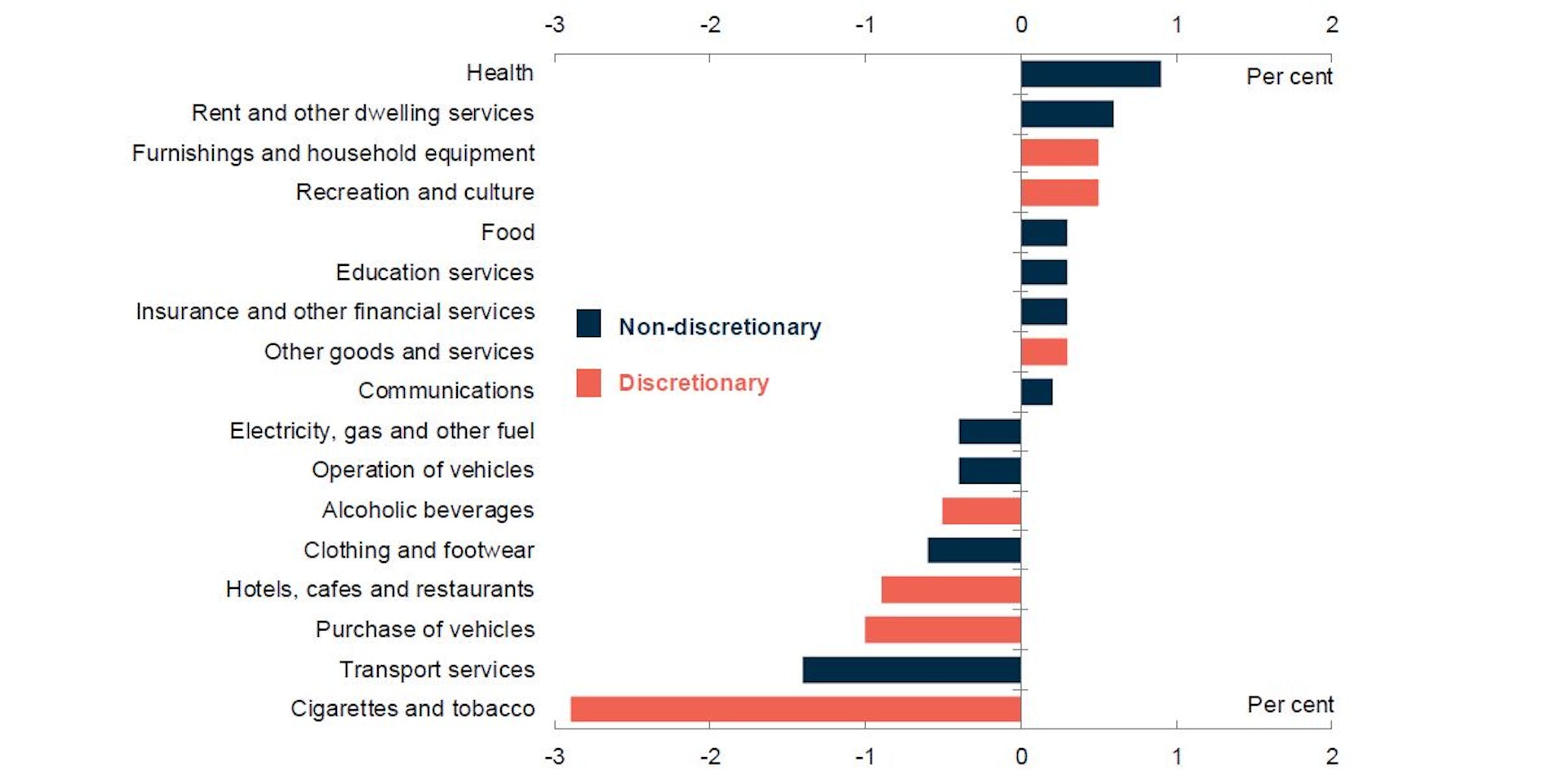
What household spending growth there was was concentrated on essentials, led by health and rent. So-called discretionary or non-essential expenditures fell, led down by spending on cars, dining out and tobacco.


Consumption growth by category, quarterly


The economy was kept afloat by a surge in government spending. It grew 0.9% in the quarter and 6% over the year. Growth in government spending and investment together accounted for 0.3 of the quarter’s 0.4 points of economic growth.

Government and mining to the rescue

Mining production grew 0.7% over the quarter and 7.4% over the year. A mining-fuelled surge in exports contributed almost as much to economic growth as government spending.

Drought-affected farm production fell 2.1% over the quarter and 6.1% over the year.

Business investment fell 4% in the quarter and 1.7% over the year, led down by a 7.8% fall in mining investment in the quarter and a 11.2% fall over the year, as liquefied natural gas projects came to completion. Non-mining investment fell 0.4%.


Read more: We asked 13 economists how to fix things. All back the RBA governor over the treasurer


Asked whether the December budget update would contain tax measures designed to boost business investment, the treasurer said he was in discussions with business. The update is expected in the week before Christmas.

There’s little evidence in today’s figures of the “gentle turning point” spoken about hopefully by the Reserve Bank governor as recently as Tuesday.

If things don’t pick by the bank’s first board meeting for the year in February, it is a fair bet it will cut its cash rate again. By then it will know what the treasurer did (or didn’t) do in the budget update and whether we decided to spend over Christmas.The Conversation


Peter Martin, Visiting Fellow, Crawford School of Public Policy, Australian National University

This article is republished from The Conversation under a Creative Commons license. Read the original article.

Read more >>