Wednesday, May 26, 2021

Going electric and banning new petrol-powered cars could be Australia’s next big light bulb moment

In 2007 Malcolm Turnbull turned off an industry’s life support without blinking.

The industry made light bulbs, of the traditional kind; so energy-inefficient they lost most of it as heat.

“A normal light bulb is too hot to hold — that heat is wasted, and globally represents millions of tonnes of carbon dioxide that needn’t have been emitted,” he explained.

From February 2009 it became illegal to import the traditional pear-shaped globes, while from November that year it became illegal to sell them.

It was a world-first, announced by Turnbull as environment minister and sanctioned by his prime minister John Howard.

The European Union followed, and then, some years later, China.

Globally, electric lighting generated emissions equal to 70% of those from cars. Australia’s switch cut emissions by an estimated 4 million tonnes per year.
Turnbull was able to do it because Australia no longer made light globes.

There was no domestic industry — and no jobs — to protect.

Australia stopped making cars in 2017. The thousands of workers who used to assemble cars in Australia no longer have those jobs.

Which means there’s no car industry to protect.

We have the opportunity to do to traditionally-powered cars what we did to incandescent light bulbs.

And the need. We’ve all but committed ourselves to net-zero emissions by 2050.

In a landmark report released last Tuesday, the International Energy Agency said the path to net-zero by 2050 was narrow and extremely challenging, requiring governments to “take action this year and every year after so that the goal does not slip out of reach”.

Many of the 400 or so milestones it set out are challenging for Australia, among them no new coal mines or mine expansions from this year, and the closure of almost all of Australia’s coal-fired power stations by the end of this decade.

But one of the milestones ought to be easy.

It’s no new sales of internal combustion cars by 2035.

The rest of the world is racing ahead

As a step along the way, the agency wants two-thirds of all new cars sold to be petrol-free by 2030. Australia, with no vehicle production industry to care about, ought to get there sooner.

Norway has promised no new petrol car sales by 2025; Denmark, the Netherlands, Ireland and Israel by 2030; and California and the United Kingdom by 2035, a target the UK has brought forward from 2040.

In addition, the European Union is imposing manufacturer-specific emissions targets, which will force each one to either sell a greater proportion of non-petrol vehicles or make the ones they do sell much more efficient.


Read more: Costly, toxic and slow to charge? Busting electric car myths


Manufacturers are getting in early. Honda says it will sell only electric and hybrid vehicles in Europe starting in 2022, three years earlier than previously planned. Volvo says 50% of its worldwide sales will be fully electric by 2025 and the rest hybrids.

Like the transitions to colour TV, automatic car windows, automatic transmissions and transistor radios, the shift will be one way. When production lines are retooled, there will be no turning back.

Moving quickly would do more than help Prime Minister Scott Morrison produce a credible roadmap to take to Glasgow climate talks in November.

It would enable us to avoid becoming a dumping ground for the dirtier, more polluting vehicles that can’t be sold elsewhere while the changeover is underway.

Switching soon would save us money

And it would save the government money. It has just committed to pay up to A$2 billion to keep Australia’s two remaining oil refineries open until 2027.

Without the payments, Ampol might have closed Lytton in Queensland (it was weighing up doing so) and Viva Energy refinery might have closed its loss-making refinery at Geelong.

While both have accepted the money, Ampol has unveiled plans to test the production of solar-powered hydrogen on its site at Lytton and Viva Energy is planning a solar farm on its site at Geelong.

Most of Australia’s petrol is imported, much of it from Singapore, meaning little would be lost if Australia’s refineries closed.

The Australian-produced fuel is dirtier than the imported fuel, something the Australian government promised to fix this month by paying Australia’s plants to make the ultra-low sulphur petrol the rest of the world switched to years ago.

If a ban on imports of petrol-powered cars wouldn’t much hurt Australia’s reluctant refiners, it might hurt petrol stations, but not much.

Australia’s service stations are in large measure retail convenience stores. They try to maximise “basket size”. Ampol plans to turn the petrol side of the business into a recharge and refuelling network for electric and hydrogen vehicles.

Mechanics would lose jobs

The much-larger industry at risk from a switch to electric vehicles is car maintenance. The Bureau of Statistics counts 352,200 automotive and engineering trades workers, almost all of them male and full time.

That a switch to low-maintenance electric vehicles would shrink their industry is unfortunate for them, but inevitable. Propping up their industry by delaying the transition would only encourage more young people into jobs with limited futures.

When Australia switched from valve to transistor-operated TV sets in the 1970s, an army of “television repair men” was thrown out of business, along with their vans and two-way radios.

Most of them stayed in the workforce doing things we needed.

To have kept using sets requiring maintenance just to have kept them in work would have been an insult to them and us.

And while Australia’s switch away from incandescent globes was problematic (many of us liked the yellowish glow we’d become used to) the switch to electric cars is looking positively joyous.
Crikey/Coal Miners Driving Teslas

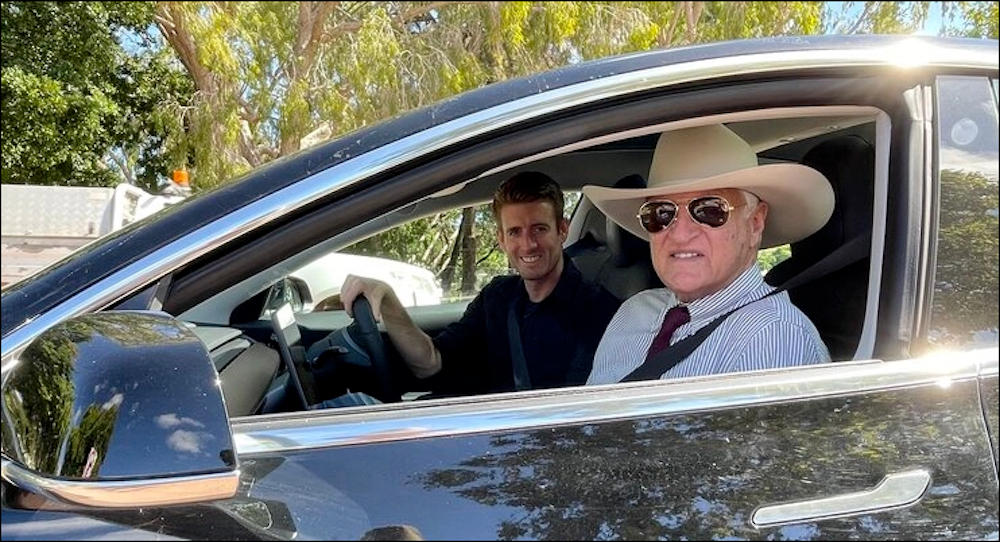
This week Crikey pointed to a video in which the Queensland MP Bob Katter gets his first taste of a Tesla as it accelerates from zero to 100 kilometres per hour in just over three seconds.

Yeehaw!” he yells. “This is so exciting.”

Australians usually embrace the future. At times we’ve been ahead of it.


Read more: International Energy Agency warns against new fossil fuel projects. Guess what Australia did next?


Peter Martin, Visiting Fellow, Crawford School of Public Policy, Australian National University

This article is republished from The Conversation under a Creative Commons license. Read the original article.

Read more >>

Monday, May 24, 2021

Great approach, weak execution. Economists decline to give budget top marks


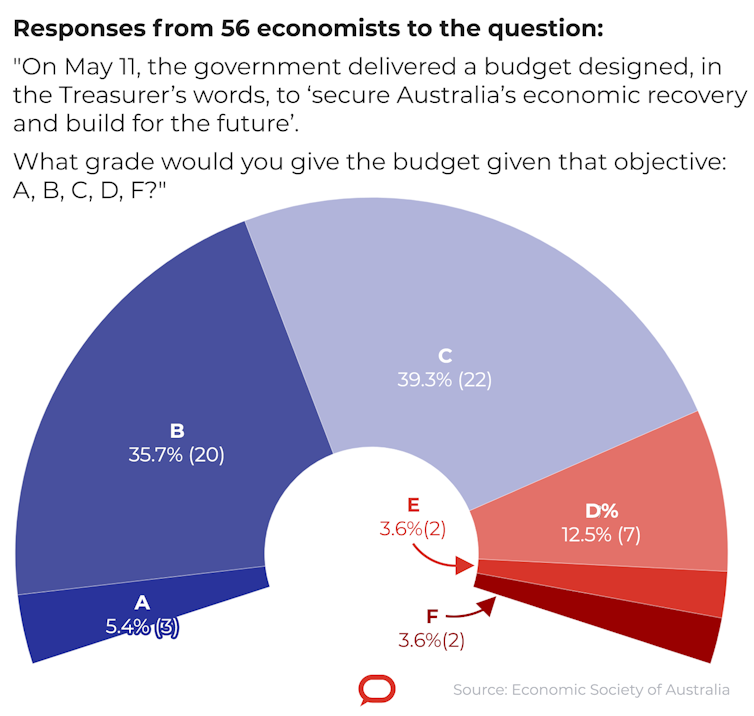
Despite overwhelmingly endorsing the general stance of the 2021 budget, only a few of the 56 leading economists surveyed by the Economic Society of Australia and The Conversation are prepared to give it top marks.

Asked to grade the budget on a scale of A to F given Treasurer Josh Frydenberg’s objective of securing Australia’s economic recovery and building for the future, only three of the 56 economists surveyed gave it an ‘A’.

But a very large 41% awarded it either an A or a B, up from 37% in last year’s October COVID budget.

The economists chosen to take part in the Economic Society of Australia survey have been recognised by their peers as Australia’s leaders in fields including macroeconomics, economic modelling, housing and budget policy.

Among them are a former head of Australia’s prime minister’s department, a former member of the Reserve Bank board, a former OECD director and two former frontbenchers, one from Labor and one from the Coalition.

Of the panel members who commented on the historic stance of the budget — expanding the size of the deficit beyond what it would have been in order to drive down unemployment — all but three offered enthusiastic endorsement.

Emeritus Professor Sue Richardson of the University of Adelaide commended the government for at last turning its back on a “debt and deficit” mantra, that was “never justified”.


Read more: Exclusive. Top economists back budget push for an unemployment rate beginning with '4'


Professor Richard Holden praised the “watershed”. In due course there should be increased attention paid to the structure and quality of spending, but for now we should applaud the “Frydenberg Pivot”.

Saul Eslake said the strategy of providing further stimulus to push unemployment down to levels not seen consistently since the first half of the 1970s was the right one. It meant the Reserve Bank and the treasury would no longer be working at “cross purposes” as they had been for most of the past two decades.


The Conversation, CC BY-ND

But Eslake said the budget fell short in the A$20 billion it devoted to tax concessions for small business in the mistaken and unfounded belief it is “the engine room of the economy” and in housing measures that failed to heed warnings from history about the risks of ultra-high loan-to-valuation ratios.

Rebecca Cassells of the Bankwest Curtin Economics Centre said the claim that 60,000 jobs would flow from extending the temporary loss carry back and full expensing tax concessions was “a stretch,” with the connection quite tenuous.

Bucks, but not the biggest bang

Consultant Nicki Hutley said a bigger boost to the JobSeeker unemployment payment would have achieved much more than the $7.8 billion one-year extension of the “lamington” low and middle income tax offset.

Economic modeller Janine Dixon said while spending more to get more people into work was the “right setting for the times,” Australia had to ensure its workforce was ready to supply the extra aged care and child care and disability services it had funded by delivering the right training, especially in the absence of migration, which has traditionally been used to address workforce shortages.

Labour market specialist Elisabetta Magnani said measures to boost wages in the caring occupations could have achieved the double bonus of drawing more workers into those occupations and shrinking the gender pay gap, given that more than 80% of the workers in residential aged care are female.

Little for net-zero

Michael Keating, a former head of the prime minister’s department, said restoring high wage growth would require big investments in education and training, which sits oddly with the cuts in funding for universities. The extra funding for apprentices and trainees only makes up for past cuts.

Professor Gigi Foster said the $1.7 billion spent on childcare subsidies was only “surface-level fiddling with the sticker price”.

“Where is the supply-side intervention required to make childcare services sustainably accessible and of high quality?” she asked. “Childcare should be viewed as social infrastructure. Instead, when we heard infrastructure, it was mainly code for transportation.”


Read more: Fewer hard hats, more soft hearts: budget pivots to women and care


Margaret Nowak of Curtin University said a budget that really “built for the future” would not have focused on the “infrastructure of the past”. Professor Richardson lamented that most of the infrastructure spending was on traditional “roads and ports” when the future was net-zero emissions.

“There is little in the budget that supports this transformation,” she said. “It is an extraordinary lost opportunity.

Nicki Hutley said retooling the economy for zero emissions would have brought forth "more jobs, higher wages, more growth and private sector co-investment”.

Some concern about debt

Former OECD director Adrian Blundell-Wignall said a much-greater investment in vaccinations would have helped “get the economy back to work and the borders opened sooner which, in turn, would have saved unemployment benefits, tourism, aviation support and the need for the extension of temporary measures”.

And he was concerned that a jump in US inflation might cause international interest rates to rise faster than expected, forcing Australia to cut its projected budget deficits in order to stabilise net debt.


Read more: Frydenberg spends the bounty to drive unemployment to new lows


Former International Monetary Fund economist Tony Makin, a critic of government spending during the global financial crisis, described the budget spending as a “knee-jerk primitive Keynesian reaction” to the COVID recession.

Unease about going into debt to keep and create jobs aside (and very few of the economists surveyed shared Makin’s unease) the criticisms of the economists surveyed relate to execution and details. If Frydenberg had been judged on his approach, most would have given him an A.


Peter Martin, Visiting Fellow, Crawford School of Public Policy, Australian National University

This article is republished from The Conversation under a Creative Commons license. Read the original article.
Read more >>

Wednesday, May 19, 2021

The GFC provided the secret sauce we used to ward off the COVID recession

We got an awful lot right during the COVID crisis — an awful lot that we couldn’t have got right just a few years earlier.

Which is another way of saying we were incredibly lucky.

Had COVID attacked during the 1980s there would have been no way to make a messenger RNA vaccine, not even for animals.

The national broadband network wouldn’t have been thought of. It wasn’t complete until 2020.

Even three years earlier, in 2017, the NBN reached only half of Australia’s 10 million households.

Had COVID struck then, before the broadband network was complete, working from home, telehealth and home schooling might have been impossible for many Australians, with devastating educational and other consequences.

And had it struck just a few years earlier still, we wouldn’t have learnt from the global financial crisis.

War Games

Australia’s handling of the GFC was exemplary, as evidenced by the fact that in much of the rest of the world it isn’t called the GFC, but The Great Recession.

Getting that crisis right owed something to a happy accident, as Ken Henry, head of the treasury at the time, explained on Monday at a seminar organised by the Institute of Public Administration.

A few years before the crisis in 2004 he was sitting in a room with senior officials discussing “some macroeconomic topic” when his deputy Martin Parkinson, sitting on his right, poked him with his left elbow.

“Martin said: you know it’s just occurred to me that you and I are probably the only people in this room who have ever experienced a recession — maybe we should have a workshop on that, what we would do if there was another crisis”.

The early 1990s recession was handled badly

Parkinson and treasury secretary Henry had worked for the Hawke and Keating governments during the early 1990s recession which scarred the Australians who it threw out of work for a decade.

In a series of “war games” held away from the treasury building, they and other officials determined that next time they should advise the government to quickly abandon budget discipline and fight what was coming with overwhelming force.

As Henry put it: “no matter how great the importance of fiscal discipline in establishing policy credibility, it is nothing compared to the loss of credibility associated with a recession”.

If the treasury didn’t tell the government this, the government would catch on anyway and sideline it for advisers who would.

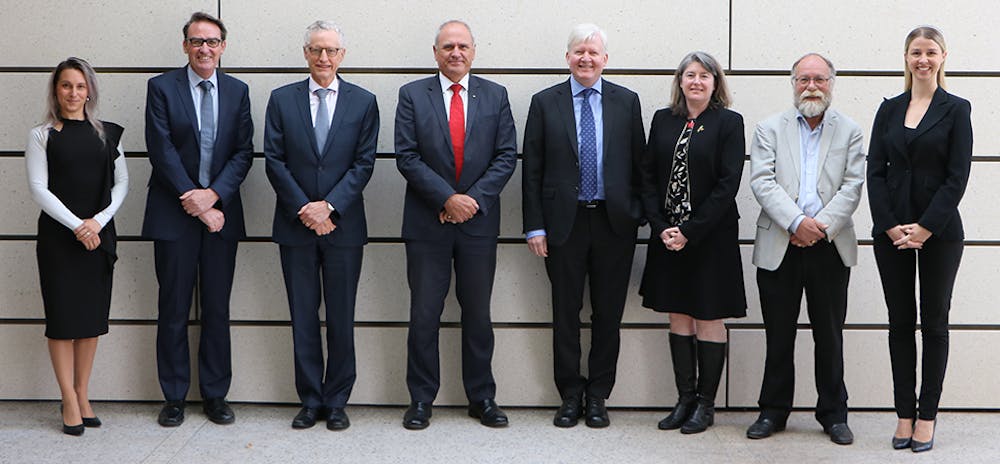
Megan Aponte-Payne, Steven Kennedy, David Gruen, Ken Henry, Malcolm Edey, Meghan Quinn and David Tune at the GFC seminar. Isabelle Franklin

“I came out of those discussions determined that if Australia were to confront a large negative shock during my tenure as secretary, the treasury would seek to put itself front and centre in advising the government,” Henry said.

“We would not be taking seats in the back row by counselling a government to rely on monetary policy, the exchange rate, or automatic stabilisers.”

As for the idea of “proportionate response”, which was still being counselled by some in the early stages of COVID last year, Henry said the word “proportionate” could be applied to a response, but never to preemption.

Preemption is not proportionate

“If you want to preempt something, you don’t talk about being proportionate,” he said. “I remember some commentators saying you should wait until you see the ‘whites of the eyes’ before taking action. "I wouldn’t know what action to take at that stage, presumably it would be to run as fast as you could, I just don’t know.”

The key thing was to get money into Australian’s hands immediately. Spending on infrastructure (spending on almost anything other than households) would take too long.

During the financial crisis Labor got money into households’ hands by handing out cheques. During COVID the Coalition did it by doubling benefits and routing payments through employers and calling them JobKeeper.

Bandwidth matters

Henry, and David Tune who was in the department of prime minister and cabinet at the time and later headed the department of finance, told the conference that attempting to do other things while getting money out the door got in the way, among them insulating homes and building school halls.

Governments have limited “bandwidth” or “thinking space”, and during the GFC the Rudd government was also considering taking over hospitals, taxing carbon, reforming the tax system and building the NBN.

The Morrison government seems to have learnt that lesson, but it doesn’t seem to have learnt another, which is that the Commonwealth isn’t good at managing projects.

The Commonwealth can’t run projects…

Whether it’s vaccinations or quarantine or insulating homes, projects are best managed by state governments who have actual experience of running things.

Another important lesson, reinforced during COVID is that in practical terms the ability of the Reserve Bank to support the government in keeping a recession at bay might be unlimited.

The Reserve Bank deputy governor at the time Malcolm Edey told the conference that the next step after low interest rates and buying government bonds is direct “money-financed fiscal expansion”, where the bank creates money for the government to spend.

…but its financial power is unlimited

With all of the government’s borrowing now in Australian dollars, and most private overseas borrowing effectively in Australian dollars because it has been hedged against exchange rate movements, and with the debt ceiling gone, there’s no limit to the force and speed with which the government can stave off a recession.

The current treasury secretary Steven Kennedy conceded that in one way fighting the COVID recession had been easier than fighting the GFC.

COVID had a clear start date. The GFC had a rolling series of starts that made it hard to be sure the worst hadn’t passed.


Read more: Frydenberg spends the bounty to drive unemployment to new lows


And perhaps because of that, we discovered what Australians can do.

Treasury Deputy Secretary Meghan Quinn praised the banks for deferring payments on $250 billion of loans, Coles and Woolworths for working together to stock each other’s stores and the private and public health systems for working together in a way that wouldn’t have been thought possible before the pandemic.

We read the GFC playbook, then went further.

Peter Martin, Visiting Fellow, Crawford School of Public Policy, Australian National University

This article is republished from The Conversation under a Creative Commons license. Read the original article.
Read more >>

Tuesday, May 11, 2021

Frydenberg spends the bounty to drive unemployment to new lows

Never before has a budget spent so much to supercharge the economy after the worst of a recession has already passed.

The economy bounced back from last year’s COVID recession far more sharply than the treasury (or just about anyone else) expected.

The bounty from the higher-than-expected tax collections that flowed from more people than expected in work, a much higher-than-expected iron ore price, and lower than expected unemployment benefits, should amount to A$26.8 billion this financial year, $15.5 billion the next, and $18.6 billion the year after that.

But rather than bank those riches and improve the budget bottom line, as the Coalition’s budget strategy used to require it to do, the government has instead decided to spend the lot.


It will spend $21 billion of this year’s $26.8 billion; it will spend or give up in new tax concessions $26.9 billion — far more than next year’s $15.5 billion bounty, and so on.

Treasurer Josh Frydenberg has come good on his historic promise to keep spending way beyond the crisis, to drive the unemployment rate down below where it was when the pandemic started.


Read more: View from The Hill: Frydenberg finds the money tree


The budget predicts an unemployment rate of 4.75% by mid-2023 and 4.5% by mid-2024.

If delivered (and the treasurer’s revised strategy published in the budget requires him to keep spending until it is), it will mark what the budget papers describe as, “the first sustained period of unemployment below 5% since before the global financial crisis, and only the second time since the early 1970s”.


In the same way as Australia emerged from the early-1990s recession with a dramatically lower inflation rate because the Reserve Bank was determined to salvage something from the carnage, Frydenberg has decided to exit the COVID recession with an ongoing lower floor under unemployment.

Both the treasury and Reserve Bank believe Australia can sustain much lower unemployment than the 5-6% it has grown used to. The treasury’s estimate is 4.5%; the Reserve Bank’s is nearer 4%. Before COVID, the United States managed 3.5%.


Read more: Fewer hard hats, more soft hearts: budget pivots to women and care


If achieved, it will mean hundreds of thousands more Australians providing services, drawing paycheques, and paying tax. And no longer on benefits.

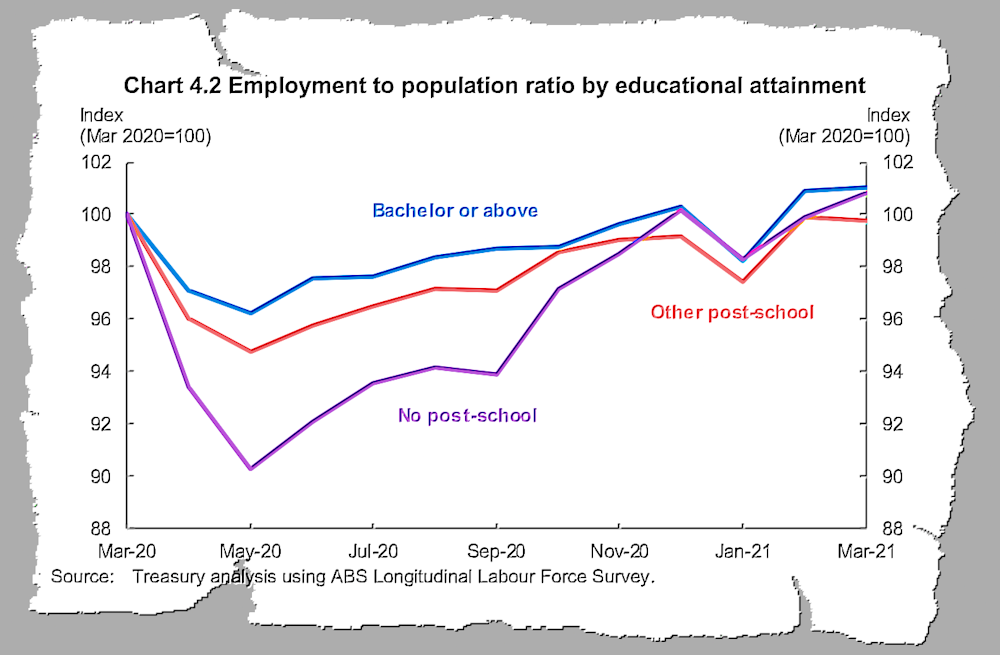
A dramatic budget graph tracking the fortunes of every Australian whose payroll was reported to the tax office throughout 2020 shows the biggest victims of the COVID recession — by far — were those without post-school education. At the deepest point of the COVID recession in May, they were almost three times as likely to have lost their jobs as Australians with degrees.

Budget Paper 1, Statement 4: The labour market through COVID-19

The budget provides an extra $400 million for low-fee or no-cost training for jobseekers, to be matched by the states; an extra $481 million for the transition to work employment service directed at Australians aged 24 and under; and a further $2.4 billion to the Boosting Apprenticeship Commencements program.

But most of what it intends to do for jobs is the indirect result of a barely precedented expansion in spending and tax concessions in all sorts of areas.

The extra $17.7 billion it is spending on aged care over four years ought to create many jobs, as should the extra $13.2 billion it is spending on the National Disability Insurance Scheme.

The $1.7 billion it is spending on making childcare more affordable should both create jobs in the sector and free up more parents to return to work.


Read more: Cuts, spending, debt: what you need to know about the budget at a glance


An extra $20 billion in business tax concessions should help as well.

The budget’s break with the past isn’t its dramatic expansion of discretionary spending. That’s common in recessions. What’s unusual is that spending is being ramped up when we are not in recession.

In the words beloved of economists, the spending is “pro-cyclical” rather than “counter-cyclical”. It is designed to supercharge our exit from recession rather than merely bring it about.

And there’s little sign of the spending stopping.


If this government or the next achieves success in driving the unemployment rate down to 4.5%, it will want to go further. It will keep going further right up until we get inflation near the top of the Reserve Bank’s 2-3% target band and wage growth in excess of 3%, neither of which this budget foresees in forecasts going out four years.

Government debt, anathema to the Coalition when Labor ran it up during and after the global financial crisis, isn’t much of a constraint.


Read more: Josh Frydenberg has the opportunity to transform Australia, permanently lowering unemployment


The Reserve Bank holds much of the government’s debt (it didn’t during Labor’s time) and is buying as much as it needs to to keep interest rates low. Recently, interest rates have been rising, but not for most of the government’s borrowings, which are long-term.

The budget papers show that even with net government debt at 34% of GDP and heading to 44%, interest payments on that debt are much less of a drain on the budget than they were back in the mid 1990s when net debt hit 18% of GDP.


And the times have changed. Worldwide, few nations have an aversion to government debt, especially not the United States. In Australia, the only side of politics that used to complain about debt is in currently in office.

Before COVID, the fiscal strategy spelled out in the budget as part of the Charter of Budget Honesty required the government to eliminate net debt.

Frydenberg’s revised strategy merely requires him to stabilise and then reduce net debt “as a share of the economy”.

His priority is driving down unemployment. If that helps expand the economy and so drives down net debt as a share of the economy so much the better. But he wants to do it regardless.


Peter Martin, Visiting Fellow, Crawford School of Public Policy, Australian National University

This article is republished from The Conversation under a Creative Commons license. Read the original article.

Read more >>

Wednesday, May 05, 2021

The budget is a window into the treasurer’s soul. Here’s what to look for Tuesday night

As surprising as it may seem, Australian budgets aren’t really about money — they’re about values.

What in America they call the State of the Union, in Australia we call the federal budget.

As a case in point, a key part of next week’s budget will be an announcement about childcare, but the childcare measures won’t start until 2022-23.

It’s not clear that they’ll need to be in the 2021-22 budget in order to get approved.

Indeed, the budget’s formal title is Appropriation bill (No. 1) 2021-22. The budget bill will deal only with appropriations for 2021-22.

But the theatre that has built up around the presentation of that bill — the budget speech — has given it the space to deal with so much more.

Legally, the budget needn’t deal with much

Last year’s speech mentioned values, twice. It spoke of our “cherished way of life”, of the courage, commitment, and compassion of healthcare workers and volunteer firefighters, of our “invisible strength”.

And it extended the low and middle income tax offset for another year.

Legally, the budget bill can’t include tax measures. That’s outlawed by the Constitution.

Tax measures have to be introduced in separate legislation, measure by measure — or not be introduced at all. Our government can continue to collect tax at the existing rates for as long as it likes, unlike in Britain where tax collections form the core of the budget bill and need to be re-authorised every year.

In Australia, government spending does need to be re-authorised every year, but only spending which is for the “ordinary annual services” of government.

Everything else — the vast bulk of government spending, everything from Medicare to pensions to grants to the states to family support to support for private schools and private health insurance — is ongoing, approved on a never-ending basis under so-called “standing appropriations” or “special appropriations”.

At the last count there were 240 such special appropriations, covering everything from the funding of universities to paid parental leave.

The Department of Finance says 167 of them are unlimited, meaning there is “no defined ceiling on total expenditure”.

What’s left, what actually needs to be re-approved in the budget each year, is little more than the payment of rent and public service wages, suggesting that if the Senate had rejected “supply” (the budget appropriation bill) during the 1975 constitutional crisis as it had threatened to do, the Whitlam government could have taxed and spent much as before, although it would have had to get private banks to advance public servants’ wages, something it was investigating doing.

Practically, it deals with most things

It might be because it needs to do so little that the budget has come to do so much.

These days we look to it as a source of official economic forecasts, but that’s a recent development. Up until the late 1980s the forecasts weren’t really forecasts — they covered only the financial year ahead, which, because the budget was delivered in August after the financial year had started, covered not much at all.

Now the “forward estimates” for spending and revenue and the state of the economy go out for four years, and some of them for ten.

The budget has become a statement of the government’s values in part because it puts numbers on those values — how much it is prepared to spend on health compared to defence, how much it plans to spend on superannuation tax concessions for high earners compared to pensions for low earners.

Which makes it a statement of values

As with the US President’s State of the Union speech, it’s the only night of the year in which the government sets out clearly what it stands for and what it plans to do.

An accident of history means it’s the treasurer rather than the prime minister who delivers the statement of values, although the treasurer speaks for the prime minister, as Joe Hockey spoke for Tony Abbott in 2014 when he infamously declared his budget to be for “lifters, not leaners”.

Josh Frydenberg’s values will be apparent in how he responds to a surging iron ore price (last year’s budget assumed US$55 a tonne and on a slightly different measure it’s currently north of US$180) and much stronger than expected recoveries in jobs and the share market.


Read more: Exclusive. Top economists back budget push for an unemployment rate beginning with '4'


It would be tempting to wind back spending and push up taxes in order to close the budget deficit without seeing how far the recovery can run.

That Frydenberg says he won’t, not until he gets the unemployment rate below 5% and hundreds of thousands more Australians are in jobs, is a statement of values.

That he is reportedly planning to spend an extra $10 billion (over the four-year “forward estimates”, not per year) on responding to the findings of the aged-care royal commission when the commission identified much greater needs might also be a statement of values.


Read more: Josh Frydenberg has the opportunity to transform Australia, permanently lowering unemployment


As might the forecasts he makes for immigration, for the spending on mental health promised in response to the Productivity Commission inquiry, for the rollout of vaccines for Australians and vaccines for countries that need them more than Australia.

They’ll all be part of a program that makes clear what the government stands for and against which it can be judged. Tuesday night will matter.

Peter Martin, Visiting Fellow, Crawford School of Public Policy, Australian National University

This article is republished from The Conversation under a Creative Commons license. Read the original article.

Read more >>

Thursday, April 29, 2021

Exclusive. Top economists back budget push for an unemployment rate beginning with ‘4’

Australia’s top economists have overwhelmingly backed a decision by Treasurer Josh Frydenberg to reset the budget strategy so that it prioritises achieving an unemployment rate of between 4% and 5% over reducing debt.

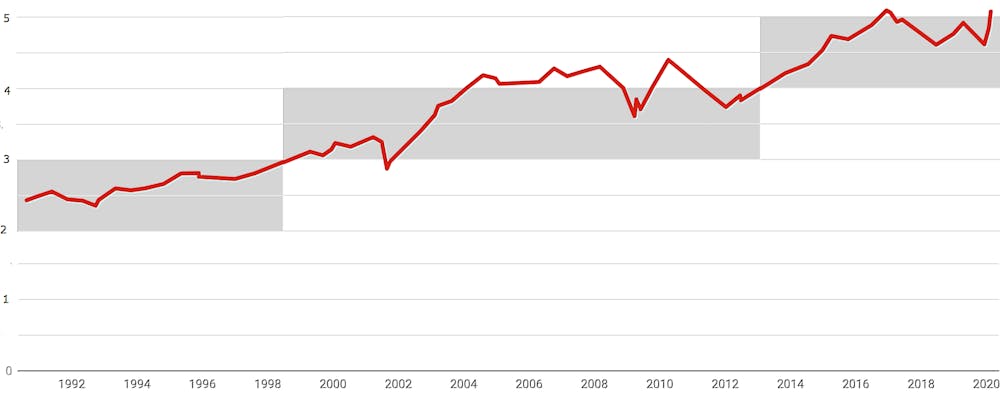
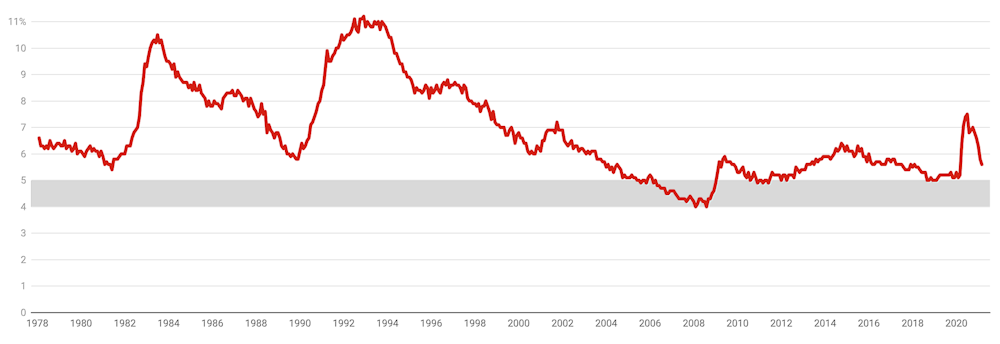
Australia hasn’t had an unemployment rate below 5% since 2011.

It hasn’t had an unemployment rate below 4% since the early 1970s.


Unemployment rate, per cent

ABS labour force survey

The new wording of the fiscal strategy required in the budget as part of the Charter of Budget Honesty will commit the government to quickly drive down unemployment until the unemployment rate is between 4% and 5%.

Only when the unemployment rate is sustainably within that band will the strategy switch to a focus on reducing government debt as a share of GDP.


Read more: Josh Frydenberg has the opportunity to transform Australia, permanently lowering unemployment


The existing wording, introduced in last year’s budget in response to the COVID crisis, only commits the government to drive down unemployment until the rate is “comfortably below 6%”.

Treasurer Frydenberg spelled out the new strategy in an address to the Australian Chamber of Commerce and Industry on Thursday saying both the treasury and the Reserve Bank now believed the so-called non-accelerating inflation rate of unemployment was lower than 5%.

“In effect, both the bank and treasury’s best estimate is that the unemployment rate will now need to have a four in front of it,” he said.

Like it was under Menzies

The Reserve Bank was limited in its ability to cut interest rates further, meaning greater weight would have to be placed on the budget to bring unemployment down to between 4% and 5%.

The exact wording of the new strategy will be unveiled on budget night, May 11.

The increased ambition means the government plans to usher in an era of sustained low unemployment not seen since the prime ministerships of Robert Menzies, Harold Hold, John Gorton and William McMahon.

Backed by 6 in 10 leading economists

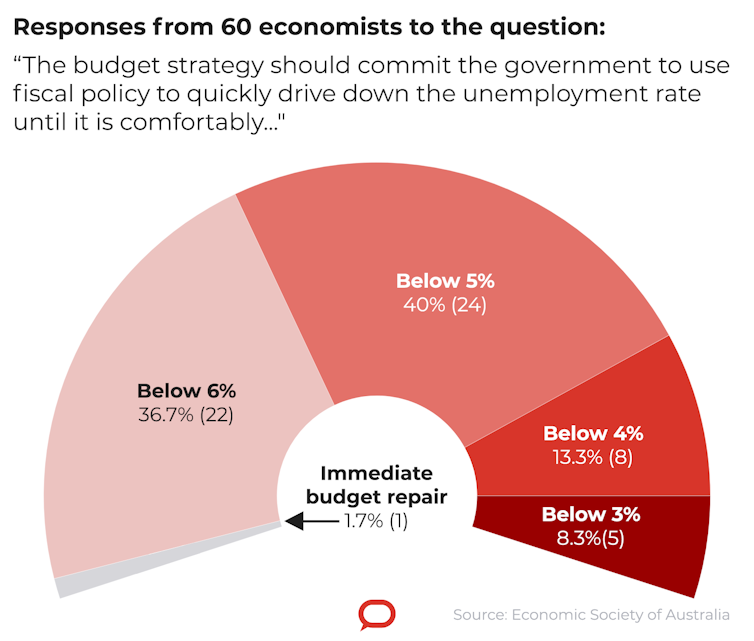
Of the 60 leading Australian economists surveyed by the Economic Society of Australia and The Conversation ahead of the announcement, more than 60% wanted the target strengthened to an unemployment rate below 5%.

Some 21% (13 of the 60 surveyed) want the target strengthened to an unemployment rate below 4%.

Five want the target strengthened to an unemployment rate below 3%.


The Conversation, CC BY-ND

Only one of the 60 top economists surveyed wanted an immediate tightening of the budget regardless of the unemployment rate.

Tony Makin, a former International Monetary Fund and treasury economist who was critical of Australia’s stimulus program during the global financial crisis says the present ultra-low interest rate settings are more than enough to drive unemployment as low as it can get without stoking runaway inflation.

He says the extra government debt that would be created by a push for even lower unemployment would put Australia’s credit rating at risk and push up interest rates and the Australian dollar, making Australian exports less competitive.

‘Unusual opportunity’

The economists chosen by the Economic Society to take part in the survey are recognised leaders in fields including microeconomics, macroeconomics, economic modelling and public policy.

Among them are former and current government advisers, former heads of government departments and agencies, and a former member of the Reserve Bank board.

Labour market specialist Sue Richardson said Australia faced an unusual opportunity to test how low unemployment can go before a tight labour market produces unacceptable stresses.

US unemployment got down to 3.5%

The combination of reduced temporary migration, very low inflation and inflation expectations and a relaxation in the focus on containing the size of government debt made this a rare moment.

Consultant Nicki Hutley said if the experience of the United States before COVID was any guide, Australia might be able to get its unemployment rate down to 3.5% without stoking accelerating inflation.

With interest rates at such low levels, investing in Australia’s economic future could not be a better decision.

Taking pressure off the Reserve Bank

Economist Saul Eslake said it wasn’t unreasonable for the treasurer to have proposed a threshold of an unemployment rate “comfortably below 6%” before beginning budget repair last year, given that at that time the conventional wisdom was that unemployment was headed to 10%.

But now both the Treasury and the Reserve Bank have made it clear unemployment can be forced lower without stoking inflation, “four point something” is realistic.

Inflation figures released on Wednesday showed one of the most reliable measures of inflation, known as the “trimed mean”, at an all-time low.


Read more: Jobs for men have barely grown since the COVID recession. What matters now is what we do about it


Another reason for the government to delay winding back debt was that it would give the Reserve Bank an opportunity to lift interest rates sooner, giving it greater ability to cut interest rates to fight downturns in the future.

A report released by the Parliamentary Budget Office on Wednesday said reducing the government’s debt-to-GDP ratio to pre-pandemic levels would take decades, “even under relatively optimistic scenarios”.

But it added that debt servicing costs should remain subdued as the existing debt was borrowed at historically low interest rates.


Read more: Should the government keep running up debt to get us out of the crisis? Overwhelmingly, economists say yes


Macquarie University’s Geoffrey Kingston said it was the wrong time to be thinking about either an unemployment or a debt target. What mattered, this year more than most, was the composition of government spending.

This meant better supplies of the Pfizer and Moderna vaccines, more facilities for mass vaccinations and safer quarantine.

Peripheral programs such as subsidising airfares to holiday destinations at a time when it remained imprudent to encourage air travel were much less important — even if they helped fight unemployment.


Peter Martin, Visiting Fellow, Crawford School of Public Policy, Australian National University

This article is republished from The Conversation under a Creative Commons license. Read the original article.
Read more >>

Tuesday, April 27, 2021

Why productivity growth has stalled since 2005 (and isn’t about to improve soon)

Not long ago it seemed as if the future was going to get better and better — not long ago at all.

For me the high point was around 2005, fifteen years ago.

I don’t know if you can remember how you felt at the time, but for me the surge in living standards, driven by an ever-building surge in output per working hour (“productivity”) suggested things were building on themselves: each new innovation was making use of the ones that had come before to the point where….

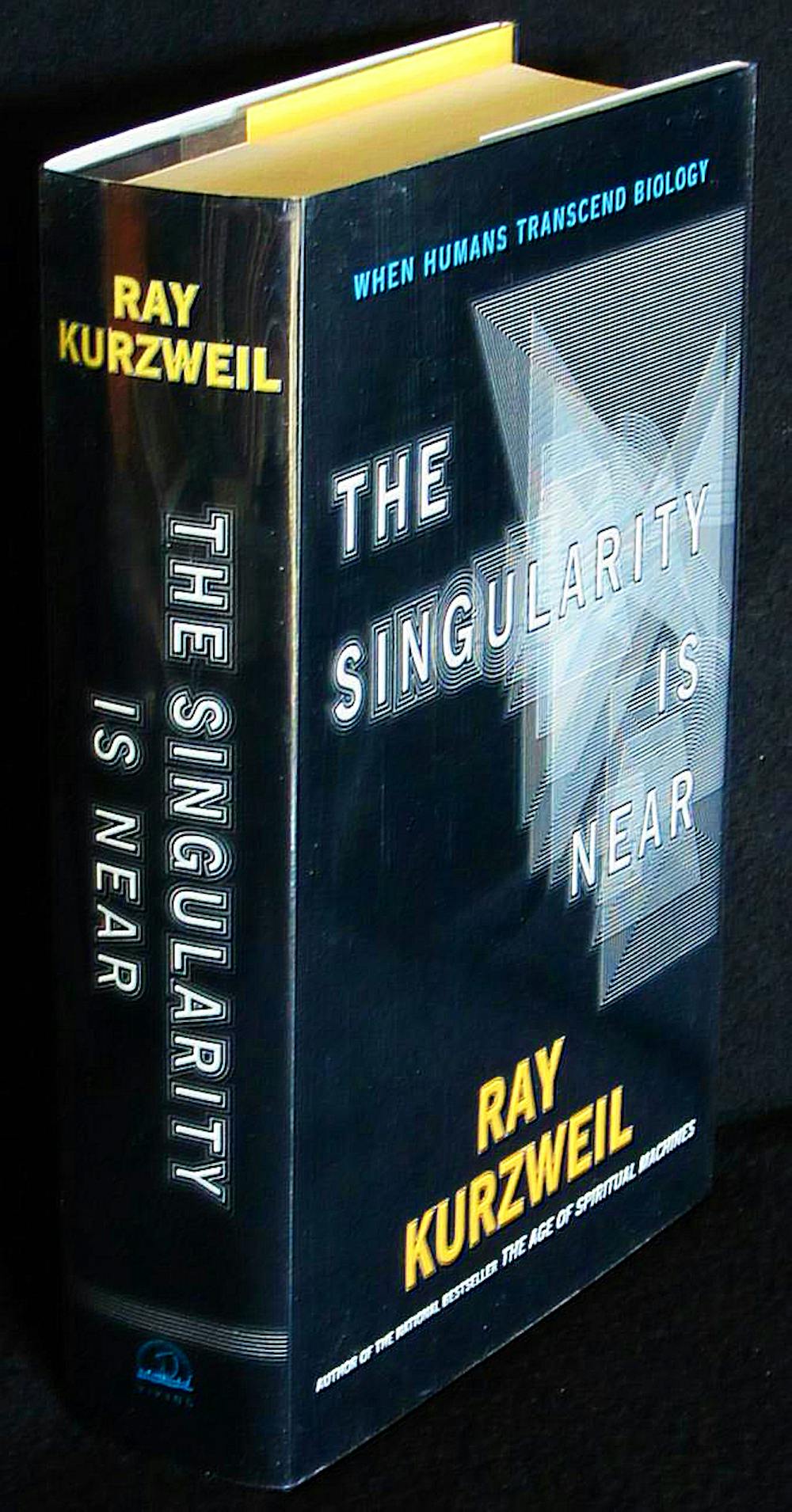
Ray Kurzweil, now the director of research at Google, summed it up in a book released in 2005 itself, titled The Singularity Is Near.

Singularity was “a future period during which the pace of technological change will be so rapid, its impact so deep, that human life will be irreversibly transformed”.

Changes would build on each other to the point where everything changed at once.

Kurzweil dubbed it the “law of accelerating returns”.

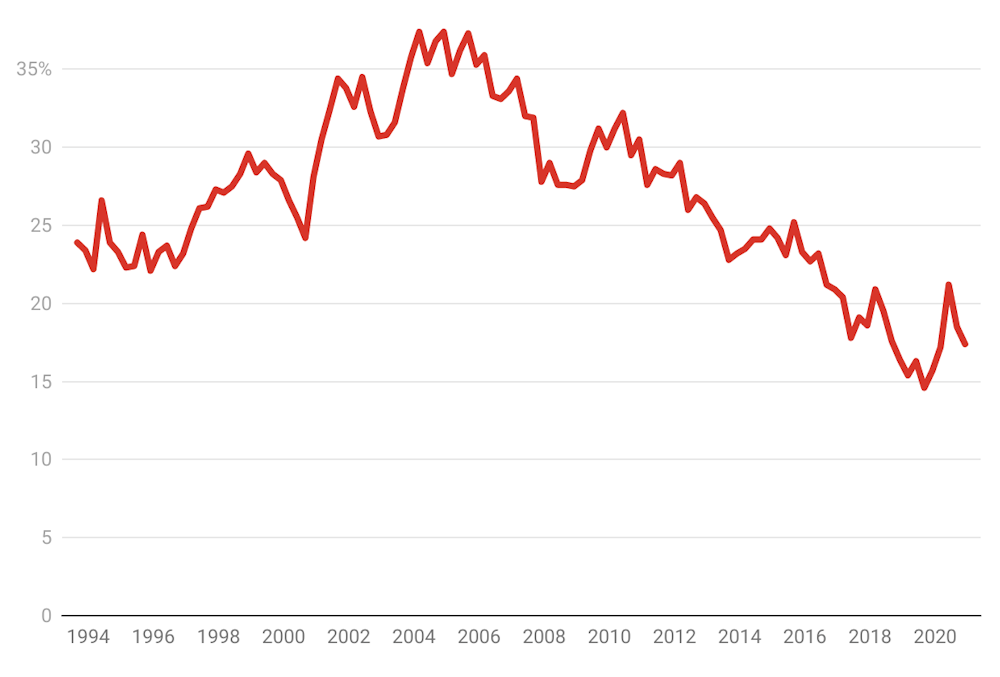
Year by year in the leadup to 2005, Australia’s productivity growth had accelerated to the point where in the 15 years to 2005 it had grown 37%.

If it kept accelerating…

In the 1930s economist John Maynard Keynes foresaw “ever larger and larger classes and groups of people from whom problems of economic necessity have been practically removed”. On average the working week might fall to 15 hours.

In the 1970s, futurologist Alvin Toffler spoke of a four-hour working day.

And then from 2005 on productivity growth collapsed. In the 15 years since, Australia’s output per working hour (productivity) has grown by just 17%.

Thirty seven per cent turned out to be the high point.


Long-run productivity growth, Australia

Growth in GDP per hour worked over the previous 15 years. ABS

And not only here. In the United States and other developed economies productivity growth is divided into “before 2005” when it was rapid, and “after 2005” when it collapsed.

2005 is when Apple got serious about developing the iPhone. It was when many of our technological innovations really did start building on themselves.

2005 is when things were meant to take off

In his impressive book The Rise and Fall of American Growth economist Robert Gordon rightly points out that things like the iPhone are nothing like as genuinely useful as the innovations in the leadup to the 1940s.

Gordon says not a single urban home was wired for electricity in 1880, but by 1940 nearly 100% had mains power, 94% had clean piped water, 80% had flush toilets and 56% had refrigerators.

He says whereas as all of us could quite happily travel back in time 60 years from today and enjoy a recognisable lifestyle, we couldn’t have done it if we travelled back 60 years from the 1940s.

Instead, they stagnated

It’s as if the innovation we’ve had has been less useful. As if, in the words of PayPal founder Peter Thiel, “we wanted flying cars, instead we got 140 characters”.

Or it might be that the things we do these days are harder to automate.

A century ago roughly half the Australian workforce worked in service jobs — doing things such as hairdressing and writing reports. Today it’s 80%.

Back then, 45% of us worked in farming or manufacturing. Today it’s not even 10%

Services such as hairdressing, nursing and aged care are about as productive as they will ever be. It’s possible to cut hair or consult patients faster, but what’s lost is the time and personal attention spent doing it, which is part of the service.

We might be reaching hard limits

If productivity is output (the service) per unit of input (time spent), it doesn’t make sense to measure it where much of the output is the input.

That’s one of the reasons the Bureau of Statistics provides measures of what it calls multi-factor productivity for industries such as agriculture and mining, but not for “health and social assistance” which is Australia’s biggest employer.

The Bureau is working on a measure for health, but it thinks it will have to use as the output changed life expectancy or surveys of patient “satisfaction” with their treatment.


Read more: Have we just stumbled on the biggest productivity increase of the century?


In the US as many as 30% of workers now work in “persuasive industries” including advertising, public relations and the law.

It is almost impossible to measure their output — is it success in persuading people to change their minds?

For public servants and writers it is possible to measure output in terms of words produced, but deeply unhelpful. It is far from certain these workers would be more productive if they worked faster.

Technology might even be sending us backwards

Which is a way of saying that we might be coming up against hard limits in the amount we can squeeze out of each hour of paid work. Or perhaps not. The Singularity promises us robots that can talk to dementia patients and bots that can write political news.

And the application of technology might even be sending productivity backwards.

British economics writer Tim Harford points out that what drove the really big advances in productivity in manufacturing was specialisation.

The father of capitalist economics Adam Smith famously observed that a pin factory employing 10 specialists could produce 48,000 pins a day.

An individual who did all of those jobs working without specialised equipment could scarcely “with his utmost industry, make one pin in a day, and certainly could not make twenty”.

Harford says technology is turning us into generalists.

“Computers have made it easier to create and circulate messages, to book travel, to design web pages,” he says. “Instead of increasing productivity, these tools tempt highly skilled, highly paid people to noodle around making bad slides.”

It’ll matter for living standards

I could say worse about smartphones and the 140 (now 280) characters in Twitter.

They might be taking away more from our work-day output than they add to it.

This failure of ever increasing amounts of technology to do anything like what was expected matters because productivity growth is what we were counting on to drive economic growth and the ability of future generations to support increasing numbers of retirees.

Over four intergenerational reports the government has revised down its estimates of productivity growth and the size of the economy in four decades time. The next five-yearly report is due later this year.

Peter Martin, Visiting Fellow, Crawford School of Public Policy, Australian National University

This article is republished from The Conversation under a Creative Commons license. Read the original article.

Read more >>

Wednesday, April 21, 2021

Jobs for men have barely grown since the COVID recession. What matters now is what we do about it

Of all the weak targets ever adopted by Australian governments, one of the weakest has to have been an unemployment rate “comfortably below six per cent” in last year’s budget.

At the time the budget was delivered on October 6, the published unemployment rate had already fallen to 6.8%.

“Comfortably below six per cent” mattered because it formed part of the “fiscal strategy” required in each year’s budget as part of the Charter of Budget Honesty.

The strategy sets out the circumstances in which the government will tighten or loosen its purse strings.

The October 2020 strategy had two phases. The first required loose purse strings in order to “quickly drive down the unemployment rate”.

It would remain in place until the unemployment rate was comfortably below 6%. In the second phase the government would “shift its focus towards stabilising and then reducing debt as a share of the economy”.

The budget jobs target is comfortably weak

On the very harshest reading, the strategy requires Treasurer Josh Frydenberg to start winding back support for the economy when the unemployment rate falls to comfortably below 6%, as it arguably already has — last week’s reading was 5.6% and heading down.

But that’s probably too harsh. The words “comfortably below” might mean “way below”, and the figure of 6% mightn’t have meant much at all.

As the pandemic gathered pace the treasury was predicting an unemployment rate of 15% - the worst since the Great Depression.

It might have picked 6% as a pseudo target merely because it was something to aim for, and it might not have put much store in what was at the time a one-off result of 5.8% because unemployment rates can bounce around.

We’re about to get an update

Frydenberg says he’ll update the target in a speech to be delivered soon.

Disturbingly, he has defined the present strategy of comfortably below 6% as meaning “around 5.25% or around 5.5%”, which is pretty close to where we are. If he wants to go further, he’ll have to adopt a more ambitious target.

The difference between 6% and 5% is 138,000 unemployed Australians. The difference between 6% and 4% is 277,000 unemployed Australians.


Read more: Josh Frydenberg has the opportunity to transform Australia, permanently lowering unemployment


That’s an extra 138,000 to 277,000 Australians working for us and paying tax; and 138,000 to 277,000 fewer people claiming JobSeeker.

The Reserve Bank governor believes Australia can “achieve and sustain an unemployment rate in the low 4s”.

A good target would approach 4%

The governor makes the point that over the past decade, the estimate of the unemployment rate associated with full employment has been “repeatedly lowered”. The target Frydenberg adopts will tell us a lot.

Because it’s been a year since COVID-19 took off in Australia, it’s possible to get an idea of who’s suffered the most in terms of jobs by comparing March 2021 with March 2020.

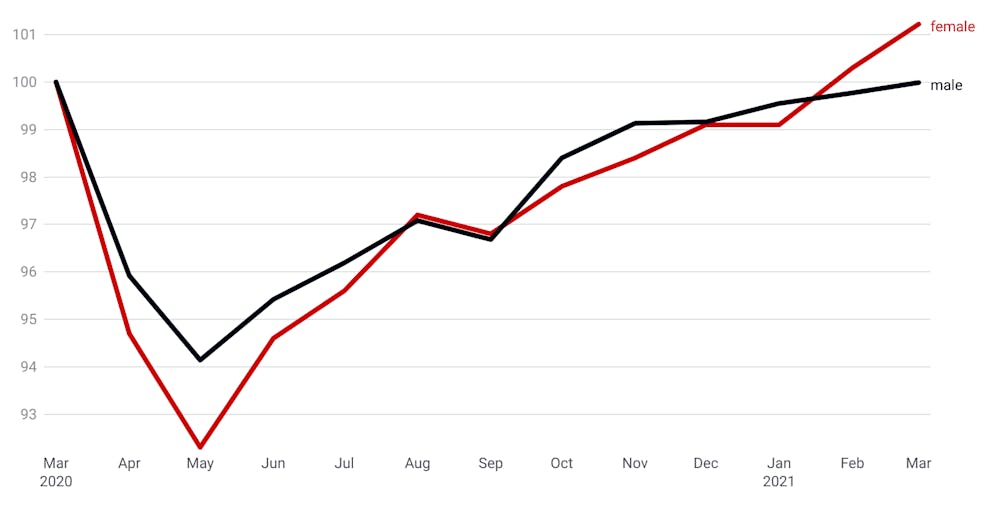
The broad-brush Australian Bureau of Statistics labour force survey turns up the surprising result that, in terms of jobs, women have done better than men.

So far, the recovery has been pink-tinged

It’s a surprising outcome because of what was said midway through last year about a pink-tinged recession.

At the time women had indeed suffered more than men. In May, in the depths of the downturn, women were down 471,000 jobs and men down 401,000. But from then on, as things improved, the gap narrowed.

By August women were no worse off than men. By March this year women were 74,940 jobs better off than before the recession, men 650 jobs worse off.


Male versus female employment, March 2020 to March 2021

Index numbers, March 2020 = 100. ABS Labour Force, Australia

For full-time jobs, the divide is starker. Men are 47,420 full-time jobs worse off, and women 44,870 full-time jobs better off.

We can get much more detail (than ever before) by examining the newly available payroll data extracted from real-time records of more than 10 million Australians, as opposed to the answers of the 50,000 who take part in the labour force survey.

Women have proved more adaptable

Amongst women, the biggest gains are in the “public administration and safety” industries, where the number of women employed is 13% higher than before the pandemic.

The biggest losses for women are in “accommodation and food services” (which means hospitality and tourism) where female employment remains down 14% on the start of the pandemic.

For men, the biggest — although much smaller — gains have also been in “public administration and safety”, where male employment is up 8% since the start of the pandemic, and in “financial and insurance services”, where male employment is up 6%.

For men, employment in “accommodation and food services” remains down 15%.

The data paint a picture of women being more adaptable than men — having suffered worse than men in the early months of the recession and then refashioning themselves into different types of workers.

Among women it is only the youngest ten-year age bands that remain worse off.

Every age band above the age of 30 is ahead.


Read more: The successor to JobKeeper can't do its job. We'll need JobMaker II


For men the damage is more widespread, and perhaps longer lasting. Only in the age bands above 50 are men better rather than worse off.

There’s an awful lot we need to do, and we have discovered during the pandemic we are more than capable of doing it.

We’ll know soon whether the government’s ambition is high or low.

Peter Martin, Visiting Fellow, Crawford School of Public Policy, Australian National University

This article is republished from The Conversation under a Creative Commons license. Read the original article.
Read more >>

Wednesday, April 14, 2021

Home prices are climbing alright, but not for the reason you might think

It’s tempting to think home prices are soaring because there aren’t enough homes.

But that can’t explain the sudden takeoff from about the year 2000, the sudden takeoff from about 2013, and again now – against expectations – the stratospheric takeoff in the wake of the COVID recession.

Broadly, we’ve enough homes. The 2016 census found we had 12% more dwellings than households, up from 10% in 2001.

That’s 12% of our houses and apartments empty – used as holiday homes and second homes, or waiting for tenants.

If there really weren’t enough homes for people who wanted them, it would be more than property prices soaring; it would be rents.

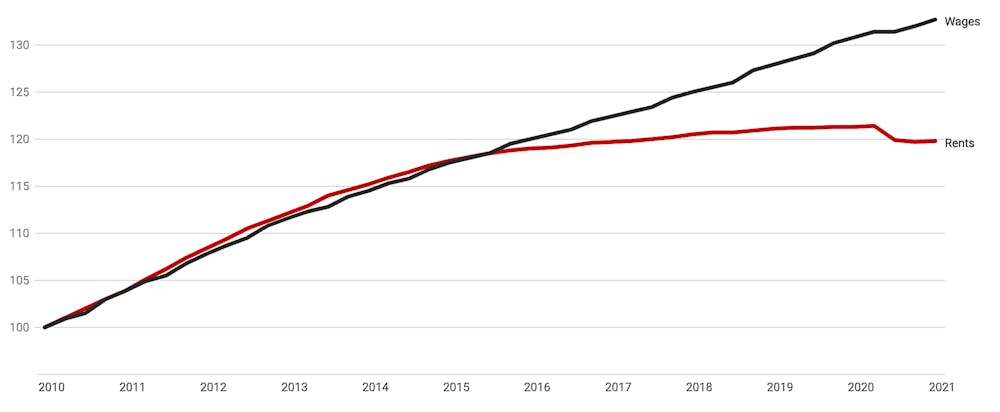
Instead, overall rents have been barely moving – growing even more slowly than wages – for half a decade.


Rent price index versus wage price index

December 2009 = 100. ABS Wage Price Index, Rent Price index from Consumer Price Index

For the half-decade from 2016, a half-decade in which Australia’s population grew by more than one million, Australian rents barely moved.

The supply of places to live in has kept pace with the demand for places to live in, but the supply of places to own has not.

More landlords, more tenants

If that sounds odd, remember people want to own houses for reasons other than living in.

Since about the year 2000, big numbers of Australians (and foreigners) have wanted to buy them to rent them out. They’ve wanted to become landlords.


Read more: Rents, not prices, are best to assess housing supply and demand


Twenty years ago only one in 15 of us were landlords. It’s now one in ten – more than two million of us.

To get those properties (other than where they’ve built them) they’ve had to outbid at auction the people who would have bought them to live in.

They’ve been helping create their own tenants, while pushing up prices.

We’re chipping away at Menzies’ legacy

From when Robert Menzies stepped down as prime minister in 1966 until the end of the 20th century, about 71% of Australian households owned the home they lived in – one of the highest rates in the world.

Since about 2000, owner-occupation has been sliding. The latest figures (themselves some years old) put it at 66%.

Among those aged 35 to 44, it has fallen to 63%

Over that time the cost of buying a home has shot up from two to three years’ household after-tax income to three to four years’ income.


Housing prices as proportion of household disposable income

Household disposable income after tax, before the deduction of interest payments, including income of unincorporated enterprises. Core Logic, ABS, RBA

What appeared to set things off was a decision by Prime Minister John Howard in 1999 to halve the headline rate of capital gains tax. Not that the committee he asked to investigate the idea recognised the possibility at the time.

The Ralph Review recommended that half, rather than all, of each capital gain be taxed, rather than the portion above inflation as had been the case since capital gains were first taxed.

The rationale was that this would “encourage a greater level of investment, particularly in innovative, high growth companies”.

A rush into property rather than high-tech companies

The review was right about the change encouraging investment, but wrong about the sort of investment.

Rather than buy shares in innovative companies, Australians bought rental properties like they never had before.

If they bid enough, they could borrow enough to negatively gear; to make sure their interest charges exceeded their income from rent, giving them annual losses they could offset against wages that would otherwise be taxed at high rates.


Read more: When houses earn more than jobs: how we lost control of Australian house prices and how to get it back


There was nothing new about negative gearing. It had been permitted from the beginning. What was new was the opportunity to later sell the property at a profit, knowing only half of the profit would be taxed.

Investors could offset all of their losses and be taxed only half their eventual gain.

Pretty soon, more than a third of the money lent for housing each month went to landlords. For several dizzying months during 2015 it was 45%. First home buyers struggled to compete.

In 2016 then treasurer Scott Morrison raised the prospect of winding things back, saying negative gearing had led to “excesses”.

APRA cleared up what our leaders could not

Labor went to two elections promising to do just that and the Coalition came out in support of the practice in public.

Behind the scenes, the Australian Prudential Regulation Authority was using its power over lenders to force lending to landlords down, getting it down ahead of COVID to 27% of new housing loans.

APRA succeeded in taking the pressure off prices where politicians couldn’t.

But that’s far from the whole story. There are other more deep-seated reasons why house prices are climbing, and they too have little to do with demand for accommodation.


Read more: Zoning isn’t to blame for Australia’s soaring house prices


Prices took off again from about 2014, shifting up from three to four years’ household income to between four and five years. That time it was Australians getting richer after years of mining booms and being able to borrow more cheaply.

Houses in general mightn’t be a good investment (there being a regularly increasing supply) but houses in prime positions were in fixed supply, there being only so many good locations.

And then it fed on itself. The father of modern economics John Maynard Keynes described investing as a game in which the best strategy is not to put money into what you think is worthwhile, but to put money into what you think other people will think is worthwhile.

It’s happening again

He spoke of a third degree, where “we devote our intelligences to anticipating what average opinion expects the average opinion to be”, and added there might be fourth, fifth and higher degrees.

It’s happening again. With mortgage rates at new extreme lows and wealthier Australians having come out of the crisis with their wealth intact, it makes sense to do what others are doing and push up prices to buy before others push them up further.

It’s nothing to do with a shortage of housing, but for many it will push home prices further out of reach. That’s because in Australia housing is two things: accommodation and a form of speculation.

Peter Martin Saturday AM with Linda Motram April 17 2021.

Peter Martin, Visiting Fellow, Crawford School of Public Policy, Australian National University

This article is republished from The Conversation under a Creative Commons license. Read the original article.
Read more >>