Monday, May 10, 2010

Got the goods on the Tax Office? Now's your chance

If you've had a problem getting your tax return, the man charged with inquiring into the ''confusion, frustration and anger'' surrounding the new Tax Office new computer system wants to hear from you.

Taxation Inspector General Ali Noroozi has called for submissions by June 7 in order to compile evidence for the inquiry ordered by the Assistant Treasurer Nick Sherry.

"I am looking for experiences backed up by documentation," he told the Herald.. The Tax Office has told me there were only two problems with the switch over, both the result of human error. I want to know whether there were more."

The new computer system commissioned on Australia Day sent out refund letters without refund cheques and letters advising that money had been deposited in the the accounts of taxpayers who had not given the Tax Office account details...

Mr Noroozi said he had already received a log of complaints from industry associations running into the hundreds.

"I am expecting many more, but I need them backed up with evidence so that if necessary I can challenge what the Tax Office is telling me," he said.

A notice placed on the Tax Office website apologises for delays and says all returns are now being processed properly.

"The introduction of our new system was a one-off event, replacing a system more than 30 years old," the letter from Tax Commissioner Michael D’Ascenzo says. "We converted 27 million taxpayer records, 32 million accounts and 282 million forms."

Mr Noroozi said he would be reporting to the Tax Office in real time as he conducted his inquiry into order to ensure problems could be fixed before the next wave of tax returns.

"I will also be reporting formally, but this can't wait," he told the Herald.

Published in today's SMH


Related Posts

. Could things get worse for the Tax Office? Maybe. They'll be an inquiry.

. Why is the Tax Office sitting on your refund cheque?

. Still waiting for your tax return?


Read more >>

Could "less tax" be the Budget surprise?

A tax cut on bank interest to as low as 18 per cent and simple "one click" tax returns are two of the key reforms likely in tomorrow's "no frills" federal budget expected to return Australia to surplus two years earlier than previously projected.

In releasing the government's response to the Henry Review a week ago Treasurer Wayne Swan said he was "attracted" its ideas for making tax time simpler and improving incentives to save.

Asked yesterday whether either reform would be unveiled Tuesday night he said "you'll just have to wait until we see the Budget".

The Review recommends only 6 of each 10 dollars earned in bank interest face tax.

Already-scheduled tax changes mean from July Australians earning $37,000 to $80,000 will face a marginal rate of 30 per cent with Australians earning up to $180,000 paying just 37 per cent. The recommendation would see those Australians paying effective tax rates on interest of 18 per cent and 22 per cent...

The review has also recommended extending the discount of income from rents, but only after other reforms to the housing sector.

Tax returns would become "one click" affairs for the 56 per cent of Australians with simple tax affairs who would be sent pre-filled forms and asked to accept a standard work expense deduction. A further 25 per cent of taxpayers would merely need to answer one additional question in order to get their refund.

Wayne Swan committed himself to action early late year telling a tax conference, "as matter of principle, working families should not have to pay hundreds of dollars per year to accountants to fill out their tax return".

Other measures expected include a further $2 billion in health funding to pay for changes to primary care, more nurses, and system of electronic health records. There will also be a boost in training for unemployed people as part of a program to boost productivity.

Mr Swan committed himself to paying for new measures by cutting existing ones, saying in many ways this would be his "hardest Budget yet – funding health reforms and other commitments without adding a cent to the deficit".

"We're not engaging in some Peter Costello - John Howard spendathon in election year. There's simply no room for that. We are offsetting all new spending and that will be there for all to see."

Finance Minister Lindsay Tanner yesterday announced savings on travel spending worth $160 million over four years achieved by new contracts with the airlines that bought out frequent flyer points.

Shadow Treasurer Joe Hockey mocked talk of savings saying "when the Treasurer says it's a boring Budget make sure you hang on to your wallet, expect new and higher taxes".

The Budget will forecast an almost immediate return to healthy economic growth and a return to Budget surplus in 3 to 4 years rather than the 6 predicted in the last budget.

"We are emerging from the global recession in better shape than just about any other advanced economy," Mr Swan said. But the impacts of the global recession will linger. Companies accumulated significant losses and they will continue to be a drag on the return of revenues."

Market economists are forecasting a budget deficit of $48 billion this financial year, down from the $58 billion predicted in the last Budget, and a deficit of $34 billion in 2010-11, down from the $57 billion predicted last time.

Published in today's SMH and Age 


Related Posts

. Earn $25,000 tax-free. You would in Henry's fast-fading world

. What is it with filling out tax returns?

. The job market's surging. Could a budget surplus be far behind?


Read more >>

Sunday, May 09, 2010

Mining giants mauled in sell-off after proposed tax ??


Mining giants mauled in sell-off after proposed tax
is what The Australian said.

Well...

Since Sunday's announcement of the Resource Super Profits Tax mining and metals stocks are down 7.52%.

The ASX 200 index itself is down 6.67%.

Maybe the mining tax mauled the lot.


Related Posts

. "Very few high risk exploration prospects are likely to proceed"

. So this idea of a super tax on mining profits... who raised it with the Henry Review?

. We'll still be mining


Read more >>

Saturday, May 08, 2010

Friday, May 07, 2010

What with things as they are, our spending has flatlined

(Perhaps we're worried about the resource super profits tax)  


Near-continual increases in interest rates have finally hit spending.

The latest retail figures show NSW consumers actually spent less in March than December after seasonal adjustment.

The Bureau of Statistics says in trend terms our spending is falling the fastest in the nation.

Since December NSW spending at supermarkets slipped 0.9 per cent, spending on clothing 11 per cent, and spending at cafes and on takeaway food 5 per cent.

"Consumers are effectively on strike," said CommSec economist Savanth Sebastian. "They are worried about loan repayments given the relentless lift in interest rates"...

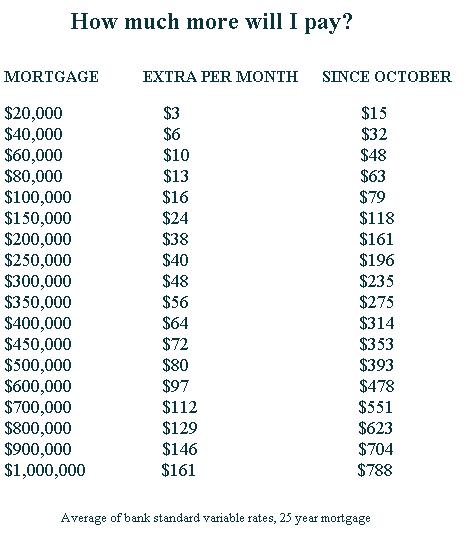
Since October the the monthly payment on a $300,000 mortgage has increased has increased $235 and the payment on a $400,000 $275.

NSW shoppers are the most exposed to interest rate increases being the most heavily mortgaged.

"The Reserve Bank might have gone one step too far," said Mr Sebastian. "Not only has retail spending gone nowhere in the first three months of this year, but annual growth has hit a nine-year low".

Deutsche Bank economist Tony Meer said spending had "basically flat-lined sine the final Rudd-drop cheques went out in May 2009."

"After May spending at first slipped, then staged a modest recovery before arguably beginning to slide again after November."

"You can see it in pricing. Once the handouts passed retail prices have been basically flat."

Not all spending slipped in the three months to March. NSW shoppers spent more on alcohol, more on furniture, shoes and cosmetics. Total spending slipped 0.9 per cent.

We also got out our cheque books for cars. Separately released industry figures show NSW residents bought 23,600 cars in April, 4000 more than the year before.

Sales of four wheel drives jumped 35 per cent.

Bureau of Statistics figures released yesterday show car imports doubled between March 2009 and March 2010, adding 775 million to Australia's monthly import bill.

Imports jumped 3 per cent in March outpacing a 2 per cent jump in exports, widening Australia's trade deficit from 1.7 billion to 2 billion.

However economists expect newly negotiated much higher prices for coal and iron ore to shrink the deficit in coming months.

"The new contract prices for coal and iron ore are massively higher," said RBS Australia economist Kieran Davies. "They will markedly improve our current account deficit, although the extra equipment brought in for the mining boom will provide some offset.
Continued...

Published in today's SMH


Related Posts

. So after all the stimulus, things seem a bit... flat

. Wind back the stimulus? Where's the love?

Read more >>

"Very few high risk exploration prospects will be capable of proceeding or are likely to proceed"


What they said about the offshore Petroleum Resource Rent Tax in 1987:

NATIONAL PRTY LEADER IAN SINCLAIR, MONDAY, 2 NOVEMBER 1987:

"With a proposed resource rent tax on 40 per cent, very few high risk exploration prospects will be capable of proceeding or are likely to proceed. Indeed, they are likely to be most unattractive.

"The inescapable conclusion to be drawn from the way in which the resource rent tax is structured is that it is a disincentive, that it is not truly profits-based and that it is a tax that will further discourage companies from spending money around Australia-all at a time when there is a need for greater exploration activity and when there is certainly a need for us to be conscious of the economic and employment consequences of failing to encourage exploration in our off-shore areas."


LIBERAL PARTY FRONTBENCHER ALEXANDER DOWNER, MONDAY, 23 MARCH 1987

"The resource rent tax which will be introduced by this Government will only make matters considerably worse because it will impose a new burden upon those people who are prepared to put money up front and to go out and explore for oil. It will put a new burden on the risk takers in the oil industry, apparently because the Government, for reasons of its own, resents and despises these people...

"I think it is an ideological proposal which is going to do very real damage to oil exploration in Australia. It is going to affect our balance of payments situation and it is going to affect the overall state of our economy. If this is to be one of the pieces of legislation which will form the general epitaph of the Government, I think it is highly appropriate. It is an anti-production, anti-development, anti-profit and anti-export tax, and the Government deserves to be condemned for the irrationality of that decision."


NOW ABBOTT'S IN ON IT: "This is a dagger aimed at the heart of Australia's posterity."


Related Posts

. So this idea of a super tax on mining profits... who raised it with the Henry Review?

. We'll still be mining

. Swan, Rudd and Tanner are stuffing things up big-time


Read more >>

Their front pages are better than ours, if more partisan


Read more >>

Thursday, May 06, 2010

So this idea of a super tax on mining profits... who raised it with the Henry Review?


You wouldn't think it


What the mining industry now says is "an unprecedented double-tax" that will hit workers, share-owners and small businesses, it once championed - in its submission the Henry Review.

The submission from the Minerals Council of Australia, dated November 2008, explicitly argued for a shift away from the existing complex system of more than 40 different state-based royalty charges to a national "profits-based" tax.

Quoting its own submission to a Ministerial Council on Mining as long ago as 2005 it said the new regime should be seen as "a return to a joint venture where the State brings the resources to the joint venture and the minerals company the expertise to convert it to a salable product".

It argued for a "sharing of the profits that arise from a saleable product," saying the government should "try to extract a share of the joint venture rents"...

By contrast at present no state had the same rate for the 42 minerals mined, with "the method of levying royalties for the same mineral differing across states, rates differing for the same mineral across states and in some cases rates differing for different mines extracting the same mineral in the same state."

It suggested the government use the proceeds of tax reform to cut the 30 per cent headline company tax rate and assist with the tax treatment of capital expenditures, also measures ticked off by the Henry Review and adopted by the government.

So sensible did the government find the Mineral's Council's suggestions that at a conference in 2009 the head of the Treasury's revenue group David Parker thanked it for "quite properly" pointing out that the best way to look at resource tax was as a "partnership or joint venture between private capital and community owned resources".

He showed the conference a graph showing that if 40 per cent excess profits tax had been in place instead of state royalties during the past decade the industry would have paid less between 2001 and 2004 and more between 2005 and 2008.

He even referred to it as a tax on "super profits."

So what went wrong? Why is the Minerals Council now opposing a change it sought?

One view is that the market changed. It became apparent that there would be many more good years than bad years in the decade ahead, making the switch to a an excess profits tax less than it seemed in 2008.

Another is that what the government now proposes is different to what the Minerals Council thought it would propose. The rate is the same, but it will apply to existing projects rather than "prospectively" to new ones only as the Council wanted.

Its submission spoke of the danger of "sovereign risk" if that happened, a contention David Parker derided at its conference observing that governments often made decisions that changed the tax treatment of existing businesses.

"I cannot recall anybody arguing that then existing investments should not have been able to access the reductions in the company tax rate in the early 2000s," he said.

Or it might be that what the Minerals Council and the government are really arguing about now is price, specifically the hurdle rate at which the super tax will apply. Like unions and employer groups fighting over wages they are talking as if the sky might fall in while calmly getting the best deal on the details.

Published in today's SMH and Age


Related Posts

. We'll still be mining

. Swan, Rudd and Tanner are stuffing things up big-time

. Commodity price boom heralds hike


Read more >>

Good news out of NSW? Someone's building homes.

At last, good news for Sydney homebuyers.

Council approvals for new houses and apartments jumped to a six-year high in March with a seasonally-adjusted 3814 new dwellings given a tick, the first month to boast more than 3000 since 2007.


In what seems to be a delayed response to government stimulus and a sign that credit is easing more than half the new dwellings were units or flats, a sector that has been in the doldrums since the global financial crisis.

Sydney is the centre of the resurgence with 1834 new homes approved in March, 1077 of them in high rise apartments or flats.

Nationally March saw the biggest activity since October 2003, with a seasonally adjusted 16,597 new homes approved. Of those, 6200 were new units or flats.

"Reports of the demise of dwelling construction would seem to have been exaggerated," said Westpac economist Matthew Hassan...

"However there's a chance the bulk of this rise is a one-off rather than a renewed leg-up."

Mr Hassan said the jump was almost entirely driven by units, "a notoriously volatlie segment that inclues large and lumpy developments. As such the March rise might be followed by a fall in April, although credit data suggests underlying trends may be improving".

ANZ property economist Ange Montalti said the resilience of approvals in the face of successive rate rises showed builders were reacting to fundamentals. "There is a housing shortage," he said. "The population is growing strongly".

"The strong momentum in prices this past year will have given builders confidence that apartment developments can generate required rates of return."

Treasurer Eric Roozendaal welcomed the jump saying it showed NSW "leading the nation in the growth of residential building approvals, another sign the green shoots of recovery are growing in the NSW".

Aaron Gadiel, chief executive of developer lobby group Urban Taskforce, said it was great NSW was "getting away from the abysmal numbers of 2009, but the state still has a long way to go in order to get its housing approvals and construction rates to a reasonable level."

Housing Industry Association economist Ben Phillips said much more needed to be done and forecast even stronger construction, notwithstanding the end of the First Home Buyer Boost.

"Housing starts should be up 18 per cent this year on a very weak 2009. There's a shortfall of about 200,000 houses," he said.

The apparent resurgence in home building will both be welcome and treated warily by the Reserve Bank.

On one hand more homes will reduce pressure on house prices and rents, weakening inflation.

Governor Stevens told a business audience last year he would regard what happened to housing as a measure of his success saying "if all we end up with is higher prices and not many more dwellings it will be very disappointing, indeed quite disturbing."

On the other hand rapid construction will drive up demand for materials and workers at a time when the economic is set to boom.

The Reserve Bank Tuesday lifted its forecast for inflation to the upper end of its target band, indicating that what happened to inflation would guide its future decisions about interest rates now that they were back to "average levels".

Published in today's SMH


Related Posts

. Fixing the sick joke that is NSW

. Sydney is a disfunctional city; NSW a failed state

. The NSW government is a joke

. Who'd live in NSW?


Read more >>

Wednesday, May 05, 2010

The stairway to super

Read more >>

Normal, but not for long - RBA

Westpac 7.51%

St George 7.43%

ANZ Bank  7.41%

Commonwealth 7.36%

National Australia Bank 7.24%


Economists are warning of still more interest rate pain after the Reserve Bank pushed up rates for the sixth time in eight months, lifting standard variable mortgage rates to near 7.5 per cent.

The new lineup sees Westpac the highest at 7.51 per cent and National Australia Bank the lowest at 7.24 after each of the big four fell in line with the Reserve and lifted rates 0.25 points.

The new rates will add a further $48 to the monthly cost of repaying a $300,000 mortgage and $64 to the cost of repaying a $400,000 mortgage, taking the total extra costs since October to $235 and $275 per month.

Labelling the decision "tough" Treasurer Wayne Swan said it was "unfortunately one of the diffficult consequences of an economy recovering better than other advanced economies".

The Bank said "considerable buoyancy" in the housing market and a bigger than expected mining boom certain to "add to incomes and foster a build-up in investment" would boost Australian economic growth over the year ahead and push inflation toward the upper end of its target band.

So big and earlier than expected was the resurgence in minerals prices... that the Bank expected them to soon surpass the all-time peak reached before the onset of the financial crisis in 2008.

"With the risk of serious economic contraction in Australia having passed some time ago, the board has been adjusting the cash rate towards levels consistent with rates to borrowers close to average," the statement said. "The Board expects that as a result of today’s decision rates for most borrowers will be around average levels."

Macquarie rates strategist Rory Robertson said the Bank was declaring "phase one of momentary tightening over," but he said phase two could start within months.

"I think the Bank will pause at least one meeting, but as early as July it may have marshaled the arguments as to why policy doesn't need be just neutral, it needs to be restrictive. There is a clear and growing bias for rates to go substantially higher."

Kevin Grice, an economist at Capital Economics in London agreeed saying Australia was "likely to be the first of the world's major economies to move beyond neutral".

The political danger for the government is that the Reserve Bank's words will no longer allow it to claim that any future rate rises are part of the process of returning to normal.

Treasurer Swan said his "no frills" budget due next Tuesday would take pressure off the economy by attending to capacity constraints. Economic stimulus was already being withdrawn.

But Opposition Treasury spokesman Joe Hockey called on him to do more, saying he could take pressure off house prices by making available more land.

"Most governments in Australia are Labor governments – they control the supply of land. I would say ring up your mates in the states, end the blame game and get more supply of land."

In an attempt to boost housing supply in Victoria Treasurer John Lenders yesterday introduced a new $20,000 grant for first home buyers of newly built home in metropolitans and $26,500 for newly built regional homes.

Mr Swan said the housing market had "long-term" problems "made worse by the impact of the global recession".

"It meant much finance for multi-unit development did not flow. We have been working on this issue since day one, and we have to do more."

Published in today's SMH and Age


Related Posts

. Could our mining boom last another 10 years, another 20?

. To normal and beyond - the RBA's interest rate path

. The RBA thinks we're in for a wild ride. It wants rates up first


Read more >>

Tuesday, May 04, 2010

RBA Rates decision. Rates up 0.25 points to 4.5% (no joke)

Statement by Glenn Stevens, Governor: Monetary Policy Decision

At its meeting today, the Board decided to raise the cash rate by 25 basis points to 4.5 per cent, effective 5 May 2010.

Recently, forecasts for world GDP growth have been revised up again, and growth is expected to be at trend pace or a little above in 2010. Conditions in Europe remain quite weak, though recent data suggest growth is becoming more established in North America. In Asia, where financial sectors are not impaired, growth has continued to be strong, contributing to pressure on prices for raw materials. The authorities in several countries outside the major industrial economies have now started to reduce the degree of stimulus to their economies.

Global financial markets are functioning much better than they were a year ago, but sovereign risk concerns have escalated significantly in Europe over recent weeks. This has prompted additional efforts by policymakers to put fiscal policies onto a sounder footing and to provide support for Greece in the near term. To date, there has been very little contagion outside Europe.

Australia’s terms of trade are rising by more than earlier expected, and this year will probably regain the peak seen in 2008. This will add to incomes and foster a build-up in investment in the resources sector. Under these conditions, output growth over the year ahead is likely to exceed that seen last year, even though the effects of earlier expansionary policy measures will be diminishing. The process of business sector deleveraging is moderating, with business credit stabilising and indications that lenders are starting to become more willing to lend to some borrowers, though credit conditions for some sectors remain difficult. Credit outstanding for housing has been expanding at a solid pace. New loan approvals for housing have moderated over recent months as interest rates have risen and the impact of large grants to first-home buyers has tailed off. Nonetheless, at this point the market for established dwellings is still characterised by considerable buoyancy, with prices continuing to increase over recent months.

Recent data on inflation confirm that it has declined from its peak in 2008, helped by a noticeable slowing in private-sector labour costs during 2009, the rise in the exchange rate and the earlier period of slower growth in demand. In both underlying and CPI terms, inflation over the most recent 12 months was around 3 per cent. Nonetheless, the extent of decline from here may not be quite as much as earlier forecast and inflation now appears likely to be in the upper half of the target zone over the coming year.

With the risk of serious economic contraction in Australia having passed some time ago, the Board has been adjusting the cash rate towards levels that would be consistent with interest rates to borrowers being close to the average experience over the past decade or more. The Board expects that, as a result of today’s decision, rates for most borrowers will be around average levels. This represents a significant adjustment from the very expansionary settings reached a year ago.

The Board will continue to assess prospects for demand and inflation, and set monetary policy as needed to achieve an average inflation rate of 2–3 per cent over time.
Read more >>

Is it on? RBA 2.30 pm today


Financial markets have an interest rate hike today a "live" possibility after official figures both showing both house prices and commodity prices climbing their fastest on record.

Just one day after Treasurer Wayne Swan declared the start of "commodity boom mark two" the official Reserve Bank index of export commodity prices recorded its biggest-ever monthly jump, climbing 17.6 per cent in April when measured in a basket of currencies.

The bank says the jump only "partially" reflects the new higher prices being negotiated for iron ore and coal with the latest deals pushing up the price of iron ore "around 100 per cent" and coking coal "55 to 100 per cent."

Separate housing from the Bureau of Statistics show prices continuing to surge in the first three months of this year even after the end of the First Home Owners Boost.

The Bureau's index has Sydney prices jumping 5 per cent between the December and March quarters, and climbing a record 21 per cent over the year. Melbourne prices climbed even faster, jumping 7 per cent and 28 per cent...

Over all capitals prices climbed 5 per cent and 20 per cent.


ABS 6416.0, March quarter

The privately compiled RP Data index, regarded as more reliable, climbed a lower 12 per cent in Sydney over the year and 19 per cent in Melbourne.

"The Reserve Bank places more weight on the RP Data index. But whatever the index this will concern it," said Macquarie Bank interest rate strategist Rory Robertson. "The economy is doing well, house prices, share prices and now commodity prices are trending up and yet rates are below average. It looks like they'll move."

BT economist Chris Caton agreed saying "even though the ABS measure is not the Bank’s favourite, a 20 per cent increase in house prices is very difficult to ignore."

"This may well be the log that broke the camel’s back. Until now, I had thought that the Bank would take a month off. It may no longer be able to afford that luxury."

Meeting in Melbourne where house prices are climbing the fastest, the Sydney-based Reserve Bank board will announce its decision at 2.30 pm. Financial markets have swung heavily behind a hike with trading putting the likelihood of a rate rise at 70 per cent, up from 55 per cent before the housing and commodity price figures.

The rate hike just before a federal budget would be unusual but not unprecedented. The Reserve Bank pushed up rates on the eve of budgets in May 2000 and May 2002.

The betting market have swung sharply behind a rate rise with 95 of bets placed at Sportsbet.com.au in the past week backing a hike.

"The market has completely turned on its head," said Sportsbet's Haydn Lane. "We're now offering just $1.35 for a $1 win on a hike. Two weeks ago it was $2.90. The activity is unprecedented."

Once regarded as of only moderate relevance to interest rate decisions, house prices became regarded as a key variable after Reserve Bank Governor Glenn Stevens used a March television interview to warn Australians he would not look kindly on continued price rises saying "if all we end up with is higher prices and not many more dwellings then it will be very disappointing, indeed quite disturbing."

A further rate hike of 0.25 per cent would add another $48 to the monthly cost of repaying a $300,000 mortgage bringing the total extra cost since October to $235 per month.

Published in today's SMH and Age 


Related Posts

. Suddenly house prices matter...

. Now the People's Governor unwinds for the cameras

. To normal and beyond - the RBA's interest rate path


Read more >>

Monday, May 03, 2010

Earn $25,000 tax-free. You would in Henry's fast-fading world

Or earn up to $40,000 in bank interest tax free


Mostly cast aside by Wayne Swan but enthusiastically promoted by Ken
Henry is a revolution that would tax the working income of all but a
tiny proportion of Australians at one simple flat rate and tax bank
interest at even less. Gone would be the Medicare Levy and all sorts
of tax offsets including those for seniors, pensioners and low-income
earners.

The committee says an illustration no worker would pay tax on their
first $25,000 earned. After that right up until an income of $180,000
tax would be flat at the rate of 35 cents in the dollar. Only the
very small proportion of Australians earning more than $180,000 would
face the higher rate of 45 per cent.

Although the system would seem to tax Australians on quite low wages
at the same rate as those on quite high incomes the review includes a
graph to show that the very generous $25,000 tax-free threshold would
have the effect of making the average tax rate progressive in a more
simple way than at present.

Australians moving from unemployment to low wage jobs would find the
zero tax rate attractive without the need for complicated rebates and
offsets...

"By taking more income support recipients out of the tax system, it
could also reduce the number of people who have to deal with both
systems at the same time," the report says.

The simplicity wouldn't stop there. Fringe benefits would taxed as
income on the tax returns of the workers who received them instead of
as expenses of employers, even for workers employed by charities who
are at present exempt from Fringe Benefits Tax. The government would
pay money directly to charities to allow them to compensate their
workers for the change.

Treasurer Swan yesterday has specifically ruled out ever imposing FBT
on charity workers, although he left open the possibility of treating
fringe benefits as ordinary income for others.

Income paid in the form of compulsory superannuation would also be
taxed on returns as ordinary income if the review had its way with the
government explicitly subsidising super accounts rather than
concessionally taxing contributions.

Tax returns would be made simple and effectively optional by giving
everyone a automatic standard deduction for work expenses, freeing
most employees from the need to prepare a return, "instead allowing
them to lodge a default return prepared by the Tax Office".

Taxpayers who wanted to claim more "would still have the option" of
submitting receipts.

Wayne Swan said yesterday he was "attracted to the idea" of making tax
returns simpler and hinted he would announce changes soon.

In an Australian first, all income from savings would be taxed at a
lower rate than income from working in recognition of the committee's
view that bank interest is overtaxed when inflation is taken into
account.

The committee recommends applying tax to only 6 out of every 10
dollars earned from bank accounts leaving the rest tax free, a formula
it believes would roughly compensate for inflation. It would do the
same for rental income and for capital gains, a move which would
effectively penalise capital gains whcih are at present only half
taxed. The Treasurer ruled out the capital gains recommendation.

Published in today's SMH and Age


Related Posts

. Don't confuse the Swan's tax moves with Henry's Tax Review

. It's time to properly tax super, and the 50% discount for capital gains looks silly as well - Henry

. What to expect from Ken Henry


Read more >>

Sunday, May 02, 2010

Don't confuse the Swan's tax moves with Henry's Tax Review


They're pretty unrelated.

The Henry Review is here.

The government's response is at futuretax.gov.au

Aside from the Resources Rent Tax, renamed the Resource Super Profits Tax, there's little relation between the two.

And don't hold out hope for much more.

Swan has released a list of the things he won't do.

Great coverage here and here.

What Swan won't do


Stronger Fairer Simpler a Tax Plan for Our Future

THE HON KEVIN RUDD MP
Prime Minister

and

THE HON WAYNE SWAN MP
Treasurer

PRESS CONFERENCE OPENING REMARKS
Parliament House

2 May 2010

PRIME MINISTER: Today the Australian Government will take concrete steps to reform the tax system to deliver Australia a strong and secure economic future. The Government acted decisively during the global financial crisis to keep the Australian economy out of recession.

Today, the Government will take action on tax reform to: one, keep Government finances strong. Two, to protect the future of the Australian economy. And three, make sure working families and small businesses get their fair share.

Australia has come out of the global recession as one of the world’s strongest economies. We have the fastest growth, the lowest debt, the lowest deficit and the second lowest unemployment of all the major advanced economies and we’ve kept our triple-A credit rating.

Just as the Government has worked hard to ensure our economy was the envy of the world during the downturn. We must now work hard to build a strong economy for the future. This long-term plan, released today, builds a stronger economy by using super profits earned from the resources owned by all Australians to provide better super for working families, simpler, lower tax for all companies especially small business [and] the future infrastructure needs of our nation.

This plan means that working families of the future will have to worry less about their retirement. The plan increases the superannuation guarantee from 9 per cent to 12 per cent, supports older workers to top up their super, and boosts the super of lower income workers.

These reforms will add $108,000 to the retirement super of an average worker aged 30 now and increase Australia’s pool of superannuation savings by $85 billion over the decade ahead. These are major reforms.

Second, the plan also means that Australian businesses will become more competitive. 2.4 million small businesses will face lower and simpler tax. All Australian companies will benefit from a cut to the company rate boosting investment, jobs and productivity.

Third, the plan will also help build the rail, roads and ports we need for the future, in particular, in our resource states. This package dedicates over $5.6 billion over the decade ahead to fund our critical infrastructure. For the first time nation building infrastructure will become a permanent structural feature of State and Commonwealth Budgets.

We also want to expand and to broaden the mining industry itself by providing big tax incentives to exploration companies. The mining industry is a fantastic industry. It involves great enterprise and hard work from tens of thousands of Australians. That is why changing the tax structure to help smaller emerging miners and exploration companies will help expand the industry. Independent modelling advises that this package will increase mining activity by 5.5 per cent.

By building a stronger economy, creating more job opportunities and higher wages, this reform will make our economy more globally competitive, it will boost long term GDP by around 0.7 per cent, and lift wages by 1.1 per cent putting $450 per year into the pockets of average workers right across the nation.

This package won’t be popular with everyone. Some will say it will cost projects and jobs. The fear campaign will be large and the fear campaign will be well funded and London-to-a-brick our political opponents will use it for a scare campaign. But I’d ask the proponents of the fear campaign why it is that mining profits have risen $80 billion in the last decade but revenue from royalties for all Australians have only increased by $9 billion. I’d also ask them to answer this question. Why should we put up with a tax system for the next decade that has cost us $35 billion in lost revenue over the last decade, money that could have been funding the rails, roads, ports and other infrastructure that our nation needs.

This is real reform that will help convert Australia’s strong economic position today into enduring prosperity for the future.

I’d like to thank the secretary of the Treasury, Ken Henry, and his team for all their work. In particular I’d like thank the Treasurer, Wayne Swan, for all his work. This has been an extraordinary undertaking by his team.

Also, Chris Bowen, Nick Sherry and Martin Ferguson and other Cabinet colleagues who have worked together on this package.

I’d now like to hand over the Treasurer to take you through the package in more detail.


TREASURER: Thank you very much Prime Minister. It’s good to see so many people flocking to Canberra on a Sunday. I know that it’s the joy of tax reform that brings you all here.

The package that we have today is an ambitious package for long-term reform. For better super, less tax for business – especially small business – and, of course, as the Prime Minister was saying before, 21st Century infrastructure. It will ensure that all Australians get a fairer share and the benefits of the boom are directed where they can make the best impact on jobs, growth and savings.

What I want to do now is just take a few minutes to go through both the historical and the macro context before I go to the specifics of the reforms. There’s probably been nothing I’ve thought about more, first of all as a Shadow Treasurer and then as a Treasurer over five years, than how do we manage the resources boom better than our predecessors managed the last boom. Because if we don’t, we will simply sell Australia short. And that objective has informed the development of this package.

It goes to the core of what we’re doing in infrastructure. It goes to the core of what we are doing when it comes to company taxation and small business taxation. And it goes to the core of the objective of increasing national savings. Not just for individuals, as important as that is, to recognise dignity, to recognise the need for adequate living standards in the retirement. But also to support national savings. That is the objective that has driven us through the late nights in the preparation of this package over a period of five months.

I want to just run through a few graphs and a few facts. Now, what we’ve seen in recent times – as the Prime Minister was saying before – we’ve seen that our mining profits have increased, but the taxpayer’s share of revenue from those mining profits has decreased. You can see the orange bars which, of course, are the profits. You can see the purple bars which, of course, are the state royalties.

If our share of profits had remained at the average of the first half of this decade we would have collected $35 billion more between 1999-2000 and 2008-09. Now these are billions of dollars that the Australian people have missed out on; billions of dollars that could have been invested in our future prosperity. Let’s give that some context. That $35 billion could have delivered something like 14 major hospital redevelopments. Now Australia simply can’t afford to make the same mistake in commodity boom mark two that was made during commodity boom mark one.

Now, there are also some macro-economic reasons why we have to get this right because we are at a crucial turning point in our economic history. Having seen off the worst of the global recession, seen off the worst that it could throw at us, Australia now faces the future from a position of economic strength. That’s a great thing for Australia, but it brings a series of challenges which are linked to the return to full capacity, and of course, the re-emergence of a two‑speed economy

The global recession has accelerated the economic shift towards the big developing countries in our neighbourhood, and that has obvious implications for our terms of trade which you can see in the next chart. Export prices will reach a 60 year high this year. Now, we don’t expect them to stay at those levels forever, but we do know our terms of trade will remain at high levels relative to what we have seen in the past.

Now, the return of boom conditions in the mining sector makes things more challenging for other industries such as manufacturing, construction and tourism. The other sectors find it harder to find workers and capital and, of course the stronger dollar makes them less competitive in their own global markets.

Now, in a two-speed economy we can still build our mining sector while we simultaneously do everything we can to grow other areas of our economy. It is absolutely critical that we grow all sectors of the economy together. We don’t want to grow apart, we actually want to grow together and that is a central objective. And, of course that’s why we’re going to cut the company tax rate to 29 per cent in 2013- 2014, and to 28 percent from 2014- 2015. In terms of competitiveness, this takes us from 22nd amongst comparable OECD countries to 17th. . And you can see that in the chart

Reducing company tax will create new jobs and grow the economy right around the country – to the ultimate benefit of all Australians. I recognise the independent review recommended the company rate of 25 per cent. This isn’t affordable right now, but depending on future revenues from the super profits tax, we have an open mind on whether 28 [per cent] is a final landing point.

And of course, small businesses will get a head start in the cut to the 28 per cent rate. This will give small business a direct financial benefit from the resource boom and an incentive to retain profits to grow their companies. But also, small business will also benefit from an instant write off of assets worth up to $5,000 and simpler depreciation arrangements for other assets.

And as I move around Australia talking to small business, this is a big reform for small business. This gets rid of red tape. This does simplify the tax system for millions of small businesses in this country and that reform should not be underestimated. The changes will let them write off many assets more quickly, increasing their cash flows at a time when they are investing to grow. This is a very big deal for small business, and as I said, it will also cut red tape.

Which brings me to national savings which the Prime Minister talked about before. And where I think we have an absolutely historic reform here. Not only in terms of the accumulation of national savings, but recognising the dignity and respect that people in retirement deserve from our nation.

And, of course there’s nothing that is more on the mind of many people who may be my age or above than what is actually happening in the retirement income system. And we know from the Intergenerational Report what an important challenge this is for Australia, which is why we have chosen to put together this reform.

Now, you’ll all remember that last year we made a real difference to the age pension, a very big difference to the base rate of pension, because so many people were living in great difficulty and in poverty. This year we build on that. We build on that by building up the private savings of Australians who are saving for the future. So it’s a source of great pride to us today that we do build on the great Labor legacy that began two decades ago – compulsory superannuation.

We are boosting super savings so we can ensure that whenever the commodity boom ends, we’ve got something more to show for it than last time. And that is terribly important. And it’s also terribly important in terms of macroeconomic management. Our plan includes concessions on additional superannuation guarantee contributions, a new government contribution for low income earners, and higher caps for the over 50s.

In increasing the SG to 12 per cent, we’re providing a three year lead time before the gradual changes start, so businesses get a decent run-up. We’re also making super fairer, namely a refund of up to $500 of contributions tax from mid 2012 for workers with incomes up to $37,000.

Our changes mean something like an extra $108,000 in the retirement super balances of today’s average 30 year old worker. And they’ll increase Australia’s pool of superannuation savings by $85 billion over 10 years which, as I said before, further boosts investment in the economy.

Now, that brings me to infrastructure, because we will make infrastructure spending a permanent structural feature of State and Commonwealth Budgets. Every single Budget, for every single year will now contain infrastructure investment funded by the Resource Super Profits Tax. I’m proud to announce some of the proceeds will be invested in a new $5.6 billion infrastructure fund focussed particularly on the resource states. That’s a very important step forward given the nature of the challenges that are coming down the road.

And, of course that brings me to the Resources Super Profits Tax. The reforms I’ve just outlined to super, business tax, and infrastructure will be completely funded by the Resource Super Profits Tax. This is entirely consistent with our belief that a fair share of the proceeds of the boom should be dedicated to a stronger and broader economy.

Our resources belong to all Australians, and Australians do deserve a fair share. That is why we will now tax mining profits in a way that supports the growth of the industry and the economy and ensures the community gets a fair return.

From 1 July 2012 we will apply a 40 per cent tax to profits from resource projects after allowing for extraction costs and recouping capital investment. Companies will not pay the tax until after they provide shareholders with a normal return on capital investments, and then only on any additional profit. The generous tax treatment of capital investment will improve the viability of less immediately profitable mining ventures, boosting investment and boosting jobs.

We’ve listened to the States, letting them keep their royalties, but refunding them to mining companies as credits, removing the distortions. And we’ve listened to the resources companies and will put in place generous transitional arrangements that we will detail in time.

So there are big gains to come from these reforms that we have announced today. Taken together, the reforms we’re announcing today will provide a long-run boost to GDP of around 0.7 per cent, and that’s in the chart there. On their own, the changes to mining taxation are expected to increase GDP in the order of 0.3 per cent in the long run. And the cut in the company tax rate is expected to increase GDP by 0.4 per cent in the long-run. Real after-tax wages are estimated to rise by 1.1 per cent in the long-run, which means $450 a year in the pocket of an average worker.

The package we are presenting today is fully funded both over the forward estimates and the medium-term projections. It fully meets our fiscal strategy, including the commitment to keep the tax-to-GDP ratio on average below what we inherited in 2007-08.
These reforms will strengthen the economy and generate a growth dividend that will be returned back to the Budget to bolster our fiscal position.

And I want to be very clear about this one point. The package I have outlined just now depends entirely on the successful implementation of the Resource Super Profits Tax. No super profits tax – no super investments, infrastructure or tax cuts.

Now of course, as the Prime Minister indicated before, there will be hysterical opposition from the Liberals but they should remember this. It isn’t possible to support the investments in this package today without supporting the Super Profits Tax that pays for it. It’s not possible to do one and not the other.

So to make sure these measures are successfully put in place, we will consult with industry on the implementation of a number of the reforms announced today. These are very significant steps in a decade long process of reform. On their own they do represent a very big agenda for the next few years. We will make more announcements on tax simplification and savings in the coming months, and you’ll see from the release we are also ruling some things out.

Can I just say this package today is built on the hard work of the tax review team, but also on the Government’s own values and priorities.

I want to take this opportunity to thank Ken Henry and all of the team that have worked on the independent tax review. I want to thank everybody in the community who contributed all of their views to this very extensive process. I also want to thank my Cabinet colleagues, particularly Chris, Nick and Martin.

As the Prime Minister said before, we are under no illusions about how difficult it will be to win support for this package. Support will never be unanimous, and we understand there will be many who will oppose parts of this reform.

But in all of my years in politics the one thing that I’ve learnt is this: that it’s the big, hard reforms that are the one that are worthwhile. They’re always the toughest to implement, but they’re always the most worthwhile for the long-term national interest. In my view the question isn’t whether Australia can afford to embark on this reform course – we can’t afford not to. For a country that stared down a global recession it should not be beyond us to face up to all of these challenges with confidence.

Now is the time to build foundations for a stable and long lasting recovery. Now is the time to start managing the next boom better than the last. Thank you.


Related Posts

. The end of cheap wine, and other things to look for in the Henry Review

. Guess what? Henry examined the evidence

. Wednesday column: We'll still be mining


Read more >>

The Henry Review lockup


I'm going in.

It'll finish at 2.30 pm.

But I won't post then. I'll be busy.

Best stuff here, and here.

And here: The TaxWatch site.
Read more >>

Saturday, May 01, 2010

Ah Oh. Richard Green asks whether we would we be better off without WA


From Troppo:

"Shane Wright weighs up pros and cons (mainly cons) of WA secession from the perspective of WA. Lets ask a natural counter question: What if the rest of Australia would be better off without WA?

Specifically, should Australia still have a single currency? If we keep worrying about the “two track economy” hypothesis maybe we should consider the idea that Australia is not a optimal currency area. The monetary policy and exchange rates we get from straddling divergent economies are optimal for neither East nor West.

My wife works in inbound tourism, catering for tour groups and corporate junkets. International tourism is experiencing difficulties and for all the rubbish that is published about Australia’s brand and bickering over successive marketing campaigns, these difficulties come down almost entirely to a simple fact : the exchange rate, pumped up by internationally high interest rates and commodity exports, is making it expensive to visit here. Likewise this bears on manufacturing, education and other exports. Meanwhile even non exporting firms are constrained by tighter monetary policy designed to keep a lid on an economy a continent away.

Dutch Disease strikes again. But whereas the Dutch could not rid themselves of the North Sea, WA may eagerly leave. The gains from a more optimal monetary regime would more than make up for the comparatively modest fiscal transfers that stir up resentment in the West. A separate currency hardly damages trade with New Zealand, so why should it with a nation nearly as similar and just as distant? Likewise we’d not have to consider bribes and withholding welfare to make up for the lack of the kind of labour mobility that is meant to be a hallmark of OCAs.

If we end this marriage, it’s less a case of kicking out a bludging partner than an amicable separation where everyone is better off."
Read more >>

What if Australia moved east? What if the Henry Review brought it about?


The wonderful Shane Wright in the West Australian:

It’s an autumn morning in 2015.

Prime Minister Colin Barnett is having an early coffee, reading the international version of The West Australian, before his mobile phone — on international roaming — rings.

It’s the Governor-General, the commander-in-chief, touching base about some planned naval exercises in the Southern Ocean where the WA Navy is likely to come close to the international boundary with Australia.

Though an exercise, it is all about the battle over access to southern bluefin tuna and the fledgling WA fishing industry as it battles against those established “over the border” in South Australia.

The Governor of the Reserve Bank of WA phones next. She warns the Prime Minister that another interest rate rise is likely to be signed off by the board later in the day to keep a lid on the housing sector which is continuing to roar along.

Fantasy, you say?

The idea of a separate Republic of WA died back in the 1930s, or with Lang Hancock, surely...
When Liberal MP Norman Moore raised the issue back in 2005, he was quickly howled down by members of his own party.

But what if there was the will, if we wanted to secede? Could West Australians afford to separate from the Commonwealth of Australia and strike out on their own?

WA has a long history flirting with the idea of becoming its own nation state. The preamble to the nation’s Constitution opens with the line: “Whereas the people of New South Wales, Victoria, South Australia, Queensland and Tasmania . . .” WA was not mentioned initially because of hesitations in our remote colony at the plan to join the Commonwealth of Australia.

Most famously, the people of WA voted overwhelmingly in favour of leaving the Commonwealth in 1933.

After a strong local campaign, 68 per cent of the 237,000 votes cast by West Australians were in favour of seceding. However, the nationalist government of Sir James Mitchell, which held the referendum, was defeated and in came the Labor administration of Philip Collier which campaigned against secession.

A delegation sent to Britain failed to sway a special committee to consider the referendum results, arguing instead that all Australians had to agree to WA’s secession — not just WA voters.

UWA historian Charlie Fox said the 1933 referendum and election result had a lot to do with the Great Depression. “It looks like a strong vote against Canberra for what was going on, but also a strong vote against the State government for how it had managed the Depression,” he said.

According to Associate Professor Fox, the feelings of West Australians towards secession ebbed and flowed over the years. In good times it retreated, but at the height of a boom or when the economy was doing it tough, those secessionist flames roared back to life.

Lang Hancock published his book Wake Up Australia in 1979, arguing WA could bankroll secession on the back of miners and wheat farmers. Even the argument for secession has changed over time.
“In the early stages, West Australian felt disadvantaged against financially by Federation, now the argument is WA would be better off without the rest of the Federation,” Associate Professor Fox said.

That’s the history of secession. But what of the finances? The WA Treasury estimates how much the State pays to Canberra every year. In last year’s Budget, it was estimated WA subsidised the Federation to the tune of a record $8.2 billion — the difference between what West Australians handed over to Canberra, and what Treasury estimated WA got back in the way of everything from infrastructure to social security benefits.

That worked out to be a subsidy per West Australian of $3832. The next largest subsidy came from NSW where it was estimated at $668 a person or about $4.6 billion. Based purely on those figures, it would seem WA is footing the bill for just about everyone else (excluding NSW and Victoria) with about $8 billion left over to cover the costs of being a nation state.

So what would you need? The most obvious cost would be defence. A country with a 13,000km coastline and valuable resources in deep waters off its most north-western boundaries would need a defence force, starting with a navy. We might like to think the SAS at Swanbourne will stay, but given the Commonwealth has a big financial stake in this (and most soldiers are not originally from WA), this important defence asset is likely to march out of the new nation back to Australia.

The assets held at Garden Island might be “gifted” to WA but the new nation would have to find the money to get those assets operational.

The most important of those naval assets are the six Collins-class submarines. Lethal as they are, they’re not much use in terms of immigration affairs or facing a flotilla of illegal fishers.

And the cost of running and crewing them is a constant problem. Little wonder Canberra is on its way to replacing the craft. Canberra spends about $22 billion a year on defence, with $4 billion on the navy.

Then there are the immigration costs that come with having a major border with Australia.
Some may be able to absorbed into the defence budget, but it goes to a wider issue — the cost of doing business in a nation state.

Curtin University economist Peter Kenyon said one of the biggest costs would be borne by businesses used to free trade with the East Coast. Free interstate trade is a key element of the Constitution. He said WA businesses would quickly find themselves paying new fees or facing extra red tape to do business with customers and other firms on the other side of the continent.

“I don’t think it financially stacks up because while everyone looks at the fiscal equalisation, they don’t look at all the benefits that flow from the federation,” he said. “That transaction costs for business would be very, very substantial, then you have to look at labour movement which would become an issue.

“And while we’re all talking now about our great economic future, we don’t look at how the Commonwealth subsidised WA in the first place and how if situations change, we could run into troubles into the future.”

There are plenty of examples of countries that can survive, even prosper, with relatively small levels of government spending. New Zealand and Singapore are good examples. But WA, at 2.5 million square kilometres, would be one of the world’s biggest countries. Australia, without WA, would retain its position as the sixth biggest country on the globe, while WA would be 11th.

And that may be part of the problem. Not just in defence, but in providing services to far-flung parts of the new nation — from Ningbing in the north to Augusta in the south.

While the 10 per cent GST would go, the new Republic of WA Government would need that cash — worth about $4.5 billion — and so would have to introduce its own value-added tax.

What about another cost of business — interest on loans?

The Reserve Bank of WA would oversee monetary policy settings and, conceivably, would have rates at different levels to those in Australia.

WA might gain the Commonwealth mint, but it would have to come up with its own currency unless it wants to follow the EU and have a common currency and interest rate setting with that of Australia.

Want to post a letter? Then you’ll be putting your tongue on the back of a Republic of WA stamp. Given Australia Post already reckons a 55¢ stamp doesn’t cover the expense of sending letters from the east to the west coast, expect an increase in your annual postage bill.

Much is made of the importance of the mining sector to the overall Australian economy. But mining as a share of gross domestic product is small.

While exports out of WA were worth $87 billion in 2008-09, much of that income (and tax revenue) flowed to overseas shareholders and government coffers in the home bases of multinational companies such as Shell and Chevron.

The national economy is worth $1.2 trillion, with much of that bound up in the retail, construction and manufacturing sectors.

For all we think about banks, the financial sector — centred in Sydney and Melbourne — employs more people, makes bigger profits and is a bigger domestic tax cash cow than the mining sector.
There are other costs, some of which are impossible to quantify.

While the Supreme Court of WA would replace the High Court, what would happen to Australian legal precedents? Would Mabo and Wik, for instance, flow through to the republic?

Welfare, a personal tax system (run by Canberra now), a bigger public service, even a tariff and import supervision system — all would need to be created and operated in a nation that would be relatively small as a global player.

Prime Minister Barnett would have sole responsibility for the nation’s hospitals and universities. Australia is a member of the G-20, representing the world’s 20 biggest economies. It has been this group driving the reforms in the banking sectors as a response to the global financial crisis.

But WA would quickly drop down the economic pecking, from part of the world’s 14th biggest economy to 50th — around the same size of Hungary or Egypt.

Even WA’s membership of the Asia-Pacific Economic Co-operation group may be an issue, given the new country would have no direct connection to the Pacific Ocean.

Despite all these financial impediments, those who believe in secession are not swayed.
WA Secession Movement secretary Wally Morris envisages a “brotherhood” of states that ditch Canberra altogether.

He said while there might be big financial obstacles in the way, that did not make secession an impossible dream.

“Whatever the financial problem if we break away, then we find a way to fix it,” he said. “I believe in self-sufficiency, so let’s look after ourselves and get away from Canberra.”

And what would happen to the Commonwealth of Australia if one of its member States departed?
Well, the Constitution does allow for New Zealand to become part of Australia.

A recent poll actually found a quarter of Kiwis supported the idea of joining in a trans-Tasman nation.


Graphic: www.allposters.com


Related Posts

. Looking for a job - don't look in Victoria, even though it's piling them on

. NSW wins more of the GST cake, WA becomes a laughing stock

. Wednesday column: We'll still be mining


Read more >>

Turnbull's back!!!


AAP:

Former Liberal leader Malcolm Turnbull has stepped back into the political fray savaging Kevin Rudd’s position on the emissions trading scheme as ‘‘the greatest act of political gutlessness anyone has ever seen’’.

Mr Turnbull said his decision to recontest his eastern Sydney seat of Wentworth at this year’s election was sparked by the ‘‘extraordinary conduct of the Rudd government’’, in particular the prime minister’s recent decision to shelve the emissions trading scheme.

‘‘He does not have the courage of his convictions, he has walked away from his climate change policy and he now has no climate change policy at all,’’ Mr Turnbull said, describing Mr Rudd’s decision as ‘‘the greatest act of political gutlessness anyone has ever seen’’.

‘‘I believe political leaders have to have guts and have to have courage and that is the reason I am stepping back into the fray and running again here in Wentworth.’’

Mr Turnbull said he stands by his support for the emissions trading scheme, which led to him losing the party’s leadership to Tony Abbott last December.

‘‘I will always make the case for an emissions trading scheme but I cannot always guarantee I will carry the day,’’ Mr Turnbull said.

‘‘People know what I stand for, but the party has a policy.’’

Mr Turnbull said Mr Abbot had been ‘‘very supportive’’ of his decision to remain in politics.

However, he said he does not anticipate a return to the opposition front bench before the next election.

‘‘(Mr Abbott) has made some remarks publicly about possible future roles for me after the election, but I leave that to him,’’ Mr Turnbull said in Sydney today.


TURNBULL'S ANNOUNCEMENT
Read more >>

The end of cheap wine, and other things to look for in the Henry Review

What to expect tomorrow

One-click tax returns
Low-tax savings accounts
Fairer superannuation tax
Flatter alcohol tax
Resource rent tax
Re-jigged family benefits
FBT on charities


What not to expect

More compulsory super
Personal income tax cuts
Big company tax cuts
Taxing the family home
Axing real estate stamp duty
Axing payroll tax


Drinkers of fine wine will be spared the pain inflicted on cigarette smokers in tomorrow's Henry Review. In fact they're likely to find Australia's most expensive drop more than $100 a bottle cheaper. But drinkers of cask wine are in for a shock.

A move towards a single flat volumetric tax on alcohol is set to cut the price of a $620 bottle of Grange by $133 while adding $20 to the price of a four-litre cask.

The dramatic changes are some of one of many driven by the Henry Review's pursuit of simplicity and fairness at the cost of shaking things up. Its recommendations would also increase the salary bills of charities who would no longer be able to offer their employees untaxed fringe benefits, subject many more businesses to payroll tax, cut tax on savings accounts, boost superannuation tax for high-income earners and cut family payments for older children in order to boost them for preschoolers.

The review finds that while beer is sensibly taxed per unit of alcohol, wine is taxed by price with rebates for small producers. This means expensive bottles are very heavily taxed, some bottles attract no alcohol tax and cask wine is taxed at just 5 cents per standard drink...

The proposed flat tax set at the packaged full-strength beer rate of 39 cents per standard drink would push up the price of a four-litre cask from $15 to $35 according to calculations from the Australian Hotels Association while taking $6 off the price of $54 Cabernet Sauvignon.

A middy of draft beer would climb in price 28 cents while $9 would be sliced off the price of a $43 bottle of Johnnie Walker Red Label whisky. Alcopops, recently subject to a tax increase, would come down in price.

In recognition of the disruption the change would cause it is likely to be phased in over a number of years.

Bank accounts will benefit from another attempt at simplicity more quickly. The review has found that the real effective tax rate on interest earned in bank accounts approaches 50 per cent for a middle earner on the 31.5 per cent rate. By contrast the real effective tax on earnings from shares is around 10 per cent, and minus 30 per cent if they are bought with borrowed money. The effective real tax rate on superannuation approaches minus 40 per cent.

In order to even things up and also advantage saving the review will cut the rate of tax on bank interest while sharply increasing tax on superannuation for high income earners. At present one third of super tax concessions go Australians earning more than $180,000. Australians earning less than $35,000 get next to nothing.

The review flatly rejects pleas from the superannuation industry to lift compulsory contributions but endorses a separate small compulsory levy to fund a national disability insurance scheme. It recommends measures to encourage so-called "longevity insurance" under which super payouts are turned into guaranteed lifetime fortnightly payments.

Insurance itself should become free of all taxes other than the GST in the committee's view. It believes high stamp duties discourage the poorest Australians most in need of insurance from using it.

Stamp duty will remain on real estate transactions. In return the family home will remain exempt from capital gains tax. But capital gains arrangements for rental properties face a shake up.

The showcase for the simplicity the review has in mind will be the one-click or optional tax return. Australians will simple tax affairs will no longer need to complete paperwork or provide the Tax Office with information. The number of different welfare benefits would shrink and family benefits would be reconfigured to pay the most in the pre-school years when high childcare costs mean expenses are their highest. The new arrangements would be directed to getting Australians off disability benefits and in to work.

Businesses will face an extension of payroll tax rather than its abolition as many had hoped. The review finds the tax is a good one and that most of its problems come from exemptions and different rates in different states. In return businesses may be relieved of the need to calculate and pay fringe benefits tax. The review has considered making it payable in the hands of employees rather than their employers and recommends for the first time imposing FBT on the employees of charities. If the government does adopt the recommendation to extend the tax to the charities it is likely to give notice and phase the change in.

Despite early enthusiasm for a hefty cut in Australia's 30 per cent rate of company tax, the review now believes that only a small cut is needed in the changed circumstances that follow the global financial crisis. Mining companies would be hit with an extra Resources Rent Tax when their profit climbs into so-called super-profit territory as are presently most offshore miners, who face a supertax of 40 per cent in addition to company tax.

The government's decision to schedule the release the Henry Review and its response on Sunday when worldwide markets are closed has intensified speculation it will introduce such a tax.

Published in today's SMH and Age 


Related Posts

. Wednesday column: We'll still be mining

. The Henry Review is imminent

. Guess what? Henry examined the evidence


Read more >>