Friday, September 18, 2009

The Reserve Bank Annual Report reads like a thriller


Let no-one tell you "it was never in doubt".

The global financial crisis has delivered the Rudd Government an unprecedented windfall in the form of massive Reserve Bank currency profits that will slash billions from the projected budget deficit and billions from government debt.

The Reserve Bank's annual report reveals that it handed Treasurer Wayne Swan a record $5.2 billion in August as a partial payment of its 2009/10 dividend, well up on the $1.4 billion in handed over as a full payment the year before.

The Reserve Bank's profit of $8.8 billion is far in excess of anything it has ever made in its 50 year history and came as a result of a decision to pour billions into supporting the Aussie dollar late last year as it slid even faster than it had during the "Banana Republic" crisis of the mid 1980s...

The Bank says that as Aussie touched 60 US cents in late October it became concerned that "the breakdown in market conditions itself had become a significant factor in the increasingly rapid depreciation".

In order to "break this dynamic" it bought $3.8 billion of Aussie dollars on foreign exchange markets helping drive the price up towards its present 87 US cents netting a cash profit of $4.4 billion as it sold dollars and an extra paper profit of $2.3 billion from revaluation of its assets.

It says in the process it had to break its own rules about the allocation of assets between currencies, rules it is now complying with again.

It'll transfer $557 million of the profit to its Reserve Bank Reserve Fund, and hand a total of $6 billion to the government, $5.2 billion to bolster its books during the current financial year, and at the request of the Treasurer a further $750 million to bolster its books during 2010/11.

The payouts will make a dent in the projected budget deficits for two financial years and will come on top of an expected budget boost of around $6 billion from better-than-forecast tax revenues as a result of the faster than expected recovery. The $57.6 billion deficit forecast by the Treasurer at Budget time is set to be revised down to somewhere between $40 and $50 when the forecasts are updated in December.

The Reserve Bank report also reveals a surge in demand for cash as Australians took money out of banks and stored it in physical form. A record 201 million $100 notes were in circulation at the end of June, up 24 million on the year before; The number of $50 notes was up 7 million. The Bank says it alerted Note Printing Australia to produce more but was able to meet to demand for previously printed supplies.


Published in today's SMH and Age

Crikey's Glenn Dyer adds:

For the first time we have been given an inkling of just how close the Australian financial system and economy came to freezing or imploding in the last quarter of 2008.

For all the confident talk from the government, the Opposition and others about how well we have done, we would not have been able to claim that if the economy had ground to a halt as credit froze over.

Prime Minister Kevin Rudd was the most accurate when he told the Queensland ALP conference earlier this year that Australia came very close to a serious crisis.

Overseas credit was cut off for everyone, including the federal government, the banks and companies, Australians panicked (there is no other word for it) and withdrew billions of dollars of cash from their banks to hide (presumably under the bed); banks could not raise money domestically from the markets so scared were they of one another, so they turned to the Reserve Bank in desperation.

So large was the demand for cash that the RBA ran out of $20, $50 and $100 bills and had to order more than $11 billion worth be printed to fill orders from the banks.

In fact everyone turned to the Reserve Bank in desperation for the three months to December, 2008 and into the early months of 2009.

All up the RBA boosted liquidity day-to-day in the markets by about $100 billion as the crisis intensified from October into early 2009. It was unprecedented.

Many of the moves, such as currency swaps with the Fed and rule changes to allow more and different types of securities to be dealt to the bank in liquidity management operations, were revealed during the year, but not the extent of activity as the RBA's balance sheet blew out to $165 billion at the height of the crisis in the last months of 2008 and early this year (now about $100 billion as conditions improved), still above normal.

The central bank's actions saved Australia (with help from treasury, the federal government and the US Fed) from joining other economies in deep freeze: The bank's senior executives were worth the pay rises they received during the year that some ignorant financial writers bagged this morning because they failed to comprehend the story that RBA laid out for them in its 2009 annual report.

Just how serious was it then?

Well, Australians were so worried about the financial crunch in the last three months of 2008 that they forced the Reserve Bank to boost supplies of cash to the economy by a massive $10 billion or 19% as they demanded cash.


The run on cash was part of a period of intense nervous crisis as the Reserve Bank found ways to boost the supply of liquid funds to the banks, individuals, businesses and even the government.

Financial institutions from credit unions to the biggest banks "self-securitised" their highest quality home-loan mortgages and sold $45 billion in the December quarter (now down to $20 billion) of them to the RBA in short-term deals called repos or repurchase agreements to raise cash to maintain liquidity during the worst months of the crisis. The RBA changed its rules to allow the exchange account balances the banks hold at the RBA to rise to a peak of $11 billion late in 2008 because financial institutions demanded instant availability of cash.


Read more >>

IKEA HEIGHTS

Shot entirely in IKEA, without the staff knowing!!!


Read more >>

Thursday, September 17, 2009

OECD on Australia's stimulus measures - the graph


The full report is here (Australian references pages 29 to 32)

Tim Colebatch outlines its thinking below:

It's working - OECD supports Labor stimulus

Australia’s jobless rate would be as much as 1.9 percentage points higher in 2010 without government handouts to consumers and infrastructure spending, the Organisation for Economic Cooperation and Development says.

“Job losses would be significantly higher if vigorous macroeconomic measures had not been taken,” the Paris-based group said in a report released overnight.

Between 150,000 and 200,000 jobs would have been shed in 2009, the OECD believes, had the stimulus measures worth $42 billion not been applied.

While stimulus measures in most countries haven’t had a “strong effect” in cushioning the drop in employment amid the deepest global recession since the 1930s, “Australia is a notable exception,” the OECD said.

The jobless rate held at 5.8 per cent last month, compared with 9.7 per cent in the US, 9.5 per cent in the euro region in July and 5.7 per cent in Japan.

The OECD report “underscores the vital importance of delivering our stimulus measures in full to keep as many Australians in work as possible,” Treasurer Wayne Swan said today.

Mr Swan this week rejected criticism of government stimulus by opposition parties, who argue the spending should be wound-back to reduce debt.

The Treasurer noted Australians are working substantially fewer hours and earning less income in the current economic downturn.

But Mr Swan said Australians were confident about the future of the economy.

"Certainly we're happy with their (OECD) evaluation but we're happier about the impact it's had in terms of supporting employment,'' he told Fairfax Radio Network.

"We moved early and we moved with a very significant economic stimulus and I think what the OECD report shows is that moving early, putting that in place early, certainly did have a dramatic impact in terms of the job outcome.''

Mr Swan said there was no doubt there had been a "substantial reduction'' in working hours, leading to a reduction in income for workers.

"Certainly unemployment has not risen as much as what's expected to happen. That's a good thing but one of the things that has happened out there is that many people are working fewer hours.

"That's why the economic stimulus has been so important, to boost employment across the board, particularly in retail, particularly in construction.

"What we have managed to do in Australia is keep a lot more confidence about the future.''

Mr Swan also defended the government's emphasis on supporting jobs rather than providing financial assistance for the unemployed.

The OECD outlook showed that 55 per cent of jobless households in Australia were "relatively poor'' compared with a 37 per cent average across OECD nations.

Australia's tax and transfer system - targeted towards low-income earners - reduced the risk of poverty among working households but was less successful in tackling poverty in jobless households, the OECD found.

"Well, jobs have been our number one priority from day one,'' Mr Swan told ABC Radio when asked about the finding on Thursday. "We have put in place from day one much more support to ensure those who are looking for work can get the qualifications they require.''

The government had responded to rising unemployment and the global recession in a "timely and powerful'' way with its economic stimulus, Mr Swan said.

The OECD said under-employment was leading to increased dissatisfaction among Australian part-time workers.

Mr Swan acknowledged some people were working fewer hours than they desired but put it down to the "extraordinary'' response of employers and employees to safeguard jobs.


OECD Employment Outlook Pages 29 - 32

Australia Briefing
Read more >>

A highlight from today's Rudd-Beazley-Nelson love-in


"Dr Nelson, you started out in the Labor Party, of course, and then did a period of time as a Liberal politician. Have you come home now?"


His reply was about serving Australia.

Full transcript below the fold.


Photo: Brisbane Times


PRIME MINISTER

TRANSCRIPT OF JOINT PRESS CONFERENCE WITH THE MINISTER FOR FOREIGN AFFAIRS, KIM BEAZLEY AND BRENDAN NELSON

CANBERRA

17 SEPTEMBER 2009


PM: Today it's my intention to appoint two greatly respected Australians to two important positions for Australia abroad.

These two men have represented Australia at the highest level. Both have been Defence Ministers in the Cabinet, both have led their parties and both have earned the respect and the trust of the Australian people.

Today, both men have reaffirmed their commitment to public service and national leadership by agreeing to represent Australia at the highest levels abroad.

Today, I'll be asking the Governor-General to approve the appointment of Kim Beazley as Australia's next Ambassador to United States of America.

Today, I'll also be asking the Governor-General to approve the appointment of Brendan Nelson as Australia's next Ambassador to the European Communities, as Australia's representative to the North Atlantic Treaty Organisation, as Australia's Special Representative to the World Health Organisation and as Australia's Ambassador to Belgium and Luxembourg.

These two appointments will ensure two respected and proud Australians continue to serve their country in the highest capacity.

Our relationship with the United States is Australia's most important relationship. Our interests with the United States are broad and they are deep and they extend back many, many decades, a relationship which has earned the support of both sides of Australian politics, in times of war and in times of peace.

And therefore I am delighted that Kim Beazley, given his distinguished career, has accepted this appointment.

To our friends in the United States I believe it confirms the seriousness with which - the seriousness we attach to this relationship and I believe that Kim will discharge the functions of ambassador there with great distinction.

Last year as Prime Minister I paid a visit also to Brussels. I indicated there, in my discussions with President Barroso, that Australia would be enhancing its relationship with the European Communities of the European Union.

Also, as you know, together with the ISAF forces and through NATO we have common interests in Afghanistan and therefore it has been a decision reinforced by the advice of the Foreign Minister that we needed a person of distinction and with great experience to discharge this function as well.

I'm delighted that Brendan Nelson has accepted this appointment. I believe to our friends in Brussels, again, it will underpin the importance which we attach to our relationship at the economic, the foreign policy level and in terms of NATO, the security policy level, in terms of that relationship with Australia and for the future.

I've said to you many times before that I do believe in a government of - which harvests the talents of the nation. I'm serious about that. These two men represent distinguished Australians with great capacity who I believe will serve Australia's national interests well.

Whatever their political backgrounds may have been, they have now entered into the public service of the Australian nation and I commend them for it. Foreign Minister.

SMITH: Well thanks very much, Prime Minister. I'm very pleased to add to your remarks. We are, of course, very pleased to this afternoon, to formally recommend to the Governor and the Executive Council the appointment of Mr Beazley as Ambassador to the United States and the appointment of Mr Nelson as Ambassador to Belgium, Luxembourg, the European Union and, of course, Australia's representative to NATO.

The Australia-United States alliance is, of course, the continuing bedrock of our strategic security and defence arrangements. It's one of our most - one of our most important posts and Mr Beazley is, of course, eminently suitable and suited to discharge those serious responsibilities and we welcome very much the fact that Kim has accepted the Government's request to serve the nation again.

So far as our Ambassador-Designate to Belgium and the European Union and Special Representative or representative to NATO is concerned, as the Prime Minister has indicated, we have taken considerable steps since coming to office to enhance our engagement with the European Union.

Last year I signed with Foreign Minister Kouchner when France was the chair of the European Union, the Australia-European Union Partnership Framework which sets the basis for the modern day relationship between Australia and the European Union.

Mr Nelson, of course, is eminently suited and suitable to that appointment , not just because of his general capacities, but because in Brussels we also have our relationship with NATO. And as a former well-respected and well-regarded Defence Minister he brings the additional attribute and qualification of that experience and we're also very pleased that Brendan was happy to consider the appointment and very pleased to be able to make it.

Thank you.

PM: If I might ask now the Ambassador-Designate to the United States of America, Mr Beazley, to make some remarks.

BEAZLEY: Thank you. Well firstly, Prime Minister, can I thank you and your Foreign Minister for the enormous honour that you've done me in presenting me with this challenge in public life to be Ambassador to the United States. I can't think of anything that I would rather do at this point of time and it's an expression of confidence which I profoundly appreciate.

The United States is a country for which I have very great affection and I have had dealings with the United States as a Minister, as an Opposition Leader, as a politician, as an academic, for a very lengthy period of time.

There is always an immense and complex agenda on the table between Australia and the United States. We are one of the strongest allies of the United States and we speak to the United States with the authority of a friend.

I thoroughly recognise that I'm there to represent the Australian national interest and represent that through the instructions that come to me from the Prime Minister and the Foreign Minister. I therefore recede from endless expressions of opinion to being in the foreign policy equivalent of what Speaker Lenthall was in the House of Commons: I have neither eyes to see, nor mouth to speak, nor ears to hear except as the Commons directs me. In my case that applies to the Australian Government.

PM: Thank you, Kim. If I could ask now, the Australian Ambassador-Designate to the European Union, Brendan Nelson, to speak.

NELSON: Thank you very much, Prime Minister and Foreign Minister. It's also an honour for me to accept this appointment as Australia's Ambassador to the European Union, Belgium and Luxembourg, to NATO, of course predominantly prosecuting the war in Afghanistan in which we're heavily involved, and I also feel privileged to be able to play a role as Australia Special Representative to the World Health Organisation.

I said last night in my valedictory speech that it's always been the case for me to do whatever I can in terms of public service and I didn't expect this offer to be made, it's one that I accept with a great sense of honour and I will do my utmost to represent Australia's best interests in the European Union and in particular, being familiar with many of the key figures in NATO that are prosecuting the war and the conflict in Afghanistan, to be able to do my very best on behalf of the Australian people, the Australian Government and the Australian Defence Force personnel who have their lives on the line every day for us, on our behalf in the war against terrorism and support of the Afghanistan people.

It is an immense honour and one that I accept very willingly and, as with Mr Beazley, I also - I also congratulate Kim Beazley very much on his appointment. I think that it is one that will be very well received by the Australian people and I would say right across the political spectrum. Thank you.

PM: Thank you, Brendan. Over to you, folks.

JOURNALIST: Prime Minister when did you first raise, discuss these appointments with the two gentlemen, in particular with Brendan Nelson? Was it before he announced his intention to leave Parliament?

PM: The discussions with Kim have occurred recently, and similarly with Brendan. Brendan indicated some time ago that he was going to leave the Parliament before the next election and subsequent to that we spoke to him about this possibility.

The Foreign Minister was very strong on this point. Given our expanded relationship with the European Union, underpinned by the Framework Agreement to which he's just alluded, given in particular the challenges that lie ahead for us all in Afghanistan and our partners in NATO, having a representative in Brussels who is a former Defence Minister and who knows the political and policy terrain on Afghanistan well, commended him for that position and I'm delighted that Brendan has accepted that invitation.

JOURNALIST: Prime Minister, you said that you want to harvest the talent, you said. Do you think people will be cynical about politicians being appointed, ex-politicians being appointed to these roles? And how important is it to you that when you try to bring former politicians in, they are, as most people would agree with these two, qualified, particularly for that particular post rather than it just being some kind of reward?

PM: When I've said previously that I believe in a government of the national talents, it's actually what I mean. Whether it's in the civil service, public service, or whether it's in beyond that, whether it's in business or whether it's in political life, on either sides of political life, what the Foreign Minister and I have an eye for is talent, applied to particular positions. No one could suggest that the gentleman standing to my right would anyway fail to discharge Australia's interest well in the United States.

There are very few people in this country who know the US better than Kim Beazley. There are very few people in this country who are more respected in the United States than Kim Beazley. And this is not a matter of the last several years but of the last several decades. In the case of Brendan, I mentioned before, his qualifications as far as the defence portfolio is concerned, and our current challenges with Afghanistan. Secondly, I believe that in dealing with the complexity of politics in the European Union, it is also helpful having someone who has experience both in policy and in politics to negotiate those often very complex shoals to secure the best outcomes for the Australian national interest.

Of course the third point is this, we know that we have challenges also in terms of global pandemics, therefore the decision to appoint Brendan as a special representative from Brussels to the WHO which is of course based in Geneva, enhances our representation of the WHO because we do not know what pandemic challenges lie ahead.

This is both a technical challenge, in terms of the work which we collaborate on around the world, as far as our health authorities are concerned in dealing with pandemics, but secondly, to have also someone with his background as head of the AMA, I think, adds something considerable to that as well.

So the answer to your question is, these two appointments, and I believe Tim Fischer's early on for the Holy See, demonstrate it's a question of applying the talents that are available to the nation wherever they come from to the tasks which the nation needs discharged.

PM: Prime Minister, what have you got in mind for Peter Costello?

PM: A cup of tea, a Bex, and a quick lie down. Well, as I think Peter indicated earlier and I have as well, a question of being a government for the national talents applies to a number of bows currently in political life, business life as well as our public service. But there is still, of course, the question of what might be most appropriate depending on his decisions concerning his future. But I am firmly of the view that you can't simply rule people out on the basis of where they happened to have served in politics before.

There is something called the national interest which, though we are tribal beasts at one level, in terms of where we come from politically, in our more sober moments, realise, we realise that these national interest transcend our engagement in the trench warfare of national politics.

PM: Take one here for Kim and then I'll (inaudible).

JOURNALIST: Mr Beazley, when we raised this with you recently, the prospect of you taking this job, you said something like 'Oh, don't wish that upon me, mate'.

PM: (Inaudible) calling you mate, oh, sorry, (inaudible) point you were making.

BEAZLEY: We're close.

SMITH: I think it was a different response when I spoke to him.

JOURNALIST: But has your plan all along been to ensure that your daughter gets through Year 12 before even considering such a role?

BEAZLEY: Right, well, of course Rachel is enormously important to me as all three of my daughters, the other two of course are married. And we're always mindful of how Rachel responds to these things and she said she'd be very cheerful of that outcome. That's the first point I'd make. The second point I'd make is if I did say that to you - and I am sure I did, you wouldn't report that inaccurately - it was to keep - it was partly motivated by a desire to keep you off my back. And the second thing I'd say is it is daunting.

This is a very tough ambassadorial job. I had not realised until this morning that Brendan was about to join me and I do congratulate him. He has got a multiplicity of jobs, I have one. This is just about the toughest ambassadorial job that we have, China, I suppose, is up there with it. And it is a complex one, you're addressing a multiplicity of constituencies in the United States and they don't all agree. And to filter the Australian national interest in, through that process and to keep your bosses happy is a very difficult task indeed, but I look forward to it.

JOURNALIST: (Inaudible) priority Mr Beazley, what do you see, obviously the relationship is in - obviously the relationship is in good hands and good standing. What do you see as the priority and do you think that Afghanistan, particularly with Dr Nelson's appointment to NATO is - how far up is that priority?

BEAZLEY: The priority is what the Prime Minister and Foreign Minister tell me are the priorities. Obviously, Afghanistan will be a matter of considerable interest to the President and I will conform to my instructions as to what I should A, prioritise and B, how I should.

JOURNALIST: I was going to ask that question, but when will the appointments be effective, is it still November for the US and Dr Nelson (inaudible)?

SMITH: The current Ambassador to the United States, Dennis Richardson, is of course the Secretary of the Department of Foreign Affairs and Trade designate. Ambassador Richardson will return to Australia in November to start his duties as secretary of the department. Mr Beazley will commence early next year in February.

And in Dr Nelson's case, the current ambassador to the European Union finishes his term in January, Dr Nelson will commence in February. Can I just add to the remarks, you will see in the paper, in the formal press release, I've also asked Dr Nelson to pay special attention to the Organisation for Security and Cooperation in Europe, which is advancing our relationship with a security organisation in Europe and that will be in addition to the responsibilities that we previously outlined, that's also in the press release. But Dr Nelson will also start in February when the current ambassador returns.

PM: So no time for Brendan to ride his Harley across Europe.

JOURNALIST: Dr Nelson, will you be toeing the Australian Government's line on climate change in your new post and, in particular, the need for an emissions trading scheme?

NELSON: Well, my job, obviously, will be to represent Australia's interests and the priorities of the Australian Government and to prosecute the position of the Australian Government on all issues in relation to the European Union, to NATO and the World Health Organization. I'll do that to the very best of my ability and as you can also see fro the number of jobs that I'll be undertaking I'll be working extremely hard.

JOURNALIST: Prime Minister, at the meeting of NATO in Bucharest last year, you laid down a series of markers for what you saw as progress. Has Afghanistan gone forwards or backwards since that time last year and how long should Australia stay engaged before you draw a line under it?

PM: I think the best answer to that question- I did an interview with a German newspaper a couple of days ago about the debate in Germany about NATO at the moment. The best that, about the engagement in Afghanistan at the moment, the best we can say about Afghanistan at the moment is that it is a work in progress. It is a very difficult work in progress. Now we all understand the complexities which have just become clear through the Afghan electoral process; they are still working their way through. That's the first point.

Secondly, I have said and said consistently we are in Afghanistan for the long haul. None of us, least of all so close to the anniversary of September 11, should ever forget the reasons we are there. This is an important and foundational reason for being there and it has to do with terrorism and the training of terrorists as well as our obligations to the United States.

I think the other things to say about our mission in Afghanistan, however is that it is not a blank check. The mission statement which concerns the training of an Afghan national army brigade to, in time, resume responsibility for the security of Oruzgan Province is our mission to then effect a transfer of security responsibility in that province. That will take some time. But when I say we are there for the long haul, I mean it. Sorry, there was one over here and then to you, Michelle.

JOURNALIST: Dr Nelson, just to clarify the Prime Minister's response to the very first question, did this job officer influence the timing of your departure from Parliament?

NELSON: No, it certainly didn't. In fact, earlier in the year when I announced that I wouldn't recontest the next election, I had a cup of tea and a conversation with the Prime Minister about a range of things in his office and he asked me when I do leave would I be interested in, our prepared in some way, to serve Australia and I said, well, yes I would but it depends on what it would be. And then the Prime Minister contacted me on the initiative of the Foreign Minister last week to specifically talk about this issue.

JOURNALIST: And to Mr Beazley, I guess, dinner's off tonight is that right, at the ANU?

BEAZLEY: No, mate, not at all, I am looking forward to seeing you.

JOURNALIST: Dr Nelson, did you give Mr Turnbull any warning of this announcement?

NELSON: I informed Mr Turnbull this morning that I had been offered this position, that I have agreed this morning to accept that position and that we would be announcing it. And I should also correct something that the Prime Minister has said. I have a Triumph Speedmaster, not a Harley.

JOURNALIST: (Inaudible) remembered the title?

JOURNALIST: Mr Rudd, changing views somewhat, given this new era of bipartisanship on foreign appointments, can you think of somewhere suitable that perhaps Barnaby Joyce could be sent as an Australian envoy?

PM: Queensland.

JOURNALIST: Prime Minister, did you-

PM : My home state, yeah.

JOURNALIST: Dr Nelson, you started out in the Labor Party, of course, and then did a period of time as a Liberal politician. Have you come home now?

NELSON: That's pretty rough. The - I thought you guys'd start to lay off.

PM: I think they're just warming up.

NELSON: Yeah, yeah, yeah. I am working for Australia, for Australians, in the best interest of our country. Nothing more, nothing less.

PM: Thanks very much, folks. Gotta run.


Read more >>

Your own personal what? Inflation rate - seriously

Here's a mockup:


Who's done it?


Beta What?

No, I'd never heard of ABS BetaWorks either, but its been in business quietly for six months.

Here's today's story:


The Australian Bureau of Statistics has begun work on the ultimate tailored statistic - a personal inflation rate.

Quietly this week on the "BetaWorks" part of its website, the Bureau began displaying a so-called "personal inflation calculator" designed to display a different rate for every person who uses it.

Asked to key in monthly spending on things such as food, alcohol, newspapers and transport as well as annual spending on insurance and air travel and longer term spending on computers and appliances the user will press a button labelled "calculate" and be presented with an inflation rate that captures how the prices of the goods and services they actually use have changed...


It's a major advance on the Bureau's much-heralded new Pensioner and Beneficiary Living index released only last month.

And it doesn't work yet. It's a mock-up designed to get feedback. First Assistant Statistician Siu-Ming Tam was unable to even obtain notional calculations for the Herald/Age detailing the inflation rate faced by heavy drinker and the inflation rate faced by a single parent.

"Our price experts would probably have a heart attack if I got you that," he said.

"Betaworks is a sandpit. We're putting ideas out there to get input and collaboration rather than inventing finished products ourselves."

If its popular the personal inflation rate calculator could go live in 3 to 6 months, alongside another Betaworks prototype - import and export data presented on Google Earth showing which Australian ports are clogged shipping what to where.

If developing novel ideas and seeking feedback is a departure for the once-staid ABS, so too is the way in which it's letting people know.

It used Twitter rather than an official announcement to unveil its inflation calculator prototype because its aiming for a "soft launch" of Betaworks until its working well.

"It's what every government department should be doing, using social media to invite users of their data into the development tent," says Nicholas Gruen, head of the Government 2.0 Taskforce due to report at the end of this year.

"But it and other departments should go further and make their raw data available to anyone who wants to make their own calculators," he said.

Dr Gruen is frustrated at the attitude of organisations such as NSW CityRail who are preparing to put their timetable information on iphones, but wont share the underlying data with other developers who might want to create competing applications.

The Child Support Agency yesterday entered into the spirit of Government 2.0 putting on line a do-it-yourself guide to family break-ups entitled "My family is separating – what now?".


Published in today's SMH and Age

Read more >>

Wednesday, September 16, 2009

"There are two sides of this climate change business"

Here's an insight into the workings of the ABC during the 1970s.

Keith Fraser was the Controller of News.

Historian Ken Inglis had access to the ABC's internal files and writes in This is the ABC (at page 285):

Fraser was determined that the habit of editorializing was not to creep into News. 'There are two sides of this apartheid business’, he wrote to all his staff on the eve of a tour by the Springboks Rugby team in 1971, 'and it is our duty as ABC journalists to present both of them... We have no charter at all to express editorial opinions so let us stick to our job and report the facts with balance and good taste.'
Inglis goes on to observe that
If good taste were the criterion the facts about the war in Vietnam might not have been reported at all.
Now lets move forward.

Harry Clarke is a lecturer in economics at La Trobe.

Flip through this powerpoint of his lecture about Climate Delusionism.

He writes:
• Delusionists seek to create false impression of
substantive debate in climate science.

• Implication that because there is 'doubt' - no case
for policy.

• Fostered by
press balance ideas — any view has
'right' to
equal treatment.


Read more >>

Alston, Beazley and the telecommunications union should hang their heads in shame.

Whatever the Coalition says about this week's long-overdue decision to split Telstra, don't expect it to call for an inquiry.

Here's why.

The Coalition's then Communications Minister Richard Alston (now High Commissioner to London) ordered such an inquiry in December 2002.

Academics and interested parties spent all that year's Christmas season preparing submissions and produced 68 of them by the deadline of January 31. Hearings were to begin on February 7.

Then on February 5, Alston got the committee to cancel the inquiry.

He said the prospect of an inquiry had "achieved its objective by flushing out [Labor's spokesman] Tanner into admitting that his structural separation proposal was a foolish and unworkable concept".

As a result there was "no valid reason for progressing this inquiry".

Rarely has a politician misused the parliament's processes so cynically...

John Quiggin spent Christmas working on one of the 68 submissions. It's here.

He wrote at the time:

Like 60-odd other suckers, I put a submission into the House of Representatives committee inquiring into the structural separation of Telstra. I knew it was an Alston stunt, designed to embarrass Labor, but I thought it might provide a useful forum for public debate. Apparently Alston has now realised this and panicked. Even though he had the numbers on the committee, the evidence showed that his policy was incoherent and unsustainable. So he's ordered the troops to put up the barricades.

Here's the email the committee sent him:

Dear Professor Quiggin

The committee has decided NOT to hold the public hearing scheduled for
tomorrow, 7th February, 2003. It has also decided NOT to hold any of the
scheduled public hearings.

I apologise for any inconvenience.


Just about the only public figure who comes out of this well is Keating. He opposed the creation of the Telstra megalith at the time.

Beazley, and his mates in the telecommunications union insisted that somehow a megalith would be good for us.

The Coalition bought the line.

It is a measure of how far we have travelled that these days the merits of genuine competition are not in dispute.

Alston, Beazley and the telecommunications union that foisted Telstra on us should hang their heads in shame.
Read more >>

Reserve Bank: Not so sure that stimulus was so hot

The Reserve Bank has directly challenged the Treasurer account of the success of his economic stimulus measures declaring that it is hard to know how much credit belongs to them and how much to its own cuts in interest rates and the economic resurgence of China.

The Treasury by contrast has provided Mr Swan with exact estimates of the effect of his stimulus measures which he has used repeatedly in Parliament and in press conferences, asserting that they were responsible for boosting Australia's economic growth by 0.4 percentage points in the December quarter, 0.6 points in the March quarter and 0.9 points in the June quarter.

Mr Swan says that without them economic growth would have been negative in all three quarters pushing Australia into technical recession and costing tens of thousands of jobs.

A Treasury Minute seen by the Age and dated August 25 warns that if the infrastructure measures in the stimulus are withdrawn now around 1 percentage point will be sliced off GDP as the stimulus effect of the December and March cash payments fades.

But the Reserve Bank's September board minutes released yesterday paint a different picture...

While acknowledging that the economy has performed much better than expected, the minutes say board members noted "that it was hard to disentangle the contribution that Asian demand, fiscal stimulus and easier monetary policy had each made to the better-than-expected outcomes".

The minutes paper over a sharp division around Reserve Bank boardroom table between those members who believe the stimulus is responsible for the bulk of Australia's better-than-expected performance and those who believe it is responsible for virtually none.

In dollar terms the Reserve Bank's interest rate cuts have boosted household budgets far more than have the government's bonus payments, cutting the standard variable mortgage rate from 9.45 per cent to 5.8 per cent and slicing $750 per month off the cost of servicing a $300,000 mortgage.

Because these cuts happened at the same time as the government's series of $900 and $950 bonus payments it is genuinely hard to disentangle the effect of the two, something Mr Swan has acknowledged by describing the effect of the suite of stimulus measures as "more than the sum of their parts".

The Treasury is understood to stand by the numbers it has provided to Mr Swan, arguing that it has attempted to measure only the changes that can easily be measured and that as a result its estimates of the effect of the fiscal stimulus measures are conservative.

Treasury head Ken Henry attended the September Reserve Bank board meeting would have had an opportunity to put this position to board members who disagreed.

The minutes point to a board agnostic about the effect of the stimulus and also unconvinced that the time is yet right to start increasing interest rates. The minutes refer to the need for higher rates only "in due course" and note that "uncertainty remains" about Australia's economic outlook.

Market economists yesterday put back their guess as to the timing of the Bank's first rate hike with most now not expecting it until November at the earliest, instead of October as previously believed. Housing commencements unexpectedly fell 3.7 per cent in the June quarter, lending weight to the view that the Bank will wait for clearer signs of a return to economic health before putting up rates.


Published in today's SMH and Age


Read more >>

Tuesday, September 15, 2009

I bet you never finished "A Brief History of Time"


I know I didn't.

But like many people I know, I had it around my house forever.

So here's the same material, presented in a 2'20" video:


Note that the big bang creates time and space itself rather than merely exploding a dense ball of matter matter within time and space. Note also that space itself expands after the big bang. Things get further apart not just because they are moving, but also because space is growing, a bit like a baloon expanding in order to help push the dots on it further apart. Is that right?

HT: Boing Boing.
Read more >>

Saturday, September 12, 2009

It's back! The National Times has risen from the ashes


Check it out here, officially from Monday, each day forever more.


David Marr has the backstory:

It was meant to stir, and stir it did. David Marr revisits The National Times - a masthead about to be reborn.

The body was not cold when we laid out page one. The state funeral was still days away. What we did would be condemned as disgraceful, despicable, gutter journalism and utter bad taste. It was also true. Over a big picture of the former premier of NSW waving a fat cigar we ran the headline: "Askin: Friend to Organised Crime."

This was late 1981. The National Times, conceived as a Sunday paper for grown-ups, was 10 years old, into its fourth editor, embarrassing the Fairfax family once again and administering another shock to the system. It had five years to go.

The paper's beat was spies, politics, prisons, rape, defence, politics, the US alliance, motoring, business, sex, politics, tax scams, education, health, the women's movement, the arts, crime and politics. The National Times pioneered a strange alliance between lifestyle and the gutter, between wine and crime. This was mocked and imitated.


We were short on columns, long on investigation. Long on writing, too: Evan Whitton's 26,000 word history of Australia's entanglement in the Vietnam War published as the last American forces fled Saigon in 1975 established the paper's reputation for intellectual courage. We gave wide open spaces to big issues.

Scepticism about power was the underlying attitude of the paper. There was much to be sceptical about. The National Times years spanned Billy McMahon to Bob Hawke, Edward Heath to Maggie Thatcher, Nixon to Reagan. It was the autumn of the Cold War. Power was heavily defended but social attitudes were loosening.

We weren't planning the overthrow of capitalism. We weren't hell-bent on radical change. The National Times was giving voice to a brand of scepticism growing in Australia for decades. The revolutionary thing was doing so from behind the conservative walls of fortress Fairfax.

The paper never made money. We soon outstripped the circulation of The Bulletin and Gordon Barton's larrikin Nation Review. But it was a good week - and Askin's death notice saw a very good week indeed - when we sold more than 110,000. We hoped we fought above our weight.

The paper never had the staff it needed. But by the sparse standards of today, we were awash. There were six or seven artists, our own photographer, a correspondent in Washington, a team in Canberra and lawyers to take us to the High Court. We didn't know what good times they were.

The paper could be obscure. We often asked readers to follow complex crime stories - say, bottom of the harbour or the so-called "Age tapes" - with only the help of the few careful suggestions our lawyers would allow. Getting the most out of the paper meant learning to crack the National Times code - like Goanna for Kerry Packer.

So much has changed, but this remains the same: The National Times was reporting an everyday world where corrupt politicians worked with crooked judges, bent cops, property developers, standover men, petty crooks and colourful business identities. In other words, we were reporting Australia.

This is not the place to drop names. But some great names worked for the paper: old-timers as well as newcomers. Most of us were in our 20s. Some have gone fishing; a few flourish in banking and business; one or two rose to dizzy heights at News Limited; several are teaching journalism; one set out to save the fauna and flora of the planet; one old editor may be facing prison; most of us are scattered through Fairfax, still at work.

Now the masthead is back from the dead. That this is powered by some folk memory of the old National Times is touching. Somehow, the paper is remembered and celebrated by people who never knew it, never bought a copy. In 1986, it disappeared into an ambitious broadsheet called The Times on Sunday. That closed a year later in the general wreckage of young Warwick Fairfax's impatient takeover of his family's empire.

From Monday the National Times begins a new life as a collection point for commentary and debate on the Fairfax website. Those who have carried a flame for the paper all these years will recognise a few names and faces. It isn't over.
Read more >>

Godwin Grech has a different take on the panic that erupted one year ago this month


His words to the Auditor General:

"When I returned to Treasury in September 2008, just as the Global Financial Crisis got into full swing, it soon became clear that Treasury officers were being asked to prepare policy option papers on highly complex and economically significant issues at a speed that was, in my view, dangerous.

Policy papers would be commissioned in the morning, usually after a meeting or discussion between the Prime Minister, Treasurer, Dr Henry and a few others, and would then be considered by much the same group either later that day or the following day, with decisions often being taken on measures involving billions in actual expenditure or in contingent liabilities.

There was little, if any testing of alternative options, with often only rubbery estimates or forecasts prepared to support possible approaches.

The normal policy development disciplines had broken down, with many policy options, certainly those that I had exposure to, being developed without any real opportunity by the Department of Finance and Deregulation to undertake proper costings, if at all. Relevant portfolio departments were either not involved in the policy development process or were given very limited information or opportunity to contribute...

The OzCar SPV was developed in this environment. As I was very
uncomfortable preparing policy papers which contained options that had not
been properly costed and which I could not be sure would even be viable, I
began to rely on a small network of 2 or 3 highly experienced former Treasury
officers who I had known for the best part of 20 years and who had genuine
policy expertise in the areas that I lacked. This was especially in costings and
fiscal implications of options, as well as to the political viability of possible
approaches.

I saw little point in putting up a policy option to the Prime Minister and the
Treasurer if it could not ‘fly’ politically – even if the numbers seemed broadly
accurate. I would therefore ‘roadtest’ a few ideas and options with my small
trusted network so that the risks of developing half baked policy options
involving contingent liabilities of $2 billion or more was reduced.

Although this may not have been consistent with normal practice, the
operating environment was hardly normal. It was in many respects chaotic
and dysfunctional and suffering from the stress of overload.

Risks were being taken that would never need to be contemplated in a normal
working environment that was adequately resourced with sensible deadlines
and expectations."
Read more >>

"Things were right on the edge" - the crisis as it unfolded one year ago, revealed


Phil Coorey, with the inside story one year on:

"Steve Morling's job was to monitor events in the United States and keep the Treasurer, Wayne Swan, informed. His language was not typical of the impenetrable terminology used by economists, but the frank vernacular of crisis.

At 6.51am (Australian time) on December 10, Morling emails that Lehman's shares had fallen by 45 per cent and the company could be forced to sell its assets at "fire sale prices".

"It's dilemma is that no one wants its crappy assets but if it sells off its good assets, then it hasn't got too much left of any value and it might go under anyway."

Two days later, on September 13, there are two cables. The first, sent at 5.06am, is brief and blunt.

"Lehman continues to be under extreme pressure - prices are continuing to fall and it is down 94 per cent over the past year."

Two hours later, Morling warns of a looming disaster with AIG: "Shares in AIG - a huge insurance and financial services company (and the 18th-largest company in world) - are falling sharply (31 per cent today)."

Two days later, on September 15, at 7.54am - Sunday evening in Washington - Morling all but reads Lehman Brothers the last rites.

"Barclays and BA have walked away. Speculation that Lehman may now go into bankruptcy. Something may still happen tonight; othwise [sic] it's going to be an interesting morning!"...


It's here.

Also Tim Colebatch:

"IT FELT like a financial earthquake, in slow motion. You could feel the financial ground giving way beneath you. You could see the money you had saved over the years sliding into the abyss. And you could do nothing to stop it.

We lost $1 of every $3 we owned in financial assets - despite all the money we poured into our bank accounts and superannuation in that time. Around the world, people thought we could be facing a Great Depression like the 1930s.

But a year later, it hasn't turned out like that. Why has this crisis proved so much milder than we expected? Why has Australia escaped so much of the fallout? And what lies ahead?...

In a nutshell, stimulus worked. When the markets failed, governments came to the rescue on a scale never seen before.

To restore trust, they guaranteed bank lending and borrowing. To prevent banks collapsing, they injected hundreds of billions of dollars in capital. And to put a floor under the economy's fall, they started spending trillions of dollars in economic stimulus measures, and slashed interest rates to minimal levels.

Treasurer Wayne Swan says they were working in a sense of crisis. ''I remember clearly thinking, 'This thing is going to be bigger than Ben Hur','' he says. ''It quickly became apparent that we were looking at something not seen in our lifetimes.

''It seemed there was a daily torrent of catastrophic news. I would come in at around 5.30 in the morning, and get briefed about some new collapse or bail-out on such a massive scale that it was scarcely believable.''

In the markets, trust broke down. Fear ruled. Some markets stopped operating; sellers could not rely on buyers being able to pay. Banks saw their capital eroded by heavy losses, but were helpless to save themselves, because investors were too afraid of buying a dud asset. Lending froze, because banks feared borrowers might not repay them. Insolvencies and defaults mounted. In the end, only one thing stood between markets and total collapse - and that was government.

This week Kevin Rudd and John Howard each claimed paternity of Australia's relative escape and, sure, there are lots of reasons why our slump has been mild. But the most crucial is that, in one way, Australia was never part of the global financial crisis.

Our financial system did not collapse. Our banks needed government guarantees to keep borrowing, but did not need to be bailed out. The big four remain obscenely profitable. Of just 11 banks worldwide to still have AA credit ratings, four are ours.

Why? Our banks refused to follow their US counterparts into the risky swamps of derivatives and credit-default swaps. They stuck largely to home lending, and Australia's real-estate boom gave them lots of opportunity for that.

It was partly good management by bank chiefs already burnt by risky lending in the '80s. It was partly good regulation by the Australian Prudential Regulation Authority under chairman John Laker, who ignored the mantra of ''light-handed regulation'' and kept nipping at the heels of the banks to head them away from risk.

And it was partly luck, that we had had our own smaller crises to learn from, and that strong population growth combined with low levels of home building to create a housing shortage, holding up prices.

Population growth also helped keep the economy growing. The Bureau of Statistics estimates that last year Australia grew by 406,000 people - the highest number ever. You can see it in Melbourne's trains and on the streets, and it's kept up demand for housing, consumer goods and services, muting the downturn.

But economists also see the Federal Government's fiscal stimulus measures as crucial. The $21.5 billion handed out to households has helped prop up retail sales, even if half of it was saved. The first home buyers' grants and investments in school buildings and public housing have turned around the outlook for construction. And exports were propped up by the Chinese Government ordering its firms and local councils to borrow and invest.

And where will we be in a year's time?

If the markets are right, Australians will be deep into recovery, at the cost of higher interest rates: up 1.5 percentage points, implying mortgage rates of 7.3 per cent, from 5.8 per cent now.

But if the economists are right, our recovery will be slow and unsteady, held back by the ongoing weakness of US, European and Japanese banks, firms and households paying back debt rather than borrowing, and the backwash as government stimulus is withdrawn, especially in China.

And David Uren:

What recession? Despite the pain suffered by those who have lost jobs and assets, little like the dire forecasts of last year has occurred

TWELVE months after the failure of the US investment bank Lehman Brothers, kicking off what became known as the global financial crisis and the Great Recession, the world looks little like the Great Depression of the 1930s despite the many dire warnings.

No major banks have failed in recent months, car sales are improving worldwide and world trade grew 2per cent in the June quarter.

In Australia, conditions remain far from normal. The recently completed round of annual company profits was down about 12 per cent, the biggest drop since the 1990-91 recession. There are about 220,000 fewer full-time jobs now than there were a year ago.

But in the Depression, unemployment hit 32 per cent in Australia, while it rose above 10 per cent in the recessions of the early 1980s and 90s. Retail sales figures out the other day showed food sales dipped 1 per cent in July, but we're not reduced to hunting rabbits.

The Australian economy is performing much better than any of the other advanced economies. But the rest of the world is also not conforming to the more pessimistic forecasts. Indeed, across the world, economic news has consistently been coming in better than expected since the beginning of the year as the chart, which measures the balance of positive and negative surprises on new economic releases.

It remains the most serious post-war recession, with unemployment about 10 per cent in Europe and the US, but recovery is in the air across the world.

WHEN the news flash reporting the collapse of Lehman Brothers hit the screens of local financial market operators on the Australian east coast about lunchtime on September 15 last year, there was the wincing relief of a boil being lanced.

The fate of the fourth largest investment bank in the US had been hanging in the balance over the previous week, its plunging share price bringing world markets down with it.

The Australian sharemarket, which had lifted 69 points on the previous Friday in hope of a rescue over the weekend, gave up 87 points that Monday (September 15) on the news of the failure.

On the Tuesday, it emerged that legendary US broker Merrill Lynch had been sold for a pittance, at the point of the US banking regulators' shotgun, to the Bank of America while shares in the world's biggest insurer, AIG, were in free-fall as banks started withdrawing their credit lines to it. When it was taken over by the US government on the Tuesday night, markets plunged amid wild speculation on what would be the next financial domino to fall.

"When I first learned that Lehman had gone down, I remember clearly thinking, `This thing is going to be bigger than Ben Hur'," Treasurer Wayne Swan recalls. "I was getting frequent briefings from my senior Treasury guy in the Washington embassy and it just seemed there was a daily torrent of catastrophic news.

"I would come in at around 5.30 in the morning, and shortly after get briefed about some new collapse or bailout on such a massive scale it was scarcely believable.

"Over that week, it became quickly apparent that we were looking at something not seen in our lifetimes."

The implications of Lehman's collapse began to sink in. No one knew who had what exposure to Lehman's $US613 billion debt, because so many of its deals were insured against the possibility of the bank failing, using a credit instrument invented in the late 1990s called a credit default swap.

These products had mushroomed with the value of debt securities insured rising from $US6 trillion in mid 2004 to reach a peak of $US60 trillion in 2007. More alarmingly, no one had any idea of the financial standing of either the intermediaries providing the insurance, or of the value of many of the underlying loans.

As the credit bubble inflated by these products burst, debt securities that supposedly had a one in 100,000 chance of defaulting did the unthinkable. The world's major banks became alarmed about the plummeting value of assets on their own balance sheets and then lost faith in the value of the assets held by other banks.

The rivers of money flowing between the world's banks started to slow, with banks demanding an ever larger premium to cover the risk of lending to each other.

UBS bank interest rate strategist Matthew Johnson says the nightmare moment came about October 10 when the market premium or extra rate that banks demanded for interbank lending blew out to about 4percentage points, at which point trade froze.

The only financial market that was working was foreign exchange futures, where traders were demanding a premium of 11 percentage points to deal in US dollars. Bond markets froze worldwide.

The commercial paper markets, which companies worldwide use to finance their working capital, stopped working. Sharemarkets plummeted worldwide, with Australian investors losing 30 per cent of their wealth between September and mid-November.

The world was staring into a financial abyss where business could not be funded, no investment undertaken and no global trade shipped.

Weird things started happening: the interest rate on short-term US treasury bonds went negative, with hedge funds paying the US government to look after their cash, while, at the same time, the credit default swap market was putting the chance of the US government defaulting on its long-term bonds at about 40 per cent.

Reflecting on the crisis after launching this year's budget, Swan recalled that as cabinet's budget subcommittee gathered on October 11 and 12 to consider what should be done, there was a consciousness of the plight of the Scullin Labor government in the wake of the 1929 sharemarket crash.

"That government was swamped by events it could neither understand nor control. Sitting around that cabinet table in October and by teleconference from [Washington] DC, we were determined that history would not repeat itself. We were determined to respond with immediacy, purpose and effect," he said.

As preliminary data started to emerge, the drumbeat of depression grew louder. Car sales dropped 40 to 50 per cent in the major economies raising the threat of widespread bankruptcies in the motor industry. Countries that had nothing to do with sub-prime lending, such as Japan, started reporting output from their factories falling 10 per cent a month. World trade plunged 25 per cent in three months.

Influential research exploring previous financial crises found they typically caused falls in gross domestic product of 9 percentage points and unemployment rising 7 percentage points. However this crisis, being global, had the potential to be worse.

At the annual International Monetary Fund meeting managing director Dominique Strauss Kahn observed: "We are living through the most dangerous financial crisis since the one that led to the Great Depression. Many people have observed that some aspects of the current crisis are similar to that terrible crisis: among the public, over-optimism followed by a faltering of confidence, in the markets, mania followed by panic. Many people fear that the economic consequences could be as important."

He did not agree, arguing that world leaders had learned from past mistakes and now possessed tools to intervene in their economies not available then.

A PERCEPTIVE speech by Reserve Bank Governor Glenn Stevens earlier this year underlined the stunning speed and simultaneity of the crisis, with production coming to a standstill in every major country including China in the final quarter of 2008. He suggested this may again be seen in the upswing.

Most people thought this unlikely because the collapse in wealth and the need for the private sector to cut debt would constrain both household demand and the ability of the banks to expand lending, he said.

"Yet the speed and size of the responses to the downturn by policy-makers around the world is just as unprecedented as the speed and size of the downturn itself. If there were an upside surprise on global growth, it would most likely be because the collective effects of all those policy responses turned out to be bigger than expected, perhaps because those expectations were formed by looking at a history where such simultaneous responses rarely occurred."

Governments across the world had responded to the IMF's clarion call to pump money into their economies with massive cash handouts and spending packages, while central banks slashed interest rates and took over the job of financing the private banks and, in several countries, private business as well.

Australia went into the crisis with the highest interest rates in the developed world, but it also cut them hardest, with rates dropping 3 percentage points between September and December.

The Australian government was first to respond with fiscal spending, with its first $10.4bn package dominated by cash handouts to families and pensioners, unveiled on October 14, responding to the advice of Treasury secretary Ken Henry of "go early, go hard, go households".

Followed by a second huge $42bn package in February, Australia's stimulus spending totals 4.9 per cent of GDP, which is one of the biggest stimulus investments in the world. However it is dwarfed by the 5.8 per cent of GDP package launched last November by the Chinese authorities, which was also supported by a massive surge in lending by China's banks.

In speeches late last year, both the RBA's Stevens and Treasury's Henry emphasised the role of confidence. "Fundamentally what is driving weaker economic outcomes globally at the moment is fractured confidence," Henry told the National Press Club.

"We can talk ourselves into worse outcomes; of course we can. People do; it wouldn't be the first time. But we don't have to."

The contribution of the stimulus delivered both by the government and the Reserve Bank to the strength of Australia's economy is widely debated, but it softened the collapse in household demand, supported business investment and boosted fragile housing markets.

Macquarie Bank senior economist Brian Redican says there are several elements to Australia's performance.

"There is our good fortune to have China as our major trading partner. It is also a good testament to the flexibility and responsiveness of policy makers, both the government and the Reserve Bank. It also reflects the fact that we didn't have the housing speculation of the US and other countries, mainly because the Reserve Bank was concerned about inflation and had been pushing up interest rates."

Opposition treasury spokesman Joe Hockey has his own list of reasons, starting with the strength of the economy going into the crisis, with 4 per cent growth, 4 per cent unemployment and strong public net assets.

Australia had no major financial collapses or banks in serious trouble requiring bailout, such as Citigroup in the US and Royal Bank of Scotland in Britain. Monetary policy was particularly effective with big rate cuts passing directly through to households because of the widespread use of variable rate mortgages.

The flexibility of a free floating currency also helped, with the value of the Australian dollar skittering from US85c to US65c in the space of six weeks.

Finally, Hockey acknowledges that the government's budget stimulus helped. "If you throw enough money at something, some of it will stick. Our argument was it was too much money and poorly targeted," he says.

Looking back on the most turbulent period managed by any treasurer since Ben Chifley during the war, Swan reflects on the turmoil of last September:

"A lot of water has gone under the bridge in the year since then, but I can honestly say I'm proud of the way we've come through the global recession that followed.

"Stimulus has meant we're basically the only advanced economy to avoid recession and we've got the lowest debt and deficit, unemployment is much lower than it would otherwise be, and the bank guarantees have helped our banking sector get through a very torrid time."

Read more >>

Friday, September 11, 2009

Things are looking better, why deny it?

Defying all expectations Australia's unemployment rate has remained unmoved at 5.8 per cent for the third consecutive month. The plateau in June, July and August has economists scrambling to wind back their forecasts of how bad things will get and leaves the government's official forecast of a unemployment peak of 8.5 per cent without support.

Access Economics, which had previously forecast a peak of 7.5 per cent, indicated yesterday it would be winding that back much further when it releases its update next month. AMP Economics had already cut its forecast of the peak to 6.3 per cent and CommSec yesterday raised the possibility that the rate might peak at just 6 per cent, way below its peak in any earlier downturn.

"We can't say for certain, but the peak certainly doesn't appear to be too far off," said CommSec economist Savanth Sebastian. "The Australian economy is growing and likely to pick up momentum, job ads are already rising and there are indications that work hours aren’t being cut to the same extent as earlier in the year."

At 5.8 per cent in August, the national unemployment rate has moved little from the 5.7 per cent recorded in March, meaning unemployment has been essentially steady for half a year...

The Budget forecast a rate of 8.5 per cent by June 2011.

The total number of hours worked has slipped 1 per cent since March as full-time jobs have been replaced with part-time ones, but encouragingly the rate at which hours are being lost is slowing with only half as many hours lost in the most recent three months as were lost in the preceding three.

Behind the good news lies a reworking of Australia's employment map with NSW and Victoria piling on jobs as every other state loses them. NSW has gained an extra 12,700 jobs since May and Victoria an extra 12,300 as Queensland, Western Australia, South Australia, Tasmania and the territories shed a combined 21,200.

The extra jobs are not reflected in the headline unemployment rates which show Victoria and NSW the worst in the country with rates of 6.3 and 6.1 per cent bolstered by an influx of Victorian job-seekers.

Prime Minister Kevin Rudd welcomed the 5.8 per cent rate, declaring that without the government's stimulus measures Australia's unemployment rate would have hit 10 per cent. "We are doing better than most of the rest of world, our stimulus measures are supporting 210,000 jobs," he told Parliament.

Opposition Treasury spokesman Joe Hockey said it was clear unemployment had as good as plateaued and might have only points more to rise. "It's now time to withdraw the stimulus and stop building debt" he said.

But the lower than expected unemployment rate will itself boost tax collections and bring down the projected budget deficit with rough estimates suggesting deficit this financial year of less than $50 billion instead of the $57.6 billion forecast in the May Budget.


The big states grow...

Extra jobs since May

-NSW + 12,700
Victoria + 12,300

...while the others shrink

Jobs lost since May

Queensland - 7,200
South Australia - 3,900
Western Australia - 6,200
Tasmania - 2,100
Norther Territory - 600
ACT - 1,200

Trend figures, ABS 6202.0


Published in today's SMH and Age


Read more >>

Thursday, September 10, 2009

Unemployment's levelling off!

At 5.8 per cent:


Read more >>

We're cooking less, sobering up and abandoning books and newspapers

So muses Bill Mitchell, examining the retail figures:

A theory about Australia

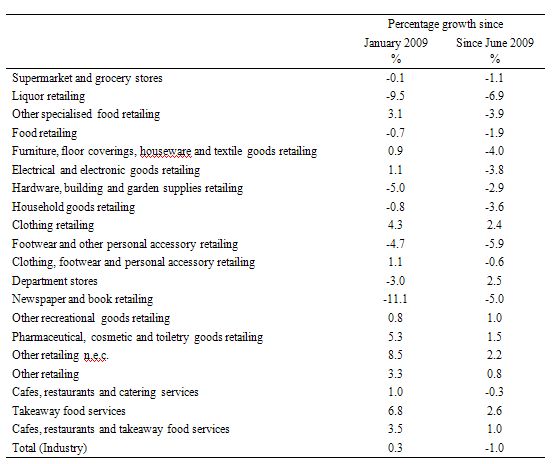
It is fairly obvious that the early and significant fiscal intervention by the Australian government has prevented retal sales from collapsing as they did in the 1991 recession. So it is worth analysing which sub-sectors have shown positive growth and vice-versa.

The following table shows the retail growth performance for Australia by sub-sector. I computed the percentage growth since January 2009 (basically the first month after the first stimulus payments started flowing into the data) and also the monthly percentage change since June 2009.

If you examine this breakdown you might come up with the following hypotheses:

H1: Australian are drinking less alcohol and sobering up after decades of
alcohol abuse.

H2: Australians have decided that they are
obese and have decided to eat less.

H3: Australians have given up on their Bunning’s binge realising that the stuff there is
mostly junk.

H4: Australians have stopped buying shoes because they have
have too many anyway. I have witnessed this personally!

H5: Australians have given up reading News Limited newspapers because they got sick of the economic commentary! (no link required).

Further we can conjecture the alternatives:

AH1: Australians are going to specialised food outlets to get organic vegetarian-based food as part of a lifestyle change.

AH2: Australians are buying more vitamins and deodorants because they are exercising more (alternative to H1 and H2 and H3).

AH3: Australians are buying more recreational goods beause they are exercising more (alternative to H1 and H2 and H3).

Conclusion
: fiscal policy is good!

Here's Bill's table:

Read more >>