Monday, July 24, 2017

F6 Extension tolls revealed: $100 per week

The proposed F6 Extension toll road from Sydney to Wollongong would charge about $10 for each one-way journey, according to a leaked planning document seen by Fairfax Media and the ABC.

The return toll of around $20 would amount to $100 per week for people who commuted from Wollongong to Sydney five days a week.

The Cabinet in Confidence document says the tollway between St Peters and Waterfall would open in stages during 2024 and 2025 and would be tolled for 35 years during which the government or a private owner would reclaim the $14.5 billion it cost to build and the $3.5 billion it would cost to operate.

The toll would rise rapidly during that time, doubling from $10 to more than $20 over the first 20 years in line with a formula that lifts the toll by at least 4 per cent per year instead of the inflation rate of around 2.5 per cent. After 20 years the toll would rise with inflation.

The toll would be capped at around $8 in 2016 dollars, which would become $10 in 2024 dollars.

It would be made up of a toll of about $3.50 from St Peters to the corner of President Avenue and Kingsway road Miranda, about $3.75 from President Avenue to Taren Point, and $3.75 from Taren Point to Loftus. The section from Loftus to Waterfall would be untolled. Although the tolls would amount to $11, the total would be capped at slightly more than $8 in 2016 dollars ($10 in 2024 dollars) matching the $8 proposed for Westconnex and the $8 proposed for the Western Harbour Tunnel and Beaches Link.

It's also about the same as the present cost of a peak adult one-way train trip between Central and Wollongong; $8.50.

The combination means a tolled trip from Sydney's Northern Beaches to the South Coast would cost around $16 each way ($32 return) in 2016 dollars, and around around $20 each way ($40 return) by the time the F6 Extension opened.

Heavy vehicles would be charged three times as much as cars and light commercial vehicles.

Asked about the leaked financial appraisal report a spokesman for Roads and Maritime Services said the F6 Extension was "in the early stages of planning with geotechnical investigations to help inform the future design, route and potential costs".

No final decision about the design or funding had been made. The community would be kept informed as the project progressed, the spokesman said.

Other leaked documents seen by Fairfax Media indicate that the proposed motorway can only achieve the promised reductions in travel time if it goes through the Royal National Park or uses land obtained by acquiring and bulldozing 460 homes and 40 commercial properties between Loftus and Waterfall.

A Roads and Maritime engagement and communication plan seen by Fairfax Media says messaging on the national park will need "careful management".

A draft Q&A for fielding questions from the media says to reply that it is "too early to speculate" when asked about the potential cost or whether the F6 Extension will be tolled.

The leak comes 22 years to the month since the previous F6 toll was scrapped in 1995. It was $1, having climbed from 40¢ when the Waterfall tollgate was opened in 1975.

In The Age and Sydney Morning Herald
Read more >>

Saturday, July 22, 2017

Why pop songs move us. It's not about us

What was it that drove 600 generally sane men, women and children to don red dresses to swoop, leap and sway to the biggest Kate Bush hit of all time at Melbourne's Edinburgh Gardens last Saturday?

The Most Wuthering Heights Day Ever was a fundraiser to help organisations dealing with domestic violence, as were satellite Most Wuthering Heights Days in Canberra, Adelaide, Brisbane, Sydney, Newcastle and Wollongong.

But the devotees weren't doing it primarily to fight domestic violence, and they weren't doing it only because they liked Kate Bush. They were doing it because of the song: because of what four minutes 26 seconds of Wuthering Heights means to them.

In his just-published book, The Memory of Music, the ABC's Andrew Ford says that while a Beethoven symphony invites us to enter its world, a pop song like Wuthering Heights enters ours; it colonises us, imprints itself on us.

"It is small wonder, then, that we associate pop songs with the time and place in which we most vividly encountered them, the girlfriend we had at the time, the summer holiday we were on, the college we were at," he says.

In most pop songs the repetition begins almost instantly, within seconds, and the fade, beginning mere minutes later, prolongs the sense of endless repetition, sometimes to infinity. Ford says the repetition encourages us "to believe the song will never end, that we still have that girlfriend, that we're still on that holiday''.

Songs are like elevators between floors of our lives. They transport us to where we were when we first heard them: the faces, the places, even the smells.

They are precious, but not necessarily because they are good. When I play songs I find important to my daughter she sometimes dismisses them. Other times she is entranced. I want to believe that those songs take hold of me because they are good. Yet I've got to confront the uncomfortable reality that I first heard most of them between the ages of 12 and 22. It'll probably be the same for my daughter. It's unlikely that the best music of all time happened to happen when I was in my teens and early 20s. It's more likely that those songs are special to me because of exposure; because they were forced on me.

In Hit Makers, released in January, and in Climbing the Charts, released in 2015, authors Derek Thompson and Gabriel Rossman lay bare the brutal way in which it happens.

Hit songs don't "go viral", spreading by infecting one listener after another as is commonly believed, even these days in the age of the internet. They are spread by broadcasting, as are tweets (in this case by uber-tweeters such as Oprah Winfrey).

"It's not so much a million one-to-one shares, as a handful to one to one-million shares," Thompson says.

Rossman has graphed the airplay of hits such as Rihanna's Umbrella. Instead of growing via infection like a virus, it began high and stayed high.

"To explain how so many radio stations came to play Umbrella, we can't resort to arguments about contagion or cascades," he says. "Rather, we must look to something apart from peer influence to explain why so many stations started playing the song so quickly without waiting to see if their peers would play it first."

By the 1980s CBS had been paying $10 million a year to get songs played. As an experiment in 1979 it decided to pay nothing in Los Angeles for Another Brick in the Wall. After all, it was already a hit elsewhere and the band was on tour. The top four stations refused to play it, sales went nowhere, and Pink Floyd's management relented and ordered CBS to hand over the money.

We share our love of special songs with others who grew up loving them, but not necessarily because they are objectively special. Mostly it's because they've been made special.

In The Age and Sydney Morning Herald
Read more >>

Thursday, July 20, 2017

Flawed by design: why superannuation fails women

Labor has a blind spot with women. In 1983 the newly elected Hawke government ratified the United Nations Convention on the Elimination of Discrimination Against Women as it had to, but entered two reservations. It wouldn't ratify the bit about employing women in combat roles, and it wouldn't ratify the bit about guaranteeing women paid parental leave.

That's right. Australia put itself in the unlikely company of Swaziland, Lesotho, Papua New Guinea and the United States as being the only countries of any size not to ensure that women who had children got paid while on leave.

Labor left it to the unions to pursue, which they did with greater and lesser degrees of vigour, occasionally going soft in their demands for paid maternity leave in return for other gains. It was an approach to delivering an essential provision that wouldn't have been tolerated for sick leave or annual leave.

A decade later, Hawke's successor, Paul Keating, introduced compulsory superannuation. As it grew, the pension was to become a mere back-up. Income in retirement was to be driven by lifetime earnings. If he had thought for a second about what that would mean, he showed no sign of it.

One in every two Australian women works part-time, compared to only one in every five men. And still more are employed away from the formal workforce where they don't get superannuation. On average those who are employed full-time get 20 per cent less than men. All up, it means women get 33 per cent less than men while in the workforce, and a lot less overall because they are often out of the workforce having children, caring for children or caring for relatives.

Super works well for high earners (who are mainly men) and the associated tax breaks make it work better for them still.

But low-earners and non-earners (who are overwhelmingly women) get next to nothing.

The Per Capita study Not So Super released on Thursday finds that women's balances on retirement are typically 47 per cent lower than men's. Seven out of 10 women have less than $150,000, compared to only four out of 10 of men. As the "independent progressive think tank" delicately puts it: "Superannuation was designed around a model of employment that is rapidly disappearing."

It was designed by men whose views were little affected by the changes going on around them. One was that menfolk would look after women. The women who had men wouldn't need that much super, because their men would hand over theirs. If the man died, they would inherit his super, and if he left them, they could go to the Family Court and demand their share.

A man was a financial plan, and the better-off the better. In the words of advice offered by a friend's grandma, "It is just as easy to love a rich man as a poor man."

But in the complicated, imperfect world in which we live, it's not that straightforward.

"Now at age 50 I have the grand total of almost $27,000 in my super," wrote one of the respondents to the Per Capita survey. "There is no possible way that in the working time I have left I am going to be able to provide funding for my retirement, and due to raising two children on a single income the possibility of owning a home was not an option either as we did not own when we separated."

"There are many like me who, after a mid-life divorce, accepted extra in the equity of their home so that the children were not disturbed rather than a share of his super," wrote another. "My husband had a for-life government pension which, after 20 years of support, I could not make a claim on. I maintained the home and full-time care of our child while he went offshore."

The Coalition wants to make it easier for women to top up their super, believing that will help. But it's hard for most women to do that, precisely for the reason that it's hard to accumulate employer contributions. They don't earn enough. In opposition Tony Abbott had a better idea than either the Coalition in government or Labor in government or opposition. It was to give women properly-funded paid parental leave and pay their super contributions while they are on it.

He was ridiculed. There was something about super he didn't get. It was that super was designed to be unfair. If it was designed to be fair it would take from everyone according to their ability to pay and give to everyone according to their need. Instead it takes from everyone (via their employer) whether they can afford it or not and hands out the most to the people who will need it the least.

In preparing their report Per Capita toyed with the idea of suggesting the system be scrapped and replaced with something that paid out according to need. Then it thought about the lobbyists who would be arrayed against it. There's $2.3 trillion in super, more than Australia's annual GDP, much of it sticking to the fingers of the finance industry. It concluded that it was too late.

In The Age and Sydney Morning Herald
Read more >>

'I will be stuffed': How super sells women short

Australia's superannuation system is failing in its primary goal of providing universal benefits and is systematically biased against women, a major study has found.

Twenty-five years after its introduction, women are on track to retire on roughly half the superannuation balance of men, with the typical woman's balance on retirement just $80,000, enough to live on for just three years, even on the most basic of living standards.

Conducted by David Hetherington from progressive think tank Per Capita and Warwick Smith for the Australian Services Union, the study polled 4000 union members and used data from the Household, Income and Labour Dynamics survey to track how superannuation balances were changing over time.

"I will be stuffed," said one. "I expect to be poor, I may become functionally homeless," said another.

"Women continue to be financially penalised across our lifetime because of our reproductive capacity, our lower wages and because of deadbeat dads who refuse to pay their share of the financial burden of raising their children (not all dads are like this but, by God, there's a lot of them)," said another respondent.

At age 25, women have roughly similar superannuation balances to men. By the prime child-rearing ages of 35 to 44 their balances are 30 per cent lower, and by ages 45 to 64 they are 45 per cent lower.

The report says superannuation is predicated on the notion that every worker is an employee. But the rise of non-standard work means almost a quarter of female workers aren't in a traditional permanent jobs and are instead working as casuals, contractors, subcontractors, for themselves or on zero-hours contracts.

One in every two employed women works part-time compared to only one in every five men. On average, women employed full-time earn 20 per cent less than men.

Because superannuation builds up with wages and because women spend more time out of the paid workforce than men they accumulate much less.

Noelene Mayne is one of them. At nearly 65 she is due to retire next March but like many women her age isn't confident she will able to do so comfortably.

"Hopefully I will be able to retire then but I don't know if circumstances will allow it," she said.

Ms Mayne, who works in a nursing home, only received super for the last 15 years of her working life.

She estimates that her super amounts to $50,000.

"I stayed home and raised four kids as a single mother. So financially I'm not probably set up but financially I don't worry about those sort of things until it happens," she said.

Mr Hetherington said the model of working men supporting homemaker women was fast disappearing.

"In that model household income was provided by one breadwinner, usually a man, via a job that was full-time and dependable," he said. "Implicitly, the benefits of superannuation would largely flow to women through their male partners."

"What has happened since is that many more women have entered the workforce to earn and save independently, but the nature of work available to them has been more intermittent and lower paid than men's. This, combined with the fact that women still do the overwhelming majority of unpaid housework, caring and parenting, means that the benefits of super, which move in direct proportion to base pay, have not flowed to female recipients as hoped."

The researchers recommend that each person's super be assessed against an "accumulation pathway" that would model the superannuation balance at each age needed to afford a basic retirement. The government would make top-up payments, of 2.5 per cent of income, to people falling more than 5 per cent below the pathway.

In The Age and Sydney Morning Herald
Read more >>

Tuesday, July 18, 2017

Schools, parks, homes in frame as smokestack sites revealed

The Wenona School in North Sydney, the Anzac Park Primary School in Cammeray and the Seaforth Public School are each within 200 metres of the sites chosen for smokestacks to release exhaust fumes from tunnels for the proposed Western Harbour Tunnel and Beaches Link.

The proposed locations, in a cabinet in confidence document seen by Fairfax Media and the ABC, are on residential streets, parkland and the existing Warringah Freeway and Wakehurst Parkway.

The proposed toll road would tunnel from WestConnex at Rozelle to the Warringah Freeway at North Sydney, then tunnel under Middle Harbour to join the Wakehurst Parkway at Allambie Heights.

It is expected to deliver time savings of up to 40 minutes between Brookvale and the city, 45 minutes between Dee Why to the airport and 35 minutes between Seaforth and North Sydney.

The ventilation shafts, each between 20 and 35 metres high, would release fumes from the thousands of trucks and cars expected to travel underground. Each would be accompanied by ventilation plants of between 1500 and 2500 square metres.

The document identifies the key issues with the potential to hold up approval as: potential opposition to the compulsory acquisition of homes from "residents, council and elected representatives", community and/or environmental group opposition to the dredging, haulage and disposal of spoil "particularly if contamination is present", and potential community and council opposition to use of crown land including St Leonards Park, Yurulbin Park, Anzac Park and The Spit Reserve.

Each mapped location is marked with a 150 metre buffer for the "downwash" of pollutants, and a wider 500 metre "sensitivity buffer".

Homes, schools, childcare centres and hospitals identified as "sensitive receptors" are also marked. No location is identified for the Rozelle exhaust stack.

smoke stack

The proposed smokestack sites are:

  • Ridge Street, North Sydney, near Wenona School and St Leonards Park
  • Falcon Street, St Leonards, near Warringah Freeway
  • Cammeray Golf Club, near Anzac Park Public School
  • Artarmon Reserve, near Gore Hill
  • Dudley Street, Balgowlah, near Seaforth Public School
  • Wakehurst Parkway, near Judith Street, Seaforth

"It should be noted that where constraints are related to the close proximity to existing residential receptors, a major risk to the project will be the perceived air quality impacts from ventilation stack outlets, despite air quality outcomes potentially being achieved," the cabinet in confidence document says.

"This perceived impact has been experienced on a number of major motorway projects involving tunnels, including NorthConnex and WestConnex more recently."

It suggests the government consider the relocation of some of the proposed stacks "to adjacent park or bushland".

Dispersal near Wenona School is hindered by tall buildings. Background pollution means the stack may cause "cumulative air quality impacts".

A table in the document points to unsafe levels of the contaminants PM2.5 and PM10 at several of the sites. The microscopic particles have been declared carcinogens by the World Health Organisation.

The level of detail in the document indicates that, as with the proposed F6 Extension toll road in Sydney's south, the "base case" for the project is well advanced. Fairfax Media understands a rail alternative has not been considered.

It raises the prospect of three multi-billion dollar toll roads – WestConnex, the F6 Extension and Western Harbour Tunnel and Beaches Link – undergoing construction at various stages and at about the same time.

Fairfax Media has already published details of the six locations chosen for the F6 Extension smokestacks, one of which is next to Port Hacking High School.

A spokesman for Roads Minister Melinda Pavey said the final alignment of the tunnels had not been determined. Therefore the location of exhaust outlets was yet to be determined.

"Geotechnical work is ongoing to determine the preferred route for the tunnel," the spokesman said. "The community has been and will continue to be informed at all stages."

The cabinet in confidence document recommends declaring the Western Harbour Tunnel and Beaches Link "critical state significant infrastructure" in order to bypass objections.

NorthConnex and WestConnex were declared critical state significant infrastructure.

The declaration would prevent appeals to the Land and Environment Court without the agreement of the planning minister and prevent the making of certain orders under the National Parks and Wildlife Act, the Threatened Species Conservation Act, Fisheries Management Act, Protection of the Environment Operations Act and the Local Government Act.

"Based on a preliminary consideration of the project, it is likely that a reasonable argument could be formulated to support the necessary view to be formed by the minister for planning that the project is essential to the State for economic, social or environmental reasons as a preceding step to declaration of the project as Critical State Significant Infrastructure," the report says.

In The Age and Sydney Morning Herald
Read more >>

Revealed: The $14 billion Beaches Link price tag

The proposed 14-kilometre tunnel tollway between Rozelle and Allambie Heights will cost $14 billion to build, almost as much as the 33-kilometre WestConnex project.

The enormous price tag, in a costing for cabinet seen by Fairfax Media, excludes an extra $8 billion that would be spent on operation and maintenance of the tunnel over the first 35 years.

The Western Harbour Tunnel and Beaches Link tollway is expected to bypass up to 19 sets of traffic lights and cut the travel time between Brookvale and the CBD by 40 minutes. It will require the erection of six exhaust ventilation stacks for which sites have been identified, several within metres of schools.

The $14 billion price tag includes about $340 million for property acquisitions, $5 billion for the direct cost of construction, $2.3 billion for indirect costs and $5 billion for contingencies and cost escalation.

As many as 20 houses would need to be acquired and demolished to build the tunnel, as well as 30 multi-occupancy buildings and 20 commercial buildings, most of them near exhaust stacks.

The Wenona School in North Sydney, the Anzac Park Primary School in Cammeray and the Seaforth Public School are each within 200 metres of the sites chosen for smokestacks, as are schools not identified when the Herald identified the proposed locations on Monday.

The Crows Nest TAFE is within 500 metres of the proposed Ridge Street exhaust stack in North Sydney and in 2019 will become the senior campus of Cammeraygal High. Other schools within 500 metres of proposed smokestacks include Marist College North Shore, the North Sydney Boys High School, the Cameragal Montessori School, the KU Cammeray Pre-School, the Balgowlah Boys Campus of the Northern Beaches Secondary College and the KU Bligh Park Pre-School.

Each exhaust stack, up to 35 metres high would be accompanied by a ventilation plant of between 1500 and 2500 square metres.

Premier Gladys Berejiklian said on Monday that locations for exhaust stacks "had not been finalised at all" as geotechnical and design work was still under way.

"It is way too early to make any predictions about where things are going to be," she said.

The costing document seen by Fairfax Media is titled "Final Business Case". A separate cabinet-in-confidence report includes three slightly different routes for the tollway, but only one set of locations for exhaust stacks.

Ms Berejiklian said her government had been "transparent at every level on every project because it's always in our interests to communicate as soon as we know something".

Opposition Leader Luke Foley said the government was treating the people of NSW with contempt. "Have they learnt nothing from WestConnex? Yet again, here is advanced planning for smokestacks, for a big mega-tunnel that will impact on hundreds of thousands of people and yet there's no consultation with the community."

The premier announced the Beaches Link before the March North Shore by-election. In March the government committed $77 million for geotechnical work along the route and in June a further $17.6 million for planning the route.

The previously undisclosed total of $14 billion compares with $16.8 billion for WestConnex (up from $10 billion when it was first announced) and $14.5 billion plus operational and maintenance costs for the proposed F6 Extension to the Illawarra region.

It raises questions about the capacity of the state budget to sustain all three road projects.

Asked whether $14 billion was the working price for building the Western Harbour Tunnel and Beaches Link a spokesman for roads minister Melinda Pavey said it was too early to determine a final price.

The Western Harbour Tunnel and Beaches Link was going through a  process of review and market testing to provide the greatest benefit to the taxpayer.

Roads and public transport projects were not mutually exclusive.

The 36-kilometre Rouse Hill to Chatswood rail upgrade is much cheaper than the Beaches Link at $8 billion, around $230 million per kilometre.

An internal Transport for NSW memo released under the Government Information (Public Access) Act refers to a cabinet directive not to consider public transport alternatives when assessing tollway projects. The memo says the Western Harbour Tunnel and Beaches Link was not benchmarked against a public transport alternative.

In The Age and Sydney Morning Herald
Read more >>

Revealed. $8 tolls each way in Sydney's north

Motorists will pay tolls in both directions on the Sydney Harbour Bridge and the Harbour Tunnel under proposals to help cover the $14 billion cost of a 14-kilometre tunnel linking the northern beaches to the city's inner west.

The plans for the new tolls, detailed in cabinet-in-confidence documents, also reveal that motorists will be slugged about $8 (in today's dollars) for a one-way journey by car on the entire length of the proposed Western Harbour Tunnel and Beaches Link.

The analysis assumes tolls will be in place for a 35-year period on the Western Harbour Tunnel from 2023, and the Beaches Link a year later. Charges for trucks will be three times greater than those for cars or light commercial vehicles.

Under the proposals contained in a "Final Business Case", $3 tolls for cars will be placed on northbound trips on the Sydney Harbour Bridge and the Harbour Tunnel from 2022 to make them the same as those on the proposed Western Harbour Tunnel.

The documents show the new tolls on the Harbour Bridge and Harbour Tunnel will help cross-subsidise the third harbour crossing and the Beaches Link, whose tolls will be insufficient to cover the full cost of building, maintaining and operating them.

Cabinet documents seen by Fairfax Media and the ABC have put the cost of the new tunnels at $14 billion, which compares with $16.8 billion for the 33km WestConnex motorway.

Transport authorities believe tolls are necessary to avoid free northbound trips on the Harbour Bridge and Harbour Tunnel undermining the case for a third crossing. A free alternative would discourage motorists from using a tolled Western Harbour Tunnel.

It has also been proposed that tolls will be placed on southbound journeys of the Eastern Distributor. They would be set at half the cost of the existing charge for a northbound journey of $7.02 – or about $3.50 each way.

The $8 toll for the entire length of the proposed roadway is made up of $3 for the new harbour tunnel between the WestConnex interchange at Rozelle and North Sydney, where it will join the Warringah Freeway, and $5 for the Beaches Link to Balgowlah in Sydney's north.

The tolls planned for the new tunnels will be fixed, unlike the distance-based tolls on WestConnex. While tolls on the Western Harbour Tunnel will rise in line with the consumer price index, those on the Beaches Link will increase every year for the first two decades by 4 per cent or at the rate of inflation, whichever is greater.

In an era of low wage growth, the likelihood of tolls rising at a faster rate than inflation means a greater proportion of Sydney motorists' income will go towards paying charges for using motorways.

The NSW government has been opposed to limiting toll increases on Sydney's growing labyrinth of motorways to the rate of inflation because it believes it could push up the initial price of new roads and make it more difficult to attract private investment.

Charges for cars on some of Sydney's largest motorways such as the M2 are, due to contracts signed with private tolling companies, are growing at twice the present annual inflation rate.

Asked about the proposed new tolls, a spokesman for Roads Minister Melinda Pavey said there was "always speculation around major projects".

"As the Premier said when she announced the project, we have commenced a market sounding process to investigate funding options and delivery approaches. That work is not yet complete," the spokesman said.

"We expect to have a detailed plan by the middle of next year."

Surveys for the government have shown a majority of people to be in favour of the new harbour tunnel and Beaches Link. However, they show northern beaches residents are more sensitive to paying to drive on motorways than those from other parts of Sydney because they have had less exposure to toll roads.

Residents in western Sydney are the biggest users of the city's toll roads.

The Berejiklian government faces growing pressure to fully consult communities about its plans for the Western Harbour Tunnel and the Beaches Link, which will require six exhaust ventilation stacks.

Some of the proposed locations of the ventilation towers, each between 20 and 35 metres high, are close to schools.

The cabinet documents show the government plan was for "stakeholder engagement" from late 2016 to the end of this year to focus on "coordinating activities to support the successful announcement" of the two tunnel projects.

And, in countering opposition from residents and councils. the proposed response was to emphasise that the government was announcing a "fresh approach to community engagement and property acquisition".

Likewise, to allay concerns that property prices will be hit, an "awareness campaign" would be rolled out to show the "bounce in local property values once a major transport infrastructure project becomes operational".

In The Age and Sydney Morning Herald
Read more >>

Thursday, July 13, 2017

Benefits from a Wollongong-to-Sydney rail upgrade would exceed costs, Cabinet told

Work needed for an upgrade to the Wollongong to Sydney rail link that would deliver passengers to Central in 66 minutes produces benefits at up to twice the cost according to a previously unreleased Cabinet in Confidence report.

The proposed schedule, also seen by Fairfax Media, has express passenger trains taking 20 minutes to get from Wollongong to Helensburgh, 35 minutes to get from from Wollongong to Hurstville, 54 minutes to Wolli Creek, and 66 minutes to Central.

The main expenses would be a $2.9 billion tunnel from Thirroul to near Waterfall on Sydney's southern tip and completion of the long-stalled freight link from Dombarton near Dapto to the commuter line.

Costed at between $700 million and $800 million in the Cabinet in Confidence document seen by Fairfax Media, the freight link has a benefit-cost ratio of between 1.5 and 2.4 depending on the scenario chosen.

A benefit-cost ratio above 1 means the project is worth doing. A benefit-cost ratio above 2 is exceptional.

Among the benefits quantified are time savings, transport cost savings, avoided environmental externalities, avoided crash costs, road congestion, and avoided road damage.

The biggest benefit, transport cost savings, is estimated at $2.4 billion over 50 years, or $560 million in present day dollars. Time savings are worth around $1 billion, or $200 million in today's dollars.

To convert future benefits to present-day dollars the 2013 study used a discount rate of 4.4 per cent "in accordance with the federal department of infrastructure and transport's nation building appraisal guidelines".

A more recent Transport for NSW assessment, evaluated this year by Infrastructure Australia, used a higher discount rate of 7 per cent, even though interest rates had fallen during the intervening years. It awarded the project a benefit-cost ratio of only 0.9 meaning the project "would not generate sufficient benefits to justify its costs".

Projects with high upfront costs and benefits years out into the future look better when low discount rates are used and worse when high discount rates are used.

Answering a question in parliament, on behalf of roads minister Melinda Pavey in June, primary industries minister Niall Blair quoted only the Infrastructure Australia conclusion and not the conclusion of the minister's department.

On the same day primary industries minister Don Harwin, replying on behalf of transport minister Andrew Constance, misled parliament when answering a question about the rail tunnel under Thirroul saying it had not been the subject of a strategic assessment or strategic paper.

Fairfax Media has seen the assessment, contained in a Cabinet in Confidence document entitled Rail Corridor Strategy: Sydney to Wollongong produced in 2014, when current premier Gladys Berejiklian was transport minister.

On Wednesday a spokesman for Ms Pavey distanced the minister from the Maldon to Dombarton benefit-cost study conducted when Ms Berejiklian was transport minister, saying the 2013 study "relied upon assumptions about growth in the iron ore market that did not eventuate".

The less favourable 2017 Infrastructure Australia assessment was "in line with an earlier report from 2011 by the then-Labor government which found the project had a benefit cost ratio of 0.56."

Asked whether Ms Pavey would release the study that found a much higher benefit-cost ratio, the spokesman did not reply.

Three-quarters of the 35 kilometre link was completed by 1988 when the NSW government suspended the project in the midst of an economic downturn and lower than expected coal traffic. The line stops in mid-air on either side of the Nepean River.

The unpublished benefit cost study finds costs at around $780 million in present-day dollar terms more than offset by benefits at $1100 million. The total cost of upgrading the Sydney to Wollongong commuter line would be around $5 billion.

An F6 Extension motorway, under active consideration by the government as an alternative to the rail project, has a price tag of around $18 billion.


In The Age and Sydney Morning Herald
Read more >>

Gas, not wind. Why power prices are going berserk

Prepare for a shock. On July 1 electricity prices jumped 15 to 20 per cent in NSW, 16 to 20 per cent in South Australia, 19 per cent in the Australian Capital Territory and 11 per cent in Western Australia.

All this, three years to the day since the Coalition axed the carbon tax.

Victoria gets six months' grace, with increases of about the same size due in January.

And those are just the retail prices. Wholesale prices and those charged to businesses that buy directly are up an extraordinary 60 to 70 per cent. It's renewables that are doing it, along with the closure of Victoria's giant Hazelwood coal-fired power generator, according to Tony Abbott.

The truth is simpler, and speaks volumes about the appalling way we've handled energy planning.

South Australia is the poster-child for renewables. It has far more wind farms than any other state, more solar cells and has closed all of its coal-fired power stations. It's also the poster-child for power prices. They are the highest in the nation and among the highest in the world. But, to be fair to renewables, they've always been the highest, even back in the days when most of South Australia's power was overwhelmingly sourced from appallingly low-quality coal that was useless for anything else.

In his latest emissions audit prepared for the Australia Institute, the Australian National University's Hugh Saddler graphs the South Australian wholesale price since 1999 alongside the share of its electricity output produced by wind. There's no relationship. As the share of wind has climbed to 45 per cent, the wholesale electricity price has moved both up and down in real terms, and even now is slightly below the peak reached in the days when wind powered just 5 per cent of the state.

His second graph shows an ultra-clear relationship. The electricity price has moved up and down in tandem with the gas price, almost exactly.

"The correlation is striking," Saddler says. "It confirms that higher wholesale electricity prices, and hence higher retail prices, are almost entirely caused by higher gas prices."

"A similar, though less stark effect is seen in the other mainland eastern states – this is not a malfunction of the National Electricity Market, but precisely how it was expected to operate."

Gas is the swing fuel. Although it doesn't supply a particularly large portion of Australia's electricity, it usually provides the last bit when nothing else is available, and at those moments it determines the price.

Things were set up that way because back in the 1980s and 1990s electricity suppliers around the world realised they would need to transition to low-emission fuels. They wouldn't go straight away to zero emissions because that would be expensive and low emissions weren't yet required by law. Instead they met the future halfway, knowing that if instead of building new coal-fired power stations they built new gas-fired ones, they would be better able to deal with the carbon price or carbon rules when they came.

It helped that gas was ridiculously cheap.

But then at about the same time they moved towards a carbon tax, the Rudd and Gillard governments approved massive gas export terminals in Queensland with the ability to suck up gas from as far afield as Bass Strait and ship it to Japan.

For a while, gas prices actually fell as production ramped up in anticipation of the export deals, but couldn't leave the country. Then, when the terminals were complete and exports began, prices went berserk. Whereas once it had cost gas-fired power stations very little to come in as the swing supplier, suddenly it cost them and their customers big-time.

And there are few other swing suppliers. Coal-fired plants usually can't do it. They are either on or off, and they take a long time to turn on. Wind can't do it. The blades are either turning or they're not. Same with the sun. Only hydro-electricity is as good as gas at rapidly responding to peaks (better, actually) but when the water that turns the turbines is used up, it can't turn them again until it rains.

Elon Musk and the South Australian government have begun to find a way out. The 100-megawatt battery farm the Tesla chief has promised South Australia (the biggest in the world) will indeed be tiny compared to South Australia's needs, as Josh Frydenberg, Barnaby Joyce and all manner of Coalition MPs have been quick to point out. But, as the central role of gas has made clear, you don't need to produce the bulk of the power in order to determine the price for power. What's needed is to be able to provide the last bit, very quickly, when all alternatives have been exhausted. Far from creating the problem of high prices, South Australia may be able to help solve it.

And it'll do something else. Its lights went out on September 28 when its gas and wind generators shut down during a storm. Most of them stayed off even after the storm was over because, just like gas cooktops, they can't be started without electricity. Musk and South Australia are about to gift us a battery.

In The Age and Sydney Morning Herald
Read more >>

Sunday, July 09, 2017

Gaming. Why young men are walking away from work?

A team of researchers in the United States might have just cracked one of the biggest mysteries in economics. It's why young men are vanishing, in Australia as well as overseas.

A decade or so back we had a good idea of where they were. Of the Australian men aged 15 to 24 who weren't in school or higher education, an impressive 85 per cent were working.

That was back in May 2007. By May this year it had fallen to 78.6 per cent. That's one in every five young men not in education now not working, up from one in every seven a few years back. An extra 51,000 young men have "gone dark", slipped under the statistical radar.

And hardly any women. Young women not in education are about as likely to work as they used to be.

No-one's too sure what the young men are doing. Tragically, our Bureau of Statistics hasn't run a time-use survey since 2006. We don't know who supports them - is it girlfriends, is it parents? And we don't know why they are not working or if they'll start. Might they have suddenly found work hard to get? It's possible. These days there are fewer (traditionally male) manufacturing jobs and far more (traditionally female) healthcare and social services jobs. Might the minimum wage have priced them out of work? It's unlikely, because young men are also falling out of work in the United States.

etween 2000 and 2015, the hours worked by American men in their 20s slid 12 per cent. The slice of those not in education who'd been out of work for at least a year jumped from 8 to 15 per cent.

It isn't showing up in the unemployment rate. America's unemployment rate is very low, lower than Australia's. That's because most of these men aren't looking for work. They're doing something else. And, in America at least, we've a good idea of what it is.

In the US, they still conduct a time-use survey. Every year they ask thousands of Americans where they were at each moment of the day, who they were with, and what they were doing.

Young men cut back on work by an average of 2.5 hours per week between 2004 and 2015. All of it became extra leisure time, an astonishing 1.9 hours of it extra "recreational computer time", and 1.4 hours of it "gaming" – using computers to play video games.

Before 2004 gaming was small time. Massive multiplayer online games hadn't been invented. There was no World of Warcraft, the graphics weren't lifelike. Gaming has swiftly become very, very attractive. But mainly to young men, not women. That couldn't be why they are deserting work, could it?

Mark Aguiar, Mark Bils, Kerwin Kofi and Charles Erik believe it is. Economists at Princeton University, the University of Rochester and the University of Chicago, they believe the increasing quality of video games explains half of the retreat from work of young men since 2004.

Their study, published on the 4th of July, is entitled Leisure Luxuries and the Labour Supply of Young Men.

Their statistical analysis suggests that gaming is like any other luxury. The greater your ability to buy it (in this case with time), the more of it you want. They find that television (even Netflix) isn't a luxury. When people get more time, they don't spend an ever greater proportion of it watching TV.

As gaming becomes better and better, it's rational for people to sacrifice more and more of other things to do more of it, especially if they can get by financially. They find an astonishing 67 per cent of non-employed men in their 20s live with their families, up from 46 per cent in 2000. And they don't mind it much, either. Men in their 20s are happier than they were in the year 2000. Older men, who aren't into gaming, are more miserable.

Read more >>

Friday, June 30, 2017

2017-18 Economic Survey. Flat shares, housing, income. The year of muddling through


The economy will be too weak to justify a rate rise in the year ahead as growth falls short of targets, the dollar sinks, housing investment and home prices stall and the sharemarket treads water.

The exclusive financial year forecasts from the BusinessDay Scope forecasting panel are predicated on continued strong growth in China, an improvement in the US, a further decline in the iron ore price, and a slight contraction in Australia's terms of trade.

Approaching its 40th year, the survey is made up of forecasts from 26 leading economists in the diverse fields of financial markets, academia, consultancy and industry. Over time its average predictions have proved to be more accurate than those of any of its individual members.

This year, for the first time, the panel has been asked to assign a probability to a conventionally defined recession. The average probability assigned to two consecutive quarters of negative economic growth during the two years ahead is 21 per cent. Panel members warn that the probability would increase dramatically if economic growth in China slowed or the housing market turned down sharply.

"When a housing market turns, it usually turns quickly," says Paul Dales of Capital Economics. "A much weaker housing market would lead to much weaker economic growth."


Home prices


After soaring an unexpected 11 per cent in the 12 months to May (probably less in the year to June when the figures are released on Monday) the CoreLogic measures of Sydney and Melbourne home prices are expected to go nowhere much in 2017-18, inching ahead by just 3.3 and 2.2 per cent.

Several panel members including Nicki Hutley of Urbis Consulting, Richard Robinson of BIS Oxford Economics, Stephen Koukoulas and Steve Keen expect house prices to sink. Stephen Anthony expects them to fall 10 per cent in Melbourne but to rise 5 per cent in Sydney.

Previously prescient forecasters including Renee Fry-McKibbin and Bill Mitchell expect further increases of 10 and 9 per cent.

After soaring 10 per cent in 2015-16 and 4.5 per cent in 2016-17, housing investment is expected to stall in 2017-18, climbing just 0.2 per cent. But the average forecast disguises a wide range. Hutley and Anthony expect slides of 4.9 and 10 per cent. Jakob Madsen and Fry-McKibbin expect an acceleration to growth of 7 per cent.

Business investment


The panel broadly agrees with the government's assessment that the worst is over. After tumbling 21 per cent in 2016-17, the panel expects mining investment to fall a further 12 per cent as predicted in the budget.

Non-mining investment is expected to grow by 3.3 per cent, rather than the forecast 4.5 per cent. Several of the panel are much more optimistic.

Margaret McKenzie of the ACTU expects growth of 10 per cent, Richard Yetsenga of the ANZ expects 7.4 per cent, and Alan Oster and Richard Robinson expect 6.5 per cent.

Economic growth


With little chance of enough extra investment to boost economic growth, and weaker than budgeted growth in household spending of 2.3 per cent, GDP is expected to grow by a below-trend 2.4 per cent rather than the budgeted 2.75 per cent. Only Paul Bloxham of HSBC expects particularly strong economic growth, of 3.4 per cent.

The more important measure of nominal GDP growth (income growth unadjusted for prices) is expected to slide from an outsized 6 per cent in 2016-17 to 3.7 per cent as the impact of higher minerals prices wears off.

Partly because nominal GDP is what drives budget revenue through company profits and bracket creep, the panel expect a worse than budgeted deficit, of $34.6 billion rather than $29 billion.

The best measure of overall living standards, real net disposable income per capita, is expected to grow just 1.8 per cent after growing by around 4 per cent in 2016-17.

Only Shane Oliver, Renee Fry-McKibbin, Besa Deda and Neville Norman are particularly optimistic about living standards, each predicting continued growth of around 4 per cent.

Several of the panel expect growth in living standards of close to zero (for which there are precedents – living standards went backwards in 2014-15).

Jakob Madsen expects growth of just 0.5 per cent, Michael Blythe expects 0.4 per cent, and Nicki Hutley expects zero, and Steve Keen a decline in living standards of 2 per cent.

The forecasts are predicated on economic growth in China near the Chinese target of 6.5 per cent and a pick-up in US growth to 2.1 per cent.

Wages and inflation


While broadly backing the government's forecast of an inflation rate close to 2 per cent, most of the panel can't see wage growth approaching the 2.5 per cent predicted in the budget.

Several of the panel expect it to slide further to 1.7 per cent (Margaret McKenzie) and 1.5 per cent and less (Steve Keen and Bill Mitchell) Only Julie Toth, Michael Blythe and Paul Bloxham expect the same sort of pick-up as the government. Bloxham expects 2.7 per cent.

Jobs


The unemployment rate, also closely watched by the Reserve Bank, will stay close to the present 5.7 per cent.

Only Michael Blythe and Paul Bloxham expect unemployment rates substantially lower, at 5.4 and 5.3 per cent.

More pessimistic than the government forecast of 5.75 per cent are Stephen Anthony and Stephen Koukoulas who expect 6.2 per cent, and Steve Keen who expects 7 per cent.

Rates


With little to celebrate about economic growth, the Reserve Bank is most unlikely to lift interest rates, in the view of the panel. Twenty-three of the 26 expect no change this year, and 16 expect no change by June 2018.

Of those that do expect a change by June, four expect increases, and four expect decreases. The most extreme forecasts are from Steve Keen (a cut in the cash rate from 1.5 per cent to 1 per cent) and Mardi Dungey and Neville Norman, who expect increases to 2 and 2.25 per cent.

The panel is expecting a lift in the 10-year bond rate from 2.5 to 2.8 per cent in line with better conditions overseas.

Markets


The Australian dollar is expected to fall from its present 77 US cents to around 72 US cents without the stimulus of rising commodity prices and the 200 is expected to climb just 1.8 per cent to 5833 absent further growth in minerals prices.

The most optimistic forecasts for the sharemarket are further growth of 8 per cent to near 6200 (Michael Blythe and David Bassanese). The most pessimistic is a slide of 12 per cent to 5500 (Steven Anthony and Steve Keen).

Only two of our panel expect the dollar to rise; Blythe (to 78 US cents) and Margaret McKenzie (to 80 US cents). Keen and Koukoulas expect a slide to 65 US cents.

Trade


The panel expects a further fall in the iron ore price from around $US65 a tonne to near $US58, an outcome that would leave the price about where it was before the extraordinary rise to $US89 in the last part of last year and the first part of this year.

Some expect a return to around $US80, among them Neville Norman, Margaret McKenzie and Jacob Madsen. The most pessimistic, Stephen Anthony, expects the iron ore price to fall to $US40.

The decline will unwind 2.8 points of the remarkable 16 per cent jump in Australia's terms of trade in the financial year just ended. The result will be a current account deficit of around $32 billion, the lowest since before the mining booms began in 2003.

In The Age and Sydney Morning Herald


One in five chance of a recession, says panel


Australia faces a "small but non-zero" chance of a recession in the next two years, according to the BusinessDay expert forecasting panel, with a sharp fall in property prices or a weakening in the Chinese economy most likely to bring it on.

"Without strong drivers and facing significant risks – headwinds from housing sector indebtedness, property price adjustments and a slowing China – and in the absence of strong leadership from Canberra – it is much more likely that growth will falter," Industry Super chief economist Stephen Anthony says.

Anthony assigns a 50 per cent probability to a conventionally defined recession within two years, the highest after expatriate Australian Steve Keen at Kingston University, in London, who puts the probability at 100 per cent.

Each of the 26 members of the Scope forecasting panel answered the question, including the chief economists from each of the big four banks.

The answers will allow them to be held accountable for their forecasts in two years' time in a way that spot forecasts of things such as the exact price of the dollar do not.

The Commonwealth Bank assigns a 20 per cent probability to a recession, Westpac and National Australia Bank a 15 per cent probability, and ANZ a 10 per cent probability.

The average across the panel is 21 per cent, a likelihood several members described as "low".

"Despite the downside risks, there are still a range of monetary and fiscal policies that could be rapidly deployed," says Nicki Hutley who picked a probability of 20 per cent. "That said, there are a number of 'grey ducks' that should never be discounted such as a China stumble, Trump impeachment, severe terror attack or climate-related shock."

A recession is conventionally defined as two consecutive quarters of negative economic growth, something Australia avoided during the global financial crisis and last experienced during 1991. Alan Oster, of National Australia Bank, believes disruptions to exports caused by bad weather could be creating a recession right now.

"Negative growth in GDP is looking possible for the second quarter, meaning that any delays in ramping up exports or any other unexpected shocks to the economy could more easily trigger a technical recession this year," he says, while pointing out that growth should rebound quickly.

"Further out, the economy will be losing significant growth drivers (mining exports hit full capacity, house prices flatten, housing construction cools etc) which again puts the economy at greater risk of recession," he says.

"Beyond that most estimates suggest slower productivity and potential growth in Australia going forward, making the economy even more vulnerable than it was previously."

When riding a slow-moving bicycle you are more likely to fall off.

Sally Auld, of JPMorgan, (who picked a 20 per cent probability) believes that much lower interest rates and a lower dollar can be deployed to enable Australia to ride out a storm.

Guay Lim, of the Melbourne Institute, believes it would be up to the government using tax and spending measures, because the Reserve Bank is unlikely to want to cut its cash rate further.

Bill Mitchell, of Newcastle University (who picked 40 per cent) distinguishes between a "technical" and a full-blown recession with colossal unemployment. He says if "push comes to shove" the Turnbull government will spend big, just as the Rudd government did, to avoid full-blown recession.

Su-Lin Ong, of RBC Capital Markets, believes there's plenty of room for a much lower dollar to do the trick. "It is only currently around the long run post-float average at $US0.75," she says. "The currency can bear the brunt of adjustment and trade much lower."

St George Bank's Besa Deda puts the probability at 10 per cent.

"We have already seen some tentative signs that non-mining investment has turned a corner, while the drag from mining investment has largely run its course," she says. "That, combined with improved profits and shrinking spare capacity, suggests to us that business investment should continue to improve. Consumer spending may be more of a challenge."

"If achieved, stronger real wage growth will certainly help, but record levels of household debt and expectations for a more subdued housing market could pose significant headwinds."

The panel will be asked the question each six months to build up a long-term profile of views about a recession.

In The Age and Sydney Morning Herald


Why 2016-17 was the year they all got wrong


No one expected the financial year just finished.

Just months in the coal price doubled. The iron ore price jumped almost 70 per cent.

Twelve of our panel had expected Australia's terms of trade to slide during 2016-17. Only five had expected them to rise, and only one predicted a substantial increase: Stephen Koukoulas, who predicted 5 per cent.

At year's end it looks as if our terms of trade climbed an exceptional 16.5 per cent – an extraordinary indication of just how unlikely 2016-17 was.

Everything that flowed from that remarkable change made most of our forecasters wrong about a good deal else.

Australia's current account deficit as good as vanished, sliding to a 40-year low of just 1.5 per cent of GDP. The panel had predicted double or quadruple that, with forecasts of 3.2 to 6 per cent.

The Australian dollar climbed to 77 US cents instead of sliding to 70¢ as predicted by the panel. The Commonwealth Bank's Michael Blythe got the outcome closest to right, predicting 75¢ along with economic modellers Janine Dixon and Renee Fry-McKibbin who predicted 74¢.

Powered by high minerals prices, the S&P/ASX 200 closed the financial year up 9 per cent. The panel had predicted 7 per cent.

The boost in national income pushed up nominal GDP 6 per cent, twice the 3 per cent predicted by the panel. Victoria's University's Janine Dixon came closest, picking 4.9 per cent.

The best measure of living standards, real net disposable income per capita, appears to have closed the year up 4 per cent, a big improvement on 2015-16 in which it actually fell and on 2014-15 in which it didn't move. The result – way in excess of the forecast range of minus 3 per cent to plus 1 per cent – is the biggest increase in living standards since the mining boom in 2011. Stephen Koukoulas had the highest forecast, an increase of 1 per cent, an indication of how much the panel was caught unawares.

Greater profits led to greater investment. Eight of our panel had expected non-mining business investment to fall. Instead it climbed 1.5 per cent. Housing investment jumped 4.5 per cent. Two of our panel had expected it to fall, including Shane Garrett of the Housing Industry Association who predicted a fall of 4 per cent.

The further jump in home prices completely surprised the panel. Three of our panel expected the CoreLogic index to fall. The central forecast was for an increase of just 3.6 in Sydney and 4.2 per cent in Melbourne. The latest figures, for May, point to increases of 11.1 per cent and 11.5 per cent. There will probably be some slippage in June making the most successful forecasts those of Fry-McKibbin and Neville Norman who picked 9 to 10 per cent.

But it wasn't all better than expected. Wage growth was much weaker, meaning most of the extra national income was captured as profits rather than trickling down. Instead of climbing by the predicted 2.3 per cent, wages are growing at an annual pace of just 1.9 per cent, the lowest in records dating back to the 1990s.

Overall economic growth (growth with the effects of higher resource prices excluded) looks like ending the financial year at just 1.75 per cent; the least since the early 1990s recession, meaning that were it not for the jump in resource prices, the economy would have been weak. The panel had predicted growth of 2.6 per cent.

Stephen Anthony and Bill Evans got wage growth exactly right, picking 1.9 per cent, and Bill Mitchell and Neville Norman came closest on overall economic growth, picking 2 per cent, which was the lowest of all the forecasts bar Steve Keen's, which was 1 per cent.

Naturally, no one takes home the trophy for forecaster of the year. Those who got Australia's appallingly low rate of economic growth right failed to see the resurgence in resource prices. Those who guessed at the resurgence (and Fry-McKibbin was closest) thought economic growth would be much stronger than it turned out to be.

In The Age and Sydney Morning Herald


Read more >>

Wednesday, June 21, 2017

The texts that could cost three government ministers their jobs

Rarely do we get to see how newspaper stories are made.

Nine days ago, across almost the entire width of its front page, The Australian published a headline that read: Exclusive: Judiciary "light on terrorism". 


They had been talking about a court case, the transcript of which we now know they hadn't read. All three were relying on no more than an ABC Online report, according to evidence given on their behalf by the Commonwealth Solicitor-General.

Each had sent a single text message to Simon Benson, national affairs editor of The Australian. One was sent at 12.36 pm on the Monday afternoon, one at 12.43 pm, and the last at 1.42 pm. They weren't sent in response to questions.

Hunt's text said: "Comments by senior members of the Victorian courts ­endorsing and embracing shorter sentences for terrorism offences are deeply concerning — deeply concerning." State courts should not be places for "ideological experiments".

Sukkar bemoaned "Labor's continued appointment of hard-left activist judges".


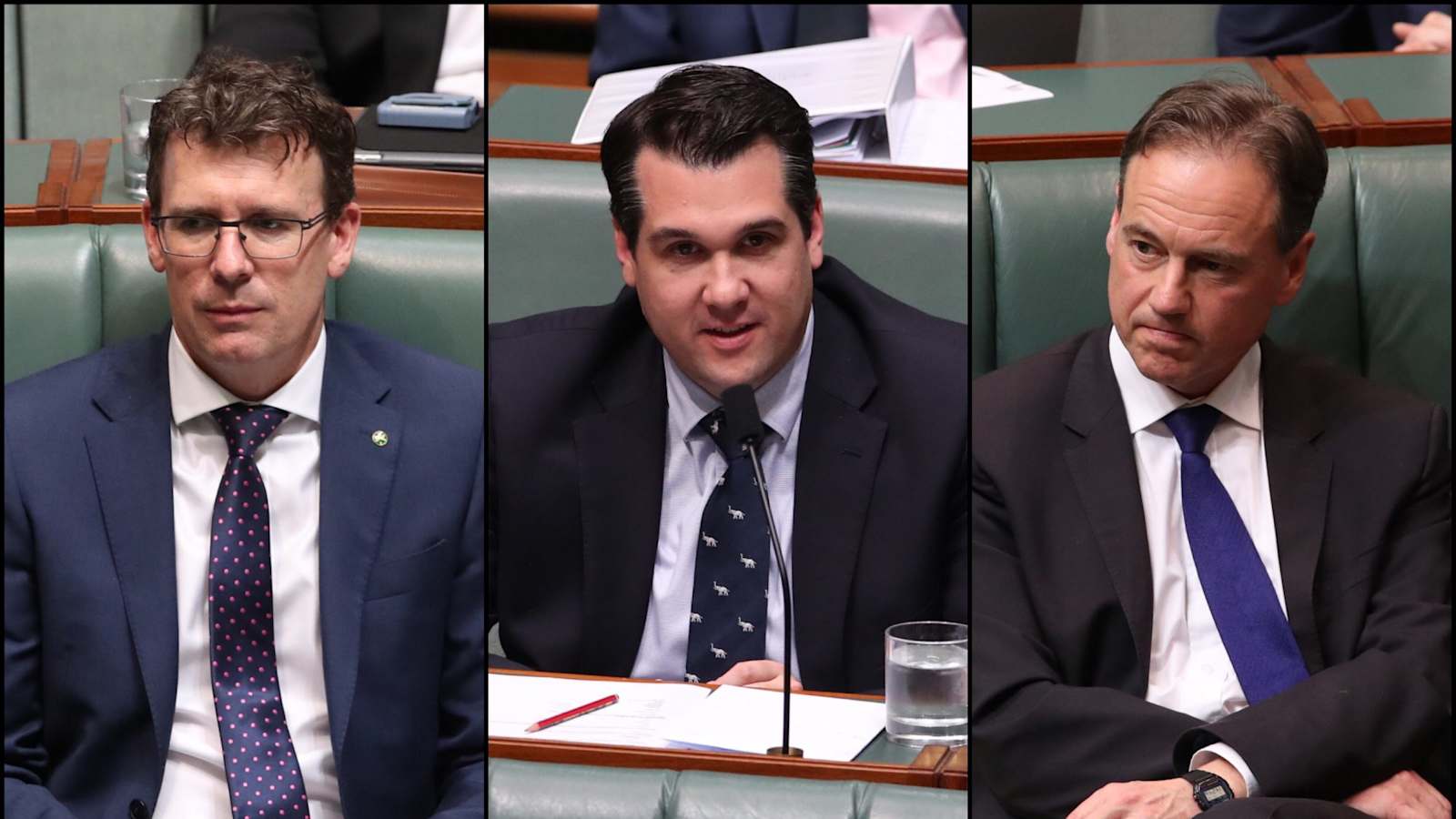
Alan Tudge, Michael Sukkar and Greg Hunt could be charged with contempt of court.CREDIT:ANDREW MEARES

Tudge said some were "­divorced from reality". They seemed "more concerned about the terrorists than the safety of the community".

Benson packaged their texts with quotes from judges at the hearing in question, all but one of which he took from the ABC website.

His lawyer confirmed that, like the ministers, he had no other source.

The Victorian Court of Appeal had been considering the sentence handed down for two men convicted of terrorism over a plan to run down and behead a police officer at an Anzac Day march in 2015.

What infuriated the judges was that they hadn't yet made a decision.

The minister's texts, amplified through The Australian, could be seen as an attempt to influence their decision. Much worse, they ran the risk of being damned whether they took account of them or not.

"On the one hand if we dismiss the appeals, then we will be accused of engaging in an ideological experiment or being hard-left activist judges, or on the other hand, if we increase the sentences ... the respondents may have an understandable grievance that we were doubtlessly affected by what three prominent ministers for the Crown had to say," Chief Justice Marilyn Warren said.

"Can I add to that?" added Justice Stephen Kaye. "If we dismiss the appeals, it may be said we are reacting, perhaps overreacting, against the content of what your client said."

The technical term is "scandalising the court". Justice Kaye said he had never seen anything like it in more than 40 years in the law. Warren and Justice Mark Weinberg agreed.

The three had invited the three ministers to appear before them on Friday to explain why they should not be tried for criminal contempt of court.

It was their last and only opportunity to put a case before the judges decided whether to refer their conduct to the Office of Public Prosecutions. None turned up. Instead, they sent the Commonwealth Solicitor-General Stephen Donaghue, QC, who made it clear he was representing them in their "role as ministers within our system of government".

He had his work cut out. The video shows him opening by reading a statement in which the ministers neither withdrew what they had said nor apologised.

Then after 39 minutes of excruciating questioning, he received his own text.

"I have just received instructions from Mr Sukkar that he is content to expressly withdraw the statement about hard left activist judges," he informed the court.

"Does he apologise for it? He doesn't apologise," Kaye noted, amid nervous laughter from the packed public gallery.

"Sounds like somebody's on the telephone," Weinberg observed, before adding: "Could I ask whether any of your three clients are lawyers or legal practitioners with any experience in the law at all?"

All three were lawyers. None had turned up.

"In other instances where these kinds of developments have occurred, the minister has taken the opportunity to retract the statement and apologised to the Court," the Chief Justice pointed out.

And then another text, amid more nervous laughter. "My instructions have evolved somewhat in the course of the morning," Donaghue stammered. "I can convey to the Court that I have received instructions to withdraw three of the statements in the article."

"Ideological experiments" and "divorced from reality" were also withdrawn.

And, on further questioning, the statement about the judges being appointed by Labor governments was withdrawn.

They had "multiple appointments to judicial offices for governments of both the Coalition and Labor," Warren pointed out.

Hunt, Sukkar, and Tudge may have left it too late for an apology. If it goes to trial and they are convicted, they could lose their seats.

But there's a potential upside. They would most likely be replaced by ministers with a clearer knowledge of the law who devoted attention to health, housing and Centrelink.


In The Age and Sydney Morning Herald


Read more >>