Showing posts with label racism. Show all posts

Sunday, January 14, 2018

The gang crisis our leaders help create

What is it about the African gang crisis that's so disturbingly familiar?

In case you haven't been paying attention, Melbourne is supposedly in the grip of a crime wave. Not on the basis of statistics, which show arson, property damage, burglary and theft down (sexual offences and robbery are up), but on the basis of a series of front page articles over summer in the Herald Sun and also The Australian about African gangs, most of them South Sudanese.

Victoria's opposition wants to recall Parliament.

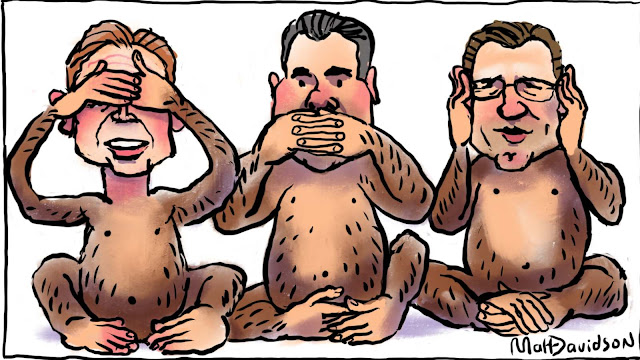
Federal minister Greg Hunt, whose day job is Health Minister and who last year had to apologise to the Supreme Court for calling it soft, says African gang crime is "out of control". Prime Minister Turnbull says he is alarmed by "growing gang violence". And Home Affairs Minister Peter Dutton says people are scared to go out to restaurants "because they are followed home by these gangs".

It's feeding on itself. A nationalist group says it's planning a rally on Sunday in order to "take a stand on the streets". African Australians are being harassed and worse by vigilantes who are suddenly emboldened. Police say a Daily Mail photographer helped create the latest "flare-up" by taking close-up photos of a group of Africans socialising.

"The teenagers had been doing nothing of public interest prior to the photographer's decision to move in," a memo reported by The Guardian says. The Mail labelled the scuffle that it helped create "the latest gang flare-up" and boasted that its pictures were "exclusive".

It is familiar because it happened in Sydney with Lebanese Muslim youths (remember the Cronulla riots?) and before that with "Asian gangs" in Cabramatta. In Adelaide a decade ago it was the "Gang of 49". There never was a Gang of 49, but The Advertiser coined the term to describe 49 mainly Aboriginal youths the police said they were looking for.

The catchphrase had incredibly unfortunate consequences. Former police say it created gangs. Dispossessed, often homeless, youths started saying they were part of Gang of 49 and stealing cars and doing ram-raids to prove it.

"It hypes them up, they think they are famous, it's them against the police," a grandmother of one of the self-described members told the ABC. Very young Aboriginals, too young to be part of a gang, started romanticising the idea and looking forward to the day when they could.

It happened after Melbourne's Moomba riots in March 2016, which the media were quick to attribute to the "Apex Gang". More a grab bag than a gang, it grew swiftly as all sorts of petty criminals started scrawling the word "Apex" wherever they had been. The more it was talked about, the bigger it became.

That's why on Wednesday Police Commissioner Graham Ashton rubbished the idea of a gang and referred instead to low-level crime. It was "complete and utter garbage" to suggest, as our leaders have, that Victorians aren't safe.

"The sort of concept that somehow it's unsafe to go out to dinner, how long since you've been out to dinner?" he asked.

Big cities have had aggravated burglaries and home invasions for years, less so in Melbourne in the past two quarters. The perpetrators are overwhelmingly Australian-born. Although Sudanese youths are over-represented in minor crime statistics (as might be expected given high socio-economic disadvantage) and are involved in many more armed robberies than before (98 in 2016-17, up from 20 in 2014-15) the perpetrators of serious assaults are 25 times more likely to be born in Australia or New Zealand than in Sudan or Kenya.

Talk about gangs has probably always created gangs, at least as far back as the Mods and Rockers in the UK in the 1960s. But it's worse now. Would-be gang members can find each other on social media. Words can do even more damage, all the more so when they are used carelessly by newspapers and "leaders" to fill space and score points.

In The Age and Sydney Morning Herald
Read more >>

Wednesday, June 21, 2017

The texts that could cost three government ministers their jobs

Rarely do we get to see how newspaper stories are made.

Nine days ago, across almost the entire width of its front page, The Australian published a headline that read: Exclusive: Judiciary "light on terrorism". 


They had been talking about a court case, the transcript of which we now know they hadn't read. All three were relying on no more than an ABC Online report, according to evidence given on their behalf by the Commonwealth Solicitor-General.

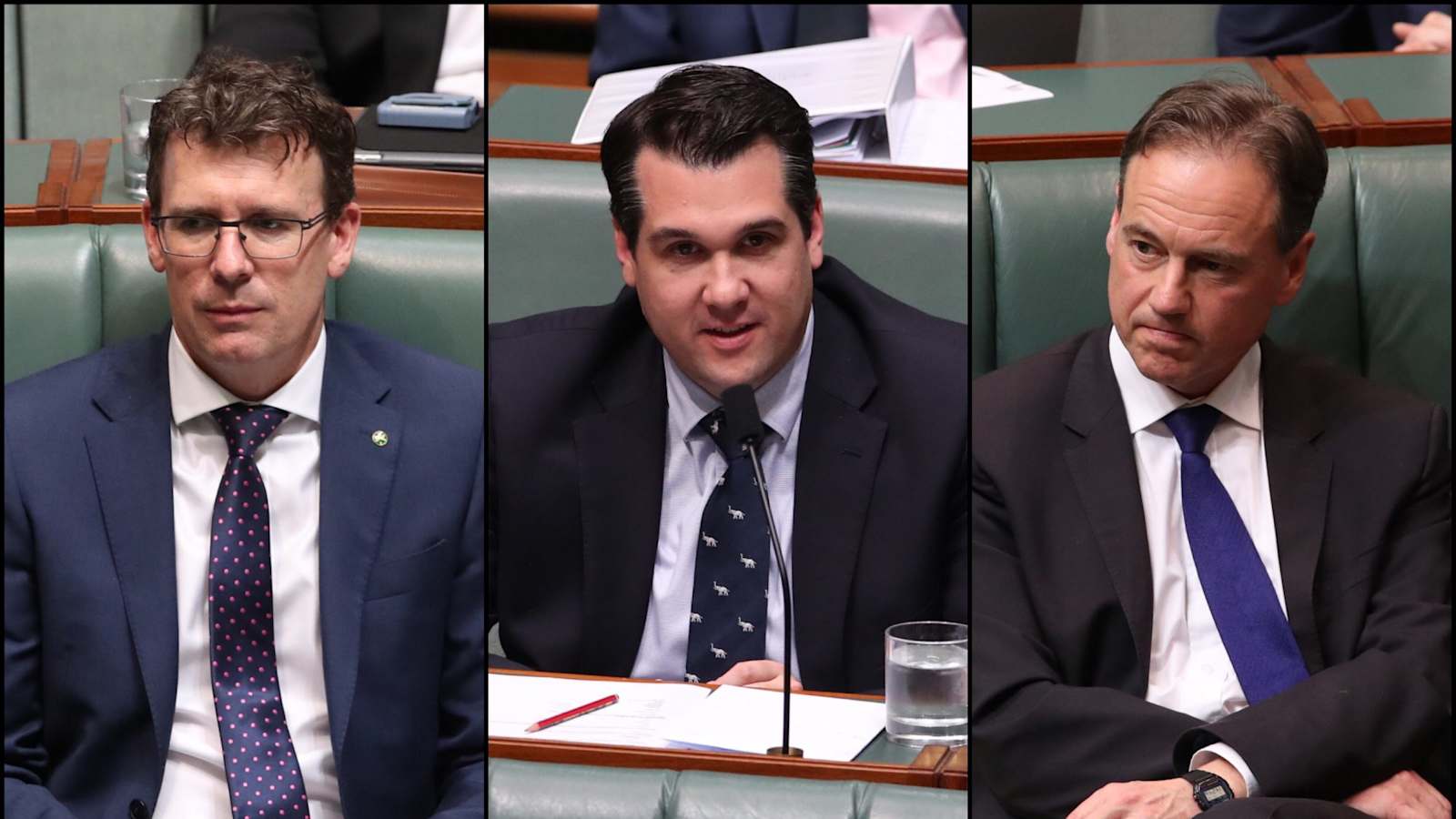
Each had sent a single text message to Simon Benson, national affairs editor of The Australian. One was sent at 12.36 pm on the Monday afternoon, one at 12.43 pm, and the last at 1.42 pm. They weren't sent in response to questions.

Hunt's text said: "Comments by senior members of the Victorian courts ­endorsing and embracing shorter sentences for terrorism offences are deeply concerning — deeply concerning." State courts should not be places for "ideological experiments".

Sukkar bemoaned "Labor's continued appointment of hard-left activist judges".


Alan Tudge, Michael Sukkar and Greg Hunt could be charged with contempt of court.CREDIT:ANDREW MEARES

Tudge said some were "­divorced from reality". They seemed "more concerned about the terrorists than the safety of the community".

Benson packaged their texts with quotes from judges at the hearing in question, all but one of which he took from the ABC website.

His lawyer confirmed that, like the ministers, he had no other source.

The Victorian Court of Appeal had been considering the sentence handed down for two men convicted of terrorism over a plan to run down and behead a police officer at an Anzac Day march in 2015.

What infuriated the judges was that they hadn't yet made a decision.

The minister's texts, amplified through The Australian, could be seen as an attempt to influence their decision. Much worse, they ran the risk of being damned whether they took account of them or not.

"On the one hand if we dismiss the appeals, then we will be accused of engaging in an ideological experiment or being hard-left activist judges, or on the other hand, if we increase the sentences ... the respondents may have an understandable grievance that we were doubtlessly affected by what three prominent ministers for the Crown had to say," Chief Justice Marilyn Warren said.

"Can I add to that?" added Justice Stephen Kaye. "If we dismiss the appeals, it may be said we are reacting, perhaps overreacting, against the content of what your client said."

The technical term is "scandalising the court". Justice Kaye said he had never seen anything like it in more than 40 years in the law. Warren and Justice Mark Weinberg agreed.

The three had invited the three ministers to appear before them on Friday to explain why they should not be tried for criminal contempt of court.

It was their last and only opportunity to put a case before the judges decided whether to refer their conduct to the Office of Public Prosecutions. None turned up. Instead, they sent the Commonwealth Solicitor-General Stephen Donaghue, QC, who made it clear he was representing them in their "role as ministers within our system of government".

He had his work cut out. The video shows him opening by reading a statement in which the ministers neither withdrew what they had said nor apologised.

Then after 39 minutes of excruciating questioning, he received his own text.

"I have just received instructions from Mr Sukkar that he is content to expressly withdraw the statement about hard left activist judges," he informed the court.

"Does he apologise for it? He doesn't apologise," Kaye noted, amid nervous laughter from the packed public gallery.

"Sounds like somebody's on the telephone," Weinberg observed, before adding: "Could I ask whether any of your three clients are lawyers or legal practitioners with any experience in the law at all?"

All three were lawyers. None had turned up.

"In other instances where these kinds of developments have occurred, the minister has taken the opportunity to retract the statement and apologised to the Court," the Chief Justice pointed out.

And then another text, amid more nervous laughter. "My instructions have evolved somewhat in the course of the morning," Donaghue stammered. "I can convey to the Court that I have received instructions to withdraw three of the statements in the article."

"Ideological experiments" and "divorced from reality" were also withdrawn.

And, on further questioning, the statement about the judges being appointed by Labor governments was withdrawn.

They had "multiple appointments to judicial offices for governments of both the Coalition and Labor," Warren pointed out.

Hunt, Sukkar, and Tudge may have left it too late for an apology. If it goes to trial and they are convicted, they could lose their seats.

But there's a potential upside. They would most likely be replaced by ministers with a clearer knowledge of the law who devoted attention to health, housing and Centrelink.


In The Age and Sydney Morning Herald


Read more >>

Sunday, May 31, 2015

More than vows. Why gay marriage matters

It's more than just marriage.

I held hands with my Dad as we walked to the polling booth at my primary school, 48 years ago. There were two questions that day. One dealt with the number of seats in the House of Representatives and the Senate. The booklet sent to households ahead of the referendum presented both arguments: "for" and "against". The other question dealt with discriminatory references to Aboriginal people in Australian Constitution. The booklet set out only one case: for removing them.

"Why?" I asked my Dad. "Why isn't there an argument against this one, as well as an argument for?" "Because there isn't an argument against," my Dad replied. "We want to count Aboriginal people in the census and we want to treat them like other people."

That day, 90 per cent of the electorate voted yes. While I have been proud of my small part in what happened that day, for much of my life I have thought of what happened as a mere administrative change. The Commonwealth became able to make laws with respect to Aborigines and was forced to include them in the census. But I've discovered more recently that for Aboriginal people it meant much more.

They'd previously not known what Anglos and others thought about them. Every bad encounter made them believe the worst. After the vote they realised that the overwhelming majority of Anglos liked them and wanted them included. Almost every Anglo they had seen in the street or on the bus or at the school had said yes.

That's what a vote for gay marriage will do if it happens this year. It'll be about more than marriage. It'll be about inclusion. It'll be the Australian Parliament saying, "Welcome to Australia".

Because despite laws that make discrimination illegal and despite all the talk about the pink dollar and enviable lifestyles, gay and lesbian and bisexual and transgender people aren't as included as the rest of us.

It shows up in the stats, if not in what hetro Australians like to believe about what they believe.

The Household, Income and Labour Dynamics survey is Australia's version of Seven Up. It has been tracking about 20,000 Australians each year since 2001. In 2012 for the first time the survey asked questions about their sexual identity.

Around 1.6 per cent said they were gay or lesbian, and 1.5 per cent bisexual. Around 0.8 per cent were "other" and 3 per cent preferred not to say.

The gay men earned much less than the straight men, about 20 per cent less, even when the figure were manipulated to adjust for education and other characteristics.

The gap is because those gay men who had jobs earned lower wages (about 11 per cent lower when adjusted) and because they were less likely to be employed at all, an astonishing 15 per cent less likely.

And it was all the worse when their sexual identity was obvious. Although 2012 was the first year in which the survey explicitly asked about sexual identity, it had been asking the gender of live-in partners since the beginning. The gay men who were (fairly openly) living with same-sex partners did much worse than the single gay men who were better able to keep their identities secret. And they did worse over time. While the earnings of all types of gay men had climbed more slowly than those of hetrosexual men since 2001, the earnings of those in relationships had climbed the slowest.

In contrast, lesbians were just as likely to be employed as straight women (although bisexual women and women who preferred to not to say were underemployed). And they took home more, about 33 per cent more. However, the extra pay was almost entirely due to the fact that they put in extra hours. Their hourly rates were little different to those of other women. It was the same whether or not they had partners. On average they got paid less than men (as all women do on average) and got extra pay only for extra work.

Joseph Sabia and Mark Wooden from the Melbourne Institute of Applied Economic and Social Research say their findings are consistent with discrimination against gay males. Gay females are taken advantage of rather than paid higher wages. Their lower likelihood of easing back on work to have children could be in part the result of discrimination against potential lesbian parents.

Allowing gay marriage, as the Parliament is set to do, will be wonderful for those wanting to get married. But it will also be good for those that don't. It'll show all of us that we want to include all of us. It'll make it harder to leave people out.

Peter Martin is economics editor of The Age.

In The Age and Sydney Morning Herald
Read more >>

Thursday, June 18, 2009

The importance of being Leigh or Booth...

...rather than  Vargonova

Having a name such as Francesco or Francesca can be a disadvantage when it comes to landing a job according to a new Australian study, unless you're applying for it in Melbourne.

A new landmark ANU study has found that having a foreign-sounding name, even an Indigenous-sounding name, makes it less likely you'll be called back. Unless your name sounds Italian and you're in Melbourne, in which case it can actually be an advantage.

Researchers Alison Booth, Andrew leigh and Elena Vargonova sent out 4000 fake job applications to employers advertising on the web for entry-level waiting, data entry, customer service and sales jobs changing only the racial origin of the supposed applicants' names.

Applicants with Chinese-sounding names fared the worst, having only a one-in five-chance of getting asked in for an interview compared to applicants with Anglo Saxon names whose chances exceeded one-in-three...

Typically a Chinese-named applicant would need to put in 68 per cent more applications than an Anglo-named applicant to get the same number of calls backs, an applicant with a Middle Eastern-named applicant 64 per cent more, and Indigenous-named applicant 35 per cent more and an Italian-named applicant 12 per cent more.

But the results varied by city.

Sydney employers were generally more discriminatory than those in Melbourne or Brisbane, except when it came to Indigenous names where they were more accepting.

But only in Melbourne was there a type of non-Anglo name that was actually loved. Melbourne employers were 7 per cent more likely to respond well to someone with an Italian name than they were to an Anglo name.

Asked to guess why, Dr Leigh hastens to point out that the 7 per cent bias in favour of Italian-sounding names is not statistically significant.

"But what it does allow you to say is that there is no statistically-discernible discrimination against Italian names in Melbourne. They are as well regarded as Anglo names."

"This could be because Melbourne has a higher share of Italians than other Australian cities, and has had for a long time. Discrimination tends to be higher when you have a recent influx of arrivals, as Sydney has from China and the Middle East."

"Or it could be because many of the jobs we pretended to apply for were waiter and waitressing positions in bistros, bars, cafes and restaurants."

Asked whether the study had found that Australian employers were racist, Dr Leigh said it was clear they discriminated on the basis of the racial origin of applicant's names. "There is no other reasonable interpretation of our results," he said.

The fake applications had made clear that the supposed job sekers had completed secondary schooling in Australia, making it unlikely that the employers had assumed the non-Anglo applicants could not speak English.

A similar study carried out in the United States found that applicants with black-sounding needed to submit 50 per cent more applications than whte applicants to get the same number of interviews, suggesting that Australian employers were more prejudiced, except when it came to Italians and Australians with Indigenous names.
Read more >>