Wednesday, November 03, 2021

Australia is about to be hit by a carbon tax whether the prime minister likes it or not, except the proceeds will go overseas

Ten years ago, in the lead-up to Australia’s short-lived carbon price or “carbon tax” (either description is valid), the deepest fear on the part of businesses was that they would lose out to untaxed firms overseas.

Instead of buying Australian carbon-taxed products, Australian and export customers would buy untaxed (possibly dirtier) products from somewhere else.

It would give late-movers (countries that hadn’t yet adopted a carbon tax) a “free kick” in industries from coal and steel to aluminium to liquefied natural gas to cement, to wine, to meat and dairy products, even to copy paper.

It’s why the Gillard government handed out free permits to so-called trade-exposed industries, so they wouldn’t face unfair competition.

As a band-aid, it sort of worked. The firms with the most to lose were bought off.

But it was hardly a solution. What if every country had done it? Then, wherever there was a carbon tax (and wherever there wasn’t), trade-exposed industries would be exempt. The tax wouldn’t do enough to bring down emissions.

We are about to face carbon tariffs

The European Union has cottoned on to the imperfect workarounds introduced by countries such as Australia, and is about to tackle things from the other direction.

Instead of treating foreign and local producers the same by letting them both off the hook, it’s going to place both on the hook.

It’s about to make sure producers in higher-emitting countries such as China (and Australia) can’t undercut producers who pay carbon prices.


Australia Institute

Unless foreign producers pay a carbon price like the one in Europe, the EU will impose a carbon price on their goods as they come in — a so-called Carbon Border Adjustment Mechanism, or “carbon tariff”.

Australia’s Energy Minister Angus Taylor says he is “dead against” carbon tariffs, a stance that isn’t likely to carry much weight in France or any of the other 26 EU nations.

Australia is familiar with the arguments for them

From 2026, Europe will apply the tariff to direct emissions from imported iron, steel, cement, fertiliser, aluminium and electricity, with other products (and possibly indirect emissions) to be added later.

That is, unless they come from a country with a carbon price.

Canada is also exploring the idea, as part of “levelling the playing field”. So is US President Joe Biden, who wants to stop polluting countries “undermining our workers and manufacturers”.

Their arguments line up with those heard in Australia in the lead-up to our carbon price: that unless there’s some sort of adjustment, a local carbon tax will push local employers towards “pollution havens” where emissions are untaxed.

In practice, there’s little Australia can do to stop Europe and others imposing carbon tariffs.

As Australia discovered when China blocked its exports of wine and barley, there’s little a free trade agreement, or even the World Trade Organisation, can do. The WTO was neutered when former US President Donald Trump blocked every appointment to its appellate body, leaving it unstaffed, a stance Biden hasn’t reversed.

Even so, the EU believes such action would be allowed under trade rules, pointing to a precedent established by Australia, among other countries.

Legality isn’t the point

When Australia introduced the Goods and Services Tax in 2000, it passed laws allowing it to tax imports in the same way as locally produced products, a move it has recently extended to small parcels and services purchased online.

Trade expert and Nobel Prizewinning economist Paul Krugman says he is prepared to argue the toss with politicians such as Australia’s trade minister about what’s legal and whether carbon tariffs would be “protectionist”.

But he says that’s beside the point:

Yes, protectionism has costs, but these costs are often exaggerated, and they’re trivial compared with the risks of runaway climate change. I mean, the Pacific Northwest — the Pacific Northwest! — has been baking under triple-digit temperatures, and we’re going to worry about the interpretation of Article III of the General Agreement on Tariffs and Trade?

And some form of international sanctions against countries that don’t take steps to limit emissions is essential if we’re going to do anything about an existential environmental threat.

Victoria University calculations suggest Europe’s carbon tariffs will push up the price of imported Australian iron, steel and grains by about 9%, and drive up the price of every other Australian import by less, apart from coal whose imported price would soar by 53%.

The tariffs would be collected by Europe rather than Australia. They could be escaped if Australian makers of iron, steel and other products can find ways to cut emissions.


Increase in price of exports to EU under carbon border adjustment mechanism
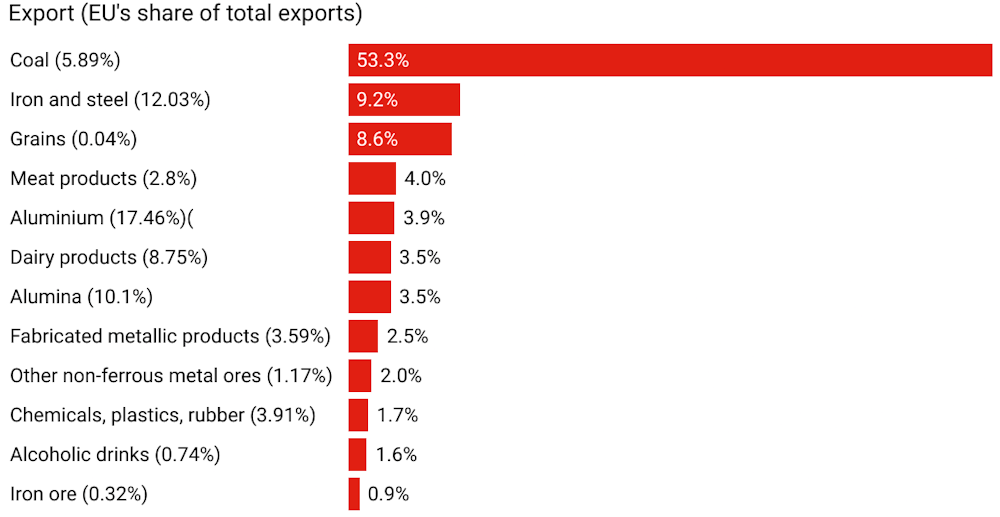
Assumes an EU carbon price of 60 euro per tonne, which is roughly today’s price; assumes the CBAM covers CO2 emissions including fugitive emissions involved in production other than direct combustion emissions that are priced already by the EU Emissions Trading Scheme.

The tariffs could also be avoided if Australia were to introduce a carbon price or something similar, and collected the money itself.

This makes a compelling case for another look at an Australian carbon price. If Australian emissions are on the way down anyway, as Prime Minister Scott Morrison contends, it needn’t be set particularly high. If he is wrong, it would need to be set higher.

One thing the sad story of Australia’s on-again, off-again, now on-again (through carbon tariffs) history of carbon pricing has shown is that politicians aren’t the best people to set the rates.

In 2011, Prime Minister Julia Gillard set up an independent, Reserve Bank-like Climate Change Authority to advise on the carbon price and emissions targets, initially chaired by a former governor of the Reserve Bank.

Astoundingly, despite attempts to abolish it, it still exists. It might yet have work to do.

Peter Martin, Visiting Fellow, Crawford School of Public Policy, Australian National University

This article is republished from The Conversation under a Creative Commons license. Read the original article.

Read more >>

Wednesday, October 27, 2021

Now it’s Liberals telling us we are going to have to cut the capital gains tax concession if we want to get Australians into homes

NSW is doing what Labor’s Bill Shorten could not – explaining why Australia’s capital gains tax concession is knocking first home buyers out of homes.

Shorten went to the 2016 and 2019 elections with a plan – Labor would halve the capital gains tax concession used by landlords who buy and sell properties.

In much the same way as he was unable to sell his (now modest by international standards) plan to make half of all new car sales electric by 2030, he was pilloried by Morrision and before him Malcolm Turnbull for a policy they said would smash house prices.

All Shorten was proposing was to wind back the capital gains tax exemption (which exempts from tax half of each profit made from buying and sell real estate and other assets) for future transactions only. The exemption would stay in place for everything already bought.

In the face of an overblown debate about whether or not it would smash house prices (Morrison’s department had quietly warned such claims were “not consistent with our advice”) the Labor leader found himself defending modelling about prices rather than outlining what his policy would actually do.

And he lost, twice.

Now, as we prepare for yet another election, the NSW Coalition government has done what Australia’s Labor opposition could not – make a cogent argument for winding back the capital gains tax concession, saying it “pushes first home buyers out of the market”.

Elbowing first home buyers aside

In a submission placed quietly on the federal government’s housing inquiry website late last week the NSW government argued that if the concession was cut, housing would be used “more for accommodation needs than investment needs”.

Here’s the line of thinking it set out, the line Shorten was never able to get across.

The income made from capital gains – from buying something, holding it, then selling it at a profit – is taxed differently from the income made from work or running a business. Only half of it is taxed.

Prime Minister John Howard and his treasurer Peter Costello were responsible for the change, introduced in 1999 in the leadup to the introduction of the goods and services tax in 2000, but with less fanfare.

Before then capital gains were taxed in the same way as other income (what they are subject to is income tax, there is no such thing as a separate capital gains tax).

But before then only the portion of each gain over and above the rate of inflation was taxed, so that people weren’t taxed on a profit that would have no real value.

The change, introduced after an inquiry that found it would “encourage a greater level of investment, particularly in innovative, high-growth companies” was to instead tax only half of each capital gain.

It was sold as a small change. A few years earlier, inflation had been big, around 8% per year, meaning that after five or so years only half of each profit would have been taxed in any event.

But inflation had since dived to a barely-noticeable 2%, where it has stayed for most of the past 20 years, making a guaranteed exemption from tax of half of each capital gain made trading property way over the odds.

It was, as economist Rory Robertson told his clients at the time, “almost as though the Australian tax system has been screaming at taxpayers to gear up to earn increased capital gains rather than to work harder to earn increased wages”.

Instead of pouring into high-growth companies, as Howard’s inquiry said it expected, the money flooded into housing, which was easier to borrow for.

Rushing into real estate rather than shares

As Reserve Bank assistant governor Luci Ellis told a parliamentary inquiry, it was “more profitable to negatively gear property, because you can gear it more”.

To buy properties quickly, real estate investors needed to buy properties that would have otherwise been bought to live in.

It pushed up prices, but that wasn’t all it did.

As the NSW submission to the current housing inquiry says, the most significant impact was “the displacement of owner occupiers (including first home buyers) from home ownership by tax-advantaged investors, predominantly those already on higher incomes”.

In its words

by encouraging investors to buy and hold property, the 50% capital gains discount increases investor demand for housing and pushes first home buyers out of the market

Before capital gains tax was halved and Australians dived into becoming landlords, more than 70% of Australian households owned the home in which they lived and one quarter rented.

At the latest count (itself four years old) only two thirds owned the place in which they lived and one third rented.

Labor has new friends

And properties are less well used. Because income from rent is no longer the chief motivation for holding property (these days most rental properties make a rental loss whereas before the capital gains tax change most made a profit) the NSW government believes more are remaining empty.

Now, when the capital gains from holding properties can be measured in hundreds of dollars per day, it would be an ideal time to wind back the capital gains tax discount. Its absence wouldn’t much hurt.

And it’s easy to forget that wasn’t what Labor was proposing. Shorten (twice) put forward something far more modest – leaving the tax discount for existing investments untouched and halving the discount for future investments.

It’s no longer Labor policy, but it was backed by the head of the Coalition’s Commission of Audit and the head of its financial system inquiry.

And it was of interest to the Business Council of Australia which pointed out that the discount “can distort investor behaviour, particularly at a time of rapid capital gains, such as in a housing or equity boom”.

Morrison’s opposition to it was hard to justify at the time. It’s harder now.

Peter Martin, Visiting Fellow, Crawford School of Public Policy, Australian National University

This article is republished from The Conversation under a Creative Commons license. Read the original article.
Read more >>

Wednesday, October 20, 2021

The easy way to rein in Facebook: stop it eating competitors

Few of us who have survived the last year aren’t grateful for technology.

Zoom, email, connected workplaces and solid internet connections at home have made it possible to work, shop, study and carry on our lives in a way that wouldn’t have been possible had the pandemic hit, say, 20 years earlier.

But parts of big tech — the parts that track us and drive us to think dangerous and antisocial things just so we keep clicking — are doing us enormous damage.

Although it might seem like we can’t have the best of both worlds — the connectivity without the damage — I reckon we can. But we are going to have to change the way we think about big tech.

The first thing is to recognise that big tech is intrinsically weak. Yes, weak. The second is that it has only become strong each time we have let it.

By “big tech” I mean Facebook and Google and related companies such as Instagram and YouTube (owned by Facebook and Google respectively).

The firms that came before them were indeed weak in the sense that they didn’t have a guaranteed future. Think back to Netscape, Myspace, MSN and all those other montholiths we were told at the time would become natural monopolies.

Terrified of losing its edge

Much of the behaviour revealed by Facebook whistle-blower Frances Haugen this past month is that of a market leader terrified it is losing its edge.

It switched what it showed away from news towards posts that inflamed and enraged people in 2018, with “unhealthy side effects on important slices of public content” in part because users had begun to interact less with it.

Extract from internal Facebook report. Wall Street Journal, US Senate Commerce Committee

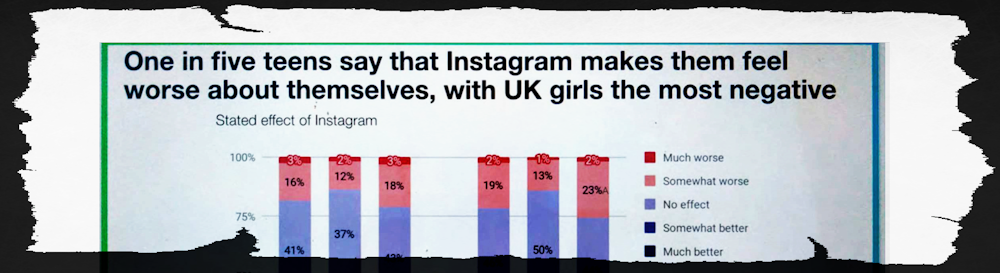
Facebook knew that “we make body image issues worse,” in the words of one of its memos, but did little to change the way Instagram worked. In part this was because teens spent 50% more time on Instagram than Facebook. Instagram looked like the future.

When engagement on Instagram started flagging, Facebook developed plans for Instagram Kids, seeing pre-teens as “a valuable but untapped audience”.

These don’t sound like the actions of a company confident of staying on top.

And nor does its initial purchase of Instagram in 2012 when it could have started its own photo-sharing service on mobiles, leveraging all that it had.

Facebook also bought WhatsApp in 2014 because its own messaging platform, Messenger, was losing ground.

It couldn’t grow anything like as big by itself, because when firms grow beyond a certain size they turn sluggish, bureaucratic.

Google got bigger by buying DoubleClick (the platform it uses to sell the advertisements that drive its income) and all manner of emerging platforms including Android, YouTube, Waze and Quickoffice.

They are the actions of a hungry company, but not one supremely confident of staying at the top.

Australian academic Stephen King, a former member of Australia’s Competition and Consumer Commission and a current commissioner with its Productivity Commission, says we need to apply special tougher rules to takeovers by companies such as Google and Facebook.

Big tech grows bigger by takeovers

Usually we only block takeovers where the target is big. Instagram and WhatsApp were small. Instagram reportedly had 13 full-time employees at the time of its takeover, WhatsApp reportedly had 55. Yet Facebook paid billions for them.

In the US and the UK both takeovers were waived through.

Big tech companies can do things with tiny takeover targets others can’t. Takeovers can give them access to vast networks of existing users and their data.

As King puts it, Instagram is big because it was acquired by Facebook, not because Instagram was necessarily the best target.

In Europe the authorities were on to this possibility and approved the takeover of WhatsApp only after Facebook informed them it would be “unable to establish reliable automated matching between Facebook users’ accounts and WhatsApp users’ accounts”.

This statement was incorrect, Facebook has done it, and paid the European Commission €110 million for providing incorrect or misleading information.

Had Australia been tougher, had the US, the UK and the European Commission been tougher, Facebook and Google would be nothing like the behemoths they have become today. They might have peaked and be losing market share.

We are able to say no

Their future is largely in our hands. For big tech companies able to use the weight of their networks (and only for those companies) we could “just say no” to takeovers. It’s hard to think of a reason for one to proceed.

If needed, we could change the law to make “no” the default.

This wouldn’t shrink the companies in a hurry. Most of the users of Facebook, YouTube, Twitter and the like are locked in, because that’s where their friends are.

But where the friends are changes every generation.

Facebook and Google know this, which is why they are so keen to take over upstart competitors and emerging platforms in fields they haven’t thought of.

If we stopped them, we wouldn’t stop them growing straight away, but we would make it hard for them to fight the natural order in which the new and fashionable displace the old and predictable. It’s their deepest fear.

Peter Martin, Visiting Fellow, Crawford School of Public Policy, Australian National University

This article is republished from The Conversation under a Creative Commons license. Read the original article.
Read more >>

Monday, October 18, 2021

Economists back carbon price, say net-zero benefits outweigh costs

Eight in ten of Australia’s leading economists back action to cut Australia’s carbon emissions to net-zero.

Almost nine in ten want it done by a carbon tax or a carbon price – mechanisms that were explicitly rejected at the 2013 election.

The panel of 58 top Australian economists selected by the Economic Society of Australia wants the carbon price restored to the public agenda even though it was rejected seven years ago, some saying Australia’s goods and services tax was rebuffed in 1993 and then restored to the public agenda seven years later.

Among those surveyed are former heads of government departments and agencies, former International Monetary Fund and OECD officials and a former and current member of the Reserve Bank board.

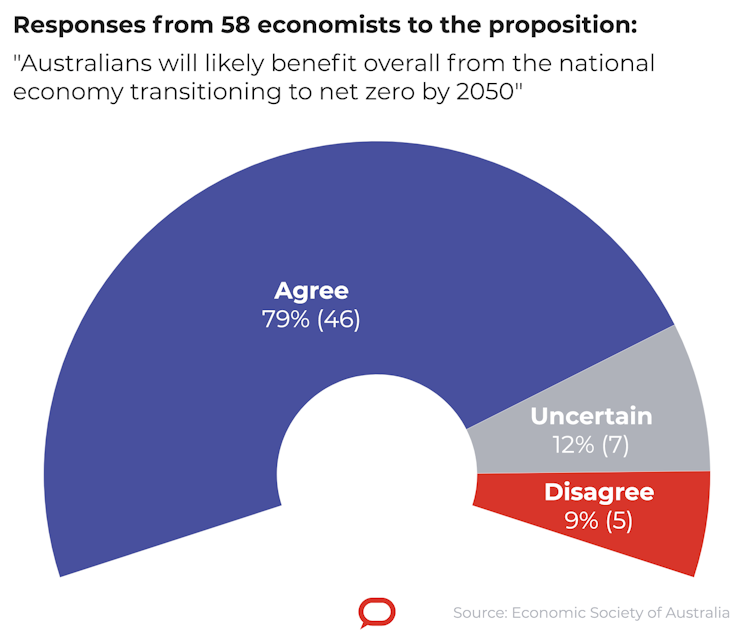
Asked ahead of November’s Glasgow climate talks whether Australia would likely benefit overall from the national economy transitioning to net-zero emissions by 2050, 46 of the 58 said yes.


The Conversation, CC BY-ND

The response is at odds with the previous positions of groups such as the Business Council of Australia which in the leadup to the 2019 election labelled Labor’s proposed steps towards net-zero “economy wrecking”.

This month the Business Council backed net-zero by 2050, and produced modelling suggesting it would make Australians A$5,000 better off per year.

Only one net-zero doubter

Only five of the 58 economists surveyed disagreed with the proposition that cutting Australia’s emissions to net-zero would leave Australians better off.

Of those five, only one doubted that cutting global move emissions to net-zero would leave Australia better off. The others believed that even if a global move to net-zero did leave Australians better off, it was likely to happen anyway, meaning Australia wouldn’t need to act, a stance derided by others as “free-riding”.

“The argument that we are only a small percentage of global emissions holds no water either ethically or in terms of establishing and implementing a global agreement,” said Grattan Institute’s Danielle Wood. “If rich countries like Australia won’t do their fair share, this undermines the likelihood that others will.”

Others including Reserve Bank board member Ian Harper pointed out that Australian exporters faced punitive tariffs and lending and insurance embargoes unless Australia pulled its weight in reducing emissions.

His comments echo those of Reserve Bank Deputy Governor Guy Debelle and Treasurer Josh Frydenberg who have said that unless Australia takes action it will face reduced access to capital markets “impacting everything from interest rates on home loans and small business loans to the financial viability of large‑scale infrastructure projects”.

University of Melbourne economist Leslie Martin made the broader point that Australia had a lot to lose from rising temperatures if free-riding didn’t pay off.

“Although Australia could possibly free-ride on the efforts of other larger economies, it would suffer disproportionately if other countries chose to do the same” he said.

Only one overwhelmingly preferred option

Offered a choice of four options for rapidly reducing emissions, and asked to endorse only one, the economists surveyed overwhelmingly backed an economy-wide carbon price in the form of a carbon tax or market for emissions permits.


Of the 58 surveyed, 49 backed a carbon price, seven backed government support to develop and roll out emissions-reducing technologies, and one backed support for technologies that drew down carbon from the atmosphere.

None backed so-called “direct action” – the program of competitive grants for firms that cut emissions the government took to the last two elections.

“The less federal governments choose to involve themselves with the technical aspects of the alternatives at a micro scale the better,” said Lin Crase, a specialist in environmental management at the University of South Australia.

Crase said governments had shown themselves to be very bad at picking winners, but very good at putting in place broad settings that allowed the people and businesses closest to the action to pick winners.

Several of the economists surveyed said the government’s slogan of “technology, not taxes” set up a false distinction. Taxes could drive the switch to better technologies – ones chosen by the market rather than by government edict.

Australia’s carbon price was introduced in 2012 and abolished in 2014. Had it still been in place Australia would have at hand the tools it needed to get to net-zero.

Some of those surveyed said it was “too late” for a carbon price, partly because of politics and partly because of lost time.

Time for everything plus the kitchen sink?

Saul Eslake said Australia was no more likely to adopt an economy-wide carbon price than he was “to step in thylacine droppings on my front lawn of a morning”, the views of the OECD and the International Monetary Fund notwithstanding.

What was needed was everything possible, including the second-best option of direct action. John Quiggin said Australia needed direct action in the literal sense of government investment in renewable electricity and infrastructure.

Rana Roy said nothing should be ruled out, including the resurrection of a carbon tax or a carbon price, perhaps by a different name. An option rejected once was not rejected “for the rest of time”.

Others pointed to Australia’s natural advantages in solar, wind, geothermal energy and carbon removal via means such as reforestation and storing carbon in soil.

With the right settings in place, Australia could become a major producer of zero-emissions hydrogen, and an industrial powerhouse that used its own iron ore and green energy to export green steel to the world.

With one of the most important settings missing, Australia would find it harder.


Detailed responses:

The Conversation

Peter Martin, Visiting Fellow, Crawford School of Public Policy, Australian National University

This article is republished from The Conversation under a Creative Commons license. Read the original article.

Read more >>

Wednesday, October 13, 2021

As home prices soar beyond reach, we have a government inquiry almost designed not to tell us why

Never has an inquiry into the skyrocketing price of homes been more urgent.

Rarely has one been as insultingly ill-suited as the one under way right now.

Midway through last year in the midst of COVID, the average forecast of the 22 leading economists who took part in The Conversation mid-year survey was for no increase in home prices whatsoever in the year ahead (actually for slight falls).

At that time the typical (median) Sydney house price was A$1 million, where it stayed until the end of the year.

Then it took off. In the ten months to the start of this month the typical Sydney house price soared $300,000 to $1.3 million – a breathtaking increase (and an awfully big penalty for delaying buying) of $1,000 each day.

For apartments, the increase isn’t as big, although still extraordinary. The cost of delaying buying a typical Sydney apartment has been $334 each day.

The cost of delaying buying a typical Melbourne house has been close to $600 per day, the cost of delaying buying a typical Melbourne apartment $150 per day.

In that time, in the year in which the typical Australian home price climbed 20.3%, the typical Australian wage climbed just 1.7%

What people stretched to the limit or now locked out of the housing market are desperate to know is

  • why it is happening

  • when it is likely to stop

  • what (if anything) we can do about it.

Instead, we have been given an inquiry into affordability in name only. Seriously. The parliamentary inquiry commissioned by the treasurer in July and chaired by backbencher Jason Falinski is called an inquiry into affordability and supply, but the word “affordability” appears in none of its three terms of reference.

It’s an inquiry into ‘supply’

Instead, the terms of reference refer to the impact of taxes, charges and other things settings on “housing supply”.

I guess the idea is that it is obvious that supply is the key to affordability, but it rather negates the idea of holding an inquiry, and it sits oddly with the explosion in prices we have seen in a year in which building approvals have surged by a near-record 224,000 and our population has as good as stayed still.

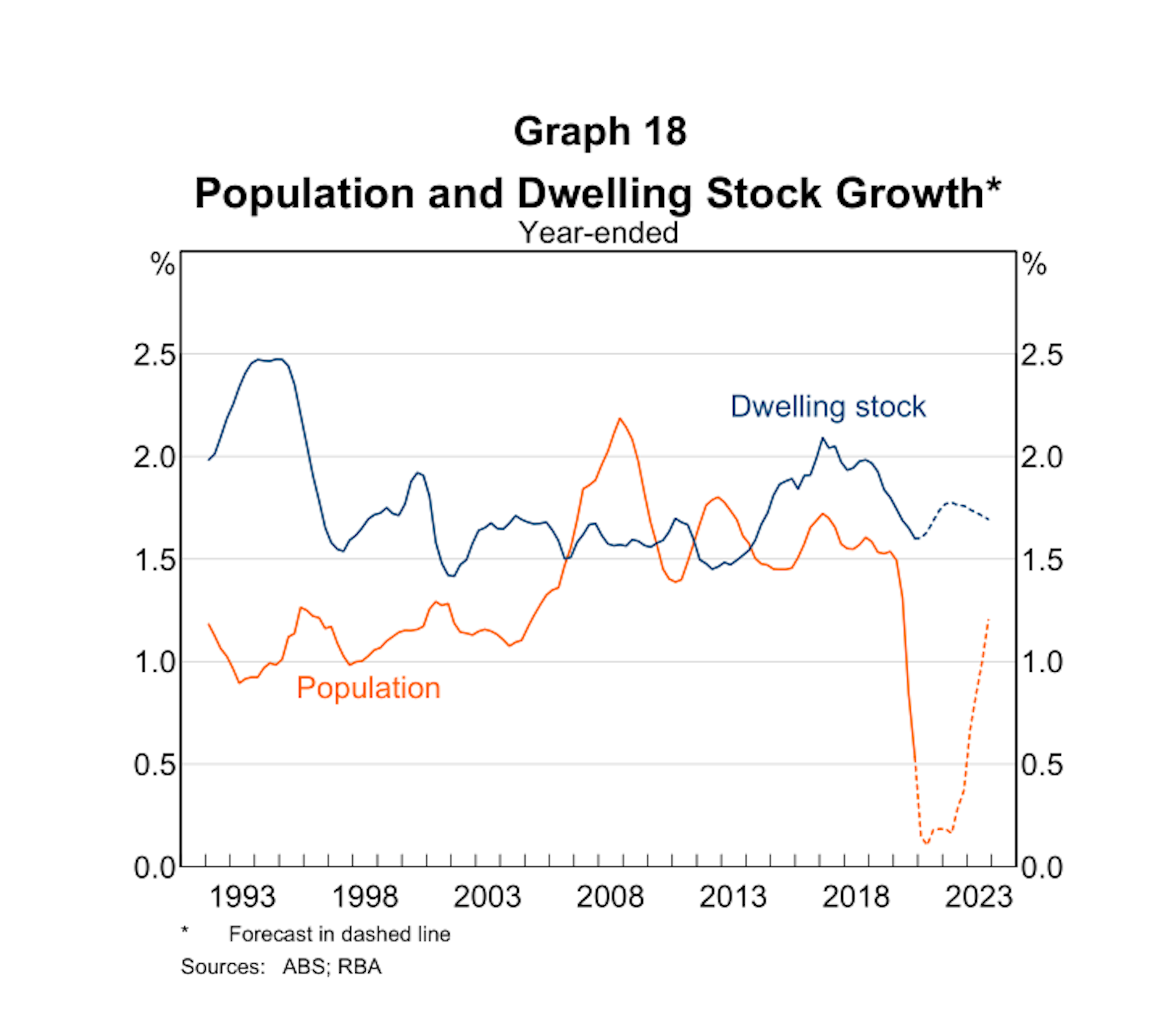
In its submission to the inquiry the Reserve Bank includes a graph showing the supply of housing (the stock of houses and apartments) outpacing population growth for the best part of the decade leading up to the latest price explosion.

Supply has been holding up

But in a sense (and stay with me here) whoever drafted the restricted terms of reference is right. Housing affordability is linked to the supply of housing.

And housing affordability has been doing okay.

In evidence to the inquiry last month Treasury assistant secretary John Swieringa drew a distinction between housing affordability (best measured by the cost of renting housing) and the cost of buying a house, which was partly an investment.

When you are a purchaser of a house you are partly investing in an asset and partly buying dwelling services; whereas when you are renting it’s probably a cleaner read on what cost dwelling services is.

That clean read – rent as a proportion of income – hasn’t much changed in 20 years. For middle earners it has remained comfortably between 20% and 25% of household disposable income.

The Reserve Bank says advertised rents for units in Sydney and Melbourne have drifted down by $30 to $50 per week over the past five years while rents in other places have mostly drifted higher.

As it happens, it says another measure of housing affordability is improving.

The cost of home loan payments as a proportion of income has been falling since the onset of COVID. Dramatically lower interest rates mean payments take up less household disposable income than they did five years ago, even with the much higher prices.

The problem is accessibility

What has worsened is what the Reserve Bank calls “housing accessibility”, to distinguish it from housing affordability.

Accessibility is the ability of a first time owner or renter to get into the market at all by finding the deposit or bond.

Astounding price growth and five years of weak income growth have pushed up the cost of an average first home deposit from 70% of income to more than 80%.

On average it now takes a 24-35 year old nine years of tucking away one fifth of their income each year to save for a typical Sydney deposit, up from five to six years a decade ago.


Average First Home Buyer Deposit

Owner-occupier; estimated as a share of average annual household disposable income using average first home buyer commitment size and assuming 20 per cent deposit. Seasonally adjusted and break-adjusted. RBA, ABS

It’s okay if you have a parent who can get their hands on money, almost impossible if you don’t. In the words of former Reserve Bank official Peter Tulip, it’s making home ownership hereditary.

He’s not the first person to have noticed.

Liberal backbencher John Alexander chaired the Coalition’s 2015 inquiry into home ownership. He said then we were “on track to becoming a Kingdom where the Lords own all the land and the biggest Lord will be King and the enslaved serf tenant is paying rent to the Lord to become wealthier”.

Ownership is becoming hereditary

Prime Minister Turnbull and Treasurer Scott Morrison used the 2016 election (in which they attacked Labor’s plan to limit tax breaks for landlords) to shut down Alexander’s inquiry, and only agreed to restart it with someone else as chair. It had considered 30 hours of evidence.

The chair of this current (limited) inquiry seems unperturbed.

He opened September’s hearings saying no question was off-limits, no idea too stupid, all forms of inquiry were worthwhile. It’d be great if that was true.

Peter Martin, Visiting Fellow, Crawford School of Public Policy, Australian National University

This article is republished from The Conversation under a Creative Commons license. Read the original article.

Read more >>

Wednesday, September 15, 2021

Delta is tempting us to trade lives for freedoms — a choice it had looked like we wouldn’t have to make

Last year COVID-19 seemed simple. It was horrific, but the arguments about what to do were fairly straightforward.

On one side were people rightly horrified by its rapid spread who wanted us to stay at home and stay away from school and work and socialising in order to save lives.

On the other side were people concerned about the costs of those measures — to jobs, to education, to freedom, to mental health, and to other lives (because if we used too much of our health system fighting COVID-19, other lives might fall through the cracks).

And through it all came a kind of consensus.

The concern about non-COVID deaths turned out to be overblown. Last year Australia recorded fewer than normal doctor-certified deaths, in part because the COVID restrictions stopped deaths from influenza, and in part because they snuffed out COVID-19 early, ensuring hospitals weren’t overwhelmed.

Last year, we didn’t have to choose

Concern about jobs also turned out to be overblown. By locking down hard and early, and paying employers to keep on staff (through JobKeeper) we ensured the lockdowns would be short-lived, with light at the end of the tunnel.

In none of the states for which there is data was there an increase in suicides.

The insurance company ClearView told a parliamentary committee this June its research found things were better than expected in part because of the universal nature of the pandemic. Everyone knew “everyone was in this together”.

Another reason was telehealth. It was easier to get help than before.


Read more: 7 lessons for Australia's health system from the coronavirus upheaval


And students returned to school sooner than they would have had the lockdowns had been weaker or started later, leaving much of their education intact.

The consensus was that by locking down hard and early we got the best of both worlds — near-elimination of COVID-19 and a quick return to normal life. Anyone who remembers Christmas last year remembers how normal it felt.

Economics is called the dismal science in part because it is about hard choices — situations where we can’t have our cake and eat it too. Last year it seemed as if COVID wasn’t one of them. Starving the virus early gave us both one of the world’s lowest death tolls and one of its shortest recessions.

Hard choices are back in sight

And then came Delta.

Far more contagious than the original, and with fewer immediate symptoms (making it harder to trace) the Delta variant became almost impossible to get on top of in the two big states where it took hold.

And without very high vaccination rates — in the view of the Grattan Institute significantly higher than either the NSW, Victorian or Commonwealth governments are targeting — it became all but impossible to reopen without condemning Australians to COVID deaths.

The new reality is plunging us back toward the territory economists call their own — the world of hard choices.

If the lockdowns don’t end (and there is no sign they can end any time soon without costing lives) education and mental health and jobs will indeed suffer.

There’s only so long businesses can hang on without pulling the pin.

We are getting closer to having to trade off lives against freedoms; getting closer to having to decide how many COVID deaths and how much COVID illness we are prepared to live with in order to return to something more like normal living.

Last week’s NSW “roadmap to freedom” implicitly made those tradeoffs.

Calculations prepared by the Treasury and the Grattan Institute make them more explicit.

There are few important things to note.

One is that we might yet be able to get the best of both worlds. We might yet be able to effectively eliminate the delta strand, restoring both health and freedoms (as we did with the earlier strand).

It won’t happen if we ease restrictions before transmission has stopped, as some states are planning to.

Lockdowns without end are unsustainable

Another is that unending lockdowns are untenable. While last year’s lockdowns didn’t do the psychological and health and educational damage that was feared, lockdowns without end would.

One type of damage clearly evident in the comprehensive report on last year’s lockdowns from the Australian Institute of Health and Welfare is family and domestic violence. The longer lockdowns continue, the longer elevated violence is likely to continue.

And another thing to note is that in a world where we have to make tradeoffs there are no particularly good options. Allowing the disease to spread in order to restore freedom of movement would itself curtail freedom of movement.


Read more: Economists back social distancing 34-9 in new poll


An analysis across US states suggests 90% of last year’s collapse in face-to-face shopping was due to fear of COVID rather than formal COVID restrictions. That fear will grow if we lift restrictions and COVID spreads.

The Grattan Institute would lift lockdowns only when 80% of the entire population has been double vaccinated (not 70-80% of people aged 16+ as the NSW and national plans envisage, which amounts to 56-64% of the population).

Grattan believes its plan would cost 2,000-3,000 lives per year; a cost it believes the public would accept because it is similar to the normal toll from flu.

The NSW and national plans (Victoria’s isn’t spelled out) would cost much more.

No option is particularly good

The Commonwealth Treasury finds, perhaps counter-intuitively, that an aggressive lockdown strategy that saved more lives would impose lower economic costs (about A$1 billion per week lower) in part because it would end up producing fewer lockdowns.

They are the sort of calculations we hoped never to have to make.

There’s still a chance we might not. With a Herculean effort NSW and Victoria could yet join Taiwan, New Zealand and every other Australian state in being effectively COVID-free. But they are running out of time.


Read more: NSW risks a second larger COVID peak by Christmas if it eases restrictions too quickly


Peter Martin, Visiting Fellow, Crawford School of Public Policy, Australian National University

This article is republished from The Conversation under a Creative Commons license. Read the original article.

Read more >>

Wednesday, September 08, 2021

From October, it will be all but impossible for most Australians to vape — largely because of Canberra’s little-known ‘homework police’

After a misstep, it’s about to become illegal to import e-cigarettes without a prescription, which means that, for most Australians, it’ll become all but impossible to vape from October 1.

The misstep tells us a lot about how the Australian government works behind the scenes — most of it good.

Mid last year, Health Minister Greg Hunt announced plans to ban the import of nicotine-containing e-cigarettes and refills without a doctor’s prescription. Border force would be checking parcels.

To Hunt, the decision made sense. It was already illegal to buy and sell such products without a prescription in every Australian state and territory, and it was illegal to possess them without a prescription in every state but South Australia.

All Hunt was doing was closing a (very wide) loophole.

Government backbenchers revolted, Hunt pointed to a doubling of nicotine poisonings over the past year and the death of a toddler, the prime minister offered less than complete support, saying he was keeping an “open mind”, and Hunt put the idea on the backburner.

That’s the way it played out in public.

But beneath the surface, something impressive was swinging into gear. It’s called the Office of Best Practice Regulation, OBPR, an apolitical body nestled within the prime minister’s department.

Canberra’s ‘homework police’

So what did this little-known entity do that will effectively stamp out vaping from next month? Its executive director, Jason Lange, revealed the back story at an Economic Society of Australia meeting in Canberra earlier this year.

Set up during the 1980s to ensure government decisions didn’t needlessly tie up business in red tape, the office gradually was given other things to consider, including the effect of government decisions on citizens, on the environment, and on the distribution of burdens throughout society.


Read more: Vaping is glamourised on social media, putting youth in harm's way


Then in 2013 Prime Minister Tony Abbott moved it out of the Department of Finance into his own department: Prime Minister and Cabinet.

Prime Minister and Cabinet is the traffic cop: it decides what gets put forward for cabinet to decide, and when. So suddenly the office was working at the centre of government decisions, getting to view every one of the 1,800 or so things put to senior ministers to decide each year.

Seven questions shaping new decisions

For the few hundred proposals it thinks might have significant unintended impacts, the office demands an impact statement.

It doesn’t tell the department or authority putting forward the idea what to put in the statement. But as Lange explained, it “marks the homework”. The proposals behind statements that aren’t good enough find it hard to get to cabinet.

Hunt’s decision on e-cigarettes wasn’t accompanied by an impact statement the first time around. Lange’s office made sure it was on the second.

Each OBPR analysis has to address seven questions.


Office of Best Practice Regulation

The first is what problem the agency is trying to solve. Maybe it’s not really a problem. Merely working that out puts what follows into focus.

The second is why government action is needed. Maybe the problem isn’t very big, or maybe it will solve itself.

The third is what options the agency is considering. The agency has to put forward at least three options, including one that isn’t a regulation. In the case of e-cigarettes, that option was a public awareness campaign.


Read more: Vaping: As an imaging scientist I fear the deadly impact on people’s lungs


Then it has to estimate the likely benefits and costs of each option, including the costs to people the option wasn’t intended to hit, such as under-the-counter retailers and people using vaping to give up smoking.

The fifth question is the range of people and organisations to be consulted (which is a way of making sure it happens). The sixth is to identify the best option from the list, which includes making no regulation whatsoever.

The seventh is the means by which the measure would be implemented and (importantly) later evaluated.

Grading government ideas, from ‘insufficient’ to ‘exemplary’

Once in, and usually after being sent back for further work, the analysis is graded on a scale from “insufficient” to “adequate” to “good practice” to “exemplary”.

Very few are graded exemplary, and very few that we know about are graded inadequate, because if such a proposal does get adopted by cabinet, the impact statement gets published along with the grade and a statement that describes its failings — a “nuclear option” Lange says can be deeply embarrassing.

All impact statements attached to proposals the government adopts get published along with its OBPR rating. It is often the best opportunity the public has to read about the thinking behind the proposal.

Tellingly, only about 80 of the hundreds of impact statements started each year get to decision makers, which means the process itself knocks out poorly thought out proposals.

But if an idea has merit, as did the ban on importing e-cigarettes without a prescription, the 180-page impact statement can make all the difference.

It sets out the problem clearly, sets out a number of possible solutions and identifies the winners and losers from each, and shows how they were consulted.

It demonstrates someone in the government has thought it through clearly, and provides material for the government to use when selling its decision.

On the Office of Best Practice Regulation website are hundreds of impact analyses on topics as diverse as food standards, protection for car dealers, and the redress scheme for child sexual abuse.

Vaping becomes harder on October 1

That’s why from October 1 it will become illegal to import without a prescription nicotine-containing e-cigarettes, and illegal to supply any liquid nicotine that isn’t in child-resistant packaging.

Behind the scenes, the government got it right.The Conversation

Peter Martin, Visiting Fellow, Crawford School of Public Policy, Australian National University

This article is republished from The Conversation under a Creative Commons license. Read the original article.

Read more >>

Wednesday, September 01, 2021

Four GDP graphs that show how well Australia was doing – before Delta hit

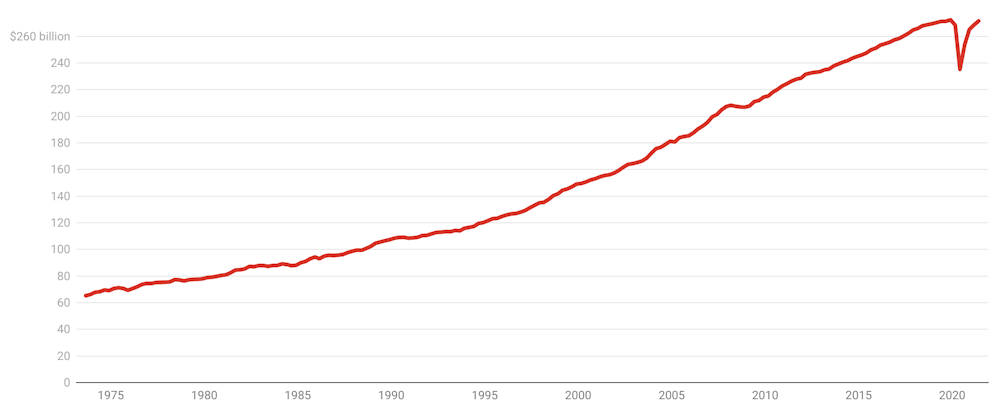
Australia’s economy was performing exceptionally well in the lead-up to the Delta variant lockdowns, propped up by a barrage of government spending in the three months to June and impressive household spending.

The June quarter national accounts published on Wednesday show inflation-adjusted production, income and spending (gross domestic product) climbed 0.7% between March and the end of June, ahead of the NSW lockdown that began on June 26.

Were it not for a surge in imports and a weather-related decline in the volume of exports (each of which cuts measured GDP) gross domestic product would have climbed 1.7% in the June quarter.

Over the year to June economic activity grew a record 9.6%, as it climbed back from a record 7% slide in the three months to June in 2020.


Australian quarterly gross domestic product

Chain volume measures, seasonally adjusted. ABS

At a Parliament House press conference, Treasurer Josh Frydenberg was the first to concede the good news was historical — of “little comfort” to Australians under renewed lockdowns facing difficult days ahead.

The September quarter figures, to be released in three months’ time, were likely to show an economic collapse of at least 2% — the deepest dive since 1974, with the exception of last year’s COVID collapse.

But the starting point for the dive was better than any other developed country. Australia is the only developed country to have gone into this year’s Delta lockdowns with both GDP and employment higher than before COVID-19 struck early last year.


Read more: The four GDP graphs that show us roaring out of recession pre-lockdown


Propping up gross domestic product in the June quarter was a 7.4% surge in public infrastructure spending, driven by state and local governments, which by itself accounted for more than half of the growth in quarterly GDP.

A 1.3% increase in other government spending accounted for the other half.

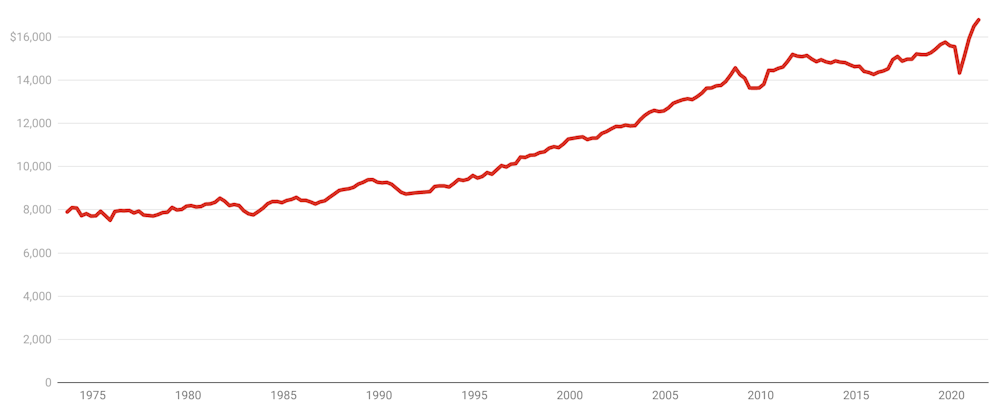
But household spending accounted for almost as much, jumping 1.1% in the quarter as Australians took advantage of a relatively COVID-free autumn to boost spending on domestic tourism, on one measure by as much as 28%.


Household final consumption expenditure

Chain volume measures, seasonally adjusted. ABS

Australians were in a better position to spend than the published economic growth figures suggest.

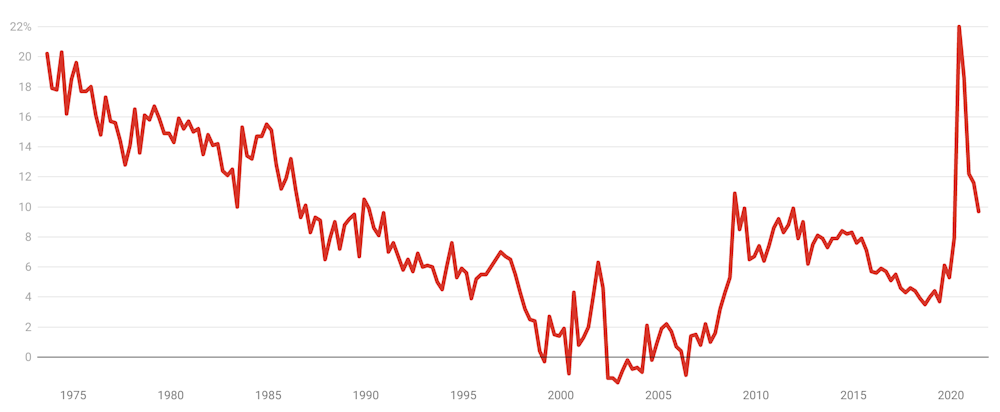
A better measure of buying power is real net national disposable income per capita. This takes account of things such as high iron ore prices, which are excluded from the GDP. It shows buying power up 1.8% in the quarter to a new all-time high.


Real net national disposable income per capita

Chain volume measures, seasonally adjusted. ABS

Before the Delta lockdowns, households were continuing to wind back their record high savings rate, which peaked at 22% in June 2020. They saved 9.7% of their income in the June quarter of this year, compared to 11.9% in the March quarter.


Household saving ratio

Ratio of saving to net-of-tax income, seasonally adjusted. ABS

The lockdowns and the growing realisation they won’t have a clear end date, as they did last year, are likely to have already pushed the saving rate back up.

For months to come, today’s good economic news is set to be as good as it gets.The Conversation

Peter Martin, Visiting Fellow, Crawford School of Public Policy, Australian National University

This article is republished from The Conversation under a Creative Commons license. Read the original article.

Read more >>

My super fund just failed the APRA performance test. What’s next?

Failure is only the beginning.

Thirteen of Australia’s 80 closely-regulated MySuper superannuation funds have failed the APRA performance test.

There’s a fair chance you are among the one million people in them.

The results were made public on Tuesday and handed to the funds on Monday. From here on — for the people who run those funds — it’s about to get worse.

APRA is the Australian Prudential Regulation Authority. Landmark reforms introduced in response to a devastating Productivity Commission report into the “mess” that is much of Australia’s super industry require APRA to rate each MySuper fund (and from next year most other funds) with a pass or a fail according to how they have managed their members’ money.

To fail — as one in six funds have — would require the fund to have for seven or eight years managed its members’ funds so badly that when judged by its own stated investment strategy, those members would have been better off investing in the broad categories of assets themselves and paying the managers to stay away.

Under the rules, which go by the name Your Future, Your Super, funds can only be given a “pass” or a “fail”. Those that fail are required to write to their members.

Letters humbling

The letters, which have to be delivered within 28 days, and which APRA will check, are humiliating.

“Hello [fund member],” they begin. “Your superannuation product has performed poorly under an annual performance test”.

As a result, we are required to write to you and suggest that you consider moving your money into a different superannuation product.

By switching into a better performing product, you can potentially save thousands of dollars more for retirement. For example, by earning 1% higher net return over a 30‑year period, you could be 20% better off at retirement.

At the bottom of each letter is a QR code members can use to go to ato.gov.au/yoursuper to compare funds’ performance. If members log in with their MyGov account they will be told exactly what super they have and where it is (I’ve tried it and it works) and get a comparison tailored to their circumstances.

The 13 funds forced to send out these letters will be lucky to see out the year. Once a fund suffers withdrawals and has to pay out members it performs even worse. Within months, many will be taken over.

Killing season

Those that remain are unlikely to last a second year. Once a product fails for two consecutive years (most that fail in the first year are expected to fail in the second) it will be prohibited from accepting new members, which means it’ll be killed.

It may or may not be relevant, but the driving forces behind the revolution are women. Women typically do much worse out of super than men.

Karen Chester chaired the Productivity Commission inquiry that quantified the hundreds of thousands of dollars lost in retirement by each worker who stays in a dud fund, and came up with the first draft of the performance test.

Kelly O'Dwyer, as financial services minister championed it, as did her successor Jane Hume.

In charge of policing the rules is APRA executive board member Margaret Cole, who was known as the “enforcer” during her time as director of enforcement and financial crime at the UK Financial Services Authority.

On Friday she declared bluntly that Australia had too many funds, too many persistently underperforming funds and too many with fees that remain too high.

Industry funds among those failed

Among the chronic underperformers now facing a death spiral are five industry funds — two of them run by members of Industry Super Australia, the organisation that represents funds set up “only to benefit members”.

Rather, they were members. Maritime Super left just ahead of the results. LUCRF, originally set up by what is now the United Workers Union, was terminated on the release of the results. Industry Super scrubbed it from its website.


Australian Prudential Regulation Authority

The other industry funds that failed the performance test are run by the Australian Catholic Superannuation and Retirement Fund, Christian Super and the Victorian Independent Schools Super Fund.

Among the for-profit failures are funds run by Westpac (BT Super) and the Commonwealth Bank (Colonial First State).

The banking royal commission found that funds run by banks often pay money to other parts of the bank for services such as buying and selling bonds, rather than doing it themselves or through brokers who would get better prices.

In the dark, until now

Super customers needn’t know what happens. They don’t get bills.

Whereas electricity bills hurt when they are delivered and have to be paid, the bills for super fees (and hidden fees in the form of relentless underperformance) aren’t seen, and don’t have to be paid — the fees come out of the funds.

And the funds grow every year, even where they are squandered. Compulsory super throws in a fresh 10% of salary each year.

The aim of what’s happened this week is to make visible what is normally invisible, and to prod people into action.

An act of faith… in competition

The government could have gone down a different track.

Peter Costello, the long-serving Coalition Treasurer who now heads the Future Fund which manages government investments, wanted his successor to create a government super fund (run by his Future Fund) which it would default new workers into.

The Future Fund would have protected workers, but to do it, would have played safe. As it became dominant it would have stifled competition and the promise of better returns. Or that was the thinking.


Read more: Super funds have been working for themselves when they should have been working for us. That's about to change


Chester, O'Dwyer, Hume and Treasurer Josh Frydneberg decided instead to supercharge competition — to make crystal clear which are the funds to run from and the funds to run to. They are making running as easy as two clicks.

One in every 11 dollars we earn is funneled into superannuation. Legislated increases mean it will soon be one in nine.

It’s important it’s looked after.The Conversation

Peter Martin, Visiting Fellow, Crawford School of Public Policy, Australian National University

This article is republished from The Conversation under a Creative Commons license. Read the original article.

Read more >>