Monday, December 21, 2020

Book chapter: Australia had sound economic leadership through the crisis, the challenge now is managing the recovery

Of all the baseless claims made as coronavirus struck, the most dangerous was that there was a trade-off between lives and the economy.

The Conversation’s cartoonist Wes Mountain illustrated it perfectly.  

The idea, raised early and not so much later on, was if we did too much to save lives from coronavirus, we would damage others in ways that were harder to see.

It was wrong in part because lives are what the economy is. 

Australia’s treasury, using a framework developed by Nobel Prize winner Amartya Sen, describes the aim of economic policy as maximising a person’s “freedom to lead a life they have reason to value”.

Deaths destroy that freedom. Deaths matter for economics.


The idea was also wrong because it failed to take account of the pernicious way the virus spreads. Assessing a lockdown is not simply a matter of weighing up lives saved versus lives disrupted. It is a matter of adding to those lives saved all of the future disruptions that will be avoided and the future lives that will be saved if the lockdown stops the virus spreading.

The government rightly imposed huge and otherwise unconscionable costs on the economy in order to get on top of the virus.

Each time it backed them with support for the people and businesses those measures would hurt.

Mid-March 2020, as the government banned public gatherings of more than 500 people (killing the Grand Prix and the footy) it doubled JobSeeker and related payments and gave Australians in need early access to their super.

In late March, as it tightened the limit on gatherings to just two people (forcing much of the population to stay at home), it unveiled JobKeeper, guaranteeing to pay the wages of millions whose jobs were at risk until at least September.

It would be wrong to say all the costs were government-imposed. Well before the big lockdown in late-March 2020 large numbers of Australians were staying away from restaurants, cinemas and the like of their own accord. The recession began during the months those venues were free to trade.

In the face of an unavoidable reality the government decided it was responsible to spend as much as was needed to survive with the least possible damage.

Gone was the carping about the “debt and deficit” Labor ran up to get us out of the global financial crisis.

When he was parliamentary secretary to Prime Minister Tony Abbott in 2014, Josh Frydenberg berated Labor for “intergenerational theft”. It had saddled “every man, woman and child” with thousands of dollars in government debt.

As treasurer, in a crisis on his own watch, Frydenberg doubled government debt with scarcely a mention of children.

His finance minister Mathias Cormann said the strategy was to deal with debt by running up more debt.

As he put it, “the way to get on top of this debt is by growing the economy more strongly and by creating more opportunity for Australians to get ahead, get into jobs, get into better paying jobs. Stronger growth leads to more revenue and lower welfare payments. That’s the way we can go back to where we were.”

We’ve known this works for more than half a century. Government debt was more than 100% of gross domestic product at the end of the second world war. It came down each year as a proportion of GDP, not because the Commonwealth ran budget surpluses it could use to pay it down (with one exception it ran deficits all the way through to the 1980s), but because GDP grew, fuelled in part by annual budget deficits that necessitated more borrowing.

The best way to grow GDP is to avoid or escape a recession. If it achieves that, borrowing can pay for itself.

Borrowing to pay interest on debt can be bad advice for a household, but for the Australian government it is different, especially in an crisis.

Reserve Bank Deputy Governor Guy Debelle resorted to an equation to explain the mechanism at a seminar organised by the Economic Society in June.

He said so long as the interest rate charged (r) was less than the future economic growth rate (g), the burden of interest payments would shrink as a proportion of GDP over time.

Australia’s average rate of real economic growth has been more than 2% per year. More importantly, over the past decade actual annual growth (not adjusted for inflation, which is what matters for debt repayments) has averaged 4.5%.

Right now the government can borrow for ten years at 0.9% per year. In late July it issued a rare 31-year bond that won’t have to be repaid until the middle of the century. It locked in 1.94%, for $15 billion. It had $36.8 billion of bids.

It has arranged interest payments that are likely to be much less than the annual growth in its ability to pay them.

Foreign and Australian investors including super funds are bidding against each other for the right to lend for next to nothing in return for a guaranteed government income.

And the government would have no problem financing its coronavirus programs even if they were not.

Erased from the consciousness of mainstream economists from the 1990s onwards has been the knowledge that governments such as Australia’s can fund as much of their spending as they want by issuing currency – “printing money”.

Britain, Japan, the United States and Europe resumed doing it during and after the global financial crisis. Australia held out for longer, clinging to the myth that the only ways governments could fund programs were taxing and borrowing.

It’s been a useful myth for those wanting to restrain government spending. Martin Wolf of the Financial Times talked about the value of propagating the myth this year when he wrote that while the myth was wrong, once politicians believed it was wrong it would “prove impossible to manage the economy sensibly”.

A branch of economics with strong roots in Australia’s Newcastle and Adelaide universities never doubted that it was wrong. It’s called “modern monetary theory”, which is odd because it is neither modern, nor a theory. It’s reality. Governments can fund spending by creating money – the only real downside being the risk of inflation, which isn’t a risk during a recession.

Since March the Reserve Bank has been doing it by buying government bonds. A bond is a piece of paper on which is written a promise to repay and to pay interest.

The bank has been paying for those bonds by creating Australian dollars, literally, through a process known as balance sheet expansion. On one side of its balance sheet it records the bond it has bought as an asset, on the other it records a matching liability, which is the deposit it has placed into the account of the institution it has bought it from.

To put some (largely cosmetic) distance between creating money and funding government spending, the bank has promised to buy only as many bonds as are needed to keep bond rates low, and to buy them from intermediaries rather than from the government itself. But the effect is the same as if it had handed the newly-created dollars directly to the government, except that it hasn’t needed to do it much.

So keen have been private investors to buy government bonds that, apart from creating and spending $50 billion early on to show that it could, the bank has been able to sit back and watch other investors fund the government, and outbid each other in order to do it.

Despite the government’s (probably premature) announcement of plans to wind back JobKeeper and JobSeeker at the end of the year, there’s no sign of big spending stopping.

After the coronavirus crisis has passed the government will need to spend still more to fund the recovery.

Borrowing at way less than the predicted rate of economic growth means it can fund projects whose prospects were once considered poor, such as high speed rail and widespread tax cuts. But it remains important to pick projects wisely.

The best ones will set Australia up to thrive in the decades to come, decades marked by climate change and (quite possibly) repeated pandemics.

Rarely has a government had such an opportunity to shape Australia.

It has handled the crisis well. The next test will be sculpting the recovery

Chapter in 2020: The Year That Changed Us, The Conversation, Edited by Molly Glassey

Read more >>

Thursday, December 17, 2020

So far so good: MYEFO shows recovery gathering pace

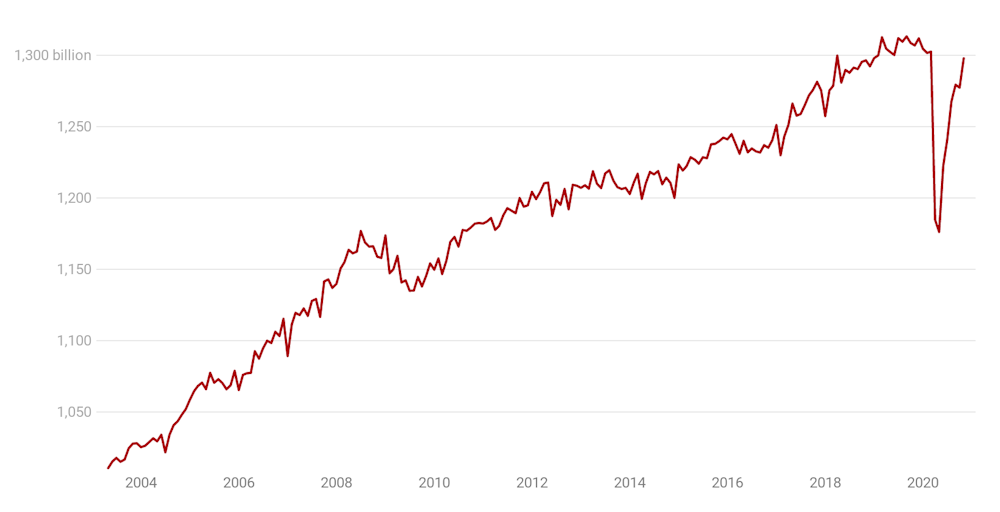
Outside of Victoria the number of hours worked has almost returned to where it was – nowhere near where it would have been, but almost where it was.

Employment figures released as Treasurer Josh Frydenberg was unveiling the mid-year budget update show 1,298 billion hours were worked outside of Victoria in November, just a whisker short of the 1,303 billion worked in March, before things went south.

On a graph it looks like a “V”, the much-talked about V-shaped recovery.


Monthly hours worked in all jobs, excluding Victoria

Seasonally adjusted. ABS Labour Force, Australia

Eagle-eyed readers will note that hours worked were turning down before the coronavirus hit. They peaked in September last year.

Victoria itself has bounced back sharply from the lowpoint of its lockdown in August.

Then it put in 417 billion hours of paid work. In November, with its lockdown over, it put in 453 billion, not too far sort of its peak of 476 billion before things turned bad.

Frydenberg says 85% of the 1.3 million Australians who either lost their jobs or saw their working hours reduced to zero are back at work.


Read more: It isn't right to say we are out of recession, as these six graphs demonstrate


The numbers reflected in the so-called MYEFO budget update.

With more people back in jobs more quickly, and people leaving JobKeeper more quickly than expected in the October budget, the projected deficits will be somewhat smaller, peaking at just under A$200 billion this financial year instead of just over A$200 billion as expected in October.

The budget will still remain in deficit for as long as anyone can forecast, at least ten years, and even after that the government’s net debt will still exceed one third of gross domestic product, although falling interest rates will mean net interest payments start to fall before net debt does.

Some government loans cost it 5% to 5.75% per year in interest. As they expire in the next the years they will be replaced by loans costing 1% or less, and in some cases less than zero, where bidders for bonds offer negative interest rates.

Soaring iron ore prices have pushed up estimates of this year’s company tax take from the $84.5 billion expected in October to $87.9 billion.

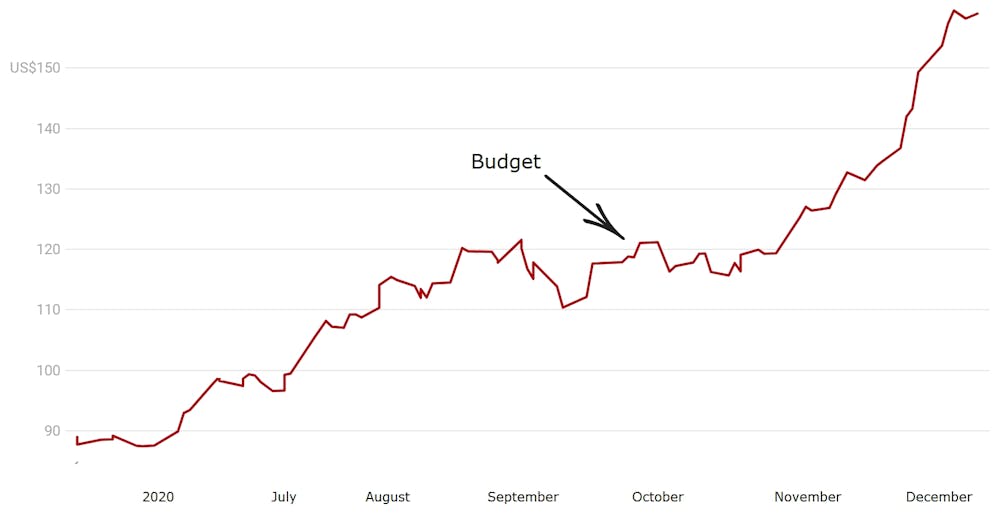
At the time of the budget on October 6, the “cost and freight” spot iron ore price (which includes the cost of getting to it to the buyer) was near US$120 a tonne. In the ten weeks since it has climbed to more than US$150 a tonne.


Spot iron ore price, US$ per tonne, cost and freight

marketindex.com.au

The budget papers express the price differently, as a “free-on-board” price, which excludes shipping and is about US$10 less than the cost and freight price.

In what it says is a “prudent judgement”, the update expects the free-on-board price to glide down to US$55 a tonne by September 2021, meaning it expects it to more than halve.

Much depends on how quickly Brazil ramps up production after a series of catastrophic dam collapses and coronavirus interuptions.

The sooner it does, the sooner the price will halve and the volumes of Australian iron ore sold will wind back, cutting company tax revenue. China would rather buy from Brazil than Australia.


Read more: Robodebt was a policy fiasco with a human cost we have yet to fully appreciate


Boosting the budget is an improved forecast for employment. The unemployment rate is now expected to get down to 5.25% by June 2024, somewhat below the 5.5% expected at budget time.

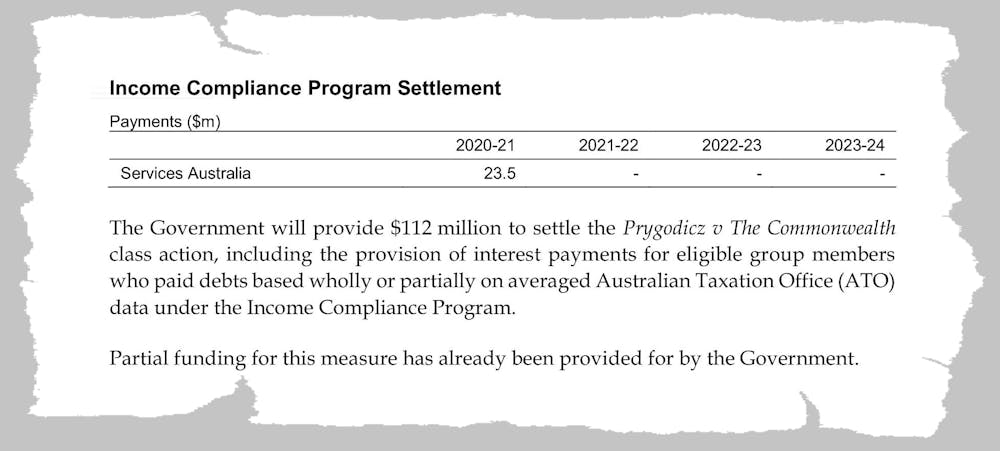
Working the other way is a self-inflicted injury. Tucked away in Appendix A of the update is confirmation of the cost of settling the case brought against the government on behalf of victims of Robodebt who were sent often-incorrect automatically-generated notices alleging that they had to pay back benefits.

It’ll cost $112 million, on top of the $705 million that’s been refunded.The Conversation

Peter Martin, Visiting Fellow, Crawford School of Public Policy, Australian National University

This article is republished from The Conversation under a Creative Commons license. Read the original article.

Read more >>

Wednesday, December 02, 2020

We're not really out of recession, as these graphs show

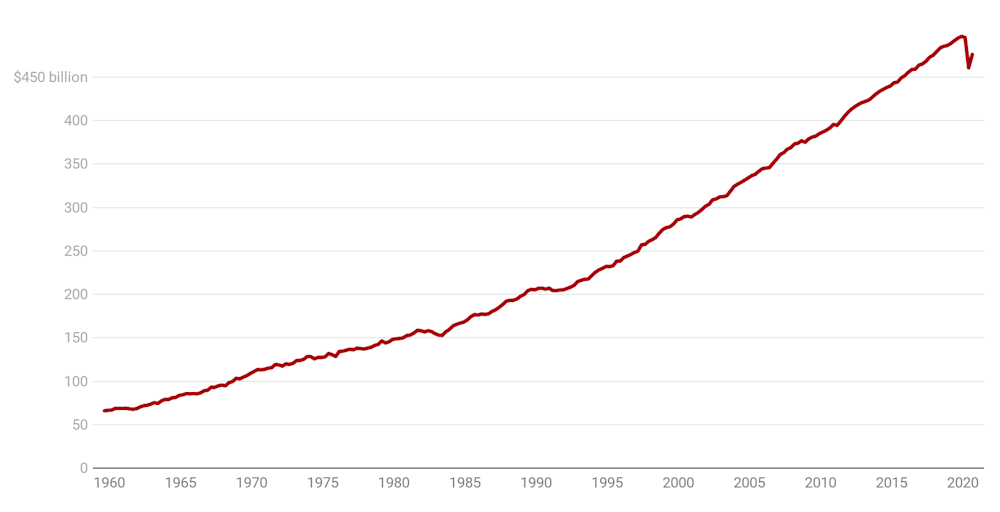
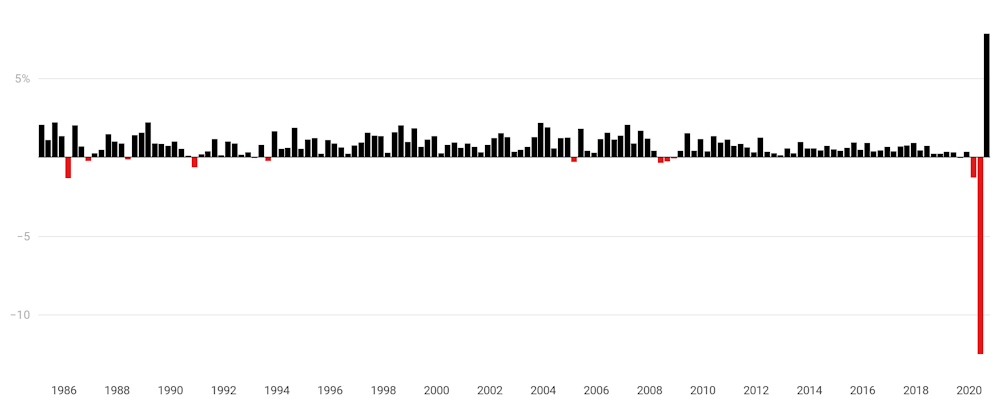
It’d be wrong to say that we are out of recession, although that’s how the graph of Wednesday’s GDP numbers makes it look.

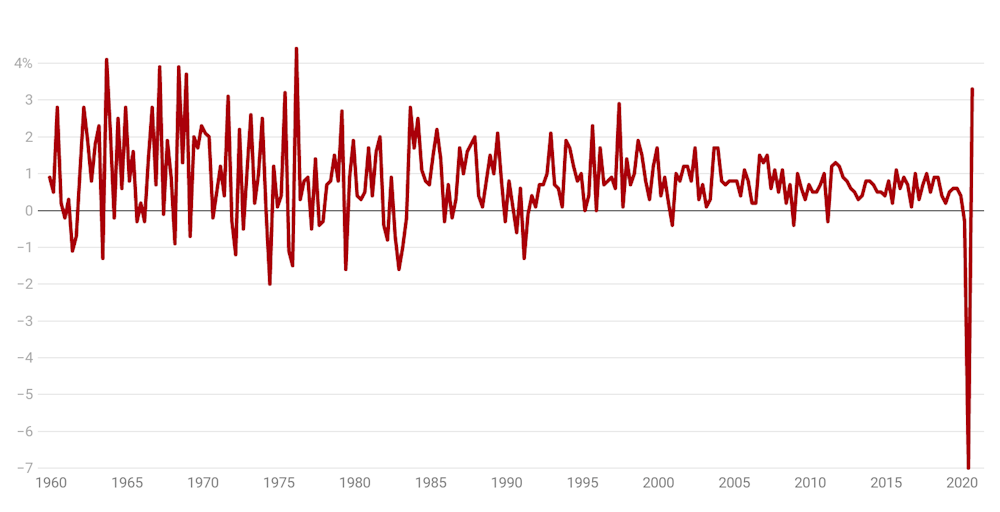
Gross domestic product (the measure of everything produced and earned and spent) fell 7% between the March and June quarters after slipping 0.3% between the December and March quarters, and then rebounded 3.3% between the June and September quarters.

It was the biggest bounce since 1976, after the biggest fall on record.


Quarterly percentage change in gross domestic product

ABS National Accounts

But it hasn’t anything like got us back to where we were.

When the levels rather than the changes in GDP are graphed, it is clear that, as Treasurer Josh Frydenberg put it, we have “a lot of ground to make up”.


Quarterly real gross domestic product

ABS National Accounts

At first sight the graph of quarterly gross domestic product looks odd. Surely if GDP fell 7% and then rebounded by half that much it should have got back half its losses.

But 3.3% of a small number is much less than 7% of a bigger number. We’ve regained only two fifths of what we lost.


Read more: 6 things to watch for as Australia crawls out of recession


And we’ve lost more than that. Had the economy grown as the Reserve Bank forecast before the coronavirus crisis, we would have spent and earned A$509 billion in the September quarter instead of $476 billion.

It’s consumer spending that’s bounced

What drove the bounce was a rebound in consumer spending after months in which we were confined to quarters, and here the news is better than it seems.


Quarterly change in household final consumption expenditure

ABS Australian National Accounts

Nationwide, household spending jumped 7.9% after falling 12.5%, but excluding locked-down Victoria (which will have its own delayed bounceback) household spending in the rest of the country rebounded 11% after falling 12%.

And it bounced back in exactly the places it collapsed while we were locked down; in services such as tourism and hospitality.


Household spending by category

National, percentage change between June quarter and September quarter. Australian Treasury

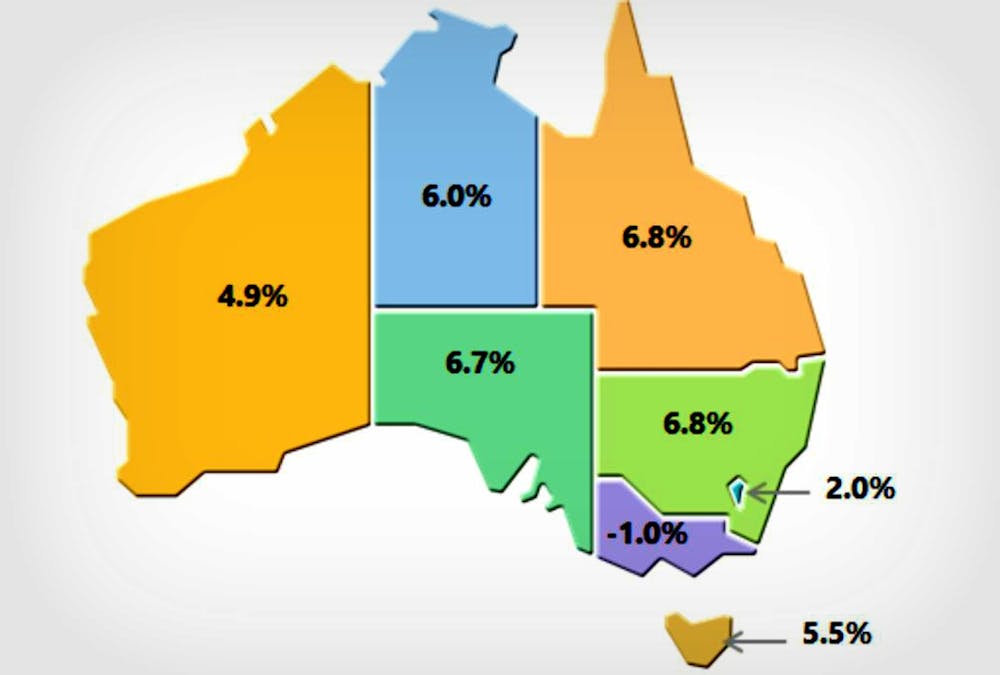
Victoria’s economy literally went backwards.

Spending in Victoria continued to fall while spending everywhere else bounced back.

In only one category, home alcohol consumption, did spending in Victoria advance while spending in other places retreated.


State and territory final demand, September quarter

ABS Australian National Accounts

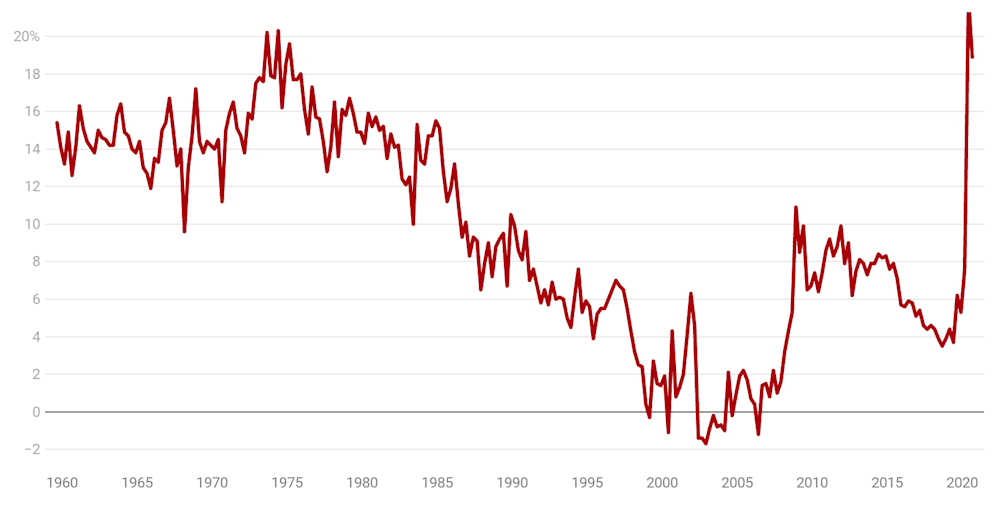
Consumers financed the extra spending by saving less, but even so, Australia’s household saving ratio remained alarmingly high.

In the June quarter Australian households saved a record (upwardly revised) 22.1% of what they earned. In the September quarter that fell to 18.9%, which is still far too high.

In good times, less-worried Australians save less than half that.


Household saving ratio

ABS Australian National Accounts

Frydenberg put the best spin he could on the extraordinarily high amount of saving by saying it would provide “ongoing support for the economic recovery in the new year as confidence continues to build”.

Australia was as well positioned to recover as “any nation on earth”. Over the past year its economy has contracted less than Britain, France, Germany and Japan.

Exports, business investment continue to fall

Much of that success is due to Australia’s achievement in getting on top of the virus and the success of JobKeeper in keeping Australians in work until conditions improved. The Reserve Bank believes it saved 700,000 jobs.

Working against that has been the forth consecutive quarterly fall in export income (something set to worsen unless relations with China improve) and the sixth consecutive fall in business investment.

In a quarter when consumer spending recovered, non-mining business investment fell a further 3% on top of a fall of 8.6% in the previous quarter.

The US National Bureau of Economic Research defines a recession as

a significant decline in economic activity spread across the economy, lasting more than a few months, normally visible in real GDP, real income, employment, industrial production and wholesale-retail sales

On that basis Australia is still in one. Employment, income and production remain well down on where they were a year ago. GDP is down 3.8% on where it was a year ago.

Speaking as the national accounts were being released, Reserve Bank Governor Philip Lowe said he expected Australia’s unemployment rate to remain above 6% for the next two years.

Annual wage growth would remain less than 2%

It was possible the economy could do better.

His forecasts assume no widespread vaccination against coronavirus until late next year. They also assume international travel restrictions until 2022.

But it was also possible things could be worse.

Just three months ago that many were hailing a robust bounce-back in Europe.

Now, Europe’s economy is expected to sink again in the December quarter as member states struggle to contain the virus.

Australia was on a different path, but there was “no guarantee we will remain so”.The Conversation

Peter Martin, Visiting Fellow, Crawford School of Public Policy, Australian National University

This article is republished from The Conversation under a Creative Commons license. Read the original article.

Read more >>

Sunday, November 29, 2020

Top economists want JobSeeker boosted by $100+ per week

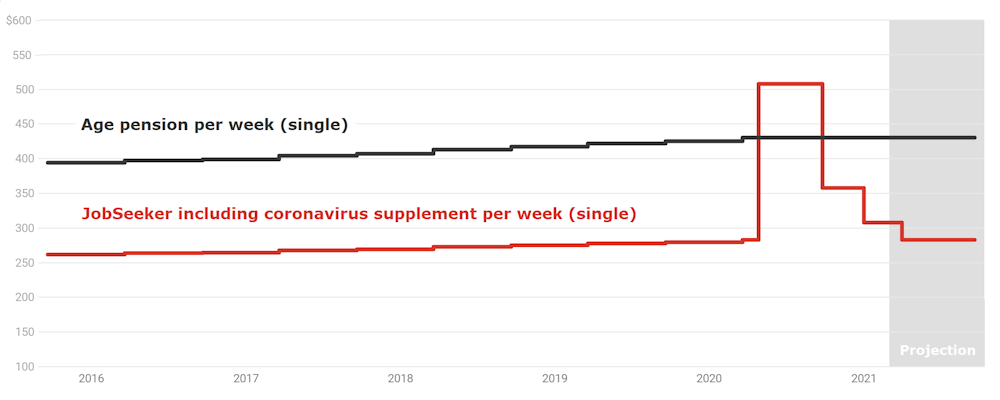
Once about as high as the pension, the JobSeeker (Newstart) unemployment payment has fallen shockingly low compared to living standards.

It’s now only two thirds of the pension, just 40% of the full-time minimum wage and half way below the poverty line.

JobSeeker has fallen relative to other payments because while the pension and wages have climbed faster than prices, JobSeeker (previously called Newstart) has increased only in line with prices since 1991.

In an apparent acknowledgement that JobSeeker had fallen too low, the government roughly doubled it during the coronavirus crisis, introducing a supplement to enable people to “meet the costs of their groceries and other bills”.

But that supplement is being wound down, from A$225 per week to $125 on September 25, and again to $75 on January 1, before expiring on March 31.

After March, the single rate of JobSeeker (including the $4.40 per week energy allowance) will drop back to about $287.25 per week.


JobSeeker vs age pension

Source: Ben Phillips ANU, Services Australia

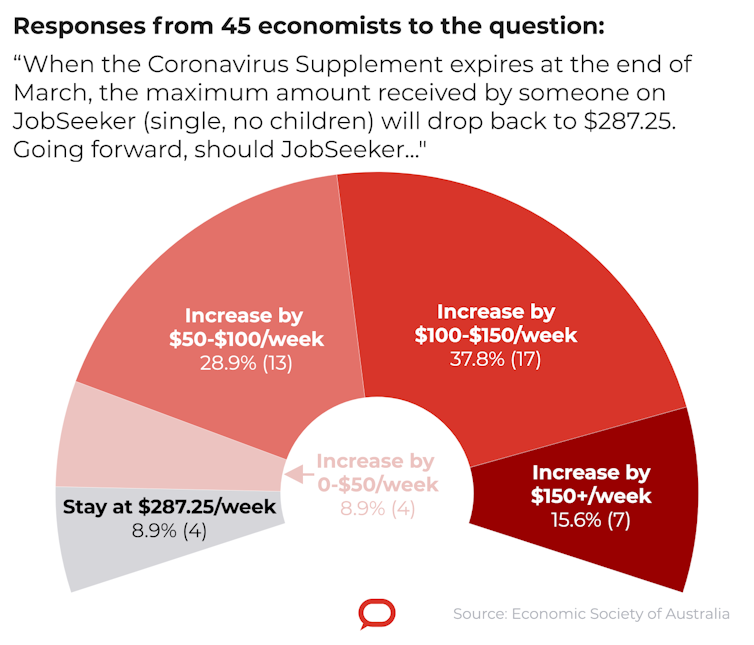
Ahead of a decision about any permanent increase expected early next year, The Conversation and the Economic Society of Australia asked 45 of Australia’s leading economists where they thought JobSeeker should settle.

Only four think it should revert to $287.25 per week.

All but eight want a substantial increase. More than half (24 out of 45) want an increase of at least $100 per week.


Economic Society of Australia/The Conversation, CC BY-ND

The results suggest the economists would be dissatisfied with a decision to merely increase JobSeeker by $75 per week in line with the supplement that is due to expire at the end of March.

The 45 members of the society’s 57-member panel who responded include Australia’s preeminent experts in the fields of microeconomics, macroeconomics economic modelling, labour markets and public policy.

Among them are former and current government advisers, a former member of the Reserve Bank board and a former member of the Fair Work Commission’s minimum wage panel.


Read more: Top economists back boosts to JobSeeker and social housing over tax cuts in pre-budget poll


Many want an increase of about $150 a week to bring JobSeeker close to the age pension and 50% of median income.

Curtin University’s Harry Bloch asked (rhetorically) whether unemployed people had “lower needs than those on the aged pension”.

Labour market specialist Sue Richardson said keeping payments so low that people lost dignity and hope and suffered material deprivation hurt not only the people who were unemployed, but also the thousands of children who grew up in their households.

A scant incentive to shirk

She knew of no evidence that suggested a low rate of JobSeeker increased the likelihood of an unemployed person getting a job.

Jeff Borland said even if JobSeeker was increased by $125 per week, those on it would still earn less than all but 1% of full-time adult workers and would face plenty of remaining financial incentives to get paid work.

In research to be published in The Conversation on Monday he examines a real-life experiment: the temporary near-doubling on JobSeeker between March and September, and finds it played no role in creating unfilled vacancies.


Read more: New finding: boosting JobSeeker wouldn't keep Australians away from paid work


Emeritus Professor Margaret Nowak said JobSeeker had been driven to the point where it denied unemployed Australians the shelter, food and transport they needed to find work.

Former Liberal party leader John Hewson described the failure to adjust JobSeeker for three decades as “immoral”, and a national disgrace driven by “little more than prejudice”.

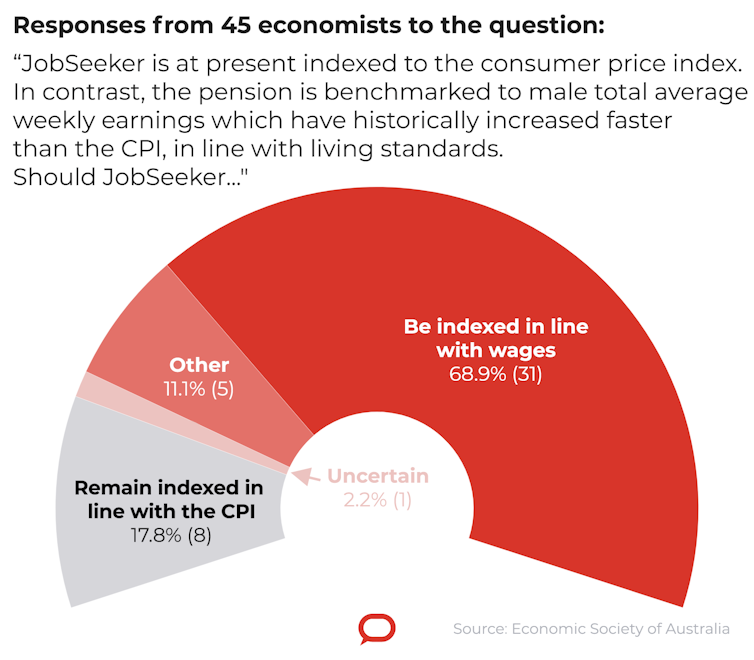
Going forward, there was overwhelming agreement among those surveyed that once JobSeeker was restored to an acceptable level, it should be linked to wages (in line with the pension) rather than increase with prices as before.


Economic Society of Australia/The Conversation, CC BY-ND

Two thirds of those surveyed want JobSeeker increase in line with wages, and of those who do not, several want the pension to increase more slowly in order to ensure the two move in sync.

Gigi Foster and Geoffrey Kingston propose a half-way house – increases in both the pension and JobSeeker halfway between increases in the consumer price index and wages.

Wages determine living standards

Others suggest practical measures to make JobSeeker better at getting Australians into jobs. Beth Webster suggests reducing the rate at which JobSeeker cuts out with hours worked to encourage part-time workers to take on more hours.

Tony Makin suggests a relocation allowance to help people take on jobs distant from their current place of residence.


Read more: 'If JobSeeker was cut, the unemployed would be picking fruit'? Why that's not true


None of the economists surveyed expressed concern about the budgetary cost of restoring the relative position of JobSeeker, estimated by the Parliamentary Budget Office to be $4.8 billion per year for an increase of $95 per week.

Several expressed a desire to put the issue behind them, increasing JobSeeker to a reasonable proportion of the pension or median wage and leaving it there so that, in the words of Saul Eslake, “this issue never arises again”.


Individual responses

The Conversation

Peter Martin, Visiting Fellow, Crawford School of Public Policy, Australian National University

This article is republished from The Conversation under a Creative Commons license. Read the original article.

Read more >>

Friday, November 20, 2020

Retirement review finds problems more super won’t solve

It would be a waste if the Friday’s mammoth Retirement Incomes Review was remembered only for its finding that increases in employers compulsory superannuation contributions come at the expense of wages.

That has long been assumed, and is what was intended when compulsory super was set up.

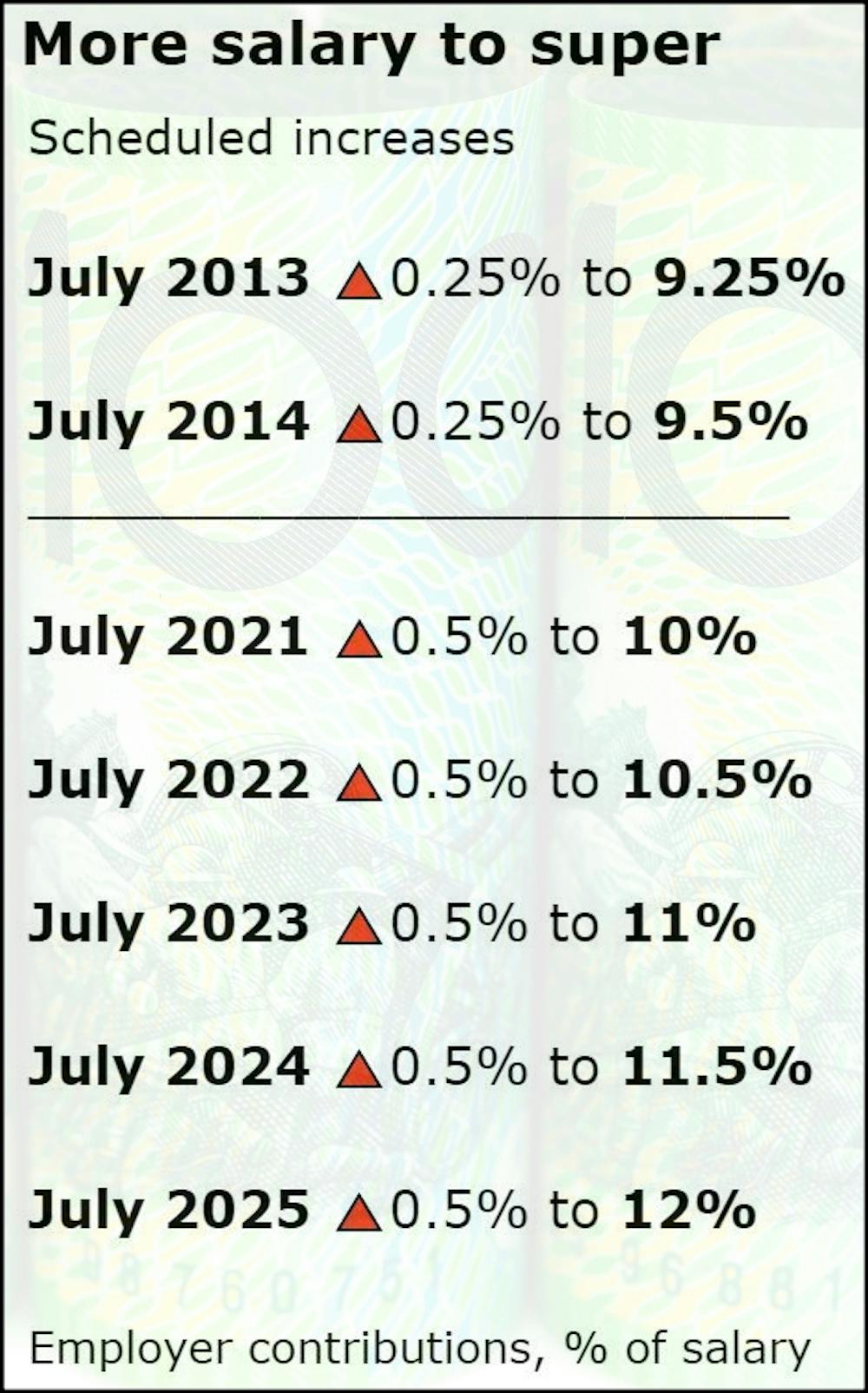
Compulsory super contributions are set to increase in five annual steps of 0.5% of salary between 2021 and 2025.

These are much bigger increases than the earlier two of 0.25% in 2012 and 2013.

And the wage rises they will be taken from will be much lower. The latest figures released on Wednesday point to shockingly low annual wage growth of 1.4%.

Should each of the scheduled increases in employers compulsory super knock 0.4 points off wage growth (which is what the review expects) annual wage growth would sink from 1.4% to 1%.


Read more: Workers bear 71% to 100% of the cost of increases in compulsory super


Private sector wage would sink from 1.2% to 0.8%, in the absence of something to push it back up.

Because inflation will almost certainly be higher than 1%, it means the buying power of wages would go backwards, all for the sake of a better life in retirement.

The review presents the finding starkly. Lifting compulsory super contributions from 9.5% of salary to 12% will cut working-life incomes by about 2%.

And for what? It’s a question the review spends a lot of time examining.

Most retirees have enough

The review dispenses with the argument that the goal of a retirement income system should be “aspirational”, or to provide people with higher income in retirement than they had in their working lives.

It finds that for retirees presently aged 65-74 the replacement rates for middle to higher income earners are generally adequate.

Many lower-income earners get more per year in retirement than they got while working.

If the increases in compulsory super proceed as planned, this will extend to the bottom 60% of the income distribution.

They’ll enjoy a higher standard of living in retirement than while working (and will enjoy a lower standard of living while working than they would have).

Most retirees die with most of what they had when they retired, leaving it as a bequest. They are reluctant to “eat into” their super and other savings because of concerns about possible future health and aged care costs, and concerns about outliving savings.

The review quite reasonably sees this as a betrayal of the purpose of government-supported super, saying

superannuation savings are supported by tax concessions for the purpose of retirement income and not purely for wealth accumulation

It’s the pension that matters

The pension does what super cannot. It provides a buffer for retirees whose income and savings fall due to market volatility, and for those who outlive their savings. 71% of people of age pension age get it or a similar payment. More than 60% of them get the full pension.

If there’s one key message of the review, it is this: it is the pension rather than super that matters for maintaining living standards in retirement, which is what the review was asked to consider.

It is also cost-effective compared to the growing budgetary cost of the super tax concessions.


Read more: Why we should worry less about retirement - and leave super at 9.5%


The age pension costs 2.5% of GDP and is set to fall to 2.3% of GDP over the next 40 years as the super system matures and tighter means tests bite.

Treasury modelling prepared for the review shows that if more money is directed into super and away from wages as scheduled, the annual budgetary cost of the super tax concessions will exceed the cost of the pension by 2050.

There’s a real retirement income problem

A substantial proportion of Australians, about 30%, are financially worse off in retirement than while working, and they are people neither super nor the pension can help.

Mostly they are older Australians who have lost their jobs and cannot get new ones before they before eligible for the age pension or become old enough to get access to their super. Often they’ve left the workforce due to ill health or to care for others and are forced to rely on JobSeeker, which is well below the poverty line.


Read more: Forget more compulsory super: here are 5 ways to actually boost retirement incomes


It’s much worse if they rent privately. About one quarter of retirees who rent privately are in financial stress, so much so that the review finds even a 40% increase in the maximum Commonwealth Rent Assistance payment wouldn’t be enough to get them a decent standard of living in retirement.

No recommendations, but findings aplenty

The review was not asked to produce recommendations. Instead, while noting that much of the system works well, it has pointed to things that need urgent attention.

It finds that pouring a greater proportion of each pay packet into the hands of super funds is not the sort of attention needed, and in the present unusual circumstances could cost jobs as employers who can’t take the extra cost out of wages take it out of headcount.

The government will make a decision about whether to proceed with the legislated increase in compulsory super in its May budget, just before the first of the five increases due in July.The Conversation

Peter Martin, Visiting Fellow, Crawford School of Public Policy, Australian National University

This article is republished from The Conversation under a Creative Commons license. Read the original article.

Read more >>

Tuesday, November 03, 2020

5 ways the Reserve Bank is batting for us like never before

The most important of the five measures the Reserve Bank announced on Tuesday is the one that won’t whirr into place for a very long time.

Others start immediately. On Thursday the bank will wade into the market and start buying up bonds issued by Australian governments.

It’ll buy Commonwealth government bonds with five to seven years left to run on Mondays, Commonwealth bonds with seven to ten years left to run on Thursdays, and bonds issued by state governments on Wednesdays.

It’ll spend about A$5 billion a week, every week for six months until it has unloaded $100 billion.

1. $5 billion per week, week in, week out

As before, when it did this on a more limited scale, it won’t be buying the bonds from the governments that issued them, but from third parties such as super funds and investment managers.

What’s (very) different is that it will be forcing a particular sum of money into their hands.

Its earlier bond buying program (which will continue) spent only as much as was needed to achieve an interest rate target.

The new program will spend a particular sum of created money (the Reserve Bank creates it out of nothing) every week for six months, whatever happens to rates.


Read more: The government has just sold $15 billion of 31-year bonds. But what actually is a bond?


It’ll be true “quantitative easing”, in that it’s the quantity of money that will matter, not the price.

Once in the hands of investors who would really rather own bonds, they’ll have to do something with it, such as investing in a business that employs people. That’s the theory.

As well, with bonds harder to find in Australia, fewer foreigners will move money here to buy them propping up the Australian dollar. That should allow the Australian dollar to fall, making local businesses more competitive against those from overseas. That’s the other part of the theory.

2. Cash rate near zero

And that’s just one of five measures Reserve Bank Governor Philip Lowe announced on Tuesday.

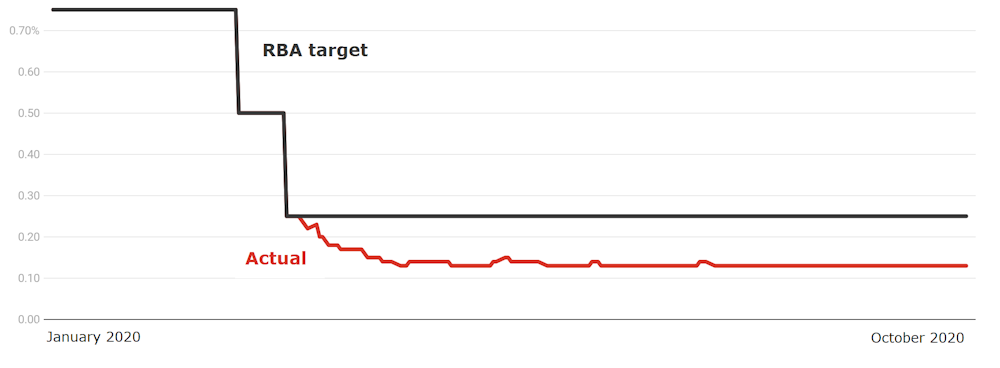
The once-watched cash rate which is the interest rate on unsecured overnight loans between banks, was cut to 0.25% in March amid hope that 0.25% was so low it wouldn’t need to be cut further.

Within days the actual cash rate at which banks transact business had fallen a good deal lower because, at 0.25%, many more of them wanted to lend than borrow.


Target cash rate versus actual

Reserve Bank of Australia

When it settled at about 0.14% the Reserve Bank didn’t bother to intervene to push it back up.

The new target of 0.10% will give banks almost no return for lending to each other and make borrowing from each other almost costless.

The separate rate for cash on deposit with the Reserve Bank will fall from 0.10% to as good as zero, 0.01%


Read more: More than a rate cut: behind the Reserve Bank's three point plan


If the cuts were passed on in full to bank customers they would cut the standard variable mortgage rate from around 3.2% to 3%.

The rate on new mortgages would slide from 2.7% to 2.5%. The rates on customer’s deposits, already near zero, would fall further.

3. Bond rate to 0.10%

The Reserve Bank had been targeting a three-year bond rate of 0.25%, buying as many bonds as were needed to keep it there. It’ll cut that target to 0.10% in line with its cut in the cash rate, buying as many bonds as are needed to get and keep the rate at 0.10%.

Three-year bonds are used to fund fixed three-year mortgages and personal and business loans. All will become even cheaper.

This bond-buying program, which will target the rate, is completely separate from, and additional to, the $5 billion per week the bank will spend buying longer-term bonds week in, week out.

4. Near-free loans to banks

Since March the government has been advancing money to private banks for three years for just 0.25%.

The more they expand their lending to business (and especially to small and medium sized business) the more it will it will advance them in accordance with a formula.

The formula won’t change but the rate will. From Thursday new loans under the program will be offered to banks for just 0.10%.

5. A commitment with teeth

Until now, the bank has been fuzzy about the circumstances in which it will eventually change course and start pushing rates back up.

Its commitment was weaker than it sounded

the board will not increase the cash rate target until progress is being made towards full employment and it is confident that inflation will be sustainably within the 2–3 per cent target band

Whether or not “progress is being made” is subjective.

The commitment allowed the bank to assert that progress was being made and reverse course at its convenience.

Whether or not the bank was “confident” that inflation would be sustainably within its target band was even more subjective.

One word, big change

On Tuesday, Governor Philip Lowe ditched the fuzziness and replaced it with something measurable.

The board will not increase the cash rate until “actual inflation” is sustainably within the 2% to 3% target range.

“For this to occur, wages growth will have to be materially higher than it is currently. This will require significant gains in employment and a return to a tight labour market.”

So prepared is the bank to bat for Australia that it won’t stop until there’s a “tight labour market”.

And it has used the word “actual”.

No longer will the bank need to merely see “progress towards” an inflation rate of 2% to 3%. It will have to be faced with an “actual” inflation rate of 2% to 3%.

Low rates for a long, long time

Australia’s inflation rate hasn’t been sustainably between 2% and 3% for more than half a decade, and it is likely to be at least that long again until it gets back there, if ever.

Governor Lowe said the bank’s forecasts, to be published this Friday, will put the inflation rate at 1%. It’ll put wage growth at the lowest on record, less than 2%.

By tying the future of the cash rate to an actual inflation rate rather than a feeling about the inflation rate, Governor Lowe is tying the bank to a cash rate of close to zero for as far anyone can see.

It means that not only will it be as cheap as it has ever been to borrow (for a mortgage, a business, for anything) it means there’s no risk of that suddenly changing because the bank gets rush of blood to the head. It’s about the future, but it matters now.The Conversation

Peter Martin, Visiting Fellow, Crawford School of Public Policy, Australian National University

This article is republished from The Conversation under a Creative Commons license. Read the original article.

Read more >>

Sunday, October 25, 2020

‘Could do better’: top Australian economists award the budget a cautious pass

Australia’s leading economists have struggled to grade this month’s budget.

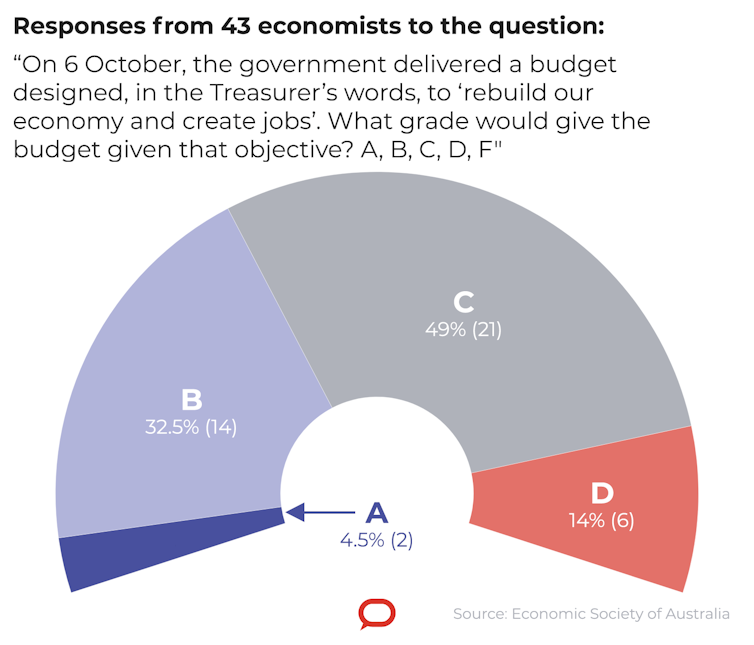
Challenged by the Economic Society of Australia and The Conversation to rate it on a scale of A to F when judged by its stated aims of rebuilding the economy and creating jobs, none of the 43 economists who responded gave it the lowest grades of E or F.

But most who gave it a pass were unhappy.

Financial markets expert Kevin Davis praised “the willingness of a conservative government to adopt needed large deficit spending at variance with its ideology”.

Economic modeller and former Reserve Bank board member Warwick McKibbin said he would give it an A for scale.

But Davis said tax cuts “to the better-off employed” weren’t the best way of achieving desired outcomes, and McKibbin said the composition could have been much better designed.


Read more: It's not the size of the budget deficit that counts; it's how you use it


“There was an opportunity to invest in green infrastructure as part of a fiscal response and a climate/energy policy response that would have longer-term economic and environmental payoffs,” McKibbin said.

“For spending support, transfers to low income households rather than income tax cuts would have given a bigger bang for the buck. Greater support of childcare would support incomes and labour supply.”

Bob Breunig said the design of the childcare benefit created a well-documented income cliff for second earners making it difficult for them to work more hours. It was a known problem and would have been easy to fix.

Hard hats instead of soft skills

The Grattan Institute’s Danielle Wood said it was “absolutely the right call to change course on fiscal strategy and recognise the need for sizeable stimulus, so marks for that”.

But the budget “very much bet the house on a private sector-led recovery”.

Where it had spent money directly it mostly went to “hard-hat” professions such as infrastructure, construction, manufacturing, defence, utilities and energy.


Read more: High-viz, narrow vision: the budget overlooks the hardest hit in favour of the hardest hats


“Some of these sectors haven’t even seen job losses during COVID,” Wood said, and there is already a healthy pipeline of work for transport infrastructure projects, so why spend your stimulus dollars here?“

Renee Fry McKibbin noted that the burden of COVID-19 falls on front-line workers in health, caring industries, hospitality, tourism, arts and education, yet she said the budget focused on sectors "traditionally dominated by men”.

Climate change overlooked

Wood said the price of those blindspots would be a weaker recovery than otherwise, unemployment higher for longer than it could have been, and women’s economic disadvantage entrenched.

Labour market specialist Sue Richardson said relying on incentives such as instant asset write-offs and hiring subsidies was risky because the private sector might not respond in the way that had been hoped.

What direct spending there was seemed “intended largely to recreate the economy of the past, rather than invest in the economy of the future”.


Read more: Budget 2020: promising tax breaks, but relying on hope


“The economy of the future will, among other things, need to have much lower greenhouse gas emissions and much greater ability to cope with the unavoidable damage arising from climate change.”

How we handle the recovery will either set us on a path towards net-zero emissions or lock us into a fossil fuel system from which it will be hard to escape.

Saul Eslake gave the government “great credit for being willing, explicitly, to recalibrate its budget strategy” and run up what (for Australia) were large amounts of debt.

On average, a bare pass

But he said the measures chosen would be less effective in delivering jobs and recovery than others available including vouchers for spending in sectors hard-hit sectors and spending on social housing and childcare.

All but one of the 43 economists who responded to the survey also responded to the pre-budget survey which nominated spending on social housing, education and training and permanently boosting JobSeeker as the top budget priorities.

Assessing the budget, 16 of the 43 (37%) awarded it either an A or a B. Almost half (49%) awarded it a C, or “bare pass”. Six (14%) gave it a D.


43
The Conversation, CC BY-ND

Some of the economists who awarded a B said it was really a “B-minus”

One of them, Lata Gangadharan, said when it came to opportunities for women (those worst affected by the downturn) the budget “failed miserably” and would attract a D.

James Morley said he might have been “too easy of a marker” by awarding a B, but that it was “possible to lose the forest for the trees when only evaluating the budget on its specifics”.

‘B’ reflects the big picture, not the details

The big picture was that deficit-financed stimulus was needed and that the budget provided much more than might have been expected given the previous positions of the treasury and the Morrison government.

He said the forward guidance that put off “budget repair” until after the unemployment rate fell below 6% was welcome, even if one could ask why the threshold of 6% number had been chosen.

The more one looks at the details, the more one wants to significantly mark down the grade for budget. But I will still give it a “B” because the big picture is on the right track and I will just hope the Treasurer somehow becomes an “A” student in the future.

Rana Roy said he would have to grade the budget a C rather than an A or B, “more in sorrow than in anger”.

While he approved of the deficits and the tax cuts and the focus on infrastructure, he strongly suspected the measures would not be enough.

“For example, in an immediate sense it is likely that the negative impact of tapering and terminating JobKeeper will overpower the positive impact of the new wage subsidies for new hires.”


Read more: Top economists back boosts to JobSeeker and social housing over tax cuts in pre-budget poll


Two of those surveyed awarded the budget a B primarily because it had shown restraint. Tony Makin said too much spending would have pushed up the dollar and drawn resources away from the private sector. Geoffrey Kingston said it was important to avoid “maxing out the national credit card”.

Chris Edmond awarded it a C primarily because its assumptions relied on hope.

By simply assuming a widespread effective vaccine will be available next year and not otherwise thinking hard about how to beat the pandemic, the government is being very optimistic.

Others said it had ignored the one thing recommended by most economists, which was to invest in social housing to make housing affordable and create jobs.

A permanent increase JobSeeker would have given a million Australian confidence in the leadup to Christmas. Higher education, a major export earner with a direct impact on productivity, was being left to shrink.

John Quiggin said the budget pursued “cultural/ideological vendettas against perceived enemies like renewable energy and the university sector”.

But he said it was still worth a C. The government was right to budget for a large deficit, and deserved continuing credit for JobSeeker and JobKeeper.


Individual responses

The Conversation

Peter Martin, Visiting Fellow, Crawford School of Public Policy, Australian National University

This article is republished from The Conversation under a Creative Commons license. Read the original article.

Read more >>

Tuesday, October 06, 2020

Budget 2020: promising tax breaks, but relying on hope

Tax cuts aren’t the half of it.

The personal income tax cuts promised in the budget will cost A$17.8 billion over four years.

The measures aimed at supporting businesses – the temporary instant tax write off of capital investments, the temporary ability to use losses to reduce previous tax payments, the JobMaker hiring credit and the enhanced apprentice wage subsidy — will cost $26.7 billion, $4.8 billion, $4 billion and $1.2 billion.

That’s a total of $36.7 billion — a subsidy for private businesses without precedent.

The clumsy wording in the part of the budget that sets out strategy says the aim is to “drive sustainable, private sector-led growth and job creation”.

‘Driving private sector-led growth’

Driving private sector-led growth doesn’t quite make sense, but it’s easy to get a handle on what it means.

By itself, business isn’t in a position to drive much.

Even with the budget measures – even with the Australian Taxation Office allowing most businesses to write off everything they spend on equipment over the next two years – non-mining business investment is expected to collapse 14.5% this financial year and bounce back only 7.5% the next.

The JobMaker hiring credit is intended to be a smarter version of the JobKeeper wage subsidy, which was wound back at the end of September, and will be wound back again after Christmas, before vanishing at the end of March.

Instead of helping pay the wages of all employees in businesses affected by the pandemic – the budget papers say right now it is helping pay 3.5 million wages, more than a quarter of the workforce – it’ll help pay the wages only of extra employees taken on.

JobKeeper replaced with something weaker

And only if they are aged between 16 and 35 and have previously been on JobSeeker or a related payment.

It’ll last for just a year and be worth only $100 or $200 a week, depending on the age of the person hired.

The government says it will support 450,000 positions.

But because a much larger subsidy for millions of positions will be withdrawn, there’s a risk employment will collapse as businesses especially affected by the pandemic (in industries such as tourism) find they can no longer afford to keep the staff they’ve got, let alone take on new ones.

It makes the budget a statement of faith, or hope.

Tax cuts in the hope we spend

There’s also hope we’ll spend the tax cuts that have been brought forward.

As of the start of this this financial year (it’ll be backdated), you can earn up to $45,000 instead of $37,000, paying just 19 cents in the dollar tax and nothing on the first $18,200.

High earners can keep paying 32.5 cents in the dollar right up to $120,000 instead of $90,000.


Low earners will get an offset of up to $700, middle earners an offset of up to $1,080 for another year.

Pensioners and recipients of carer payments and family tax benefits will get two extra cash payments of $250, on top of the two of $750 each earlier this yer, to be delivered in December and March.

The government is hoping the payments and the tax cuts will keep the slump in consumer spending to 1.5% this year, followed by a rebound of 7% next financial year.

All being well, unemployment will fall

It expects the unemployment rate to peak at 8% in the last three months of this year and then to fall to 6.5% by mid-2022.

It says the “effective unemployment rate”, which counts as unemployed people who are working zero hours (because of JobKeeper or other reasons) peaked at close to 15% in April, before sliding to around 9.25%.

The economy is expected to grow a larger than normal 4.75% next financial year and then to grow by 3% after falling 1.5% this financial year.


While not returning to surplus at any time in the next ten years, the budget deficit is expected to shrink from an eye-watering $213.6 billion this financial year (11% of gross domestic product) to -11.0 to $66.9 billion in 2023-24 (3% of GDP).


It’ll do it as spending returns to normal, which it might, if everything turns out as assumed.


A lot needs to go right

But the budget says, in words stronger than those used previously, “outcomes could be substantially different to the forecasts, depending upon the extent to which these assumptions hold.”

Those assumptions are that from here on, localised outbreaks of COVID-19 occur but are largely contained, a population-wide vaccination program is fully in place by late 2021, general social distancing restrictions continue until that happens and Victoria’s special restrictions and state border restrictions are lifted by the end of the year — except for Western Australia’s which will be lifted by April 2021.

There are other assumptions.

International travel is expected to remain low until late next year and then climb, allowing net overseas migration to reach 201,000 by 2023-24, still less than the 271,000 per year that was common.


For this year and next year, net overseas migration will be negative, as we lose more people to overseas than we gain from overseas.

Only a (somewhat diminished) birth rate will stop the population shrinking.

A lot could quickly date

The government’s most-recent economic statement, in July, was rendered out of date within days as Victoria went into stage 4 lockdown.

Anything could happen to render the budget forecasts redundant, and probably will.


Read more: Budget 2020: Frydenberg tells Australians, ‘we have your back’


From my standpoint, the government is putting too much store on businesses driving the recovery after JobKeeper has been wound back.

But if businesses don’t, it has given every indication it is prepared to do more. It’s hard to fault much of what its done. It has certainly shown its willingness to be flexible.The Conversation

Peter Martin, Visiting Fellow, Crawford School of Public Policy, Australian National University

This article is republished from The Conversation under a Creative Commons license. Read the original article.

Read more >>