Tuesday, October 06, 2020

Budget 2020: promising tax breaks, but relying on hope

Tax cuts aren’t the half of it.

The personal income tax cuts promised in the budget will cost A$17.8 billion over four years.

The measures aimed at supporting businesses – the temporary instant tax write off of capital investments, the temporary ability to use losses to reduce previous tax payments, the JobMaker hiring credit and the enhanced apprentice wage subsidy — will cost $26.7 billion, $4.8 billion, $4 billion and $1.2 billion.

That’s a total of $36.7 billion — a subsidy for private businesses without precedent.

The clumsy wording in the part of the budget that sets out strategy says the aim is to “drive sustainable, private sector-led growth and job creation”.

‘Driving private sector-led growth’

Driving private sector-led growth doesn’t quite make sense, but it’s easy to get a handle on what it means.

By itself, business isn’t in a position to drive much.

Even with the budget measures – even with the Australian Taxation Office allowing most businesses to write off everything they spend on equipment over the next two years – non-mining business investment is expected to collapse 14.5% this financial year and bounce back only 7.5% the next.

The JobMaker hiring credit is intended to be a smarter version of the JobKeeper wage subsidy, which was wound back at the end of September, and will be wound back again after Christmas, before vanishing at the end of March.

Instead of helping pay the wages of all employees in businesses affected by the pandemic – the budget papers say right now it is helping pay 3.5 million wages, more than a quarter of the workforce – it’ll help pay the wages only of extra employees taken on.

JobKeeper replaced with something weaker

And only if they are aged between 16 and 35 and have previously been on JobSeeker or a related payment.

It’ll last for just a year and be worth only $100 or $200 a week, depending on the age of the person hired.

The government says it will support 450,000 positions.

But because a much larger subsidy for millions of positions will be withdrawn, there’s a risk employment will collapse as businesses especially affected by the pandemic (in industries such as tourism) find they can no longer afford to keep the staff they’ve got, let alone take on new ones.

It makes the budget a statement of faith, or hope.

Tax cuts in the hope we spend

There’s also hope we’ll spend the tax cuts that have been brought forward.

As of the start of this this financial year (it’ll be backdated), you can earn up to $45,000 instead of $37,000, paying just 19 cents in the dollar tax and nothing on the first $18,200.

High earners can keep paying 32.5 cents in the dollar right up to $120,000 instead of $90,000.


Low earners will get an offset of up to $700, middle earners an offset of up to $1,080 for another year.

Pensioners and recipients of carer payments and family tax benefits will get two extra cash payments of $250, on top of the two of $750 each earlier this yer, to be delivered in December and March.

The government is hoping the payments and the tax cuts will keep the slump in consumer spending to 1.5% this year, followed by a rebound of 7% next financial year.

All being well, unemployment will fall

It expects the unemployment rate to peak at 8% in the last three months of this year and then to fall to 6.5% by mid-2022.

It says the “effective unemployment rate”, which counts as unemployed people who are working zero hours (because of JobKeeper or other reasons) peaked at close to 15% in April, before sliding to around 9.25%.

The economy is expected to grow a larger than normal 4.75% next financial year and then to grow by 3% after falling 1.5% this financial year.


While not returning to surplus at any time in the next ten years, the budget deficit is expected to shrink from an eye-watering $213.6 billion this financial year (11% of gross domestic product) to -11.0 to $66.9 billion in 2023-24 (3% of GDP).


It’ll do it as spending returns to normal, which it might, if everything turns out as assumed.


A lot needs to go right

But the budget says, in words stronger than those used previously, “outcomes could be substantially different to the forecasts, depending upon the extent to which these assumptions hold.”

Those assumptions are that from here on, localised outbreaks of COVID-19 occur but are largely contained, a population-wide vaccination program is fully in place by late 2021, general social distancing restrictions continue until that happens and Victoria’s special restrictions and state border restrictions are lifted by the end of the year — except for Western Australia’s which will be lifted by April 2021.

There are other assumptions.

International travel is expected to remain low until late next year and then climb, allowing net overseas migration to reach 201,000 by 2023-24, still less than the 271,000 per year that was common.


For this year and next year, net overseas migration will be negative, as we lose more people to overseas than we gain from overseas.

Only a (somewhat diminished) birth rate will stop the population shrinking.

A lot could quickly date

The government’s most-recent economic statement, in July, was rendered out of date within days as Victoria went into stage 4 lockdown.

Anything could happen to render the budget forecasts redundant, and probably will.


Read more: Budget 2020: Frydenberg tells Australians, ‘we have your back’


From my standpoint, the government is putting too much store on businesses driving the recovery after JobKeeper has been wound back.

But if businesses don’t, it has given every indication it is prepared to do more. It’s hard to fault much of what its done. It has certainly shown its willingness to be flexible.The Conversation

Peter Martin, Visiting Fellow, Crawford School of Public Policy, Australian National University

This article is republished from The Conversation under a Creative Commons license. Read the original article.

Read more >>

Monday, September 28, 2020

Top economists back boosts to JobSeeker and social housing over tax cuts in pre-budget poll

Overwhelmingly, Australia’s leading economists want the budget to boost social housing and the JobSeeker unemployment benefit rather than bring forward personal income tax cuts.

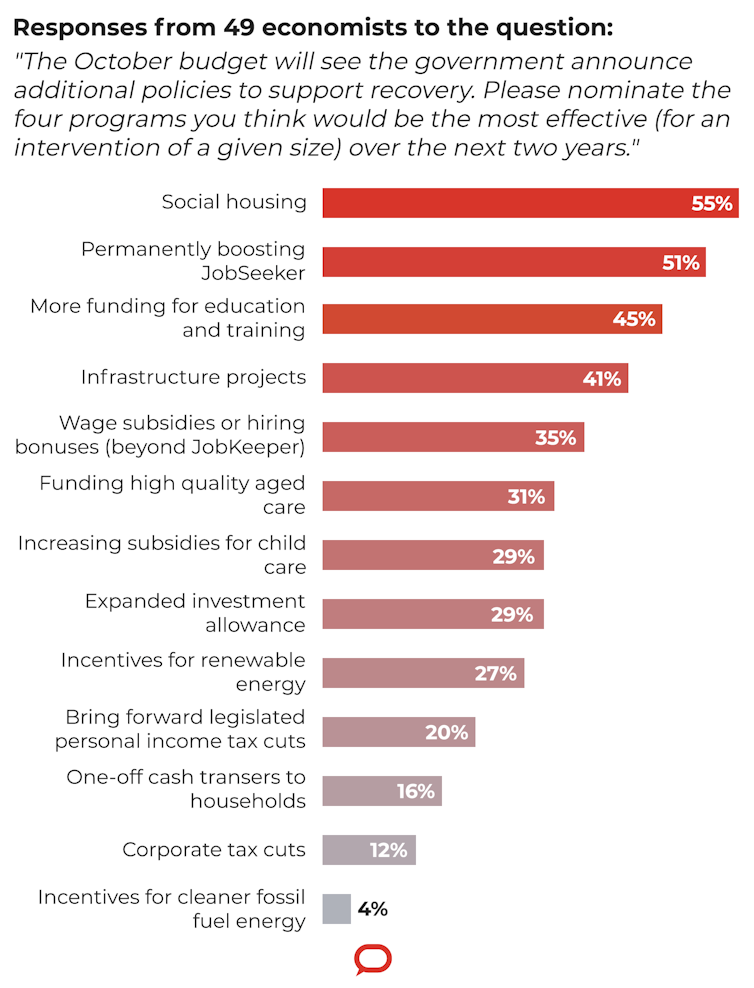
The 49 eminent economists who responded to Conversation-Economic Society of Australia pre-budget survey were asked to rate 13 options in terms of “bang for the buck” – effectiveness in boosting the economy over the next two years.

Among the options offered were boosting JobSeeker (previously called Newstart), wage subsidies beyond the expiry of JobKeeper, one-off cash payments to households, big infrastructure spending, bringing forward the personal income tax cuts, and company tax cuts.

The options were selected by a committee of the central council of the Economics Society and were presented to each surveyed economist in a random (shuffled) order.

The economists surveyed are Australia’s leaders in the fields of microeconomics, macroeconomics, economic modelling and public policy. Among them are former and current government advisers, former heads of statutory authorities, and a former member of the Reserve Bank board.

Each was asked to nominate the four most effective options for boosting the economy.


Economic Society of Australia/The Conversation, CC BY-ND

The most popular option, endorsed by 55% of those surveyed, was boosting spending on social housing.

Monash University econometrician Lisa Cameron said the budget provided an unusual opportunity to fix things for the long term while boosting the economy.

Social housing would leave us with something worthwhile (as did the school hall building program during the global financial crisis) in addition to providing work for the building industry. Alleviating homelessness would be a lasting benefit.

If it goes to the unemployed, it will be spent

The second most popular option, endorsed by 51%, was permanently boosting JobSeeker, previously known Newstart. The temporary boost in the A$282.85 per week payment was wound back last week and will end in December.

Melbourne University economist John Freebairn pointed out that with no real increase in Newstart since 1993 and many on it in demonstrable poverty, every extra cent spent on it will be spent rather than saved.

Supported by fewer than half of those surveyed, but third most popular at 45%, was more funding for education and training.


Read more: Should the government keep running up debt to get us out of the crisis? Overwhelmingly, economists say yes


Flinders University labour market specialist Sue Richardson said education was labour-intensive, which would help with employment, and would assist young people severely hit by the pandemic to get the skills they would need to get jobs rather than stay unemployed.

Matthew Butlin, who heads the South Australian Productivity Commission, said the decimation of income from student fees means universities will have less money to subsidise research. There was a case for more direct funding of university research in the form of competitive grants for projects with practical applications.

The fourth most popular option was infrastructure spending, supported by 41%.

Why not a Hoover Dam, a new Opera House?

Many made the point that the projects chosen would have to be worthwhile in their own right, and feared this might not be the case. Others looked to big “nation building” projects along the lines of the Hoover Dam in the United States which was built during the Great Depression and employed 21,000 people.

“Why not building a massive dam in Australia? Why not building a new Sydney Symphony Orchestra building like the Berlin Philharmonie? Why not expand the National Parks? Why not building green libraries all over Australia?,” asked Sydney University’s Stefanie Schurer.


Read more: Homelessness and overcrowding expose us all to coronavirus. Here's what we can do to stop the spread


Done right, like the Sydney Harbour Bridge which was completed during the Great Depression, big imaginative projects could leave us with something valuable.

There was less enthusiasm for continued wage subsidies (35%) and an expanded investment allowance (29%) with University of NSW economist Gigi Foster saying investment allowances could be replaced with income-contingent loans along the lines of the Higher Education Contributions Scheme.

That way businesses could borrow to invest, with an obligation to repay if the investment paid off.

If it goes on tax cuts, it might not be spent

The same approach was taken by some to funding higher quality aged care (supported by 31%) and increasing subsidies for child care (29%).

Economic modeller Warwick McKibbin suggested funding child care through income-contingent loans (repayable on the basis of income) rather than subsidies.

Bringing forward the leglislated personal income tax cuts as proposed by the government and cash payments to households were relatively unpopular, supported by 20% and 16%.

Saul Eslake said that while he agreed with the treasurer that early tax cuts would “put money in people’s pockets”, there was no guarantee the high earners “into whose pockets most of that money would be put”, would take it out and spend it in sufficient quantity.


Read more: Frydenberg is setting his budget ambition dangerously low


Eslake suggested that rather than supporting households with cheques as happened during the financial crisis, households could be handed time-limited tradeable vouchers that could be spent in areas hurt by restrictions, such tourism and the arts, or used for other worthwhile purposes such as childcare or reskilling.

Among those who did support bringing forward the tax cuts was John Freebairn, who said that although presented as cuts, what was proposed would do little more than restore what had been lost to bracket creep, keeping income tax steady.

Company tax cuts an also-ran

Company tax cuts, once touted by former prime minister Malcolm Turnbull as the key to jobs and qrowth garnered minimal support, being backed by just six of the 49 economists surveyed.

The least popular option, backed by only two economists surveyed, was government support for cleaner fossil fuels such as natural gas, as the prime minister is promising. In contrast 13 (26%) backed support for renewable energy.


Individual responses

The Conversation

Peter Martin, Visiting Fellow, Crawford School of Public Policy, Australian National University

This article is republished from The Conversation under a Creative Commons license. Read the original article.
Read more >>

Wednesday, September 02, 2020

Six graphs that explain Australia's recession

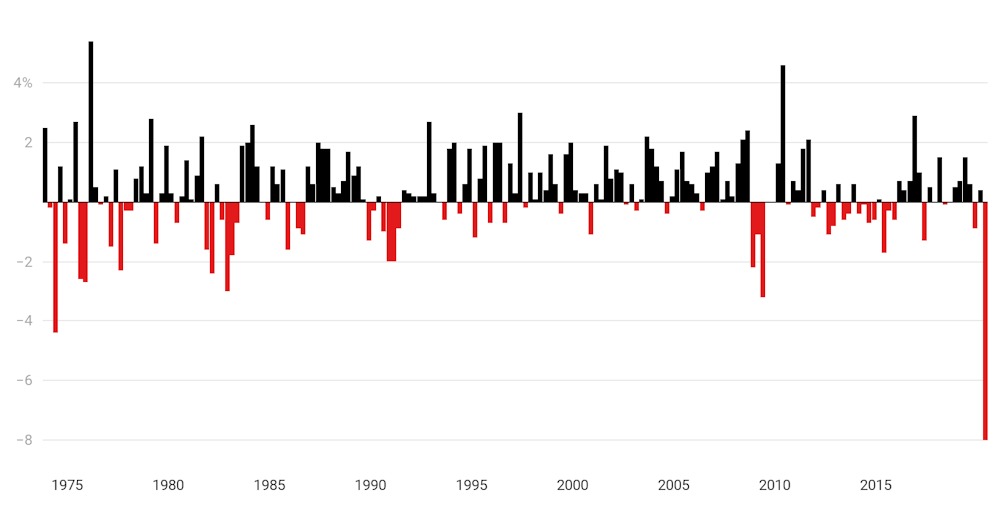
Australia’s recession is the deepest since the Great Depression of the early 1930s.

Nothing else comes close.

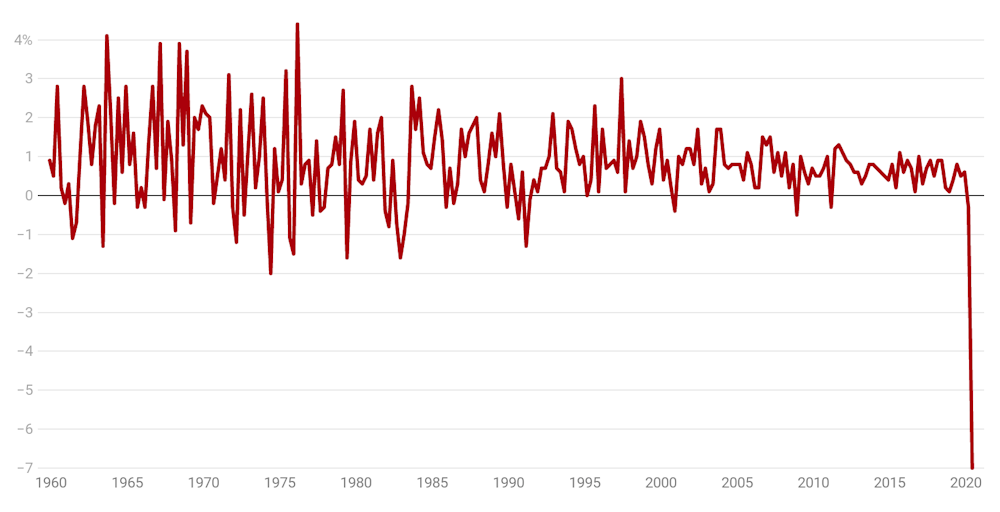
The economy shrank an extraordinary 7% in the three months to June – by far the biggest collapse since the Bureau of Statistics began compiling records in 1959.

The previous worst quarterly outcome was minus 2%, in June 1974.


Quarterly percentage change in gross domestic product

ABS National Accounts

It was going to be worse.

Treasurer Josh Frydenberg told a parliament house press conference that in March his advisers were predicting a collapse three times as big in the June quarter – 20%. In May the forecast was for a June quarter collapse of 10%.

Britain’s economy actually did collapse 20% in the June quarter; the US economy collapsed by nearly 10%.

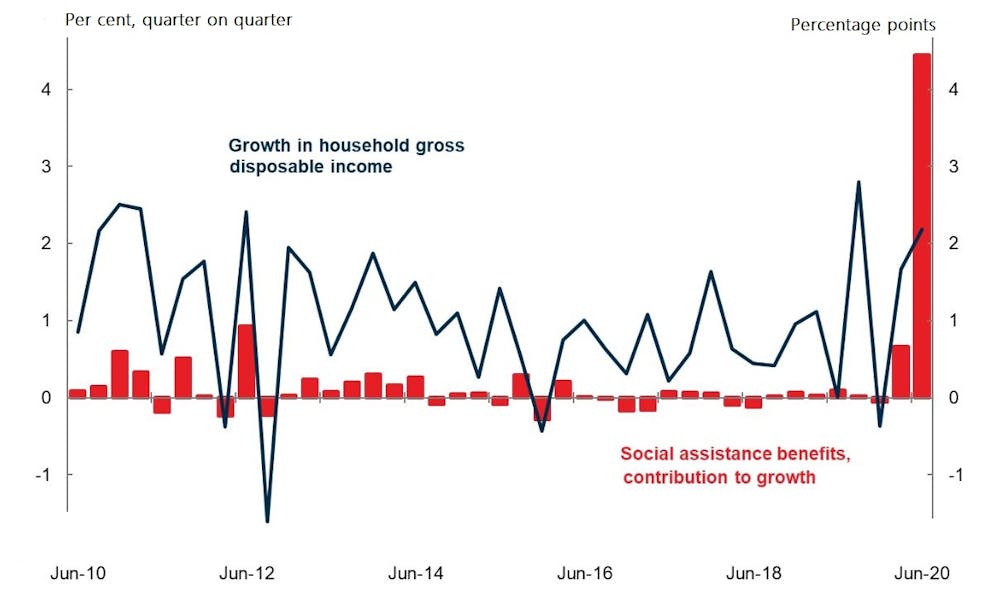
What staved off a collapse of the order feared was unprecedented government support – more than A$100 billion in JobKeeper and expanded JobSeeker payments alone–enough to actually lift household incomes while 643,000 Australians lost their jobs and many more lost hours.


Contribution of government benefits to household income growth

Commonwealth Treasury

A better measure of living standards, taking account households and businesses, so-called “real net national disposable income per capita”, fell nonetheless, by a record 8%.


Quarterly percentage change in living standards

Quarterly change in real national disposable income per capita. ABS Australian National Accounts

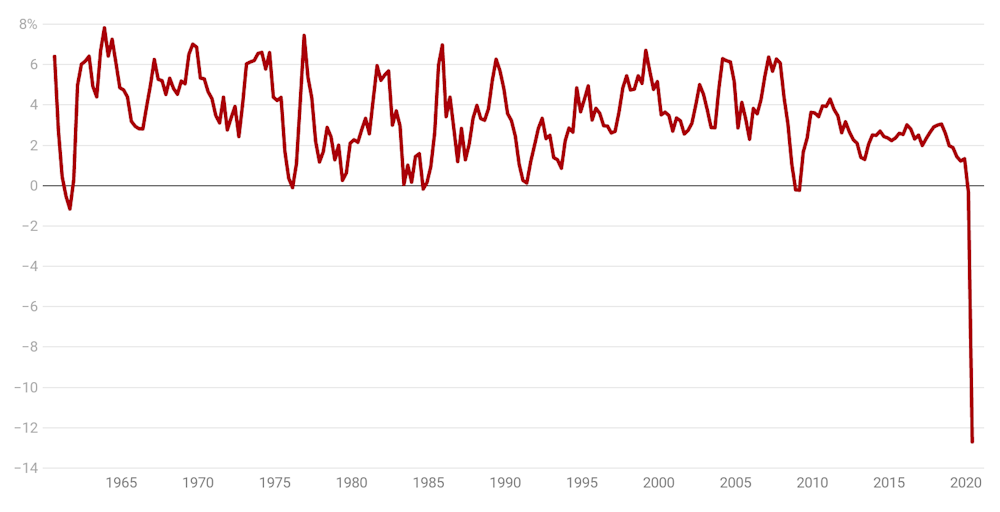
Consumer spending fell by even more, an extraordinary 12.7%, in part because lockdowns and caution in the face of COVID-19 provided fewer opportunities to spend.

Given that consumer spending climbed not at all over the three quarters leading up to the June quarter, it meant that household spending fell over the entire financial year, for the first time since records have been kept.


Quarterly change in household final consumption expenditure

ABS Australian National Accounts

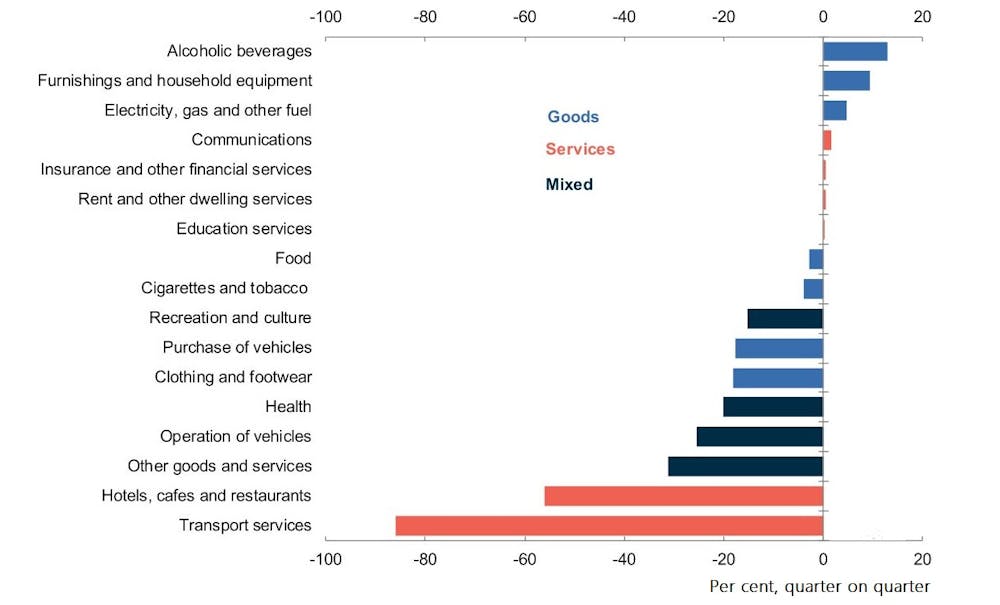
Spending on goods was barely hit, while spending on services collapsed 17.6%.

Spending on transport services, a category that encompasses everything from flights to public transport, fell 88%. Spending on accommodation, a category that encompasses tourism, fell 55.7%.

Spending on recreational and cultural services, a category that encompasses sporting events, gambling and performances and cinema admissions, fell 54.5%.


Household spending by category

Commonwealth Treasury

It meant far more income than usual was saved. During the depths of the global financial crisis, Australia’s household saving ratio climbed to a peak of 10.9% as households squirrelled away one in every ten dollars they earned.

In June they squirrelled away a remarkable 19.7% – one in five dollars that came in the door.


Household saving ratio

ABS Australian National Accounts

The Bureau of Statistics says if household income from special initiatives including early access to super was included, the household income ratio would be even higher. What it calls the “household experience savings ratio” would be 24.8%.

It’s possible to see households saving one in every four dollars as a “glass half full”. Frydenberg does.

He says this never-before-experienced accumulation of savings will be useful in the recovery, giving people the capacity to spend big when restrictions ease and they are better able to spend.

What if we remain unwilling to spend…

That’s assuming people aren’t “scarred” by the experience, left with damaged psyches and unwilling spend, a possibility the Treasurer acknowledges.

He says for the next quarter, the current one that encompasses the three months to the end of September, the Treasury is expecting economic activity to shrink only a little further or no further at all.

A lot depends on how soon Victoria’s Stage 4 restrictions and other restrictions are eased, which means a lot depends on things that are unknowable.

…and businesses unwilling to invest?

The Treasurer will deliver the budget in a little over four weeks’ time.

He said a key part of it will be measures to make it easier for businesses to do business, unlocking “entrepreneurship and innovation” at low cost.

Businesses certainly could invest more. Non-mining business investment was down 9.3% in the quarter. On Tuesday the Reserve Bank made available an extra $57 billion at low cost for banks to advance businesses and households.

But they are only likely to want to invest more when they can see returns.


Read more: When it comes to economic reform, the old days really were better. We checked


Examining the figures on Wednesday, former Reserve Bank economist Callam Pickering said they showed the economy being held together “with duct tape by JobKeeper and JobSeeker”.

At his press conference, Frydenberg resisted suggestions that he revisit the wind-downs of JobKeeper and the JobSeeker Coronavirus Supplement due to take place over the next six months.

But the Victorian situation is far worse than when he announced the schedule on July 21.

He might find there’s a case for more duct tape, for a while longer.The Conversation

Peter Martin, Visiting Fellow, Crawford School of Public Policy, Australian National University

This article is republished from The Conversation under a Creative Commons license. Read the original article.

Read more >>

Monday, August 31, 2020

Australia's top economists oppose the next increases in compulsory super: new poll

The five consecutive hikes in compulsory super contributions due to start next July should be deferred or abandoned in the view of the overwhelming majority of the leading Australian economists surveyed by the Economic Society of Australia and The Conversation.

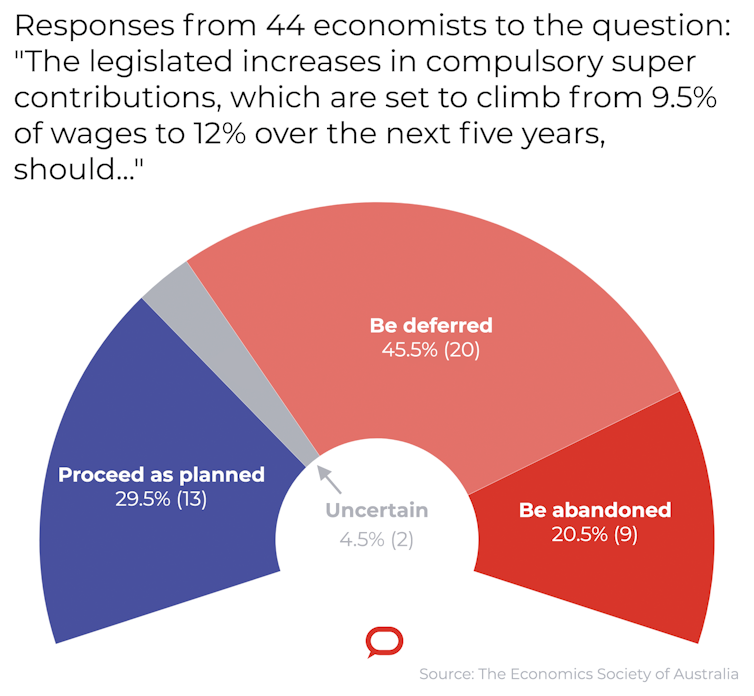
Two thirds – 29 of the 44 surveyed – want the increases deferred or abandoned. Only 13 think they should proceed as planned.

An even larger majority, including some economists who want the increases to proceed, believe they will hit wage growth. Several are concerned they will hit employment.

Compulsory superannuation contributions are paid by employers.

But ahead of the most recent increase in compulsory super, from 9% of salaries to 9.5% in 2013 and 2014, the then Labor superannuation minister Bill Shorten said the increase would cost employers nothing because it would be taken from wage rises.


“A portion of what would have been employees’ increases will go into compulsory savings,” he said.

That conventional wisdom has since been challenged in work funded by the superannuation industry and has been examined extensively in the retirement income review at present with the government.

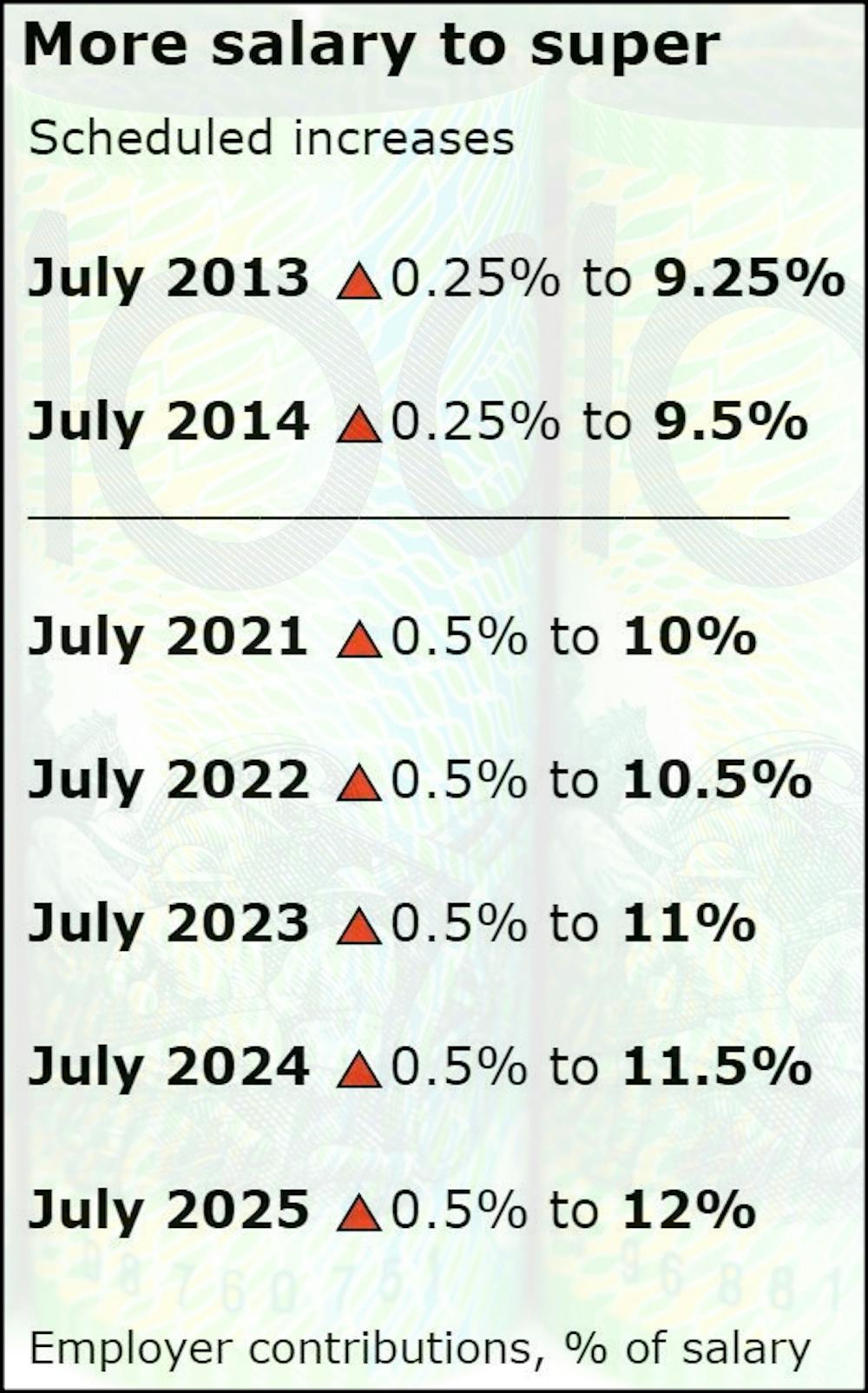
The two most recent increases in compulsory superannuation in 2013 and 2014 were small by design – 0.25% of salary each.

The next five increases, originally due to due to begin in 2015 but postponed to start in July 2021, are much bigger – 0.5% of salary each – at a time when wage growth is much smaller.

In 2012 Shorten was expecting wage increases of 3-4% and “assuming that a quarter of a per cent of that 3% to 4% may well go into your compulsory savings”.

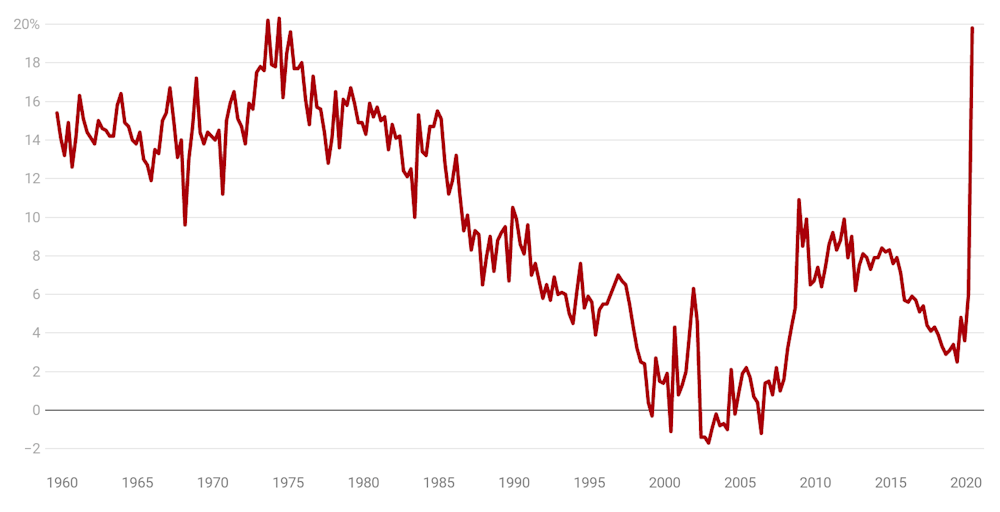
Wage growth has since slipped to 1.8%, the lowest on record. If the best part of 0.5% is taken out of that each year for the next five years it is unlikely to climb.


Wage growth has slipped to 1.8%

Wage Price Index annual growth, public and private, all industries, seasonally adjusted. ABS 6345.0

The 44 members of the Economic Society’s 57-member panel who responded include Australia’s preeminent experts in the fields of microeconomics, macroeconomics economic modelling, labour markets and public policy.

Among them are former and current government advisers and a former head of the Australian Fair Pay Commission and member of the Reserve Bank board and a former member of the Fair Work Commission’s minimum wage panel.


Read more: 5 questions about superannuation the government's new inquiry will need to ask


Each was asked whether the legislated increases in compulsory super contributions should proceed as planned, be deferred or be abandoned.

Only 13 of the 44 thought the increases should proceed as planned. 29 thought they should be deferred or abandoned, nine of them preferring they be abandoned altogether.


Charts showing that of 44 economists asked

Those who thought they should be deferred argued that now is “not a time to encourage saving”. In the current circumstances we should be “far more worried about spending power today than in the golden years of present-day workers”.

Economist Saul Eslake said he had changed his mind. The latest evidence (which will be updated in the retirement income review) suggests that the current 9.5% so-called super guarantee will be enough to provide most people with an adequate income in retirement .

“In saying that I acknowledge that there is still a significant problem with regard to the adequacy of superannuation savings for women relative to men, but I don’t see how raising the super rate for everyone to 12% solves that problem,” he said.

“Not a time to encourage saving”

Economic modeller Janine Dixon said it was not clear that the optimal contribution was 12% rather than 9.5%. The increase would force some households into greater debt. While this would pose a risk to economic stability at any time, Australia could “not afford to let the household sector weaken further at present”.

Economist Geoffrey Kingston said anyone who felt 9.5% was not enough remained “free to make voluntary contributions”.

Among those believing the increases should proceed as planned were two former politicians, Labor’s Craig Emerson and former Liberal leader John Hewson.

Emerson said 9.5% was “considered inadequate by the burgeoning retiree population”. Without an increase, that population “would successfully demand increased pension levels from the Commonwealth”.

Opponents more confident

Hewson said compulsory super had become a fundamental part of an effective retirement incomes strategy and, COVID and economic collapse notwithstanding, we should “finish the job”.

Sue Richardson, a former member of the Fair Work Commission’s wage panel, believed any deferral might lead to another deferral and be “hard to recoup”.

The economists were asked to rate their confidence in their responses on a scale of 1 to 10.

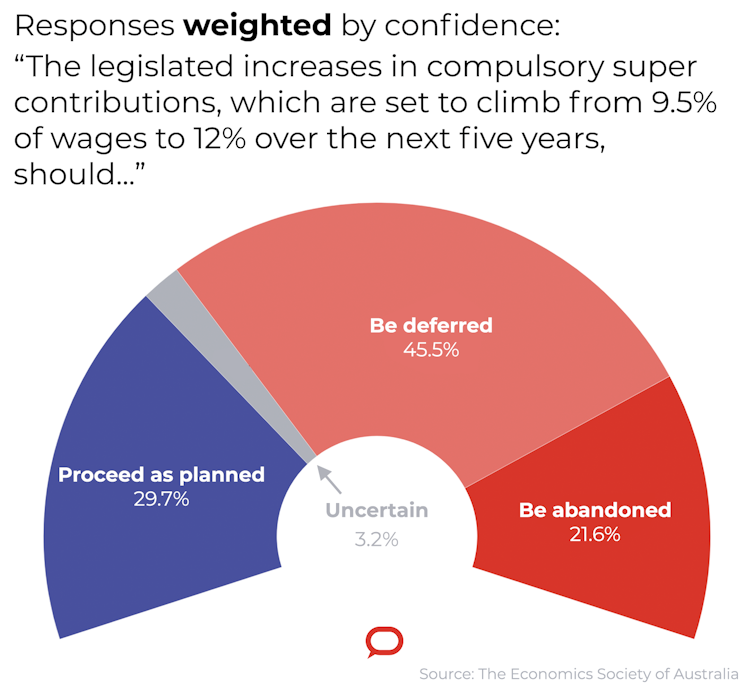
Unweighted for confidence, 20.5% of those surveyed wanted to abandon the increases altogether. When weighted for confidence, that proportion climbed to 21.6%. The proportion that wanted the increases either deferred or abandoned climbed to 67.1%


Weighted responses to the question,

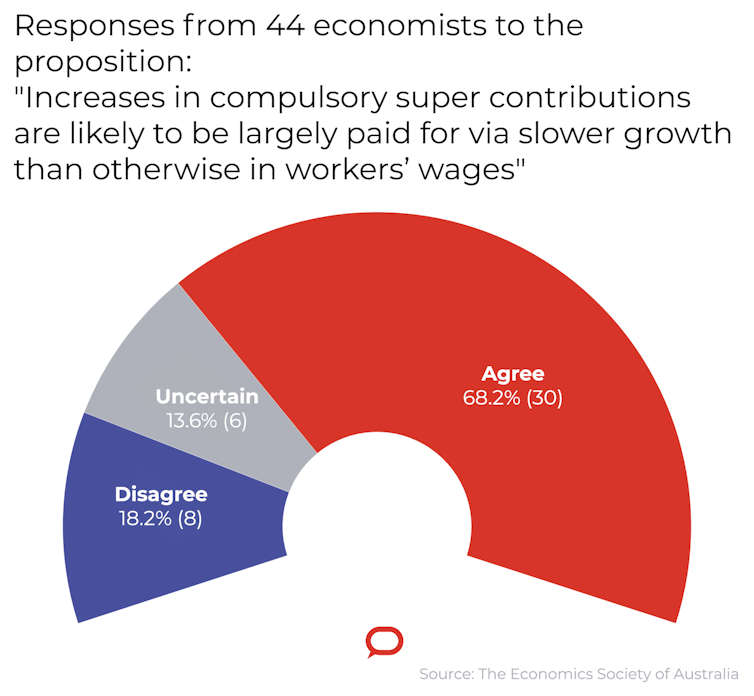
Asked whether the increases were likely to be largely paid for via slower wage growth than otherwise, 30 of the 44 economists agreed. Only eight disagreed.

Economist Nigel Stapledon said this “should not be controversial”.

Private sector economist Michael Knox said: “unless one lives in an unreal world, increases in superannuation guarantees are funded by employers out of the total wage the worker might otherwise receive”.

Super and wages come from the same pool

Several enterprise bargains explicitly make a trade-off between wages and superannuation, providing for wage increases that will be 0.5 points higher should compulsory super contributions not climb by 0.5 points.

Economist Alison Booth said if employers weren’t able to trim wage rises to pay for the scheduled increases in super contributions, they might “attempt to adjust on other margins”.

In a recession, when workers lack bargaining strength, “employers could coerce them to accept other adjustments to their contracts”.


Responses from 44 economists to the proposition:

Two of the eight economists who disagreed with the proposition that the increases in compulsory super would come at the expense of wages thought that employers wouldn’t grant wage rises anyway. Increases in super contributions might be one way for employees to get something.

A concern among both those who agreed and disagreed was that if the increase didn’t come at the expense of wages, it would push up the cost of hiring and come at the expense of jobs.

“Inflation is very likely to be very, very low and wages to be sticky,” said government advisor Matthew Butlin.

A drag on jobs if not wages

“Higher superannuation payments in an environment where wages are unlikely to rise and cannot fall will raise real labour costs and reduce the incentive to employ.”

Economic modeller Janine Dixon said that while over time the increase in contributions would probably come from wages, the immediate impact would be to increase the cost of hiring, “which is an unacceptably large risk in the present climate”.

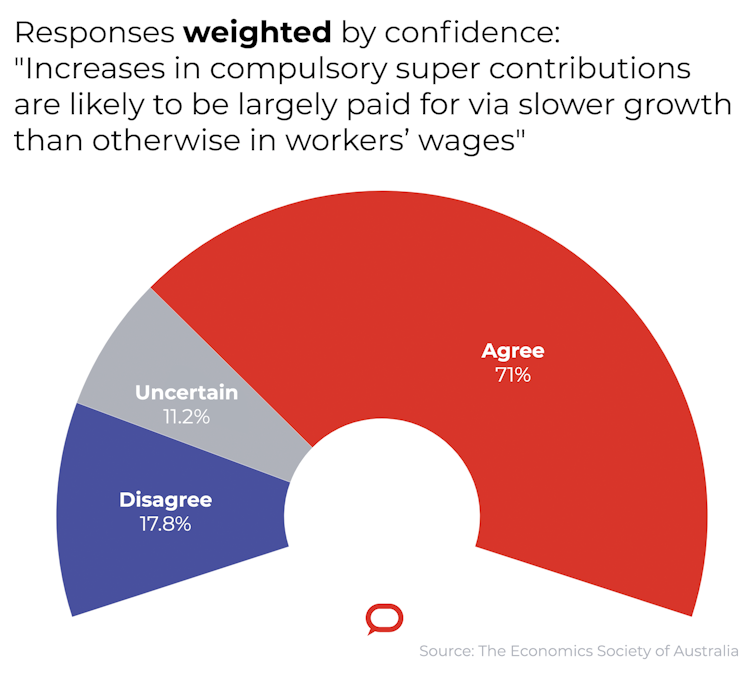
When adjusted for confidence, the proportion of those surveyed expecting the increases to largely paid for via slower wage growth climbed from 68.2% to 71%. The proportion disagreeing fell from 18.2% to 17.8%.


Weighted responses to the proposition:


Individual responses

The Conversation

Peter Martin, Visiting Fellow, Crawford School of Public Policy, Australian National University

This article is republished from The Conversation under a Creative Commons license. Read the original article.
Read more >>

Friday, August 07, 2020

No snapback: Reserve Bank no longer confident of quick bounce out of recession

The good news in the Reserve Bank’s latest quarterly set of forecasts is that the recession won’t be as steep as it thought last time.

The bad news is it now expects ultra-weak economic growth to drag on and on, pushing out the recovery and meaning Australia won’t return to the path it was on for years if not the end of the decade.

Its so-called baseline scenario, which is for the worst recession in 70 years, relies on a number of things going right:

the heightened restrictions in Victoria are in place for the announced six weeks and then gradually lifted. In other parts of the country, restrictions continue to be gradually lifted or are only tightened modestly for a limited time, although restrictions on international departures and arrivals are assumed to stay in place until mid 2021

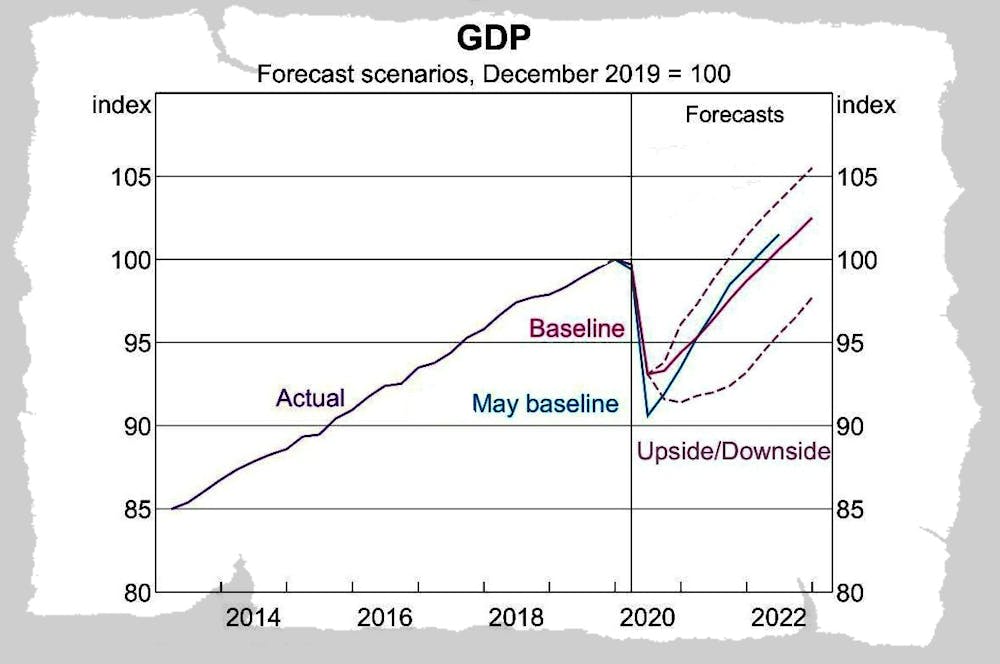
Whereas three months ago in its May update the Reserve Bank expected economic activity to collapse 8% in the year to June 2020 and then bounce back 7% over the following year, it now believes it collapsed a lesser 6% but will claw back only 4% in the year to come.

The direct impact of locked doors and shut shops was smaller than it expected, but the ongoing impacts are “likely to be larger”.

It’ll depend on households

What economic growth there is will be driven by household spending. Business investment, once a key economic driver, won’t be back to anything like where it was until well into 2023.

Business after business has been telling the bank’s liaison officers they have deferred or cancelled planned spending to preserve cash.

In usual times, household spending accounts for 60% of gross domestic product.


Read more: The Reserve Bank thinks the recovery will look V-shaped. There are reasons to doubt it


The Reserve Bank believes household spending fell 11% by the middle of the year and will start to edge back up, but it warns that household incomes are expected to slide and unemployment grow as government winds back JobKeeper and JobSeeker:

The JobKeeper program ensures that many more workers remain attached to their job than otherwise. However, it is expected some workers will be retrenched once they are no longer eligible for the subsidy in late 2020 and early 2021. Moreover, the reinstatement of job search requirements for the JobSeeker program outside of Victoria in the September quarter and the lifting of restrictions will result in more people looking for jobs

It will have been heartened by the Prime Minister’s recent decision to make the wind-back of JobKeeper less steep.

The bank says that the way businesses and households adjust to a lower income in the months ahead will be “an important determinant of the outlook over the rest of the forecast period”.

Reserve Bank of Australia

It expects employment to fall further over the rest of the year, as job losses from restrictions in Victoria and the tightening of JobKeeper more than offset a continued recovery in jobs elsewhere.

One in ten of the businesses it has contacted through its liaison program report wage cuts, most of them targeted towards senior management, but some implemented broadly.


Read more: The Reserve Bank thinks the recovery will look V-shaped. There are reasons to doubt it


The proportion reporting wage cuts is “significantly higher” than during the global financial crisis.

By the end of next year the bank expects the published unemployment rate to be somewhere between 11% and 7%.

The forecast range is an indication of how uncertain it is about what will happen.

Reserve Bank of Australia

The bank’s forecasts for recession and recovery have a similarly wide range.

On one hand GDP might not be back to where it was until the middle of the decade, and not back to where it would have been until the start of the following decade.

On the other, it might have made up its losses by the end of next year.

Reserve Bank of Australia

The bank’s central “baseline” forecast points to a worse recession than any since World War II and the Great Depression.

Reserve Bank of Australia

Its upside scenario assumes quick progress in controlling the virus, improving consumer confidence as a result, a quick end to the outbreak in Victoria and no further major outbreaks.

The downside scenario assumes rolling outbreaks and rolling lockdowns along with a widespread resurgence in infections worldwide.

Risks a plenty…

It says if households conclude that low income growth will be more persistent than previously expected, they might “permanently adjust their spending” leaving the economy weaker for longer.

The uncertainty could lower firms’ risk appetite, prodding them to pay down debt and increase cash buffers rather than invest even when conditions recover.


Read more: It really is different for young people: it's harder to climb the jobs ladder


A sustained period of lower investment, combined with “scarring” as people unemployed or underemployed find themselves unable to improve their position could “damage the economy’s productive potential”.

…little harm in spending

The bank says there’s little more it can do. It has considered negative interest rates, and believes they would be of no real help.

It’ll be up to the government to support the economy with spending. Where needed the bank will buy government bonds with money it creates in order to keep borrowing costs low.

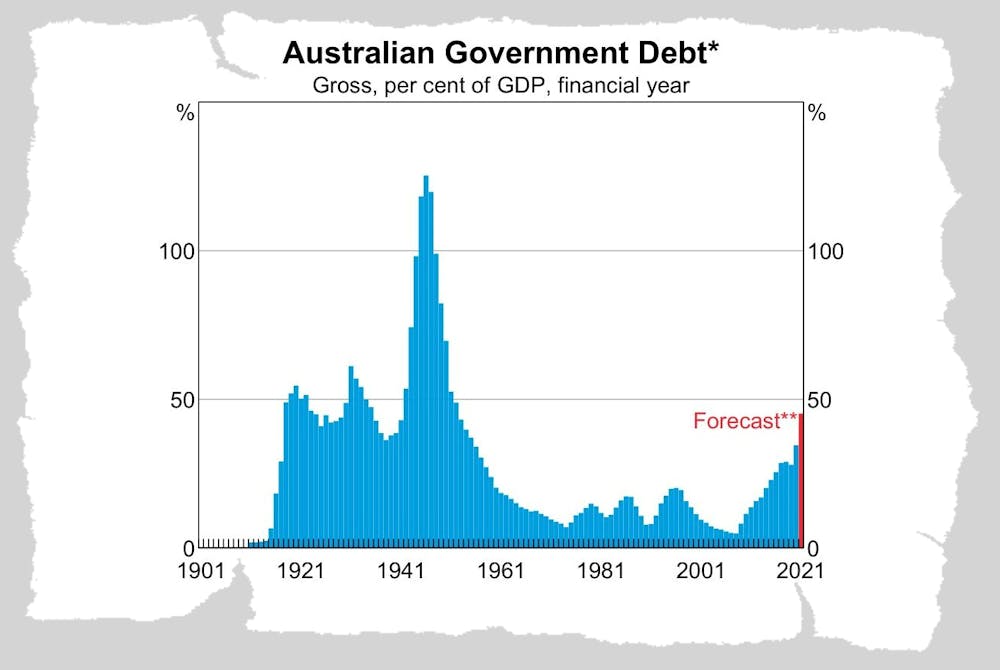
To make the point that government shouldn’t be afraid of borrowing, it includes a graph of government debt since Federation.

Reserve Bank of Australia

Its point is that as a proportion of the economy the government has borrowed and spent much much more in the past.

To the extent that it is needed to make households feel able to spend and businesses able to invest, it is worth it.The Conversation

Peter Martin, Visiting Fellow, Crawford School of Public Policy, Australian National University

This article is republished from The Conversation under a Creative Commons license. Read the original article.
Read more >>

Thursday, July 30, 2020

The government has just sold $15 billion of 31-year bonds. What's a bond?

There are the Boxing Day sales, and there was this week’s rush of extremely cashed-up investors desperate to get a slice of this week’s rare 31-year government bond auction.

What’s a bond? What’s a bond auction? We’ll get to those shortly.

First, just know that the government received A$36.8 billion of bids, $20 billion of them within hours of opening the two-day auction on Monday.

It had been wanting to move $15 billion, and could have moved that much again.

$15 billion makes it the third biggest bond sale in Australian history. The two bigger were recent – a $19 billion ten-year bond sale in May and a $17 billion five-year bond sale in July.

Each sale nets the government money it won’t have to pay back for five, ten or 31 years at rates of interest that until recently would have been unthinkably low.


Read more: More than a rate cut: behind the Reserve Bank's three point plan


The 31-year bond went for 1.94%. That means the foreign and Australian investors who bought them (including Australian super funds) were prepared to accept less than the usual rate of inflation right through until 2051 in return for regular government-guaranteed interest cheques.

Investors who bought ten year bonds were prepared to accept only 0.92% per year, investors who bought five year bonds, only 0.40%.

What’s a bond?

Even bond traders find it hard to get a handle on what bonds are. In his novel Bombardiers, author Po Bronson writes a scene where a bond trader refuses to work any more and demands to see an actual bond, “any kind of bond”.

He tells his boss he can’t sell bonds “if he’s never seen one”.

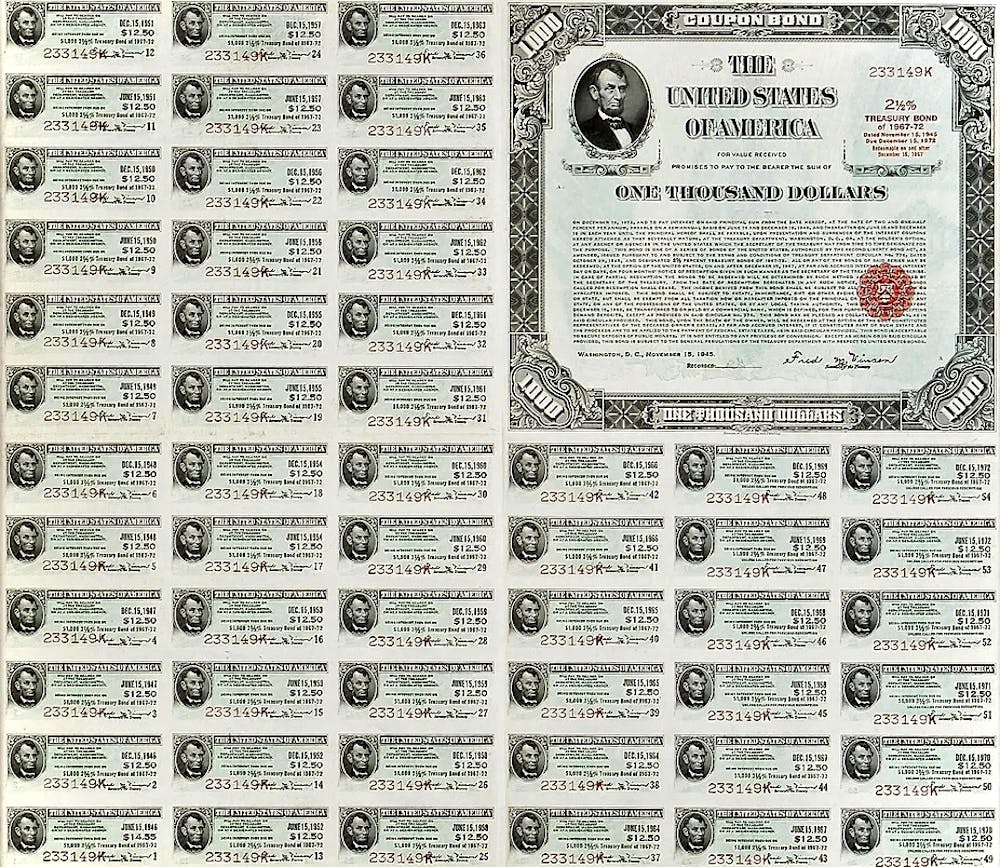
Like many things that used to exist physically, they’re now mainly numbers on screens, but it helps to get a picture.

This one is a US 27-year bond from 1945.

The Joe I. Herbstman Memorial Collection

The biggest part of the paper is a promise to repay the US$1000 it cost, in 27 years time.

The smaller rectangles are called coupons, and each year the owner can tear one off and take it in to get 2.5%.

If the owner wants to sell the bond to someone else (and bonds are traded all the time) it’ll be sold with one coupon missing after one year, two coupons missing after two years, and so on.

When rates fall, prices rise

The price of a bond will vary with what’s happening to interest rates. If they are falling, an existing bond, offering returns at old rates, will become more expensive and can be sold at a profit. If they go up, an existing bond will become worth less and have to be sold at a loss.

It leads to confusion. When bond rates fall, bond prices rise, and visa versa.


Read more: 'Yield curve control': the Reserve Bank's plan for when cash rate cuts no longer work


For half a decade now bond rates have been falling. They’ve fallen further during the COVID crisis, making bonds a doubly good investment. They offer superannuation funds and others certainty at a time when everything seems uncertain, and if rates continue to fall they increase in value.

It is an indictment of our times that so many investors want them. The government’s office of financial management is going to need to sell an extra $167 billion over the coming year. The rush to buy suggests it could sell more.The Conversation

Peter Martin, Visiting Fellow, Crawford School of Public Policy, Australian National University

This article is republished from The Conversation under a Creative Commons license. Read the original article.
Read more >>

Thursday, July 23, 2020

These budget numbers are shocking, and there are worse ones in store

Even if the government hadn’t spent A$5.9 billion on JobKeeper and other emergency measures last financial year and wasn’t planning to spend a further $12.2 billion this financial year, its budget position would have collapsed.

The economic statement released Thursday morning shows it collected $13.2 billion less company tax than it expected last financial year, and will collect $12.1 billion less this financial year.

It collected $9.2 billion less personal income tax last financial year and will collect $26.9 billion less this financial year.

That’s assuming the present lockdown in Melbourne, the Mornington Peninsula and the Mitchell Shire lasts only six-weeks followed by a gradual return to normal and no further lockdowns.

Reality bites

Goods and services tax and excise and customs duty collections are down by $7.3 billion last financial year and down by a forecast $10.7 billion this financial year.

Tax collections from super funds held up in the financial year just ended but are expected to halve in 2020-21, collapsing from $13.2 billion to $6.4 billion.

The collapse reflects what Treasurer Josh Frydenberg called “the reality of where the economy is at”.

Business are closed, planned investment has been axed (non-mining business investment is expected to fall 19.5% this financial year after falling 9% last financial year), consumers are staying at home, and spending on housing is expected to fall 16% after falling 10%.

It has to be lived with

Most of this can’t be undone. Nor can it be offset by increasing tax rates or cutting government spending. As Finance Minister Mathias Cormann noted, that would shrink private spending further.

Net government debt, which was expected to be close to zero last financial year (0.4% of GDP) instead blew out to 24.6% of GDP and is expected to blow out to 35.7% this financial year.

The only safe way to bring it down is to ramp it up as much as is needed to ensure the economy recovers.

As Cormann put it,

the way to get on top of this debt is by growing the economy more strongly and creating more opportunity for Australians to get ahead, get into jobs, better paying jobs and get ahead, because stronger growth leads to more revenue and lower welfare payments and that is the way that we can go back to where we were

It has worked before. Australian government debt blew out to more than 100% of GDP during the second world war but then shrunk year by year in relation to GDP in the economic growth that followed.

Debt didn’t shrink in absolute terms, it shrank in relation to the government’s ability to handle it, and that’s what will happen again if economic growth can be reignited.

The government has been borrowing at annual interest rates of less than 1%. If the economy can grow by more than 1% per year, which historically it has, the payments will eat into less and less of the budget.

Finances are holding up

Next week the government’s office of financial management launches an audacious bid to lock in ultra-low borrowing rates until the middle of the century.

It will issue an unusually long-dated bond (lone) lasting 31 years. It won’t need to be repaid until 2051.

It has appointed five lead managers to sell it – ANZ, Commonwealth Bank, Deutsche Bank, JP Morgan Securities and UBS – in the hope that it can bed down low annual interest payments for a generation.

In the unlikely event the market doesn’t support it, the Reserve Bank has undertaken to step in and use created money to buy as many bonds as are needed to keep the rates low. Since it made the commitment in March it hasn’t needed to spend much at all. Government bond issues have been up to five times oversubscribed by investors desperate for the certainty of a government revenue stream and uneasy about riskier alternatives.

Best case

The forecasts for what will be required need to be seen as best case. The budget deficit is believed to have blown out from an expectation of around zero to $85.8 billion in 2019-20 and $184.5 billion in 2020-21.

Those forecasts have the unemployment rate at 8.75% by this time next year, by which time the economy will have shrunk 2.5%

Economic activity slipped 0.3% in the March quarter, is believed to have shrank 7% in the June quarter, is expected to climb back 1.5% in the September quarter and to claw its way back after that.


Read more: Budget deficit to hit $184.5B this financial year, unemployment to peak at 9.25% in December: economic statement


That’s if restrictions aren’t reimposed, state borders are reopened and there are no further “second waves” of infections.

The treasury says its estimates take into account the effect of the Melbourne outbreak on consumer confidence and activity in the rest of Australia, but assume the outbreak does not spread.

In this way the numbers are a best case. The section in the document on risks to the outlook was unusually short – only three paragraphs.

It says the pandemic is still evolving and the outlook remains highly uncertain.

It will present a fuller assessment of the risks and four years of projections in the formal budget on October 6.The Conversation

Peter Martin, Visiting Fellow, Crawford School of Public Policy, Australian National University

This article is republished from The Conversation under a Creative Commons license. Read the original article.
Read more >>

Wednesday, July 22, 2020

Should the government keep running up debt to get us out of the crisis? Overwhelmingly, economists say yes

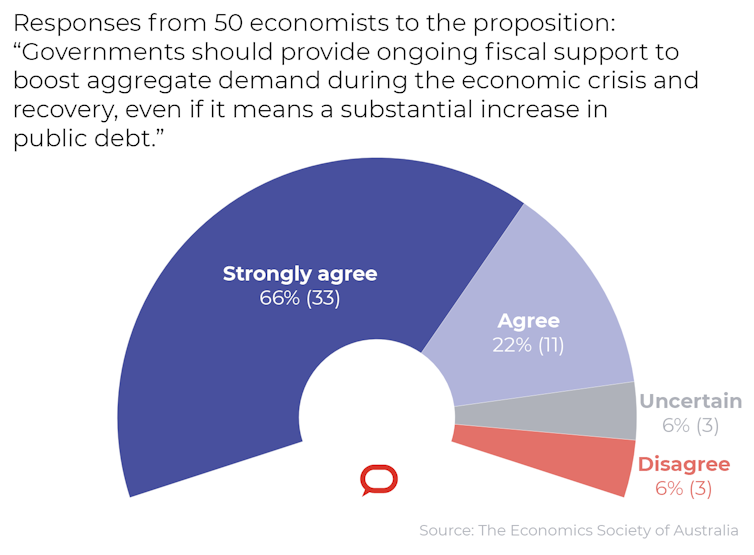
Overwhelmingly, the 50 leading Australian economists surveyed by the Economic Society of Australia and The Conversation ahead of Thursday’s economic statement want the government to keep spending to support the economy — even if it means a substantial increase in debt.

The question is the third asked in the Economic Society-Conversation monthly poll, which builds on a series of polls conducted by the society since 2015.

The economists polled were selected for their preeminence in the fields of microeconomics, macroeconomics, economic modelling and public policy. Among them are former and current government advisers and a former and current member of the Reserve Bank board.

Each was asked whether they agreed, disagreed, or strongly agreed or strongly disagreed with this proposition:

Governments should provide ongoing fiscal support to boost aggregate demand during the economic crisis and recovery, even if it means a substantial increase in public debt

Only three of the 50 economists polled disagreed with the proposition, none of them “strongly”.

It is one of the starkest results in the survey’s five-year history.

50 economists respond: Govs should provide ongoing fiscal support to boost aggregate demand during the economic crisis and recovery, even if it means a substantial increase in public debt. Strongly agree: 66%,  Agree: 22%, Uncertain: 6%, Disagree: 6%
The Conversation, CC BY-ND

Of the 50 economists polled, 44 supported the proposition, 33 of them “strongly”.

Of the remaining six, three were uncertain, and provided well-argued accounts of their reasoning which are published in full along the responses of each of the other participants at the bottom of of this article.

Debt now, concern later

Rachel Ong of Curtin University said the amount of public debt that has accumulated during the COVID-19 crisis was at a historical high and had to be repaid at some point. But she said governments had to be careful about removing support until the economy was clearly on a trajectory of recovery.

Nigel Stapledon of the University of NSW said while some level of on-going support was needed, at some point the cost would be larger than the benefit. Some sectors, including universities, will have to permanently adjust to lower incomes.


Read more: Bowing out gracefully: how they'll wind down and better target JobKeeper


The economists who strongly agreed said that if not enough support was provided or if it was withdrawn too early, the resulting recession would itself make the debt that had been run up less sustainable (Fabrizio Carmignani, Griffith Business).

Financial markets are keen to lend

Beth Webster of Swinburne University argued the only real limit to government spending was high and damaging inflation.

If the government was worried about debt, it could finance its spending in other ways, by borrowing from the Reserve Bank (which could itself create money and “monetise” the debt).

Sue Richardson from the University of Adelaide agreed, using a technical term to argue that the was economy was “so far inside its production possibility frontier” (producing so much less than it was capable of) and inflation was so dormant, that there was a case for creating money.

Saul Eslake said that wasn’t necessary. Even with the hundreds of billions committed, financial markets appeared to be comfortable with the debt and keen to lend.

Debt is how we do things

Reserve Bank board member Ian Harper said the Commonwealth could borrow for 30 years at about 1%. “Can we expect the economy to grow faster than 1% per annum in nominal terms over a 30-year horizon?” he asked rhetorically. “I would have thought that’s a shoo-in,” he answered. If so, then the debt would be easily serviced.

Consulting economist Rana Roy pointed out that public debt was “not an anomaly”. It was an enduring and defining feature of the modern economy, providing an enduring and defining asset class, sovereign bonds, which were in high demand.


Read more: Australia's first service sector recession will be unlike those that have gone before it


Of the three economists who opposed the proposition, Tony Makin of Griffith supported “supply side” measures such as JobKeeper that would keep firms in business but opposed “demand side” measures to boost consumer spending, saying they would ultimately prove counterproductive.

Escalating public debt would induce capital inflow, drive up the dollar and make Australian businesses less competitive. Although interest rates are at present low, they would increase when the debt had to be refinanced.

Doubts for differing reasons

Paul Fritjers of the London School of Economics said he would normally support running up government debt for the sake of the economy, but could not support it being run up to support an economy the government itself had run down.

The government should wean the population off of its “irrational fears” and letting “normal economic life return”.

Although strongly argued, these views were more weakly held than those of the majority.

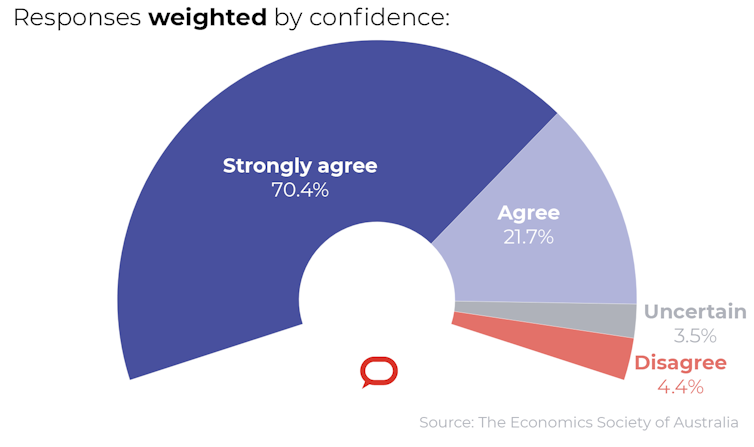
Previous responses weighted by confidence: Strongly agree: 70.4%,  Agree: 21.7%,  Uncertain: 3.5%,  Disagree: 4.4%
The Conversation, CC BY-ND

Participants were asked to rate the confidence with which they held their opinions on a scale of 1 to 10.

When adjusted for these ratings, the proportion prepared to countenance a substantial increase in public debt climbed from 88% to 92.1%.

The proportion opposing it fell from 6% to 4.6%.

Tommorrow’s economic statement will be the last budget and economic update before the budget itself on October 6.


Individual responses

The Conversation

Peter Martin, Visiting Fellow, Crawford School of Public Policy, Australian National University

This article is republished from The Conversation under a Creative Commons license. Read the original article.
Read more >>