Showing posts sorted by relevance for query drive dollars. Sort by date Show all posts

Tuesday, February 27, 2007

Baby you can drive my car...


Backwards and forwards, backwards and forwards...

I had thought this was an urban myth.

But apparently not.

Throughout Australia this month executives are going to be driving their cars (or having their wives and children drive their cars) backwards and forwards, backwards and forwards, up and down hills...

...in order to save a few thousand dollars on tax.

Deloitte Indirect Tax has put out a press release, not condemning the practice, but stressing the benefits. I am not sure what they expected me to do with it.

Perhaps to post it here for everyone to read:


Media Release

FOR IMMEDIATE RELEASE

Drive your benefits further – before it’s too late!

As the end of the FBT year approaches, so does the last chance for significant FBT savings on your salary packaged car.

Deloitte Indirect Tax Principal Frank Klasic said that salary packaged cars remain the most popular fringe benefit provided to employees.

“Although many employees successfully package their cars, there are still many who do not minimise the FBT associated with their car fringe benefit,” Mr Klasic said.

“The easiest way for employees to maximise their FBT savings is to plan ahead before the FBT year ends on 31 March.”

According to Mr Klasic, many employees may be on the cusp of the next kilometre threshold used to calculate FBT using the statutory formula method. Where this is the case, increasing the kilometres driven can also significantly increase your savings.

For example, an employee who has a car valued at $35,000 and drove 24,000km during the FBT year would have an FBT liability of $6,720. Increasing the number of kilometres driven to more than 25,000km would reduce that employee’s FBT liability to just $3,696 – a saving of more than $3,000.

“Employees should be aware that all kilometres driven between now and 31 March will be included when calculating the associated FBT,” Mr Klasic said.

“In addition, employees should collate their invoices and receipts to substantiate related car expenses such as car insurance, maintenance and repairs, where these have been paid using their own after-tax dollars.

“Employers that leave requests for odometer readings to the last moment may find that employees are not contactable or too busy to provide the information. This can result in estimates being used which often prove incorrect.”

Another important consideration for employees, before the 31 March deadline, is the possibility of making after-tax contributions towards their car fringe benefit.

“Many employers and employees continue to use salary packaging arrangements entered into before the reduction in personal income tax rates which came into effect on 1 July 2006. This change, in many circumstances, means that employees using the employee contribution method will significantly reduce the FBT liability on their car fringe benefits. This, in turn, can result in a net increase in after-tax salary.

“It’s not only car fringe benefits that require some housekeeping at this time of year. Many other benefits require employees to provide declarations at year end.”

Employers who are classified as rebatable or exempt employers (including hospitals, charities and public benevolent institutions) are exempt or concessionally taxed for FBT up to a certain threshold. As such, they may be able to provide employees with extra benefits which won’t be subject to FBT.

“Many employees do not reach their threshold limits in relation to benefits provided by a rebatable or exempt employer. This means employees and employers are not getting the most out of their salary packaging arrangements.”

“Tax effective planning methodologies and effective communication strategies are very important at this time of year,” according to Klasic.


NB: See our media releases and research at www.deloitte.com.au.


For further information:


Frank Klasic

Deloitte Indirect Tax Principal

Tel: (0) 3 9208 7514


Amanda Kennedy

Media and communications manager

Tel: + (0) 3 9208 7407

Read more >>

Wednesday, December 11, 2013

Inside story. How the Aussie dollar floated, 30 years ago today

1983 was the year

It was Sunday March 6 1983, hours after the election that swept Labor’s Bob Hawke to victory. Australia’s 39-year old Treasurer-elect Paul Keating was pacing a bedroom in Canberra’s Lakeside Hotel greeting his team of would-be economic advisors. Australia’s most powerful bureaucrat, the Treasury boss John Stone was about to present them with the “Red Book”, the incoming government brief that would tell them everything Treasury knew about the state of the budget and the economy.

But the room was too small.

“Keating talked to the manager and said: ‘Look I need some better space’,” remembers Barry Hughes. Hughes was an economics professor who had caught the early flight from Adelaide.

“The manager said there was plenty of room in the lobby, but the lobby was crawling with journalists. The upshot was, it being Sunday and Canberra pubs not open on Sunday, we all went down in the lift right into the basement, went through all the plumbing and ended up in the empty saloon bar. It was about two o'clock in the afternoon.”

Stone opened the conversation not by talking about the Red Book, but by recommending a devaluation - a big one, immediately.

“Stone amazed us by saying he wanted 10 per cent. What was amazing was firstly the amount, and secondly the fact that the Fraser government had been keeping the dollar high as a sort-of anti inflation policy. We had always thought Stone supported it,” Hughes says.

Worried about Australia under Labor, investors had been converting their Australian dollars to US currency and whisking them out of the country. An astonishing $3 billion had left the country in a matter of weeks, the same as $24 billion today.

Short of draconian currency controls the only way to stem the tide was to make converting Australian to foreign dollars more expensive, and the only way to do that was to devalue the Aussie.

But doing it - as Stone had Keating do in his first act as Treasurer (actually it was before he was Treasurer, he had to visit Kirribilli House to ask the outgoing government to do it) only enriched the traders. They were able to convert their US dollars back to Australian dollars at a cheaper price.

Peter Jonson was incensed. By then head of the Reserve Bank’s research department, he couldn’t see the sense in manually adjusting the dollar to staunch such flows. It allowed the speculators to make easy money by punting on near certain outcomes.

Shortly after he joined the Bank in the early 1970s he had asked the then deputy governor Harold Knight why the dollar hadn’t already been floated.

“Harry replied that, like Saint Augustine, he wished to be made pure, but not yet,” Jonson says. “Those were almost his exact words.”

Knight became the governor a few years later and maintained his opposition to a float right up until he left in late 1982, months before Labor came to power. Jonson says his replacement Bob Johnston had no such reservations.

“I kept making the point personally to Johnston and to the treasurer that in effect over that weekend in March 1983 speculators had made $300 million,” he says. “They had done it at the expense of the taxpayer. I left Keating in no doubt as to my view: it wasn’t right that that should happen under a Labor government.”

Jonson had a better idea. He wanted buyers of dollars to negotiate with sellers of dollars and agree on a price. Then they could make money off each other...


Jonson had some experience setting the price of the dollar. By the early 1980s the rate was adjusted weekly and later daily by a committee of four - Stone or his delegate, the Reserve Bank governor or his delegate, and the heads of the finance and prime minister’s departments or their delegates. They posted the result at 9.30 each morning and had to accept whatever foreign exchange would flow in to the country at that price and whatever would flow out for the next 24 hours. For a while Jonson had the related job of determining the “forward rate”, also posted at 9.30 am. It was the rate at which the Australian government agreed buy and sell dollars some time into the future.

“I was feeling comfortable at 9.16 one morning when a colleague told me President Reagan had been shot,” he recalls. We didn’t know whether he would survive. New Zealand had kept its market closed, meaning we would be the first in the world to open. I had to decide whether to close our market or to pick a price and hope it was right.” Jonson sipped his coffee, picked a price and at 9.25 told his colleague to open and make sure Reagan wasn’t dead.

By mid 1983 the entire weight of opinion within the Bank had swung toward a float. Much of the rest of the world had been floating for a decade.

The Bank’s international division undertook “an exercise to look at the options for a more market oriented exchange rate system”. It bundled up the documents in what it called a “War Book” and kept it ready. The then Treasury head John Stone says that he too was in favour of a float by then and points to a memo he sent to Keating in October which supported the Bank “to the extent of agreeing that some change in the system is warranted”. It said the change “should be undertaken in stages”.

Hughes has a different recollection.

“Stone was absolutely adamantly opposed,” he says. “Whatever he says now, he was flatly adamantly opposed to floating the dollar.”

Des Moore was Stone’s deputy at the Treasury. He remains a sceptic. “My scepticism has been reinforced by the difficulties facing smaller nations which have had to go back to a fixed rate or a quasi fixed rate,” he says. “You need a means of protecting the rate from rapid flows.”

In Hawke’s office the newly appointed economics advisor Ross Garnaut pushed for a float. Keating’s office was unanimously in favour. The Reserve Bank had dropped its opposition, and by December foreign money was flowing in to the country as the economy picked up. The government faced the opposite problem. Speculators were punting on the dollar being sharply revalued to stem the flow, increasing the value of the money they had poured in.

The Reserve Bank had turned its back on the daily business of adjusting the rate. On some days Stone did it on his own. Hawke and Keating held a series of private meetings to which they did not invite the Treasury.

On the morning of Friday December 9 in the Cabinet room of the old parliament house Hawke made it official. He was courteous and invited Stone to speak, but Stone says he was “merely going through the motions”.

“Stone used every argument under the sun to delay the float - to delay the freeing of the market,” Hughes says.

“And then Hawke addressed Stone directly.”

“He said to Stone: ‘You have a reputation as a bogeyman amongst my left wing colleagues. Given that it is almost Christmas, in the spirit of Christmas, I wouldn't dare to let them know what you just said and take their boogeyman away from them’.”

Keating had wanted Stone to appear beside him in the historic press conference that followed. He had to make do with Bob Johnston.

Then Johnston flew back to Sydney and directed the Bank to “abolish the foreign exchange control department, today”.

“The relevant officials said we can't do it today,” Peter Jonson recalls.

“And Bob said: Yes, you are going to do it today”.

“Why? So that no-one could turn back.”

“It was like a commander burning the boats to ensure the troops were committed to the battle.”

In the treasury there was confusion about what the decision meant.

“I was responsible for foreign investment,” Moore remembers. “As soon as the decision was made, staff came to me and said: now that the exchange controls have been removed we need to get rid of foreign investment controls”.

“I said, hang on a second, before we do anything like that we need to check with Keating. When we actually got a message to him he said: ‘Wait, I’ll check with my colleagues’, and of course that wasn’t what he wanted.”

The dollar traded uneventfully on Monday December 12. It opened at around 90 US cents and stayed there for six weeks before climbing to a peak of 96 US cents, and then diving and at times climbing in the decades that followed, never again returning to those opening heights until the most recent mining boom.

The movements have enriched traders, at times impoverished and revitalised exporters, and alternately cut and swelled Australian’s buying power.

Going back to having the price set by manually seems unthinkable. And yet...

Peter Jonson spent a decade building the case for a float and much of the subsequent two decades singing its virtues.

Long since retired from the Bank and from a career working in financial markets he wonders now whether Australia shouldn’t be aggressively intervening to drive the dollar down.

“The currency is way too high,” he says. “It is making Australia’s costs too high - you are seeing it with Holden and Qantas. We will need to either bring the dollar down or suffer a recession which will do it for us”.

Johnson suggests a tax on capital inflows.

“John Howard famously said: ‘we will decide who comes to this country and the circumstances in which they come’. It is equally clear we have the right to discourage the excess capital that is flowing in and creating the high exchange rate that’s putting excess pressure on Australian industries.”

Barry Hughes, never a doubter about the worth of floating the dollar, can also see the case for limits.

“I like to think of it as ‘wide tramlines’ around a floating figure. You may not be able to work out exactly what the fair value is, but you should at least be able to work out fair value to within plus or minus 15 per cent,” he says.

The float as we have known it isn’t completely fixed, just as the dollar was never completely fixed. The one constant still with us is the spirit of continual reassessment which brought about the float thirty years ago this week.

Peter Martin worked in the Treasury in 1983.

In The Sydney Morning Herald and The Age


Related Posts

. 'Twas the dollar that killed Holden

. How the high dollar hurts

. If I hear one more person tell me to bring down the dollar

Read more >>

Friday, September 18, 2009

The Reserve Bank Annual Report reads like a thriller


Let no-one tell you "it was never in doubt".

The global financial crisis has delivered the Rudd Government an unprecedented windfall in the form of massive Reserve Bank currency profits that will slash billions from the projected budget deficit and billions from government debt.

The Reserve Bank's annual report reveals that it handed Treasurer Wayne Swan a record $5.2 billion in August as a partial payment of its 2009/10 dividend, well up on the $1.4 billion in handed over as a full payment the year before.

The Reserve Bank's profit of $8.8 billion is far in excess of anything it has ever made in its 50 year history and came as a result of a decision to pour billions into supporting the Aussie dollar late last year as it slid even faster than it had during the "Banana Republic" crisis of the mid 1980s...

The Bank says that as Aussie touched 60 US cents in late October it became concerned that "the breakdown in market conditions itself had become a significant factor in the increasingly rapid depreciation".

In order to "break this dynamic" it bought $3.8 billion of Aussie dollars on foreign exchange markets helping drive the price up towards its present 87 US cents netting a cash profit of $4.4 billion as it sold dollars and an extra paper profit of $2.3 billion from revaluation of its assets.

It says in the process it had to break its own rules about the allocation of assets between currencies, rules it is now complying with again.

It'll transfer $557 million of the profit to its Reserve Bank Reserve Fund, and hand a total of $6 billion to the government, $5.2 billion to bolster its books during the current financial year, and at the request of the Treasurer a further $750 million to bolster its books during 2010/11.

The payouts will make a dent in the projected budget deficits for two financial years and will come on top of an expected budget boost of around $6 billion from better-than-forecast tax revenues as a result of the faster than expected recovery. The $57.6 billion deficit forecast by the Treasurer at Budget time is set to be revised down to somewhere between $40 and $50 when the forecasts are updated in December.

The Reserve Bank report also reveals a surge in demand for cash as Australians took money out of banks and stored it in physical form. A record 201 million $100 notes were in circulation at the end of June, up 24 million on the year before; The number of $50 notes was up 7 million. The Bank says it alerted Note Printing Australia to produce more but was able to meet to demand for previously printed supplies.


Published in today's SMH and Age

Crikey's Glenn Dyer adds:

For the first time we have been given an inkling of just how close the Australian financial system and economy came to freezing or imploding in the last quarter of 2008.

For all the confident talk from the government, the Opposition and others about how well we have done, we would not have been able to claim that if the economy had ground to a halt as credit froze over.

Prime Minister Kevin Rudd was the most accurate when he told the Queensland ALP conference earlier this year that Australia came very close to a serious crisis.

Overseas credit was cut off for everyone, including the federal government, the banks and companies, Australians panicked (there is no other word for it) and withdrew billions of dollars of cash from their banks to hide (presumably under the bed); banks could not raise money domestically from the markets so scared were they of one another, so they turned to the Reserve Bank in desperation.

So large was the demand for cash that the RBA ran out of $20, $50 and $100 bills and had to order more than $11 billion worth be printed to fill orders from the banks.

In fact everyone turned to the Reserve Bank in desperation for the three months to December, 2008 and into the early months of 2009.

All up the RBA boosted liquidity day-to-day in the markets by about $100 billion as the crisis intensified from October into early 2009. It was unprecedented.

Many of the moves, such as currency swaps with the Fed and rule changes to allow more and different types of securities to be dealt to the bank in liquidity management operations, were revealed during the year, but not the extent of activity as the RBA's balance sheet blew out to $165 billion at the height of the crisis in the last months of 2008 and early this year (now about $100 billion as conditions improved), still above normal.

The central bank's actions saved Australia (with help from treasury, the federal government and the US Fed) from joining other economies in deep freeze: The bank's senior executives were worth the pay rises they received during the year that some ignorant financial writers bagged this morning because they failed to comprehend the story that RBA laid out for them in its 2009 annual report.

Just how serious was it then?

Well, Australians were so worried about the financial crunch in the last three months of 2008 that they forced the Reserve Bank to boost supplies of cash to the economy by a massive $10 billion or 19% as they demanded cash.


The run on cash was part of a period of intense nervous crisis as the Reserve Bank found ways to boost the supply of liquid funds to the banks, individuals, businesses and even the government.

Financial institutions from credit unions to the biggest banks "self-securitised" their highest quality home-loan mortgages and sold $45 billion in the December quarter (now down to $20 billion) of them to the RBA in short-term deals called repos or repurchase agreements to raise cash to maintain liquidity during the worst months of the crisis. The RBA changed its rules to allow the exchange account balances the banks hold at the RBA to rise to a peak of $11 billion late in 2008 because financial institutions demanded instant availability of cash.


Read more >>

Monday, March 19, 2007

Tuesday Column: Is it time to turn off life-support for Australia's car industry?

Politicians love Australian carmakers. What they can’t understand is that Australians don’t.

On Thursday Labor’s Ken Rudd promised another handout of another half a billion dollars to Australian carmakers, this time to encourage them to build ‘greener’ cars.


We already hand Australia’s big four car manufacturers assistance worth more than $1 billion a year – and that’s just from the Commonwealth government. No one knows quite how much South Australia and Victoria chip in as well.

Yet the sad truth that for all the repeated talk about how important it is to have Holden, Ford, Toyota and Mitsubishi here in Australia making new cars - ordinary Australians won’t buy them.

What if it was another industry – with four manufacturers were there probably should be two, production in some plants slowed to a trickle and buyers turning away at the rate of 20 per cent in the last year - would politicians be standing in front of its factories offering even more support?

But then the Australian car industry is unlike any other industry, both in the strange way it operates and in the rate at which Australians are shunning its products...

Australians bought just short of 1 million new cars last year. Back a decade ago half of all of the new cars sold were made in Australia. But last year out of the 1 million total only 201,623 were Australian-made.

We are moving en masse to buying foreign-made cars because they are cheaper, smaller and use less petrol.

And that sales figure of 201,623 hugely overstates our interest in buying Australian-made cars.

One of the oddities of car sales in Australia is that even where new Australian cars are sold, for the most part ordinary Australians don’t buy them.

When the Productivity Commission examined the issue 10 years ago half of all new Australian cars sold went to government and private fleets. Telstra was the country’s biggest car buyer.

Jump forward a decade and 88 per cent of Ford Falcons, 87 per cent of new Mitsubishi’s and 81 per cent of Holden Commodore’s go to fleets.

Only new Toyota Corolla’s are bought in any numbers by ordinary Australians. They are 60 per cent sold to fleets.

Companies, governments and charities buy at these sorts of levels for tax reasons - they can help with salary packaging – and then offload them for a good price while they are still nearly new.

Very few individual Australians buy new Australian cars from the showroom. They buy them “near-new” from corporations, or more likely buy cars made overseas.

When he came to office in 1996 the Treasurer Peter Costello tried to crack down on the bizarre tax-driven ritual of corporate car trading. He asked Australia’s state and local governments to pay sales tax on the cars they bought. He was overruled by his Prime Minister.

Since then the rituals seem to be getting stranger.

If you see more traffic on the road between Sydney and Melbourne this month you could well be watching the drivers of salary-packaged cars trying to get their miles up before March 31.

That’s the cut-off date for calculating their rate of fringe benefits tax. The more kilometers they drive the lower their fringe benefits tax rate.

The accounting firm Deloitte has even sent out a note to clients advising them to “Drive your benefits further – before it’s too late!”

It reads: “Many employees may be on the cusp of the next kilometre threshold used to calculate FBT.... Where this is the case, increasing the kilometres driven can also significantly increase your savings.”

It says an employee who drove 24,000km during the FBT year would owe $6,720 in FBT. Increasing the number of kilometres to more than 25,000km would cut the bill to $3,696 – “a saving of more than $3,000”.

Removing all of the convoluted, expensive and environmentally stupid hidden supports for the Australian car industry would force the manufactures to face up to the reality that Australians don’t want to buy their products at the price they are charging.

It would doubtless force at least one of them to close, most probably Mitsubishi whose daily output is now embarrassingly low. But if that is going to happen, from an economic point of view now is probably a good time. There is a skills shortage in many parts of the country (if not in Adelaide) and it should be as easy as it will ever be for retrenched workers to get new jobs.

Mitsubishi itself is reported to have drawn up plans to close its Australian car manufacturing operations after this year’s election under the code-name “Project Phoenix”. After the ABC quoted from the document Mitsubishi denied that it represented its official position.

Officially the industry wants a freeze on the next round of tariff cuts due in 2010 – perhaps indefinitely. The Labor Party says it is prepared to consider the idea and it gone further and held out the prospect of an extra half a billion for research into ‘green’ vehicles, to be matched by manufactures three dollars to one.

Holden has already done that research. With the CSIRO in the late 1990’s it developed what it called its ECOmmodore. Powered by both a conventional and an electric motor it was said to have twice the fuel economy and half the emissions of a conventional Commodore. It drove the Olympic flag on the first leg of its journey from Uluru in 2000.

Little has been heard of it since.

With continuing tariff, taxation and direct government financial support for the Australian car industry (if not consumer support) Holden might have seen only risks in bringing to market a product Australians might want.

Kevin Rudd is to be commended for attempting to get the Australian car industry to do the sort of thing it should be doing anyway.

But I can’t help thinking that away from an election a forward thinking political leader would tell this sickest, most unloved and perpetually needy of Australian industries to stand or fall on its merits.
Read more >>

Tuesday, April 15, 2008

Tuesday Column: Budget night - when will find out what new leadership means

The Rudd government is either a good one or merely good-looking. We will know four weeks from tonight.

We don’t know yet partly because much of what it has announced to date are inquiries (or summits). It is easy to have good intentions while looking into things.

It is harder to make decisions that actually take things away from people. Until now the Rudd government has shown little stomach for it, last month buckling under pressure not to “take away” bonus payments for carers and pensioners that were not even promised by it nor by the Coalition.

The content of the first Rudd-Swan Budget will be important for another reason.

History suggests that it will be the best budget they give us...

The first Howard-Costello budget was its best, the second was its second-best, and after that they got pretty awful.

The Treasury took a macabre delight in chronicling the descent.

In an analysis published in the latest edition of its Economic Roundup it says that whereas around one third of all the measures in the second Howard-Costello budget were designed to save money, by the end of their term only 1.5 per cent were.

But tax breaks, otherwise known as tax expenditures, soared since that second Howard-Costello budget, climbing 51 per cent in real terms and are on a track to climb higher still.

So what might we expect on May 13, and what will indicate whether the government is good or just good-looking?

I have compiled a list of the sort of things a good government would do as a matter of course. Many are straight-forwardly good administrative decisions; not necessarily designed to save money now, but designed to prevent more money being wasted in the future. None should be widely unpopular and none would involve breaking an election commitment (as would the otherwise good idea of abandoning the $31 billion of promised tax cuts).

The first is doing something to stop the concessional Capital Gains Tax rort exploding. An extraordinary 1.3 million of us are now landlords. An extra 50,000 are piling in each year. And why not? We can deliberately lose money on rent and mortgage payments (in order to cut our income for tax purposes) and then sell the property later for a profit, paying tax on only half of the capital gain we make.

Rudd and Swan can turn the upcoming tax cuts to their advantage by using them to wind back the rort. Right now only half of each capital gain is taxed, meaning that for people on the top two rates of 45 per cent and 40 per cent the effective rates of capital gains tax are 22.5 per cent and 20 per cent.

Why not freeze the rate of tax for capital gains at either 22.5 or 20 per cent plus the Medicare levy so that as the top rates of tax come down over time capital gains, and negative gearing will become less attractive relative to earning income?

Why not end the exceptional free kick given to the drivers of company-provided cars? And I do mean drivers. Early last year Deloitte Indirect Tax put out a press release headed “Drive your benefits further – before it’s too late”.

As it advised those enjoying company-provided cars, “increasing the kilometres driven can significantly increase your savings”.

“For example, an employee who has a car valued at $35,000 and drove 24,000 kilometres during the Fringe Benefit Tax year would have a tax liability of $6,720. Increasing the number of kilometres driven to more than 25,000 kilometres would reduce that employee’s liability to just $3,696 – a saving of more than $3,000.”

That’s right. The more you drive your employer-provided car the LESS tax you pay (and the bigger your engine – above 2500cc is best - the less tax you pay).

Australians are literally driving their employer-provided cars up and down hills, round and round in circles and backwards and forwards merely in order to pay less tax.

The Fringe Benefit Tax concession for motor vehicles is on track to cost $2 billion a year and according to the Australian Conservation Foundation is responsible for as much extra greenhouse pollution as a medium-sized coal-fired power plant. The special fringe benefits treatment for cars has to go.

As does the special treatment for four-wheel drives. Ordinary cars face a 10 per cent import duty. Gas-guzzling Standard Utility Vehicles built to lower safety standards only face a 5 per cent duty, apparently because they were once predominantly used by farmers. No government concerned about carbon emissions (or the safety of our city roads) would allow the rort to stand.

And then there are the rorts that overtly favour the rich.

Not for nothing is Family Tax Benefit B known as “pin money for millionaires’ wives”. Labor has quite sensibly promised plan to cap the payments for families earning more than $250,000 a year.

It should do the same thing with the pension, removing access to it for pensioners owning houses worth more than, say, $2 million. Welfare was never meant to be for those people.

A “boarding allowance” of up to $8,694 per student is paid to well-off rural parents able to send their children to a city boarding school. The main requirement is to live more than 4.5 kilometres from a bus stop.

As the Canberra education researcher Barbara Preston puts it, “many recipients of boarding allowances have no difficulty attending primary school, but when they attain secondary school age they become ‘isolated’ and incapable of catching the bus they took to school from age five”.

Their less well off neighbours manage to get their children to school, keep them in the region and miss out on thousands of taxpayer-funded dollars.

And then there’s the milk tax. Introduced eight years ago to cover the cost of a $2 billion payment to help dairy farmers adjust to deregulation it adds 11 cents a litre to the price of every bottle of milk. Milk is unimportant in the budget of well-off Australians but very important in the budget of families who are struggling. That makes it a very regressive tax, one that would cost only $233 million to end.

There are many, many more good decisions that the government could include in the budget, but these are the type that I will be looking for – ones that show that it is serious about governing properly and fixing up the mistakes of those who have governed sloppily in budgets past.


And here are some other suggestions from comments received below (please add extra ones to to this comments stream):

. Reverse the Howard Government's caving in to big pharma and restore the integrity of the PBS.

. End to the Fuel Tax Credit Scheme and for the aviation industry to pay the full fuel tax where they are currently only paying 3 cents per litre.

. End to the tax advantages of Managed Investment Schemes.

. Reverse the recent removal of super withdrawal taxes

. End tax advantages of salary packaging (preferably for everyone, but if not, for public servants)

. End salary sacrifice arrangements for super

. End tax concessions for recipients of superannuation income (same tax rates as anyone else)

. Impose a wealth ceiling on those claiming the age pension that INCLUDES the family home.

. Make eligibility for the age pension more generous for those who don't own their own homes but have a moderate amount of investment assets. (Most people are over-capitalised in the family home and undercapitalised elsewhere. There is also the equity principal that people in $2m homes in Sydney deserve the age pension less than a renter with a quarter of that in investments)

. Extend capital gains tax to the family home.

. Reintroduce death duties

. Redirect sports funding from elite athletes/AIS to projects that promote mass activity (eg a major footpath/cycleway building program). Subject elite athletes to a HECS-style repayment program.

. Consider imposing a levy on art auctions or sales to fund artists. Like sport, art should be self-funding.

. Impose a vacancy tax on homes that are left vacant because the owners have not advertised for tenants (mainly holiday homes). This may ease rental shortages in some regional areas.

. Impose a vacancy tax on undeveloped land in urban areas, particuarly that near transport infrastructure such as railway stations.

. Examine concept of depreciation more widely with a view to reducing tax benefits investors and others derive from it.

. Abolish concept of tax deductions in favour of direct subsidies equivalent to about 30% of income. This establishes equity between low, middle and high income earners who pay the same dollars for work related expenses but get unequal amounts back.

. Remove special pensioner concessions for power, phone, rates etc and include these in basic pensions.

. How about not exempting Defence from budget cuts? There seems to be a lot of spending money at will (Sea sprite, AWD, JSF, pick your acronym) and much of it pork barrelling. While the closure of ADFA was suggested, there must be more than that available.

. How about abolishing the states? And yes, I'm serious. There is some serious duplication that must cost the country some serious dollars. Yes, it keeps people like Mike Wran and Morris Iemma in a job (what else would they do, do you wonder?), but I'm not sure the cost is worth it.

. Include an 'I claim no tax deductions' box where taxpayers who tick it get either $500 or $1000 back. This could possibly also replace the 'low income tax rebate' as it is more generous.

The above could be based on a model where most employees either don't need to fill in a tax return or can do so in 5 minutes via either the internet or a prepaid envelope.

Further, I would make the tax return a single A4 sheet of paper that folds into an envelope to enclose the group certificate/payment summary.

And we need to some plain-English guidance to guide people to the right decision, eg:

( ) I claim no tax deductions for 2007-2008. I understand that by making this choice I will receive $1000 (or equivalent credit if tax is owing) as a no-claim bonus within 7 days. I do not need to answer any more questions, will not need to see a tax professional and can lodge this return immediately.

( ) I wish to claim tax deductions for 2007-2008. I understand that by making this choice I am not eligible for the $1000 no-claim bonus and must enclose evidence of all expenses claimed. I will need to answer further questions and may wish to exercise my right to see an accountant. Any refunds due will be paid within 60 days.


Read more >>

Saturday, January 31, 2009

SATURDAY INSIGHT: Our problems are worse - much worse

Yes, it's the current account deficit. Remember that? It puts us at risk.

What if a weakened financial system and weaker than usual spending are the least of our problems?

What if there's more to worry about that keeping the money flowing and minimising the extent of the recession?

What if our real problems are deeper and have the potential to sink us?

What if we are only dimly aware of them or find it easier to deny them until it's too late?

What if we've been doing that for years?

It's hardly an unlikely scenario.

In the United States a problem which did have the potential to undo the economy was ignored or denied by everyone from the world's most important central banker down.

Investments that seemed too good to be true were investigated and found trouble-free right up to the day millionaire philanthropist and funds manager Bernie Madoff turned himself in.

Welcome to Australia in the first decade of the 21st century.

Welcome to where where we find ourselves at the end of The Howard years...

Back in 1997 when the Howard government was young, financial markets took a set against a a number of Asian countries including Indonesia. Its currency plunged 60 per cent. There was mass unemployment, rioting, regime change, austere medicine imposed by the International Monetary Fund which made things worse and the loss of 13 per cent of GDP.

And yet, as the winner of this year's Nobel Prize in economics Paul Krugman points out in the new edition of his book The Return of Depression Economics, Indonesia's current account deficit at the time was smaller than Australia's. Its standard of living was more sustainable than ours.

A country's current account deficit is the measure of the foreign dollars that it pays out to rest of the world each quarter over and above the foreign dollars that come in. It can only be sustained by ever-growing foreign borrowing.

Since the Asian economic crisis - the bullet that Australia missed - our current account deficit ratio has doubled. What we pay out over and above what we take in now amounts to roughly 6 per cent of our GDP. That's quite an achievement for a nation at the end of five years of an almost-unprecedented export boom. Our imports have climbed faster.

Much of the increased import spending has been on mining equipment and the like - a necessary counterpart to the resources boom.

But much of the rest has been on consumer goods: roughly 50 per cent more on consumer electrical imports such as plasma TVs, almost 70 per cent more on imported food - all within the space of five years.

The Howard government helped, announcing personal income tax cuts in each of 2003, 2004, 2005, 2006 and 2007. Tax breaks - either outright exemptions or concessions - soared from $50 billion to $73 billion. Government spending jumped by one third. At a time when employment generally climbed 15 per cent, the Commonwealth public service (excluding Defence) swelled 25 per cent.

Almost as the fast as each wave of mining-generated cash came in, the government pushed it out where it would be spent. In its dying days it formally adopted as a campaign slogan what by then had long been its unofficial guiding principle - go for growth.

The party that in opposition had hired a "debt truck" to drive around Melbourne streets bemoaning Labor's $200 billion foreign debt, left office with a foreign debt exceeding $600 billion. During its final year we were expanding that borrowing at the rate of $200 million per day.

Much of it was spent on the not-particularly-useful exercise of bidding up the price of Australian houses. After the government halved the headline rate of Capital Gains Tax at the turn of the century Australian house prices doubled. Investors who used to account for only 20 per cent of the loans to purchase housing took out 40 per cent as they swept owner-buyers aside and pushed up prices. It used to take three to four years of a typical household income to buy a Melbourne house. It now takes seven. The US website Demographia lists Melbourne, Sydney, Adelaide, Bundaberg, and Queensland's Gold Coast as among the world's 12 least affordable markets. It identifies Melbourne as being less affordable than New York.

This makes no obvious sense from an international point of view and bears all the signs of a bubble waiting to be pricked. It has also put housing beyond the reach of Melbournians who could have once afforded it, perhaps unsustainably. But it has kept the a larger number of constituents happy. One of John Howard's parliamentary secretaries is reported to have once quipped, “rising prices make for happy voters”.

That happiness fed into a feeling of wealth, and a feeling that (perhaps aided by dipping into housing equity) it was okay for Australians to spend more than they earned each year.

Extraordinarily in 2003 Australia's household saving ratio turned negative after being in positive territory ever since records had been collected. For the first time Australians households in aggregate were spending more than they earned each pay period. We began to literally live beyond our means as our mining boom was taking hold. (Our savings ratio has since returned to positive territory and is now climbing sharply as we shut their wallets ahead of a recession.)

We could have done things differently.

Norway stands alone in the rest of the world in having had as much wealth showered on it as has Australia in the last half decade. No other nation comes close. (Canada, which has experienced the third biggest boost to its terms of trade is a distant third.)

Instead of running up a growing current account deficit, Norway built a rapidly growing current account surplus and is perhaps the most protected nation in the world from attacks by financial markets.

Whereas Australia was blessed with natural gas, coal and iron one, Norway was blessed with North Sea oil. But it knew it wouldn't last. So it moved the windfall tax revenue to an untouchable Norwegian Petroleum Fund, later renamed the Norwegian Pension Fund. Not only could the massive inflow not be paid out in tax cuts or used to expand government programs beyond all reason, most of it couldn't even be brought onshore. (It also has to invest ethically.)

Because the Petroleum Fund invests its money in foreign currencies offshore it neither bids up the Norwegian currency, Norwegian real estate, Norwegian prices nor Norwegian imports.

Norwegians mightn't feel as wealthy as they might have had they gone down the Australian road. But in reality they are much wealthier, with a buffer of continuing earnings that will protect them whatever happens to China and the worldwide demand for resources.

Australia has no such buffer. Australia is in the same situation as a lottery winner who splurges the booty as it comes in spending even more than the winnings in the excitement. Norway is like a lottery winner who keeps the windfall away from the family and won't even let it in the house, banking if offshore as insurance against the day things turn nasty.

And Norway is not alone. Timor has also set up a petroleum fund.

As the globe enters its first co-ordinated recession in half a century, and as the providers of finance become more jittery than they've been in generations Australia finds itself absolutely dependent on the rest of the world to maintain its standard of living, more so than Indonesia was before its currency came under attack during the Asian economic crisis.

China's surge in economic growth - the one thing that bought Australia temporary immunity from attack by financial markets - has stalled, or perhaps stopped.

Marvin Goodfriend from Carnegie Mellon University describes China's boom as “a one-off in the history of the planet earth.”

“We have never had it before in thousands of years of planet earth and we are not going to have it again in a few thousand years,” he said during a visit to Australia.

What if China's boom doesn't restart? What if instead of being a blessing Australia's abundance of resources remains as irrelevant as it is now becoming.

In its recent economic update Access Economics reminded clients that it it has long said that, "if China's surge stumbles then Australia's trading balance will be buggered". It added, "buggered it will soon be."

Access sees Australia's current account deficit jumping to a "Godzilla-like" 9 per cent of GDP next financial year, in part because it believes our recession will be milder than those overseas and we'll continue to expand our imports without the export income to pay for them.

The result might be an orderly collapse in the Australian dollar (Access sees a collapse from US 65 cents to US 56 cents) or it might be an attack on the dollar.

Its easy to understand why foreign funds managers might feel we are good candidate for such an attack. Our current account deficit would be many times the level of the Asian countries caught up in last decade's economic crisis. Our developed legal and banking system need not save us. In 1992 funds manager George Soros successuflly took on the Bank of England, making his reputation and US$ 1.1 billion in the process. Our Reserve Bank carries only small reserves of foreign exchange. It couldn't last as long as did the Bank of England.

On the face of it the United States would be as vulnerable to a capital strike or currency attack as would Australia or Britain. But the US is different. It manufactures the world's currency. It could literally print money to buy itself time.

Earlier this week The Age spoke to seven of Australia's more thoughtful economic observers. They were asked for their thoughts on the best way to stimulate things. But some said that was the wrong question. Melbourne University's John Freebairn said instead we had to get prices, spending and saving back into balance. "I for one am not worried if Australians save any tax cuts," he said. "We've been spending too much."

"Some corrections are necessary. Our housing prices have to fall. These recessions - almost as Paul Keating said, sometimes we need them to get over our bad behaviour."

Cutting interest rates toward zero as the US has done would be a bad idea, Freebairn says. The US did a similar thing at the start of this century in order to escape its 2001 recession. It helped create the sub-prime mortgage boom whose unwinding led to the crisis that is now threatening the globe.

Freebairn wants our leaders to use the present crisis to set up things up for sustainable recovery in the decades that follow. Otherwise, he says, "it's a wasted opportunity".

The former head of the Competition Commission Allan Fels wants the government to do nothing that will make Australia less competitive for the recovery which is to follow. It's already approved the gobbling up of two middle size banks by the majors and is showing signs of handing out money to whatever interest group asks for it first. "The should plan as if the recession will last for three years," he says. "And keep their eye on the sort of Australia that will emerge from it."

Gerry Harvey of the retailer Harvey Norman says he's not that fussed about getting people back into his stores in the short-term. He'd rather the government concentrated on making Australia productive.

With surprisingly little to protect us from what the future has in store after a half decade of riches we will need to work our way out of our problems carefully.

Read more >>

Tuesday, June 04, 2019

The Reserve Bank will cut rates again and again, until we lift spending and push up prices

The Reserve Bank cut interest rates on Tuesday because we aren’t spending or pushing up prices at anything like the rate it would like. And things are even worse than it might have realised.

As the board met in Martin Place in Sydney, in Canberra at 11.30 am the Bureau of Statistics released details of retail spending in April, one month beyond the March quarter figures the bank was using to make its decision.

They show the dollars spent in shops fell in April, slipping 0.1%, notwithstanding weakly growing prices and a more strongly growing population.

The March quarter figures the board was looking at were adjusted for prices. They show that the volume of goods and services bought, but not the amount paid for them, fell in seasonally adjusted terms during the March quarter.

Adjusted for population, the volume bought would have fallen further.

We’ll know more on Wednesday

The Bureau of Statistics will release population-adjusted figures as part of the national accounts on Wednesday.

The figures for the September quarter show that income and spending per person barely grew. The figures for the December quarter show income and spending per person fell.

A second fall in the March quarter will mean two in a row – what some people call a per capita recession.


Australian National Accounts

Even unadjusted for population, economic growth is dismal.

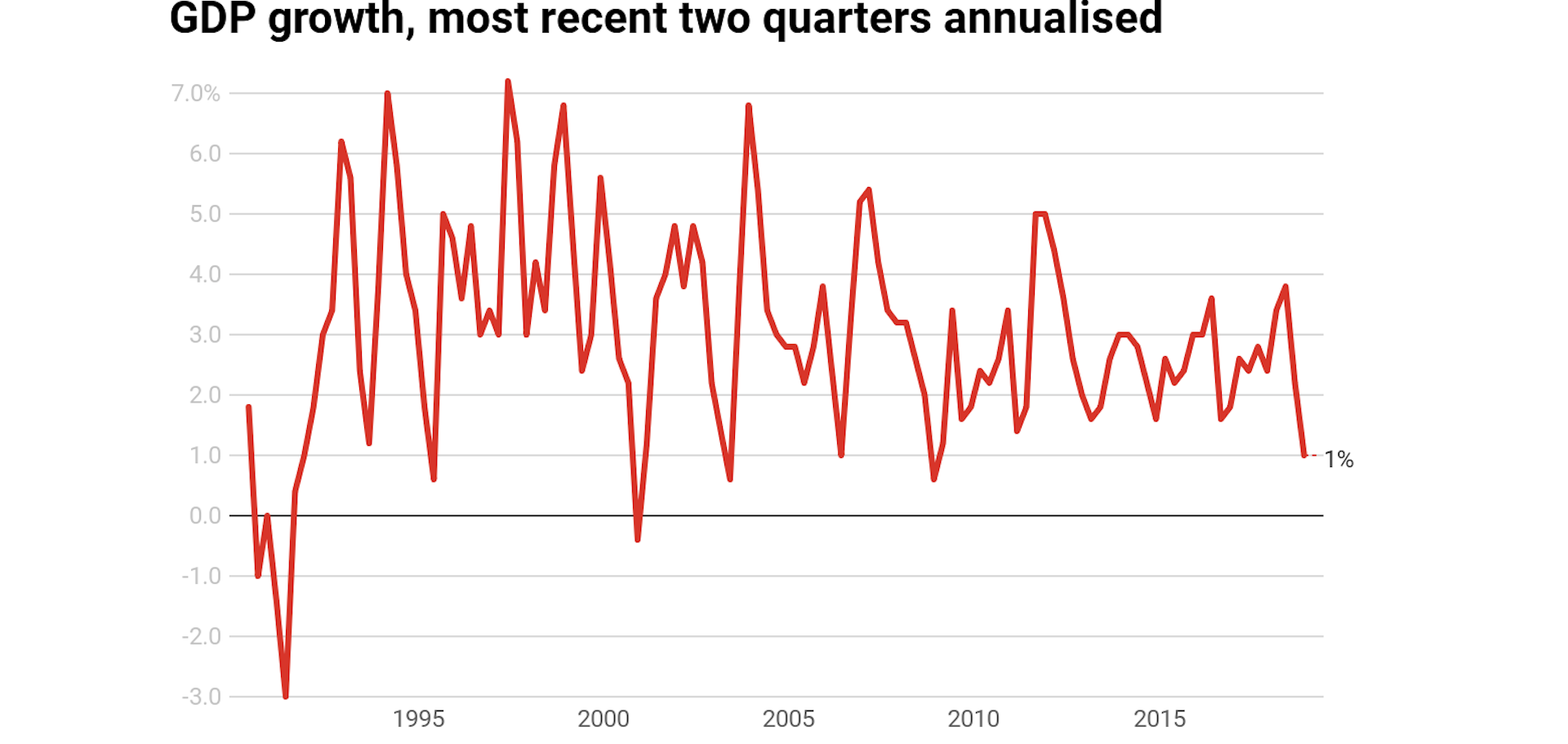
During the September and December quarters the economy grew just 0.3% and 0.2% – an annualised rate of just 1%.

That’s well short of the 2.75% the treasury believes we are capable of, and the lower than normal 2.25% it has forecast for the year to June.


Australian National Accounts

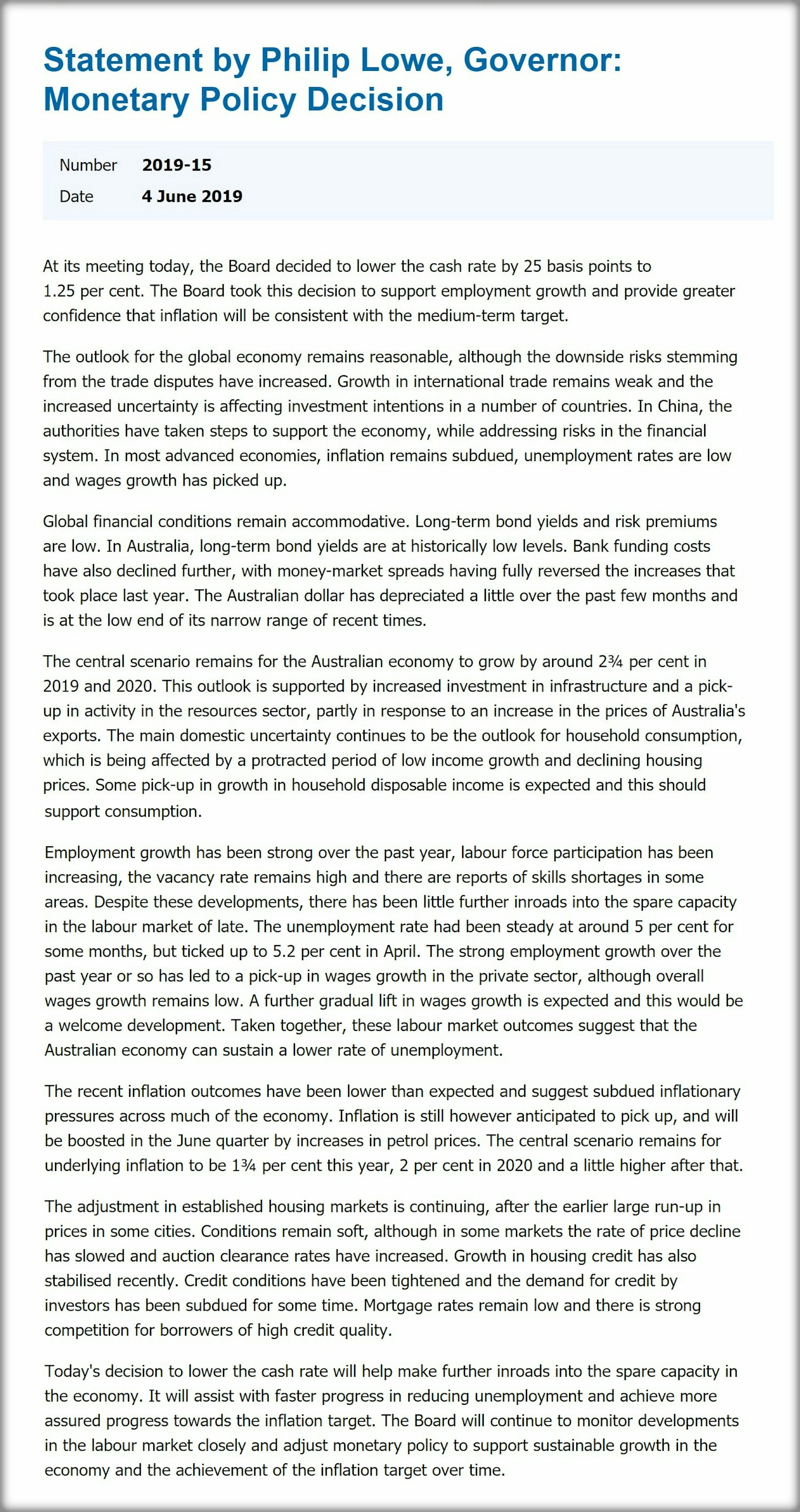
We’ve been doing it by ourselves. As Reserve Bank Governor Philip Lowe said in announcing the rates decision on Tuesday:

The main domestic uncertainty continues to be the outlook for household consumption, which is being affected by a protracted period of low income growth and declining housing prices.

The bank wants both inflation and employment higher, and it wants us to spend more in order to do it. Lower rates should help, although not for everybody.

Lowe acknowledged this in a speech to a Sydney business audience on Tuesday night, but he said households paid two dollars in interest for every one dollar of interest they received. So while rate cuts hurt savers, they benefit borrowers by more, and over time should benefit all households by boosting the economy. They also drive the dollar lower, making Australian businesses more competitive.

Tuesday’s cut should free up an extra A$60 a month for a typical mortgage holder. Another one will free up a total of A$120.

It’s not much, and there’s doubt about whether it will do much, but interest rates are about the only tool the Reserve Bank has.

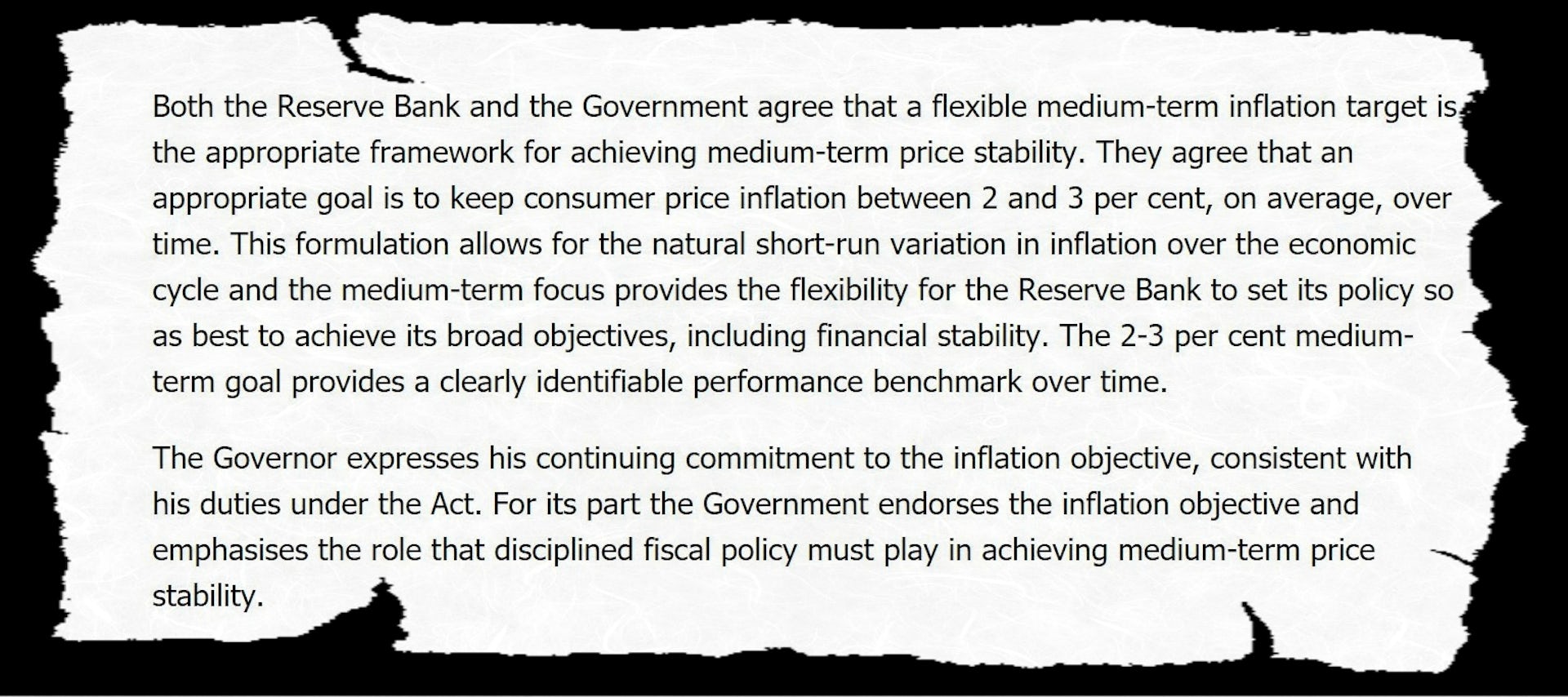
It is required by its agreement with the government to aim for an inflation rate of between 2% and 3%, “on average, over time”.

Reserve Bank of Australia

Uncomfortably for Governor Lowe, underlying inflation (abstracting from unusual moves which are quickly reversed) has been below 2% ever since he was appointed governor in late 2016.

Explaining his push for higher inflation to a business audience in Sydney on Tuesday night he said that while adherence to the target was intended to be flexible, that flexibility was “not boundless”.

If inflation stays too low for too long, it is possible that inflation expectations move lower – that Australians come to expect sub-2% inflation on an ongoing basis. If this were to happen, it would be harder to achieve the medium term inflation goal. So we need to guard against this possibility.

He is also required to aim for full employment.

He told the business audience that while for some years the bank and others had thought full employment meant an unemployment rate of 5%, the absence of inflation at 5% and the persistence of underemployment (where people wanted more hours) meant it could and should go lower.

Our judgement now is that we can do better than this – that we can sustain an unemployment rate of 4 point something.

Lower interest rates should help by making it easier for businesses to borrow to expand, and giving consumers something in their pockets to buy from them.

If you don’t succeed…

If that doesn’t happen, the bank will cut again.

Tuesday’s statement as good as said so:

The board will continue to monitor developments in the labour market closely and adjust monetary policy to support sustainable growth in the economy and the achievement of the inflation target over time.

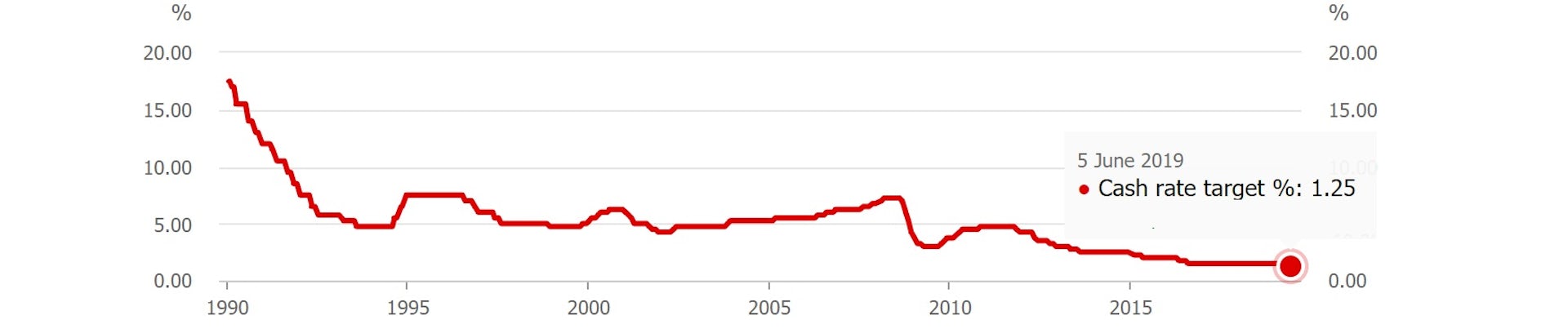
Tuesday’s cut and the next will take the bank into uncharted waters, where its so-called cash rate – what it pays to banks to deposit money with it overnight – is close to zero.

As far as can be discerned it has never been that low in the 100+ years the Reserve Bank has been in operation, originally as the Commonwealth Bank of Australia.


Reserve Bank cash rate since 1990
Reserve Bank of Australia

Should inflation still not pick up and employment still not fall as far as it believes it could, it will have to effectively cut its cash rate below zero, forcing cash into the hands of banks by aggressively buying government bonds, giving them little choice but to lend it to households and businesses, in a process known as quantitative easing. It has been done in the United States, Europe, the United Kingdom and Japan, and is by now anything but unconventional.

Governor Lowe would prefer the government to pull its weight by cutting tax and boosting spending, especially on infrastructure, and by policies that make Australia more productive.

He said so on Tuesday night

the best approach to delivering lower unemployment and a stronger economy is through structural policies that support firms expanding, investing, innovating and employing people. As we ease monetary policy, it is in the country’s interest that other policy options are considered too.

Treasurer Josh Frydenberg gets it.

He pointed out on Tuesday that the yet-to-be-approved tax offsets in the budget will give Australians on up to A$126,000 a cash bonus of up to A$1,080 when they submit this year’s tax return, far more than the rate cut.

His biggest concern, and the biggest concern of the governor, might be that they don’t spend it. Another concern would be that the banks don’t pass the rate cut on.

The ANZ has said it will only cut mortgage rates by 0.18 points instead of the full 0.25, a decision Frydenberg said “let down” customers. Westpac has cut by only 0.20 points. The National Australia and Commonwealth banks have passed on the cut in full.

On Tuesday night in Sydney Governor Lowe addressed the question of whether the banks should have passed on the full cut head on:

My usual practice in answering this question has been to explain that there are a range of other factors that influence mortgage pricing, and then say “it all depends”.

Today, though, I would like to break with my usual practice and provide a clearer answer. And that is: Yes. There has been a substantial reduction in the cost of banks raising funds in wholesale markets. Average rates on retail deposits have also come down.

This means that the lower cash rate should be fully passed through into standard variable mortgage rates. Full pass-through would also mean that the economy receives the full benefit of today’s policy decision.

The Governor is concerned that, for their own reasons, lenders such as ANZ and Westpac are forcing him to cut rates lower than he should and making an already difficult job harder.

If he has to cut further he will, but with the cash rate at just 1.25%, he would dearly love not to have to.

Reserve Bank of Australia

Read more: Cutting interest rates is just the start. It's about to become much, much easier to borrow The Conversation


Peter Martin, Visiting Fellow, Crawford School of Public Policy, Australian National University

This article is republished from The Conversation under a Creative Commons license. Read the original article.

Read more >>

Sunday, August 06, 2017

When it comes to electricity, the joke's on us

There's this joke, told against economists.

Two of them are walking down the street. One points, and says: "Hey look, there's a $20 note on the footpath." The other replies: "Impossible. If there was, someone would have picked it up by now."

Boom tish. My favourite is about a can-opener. And there's another one about sheep. But we'll leave them for another day.

What I'm getting at is that the joke against economists is actually a joke against us, about half of us.

Newgate Research has come up with the numbers in a paper prepared for the Australian Energy Market Commission, quoted by the Prime Minister in his letter to electricity bosses; the one summoning them to a crisis meeting in Canberra on Wednesday.

Roughly half of us haven't switched electricity suppliers in the past five years, and a good many have never switched.

The letter says they are leaving on the table (or on the ground) savings of up to $830 per year in Victoria and $1400 in NSW.

Why do they do it? Most say (just like the economist) that they "generally don't trust energy companies that promise a better deal". Most also say it's too complicated to compare offers and plans, a conclusion I reluctantly came to myself, and I'm normally good at these things.

Curiously, around half say they would rather cut their bill by cutting electricity use than shopping around, and most strangely of all, 39 per cent say the amount of money they could save isn't "worth the time and effort involved in switching".

It's strange, because without investigating switching they can't know how much they could save, and also because the savings would be ongoing, whereas the time and effort would be a one-off.

Newgate dug deeper and asked how much of a saving they would need in order to seriously consider switching. The thresholds were astonishingly high. On average the 2000 householders surveyed said they would need to save 23 per cent of their electricity bills to make the effort worthwhile. That's $82 each quarter in Victoria (more than $300 a year) and $97 each quarter in NSW (almost $400 a year).

If it was petrol, or groceries, we'd drive to the other end of town to save half as much.

And savings available from switching electricity suppliers appear to be bigger. Half of us don't know it because we don't think its worth our while finding out.

Many of us wouldn't know where to start. Asked unprompted to name a government price comparison website, only 2 per cent could. Energymadeeasy.gov.au might as well not exist. Twice as many people used Google to compare suppliers as used a comparison website. Of those that did try to switch, 21 per cent found it difficult, a result much worse than the 15 per cent who found it difficult to switch internet providers, 9 per cent who found it difficult to switch mobile phone companies and 7 per cent who found it difficult to change home insurance. It's about the same as the 20 per cent who find it difficult to switch banks, the best part of a decade after attempts to make it easy.

Partly, the difficulty is intentional. By expressing electricity charges in formulas that are hard to calculate, the retailers hope we'll give up. And I reckon it's also because electricity is dull, and the rewards are delayed. If you get a bargain on an iPad, you feel good straight away. You can take it home and see what you've saved.

But if you get a bargain on electricity, nothing changes: the electrons are the same and you won't see a changed bill for months. It's the same with mortgages: the dollars are identical and the savings take a while to flow through.

We're wired for novelty. If the dollars are dull, we won't pick them up.

In The Age and Sydney Morning Herald
Read more >>

Friday, August 10, 2012

We've got them stumped. Why we drive across suburbs to avoid a $2 fee

Australians have banking economists stumped.

They thought they knew what we would do when in 2009 the Reserve Bank outlawed largely hidden payments between financial institutions that were usually passed on to us as account keeping fees whenever we used a so-called “foreign” teller machine owned by another bank.

They thought we would do nothing.

In place of the indirect fees were direct fees in which the owner of each foreign ATM took the money directly from our accounts each time we made a foreign withdrawal.

But the size of the charge, typically two dollars, didn’t change. All of the economic models - including the Reserve Bank’s own model - suggested we would use ATMs pretty much as we had before. The incentives were much as they had been.

Instead withdrawals from foreign machines dived from around half of all ATM withdrawals to just 40 per cent. Among senior citizens the proportion fell to less than 10 per cent. The group the Reserve Bank had thought would be the least able to shop around turned out to be the keenest to drive across entire suburbs to avoid the two dollar charge.

A Reserve Bank study released yesterday says it’s behaviour that “cannot be accounted for by the model of ATM fees presented in this or any other existing paper”.

To work out why it has turned to research on retailing and a finding that point-of-sale displays can change purchasing decisions even when they convey no new information...

It says one of the reforms it introduced in 2009 was effectively a “point-of-sale prompt”. Since then every foreign user attempting to complete a transaction has been presented with a message reminding them of the fee and asking them to press a button to either continue or cancel.

An astonishing ten per cent of us confess to cancelling at least once in the past month.

The Bank’s tentative conclusion is that it is not the fee that is frightening us, it is being continually told about it.

In today's Age

Extra Reading

. Hugh Green, Transparency for Transparency's Sake, Agenda 19, 1 2012

Related Posts

. Incredibly good news - action on remote Indigenous ATM ripoffs

. Friday surprise. Senior citizens are better at using ATMs

. OUR CURIOUS STASH: We're loaded with cash. Except that most of us aren't.


Read more >>

Friday, May 02, 2014

Budget explainer: It's the debt, not the spending. Why the budget is bleeding

“Australia has a serious spending problem.” Keep repeating it until you believe it. Joe Hockey has.

The Treasurer was at it again on Friday in the third and final of his scene-setting speeches before the budget.

“The problem at the heart of Labor's legacy was excessive spending,” he told the Australia-Israel Chamber of Commerce .

It’s a good line, but it isn’t true.

Spending is running somewhat higher than it was when the Coalition was last in office, that’s all. On the other hand, government revenue – most of it tax – is far lower.

Australia has a big budget problem – certainly a big revenue problem - but it doesn’t yet have a spending problem.

The figures for the most recent financial year tell the story. Two years beforehand in 2010-11, Treasury forecast revenue equal to 24.1 per cent of gross domestic product by 2012-13. It was a low forecast by the standards of the previous Howard government. But what the Gillard government got was 23.1 per cent of GDP, billions of dollars less.

By a staggering coincidence, government spending that year amounted to exactly 24.1 per cent of GDP, precisely the same figure as the revenue it had expected to get.

If revenue had rolled in as expected, the past financial year’s budget wouldn’t be in deficit in all. Wayne Swan would be crowing about his success in eliminating the deficit on time, as promised.

No one is too sure where the revenue has gone. It’s a murder mystery with multiple suspects.

One is a new style of tax minimisation. Cloud-based corporations such as Google, Apple, Microsoft and Amazon pay far less tax here than their bricks and mortar predecessors used to. Whether it’s Ireland, Singapore, Holland or a more exotic tax haven, they can decide where big chunks of their incomes are meant to reside and shuffle their locations at will. So far we’ve been powerless to stop them.

Another is mining companies. Although big taxpayers because of the size of their operations, they have been paying a much lower proportion of their operating profits as tax than the rest of the corporate sector, about 5 to 10 percentage points less according to Treasury Secretary Martin Parkinson.

“Just to be clear, this is not a judgment about what the effective tax rate paid by mining companies should be,” he told business economists last May. “It is simply a statement of fact.”

Miners have been ramping up their investment spending and writing it off against their incomes quickly for tax purposes.

Another suspect is John Howard. Trapped in a moment of what columnist Annabel Crabb calls “electoral existential panic” over petrol prices in 2001, he froze the fuel excise, abandoning indexation. It hasn’t moved since. It’s still 39.14¢/litre, even though the price of petrol has climbed 60 per cent. The quick fix didn’t cost his budget much at the time but now costs $5 billion per year...

Howard gets fingered again for what economist Saul Eslake describes as “one of the worst taxation decisions made in the past 20 years”. In his last months in office, Howard exempted entirely from tax all superannuation benefits paid to almost all Australians aged 60 and over. Even the interest earned within their funds became tax free. The parting gift cost his budget nothing but crimps revenue more and more as more and more Australians age.

Another suspect is us. At times during the Howard era, households saved nothing. Income was spent as it came in. Now households as a whole save a staggering 10 per cent of their income. Much of it isn’t put in the bank, it’s used to pay down mortgages. We haven’t saved as much since 1986. It’s money largely withdrawn from the economy, money that would have once been spent on businesses that would themselves be taxed and would employ staff who would also be taxed.

And we are changing the way we are spending. More of it is overseas where it escapes the goods and services tax and more is on education and health, also untouched by the GST. The GST is allocated to the states rather than the Commonwealth so the shortfall doesn't have an impact on the Commonwealth directly, but it does put it under pressure to give the states more of its diminished income.

Australia goes into the budget with a projected deficit of $47 billion (a figure inflated by the government’s decision to pay $8 billion to top up the Reserve Bank’s reserve fund).

Each extra year the budget remains in deficit means many more billions the government has to borrow. Net debt is now expected to peak at 16 per cent of GDP, about $280 billion. Two years ago, the forecast was for a peak of just 6 per cent of GDP, about $100 billion.

Although very low by the standards of other developed countries, the forecast is an awful lot bigger than it was.

By itself, the level of debt doesn’t matter much. Government debt is not like household debt. When you or I have a debt it is usually owed to a single institution, the one that provides our mortgage. We have no choice but to pay it off, either by making the payment in full or by dying and having it taken out of our estate.

But governments aren’t like people. They are more like corporations with a multitude borrowings, each paid off when it falls due and each overlapping. There is no such thing as “the” government debt. Instead it is like the water in a bath being kept warm as old water escapes and new water flows in. The volume of water in the bath may not change, but the composition changes all the time. Lenders lend and get repaid continuously. And, unlike people, governments never die. There is never an end point at which “the government debt” has to be extinguished.

And extinguishing it would be a bad idea. In 2002-03, when the Howard government no longer needed government debt, it commissioned a review into whether it should bother continuing to issue government bonds. The review concluded that financial markets need government bonds in order to price private sector loans. Without them, interest rates would be higher. And financial institutions are required by regulators to hold some of their capital in extremely safe assets. Without government bonds they would be struggling. So the Howard government undertook to ensure it always borrowed at least $25 billion whether it needed it or not. It invested what it borrowed in shares and the like, allowing it to boast that it had no net debt while maintaining a gross debt

It’s just as well it did. When the financial crisis hit, the Rudd government decided to borrow big time. Had the Australian government not kept its debt market open it would have found that difficult in the circumstances of the time. Few would now argue the government should be entirely debt free.

A subsequent review found it would be wisest for gross debt to never fall below 12 to 14 per cent of GDP, around $200 billion in today’s dollars. (Today’s gross debt is around $400 billion.)

Although by itself the level of debt doesn’t matter much, it matters for what it does to the annual budget deficit. Once negligible, net interest payments are now about $9 billion. That’s an extra expense the budget didn’t used to have. It is set to climb to $13 billion in two years’ time as more deficits mean more borrowing, which means even bigger interest payments in future budgets.

The scale of the interest bill can be seen by comparing it to other government expenses. At 2.2 per cent of spending, $9 billion is the same as the sum the government spends on non-government schools, on residential aged care and on Newstart. Truly massive in the context of government spending, it’s about one half the size of Medicare and one third  the size of the biggest program of all – the age pension.

Unless something happens to drive that interest bill down, the government will be increasingly constrained in what it can do.

The only way to drive it down (short of a cut in interest rates) is to start running budget surpluses.

That’s why it’s talking about temporary taxes and slowing increases in the pension. It’s why the budget will be unpleasant.

It’s true the problem would disappear if revenue simply snapped back to where it used to be as a proportion of the economy. But this government can no more whistle up Howard-era revenue than could the last one.

Something has changed in the way the economy works and government has to change too.

In The Age and Sydney Morning Herald


Related Posts

. Advice for Hockey: Slug super and fix the budget in one hit

. Worried about government debt? Then don't look at this

. April 2013: Austerity. Why it is suddenly no longer fashionable

Read more >>

Thursday, January 27, 2011

Complete package of flood response documents


Complete Flood Package Documents


Full text of Gillard's speech:


Yesterday was Australia Day, and in some ways, it was an Australia Day like any other.

Picnics and barbecues, tennis and cricket, a new Australian of the Year and new Australian citizens - in so many ways it felt just like last year did and just like next year will.

But yesterday in Toowoomba, Australia Day felt different to any I have known.

I went to Toowoomba yesterday to be with some of the people I have met in these last weeks. I went to Toowoomba, where shock has been followed by horror and horror has been followed by grief and where grief's long season has only now begun, because I wanted the people I have met to know that their Prime Minister won't let them go.

I also went to Toowoomba to express my admiration for the way Australians have started rebuilding already. Whether with a mop or a shovel or a bulldozer, Australians see what needs to be done and are doing it.

It is no different for the Government. I see what needs to be done and I will do it...

We will rebuild.

The great floods of this summer have been a national tragedy, not just a natural disaster, because of the awful loss of human life.

The great floods of this summer have destroyed billions of dollars of wealth and robbed us of billions of dollars of income. In time they may prove to be the most expensive disaster in Australian history.

We are grieving.

We are burying the dead.

We are thanking many thousands for their courage and selflessness.

We are moving from crisis to recovery.

Now is the time to count the cost and to start to rebuild.

THE TASK BEFORE US

So today, I want to explain what we already know about the task before us and what we plan to do.

Queensland is of course the worst affected, but there are flood affected areas in almost every state, and the effects are being felt in the whole country today.

In order to think clearly about the best way to rebuild we need to understand not only the costs to the economy and the Federal Budget, but the growing capacity constraints on the economy, as well as the importance of the Government's long-term reform agenda.

The economic costs begin with the immediate cost of damage and destruction of property.

Private homes and cars have been wrecked, business equipment ruined, public ferry terminals and highways have been damaged, even the ocean floor of Moreton Bay itself needs cleaning up.

That is a huge, one-off cost – simply replacing the things the floods have destroyed. These costs will be shared by people and families, by firms and insurers, by all levels of Government.

The Australian Government's greatest part is through direct payments to affected individuals and businesses and through the cost of rebuilding. And in rebuilding, the Australian Government pays the greatest share. Under our longstanding natural disaster arrangements with the States, we meet 75 per cent of this cost for major disasters.

Today's estimates of the Federal Budget costs of these floods over the next four years are of course preliminary, but they are the best figures we have before us.

The Australian Government Disaster Recovery Payments – which have given short-term financial assistance to half a million Australians affected by the floods – are estimated to cost over $600 million. The Disaster Income Recovery Subsidy – helping workers, small businesspeople and farmers who have lost income – will cost another $120 million.

At this stage – and I stress the estimates are preliminary and costs may well rise – the cost to the Australian Government of rebuilding flood affected areas outside Queensland is estimated at $1 billion.

Rebuilding flood affected areas in Queensland itself is estimated to cost us $3.9 billion.

Bringing all of those elements together the best preliminary estimate of the direct cost to the Federal Budget of this summer's flood disaster is just over $5.6 billion.

So that is the immediate Budget challenge, to find over $5 billion.

Although our economy remains strong, there is also the one-off effect on economic activity because of the immediate disruption from the floods.

When a city of millions is closed for business for days, the cost to the economy is huge. When roads are closed all over a State that represents a fifth of GDP, the cost to the economy is enormous.

And the cost of this disruption continues into the future. Some coal mines won't return to full production for months and farming will be affected for seasons.

Treasury's preliminary estimates are that GDP growth in this financial year will be around half a percentage point lower due to the floods. The Treasurer will be saying more about the future impact on the economy in coming days.

But we still have the advantage that our overall economy is strong and that means we have the capacity to pay as we go”.

With our growing economy and rising national income, we can pay for rebuilding now. And if we can, we should. We should not leave the task of finding the money until future years.

My experience in Government since 2007 tells me that while we must plan to sustain growth we must never take future growth for granted, so we should not put off to tomorrow what we are able to do today.

Solely borrowing to rebuild Queensland is a soft option I am not prepared to consider.

My Cabinet's job is still to make the decisions which will bring the Budget back to surplus in 2012-13.

In a growing economy, we pay as we go.

In addition to the Budget challenge there is a wider economic challenge as well: building and managing economic capacity.

This is because we don't only need to be able to pay for the new things we now need – we quite literally need to be able to make the new things we now need as well.

The floods have not washed away piles of hundred dollar notes. They've put holes in roads, buckled rail, broken up sections of ports, wrecked factory equipment, washed away fencing on farms.

So we're not just going to need money, we're going to need concrete and rubber and steel – and more importantly, we're going to need carpenters and bricklayers and road gangs.

And while the advantage of a strong economy is felt when we come to fund the rebuilding, the challenge of a strong economy is felt when we look for the capacity: delivering the actual rebuilding itself.

There is unprecedented demand in many parts of Australia for skilled labour.

Unemployment is already low and participation is already rising.

And that's before we add one extra tradie or truck driver to rebuild after the floods.

There is unprecedented pressure on Australia's infrastructure as well.

More infrastructure is already needed to nurture the mining boom and support economic growth, so the Government is investing in long lived economic assets and infrastructure like high speed broadband, ports, roads and rail.

Now we have thousands of kilometres of roads and rail to rebuild as well.

Simply spending to rebuild without addressing the balance between supply and demand in the economy as a whole is not an option.

That would only drive up the cost of skilled labour and the cost of building materials and other economic inputs, reduce value for money in the rebuilding itself, rob our mining industry and other economic sectors of the skills and material they need, and ultimately spill over into higher inflation and interest rates.

To make up for the demand we are putting into the economy with our rebuilding efforts the Government must take some demand out of the economy at the same time.

So sound Budget principles say we should pay as we go – and sound economic principles say we should not add to capacity pressures.

And we must drive reforms for the future as well.

I know Australians expect that while we rebuild after the floods, the Government will not lose sight of our long-term reform agenda.

Australians expect their governments to do more than one thing a time.

So 2011 remains a year when I will be delivering the national broadband network, creating more opportunity through education reforms and improving health care as well as a year when I will make long-term decisions on workforce participation and a carbon price.

That is my job and that is what I will do.

DELIVERING REBUILDING

Here's how I'll begin.

I will make an immediate upfront payment to Queensland of $2 billion.

With this money rebuilding can start in more than 60 flood-affected communities across Queensland.

The payment will be made in the current financial year, as soon as financial controls and arrangements are finalised.

I'm acutely conscious of the desire of the Queensland Government to use their powers to cut through red tape and deliver rebuilding as fast as they can. I want to ensure that nothing in the funding arrangements holds them back.

I want this money to be available immediately. In my meetings with Premier Bligh and with Major General Mick Slater they've stressed that no town should be closed for a day longer than is necessary because of a lack of funds ready to be spent. And from my discussions with local community leaders and small and medium business owners, they want funds to flow as soon as possible so economic life can return to the main streets of regional towns.

A National Partnership Agreement with Queensland will establish the conditions of the funding. I expect this to be a simple, transparent and generous set of guidelines which ensure public money is spent in the right ways and at the right time.

Queensland will get what it needs.

The money will be managed by the Queensland Reconstruction Authority, which will scope and coordinate the total statewide rebuilding program and develop a statewide reconstruction plan. This will take into account unique local problems and opportunities in each flood affected community.

Payments to other states will be made through the Natural Disaster Relief and Recovery Arrangements in the usual way. We are working closely with the responsible State Governments to ensure all this assistance is delivered when and where it is needed.

The Australian Government's total commitment – which our best estimates suggest will reach $5.6 billion – is absolutely vital to the rebuilding of our country and our recovery from the floods.

FUNDING AND SKILLING REBUILDING

We will meet the cost.

Rebuilding after the floods in an economy with growing capacity constraints for the present while delivering reforms and making decisions is a big job and there'll inevitably be setbacks.

But as a nation we are up to the challenge and we are up to managing the economic strains.

So we can do just that, I have made a set of decisions on funding and managing economic demand.

I announce today a $5.6 billion funding and skilling package for flood rebuilding.

A balanced package which cuts some spending programs, defers some new infrastructure and applies a one-off levy to most Australian income earners from 1 July this year.

Two dollars are saved in spending cuts for every dollar raised by the levy.

With other changes to ensure we have enough skilled workers to get the new work done.

First, we will deliver a one-off levy. It will not include lower-income earners.

A levy of 0.5 per cent will be applied on taxable income between $50,001 and $100,000 and a levy of 1 per cent will be applied on taxable income above $100,000. Anyone earning under $50,000 will not pay the levy.

In other words it is not like the Medicare Levy, which for most taxpayers applies to all their income – it is like income tax rates which apply only above certain income levels.

Under this levy, someone who has an income of $60,000 will pay just under $1 extra per week. A person earning $100,000 per year will pay just under an extra $5 per week.

The levy will apply only in the 2011-12 financial year and it will raise $1.8 billion.

People who were affected by the floods will not pay this levy.

Anyone who receives the Australian Government Disaster Recovery Payment for a flood this financial year will be exempt.

And importantly, this levy is completely separate from donations.

People who have generously donated are helping out individuals in their time of need. People who pay this levy will be helping to rebuild the infrastructure – roads, bridges, ports – which has been torn apart by these floods.

The great majority of Australians are ready to contribute, I have no doubt about that.

The legislation will be introduced into the Parliament in the first sitting week.

Second, we will defer some infrastructure projects to help manage capacity constraints and to redirect funding to immediate rebuilding.

Six Queensland roads projects will be delayed by periods of one to three years. This will save $325 million in the Budget period. And these changes have been agreed to by the Queensland Government.

I have also identified a number of projects in other states where delays and reductions in Australian Government funding will save approximately $675 million. Over coming days I will be discussing these projects directly with the affected State Governments before the Minister for Infrastructure publicly announces the details of our changes.

The savings from these infrastructure decisions make a major contribution to funding the rebuilding. Perhaps even more important, these decisions will free up skilled labour for rebuilding. This is part of ensuring we not only pay as we go, but manage capacity as well.

These decisions will also ensure value for money when these projects are delivered.

That's an important part of my thinking in deferring these infrastructure works: for these long-term projects, I am determined to ensure value for money. Pressing ahead now would inflate the cost to taxpayers considerably.

Third, we will cut some spending programs and cap some others.

I am abolishing, deferring and capping access to a number of carbon abatement programs.

These include the Green Car Innovation Fund, Cleaner Car Rebate Scheme, the Carbon Capture and Storage Flagships and Solar Flagships, the Solar Hot Water Rebate, Green Start Program, Solar Homes and Communities Plan and the Global Carbon Capture and Storage Institute.

The key to these carbon abatement program savings is my determination to deliver a carbon price.

There is complete consensus that the most efficient way to reduce carbon is to price carbon. Some of these policies are less efficient than a carbon price and will no longer be necessary – others will be better delayed until a carbon price's full effects are felt.

And these decisions also mean cuts to industry programs. Business will be doing its part.

With the major call on the Budget for rebuilding, it is now appropriate to reduce this spending, in the knowledge that the objectives will be delivered better through the Government's more economically efficient policy of a carbon price.

I am also capping some programs to limit their cost: the National Rental Affordability Scheme and the LPG Vehicle Scheme. And some lower priority education spending, where the desired outcome can be achieved through other programs, will be discontinued. This includes the Capital Development Pool and the Australian Learning and Teaching Council.

And Building Better Regional Cities funding and Priority Regional Infrastructure Program funding will be redirected to the highest priority infrastructure demand on Government – flood rebuilding.

There are no easy savings, but this package is balanced and appropriate.

I am confident Australians will understand the need for these decisions.

Skilled labour will be as important as funding for rebuilding.

The 457 visa program for temporary skilled migrants has proven to be very responsive to prevailing economic conditions. The program is entirely demand driven by employers.

So I am announcing quicker approval for temporary skilled migrants who work on flood rebuilding. There will be extra resources, assistance to employers and simpler processes to ensure a five day turnaround for ‘decision-ready' applications for workers in a host of nominated occupations to work on rebuilding Queensland.

I am also doubling the pilot of relocation assistance for people on income support and directing it to Queensland. Up to 4 000 eligible jobseekers who want to get a job helping out will now receive support to move to Queensland and make a difference on the ground.

The offer to these jobseekers is simple: we can get you help to get there if you can stick at the job.

The funding and skilling package is the right one.

Two dollars saved in spending cuts for every dollar raised through the temporary levy.

Cutting less efficient carbon abatement programs because the carbon price will deliver a market based solution. Business doing its part through cuts to industry programs.

Capping demand-driven programs to limit costs. Redirecting infrastructure spending to the highest priority, flood rebuilding. Delivering the skilled workers we need as quickly as we can.

Paying as we go and managing demand.

THE INVALUABLE WORK OF THE COMMUNITY AND BUSINESS

As important as the role of government is in responding to this disaster, others will also play a vital role.

Australians have given generously to the Premier's Relief Fund in Queensland and similar funds in other states. I am very proud of that helping hand of mateship.

This will help meet the hardship and distress of individual flood victims.

The Australian Government has pledged contributions to these funds as well as encouraging business to give generously.

And I do want to take a moment to pay particular tribute to corporate Australia's contribution in the crisis. Hundreds of Australian big, medium and small businesses have already pledged money and donations in kind.

My meeting with business leaders in Brisbane on Monday confirmed that more money was on its way to rebuild and repair – as well as trucks to remove the rubbish, bottled water for drinking, clothes and toys for people whose houses were lost or damaged.

These are just examples of the substantial corporate assistance coming through.

I'm proud of the way corporate Australia has given something back this month.

I believe all insurers should show as much compassion and flexibility in dealing with individuals affected by the floods.

Australia's insurance industry has a very positive record of assisting communities after natural disasters, but I know a number of questions have arisen as a result of the floods about definitions, coverage and consumer protection.

Already the Treasurer and Assistant Treasurer have engaged in a frank and constructive dialogue with the Insurance Council of Australia and the major flood affected insurers and we have seen RACQ lead the way by announcing a $20 million package to assist flood victims.

This is an example the industry should follow.

But the rebuilding cost for government is something quite different from corporate assistance and the relief funds or the costs met by insurance.

Donations will provide invaluable extra help.

Government funding will provide the core assistance all Australians rely on and rightly expect from their Government. This will largely fund the restoration and replacement of essential public assets and long-term economic infrastructure.

Roads and rail to get farm produce to market and coal to port - Integral parts of the public infrastructure, which urgently need to be brought back into service, and for which the costs run into the billions.

A CHALLENGE FOR OUR NATION

I've spent a lot of time in flood-affected parts of our country in the past two weeks.

I wanted to be on the ground to make sure that the Queensland Government could get whatever it needed from the Government straight away.

I also wanted to be able to see my Government's efforts with my own eyes and ensure it was all working at its best, across the country.

What I have learnt has certainly been instrumental in my own thinking as we've put together this package to rebuild after the floods.

And while what I learnt was important, what I was reminded of was so much more.

I was reminded about our people.

Flood affected people in Queensland who feel the sorrow, even the grief, but who know the sun will come up and are determined to endure.

Flood affected people outside Queensland who keep telling me there's worse off than them, and they are glad there hasn't been greater loss of life in their parts. But flood damage is flood damage and in a quiet way, they also say to me ... don't forget us.

Australians not affected by floods who just want to help. Not just Brisbane's amazing clean up volunteers, not just friends filling sandbags for friends, but all Australians, especially those far from the waters, are looking for a way to make a difference.

As I reflect on these floods and what has happened, I can't escape the sadness. None of us can. But I won't forget the pride in what we have done together.

But then I look forward and I know what needs to be done: Investing in rebuilding; investing in future growth; managing demand; reforming for the future. That's what we will do.

My plan for rebuilding after the floods is the right economic solution, but it is more than that.

It is what Australians have a right to expect.

Putting the national interest first.

Working to build consensus.

Tackling the big challenges.

Focussing on delivery.

Doing it the Australian way.

Sharing and sticking together.

Everyone doing their part.

We put out a hand to help the flood victims on the first day when they needed us. They still need us.

We won't let go.


Related Posts


Read more >>