Tuesday, February 27, 2024

Worried about price gouging? For banks, there’s a simple solution

Does it feel like you’re being charged more for all sorts of things these days, from groceries to banking? Turns out, you’re right.

While we might be more likely to remember prices that go up than prices that go down, the very best evidence – assembled by Australia’s Treasury, the federal government’s lead economic adviser – says your suspicions are right. We really are being charged more than we used to be two decades ago.

Coupled with the latest profit reports from Australia’s biggest supermarkets and banks, including Tuesday’s half-year results from Coles, it suggests we are contributing more to company profits than we used to.

Climbing price markups

The Treasury estimates show in the 13 years between 2003-04 and 2016-17, the average price markup – the difference between the cost of a product and its selling price – across all Australian industries climbed 6%.

That’s extra profit, taken from your wallet, going to the people selling you things.

Those Treasury estimates are contained in a background paper prepared for the competition inquiry being undertaken by a panel including Productivity Commission chair Danielle Wood, former Competition and Consumer Commission chief Rod Sims, and business leader David Gonski.

At the same time, the average share of each industry held by its biggest four firms edged up from 41% to 43%.

Profit margins are also higher here than in more competitive markets overseas.

This is true in banking, where the big four have taken over St George, BankWest, and the Bank of Melbourne – and are about to take over Suncorp.

It’s also true in supermarkets, where the big two, Woolworths and Coles, have taken over or seen off Franklins, Bi-Lo and Safeway.

Bigger profit margins than overseas

Coles supermarkets reported earnings before adjustments of A$1.73 billion on sales of $19.778 billion in the half year to December – a profit margin of 8.7%.

Last week, Woolworths supermarkets reported earnings of $2.45 billion on sales of $25.648 billion – a margin of 9.6%.

By way of comparison, the dominant UK supermarket group, Sainsbury’s, has a profit margin of 6.13%.

In banking, the Commonwealth Bank has just reported a return on equity (profit as a proportion of shareholders’ funds) of 13.8%. National Australia Bank reported 12.9%.

While on a par with the big banks overseas, those recent returns are a good deal higher than CommBank’s 11.5% and NAB’s 10.7% reported two years ago.

Little hope for groceries

For supermarkets, there’s not a lot the government can do, apart from launching an inquiry, and perhaps giving Australian authorities the power to break up firms that abuse their market power.

But Prime Minister Anthony Albanese has said he isn’t keen on giving Australian authorities the sort of powers available to authorities in the United States and the United Kingdom, saying (incongruously) Australia is “not the old Soviet Union”.

And doing anything short of that would be unlikely to have much effect. Australia’s two supermarket giants have invested a fortune in high-tech warehouses and distribution systems, which new rivals would be hard-pressed to match.

Hope for more competitive banking

But for banks it’s altogether different. Richard Denniss of the Australia Institute has come up with the idea, and it’s a beauty.

It’s for the government to provide a low-cost banking service – expanding on services it already offers.

The costs would be so low, other banks might decide to add features and resell them in the same way as resellers sell mobile phone and NBN services.

The primary function of any bank is to provide a numbered account into which Australians can deposit and withdraw funds.

The Australian Tax Office does this already, at an incredibly low cost.

The tax office gives every working Australian a tax file number. Employers deposit money into these accounts, and – should the tax office owe a refund – taxpayers withdraw them.

Some taxpayers ensure their tax is overpaid, so they withdraw later.

Denniss describes it as a bank account with the world’s clumsiest interface.

The government could offer bank loans

It wouldn’t be much of a stretch from improving that interface to offering government loans.

In fact, government loans are already provided in some circumstances: such as to retirees with home equity through the home equity access scheme, and to Centrelink recipients through advance payments.

It woudn’t be much more of stretch to provide loans more broadly, at an incredibly low administrative cost. The government already lends against the value of homes.

Back in the days when the federal government owned the Commonwealth Bank, it had to cover the high costs of running bricks and mortar branches.

Freed from those costs, the government could now offer a low-cost, technology-enabled basic banking service that would tempt us away from the big four banks – unless they offered better value.

Of course it would cost money, although a lot of it has already been spent setting up the system of tax file numbers and accounts. And of course the banks would hate the idea. That would be the point.

But doing what we can to stop Australians being overcharged is important, not only for wage earners but also for businesses.

The competition inquiry the government has launched is a good start. It shouldn’t be frightened about where it might lead.The Conversation

This article is republished from The Conversation under a Creative Commons license. Read the original article.

Read more >>

Tuesday, February 13, 2024

What would a vehicle efficiency standard for new cars cost – or save – Australian drivers?

Opposition leader Peter Dutton says Labor’s proposed fuel efficiency standard for new cars would push up the price of a Mazda CX30 “by about $19,000”.

Given that right now the Mazda CX30 costs A$33,140, that’d be one hell of an increase.

So what should we really expect if Australia finally introduces fuel efficiency standards here – decades after the US and Europe? What could it cost us upfront for buying new cars? And how much could we save later in lower fuel bills?

Here’s what we do know, based on decades of international experience, new federal government analysis – and even cost estimates from a previous Coalition government.

Car efficiency standards are common overseas

Labor is proposing a so-called new vehicle efficiency standard of the kind proposed by the Coalition in 2016, championed by the Coalition in 2022, and common in the rest of the world.

Here’s how it works in Europe, the United States and Japan, and just about every advanced economy other than Russia and Australia.

Every car manufacturer has to meet an average efficiency standard for the new vehicles it sells each year, whether expressed in miles per gallon (the US) or carbon dioxide emitted per kilometre (Europe).

Europe has been doing it since 2009. When it tightened its standards in 2020, average CO₂ emissions of new passenger cars sold fell 12% and a further 12.5% the following year.

In the US, fuel efficiency has doubled

The United States has been doing it since 1975.

In that time, the average efficiency of its new cars has doubled, and it is about to tighten standards further.

After decades of being the odd one out, Australian passenger cars on average use 20% more fuel than passenger cars in the US.

And that isn’t only because Australians like SUVs and utes. In both Australia and the US, SUVs and utes account for four out of every five new light vehicles sold.

But the new SUVs and utes sold in Australia produce on average 24% more emissions than those sold in the United States. The new smaller cars sold in Australia produce 31% more.

Standards change the mix of what’s sold

Efficiency standards don’t prevent carmakers from selling inefficient vehicles. What they do is ensure they make those vehicles more efficient, or balance their sales with sales of more efficient ones.

At the moment, it means the vehicles sold in the US and elsewhere get advanced emissions technologies not generally offered in Australia.

It’s easy to understand why. With efficient vehicles prized in the US, Europe, and other places, because they are needed to balance up the sales of less efficient vehicles, they get diverted to those places – rather than Australia.

In the words of Volkswagen Group Australia chief Michael Bartsch, it makes Australia a “dumping ground” for older and less efficient vehicles.

Labor has put forward three options for targets: a slow start, a fast start, and its preferred option: “fast but flexible”.

Its preferred option would require carmakers selling in Australia to catch up with the standards of countries including the United States by 2028.

For motorists, the biggest benefit is fuel savings – calculated at A$107 billion between now and 2050. Against that sit vehicle technology, electricity and battery replacement costs of half as much, leaving motorists a long way ahead.

But would it push up the price of cars, as Dutton suggests?

‘No systemic, statistically significant increase’

The government’s consultation paper says the evidence consistently shows no price impact or a negligible price impact.

But common sense suggests it’ll make the price of gas guzzlers somewhat more expensive, and lean, fuel-efficient machines less expensive, as carmakers adjust the mix of what they trying to sell.

When the Coalition looked at this back in 2016, it found the standard it proposed would increase the price of an average-performing petrol passenger vehicle by between $800 and $2,000, and the price of an average-performing diesel light commercial vehicle by between $750 and $2,000.

At the petrol price at the time, $1.30 per litre – far less than we’re paying now – motorists would have been ahead after four years.

Maybe Labor’s plan will push up car prices more than the Coalition’s 2016 plan, because it is more ambitious, as Dutton suggests. Or maybe it will push up prices by less because vehicle technology has improved.

In the US, a statistical analysis of prices from 2003 to 2021 found “no systemic, statistically significant increase in inflation-adjusted vehicle prices” during two decades in which standards were tightened and fuel economy improved 30%.

And standards will need to tighten. Cars and other light vehicles account for 13% of Australia’s carbon emissions. Both this government – and its Coalition predecessor – committed to cutting Australia’s net emissions to zero by 2050.

Without vehicles pulling their weight, along with heavy industry and electricity, we won’t get there.The Conversation

This article is republished from The Conversation under a Creative Commons license. Read the original article.

Read more >>

Tuesday, February 06, 2024

How Albanese could tweak negative gearing to build more new homes

There are two things the prime minister needs to get into his head about tax. One is that saying he won’t make any further changes no longer works. The other is that negative gearing doesn’t do much to get people into homes.

Anthony Albanese seemed to have taken the first point on board when he spoke to The Insiders on Sunday.

Rather than promising flat-out not to change the rules around negative gearing, he merely said he was

supportive of the current rules, we have not considered changes to them

But he was less careful when it came to the virtues of negative gearing. He said there was

a whole lot of analysis that says they encourage investment in housing, the key when it comes to housing is housing supply.

His official advisers in the treasury don’t think negative gearing does much to increase the supply of housing – or, if they do, they omitted it from the six-page briefing note headed “negative gearing”, prepared to help the treasurer answer questions about it in parliament.

Our rules reward bad management

Negative gearing is a particularly Australian tax benefit, which – unlike in other countries – benefits dud landlords: those who can’t make money by renting out properties.

If they lose money (by paying out more in interest, maintenance and other expenses than they are receiving in rent) we let them offset that loss, not only against income from other investments, but also against income from their wage or salary.

It means they can cut their wage for tax purposes, cutting the tax they pay on it. And at the same time, they can hang on to a property they can later sell for a profit, which will be taxed at only half the normal rate, thanks to Australia’s 50% discount on capital gains.

It isn’t allowed in the United Kingdom or the United States. There, if you are a landlord who can’t make money, you can offset your losses against profits from other investments – but not against your wage.

In Canada you can offset rental losses against wages, but there must have been an “an intention to make a profit”. That would probably rule out most Australian negative gearers.

Most gearers don’t build homes

In Australia, an astounding one million of us negatively gear – more than one in nine taxpayers. In 2020-21 they claimed losses amounting to $8.7 billion – 3.5% of the income tax collected – meaning if they didn’t do it (if they didn’t claim for what seem to be deliberate losses) the rest of us could pay less tax.

What Albanese said on the weekend was half right. Negative gearing encourages investment. Most months, more than one in three new home loans is for an investment property.

But most of those loans don’t increase supply – the thing Albanese says matters.

That’s because the overwhelming bulk of investor home loans go to “investors” planning to buy existing homes – to bid against and likely beat would-be owner-occupiers.

In December 2023, only 23% of the loans to investors was used to build a home or buy a newly-built home. In November only 19%.


As a means of getting more homes built, negative gearing leaks like a sieve. As a means of ensuring Australians continue to rent, rather than buy, it’s effective.

In the 20 or so years since the headline rate of capital gains tax was halved, supercharging negative gearing, the proportion of Australian households renting has climbed from 26% to 30%. If those extra renters become owners, an extra 400,000 Australians would be in homes they could call their own.

How to get better value from gearing

The really bizarre thing is that Albanese has it in his power to ensure negative gearing does exactly what he said it did – supercharge the building of houses.

All he would need to do is what Labor promised to do in 2016 and again in 2019. In those elections, Bill Shorten went to voters promising to limit the use of negative gearing to newly-built homes.

As Shorten put it, taxpayers would

continue to be able to deduct net rental losses against their wage income, providing the losses come from newly constructed housing.

The sieve would no longer leak. Every dollar of tax lost to a negative gearer would help build a home.

What would have happened if Shorten had got his way: if Australia both focused the use of negative gearing and cut the capital gains discount as he had proposed?

Modelling just published in Australian Economic Papers finds the share of households who own their home rather than renting it would have climbed 4.7%.

That’s security worth having, especially if it is accompanied by more homes.

An idea whose time is coming?

Australia’s Treasury has begun publishing estimates of the cost of the present unfocused system of negative gearing. Its latest, released last week, puts the cost at $2.7 billion per year, to which should probably be added a chunk of the $19 billion per year lost as a result of the capital gains concession.

The estimates are new. Until Jim Chalmers became treasurer, his department didn’t publish estimates of the cost of rental deductions.

Chalmers is far from the first treasurer to be curious about what the concession does. Scott Morrison expressed concern about the “excesses” of negative gearing.

And Morrison’s predecessor, Joe Hockey, said on leaving parliament that negative gearing should be skewed towards new housing, so “there is an incentive to add to the housing stock rather than an incentive to speculate on existing property”.

Albanese is normally cautious. But as he is showing us right now with his rejigged Stage 3 tax cuts, there are times when he is not.

If he really wants to throw everything he has got at building more homes, he knows what to do.The Conversation

This article is republished from The Conversation under a Creative Commons license. Read the original article.
Read more >>

Saturday, February 03, 2024

Mortgage and inflation pain to ease, but only slowly: how 31 top economists see 2024

Wes Mountain/The Conversation, CC BY-ND

A panel of 31 leading economists assembled by The Conversation sees no cut in interest rates before the middle of this year, and only a slight cut by December, enough to trim just $55 per month off the cost of servicing a $600,000 variable-rate mortgage.

The panel draws on the expertise of leading forecasters at 28 Australian universities, think tanks and financial institutions – among them economic modellers, former Treasury, International Monetary Fund and Reserve Bank officials, and a former member of the Reserve Bank board.

Its forecasts paint a picture of weak economic growth, stagnant consumer spending, and a continuing per-capita recession.

The average forecast is for the Reserve Bank to delay cutting its cash rate, keeping it near its present 4.35% until at least the middle of the year, and then cutting it to 4.2% by December 2024, 3.6% by December 2025 and 3.4% by December 2026.


The gentle descent would deliver only three interest rate cuts by the end of next year, cutting $274 from the monthly cost of servicing a $600,000 mortgage and leaving the cost around $1,100 higher than it was before rates began climbing.

Six of the experts surveyed expect the Reserve Bank to increase rates further in the first half of the year, while 20 expect no change and three expect a cut.

Former head of the NSW treasury Percy Allan said while the Reserve Bank would push up rates in the first half of the year to make sure inflation comes down, it would be forced to relent in the second half of the year as unemployment grows and the economy heads towards recession.

Warwick McKibbin, a former member of the Reserve Bank board, said the board would push up rates twice more in the first half of the year as insurance against inflation before leaving them on hold.

Former Reserve Bank of Australia chief economist Luci Ellis, who is now chief economist at Westpac, expects the first cut no sooner than September, believing the board will wait to see clear evidence of further falls in inflation and economic weakening before it moves.


Inflation to keep falling, but more gradually

Today’s Reserve Bank board meeting will consider an inflation rate that has come down faster than it expected, diving from 7.8% to 4.1% in the space of a year.

The newer more experimental monthly measure of inflation was just 3.4% in the year to December, only points away from the Reserve Bank’s target of 2–3%.

But the panel expects the descent to slow from here on, with the standard measure taking the rest of the year to fall from 4.1% to 3.5% and not getting below 3% until late 2025.

Economists Chris Richardson and Saul Eslake say while inflation will keep heading down, the decline might be slowed by supply chain pressures from the conflict in the Middle East and the boost to incomes from the tax cuts due in July.


Slower wage growth, higher unemployment

While the panel expects wages to grow faster than the consumer price index, it expects wages growth to slip from around 4% in 2023 to 3.8% in 2024 and 3.4% in 2025 as higher unemployment blunts workers’ bargaining power.

But the panel doesn’t expect much of an increase in unemployment. It expects the unemployment rate to climb from its present 3.9% (which is almost a long-term low) to 4.3% throughout 2024, and then to stay at about that level through 2025.

All but two of the panel expect the unemployment rate to remain below the range of 5–6% that was typical in the decade before COVID.

Economic modeller Janine Dixon said the “new normal” between 4% and 5% was likely to become permanent as workers embraced flexible arrangements that allow them to stay in jobs in a way they couldn’t before.

Cassandra Winzar, chief economist at the Committee for the Economic Development of Australia, said the government’s commitment to full employment was one of the things likely to keep unemployment low, along with Australia’s demographic transition as older workers leave the workforce.


Slower economic growth, per-capita recession

The panel expects very low economic growth of just 1.7% in 2024, climbing to 2.3% in 2025. Both are well below the 2.75% the treasury believes the economy is capable of.

All but one of the forecasts are for economic growth below the present population growth rate of 2.4%, suggesting that the panel expects population growth to exceed economic growth for the second year running, extending Australia’s so-called per capita recession.


The lacklustre forecasts raise the possibility of what is commonly defined as a “technical recession”, which is two consecutive quarters of negative economic somewhere within a year of mediocre growth.

Taken together, the forecasters assign a 20% probability to such a recession in the next two years, which is lower than in previous surveys.

But some of the individual estimates are high. Percy Allen and Stephen Anthony assign a 75% and 70% chance to such a recession, and Warren Hogan a 50% chance.

Hogan said when the economic growth figures for the present quarter get released, they are likely to show Australia is in such a recession at the moment.

The economy barely grew at all in the September quarter, expanding just 0.2% and was likely to have shrunk in the December quarter and to shrink further in this quarter.

The panel expects the US economy to grow by 2.1% in the year ahead in line with the International Monetary Fund forecast, and China’s economy to grow 5.4%, which is lower than the International Monetary Fund’s forecast.

Weaker spending, weak investment

The panel expects weak real household spending growth of just 1.2% in 2014, supported by an ultra-low household saving ratio of close to zero, down from a recent peak of 19% in September 2021.

Mala Raghavan of The University of Tasmania said previous gains in income, rising asset prices and accumulated savings were being overwhelmed by high inflation and rising interest rates.

Luci Ellis expected the squeeze to continue until tax and interest rate cuts in the second half of the year, accompanied by declining inflation.

The panel expects non-mining investment to grow by only 5.1% in the year ahead, down from 15%, and mining investment to grow by 10.2%, down from 22%.

Johnathan McMenamin from Barrenjoey said private and public investment had been responsible for the lion’s share of economic growth over the past year and was set to plateau and fade as a driver of growth.

Home prices to climb, but more slowly

The panel expects home price growth of 4.6% in Sydney during 2024 (down from 11.4% in 2024) and 3.1% in Melbourne, down from 3.9% in 2024.

ANZ economist Adam Boyton said decade-low building approvals and very strong population growth should keep demand for housing high, outweighing a drag on prices from high interest rates. While high interest rates have been restraining demand, they are likely to ease later in the year.


In other forecasts, the panel expects the Australian dollar to stay below US$0.70, closing the year at US$0.69, it expects the ASX 200 share market index to climb just 3% in 2024 after climbing 7.8% in 2023, and it expects a small budget surplus of A$3.8 billion in 2023-24, followed by a deficit of A$13 billion in 2024-25.

The budget surplus should be supported by a forecast iron ore price of US$114 per tonne in December 2024, down from the present US$130, but well up on the US$105 assumed in the government’s December budget update.


The Conversation’s Economic Panel

Click on economist to see full profile.

Download the answers as XLS PDFThe Conversation

This article is republished from The Conversation under a Creative Commons license. Read the original article.

Read more >>

Tuesday, January 23, 2024

Why Australian workers’ true cost of living has climbed far faster than we’ve been told

Why is Prime Minister Anthony Albanese suddenly so keen to deliver extra cost-of-living relief – keen enough to summon Labor members of parliament to Canberra for a briefing on Wednesday, followed by a National Press Club address on Thursday?

One immediate reason is he is keen to make sure Labor wins the upcoming byelection in the outer-Melbourne electorate of Dunkley on March 2.

But the cost of living wouldn’t matter much for Dunkley – and it wouldn’t matter much for the rest of us – unless it was really biting.

And despite what the treasurer himself has been trying to tell us, it is biting.

Treasurer Jim Chalmers has been pointing out that in the June quarter and the September quarter (the three months to June and to September) real wages grew for the first time in years. By that he means that the wages index compiled by the Bureau of Statistics began growing faster than the consumer price index.

It’s better than growing more slowly, but it tells us next to nothing about what’s happening to buying power. Here’s why.

Why CPI understates today’s living costs

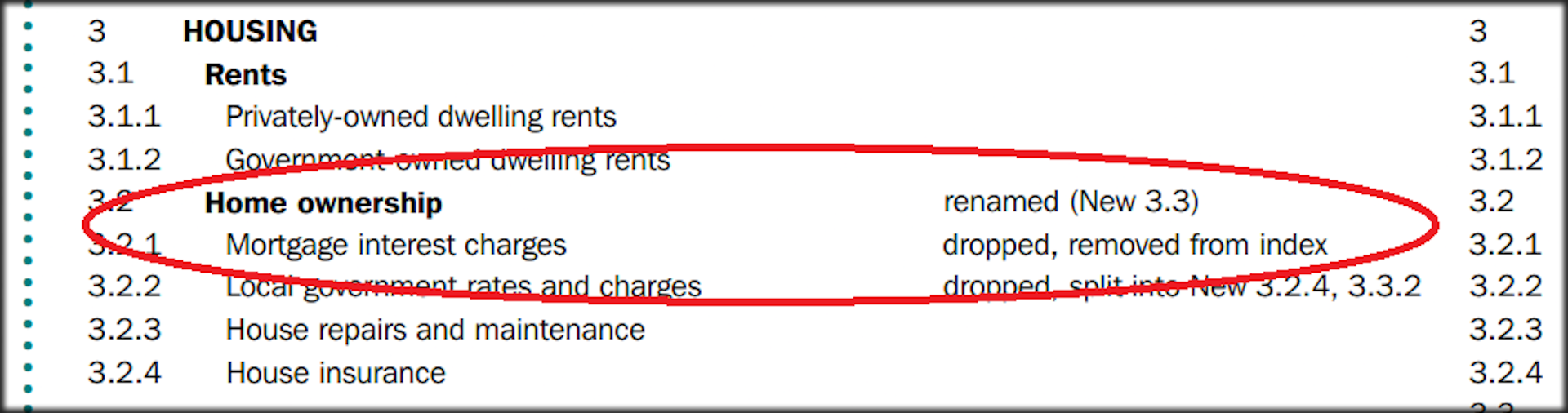
Way back in the late 1990s, more than a quarter of a century ago, the consumer price index (CPI) used to actually reflect the cost of living. It included all of the big costs incurred by households, including – importantly – mortgage interest payments. At the time, mortgages accounted for an average of $5 of every $100 each wage earner spent.

Then in September 1998, in response to representations from the Reserve Bank and the Treasury, the bureau changed the way it calculated the index. It excluded mortgage and other interest payments, in a decision it acknowledged would make the index worse at measuring living costs.

It still carries the warning on its website, saying the consumer price index is

not the conceptually ideal measure for assessing the changes in the purchasing power of the disposable incomes of households.

The index actually does a pretty good job of measuring changes in living costs at times when mortgage rates aren’t much changing. But at times when they are tumbling, it’ll overestimate living costs. And when mortgage rates are soaring – as they have been lately – it will way understate what’s happening to living costs.

We know by how much. For years, the bureau has also published a separate set of measures it pointedly calls “living cost indexes”. These do include mortgage and other interest charges, and for households headed by employees (for whom the buying power of wages matters) they are substantial.

Living costs are up 9%, rather than 5.4%

While the consumer price index (the one quoted by the treasurer) increased 5.4% in the year to September, the living cost index for households headed by wage earners climbed 9%.

For these working households, the price of food climbed 4.8% in the year to September, the price of electricity 14.5% and the price of mortgage interest charges 68%.

It’s the increases in mortgage rates that have made the increases in the other prices hurt so much.

The overall increase in prices faced by wage-earners – 9% – is way above the typical wage increase of 4%.

Bill Mitchell of the University of Newcastle points out that on this measure, the correct one, the buying power of wages has been falling for two and a half years. He says it puts the treasurer’s comments in a wholly different light.

Why we should distrust the CPI

Working Australians are right to distrust the consumer price index, which is something the Australian Council of Social Service warned the bureau about when it made the change.

Each month, the Melbourne Institute asks Australians whether their family finances have deteriorated over the previous year. Usually, about one-third of those surveyed say they have.

But for more than a year now, around 50% of those surveyed have been saying their finances have got worse. That’s a peak not seen since the global financial crisis, and one that has lasted longer.


Asked about family finances over the next 12 months, more than 30% say they’ll worsen further. It’s usually 20%.


Looked at from today’s perspective, the arguments put forward in 1997 for weakening the consumer price index as a measure of living costs are unimpressive.

Back then, the Treasury noted that many welfare recipients didn’t have mortgages and that a consumer price index that excluded them would better reflect their living costs.

The Reserve Bank argued interest rates were “conceptually different from other prices”. In any event, it wanted them excluded because it found it hard to use higher interest rates to bring down inflation if those higher rates pushed the measure of inflation up.

The change attracted little attention at the time, because mortgage rates weren’t moving much. By the time they did, the change had been bedded down.

But here’s some good news

For most of the time since the change, mortgage rates have either increased gradually or been cut, meaning the difference between what the consumer price index has been telling us and what’s been happening to us hasn’t been too stark. It’s been stark lately because interest rates have been rising quickly.

The good news – and there is good news – is that financial markets expect rates to begin falling this year, with the next move down.

Inflation as measured by the consumer price index (inflation excluding mortgage rates) is already falling.


We get the next official update on the consumer price index next week (and the update for the lesser-known living cost indexes a week after that).

It makes now a particularly good time to announce measures to address the cost-of-living crisis. We need them because we really are in something of a crisis. Things are a lot worse than the official index suggests.

And there’s a chance that soon they’ll begin to get better, allowing the prime minister to claim a win.The Conversation

This article is republished from The Conversation under a Creative Commons license. Read the original article.

Read more >>

Tuesday, December 05, 2023

Will the RBA raise rates again? Unless prices surge over summer, it’s looking less likely

If you’re looking for clues about whether the Reserve Bank has any interest rate rises left, Governor Michele Bullock offered several in her statement after Tuesday’s board meeting, saying:

  • the latest monthly figures showed inflation “continuing to moderate”

  • inflation expectations remained “consistent with the inflation target”

  • wages growth was “not expected to increase much further”.

The statement reads not only as an account of why the board kept rates on hold this month – as expected, after increasing them in November – but also an account of why it might not need to lift rates again.

Much will depend on “data and the evolving assessment of risks”. The board will make that assessment at its first meeting for the year in February.

Here’s why that next meeting matters so much.

Inflation’s headed in the right direction

The monthly measure of annual inflation has been falling since it peaked in December. Last week we learned that in October it fell from 5.6% to 4.9%, meaning it’s now closer to the Reserve Bank’s target of 2-3% than to the December peak of 8.4%.


A few special government measures helped push it down.

An increase in Commonwealth rent assistance decreased recorded rents; energy bill rebates decreased recorded electricity prices; and changes to the childcare subsidy decreased recorded childcare prices.

Those government measures won’t depress future inflation readings, suggesting that from here on inflation might bounce back.

But on the other hand, from here on the very large inflation outcomes recorded at the end of last year will drop out of the 12-monthly figures.

The mathematics of falling inflation

Simple maths suggests that if this year’s November and December readings are like the average of the other readings this year, annual inflation will fall to 3.1%.

The November figure will be released on January 10 and the December figure on January 31. Both will be available to the Reserve Bank board when it meets on February 5 and 6, along with the latest quarterly measure of inflation.

If that quarterly measure is the same as the average of the past two quarters, it will show annual inflation of 4%.

Such outcomes – which are likely if inflation continues along its present trajectory – would see inflation closing in on the Reserve Bank’s target band and relieve it of any need to further lift rates.

Of course, it mightn’t happen. But there’s a lot driving down inflation.

Prices we don’t much notice are falling

The prices we pay attention to are those we see in the supermarket, what we fork out on mortgage payments and household bills, and what we pay at the petrol pump. (Petrol prices have been falling for weeks now.)

Prices we notice less are far less troubling than they were.

During 2022, the price of household appliances climbed 8.2%. So far this year it has fallen 2%.

The price of furnishings climbed 5.3% during 2022. So far this year it has fallen 1.6%. The price of clothing climbed 5.4%. So far this year it has fallen 2.6%.


All sorts of prices are coming down, partly because the supply bottlenecks driving them up last year are being reversed and partly because – thanks to 13 near consecutive interest rate rises – we are not buying at anything like the rate we used to.

Retail spending grew by just 1.2% over the year to October – the least since the COVID lockdowns.

Likely population growth of 2.4% and what Westpac believes to be retail price growth of 3.6% means the amount bought per person actually fell 4.5%.

Even this year’s more hyped Black Friday spending was up only 0.6% to 1% compared to Black Friday in November last year. Given our population growth was higher than that, it suggests we spent less on those sales per person this year.

Dentistry and haircuts are more expensive

What about the prices that are climbing strongly?

With the exception of rents – up 7.6% over the year – it’s hard to find many.

In a speech after the last Reserve Bank board meeting, Governor Bullock said inflation was increasingly being driven by the price of services, which stands to reason given inflation in the price of goods has been ebbing away.

She nominated increases in the prices charged by hairdressers and dentists, as well as restaurants. And there’s definitely something to see there, for dentists.

During 2022, the statistician’s measure of the price of dentistry climbed 3.9%.

In the first three quarters of this year, it climbed by that much again, meaning the pace picked up. But the increase is not that much more than the overall increase in wages, suggesting dentistry is not being priced much further out of reach.

Haircuts climbed in price a hefty 6% during 2022 and continued to climb at that pace during the first three quarters of 2023, which is uncomfortable, but at least not accelerating.

The price of restaurant meals climbed 6.7% during 2022 but only 3.8% in the first three quarters of 2023, meaning the pace is easing.

Wage growth a risk, but not yet a worry

The governor is concerned high wage growth will become embedded in the price of services. But at 3.9%, wage growth isn’t particularly high.

About a third of workers are covered by enterprise agreements. Jeff Borland of the University of Melbourne points out the increases in most of the newly-lodged enterprise agreements are flat or trending down. Many of us got a top-up at the start of our three-year agreements, which won’t be continued.

Borland’s statistical analysis suggests individual agreements aren’t pushing up wage growth either, but increases granted by the Fair Work Commission to the 20% of workers on awards are. Yet, by design, these increases reflect, rather than drive, inflation.

If inflation does accelerate over the holiday season, the Reserve Bank probably will push up rates further. But as the governor seemed to acknowledge on Tuesday, it’s not looking likely.The Conversation

This article is republished from The Conversation under a Creative Commons license. Read the original article.

Read more >>

Tuesday, November 28, 2023

Governments have been able to overrule the Reserve Bank for 80 years. Why stop now?

Pay close enough attention to parliament these next few days, and you’re likely to witness something truly remarkable: politicians from both sides of politics uniting to remove the power of politicians to overrule the Reserve Bank.

As an instance of self-loathing, it’s hard to top.

Sure, a good many of us don’t trust politicians. But surely politicians ought to trust politicians. Surely politicians ought to realise that we put them there to make decisions – not usually the day-to-day decisions, but the ultimate big decisions. They are meant to be where the buck stops.

That Treasurer Jim Chalmers could be even thinking about axing his ultimate power to veto decisions of the Reserve Bank board shows just how far the myth of an “independent Reserve Bank” has spread.

Scroll through the treasurer’s website, and you’ll find 195 documents referring to the “independent Reserve Bank”, many multiple times.

‘Independent’, but not according to the law

Saying the Reserve Bank is independent suits the treasurer and it suits the prime minister, just as it has suited many of their predecessors. As soon as the bank does something that’s necessary but unpopular (such as pushing up interest rates) they are able to say – wrongly – there’s nothing they can do.

The government’s Reserve Bank is dependent on the government in myriad ways.

The government set up the Reserve Bank. The government appoints every member of its board. The government directly appoints its chief and deputy chief. And from time to time the government gives it running instructions.

But – most importantly – the government can overrule it.

The mechanism is built into the Reserve Bank Act.

In the event of a disagreement, the treasurer can

submit a recommendation to the governor-general, and the governor-general, acting with the advice of the Federal Executive Council, may, by order, determine the policy to be adopted by the bank.

The government is to accept responsibility for the decision taken, and the Reserve Bank board must

thereupon ensure that effect is given to the policy determined by the order and shall, if the order so requires, continue to ensure that effect is given to that policy while the order remains in operation.

After so directing the bank, the treasurer is to table in parliament a copy of the direction, along with a statement explaining the reasons, and a statement from the Reserve Bank board putting the case that failed to convince the treasurer.

These are the clauses – until now unused – that in April the outside review of the Reserve Bank asked the government to do away with.

Its thinking was that the government can’t be trusted.

As the review put it,

if an elected government controls monetary policy there are risks that it may try to push the economy to run above its capacity, resulting in higher inflation but with no lasting impact on employment.

On releasing the review’s recommendations, Treasurer Jim Chalmers said straight away that he agreed in principle with all of them.

Shadow Treasury Angus Taylor said much the same thing, although he now says the Coalition will wait until sees the legislation Chalmers is about to introduce before deciding its position on it.

The veto power is there for a reason

On the face of it, a reasonable position would be that the government’s ability to overrule the bank in extreme circumstances has caused no problem so far.

The review counters this by warning of “the possibility that established conventions cease to be observed”.

But, if that did happen, it would be because there was a serious (and ultimately public) rift between the elected government and an unelected board.

With the exception of judges in Australia’s courts, unelected officials can’t normally overrule elected governments. It’s how our system is designed.

The Reserve Bank tried to overrule the government once, and succeeded, which is why the provision we have was written into the law.

Back in 1930, in the early years of the Great Depression, the Reserve Bank was part of the Commonwealth-owned Commonwealth Bank, run by a board appointed by the government which reported to the government.

In The Conversation earlier this year, Alex Millmow outlined what happened.

Desperate to support the economy, the government begged the government-owned bank to help it finance public works.

The bank refused. Its government-appointed chairman, Sir Robert Gibson, wrote to Treasurer Ted Theodore warning a point was being reached

beyond which it would be impossible for the Commonwealth Bank to provide further financial assistance for the governments in the future

Theodore replied complaining the bank was trying to

arrogate to itself a supremacy over the government in the determination of the financial policy of the Commonwealth, a supremacy which, I am sure, was never contemplated by the framers of the Australian Constitution

While the government did not question the right of the bank’s board to offer such comment or criticism as the board thought proper, the control of the public purse had “heretofore always been regarded as an essential prerogative of the people”.

In the end, it was the government that backed down. But to ensure it could never be overruled again, Labor wrote the veto power into the Commonwealth Bank Act of 1945 and the Coalition wrote it into the Reserve Bank Act of 1959.

That’s the veto power today’s Labor Party, quite possibly with the support of the Coalition, is about to try to remove.

I understand why the Reserve Bank review made the recommendation it did: it wants monetary policy to work well. But I don’t think that’s enough of a reason for the government to attempt to abrogate its responsibility.

And ultimately, it can’t. The Australian public is going to hold the government responsible for the state of the economy even if it succeeds in tying one hand behind its back. But I don’t think it’s wise. One day it might need it.The Conversation

This article is republished from The Conversation under a Creative Commons license. Read the original article.

Read more >>

Tuesday, November 21, 2023

Why further RBA rate hikes are less likely now than even 1 week ago

Since Australia’s Reserve Bank hiked interest rates two weeks ago, there have been two important developments – one in the United States and the other in the United Kingdom.

If it’s not clear to you why events overseas influence Australia’s interest rates, which are meant to be set to control Australian inflation, read on.

US and UK inflation close to zero

We haven’t been complete masters of our own destiny since the Australian dollar was floated 40 years ago next month.

What happened in the US last Tuesday was news of dramatically lower US inflation. When increases and decreases in prices were taken together, overall US prices moved not at all in the month of October. That’s right, inflation was zero.

While zero movement in one month doesn’t mean zero over the entire year, it helps bring down the rate over the entire year. US inflation fell from 3.7% in the year to September to 3.2% in the month to October.

Then the next day we got similar news from the UK.

Taken together, prices in the United Kingdom scarcely grew at all in October, climbing just 0.1%. The screeching halt to UK monthly inflation took the annual rate down from 6.7% for the year to September to 4.6% for the year to October.


In both the US and the UK, there’s talk there will be no need for further interest rate hikes, and very probably a case for interest rate cuts as soon as next year.

We don’t yet know what happened to Australia’s inflation rate in October – the Bureau of Statistics will tell us next week.

But we have an early indication.

The Melbourne Institute inflation gauge, which roughly tracks the bureau’s measure, fell 0.1% in October. If that is what the bureau finds – that overall prices barely moved (or fell) in October – Australia’s annual inflation rate should fall from 5.6% for the year to September to around 5.2% for the year to October.

Inflation down all over

All over the world, inflation is falling for much the same set of reasons: the price of oil is heading back down after Saudi Arabia and Russia tried to restrict supply in the middle of the year, and the price pressures caused by shortages are easing.

As Australia’s Reserve Bank conceded in the minutes of the November board meeting, in which it pushed up rates, there has been “an easing in supply chain pressures and raw materials prices”.

Not that this means the bank is relaxed about what’s happening to inflation; far from it.

In the minutes released on Tuesday and in remarks delivered at a conference ahead of their release, Governor Michele Bullock said what concerned her was stronger-than-expected demand pressures. Australians remained keen to spend.

And she drew attention to disturbing

growing signs of a mindset among businesses that any cost increases could be passed onto consumers

But what has just happened overseas will help, big time. Here’s why.

Australians’ buying power just jumped

As soon as the news of low US inflation came out last Tuesday, the US dollar slid.

Investors became less keen to hold US dollars when it became less likely that US interest rates would rise further, and a good deal more likely they would fall.

Against the Australian dollar, the US dollar fell 2%. From an Australian’s point of view, the buying power of an Australian dollar jumped from 63.7 to 64.9 US cents and has since jumped to 65.8 US cents.


A sudden jump in the value of the Australian dollar

Value of Australian dollar in US cents. Yahoo Finance

This means that, for as long as it lasts, Australian dollars will buy more than they did.

Australians will pay less in Australian dollars for the goods and services ultimately paid for with US dollars. The changed interest rate outlook in the US will act to keep Australian prices low.

In this way, decisions made in the US not to increase interest rates or even to cut them make it easier for Australia’s Reserve Bank not to increase rates – or even to cut them.

A higher dollar means lower inflation

The effect isn’t big. The RBA believes it takes a 10% change in the value of the Australian dollar to move the Australian inflation rate 0.4 percentage points.

But it is better than things moving in the other direction, which is what has been happening until now.

For more than a year now, whenever interest rates have climbed in the US, Australia’s Reserve Bank has been under pressure to push up its rates to stop the Australian dollar falling and prices climbing.

No longer. After last week’s news from the US and the UK, Australian financial markets began pricing in a close to zero chance of further interest rate rises – with a fair chance of a rate cut next year.

It’s always impossible to tell for sure what the Reserve Bank will do to rates. A lot will depend on what actually happens to inflation.

But for the first time in a long time, the Reserve Bank has tail winds from overseas, rather than headwinds.

For the first time in a long time, the bank won’t feel pressured to push up rates just because rates have been pushed up overseas.The Conversation

This article is republished from The Conversation under a Creative Commons license. Read the original article.

Read more >>

Tuesday, November 14, 2023

We could make most Australians richer and still save billions – it’s not too late to fix the Stage 3 tax cuts

The Albanese government is about to have to make a really important decision.

It’s going to have to decide what’s more important: supporting Australians who are financially under water, or keeping an election promise.

And it’ll have to do it soon. It’s already working on its May budget, now just six months away.

That choice will affect almost every Australian, and it could shape whether you’re thousands of dollars a year better off – or not – from July next year.

Household budgets are shrinking

When Labor took office in May 2022, Australians were doing well. Consumer spending and economic growth were on the up and up, and mortgage rates and rents were only starting to climb.

A promise to keep the proposed multi-billion dollar Stage 3 tax cuts – announced but not implemented by the Coalition back in 2018 – seemed worth making to clear away any reasons any voters might have not to vote Labor.

Since May 2022, just about everything has got worse for ordinary Australians – those on typical incomes, which are about $85,000 for full-time workers and $43,000 for adult part-time workers.

The best measure of the buying power of after-tax incomes is real household disposable income per capita. During the past year, it shrank 5.3%, which is more than it shrank in either the early 1990s recession or the global financial crisis.

On my calculations, it’s the worst collapse in 40 years.

From those incomes have to be taken rents and mortgage payments.

The Reserve Bank says scheduled mortgage payments are now taking up a larger share of household disposable income than at any time in history – 10% when averaged over all households including those that don’t have mortgages, and many times that for those that do.

This means when you go to the supermarket and find you can’t afford what you used to, you’re not imagining it. It hasn’t been like this in decades. And it’s about to get worse.

The Christmas bonus is missing

In the lead up to each of the past four Christmases, ordinary earners have received a bonus from the tax office - the so-called low and middle income earner tax offset, initially worth $1,080 and increased to $1,500 in 2022.

This year, it’s gone. It means middle-earners’ pre-Christmas tax refunds will be up to $1,500 smaller or replaced with bills. Taxpayers who normally have a tax bill will get a bill up to $1,500 bigger.

An estimated 10.5 million Australians submitted their tax forms by October 31.

Most of them – most of those earning up to $90,000 and previously eligible for the full $1,500 offset – are about to find themselves a good deal worse off.

Average earners will lose, while the rich get thousands

The very expensive Stage 3 tax cuts (costing $20 billion in their first year, and $313 billion over ten years) were meant to come to the rescue. They begin next July.

Speaking notes prepared for Treasurer Jim Chalmers and released under freedom of information laws say they will provide relief to low and middle earners and kick in at $45,000.

But someone on that income will get no relief. That person will lose an offset of $1,275 in return for a tax cut of zero. Someone on a higher wage of $50,000 will lose $1,500 in order to gain $125, and someone earning the typical full-time wage of $85,000 will have to lose $1,500 to gain just $1,000.

That’s right, a typical full-time worker will get relief of $1,000 from the Stage 3 tax cuts in return for losing the axed tax offset of $1,500.

Higher earners will do much, much better. An Australian earning twice as much as is typical – $190,000 – will get $7,500. An Australian earning a bit more than that again – $200,000 – will get $9,000.

Labor has been handed an opportunity

Handing $9,000 to a high earner but only $1,000 to an ordinary full-time earner is an indulgence that might have seemed okay when it looked as if ordinary earners were doing alright, or wouldn’t notice.

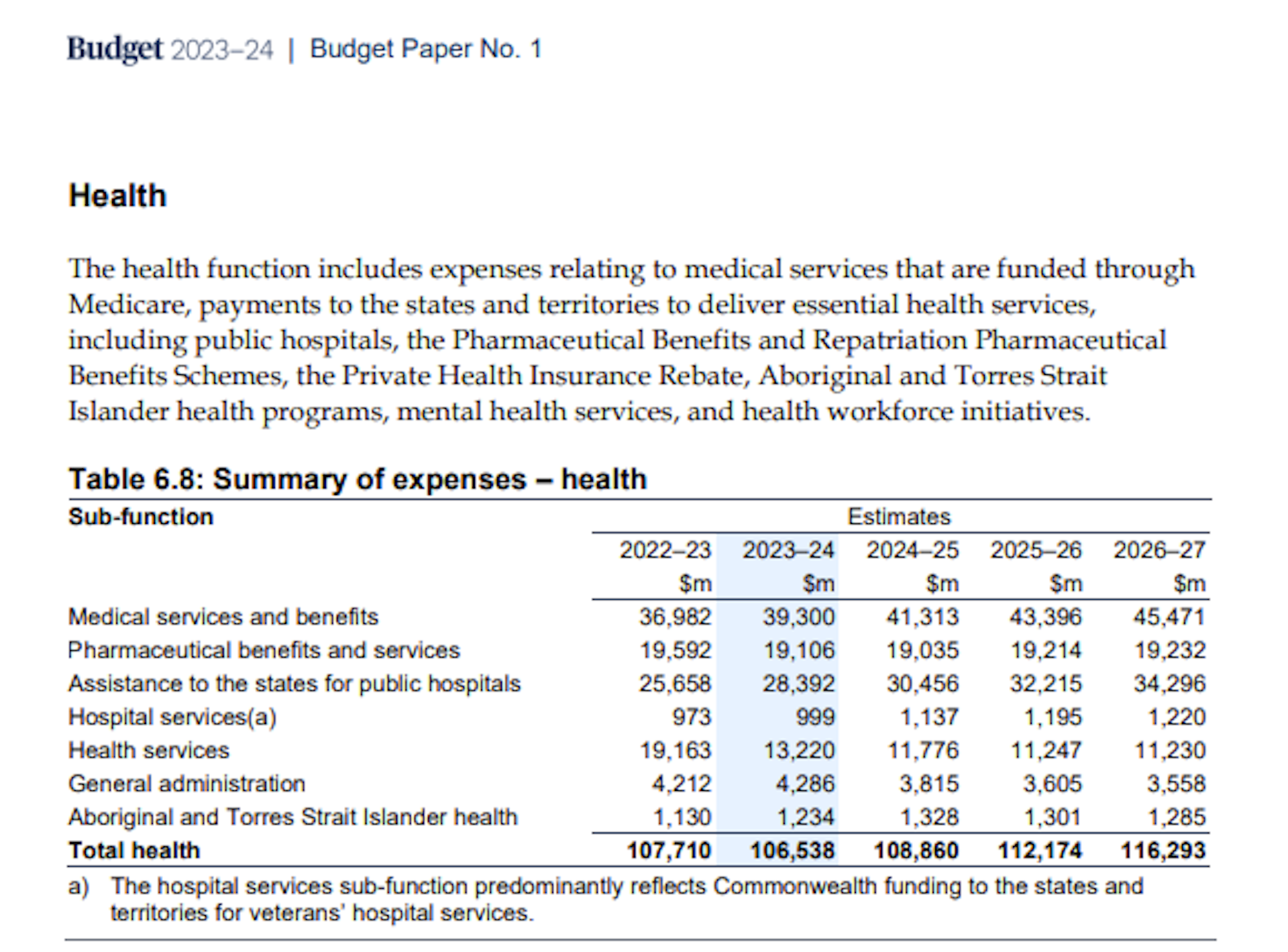
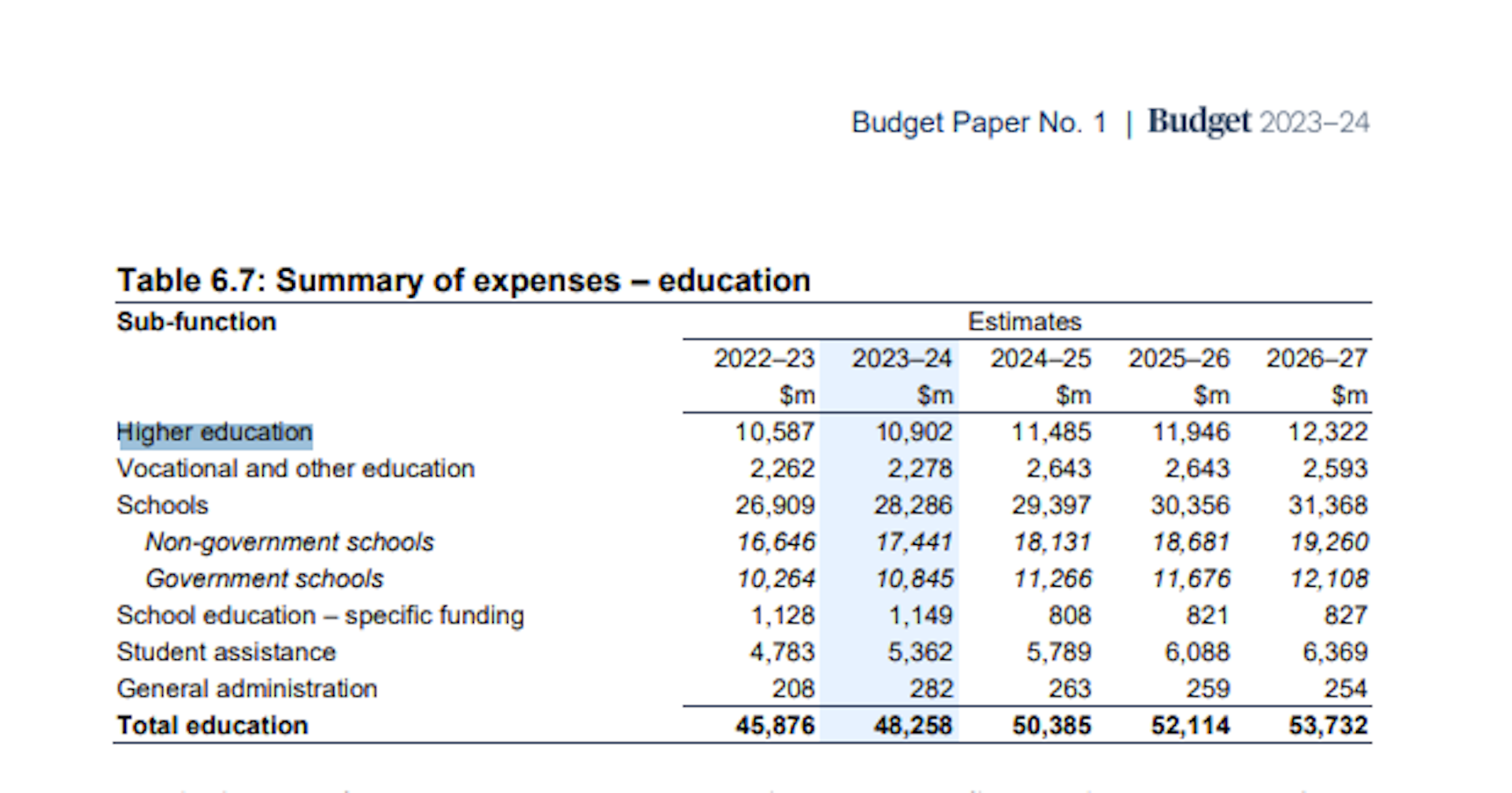
But it’s about to happen, and it’s about to cost $20 billion in its first year. That’s as much as the government plans to spend on the pharmaceutical benefits scheme in that year and almost twice what it plans to spend on higher education.

What if it kept the tax cuts, but reoriented them to Australians who actually needed them – to the more than 80% of Australians who earn less than $120,000 a year – while still providing generous cuts to those who earned more than $120,000?

That’s a task Matt Grudnoff and Greg Jericho set themselves at the Australia Institute, coming up with four options. Each of those four would cost less than Stage 3 cuts, deliver more to Australians on less than $120,000, and even fund a $250 per fortnight increase in the JobSeeker unemployment benefit.

Jericho’s punchline, delivered to the revenue summit at Parliament House last month: “I actually wish it was harder than it was”.

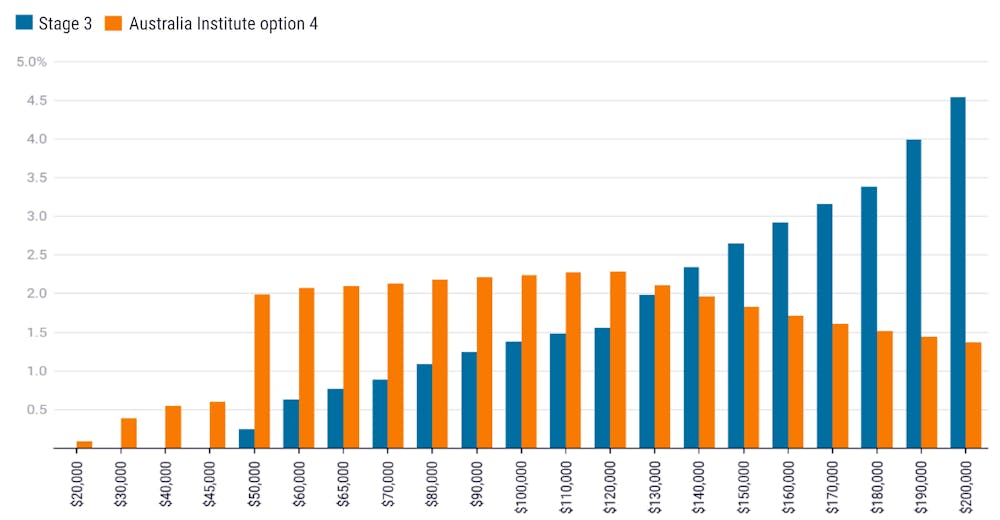
Option 4 costs $70 billion less over ten years but leaves every taxpayer earning up to $132,000 better off.

It doubles the tax cut Stage 3 gives to a typical full-time earner on $85,000, and still gives high earners $2,197 a year each.


Stage 3 vs Australia Institute Option 4, tax cut as percent of taxable income

Graph of percentage benefits from Stage 3 and an alternative at different incomes
The Australia Institute, A better Stage 3: fairer tax cuts for more Australians, October 2023, CC BY-SA

His point isn’t that this is the best option. It is that there are options, many of which give the bulk of Australians – the stressed ordinary voters Labor and the Coalition will need in the next election – much more than Stage 3.

What’s wrong with making 80% of the electorate better off at a time when they desperately need it, and cutting future budget deficits by $70 billion?

Only that it would break a promise, and Prime Minister Anthony Albanese likes keeping promises.

But when asked in an Australia Institute survey what was more important – keeping a promise or reacting to changing economic circumstances – 61% picked reacting to changing circumstances.

Even among Coalition voters, 56% supported reacting to changing circumstances.

It puts the Stage 3 tax cuts in play. There’s still time, and plenty of electoral and economic reasons to rejig them.The Conversation

This article is republished from The Conversation under a Creative Commons license. Read the original article.

Read more >>

Tuesday, November 07, 2023

Why it’s a good bet the Melbourne Cup Day rate hike will be the last

Australia just became the odd one out.

At its meeting last week, the US Federal Reserve kept its official interest rate on hold. A week earlier, the European Central Bank and the Bank of Canada kept their rates on hold, and, at their meetings before that, the Bank of England and the Reserve Bank of New Zealand did the same thing.

Throughout the Western world – with perhaps Australia as the only exception – financial markets have been assuming central banks were done with increasing rates and would soon start pushing them down.

Reserve Bank Governor Michele Bullock’s statement accompanying Tuesday’s hike in Australia’s cash rate makes it look as if we’re about to join that club. It makes it look as if this hike from 4.1% to 4.35% – a 12-year high – will be the last.

And with good reason. Inflation has been falling almost everywhere, and – notwithstanding the recent uptick associated with higher oil prices – is forecast by the International Monetary Fund to keep falling.


The RBA has taken out insurance

So why did Australia’s Reserve Bank push up rates at all, at a time when none of its global peers were?

The statement makes it look as if it wanted to take out insurance.

While the bank still expects inflation to continue to fall, it says progress now looks “slower than earlier expected”.

Its revised set of forecasts, to be released on Friday, still have inflation falling, but to around 3.5% by the end of next year, instead of 3.3%, then to around 3% by the end of 2025 instead of 2.8%.

The bank is particularly worried that the prices of services – things such as service in a cafe, done by hard-to-find workers – are “continuing to rise briskly”.

And it mentions “uncertainties” four times in eight paragraphs. It isn’t that it thinks inflation won’t keep coming down; it’s that it wants to be sure it is.

Australian hikes hit harder than in the US

One argument the bank hasn’t used – and nor should it – is catch-up. The US, the UK, the EU, Canada and New Zealand all have higher official rates than Australia.

But they are all are different to Australia, in an important way.

When the US Federal Reserve pushes up its Federal Funds Rate, nothing much happens to US home borrowers. Here’s why: almost all US home borrowers are on fixed rates, meaning their required mortgage payments don’t increase.

In Australia, only about one-third of home loans are fixed.

And US fixed rates are nothing like Australian fixed rates. The typical term in the US is 30 years, rather than the two to three years common in Australia.

This means that, as long as borrowers in the US don’t refinance or move homes, their payments are fixed for the entire term of their loans. Americans never have to pay more just because the Fed jacks up rates.

At least when it comes to homebuyers, the US Fed has to do a good deal more than Australia’s Reserve Bank to have the same effect.

It means the US official rate of 5.25% has less immediate effect on ordinary Americans than Australia’s new rate of 4.35% will have on us.

That’s what the consumer spending figures show.

After a year of high US rates, American consumers are buying 2.9% more goods and services than they were a year ago.

After a year of less-high Australian rates, Australian consumers are buying 1.7% less.

This means that, as relatively lightweight as our previous 4.1% cash rate had seemed, it might have been packing more punch than the higher 5.25% rate in the US; and also the higher rates in the UK, Canada and New Zealand, where most of the mortgages are also fixed.

‘Painful squeeze’

In her statement, Governor Bullock acknowledged many households were experiencing “a painful squeeze on their finances”. She also noted others were benefiting from rising housing prices, substantial savings buffers and higher interest income.

Bank calculations suggest one in 20 variable-rate borrowers are now going backwards – paying more for essential expenses and housing than they earn.

Among borrowers with big loans relative to their incomes, it’s one in four.

There’s nothing in the governor’s statement to suggest she is thinking of pushing up rates again. After today’s hike, the futures market assigned only a 30% probability to another hike.

The best guess of people who bet on this for a living is that Australia is about to join the rest of the world and leave rates where they are for quite some time.

A frugal Christmas, before possible rate drops in 2024

Alternatively, rates could even begin coming down within 12 months.

The detail of the inflation figures shows monthly inflation surged to 0.8% for one month only, in August, when petrol and diesel prices jumped 9.1%, then fell back to 0.3% in September, which is where it was before petrol prices jumped.

It is also looking like prices scarcely increased at all last month.

The Melbourne Institute inflation gauge, which comes out ahead of the Bureau of Statistics gauge and broadly tracks it, fell 0.1% in October. This suggests that, when taken together, price falls (slightly more than) outweighed price increases.

It’s what you would expect if we were tightening our belts, as we are.

At Big W discount department stories across Australia, sales are down 5.5% on where they were a year ago.

Big W says shoppers have moved away from buying big-ticket items and are instead buying a remarkable number of small gifts, such as Hot Wheels toy cars.

They sell for $2 each, or five for $9.

It’s pointing to a frugal Christmas in which retailers are going to have to discount if they want to move goods, taking further pressure off inflation.

Should that happen, rates could turn down even sooner than financial market traders expect, perhaps by the middle of next year.The Conversation

This article is republished from The Conversation under a Creative Commons license. Read the original article.
Read more >>