Showing posts with label tax cuts. Show all posts

Tuesday, November 14, 2023

We could make most Australians richer and still save billions – it’s not too late to fix the Stage 3 tax cuts

The Albanese government is about to have to make a really important decision.

It’s going to have to decide what’s more important: supporting Australians who are financially under water, or keeping an election promise.

And it’ll have to do it soon. It’s already working on its May budget, now just six months away.

That choice will affect almost every Australian, and it could shape whether you’re thousands of dollars a year better off – or not – from July next year.

Household budgets are shrinking

When Labor took office in May 2022, Australians were doing well. Consumer spending and economic growth were on the up and up, and mortgage rates and rents were only starting to climb.

A promise to keep the proposed multi-billion dollar Stage 3 tax cuts – announced but not implemented by the Coalition back in 2018 – seemed worth making to clear away any reasons any voters might have not to vote Labor.

Since May 2022, just about everything has got worse for ordinary Australians – those on typical incomes, which are about $85,000 for full-time workers and $43,000 for adult part-time workers.

The best measure of the buying power of after-tax incomes is real household disposable income per capita. During the past year, it shrank 5.3%, which is more than it shrank in either the early 1990s recession or the global financial crisis.

On my calculations, it’s the worst collapse in 40 years.

From those incomes have to be taken rents and mortgage payments.

The Reserve Bank says scheduled mortgage payments are now taking up a larger share of household disposable income than at any time in history10% when averaged over all households including those that don’t have mortgages, and many times that for those that do.

This means when you go to the supermarket and find you can’t afford what you used to, you’re not imagining it. It hasn’t been like this in decades. And it’s about to get worse.

The Christmas bonus is missing

In the lead up to each of the past four Christmases, ordinary earners have received a bonus from the tax office - the so-called low and middle income earner tax offset, initially worth $1,080 and increased to $1,500 in 2022.

This year, it’s gone. It means middle-earners’ pre-Christmas tax refunds will be up to $1,500 smaller or replaced with bills. Taxpayers who normally have a tax bill will get a bill up to $1,500 bigger.

An estimated 10.5 million Australians submitted their tax forms by October 31.

Most of them – most of those earning up to $90,000 and previously eligible for the full $1,500 offset – are about to find themselves a good deal worse off.

Average earners will lose, while the rich get thousands

The very expensive Stage 3 tax cuts (costing $20 billion in their first year, and $313 billion over ten years) were meant to come to the rescue. They begin next July.

Speaking notes prepared for Treasurer Jim Chalmers and released under freedom of information laws say they will provide relief to low and middle earners and kick in at $45,000.

But someone on that income will get no relief. That person will lose an offset of $1,275 in return for a tax cut of zero. Someone on a higher wage of $50,000 will lose $1,500 in order to gain $125, and someone earning the typical full-time wage of $85,000 will have to lose $1,500 to gain just $1,000.

That’s right, a typical full-time worker will get relief of $1,000 from the Stage 3 tax cuts in return for losing the axed tax offset of $1,500.

Higher earners will do much, much better. An Australian earning twice as much as is typical – $190,000 – will get $7,500. An Australian earning a bit more than that again – $200,000 – will get $9,000.

Labor has been handed an opportunity

Handing $9,000 to a high earner but only $1,000 to an ordinary full-time earner is an indulgence that might have seemed okay when it looked as if ordinary earners were doing alright, or wouldn’t notice.

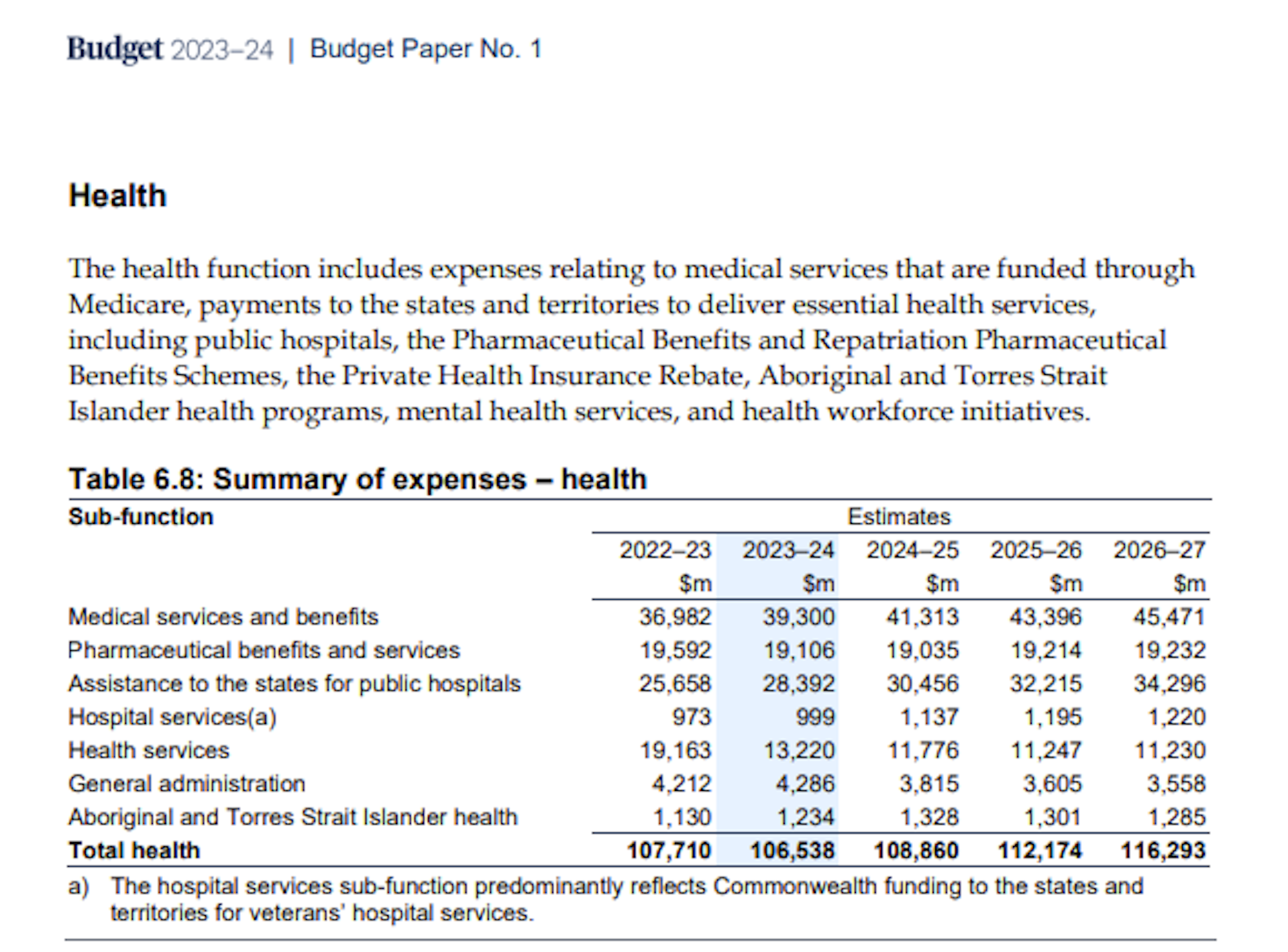
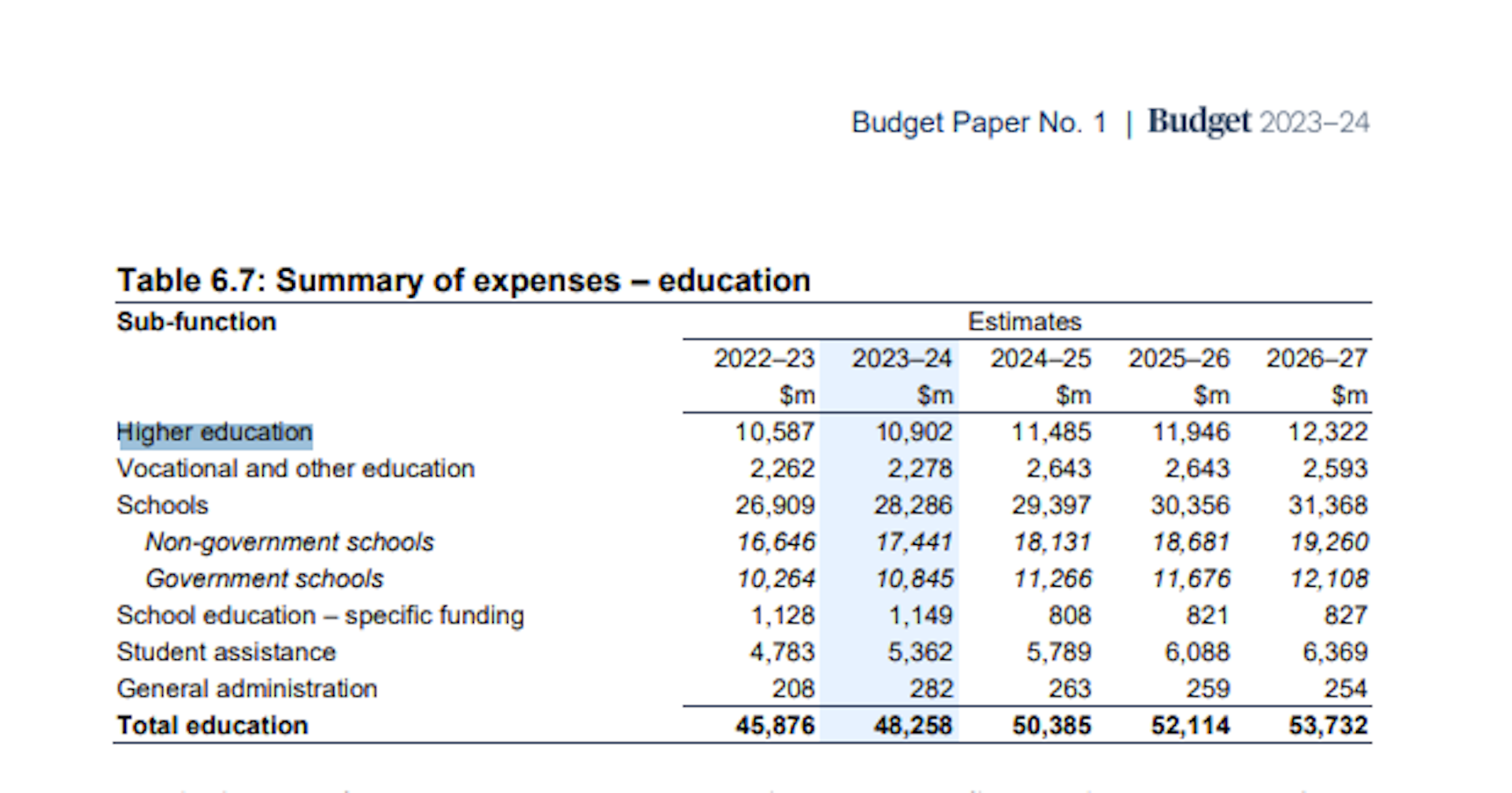
But it’s about to happen, and it’s about to cost $20 billion in its first year. That’s as much as the government plans to spend on the pharmaceutical benefits scheme in that year and almost twice what it plans to spend on higher education.

What if it kept the tax cuts, but reoriented them to Australians who actually needed them – to the more than 80% of Australians who earn less than $120,000 a year – while still providing generous cuts to those who earned more than $120,000?

That’s a task Matt Grudnoff and Greg Jericho set themselves at the Australia Institute, coming up with four options. Each of those four would cost less than Stage 3 cuts, deliver more to Australians on less than $120,000, and even fund a $250 per fortnight increase in the JobSeeker unemployment benefit.

Jericho’s punchline, delivered to the revenue summit at Parliament House last month: “I actually wish it was harder than it was”.

Option 4 costs $70 billion less over ten years but leaves every taxpayer earning up to $132,000 better off.

It doubles the tax cut Stage 3 gives to a typical full-time earner on $85,000, and still gives high earners $2,197 a year each.


Stage 3 vs Australia Institute Option 4, tax cut as percent of taxable income
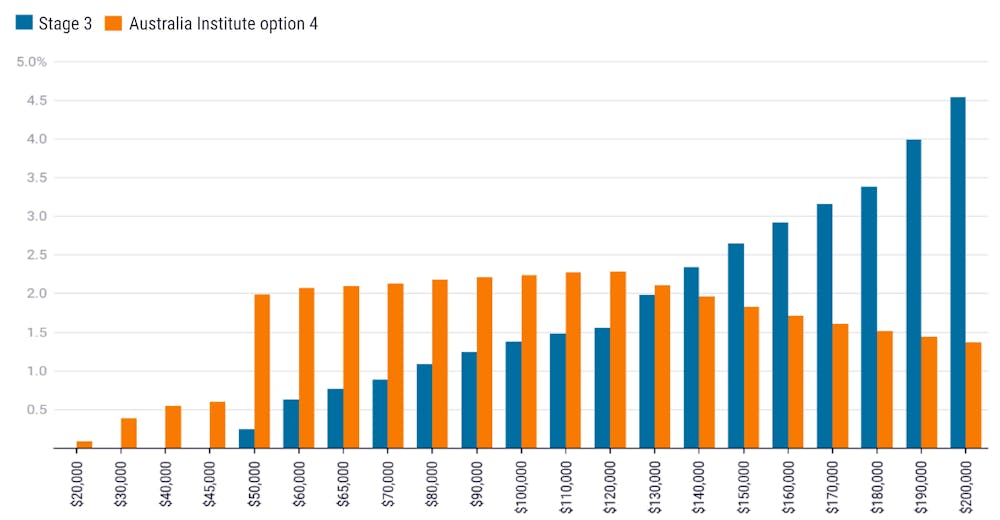
Graph of percentage benefits from Stage 3 and an alternative at different incomes
The Australia Institute, A better Stage 3: fairer tax cuts for more Australians, October 2023, CC BY-SA

His point isn’t that this is the best option. It is that there are options, many of which give the bulk of Australians – the stressed ordinary voters Labor and the Coalition will need in the next election – much more than Stage 3.

What’s wrong with making 80% of the electorate better off at a time when they desperately need it, and cutting future budget deficits by $70 billion?

Only that it would break a promise, and Prime Minister Anthony Albanese likes keeping promises.

But when asked in an Australia Institute survey what was more important – keeping a promise or reacting to changing economic circumstances – 61% picked reacting to changing circumstances.

Even among Coalition voters, 56% supported reacting to changing circumstances.

It puts the Stage 3 tax cuts in play. There’s still time, and plenty of electoral and economic reasons to rejig them.The Conversation

This article is republished from The Conversation under a Creative Commons license. Read the original article.

Read more >>

Wednesday, May 11, 2022

Stand by for the oddly designed Stage 3 tax cut that will send middle earners backwards and give high earners thousands

The Reserve Bank is pushing up interest rates to take money out of our hands.

The first increase in the current round will add about A$65 a month to the cost of paying off a $500,000 mortgage.

The second will add a bit more. If, as the bank’s forecasts assume, there are another four such increases this year, that’s a further $275 a month, and so on.

The point, in the words of the Reserve Bank Governor Philip Lowe, is to “slow the economy, to get things back onto an even keel”.

In a helpful video, the Governor explains that rate rises take money out of mortgagee’s hands directly, make it harder to borrow, make people “feel less happy”, and hit the prices of houses and other assets so people “don’t feel as confident and they don’t spend as much”.

Which is fair enough, if the Governor decides that’s what’s needed.

So why on earth are we scheduled to do the opposite?

As the RBA takes, the government will give

From mid-2024 the government will put an awful lot of money in to people’s hands. Stage 3 of the income tax cuts will cost $15.7 billion in its first year.

By way of comparison, that’s almost as much as the $16.3 billion will be spent on the Pharmaceutical Benefits Scheme that year, and more than the $10.5 billion that will be spent on higher education.

That it is mistimed ought not be a surprise. Stage 3 was legislated in 2018.

The treasurer at the time, back in the year Grant Denyer won the Gold Logie, was Scott Morrison, who said he was legislating Stages 1, 2 and 3 of the tax cuts all at once (and Stage 3 six years ahead of time) in order to provide “certainty”.

A tax switch settled years ahead of time

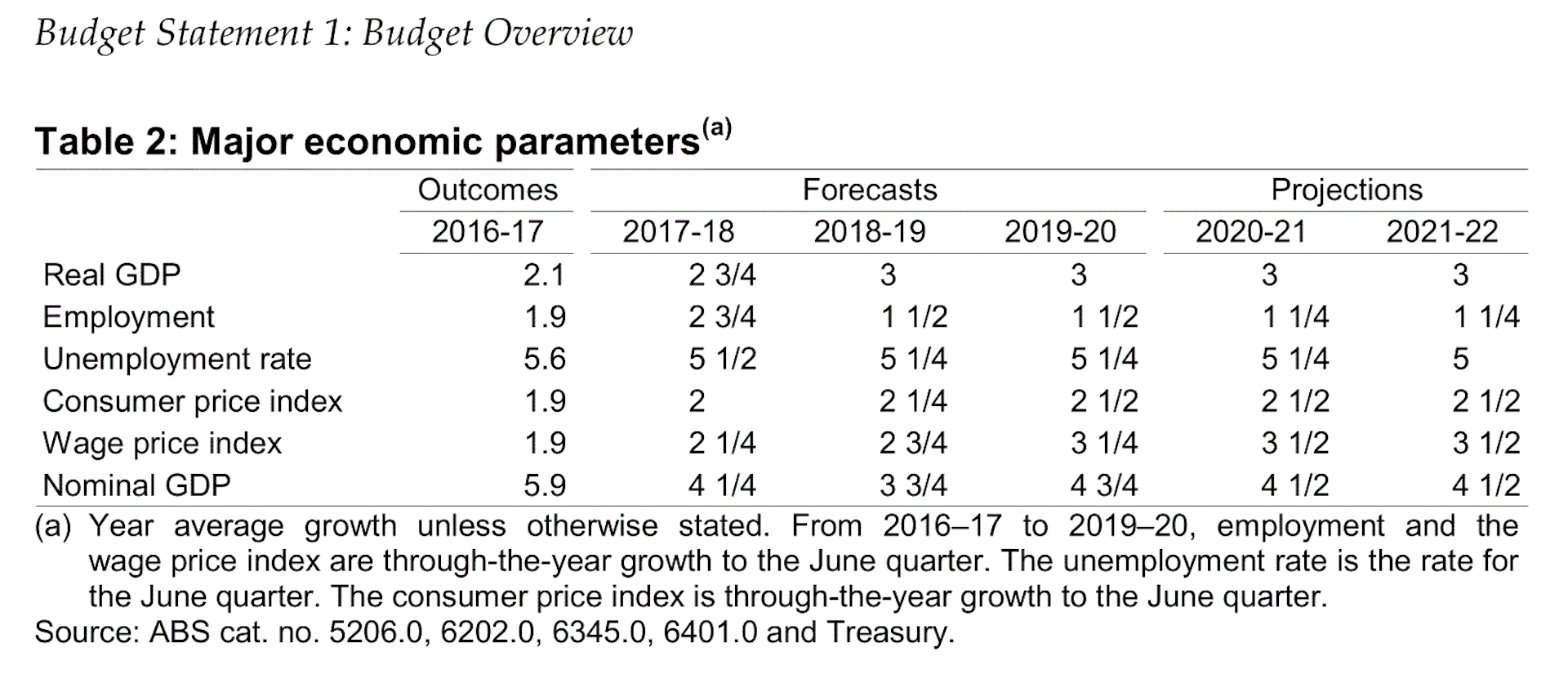
So uncertain was the treasury about the future back then that it only forecast the economy two years ahead, and produced less reliable and more mechanical “projections” for the following two years, neither of which extended to 2024.

At the time the Reserve Bank had been cutting interest rates (12 times in a row), at the time inflation was 1.9%. It looked as if the economy could do with a bit of a boost, albeit a boost which wouldn’t be delivered for six years.

In saying that things have changed, it’s fair to also acknowledge that things might change back again. We can’t be sure what will be needed in 2024, although we can be a good deal more sure than we were back then.

Backed by Labor

The Stage 3 tax cuts were opposed by Labor at first, but are now backed by Labor treasury spokesman Jim Chalmers after “weighing up a whole range of considerations”.

They are overwhelmingly directed at high earners.

Of the $184.2 billion the parliamentary budget office believes Stage 3 will cost in its first seven years, $137.9 billion is directed to Australians on $120,000 or more.

Part of Stage 3, the part that cuts the rate applying to incomes over $45,000 from 32.5 cents in the dollar to 30 cents, will benefit most taxpayers.

The bigger part extends that low rate all the way up to $200,000, abolishing an entire rung of the tax ladder paid by the highest earners.

For those very high earners, the part of their income that was taxed at 37 cents will be taxed at 30, as will part of the rest that was taxed at 45 cents.

A politician, on a base salary of $211,250, will get a tax cut of $9,075. A registered nurse on $72,235 will get a tax cut of $681 according to calculations prepared by the Australia Institute.

More broadly, a typical middle earner can expect $250 a year, whereas a typical earner in the top fifth can expect $4,230 according to a separate analysis by the parliamentary budget office.

The fate of the middle earner will be made worse by the loss of the $1,000+ middle income tax offset which wasn’t extended in this year’s budget, sending the middle earner backwards.

The typical female earner will go backwards too after the loss of the offset, getting half as much as the typical (higher earning) male, according to the budget office.

A tax switch that’ll send some backwards

The logic is (or was) that middle and higher earners would need big tax cuts to compensate them for bracket creep (which is wage rises pushing them into higher tax brackets), though there’s been a lot less of that than expected.

Were it not for the fact that Labor supports and will implement it, Stage 3 would provide a stark contrast with Labor leader Anthony Albanese’s approach unveiled on Tuesday of asking the Fair Work Commission to lift the minimum wage to compensate for inflation.

Such an increase would go to low wage earners first, and flow through more slowly to award wages. It would give the greatest help to those who needed it the most when they needed it, rather than years in the future when things might be quite different.

Peter Martin, Visiting Fellow, Crawford School of Public Policy, Australian National University

This article is republished from The Conversation under a Creative Commons license. Read the original article.
Read more >>

Wednesday, February 23, 2022

This pointless $1,080 tax break should have ended years ago – but has become hard to stop

We are about to find out whether we’ll lose a tax break worth up to $1,080 a year.

Treasurer Josh Frydenberg says he hadn’t “made any final decision” on the A$7.8 billion per year low and middle income tax offset ahead of next month’s budget.

He also says it was never intended to be “a permanent feature of the tax system”, which is true enough.

He could have added that it is incredibly poorly designed, introduced for a purpose that no longer exists, extended for a purpose that didn’t make sense, and now can’t be abolished without giving people a “pay cut”.

The low and middle income tax offset (LMITO) was introduced by Scott Morrison in his final budget as treasurer before becoming prime minister in 2018.

Its peculiar design owes much to the government’s experience with Robodebt, and its ill-fated attempt to collect what it believed were overpaid Centrelink benefits.

A flawed tax break, designed in Robodebt’s shadow

Morrison was by then acutely aware of the anguish caused by Robodebt, officially called the online compliance intervention program – which many people forget he introduced in 2016 to ensure “welfare recipients accurately disclose assets and investments”.

Robodebt sent what looked like demands for repayment to Australians who often owed nothing, and ended up costing the government A$1.8 billion in settlements.

LMITO was born of a desire to flatten Australia’s income tax scale and avoid the mistakes of Robodebt.

Australia has five tax rates counting the initial tax rate of zero, which applies to dollars earned up to $18,200. Anything earned above $18,200 up to a threshold gets taxed at 19%, anything beyond the next threshold gets taxed at 32.5%, anything beyond the next at 37%, and anything beyond $180,000 at 45%.

Morrison wanted to remove one of the thresholds, the one that introduced the 37% tax rate, leaving the scale with just three rates above zero: 19%, 32.5% and 45%.

The cost would be enormous, climbing to $24.6 billion per year. By then 44% of the benefit would go to the highest earning Australians on more than $180,000.

Part one of a three-part plan

So Morrison did it in stages. The first would provide “tax relief for middle and low income earners now”. It would be limited to taxpayers earning up to $125,333.

The second, in 2022-23, would push out two of the thresholds: 32.5% would come in at $45,000 instead of $37,000, and 37% would come in at $120,000 instead of $90,000. And the LMITO tax break would go. It wouldn’t be needed, because people getting it would get at least as much from stage two.

The third and final stage, in 2024-25, would flatten the tax scale.

But the problem with directing a benefit to what Morrison called “low and middle earners” was ensuring it went only to them.

What if one of them thought they would earn $100,000, and actually earned $150,000?

They’d have to be sent letters asking them to pay the money back, as with Robodebt.

So Morrison and the treasury decided recipients wouldn’t get the money until they had put in their tax returns, documenting what they made.

The offset would begin in July 2018, but the money wouldn’t hit the recipients’ bank accounts for more than a year, until the second half of 2019 – after their tax had been sorted.

Despite being called the low and middle income tax offset, very low earners would get nothing.

Those on less than $18,200 had no tax to refund. The rest would get up to $530 (later lifted to $1,080) – but only after they had done their tax. And the messy arrangement was only to last for a few years, until the second stage came in.

‘Not permanent’, but hard to stop

In 2020, as part of the government’s COVID response, Treasurer Josh Frydenberg brought forward stage two. At that point, the offset was no longer needed.

But, perhaps in order to claim “the greatest benefits will flow to those on lower incomes”, Frydenberg extended the offset for another year.

In 2021 he extended it for yet another year, this time as a “stimulus measure”, albeit an ineffective one. A stimulus measure that doesn’t hit bank accounts for more than a year is anything but immediate.

Frydenberg’s problem is that now he has given us both the offset and the stage two together, and done it for two years, actually ending the offset will quite rightly be seen as a tax increase or a “pay cut”, directed at low and middle earners. The timing is particularly tricky, with a federal election due weeks after this year’s budget.

Costing the best part of $8 billion per year, delivered when it is not needed, and destined to continue until someone can find a way to stop it, the offset is an awfully constructed annual bonus for all but the highest-earning Australians.

Like the instant asset write off for business, which keeps getting extended because otherwise businesses would complain, there’s a chance the LMITO will stay with us forever.

As ill-fitting as it is, there is an unexpected benefit. The Tax Office says we’ve been getting our returns in early.The Conversation

Peter Martin, Visiting Fellow, Crawford School of Public Policy, Australian National University

This article is republished from The Conversation under a Creative Commons license. Read the original article.

Read more >>