Showing posts with label television. Show all posts

Wednesday, August 11, 2021

Casino operator Crown plays an old business trick: using workers as human shields

Casino operator Crown Resorts must be desperate or think we’re dumb.

Last week, before the royal commission into its right to hold a casino licence in Victoria, Crown resorted to one of the oldest, most discredited, tricks in the book. It used its workers as shields.

“More than 20,000 people work across Crown’s resorts. Over 11,600 of those work in Melbourne. The vast majority of them were of course not complicit in the misconduct,” its lawyer Michael Borsky told the commission.

Revoking Crown’s licence would sentence Crown’s employees to “enormous disruption and possibly financial hardship” at a time when many were already “living through great uncertainty and hardship”.

And not only Crown’s employees. Among Crown’s shareholders were “tens of thousands of small shareholders and, indeed, superannuation funds”.

Removing Crown’s licence would not only endanger Crown’s workers, it would have “a significant impact on the Victorian tourism industry”.
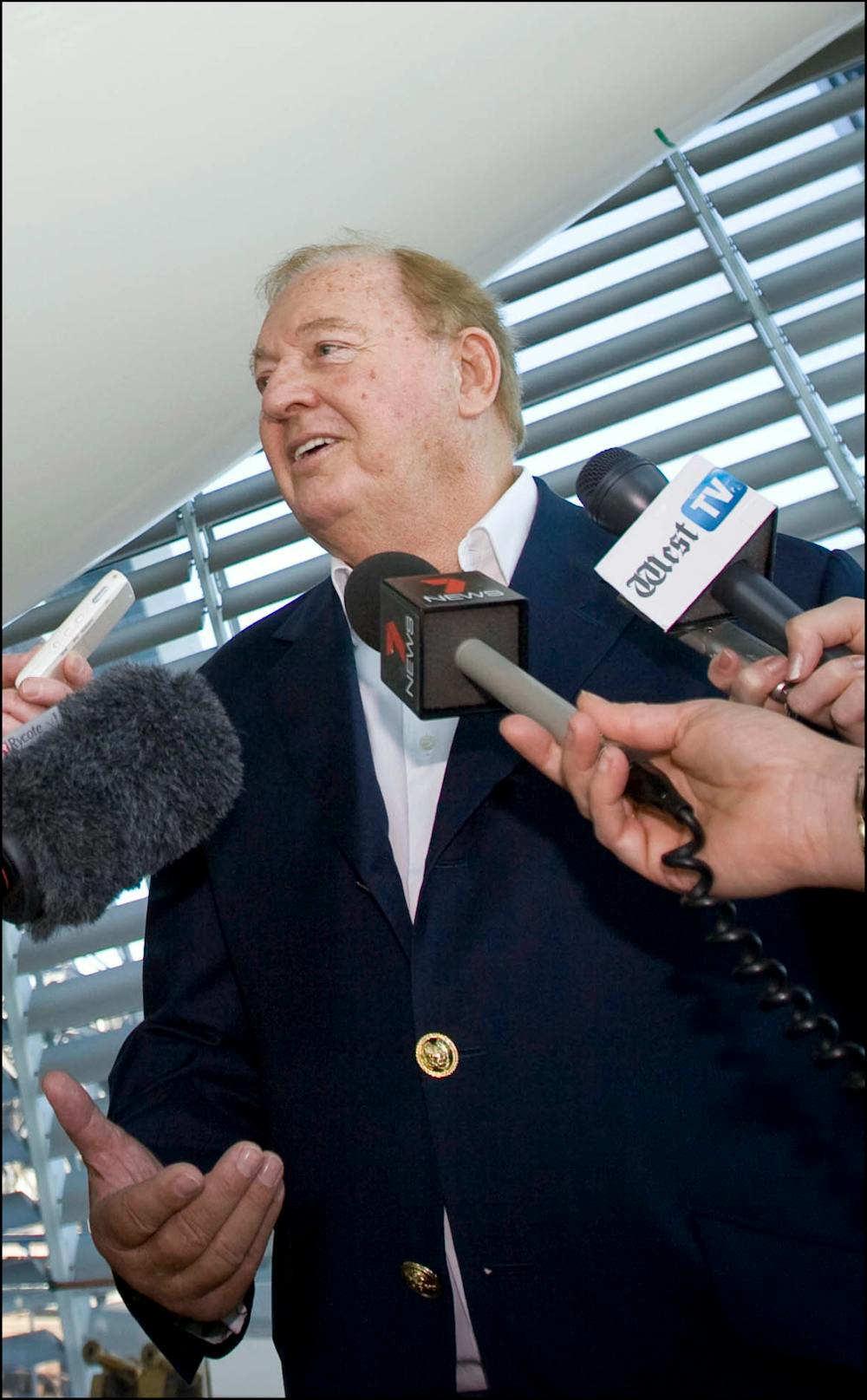
Crown provided 10% of Melbourne’s hotel rooms. Before COVID-19 hit, it contributed A$1.2 billion per year to Victoria’s economy.

It’s a logically flawed defence of the kind I first heard from Alan Bond’s Bond Corporation in the late 1980s, several years before he was imprisoned for fraud.

Trying to fend off an attempt to have his breweries placed in receivership, the company said Bond had 20,000 employees. They might not “have a job to go to on Tuesday”.

The logical flaw was the suggestion that if Bond didn’t own the breweries, the breweries wouldn’t exist.

The beers made by those breweries — Tooheys, Swan and XXXX — are still being made today.

Similarly, if Crown loses its casino licence, its 10% of Melbourne hotel rooms will still be there, most likely run by someone else. Its casino (or one like it) will also still be there, also run by someone else.

Clive Palmer tried it as well

The use of this flawed argument reached its peak early last decade during the battle over Labor’s proposed resource super profits tax.

Despite its name, the tax was designed as a profit-sharing arrangement. The government would be on the hook for 40% of the cost of each project and would take 40% of the profit.

If a project was profitable for a mining company, then 60% of the project would also be profitable, meaning the tax ought to make no difference to its willingness to invest.


Read more: Mineral wealth, Clive Palmer, and the corruption of Australian politics


Yet mining magnates such as Clive Palmer and Andrew Forrest threatened to abandon Australia and take their money elsewhere, to Africa or to China.

Their threats were no more a threat to Australian mining than Alan Bond’s was to Australian brewing.

If Forrest and Palmer had walked away (or even BHP and Rio Tinto, which talked along similar lines), someone else would have walked in.
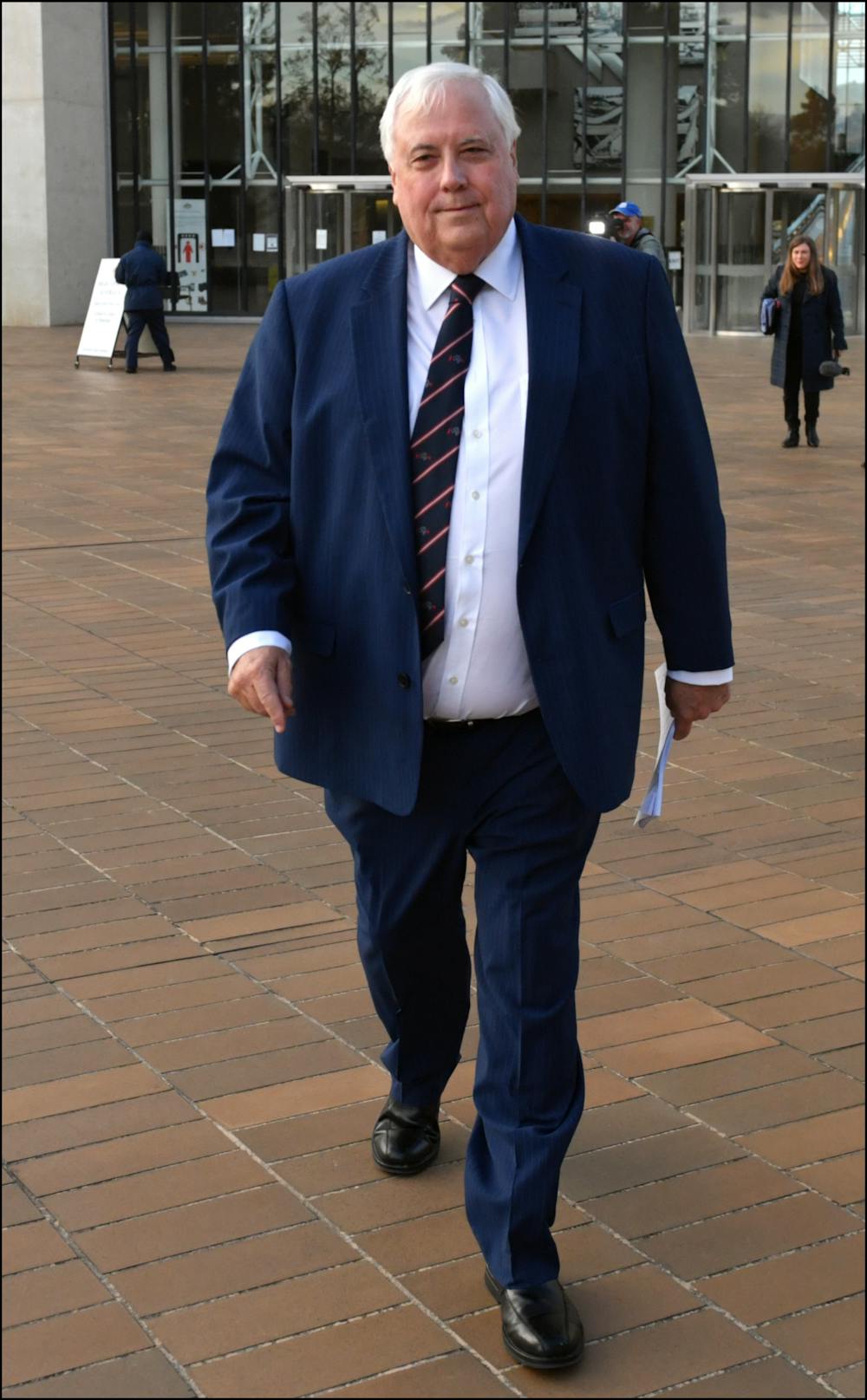
The arrangement might not be to their liking, but it would be to the liking of someone else prepared to take the profit in their place.

Crown, as Royal Commissioner Ray Finkelstein pointed out on August 3, is profitable. Its casino operation is very profitable: “maybe on the decline a little bit, but very profitable”.

“The way industry works is somebody will always step in, so I don’t treat 12,000 employees [as] at risk. ” Finkelstein said.

“They might change their employer, but they are not at risk of losing their jobs.

Nor were suppliers or tourists at risk.

"When we have a profitable operating business, there will be an operator there out in the world, a suitable one.”

A line that used to work — on television

That Crown thought it could spin this line might have something to do with the experience of its largest shareholder, from whom Crown is now distancing itself.

James Packer used to own Channel Nine (as in an earlier era did Alan Bond).

For most of its life, Australia’s television owners have played chicken with the bodies meant to be policing them — the Australian Broadcasting Tribunal and then the Australian Communications and Media Authority.

Each body was given enormous power: the power to suspend or cancel a licence, but with a catch. It lacked lesser powers.


Read more: The TV networks holding back the future


If it suspended or cancelled an operator’s licence, the station would go off the air (at least for a while). The authority would be deluged with complaints.

Packer, Bond and the other owners could use their viewers as human shields.

Time after time (11 times in five years) the authority found Nine had breached the industry code of practice. Time after time it failed to invoke the ultimate sanction.

In a 2005 report for the authority, Professor Ian Ramsay said this meant that in effect it had “less enforcement powers” than other authorities.

Crown’s workers don’t place it beyond the law

Blessedly, in 2006 (as Packer was selling out of Nine) the government acted on Ramsay’s report. The authority can now issue fines and seek enforceable undertakings, without fear of blow-back.

For Finkelstein to accept that if Crown’s licence was revoked its workers or the tourist industry would suffer would be to accept that, like the television industry was for many decades, Crown is beyond the practical reach of the law.

He is giving every indication he thinks no such thing.The Conversation

Peter Martin, Visiting Fellow, Crawford School of Public Policy, Australian National University

This article is republished from The Conversation under a Creative Commons license. Read the original article.

Read more >>

Wednesday, February 17, 2021

The TV networks holding back Australia's future

If I offered you money for something, an offer you didn’t have to accept, would you call it a grab?

What if I actually owned the thing I offered you money for, and the offer was more of a gentle inquiry?

Welcome to the world of television, where the government (which actually owns the broadcast spectrum) can offer networks the opportunity to hand back a part of it, in return for generous compensation, and get accused of a “spectrum grab”.

If the minister, Paul Fletcher, hadn’t previously worked in the industry (he was a director at Optus) he wouldn’t have believed it.

Here’s what happened. The networks have been sitting on more broadcast spectrum (radio frequencies) than they need since 2001.

That’s when TV went digital in order to free up space for emerging uses such as mobile phones.

Pre-digital, each station needed a lot of spectrum — seven megahertz, plus another seven (and at times another seven) for fill-in transmitters in nearby areas.

It meant that in major cities it took far more spectrum to deliver the five TV channels than Telstra plans to use for its entire 5G phone and internet work.

Digital meant each channel would only need two megahertz to do what it did before, a huge saving Prime Minister John Howard was reluctant to pick up.

His own department told him there were

better ways of introducing digital television than by granting seven megahertz of spectrum to each of the five free-to-air broadcasters at no cost when a standard definition service of a higher quality than the current service could be provided with around two megahertz

His Office of Asset Sales labelled the idea of giving them the full seven a

de facto further grant of a valuable public asset to existing commercial interests

Seven, Nine and Ten got the de facto grant, and after an uninspiring half decade of using it to broadcast little-watched high definition versions of their main channels, used it instead to broadcast little-watched extra channels with names like 10 Shake, 9Rush and 7TWO.

Micro-channels are better delivered by the internet

TV broadcasts are actually a good use of spectrum where masses of people need to watch the same thing at once. They use less of broadcast bandwidth than would the same number of streams delivered through the air by services such as Netflix.

But when they are little-watched (10 Shake got 0.4% of the viewing audience in prime time last week, an average of about 10,000 people Australia-wide) the bandwidth is much better used allowing people to watch what they want.


Read more: Broad reform of FTA television is needed to save the ABC


It’s why the government is kicking community television off the air. Like 10 Shake, its viewers can be counted in thousands and easily serviced by the net.

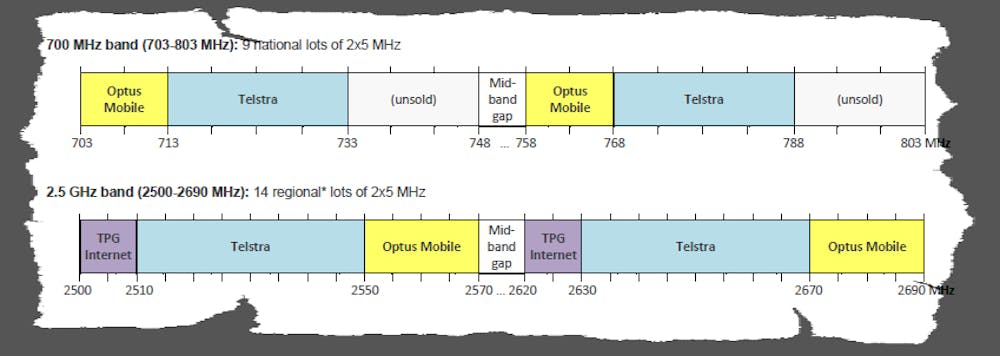
The government’s last big auction of freed-up television spectrum in 2013 raised A$1.9 billion, and that was for leases, that expire in 2029.

Among the buyers were Telstra, Optus and TPG.

The successful bidders for leases on vacated television spectrum in 2013. Australian Communications and Media Authority

The money now on offer, and the exploding need for spectrum, is why last November Fletcher decided to have another go.

Rather than kick the networks off what they’ve been hogging (as he is doing with community TV) he offered them what on the face of it is an astoundingly generous deal.

Any networks that want to can agree to combine their allocations, using new compression technology to broadcast about as many channels as before from a shared facility, freeing up what might be a total of 84 megahertz for high-value communications. Any that don’t, don’t need to.

All the networks need to do is share

The deal would only go ahead if at least two commercial licence holders in each licence area signed up. At that point the ABC and SBS would combine their allocations and the commercial networks would be freed of the $41 million they currently pay in annual licence fees, forever.

That’s right. From then on, they would be guaranteed enough spectrum to do about what they did before, except for free, plus a range of other benefits

The near-instant reaction, in a letter signed by the heads of each of the regional networks, was to say no, they didn’t want to share. The plan was “simply a grab for spectrum to bolster the federal government’s coffers”.

And sharing’s not that hard

It’s not as if the networks own the spectrum (they don’t) and it’s not as if they are normally reluctant to share — they share just about everything.

For two decades they’ve shared their transmission towers, and for 18 months Nine and Seven have been playing out their programs from the same centre.

That’s right. Nine and Seven use the same computers, same operators, same desks, to play programs.

One day it is entirely possible that a Seven promo or ad will accidentally go to air on Nine, just as a few years back some pages from the Sydney Morning Herald were accidentally printed in the Daily Telegraph, whose printing plants it makes use of.

All the minister is asking is for them to share something else, what Australia’s treasury describes as a “scarce resource of high value to Australian society”.

There’s a good case for going further, taking almost all broadcasting off the air and putting it online, or sending it out by direct-to-home satellite, removing the need for bandwidth-hogging fill-in transmitters.

Seven, Nine and Ten have yet to respond. Indications are they’re not much more positive than their regional cousins, although more polite. They’re standing in the way of progress.

Peter Martin, Visiting Fellow, Crawford School of Public Policy, Australian National University

This article is republished from The Conversation under a Creative Commons license. Read the original article.
Read more >>

Friday, November 28, 2014

You'd think the networks owned the airwaves

You'd think our commercial networks owned the airwaves.

When Communications Minister Malcolm Turnbull cut back the ABC and SBS last week he also gave notice of a minor rule change that sent them into convulsions.

Henceforth, the SBS would be able to broadcast up to 10 minutes of advertising each peak hour instead of the usual five.

The networks acted as if he had attacked their right to exist.

"This government was elected as being pro-business," thundered Seven Network chief executive Tim Worner. "It shouldn't be making decisions that harm Australian businesses."

"I am surprised the government is prepared to compete against and inflict damage on Australian commercial broadcasters," wailed Nine's David Gyngell.

What was proposed was "directly at odds with the government's claim that Australia is open for business," said Free TV Australia chair Harold Mitchell.

What was proposed was competition.

Australian television networks don't believe they are like other businesses. Banks have to put up with competitors muscling in on their turf, supermarket chains have had to cede ground to Aldi, carmakers have had to compete or go under, but the spoiled children of Australian industry want to be forever protected from competition on the airwaves as everything changes around them.

The biggest change is that broadcast spectrum has become incredibly valuable for mobile communications. Yet the networks sit on it.

Another is that much less spectrum is needed to broadcast a TV program than before.

Yet the networks sit on it. During the switch to digital in the 1990s, rather than broadcasting what they had before using much less spectrum (the whole point of the exercise) they said they needed more spectrum in order to broadcast in full high definition. That way it couldn't be used by anyone that might want to start a competing network. They produced dodgy-looking research saying Australians didn't want extra channels - they wanted the same channels in high definition.

Prime Minister John Howard bought their line against the recommendations of his advisers.

The Office of Asset Sales labelled it "a de facto further grant of a valuable public asset to existing commercial interests".

His department said there were "better ways of introducing digital television than by granting seven megahertz of spectrum to each of the five free-to-air broadcasters at no cost when a standard definition service of a higher quality than the current service could be provided with around two megahertz".

They were given it on the condition that they could only use it for broadcasting their existing channels in high definition.

When after some years it became apparent that Australians weren't going to switch to digital if all they got was the same channels (invalidating the networks' dodgy looking research) the networks said they could better use the excess spectrum for extra channels themselves.

Each still maintains a token commitment to high definition on one of its channels (it's actually degraded high definition to make way for the extra channels) but no one much notices. Much of the time those channels don't carry high definition content. The spectrum is wasted, but no one else has it. That's how the networks think.

And the minister is on to them.

He has already picked on the easiest target. The poorly watched community channels in Melbourne, Geelong, Sydney, Brisbane Adelaide and Perth will be kicked off their spectrum at the end of 2015. They'll have to use the internet. After the freed-up spectrum is used to test new technologies it'll be made available to the highest bidders, almost certainly mobile phone and data companies.

The next step will be grabbing back spectrum from the ABC and SBS. That's fairly easy - cut their budgets, let them use a new compression technology called MPEG-4 that halves the amount of spectrum they need and tell them they can save on transmission costs and give the other half back.

The commercial networks require more subtle handling. The minister has launched an inquiry - the spectrum review -  to work out how to "maximise the economic and social return from spectrum". Its preferred approach is auctions, with the winning bidders limited to 15 years at a time and the department given the right to take the spectrum off them (with compensation) if it's not fully used.

The treasury describes spectrum as a scarce resource in its submission. It says it should be allocated to the highest value uses.

"To be clear, this includes both commercial and non-commercial applications," it says - making a pointed reference to two of the biggest hogs of spectrum, our armed forces and our police and emergency services.

Defence will, at the very least, have to justify what it needs and hand some back. Police and emergency services might be able to hand back a lot with the proviso that in a real emergency they get it to use it again, with the mobile communications company that has bought it agreeing to degrade its service to give emergency services priority.

And the networks. Turnbull will probably get it off them by being nice. Using new compression technology, they will need only half as much and be able to sell the excess to someone who wants it more. It's far more than they deserve, but at least their spectrum will be better used.

It'd make a nice little earner for whoever buys Channel Ten and a really good earner if the new owner sold the lot and closed the station down.

Mobile communication is increasingly important to us. Network television is not.

In The Age and Sydney Morning Herald
Read more >>

Monday, November 14, 2011

Fun at work. What news presenters do during commercial breaks


Chicago WGN News anchors Robert Jordan and Jackie Bange. They're still at the station!

HT: Nick Gruen


Related Posts

. How to report the news

. Ah, television


Read more >>

Friday, September 16, 2011

Remember when Tony and Julia loved each other?


Sigh! Thanks @annabelcrabb
Read more >>

Friday, September 09, 2011

9/11 How Sandra Sully presented the news in Australia, and how we got it at all


Click on the picture to see Sandra Sully present an unexpected edition of Ten News on the night and her recollections of the night. (You'll have to watch a 15 second ad first.)

Sandra says CNN was the only organisation feeding it live internationally as it happened.

Here's why.

An executive called Paul Cutler was in the control room of CNN International as the attacks happened supervising CNN's multiple outputs - different programs go to different regions, CNN Asia etc.

Someone pointed out the US presenters had cut to traffic camera vision of smoke coming out of the World Trade Centre building. At that stage no-one knew what it was or whether international viewers would be interested.

Paul uttered three words: "Go All Regions"

Instantly every CNN outlet worldwide switched to the New York vision being fed to the US via Atlanta.

Were it not for Paul... Sandra would have seen nothing.

These days he is head of News at SBS TV in Australia, where he told me the story.


Related Posts

. How 24-hour news can sometimes look

. How to report the news

. Ah, television

Read more >>

Tuesday, August 30, 2011

David Hicks on Australian Story tonight. It will be good


Why do I think it'll be good?

Because Australian Story isn't always sympathetic to its subject.

The producer Helen Grasswell is one of the very best. She has won many awards for television, one of them shared with me.

The one-hour program is on at the "special time" of 8.30 pm.


Read more >>

Tuesday, August 24, 2010

Interviewing an empty chair


It's a grand tradition.

But the those in charge of last night's Q&A could have gone further... (Hi Peter, Hi Amanda)

...as did the BBC game show Have I Got News For You after a Labour MP cancelled on them for the third time:


It'd never be allowed in Brazil. Or Fiji.

HT: Mumbrella


Here's the correspondence

"We cannot accept your request that you choose a substitute panel member for tonight’s Q&A since this would be a clear breach of the ABC’s editorial independence. Mr Arbib will be represented by an empty chair at the Q&A desk.

I hope that the Prime Minister and Mr Arbib might still be responsive to the obligations that all Australian politicians have to face Australian citizens and the media on matters of national significance such as the future government of Australia."


Related Posts

. I'm a bit worried about this concept of an ABC 24-hour news channel (funny videos)


. I mentioned that I used to work in television news... (funny video)

. Ah, television

Read more >>

Tuesday, July 13, 2010

At last! A start date for ABC News 24!

Thursday next week, July 22.

"The ABC is pleased to announce that ABC News 24 – Australia’s first free-to-air, 24-hour digital news service – will start broadcasting at 7.30pm AEST, Thursday 22nd July, right across the country.

These service will be on display during ‘ABC News 24 Launch – ABC News Special’ – a national program airing on ABC1 at 7.30pm, and simulcast on ABC News 24 at 7.30pm AEST, on Thursday 22nd July."


It'll be online and on iphone as well at www.abc.net.au/news

So let's revisit asome memories I posted in January (After all, I am on holiday):

Rupert to the rescue - his little-known role in the creation of ABC News 24

Here's how it happened as I remember it, and I was at ABC TV at the time and following things closely:

Telstra and NewsCorp set up a jointly-owned company called Foxtel, and later brought in other owners.

In 1995 they were looking for a 24-hour news channel as part of their offering.

The ABC put in a tender which was verbally accepted.

But it wasn't an ABC-only tender. It was the ABC in partnership with Fairfax which produces the Sydney Morning Herald, The Age and other newspapers.

The venture spent a fortune on a beautiful new studio-newsroom at Gore Hill in Sydney which I toured a working newsroom with computer editing and robotic cameras (which unnervingly had no viewfinders) - all way ahead of its time for 1995...

It set up live broadcast points from Fairfax newsrooms and money market dealing rooms etc, hired Katrina Lee and John Lombard as anchors, got Weather Bureau presenters to rehearse and work for free and actually produced weeks of test broadcasts that were beamed into Parliament House in Canberra.

(ABC news staff were generally wary of the whole thing - it involved a partnership with a commercial competitor.)

Then Rupert said 'no'.

Legend has it it was something an ABC executive said, implying that the deal wasn't final and the venture might go on the Foxtel competitor OptusVision.

Another legend is that he was upset about a forthcoming or just-broadcast Four Corners program about him.

And another is that the argument was about price. He asked a consortium of commercial TV stations to tender for a bare bones service, which they did at a fraction of the price, and named it Sky News Australia.

Rupert probably also didn't want to give a leg-up to two competitors.

But he did say no, and Telstra backed him - leading to the absurd situation where a government-owned carrier refused to carry the government broadcaster.

The ABC and Fairfax wrote off the expenditure, the staff were redeployed or terminated, the equipment sold and the building closed down.

(And the experience was sucked into a memory hole.  Last year an editorial in The Australian was able to claim that the ABC had lacked the foresight to do what Sky News Australia had done.  If only the editorial writer had known!  It wasn't the foresight it lacked, it was the ability.)

Fast forward to 2010.

Sky News Australia is quite good at what it does.  And now the ABC is about to launch a free 24-hour news channel without a commercial partner to make its unmatched resources available all the time to all Australians.

Good outcome, eh?

Were it not for Rupert, the new ABC service would be restricted to those Australians with pay-TV and would have compromised the ABC by partnering it with Fairfax.

Well done. And thanks.

ABC News 24


Related Posts

. I'm a bit worried about this concept of an ABC 24-hour news channel (funny videos)

. Thursday column: The networks war on TV

. Rupert to the rescue - his little-known role in the creation of ABC News 24


Read more >>

Monday, March 29, 2010

"This is where it all happens? Now, where does everyone sit?"


Glenn Stevens has become the people's governor, following his unprecedented appearance on Sunrise this morning, jawboning direct to the public.  It's worth watching the full five minutes:


Good for Sunrise, good for the Bank. And an example of what commercial television can still do well.

Full transcript below:


KOCH: Well, he's the bloke charged with safeguarding your wealth and that of the country. Reserve Bank Governor Glenn Stevens is a really bright, unassuming character who really did save this country from the worst of the global financial crisis.

You don't know about him much though, because he's never done an in-depth TV interview before. To mark the 50th birthday of the Reserve Bank he sat down with Sunrise to talk about a whole range of things, including how he sets interest rates and where they're likely to go.

KOCH: The first Tuesday of every month at 9:00 o’clock on the dot the Reserve Bank of Australia Board sits down to talk money and interest rates. It's a big decision with even bigger consequences for all of us.

KOCH: This is where it all happens?

STEVENS: This is where it all happens.

KOCH: The boardroom.

STEVENS: This is the boardroom.

KOCH: Now, where does everyone sit?

STEVENS: Well, I sit here at the uncomfortable spot where tables join and...

KOCH: (laughs)

STEVENS: The Deputy Governor typically sits to my left. We have a couple of senior members of staff who sit to the right.

KOCH: Does it get pretty feisty around here when you're discussing - particularly whether to move interest rates? Or do they generally take your advice?

STEVENS: Feisty isn't the word I'd use to describe the discussion. It's very well-mannered but it's certainly intense. They're not here to be a rubber stamp, they're here to test our arguments and to make sure that we're on the right track.

KOCH: Because I suppose a lot of people, particularly small business people and mums and dads would say - "OK, these are all pretty highfalutin people, you know, they're all in the top corporate world. What would they really know about my experiences?"

STEVENS: The board members are very experienced people, they get out a lot. They're only here one day a month. The rest of the time they're undertaking their regular activities, and a couple of them are actually small - in that sense – business people themselves.

This is...

KOCH: Trading room?

STEVENS: Yes.

KOCH: Before making its decision the RBA also checks in with 100 small businesses each month to gauge the real economic health of the nation at the coal face.

Because the decisions made here affect so many people. Does that weigh heavily on the decision making?

STEVENS: The thing they're also weighing is if we wait too long, do we end up having to do more than that, and those people would actually end up in a lot more pain.

KOCH: Rates have already jumped a fair bit from the lows, so how much higher are they likely to go?

STEVENS: We cut interest rates to what we call emergency settings when we had an emergency, when we thought we really were going to face a big downturn and we wanted to try to get ahead of that. Once the emergency has passed and things gradually look more normal, then it's not wise to leave interest rates right down at rock bottom any longer than we need. And you shouldn't assume they'll stay low because that assumption will prove to be, you know, unfortunate.

KOCH: So, you're sort of preparing us that interest rates are going to go up?

STEVENS: I think it would be - not doing people any favours to have a prolonged period of very low rates and then hammer them unexpectedly and, of course, the banks that are lending them money should be - and I'm sure are - testing the potential borrower - can you handle some rise in interest rates?

KOCH: When you look at things at the moment, is there anything that we should be thinking about, concerned about?

STEVENS: I think it is a mistake to assume that a, you know, riskless, easy, guaranteed way to prosperity is just to be leveraged up into property. You know, it isn't going to be that easy. And I think if we think about property prices as parents - you're a parent, as am I - I've got kids that within not too many more years are going to want somewhere of their own to live and you wonder, you know, how is that going to be afforded because the prices are getting quite high.

KOCH: Thanks for joining us.

STEVENS: Pleasure. Thank you.

(package ends)

DOYLE: Wow! You even wore your best pin-striped suit for that and a tie.

KOCH: I know I had to put a tie on. I was so nervous with that.

DOYLE: What did you do? Did you get a photo?

KOCH: No I was a bit embarrassed to get a photo.

But just look at what he was saying; Inside the board room, how cool is that?

DOYLE: Very cool.

KOCH: First Tuesday of every month, look at that - where he sits. He sits where the leg is so has the most uncomfortable seat on the table.

DOYLE: That is noble.

KOCH: But saying – be careful, interest rates are going to go up, and be careful about over extending yourself into property. Take the advice, he is the guy that sets it.


Related Posts

. You think there's agreement around the the Reserve Bank board table?

. I mentioned that I used to work in television news... (funny video)

. The networks war on TV


Read more >>

Thursday, February 18, 2010

This outrage over what Conroy did... it took surprisingly long to build


I was working Sunday February 7 when Conroy made the strange announcement, and frankly felt a bit of outrage might be in order.

The ABC's Mark Scott, whose tweets I follow, actually seemed pleased with the announcement:

Government to rebate commercial free-to-air TV licence fees to promote Australian content.......very significant step. 3:30 PM Feb 7th  from TweetDeck


The Coalition's Communications Spokesman Tony Smith through his spokesman Andrew Cox dictated these supportive words to me over the phone:
"Preserving quality Australian content is important and there is little doubt the cost of delivering that content is higher at present. While we acknowledge support is warranted during transition to digital television, we look forward to considering further details and the government's costings."
No suggestion at the time that it could be inappropriate...

One week later on Sunday February 14, I was working again when news came through about Conroy's skiing meeting with Stokes.

Smith emailed Cox who emailed me:

From: Smith, Tony (MP)
To: Cox, Andrew (T. Smith, MP)
Sent: Sun Feb 14 17:00:02 2010

Senator Conroy has simply not been upfront and open in the last week.

He should release the full costings and all of the detail to justify both the size and the duration of the rebates.

And given his public linkage of the rebates with quality Australian content – he must detail what commitments he has sought and received to achieve this objective.

Again, no outrage at the idea of handing money to the commercial television networks.

Like I said, that took time to build.


Related Posts

. The networks war on TV

. Of all the dodgy explanations... (Stephen Conroy edition)

. Well it's quarter of a billion, see. And I'm handing it to Australia's commercial television stations


Read more >>

Thursday column: The networks war on TV

There are five free-to-air television networks in Australia. All are now government funded.

How it came to this when any one of a number of private entrepreneurs would have been keen to enter the market on any terms and take their chances providing viewers with what they want says as much about the malleability of our leaders as it does about the essentially anti-television attitudes of the networks who claim to be its protectors.

What I about to describe is a three-card trick. Watch closely for the switch, admire the skill and cynicism with which it was executed, and if you can keep an eye out for the interests of viewers as taxpayers; just about no-one else has.

Let's start in the lead up to March 1998 when an entire new world of viewing became possible.

Digital channels, which took up far less spectrum than analogue channels, would enable far more chanels to be broadcast... The UK and much of Europe were planning to give one of the new channels to each of the existing broadcasters and then auction the others to new entrants. It would be a great deal for taxpayers and a great deal for viewers.

The networks pulled out all stops to prevent it happening here. Spreading what now looks like dodgy research they told us we didn't really want more channels, we wanted better quality pictures.

To popularise the idea they produced a series of ads fronted by Mr Fizzy, Mr Squirt and Mr Butt. Each of the existing networks was to get given enough spectrum to simulcast its existing channel in near cinema-quality High Definition leaving no spectrum free for upstarts such as Mr Singleton or Mr Murdoch to broadcast new channels.

Prime Minister John Howard and Communications Minister Richard Alston bought the network's line against the express wishes of just about every one of their official advisors.

The Office of Asset Sales labelled the move "a de facto further grant of a valuable public asset to existing commercial interests".

Prime Minister and Cabinet said there were "better ways of introducing digital television than by granting 7 megahertz of spectrum to each of the five free-to-air broadcasters at no cost when a standard definition service of a higher quality than the current service could be provided with around 2megahertz of spectrum each."

Announcing the gift of so much spectrum, announcing a ban on its use for anything other than HD broadcasting, and announcing a ban on new entrants the minister said he "would normally welcome additional competition, in any industry, as healthy" but that the existing operators needed special treatment because of the cost of installing new equipment.

Franco Papandrea of the Institute of Public Affairs wrote that "if the cost of introducing new technology were to be a legitimate reason for limiting competition, every industry in Australia would be seeking and would be entitled to protection".

I said it was a three-card trick. It had to be, because the truth was we weren't too fussed about near-cinema quality pictures. We wouldn't stump up the money for set-top boxes if all they would offer was smoother-looking versions of the programs we had before. The broadcasters weren't too keen on offering higher quality pictures anyway. Most of what they simulcast on their HD channels was made in standard definition.

The ABC begged for approval to somewhat degrade the quality of its HD signal to allow it to broadcast extra channels that might actually drive demand for the new technology. The government granted the approval but on one very odd condition - the extra channels were not allowed to be very interesting. The could show children's and educational programs but could not show drama, comedy, entertainment or national news, current affairs or sport.

The ABC began broadcasting children's channels and later ABC 2 which was indeed boring until the genre restriction was lifted.

By this time each of the networks had degraded the quality of its HD channel to enable it to broadcast more channels. After all real HD had never been the point. The point had been soaking up free spectrum to prevent anyone else from using it.

The cards having been switched, in the past year the incumbents have been dancing on HD's grave.

Network Ten is using its HD channel to broadcast continuous sports programing under the name ONE HD. It's abandoned the pretense of offering ordinary programs in HD. The ABC, having used up the two extra channels it created by degrading its HD channel is now going to use what remains of the HD channel to broadcast 24 hour news.

And now the networks want compensation. Why they want more compensation given what they've pulled off at public expense is a bit of mystery, and perhaps even a mystery to the minister who handed it out.

In granting them rebates on their license fees of 33 per cent this year and 50 per net next year - government funding - Minister Conroy has variously said it it will protect Australian content, assist with the cost of new equipment, and help the networks as they face increased competition from new media.

On Tuesday he offered an extra explanation - the Free Trade Agreement with the United States. He said the decision was about protecting Australian content but "we are not in a position that we can afford to breach trade obligations". The industry itself had yet another take - it was compensation for the analog spectrum they would lose when the analog signals were finally turned off. Never mind that they have already been compensated and that analog won't be turned off for years.

As with the best conjurer's tricks, its hard to work out how it happened.


Published in today's Age


Fiddling With the Digital TV Tuner Agenda 2009


Digital Three-Card Trick, IPA Reveiw


Related Posts

. Rupert to the rescue - his little-known role in the creation of ABC 24/7

. Of all the dodgy explanations... (Stephen Conroy edition)

. Well it's quarter of a billion, see. And I'm handing it to Australia's commercial television stations


Read more >>

Monday, February 15, 2010

Of all the dodgy explanations... (Stephen Conroy edition)

Communications Minister Stephen Conroy has described as "entirely appropriate" his decision to meet with Channel Seven chief Kerry Stokes at a Colorado ski resort shortly before handing to the networks fee rebates worth one quarter of a billion dollars.

The Minister yesterday confirmed reports that he had met Mr Stokes in Veil, Colorado while on a personal holiday in January "fully paid for by me including all airfares from Australia to Colorado".

While not directly addressing a claim by a spokesman for Mr Stokes that the two had "enjoyed a couple of ski runs" together the Communications Minister said he "met regularly with all senior communication stakeholders".

"All of my conduct with Mr Stokes and his associates, and all other stakeholders in my portfolio, has been entirely appropriate," he added.

Within weeks the Minister announced what amounted to a gift to the commercial networks of $250 million... in the form of a 33 per cent rebate on their licence fees in 2009 and a 50 per cent rebate in 2010.

Although headed "Government to protect Australian content on commercial television" the announcement detailed no requirement for the networks to protect or extend Australian content and merely restated existing rules.
Opposition frontbencher Christopher Pyne called for an explanation.

"The actual visit and the skiing with Kerry Stokes is not nearly as important as exactly what is going on with the communications portfolio," Mr Pyne told the ABC's Insiders.

"He has given the networks $250 million. He hasn't yet said how he arrived at the figure, what exactly the money is to be used for, and what guaranntees he's received from the networks that it will be used for something that will benefit the public."

"Was there a rationale, or did he pull the figures out of his ear?"

A spokesman for the Minister said the rebate was "an interim measure to support current Australian content at a time of structural change".

"Treasury were involved in developing the costings," she said.

Published in today's SMH 

Graphic: Vail Hotel, Colorado


Related Posts

. Well it's quarter of a billion, see. And I'm handing it to Australia's commercial television stations

. Revealed: Labor's $30 billion broadband furphy

. Conroy thinks our internet is slow

Read more >>

Monday, February 08, 2010

Well it's quarter of a billion, see. And I'm handing it to Australia's commercial television stations

Christmas has come early to Australia's commercial television channels in the form of a $240 million gift from Communications Minister Steven Conroy.

This year he will give the networks a 33 per cent rebate on their annual licence fees of $287, and next year a 50 per cent rebate.

Although the announcement is headed "Government to protect Australian content on commercial television" the broadcasters will be required to do no more than meet the existing Australian content requirements in return for the rebates.

The Minister said Australian networks faced higher licence fees than those overseas and were facing challenges including the switch to digital television.

"Broadcasters have a unique role in preserving our national culture and the commercial television sector invests hundreds of millions of dollars each year in the production of local content," he said.

"However, they are faced with a converging media environment and switch to digital television, as well as the impact on revenue created by a decline in advertising spend as a result of the global financial crisis"...

"The Government recognises that the commercial broadcasters will require assistance to maintain Australian content production, while investing in a new delivery platform. "

The $240 million in rebates follows long negotiations with the networks and is understood to be an attempt to keep them profitable.

The Nine network is majority foreign owned and the seven network is half foreign owned.

Channel Nine last night wrongly reported the deal as saying it would "guarantee the continued production of series such as Underbelly". In fact it imposes no additional requirements on the networks.

They are already required to meet a range of targets including broadcasting Australian material for 55 per cent of the time between 6 am and midnight.

The Ministers office last night declined to give an assurance that the rebates would not continue beyond 2011.

Australian networks pay around 8 per cent of their revenue in license fees, compared to around 2 per cent in the US, the UK and Canada.

Coalition Communications spokesman Tony Smith yesterday backed Senator Conroy on the rebates.

"Preserving quality Australian content is important and there is little doubt the cost of delivering that content is higher at present," he said. "While we acknowledge support is warranted during transition to digital television, we look forward to considering further details and the government's costings."


Published in today's SMH and Age

Licence Fee Relief Conroy


Related Posts

. The sendup YouTube has apparently banned

. Remember when the ads used to be better than the programs?

. If TV doesn't kill you...

Read more >>

Sunday, January 31, 2010

I mentioned that I used to work in television news... (funny video)

Not for long, and always as part of another job - mainly being the ABC's Tokyo Correspondent.

My reports were NEVER like this:


HT: Mark Colvin


Related Posts

. Ah, television

. The ABC keeps trying to do more with less

. TV's biggest crime - it's a thief of time


Read more >>

Saturday, January 30, 2010

Rupert to the rescue - his little-known role in the creation of ABC News 24

Australia's new 24 hour news channel

Here's how it happened as I remember it, and I was at ABC TV at the time and following things closely:

Telstra and NewsCorp set up a jointly-owned company called Foxtel, and later brought in other owners.

In 1995 they were looking for a 24-hour news channel as part of their offering.

The ABC put in a tender which was verbally accepted.

But it wasn't an ABC-only tender. It was the ABC in partnership with Fairfax which produces the Sydney Morning Herald, The Age and other newspapers.

The venture spent a fortune on a beautiful new studio-newsroom at Gore Hill in Sydney which I toured... a working newsroom with computer editing and robotic cameras (which unnervingly had no viewfinders) - all way ahead of its time for 1995.

It set up live broadcast points from Fairfax newsrooms and money market dealing rooms etc, hired Katrina Lee and John Lombard as anchors, got Weather Bureau presenters to rehearse and work for free and actually produced weeks of test broadcasts that were beamed into Parliament House in Canberra.

(ABC news staff were generally wary of the whole thing - it involved a partnership with a commercial competitor.)

Then Rupert said 'no'.

Legend has it it was something an ABC executive said, implying that the deal wasn't final and the venture might go on the Foxtel competitor OptusVision.

Another legend is that he was upset about a forthcoming or just-broadcast Four Corners program about him.

And another is that the argument was about price. He asked a consortium of commercial TV stations to tender for a bare bones service, which they did at a fraction of the price, and named it Sky News Australia.

Rupert probably also didn't want to give a leg-up to two competitors.

But he did say no, and Telstra backed him - leading to the absurd situation where a government-owned carrier refused to carry the government broadcaster.

The ABC and Fairfax wrote off the expenditure, the staff were redeployed or terminated, the equipment sold and the building closed down.

(And the experience was sucked into a memory hole.  Last year an editorial in The Australian was able to claim that the ABC had lacked the foresight to do what Sky News Australia had done.  If only the editorial writer had known!  It wasn't the foresight it lacked, it was the ability.)

Fast forward to 2010.

Sky News Australia is quite good at what it does.  And now the ABC is about to launch a free 24-hour news channel without a commercial partner to make its unmatched resources available all the time to all Australians.

Good outcome, eh?

Were it not for Rupert, the new ABC service would be restricted to those Australians with pay-TV and would have compromised the ABC by partnering it with Fairfax.

Well done. And thanks.


"Independent, accurate, always there."


Related Posts

. A commenter asks about Murdoch newspapers

. Absolutely top notch listening - Paul Krugman, Mark Scott

. It's back! The National Times has risen from the ashes


Read more >>

Wednesday, January 13, 2010

If TV doesn't kill you...

...it'll probably make you miserable

This paper from Australian medico David Dunstan has been sparking a lot of debate.  Commentators reckon it's pretty good.

Its key message:

Australian researchers tracked the lifestyle habits of 8,800 adults and found that each hour spent in front of the television daily was associated with:

. an 11 percent increased risk of death from all causes,
. a 9 percent increased risk of cancer death; and
. an 18 percent increased risk of cardiovascular disease (CVD)-related death


But there's a another reason most of us should not watch much TV - it'll make us less happy. Here's my report of few years back:


IF YOU really want to be happy, throw away your television set. That's the bizarre finding of new economic research completely at odds with traditional assumptions. It has traditionally been assumed that people who choose to do a lot of something must enjoy it. And we certainly choose to watch a lot of TV.

I like to think of myself as a light viewer, but in truth I watch 30 to 90 minutes a night plus at least that much again of children's programs in the background each morning.

The typical Australian is said to watch two to three hours a day. Added up over a lifetime, that means someone who lives to 75 may have watched TV for nine years. The only things we do more of are work and sleeping.

So it's odd that economists haven't much studied TV viewing until now. When they have, they have found that we enjoy it. Most recently the Nobel Prize winner Daniel Kahneman asked 1000 women to record how they felt at each moment of the day. They felt their best when having sex, socialising, eating and watching TV...


They enjoyed TV more than they did talking to their spouse, shopping or caring for their children.

Now a team from the University of Zurich is suggesting that Kahneman and others have been looking at only half the picture. In a paper entitled Does Watching TV Make Us Happy? Bruno Frey and his colleagues argue that it is not enough merely to ask people how they feel at the exact moment when they are watching TV. It is also necessary to ask how people who watch a lot of TV generally feel.

They say that drug addicts feel great at the exact moment they are getting their fix, but they generally feel awful.

The team had access to data from a European survey in which 42,000 people were asked: "All things considered, how satisfied are you with your life as a whole nowadays?" They were also asked how much TV they watched. The team found that the people most satisfied with their lives were those who watched TV the least.

The effect was large. One of the most important predictors of happiness (for men) is whether they are married. The effect of not watching much television is about one third as big.

The team was left with a paradox. Watching TV made people feel good while they were doing it, but seemed to make them less satisfied overall.

Other activities affect us in the same sort of way. One is smoking. Cigarettes hurt smokers, but they do so slowly. Immediately, they offer relaxation - which becomes addictive.

Bruno Frey could see how television might act like that. It offers an immediate benefit - relaxation, with the costs not apparent until later. Those costs include tiredness, weak social relationships and insufficient attention to study and careers.

People who don't care about the future or who lack self-control will watch more TV than they should, and will be less happy as a result.

Opinion polls suggest that this is the case for many Americans. Forty per cent of US adults and 70 per cent of teenagers say they spend too much time watching TV.

But there is another possibility which Frey and his team have not been able to rule out completely. It's that rather than excessive TV use making people unhappy, people who are already unhappy may choose to watch a lot of TV.

Frey thinks this is not the case, and he designed a test to back up his opinion. He says if he is right about heavy TV viewing causing unhappiness, it won't do it to everyone.

The only people seriously harmed by heavy viewing will be those who have other things they can usefully do with their time. (Economists call them people with "high opportunity costs" of time.)

They include the self-employed, senior managers and people in professions where the work never ends. For them, lost time matters.

By contrast, pensioners and the unemployed (with low opportunity costs of time) shouldn't be that much harmed by the hours taken up watching TV - they might even welcome them.

Frey has gone back to the European data and found exactly that pattern. Watching TV for more than 1½ hours a day doesn't appear to hurt pensioners and the unemployed, but it makes a big dent in the happiness of the professionals who do it. Denied time in which they know they could be really achieving things, they feel perpetually unsatisfied.

TV appears to play with our minds in other ways as well.

The European survey asked people about their anxieties. One question asked: "How do you feel about your household's income these days?"

Another asked: "How important is it for you to be rich?"

Frey found that heavy TV viewers were both more anxious and more greedy than were light viewers on the same incomes. They were also more scared about the outside world.

Other questions asked whether people could generally be trusted, and whether it was safe to walk outside at night.

On both counts heavy viewers were more frightened.

Television viewing is by far our biggest leisure-time activity. And it's not all bad. (I happen to work in television.) But until now discussion of its impact has moved little beyond debates about whether or not it makes us violent. Its biggest crime may be to steal our time.


Related Posts

. Remember when the ads used to be better than the programs?

. Ah, television

. Want to price happiness?

Read more >>

Monday, November 09, 2009

Remember when the ads used to be better than the programs?

That was in the days when every television advertisement broadcast here had to be made here.

Call it protection if you want, but it resulted in quality ads that actually spoke to us in our own (peculiar) language.

In order to celebrate its 75th anniversary, the legendary Australian agency George Patterson has put 20 best on YouTube.

Here are my picks.


Try to watch this without crying:


This works even though I hate banks:


And this is truly wonderful, better than all manner of programs:


And this sold a lot of Colgate:


Sigh!

HT: Mumbrella


Related Posts

. TV's biggest crime - it's a thief of time

. Back to the Eighties

. Keep your feet on the ground...


Read more >>