Showing posts with label financial advice. Show all posts

Tuesday, February 14, 2023

Australians need good financial advice more than ever to pay for soaring interest rates. Here’s how to get it

Hundreds of thousands of us who took out fixed-rate mortgages in 2020 and 2021 are about to be hit with massive increases in payments.

After nine successive interest rate increases and at least two more to come, those of us on variable rates will soon be paying as much as A$1,000 a month more.

With such an uncertain economic outlook, should we switch our super fund’s investment strategies from “growth” to “conservative”? Should we rent rather than buy while home prices fall?

We need answers to our financial questions – but they’re now much harder to get.

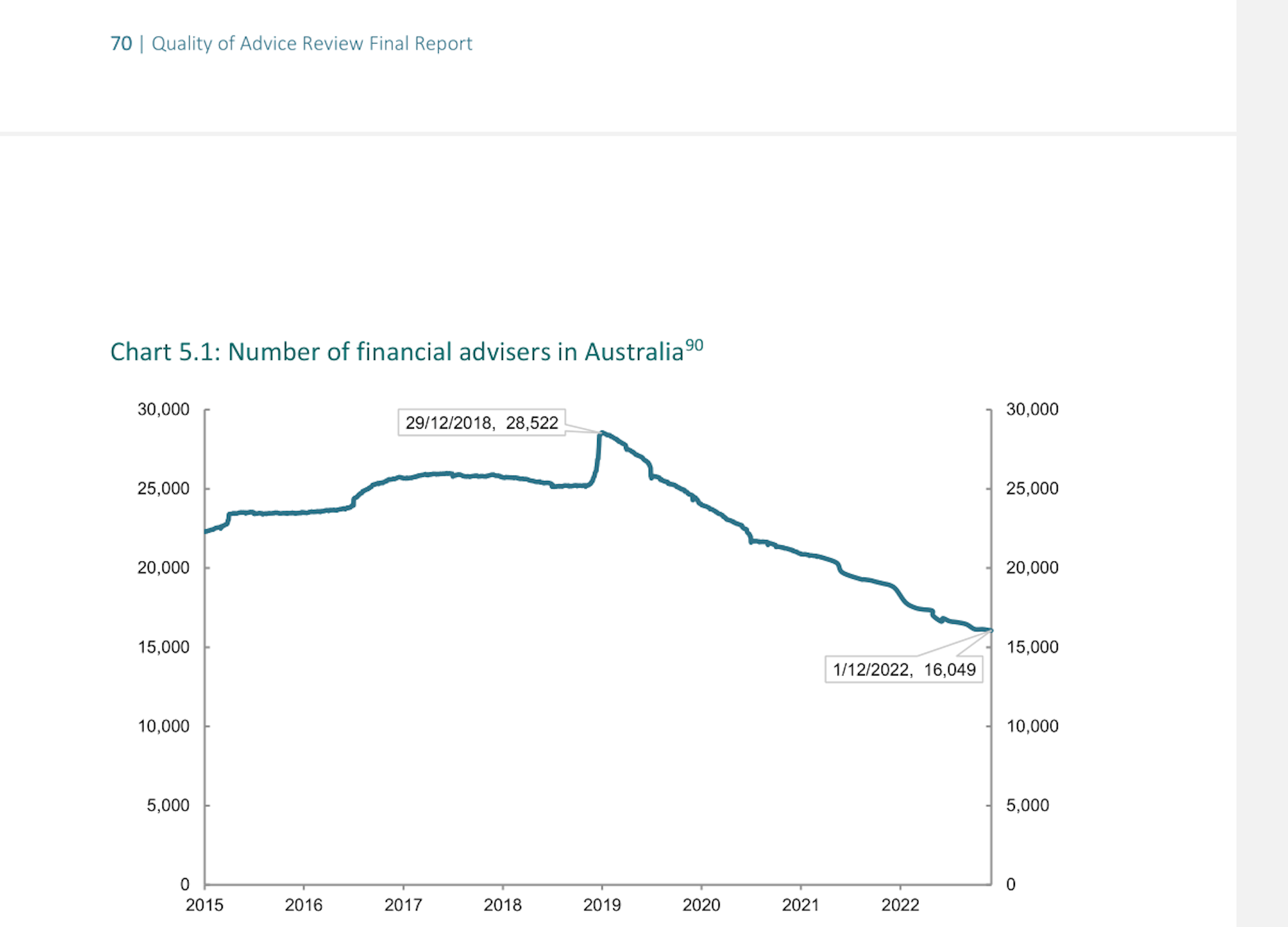
Five years ago, Australia had 28,000 financial advisers. Today there are 16,000. That’s according to a review of financial advice commissioned by the previous government and released by the Albanese government last week.

Thousands of advisers are leaving the industry each year. The ones that remain are charging far more than they used to – $3,710 is said to be common, up 48% in five years, and enough to turn many people away.

So how did it come to this? And what does the new report recommend we do to make it easier for more Australians to get good, more affordable financial help?

Fixing rorts, where even dead people paid a price

This is a story about how Australia, under successive Labor and Coalition governments, let aiming for what’s perfect get in the way of what’s good. Up until I read the Quality of Advice Review last week, I was guilty of doing it too.

For years, I argued we should make financial advice perfect: delivered by genuinely professional advisers, who weren’t receiving kickbacks from firms wanting access to our money. I also argued we should pay for that advice in full upfront, because, whatever the cost, the advice will save us money in the long run.

We needed to do something. Back before a series of explosive Four Corners reports and the 2019 Hayne royal commission into the financial services industry, advisers and the funds they pushed us towards sucked money out of our accounts and presented us with options that made money for them – rather than us.

The consequences were shocking. Dead people were being charged for financial advice, and even for life insurance. Gym instructors and other “introducers” were used to lure people into products that charged unnecessarily high fees.

The professionals we now call investment advisers used to be called insurance salesmen. They were paid through commissions to beguile us into signing up for products that charged high fees and paid them high ongoing commissions.

Unintended results of tougher standards

Ahead of the Hayne royal commission, things began to change.

The Rudd Labor government outlawed commissions and introduced legislation requiring advisers to “place clients’ interests ahead of their own”. After winning government, the Coalition tried to undo the changes, before adopting just about the lot after Hayne reported.

It’s now illegal for financial advisers to accept commissions (although mortgage brokers and people who sell insurance still can) and illegal to offer advice that isn’t in the “best interests” of the customer taking almost everything into account. This makes it all but impossible for bank tellers and super funds to offer advice.

So I have been having second thoughts about the arguments I once made for no commissions, best interests, and lots of disclosure documents – especially after reading the Quality of Advice Review. Ironically, its release was largely drowned out by coverage of Australians’ growing financial stress.

The report’s author Michelle Levy is a senior lawyer and expert on superannuation, life insurance, distribution and financial services law.

As well as being a partner at Allens, she’s also a parent – and knows more than most how vile predatory financial advisers can be.

During the royal commission, we heard about a man with Down syndrome who was signed up for life insurance over the phone, even though he lived on a pension, had no dependants and could not afford the premiums.

In her review, Levy discloses that she has a daughter who, “like this gentleman”, lives with a disability and has bank accounts, but does not know the difference between $10 and $1,000, does not know how to use a credit card, or what superannuation is.

Levy writes that her daughter ought to be able to rely on her bank and super fund to assist her.

She says by stopping firms from providing advice that isn’t perfect, we’ve inadvertently stopped our financial institutions from providing advice that is “good”. We have made it hard for human beings to help each other.

Why ‘good’ might be a better benchmark than ‘best’

So Levy wants to allow super funds and banks to offer advice which is “good” but isn’t comprehensive, in the same way as sales assistants are able to offer advice on clothes and mechanics are able to offer advice on cars.

Good advice does not mean “okay advice” or “good enough” advice, she says.

It is unlikely to be good advice to recommend a poorly performing superannuation product. It will not be good advice to recommend that a person who is unable to pay their mortgage open a term deposit.

If the advice isn’t good, the full force of the existing law will come down on the person who provides it (the maximum penalty for an individual is $1.11 million). But it needn’t be comprehensive; not every piece of financial advice needs to be a lifetime plan.

What Levy is proposing, and what the government is now considering, is more subtle than what we are doing at the moment – which is simply banning self-interested parties from giving advice.

Levy wants to allow the self-interested to give advice, while ensuring it “also serves the interests of their customers”.

In the meantime, if you are in serious financial difficulty (rather than simply needing advice) the National Debt Helpline is one of a number of places that can help. You can request a free, confidential meeting with a financial counsellor on 1800 007 007.The Conversation

This article is republished from The Conversation under a Creative Commons license. Read the original article.

Read more >>

Thursday, April 26, 2018

How the Coalition ran interference for the banks

The Coalition wasn't merely asleep at the wheel when it came to the practices being exposed at the banking royal commission: it pulled out all stops to allow some of them to continue, including attempting to circumvent the will of parliament, in an extraordinary 12-month burst of activity that began within weeks of its election.

It had inherited Labor’s Future of Financial Advice Act, legislated in 2012 but not due to take full effect until mid 2014, 10 months after the election that swept it to power.

The result of a parliamentary inquiry and years of agonising about how to protect consumers in the wake of the collapse of investment schemes including those run by Storm Financial, Timbercorp, Opes Prime, Bridgecorp, Westpoint, Trio and Commonwealth Financial Planning Limited, the law banned secret commissions and, from that point on, required financial advisers to put the interests of their clients ahead of their own.

Actually, it came into effect on July 1, 2013 during the life of the Gillard Labor government, but the Securities and Investments Commission decided to take “a facilitative compliance approach”, meaning it wouldn’t enforce it until July 1, 2014, which turned out to be after the Coalition took office.

The law banned kickbacks and commissions paid to advisers by the makers of the products they were selling, which for the dangerous products had been extraordinarily large. Advisers putting retirees into Storm Financial had been paid 6 to 7 per cent of the amount invested. Advisers putting clients into Timbercorp had been paid 10 per cent plus an ongoing fee for as long as the funds stayed there.

Labor’s law wound back, but did not completely eliminate, the ability of banks to reward their staff for recommending the banks’ own products, and it only applied prospectively. Existing kickbacks could remain but clients would have to be told how much money was being taken out of their investments each year and would have to approve.

Once every year they would be given a statement explicitly telling them how much of their funds was being siphoned off to pay their adviser. Once every two years they would be asked if they wanted it to continue. If they said "no" or said nothing (which would be the case if they were dead, or the adviser had lost contact with them) the outflow would stop.

Clients who felt they were continuing to get good service from their adviser could allow the withdrawals to continue, which might be why it so terrified the (largely bank-owned) advice industry.

Days before Christmas 2013 the Coalition outlined amendments it hoped to get through parliament. Fee disclosure statements were only to be provided to new clients. Old ones could remain in the dark. And there would be no need for clients to opt in to having money removed from their accounts, ever. And there would no longer be an overarching requirement for advisers to act in the best interests of their clients, merely steps they would have to follow, “so that advisers can be certain they have satisfied their obligations”.

As July 1 2014 approached and it looked as if the amendments wouldn’t get through parliament, Finance Minister Mathias Cormann gazetted regulations that purported to have the same effect. Parliament would have been able to disallow them when it next met, but he delayed tabling them until the last possible moment, lengthening the period of time they were in force without being tested. Then Labor trumped him by reading them out aloud in the Senate, which effectively tabled them and forced a vote. Cormann managed to get the Palmer United Party on side and keep the regulations at first, until Jackie Lambie split with Clive Palmer over the issue and left his party and voted them down.

Then, when all had been lost, the banks and financial advisers begged for more time. They have been "thrown into disarray" and wouldn’t have their systems ready. ASIC said it wouldn’t enforce the law until July 1, 2015, two years after it had been due to begin.

ASIC and Cormann had given the financial advice industry an extra two years in which to charge commissions and escape an overarching requirement to put the clients first.

Even now, all this time later, I can’t work out why Cormann tried so hard.

Looking back over the emails we exchanged, I can see that he distinguished between "sales" and advice. He said that financial advice should be commission-free, but that "sales" were different, which is what the banks were arguing.

And advisers should be allowed to limit their advice about just one topic, such as superannuation, without the need to take everything into account and weigh up their client's best interests (as do doctors and lawyers, who have to put their client's best interests first regardless).

He said the requirement for clients to opt in to making continuing payments to advisers was "red tape", and "retrospective".

“Peter, I have honestly tried my best to do the right thing in the public interest,” he wrote. “I don’t expect that any of this will change your mind, but I thought you should know why we are doing what we are doing.”

In The Age and Sydney Morning Herald
Read more >>

Tuesday, July 29, 2014

FOFA. How Palmer was conned. The rotten underbelly of Australia's financial advice industry

Clive Palmer has been conned. In the most exquisite of ironies he has allowed the Coalition to water down financial advice rules without first seeking advice.

"I didn't become a billionaire by listening to advisers," he said after he closed the deal, dismissing concerns the regulations he had endorsed would condemn ordinary Australians to years more of seeing advisers partially on the take from the firms whose products they advised on.

He’d insisted on safeguards. Fees and payments would be out in the open. It would help.

Palmer has probably never sought advice from George Loewenstein. The Carnegie Mellon University professor does cutting-edge research in the netherworld where economics meets psychology.

His examination of this very topic is called “The Dirt on Coming Clean: Perverse Effects of Disclosing Conflicts of Interest.”

Loewenstein says if advisers admit they are getting kickbacks their clients often don’t know how to assess the information. The clients don’t know much about the field. That’s why they are seeking advice. Sometimes it makes them more trusting. If an adviser is going out of his or her way to be honest the client might “place more rather than less weight on the adviser’s advice”.

The adviser on the other hand might feel emboldened, “exaggerating their advice in order to counteract the diminished weight that they expect estimators to place on it”.

His experiments find advisers make more money when they disclose kickbacks and their clients make less (because they receive even more biased advice). They are also keener to help out advisers by buying the products that will give them kickbacks.

If you doubt that Australians are extraordinarily bad at appraising the worth of their financial advisers, consider the results of this Australian Securities and Investments Commission survey, detailed in the interim report of the Murray financial system inquiry delivered on the day that Palmer caved...

Eighty six per cent of the Australian customers surveyed said they had received “good quality advice”.  Eighty one per cent said they trusted the advice “a lot”. But when ASIC examined the advice if found only 3 per cent was good, 58 per cent was adequate and 39 per cent “poor”.

The advisers who renounced commissions were the most likely to provide good advice.

“Unsurprisingly, where advice fees were contingent on a product recommendation there were numerous examples where the advice appeared to be structured towards recommending or selling financial products,” ASIC reported.

The regulations Palmer has agreed to will allow banks to continue to reward advisers for shifting their products. The only constraints are that the advisers must work for the banks, they must style themselves as “general” rather than “personal” advisers, the payments can not be ongoing and they must not be made “solely” because of the volume of product they have shifted.

Payments or in-kind payments not linked to the sale of a particular product are fair game, among them payments for training, promotion, conferences in remote locations, the upgrade of computer systems and direct payments to staff who “execute” trades recommended by advisers.

They are generous loopholes. They would have been illegal had Palmer not caved.

The Murray report doesn’t think much of them. It has suggested banning the use of the term “adviser” in such circumstances, relabeling it “sales” or “advertising”.

The inquiry’s chair David Murray knows about what masquerades as financial advice in Australia. He used to run the Commonwealth Bank.

“Advisers” are allowed to practice in Australia with as little as six hours training, although it’s often more - sometimes six weeks. In Canada, Hong Kong, Singapore, the United Kingdom and the United States would-be advisers need to sit a national exam. Not here. I know of one economist with impeccable finance market credentials who wanted to work as a financial adviser to give something back He was turned away because he hadn’t worked in sales.

Unfathomably, there’s not even a public register of who does and who does not have an adviser's licence. (Palmer is on to this one. He demanded a register as a condition of agreeing to water down the rules.)  If there was a register potential clients could see how long an adviser had been practicing and whether they had ever been struck off.

So limited are the regulators powers that when advisers do get stuck off they simply pop up elsewhere. Murray says ASIC can prevent someone being an adviser but can’t prevent them from managing advice firms, something stuck off advisers often do.

In Britain the Financial Conduct Authority has “product intervention” powers. It can review products or product categories and take them off the market. In Australia ASIC can only warn.

And it can do next to nothing about advisers who sell insurance. Incredibly effective lobbying by insurance providers means that under both Labor’s old rules and the Coalition’s new ones advisers can continue to accept commissions from insurance companies. It’s why advisers often ask: “Would you like insurance with that?”. The commission is often as much as 110 per cent of the first year’s premium. It’s a powerful incentive for advisers to advise their clients to switch, regardless of the consequences.

David Murray is on to it, even if Clive Palmer is not. But there’s hope. The regulations Palmer waved through apply only until December 2015. In November 2014 David Murray presents his final report. Palmer’s no fool. He would probably be horrified at the state of the industry if he took wider soundings. He has 18 months in which to do it.

In The Age and Sydney Morning Herald


Related Posts

. FOFA. Your financial planner is about to send you a letter, but it's not enough

. FOFA. How the Commonwealth Bank got what it wanted, quietly

. FOFA. Why the Coalition thinks weakening Labor's financial advice rules is urgent


Read more >>

Tuesday, July 22, 2014

MH17. Why planes and financial systems crash

What does the crash of Malaysia Airlines flight MH17 have to do with the global financial crisis?

One was destroyed by a surface-to-air-missile, the other came about because huge numbers of American housing loans became worthless at once. Enabling each was a bet that the unlikely wouldn’t happen.

It’s usually a good bet.

Qantas, Korean Air, and Taiwan's China Airlines weren't prepared to take it. They rerouted their flights to avoid the Ukraine months ago. Their caution cost them fuel, travelling time and profits.

Airlines such as Malaysia, Singapore and Lufthansa took a punt.

“What logic, what lack of sensitivity, and what lack of basic decency influenced Singapore Airlines and Malaysia Airlines and others to expose their passengers to these risks?” asked aviation journalist Ben Sandilands on his blog Plane Talking.

The logic was that the unlikely probably wouldn’t happen, or at least wouldn’t to them. Being slaughtered while flying well above a war zone is what experts call a low-probability, high-impact event.

Coldly risking something catastrophic in the knowledge that it almost certainly won’t happen (at least not to you) is a way to deliver superior financial returns, right up the point when it is not. And it’s rife in the finance industry.

Fund managers get paid for performance. Well ahead of the financial crisis in early 2008 two academics from Oxford and Pennsylvania universities demonstrated that it was possible for a fund manager to consistently deliver superior performance by betting the fund that an unlikely catastrophic event wouldn’t happen.

If, as was highly likely, the catastrophe never occurred the bet would pay off and they would be rewarded for their superior performance. If it eventually did occur they would have already received their bonuses and could leave the fund to collapse, moving on to a new job.

Because fund managers keep their methods secret professors Peyton Young and Dean Foster said it was “virtually impossible to set up an incentive structure that rewards skilled hedge fund managers without at the same time rewarding unskilled managers and outright con artists”.

As they put it, “anyone can cobble together a car that delivers apparently superior performance for a period of time and then breaks down completely”. Airlines can do it, privatised electricity suppliers can do it by not investing in maintenance as Victoria has discovered to its cost during brownouts, and state governments can do it by continuing to allow building in flood prone locations as Queensland did before its most recent devastating flood.

The entire world can do it by acting as if climate change won’t be too serious (although that’s probably better described as a medium to high probability high-impact event).

And the manufacturers of financial products can do it...

In the leadup to the global financial crisis they created products sprinkled with loans that could never be repaid if housing prices fell. But they bet that prices wouldn’t fall, not all at once. Compliant ratings agencies produced estimates of how unlikely such an event was. When it happened the products and the financial institutions that created them became worthless. The government rescued the important ones and much of the world slid into recession.

There’s no quick fix to stop it.

Part of the solution is better regulation, something the world’s financial authorities are on to after the global financial crisis. But regulation usually only closes a door after a crisis. Then a different unforeseeable event occurs creating another crisis creating another regulation.

As strange as it seems rewards for performance are probably a bad idea. They are what encouraged reckless practices in the United States. If Qantas schedulers were paid bonuses for speed they might have been keener to flirt with danger.

On the other hand real ownership could help. Paying employees in shares that couldn’t be cashed in for years would encourage them to be careful, as would requiring maintenance engineers to engrave their names of the fuselage of the planes they repair - a practice that is said to take place in Japan.

The best antidote is probably a rigorous cost benefit and risk analysis performed by someone whose pay cheque doesn’t depend on the next month’s profit.

The Coalition embraced such an idea in its September election policy. All Commonwealth infrastructure spending exceeding $100 million was to be “subject to analysis by Infrastructure Australia to test cost-effectiveness and financial viability”. Even state government projects only partially supported by the Commonwealth were to face Infrastructure Australia scrutiny.

No longer. On Thursday the government rejected a Senate resolution that would have given effect to its own policy. Labor moved that the reward payments made to states that privatise assets and then use the proceeds for new projects be subject to Infrastructure Australia cost benefit analysis. It would have covered the Metro Rail project and anything else funded by the sale of right to use the Port of Melbourne.

The Coalition said no.

Commonwealth cost benefit statements were “red tape with no additional benefit”. They risked delaying “the delivery of critical infrastructure”. They would “stand in the way of the government building a stronger more prosperous economy and investing in new infrastructure,” according to the finance minister Mathias Cormann.

But when lots of money or lives are at stake, delay is often a good idea. There’s a lot to be said for caution.

In The Age and Sydney Morning Herald


Related Posts

. 2008. Getting the truth out of Qantas

. 2008. The sub-prime primer

. "Things were right on the edge" - the crisis as it unfolded


Read more >>

Wednesday, July 16, 2014

Superannuation. The financial system inquiry is talking about a revolution

And there were those who said it would favour the banks

The financial system inquiry has proposed a revolution in Australia’s superannuation system that would vanquish high fees and force Australians to take more super as income rather than lump sums.

Unveiling what are officially called “options” rather than recommendations, inquiry chairman David Murray raised the prospect of a 40 per cent cut in fees across the entire sector.

Such a cut would deliver a saving to members of around $7 billion per year. It would boost the average retirement payout by $40,000.

“I’ll take some flack for suggesting this, but it’s too important not to,” Mr Murray told the National Press Club.

Australian fees are twice as high as those in countries with similar sized systems. Superannuation itself is much more heavily weighted to riskier assets such as equities.

The report suggests banning borrowing by super funds and slowing down the process by which members can switch funds which it says encourages providers to hold more short term assets than they should.

Its most radical suggestion is that Australia follow the lead of Chile and auction off the right to be the nation’s default super fund. The firm offering to charge the the lowest fee would become the default provider for all new accounts until the next auction. Chile used the system to cut default fund fees by 65 per cent...

The inquiry also wants some sort of restriction on the ability of Australians to take and spend super lump sums knowing they can fall back on the age pension. It’s most extreme option would mandate the setting aside of a portion of lump sums for so-called deferred annuities which would pay out only after the age of 85 should the retiree live that long.

It is caustic in its findings about superannuation tax concessions observing that most go to the top 20 per cent of earners, people “likely to have saved sufficiently for their retirement even in the absence of compulsory superannuation or tax concessions”. It is likely to recommend changes to the system of super tax concessions that could form part of the white paper on tax reform to be developed next year.

Mr Murray refused to be drawn on whether if super fees come down there would still be a need to lift Australia’s compulsory super contributions from 9.5 of salary to 12 per cent as is presently legislated, saying the inquiry would be happy to receive submissions on the topic before it prepares its final report to be released in November.

Set up by treasurer Joe Hockey to to update the 1997 Wallis inquiry in light of the global financial crisis, the Murray inquiry finds the financial system is at risk from the perception that Australia’s big four banks are too big to fail and would be rescued by the government.

It floated several options to deal with what it calls “moral hazard” one of which is ring-fencing crucial bank functions such as taking deposits and writing home loans from other activities.

Although a former chief executive of the Commonwealth Bank Mr Murray is harsh in his criticism of the banks’ systems for rewarding their financial planners.

“The thing we have been very clear on is our view that conflicted remuneration can weaken advice,” he told Fairfax Media.

“There's not much we can do at the moment. The government is in the middle of having this voted on in parliament. But there is an information asymmetry between an advisor and a client, one we will be addressing in our final report.”

The interim report suggests outlawing the term “general advice” and replacing it with “sales” or “product information” if the people providing it continue to receive payments from the providers of financial products.

A spokesman for Mr Hockey said the treasurer would not be commenting on the report. It was Mr Murray’s and it was up to him to outline it. Labor’s treasury spokesman Chris Bowen said he would give it due consideration.

In The Age and Sydney Morning Herald


Related Posts

. Treasury: Super costs us three times what it should

. The Grattan fix. How to stop fees eating up our super

. Swan was advised to call a financial system inquiry. He hasn't. So it's up to Hockey


Read more >>

Monday, July 14, 2014

FOFA. Your financial planner is about to send you a letter, but it's not enough

Expect letters. If you’ve had a financial planner steer you into a product in the last few years, that person is about to write to you. He or she will have to, even if they haven’t been in touch. He or she has been taking your money.

The first letter (due on the birthday of you accepting their advice) will do more than simply tell you how much the planner has been taking from your accounts. It’ll also ask if you want the withdrawals to continue. If you don’t you merely need to do nothing. The withdrawals will stop. If you do want your accounts continually drained you’ll have to send back a form. It’s called “opting-in”.

That’s what financial planners and the organisations that employ them have been engaged in a last-ditch battle to stop. Living off ignorance and amnesia, they’ve been desperate to ensure their long-forgotten clients don’t remember what’s being taken from their accounts and can’t easily stop it.

The Coalition has been backing them rather than us under the guise of stopping red tape. So keen has it been to do their bidding rather than ours that it waited until the parliament wasn’t sitting to introduce a regulation that would smother the requirement. The requirement had been due to become mandatory on July 1.

Then, when parliament resumed last week it delayed tabling the regulation. What’s not tabled can’t be disallowed. On Thursday it refused a formal request from the Senate to table it forthwith. Labor ended up tabling the government’s regulation itself and on Monday moved a motion to disallow it.

The disallowance motion is likely to pass. The Coalition’s attempt to appease financial planners will pass into history. Asked by the Australian Financial Review last week what he thought about its rear guard action Clive Palmer replied: “They can stick it up their arse and you can quote me on that.”

The Coalition meanwhile fulminates against “retrospective fee disclosure requirements,” even though the fees that will be disclosed aren’t retrospective, they’re ongoing. And it makes the - correct - claim that any investor who really wants to know what was being taken out of their accounts can look...

The payments are noted in the fine print of the annual statements for each product provider.  But for someone who has multiple annual statements (it is quite common to be signed up for multiple products) it’s quite a bit of effort to look up each one and then ask the provider to stop. One simple “opt-in” box removes the red tape. The Coalition says it’s against red tape, but it’s really against red tape for planners rather than their clients.

Older clients get no relief from red tape whatsoever. Before making explicit payments to planners from their clients’ accounts financial institutions used to pay implicit - hidden - payments known as upfront and trailing commissions. The planner typically received upfront 2 per cent of the amount to be invested and then a further 0.6 per cent per year for as long as the money stayed with the product provider. It provided a powerful incentive to advise in favour of the product paying the money and an even greater incentive not to recommend the client leave it.

Although the upfront part sounds bigger, it isn’t. Rainmaker research reckons that over the past five years upfront commissions have accounted for 8 per cent of annual commission payments, ongoing trailing commissions 67 per cent.

Most of the old trailing commissions aren’t disclosed to the clients. They don’t appear on their annual statements. The product providers say they don’t have the computer systems to recognise them (although curiously their systems recognise the planners to who they are being paid). Labor’s legislation ignored old fashioned ongoing trailing commissions. It applied only to new-fashioned explicit payments.

And the worst part is that many of those payments may be going to no-one at all. They are being taken out of accounts in order to reward long forgotten planners, but the planners themselves may have died or shut up shop.

Institutions remove the commissions, hang on to them and pay them to no-one. More often than not those institutions are owned by banks.

They are called “orphan commissions”. Rice Warner actuaries believes the old-style commissions untouched by both  the Coalition will cost consumers $6.1 billion over the next eight years. A staggeringly high proportion may be orphans. The financial institutions won’t tell us. Mortgage Choice found last month that 89 per cent of us “do not currently have a financial plan in place that was created by a financial planner,” suggesting that most commissions are orphans.

Neither side of politics has had the courage to tackle them. Industry Super has. It wrote to the Australian Securities and Investments Commission last month asking for an urgent investigation to at least determine the extent of orphan commissions.

The government’s financial system inquiry releases its first report on Tuesday. If it is serious about making the financal system work for us it’ll stamp out orphan commissions and stamp out commissions altogether, including the old ones. Anything less will suggest it works for the banks.

In The Age and Sydney Morning Herald


Related Posts

. FOFA. Cormann's Instant Karma

. FOFA. How the Commonwealth Bank got what it wanted, quietly

. FOFA. Why the Coalition thinks weakening Labor's financial advice rules is urgent


Read more >>

Friday, July 11, 2014

FOFA. Cormann's Instant Karma


The Coalition is reaping what it sowed.

It has repeatedly treated the Parliament with contempt in its effort to neuter parts of Labor's financial advice laws before they had full force on July 1.

Rather than put changes before the Parliament as an amendment to Labor's act, it introduced them by regulation when the Parliament wasn't sitting. It was aware of legal advice from Arnold Bloch Leibler that they would not survive a challenge in the High Court. Regulations are meant to assist the implementation of acts, not to nullify them.

Labor alleges that Treasury sent a copy of the regulations to the Senate tabling office on July 1 and then attempted to withdraw them, saying it didn't want them tabled until the last possible date, next Tuesday, July 15. What is not tabled cannot be disallowed.

Directed by a vote of the Senate to table the regulations immediately, the Minister, Mathias Cormann, refused. Cynics suggest he was trying to delay the process long enough to get through to the five-week parliamentary break and then accuse the Senate of creating uncertainty when it tried to exercise its rights.

Then Labor's Senator Sam Dastyari pulled a stunt, one worthy of Cormann himself.

He read from the regulations and had a Labor senator demand that he table the document he was reading from.

In the confusion the motion passed with the help of the Greens and a handful of independents. On Monday Labor will give notice of a motion to strike the regulations down. If it succeeds, consumers will be protected in the way Parliament originally intended. It will have got around the workaround.


In The Age and Sydney Morning Herald


Related Posts

. FOFA. How the Commonwealth Bank got what it wanted, quietly

. FOFA. Why the Coalition thinks weakening Labor's financial advice rules is urgent

. Secret fees. Why the war on red tape is a war on us


Read more >>

Wednesday, July 02, 2014

FOFA. How the Commonwealth Bank got what it wanted, quietly


When someone is proud of what they have done they make an announcement. When someone is not, they keep quiet. With no announcement whatsoever last Thursday morning finance minister Mathias Cormann had the Governor-General sign into law regulations that neutered parts of Labor’s financial advice rules.

The Financial Planning Association is generally supportive of Labor’s rules. The Commonwealth Bank is not. In the runup to the election it gave the Coalition $56,000. It wants to continue to reward its staff and advisers for steering customers into the bank’s own products. So severe is the pressure that a union survey obtained by Fairfax Media this week finds stress, depression and bullying among staff as they try to meet expectations.

A few hours after the Governor-General quietly signed the changes into law thursday morning the Senate economics committee called for a royal commission to the behaviour of the financial planning division of the Commonwealth Bank.

It found “forgery and dishonest concealment of material facts".

On Thursday Mathias Cormann said he would comment on the report when he had “worked my way through it”. At no point did he acknowledge that earlier that day he had had the Governor-General sign into law regulations that would enable the bank to keep rewarding staff for the volume of business they wrote, one of the practices that concerned the Senate inquiry...

The next morning on the ABC’s AM program he called on the Commonwealth “to provide a proper response to the allegations that have been raised”.

He defended the changes to the financial advice law he was “proposing” saying: “The changes that we are proposing to financial advice laws in no way interfere with what is required in order to ensure that these sorts of events don't happen again.”

At no point in the interview did he acknowledge that he had actually changed the regulations one day earlier.

Later on Friday asked by Fairfax Media when the Governor-General was going to sign into law the regulations Senator Cormann’s office said it “had no idea”. It would make inquiries. It never returned the call.

The Commonwealth Bank got what it wanted, but quietly. It wasn’t the time to make a fuss.

In The Age and Sydney Morning Herald


Related Posts

. FOFA. Why the Coalition thinks weakening Labor's financial advice rules is urgent

. Secret fees. Why the war on red tape is a war on us


Read more >>

Tuesday, June 24, 2014

FOFA. Why the Coalition thinks weakening Labor's financial advice rules is urgent

What could be so urgent that the government needs to sneak it through by regulations rather than wait until the new Senate meets on July 7?

It’s the destruction of parts of Labor’s financial advice law. The government can’t wait 13 days until July 7, because in seven days the law will bite.

From July 1 banks will have to stop rewarding their financial planners and tellers for steering customers into the bank’s own products. And from July 1 financial advisers will be forced to tell their former clients exactly how much they are continuing to take from their accounts.

That’s why on Saturday June 28 just two days before the July 1 deadline the finance minister Mathias Cormann will ask the Governor General to sign a regulation that purports to negate those parts of Labor’s law.

Of doubtful constitutional validity (regulations are meant to support the aims of laws, not negate them) it’ll stay in place until it is struck down the High Court or stuck down by the new Senate after it is sworn in.

The Senate will have 15 sitting days to disallow it after it is brought to its notice, which doesn’t have to happen for five sitting days.

In the meantime our banks will get breathing space.

And they need it.

On their own evidence they are woefully unprepared...

Bank staff are paid in bonuses as well as salary. Part of determining those bonuses is sales - how many of the bank’s products they shift. The existing law bans sales-related bonuses from July 1. The banks have known about it for years. The Future of Financial Advice Act was introduced on July 1 2012. But rather than prepare for the ban, they’ve lobbied against it.

At the Senate hearing in May the Bankers’ Association’s director of retail policy Diane Tate was gently asked whether banks were acting as if they expected the provision to be repealed.

“Banks have a choice to continue to operate in the way that they do,” she replied.

“One thing I know corporations are really good at doing is managing risk,” Senator Peter Whish-Wilson told her. “You have not changed your compliance, from what I am understanding now, because you obviously have an expectation that these laws are going to be changed for you.”

“We do have an expectation, because we had bipartisan support prior to the last election that these things would happen,” she replied. “If they don’t happen, it just means that expedited and fast changes need to be made."

Expedited indeed.

It would be entirely possible, in fact desirable, for banks to reward their staff in ways that didn’t constitute commissions. That’s what the Act intends. They could reward them on the basis of customer satisfaction, they could reward them on the amount of money they advised on, or both. But banks are desperate for this not to happen.

When Noel Stevens was phoned by his local branch of the Commonwealth Bank and asked to switch his life insurance policy from Westpac to the Commonwealth he didn’t know that the teller received a referral fee of $444.60. The bank employed financial planner got almost twice as much plus an ongoing commission.

When he was diagnosed with pancreatic cancer and given six months to live the bank refused to pay. It said he had a pre-existing condition.

A judge later found the planner did not act in Noel's best interests. Commissions and kickbacks might have influenced the advice.

Commissions will continue under the changes the Coalition is planning to sneak through. So long as the commissions are part of a ‘balanced score card’ of rewards and so long as the tellers are not making ‘recommendations’ the banks will be in the clear.

But it’s easy to get confused.

In an ABC 7.30 interview last week the chief executive of the Bankers Association Stephen Munchenberg spoke at first as if he thought the changes would allow recommendations.

“There are broadly about making sure that staff in banks are able to recommend - not recommend - sorry I'll have to rephrase that because it's actually legally incorrect. Please don't use that,” he told reporter Greg Hoy. The correct term was general information rather than recommendation.

It’s beyond me why bank staff providing general information need to be rewarded for the number of customers whose life savings they switch across, although I am also easily confused.

The two other changes the Coalition intends to stop before they take effect on July 1 hit planners even harder. From July 1, on the anniversary of each sale from which they are still getting a commission they will need to write to each customer and tell they how much money they are taking out of their account. Even worse, they’ll have to ask each customer for permission to keep taking it out. No permission, no more commission.

It’s a great thing for anyone who has ever been put into an investment product by a financial planner. It’s an appalling thing for planners, although I suspect their complaints have less to do with “red tape” than the amount of income they will lose.

But much of that income has already been lost. As July 1 approaches financial planners have been getting out and selling their practices for much less than the value of the ongoing commissions. They’ve taken the government at its word on on commissions and taken a loss. In many cases the big firms and banks who have bought their practices cheaply will get the benefit of the Coalition's move to rescue ongoing commissions rather than the planners for whom the commissions were intended.

For a while at least. The Senate will most likely strike the regulations down and return things to how they were. Which makes me wonder why the finance minister is bothering.

In The Age and Sydney Morning Herald


Related Posts

. Secret fees. Why the war on red tape is a war on us


Read more >>

Tuesday, May 20, 2014

Budget 2014. Settling scores and looking after mates

The budget was an exercise in settling scores and looking after mates.

Sure, it improved the nation’s finances. But at every turn it took the opportunity to punish or threaten the Coalition’s critics while protecting its supporters. Australians on benefits get their incomes cut by up to 10 per cent and in some cases 18 per cent. They will be charged for previously free visits to the doctor. Organisations that normally speak up for them such as the Council of Social Service have been told their government funding will be extended by only six months this year and then the contracts put out to tender.  

Big food, big tobacco and big alcohol have been thrown the carcass of the Australian National Preventive Health Agency. Like the introduction of Medicare co-payments the move won’t actually save the budget any money because the savings will be redirected to medical research, but it will please corporations which have been amongst the Coalition’s biggest backers.

Coalition pets such as the banks, private health insurance industry and private schools get off lightly. The government will hand private schools $6.8 billion in the coming financial year - no cutback on what was scheduled - and $9.3 billion the following year. The private health insurance rebate survives with barely a scrape. It’ll cost $5.5 billion this coming financial year and $5.8 billion the next.

And the banks profit hugely from the tens of billions of dollars handed out every year in superannuation tax concessions, also untouched.

They are about to be given a second helping. Hurriedly pushed on to the back burner in March when assistant treasurer Arthur Sinodinos stepped aside over questions about his behaviour at the NSW Independent Commission Against Corruption, the government is about to revive its attempt to neuter parts of the financial advice law.

It wants what the banks want. They want to remove the  requirement for financial planners to always act in their clients' best interests, and they want to reintroduce limited commissions.

It’s a prospect that terrifies anyone who had just watched Four Corners. On May 6 reporter Adele Ferguson examined the behaviour of the Commonwealth Bank, one of the banks that wants Labor’s new law to be watered down.

It rewarded its tellers for trawling through information about their customers in order to find prospects for financial planners.

“A lot of people, what they don't understand is that the teller will be looking up their details on the bank's information system, identifying if they could be sent to a planner,” a former Commonwealth planner said. “They are given targets for referrals each week.

“The emphasis is always on trying to get the maximum share of wallet out of each customer. The planners have actually been incentivised or forced in a way to give advice that's not in people's best interests, and the whole system is really structured to bring that about.”

Four Corners told stories of families almost brought to ruin after the Commonwealth Bank and its representatives steered them out of safe products into dangerous ones, in some cases “without ever explaining the risks”.

Labor’s law, already in place, requires financial planners to take all reasonable steps to act in the best interests of their clients.

The banks and the Coalition want to water this down so they merely have to complete a checklist of six specific steps. Monash University corporate law specialist Paul Latimer told the Senate inquiry that removing the overarching best interests requirement would be like leaving doctors with only a few specific boxes to tick instead of asking them to also ensure they were acting in the best interests of their patients.

And they want to allow tellers to once again receive commissions for pushing products and advisors their customers’ way.

Why? Right now the big four banks with the AMP control 80 per cent of the financial planning industry. If they can’t leverage their tellers that share will shrink. And incentives work.

In 2012 two economists from the Federal Reserve Bank of Chicago and Ohio State University published a study entitled Do Loan Officers’ Incentives Lead to Lax Lending Standards?. It found that loan officers whose pay was supplemented by incentives wrote 19 per cent more loans than those whose pay was not. And the loans they wrote were 28 per cent more likely to default.

Incentives work, even if - in some cases, especially if - they are small.

The banks need to blunt the Future of Financial Advice Act. But it’s less clear why the Australian government needs to blunt it. It’s true that banks have been big supporters of the Coalition. One of them, the National Australia Bank, employed the assistant treasurer Arthur Sinodinos as an executive after he left John Howard’s office and before he joined the Senate where he drew up the pro-bank legislation the government is about to introduce.

In The Age and Sydney Morning Herald
Read more >>

Tuesday, February 18, 2014

Protecting predators. What is it with assistant ministers?

What is it with assistant ministers? First the assistant health minister pulls down a healthy food labeling website, then the assistant treasurer insists he’ll plow on with plans to neuter Australia’s new financial advice rules.

One took two years to build, the other took five years. The food website had just gone live. The Future of Financial Advice legislation has been in place seven months.

What assistant ministers Fiona Nash and Arthur Sinodinos have in common is a willingness to buckle to the least consumer-friendly parts of the industries they regulate.

Nash was helped by a Chief of Staff who had an undisclosed conflict of interest. Sinodinos was until recently a senior executive at the National Australia Bank.

The legislation Sinodinos plans to stifle was born out of the collapse of Storm Financial.

Thousands of elderly and poor investors lost everything they had and more, persuaded by their advisors to borrow against their homes to buy shares and then to borrow more using the shares themselves as collateral. When the share price collapsed in the global financial crisis they lost the lot and owed even more.

The owners of Storm financial pocketed 7.5 per cent of everything that was sent their way, upfront. That’s 7.5 per cent of everything the clients invested as well as everything the clients borrowed. They directed huge chunks of it as rewards to the advisers the clients trusted.

After a landmark parliamentary inquiry and three years of subsequent negotiations Labor introduced a new law designed to make sure it could never happen again.

Financial planners would be required to act in the “best interests” of their clients. It was that simple. Sure, there were also specific requirements, but behind them was a straightforward requirement to act in their client’s “best interests”.

One of the specific requirements was a ban on commissions and other forms of conflicted remuneration...

It’s hard to work for a client when you are being rewarded for steering your clients in a particular direction. Doctors are unable to receive payments for scripts from drug companies. It’s fairly straightforward.

And advisors who continued to receive annual so-called “trailing commissions” from the makers of products they had previously sold would be required to let their clients know, by letter, once a year.

Every two years the clients would be asked by letter whether they wanted to continue to have the trailing commission deducted from their funds. If they failed to “opt in” the deductions would stop.

It would be fair to say much of the industry has already adapted to the changes (just as much of the food industry has already adapted to the food labelling changes that annoyed the assistant health minister).

Financial planners whose business model was built around commissions have left the industry. Many of those that remain are keen to serve their clients.

During the election the Coalition said little about the Future of Financial Advice Act (just as it said little about food labelling). Sinodinos didn’t know he would have the portfolio.

Just before Christmas he declared that the law had gone “too far”. They had created “unnecessary complexity”.

Oddly the part of the law he was keenest to remove was the simplest - the requirement for an advisor to act in their client’s “best interests”.

Taking it away would leave the process-related steps, the boxes that should be ticked, making it legal for an advisor to tick each box and yet not act in their client’s best interests.

Conflicted payments would be allowed once again, where the advice was general in nature and not personal. Put simply, if an advisor promises not examine a client’s circumstances, they are able to receive a kickback.

Advisors continuing to receive trailing commissions won’t need to let their clients know. Annual letters will be required only to clients signed up after July 2013. Sinodinos says “applying this requirement to existing clients is overly onerous” - an odd statement given that trailing commissions are said to be a continuing fee for an ongoing service.

And “opt in” will become “opt out”. Clients will be able to stop financial planners getting what might be an ongoing 0.5 per cent of their funds each year, but only if they find out about it and only if they make the effort of “opting out”.

It’s the delivery of a wish list which is making some in the industry blush. Although not the banks. They hated it the new law. They want to be able to continue to incentivise their employees for steering their customers into their own products. Being freed from the need to act in a customer’s “best interests” is worth a lot.

If Sinodinos was going to change the law he would have to act quickly. It has been in place since July 2013. Waiting until the Senate changed in July 2014 would waiting too long.

So he is going to try and do it by regulation. Regulations can be disallowed by the parliament, but that needn’t be an impediment if Sinodinos introduces them just after the parliament rises on March 27. It won’t sit again for six clear weeks giving his regulations the force of law - if they are legal, which the top law firm of Arnold Bloch Leibler believes they are not.

Regulations are intended to implement the provisions of an laws rather than nullify them it says in advice to Industry Super. Sinodinos will be hoping that by the time anyone challenges the regulations a more compliant Senate will have amended the law, giving him cover.

But it’s a big risk for an infinitesimal political gain.

Sinodinos is looking like Nash.
In The Age and Sydney Morning Herald
Read more >>

Sunday, January 12, 2014

Secret fees. Why the war on red tape is a war on us

Imagine being whacked with an annual fee for a service you didn’t get. You would want to know about it, right? Apparently we’ve voted not to.

The annual fees we pay to financial planners are so big they rival electricity bills. Many of us might not even be able to remember the last time we saw a financial planner. But if we once did, and if that planner put us into a superannuation fund or investment product, it is likely the planner is continuing to get an ongoing “kick back” or “trailing commission” - year in, year out for as long as we stay with the product.

Worth typically 0.5 per cent of the funds under management, it gets bigger over time as our contact with the planner recedes into the past. It adds up to $500 on a fund with $100,000 under management, $1000 per year when the fund grows to $200,000 under management, and $2000 per year when it grows to $400,000.

It shouldn’t be confused with the separate and larger annual fee for actually managing the money - that goes to the financial institution itself. The trailing commission is a hangover from the days when financial planners were called insurance salesmen. It was their commission for selling and keeping you in a product. (A separate, larger commission was paid to them upfront - taken directly from your funds before they were placed under management).

If you didn’t know you were paying the annual fee, it could be because you didn’t read the fine print, or it could be because you were put into the fund way back in the days when the fine print was exceedingly fine and hard to find.

It is still hard to find, which is why after a Senate inquiry into the collapse of several high-fee institutions the previous government wrote into the law a requirement for financial planners to tell you.

Every year each financial planner would be required to write to each client telling them the fee the planner had taken out of their fund in the previous year, the services that had been provided in return for the fee, the fee that would be taken out the following year and the services that would be provided in return for it.

Every second year they would be required to also send a renewal notice...


If the client said no, or didn’t send it back, that would be the end of the fee.

Planners could escape the strict letter of the law only by joining a professional association which imposed requirements no less severe.

The law required a few other things as well. Financial planners would required to act in the “best interests” of their clients and to “place the interests of their clients ahead of their own”. Astoundingly, this hadn’t previously been the case. That’s because financial planners were once salesmen. Just as a refrigerator salesman isn’t required to put your interests ahead of his own in recommending the most suitable model, insurance salesmen weren’t either.

And from July 2013 it would be illegal for any new deal between a planner and a client to be funded by “conflicted remuneration” or kickbacks. Customers would have to pay planners directly.

Rather than accept the law, or campaign publicly against it, those planners wedded to trailing commissions went to the Coalition complaining about “red tape”.

After the election, under the cover of Christmas on Friday December 20, those planners received their reward.

The assistant treasurer Arthur Sinodinos announced that “consistent with the Coalition's election commitment to reduce compliance costs for small business, financial advisors and consumers,” the legislation would be “improved”.

Gone will be the requirement to send all clients an annual statement. It will apply only to new clients, signed up from July 2013. Older clients (most of us) won’t be told how much we are continuing to pay to someone who was once our advisor. They will be able to keep the income stream and sell it when they sell their businesses.

One statement once a year would have been “overly onerous”, even though its probably the least that could have been expected from a planner who actually was providing on ongoing service.

Gone too will be the requirement for anyone paying an ongoing fee to “opt in” every two years. We will still be able to opt out if we want, but unless the planner hears from us it’ll be assumed we want to keep paying the annual fee (even if we don’t know what it is because we are not getting annual statements).

Its a deal other industries would love, made all the more invisible because superannuation contributions are deducted automatically from our wages.

Sinodinos thinks we voted for it.

In The Canberra Times and Sun Herald


Related Reading

. Professional Planner. Has the industry shot itself in the foot?

. Kohler. Not all regulation is bad

. Horin. Swimming with sharks


Related Posts

. 2010. An epoch ends. Financial planners won't get kickbacks

. Cooper is super, Brogden is a disgrace


Read more >>

Saturday, January 22, 2011

That economics experiment with cute animals, it was about the stockmarket


The experiment is here.

Vote again if you want to.

Then look below the fold to find out what it was really doing.


From NPR’s Planet Money:


On the surface, Planet Money’s first-ever economics experiment was all about cute animals. But we were really trying to get a better sense of how the stock market works.

We got the idea from John Maynard Keynes. Back in 1936, he described the stock market as a particular kind of beauty contest. You see a bunch of women's faces, but you're not supposed to say who you think is prettiest. You're supposed to guess who everyone else will think is the prettiest.

In the market, Keynes argued, it doesn't make sense to invest in the company you think is best. It makes sense to invest in the company that you think other people will think is best. Because if everyone else invests in a company, the price of its stock will rise.

Of course, when everyone does this, it leads to a slippery investment world. "We have reached the third degree where we devote our intelligences to anticipating what average opinion expects the average opinion to be," Keynes wrote.

Instead of photos of people, we used videos of cute animals. About 12,000 people participated. When they came to our experiment page, they saw three videos that showed a kitten, a slow loris and a baby polar bear.

Half the people in the experiment were asked to pick the animal they genuinely thought was the cutest. And half were asked to pick the animal they thought everyone else would find the cutest.

Marla Wood, a Planet Money listener from Colorado thought the loris was cutest. But she picked the cat, because she thought that's what everybody else would pick.

If the stock market were filled with Marlas, you could have a huge kitten bubble, even if no one thought kittens were cute.


HT: Econgirl


Related Posts


Read more >>

Monday, April 26, 2010

An epoch ends. Financial planners won't get kickbacks.


....from 2012

Congratulations, thank you Chris Bowen


Financial planners will have to earn their keep openly from their customers as part of sweeping changes that will outlaw kickbacks and commissions and revolutionise superannuation and investment advice from 2012.

Fiercely resisted by parts of the industry, the changes go further than recommended by the Senate inquiry set up in the wake of the collapse of the Storm financial group that cost thousands of Australians their life savings.

That inquiry recommended in November that the government merely "consult with and support industry in developing the most appropriate mechanism by which to cease payments from product manufacturers to financial advisers".

Instead Minister Chris Bowen will legislate to ban the payment of all types of commissions on all investments other than insurance from July 2012. The deadline is ahead of a similar reform in the United Kingdom that will take effect at the end of that year.

The legislation will also require financial planners to "place clients interests ahead of their own," something they are not currently obliged to do..

"We are facing an ageing population. Access to quality advice will be an important part of planning for that future. The reforms will give Australians advice that is in their best interests, rather than the result of incentives or commissions," said Mr Bowen.

Crucially the new law will not only ban the payment of upfront commissions, sometimes worth 1 to 2 per cent of the sum invested, but also the hidden but more significant "trailing commissions" worth 0.55 to 0.60 per cent of the funds under management for each year that it stays invested. On a 200,000 investment these can cost $1200 per year, or more than $24,000 over 20 years whether or not continuing advice received. The financial research firm Rainmaker estimates that Australians pay more than $1 billion in ongoing commissions per year, a figure that would be far lower if investors only paid for advice when they wanted it.

"This will end the kickbacks and commissions and intertia payments that four million Australians have endured for decades, said Industry Super Network chief executive David Whiteley.

"It'll make the commercial funds more like our industry funds. We might have to stop running those compare the funds TV ads. But that's a small price to pay for good public policy."

The Coalition has indicated it will oppose such reforms. Treasury spokesman Joe Hockey gave the industry a commitment in November that "the Liberal Party will not support the banning of commissions. We will not do that."

The changes will only apply prospectively, meaning that Australians in existing superannuation funds will continue to pay on-going commissions, giving the industry time to adjust. However changes to the operation of so-called default funds recommended the Cooper superannuation review are likely to outlaw the payment of trailing commissions for 80 per cent of fund members in any case.

To soften the blow of upfront charging by financial advisors the minister has hinted that government will make such charges tax deductible when it responds to the Henry Review. The concession would cost $1 billion. Mr Bowen said the government would reveal its position on tax deductibility when it responds on Sunday.

Published in today's Age


Future of Financial Advice - Information Pack


Related Posts

. Cooper is super, Brogden is a disgrace

. "Cease payments from product manufacturers to financial advisers"

. Why you shouldn't trust a mortgage broker

. Australian Financial Planners are shockers!


Read more >>

Monday, November 23, 2009

"Cease payments from product manufacturers to financial advisers"


I never thought I would see the day. So soon.

That's what has just been recommended by the Joint Parliamentary Inquiry set up after the collapse of Storm Financial.

Recommendation 4

The committee recommends that the government consult with and support industry in developing the most appropriate mechanism by which to cease payments from product manufacturers to financial advisers.

Here's what the Committee Chair Bernie Ripoll just told me at his 9.00 pm news conference:

"The word cease means stop".

"This is a big, big change that we have recommended. It is huge. For it to happen it has to be done in consultation with the sector."

"A clear message has come from the sector to us that this is what they want... We need to work on ensuring that what we want to deliver in intent is actually delivered in practice."

Would this apply to mortgage brokers, insurance brokers? I asked.The answer: Not yet.

"They are not defined as financial advisors under the Corporations Act at the moment."


But I'm happy. Very happy. Let's get busy.


Related Posts

. Bloody hell! It's not April 1 is it?

. If it's an offence to sell alcohol irresponsibly...

. The Money Men - they never lied to us. Right?

Read more >>

Tuesday, July 14, 2009

Why you shouldn't trust a mortgage broker


Today's Australian:

"The Commonwealth Bank has told 8000 mortgage brokers from a variety of broking firms they will no longer be able to offer the bank's home loans if they fail to write enough business for the bank.

Wayne Ormond, executive chairman of Queensland-based mortage brokers Refund Home Loans, told The Australian yesterday the CBA had written to his firm last month stepping up a demand first made in January that each of its brokers submit four home loans per quarter.

Mr Ormond said Refund employed 270 brokers, meaning the group would have to put through 1000 CBA home loans every three months...

"It would be valid for consumers to ask: if a broker is recommending a CBA loan, is that the best loan, or is it being recommended so the broker won't lose his accreditation?"
Read more >>

Friday, May 01, 2009

Bloody hell! It's not April 1 is it?

FPA recommends fee-for-service advice

Friday, 1 May 2009 12:55pm

In a day that marks a new chapter in the financial services sector, the Financial Planning Association (FPA) has recommended to the government that the standard remuneration model for advice should be fee-for-service, citing that the "commission-based regime is unsustainable" and has only deterred the public from seeking financial advice.


This is a day I never thought would come.

A stream of employees have left the FPA in disgust with the approach of its members.
Read more >>

Tuesday, April 28, 2009

If it's an offence to sell alcohol irresponsibly...

Why not loans? It soon will be

MORTGAGE brokers, bank employees, payday lenders and retailers offering credit will face fines and even jail under new "responsible lending" rules set to become law in November.

The provisions, in draft legislation unveiled by Corporations Minister Nick Sherry will for the first time require all credit providers to be licensed and will make it an offence to supply unsuitable credit that can't be repaid.

The maximum penalty will be five years' jail and a fines of up to $220,000 for an individual and $1.1 million for a corporation.

The new laws will bring under Commonwealth control a range of practices that were previously state-regulated and will regulate others for the first time...

The Australian Securities and Investments Commission will be given an extra 200 staff in order to oversee credit providers.

"I can assure you that we will be extremely proactive in administering these laws and vigilant in their enforcement," said ASIC Chairman Tony D'Aloisio.

"We will have to register some 10,000 entities. Around 5.7 million households have some sort of debt. Around 2.9 million have a home loan; 750,000 have an investor loan and 2.3 million households have a credit loan."

Banks, credit unions and building societies yesterday attacked the new provisions as "heavy-handed", saying they would result in higher loan fees and a longer delays in approvals.

"While the Federal Government is suggesting this will improve consumer
confidence, the real question for the Government is what will this do for the
confidence of the main body of credit providers, which is much needed in the
present economic circumstances," said Bankers Association Acting Chief Executive Tony Burke. "The penalty regime is disproportionate."

Abacus, which represents credit unions and building societies, welcomed the new laws for replacing ineffective state regulations but warned they ran the risk of "burying" responsible lenders in bureaucracy.

"Focus the legislation on the poor behaviour of dodgy lenders and brokers - don't drive up the cost of borrowing with ineffective red tape," said Abacus chief executive Louise Petschler.

Senator Sherry was unapologetic, saying the Rudd government intended to crack down on irresponsible lending, and "dodgy providers of credit finance and dodgy advisers".

"For example margin lending has been of significant contention over the last 18 months. There have been individuals who only had their own home as the asset to support the lending to buy shares, and/or had a very low income. It will be practically very, very difficult for individuals to enter into margin lending with these new laws."

As previously foreshadowed Australians with mortgages of up to $500,000 will be able to apply to change their credit contract if they get into financial difficulty, an increase in the threshold from $312,400.

The Bankers Association said the provision was unnecessary as its the banks' own hardship principles already went further and did not apply a threshold.

"It is important that customers understand that if they are experiencing any problems in repaying their loans, they should contact the bank as soon as possible," Mr Burke said.

The government plans to introduce the bill in June after a four-week public consultation period and expects it to be passed in September.

* Actually there are several arguments as to why not loans. Nick Gruen spells them out.

Also if it is to be done ASIC is arguably the wrong body to do it. Is less conflicted when it comes to regulating finance providers, has a better record of getting good outcomes for consumers, and will have to deal with the "non-finance" bit of many transactions (eg the house itself) anyway.

And by adopting national rather than state regulation we lose the ability
to try things out. The Minister Nick Sherry acknowledged how useful this could be when he said in launching the new scheme:

"Payday lenders will be covered by this legislation. I think three states have a 48 per cent cap. That will be retained.

What we are doing is adding this new responsible lending principle for the first time. Those states that don't have a 48 per cent cap, we're going to ask them not to impose a 48 per cent cap, and then we will assess the outcomes; we'll look at what has happened in the states that have a 48 per cent cap and those that don't, with a responsible lending provision that has come into force, and we'll look at what the outcomes are and determine whether it is appropriate to maintain that 48 per cent cap.

It's a good example, I think, of a practical way to assess the evidence in an area where there was strong disagreement between the various people, organisations who were consulted."


But these are quibbles.
Read more >>

Friday, March 27, 2009

What the IMF would tell the US if it could


Great reading, from May edition of The Atlantic, posted early on line

"Typically, these countries are in a desperate economic situation for one simple reason—the powerful elites within them overreached in good times and took too many risks.

Emerging-market governments and their private-sector allies commonly form a tight-knit—and, most of the time, genteel—oligarchy, running the country rather like a profit-seeking company in which they are the controlling shareholders."
Read more >>