Tuesday, September 05, 2023

What’s to stop Philip Lowe moving to a private bank after he leaves the RBA? It’s what his predecessors did

Surely Reserve Bank Governor Philip Lowe won’t move to a private bank after his term as governor ends next week.

After having chaired his last board meeting on Tuesday, there’s nothing to stop him, and – as shabby as it seems – he wouldn’t be the first.

There are three reasons why he shouldn’t join the board of or become chair of a private bank, all alluded to in the public service code of conduct.

One is concern that the former employee would reveal confidential Commonwealth information (which would be unlikely for someone as cluey as Lowe) or “provide other information that would give the new employer an advantage in its business dealings”, which would be more likely, even if unintentional.

Banks don’t seek out former Reserve Bank chiefs unless they think there’s something in it for them.

Another concern set out in the code of conduct is that the former employee would exploit their knowledge of the Commonwealth to lobby, or otherwise seek advantage for their new employer in dealing with the Commonwealth.

Banks such as Westpac, NAB, the ANZ and Macquarie Bank deal with the Reserve Bank all the time. It runs the payments system, it is responsible for the financial system, and it sets interest rates.

Every one of the four banks I just mentioned has employed either a former Reserve Bank Governor or Treasury Secretary.

Perceptions matter when a Governor moves on

Even where these high-profile hires don’t help the banks in their relations with the regulator, the public service code of conduct points to the “perception” that they will have a greater ability to influence regulators than other hires.

The third concern identified in the code of conduct – in my view the most important – has been labelled “ingratiation” by a public service specialist at the Australian National University, Richard Mulligan.

It’s the possibility that while still in the public service, the employee will use their position to go soft on an organisation (or type of organisation) they see as a potential future employer.

The Reserve Bank’s own code of conduct is silent on the question of taking up employment with the banks it regulates, although it does say that where there is a perception of conflict of interest, the employee has to discuss it with the relevant department head or governor.

The government’s lobbying code of conduct in place since 2008 purports to ban heads of department from engaging in lobbying activities relating to any matter with which they have had official dealings for 12 months after they have left office.

But former governors needn’t lobby, and 12 months isn’t long to wait.

Philip Lowe’s predecessor, the man to whom he was deputy, Glenn Stevens, finished up as Reserve Bank Governor in September 2016 and joined the board of the Macquarie Bank and Macquarie Group in December 2017. He has been chair of Macquarie Bank and Macquarie Group since 2022.

Stevens’ predecessor as governor, Ian Macfarlane, finished as head of the Reserve Bank in September 2006 and joined the board of the ANZ bank in February 2007.

The governor he replaced, Bernie Fraser, finished at the Reserve Bank in September 1996 and joined the board of the industry funds that became Australian Super in the same year, becoming chair of the super-fund-owned ME Bank in 2000.

Macquarie, Westpac, NAB. Governors get looked after

Ken Henry stepped down as head of the Australian Treasury (and a member of the Reserve Bank board) in April 2011 and in November that year joined the board of the National Australia Bank. In 2015 he was made its chair.

The man Henry replaced at the Treasury, Ted Evans, stepped down in April 2001 and joined the board of Westpac that year, becoming its chair in 2007.

I’ve dealt with each of these people while they were governors or treasury secretaries and I’ve never seen anything that made me doubt their integrity.

And yet in my view, none of them should have gone on to work for the type of organisations they used to regulate.

All of them were paid extraordinarily well. In 2021–22 Philip Lowe was on a package of $1.037 million including superannuation and a salary of $890,252.

None needed another high-paying job straight away, and (because of public service super) all had a generous income to look forward to in retirement.

I understand their need to continue to do interesting things, but I don’t think it’s too big a sacrifice to ask former regulators to do those things away from the types of organisations they had the privilege of regulating.

On retiring from the Reserve Bank in 1968, its first governor HC Coombs, chaired the Council for the Arts and the Council for Aboriginal Affairs. He made an ever-greater contribution to Australia without doing what the Japanese call amakudari, or “descending from heaven” to work for the organisations he once regulated.

A profile of the practice includes the admonition “don’t snicker”.

When Lowe took the governor’s job in 2016 I wrote a profile of him for The Age and the Sydney Morning Herald, speaking to former teachers and colleagues off the record. Repeatedly, unprompted, they mentioned his moral compass.

Lowe is about to turn 62. He has years of useful work ahead of him. I don’t expect him to descend from heaven to do it.The Conversation

This article is republished from The Conversation under a Creative Commons license. Read the original article.

Read more >>

Monday, August 21, 2023

With one exception, the Intergenerational Report is far less scary than you’ve heard

What if nearly everything that’s been written about this month’s Intergenerational Report is wrong?

I’ll explain. But first, here’s a sample of the headlines: “Young Australians at risk of a poorer future”, “Fewer workers to shoulder soaring income tax”, “Ageing population driving $140 billion blowout in spending”, and so on.

On radio it was worse. One ABC presenter referred to a “ticking tax bomb”.

The picture painted is one of a future in which (old) dependants have far fewer people of working age to care for them, in which tax climbs dramatically to pay for the care of the elderly, and in which the next generation is poorer than this one is.

And to be fair to the people who’ve said these things, some of the language in the Intergenerational Report is like that, but not the numbers.

Each report less scary than the one before

Let’s start with the most fundamental problem identified in the report: that in 40 years’ time (each Intergenerational Report looks forward 40 years) there will be many fewer Australians of traditional working age for each Australian aged 65 and over – what the report calls the “old-age dependency ratio”.

Back in 2002 the government’s first intergenerational report found that whereas there were 5.3 Australians of working age for each Australian aged 65 and over at the time, by 2042 there would be only half as many – just 2.5.

This latest report finds that whereas there are now 3.7 Australians of such age for each of us aged 65 and over, by 2063 there will be 2.6. While not quite as dramatic as the fall projected in first report, and happening two decades later, this is still a big stepdown.

Except that ratio is not a useful guide to the ratio of people of working age to the people they’ll need to support. That’s because young people need support too.

Australia will be older, but also less young

Whereas old people need aged care workers, young people need child care workers; and they both need workers to make the goods and services they use. What matters is the total dependency ratio: old and young combined.

Examining only half the ratio (the half that look worse as the population ages) without also examining the other half (the half that looks better as the population ages) is hard to justify – unless the argument is that the Commonwealth is responsible for aged care and the states for schools.

But that ought not be relevant when talking about the supply of workers.

Australia will need more aged care workers as a proportion of the population in 40 years’ time, but it is also going to need fewer teachers.

What will matter is the ratio of potential workers to all people aged (say) under 15 as well as aged 65 and older, both old and young.

That total dependency ratio also told a dramatic story in the first report. The number of Australians of traditional working age to those aged either under 15 or 65 and older was set to slide from 2 to 1.55.

But the slide isn’t big as this time. The ratio is set to slip from 1.82 (which we are finding manageable) to 1.57, but over 40 years.

Old people will find it easier to find jobs

One of the reasons why the “fewer workers to dependents” story has much less sting than it was going to is we have had many more migrants than we were going to, and the migrants and students we have let in are nearly all aged 15 to 64.

Another, and this would have happened regardless of migration, is that as people of traditional working age become more scarce, people of non-traditional age (65 and over) are taking up and staying in paid work. Back at the time of the first report, only 5% of Australians aged 65 and older were employed. Now it’s 11.5%.

Partly this is because of a rule change (the pension age is now 67), partly it is because work is less physically demanding (an awful lot of us have office jobs) and partly it is because employers are no longer as prejudiced – they’ve had to accept applications from older workers and have discovered they are not too bad.

On present projections we will be much, much richer

As for the idea that young Australians face a poorer future, that’s unlikely to be the case if we do indeed run short of workers (and have to pay them more) and it certainly isn’t what’s projected in the Intergenerational Report.

The report has living standards, as measured by real GDP per person, an extraordinary 57% higher in 2042, even with lower-than-previously-assumed productivity growth.

That’s right, although things won’t be the same for everyone, on average the report has future generations better off materially than present generations, just as they are better off materially than generations 40 years earlier.

It ought to be noted that the first intergenerational report in 2002 predicted an even bigger growth in living standards, and this one says climate change could trim its projections, although the numbers in the report are woolly and the Treasury is still building up the capacity to properly model climate change.

But 57% – or even 50% or 40% – is still an enormous increase in living standards.

On the numbers in the report, intergenerational inequity will be the opposite of what’s usually claimed: the next generation will be so much better off financially it will be easily able to stump up a few more dollars in tax.

We will easily be able to stump up extra tax

And the extra tax the next generation is asked to stump up won’t be “soaring”, despite what the headlines say.

The projections in the report suggest we might have to pay an extra 3.9% of GDP in tax to fund the things we will need, but not all at once, and not the full amount until 2063. By that time (as mentioned) GDP per person will be much higher.

Most of the extra projected government spending (60%) is unrelated to ageing. A lot of it is to fund the cost of new and better health treatments, of the kind we’re pretty certain to want given our higher living standards.

I’ve read the 300-odd pages of the report pretty carefully, and (with the exception of the section on climate change) I’m yet to find anything particularly alarming.The Conversation

This article is republished from The Conversation under a Creative Commons license. Read the original article.
Read more >>

Monday, August 14, 2023

Why a public holiday for a Matildas World Cup win could cost far less than you think

Prime Minister Anthony Albanese is right about one thing when it comes to public holidays.

Should the Matildas win the World Cup, any decision to grant an extra public holiday is one for the states and territories. The Fair Work Act specifies only eight national public holidays. Any others have to be “declared or prescribed by or under a law of a state or territory”.

The prime minister doesn’t get a look in. Yet he says he will put forward the idea of a public holiday for a Matildas win at Wednesday’s meeting of national cabinet, and expects the premiers and chief ministers to “fold like tents”.

One already has. NSW Premier Chris Minns says should the Matildas win in Sydney on Wednesday, and go on to win Sunday’s final in Sydney, he’ll not only arrange a statewide holiday but also a massive parade to celebrate “what would be an amazing life-changing and unbelievable event in the state’s history”.

Some people claim such a holiday could cost us A$2 billion. But my own calculation – based on very recent global research – shows it could be significantly lower.

‘Imagine the kind of energy’

It wouldn’t be the first public holiday for a sporting event. Melbourne has a public holiday for the Melbourne Cup, South Australia (improbably) for the Adelaide Cup, and all of Victoria for the eve of the AFL grand final.

But it wouldn’t happen on the Monday following the game. Minns says it takes seven days to gazette a public holiday.

To critics concerned about the cost of an extra day off, Minns asks:

can you imagine the kind of energy, economic excitement? It would be an explosion of economic activity, particularly for the CBD.

It is unconscionable to talk about the cost of a public holiday without also talking about the benefit – what the Productivity Commission describes as the “genuine social benefit associated with widespread community engagement in events, especially on days of cultural or spiritual significance”.

These benefits are deeper and richer than those of ordinary annual leave, in which individuals or families are away from work – but not the entire city or country.

The commission – no fan of unlimited days off – points to evidence that “more shared days of leisure enrich the relationships of people with their friends and acquaintances, which then improves the quality of leisure on other days”.

No hit to productivity

It’s easy to imagine that happening should the Matildas win. A national holiday would bring the nation together, at a cost. And very new international research makes it pretty clear that cost would be small.

One thing it wouldn’t do, despite loose talk, is dent productivity.

Productivity is usually defined as production per hour worked. If the number of hours worked is cut, production per hour worked is likely to stay the same, or even increase if people work a bit harder the next day to catch up.

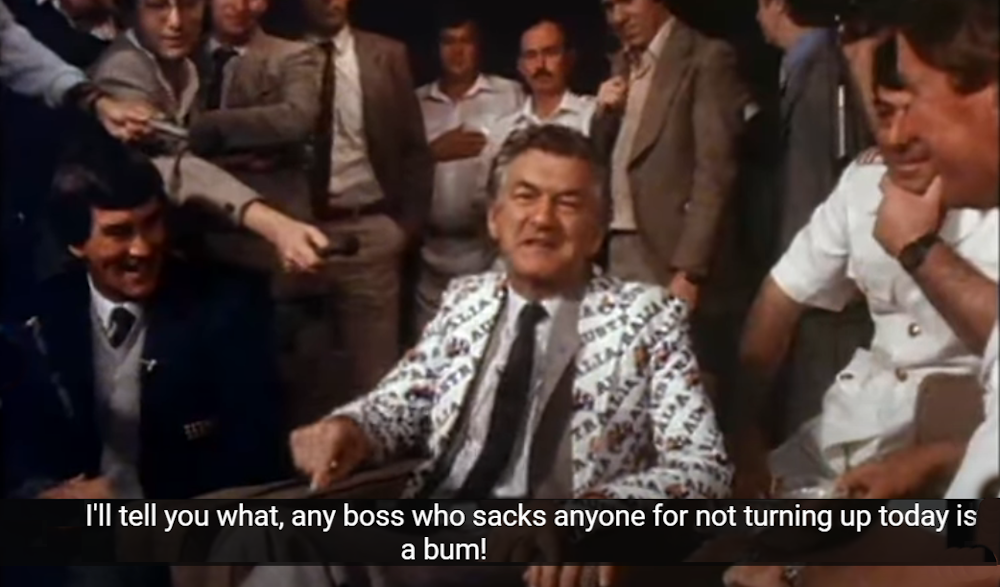
It’s what Prime Minister Bob Hawke was getting at the morning Australia won the America’s Cup in 1983. He famously declared “any boss who sacks anyone for not turning up today is a bum!”. But far fewer people remember what Hawke then added: “You have to work a bit harder the next day to make up.”

Prime Minister Bob Hawke when Australia won the America’s Cup in 1983. ABC

Far more of us are able to work a bit harder to make up than when Hawke made the suggestion. Back then, one in six Australians worked in manufacturing, often on production lines that moved at a constant pace without the ability to catch up. These days it’s just 6%. More of us work at desks.

A back-of-the-envelope estimate of the production that would be lost – quoted as if it is authoritative by Opposition Leader Peter Dutton – is $2 billion.

But while some businesses will produce less, and perhaps sell less, if there’s an extra public holiday, others will sell more (as Minns has pointed out).

And if they have to pay penalty rates to do it, that’s not actually an economic cost. In the language of economists, it’s a transfer from employers and their customers to employees.

A better estimate of public holiday costs

Working out the net effect of an extra public holiday on gross domestic product requires ingenuity, because it’s hard to know what would have happened to GDP without it.

Late last year, two economists from Harvard University and the University of Chile, Rodrigo Wagner and Lucas Rosso, presented a solution.

They took advantage of the fact that, in many countries, certain holidays aren’t moved when they fall on weekends. This means in some years those countries have fewer days off work from holidays than others.

Examining data from more than 200 countries over the two decades leading up to COVID, they determined the net dent to GDP from an extra public holiday was only 20% of the GDP that would have been produced that day.

As they put it, this means “an 80% recovery with respect to the GDP that would have been lost if the effect were exactly proportional”.

An awful lot of us do a bit more work to catch up after a holiday, or are in jobs where that doesn’t matter, or get more business because it is a holiday.

As Wagner and Rosso expected, the effects varied by industry. In manufacturing, only about half of the expected losses were recovered. In agriculture, which continues regardless of holidays, all the expected losses were recovered.

More like $1 billion – with some real benefits

What does their research mean here in Australia?

I did my own back-of-the-envelope calculations, applying Wagner and Rosso’s 200-plus nation results to Australia’s GDP.

The result? It suggests a hit to production of as low as $1 billion from an extra holiday.

It is worth saying again that’s not a $1 billion loss. In return, we would get extra leisure, and a good deal more besides.

Wagner and Rosso also used their data to examine other things. They found that self-reported happiness climbed in the years there were extra holidays, while deaths (mainly from job-related accidents) fell.

Like most of the things we like, holidays do have costs. But they are probably lower than we have thought, and – at least in the case of a Matildas celebration – would be offset by rather nice benefits.The Conversation

This article is republished from The Conversation under a Creative Commons license. Read the original article.

Read more >>

Saturday, August 12, 2023

We can and should keep unemployment below 4%, say top economists

Australia’s leading economists believe Australia can sustain an unemployment rate as low as 3.75% – much lower than the latest Reserve Bank estimate of 4.25% and the Treasury’s latest estimate of 4.5%.

This finding, in an Economic Society of Australia poll of 51 leading economists selected by their peers, comes ahead of next month’s release of a government employment white paper, and an expected direction from Treasurer Jim Chalmers that the Reserve Bank quantify its official employment target.

Asked what unemployment rate was most consistent with “full employment” under present policy settings, the 46 respondents who were prepared to pick a number or range picked an average rate of 3.75%.

The median (middle) response was higher, but still below official estimates – an unemployment rate of 4%.


Significantly, only two of the economists surveyed picked an unemployment rate of 5% or higher, which is where Australia’s unemployment rate has been for most of the past five decades.

The 3.75% average implies either that the Reserve Bank and government have lacked ambition on employment for much of the past half-century, or that the sustainable unemployment rate has fallen.

Australia’s unemployment rate dived to 3.5% in mid-2022 and has remained close to that long-term low since.

The survey result suggests the government can lock in the present historic low and need not – and should not – allow unemployment to climb too far from its present rate.


Many of the experts surveyed questioned the idea of a “magic number” or non-accelerating inflation rate of unemployment (NAIRU) used by the Treasury and the Reserve Bank as a guide to how low unemployment can go without feeding inflation.

Former OECD official Adrian Blundell-Wignall said the concept was not helpful “even in the short run, and certainly not the long run” because NAIRU kept changing depending on what else was going on in the domestic and global economy.

Any rate of unemployment would have a different implication for inflation depending on what the government was doing with tax and spending policy.

Geopolitical events and climate change have probably pushed up the rate of inflation to be expected from any given domestic unemployment rate.

3.5% unemployment, yet falling inflation

Craig Emerson, a former minister in the Rudd and Gillard governments, said NAIRU was best described as the lowest unemployment rate consistent with inflation not taking off. Given Australia’s inflation rate is now coming down, NAIRU is clearly below the present unemployment rate of 3.5%, he argued.

The University of Queensland’s John Quiggin said Australia can be considered to have full employment when the number of job vacancies matches the number of unemployed people. This is the case at present, suggesting “full employment” means an unemployment rate of 3.5%.


Alison Preston from the University of Western Australia said industrial relations changes have given workers much less power to obtain higher wages than before, suggesting the “non-inflation accelerating rate of unemployment” was either lower than before or an irrelevant concept.

Curtin University’s Harry Bloch says there will always be a mismatch between the jobs on offer and the skills available – an academic can’t do the work of a plumber, or vice versa, for instance. But even so, he says it ought to be possible to get unemployment down to the 2% achieved repeatedly during the 1950s and 1960s.

Consulting economist Rana Roy says in normal times “full employment” probably meant an unemployment rate near 1%, but the business cycle meant there would always be brief – “and I stress brief” – periods when governments might have to accept an unemployment rate of nearer 2%.

Fix education, job-matching and childcare

Asked to select the three measures from a list of 11 that would do the most to bring down the sustainable rate of unemployment, the 51 experts overwhelmingly backed improving the quality of school education (55%), followed by improving employment services (39%) and cutting out-of-pocket childcare costs (39%).

There was also strong support for relaxing industrial relations to give employers greater flexibility (33%) and winding back taxes and regulations facing businesses (24%) as well as boosting enrolments in tertiary education (27%).

There was very little support for cutting immigration or the JobSeeker payment.


Labour market specialist Sue Richardson said a high-quality job-matching service would both reduce unemployment and boost productivity because Australians would be matched to jobs for which they were best suited.

The unemployed who would benefit the most would be those further down the queue who were the least successful in finding jobs.

Industry economist Julie Toth said digital technologies and working from home were already making it easier to match Australians with jobs across a range of industries, and it was important to preserve these recent gains.

One of the panellists, Peter Tulip from the Centre for Independent Studies, rejected all the options offered for lowering the achievable unemployment rate, and said the only one that might have some effect was restraint when increasing minimum wages.

Another, Brian Dollery from the University of New England, said much of Australia’s unemployment had been generated by unemployment benefits that were too high.

Together, the results of the survey call for the government and the Reserve Bank to be ambitious about unemployment, and not to accept a rate above 4%.

The government’s employment white paper is due by the end of September.


Individual responses. Click to open:

The Conversation

This article is republished from The Conversation under a Creative Commons license. Read the original article.

Read more >>

Tuesday, August 08, 2023

Beyond Barbie and Oppenheimer, how do cinemas make money? And do we pay too much for movie tickets?

I’ve got two questions about blockbuster movies like Barbie and Oppenheimer.

  1. Why aren’t the cinemas charging more for them, given they’re so popular?

  2. Why are they the same price, given Oppenheimer is an hour longer?

The opening weekend for both films saw an avalanche of Australians returning to the cinema. Extra staff had to be put on (although probably not enough) to manage queues, turn away pink-clad fans who couldn’t get in, and clean up mountains of popcorn trampled underfoot.

An obvious solution to such a rush of demand is to push up prices. Airlines do it when they are getting low on seats. When more people want to get a ride share, Uber makes them pay with “surge pricing”.

Even books are sold at different prices, depending on the demand, their length, their quality and how long they’ve been on the shelves.

But not movie tickets, which are nearly always the same price, no matter the movie. Why? And how much has the cost of a trip to the movies risen over the past 20 years?

Why not charge more for blockbusters?

In suburban Melbourne, Hoyts is charging $24.50 for the two-hour Barbie – the same as it is charging for the three-hour Oppenheimer, even though it could fit in far fewer showings of Oppenheimer in a day. It’s also the same price as it is charging for much less popular movies, such as Indiana Jones and the Dial of Destiny.

It’s also how things are in the United States, where James Surowiecki, author of The Wisdom of Crowds blames convention and says

it costs you as much to see a total dog that’s limping its way through its last week of release as it does to see a hugely popular film on opening night.

Australian economists Nicolas de Roos of The University of Sydney and Jordi McKenzie of Macquarie University quote Surowiecki in their 2014 study of whether cinema operators could make more by cutting the price of older and less popular films and raising the price of blockbusters.

By examining what happened to demand on cheap Tuesdays, and developing a model taking into account advertising, reviews and the weather, they discovered Australian cinemas could make a lot more by varying their prices by the movie shown. We turn out to be highly price sensitive. So why don’t cinemas do that?

‘There’s a queue, it must be good’

It’s the sort of thing that puzzled Gary Becker, an economic detective of sorts who won the Nobel Prize for Economics in the early 1990s. A few years earlier, he turned his attention to restaurants and why one particular seafood restaurant in Palo Alto, California, had long queues every night but didn’t raise its prices.

Across the road was a restaurant that charged slightly more, sold food that was about as good, and was mostly empty.

His conclusion, which he used a lot of maths to illustrate, was there are some goods for which a consumer’s demand depends on the demand of other consumers.

Queues for restaurants (or in 2023, long queues and sold out sessions, as crowds were turned away from Barbie) are all signals other consumers want to get in.

This would make queues especially valuable to the providers of such goods, even if the queues meant they didn’t get as much as they could from the customers who got in. The “buzz” such queues create produces a supply of future customers persuaded that what was on offer must be worth trying.

Importantly, Becker’s maths showed that getting things right was fragile. It was much easier for a restaurant to go from being “in” to “out” than the other way around. Once a queue had created a buzz, it was wise not to mess with it.

Cashing in from the snack bar

There are other reasons for cinemas to charge a standard ticket price, rather than vary it movie by movie.

One is that it is hard to tell ahead of time which movies are going to soar and which are going to bomb, even if you spend a fortune on advertising as the makers of Barbie did. In the words of an insider, “nobody knows anything.”

Another is the way cinemas make their money. They have to pay the distributor a share of what they get from ticket sales (typically 35-40%). But they don’t have to pay a share of what they make from high-margin snacks.

This means it can make sense for some cinemas to charge less than what the market will bear – because they’ll sell more snacks – even if it means less money for the distributor.

Rising prices, despite some falling costs

But cinemas still charge a lot. From 2002 to 2022, Australian cinemas jacked up their average (not their highest) prices from $9.13 to $16.26 – an increase of 78%.

In the same 20 year period, overall prices in Australia, as measured by the consumer price index, climbed 65% – less than the rise in movie ticket prices.


A 2015 study found Australian cinemas charge more than cinemas in the US.

Yet some of the cinemas’ costs have gone down. They used to have to employ projectionists to lace up and change reels of film. Digital delivery means much less handling.

A now-dated 1990s report to the Australian Competition and Consumer Commission found the two majors, Hoyts and Greater Union/Village, charged near identical prices except where they were faced with competition from a nearby independent, in which case they discounted.

Whether “by design or circumstance”, the two cinema chains rarely competed with each other, clustering their multiplexes in different geographical locations.

Longer films no longer displace shorter films

I think it might be the multiplex that answers my second question: why cinemas don’t charge more for movies that are longer (and movies are getting longer).

In the days of single screens, a cinema that showed a long movie might only fit in (say) four showings a day instead of six. So it would lose out unless it charged more.

But these days, multiplexes show many, many films on many screens, some of them simultaneously, meaning long films needn’t displace short films.

Although we have fewer cinema seats than we had a decade ago (and at least until the advent of Barbie, we’ve been going less often) we now have far more screens.

Long movies no longer stop the multiplexes from playing standard ones. And because cinemas like to keep things simple, you pay the same price, no matter which movie you chose. The Conversation

This article is republished from The Conversation under a Creative Commons license. Read the original article.

Read more >>

Tuesday, August 01, 2023

Australia is about to set its first full employment target – and it will define people’s lives for decades

Stand by for one of the most important decisions Treasurer Jim Chalmers and the Albanese government will make.

That decision is to commit future governments and the Reserve Bank to full employment, and, more importantly, spell out what that means.

The Australian government hasn’t wholeheartedly and publicly committed itself to full employment since the 1945 Full Employment White Paper, released as the second world war was drawing to a close and Australia was gearing up for peace.

The definition Chalmers chooses – whether it specifies an unemployment rate of 3.5%, 4.5%, or the more ambitious target of 3% I would most like – could reverberate for as many decades as the white paper did in 1945.

Tuesday’s Reserve Bank decision not to increase interest rates further makes it more likely we could end up with a more ambitious target.

Australia’s daunting post-war challenge

The 1945 white paper was prepared for Prime Minister John Curtin by a committee led by the head of post-war reconstruction HC “Nugget” Coombs.

In the 20 years leading up to the war, more than 10% of workforce had been out of work, climbing to 25% during the depression. The committee wanted the all-out mobilisation necessitated by war to be continued into the peace.

Their challenge was to find jobs for the 1 million defence staff who would be returning to civilian life.

Achieving that would require governments to actively stimulate private spending, through their own spending and through monetary and other policies “to the extent necessary to avoid unemployment and the consequent waste of resources”.

That was an idea accepted by both Labor and Coalition governments right through to the 1970s, where unemployment remained as low as 2%. It was also one Coombs himself adopted as the first head of the Reserve Bank of Australia from 1960.

But the employment target Coombs helped write in to the Reserve Bank Act was fuzzy: it simply committed the bank to “the maintenance of full employment in Australia”.

Finally setting a jobs target

Fast forward to March 2023, when the treasurer was handed the review of the Reserve Bank, An RBA fit for the future.

That final report pointed out the bank’s target for inflation is specific – defined in a written agreement with the treasurer as “2-3% on average, over time”.

In contrast, the bank’s target for employment has no numbers attached – resulting in inflation getting prioritised.

While it is true that putting a number on a target doesn’t guarantee an outcome, the number put on the inflation target does seem to have helped bring it down.

The RBA review recommended the treasurer’s agreement with the bank be updated, requiring it to adopt an explicit target for “full employment”. That would most likely be expressed via a range of indicators, including the unemployment rate, the underemployment rate, and the tenure of employment.

Chalmers says he will update the agreement and issue the direction by the end of the year. Before then, next month he will make public his own target for full employment via his employment white paper, now being prepared by the treasury.

Moving unofficial targets of the past

The numbers that the treasurer and the Reserve Bank adopt will matter enormously. And it’s worth clarifying that the target can’t be an unemployment rate of zero.

There will always be some temporary unemployment as people move between jobs. That’s also the case when people leave industries that are no longer needed – such as thermal coal mining in the years ahead, as our energy mix changes – and go on to retrain for jobs in emerging industries.

For a while in the 1990s, the Reserve Bank acted as if full employment meant an unemployment rate of 7%. That was its estimate of the “non-accelerating inflation rate of unemployment” (also known as NAIRU), the rate needed to stop shortages of useful workers pushing up inflation.

In 2017, the bank cut that estimate to 5% and then 4.5% in 2019. Then, about a year after COVID hit, it appeared to cut it further when Governor Philip Lowe said in 2021 there was a chance Australia could achieve and sustain an unemployment rate in the “low fours”, although only time would tell.


The lower our target, the more secure we will be

The unemployment rate is now 3.5% – a near five-decade low.

If the government and the bank choose to adopt 3.5% as a target, it would put 150,000 more Australians into work than would a higher unambitious target of 4.5% – in perpetuity.

A lower target of 3% (not too far above the 2% Australia achieved from 1940 to 1974) would do much more than put people into jobs and better use our resources.

It would also help us adapt to change in the way we are going to need to.

Creating confidence to face change

The 1945 white paper was on to this, at another time of massive transition when the wartime industries were dying and the peacetime industries emerging.

It said an assurance of full employment would

assure workers that the community has need of their services somewhere, and will restore the basic sense of security without which new risks will not readily be undertaken.

It’s a point echoed by Prime Minister Bob Hawke’s former economic advisor, Ross Garnaut, in an address to the Australian Conference of Economists last month.

He said unless there was confidence in high employment, every time an industry or employer was threatened with closure, there would be a cry of “jobs, jobs, jobs” as workers fought to protect what they had.

Garnaut told me it was a lesson he learned from Hawke when he signed on with the prime minister in 1983. Hawke agreed with him that the economy would have to change and some industries would have to die. But Hawke told him he wasn’t going to bring on those changes until unemployment was clearly coming down.

When people knew they could get another job, they would accept change.

Now, as in the 1940s and 1980s, we need that confidence. If Chalmers and the Reserve Bank adopt an ambitious target, they’ll create it and set us up for the challenges ahead.The Conversation

This article is republished from The Conversation under a Creative Commons license. Read the original article.

Read more >>

Tuesday, July 25, 2023

Behavioural ‘experts’ quietly shaped robodebt’s most devilish details – and their work in government continues

One of the things still worrying me about robodebt was the attention to detail.

By that, I am not referring to the crude system by which hundreds of thousands of Australians on benefits received letters between 2016 and 2019, wrongly demanding they repay Centrelink money they did not owe.

I am referring to the care with which the robodebt letters were designed – and the so-called science behind those devastating design decisions.

‘Nudging’ people to pay at all costs

What Centrelink wanted was for the recipients to quietly pay up, or go online and provide years of payslips they probably didn’t have, rather than jam up its switchboards asking questions.

The robodebt royal commission heard that details as specific as the colours of the letters were decided on after receiving advice from “experts in behavioural science”. (In the end, Centrelink went with black and white.)

An email about redeveloping debt letters using ‘behavioural insights’. Robodebt royal commission

So it made what Royal Commissioner Catherine Holmes found was a “conscious decision” not to include a phone number recipients could use to find out more.

That’s right, the letter didn’t include a phone number – a decision Holmes found was made “with the intention of forcing recipients to respond online”.

Where did the idea come from?

Holmes found it came from “behavioural insights”.

The human toll of powerlessness

People left with nowhere to turn and without ready access to, or familiarity with, using the internet felt powerless.

Witnesses told Holmes they wanted to end their lives. Holmes devotes an entire chapter to those who did.

Holmes found that while “behavioural insights” were sought, “no outside parties with an interest in welfare were consulted in order to understand how the scheme might actually affect people”.

Holmes wrote:

The effect on a largely disadvantaged, vulnerable population of suddenly making demands on them for payment of debts, often in the thousands of dollars, seems not to have been the subject of any behavioural insight at all.

And that’s the problem with the relatively new technocratic-sounding science of behavioural economics.

‘Choice architects’ shaping policy

That Centrelink used specialists in behavioural science ought not be surprising.

A year before robodebt began, the then prime minister Malcolm Turnbull set up what he called a Behavioural Economics Team Australia (BETA) unit in his department. It was modelled on the so-called “nudge units” set up by former US president Barack Obama and former UK prime minister David Cameron.

A “nudge” is a change destined to get someone to do something, sometimes also known by the Orwellian-sounding name “choice architecture”.

Cass Sunstein helped invent both those terms, coauthored the book Nudge, and headed Obama’s Nudge Unit. In 2015, Sunstein launched Turnbull’s unit.

I was a fan of behavioural economics, back when Turnbull set up his nudge unit.

Now, after robodebt, I’m starting to suspect much of it is no science at all.

Hollow science

A real science examines not only cause and effect, but also develops a theory of the mechanism by which that effect takes place. That’s another way of saying a real science examines more than correlations.

Psychology is one such real science; economics is (usually) another.

But the more I’ve looked at it, the more often behavioural economics seems hollow: not concerning itself enough with what needs to happen for results to be achieved.

The Behavioural Economics Team Australia is still active in the prime minister’s office. Its website is full of dozens of projects that look useful: how to lift organ donation rates, how to make energy bills easier to understand, how to get people to take part in the census.

Yet – and I am aware of the irony – even the best-known choice architects have sometimes lacked insight into their own work.

One of the most famous findings in behavioural economics, in a 2012 paper, was that people who signed an honesty declaration at the beginning of a form rather than the end were less likely to lie.

Two years ago the paper was retracted amid allegations the data was false.

Blind to empathy

So widespread are behavioural economics “findings” that cannot be replicated, the prime minister’s BETA unit has done a podcast on that “replication crisis”.

And now, under the Albanese government, there’s another unit. This one is being set up in Treasury under the eye of Competition Minister Andrew Leigh and will be called the Australian Centre for Evaluation (ACE).

Its brief, a bit like BETA, will be to find out what works.

But if it only does that, without examining how it works, it risks being as blind to the potential costs on real people as the “behavioural insights” that shaped the robodebt letters.The Conversation

This article is republished from The Conversation under a Creative Commons license. Read the original article.

Read more >>

Tuesday, July 18, 2023

Australia is on the brink of ending interest rate hikes and an economic first – beating inflation without a recession

What if Reserve Bank Governor Philip Lowe and his successor Michele Bullock were able to achieve something truly remarkable – a steady decline in inflation without further interest rate increases, and without bringing on a recession.

It’s suddenly looking possible. Inflation is now coming down so quickly worldwide there’s probably no need to push it down further.

We couldn’t have said that a week ago. Then, the US inflation rate was 4%, well down on the peak of 9.1% a year earlier, but high enough for eminent economists such as former US Treasury Secretary Larry Summers to say the US would need a mountain of unemployment to bring it down further.

Specifically, Summers said that to control inflation the US would need

five years of unemployment above 5% to contain inflation – in other words, we need two years of 7.5% unemployment, or five years of 6% unemployment, or one year of 10% unemployment

That was in late June, when US inflation had slipped from 5% to 4.9% to 4% over three months. Then, it was at least arguable that it wouldn’t fall much further without another push.

No longer. Last week, we learned that US inflation plunged yet again to 3% in June. Although our result for June isn’t out yet (it’s next week) it is now no longer easy to argue that progress isn’t real and continuing.

This graph of the latest monthly readings of annual inflation rates shows inflation peaked in the US, the UK, Canada and Australia late last year, and has been coming down fairly steadily since.


Summers and others in the US used to deride those who said ultra-high inflation would go away as “team transitory”. But it is now looking as if that high inflation was indeed transitory, even if the transition took longer than expected.

Driving down inflation has been one of the key forces that drove it up: energy and transport prices, which surged in the wake of Russia’s February 2022 invasion of Ukraine.

US energy prices have fallen 16.7% over the past year, led down by a 26.5% slide in the price of what Australians call petrol. That’s a saving that will push down Australia’s inflation rate and inflation rates worldwide.

Non-energy and non-food inflation fell as well, suggesting that there isn’t (yet) a psychology of expectations holding US inflation up.

Falling inflation expectations

Here, Australians expect falling inflation, if their answers to the Melbourne Insitute’s monthly expectations survey are to be believed. In June, those surveyed expected inflation of 5.2% in the year ahead, down from 6.3% a year earlier.

This makes Australians less likely than they were to bake high inflation into wage negotiations and other decisions, making it less likely inflation will remain high.

And it ought to be noted that the inflation Australians say they expect has traditionally been much more than what’s been delivered. That’s presumably because most of us notice the prices that are going up more than those that aren’t.

A soft landing, without a recession

The much quicker than expected collapse in US inflation has dramatically raised the likelihood of what’s called a “soft landing” in the US. Here in Australia, it’s what our current Reserve Bank Governor has called staying on the “narrow path” of returning inflation to target in a reasonable timeframe, without a recession.

If that happens, finance journalist Alan Kohler says Lowe and his successor Michele Bullock (who takes over in September) will be the first team at the top of the bank to get inflation down from above 7% without delivering a recession.

There was a recession when the bank tried to get inflation down below 7% in the mid-1970s, in the early 1980s, and in the early 1990s.


That we might be able to pull off yet another first ought no longer to surprise us, after all of the firsts during COVID. Enduring Australia’s (brief) 2020 recession without unemployment climbing above 7% was also a first.

The minutes of the Reserve Bank’s June board meeting released on Tuesday show it is prepared to countenance such a first.

The bank’s board members acknowledged that inflation was “now declining, albeit from a high level”, while falling commodity and shipping prices were cutting cost pressures. All this before the full effect of the bank’s 12 rate rises to date has been felt.

Remember, these are minutes of a meeting that took place before last week’s extraordinarily good news from the US. Those board members’ comments hold open the possibility of Australia keeping the bulk of its gains in employment, while getting inflation back down to controllable levels.

The fact that it has never happened before hasn’t stopped the economics team at the ANZ Bank from predicting it – no further rate rises from here on, a continuing slide in inflation, and only a modest uptrend in unemployment.

A ‘Goldilocks’ economy is in sight

The “Goldilocks” outcome – not too hot or too cold, but just right – would be keeping in work most of the Australians who got into work when unemployment fell and getting on top of inflation. If we can manage that, we will have done future Australians an enormous service.

Things get easier when unemployment is low. We get more likely to become more productive, because we’re less resistant to change when unemployment is less of a threat. We get in a better position to help the budget, by taking less in benefits and paying more in tax. And we become more like each other – lessening inequality.

It is looking as if the Reserve Bank has the opportunity to cement low unemployment while controlling inflation. Holding off (and perhaps abandoning) future rate raises will keep it in reach.

Our next official inflation update, due out next Wednesday, will matter a lot.The Conversation

This article is republished from The Conversation under a Creative Commons license. Read the original article.

Read more >>

Tuesday, July 04, 2023

The RBA has kept interest rates on hold. It’ll be cautious from here on

The Reserve Bank decided to keep interest rates on hold at 4.1% because it thinks there’s a chance – just a chance – it has lifted them all it needs to.

In his statement released after Tuesday’s board meeting, Governor Philip Lowe said while inflation was still too high and set to remain so for some time yet, it had “passed its peak”.

Growth in the Australian economy had slowed and labour market conditions had eased, although they remained tight.

After 12 near-consecutive rate hikes, and in light of the “uncertainty surrounding the economic outlook”, it had decided to wait at least a month before hiking again until it knew more about the impact of what it has done on inflation and the health of the economy.

And when you compare Australians’ experience of rising rates with other countries, the Reserve Bank has already done more than many people realise.

Rising rates have hit Australian borrowers harder

Criticism of Australia’s Reserve Bank for not pushing up its cash rate as far as other countries overlooks an important difference between Australian borrowers and borrowers in those countries.

Canada has lifted its central bank rate from close to zero to 4.75%, Britain to 5%, the US to just above 5% and New Zealand to 5.5%.

Yet Australia’s increase – from close to zero to 4.1% – has caused Australian borrowers much, much more pain than borrowers in those other countries.

That’s because an exceptionally large proportion of Australian mortgage holders are on variable rates: roughly 70%. That’s compared to 35% in Canada, 15% in the UK, 12% in New Zealand and less than 5% in the United States.

In the words of Australia’s Reserve Bank: “interest rates on loans with very long fixed-rate terms tend to be less sensitive to changes in the short-term rates”.

Back in February, the Reserve Bank’s estimate was that the interest rates actually paid on Australian mortgages had climbed two percentage points since it began pushing up rates.

In contrast – as this Reserve Bank chart shows – the rates actually paid in New Zealand had climbed by one and half percentage points, the rates in the UK by just half a percentage point, and the rates in the United States by very little at all.


Increases in mortgage rates actually paid

Months since the official rate began climbing. 100 = one percentage point

RBA, APRA

And because mortgages themselves are so much bigger than they used to be, the dramatic increase in rates actually paid costs a lot more than it would have.

Modelling by Ben Phillips at the ANU’s Centre for Social Research and Methods suggests that in the past two years, the average share of mortgaged households’ post-tax income devoted to payments has jumped from 17% to 25% – the biggest share in an awfully long time.

And it’s set to get worse, whatever the bank does to its cash rate.

The looming mortgage cliff

Usually, Australians take out very few fixed-rate mortgages. But in 2020 and 2021, we took out lots with fixed two- and three-year rates, when fixed rates were low.

As many as 880,000 of those fixed-rate terms are about to expire, pushing those borrowers from rates of around 2% (which might cost $2,100 per month to service) to rates nearer 5.5% (which might cost $3,000 to service).

The Reserve Bank itself expects 15% of borrowers to find themselves with negative cash flows in the coming months – meaning their incomings won’t match their outgoings and they’ll have to run down savings, work more hours, or tighten belts.

We’re already winding back spending. Although total retail spending has climbed 4.2% over the past year, prices have probably climbed 7% while the population has climbed 2%. This means the amount bought per person has shrunk sharply.

Recession is increasingly likely

Anything that makes us cut back even more runs the risk of bringing on a recession, something that’s already happened in New Zealand and may be about to happen in the United Kingdom.

At the start of this week, The Conversation’s expert forecasting panel assigned a 38% probability to a recession in Australia, much more than at the start of the year, but still less than 50% – meaning we might escape it.

The panel’s central forecast is for two more rate hikes this year, which it expects to be quickly unwound. If that happens, and if we escape a recession, the panel expects unemployment to climb only modestly over the year ahead while inflation glides down to 3.9% – within spitting distance of the Reserve Bank’s 2-3% target.

Lowe says getting things right means staying on a narrow path.

The case for living with higher inflation

That path might mean accepting a slower glide down in inflation than some would like, or even a higher end point – something closer to 3% than 2-3%.

Nobel prize-winning economist Paul Krugman this week suggested quietly abandoning the US inflation target (of 2%) once inflation dropped to a point where people no longer noticed it all the time, which he thought would be about 3-4%.

There would be a case for doing that here, so long as inflation was stable, predictable and no longer causing alarm. It’d help keep unemployment low.

In any event, we’re nowhere near there yet. The March quarter inflation figure (the most recent quarterly figure) put the annual rate at 7%. The update due in three weeks will show how quickly we are moving toward 4%.

When we get there, Lowe or his successor (Lowe’s term expires in September) will have time to think about how important ultra-low inflation of 2-3% really is, and whether it is worth the cost to Australians of getting there.The Conversation

This article is republished from The Conversation under a Creative Commons license. Read the original article.

Read more >>

Sunday, July 02, 2023

Two more RBA rate hikes, tumbling inflation, and a high chance of recession: how our forecasting panel sees =2023-24

Of the 27 leading economists assembled by The Conversation to forecast the financial year that’s just begun, every one expects inflation to continue to fall.

The official quarterly measure of inflation peaked at 7.8% in the year to December and is now 7%, and the newer monthly measure peaked at 8.4% and is now 5.6%.

What’s at issue is how quickly inflation will continue to fall, how many more times the Reserve Bank will push up interest rates to make sure it falls as quickly as it wants, and the damage those rate hikes will do to an already very weak economy.

Twelve of the 27 think a recession is either more likely than not, or an even chance. And almost all expect a “per-capita recession”, in which economic growth fails to keep pace with population growth, sending living standards backwards.

Now in its fifth year, The Conversation survey draws on the expertise of leading forecasters in 25 Australian universities, think tanks and financial institutions – among them economic modellers, former Treasury, International Monetary Fund and Reserve Bank officials, and a former member of the Reserve Bank board.

Two more interest rate hikes this year

After 12 interest rate hikes that lifted the Reserve Bank’s cash rate from 0.1% to 4.1% in a little over a year, the panel expects two more.

The panel predicts a cash rate of 4.5% by the end of this year, followed by a decline to 4.3% by the middle of next year, and to 3.9% by the end of 2024.


Asked to specify the month in which the cash rate will peak, and how high it will go, the panel settled on a peak of 4.7% in November.

A cash rate of 4.7% would lift the typical rate on a new mortgage from 5.4% to 6%, adding a further $200 per month to the cost of servicing a $600,000 loan.


But the extra pain would be short-lived. Asked how long the cash rate would stay at its peak before being cut, the panel’s average guess was six months, meaning rates would begin to fall in June next year.

Several of those surveyed warned against expecting rates ever to fall back to anything like the emergency lows of 2020 and 2021. Others noted that the one thing that could force the Reserve Bank to cut rates faster than expected was a recession.

Plummeting inflation, an uptick in real wages

The panel expects inflation to slide from 7% to 5.2% by the end of the year, then to 3.9% by mid-2024, and to 2.9% a year later – putting it back within the Reserve Bank’s 2-3% target band.

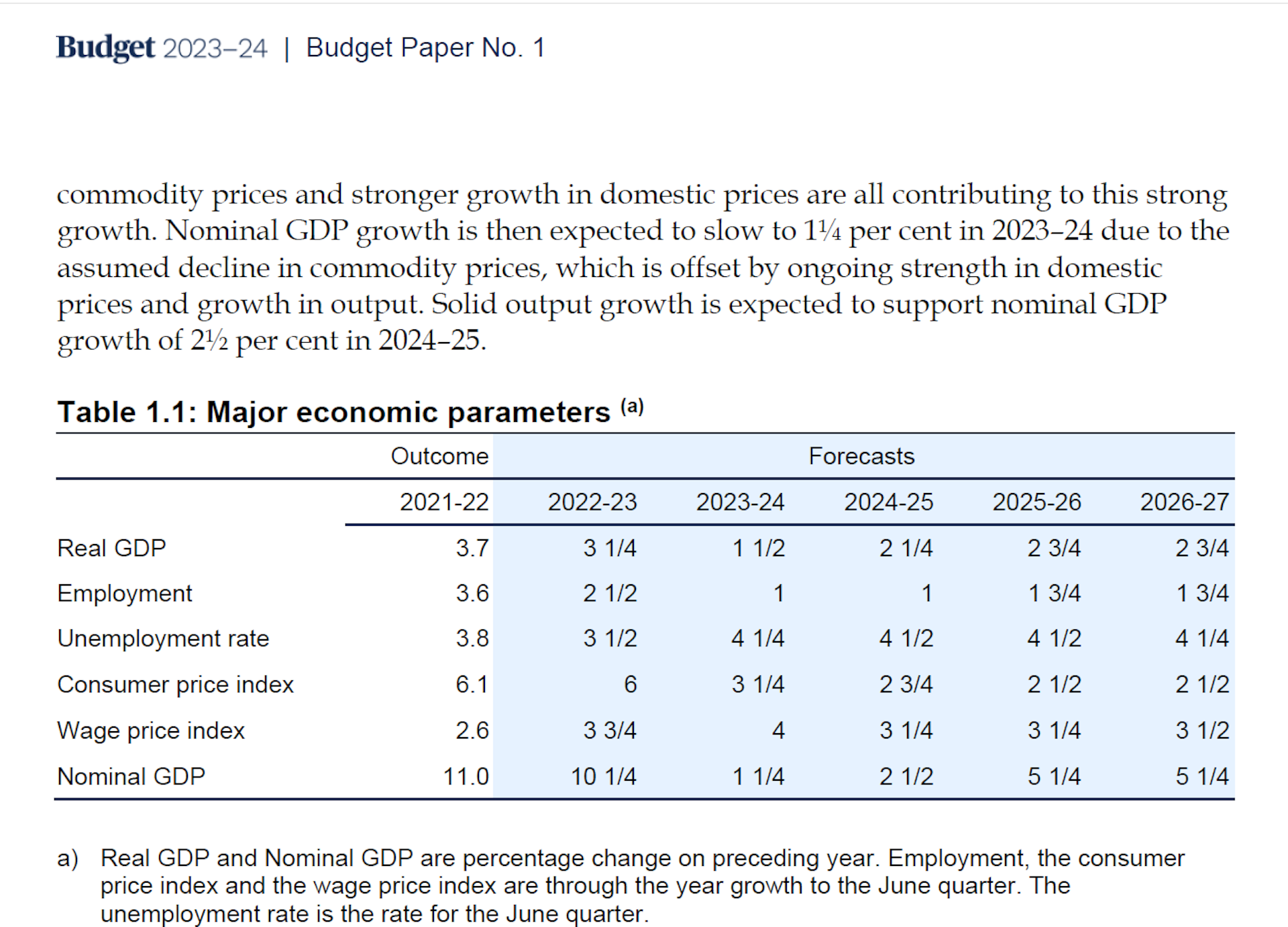
Although steep, the fall in inflation isn’t as fast as predicted by the bank itself (3.6% by mid-2024) or the Treasury (3.25% by mid-2024).


Barrenjoey Chief Economist Jo Masters said while price pressure from imported goods and fuel was easing, inflation was increasingly being driven by the prices of services such as rents that tended to be persistent.

Margaret McKenzie of Federation University identified the reopening of borders as a source of downward pressure on prices, saying it would ease labour shortages.

Moody’s Analytics’ Harry Murphy Cruise said although weaker spending was putting downward pressure on inflation, the Reserve Bank seemed unwilling to let that take its course and wanted to slow inflation more quickly, risking “knocking the wind out” of an already fragile economy.

A welcome upside of much lower inflation forecasts is a forecast of the first increase in real wages in three years, albeit a small one.

The panel expects wages growth of 4% in the financial year ahead, just beating price growth of 3.9%. The resulting 0.1% increase in the so-called real wage would be followed by a more substantial increase of 0.7% in 2024-25 as wages growth of 3.6% topped price growth of 2.9%.


A per-capita (if not an actual) recession

New Zealand is already in a recession, and the panel assigns probabilities of 59% and 42% to the prospect of recessions in the United Kingdom and United States respectively, with the most likely start for both being the final three months of this year.

Throughout 2023, the panel expects economic growth of just 1.2% in the US and historically weak growth of 4.9% in China, suggesting Australia’s biggest customer for minerals will be unable to provide much help as Australia’s own economic growth dwindles.

The panel is forecasting Australian economic growth of just 1.2% in 2023 – the lowest rate outside a recession in more than 30 years, climbing to just 1.5% in the year to June 2024 and 2.3% in the year to June 2025.


AMP Chief Economist Shane Oliver said if the low growth rate turns into what is usually called a recession (two consecutive quarters of shrinking gross domestic product) it will be because the Reserve Bank pushes up interest rates too far for highly indebted Australians to withstand.

He said consumer spending is almost certain to shrink as debt servicing costs hit a record high and, on the Bank’s own analysis, 15% of households with a variable-rate mortgage – roughly a million people – experience negative cash flow.

Asked to estimate the chance of the Australian economy going into recession in the next two years, the panel’s average answer was 38%, well up from the 26% the panel assigned to a recession in February’s survey.

KPMG Chief Economist Brendan Rynne assigned a 100% probability to what he called a “shallow, extended recession”, in which growth is first weighed down by a downturn in housing investment, followed by a slowdown in business investment.

The average forecast start date of a recession, should there be one, is the final three months of this year.


The panel’s economic growth forecast of 1.5% for 2023-24 is well below the Treasury’s forecast of population growth of 2%, suggesting output per person will shrink in what is called a per-capita recession.

Unemployment climbing, albeit slowly

The panel expects a gradual increase in the unemployment rate from its present near-50-year low of 3.6% to 4.3% by mid-next year, followed by an increase to 4.6% by mid-2025.

The forecasts are in line with those of the Treasury and Reserve Bank, and suggest Australia is unlikely to surrender the big gains in employment made in the aftermath of the COVID lockdowns and return to the pre-COVID unemployment rate of 5%.

University of Tasmania economist Mala Raghavan said while job markets would become less tight as the economy weakened and as foreign students and migrants returned, the impact would be felt first in the underemployment rate, which reflects the extent to which workers are working fewer hours than they want.


Less household buying, higher house prices

The panel expects growth in real household spending of just 1.5% in 2023-24, meaning the amount bought per household is likely to shrink.

Yet at the same time, it is forecasting continued modest growth in home prices, which climbed for the fourth month in a row in June after falling since mid-2022.

Most of the panel expects further growth in Sydney and Melbourne home prices in the 12 months ahead, with only four panel members predicting declines. The average forecast is for both Sydney and Melbourne prices to climb a further 2%.

Former Productivity Commission economist Jenny Gordon identified renewed migration as a driver of demand, offset by declining real wages and the risk of a recession.

Jo Masters said sellers appeared to be withdrawing supply, with total listings a third lower than normal, while the buyers appeared to have higher incomes than before and lower debt-to-income ratios, meaning they were less troubled by high interest rates.


Tiny share market growth, tiny budget deficit

The panel expects the budget surplus for the financial year just ended to be followed by only a tiny budget deficit of A$9.4 billion in 2023-24, which would be less than 0.4% of GDP.

Two panellists, Mariano Kulish and Stephen Anthony, expect this year’s surplus to be followed by another one of $18 billion to 20 billion. Anther, Jenny Gordon, expects this year’s surplus to be followed by a budget in balance.

The forecasts reflect an iron ore price expected to stay near US$104 per tonne at the end of the year, instead of falling towards US$60 as forecast in the budget.

The panel expects modest share market growth of 3% in the year to June 2024, with the results sensitive to home prices (through the profits of financial corporations) and minerals prices (through the profits of mining companies).


The Conversation’s Economic Panel

Click on economist to see full profile.

Download the results on one pageThe Conversation

This article is republished from The Conversation under a Creative Commons license. Read the original article.

Read more >>

Tuesday, June 20, 2023

Cash could be almost gone in Australia in a decade – but like cheques, who’ll miss it?

Late last year, the Reserve Bank gave 1,000 Australians diaries and asked them to record every payment they made over the course of a week. Of the 13,000 payments, only 17 were with cheques.

It’s been an astounding collapse. Back in 1980 at the start of the credit card era, 85% of non-cash payments were made with cheques. Today it’s less than 0.1%.

Earlier this month, the government announced it was following New Zealand, Denmark, the Netherlands and others, closing our cheque system down by 2030.

Meanwhile, New Zealand is already on to the next thing. Having phased out cheques, it’s now looking at winding down the use of cash.

So how close is Australia now to becoming a cash-free nation?

The hidden costs of cheques and cash

Cheques are horrendously expensive to process. The average cost of everything that had to happen to process a cheque exceeds $5 per payment, mostly borne by banks.

But cash is expensive in its own way. The average cost of creating, sorting and trucking all those sheets of plastic and coins exceeds 50 cents per payment, mostly passed on to banks and retailers, and it is soaring as the number of payments plummets.

As recently as 2007, the vast bulk of consumer payments – 69% – were in cash. By 2019 only 27% were in cash. By 2022, after two years of COVID, it was only 13%.

At this rate, it’s hard to be certain how long cash will last.

What made cheques so slow and costly

For those who’ve never had to write one, cheques are bank-issued pieces of paper on which the owner writes the name of the person they want the bank to pay and the amount. They they hand it to that person, who then hands it to their bank, which then tries to get the money from the payer’s bank.

Behind the scenes, until recently when the electronic transmission of digital images changed things, each bank would collect all the cheques that had been presented to its branches each day and sort them into bags, one for each originating bank.

Then, late at night, its “bag man” would travel to a nondescript city location with a bag for each bank, hand the correct one to each of the other bagmen, and be given bags in return, which the bagman would take back to the bank for signature checking.

When each bank worked out what it owed the other bank, they would usually discover the flows largely cancelled each other out, and then make net payments which would be reflected in the cheque-writer’s account, up to five business days later.

Always expensive, the cost per cheque grew and grew as the number of Australians paying with cheques dwindled to a fraction of what it had been.

How moving cash became a loss-making business

It’s the same sort of story with cash. Although we don’t often think about it, cash costs an awful lot to move, sort and restock.

Printing the notes still makes money – it costs about 32 cents to make each note, whether it’s worth $5 or $100, although making some coins now loses money.

The real expense is in moving notes and coins around, keeping them nearby and restocking banks and cash registers. Aside from payments the Reserve Bank makes to banks for returning damaged notes, the banks (and, through them, the retailers) are expected to pay for the lot.

Until recently that gave the two firms that dominate the business (Linfox Armaguard, and Prosegur, which owns Chubb Security) a pretty good deal.

Except that the volume of cash they’ve carried has dived 47% over the past ten years, 30% of it during COVID.

Both firms say their money-moving arms are incurring “heavy financial losses” and that if they increase their prices much more, retailers might move even further away from cash, pushing their costs even higher.

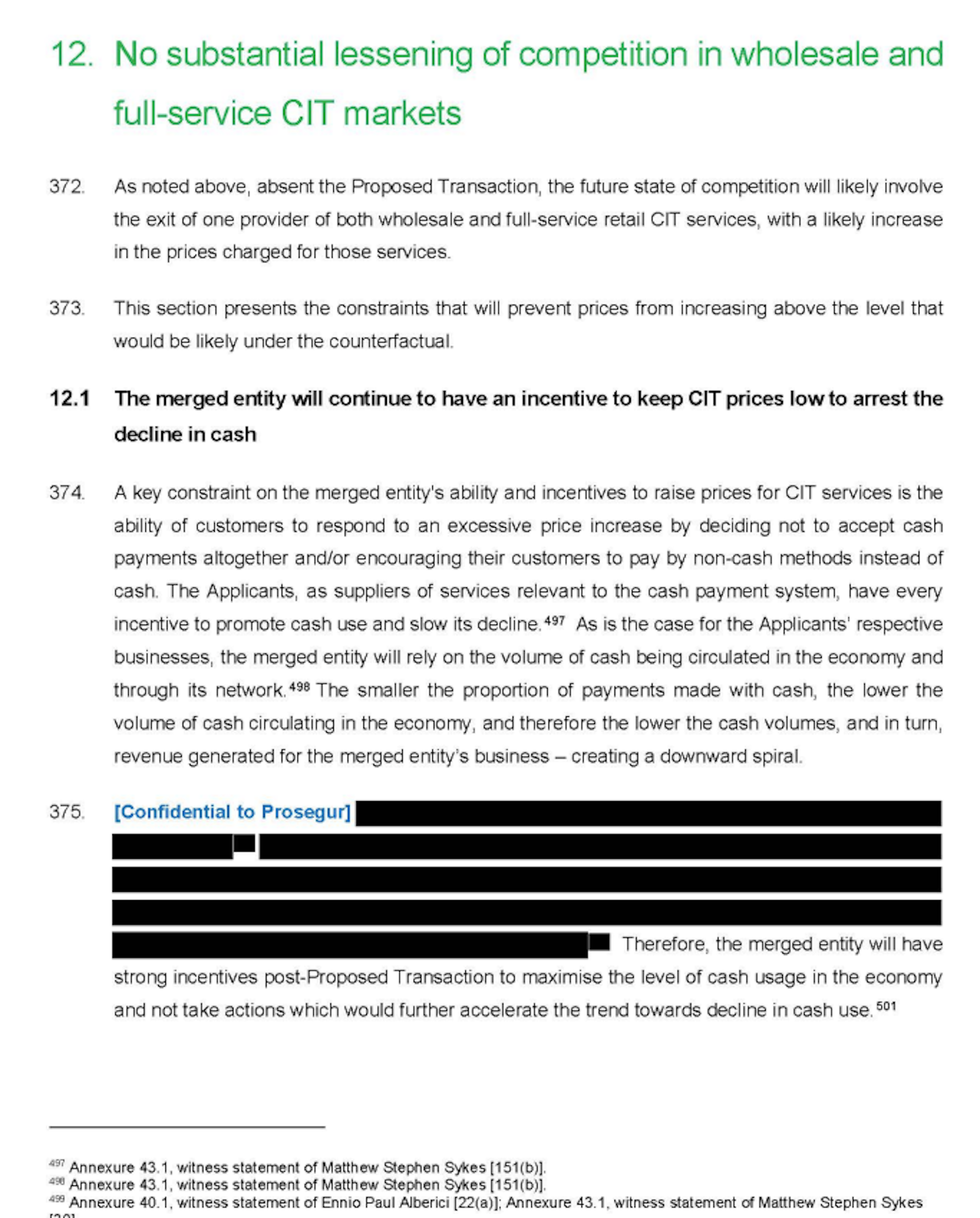
Last week, the Competition and Consumer Commission allowed them to merge on the condition that they limit their price increases to the consumer index plus 7.5% per year. That increase is so steep as to suggest a death spiral: the more they charge, the less retailers will use cash, the more they’ll have to charge.

The only way out, unless they can make really big efficiencies, or unless the decline in the use of cash stops, would be for the government to return to subsidising the use of cash. It’s hard to see how it could make the case to do that when there are cheaper emerging technologies.

Bank transfers cost a mere fraction of using cash, and pretty soon we’ll be able to use them for everything, via things such as QR codes.

So when will cash go the way of cheques?

A previous federal government has already tried to eliminate the use of cash for transactions worth more than $10,000, as part of its attack on the black economy.

Announced in 2016 by the Turnbull Coalition government, the ban was due to come into force in 2019. But, after delays, in 2020 the Morrison-led Coalition government backed down.

If Australia wants to ban cash (and ban it for small transactions too – cash is now used less than cards for transactions of all sizes) the easiest solution might be simply to wait.


Cards are now the dominant means of exchanging money, and electronic transfers are growing from a small base.

Pure extrapolation would suggest cash has less than a decade to go, but it will probably hang around for longer as an (expensive, little-used) backup that maintains privacy.

Like cheques, cash will probably die gradually, then suddenly. By the time it does, there will be few users left who care.The Conversation

This article is republished from The Conversation under a Creative Commons license. Read the original article.

Read more >>