Showing posts with label cash economy. Show all posts

Wednesday, April 07, 2021

The paradox of going contactless is that we’re more in love with cash than ever

In the first two months of the pandemic, cash withdrawals from automatic teller machines halved. Even now they are down 20%.

So little-used were the main notes traditionally used for small transactions – $5 and $10 notes – that authorities stopped issuing them in the first half of 2020.

The amount of cash banked by retailers dropped by a third between February and May, and according to a new Reserve Bank study is still much lower than it was.

Only 23% of Australians surveyed in October said they had used cash for their most recent face-to-face purchase, down from more than 30% before.

Of those who said they avoided using cash, 28% said it was unhygienic; 45% had come across a business that wouldn’t take it.

The bank estimates only 4% of businesses refused to accept cash outright, although many more did what they could to discourage it.


ATM cash withdrawals using debit cards
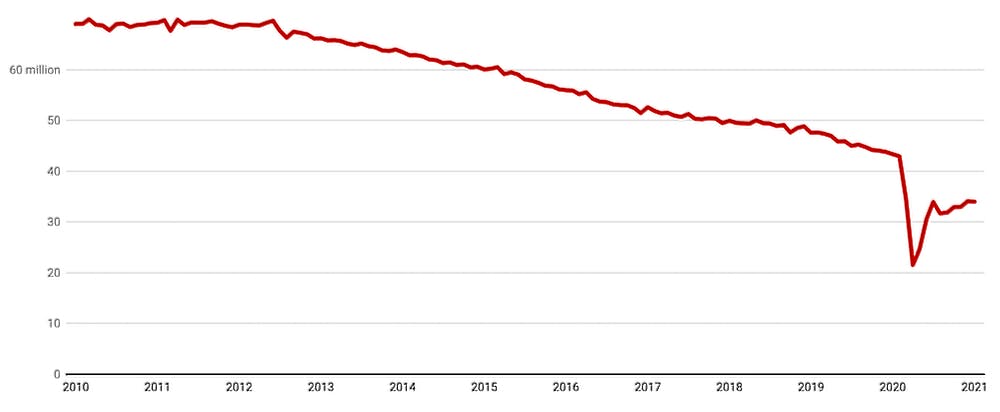
Monthly, seasonally adjusted. Reserve Bank of Australia

Cafes and pubs offered contact-free ordering via QR codes, shops were given permission to lift the PayWave limit for transactions without a PIN, and banks were given permission to mail out cards to customers who didn’t ask for them.

One in five of us holds no cash

If the switch away from using cash seems like something we took in our stride, it’s because we’ve been slinking away from it for years.

Contactless card transactions accounted for a record 50% of in-person sales in 2019, up from 10% in 2013. More than one in five Australians reported they held no cash in their purses and wallets in 2019, up from one in ten in 2013.

An even bigger 40% said they held no cash outside their wallets.

Toll roads haven’t accepted cash for years. Transport cards such as Myki, Opal and MyWay have grown to the point where they account for 2% of all transactions. Now 5% of face-to-face transactions are done with mobile phones.

The “threshold” below which cash remains the most common means of payment has been falling for decades. In 2019 it was just $4, down from $41 in 2007.

It means you would be entitled to think (and entitled to be certain) that we are falling out of love with cash. We need it less than ever.

Yet bizarrely (and this is something even the experts can’t make sense of) we are amassing more of it than ever, even more so during the pandemic.

Yet in aggregate, we are holding more than ever

The value of cash out there somewhere (notes issued in excess of those returned) soared 17% during 2020. In each of the previous ten years, while our use of cash dwindled, our holdings climbed by an average of 5%.

So big was demand for cash during the pandemic that the Reserve Bank opened its “contingency” distribution site twice, in March and in July, to get $50 and $100 notes out to banks being asked for them. At the same time the banks held back on returning poor-quality notes in case they needed them.


Read more: Depending on who you are, the benefits of a cashless society are overrated


The paradox is that while many of us are holding absolutely no cash, and many more are holding none outside of their pockets, some are holding bewilderingly large and growing amounts, which they fortified during the recession.

When asked, only one in 200 owns up to holding more than $5,000 in cash, but the amounts some of those people are holding must be staggering.

The latest figures show there were 186 million $20 notes out there in circulation at the end of March — about seven for each woman, man and child in the country.

A clutch of 20s, far more 50s and 100s

The count of $20 notes seems about right. Some are in tills, some in wallets.

But for $50 notes (the ones many of us don’t hold as often) there are an improbable 37 per person in circulation — 947 million. For $100 notes – the ones some of us never see – it is 17 per person.

There are far more $50 and $100 notes than there used to be. Twenty years ago we had just six $100 notes per person, alongside about as many $20 notes as now.

Our neighbour across the Tasman Sea is like we used to be. New Zealand still has only five $100 notes per person in circulation.

For Australia, “circulation” is scarcely the right word.

Our high-value notes are exchanged so rarely the Reserve Bank’s best guess is that, on average, each $100 note will last 200 years before being returned damaged or worn out; $20 notes are returned every eight years.

Banknotes in circulation per person
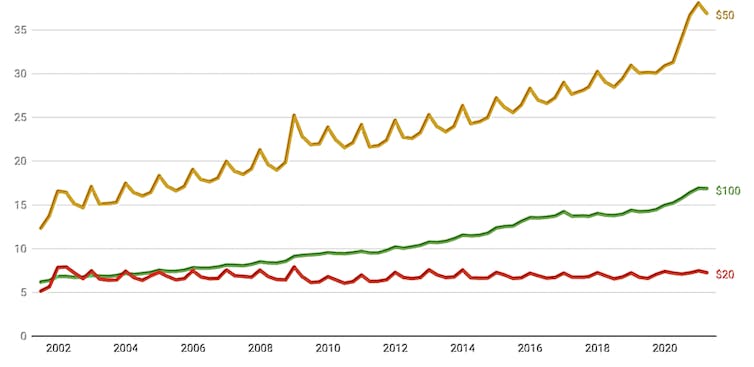
So big is the mystery about where all the notes are that the Reserve Bank has published a study, Where’s the Money? An Investigation into the Whereabouts and Uses of Australian Banknotes.

Crime, tax and means tests

It finds 5-10% are lost. It gets the estimate from the number of paper notes that were never converted to plastic when we switched over in the 1990s.

Up to 15% are kept overseas. The RBA can tell by the way demand for notes changes with the value of the Australian dollar.

Only a few percent are used to store the proceeds of crime. Criminals “convert a large share of their cash profits into other assets”.


Read more: Limiting cash to $10,000 is more dangerous than you might think


Interestingly, where criminals do store cash, the chemical residues left at the site of drug busts suggests it is as $50 rather than $100 notes.

The rest is hoarding, both in case something goes wrong with the banking system (which explains the spike during COVID) and what appears to be an especially Australian desire to avoid tax and things such as the age pension assets test.

New Zealand doesn’t have a pension assets test.

Peter Martin, Visiting Fellow, Crawford School of Public Policy, Australian National University

This article is republished from The Conversation under a Creative Commons license. Read the original article.

Read more >>

Sunday, October 15, 2017

Standard gauge no more. How the Reserve Bank is about to make our money fly

Why is it so hard to move money?

In part, for the same reason our trains are the shape they are, and our cars, and perhaps even our space shuttles. Nothing gets designed from scratch.

In the US (and Australia) the standard rail gauge is 1435 mm, which was 4 feet 8.5 inches. It was copied from England, where it had been used for trams, whose designs were copied from horse-drawn wagons.

The wheels of the wagons were that distance apart in order to fit into the ruts that were first cut into long-distance roads by Roman chariots. The Romans made their chariots that width so that each could be pulled by two horses.

And the connection to space travel? Each space shuttle had two big booster rockets attached to the sides of its fuel tank. The shuttles were launched from the Kennedy Space Centre at Cape Canaveral in Florida. But the booster rockets were made in Utah, from where they had to travel to Florida by train. You can guess the rest.

The boosters could have been wider, but the train had to travel through a tunnel, the width of which was related to the width of the tracks, which were related to the width of the ruts made by chariots on British roads, which were related to the width of Roman horses.

It's the same for Twitter, whose (generally popular) limit of 140 characters was set in its early years as a service delivered by mobile phone texts that were limited to 160 characters. After setting aside 20 characters for the delivery address, Twitter offered 140 for the message.

The number 160 came from a German communications researcher who in 1985 sat at a typewriter tapping out random sentences to figure out just how small a message could reasonably be and still fit in the small amount of extra bandwidth allocated alongside the space for mobile phone calls by the emerging GSM global system for mobile communications.

It's the same with typewriters. Most of us type on a keyboard whose top row begins with QWERTY. It was set up that way in the late 1800s in order to separate the keys of the letters commonly typed together on manual typewriters in order to ensure they didn't jam (or perhaps because that was the best way to type Morse code, the stories differ).

Centuries on, we still use the inelegant QWERTY even though we don't need to, although for better or worse Twitter says we are about to get 280 characters.

Which brings us to money. Have you ever wondered why we can't transfer it in real time, and why internet banking limits you to a miserly 14 characters to identify the reason. It's because the system it is built on dates back an awfully long way, back to the days of computer punch cards. The message length was then 80 characters because that's how many holes there were in the punch cards. It got crunched to 14 as more of the holes got used for other things.

Until now. Adrian Lovney, chief of the new payments platform that will be rolled out from Australia Day describes it as an "entirely new set of rails". Built from the ground up it will allow us to use email addresses or phone numbers instead of BSBs and it will give us 280 characters rather than 14. Down the track it could give us more, if we need them. And it'll transfer money within seconds rather than overnight.

The company that's building it is owned by the Reserve Bank and the 12 biggest private banks, but it'll be used by the lot. Like microwave ovens and GPS tracking, we'll soon wonder how we ever lived without it, at least until a few decades down the track when it is baked into future products and holding us back.

In The Age and Sydney Morning Herald
Read more >>

Sunday, March 19, 2017

If your wallet is empty, you're part of the new majority

Open your purse or wallet. If it's empty, apart from cards, you're part of something big.

For the first time, cards account for more of our purchases than cash. Whether its payWave or myki or Opal or MyWay for the small things, or Visa, MasterCard and debit cards for the big ones, we are using cards more often than ever before and taking less cash out of ATMs than at any time in the past 15 years.

Often I have not a single piece of cash on me (much to my children's annoyance).

A new Reserve Bank report released on Thursday finds that an astonishing one-fifth of Australians carried no cash whatsoever on the day they were surveyed, up from 8 per cent three years before.

The typical amount carried fell from $55 to $40.

The typical amount secreted away around the home (such as in bedrooms and under fruit bowls) is $100.

An astounding 30 per cent of us keep no cash whatsoever in the house, up from 25 per cent three years ago.

If nothing else, it suggests incredible faith in banks.

The Reserve Bank carries out the survey every three years. In November it gave 1500 people diaries and asked them to record every transaction for a week, more than 17000 transactions in total. In a telling irony it rewarded them with gift cards rather than cash.

Only one-third of the transactions were in cash, down from two-thirds in 2007. The use of cards jumped from one-quarter to 52 per cent, supercharged by a surge in the use of contactless payments for amounts under $20.

Only for payments of less than $10 did cash still hold its own, and predominantly among older and poorer Australians.

The said they used it because it was cheaper (no surcharges) and easier to budget with because it could be seen. Some said they were concerned about privacy and fraud, but not many.

Soon many of them will be abandoning cash. Smartphone payments (made by waving phones instead of cards) accounted for only 1 per cent of transactions in November, but they are about to get big.

For people like us. Different Reserve Bank statistics suggest there's another (smaller) class of people for whom cash is almost everything and becoming even more. The use of $100 notes jumped 9 per cent in the past year, well above the long-term growth rate of 7 per cent.

There are now an extraordinary 12 $100 notes per person in circulation, twice as many as the more widely-seen $20 notes. The Bank knows this because it pumps them out. In an attempted explanation, its annual report limply says they are "used as a store of wealth".

But not by people like you or me.

A raid on the home of the now-jailed NSW Labor powerbroker Eddie Obeid found $30,000 in cash. There are more Obeids around, and their wallets are anything but empty.

In The Age and Sydney Morning Herald
Read more >>

Wednesday, September 26, 2012

Elderly Australians: We don't have those $100 bills...

Well, we might have some of them

Older Australians hoard thousands of dollars in cash to pay for their funerals, but they don’t do it to get the pension says Seniors Australia, which has labelled the suggestion seniors use cash to defraud the pension system "unfounded and offensive".

Former senior Reserve Bank official Peter Mair has written to the governor of the Bank suggesting elderly Australians are behind the the extraordinarily high number of $100 notes in circulation.

Reserve Bank figures show there are ten $100 notes in circulation for each Australian compared to only seven $20 notes.

“In broad terms the average value of notes held by New Zealanders is about one third of the $A2000 held by Australians,” Mr Mair writes to governor. “An obvious explanation - means-test free age-pensions in New Zealand - points to the benefits some pension recipients in Australia unfairly take by holding undeclared assets masquerading as $100 notes.”

Mr Mair says the government should consider removing $50 and $100 notes from circulation to make hoarding more difficult.

National Seniors Australia chief executive Michael O'Neill said there was “no doubt” some senior Australians kept large amounts of cash in their homes.

"I know people who have $6000 or $7000 or $8000 put aside for their funeral,” he told the Herald... “They still have that attachment to the folding stuff. And I think part of the attitude is wanting to have money there to pay for the funeral, so the family won’t have to worry.”

But he said he had never heard from any of his members about hoarding high-denomination notes in order to get access to the pension and the prized Commonwealth Health Care Card.

“There' is a view folk strongly have that they have been taxed all their lives and that it is simply unfair that they don’t have access to the card.”

“I don't dispute that people go to their accountants and try and accommodate access, in entirely legitimate ways which they are entitled to provided it is legal. But in terms of large volumes of cash being hidden under the mattress, I find it difficult to accept.”

Finance minister Penny Wong said she had not been looking under pensioners’ beds lately, but that people were “required to declare their assets and their income in order to access the pension”.

In the six months to December only 44 people aged over sixty were convicted of social security fraud out of a total of 826.

Mr Mair has told the Bank he believes it is conflicted in dealing with Australia’s unusually large supplies of currency by the $1.5 billion plus annual profit it makes issuing currency. He will raise the question at the financial system inquiry promised by the Coalition after the election.

In today's Canberra Times, Sydney Morning Herald and Age


Related Posts

. The grey economy. Might pensioners have those $100 notes?

. Why do we have so many $100 notes?

. OUR CURIOUS STASH: We're loaded with cash. Except that most of us aren't.


Read more >>

Tuesday, September 25, 2012

The grey economy. Might pensioners have those $100 notes?

Elderly Australians committing welfare fraud on a massive scale are behind the extraordinarily high number of $100 notes in circulation in Australia, according to a former senior Reserve Bank official.

The Herald revealed yesterday there are now ten green $100 notes in circulation for each Australian, far more than the more-commonly seen orange $20 notes.

One popular explanation is that they are used for illegal transactions as part of the cash economy, something former Reserve official, Peter Mair, rejects as a “furphy”.

But, in a letter to Reserve governor Glenn Stevens dated July 4, Mr Mair laid the blame squarely on elderly people wanting to get the pension and hiding their income in cash to ensure they qualify for the means-tested benefit.

“The Bank is basically facilitating a tax avoidance scheme by issuing high denomination notes,” he told the Herald. “They are not needed for day-to-day transaction purposes, or even as reasonable stores of value."

His best guess is the average pensioner couple holds up to $50,000 in undeclared $50 and $100 notes in order to get access to the pension.

Mr Mair added that when the green plastic $100 note replaced the grey paper note in 1996, the Martin Place headquarters of the Reserve Bank received regular visits from retirees wanting to withdraw large quantities of the new notes. He said the commercial banks had sent them to the Reserve Bank because they didn't have enough $100 notes on hand.

Mr Mair says the return for an Australian close to getting the pension who holds $10,000 in cash, rather than declaring it, is “enormous”...

“If putting it under the bed or in a cupboard means you qualify for the pensioner card you get discounted council rates, discounted car registration, discounted phone rental - in percentage terms the return is enormous,” he said.

Mr Mair is a former senior Reserve Bank manager responsible for the payments system. He assisted both the Campbell and Wallis inquiries into the financial system.
He used comparisons of the per capita holdings of large denomination currency in Australia and New Zealand to back his argument.

“In broad terms the average value of notes held by New Zealanders is about one third of the $A2000 held by Australians - almost all of which by value is in the $50 and $100 denominations,” he wrote in his letter to the Reserve Bank governor.

“An obvious explanation for the difference is means-test free age-pensions in New Zealand.”

His letter to the governor proposes phasing out the $100 and $50 denominations which he says technology has rendered unnecessary.

“Cards and the internet have delivered a body blow to high denomination bank notes, they are redundant,” he told the Herald/Age. “There is no longer any point in issuing them except to facilitate tax dodging.”

“The authorities would announce that from, say, June 2015 every $100 and $50 note could be redeemed but no new notes would be issued. After June 2017 every note could only be redeemed at an annual discount of 10 per cent. It would mean that after two years each $100 note could only be redeemed for $80, and so on.”

The letter acknowledges the proposal would be “contentious” and says it should not be done “in any way precipitously” but says as retail payments become progressively more electronic it will become inevitable.

“What would remain in circulation are coins and a modestly expanded issue of currency notes in the $10 and $20 denominations: there is every reason to expect that a national currency issue of this character would soon be adequate to meet the reasonable needs of a community ever more exclusively making substantial payments electronically,” the letter says.

Mr Mair would also strip the Reserve Bank of authority for issuing notes, handing it back to the Treasury which had it until 1911.

“Treasury already issues our coins. If it issued our notes as well it would be much more interested than the Bank in making sure people didn't hoard them to load up on the pension, because it pays the pension.”

In today's Canberra Times, Sydney Morning Herald and Age

SOME FEEDBACK

...AND LETTERS


Related Posts

. Why do we have so many $100 notes?

. OUR CURIOUS STASH: We're loaded with cash. Except that most of us aren't.

. More $100 notes than $20 notes?


Read more >>

Monday, September 24, 2012

Why do we have so many $100 notes?


Cashless? Hardly. Australians are holding on to more of the stuff than ever before, and accumulating it at an increasing rate.

The latest Reserve Bank figures show our holdings of plastic notes grew an extraordinary 7 per cent in the year to June at a time when Australia’s population grew 1.4 per cent.

Australians now hold an average of seven $5 notes per person, up from five a decade ago, and five $10 notes, up from four. Our holdings of $20 notes are little changed at seven per person.

The explosive growth is in our holdings of $50 notes - up from 15 per person to 23 per person - and $100 notes, up from seven per person to ten.

So much do the big value notes dominate that the Reserve Bank says $50 and $100 notes account for 91 per cent of the value of notes in circulation and 65 per cent of the number of notes in tills, wallets and in storage.

Yet many Australians hardly ever see a $100 note and probably see an orange $20 note more often than often than the three-times as popular yellow $50.

One reason might be that many of the yellow notes are stored in automatic teller machines where they have replaced the orange $20 note as the main means of supplying cash. Another might be that many of the green $100 notes are stored in bundles in boxes or suitcases as means of facilitating the cash economy rather than put into wallets for use in legitimate transactions.

If so, the cash economy is growing at an alarming rate... Before the introduction of the goods and services tax in 2000 there were roughly half as many $100 notes per person as there are today. Backing the theory that the extra $100 notes are kept in bundles rather than put into wallets are Reserve Bank estimates that the average $20 note lasts twelve years before being damaged and replaced whereas the average $100 note is on track to last 70 years.

The $50 note is by far the most counterfeited, with almost 7000 fake notes detected in the year to June compared to only 600 fake $100 notes.

The annual report says the number of counterfeits dived in 2011-12 following the arrest in 2010 of several people allegedly connected to a well organised criminal operation in NSW.

Published in today's Canberra TimesSydney Morning Herald and Age


Related Posts

. The cashless society... the paperless office: we're rolling in it

. OUR CURIOUS STASH: We're loaded with cash. Except that most of us aren't.

. More $100 notes than $20 notes?


Read more >>

Tuesday, March 13, 2012

Don't you want me baby. We're falling out of love with cash


ATM cash withdrawals down 1.3%
Internet transfers up 7.5%
EFTPOS transactions up 7.5%
Credit card balances up 0.7%
Personal cheques down 5.7%

Year to January. Reserve Bank of Australia


We’re falling out of love with cash. We withdrew cash from ATMs 64.7 million times in January, which sounds a lot but was well down on 65.6 million times the previous January.

December was even worse. We took out cash 71.9 million times compared to 73.6 million the year before.

Mobile phones, EFTPOS, internet transfers and cards that merely need to be waved in front of machines are taking the place of cash, but credit cards aren’t.

Reserve Bank figures released yesterday show the average credit card limit climbed just 0.7 per cent over the year to January, the smallest annual growth on record.

Internet transfers jumped 7.5 per cent. We put through 60 million in January, up from 55 million.

Debt card transactions jumped 12 per cent.

As we used both credit and debt cards more intensively in place of cash the average size of a card transaction fell to just $89.53 - an all-time low...

“People don’t want to carry cash around, welcome to the new age,” said CommSec chief economist Craig James.

“The extent of the slide is staggering. Cash is losing its place as the primary method for making purchases and exchanging value.”

Fees for ATM use appear to be changing behaviour. The proportion ATM withdrawals made from ‘home bank’ rather than ‘foreign’ ATMS has climbed form 52 per cent to 59 per cent over the last five years.

Our growing aversion to using credit cards might be part of the same value-shopping mentality. Although the average credit card limit is $9,100 calculations by Mr James suggest the average debt outstanding debt is just $3200.

“Certainly credit is available if consumers want it, but they much prefer to be in control of their finances,” said Mr James. “The new age of consumer conservatism shows no sign of ending.”

“We’ll soon get a better handle on spending by tracking card transactions than retail data. Cards are replacing cash, services are replacing traditional retail and online stores are replacing bricks and mortar.”

Published in today's Sydney Morning Herald and Age


Related Posts

. We're putting it on plastic, but differently

. Where the hell are our $100 notes?

. We are using our cash more slowly


Read more >>

Monday, November 01, 2010

OUR CURIOUS STASH: We're loaded with cash. Except that most of us aren't.


What's in our wallets:

Cash per person June 2010

6 $5 notes
4 $10 notes
6 $20 notes
20 $50 notes
9 $100 notes

Reserve Bank annual report


We now have money than ever - literally. Although many of us mightn't realise it. Officially each Australian now has on hand or on demand at banks and shops an average of six $5 notes, four $10 notes and six $20 notes -- totals that are little changed in years.

But our holdings of $50 and $100 notes have exploded since the financial crisis as the Reserve Bank has pumped into circulation an extra 72 million and 30 million $50 and $100 notes, pushing up the number of $50 notes from 18 to 20 per person and the number of $100 notes from 8 to 9 per person.

If those totals strike you as unlikely it could be because you are lacking experience in high-finance or the cash economy. Or it could be because you haven't kept up.

A decade ago there were roughly equal numbers of $20 and $100 notes per person, a fact that by itself might have seemed unlikely to those of us who would have had trouble even identifying the colour of a $100 note.

But demand for $100 notes took off with the the introduction of the Goods and Services Tax ten years ago and reached fever pitch in the financial crisis when the Reserve Bank boosted cash on hand by a record 14 per cent in order to ensure banks and ATMs could meet demands associated with the stimulus and the desire to actually store money in briefcases or in shoeboxes under beds.

Even before the GST Australians stood out as lovers of cash, holding more per person than citizens of the United States, Canada and the US and three times as much as New Zealanders...

Adding weight to the theory that many or most $100 notes are stowed rather than put into wallets are Reserve Bank estimates showing $100 notes should last around 70 years before becoming damaged, whereas $20 notes should last 12.

The Bank's annual report reveals that after the crisis our demand for cash didn't slacken, suggesting a permanent or semi-permanent step up in our holdings of cash as a result of the crisis.

So concerned was the Bank that we get access to cash in 2009 it opened a new distribution point for notes at its head office in Martin Place, literally across the road from the main bank branches in addition to its distribution centre at Craigieburn in Victoria.

It passed on to banks and ATM operators its advance knowledge of where and when stimulus payments would be made so they could order extra cash and place trucks on standby.

Our growing love affair with cash hasn't led to an explosion in counterfeiting. The Bank found only 7800 fake notes last financial year, no more than normal and a much lower rate than in other countries. Almost all were copies of $50 notes.

Published in today's SMH

Related Posts

. More $100 notes than $20 notes?

. Where the hell are our $100 notes?

. Our love affair with Cash

. We're spending, but more carefully

Read more >>

Thursday, September 13, 2007

More $100 notes than $20 notes?

Tell me this isn't true:


Take look inside your wallet or purse.

How many $20 notes, how many $50 notes and how many $100 notes do you see?

If you see mainly $20s, a few fives and tens and perhaps one $50 note I suspect you are like most people.
But not according to the Reserve Bank. Each year it tots up the total number of notes in circulation for its annual report.

The latest released yesterday shows that we hold three times as many $50 notes as we do $20 notes. Per person we hold five $5 notes, four $10 notes, seven $20 notes and an astounding eighteen $50 notes.

Of course many of these notes are not held by people but in cash registers and ATMs – which help explain the large number of $50 notes. Most ATMs are configured for $20 and $50 notes.

What’s more surprising is the very large number of $100 notes, a denomination not widely used ATMs...

The Bank’s figures show that there are now more $100 notes in circulation than $20 notes - a surprising result given the contents of most of our wallets: eight per person as opposed to seven.

Part of the explanation may involve the Y2K scare in the lead-up to the year 2000. The Bank says it printed and distributed a large number of $100 notes in the lead up to Y2K to help people and businesses prepare for the eventuality that they might have to use cash rather than computers.

But the figures in its report show that these $100 notes were not returned. In fact there are many more $100 notes in circulation now than there were back then.

There is evidence that many of them do not change hands. The Bank reported in 2001 that so few soiled $100 notes were returned for replacement that on average each would last 70 years. By contrast each $50 note would last only 25 years.

One likely explanation for the preponderance of unseen, unsoiled and apparently untraded $100 notes is that most remain wrapped up in bundles in briefcases, traded only in bulk and nefariously. When not traded they are hidden under floorboards and in roof cavities away from the eyes of the authorities.

The Good and Services Tax, introduced seven years ago, was intended to kill the black economy. The latest Reserve Bank figures suggest that it remains alive, if well hidden.
Read more >>

Saturday, July 12, 2003

Our love affair with Cash 3/3/2003

How much cash do you have about your person right now? When I asked Gerry shed told me the answer was less than twenty dollars. For most of us, it certainly wouldn't be $1,000. Yet according to the official figures around $32 billion in notes is out there in people's possession at the moment - that's about $1,600 for each Australian man, woman and child. That’s more than the typical American, the typical Canadian, the typical Brit, and about three times as much as the typical New Zealander.

RBA comparative figures from 1996 show Australians holding cash of $US870 each, yanks $US610, and NZers $280!

We are eclipsed by some European countries and Japan. The Japanese held at the time $US3,588 under their beds and in other places.

Which is understandable. Japan has deflation. The Japanese don't trust the banks, and for historical reasons neither do many Europeans. But how can we explain Australains love affair with cash?

Christopher Bajada, of the UTS attempts to and comes up with the conclusion that much of it is used to store the proceeds of crime.

The RBA figures suggest this may well be the case. Almost half of the cash we hold about our person is in the form of $100 notes.

Officially we each hold about as many $100 notes per person as we do $20 notes (six to seven).

You and I know this is not true, leading to the thought that perhaps most of Australia's 130 million $100 notes are stored away in suitcases somewhere unopened.

Reserve Bank figures on the life of the notes lend support to this notion. $100 notes last an estimated 70 years. $20 notes last twelve years.
Read more >>