Tuesday, February 21, 2023

See when Australia’s biggest banks stopped paying proper interest on your savings – and what you can do about it

Whenever interest rates went up in the past, I used to get told it wasn’t all bad news. At least it was good for some people: savers – people with money in the bank.

I hear a lot less of that these days.

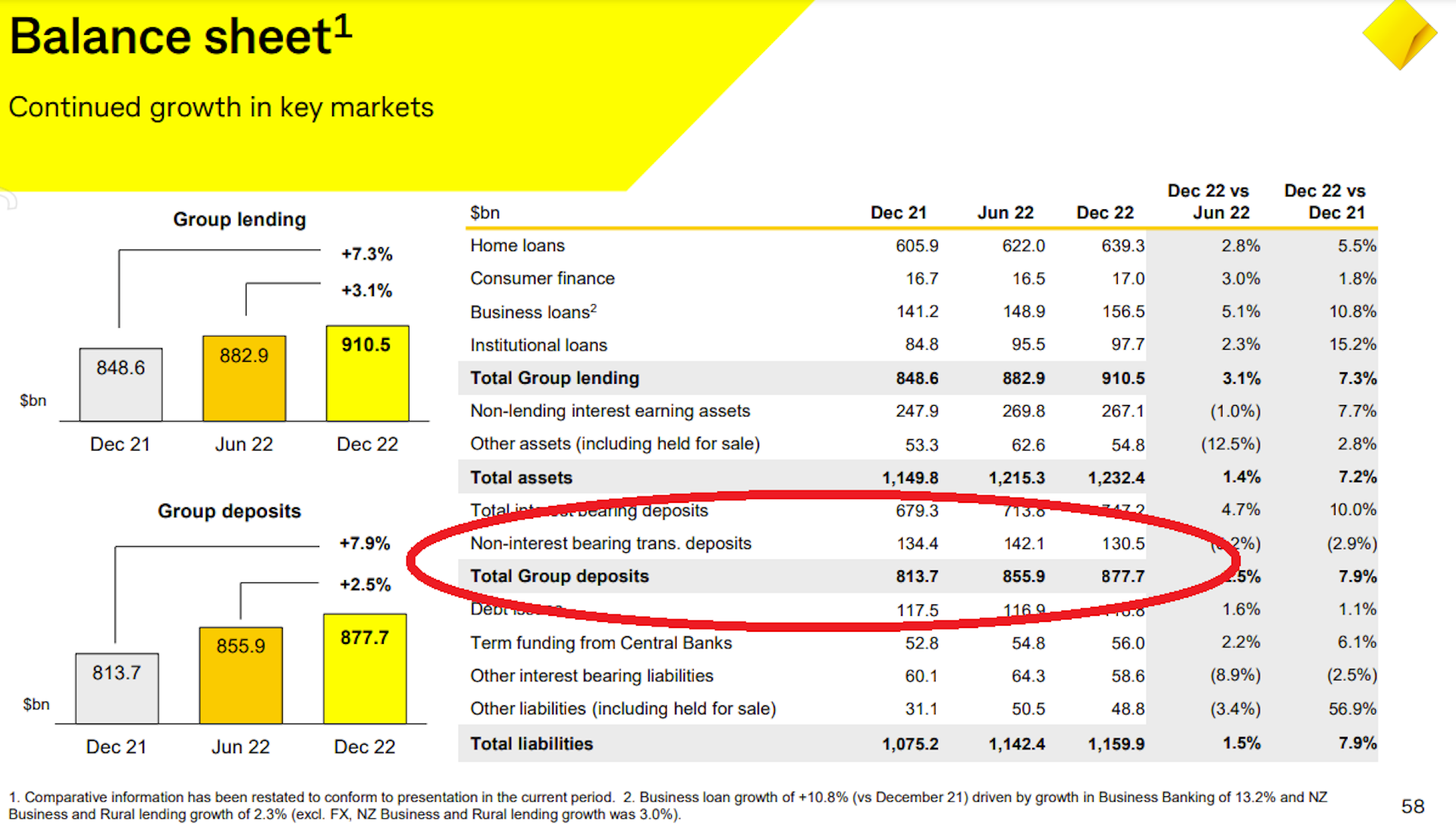
If you’ve got money in the bank, you’re now lucky to earn anything at all. One in seven of the deposit dollars held by the Commonwealth bank (Australia’s biggest for deposits) is in a “transaction account” on which it no longer pays interest.

Where interest is paid, it is so tiny compared to what it was that Treasurer Jim Chalmers this month directed the Australian Competition and Consumer Commission to conduct an inquiry, using its compulsory information-gathering powers.

The last time the commission conducted such an inquiry, into mortgage rates in 2018, it gained access to nearly 40,000 documents from the big four banks and more than 7,000 from the smaller banks.

Bad news for savers: when your rates began to fall

What the commission is likely to find is that whereas transaction accounts stopped paying interest some time ago, so-called online accounts offering interest on large deposits were paying very reasonable interest – up until five years ago.

How do I know that’s the likely finding? Here’s what I found, when I graphed the Reserve Bank’s measure of the average online rate for a $10,000 deposit against the Reserve Bank’s cash rate, going back to 2010.


What the graph shows is that, until about five years ago, the online rate for big deposits moved in line with the cash rate and (as it happened) almost exactly matched it. When the cash rate was 3%, the online deposit rate was 3%, and so on.

But from 2018, the deposit rate fell away. Except for the time when both rates were close to zero during the early years of COVID, the rate paid on large deposits has stayed well below the cash rate ever since.

That’s what the official figures say. But Anna Bligh, chief executive of the Australian Banking Association, sees them differently.

“This time last year, the four major banks, nobody, no bank was offering more than 0.3% on their savings account,” she told the Australian Financial Review this month. “Right now, they’re all offering at least 4% or more. So that’s a massive increase.”

But the rates Bligh quotes aren’t the standard ones.

The Commonwealth Bank is indeed paying 4% on its so-called NetBank Saver account, but the 4% is an introductory rate for new customers only – before slipping back to 1.6% after five months.

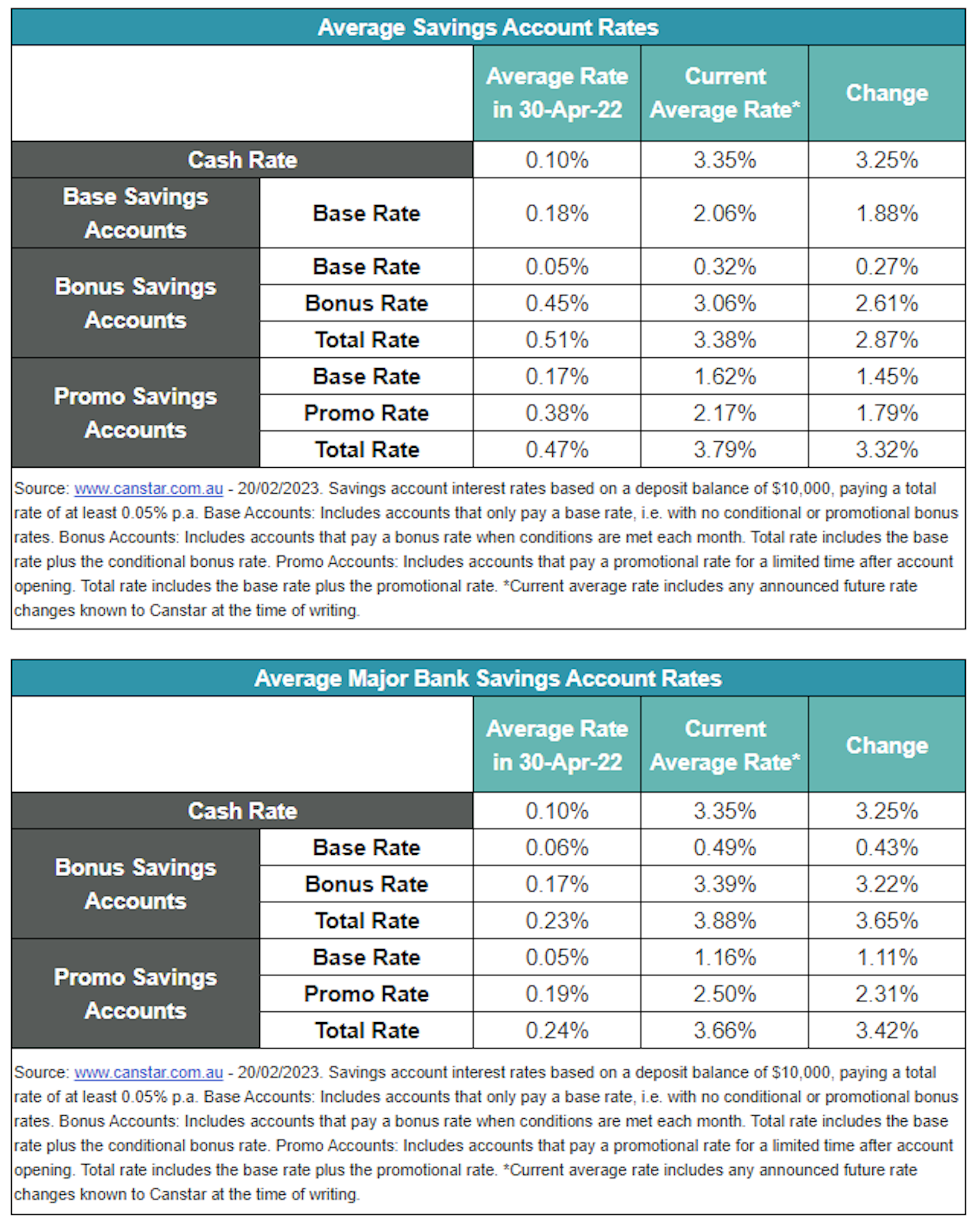
The web comparison site Canstar finds the average big bank introductory rate on $10,000 is 3.66%, up from 0.24% before the Reserve Bank put up the cash rate by a total of 3.25 points.

But the average rate offered when the introductory bonus wears off has climbed by much less, from 0.05% to just 1.16%.

Complexity and suspected collusion makes switching hard

And some of the high-looking rates have special conditions.

The Commonwealth’s GoalSaver account also offers 4%, but only if you put in more money in each month. If you can’t, or if you make a withdrawal, the rate plummets to 0.25%.

The Australian Competition and Consumer Commission’s inquiry is likely to find that the complex nature of the deals makes switching hard, just as does the complex nature of electricity and health insurance deals.

That’s what it found about the bank’s mortgage offerings in 2018.

It found the “opaque” nature of the offers inflated the costs of shopping around (including time and effort) and was one of the reasons why 70% of borrowers surveyed by one of the big banks said they signed up after getting just one quote.

It said the big four banks profited from the suppression of incentives to shop around and lacked strong incentives to make prices more transparent.

So why have the deposit rates offered by the big four banks dropped away?

When it came to mortgages, the ACCC suspected tacit collusion. Its 2018 report referred to a “synchronised” approach to rates seven times.

Why the banks won’t act – unless we make them

In very recent years, the banks have had less reason to offer high rates. During the first 15 months of COVID, the Reserve Bank made available A$188 billion of funding to banks at the extraordinarily low rates of 0.25% and 0.1%.

This meant banks had less need to attract deposits, and in any event, they were overwhelmed with deposits. Elevated savings rates during COVID pushed an extra $300 billion through their doors, as worried and locked-down households sought out safe places to stash cash.

Both of these things are changing. The last of the Reserve Bank’s cheap three-year loans to banks expires mid-next year, and households are stashing less into banks than they used to.

It is possible deposit rates might be about to improve, all the more so because the banks will be under scrutiny until the ACCC inquiry reports at the end of the year.

When announcing the inquiry, the treasurer invoked fairness. Chalmers called on the banks to “pass on the interest rate rises to savers as quickly as you pass on the interest rate rises to mortgage holders”.

But fairness has little to do with it. The banks will pay depositors more only when they need to, or when they are pressured to. Until then, for many of us, deposits will earn next to nothing, regardless of where the Reserve Bank moves rates.

So if you’ve got a savings account, why not call up your bank, quote this article – and ask them what they’re going to do about it.The Conversation

This article is republished from The Conversation under a Creative Commons license. Read the original article.

Read more >>

Tuesday, February 14, 2023

Australians need good financial advice more than ever to pay for soaring interest rates. Here’s how to get it

Hundreds of thousands of us who took out fixed-rate mortgages in 2020 and 2021 are about to be hit with massive increases in payments.

After nine successive interest rate increases and at least two more to come, those of us on variable rates will soon be paying as much as A$1,000 a month more.

With such an uncertain economic outlook, should we switch our super fund’s investment strategies from “growth” to “conservative”? Should we rent rather than buy while home prices fall?

We need answers to our financial questions – but they’re now much harder to get.

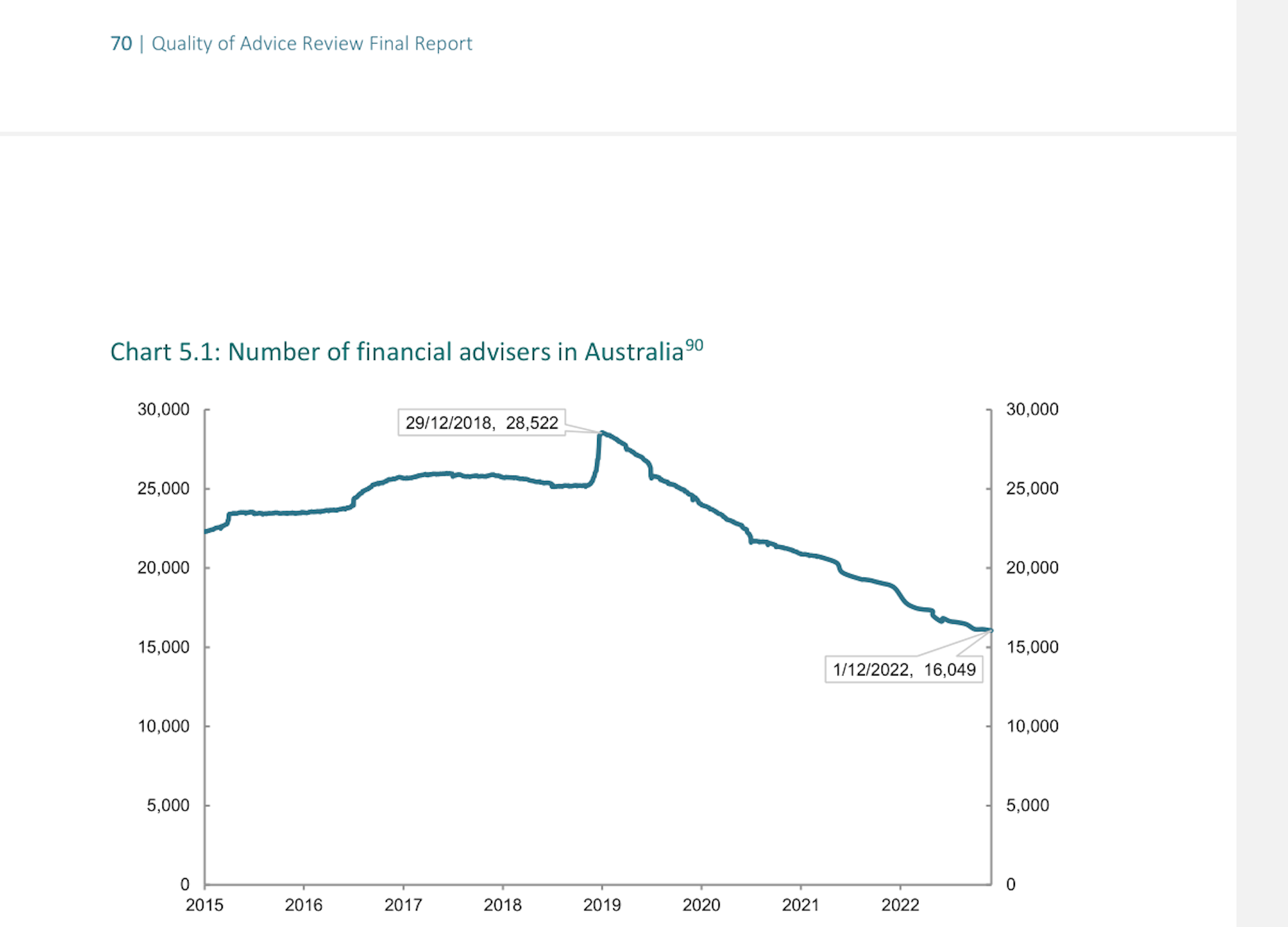
Five years ago, Australia had 28,000 financial advisers. Today there are 16,000. That’s according to a review of financial advice commissioned by the previous government and released by the Albanese government last week.

Thousands of advisers are leaving the industry each year. The ones that remain are charging far more than they used to – $3,710 is said to be common, up 48% in five years, and enough to turn many people away.

So how did it come to this? And what does the new report recommend we do to make it easier for more Australians to get good, more affordable financial help?

Fixing rorts, where even dead people paid a price

This is a story about how Australia, under successive Labor and Coalition governments, let aiming for what’s perfect get in the way of what’s good. Up until I read the Quality of Advice Review last week, I was guilty of doing it too.

For years, I argued we should make financial advice perfect: delivered by genuinely professional advisers, who weren’t receiving kickbacks from firms wanting access to our money. I also argued we should pay for that advice in full upfront, because, whatever the cost, the advice will save us money in the long run.

We needed to do something. Back before a series of explosive Four Corners reports and the 2019 Hayne royal commission into the financial services industry, advisers and the funds they pushed us towards sucked money out of our accounts and presented us with options that made money for them – rather than us.

The consequences were shocking. Dead people were being charged for financial advice, and even for life insurance. Gym instructors and other “introducers” were used to lure people into products that charged unnecessarily high fees.

The professionals we now call investment advisers used to be called insurance salesmen. They were paid through commissions to beguile us into signing up for products that charged high fees and paid them high ongoing commissions.

Unintended results of tougher standards

Ahead of the Hayne royal commission, things began to change.

The Rudd Labor government outlawed commissions and introduced legislation requiring advisers to “place clients’ interests ahead of their own”. After winning government, the Coalition tried to undo the changes, before adopting just about the lot after Hayne reported.

It’s now illegal for financial advisers to accept commissions (although mortgage brokers and people who sell insurance still can) and illegal to offer advice that isn’t in the “best interests” of the customer taking almost everything into account. This makes it all but impossible for bank tellers and super funds to offer advice.

So I have been having second thoughts about the arguments I once made for no commissions, best interests, and lots of disclosure documents – especially after reading the Quality of Advice Review. Ironically, its release was largely drowned out by coverage of Australians’ growing financial stress.

The report’s author Michelle Levy is a senior lawyer and expert on superannuation, life insurance, distribution and financial services law.

As well as being a partner at Allens, she’s also a parent – and knows more than most how vile predatory financial advisers can be.

During the royal commission, we heard about a man with Down syndrome who was signed up for life insurance over the phone, even though he lived on a pension, had no dependants and could not afford the premiums.

In her review, Levy discloses that she has a daughter who, “like this gentleman”, lives with a disability and has bank accounts, but does not know the difference between $10 and $1,000, does not know how to use a credit card, or what superannuation is.

Levy writes that her daughter ought to be able to rely on her bank and super fund to assist her.

She says by stopping firms from providing advice that isn’t perfect, we’ve inadvertently stopped our financial institutions from providing advice that is “good”. We have made it hard for human beings to help each other.

Why ‘good’ might be a better benchmark than ‘best’

So Levy wants to allow super funds and banks to offer advice which is “good” but isn’t comprehensive, in the same way as sales assistants are able to offer advice on clothes and mechanics are able to offer advice on cars.

Good advice does not mean “okay advice” or “good enough” advice, she says.

It is unlikely to be good advice to recommend a poorly performing superannuation product. It will not be good advice to recommend that a person who is unable to pay their mortgage open a term deposit.

If the advice isn’t good, the full force of the existing law will come down on the person who provides it (the maximum penalty for an individual is $1.11 million). But it needn’t be comprehensive; not every piece of financial advice needs to be a lifetime plan.

What Levy is proposing, and what the government is now considering, is more subtle than what we are doing at the moment – which is simply banning self-interested parties from giving advice.

Levy wants to allow the self-interested to give advice, while ensuring it “also serves the interests of their customers”.

In the meantime, if you are in serious financial difficulty (rather than simply needing advice) the National Debt Helpline is one of a number of places that can help. You can request a free, confidential meeting with a financial counsellor on 1800 007 007.The Conversation

This article is republished from The Conversation under a Creative Commons license. Read the original article.

Read more >>

Tuesday, February 07, 2023

RBA warns of at least 2 more interest rate rises in coming months, as the economic outlook worsens

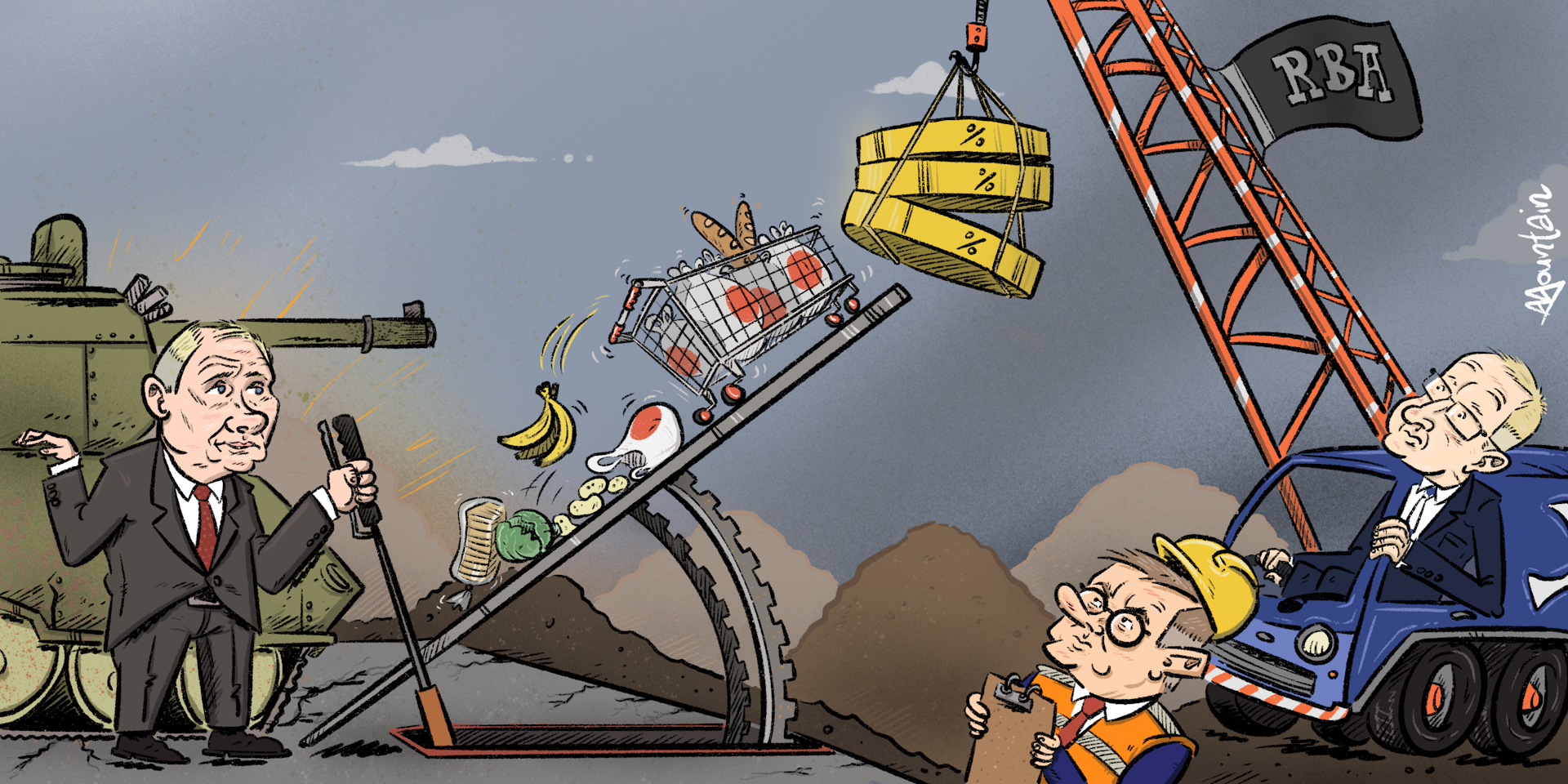
Australia’s cash rate has hit 3.35%, after the Reserve Bank raised interest rates for the ninth time in a row – and signalled more interest rate pain ahead. The 0.25 percentage point rise adds A$90 a month to a $600,000 variable mortgage.

Ahead of Tuesday’s statement from the Reserve Bank board, there was talk of just one more 0.25 point rate hike this year.

That was the view of traders in the money market, who had priced loans on the basis that the bank’s cash rate would climb just 0.35 points further after being lifted to 3.35% on Tuesday, before plateauing and then falling.

No longer. The statement released after Tuesday’s board meeting included this carefully-considered plural:

The Board expects that further increases in interest rates will be needed over the months ahead to ensure that inflation returns to target and that this period of high inflation is only temporary.

The reference was to “increases”, not an “increase”, and to those increases in the months ahead, implying (at least) two more increases within months.

Within minutes, traders adjusted their prices to a peak in the cash rate of 3.9%, rather than 3.7% – which coincidentally was around the average forecast of participants in The Conversation’s economic survey at the start of the week.

The bank is lifting rates even though it thinks inflation is heading down.

In a preview of its full set of forecasts to be released on Friday, it said it expected inflation to slide from its present 7.8% to 4.74% by the end of this year, and to around 3% by mid-2025, which is also in line with the forecasts of the Conversation’s panel.


The steam is coming out of inflation partly because of interest rate hikes here and overseas, and partly because the global effects of Russia’s invasion of Ukraine are fading.

Last Wednesday, the head of the US Federal Reserve Jerome Powell (the equivalent of Australia’s Reserve Bank Governor Philip Lowe) began talking about “disinflation”.

“We can now say, I think for the first time, that the disinflationary process has started,” he told a press conference, and to underline the point he used the word “disinflation” ten more times in 44 minutes.

US inflation has been falling since the middle of last year, from a peak of 9.1% in June to 6.5% in December.

Powell says inflation is falling mainly because the global shortages of goods and commodities caused by Russia’s invasion of Ukraine have been “fixed”.

But inflation is also falling because of the work Powell has done. In the US, the Federal Funds rate (similar to our Reserve Bank cash rate) has climbed from something near zero to 4.5% in the space of a year, denting consumer spending.

Disinflation abroad, weak wage pressure at home

In Australia, figures released by the Bureau of Statistics on Monday show spending fell in the three months to December – not in absolute dollar terms, because December is always a big month, but compared to what would have been expected given the end of the year.

Continuing to hold up inflation in the US and in the UK – but not in Australia – has been very high wages growth. Higher prices have become baked into higher wages, which have been fed into higher prices, which have in turn fed back into higher wages.

Not here. Whereas in the US and the UK wage growth has topped 6%, here it is officially 3.1% – way below what would be needed to hold up inflation.

In part, we’ve a former Labor government to thank for the absence of a wage-price spiral.

Prime Minister Paul Keating steered Australia toward enterprise bargaining at the start of the 1990s, locking many of us into wage agreements that are only struck once every three or so years, and are unable to respond quickly to prices.

So why is the Reserve Bank determined to whack inflation further, rather than watch it slowly die?

Perhaps to send a message that it is really, really serious, and that it is not a good idea to get relaxed about spending, thinking the worst will soon be over.

Bleak times ahead

Between the lines though, the bank is hinting it’s likely to soon ease off.

Its statement says rate increases affect the economy “with a lag” and that Australians on fixed-rate mortgages have yet to feel the full effect of the cumulative increases since May.

The bank’s assessment of the economy after the increases are over is bleak.

It says it expects GDP growth to slow to only 1.5% during 2023 and 2024, which is an even more dismal forecast than the International Monetary Fund’s, which has economic growth of just 1.6% this year, climbing to a historically-low 2.2% by 2026. The Conversation’s forecasters expect 1.7%, climbing to 2.5%.

The RBA’s forecast would mean income per person barely increases for years to come (although the unemployment rate would stay below 5%), a condition that before COVID was known as secular stagnation.

This would mean the economic resources Australian governments needs to provide the services we’re likely to need (such as to get to net zero emissions, and to deal with climate change) are going to be harder to come by.

It’s what Treasurer Jim Chalmers intends to spend much of 2023 readying us for.

Later this month Chalmers will release a revamped tax expenditures statement, setting out the scope to wind back tax breaks, including those for profits made selling high-end family homes. That’s something Chalmers says he isn’t considering, but which the IMF has recommended.

And then later in the year, he will release the first intergenerational report to properly spell out the financial costs of climate change – right through to 2063.

2023 is going to be quite a year.The Conversation

This article is republished from The Conversation under a Creative Commons license. Read the original article.

Read more >>

Sunday, February 05, 2023

Higher interest rates, falling home prices and real wages, but no recession: top economists’ forecasts for 2023

Wes Mountain/The Conversation

Australia’s Reserve Bank is set to push up rates once again at its first meeting for the year on Tuesday, according to all but two of the 29 leading economists surveyed by The Conversation at the start of 2023.

Those experts predict we will still be living with higher rates by the end of the year, although they should start to come down in 2024.

Their average forecast is an increase in the bank’s cash rate target from 3.1% to 3.6% during 2023. That’s enough to add an extra A$190 to the monthly cost of servicing a $600,000 variable mortgage, bringing the total increase in the cost of servicing such a mortgage since the bank began hiking rates in May 2022 to more than $1,000.


All but three of the specialists surveyed expect the Reserve Bank’s cash rate target to peak during 2023, and on average the panel expects it to fall back to close to its present level during 2024.

Panelist Jo Masters of Barrenjoey Capital says the bank’s keenness to bring down inflation will be tempered by the knowledge that a large number of borrowers are set to exit the very cheap three-year fixed-rate loans they took out early in the pandemic and are facing very steep increases indeed.


The highest forecast for a peak in the cash rate is from former Reserve Bank research manager Peter Tulip, who expects a cash rate of 5% by December 2024 – enough to add a further $725 to the monthly cost of servicing a $600,000 mortgage.

The panel assembled by The Conversation includes macroeconomists, economic modellers, former Treasury, International Monetary Fund and financial market economists, and a former member of the Reserve Bank board.

Most expect inflation to fall sharply from here on, with all but five believing the quarterly rate will turn out to have peaked at 7.8% in December 2022.


Financial markets economist Warren Hogan says the food and fuel prices pushed up by Russia’s invasion of Ukraine are already falling, and the only question is how quickly inflation falls, and how soon it returns to the Reserve Bank’s 2-3% target band.

Former federal Labor minister Craig Emerson says, unlike in the 1970s, wage rises aren’t helping sustain inflation. Then, more than half the Australian workforce was unionised and wage setting was centralised. Today only one-eighth of the workforce is unionised and most wages are not set centrally.

The panel expects real wages to go backwards for the third consecutive year in 2023, as wages growth of 3.9% is overpowered by prices growth of 4.5%.


Wage growth is expected to fall back to 3.6% in 2024 as the economy weakens and as an increase in immigration helps fill labour shortages. But the average forecast is wage growth to outstrip price rises next year for the first time since 2020, as inflation falls back to 3.2%.

Recession unlikely at home, more likely abroad

The panel assigns a 26% probability to a recession in the next two years, an increase on the 20% it assigned in mid-2022.

Former Department of Foreign Affairs and Trade chief economist Jenny Gordon says if Europe goes into a recession in its 2023-24 winter and China’s recovery is slow, a recession in Australia will become more likely.

While the panel expects China’s decision to end COVID lockdowns will lift its growth rate from 3% in 2022 to 4.7% in 2023, it does not expect anything like a return to the previous growth rates of 8% or more.

Industry economist Julie Toth says China is facing resource depletion and population decline, as well as a cyclical downturn in industrial and residential investment. COVID-19 presents an immediate threat to its people and economy.

The panel assigns a 42% probability to a recession in the United States within the next two years, a 57% probability to a recession in the European Union, and a 73% probability to a recession in the United Kingdom.

Four of the economists surveyed believe the UK recession has already started. As in the US, it is likely to result from the run of interest rate increases put in place to contain inflation.

University of Tasmania economist Mala Raghavan expects the US to skirt an outright recession and instead experience a “rolling recession”, in which different parts of the economy take time to turn down.


KPMG forecaster Sarah Hunter says while Australia should avoid a recession as commonly described (two consecutive quarters in which production shrinks) economic growth could well turn negative for one quarter at the start of the year, as household spending turns down and mining shipments are disrupted by floods.

Regardless, the economy will be “very weak by historic standards” in 2023. The panel expects economic growth of only 1.7% in 2023, climbing to 2.5% by 2026.


The panel is forecasting very weak growth in household spending of 2.2% over the year to December, and a further decline in the household saving ratio from 6.9 to 5.1%.

Non-mining business investment is expected to hold up, climbing 2.8% over the year to December, up from 1.75%. Mining investment is expected to climb 3.4%, with much depending on demand from the rest of the world.

Home prices are expected to fall further in 2023 in response to higher interest rates, slipping another 7% in Sydney and 6% in Melbourne.

AMP economist Shane Oliver says the buying power of someone on average full-time earnings with a 20% deposit has fallen by more than one quarter as a result of interest rate hikes, and prices are yet to fully reflect this.


Jobs to hold up

Australia’s unemployment rate dipped below 4% for the first time in five decades in 2022. It is expected to stay below 4% (at 3.96%) in 2023 and then remain below 5% in 2024 even as immigration builds up, in part because low unemployment has made previously unemployed Australians employable.

As former Deloitte Access director Chris Richardson puts it, previously hard to employ Australians have been “polishing their skills and their resumes”.

Federation University economist Margaret McKenzie also points to the large amount of sick leave being taken, creating demand for workers to fill the gaps.


On average, the panel is expecting a flat share market in the year ahead, but the forecasts range from growth of 8% to a decline of 17%, led down by weaker bank stocks and household spending as interest rate increases bite.

The panel expects the iron ore price to remain roughly steady at US$105 throughout 2023, rather than falling to the US$55 assumed in the budget.

Partly as a result, the panel is forecasting a budget deficit of A$29.4 billion in 2022-23, down from the officially forecast $36.9 billion.


The Conversation’s Economic Panel

Click on economist to see full profile.

Download the 2023 economic surveyThe Conversation

This article is republished from The Conversation under a Creative Commons license. Read the original article.
Read more >>