Tuesday, August 23, 2022

If the PM wants wage rises, he should start with the 1.6 million people on state payrolls

If Prime Minister Anthony Albanese really wants to boost wage growth, there’s a simple way to do it.

And if he did that one simple thing, analysis prepared for The Conversation shows some of our most trusted but least well-paid workers – teachers and nurses – could be among the wage winners.

During the election campaign, the Labor leader made a public push for wages growth. He held aloft a $1 coin and said that’s what his government would be asking for: a boost in the minimum wage from $20.33 an hour to $21.36, which would lift it 5.1%, which was the inflation rate at the time.

After the election that’s what the government asked for. The Fair Work Commission delivered slightly more for Australia’s lowest-paid – an increase of 5.2% – and somewhat less for higher earners: an increase of 4.6%.

Then the inflation rate climbed to 6.1%. That figure, for the year to June, far eclipsed total wage growth of 2.6% over the same period and rendered even what the commission had delivered out of date, sending real (inflation adjusted) wages backwards by the most in 25 years.

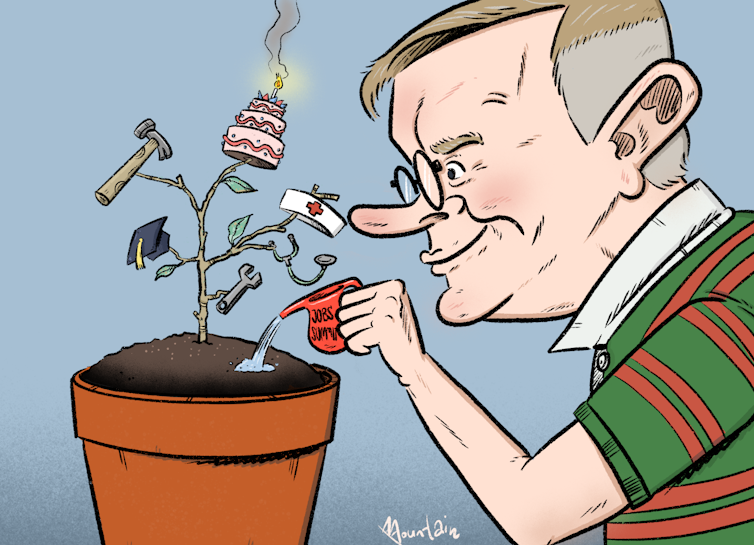
Next week’s Jobs Summit is, in part, an attempt to do something about wages. But the issues paper released ahead of the summit is curiously bereft of ideas about how.

The paper says wages have traditionally climbed with labour productivity (which is output per hour worked) and that productivity growth has fallen to its lowest in 50 years.

It says if businesses invested more in labour-saving technology and workers got a better mix of skills, productivity growth would climb, but (and it’s a big but) that growth would only flow through to wages “over the medium term”.

Which leaves… not much happening for wages in the meantime.

Silent on what the states should do

The other things the paper notes are that fewer workers are covered by enterprise agreements and more by Fair Work Commission awards (presumably because enterprise agreements have expired, or aren’t high enough) and that 23% of workers are casuals (a figure that hasn’t changed much in 20 years).

What the summit paper doesn’t mention, but ought to, is that governments set wages – the wages of their own employees.

The lowest-paid quarter of the workforce has its wages set by the Fair Work Commission, either via the minimum wage or awards.

The Fair Work Commission looks after these people by usually increasing their wages in line with the consumer price index, and often by more.


Private employers are offering more, where they can

Most of the rest of the workforce gets only what their employers agree to, and the good news here is that, increasingly, employers are offering more.

Two years ago, as COVID took hold, the private employers who did lift wages offered an average of 0.8%. One year later, in the year to June 2021, they offered 2.7%. In the year to June this year they offered 3.8%.

Of course many private employers can’t offer much. They are small, and are being squeezed by soaring costs.

But governments budget in billions, and can afford to offer whatever they think they should, covering it with tax or borrowing.

The Commonwealth government, under Albanese, employs one quarter of a million Australians. The states, with whom Albanese could have a word, employ 1.6 million – many of them teachers and nurses.

Yet far from increasing their wages in line with inflation, or even in line with private sector increases, Australia’s states have been extraordinarily stingy.

Governments are offering as little as 1.5%

Victoria’s wages policy, announced in January, is for a cap on annual increases of 1.5%. Western Australia, despite its large budget surplus, was limiting increases to 2.5%. In July it lifted the offer to 3% with a one-off $2,500 cost of living payment.

NSW has a ceiling of 3%, which falls back to 2.5% after two years. (And the NSW ceiling is lower than it seems. It includes employers’ super contributions, which are to climb by 0.5 percentage points a year for the next few years, making the quoted ceiling of 3% a ceiling of 2.5% for take-home pay.)

Using Bureau of Statistics figures to examine the increases actually paid (as opposed to offered) shows Western Australian public sector wages climbed just 1.1% in the year to June. South Australian public sector wages climbed 1.7%.

In Victoria and NSW, the increases were 2% and 2.1%. Only Queensland, which shelled out 4%, paid anything approaching the rate of inflation.

Nurses and teachers hit hard

This stinginess hits most the two biggest groups of state government employees: teachers and nurses.

Whereas public wages as a whole climbed 2.4% over the past year, the wages of public education and training workers climbed 2.2%.

A Bureau of Statistics breakdown prepared for The Conversation shows that in NSW and Victoria those workers (mainly teachers) got just 2%. In Victoria, health care and social assistance workers (largely nurses) got 1.7%.

Economic research suggests the states are stingy, in part because they can be. They are the only big employer of nurses, teachers, police and public servants.

The PM could have a word

If Albanese means what he says about wages keeping pace with inflation, his next step should be to ask his mates in the states to do more. Most of the premiers are from his side of politics. All of them will be at the Jobs Summit.

There are signs he is putting his own house in order. His departments have been told not to enter into new agreements while the previous penny-pinching wages policy is under review, and he has backed a big rise for aged care workers (whose wages the Commonwealth funds) in a submission to the Fair Work Commission.

But going easy on the states, as he has so far, while telling private sector employers with far smaller financial resources to lift wages, makes it look as if he is not serious.

If he genuinely believes wages ought to keep pace with inflation, he ought to name and shame his Labor mates.The Conversation

This article is republished from The Conversation under a Creative Commons license. Read the original article.

Read more >>

Tuesday, August 16, 2022

Why unemployment is set to stay below 5% for years to come

Unfathomably, Australia’s unemployment rate has sunk to 3.5%. Even harder to believe is that it will soon sink lower – perhaps even this week, when the update is released on Thursday – and after that, if the ANZ’s forecasts are correct, dip below the next threshold to two-point-something for the first time since 1974.

That this can be happening at a time when interest rates are soaring and households are tightening their belts belies standard analysis.

So what’s driving this new ultra-low unemployment? It’s been harder for employers to get workers, because borders were closed, and because of unusually high rates of people off sick.

But digging further into the economic data reveals something we haven’t seen before – which has already changed the lives of almost 100,000 Australians.

Time lost to illness has almost doubled

Even now, an awful lot of workers on whom employers normally depend are sick, or on reduced hours, caring for someone who is sick.

In the years before COVID (and in the first two years of COVID itself), typically 3% of the workforce worked less than usual hours in any given week as a result of illness or injury. Calculations by the University of Melbourne’s Jeff Borland suggest so far this year it’s been 5.2%.

The effect isn’t quite as dramatic when you examine the number of hours lost. Pre-COVID (and in the first two years of COVID) 2% of working hours were lost to illness. So far this year, with so many of us ill, it’s been 3.8%.

As a sign at a doctor’s surgery I visited the other day read:

The whole world is short-staffed, be KIND to those who show up.

Borland illustrates what sickness is doing to employment by talking about a cafĂ© with five staff. He says if one is away one day per week on average, the cafe might have to put on a sixth to cover – if it can. Unfilled vacancies are higher than ever.

It’s also true (at least until now) we’ve been spending big-time, spurred on by pent-up demand from when we were all in lockdown, as well as ultra-low interest rates and generous government support.

We escaped the jobless ‘escalator’

But there’s something else explaining our new ultra-low unemployment, something that flows from the nature of the labour market – and how it’s different from the market for goods in shops.

You can see it most clearly when unemployment climbs.

In the half century we have been collecting modern employment statistics, unemployment has shot up dramatically three times:

  • in the mid 1970s, when it jumped from 2.1% to 5.4% in a matter of months and never came back down

  • in the early 1980s, when it jumped from 5.3% to 10.3%, and took six years to come back down

  • in the early 1990s, when it jumped from 5.8% to 11.2%, and took seven years to come back down.


Each time, unemployment went up by the escalator, and down by the stairs.

Remarkably, as the graph shows, that’s not what happened during the global financial crisis or COVID. Instead, both times the government and Reserve Bank went hard and early with as much support as it took to prevent unemployment climbing too far.

If unemployment had shot up as it had in earlier crises, it might have taken the best part of a decade to get down.

The long-lasting scars of unemployment

Economists use an ugly word to describe the reasons why unemployment stays high long after the reason for high unemployment has passed. It’s “scarring”.

Each person who loses their job or who is unable to get a first job when unemployment shoots up can lose confidence and up-to-date work experience.

Then, as things improve and employers begin hiring again, people who have been out of work for longer get pushed back in the queue. Employers find it safer to take on new graduates or people with more recent experience.

The more those who were unlucky during a crisis get pushed to the back of the queue, the less employable they seem – and the less employable they become.

This puts a new higher “floor” under the unemployment rate, because it gets to the point where employers would rather not fill a vacancy than put on someone who’s been continually passed over.

It’s a phenomenon well known to the Treasury and Reserve Bank. What’s less well known, and is only now becoming apparent, is that it can work in reverse.

Almost 100,000 lives already transformed

If employers are forced to hire people they wouldn’t have in other circumstances, because they’ve run out of every other conceivable option, those people become employable. They either develop the right skills, or employers discover they are not so bad after all. The floor under the unemployment rate drops.

We haven’t seen this before – at least, not in the past half century – because employers have never before been given no other option but to employ people they would really rather not.

People are regarded as long-term unemployed (and harder to employ) if they’ve been out of work for one year or more. In the year to June 2022, the number of long-term unemployed fell from 218,200 to 130,100.

That fall is far more important than the fall in the total number of unemployed from 682,400 to 493,900.

It means those Australians are more likely to be employed than shunned for years to come. It means future employments rates are more likely to start with a “2”, a “3” or a “4” than a “5”.

It means we’ve bought ourselves long-lasting lower unemployment, whatever happens from here on.

It also means the best part of 100,000 lives have been transformed. It means the best part of 100,000 people no longer face years on JobSeeker.

And it means we’ve discovered something really useful.

Just as a crisis that renders people near unemployable can lift the floor under unemployment for years to come, a crisis that forces employers to take on people rendered near unemployable can cut it, perhaps for a very long time.The Conversation

This article is republished from The Conversation under a Creative Commons license. Read the original article.

Read more >>

Sunday, August 14, 2022

‘It’s important not to overreact’: top economists on how to fix inflation


Wes Mountain/The ConversationCC BY-ND

Australia’s top economists are divided about how to tackle ballooning inflation of 6.1% that’s forecast to climb to a three-decade high of 7.75% by the end of the year.

Three of the 48 leading economists surveyed by the Economic Society of Australia and The Conversation say Australia should be able to tolerate an inflation rate of 8% or higher.

Seven expect inflation to fall back to an acceptable level without the need for any further action other than Reserve Bank adjustments to interest rates.

That view was lent weight by news from the United States last week that annual inflation slid from 9.1% to 8.5% in July, after inflation of zero over the month.


Asked how high an inflation rate Australia should be prepared to tolerate, most nominated a rate at the top of or above the Reserve Bank’s 2-3% target band.

Twelve nominated a rate well above the target band.

Ten said the step-up in inflation was primarily caused by events overseas not within Australia’s power to control.

The economists polled are recognised as leaders in their fields, including economic modelling and public policy. Among them are former Reserve Bank, Treasury and OECD officials, and a former member of the Reserve Bank board.


Beyond rate rises, what could be done?

There are three kinds of actions governments can take to bring consumer price inflation down

  • actions that suppress consumer spending (“demand”)

  • actions that boost the supply of goods and services (“supply”)

  • actions that directly restrain prices

Invited to choose from a menu of options, and add options to the menu, the panel placed slightly greater weight on measures to restrain demand than measures to boost supply, and greater weight on both than measures to directly restrain prices.

The most popular measure, backed by 37% of those surveyed, was winding back government spending. Almost as popular, backed by 33%, was a super-profits tax on fossil fuel producers, with the proceeds used to reduce cost of services.


Another tax measure – increased income taxes with the proceeds used to reduce cost of services – was backed by 17%. Two of those surveyed wanted to abandon the legislated Stage 3 tax cuts for higher earners due to take effect in 2024.

But several of those who advocated winding back government spending or boosting tax did so without enthusiasm, believing that while the government should be prepared to assist the Reserve Bank in suppressing consumer demand, suppressing demand wouldn’t tackle the main reasons prices were climbing.

The risks of doing too much

The Australian National University’s Robert Breunig said much of the inflationary pressure had come from things such as oil prices that were beyond the power of Australians to influence, making it “important not to overreact”.

Melbourne University banking specialist Kevin Davis said what appeared to be high inflation might actually mainly be a series of short-term supply-induced price rises, making it hard to see how choking demand could do much good.

Australia’s current ultra-low unemployment rate was an achievement that should be celebrated, rather than put at risk without a good reason.

If high inflation did stay for a while and spread to wages, a welcome side effect would be more affordable housing.

Curtin University macroeconomist Harry Bloch made the point that while measures to suppress demand in Europe and the United States would indeed have an impact on global energy and food prices, that wasn’t true of measures to suppress demand in Australia, which is too small to influence global prices.

Consulting economist Rana Roy disagreed, saying the fact that high inflation wasn’t primarily caused by excess demand was no reason not to treat it by containing demand. Whatever the cause, containing demand would contain inflation.

Mala Raghavan from the University of Tasmania and Leonora Risse from RMIT University suggested winding back or delaying spending in two areas where it was clear the government was contributing to domestically-driven higher prices: subsidies for, and spending on, construction and infrastructure.

Withholding gas, boosting immigration

The most popular ideas for boosting the supply of goods and services to take pressure off inflation were reserving a portion of Australian gas and other commodities for domestic use, and boosting immigration, supported by 33% and 29% of the economists surveyed.


Reserving a portion of Australian east coast gas for use in Australia would help decouple Australia’s east coast gas prices from sky-high international prices as has happened in Western Australia, which reserves 15% of its gas for domestic use.

Boosting immigration would take pressure off costs by easing labour shortages.

Federation University’s Margaret McKenzie suggested investigating blockages in supply chains and offering diplomatic and industry support to bust them.

Subsidising childcare, subsidising fuel

The most popular idea for directly restraining prices was increased subsidies for childcare, supported by 25% of the economists surveyed, several of whom suggested it could also boost the supply of workers who had previously been prevented from working by unaffordable childcare.


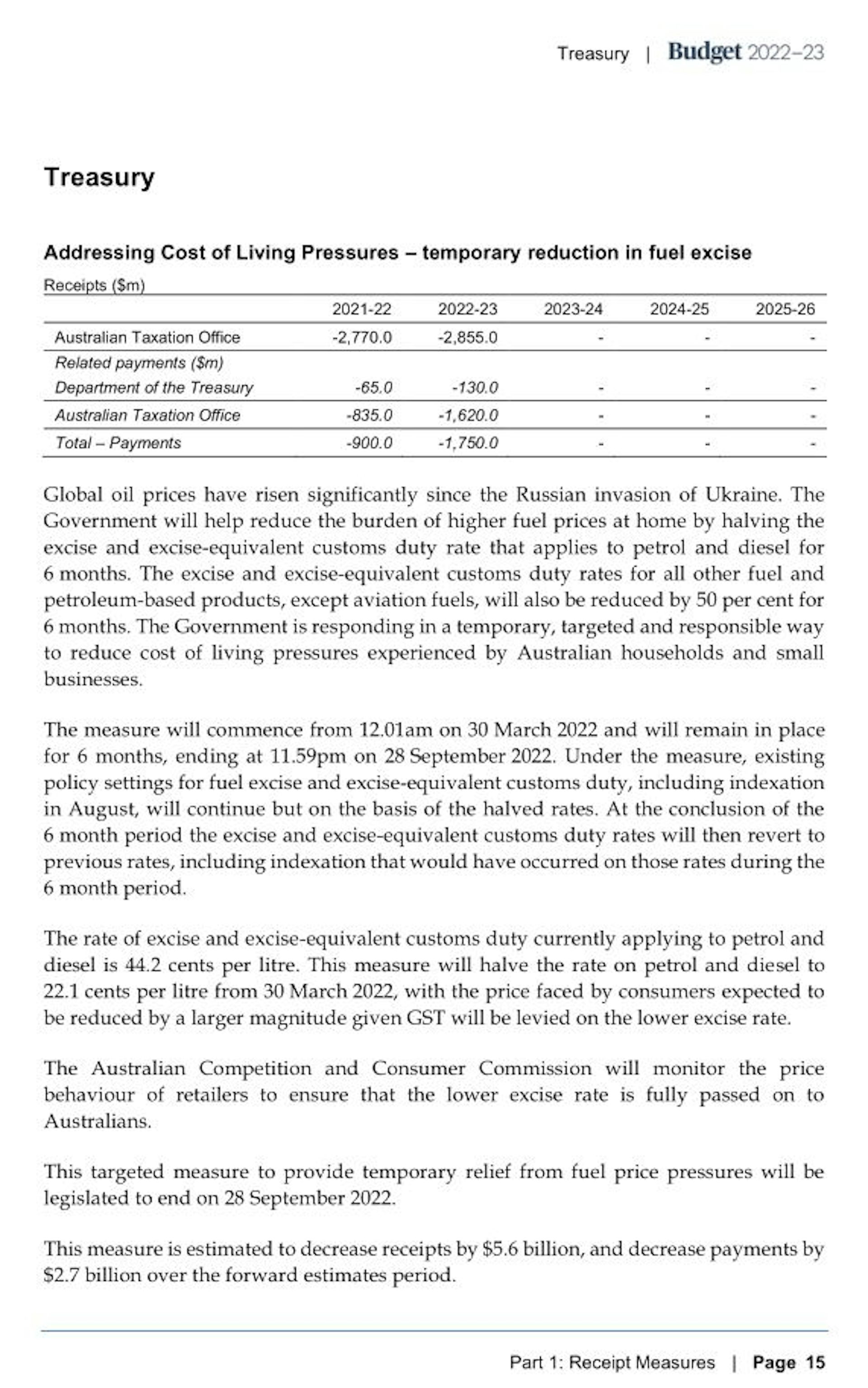
Other ideas that would directly restrain some prices included pushing for below-inflation wage rises in the Fair Work Commission and extending the six-month cut in fuel excise due to expire in September.

Former Reserve Bank board member Warwick McKibbin warned against pursuing low inflation for its own sake, saying when the economy was weak or in recession a high rate of inflation could be more easily justified than at other times.

He said the Reserve Bank should stop targeting inflation and instead target the rate of growth in national spending, an idea he will be putting to the independent review of its operations.


Detailed responses:

The Conversation

This article is republished from The Conversation under a Creative Commons license. Read the original article.

Read more >>

Tuesday, August 02, 2022

The RBA is hiking rates because it’s scared it can’t contain inflation

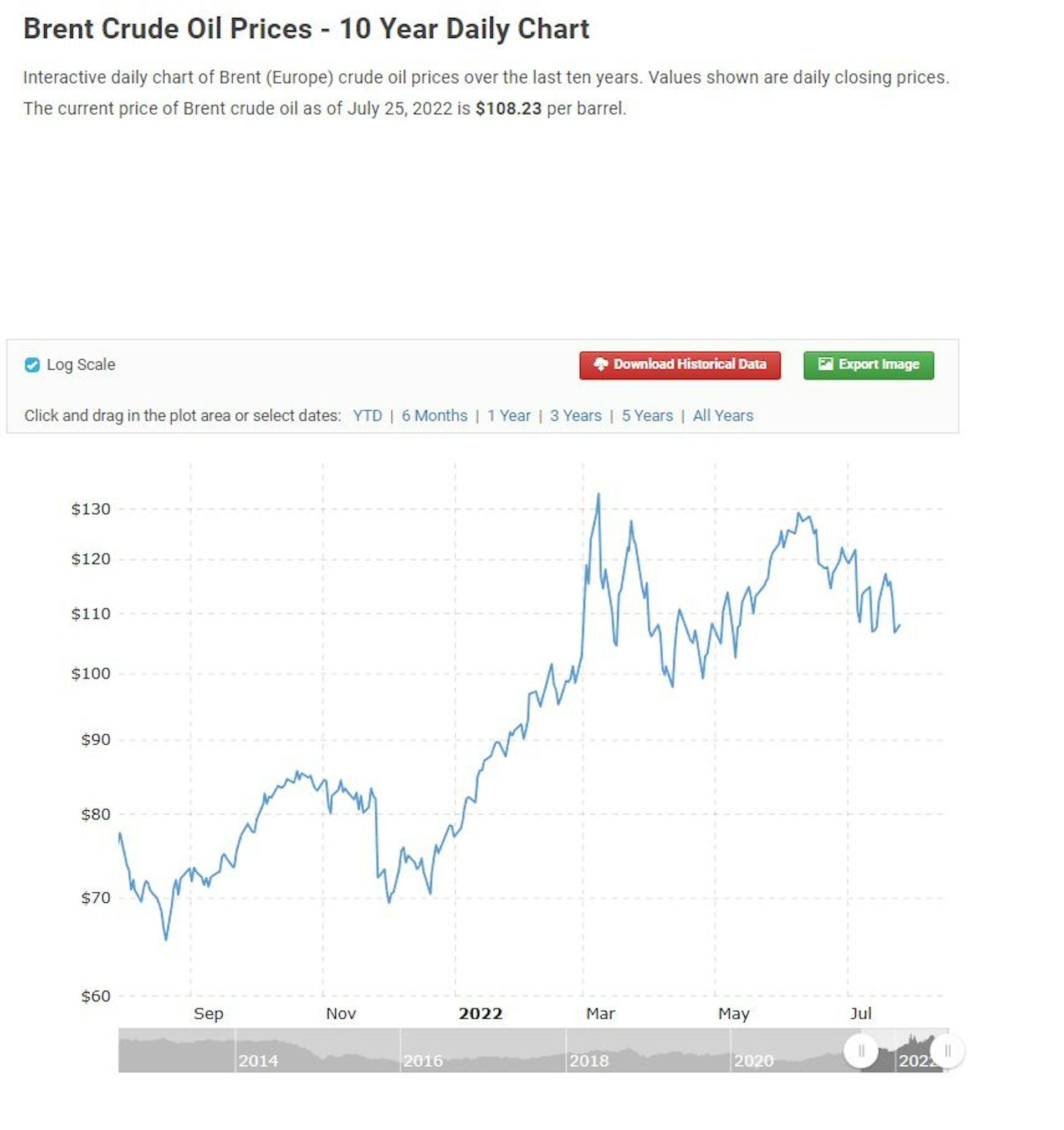
There are signs inflation pressures are easing. Oil prices are down almost 20% on their peak in March. They’ve been falling consistently for a month.

The average capital city unleaded price is down from A$2.11 per litre in early July to a more bearable $1.74.

The money market is pricing in much lower inflation than we presently have over the next one to four years, and consumers’ inflation expectations (although still high at 6.3%) eased off a bit between June and July.

So why did the Reserve Bank just hike its cash rate by an outsized 0.50 percentage points for the third consecutive month, taking it to 1.85%?

Partly because it knows what is to come.

Higher inflation in store

The 6.1% inflation figure released last week was for the year leading to the quarter that ended in June. Since then, in July, we’ve been hit by massive electricity price increases, some as high as 19%, and gas prices that have manufacturers screaming.

The monthly inflation gauge compiled by the Melbourne Institute (the Bureau of Statistics hasn’t yet gone monthly) kicked up 2.1% in July, the biggest monthly jump in two decades.

And there’s something else.

The Reserve Bank’s deepest fear might be that it can’t contain inflation, and that its apparent success over three decades has owed a lot to luck.

Reserve banks blessed by luck

Inflation fell to low levels throughout the world around the world at about the time it fell to low levels in Australia. From the mid 1990s, inflation fell to 2-3% in the US, the UK, Canada and just about every other Western nation, as China deluged the world with low-priced goods and companies began offshoring.

It got to the point where almost as many prices were falling as rising.

The US economic historian Adam Tooze says it’s reasonable to ask whether we had inflation at all from the mid 1990s onwards.

The Bank for International Settlements defines inflation as a “largely synchronous increase in the prices of goods and services” – a situation where prices broadly climb together.

Little real inflation for 30 years

It needs to be largely synchronous to qualify as inflation because otherwise the amount a dollar can buy isn’t clearly changing – any such effect is overwhelmed by changes in the mix of goods and services a dollar can buy.

It is only when prices start to move together, as they are now, that inflation gets normalised and becomes entrenched.

Twenty years ago, in June 2002, by my count 20 of the 87 types of items that made up the consumer price index fell in price. Ten years ago, 32 fell in price.

By economist Saul Eslake’s count, this June only 15 of what are now 90 expenditure classes fell in price – what appears to be the lowest number in decades.

Suddenly, price rises are synchronised

It means the Reserve Bank is having to deal with broad-based inflation of a kind it hasn’t faced since it began targeting inflation in the early 1990s.

Just about the only tool it has to do it – higher interest rates – makes people poorer.

Higher interest rates work in other ways as well.

  • they increase the reward for saving, diverting some money from spending

  • they make it harder to borrow, diverting more money from spending

  • and they push up the exchange rate, making imported goods cheaper – or they would have, were other central banks not also pushing up their rates, meaning the Australian dollar is no higher than it was when the bank began pushing up rates in May.

But their chief effect is impoverishing variable mortgage holders, to the tune of hundreds of dollars a month.

The more variable mortgage rates go up (Tuesday’s hike will push up the ANZ standard rate from 4.24% to 4.74%) the less mortgage holders have to spend on other things, and the less they will add to price pressure.

That’s the idea. And it is disingenuous to pretend otherwise.

Mortgage buffers are scant protection

In a speech last month Reserve Bank Deputy Governor Michele Bullock said households in aggregate were “well positioned”.

They had saved $260 billion since the start of the pandemic, much of which had gone into redraw facilities and offset and deposit accounts.

Around half were almost two years ahead on mortgage payments, or more. They had “large buffers”.

But, as University of Newcastle economist Bill Mitchell points out, by the bank’s own logic, this just means it will have to squeeze them harder.

It wants Australians to spend less and, if they use their buffers to keep spending as they have, it will have to either give up, or push rates higher until they do.

RBA Governor Philip Lowe says he is navigating a “narrow path” to curb inflation without too much pain. He can’t be certain he knows the way.The Conversation

This article is republished from The Conversation under a Creative Commons license. Read the original article.

Read more >>