Sunday, May 26, 2024

Top economists give budget modest rating and doubt inflation will fall as planned

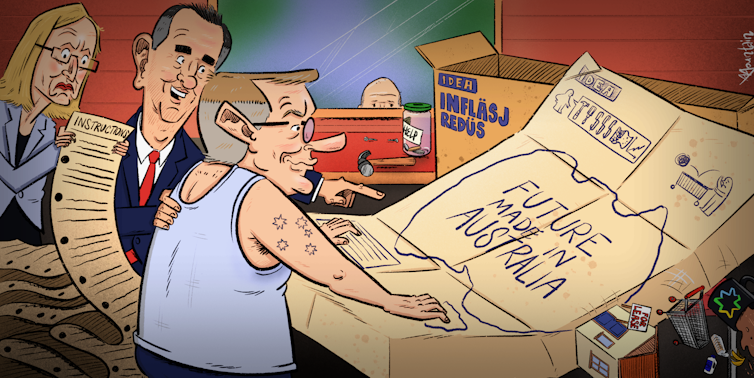
Wes Mountain/The Conversation

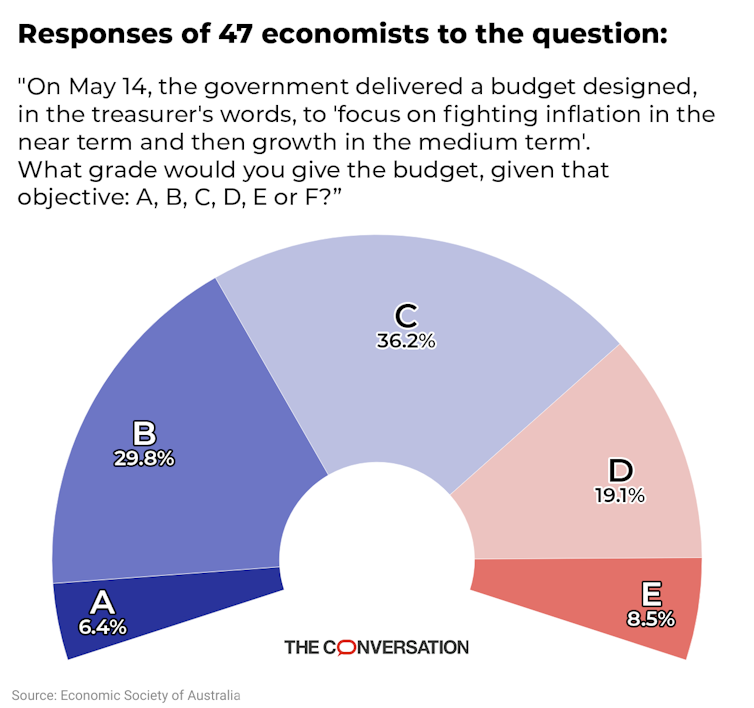
Asked to grade Treasurer Jim Chalmers’ third budget on his own criteria of delivering on “inflation in the near term and then growth in the medium term”, most of the 49 leading economists surveyed by the Economic Society of Australia and The Conversation have failed to give it top marks.

On a grading scale of A to F, 17 of the 49 economists – about one-third – give the budget an A or a B. Two have declined to offer a grade.

The result is a sharp comedown from Chalmers’ second budget in 2023. Two-thirds of the economists surveyed conferred an A or a B on that budget.

The economists chosen to take part in the post-budget Economic Society surveys are recognised by their peers as leaders in fields including macroeconomics, economic modelling, housing and budget policy.

Among them are a former head of the Department of Finance, a former Reserve Bank board member and former Treasury, International Monetary Fund and Organisation for Economic Co-operation and Development officials.

Thirteen of those surveyed – more than a quarter – give the budget a low mark of D or an E. None have given it the lowest possible mark of F.


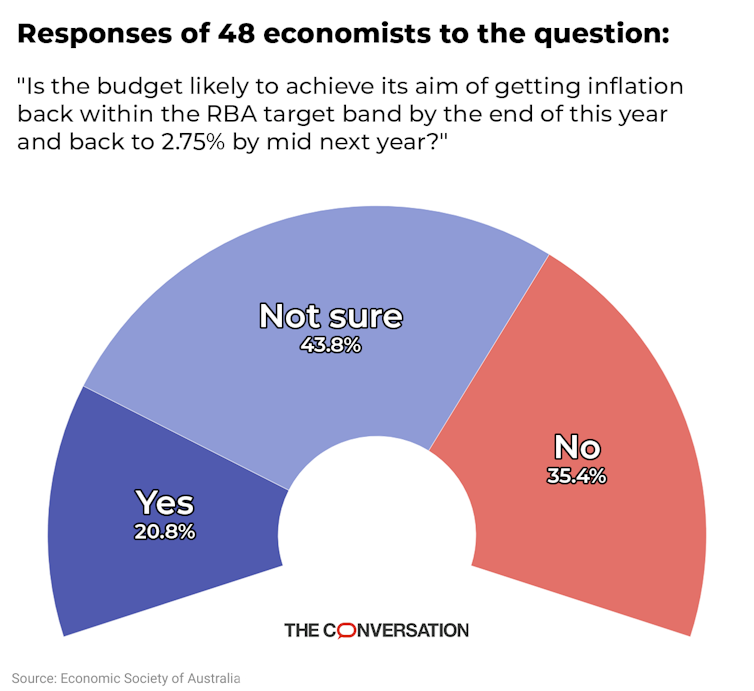
Asked whether the budget was likely to achieve its aim of getting inflation back within the Reserve Bank’s 2-3% target band by the end of this year, and back to 2.75% by mid next year, 17 thought it would not. Only ten thought it would.

A greater number – 21 – were not sure.


In his budget speech, Chalmers predicted inflation would come back to the Reserve Bank’s target band sooner than the 2025 expected by the Reserve Bank itself, “perhaps even by the end of this year”.

The budget papers forecast an inflation rate of 2.75% by mid-2025, well within the target band and a half a percentage point lower than the bank’s forecast.

The papers say two measures in the budget, not known to the Reserve Bank when it produced its forecasts in early May, explain why the budget forecast is half a percentage point lower.

They are an extra year of energy bill relief of $300 per household and $325 for eligible small businesses and a further 10% increase in the maximum rate of Commonwealth Rent Assistance.


If the lower budget forecast is correct, and if the Reserve Bank sticks to the letter of its agreement with the treasurer that requires it to aim for consumer price inflation between 2% and 3%, the bank is likely to cut interest rates late this year or early next year as inflation approaches its target zone.

But economists including Flavio Menezes from The University of Queensland say while the budget measures might “mechanically” suppress measured inflation, they are:

unlikely to alleviate underlying inflationary pressures and may even exacerbate them; for households not experiencing financial strain, lower energy bills could simply lead to increased spending in other areas.

Former Reserve Bank board member Warwick Mckibbin says the bank is likely to “see through” (ignore) the largely temporary mechanical price reductions and “raise interest rates to where they should be”.

Others surveyed, a minority, argue the economy is too weak for the extra spending in the budget to boost inflation through consumer spending. Former Finance Department Secretary Michael Keating says any stimulus is “likely to be swamped by the economic slowing well under way”.

Independent economist Saul Eslake said the subsidies for energy and rent would inject only $3 billion into the economy in 2024-25. This meant any boost they would give to underlying inflation would be hardly “material”.

Tax cuts matter more than energy rebates

More important for boosting the economy would be previously budgeted Stage 3 tax cuts. These are set to inject $23.3 billion per year from June, climbing to $107.2 billion over four years.

Eslake said the decision to reskew the tax cuts toward middle and lower earners had saved the government from the need to direct extra specific support to these people. Politically, the government could not have got away with doing nothing.

But Eslake was appalled to discover that the cost of the single biggest spending item in the budget, the untied grants to the states, had blown out even more than expected. The special top-up for Western Australia is now set to cost $53 billion over 11 years instead of the $8.9 billion over eight years expected in 2018.

How the national government could justify gifting $53 billion to the government of Australia’s richest state was beyond his comprehension.

Big issues unaddressed

A repeated theme among the economists was that the budget did very little to boost productivity or address persistent problems.

Several described it as an election budget, others a budget driven by polling.

Macquarie University’s Lisa Magnani said the lack of attention to home prices, the funding of public schools and the poor performance of Australian firms was concerning, given Chalmers’ claim it was a budget for “decades to come”.

Former Department of Foreign Affairs chief economist Jenny Gordon said the budget had failed to tackle the distortions in the housing market and the financial sustainability of needed services including health care, aged care and childcare.

Independent economist Nicki Hutley said crunch time for tax reform was coming, given the large baked-in increases in spending on defence, health and disability insurance and Australia’s over-reliance on income tax and company tax.

Warwick McKibbin said Australia’s main economic problems were its lack of productivity growth, the big changes needed to bring about the energy transition, the surge in artificial intelligence, the risk of much lower export prices and geopolitical uncertainty.

The government should have tried to build a bipartisan consensus about how to fix these.

Private investors were hanging back knowing that whatever the government did could be reversed at the next election.

Although many of those surveyed welcomed the Future Made in Australia Act, some criticised its approach of “picking winners” and “wasting precious resources” by putting money into activities such as the manufacture of solar panels, which could be done more cheaply elsewhere.

Bigger government

Former Industry Department chief economist Mark Cully said it was in some ways one of the most consequential budgets in years.

It locked in a clear shift towards higher spending and revenue, which, at around 26% of GDP, was higher than any other time Australia had been near full employment.

Future Made in Australia was the most marked intervention by a government in shaping the future direction of the economy for decades.


Individual responses. Click to open:

The Conversation


This article is republished from The Conversation under a Creative Commons license. Read the original article.

Read more >>

Tuesday, May 21, 2024

Peter Dutton makes Labor’s case. Tax breaks for landlords should be restricted to those who build homes

Opposition Leader Peter Dutton might have done us a favour.

As part of his budget reply speech on Thursday night he promised to stop foreigners buying existing Australian homes.

He didn’t only want to stop foreigners buying existing homes to live in, something they are able to do while here temporarily, as long as they they sell within three months of moving out.

He also wanted to stop them buying existing Australian homes to let to renters. He wanted to stop them being landlords. Not because landlords deprive us of homes to live in (they don’t) but because they deprive us of homes to own.

Every existing home that is owned by a landlord is a home that isn’t owned by an owner-occupier. It’s maths.

Foreign investors outbid residents

It was, Dutton said, pretty unfair to be at an auction “bidding against somebody who has very deep pockets and somebody who’s not an Australian citizen”.

Stopping foreign investors would help restore the “dream of home ownership”.

Here’s the favour. Dutton has pointed out something that’s true for all investors. By bidding against people who want to buy existing homes to live in, they are pushing up the price of those homes. When they succeed in buying an extra home, they ensure an owner-occupier does not.

Dutton has spelled out the maths.

He has acknowledged that, for foreign investors, the numbers aren’t big. It’s already hard for them to buy existing properties. In 2021-22, the most recent year for which we have figures, only 1,339 foreign investors bought existing properties.

But he told 3AW’s Tom Elliott that if there was anything that could be done, no matter how little, he would “jump at it”.

Local investors also outbid residents

There is something much bigger that could be done, which is to extend his idea to all would-be investors – every one of them who turns up at an auction for an existing property and bids against someone who wants to buy it to live in.

It’s hard to think of reasons why investors should be supported to bid against intending homebuyers. In the quarter century since the headline rate of capital gains tax was halved in 1999, investors have been supported by a particularly effective blend of negative gearing and capital gains tax concessions.

An extraordinary 2.2 million Australians now own investment properties – one in every six taxpayers. Thirty percent of them own two investment properties or more.

In the census before the change, 25.5% of households headed by someone aged 35-54 rented. In the most recent census it was 33.7%.

This isn’t because of a shortage of supply. It’s because a bigger chunk of the supply has been grabbed by landlords at the expense of Australians who in earlier years would have owned.

Had that bigger chunk not been grabbed, hundreds of thousands more Australians would own the homes they live in.

No one objects to investors who build new homes, increasing supply – certainly not Dutton. The two-year ban he put forward in his budget reply speech would have only stopped foreign investors buying existing properties. There would be nothing to stop them building and letting out new ones.

That’s how you would design a grander Dutton-style plan that applied to all investors. Labor put one forward at the 2016 and 2019 elections.

Labor had a plan like Dutton’s

Under Labor’s 2019 plan, negative gearing – the tax break that allows investors to write off losses they make from renters against their wage income – would no longer be available to new investors, except those who actually provided new homes.

Labor planned to

put negative gearing to work by limiting it to new investment properties to help boost housing supply and jobs

Negative gearing isn’t being put to work right now.

In March, the most recent month for which we have statistics, only 2,048 of Australia’s 16,948 property investment loans were for building new homes. Most of the rest went to investors who were going to compete against would-be residents to buy existing properties.

Labor says restricting negative gearing is no longer its plan.

On ABC Q&A on Monday Treasurer Jim Chalmers said he “wasn’t attracted” to the idea of changing negative gearing, yet he repeatedly said there was “no substitute for building new homes”

What Labor proposed in 2016 and 2019 would have directed investors towards building new homes.

It’s worth doing both because it would help create new homes and because it would reduce the number of would-be landlords going up against would-be homeowners at auctions.

Q&A. ABC

One of those intending homebuyers, Jessica Whitby, who was outbid at an auction in Chalmers’ electorate, asked him on Monday to “disincentivise people who are purchasing multiple investment properties to assist first home buyers to get into the market sooner”.

Chalmers replied the thing that mattered most was supply, but he didn’t mention that what Whitby was proposing used to be Labor Party policy, didn’t acknowledge that it would encourage supply, and didn’t acknowledge that (in theory at least) Dutton appears to agree.

Support from many quarters

And not only Dutton. Scott Morrison expressed concern about the “excesses” of negative gearing as treasurer in 2016. His predecessor, Joe Hockey, said on leaving parliament that negative gearing should be skewed toward new housing so there was “an incentive to add to the housing stock”.

It’s as if almost everyone can see the sort of thing that needs to be done.

Australia’s negative gearing and capital gains tax concessions are incredibly expensive. The treasury costs negative gearing alone at $2.7 billion per year.

At least in principle, there’s agreement about how to make it work for us.The Conversation

This article is republished from The Conversation under a Creative Commons license. Read the original article.
Read more >>

Tuesday, May 07, 2024

If the RBA’s right, interest rates may not fall for another year. Here’s why – and what it means for next week’s budget

The Reserve Bank is now assuming Australians will see no interest rate cuts this year – and quite possibly none before the next federal election, due next May.

That’s a big change compared to just three months ago. Back in February, the Reserve Bank assumed three rate cuts before the middle of the next year.

Its newly-updated assumptions have interest rates remaining high for the rest of this year, then declining only slowly, with a cut by May 2025 about as unlikely as it is likely.


The assumptions are based on financial market pricing, which the bank says is “the best predictor of the future cash rate path”.

What changed the market pricing and the bank’s forecasts? Inflation.

That’s posing a big challenge for the Albanese government as it prepares for next week’s federal budget.

Rates on hold amid rising inflation

In its statement on Tuesday explaining why it was leaving its cash rate on hold at 4.35%, the Reserve Bank board sharpened its language about inflation.

It’s now forecasting an increase in inflation later this year and warning that getting it down is proving harder “than previously expected”.

The updated forecasts have the annual rate of inflation climbing from its present 3.6% to 3.8% in June and staying there for the rest of the year, before falling back in line with the bank’s previous forecast released in February.


Both forecasts have inflation remaining above the bank’s 2-3% target band until late 2025, and both have it not returning to the centre of the band until mid-2026.

US rate cuts are also on hold

It’s a similar story in the United States, with the expected date of rate cuts blowing out there as well.

There, as here, the monthly measure of annual inflation rate remains stuck at 3.5%. In both countries, it’s no lower than it was late last year.

The chair of the US Federal Reserve Jerome Powell now says he won’t cut rates until he is more confident inflation is heading back down towards his target, adding it is likely to take longer than expected to get that confidence.

The budget will focus on more than inflation

So what’s Treasurer Jim Chalmers planning to do on budget night next week to give the Reserve Bank more confidence inflation is clearly heading down?

Not that much – and certainly not nearly as much as in previous budgets.

Chalmers’ opposite number, Coalition Treasury spokesman Angus Taylor, says the treasurer should “stop the spend-a-thon”, by which he means containing growth in government spending to take pressure off inflation.

It’s advice Chalmers and Finance Minister Katy Gallagher won’t be following this time. And not because they don’t understand the thinking behind it.

Restraining spending (and pushing up tax) would indeed take pressure off prices. Chalmers and Gallagher could say they’ve cut $50 billion off spending over the past two years. But a further big cut might push the economy into free fall.

We’re buying and dining out less

The Australian economy is alarmingly weak. As the Reserve Bank board met on Tuesday, the Bureau of Statistics released its latest estimates of the volumes of goods and services bought from online and physical stores.

The estimates are price-adjusted, which in this case means that while what we spent climbed (a tiny) 0.8% over the year to March, what we bought fell 1.3%.

The amount of food we bought fell 1.5%. The amount of household goods we bought fell 1.8%. And the amount we bought from cafes and restaurants fell 2.5%.

The only category in which buying has climbed over the past year was clothing and footwear, and only by 0.3%.

All this has happened in a year in which the Australian population grew by more than 2% – which means the reduced amount of things we have bought has had to feed, clothe and service about an extra 600,000 of us.

Chalmers knows this. It’s consistent with the national accounts, which show the amount we’ve spent and earned per person has shrunk over the past year, in a so-called per capita recession.

The Australian National University’s latest ANUPoll finds us more financially stressed than during the depths of the COVID lockdowns.

Twenty per cent of us say we have borrowed money from friends or relatives over the past year, up from 16% during the lockdowns. Meanwhile, 21% have fallen behind on our bills, up from 17%; and 62% of us have cut our spending on groceries and essential items, up from 43%.

A ‘scorched earth’ budget risks recession

It means that a further big cut in government spending – right now – could push us from a per capita recession into an actual recession.

It’s why Chalmers said on Monday now was “not the time for scorched earth austerity”. He won’t slash and burn while the economy is weak.

After three budget updates in which he has spent less than previously forecast, in next Tuesday’s budget he will spend more – at least for some of the years for which he will produce projections.

Gallagher added this week she’s been as good as forced to spend more in some areas. Several programs introduced, but not properly funded, by the previous government are set to end abruptly. One is the leaving violence payment, which began as a trial.

Don’t expect rates to change soon

In fairness to the Reserve Bank, it too knows the economy is weak. Its updated forecasts released on Tuesday have downgraded expected economic growth to just 1.2% for the year to June and 1.6% for the year to December.

And it knows its 13 interest rate rises to date are yet to have their full effect.

Speaking at a press conference after the board’s decision to keep rates on hold, Governor Michele Bullock gave the impression that lifting rates further was still one of the furthest things from her mind.The Conversation

This article is republished from The Conversation under a Creative Commons license. Read the original article.
Read more >>

Wednesday, May 01, 2024

Australians lose $5,200 a minute to scammers. There’s a simple thing the government could do to reduce this. Why won’t they?

What if the government was doing everything it could to stop thieves making off with our money, except the one thing that could really work?

That’s how it looks when it comes to scams, which are attempts to trick us out of our funds, usually by getting us to hand over our identities or bank details or transfer funds.

Last year we lost an astonishing A$2.74 billion to scammers. That’s more than $5,200 per minute – and that’s only the scams we know about from the 601,000 Australians who made reports. Many more would have kept quiet.

If the theft of $5,200 per minute seems over the odds for a country Australia’s size, a comparison with the United Kingdom suggests you are right. In 2022, people in the UK lost £2,300 per minute, which is about A$4,400. The UK has two and a half times Australia’s population.

It’s as if international scammers, using SMS, phone calls, fake invoices and fake web addresses are targeting Australia, because in other places it’s harder.

If we want to cut Australians’ losses, it’s time to look at rules about to come into force in the UK.

Scams up 320% since 2020

The current federal government is doing a lot – almost everything it could. Within a year of taking office, it set up the National Anti-Scam Centre, which coordinates intelligence. Just this week, the centre reported that figure of $2.74 billion, which is down 13% on 2022, but up 50% on 2021 and 320% on 2020.

It’s planning “mandatory industry codes” for banks, telecommunication providers and digital platforms.

But the code it is proposing for banks, set out in a consultation paper late last year, is weak when compared to overseas.

Banks are the gatekeepers

Banks matter, because they are nearly always the means by which the money is transferred. Cryptocurrency is now much less used after the banks agreed to limit payments to high risk exchanges.

Here’s an example of the role played by banks. A woman the Consumer Action Law Centre is calling Amelia tried to sell a breast pump on Gumtree.

The buyer asked for her bank card number and a one-time PIN and used the code to whisk out $9,100, which was sent overseas. The bank wouldn’t help because she had provided the one-time PIN.

Here’s another. A woman the Competition and Consumer Commission is calling Niamh was contacted by someone using the National Australia Bank’s SMS ID. Niamh was told her account was compromised and talked through how to transfer $300,000 to a “secure” account.

After she had done it, the scammer told her it was a scam, laughed and said “we are in Brisbane, come find me”.

How bank rules protect scammers

And one more example. Former University of Melbourne academic Kim Sawyer (that’s his real name, he is prepared to go public) clicked on an ad for “St George Capital” displaying the dragon logo of St. George Bank.

He was called back by a man using the name of a real St. George employee, who persuaded him to transfer funds from accounts at the AMP, Citibank and Macquarie to accounts he was told would be in his and his wife’s name at Westpac, ANZ, the Commonwealth and Bendigo Banks.

They lost $2.5 million. Sawyer says none of the banks – those that sent the funds or those that received them – would help him. Some cited “privacy” reasons.

The Consumer Action Law Centre says the banks that transfer the scammed funds routinely tell their customers “it’s nothing to do with us, you transferred the money, we can’t help you”. The banks receiving the funds routinely say “you’re not our customer, we can’t help you”.

That’s here. Not in the UK.

UK bank customers get a better deal

In Australia in 2022, only 13% of attempted scam payments were stopped by banks before they took place. Once scammed, only 2% to 5% of losses (depending on the bank) were reimbursed or compensated.

In the UK, the top four banks pay out 49% to 73%.

And they are about to pay out much more. From October 2024, reimbursement will be compulsory. Where authorised fast payments are made “because of deception by fraudsters”, the banks will have to reimburse the lot.

Normally the bills will be split 50:50 between the bank transferring the funds and the bank receiving them. Unless there’s a need for further investigations, the payments must be made within five days.

The only exceptions are where the consumer seeking reimbursement has acted fraudulently or with gross negligence.

The idea behind the change – pushed through by the Conservative government now led by UK Prime Minister Rishi Sunak – is that if scams are the banks’ problem, if they are costing them millions at a time, they’ll stop them.

New Zealand is looking at doing the same thing, as is Singapore.

But here, the treasury’s discussion paper on its mandatory codes mentions reimbursement only once. That’s when it talks about what’s happening in the UK. Neither treasury nor the relevant federal minister is proposing it here.

Australia’s approach is softer

Assistant Treasurer Stephen Jones is in charge of Australia’s rules.

Asked why he wasn’t pushing for compulsory reimbursement here, Jones said on Monday prevention was better.

I think a simplistic approach of just saying, ‘Oh, well, if any loss, if anyone incurs a loss, then the bank always pay’, won’t work. It’ll just make Australia a honeypot for these international crime gangs, because they’ll say, well, ‘Let’s, you know, focus all of our activity on Australia because it’s a victimless crime if banks always pay’.

Telling banks to pay would certainly focus the minds of the banks, in the way they are about to be focused in the UK.

The Australian Banking Association hasn’t published its submission to the treasury review, but the Consumer Action Law Centre has.

It says if banks had to reimburse money lost, they’d have more of a reason to keep it safe.

In the UK, they are about to find out. If Jones is right, it might be about to become a honeypot for scammers. If he is wrong, his government will leave Australia even further behind when it comes to scams – leaving us thousands more dollars behind per day.The Conversation

This article is republished from The Conversation under a Creative Commons license. Read the original article.

Read more >>