Tuesday, April 23, 2024

Beyond the spin, beyond the handouts, here’s how to get a handle on what’s really happening on budget night

Three weeks from now, some of us will be presented with a mountain of budget papers, and just about all of us will get to hear about them on radio, TV or news websites on budget night.

The quickest way to find out what the budget is really doing will be to listen to the treasurer’s speech, or to peruse online the aptly-named “glossy” – a document that last year was titled “Stronger foundations for a better future”.
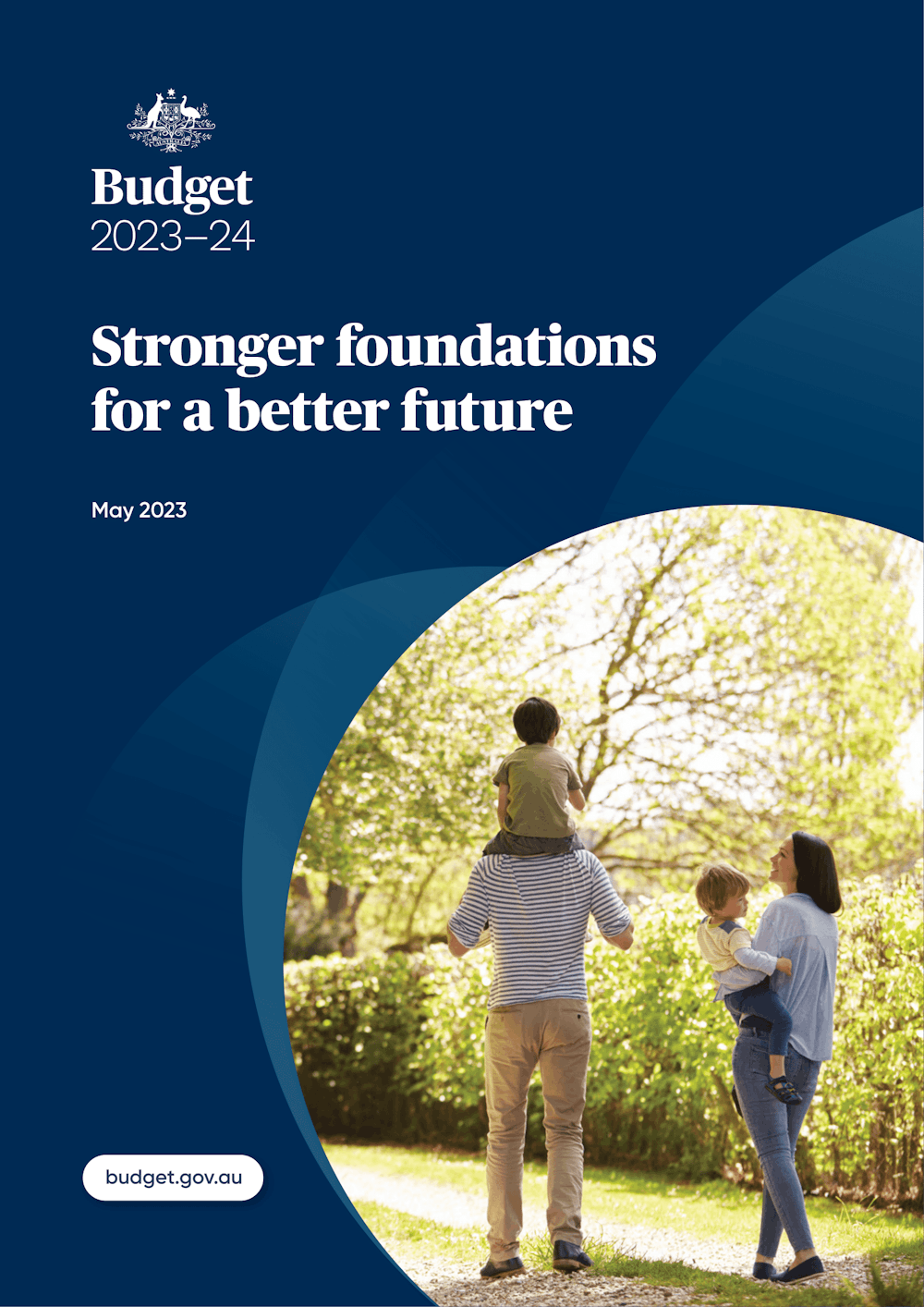
Cover of 2023 budget glossy

But they will tell you exactly what the government wants you to hear, exactly as it wants you to hear it.

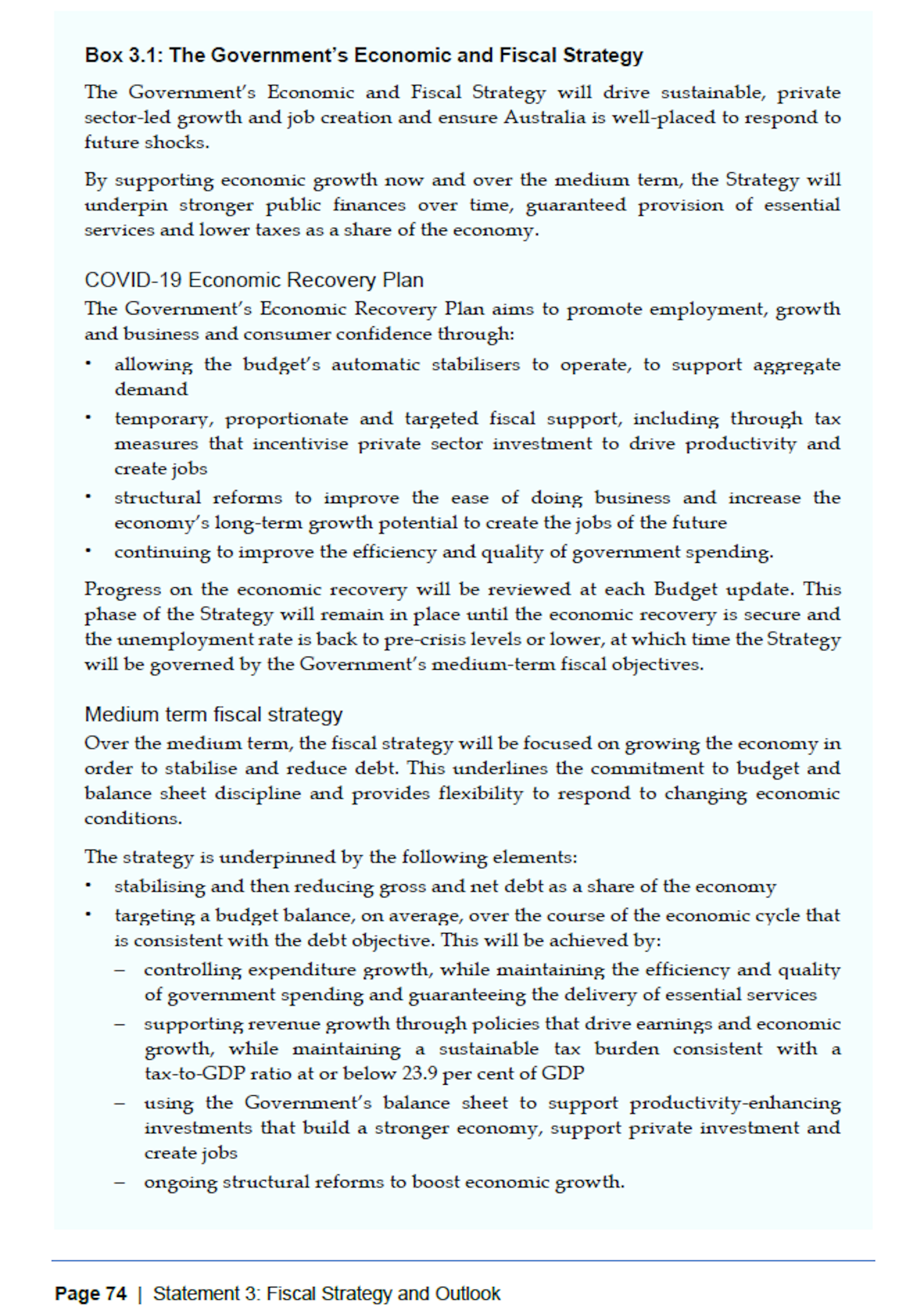
If you are looking instead for the truth – what the government is actually trying to achieve and what it is holding itself and its officials to, I would suggest something else, tucked away on about page 87 of the main budget document.

It is required by the Charter of Budget Honesty Act introduced in 1998 by Peter Costello, the treasurer under Prime Minister John Howard.

On taking office in 1996, Costello set up a National Commission of Audit to examine the finances he had inherited from the Hawke and Keating governments, presumably with an eye to discovering they had been mismanaged.

But the members of the commission weren’t much interested in that. Instead, they decided to deal with something more fundamental.

Budget as you wish, but explain your strategy

Governments were perfectly entitled to manage money in whatever way they wanted, and they were perfectly entitled to spend more money than they raised (which they usually do, it’s called a budget deficit).

What the commission wanted was for governments to make clear what they were doing, and to spell out the strategy behind it.

Only part of it was about being upfront with the public. The commission also wanted governments to be upfront with themselves – to actually develop frameworks for what they were doing, rather than doing whatever they felt like.

The commission recommended a Charter of Budget Honesty, which among other things requires officials to prepare independent assessments of the finances before each election, requires budget updates six months after each budget, and requires tax expenditures (tax breaks) to be accounted for like other expenditures.

And it requires the publication and regular updating of a fiscal strategy statement.

Where treasurers hold themselves accountable

The fiscal strategy can be thought of as an exam question set by the student who is being examined – something along the lines of “this is what you say you want your budget to achieve, please set out the means by which you plan to achieve it”.

It turns out to have been exceptionally effective in getting governments to organise their thoughts, make budgets at least try to achieve something, and let the rest of us know what they are trying to achieve.

Every few years, treasurers change the strategy, as is their right. Treasurer Jim Chalmers says he’ll change it again this budget, to de-emphasise the fight against inflation and to more greatly emphasise the need to support economic growth.

His statement will tell us what’s behind his actions in a way the glossy words in his brochure and speech might not.

The strategy that has signposted 26 years

Previous statements have signposted all the important turns in what the budget is trying to do.

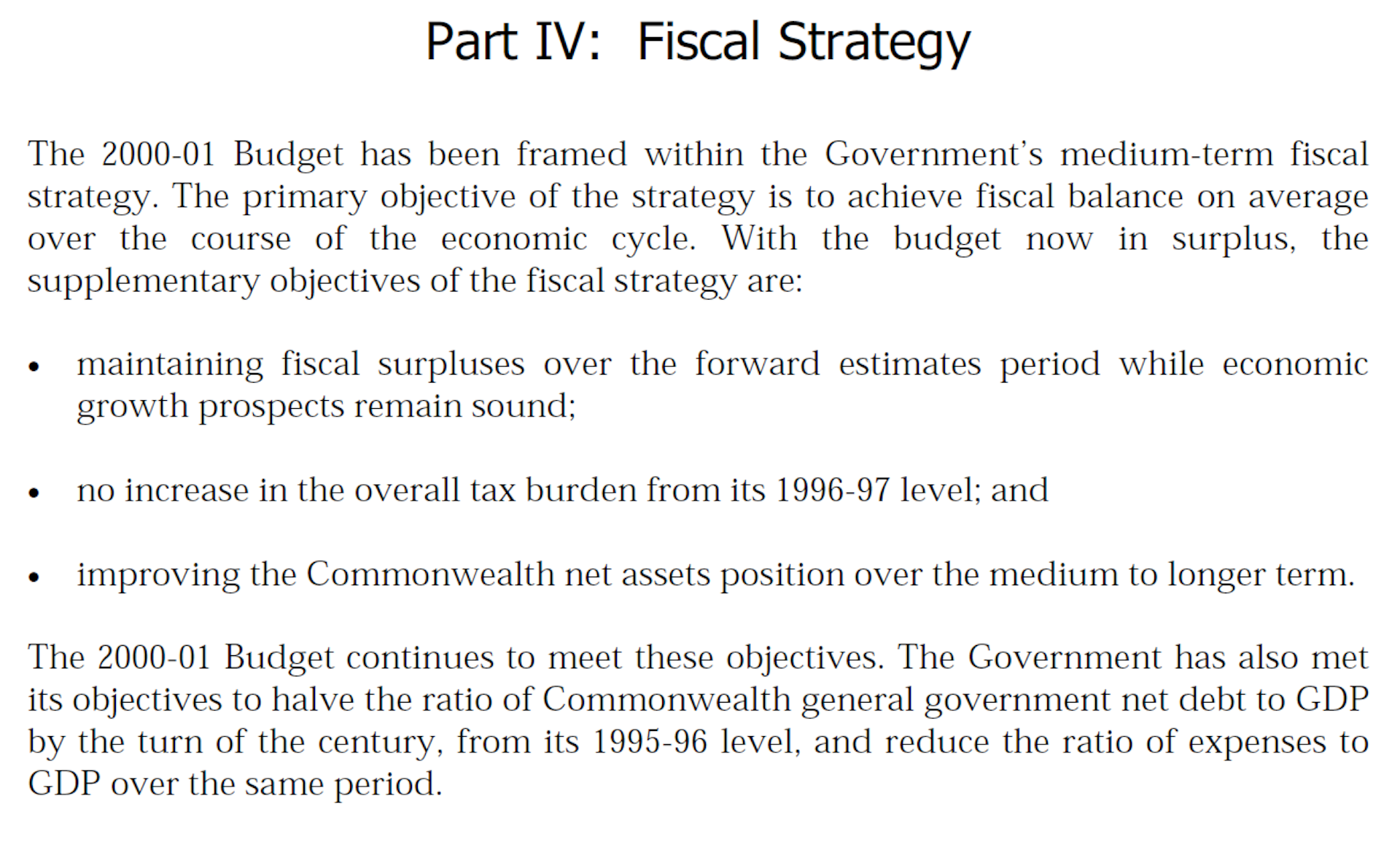
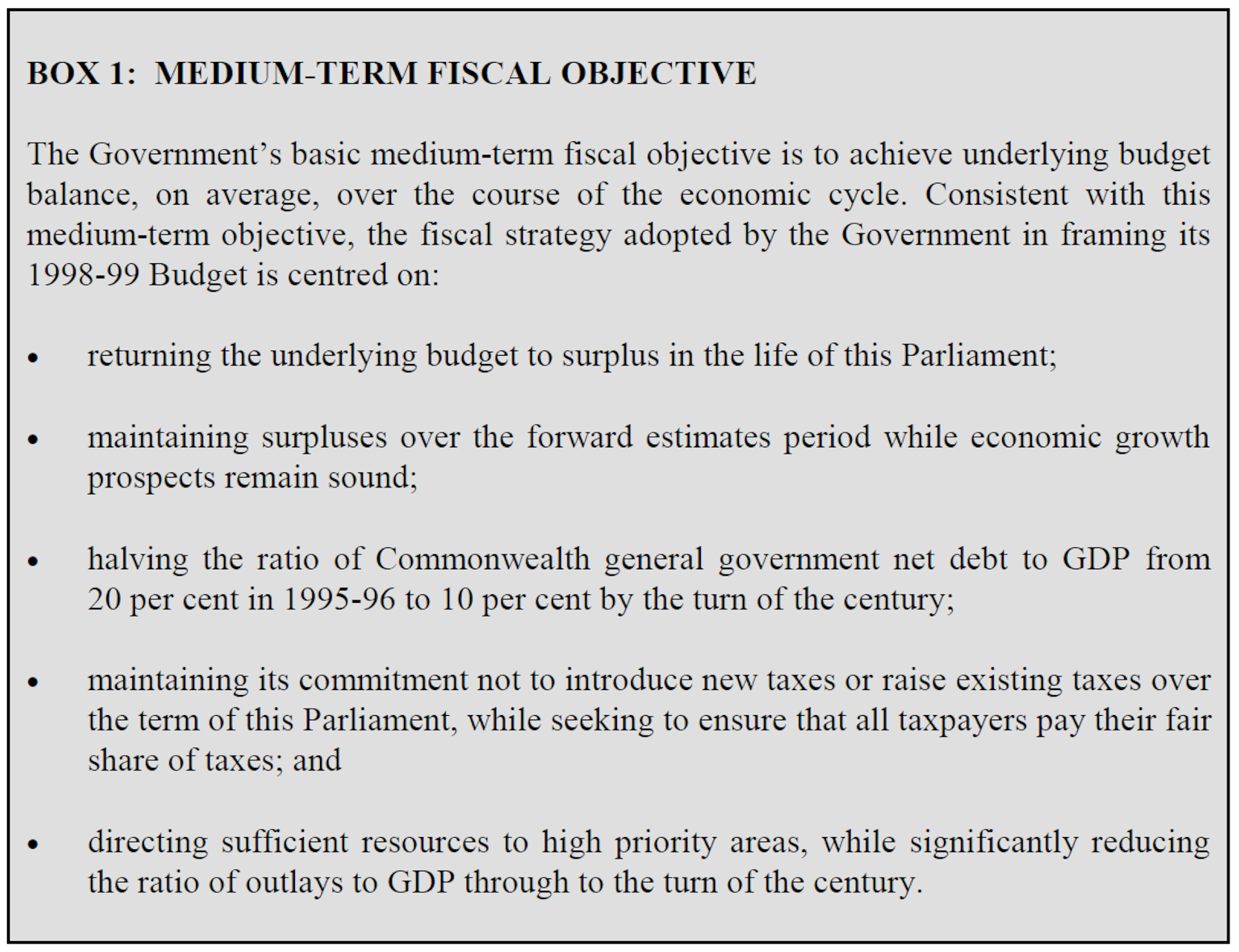
The first, in 1998, committed Costello and Howard to achieving a budget surplus on average over the economic cycle and whenever “growth prospects remain sound”.

Making that commitment more difficult was another “not to introduce new taxes or raise existing taxes over the term of this parliament”.

Two years later, after the government had won an election promising a new goods and services tax, that commitment was changed to “no increase in the overall tax burden from its 1996-97 level”, a condition met by calling the GST a state tax.

Hockey and Morrison wound back spending

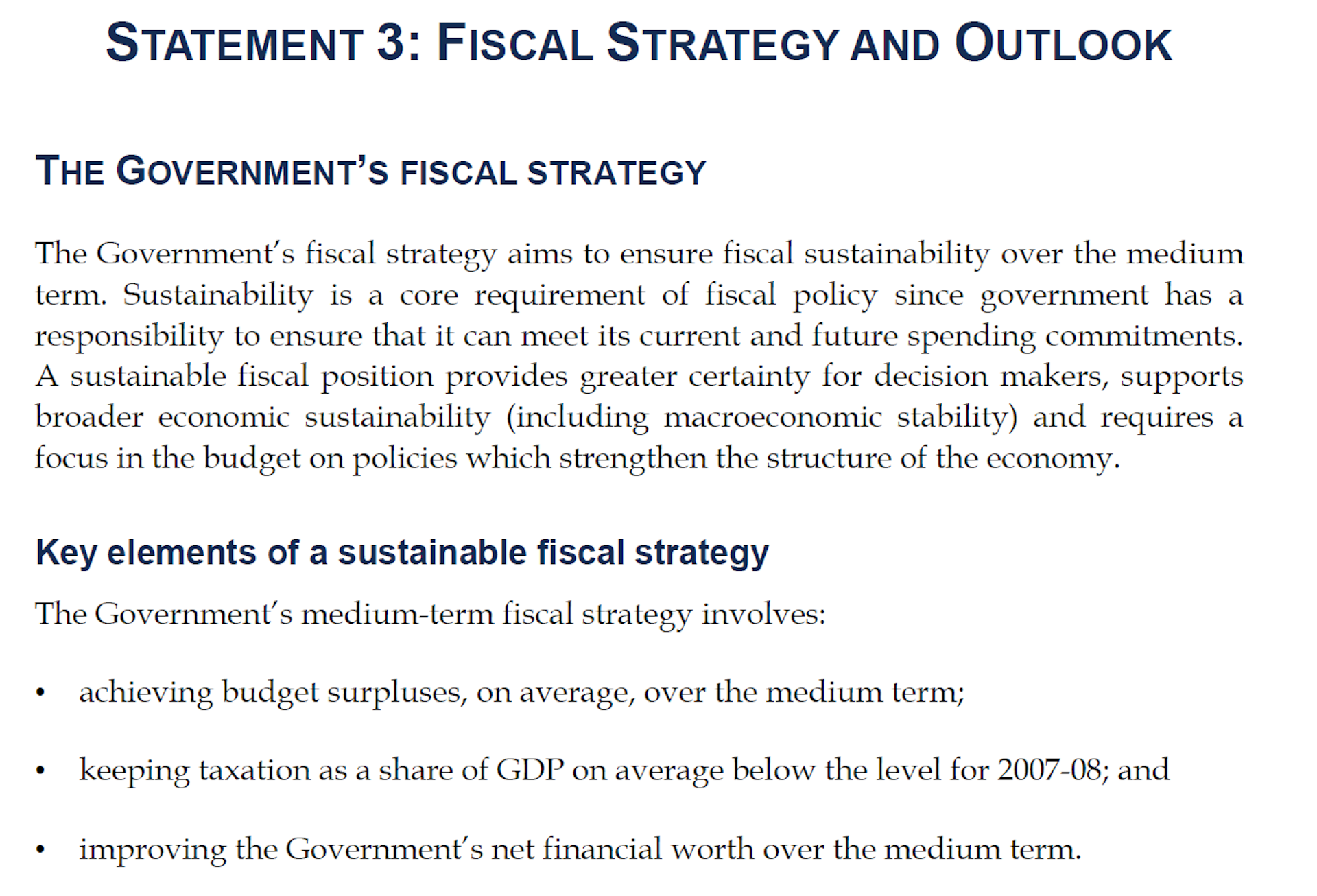
The Labor budgets from 2008 loosened the tax target to the average share of GDP below the reference year, which they changed to the higher-tax year of 2007-08.

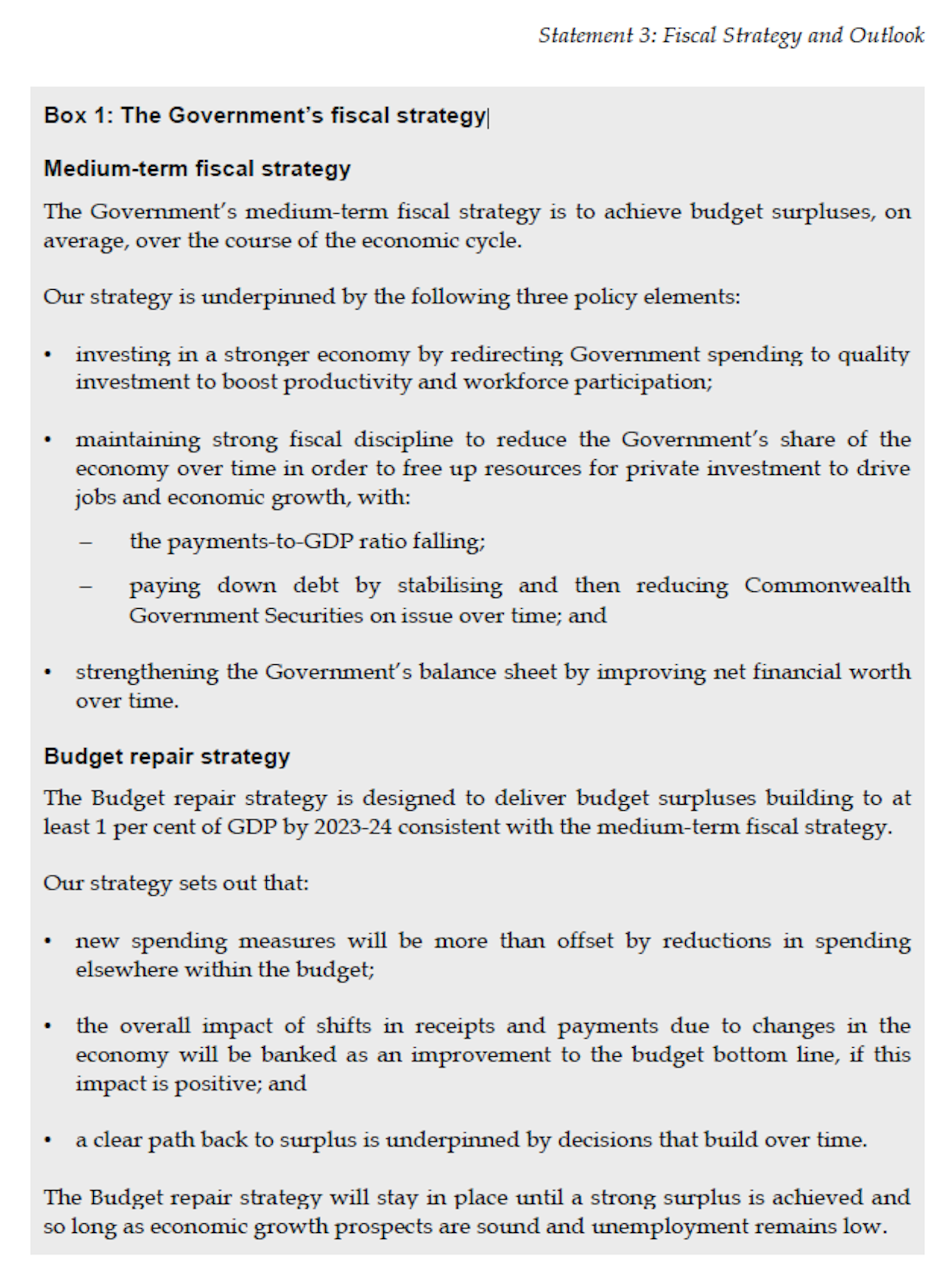
The first Coalition budget under Treasurer Joe Hockey in 2014 changed the target from tax to spending, pledging to bring down the ratio of payments to GDP, and pledging a surplus of 1% of GDP by 2023-24.

Any new spending would be more than offset by cuts elsewhere, and if the budget did receive a burst of unexpected revenue it would be “banked” rather than spent.

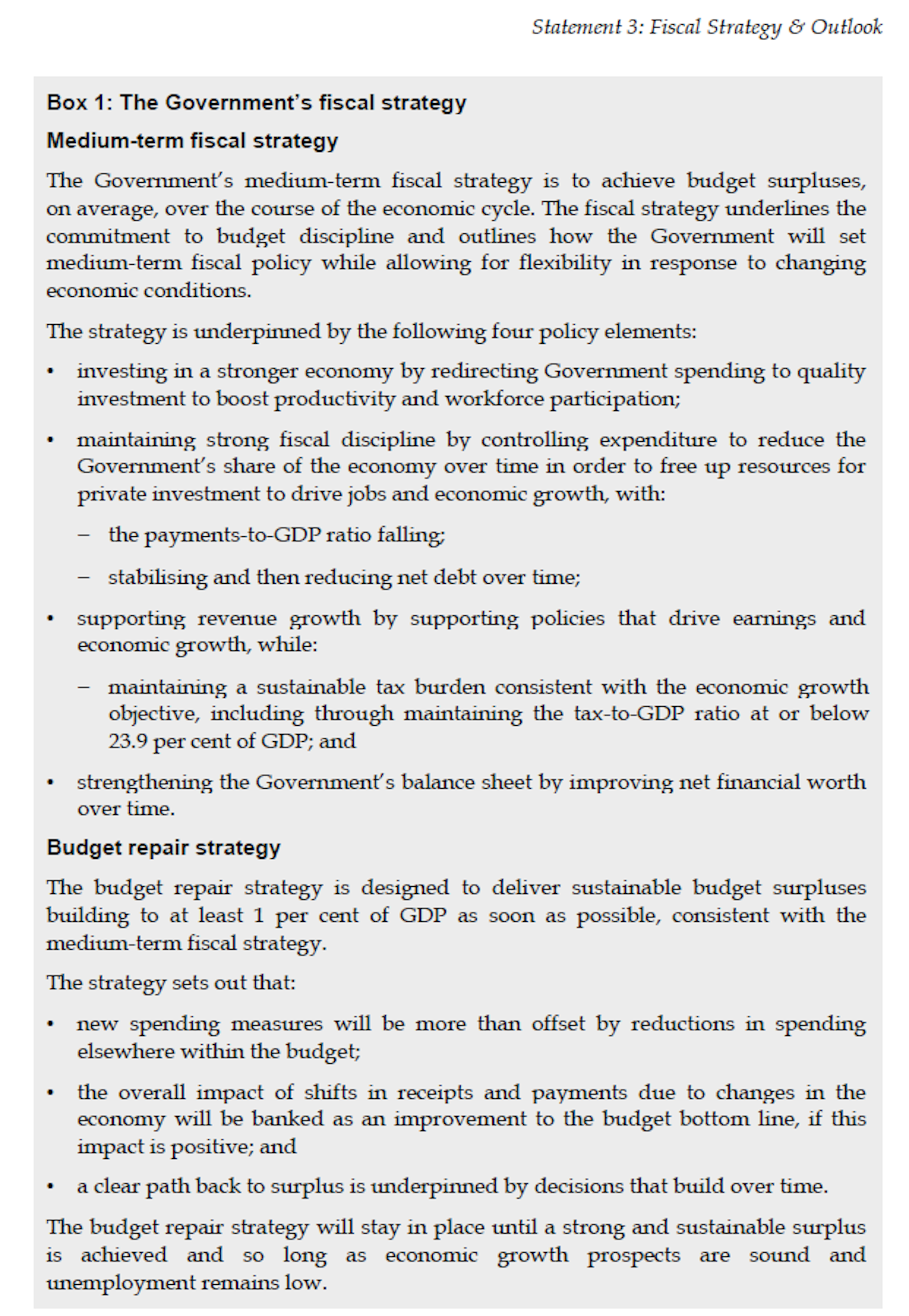
In 2018 Treasurer Scott Morrison reintroduced tax as a target, that he spelled out precisely. Tax was not to increase beyond 23.9% of GDP.

Then during COVID, Frydenberg spent big

In 2020, in the face of a COVID-induced recession and soaring unemployment, Finance Minister Mathias Cormann and Treasurer Josh Frydenberg pushed the old strategy to one side.

They would spend big now to keep the economy afloat so they wouldn’t have to spend more bailing it out later, and they wouldn’t return to their old concern about the deficit until the unemployment rate was “comfortably below 6%”.

So well did they succeed that in 2021 Frydenberg made the momentous decision to keep going, abandoning the promise to return to worrying about the deficit when unemployment fell below 6%.

Instead he promised to keep spending big until unemployment was “back to pre-crisis levels or lower”.

The decision propelled unemployment down to a 50-year low of 3.5%.

Along with high iron ore prices, that one change of strategy has probably helped deliver Chalmers two consecutive budget surpluses – the one he announced last year for 2022-23, and the one he is set to announce this year for 2023-24. More of us have been in jobs paying tax, and fewer have been out of jobs on benefits.

It’s a powerful demonstration of the real-world difference budget decisions can make, and the way in which the fiscal strategy tells the story.The Conversation

This article is republished from The Conversation under a Creative Commons license. Read the original article.

Read more >>

Wednesday, April 17, 2024

Biden is cancelling millions of student debts – here’s what to expect from Albanese

So weighed down have Americans become by student debt, and so potent a political issue has it become in the US, that President Biden plans to waive interest or write off money owing by 30 million of them.

He is doing it bit by bit, in the face of resistance from the US Supreme Court. He has already axed or wound back 4.3 million debts, and on Friday cancelled 277,000 more.

The benefits, as he keeps telling anyone who will listen in the lead-up to the November election, are likely to be increased consumer spending, better mental health and credit scores for borrowers, and increased home ownership.

In Australia, Prime Minister Anthony Albanese is under pressure to do something – anything – for Australians under the same sort of pressure.

Every June, the amount owed jumps

Every June the amount that someone who has borrowed under the Higher Education Loan Program (HELP) jumps. Because the jump is linked to inflation, and because inflation has been low for decades, in most Junes the jump has been small, until last June.

On June 1 2023, Australians who had made no payments over the previous year faced a jump of 7.1%. Someone who had owed $25,000, suddenly owed $26,770, and so on.

A quarter of a million Australians have signed a petition asking for change.

The good news is there’s likely to be some change, and we are likely to hear about it soon, in the lead-up to the May budget.

The bad news for borrowers is it won’t be debt relief of the kind Biden is offering.

It’s worse in the US

While in both Australia and the US it’s the government that lends to pay student fees rather than private lenders (who don’t like the risks) in the US the loans are really onerous, requiring fixed monthly repayments over a set period of time, regardless of the borrower’s circumstances.

In Australia, the United Kingdom, New Zealand and some other countries that have copied Australia’s system, the loans are income contingent, meaning they only need to be repaid when the borrower’s income rises to a certain level.

At the moment Australia’s repayment threshold is A$51,550 per year, meaning anyone who earns less than that doesn’t need to repay a cent, perhaps forever if their income never climbs that high.

Where payments are required, they are taken out in the same way as income tax is, each fortnight for pay-as-you-earn employees.

Buried within Biden’s announcement is a decision to move towards an Australian-style plan he has called SAVE, which stands for Saving on a Valuable Education.

If it becomes law, single Americans won’t have to repay until they earn US$32,800. For an American supporting a family of four, the threshold will be US$67,500. It will be an Australian-style system.

Easy wins for Albo

While Australia’s system is much better than the one in the US and has been copied around the world, it is far from perfect.

A simple change, identified by the report of the Australian Universities Accord delivered to Education Minister Jason Clare, in February is to increase the amount owing each year by either the rate of increase in prices or the rate of increase in wages, whichever is lower.

Usually, prices increase by less than wages, which is why the system was set up in 1988 to index amounts owed to prices.

But last year, unusually, prices increased faster than wages. In those years it would be simple to lift the amount owed only in line with wages, as the report recommends.

The amount owed needs to increase in line with something, because otherwise its value would shrink rapidly as prices rose. The government doesn’t charge interest (which would hurt) so instead it lifts the amount owed in line with prices to ensure that compared to other things it remains little changed.

Make repayments more like tax

Although we repay student loans through the income tax system, we don’t do it like income tax.

Here’s how it works for tax: on our first $18,200 of income we pay nothing, then we pay 19 cents in the dollar for each extra dollar we earn up to the next threshold, and so on. The key words here are “for each extra dollar”. We continue to pay nothing on the first $18,200 we earn.

Higher education loans work differently. For them, we repay nothing until we earn $51,550, and then at that point, even if we earn just one dollar more, we pay one per cent of all our annual income, the entire $51,550 (which amounts to $515).

It’s a repayment cliff that sends us backwards. It means earning an extra dollar costs more than $500 in that year. That’s an effective marginal tax rate of 500%.

The cliff matters. Each year, there’s an impressive cluster of taxpayers who happen to be earning just under the threshold. More likely to be women than men, they might be deciding not to work in order to keep their incomes below the threshold.

Make it easier to get home loans

Britain and other nations that copied Australia’s system don’t impose large repayments in one hit, and the economist who designed Australia’s system now says that part of the system was “an error, a mistake”.

That economist, Bruce Chapman, has suggested a redesign that would require collections only on extra rather than total incomes, a proposal the report to the government endorses.

And there’s something else Albanese can do. Right now Australia’s banking regulator requires banks to count student loans as debt for the purpose of determining who can get a housing loan, knocking some former students out.

Chapman says it would make more sense to treat the compulsory payments as tax, which is how they function. All they do is reduce after-tax income, and for low earners, they don’t even do that. It’d get more people into housing.

Now it’s over to Albo.The Conversation

This article is republished from The Conversation under a Creative Commons license. Read the original article.

Read more >>

Sunday, April 14, 2024

Scrap the West Australian GST deal set to cost $40 billion – leading economists

Australia’s top economists overwhelmingly want Prime Minister Anthony Albanese to scrap a special deal with Western Australia that’s set to deliver it an extra A$40 billion in Commonwealth funding by the end of the decade.

Albanese pledged to maintain the special treatment for Western Australia in a visit to Perth in February. He even signed a promise on a newspaper front page and on a reporter’s arm with a marker pen.

The deal was struck in 2018 by the then Western Australian premier, Mark McGowan, and then federal treasurer, Scott Morrison. It gives Western Australia a much greater share of the centrally collected goods and services tax than it is entitled to under the formula administered by the Commonwealth Grants Commission.

In place in various forms since Federation, the formula distributes funds in such a way as to ensure each state and territory would be able to deliver comparable services if it made a similar effort to raise revenue from its own resources. It has been used to distribute GST collections since 2000.

For most of the past 100 years the formula has delivered more to the smaller states (including Western Australia) than would be expected on the basis of population, and less to the larger states of New South Wales and Victoria.

In the leadup to 2018, the mining boom changed that. The amount of GST delivered to Western Australia was pushed down to only 45% of what it would have got if the GST was split on the basis of population, in recognition of its much greater ability to raise revenue.

Morrison and McGowan’s deal phased in a floor under how much of the GST each state could get. In June it will climb to 75% of what the state would get on the basis of population, and from 2026 to no less than what the strongest of Victoria and NSW get, no matter how strong the state’s economy.

Haul of $30 billion to $50 billion

The extra payments to Western Australia will initially be funded from general Commonwealth tax revenue, rather than by cutting GST payments to other states.

Estimates of the cost by 2030 range from $30 billion to $50 billion. Independent economist Saul Eslake puts the cost at $39.2 billion, assuming the iron ore price falls in line with budget assumptions.

Beyond 2029‑30, any extra payments to Western Australia will come from the GST total at the expense of other states.

Asked whether the long-standing method of distributing GST revenue in accordance with need and ability to pay is broadly the best one, 25 of the 38 top economists who responded to the Economic Society of Australia poll said yes.

Ten said no, five of them saying it would be better to move towards a system where revenue was distributed on the basis of population or gross state product.


Asked whether the 2018 changes that advantaged Western Australia should be kept or scrapped, 28 of the 38 wanted them scrapped.

Only four wanted them kept.


The 38 experts who took part are recognised by their peers as leaders in fields including tax and budget policy. Two are from Western Australia.

Several observed that the natural resources with which Western Australia is endowed are a matter of luck, “even acknowledging that it takes skill and effort to extract them”.

Sue Richardson from the University of Adelaide argued that minerals were a national rather than a local resource and it undermined the integrity of the nation to have the benefits from mining them concentrated in the part of the nation in which they sat.

Eslake said that even if Australia had no state governments and just one central government, as did Japan and New Zealand, it would still make sense to distribute resources to the parts of the nation with the greatest need in much the same way as the Grants Commission has traditionally done.

Consultant Rana Roy said that distributing resources away from the rich states in order to make the poorer states more liveable was actually in the rich states’ best interests.

“Paris would not benefit if an impoverished rest-of-France were to decamp to Paris,” he said. “And London would not benefit if an impoverished rest-of-Britain were to decamp to London.”

Tasmania’s Hugh Sibly added that Australians move between states and many retire in a different state to the one in which they paid taxes, giving the entire nation an interest in ensuring all parts of the nation were liveable.

Equalisation good, but complex

Others surveyed said the calculations used to deliver what was once known as “full equalisation” and since 2018 has been known as “reasonable equalisation” were complicated – “almost farcical” – and should be replaced by something simpler, even if it made the system less fair.

One suggestion was that GST revenue should be allocated on the basis of the size of each state’s economy. Another was that it be allocated on the size of each state’s population, with top-up grants used to meet particular needs.

Former OECD official Adrian Blundell-Wignall said the needs of Indigenous Australians in particular should be addressed directly rather than by GST distributions as the governments that got GST money on the basis of their high Indigenous populations did a very poor job of spending it on those populations.

Two of the economists surveyed suggested a Commonwealth resource tax of the kind promoted by former Treasury head Ken Henry who said earlier this month Australia should stop revering plunder and dumb luck, and abandon its “finders keepers” approach to minerals.

The Productivity Commission will review the Western Australian deal in 2026.


Individual responses. Click to open:

The Conversation

This article is republished from The Conversation under a Creative Commons license. Read the original article.

Read more >>

Tuesday, April 09, 2024

How about this time we try, just try, to report on budgets and tax differently?

There are just five weeks until the budget, and the usual lists of winners and losers.

Among last year’s winners were said to be single parents, renters and first home buyers. Among the losers were said to be vapers, truckies and consultants.

It’s also how we talk about tax: winners and losers.

On budget night when the changes to the Stage 3 tax cuts are re-announced, we will be told they will make Australians earning less than A$146,000 better off than they would have been, and Australians earning more than that worse off.

It’s terribly predictable, but it’s also worse than that.

It’s part of a way of thinking and reporting that makes changes that could actually help us all but impossible.

Making that point passionately in Canberra last week (and apologising for his own role in it) was Ken Henry, the government’s chief economic advisor as head of the treasury between 2001 and 2011, and the head of the 2009 Henry Tax Review.

Confessions of a gun for hire

Here’s Henry’s confession. Shortly after he joined the treasury as a tax expert in the lead up to the 1985 tax summit convened by Treasurer Paul Keating and Prime Minister Bob Hawke, he was taken aside by his treasury bosses and told that arguments about making Australia better weren’t going to fly.

His bosses told him:

all anybody would want to know is what was in it for them, how many dollars they were going to get – and that’s also all the newspapers would want to know, that’s what they would be printing on their front pages.

What would matter would be the immediate “overnight” estimates of who would win and who would lose. Beyond not costing the government money, nothing else would matter – not how the changes would affect society by funnelling people into doing some things and not others, and not what they would do over time to the people who won or lost on the night.

So, presumably with a heavy heart, Henry developed a computer model that spat out nothing more than immediate winners and losers and ignored what the changes would do to Australia over the longer term.

Winners and losers are (almost) beside the point

Henry says looking back it is easy to understand “why we did what we did”.

“But I can’t escape the sense that, in developing the tools that facilitated squabbles over the distribution of gains and losses among the households of Australia in 1985, we were participating in a conspiracy against future Australian households.”

Henry did it again in 1991, helping build a much more precise version of the model whose exaggerated precision was used by Keating as prime minister to kill off Opposition Leader John Hewson’s plan for a raft of tax changes including a 15% goods and services tax and to end Hewson’s political career.

But it worried Henry. He says Hewson’s package was a genuine attempt to break out of the winners and losers mindset and argue for changes on the basis they would benefit society.

Then in the late 1990s Henry dusted off the model again and used it in the opposite way – to help the Howard government get its 10% GST over the line.

‘A conspiracy against future Australians’

Henry’s confessions tell us about more than the flexibility needed to serve the government of the day. They tell us the thing that matters most, making Australia work better, can’t really be spoken about.

And the more it is not spoken about – the more people are merely told what’s in it for them – the harder that is to change.

Here’s what Henry says really matters, and what he says he tried to address in his 2009 tax review.

The things we ought not to celebrate, and ought to tax heavily, are plunder, dumb luck, and a “finders keepers” approach to resources, including mineral resources.

The things we ought to avoid taxing are income from work, the normal rates of return for businesses, and transactions. They are the things we need more of to build our living standards.

We need less tax on wages and ordinary profits, and more on unreasonably large profits, windfall capital gains, wealth and the use of land and natural resources.

By lightly taxing the things that take from the rest of us (such as the superprofits earned by companies with some sort of monopoly) and heavily taxing the things that give to the rest of us (such as the effort put in by workers and businesses) we are bequeathing to our children a weaker Australia.

What’s winning matters as much as who’s winning

As Henry puts it, Australia’s young people are being screwed – not necessarily by what the tax system is doing to them today (although what negative gearing and capital gains tax breaks are doing to home prices can’t be helping) but by the way we are choking attempts to build the economy they’ll inherit.

He says we’ve got to level with them and level with ourselves, which is also the argument of Mixed Fortunes, the book detailing the history of tax reform in Australia by former treasury official Paul Tilley that Henry launched.

It’s an argument the journalists in the audience (I am one) and the lone politician in the audience (Assistant Treasury Minister Andrew Leigh) should take to heart. I’ll still report on winners and losers next month, but I’ll also aim to go deeper – to report on what’s winning as well as who.The Conversation

This article is republished from The Conversation under a Creative Commons license. Read the original article.

Read more >>

Tuesday, April 02, 2024

From where we work to what we spend, the ABS knows more about us than ever before: here’s what’s changing

How much were prices rising in January when Shadow Treasurer Angus Taylor said inflation was “rampant”?

The prices that give us a good steer on inflation were falling, by 0.4%.

That’s the change that month in what the Bureau of Statistics calls the consumer price index “excluding volatile items”. The items it excludes (because they are often affected by supply disruptions) are fruit, vegetables and fuel.

Apart from that, the measure of prices I just quoted is the best monthly measure of the prices of everything that households buy in the proportions they buy them.

Not all prices were falling. The price of alcohol was up, the price of bread was down, the price of rent was up, and the price of tourist accommodation was down. It’s only on balance (excluding volatile items) that prices fell.

This is the sort of thing we wouldn’t have known about until just a few years ago. Up until late 2022, the consumer price index was calculated only four times a year, and even that was a herculean feat.

A ten-fold increase in data

The bureau had to collect what used to be 100,000 separate prices for each of those four surveys – a huge number collected in person, either over the phone (“hello, can you tell me your current price for…”) or in stores via handheld devices.

The cost to the bureau, and the number of staff involved, was enormous – big enough to make a monthly measure impossible, as important as that would have been to a Reserve Bank that set interest rates monthly and needed a monthly read on inflation.

But in the last few years the use of supermarket scanner data, “web scrapping” to collect online prices, and data feeds direct from the computers of rental agents and all sorts of other businesses have cut costs enormously and increased the number of prices collected each quarter almost ten-fold to 900,000.

The bureau says the monthly index isn’t as comprehensive as the quarterly index yet, but it will be by the end of 2025, at which time the bureau will use it to replace the quarterly index, delivering something of the same quality 12 times a year.

That’s just one of the ways in which an explosion of previously-inaccessible data is transforming the way the bureau goes about its job and is set to make statistics that used to be only fairly reliable suddenly very reliable.

Retail figures set for the chop

For more than half a century, every month since April 1961, the bureau has published an update on retail spending – how much we are spending in shops.

The survey used to be quite useful. Back when it started, we did more than half our spending in shops. These days it’s only one third, the rest is on services.

And the retail survey was always a pretty rough-and-ready way to find out what we spent in shops. Each month the bureau surveys about 700 large businesses and 2,700 smaller businesses selected at random. It uses phone calls and paper forms.

Meantime, in part due to the national emergency created by COVID, it’s been given access to something better. Australia’s big four banks agreed to give the bureau de-identified card and transaction data to enable it to quickly get a handle on how much we were spending early in the pandemic, and they’ve kept providing it.

It turns out to be very good indeed. It covers far more retail outlets than the retail survey ever did, as well as spending on services and spending overseas, and it divides spending into categories based on the type of merchant.

It doesn’t directly cover what we spend in cash, but there’s a lot less of that than there used to be. It’ll replace the retail survey from the middle of next year.

Millions instead of thousands

The mammoth monthly employment survey of 24,000 households remains in place, as do the doorknocks that begin each household’s eight-month turn at completing the survey, but alongside it the bureau is developing a far more comprehensive measure using payroll data submitted to the tax office.

While payroll numbers can’t tell us everything the employment survey does (they can’t yet tell us the hours people work and whether are looking for work) they cover millions of Australians instead of thousands, and come out weekly.

The bureau is doing the same sort of thing almost everywhere. For more than a century it has surveyed farmers to find out what they are growing. It’s begun supplementing that with data from satellites and the machines used on farms.

The ultimate goal of all of these changes, gathered together under the banner “Big Data, Timely Insights” is to ask as few questions as possible. Why run a survey, when you can find out directly?

Big data, timely insights

It’s far harder than it looks. A lot of the so-called administrative data provided to banks and other organisations isn’t sorted in a way that makes it useful. That’s where the bureau is concentrating its efforts. The more it succeeds, the less it will need to bother us and the better the information it will produce.

In the meantime, here’s an update on those inflation figures, the ones that come out monthly. In February, the consumer price index excluding volatile items did not change, meaning in that particular month, inflation was zero.

Even better, adding the past six months together (and multiplying by two) gives you an annual inflation rate of 2.5% – slap bang in the middle of the Reserve Bank’s 2-3% target band, suggesting things are moving in the right direction.

It’s too early to declare victory over inflation that was at one stage heading towards 8%, but at the moment the monthly figures show things heading down.

If the direction changes, the bureau will tell us, quick smart.The Conversation

This article is republished from The Conversation under a Creative Commons license. Read the original article.
Read more >>