Tuesday, July 26, 2022

Labor is winding back reforms meant to hold super funds accountable to their members

Who could even question a requirement that super funds act in the best financial interests of their members?

Labor’s new assistant treasurer Stephen Jones, that’s who.

While the treasurer himself has been working on Thursday’s major economic statement, Jones has asked the treasury to consider concerns relating to the “regulatory complexity” of a requirement that funds act in their members best financial interests – a requirement that on the face of it is straightforward.

Oddly, he titled the announcement “Review to strengthen super,” a title he might need to rework if the review finds the duty should be weakened.

The Coalition strengthened the requirement a year ago as part of a suite of reforms called “Your Future, Your Super”, changing it from a duty to act in the “best interests” of members to the best “financial” interests of members.

The difference between the two is that whereas spending members funds on things such as corporate hospitality or wellbeing services or news websites might arguably be in the best interests of members, it need not be in the best financial interests of members.

And that’s what superannuation funds are meant to be for – to grow rather than spend the trillions entrusted with them for workers’ retirements.

To make sure the funds do it, the Coalition reversed the onus of proof. If questioned, fund directors needed to be able to demonstrate that their spending was in the best financial interests of their members, or at least in what they thought at the time would be their members best financial interests.

‘Best financial interests’ up for review

That might be the “regulatory complexity” the assistant treasurer is referring to –a requirement directors use their members funds to grow their members funds, and be able to demonstrate that’s what they were attempting if asked.

It’s good news for members, whose compulsorily-acquired funds the directors are managing, but troubling for some directors (in industry funds most directors are union and employer representatives), and Jones listened to the directors.

He has backed them on another concern.

The Coalition’s regulations require funds to itemise their spending on political donations and payments to related parties and industrial bodies, as well as their spending on marketing, in a statement to members before each annual meeting.

Jones has drafted regulations that remove the requirement for itemisation while leaving in place the requirement for funds to report the totals to members.

It won’t save the funds work (they still have to itemise each payment in order to prepare the totals), but it will save them embarrassment.

And he is tampering with perhaps the most important super reform of them all.

Performance test up for review

Last year for the first time each of the 80 MySuper funds (the funds into which new employees can be defaulted) was graded on its performance.

Thirteen failed. They weren’t being graded on absolute returns. That would have been unfair. They were graded on returns over the past seven years given their stated investment strategy.

If their strategy had been to (say) invest all of their members funds in shares, and shares did badly, that would be fine so long as the fund’s shares didn’t do significantly worse than the share market as a whole over seven years, which is a way of saying it is a hard test to fail.

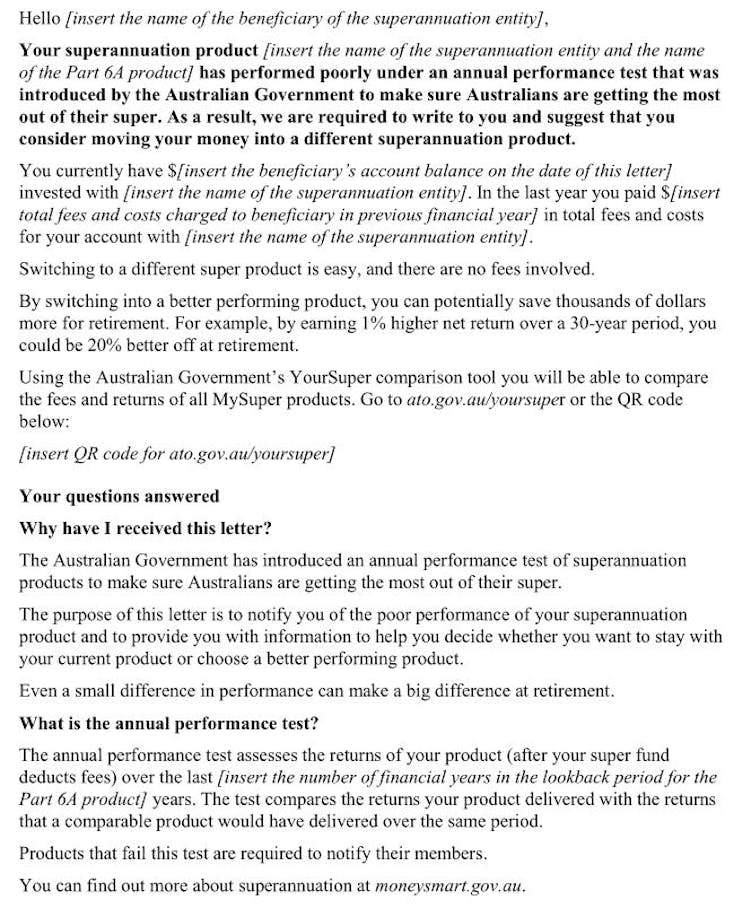
Under the Your Future, Your Super rules the 13 funds that failed were required to write to their members telling them they had performed badly and suggesting they switch to a better-performing product.

The second test will be this year. Any funds that fail two years in a row get banned from accepting new members.

Not that it’s likely to come to that. Eleven of the 13 have merged or are in the process of merging with better funds, which is how the system is supposed to work. It is weeding out dud funds, advancing members interests.

Even the fear of failing is advancing members interests. Industry observers say funds likely to fail are cutting their fees to ensure they don’t. The performance test is on returns net of fees.

Twelve month pause

From next year the test was to be extended to all super funds, whether default or not, so it could really weed out the duds. The Productivity Commission found non-default funds performed notably worse than default funds.

But Jones says he’ll stop the extension – “pause” is his word – for 12 months while the treasury rechecks the system for “unintended outcomes”.

Hundreds of funds (some of them bad) will be given a reprieve, something that was itself unintended when the system was set up.

There are genuine concerns about the test. It is backward looking, as it has to be, and funds in difficulty will have it made worse by an exodus of members when the results are published.

But these are concerns for the directors of the funds, not their members. And Australians put more of their money into super than anything other than housing.

A landmark 2018 Productivity Commission inquiry found much of the system was a “mess” that allowed poorly performing funds to produce $660,000 less in retirement than well-performing funds.

Your Future, Your Super was the government’s response to that. It’s already achieved a lot. Until the new minister hit pause, it was about to achieve more.The Conversation

This article is republished from The Conversation under a Creative Commons license. Read the original article.

Read more >>

Tuesday, July 19, 2022

‘Wellbeing’ will give future budgets more rigour than any before

What if the most important thing in Jim Chalmers’ first budget is the thing his critics are writing off as a gimmick?

Australia’s new treasurer has a lot on his plate. He has commissioned a complete review of the way the Reserve Bank works, he is drawing up a statement to parliament he says people will find “confronting” and he is preparing the second of two budgets in one year; in October, updating the Coalition’s budget in March.

In what some see as a gimmick, it will be Australia’s first budget to benchmark its measures against their impact on the wellbeing of the Australian people: Australia’s first “wellbeing budget”.

When Chalmers proposed the idea in opposition, the treasurer at the time, Josh Frydenberg, described it as “laughable”.

Wellbeing was “doublespeak for higher taxes and more debt”.

Frydenberg asked parliament to imagine Chalmers delivering his first budget, the one he will deliver on October 25, “fresh from his ashram deep in the Himalayas, barefoot, robes flowing, incense burning, beads in one hand, wellbeing budget in the other”.

But here’s the thing. In an important way, Chalmers first “wellbeing budget” will have more rigour than any of the budgets prepared by Frydenberg or any of his predecessors.

It’ll be the first to have a stab at cost-benefit analysis.

Budgets are usually three things: a statement of accounts, with measures that will have an impact on the accounts (and sometimes measures that won’t), as well as the legislation needed to authorise another year’s worth of expenditure.

What they don’t do, as a rule, is assess the impact of those measures, even the impact on the economy.

Measures without outcomes

Frydenberg’s first budget for example, in 2019, included a measure named “lower taxes for hard-working Australians”.

The budget papers described what the measure would do and its impact on the budget, but not its impact on the economy.

The calculations may well have been carried out, but they weren’t included in the budget, as was typical. The budget papers told us what was being done, but not what it would do.

Until 2014 the budget papers at least told us who the budget would make better off and worse off. The standard table identified the impact of the budget as a whole on 17 different types of households at different types of incomes.

Prime Minister Tony Abbott and Treasurer Joe Hockey removed it in their first budget, perhaps because they didn’t want the winners and losers to become apparent, and it hasn’t returned.

The budget papers neither tell us what the budget will do to economic growth, nor what it will do to incomes, nor what it will do to the environment or anything else other than the budget’s bottom line.

Which is a pity, because the budget is massive.

The government takes in just short of one quarter of all the dollars spent in Australia and pays out slightly more than one quarter of the dollars earned.

The balance between that income and spending is called the budget deficit or surplus. It matters, but so too does what that income and spending does.

Encompassing rather than replacing GDP

What Chalmers is proposing, and what New Zealand and Scotland are doing, and what Canada is working towards, is a scorecard of how budget measures affect the things that matter, including how much we produce: gross domestic product.

During the first Rudd government, Angela Jackson was deputy chief of staff to Finance Minister Lindsay Tanner. Reflecting on that time at last week’s Australian Conference of Economists, she said it was astounding that the expected effects of budget measures weren’t made explicit.

It meant what happened couldn’t be assessed against expectations.

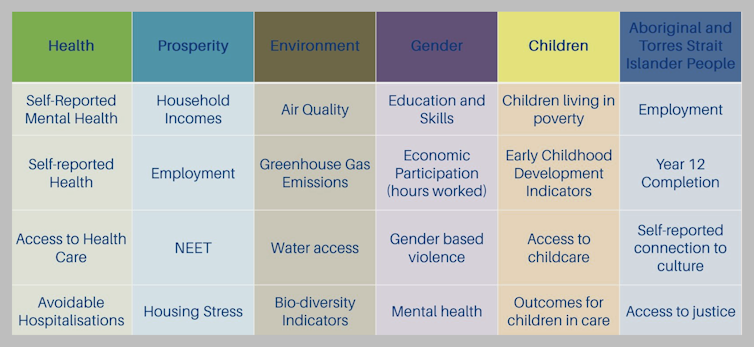
Introducing measurables wouldn’t be about supplanting GDP, but about including it along with other measures of prosperity as outcomes against which the budget could be assessed, along with measures of health, the environment, gender, children’s welfare, and the welfare of Aboriginal and Torres Strait Islander people.

It would let us see whether we are making progress or going backwards on the environment (where we seem to be going backwards) and on living standards, inequality, health and other things, and what the budget is doing about it.

The Australian Bureau of Statistics was on to this back in 2008 when it introduced a short-lived publication called Measures of Australia’s Progress that reported on whether what came to be 26 key indicators were going forwards or backwards.

Australia’s Treasury was on to it earlier, in 2004, introducing its own wellbeing framework for internal use. It understands the concept.

Taking that concept public will improve or weed out budget measures before they are announced. They will need to demonstrate that they can improve wellbeing, or at least not make it worse.

After it is established, it will require future treasurers to level with the public about the impact of what they are proposing in the same way as Coalition treasurer Peter Costello’s Charter of Budget Honesty required future treasurers to level with the public about the cost of what they were proposing.

It’s already shaping up as Chalmers’ most important legacy.The Conversation

This article is republished from The Conversation under a Creative Commons license. Read the original article.

Read more >>

Friday, July 01, 2022

Sky-high mortgages, 7.1% inflation, and a 20% chance of recession. How the Conversation’s panel sees the year ahead

Homeowners will face mortgage rates near 5.5% in a little over a year, according to a survey of 22 leading Australian economists.

The Conversation’s 2022-23 forecasting survey predicts an increase in the Reserve Bank’s cash rate from its present 0.85% to a peak of 3.1% by next August.

If fully passed on, the series of rate hikes would lift the cost of payments on a variable $500,000 mortgage by about $600 per month and the cost of payments on a $800,000 mortgage by about $1,000 per month.

Sydney and Melbourne home prices would slide 6-7%.

The panel believes the Reserve Bank will push its cash rate to its highest point since the 2010-2012 resources boom in an effort to contain inflation, which it expects to jump from its present 5.1% to a peak of 7.1% before the end of the year.

Panel members put the risk of an overreaction by authorities bringing on a recession at a 40% chance in the United States, and a lower 20% probability in Australia.

Now in its fourth year, The Conversation’s survey draws on the expertise of leading forecasters in 20 Australian universities and financial institutions, among them economic modellers, former Treasury, International Monetary Fund and Reserve Bank officials, and a former member of the Reserve Bank board.

Inflation

The panel expects the next inflation figure to be released later this month to show prices climbed 6.7% in the year to June – the most since the early 1990s.

Panelist Saul Eslake says it hard to be confident about when inflation will peak without being confident about when and how the conflict in Ukraine will end, although he says it is difficult to see energy prices climbing higher, and there is some evidence COVID-related supply disruptions are beginning to ease.


On balance the panel expects inflation to peak at 7.1% towards the end of this year before declining next year.


Interest rate rises

The panel expects the equivalent of five 0.25 point increases in the Reserve Bank’s cash rate in the next six months, and just short of another two 0.25 point increases in the six months that follow.


On balance, the panel expects the cash rate to stop climbing when it gets to 3.1% next August, but some members expect much steeper increases.

Warwick Mckibbin, a former member of the Reserve Bank board, expects a cash rate of 4.5% (implying mortgage rates of 6.75%) by March, and he says that is less than required.

He says the cash rate needs to climb above the 3.5% that would normally be thought of as neutral, and stay there for a sustained period to bring inflation back to the Reserve Bank’s target.

Former Commonwealth Treasury and financial markets economist Warren Hogan sees rates climbing for as many as five years, although his forecast is for four.

RBC Capital Markets head of economics Su-Lin Ong believes that won’t be needed to cool the economy, as the expiry of the ultra-cheap three-year fixed rate mortgages taken out during COVID will deliver a “market-induced tightening”.


Recession risk in the US and Australia

The panel believes the United States is at a much greater risk than Australia of a miscalculation in which rates are pushed so high to contain inflation that they bring on a recession.

The US economy has already turned down in the first three months of this year, and the panel expects it to finish the year just 2.2% larger than when the year began. The panel expects unusually low economic growth of 2.6% in China.


In the United States, the task of defining the start and end of recessions is assigned to the National Bureau of Economic Research’s business cycle dating committee.

The panel believes there is a 40% chance it will call a recession in the next two years, with the most likely start being March 2023.


The panel assigns a lower 20% probability to a recession in Australia (commonly defined as two consecutive quarters of negative economic growth) and believes the most likely start date is August 2023.


Economic growth

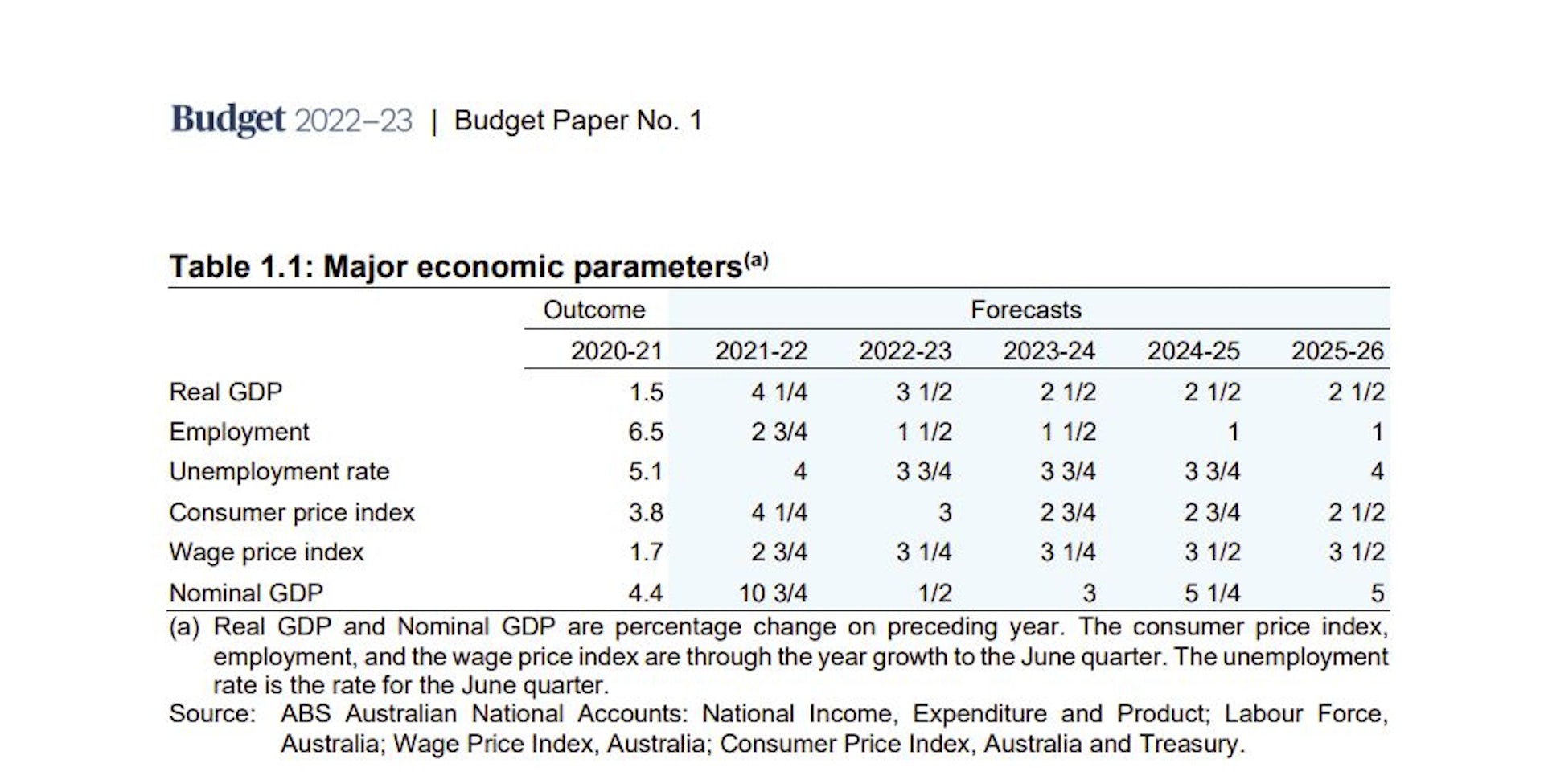
Absent recession, the panel expects economic growth to decline in line with forecasts in the March budget from year-on-year growth of 4.25% in 2021-22 to 2.5% over the coming five years.


Living standards

The substantial increase in wage growth the panel expects from 2.4% in the year to March to 3.6% by June next year will be nowhere near enough to prevent real wages sliding.

Even with inflation down to 4.8% by then as forecast, real wages would go backwards by a further 1.2%.


Weighing on further increases in wages growth will be a forecast nudge up in the rate of unemployment, from 3.9% to 4.2%.

ANZ chief economist Richard Yetsenga says while reopening Australia to skilled migrants, temporary visa holders, students and backpackers will add to the supply of workers, it should also boost already very strong consumer spending, limiting any increase in unemployment.


The panel expects outsized real growth in household spending of 4.5% in 2022-23 boosted by what Barrenjoey Capital’s chief economist Jo Masters describes as elevated household savings, combined with continuing fixed rate mortgages and the low and middle income tax offset payments due to hit accounts from July.

The broadest measure of living standards, real net disposable income per capita, should continue to advance, although modestly.


Home prices

The panel expects mortgage rate driven falls in home prices to reach 6-7% in Sydney and Melbourne over the coming year.

Julie Toth of Swinburne University and Nous Group expects the biggest impact in low and medium income suburbs, where buyers are more vulnerable to mortgage increases.


Markets

The panel nonetheless expects solid growth in non-mining business investment of 6.4% (and mining investment of 7.6%), and an iron ore price above US$100 an ounce but sliding down from its present US$130 to US$108.

It expects the Australian share market to end the financial year 2% lower.


After a year in which the 10-year bond rate that determines the government’s cost of borrowing soared from 1.5% to 3.7%, panelists expect only a small further increase in 2022-23, to 3.9%.

After sliding from 75 US cents to 69 US cents, they expect the Australian dollar to climb modestly to 72 cents during 2022-23, putting some downward pressure on inflation.


The Conversation Economic Panel

Click on economist to see full profile.

Download the 2022-23 economic surveyThe Conversation

Peter Martin, Visiting Fellow, Crawford School of Public Policy, Australian National University

This article is republished from The Conversation under a Creative Commons license. Read the original article.
Read more >>