Thursday, September 22, 2022

Global recession is increasingly likely. Here’s how Australia could escape

Global stock markets are tanking on fears of recessions in the US, the UK and Europe, and the OECD is actually forecasting recessions in Europe.

So is recession now inevitable in Australia? Not at all.

The good news is there are several reasons to think Australia might be able to escape a global slide into recession – though it will need careful management.

What could push Australia into recession?

Here’s the worst case scenario. The United States keeps pushing up interest rates until it brings on a recession, and Australia gets pressured to do the same.

Here’s how it’s playing out at the moment. The US Federal Reserve has lifted rates at each of its past five meetings. The past three hikes have been massive by Australian and US standards – 0.75 percentage points each, enough to slow already-forecast US economic growth to a trickle, which is what the Fed wants to fight inflation.

But the Fed is planning to go further. Its chair, Jerome Powell says he expects ongoing increases, and last week countenanced the possibility they would throw the country into recession:

We don’t know, no one knows, whether this process will lead to a recession or if so, how significant that recession would be. That’s going to depend on how quickly wage and price inflation pressures come down, whether expectations remain anchored, and whether also we get more labour supply.

Powell is saying he is prepared to risk a recession to get inflation down.

The UK’s top banker already expects a recession

Powell’s not alone. His UK equivalent, Bank of England governor Andrew Bailey, has lifted rates seven times since December. Bailey says he is prepared to do more to fight inflation – “forcefully, as necessary” – and is actually forecasting a recession, which he says has probably started.

So alarmed is the new UK government headed by Liz Truss that on Friday it unveiled a £45 billion (A$75 billion) “growth plan” made up of tax cuts and infrastructure spending, on top of spending of £60 billion (A$100 billion) to cap household and business energy bills.

Given what’s now happening overseas, you might expect Australia’s Reserve Bank to take note and behave differently to central banks overseas.

Except it’s not quite that easy.

Pressure to follow the US

Whenever the US hikes interest rates (it’s hiked them seven times since March), investors buy US dollars to take advantage of the higher rates. This forces up the price of the US dollar in relation to currencies of countries that didn’t hike.

This means unless countries such as Australia hike in line with the US, the values of their currencies are likely to fall in relation to the US dollar – meaning their values are likely to fall in relation to the currency in which most trade takes place.

This means more expensive imports, which means more inflation.

And Australia’s Reserve Bank is trying to contain inflation.

The upshot is whenever the US pushes up rates (no matter how recklessly) there’s pressure on Australia to do the same, simply to stop inflation getting worse.

The risk of ‘a gratuitously severe recession’

Since March, when the US began pushing up interest rates more aggressively than Australia, the value of the Australian dollar has slid from US0.73 to less than $US0.65, putting upward pressure on goods traded in US dollars of about 11%.

With Australian inflation already forecast to hit 7.75% this year, way above the Reserve Bank’s 2-3% target, still more inflation is what the bank doesn’t want.

This locks countries such as Britain (whose currency has fallen to an all-time low against the US in the wake of the tax cuts) and Japan (whose government has intervened to try to stop its currency falling) into a semi-dependent relationship with the US.

Failing to follow its lead makes inflation worse.

It is why US economist Paul Krugman says there is serious risk the Fed’s actions “will push America and the world into a gratuitously severe recession”.

Going your own way can hurt your dollar

The risk isn’t merely that the US will go too far. The risk is that other countries, including ours, will ape the US in pushing up rates to maintain the value of their currencies, amplifying the effect of a US recession and making it global.

It’s often said that central banks hunt in packs. What’s less often noted is the pressure they are under to follow each other.

In Australia, AMP chief economist Shane Oliver puts it starkly: if the Reserve Bank doesn’t follow the US Fed, the Australian dollar might crash.

But here’s the good news. We know Australia can avoid the worst of global economic downturns, because we’ve done it before.

How Australia has avoided past recessions – and can again

Australia avoided recession during the 1997 Asian financial crisis, we escaped the 2001 US “tech-wreck”, and we avoided the “great recession” during the global financial crisis.

In part, this has been due to excellent judgement. Our Reserve Bank was able to take clear-eyed decisions about when to follow the US on rates and when not to.

At times it was helped by high commodity prices, which are high again following Russia’s invasion of Ukraine and which are supporting our currency, even though we are increasing rates less aggressively than the United States.

At the right moment, Australia’s Reserve Bank would be wise to decouple from the US. If the Fed pushes up rates to the point where it is about to bring on a US recession, Australia would be well advised to stand back and not lift rates, letting the collapse of the US economy bring down inflation by itself.

If Australia’s Reserve Bank thinks that moment is approaching, it should consider shrinking the size of its rate rises (the last four have been 0.5 percentage points).

Its next meeting is next Tuesday. Because of its importance, the Bureau of Statistics is bringing forward the publication of its new monthly measure of inflation to this Thursday, publishing the results for both July and August at once.

But the bank will need more than information. It’ll need the intuition and common sense that has kept us out of trouble in the past.The Conversation

This article is republished from The Conversation under a Creative Commons license. Read the original article.

Read more >>

Tuesday, September 20, 2022

The Mint and Note Printing Australia make billions for Australia – but it could be at risk

Briefly, in the days after the death of the queen, we were afforded a glimpse into the machine that makes Australia’s money.

Assistant Treasury Minister Andrew Leigh turned up at the Royal Australian Mint to explain the process by which a portrait of the King Charles will replace the portrait of the queen on the heads-side of coins minted from 2023.

(And yes, he noted “for the avoidance of doubt, for any conspiracy theorists out there, all coins bearing the face of Queen Elizabeth II will remain legal tender”.)

The Mint makes an extraordinary 120 million to 140 million coins per year (even more, as much as 175 million when Australians stocked up on cash during the first year of COVID), and it is a money-making operation in more ways than one.

20 cents to make a $2 coin

Usually it costs the Mint far less to make each coin than each one becomes worth the moment it is sold to a bank (before metal prices climbed, it cost the mint about 20 cents to make a $2 coin, and about 15 cents to make a 50 cent coin).

The profit – the huge markup – goes straight to the Commonwealth budget as non-taxation revenue, tens of millions per year. It’s called “seigniorage”, an ancient French word that refers to the profit only a seignior (feudal lord) can make from the exclusive right to mint coins.

This financial year the government expects A$59 million, next year $67 million.

That the government can keep making money from seigniorage appears to defy common sense. Surely we’ve got just about all the coins we need. Merely replacing coins as they get worn out doesn’t earn seigniorage.

But a previous head of the Mint, Ross MacDiarmid, let the cat out of the bag in 2014 when he told a Senate committee:

most of the coins that we provide are against coins that disappear down the back of chairs, down the back of car seats, into rubbish dumps and, in some cases, are taken overseas.

Asked whether he was seriously suggesting a hundred million or so coins per year disappear, MacDiarmid replied he was.

This means the government makes tens of millions per year replacing – at a huge markup – things we have lost.

And it’s just the beginning. The $5, $10, $20, $50 and $100 notes made by Note Printing Australia for the Reserve Bank have an astronomical markup.

32 cents to make a $100 note

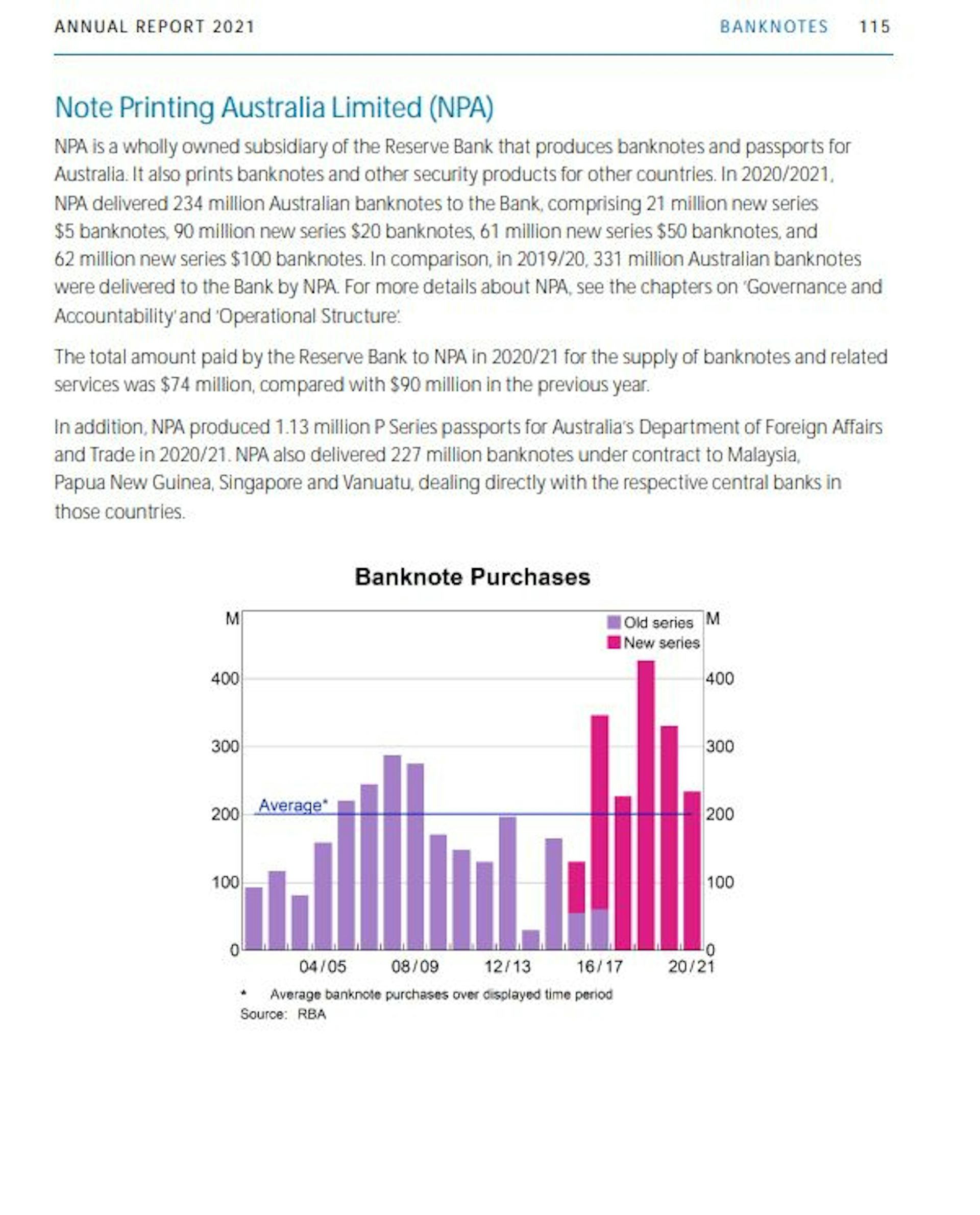
In 2020-21, Note Printing Australia delivered 234 million notes to the bank for a fee of $74 million, suggesting they cost about 32 cents each to make. Most were $50 and $100 notes, sold to private banks for $50 and $100 each.

That profit is accounted for differently to the profit for coins, and is hard to find.

One estimate, in an international study of 90 countries at the end of the 1990s, found Australia’s income from seigniorage of notes and coins to be low compared to other countries at 2.6% of government spending.

2.6% is an enormous amount. These days that’d be $16.3 billion, which is about what we spend on the Pharmaceutical Benefits Scheme.

$6-10 billion per year

The Reserve Bank measures seigniorage differently, using a formula that can produce odd results because it depends on the rate of interest. Before COVID, its view was that it only made about $1 billion per year from seigniorage, a figure it doesn’t usually calculate and doesn’t report to the government.

A simpler calculation would take the $6.8 billion of extra notes the bank supplied in 2020-21, deduct the $74 million it cost to print the notes and about as much again for the payments it makes to commercial banks to encourage them to hold sufficient stocks and return worn notes and come up with $6.6 billion.

A year earlier, as we stocked up on cash as COVID took hold, the bank would have made $10 billion.

An end to easy money?

The profits from printing notes don’t flow directly to the budget, except in part via Reserve Bank dividends, but they help by keeping the bank self-funding.

Profits from notes and coins are under threat. For the Reserve Bank it’s the threat of us one day wanting less cash – although for the moment, while we are using less cash in transactions, we are holding on to more for safekeeping than ever.

For the Mint, it’s the reality that we are using less cash. In 2020-21 it produced $82.2 billion worth of new coins, down from $114 billion a decade earlier.


Its other threat is the soaring price of metal. Mint chief executive Leigh Gordon revealed last week it was costing north of 12 cents to make each five-cent piece.

Earlier this year, after nickel prices soared in the wake of Russia’s invasion of Ukraine, he said even 20 cent coins were about to lose money.

Cheaper coins to the rescue?

Nickel prices have since come down, and one of the oddities of pricing is that it costs far less to make the largely copper and aluminium $1 and $2 coins (about eight cents each) than it does the nickel-heavy 10 and 20 cent coins (14-28 cents), but the Mint is preparing.

In 2016 the Mint developed a proposal to cheapen the metal content of its five, ten and 20 cent coins and shrink the size of its 50 cent coins, which it says was favourably received by retailers and banks who wanted coins that weighed less. The idea was submitted to the Treasury, but “not progressed”.

In the meantime it has partnered with Woolworths to produce limited edition “Olympic” and “Wiggles” coins that are delivered as change through cash registers rather than through banks, for which it charges a touch over $2.

There’s a lot that can be done, and every time there’s a crisis, we seem to rediscover cash. But eventually the money-making machine will stop.The Conversation

This article is republished from The Conversation under a Creative Commons license. Read the original article.

Read more >>

Tuesday, September 13, 2022

The certainty of ever-growing living standards we grew up with under Queen Elizabeth is at an end

Much has been written about how, with the passing of the Queen, we have lost one of our last continuing links to the second world war.

We have, but we have also lost something even more profound – the link she gave us back to when the kind of world we know began.

On Tuesday last week Queen Elizabeth appointed a new prime minister of Britain, Liz Truss, who was born in 1975.

Seven decades earlier, Elizabeth II ascended to the role alongside Prime Minister Winston Churchill, who was born in 1874.

That her first and last prime ministers were born a century apart is remarkable enough. But it is particularly significant that the thread of her reign extended all the way back, through Churchill, to the 1870s. That’s when it is possible to argue the expectations we grew up with began.

As the new UK Prime Minister was sworn in last week, University of California, Berkeley economist Bradford DeLong published his long-awaited Slouching Towards Utopia.

It’s an account of what he calls “the long 20th century”, a century he says began in 1870.

Why 1870, and not 1901, or even a century earlier at the start of the industrial revolution?

Because, DeLong says, right up until the 1870s living standards hadn’t changed much.

More importantly, living standards hadn’t changed much since the dawn of recorded time.

Until 1870, we weren’t much better off

In the millennia leading up to the birth of agriculture, what humans were able to produce barely increased at all.

In the 10,000-odd years between the year minus-8000 and the industrial revolution in 1500, our ability to produce food and other things increased tenfold, still not enough to be noticed over our (short) lifetimes.

Our ability to produce more than doubled again between 1500 and the 1870. But so did population, which kept most people desperately short of calories – and in near continual childbirth in an attempt to produce surviving sons – while necessitating smaller farm sizes that blunted the benefits of mechanisation.

From the 1870s, life got a lot better – fast

Then, from the decade of Churchill’s birth, things went spectacularly right.

Delong writes that in 1870 the daily wages of an unskilled male worker in London, the city then at the forefront of economic growth, would buy him and his family about 5,000 calories worth of bread. In 1600 it had been 3,000 calories.

He says today the daily wages of such an unskilled worker would buy 2,400,000 calories worth of bread: nearly 500 times as much.

The population grew, but our ability to produce things grew far faster. It grew to the point where, even in our lifetimes, we could see things getting better.

In the words of Billy Joel, every child had “a pretty good shot to get at least as far as their old man got”.

Unimaginable change in one lifetime

From the 1870s on, continual improvements in living standards became a birthright – not for everyone, but for humanity as a whole.

As did the development of once unimaginable products. The motor car, the radio, the television and the computer became ubiquitous during Queen Elizabeth’s life.

With more to go around, it became easier to share rather than take things. Democracies grew to the point where they became natural.

Economically, DeLong credits the development of research labs, modern corporations and cheap ocean transport that “destroyed distance as a cost factor”.

From the 1870s onwards, people were able to get what they wanted from where it was made, and were able to seek better lives by travelling to where they were needed.

University of California, Berkeley Professor Bradford DeLong’s economics lecture on ‘Slouching toward Utopia’.

Most economists didn’t see it coming

The market economy was necessary for this explosion in living standards, but not sufficient. People had bought and sold things for prices for millennia, but the prices had little to work with.

Almost no one saw such an extraordinary change coming.

The leading economist of the 1870s, John Stuart Mill, wrote it was “questionable if all the mechanical inventions yet made have lightened the day’s toil of any human being”. They had merely “enabled a greater population to live the same life of drudgery and imprisonment”.

Mill wanted population control. He wanted the expanding “pie” to be split among the people we had, rather than the hordes that would grow to cut each slice back to size.

The fathers of communism, Karl Marx and Frederick Engels, saw things more clearly. They expected technology and the taming of nature to produce so much wealth that there would one day be more than enough to go around, making the problem one of how to make sure it went around.

DeLong sees the long 20th century that began in 1870 as an ever-shifting battle between those who wanted the market to determine the distribution of wealth (believing it was the best way to grow the pie), against those who believed such unfairness wasn’t what they signed up for.

The end of certainty

How long did that “long 20th century” last? DeLong thinks it ended in 2010, making it a long century of 140 years. Since the global financial crisis, we have been unable to return economic growth to anything like the pace of those 140 glorious years.

Today, DeLong says material wealth remains “criminally” unevenly distributed. And even for those who have enough, it doesn’t seem to make us happy – at least “not in a world where politicians and others prosper mightily from finding new ways to make and keep people unhappy”.

DeLong sees “large system-destabilizing waves of political and cultural anger from masses of citizens, all upset in different ways at the failure of the system of the twentieth century to work for them as they thought that it should”.

Not only are we not near the end of the Utopian rainbow, Delong says the end of the rainbow is “no longer visible, even if we had previously thought that it was”.

King Charles III inherits a future with no guarantee of ever-increasing living standards, no guarantee human ingenuity will prevail over global warming, and no guarantee democracy will prevail.

It’s almost impossible to predict what the rest of this century has in store. But that’s how it was in the 1870s too – when even the brightest minds of the time couldn’t imagine what was to come.The Conversation

This article is republished from The Conversation under a Creative Commons license. Read the original article.

Read more >>

Tuesday, September 06, 2022

Australians on unemployment benefits are set for two record paydays – but it’s a sign of a broken system, long overdue for a fix

Australians on our humiliatingly-low unemployment benefit are about to get their biggest payday ever.

On September 20, the single rate of JobSeeker will climb A$25.70 per fortnight from $642.70 to $668.40. That’s the biggest automatic increase since the payment began at the turn of the 1990s, and twice as big as the next-biggest.

But it will still be a pitiful $17,378 a year – not even two-thirds of the way to meeting the Melbourne Institute’s poverty line of around $28,600 a year.

If the official forecasts turn out to be correct, the next increase (on March 20) will be of a similar order, meaning JobSeeker will have jumped 7.75% in a year, which ought not to be surprising, because inflation will have reached 7.75%.

Until now, pensioners have had a better deal

JobSeeker is linked to inflation, the rate of increase in prices, which has been low since the early 1990s. Wages and national income per person have climbed faster.

Pensioners, including age pensioners, have had a better deal. Since the 1990s, their incomes have been linked to male total average earnings, with a bonus clause that gives them inflation if male earnings don’t climb enough.

The difference between the growth in male earnings and inflation hasn’t amounted to much in any given year – typically 0.6 percentage points, meaning that if inflation was 2.5%, wages were likely to climb 3.1%.

But because wages nearly always grew by more than inflation, even if not by much, over time the compounding of those differences came to matter a lot.


JobSeeker (when it was called Newstart) used to be close to the age pension. In 1997 JobSeeker was A$321.50 per fortnight, and the age pension was $347.80.

But an accumulation of larger percentage increases in the pension (and a one-off increase in the pension) meant that by 2019, on the eve of COVID, the pension was 50% bigger.

Projections based on the then-prevailing rates of inflation and wages growth suggested that, unless something changed, the pension would be twice as much as JobSeeker by 2070.

So weak had JobSeeker become in relation to general living standards (well below the poverty line) that early in COVID in 2020 the Coalition effectively doubled it by adding on a $550 per fortnight coronavirus supplement.

Not enough to ‘meet the cost of groceries’

In an implicit acknowledgement that JobSeeker was no longer enough to feed and house people, then Treasurer Josh Frydenberg said the temporary bonus would allow unemployed people to “meet the costs of their groceries and other bills”.

When the temporary supplement ended, the treasurer lifted JobSeeker by only a little – $50 a fortnight, making the point that unemployment was meant to be temporary, whereas the age pension was for the remainder of a pensioner’s life.

There are two other important differences.

One is that the age pension goes to an identifiable voting bloc – three in every five of the Australians aged 65 and older. Dudding them would cost votes. There aren’t as many unemployed, and many of them are just passing through unemployment.

Matching JobSeeker to the pension would cost billions

The other difference is that JobSeeker is now so low relative to the pension that boosting it from its present $642.70 per fortnight to anything like the pension rate of $901 per fortnight would cost multiples of the $2.2 billion per year the government budgeted for the $50 increase.

Unemployed Australians (and those on Youth Allowance and other payments that have only increased in line with the consumer price index) seemed condemned to live an income so low as to raise concerns even 12 years ago about:

its effectiveness in providing sufficient support for those experiencing a job loss, or enabling someone to look for a suitable job

And no, those concerns about Australia’s comparatively low unemployment benefits weren’t raised from the Australian Council of Social Service – it was from the hardly radical Organization for Economic Co-operation and Development (OECD), in 2010.

These days the OECD is headed by former Liberal minister Mathias Cormann.

Former prime minister John Howard has expressed regret about allowing JobSeeker to fall so low relative to the pension.

In opposition, Anthony Albanese said it was not enough to live on.

Abbott tried to put pensions in line with jobless benefits

Just for now, the collapse in wages growth and the resurgence in inflation has frustrated what seems to have been a deliberate decision to allow JobSeeker to grow more slowly than the pension.

But it ought to be frustrated for good. Whatever the arguments for setting JobSeeker lower than the pension (the Centre for Independent Studies says pensions are for those out of work for “legitimate reasons”) there’s no defensible argument for a system that allows one to keep falling relative to the other.

Tony Abbott’s Coalition government deserves credit, sort of, for acknowledging this. In its first “horror budget” in 2014, it promised to put pension increases on the same footing as increases in the unemployment benefit.

“We promised at the last election not to change pensions in this term of government and we won’t,” his treasurer told parliament.

But beyond the next election, from September 2017, pensions would only increase in line with inflation, in tandem with unemployment benefits.

Like much of the rest of that budget, the measure didn’t survive a change of treasurer and prime minister.

Cheaper than the Stage 3 tax cuts

In the lead-up to the 2019 election, Labor promised an independent review of JobSeeker. Albanese withdrew the promise ahead of the 2022 election, saying the budget could not withstand it.

His commitments were about priorities. The starting cost of the previous government’s legislated Stage 3 tax cuts, supported by Labor, is $17.7 billion per year, which is less than making JobSeeker match the rate of the pension.

Half of the Stage 3 benefits accrue to Australians earning $180,000 or more.

Beyond the September 20 increase, lifting JobSeeker further in future would change the lives of Australians on $17,378.

In a Radio National interview on Monday, Albanese sounded as if he was open to doing something soon.

When inflation comes down, he won’t be able to rely on unusually high price rises to do the work for him.The Conversation

This article is republished from The Conversation under a Creative Commons license. Read the original article.
Read more >>