Showing posts with label incentives. Show all posts

Tuesday, August 24, 2021

Top economists in no rush to offer cash incentives for vaccination

Australia’s top economists are reluctant to endorse the use of either cash incentives or lotteries to boost vaccination rates.

A survey of 60 leading Australian economists selected by the Economic Society has instead overwhelmingly endorsed a national advertising campaign (90%), vaccine passports for entry to high-risk settings such as flights, restaurants and major events (85%) and mandatory vaccination for high-risk occupations (81.7%).

Offered six options for boosting uptake once supply was in place and asked to pick as many as they liked, only 35% picked cash incentives and only 31.7% lotteries.

Many said advertising and vaccine passports should work on their own.

Others, such as Uwe Dulleck from the Queensland University of Technology, suggested that while cash and lotteries might also work, “maybe a little bit”, they were ethically no better than coercion.

The panel selected by the Economic Society includes leading experts in the fields of behavioural economics, welfare economics and economic modelling. Among them are a former and current member of the Reserve Bank board.


Read more: Paying Australians $300 to get vaccinated would be value for money


Michael Knox of Morgans Financial said the most important thing for getting Australians vaccinated was “trust”.

Trust could be built through a national advertising campaign delivered via doctors and chemists as well as the media.



Others supported advertising in principle, but doubted the government’s ability to do it well.

The Australian government’s A$3.8 million “tacos and milkshake” campaign about sexual consent did not inspire confidence, said RMIT’s Leonora Risse.

The University of Sydney’s Stefanie Schurer said an easy and effective measure would be to simply reduce “transaction costs”. Many vaccinations don’t take place simply because they are difficult to arrange.

‘What’s in it for me?’

Former OECD director Adrian Blundell-Wignall said as a child in the 1950s, if you turned up on the day the polio or smallpox caravan was at school, you were either lined up and injected with a vaccine, or else given a lump of sugar with vaccine on it to swallow. “There was no debate, thank heaven.”

Underlying the reticence of two-thirds of those surveyed to endorse vaccine payments — along the lines of the $300 suggested by Labor or “VaxLotto” suggested by the Grattan Institute — was a concern that it would change the debate to “what’s in it for me?”.

Reserve Bank board member Ian Harper said “what’s in it for the rest of us” was at least as important.


Read more: Why lotteries, doughnuts and beer aren't the right vaccination 'nudges'


Macquarie University’s Elisabetta Magnani said cash incentives could “validate mistrust”. The University of Sydney’s Susan Thorp was concerned they might set a precedent.

“Would people expect another cash incentive in future for COVID vaccination boosters or for flu shots or childhood diseases?” she asked.

‘My body, my choice’

Two of the 60 economists surveyed backed “no additional measures”. UNSW Sydney economist Gigi Foster said the choice should be an individual’s, made without social shaming, goading, moralising or outright coercion.

But others strongly disagreed about individual choice. The University of Melbourne’s Leslie Martin said while personal choice mattered, it “should not come at a cost to others”. And Stefanie Schurer said in a world where individual freedoms were already wildly curbed, vaccination mandates and passports did not seem off the charts:

A requirement for children to meet immunisation schedules has been attached to childcare payments since 1998 and for the Family Tax Benefit A supplement from 2012. Families can access their family-related Centrelink payments only if their child’s vaccination schedule is up-to-date. In 2015 exemption rules were tightened to make it harder for so-called conscientious objectors. States such as NSW have also introduced vaccination mandates for children to access childcare centres.

Several of the economists who supported cash payments and lotteries said they should be held in reserve and used only as a “last resort”.

The Grattan Institute’s Danielle Wood said even if they only shifted the dial a few percentage points, there was a big difference between getting 75% of people vaccinated and 80%.

Eighty per cent might be enough to get a re-opening of the economy to “stick” without the need for further lockdowns.


Detailed responses:

Read more >>

Wednesday, August 04, 2021

Paying Australians $300 to get vaccinated would be value for money

I reckon Albo’s on the right track. The opposition leader wants to pay A$300 to every Australian who is fully vaccinated by December 1.

The Grattan Institute is on a similar theme. It has proposed a $10 million per week lottery, paying out ten $1 million prizes per week from Melbourne Cup day. One vaccination gets you get one ticket. Two gets you two tickets.

The costs are tiny compared to what’s at stake. Treasury modelling released on Tuesday puts the cost of Australia-wide lockdown at $3.2 billion per week.

Paying people to get vaccinated fits the government’s criteria of a response that’s “temporary, targeted and proportionate”.

And the published research on small payments shows they are extraordinarily effective, often more effective than big ones.

A few years back, Ulrike Malmendier and Klaus Schmidt of US National Bureau of Economic Research discovered that a small gift persuaded the subject of an experiment to award contracts to one of two fictional companies 68% of the time instead of the expected 50%.

Small payments can be more effective than big ones

A gift three times as big cut that response to 50%, which was no better than if there had been no gift at all.

The effect of small payments to pregnant British smokers has been dramatic.

Offered £50 in vouchers for setting a quit date, plus £50 if carbon monoxide tests confirmed cessation after four weeks, £100 after 12 weeks and £200 in late pregnancy in addition to the counselling and free nicotine replacement therapy given to the other pregnant smokers, those offered the payment were more than twice as likely to quit — 22.5% compared with 8.6%.


Read more: Albanese calls for $300 vaccination incentive, as rollout extended to vulnerable children


Never mind that these small sums ought to have made no financial sense.

The gifts were minuscule compared with the money the recipients would have saved anyway by not smoking, yet they worked so well that the researchers estimated the cost of the lives saved at just £482 per quality-adjusted year.

Around 5,000 British miscarriages each year are attributable to smoking during pregnancy. The participants randomly assigned the offer of a payment not to smoke gave birth to babies that were on average 20 grams heavier.

The incentives can be even smaller.

Mai Frandsen at the University of Tasmania has trialled offering smokers half as much — a A$10 voucher on signing up, then $50 per checkup in addition to support from a pharmacist. The results are encouraging.

Lotteries are cheaper still. The Grattan Institute’s suggestion of a $10 million per week payout sounds like a lot, but it isn’t when divided by Australia’s population.

A preliminary analysis of Ohio’s Vax-a-Million lottery found it increased takeup by 50,000-80,000 in its first two weeks at a cost of US$85 per dose.

Beer, doughnuts, dope

Other incentives offered with apparent success in the US include free beer, donuts and (in Washington state) free cannabis.

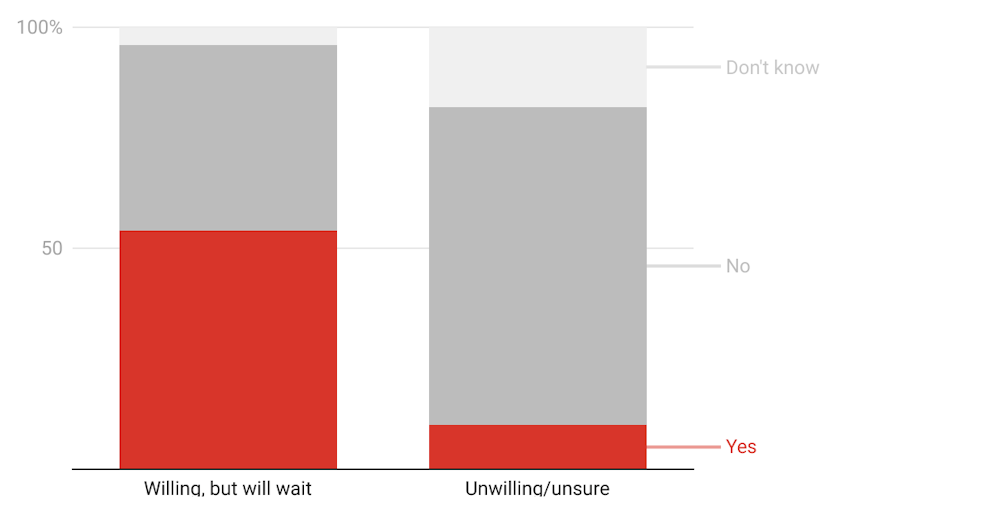
They needn’t work for everyone. A survey conducted by the Melbourne Institute in June found that of those who were willing to get vaccinated but hadn’t got around to it, 54% would respond to a cash incentive.

Of those who weren’t willing or weren’t sure, only 10% would respond to cash.


If you were paid a cash incentive, would you get vaccinated as soon as possible?

Melbourne Institute Pulse of the Nation survey

But the important thing about vaccination is that not everyone needs to do it.

The Grattan Institute believes 80% of the population needs to be vaccinated before we can reopen borders.

The national cabinet has adopted a lower target: 80% of Australians over 16, which is 65% of the population.

Vaccination expert Julie Leask says when it comes to child vaccines, most non-vaccinating parents are simply “trying to get on with the job of parenting”. If it’s made easy for them, they’ll do it.


Read more: When will we reach herd immunity? Here are 3 reasons that's a hard question to answer


There’s not a lot to be gained by trying to reach these who actually don’t want to be vaccinated. Try too hard, and you’ll get their backs up.

The tragedy of the government’s COVID vaccine rollout (aside from the difficulties with assuring supply) is that the government hasn’t made it easy.

Vaccination ought to be easy

The government could have made it easy. When it sought advice last year from departments including the treasury, it was told to do what’s done for the flu vaccine — to distribute it through employers and pharmacies as well as general practitioners, so as to make it almost automatic.

The best part of a year later, it’s a view the prime minister is coming round to. Most of us don’t go to the doctor very often — it’s out of our way.


Read more: Over 18 and considering AstraZeneca? This may help you decide


For a government that came to office promising to slash red tape for business and offered businesses incentives to invest, this government appears not to have fully grasped the importance of red tape and incentives when it comes to health.

It might yet. Prime Minister Scott Morrison said yesterday he had investigated something along the lines put forward by Albanese. General Frewen, in charge of the COVID taskforce, said it wasn’t needed “right now”.

When the time comes, if we remain under-vaccinated, Morrison can reach for it.

Peter Martin, Visiting Fellow, Crawford School of Public Policy, Australian National University

This article is republished from The Conversation under a Creative Commons license. Read the original article.

Read more >>