Showing posts with label covid. Show all posts

Wednesday, February 09, 2022

An investment in clean indoor air would do more than help us fight COVID – it would help us concentrate, with lasting benefits

Sometimes the best things you can do are invisible.

Such as fighting cholera by ensuring drinking water wasn’t contaminated by sewage, as happened in London in the 1840s.

Or setting up an emissions trading scheme, which drove emissions down, despite former prime minister Tony Abbott attacking it as a “so-called market in the non-delivery of an invisible substance to no one”.

Air free from contamination is as invisible as uncontaminated water, but the case for air isn’t yet as widely accepted as it is for water.

Air pollution from motor vehicles kills about 280 Australians per year, yet Australian petrol is allowed to contain 15 times as much sulphur as petrol sold in the US, the UK, Europe, Korea, Japan and New Zealand. Australia is planning to adopt in 2024 the standard adopted elsewhere in 2015.

And poor air quality harms us in ways that fall short of death.

Poor air harms performance

A new six-nation study of office workers in countries from China to the United States found that where ventilation is poor and levels of particulate matter are high, workers perform worse or more slowly on tests involving adding and subtracting and colour-coding words.

Another study on the relationship between indoor air quality and competitive chess players found that when the concentration of fine particulate matter with a diameter smaller than 2.5 micrometres (0.0025mm, better known as PM2.5) climbs as much as it can, players are 26% more likely to make mistakes.

The effect is worse if the players are running out of time.

Smart employers recognise this. When Google moved into a new headquarters in Mountain View, California, it was offered air filtration that cut pollutants to 0.0001 parts per billion. It opted for zero parts per billion, and paid more to get it.

If performance and education matter (and they do – on Monday the government launched a new inquiry into productivity) we ought to be treating clean air as an investment in productivity, over and above its undoubted benefit in containing the spread of COVID.

Here’s my big idea. The A$14 billion Building the Education Revolution program Labor put in place during the global financial crisis both helped fight the crisis and left Australia with thousands of school halls.

As far as legacies go, this wasn’t bad. The halls have been used for assemblies and plays and before and after school care.

But a program designed to contain the spread of COVID that left Australia with schools and workplaces in which the occupants were able to think clearly, and rarely caught infections – that would deliver an enduring dividend.

Many schools have openable windows, as do some workplaces. But in winter and for security reasons they are often closed and not reopened.

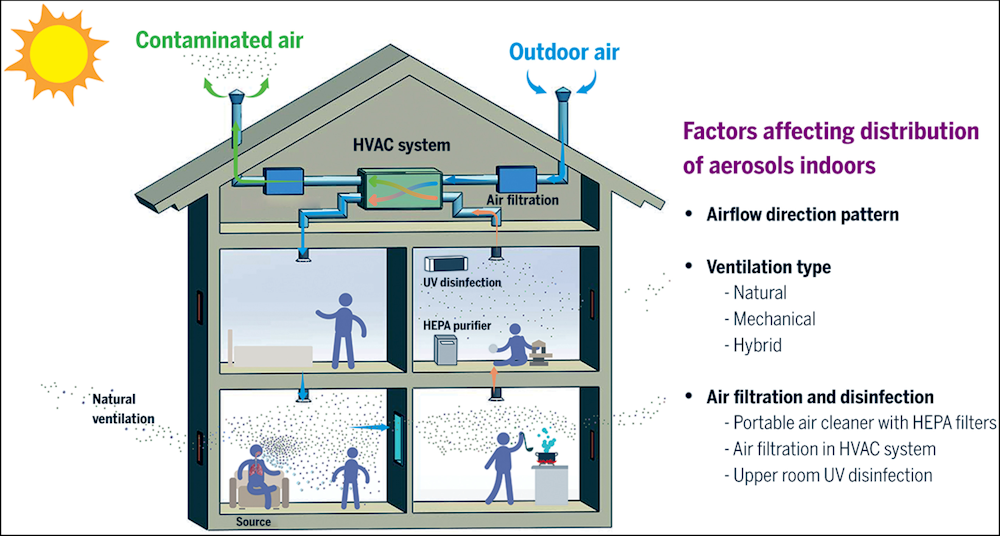
Distinguished Professor Lidia Morawska, director of International Laboratory for Air Quality and Health at the Queensland University of Technology, says outside air typically contains about 420 parts per million of carbon dioxide.
Science magazine

Beyond a few hundred parts per million indoors, the aerosols that carry viruses circulate rather than get blown away. In closed rooms and offices they can travel long distances and remain aloft for hours. Beyond 1,000 parts per million – and indoors, many times 1,000ppm is common – our ability to concentrate drops.

In order to fight COVID in classrooms, education authorities in Victoria, NSW, Queensland, Western Australia, South Australia, Tasmania the ACT and the Northern Territory say they are prepared to install air purifiers where needed.

The ACT is reusing those it bought to filter smoke during the 2020 bushfires. Victoria has gone the furthest – ordering 51,000 from Samsung.

These so-called high efficiency particulate air (HEPA) filters work by removing ultra-fine particles rather than bringing in air from the outside.

Portable purifiers are a stopgap

As a stop-gap for fighting COVID Professor Morawska thinks purifiers are okay. But she says as soon as COVID passes they are likely to be put in cupboards and not used til next time. They are unlikely to produce a lasting benefit.
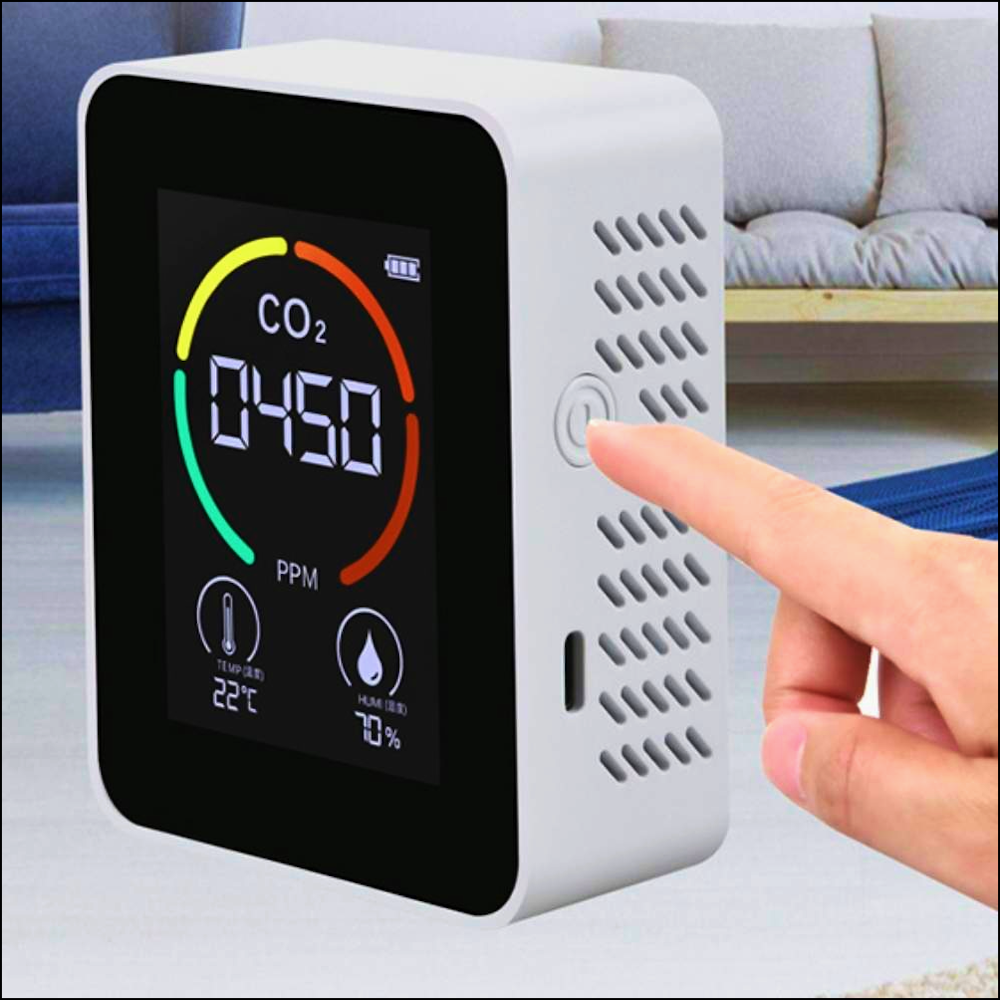
A far, far cheaper and perhaps more enduring solution would be to buy or mandate cheap carbon dioxide (C0₂) meters (portable meters can cost less than $100) for every classroom, office and shop.

Heavy duty meters can be mounted on walls and set to glow red when the air is bad. They are in schools throughout Germany.

C0₂ meters do more than monitor carbon dioxide.

By calculating how much of it is in rooms where humans have been, they measure ventilation. They are a good guide as to whether air is circulating and viruses and toxins are being diluted.

Installing meters and ensuring their output is displayed might just be one of the best-value interventions to fight COVID there is – leaving us with the lasting benefit of air that is safe in the same way as our water is safe.

Meters make the invisible visible

The initial cost would be low compared to the $14 billion spent on school halls.

The lasting benefit would be an awareness of when and where we needed to open windows and spend money installing better air flow systems, and when and where we did not.

The cost of poor indoor air can be measured not just in billions, but in billions per year. Back in the late 1990s the CSIRO calculated a cost of $12 billion per year. Two decades on, coronaviruses and bushfire smoke would make it greater still.

We’ve been offered a cost-effective chance to make the invisible visible and extend our productivity and lifespans. I reckon we should grab it.

Peter Martin, Visiting Fellow, Crawford School of Public Policy, Australian National University

This article is republished from The Conversation under a Creative Commons license. Read the original article.

Read more >>

Wednesday, August 04, 2021

Paying Australians $300 to get vaccinated would be value for money

I reckon Albo’s on the right track. The opposition leader wants to pay A$300 to every Australian who is fully vaccinated by December 1.

The Grattan Institute is on a similar theme. It has proposed a $10 million per week lottery, paying out ten $1 million prizes per week from Melbourne Cup day. One vaccination gets you get one ticket. Two gets you two tickets.

The costs are tiny compared to what’s at stake. Treasury modelling released on Tuesday puts the cost of Australia-wide lockdown at $3.2 billion per week.

Paying people to get vaccinated fits the government’s criteria of a response that’s “temporary, targeted and proportionate”.

And the published research on small payments shows they are extraordinarily effective, often more effective than big ones.

A few years back, Ulrike Malmendier and Klaus Schmidt of US National Bureau of Economic Research discovered that a small gift persuaded the subject of an experiment to award contracts to one of two fictional companies 68% of the time instead of the expected 50%.

Small payments can be more effective than big ones

A gift three times as big cut that response to 50%, which was no better than if there had been no gift at all.

The effect of small payments to pregnant British smokers has been dramatic.

Offered £50 in vouchers for setting a quit date, plus £50 if carbon monoxide tests confirmed cessation after four weeks, £100 after 12 weeks and £200 in late pregnancy in addition to the counselling and free nicotine replacement therapy given to the other pregnant smokers, those offered the payment were more than twice as likely to quit — 22.5% compared with 8.6%.


Read more: Albanese calls for $300 vaccination incentive, as rollout extended to vulnerable children


Never mind that these small sums ought to have made no financial sense.

The gifts were minuscule compared with the money the recipients would have saved anyway by not smoking, yet they worked so well that the researchers estimated the cost of the lives saved at just £482 per quality-adjusted year.

Around 5,000 British miscarriages each year are attributable to smoking during pregnancy. The participants randomly assigned the offer of a payment not to smoke gave birth to babies that were on average 20 grams heavier.

The incentives can be even smaller.

Mai Frandsen at the University of Tasmania has trialled offering smokers half as much — a A$10 voucher on signing up, then $50 per checkup in addition to support from a pharmacist. The results are encouraging.

Lotteries are cheaper still. The Grattan Institute’s suggestion of a $10 million per week payout sounds like a lot, but it isn’t when divided by Australia’s population.

A preliminary analysis of Ohio’s Vax-a-Million lottery found it increased takeup by 50,000-80,000 in its first two weeks at a cost of US$85 per dose.

Beer, doughnuts, dope

Other incentives offered with apparent success in the US include free beer, donuts and (in Washington state) free cannabis.

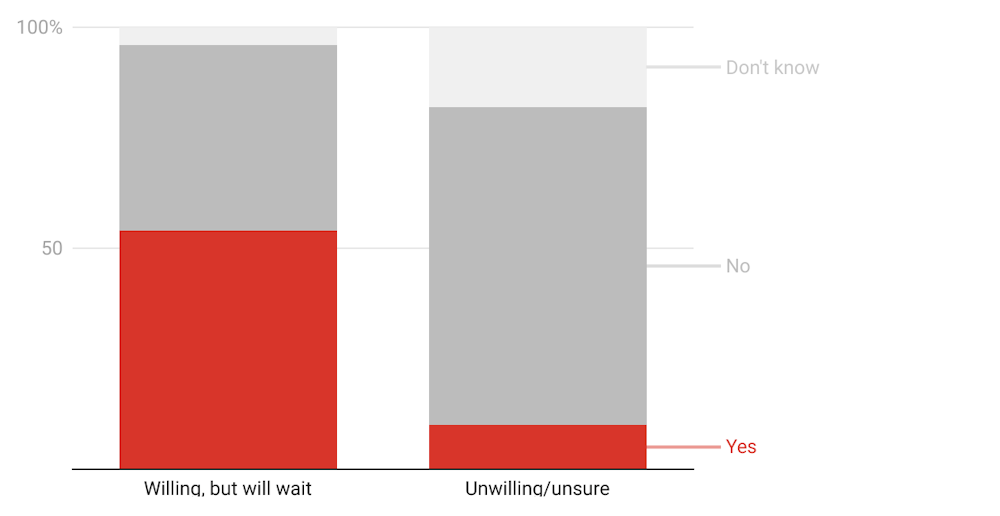
They needn’t work for everyone. A survey conducted by the Melbourne Institute in June found that of those who were willing to get vaccinated but hadn’t got around to it, 54% would respond to a cash incentive.

Of those who weren’t willing or weren’t sure, only 10% would respond to cash.


If you were paid a cash incentive, would you get vaccinated as soon as possible?

Melbourne Institute Pulse of the Nation survey

But the important thing about vaccination is that not everyone needs to do it.

The Grattan Institute believes 80% of the population needs to be vaccinated before we can reopen borders.

The national cabinet has adopted a lower target: 80% of Australians over 16, which is 65% of the population.

Vaccination expert Julie Leask says when it comes to child vaccines, most non-vaccinating parents are simply “trying to get on with the job of parenting”. If it’s made easy for them, they’ll do it.


Read more: When will we reach herd immunity? Here are 3 reasons that's a hard question to answer


There’s not a lot to be gained by trying to reach these who actually don’t want to be vaccinated. Try too hard, and you’ll get their backs up.

The tragedy of the government’s COVID vaccine rollout (aside from the difficulties with assuring supply) is that the government hasn’t made it easy.

Vaccination ought to be easy

The government could have made it easy. When it sought advice last year from departments including the treasury, it was told to do what’s done for the flu vaccine — to distribute it through employers and pharmacies as well as general practitioners, so as to make it almost automatic.

The best part of a year later, it’s a view the prime minister is coming round to. Most of us don’t go to the doctor very often — it’s out of our way.


Read more: Over 18 and considering AstraZeneca? This may help you decide


For a government that came to office promising to slash red tape for business and offered businesses incentives to invest, this government appears not to have fully grasped the importance of red tape and incentives when it comes to health.

It might yet. Prime Minister Scott Morrison said yesterday he had investigated something along the lines put forward by Albanese. General Frewen, in charge of the COVID taskforce, said it wasn’t needed “right now”.

When the time comes, if we remain under-vaccinated, Morrison can reach for it.

Peter Martin, Visiting Fellow, Crawford School of Public Policy, Australian National University

This article is republished from The Conversation under a Creative Commons license. Read the original article.
Read more >>