Tuesday, November 28, 2023

Governments have been able to overrule the Reserve Bank for 80 years. Why stop now?

Pay close enough attention to parliament these next few days, and you’re likely to witness something truly remarkable: politicians from both sides of politics uniting to remove the power of politicians to overrule the Reserve Bank.

As an instance of self-loathing, it’s hard to top.

Sure, a good many of us don’t trust politicians. But surely politicians ought to trust politicians. Surely politicians ought to realise that we put them there to make decisions – not usually the day-to-day decisions, but the ultimate big decisions. They are meant to be where the buck stops.

That Treasurer Jim Chalmers could be even thinking about axing his ultimate power to veto decisions of the Reserve Bank board shows just how far the myth of an “independent Reserve Bank” has spread.

Scroll through the treasurer’s website, and you’ll find 195 documents referring to the “independent Reserve Bank”, many multiple times.

‘Independent’, but not according to the law

Saying the Reserve Bank is independent suits the treasurer and it suits the prime minister, just as it has suited many of their predecessors. As soon as the bank does something that’s necessary but unpopular (such as pushing up interest rates) they are able to say – wrongly – there’s nothing they can do.

The government’s Reserve Bank is dependent on the government in myriad ways.

The government set up the Reserve Bank. The government appoints every member of its board. The government directly appoints its chief and deputy chief. And from time to time the government gives it running instructions.

But – most importantly – the government can overrule it.

The mechanism is built into the Reserve Bank Act.

In the event of a disagreement, the treasurer can

submit a recommendation to the governor-general, and the governor-general, acting with the advice of the Federal Executive Council, may, by order, determine the policy to be adopted by the bank.

The government is to accept responsibility for the decision taken, and the Reserve Bank board must

thereupon ensure that effect is given to the policy determined by the order and shall, if the order so requires, continue to ensure that effect is given to that policy while the order remains in operation.

After so directing the bank, the treasurer is to table in parliament a copy of the direction, along with a statement explaining the reasons, and a statement from the Reserve Bank board putting the case that failed to convince the treasurer.

These are the clauses – until now unused – that in April the outside review of the Reserve Bank asked the government to do away with.

Its thinking was that the government can’t be trusted.

As the review put it,

if an elected government controls monetary policy there are risks that it may try to push the economy to run above its capacity, resulting in higher inflation but with no lasting impact on employment.

On releasing the review’s recommendations, Treasurer Jim Chalmers said straight away that he agreed in principle with all of them.

Shadow Treasury Angus Taylor said much the same thing, although he now says the Coalition will wait until sees the legislation Chalmers is about to introduce before deciding its position on it.

The veto power is there for a reason

On the face of it, a reasonable position would be that the government’s ability to overrule the bank in extreme circumstances has caused no problem so far.

The review counters this by warning of “the possibility that established conventions cease to be observed”.

But, if that did happen, it would be because there was a serious (and ultimately public) rift between the elected government and an unelected board.

With the exception of judges in Australia’s courts, unelected officials can’t normally overrule elected governments. It’s how our system is designed.

The Reserve Bank tried to overrule the government once, and succeeded, which is why the provision we have was written into the law.

Back in 1930, in the early years of the Great Depression, the Reserve Bank was part of the Commonwealth-owned Commonwealth Bank, run by a board appointed by the government which reported to the government.

In The Conversation earlier this year, Alex Millmow outlined what happened.

Desperate to support the economy, the government begged the government-owned bank to help it finance public works.

The bank refused. Its government-appointed chairman, Sir Robert Gibson, wrote to Treasurer Ted Theodore warning a point was being reached

beyond which it would be impossible for the Commonwealth Bank to provide further financial assistance for the governments in the future

Theodore replied complaining the bank was trying to

arrogate to itself a supremacy over the government in the determination of the financial policy of the Commonwealth, a supremacy which, I am sure, was never contemplated by the framers of the Australian Constitution

While the government did not question the right of the bank’s board to offer such comment or criticism as the board thought proper, the control of the public purse had “heretofore always been regarded as an essential prerogative of the people”.

In the end, it was the government that backed down. But to ensure it could never be overruled again, Labor wrote the veto power into the Commonwealth Bank Act of 1945 and the Coalition wrote it into the Reserve Bank Act of 1959.

That’s the veto power today’s Labor Party, quite possibly with the support of the Coalition, is about to try to remove.

I understand why the Reserve Bank review made the recommendation it did: it wants monetary policy to work well. But I don’t think that’s enough of a reason for the government to attempt to abrogate its responsibility.

And ultimately, it can’t. The Australian public is going to hold the government responsible for the state of the economy even if it succeeds in tying one hand behind its back. But I don’t think it’s wise. One day it might need it.The Conversation

This article is republished from The Conversation under a Creative Commons license. Read the original article.

Read more >>

Tuesday, November 21, 2023

Why further RBA rate hikes are less likely now than even 1 week ago

Since Australia’s Reserve Bank hiked interest rates two weeks ago, there have been two important developments – one in the United States and the other in the United Kingdom.

If it’s not clear to you why events overseas influence Australia’s interest rates, which are meant to be set to control Australian inflation, read on.

US and UK inflation close to zero

We haven’t been complete masters of our own destiny since the Australian dollar was floated 40 years ago next month.

What happened in the US last Tuesday was news of dramatically lower US inflation. When increases and decreases in prices were taken together, overall US prices moved not at all in the month of October. That’s right, inflation was zero.

While zero movement in one month doesn’t mean zero over the entire year, it helps bring down the rate over the entire year. US inflation fell from 3.7% in the year to September to 3.2% in the month to October.

Then the next day we got similar news from the UK.

Taken together, prices in the United Kingdom scarcely grew at all in October, climbing just 0.1%. The screeching halt to UK monthly inflation took the annual rate down from 6.7% for the year to September to 4.6% for the year to October.


In both the US and the UK, there’s talk there will be no need for further interest rate hikes, and very probably a case for interest rate cuts as soon as next year.

We don’t yet know what happened to Australia’s inflation rate in October – the Bureau of Statistics will tell us next week.

But we have an early indication.

The Melbourne Institute inflation gauge, which roughly tracks the bureau’s measure, fell 0.1% in October. If that is what the bureau finds – that overall prices barely moved (or fell) in October – Australia’s annual inflation rate should fall from 5.6% for the year to September to around 5.2% for the year to October.

Inflation down all over

All over the world, inflation is falling for much the same set of reasons: the price of oil is heading back down after Saudi Arabia and Russia tried to restrict supply in the middle of the year, and the price pressures caused by shortages are easing.

As Australia’s Reserve Bank conceded in the minutes of the November board meeting, in which it pushed up rates, there has been “an easing in supply chain pressures and raw materials prices”.

Not that this means the bank is relaxed about what’s happening to inflation; far from it.

In the minutes released on Tuesday and in remarks delivered at a conference ahead of their release, Governor Michele Bullock said what concerned her was stronger-than-expected demand pressures. Australians remained keen to spend.

And she drew attention to disturbing

growing signs of a mindset among businesses that any cost increases could be passed onto consumers

But what has just happened overseas will help, big time. Here’s why.

Australians’ buying power just jumped

As soon as the news of low US inflation came out last Tuesday, the US dollar slid.

Investors became less keen to hold US dollars when it became less likely that US interest rates would rise further, and a good deal more likely they would fall.

Against the Australian dollar, the US dollar fell 2%. From an Australian’s point of view, the buying power of an Australian dollar jumped from 63.7 to 64.9 US cents and has since jumped to 65.8 US cents.


A sudden jump in the value of the Australian dollar

Value of Australian dollar in US cents. Yahoo Finance

This means that, for as long as it lasts, Australian dollars will buy more than they did.

Australians will pay less in Australian dollars for the goods and services ultimately paid for with US dollars. The changed interest rate outlook in the US will act to keep Australian prices low.

In this way, decisions made in the US not to increase interest rates or even to cut them make it easier for Australia’s Reserve Bank not to increase rates – or even to cut them.

A higher dollar means lower inflation

The effect isn’t big. The RBA believes it takes a 10% change in the value of the Australian dollar to move the Australian inflation rate 0.4 percentage points.

But it is better than things moving in the other direction, which is what has been happening until now.

For more than a year now, whenever interest rates have climbed in the US, Australia’s Reserve Bank has been under pressure to push up its rates to stop the Australian dollar falling and prices climbing.

No longer. After last week’s news from the US and the UK, Australian financial markets began pricing in a close to zero chance of further interest rate rises – with a fair chance of a rate cut next year.

It’s always impossible to tell for sure what the Reserve Bank will do to rates. A lot will depend on what actually happens to inflation.

But for the first time in a long time, the Reserve Bank has tail winds from overseas, rather than headwinds.

For the first time in a long time, the bank won’t feel pressured to push up rates just because rates have been pushed up overseas.The Conversation

This article is republished from The Conversation under a Creative Commons license. Read the original article.

Read more >>

Tuesday, November 14, 2023

We could make most Australians richer and still save billions – it’s not too late to fix the Stage 3 tax cuts

The Albanese government is about to have to make a really important decision.

It’s going to have to decide what’s more important: supporting Australians who are financially under water, or keeping an election promise.

And it’ll have to do it soon. It’s already working on its May budget, now just six months away.

That choice will affect almost every Australian, and it could shape whether you’re thousands of dollars a year better off – or not – from July next year.

Household budgets are shrinking

When Labor took office in May 2022, Australians were doing well. Consumer spending and economic growth were on the up and up, and mortgage rates and rents were only starting to climb.

A promise to keep the proposed multi-billion dollar Stage 3 tax cuts – announced but not implemented by the Coalition back in 2018 – seemed worth making to clear away any reasons any voters might have not to vote Labor.

Since May 2022, just about everything has got worse for ordinary Australians – those on typical incomes, which are about $85,000 for full-time workers and $43,000 for adult part-time workers.

The best measure of the buying power of after-tax incomes is real household disposable income per capita. During the past year, it shrank 5.3%, which is more than it shrank in either the early 1990s recession or the global financial crisis.

On my calculations, it’s the worst collapse in 40 years.

From those incomes have to be taken rents and mortgage payments.

The Reserve Bank says scheduled mortgage payments are now taking up a larger share of household disposable income than at any time in history10% when averaged over all households including those that don’t have mortgages, and many times that for those that do.

This means when you go to the supermarket and find you can’t afford what you used to, you’re not imagining it. It hasn’t been like this in decades. And it’s about to get worse.

The Christmas bonus is missing

In the lead up to each of the past four Christmases, ordinary earners have received a bonus from the tax office - the so-called low and middle income earner tax offset, initially worth $1,080 and increased to $1,500 in 2022.

This year, it’s gone. It means middle-earners’ pre-Christmas tax refunds will be up to $1,500 smaller or replaced with bills. Taxpayers who normally have a tax bill will get a bill up to $1,500 bigger.

An estimated 10.5 million Australians submitted their tax forms by October 31.

Most of them – most of those earning up to $90,000 and previously eligible for the full $1,500 offset – are about to find themselves a good deal worse off.

Average earners will lose, while the rich get thousands

The very expensive Stage 3 tax cuts (costing $20 billion in their first year, and $313 billion over ten years) were meant to come to the rescue. They begin next July.

Speaking notes prepared for Treasurer Jim Chalmers and released under freedom of information laws say they will provide relief to low and middle earners and kick in at $45,000.

But someone on that income will get no relief. That person will lose an offset of $1,275 in return for a tax cut of zero. Someone on a higher wage of $50,000 will lose $1,500 in order to gain $125, and someone earning the typical full-time wage of $85,000 will have to lose $1,500 to gain just $1,000.

That’s right, a typical full-time worker will get relief of $1,000 from the Stage 3 tax cuts in return for losing the axed tax offset of $1,500.

Higher earners will do much, much better. An Australian earning twice as much as is typical – $190,000 – will get $7,500. An Australian earning a bit more than that again – $200,000 – will get $9,000.

Labor has been handed an opportunity

Handing $9,000 to a high earner but only $1,000 to an ordinary full-time earner is an indulgence that might have seemed okay when it looked as if ordinary earners were doing alright, or wouldn’t notice.

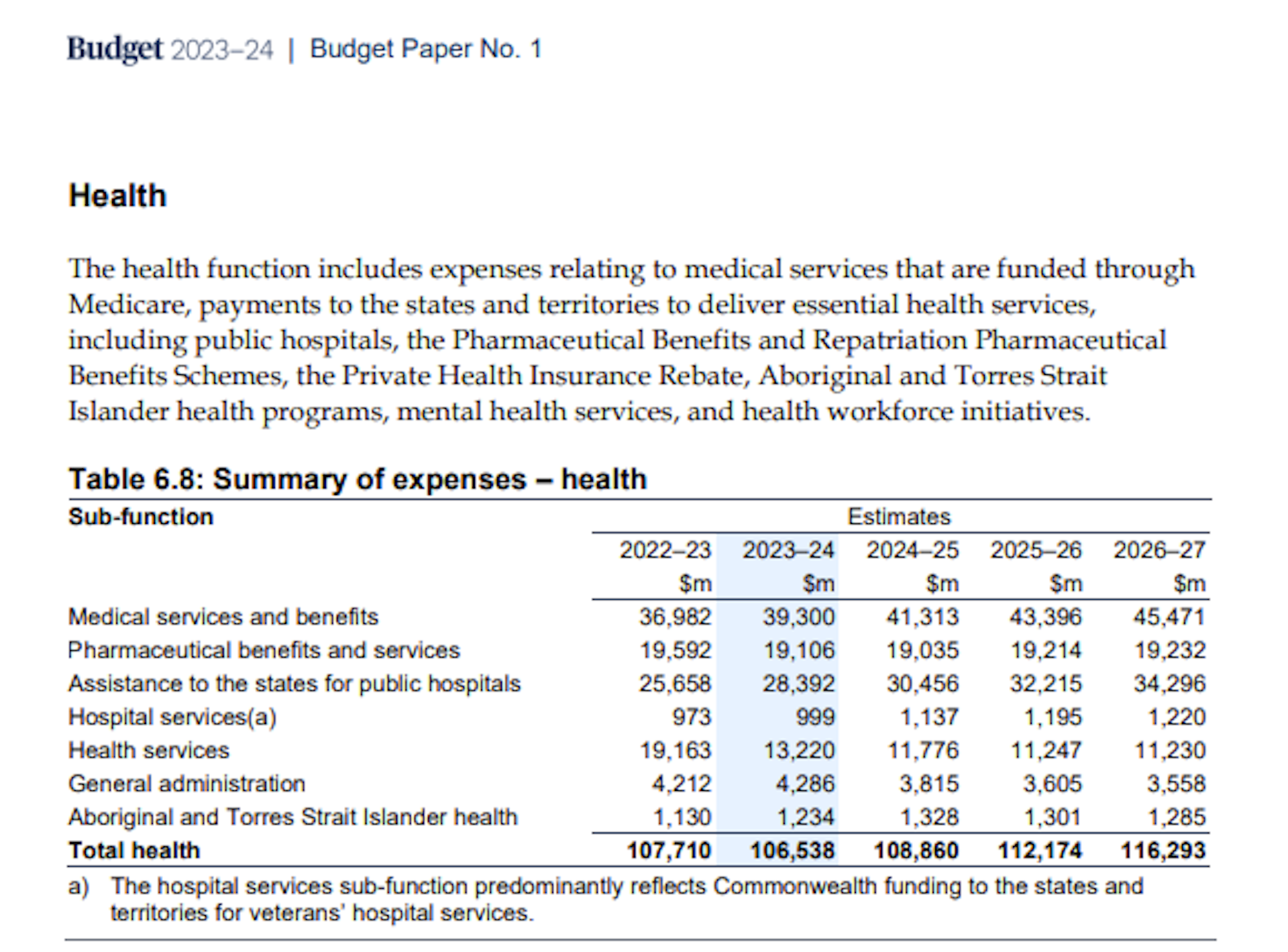
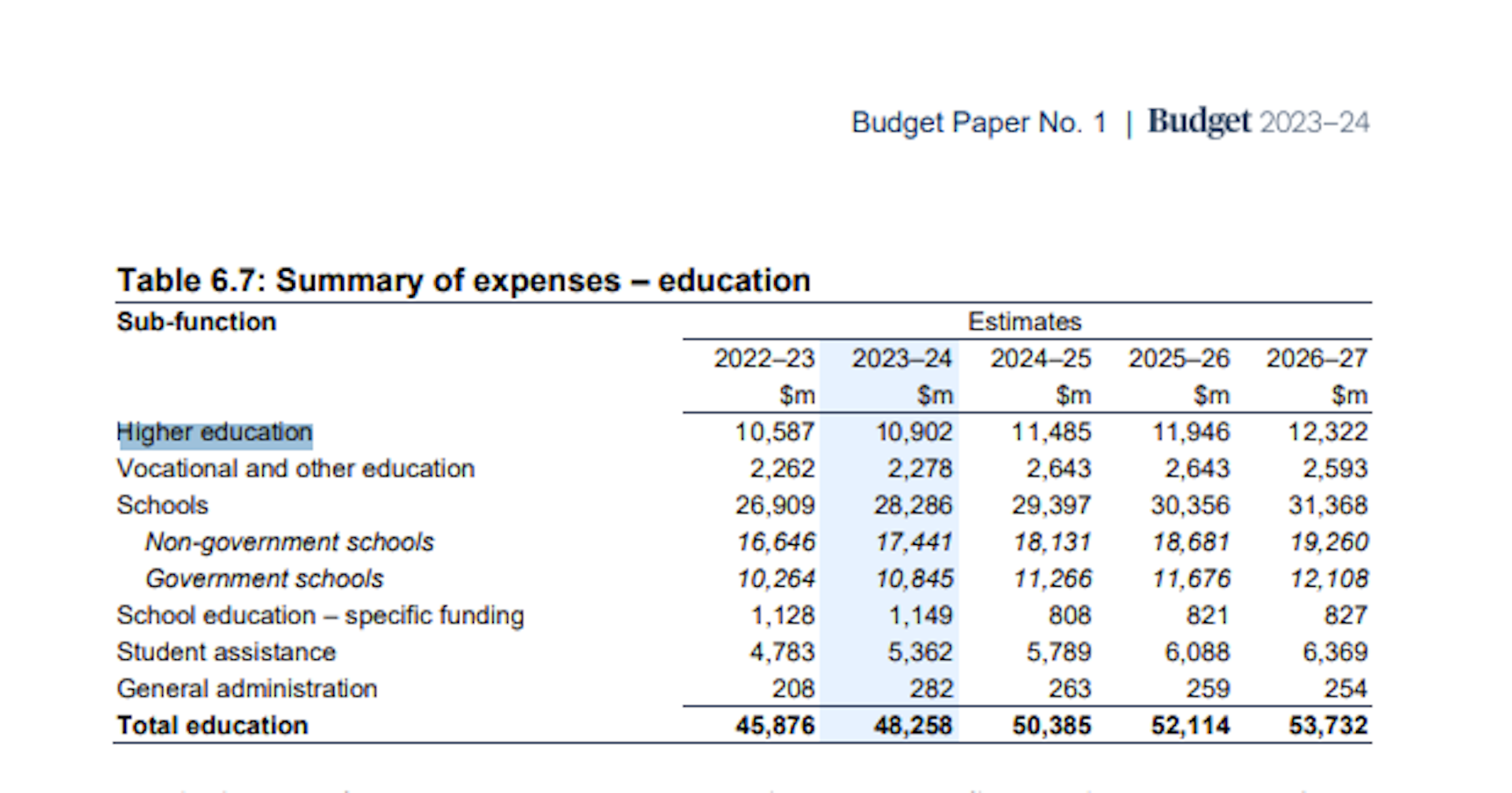
But it’s about to happen, and it’s about to cost $20 billion in its first year. That’s as much as the government plans to spend on the pharmaceutical benefits scheme in that year and almost twice what it plans to spend on higher education.

What if it kept the tax cuts, but reoriented them to Australians who actually needed them – to the more than 80% of Australians who earn less than $120,000 a year – while still providing generous cuts to those who earned more than $120,000?

That’s a task Matt Grudnoff and Greg Jericho set themselves at the Australia Institute, coming up with four options. Each of those four would cost less than Stage 3 cuts, deliver more to Australians on less than $120,000, and even fund a $250 per fortnight increase in the JobSeeker unemployment benefit.

Jericho’s punchline, delivered to the revenue summit at Parliament House last month: “I actually wish it was harder than it was”.

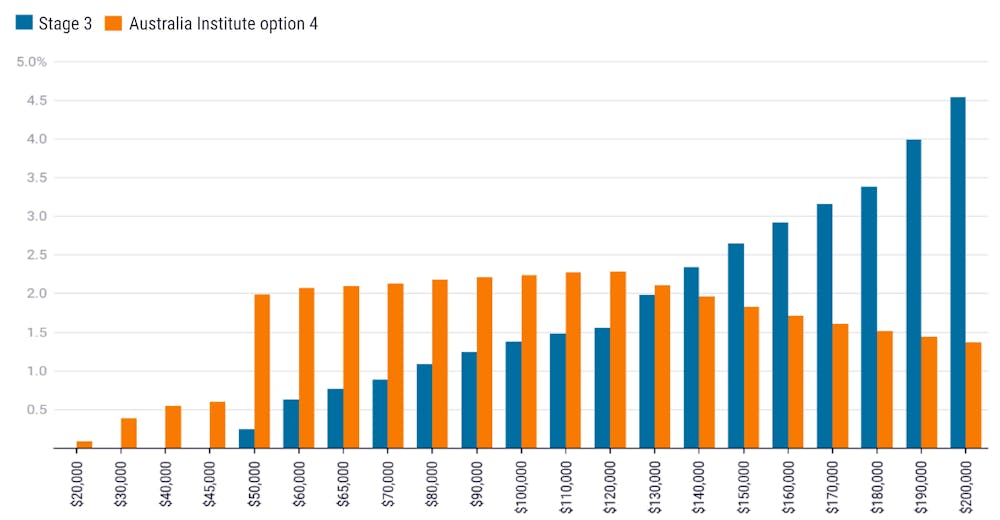
Option 4 costs $70 billion less over ten years but leaves every taxpayer earning up to $132,000 better off.

It doubles the tax cut Stage 3 gives to a typical full-time earner on $85,000, and still gives high earners $2,197 a year each.


Stage 3 vs Australia Institute Option 4, tax cut as percent of taxable income

Graph of percentage benefits from Stage 3 and an alternative at different incomes
The Australia Institute, A better Stage 3: fairer tax cuts for more Australians, October 2023, CC BY-SA

His point isn’t that this is the best option. It is that there are options, many of which give the bulk of Australians – the stressed ordinary voters Labor and the Coalition will need in the next election – much more than Stage 3.

What’s wrong with making 80% of the electorate better off at a time when they desperately need it, and cutting future budget deficits by $70 billion?

Only that it would break a promise, and Prime Minister Anthony Albanese likes keeping promises.

But when asked in an Australia Institute survey what was more important – keeping a promise or reacting to changing economic circumstances – 61% picked reacting to changing circumstances.

Even among Coalition voters, 56% supported reacting to changing circumstances.

It puts the Stage 3 tax cuts in play. There’s still time, and plenty of electoral and economic reasons to rejig them.The Conversation

This article is republished from The Conversation under a Creative Commons license. Read the original article.
Read more >>

Tuesday, November 07, 2023

Why it’s a good bet the Melbourne Cup Day rate hike will be the last

Australia just became the odd one out.

At its meeting last week, the US Federal Reserve kept its official interest rate on hold. A week earlier, the European Central Bank and the Bank of Canada kept their rates on hold, and, at their meetings before that, the Bank of England and the Reserve Bank of New Zealand did the same thing.

Throughout the Western world – with perhaps Australia as the only exception – financial markets have been assuming central banks were done with increasing rates and would soon start pushing them down.

Reserve Bank Governor Michele Bullock’s statement accompanying Tuesday’s hike in Australia’s cash rate makes it look as if we’re about to join that club. It makes it look as if this hike from 4.1% to 4.35% – a 12-year high – will be the last.

And with good reason. Inflation has been falling almost everywhere, and – notwithstanding the recent uptick associated with higher oil prices – is forecast by the International Monetary Fund to keep falling.


The RBA has taken out insurance

So why did Australia’s Reserve Bank push up rates at all, at a time when none of its global peers were?

The statement makes it look as if it wanted to take out insurance.

While the bank still expects inflation to continue to fall, it says progress now looks “slower than earlier expected”.

Its revised set of forecasts, to be released on Friday, still have inflation falling, but to around 3.5% by the end of next year, instead of 3.3%, then to around 3% by the end of 2025 instead of 2.8%.

The bank is particularly worried that the prices of services – things such as service in a cafe, done by hard-to-find workers – are “continuing to rise briskly”.

And it mentions “uncertainties” four times in eight paragraphs. It isn’t that it thinks inflation won’t keep coming down; it’s that it wants to be sure it is.

Australian hikes hit harder than in the US

One argument the bank hasn’t used – and nor should it – is catch-up. The US, the UK, the EU, Canada and New Zealand all have higher official rates than Australia.

But they are all are different to Australia, in an important way.

When the US Federal Reserve pushes up its Federal Funds Rate, nothing much happens to US home borrowers. Here’s why: almost all US home borrowers are on fixed rates, meaning their required mortgage payments don’t increase.

In Australia, only about one-third of home loans are fixed.

And US fixed rates are nothing like Australian fixed rates. The typical term in the US is 30 years, rather than the two to three years common in Australia.

This means that, as long as borrowers in the US don’t refinance or move homes, their payments are fixed for the entire term of their loans. Americans never have to pay more just because the Fed jacks up rates.

At least when it comes to homebuyers, the US Fed has to do a good deal more than Australia’s Reserve Bank to have the same effect.

It means the US official rate of 5.25% has less immediate effect on ordinary Americans than Australia’s new rate of 4.35% will have on us.

That’s what the consumer spending figures show.

After a year of high US rates, American consumers are buying 2.9% more goods and services than they were a year ago.

After a year of less-high Australian rates, Australian consumers are buying 1.7% less.

This means that, as relatively lightweight as our previous 4.1% cash rate had seemed, it might have been packing more punch than the higher 5.25% rate in the US; and also the higher rates in the UK, Canada and New Zealand, where most of the mortgages are also fixed.

‘Painful squeeze’

In her statement, Governor Bullock acknowledged many households were experiencing “a painful squeeze on their finances”. She also noted others were benefiting from rising housing prices, substantial savings buffers and higher interest income.

Bank calculations suggest one in 20 variable-rate borrowers are now going backwards – paying more for essential expenses and housing than they earn.

Among borrowers with big loans relative to their incomes, it’s one in four.

There’s nothing in the governor’s statement to suggest she is thinking of pushing up rates again. After today’s hike, the futures market assigned only a 30% probability to another hike.

The best guess of people who bet on this for a living is that Australia is about to join the rest of the world and leave rates where they are for quite some time.

A frugal Christmas, before possible rate drops in 2024

Alternatively, rates could even begin coming down within 12 months.

The detail of the inflation figures shows monthly inflation surged to 0.8% for one month only, in August, when petrol and diesel prices jumped 9.1%, then fell back to 0.3% in September, which is where it was before petrol prices jumped.

It is also looking like prices scarcely increased at all last month.

The Melbourne Institute inflation gauge, which comes out ahead of the Bureau of Statistics gauge and broadly tracks it, fell 0.1% in October. This suggests that, when taken together, price falls (slightly more than) outweighed price increases.

It’s what you would expect if we were tightening our belts, as we are.

At Big W discount department stories across Australia, sales are down 5.5% on where they were a year ago.

Big W says shoppers have moved away from buying big-ticket items and are instead buying a remarkable number of small gifts, such as Hot Wheels toy cars.

They sell for $2 each, or five for $9.

It’s pointing to a frugal Christmas in which retailers are going to have to discount if they want to move goods, taking further pressure off inflation.

Should that happen, rates could turn down even sooner than financial market traders expect, perhaps by the middle of next year.The Conversation

This article is republished from The Conversation under a Creative Commons license. Read the original article.

Read more >>