Tuesday, September 26, 2023

The Albanese government blew its shot at setting a historic new unemployment target

Treasurer Jim Chalmers says the federal government’s employment white paper is “ambitious”. I’m not convinced.

A clearly ambitious statement would have specified a target for unemployment, ideally one that was a bit of a stretch.

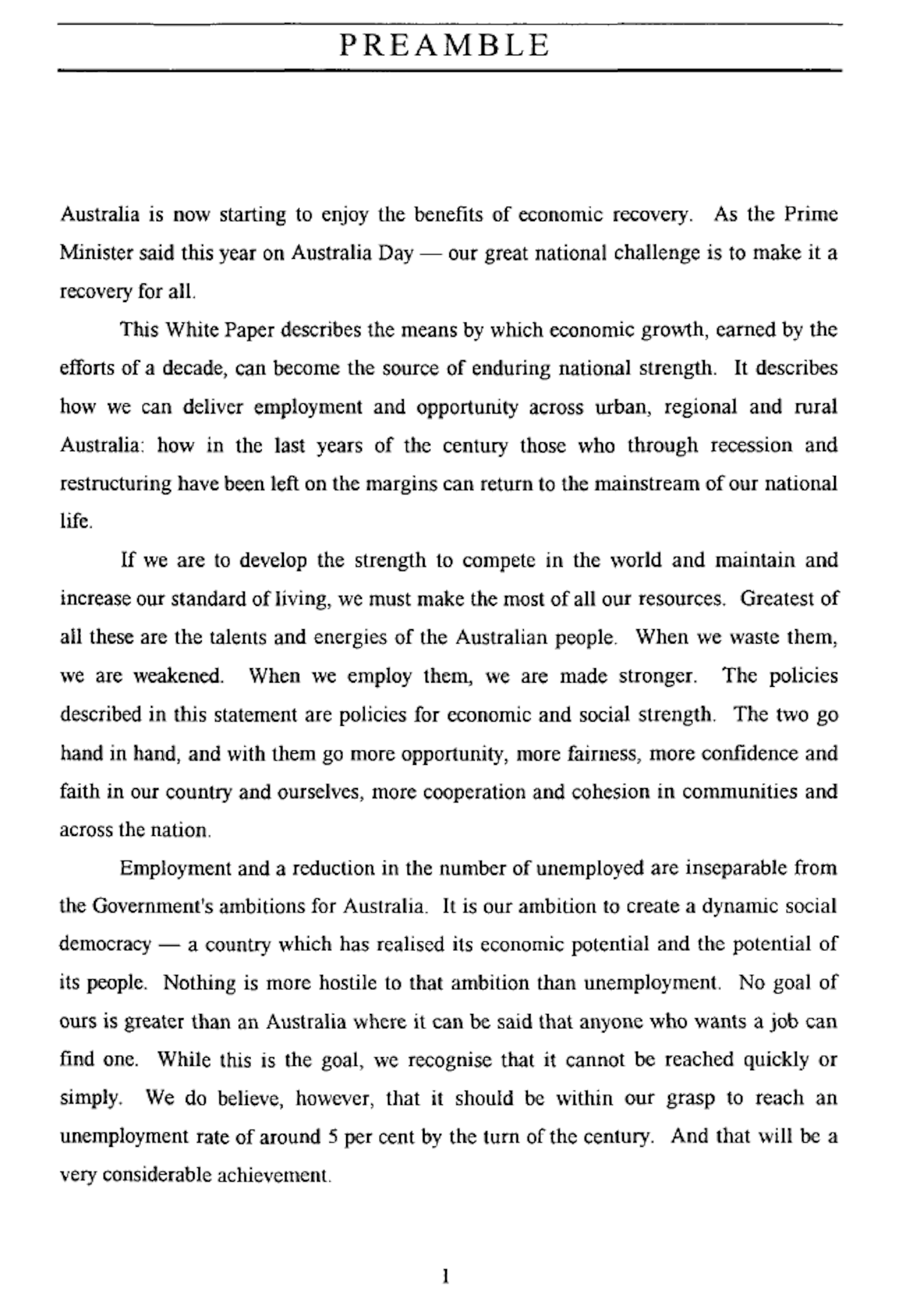
The Keating Labor government’s Working Nation statement did that in 1994. Released at a time when unemployment was almost 10%, it specified a target unemployment rate of 5% – an ambition that served as a beacon for decades.

That target certainly needs to be updated. Unemployment is now well below 5%, meaning “full employment” is now much less than 5%. Yet the Albanese government has passed up a historic opportunity to say how much less, which it could have done by setting its own target.

Setting our sights below 5%

The white paper released on Monday defines full employment as a state in which “everyone who wants a job should be able to find one without searching for too long”. That means our unemployment target ought to be somewhere between zero and 5%.

Of course, the unemployment rate can never be zero.

There will always be people out of work while they are moving between jobs, what the white paper calls “frictional” unemployment. That will also be true when Australia’s mix of employers changes – what the paper calls “structural” unemployment, as new industries requiring one sort of training replace old industries that required another.

The white paper says what matters in addition to unemployment (539,700 Australians) is “underemployment” in which people work fewer hours than they want (1 million) and “potential workers” who would like work but aren’t actively looking and so aren’t counted as unemployed (1.3 million).

I get that these things matter. I get that we need, in the words of the white paper, “a higher level of ambition than is implied by statistical measures”.

What gets measured gets done

But that higher level of ambition ought not replace targets.

If a target isn’t specific, it isn’t a target at all (or at best it’s a fuzzy target). That means it’s less likely to be aimed at and less likely to be hit.

That’s how it’s been with full employment itself. In 1996 Treasurer Peter Costello and the man he appointed Reserve Bank governor, Ian Macfarlane, signed what became the first Statement on the Conduct of Monetary Policy, an agreement that’s been updated six times.

As with all of the agreements since, that first statement set out an inflation target (“between 2% and 3%, on average, over the cycle”) but not an employment target – even though both are meant to be objectives under the Reserve Bank Act.

As a result, Governor Macfarlane was able to step down ten years later, secure in the knowledge that on average he had hit the middle of the target band: 2.5% inflation. His successor Glenn Stevens stepped down ten years further on, quietly boasting the same thing.

But neither could make any boast about hitting the employment target – because there wasn’t one.

How failing to set a target costs jobs

The governor who has just retired, Philip Lowe, looks like he’ll hit an inflation average of 2.8%, which is pretty low given how high inflation has been lately.

But an estimate by former Reserve Bank staffer Isaac Gross, prepared using the Reserve Bank’s own economic model, suggests that in doing so he kept unemployment a good deal higher than it needed to be between 2016 and 2019 – the equivalent of 270,000 people being out of work for one year.

Lowe wasn’t held to account for the extra unemployed in the same way as he is being held to account for his performance on inflation. Why? Because he was never actually given an unemployment target.

I am quite prepared to acknowledge that other measures of employment matter, underemployment among them. But here’s the thing: they move in line with unemployment.

When Australia’s unemployment rate falls, Australia’s underemployment rate falls, almost in tandem.


It’s easy to see why. As employers find it hard to hire new workers, they get existing workers to put in more hours. And retirees and others who haven’t been looking for work begin putting themselves out there.

Australia’s participation rate measures the proportion of the population making itself available for work. As unemployment has fallen, it has climbed to an all-time high.

Our unemployment rate is a proxy for what matters

This makes the unemployment rate just about the perfect proxy for everything else about the labour market that matters, and just about the perfect number to target.

The Albanese government could have recognised that this week – setting a stretch target of 3% (or even 4%) as an aspiration. Even that would have been less “ambitious” than Keating choosing 5%, when the rate was twice as high.

Treasurer Chalmers says the government didn’t set a target because apparently the unemployment rate doesn’t capture “the full extent of spare capacity in our economy or the full potential of our workforce”.

The saving grace is this government has a second chance at this. Chalmers is about to update the Reserve Bank’s statement of expectations, the one that until now hasn’t included a target for unemployment.

It would be open to him to put a specific target in there – making the RBA as accountable as it is now on inflation.

At the moment, it looks more likely Chalmers will adopt a recommendation of the independent review of the bank, which reported in March.

That review recommended the bank be required to produce its own “best assessment of full employment at any point time”, including its estimate of the lowest rate of unemployment that can be sustained without accelerating inflation.

It would be a small step forward. That full employment estimate would become a number to watch, in the same way as the bank’s performance on inflation is at the moment.

But it still won’t be an official government target. The Albanese government had an opportunity to live up to its ambitious rhetoric – and it passed.The Conversation

This article is republished from The Conversation under a Creative Commons license. Read the original article.

Read more >>

Tuesday, September 12, 2023

How Qantas might have done all Australians a favour by making refunds so hard to get

I’m not sure whether I’ve got any unclaimed Qantas flight credits.

I haven’t looked, either because I’m too busy or can’t be bothered. Which is exactly what Qantas wants. And not only Qantas. Separating out those people who are desperate or determined to get their money from those who give up is a standard business practice.

It’s called price discrimination, although Qantas appears to have added a twist.

Washing machine, fridge and computer manufacturers all do it. They sell their products for a standard price, and then offer a $200 or $400 “cash back” to buyers who fill in and send off a form when they get home.

The manufacturers know time-poor, lazy or well-off customers won’t bother, so they won’t need to send them cash. But the customers who do bother will really need the cash, and probably wouldn’t buy the products without it.

That way they can sell to people who otherwise wouldn’t have bought, while at the same time charging a high price to people prepared to pay it. They’ve arranged things so the two groups sort themselves out.

A tax on the time-poor

Qantas (and Virgin) could have easily refunded money to people who bought flights during the first years of COVID and had to cancel because of lockdowns. In most cases, Qantas had their credit card numbers. It still has them. It could refund the best part of A$500 million right now.

Instead, it makes it really difficult to get money back. It requires phone calls, waiting on the line and fishing out old emails and customer codes.

For a while, until it backed down days ahead of its chief executive bringing forward his retirement, Qantas said those credits would expire unless they were reclaimed, knowing full well many would not be.

But it’s not only Qantas imposing a tax on the time-poor.

A tax on those who won’t pick up the phone

News Corporation will allow you to subscribe to its papers with a click and a card. But when you hit “unsubscribe”, you get given a phone number.

When (and if) you get around to ringing it, you are subjected to an ordeal in which the operator gives you reason after reason not to unsubscribe, instead of acting on your request. You can insist, of course, but it takes time and effort.

The (NewsCorp-owned) Wall Street Journal also makes it impossible to unsubscribe without a phone call… unless you live in California. There, and only there – not in Australia, not in the rest of the United States – you are allowed to unsubscribe online because of a law forcing providers to offer the option.

Australia’s banks are experts at separating lazy customers from diligent shoppers, as are electricity companies.

They routinely offer customers who switch (or say they are about to switch) better rates than customers who stay, turning a time-poor tax into a loyalty tax.

A tax on loyal customers

You might think a tax on those who don’t chase the best deals is effectively a tax on the better-off, as they are the least likely to need savings.

Yet an array of evidence across a wide range of industries assembled by David Byrne and Leslie Martin finds loyalty taxes hit the poorest the hardest.

In an intriguing and expensive experiment in 2017, Byrne and Martin attempted to find out why this was.

They staffed a call centre at The University of Melbourne, in which actors phoned electricity companies, provided or let slip a few details, and said they were thinking of switching.

Among those details was eligibility for Victoria’s low-income energy subsidy.

Byrne and Martin found no discrimination against low-income callers because they said they had low incomes. But they did find that where the callers sounded as if they lacked information, they were presented with worse offers.

A premium price dispute

Disturbing evidence tendered in the Federal Court suggests some Australian insurance companies may be systematising discrimination against Australians who lack access to information.

The Australian Securities and Investments Commission has alleged some insurers set premiums not only on the basis of risk, but also on the basis of what a computer model tells them about the likelihood of each customer tolerating a price hike.

ASIC says the alleged practice is known internally as “renewal optimisation”.

Those claims are disputed, with insurer IAG telling The Australian Financial Review: “We don’t agree with how ASIC has characterised the process by which we calculate renewal premiums, and the impact on our customers.”

Enough for a government inquiry

Where immorality starts and standard business practice stops will be a question for a newly-established taskforce on competition. It will be headed by the Grattan Institute’s Danielle Wood (who will also head the Productivity Commission) and the former head of the Competition and Consumer Commission, Rod Sims.

One thing they might be able to agree on immediately is that something else Qantas has been accused of doing with flight credits is beyond the pale.

Evidence supplied to the ABC in 2022 suggests that not only has Qantas been hanging on to customers’ money by directing them to use credits for flights rather than refunds, it has been jacking up the price of flights when they do – by 50% to 300%, imposing what amounts to an extra (enforced) loyalty tax.

If Qantas and others have taken standard business practices just that little bit further in recent years, there’s a small chance they’ve done us a favour. They’ve given the taskforce something to sink its teeth into.The Conversation

This article is republished from The Conversation under a Creative Commons license. Read the original article.

Read more >>

Tuesday, September 05, 2023

What’s to stop Philip Lowe moving to a private bank after he leaves the RBA? It’s what his predecessors did

Surely Reserve Bank Governor Philip Lowe won’t move to a private bank after his term as governor ends next week.

After having chaired his last board meeting on Tuesday, there’s nothing to stop him, and – as shabby as it seems – he wouldn’t be the first.

There are three reasons why he shouldn’t join the board of or become chair of a private bank, all alluded to in the public service code of conduct.

One is concern that the former employee would reveal confidential Commonwealth information (which would be unlikely for someone as cluey as Lowe) or “provide other information that would give the new employer an advantage in its business dealings”, which would be more likely, even if unintentional.

Banks don’t seek out former Reserve Bank chiefs unless they think there’s something in it for them.

Another concern set out in the code of conduct is that the former employee would exploit their knowledge of the Commonwealth to lobby, or otherwise seek advantage for their new employer in dealing with the Commonwealth.

Banks such as Westpac, NAB, the ANZ and Macquarie Bank deal with the Reserve Bank all the time. It runs the payments system, it is responsible for the financial system, and it sets interest rates.

Every one of the four banks I just mentioned has employed either a former Reserve Bank Governor or Treasury Secretary.

Perceptions matter when a Governor moves on

Even where these high-profile hires don’t help the banks in their relations with the regulator, the public service code of conduct points to the “perception” that they will have a greater ability to influence regulators than other hires.

The third concern identified in the code of conduct – in my view the most important – has been labelled “ingratiation” by a public service specialist at the Australian National University, Richard Mulligan.

It’s the possibility that while still in the public service, the employee will use their position to go soft on an organisation (or type of organisation) they see as a potential future employer.

The Reserve Bank’s own code of conduct is silent on the question of taking up employment with the banks it regulates, although it does say that where there is a perception of conflict of interest, the employee has to discuss it with the relevant department head or governor.

The government’s lobbying code of conduct in place since 2008 purports to ban heads of department from engaging in lobbying activities relating to any matter with which they have had official dealings for 12 months after they have left office.

But former governors needn’t lobby, and 12 months isn’t long to wait.

Philip Lowe’s predecessor, the man to whom he was deputy, Glenn Stevens, finished up as Reserve Bank Governor in September 2016 and joined the board of the Macquarie Bank and Macquarie Group in December 2017. He has been chair of Macquarie Bank and Macquarie Group since 2022.

Stevens’ predecessor as governor, Ian Macfarlane, finished as head of the Reserve Bank in September 2006 and joined the board of the ANZ bank in February 2007.

The governor he replaced, Bernie Fraser, finished at the Reserve Bank in September 1996 and joined the board of the industry funds that became Australian Super in the same year, becoming chair of the super-fund-owned ME Bank in 2000.

Macquarie, Westpac, NAB. Governors get looked after

Ken Henry stepped down as head of the Australian Treasury (and a member of the Reserve Bank board) in April 2011 and in November that year joined the board of the National Australia Bank. In 2015 he was made its chair.

The man Henry replaced at the Treasury, Ted Evans, stepped down in April 2001 and joined the board of Westpac that year, becoming its chair in 2007.

I’ve dealt with each of these people while they were governors or treasury secretaries and I’ve never seen anything that made me doubt their integrity.

And yet in my view, none of them should have gone on to work for the type of organisations they used to regulate.

All of them were paid extraordinarily well. In 2021–22 Philip Lowe was on a package of $1.037 million including superannuation and a salary of $890,252.

None needed another high-paying job straight away, and (because of public service super) all had a generous income to look forward to in retirement.

I understand their need to continue to do interesting things, but I don’t think it’s too big a sacrifice to ask former regulators to do those things away from the types of organisations they had the privilege of regulating.

On retiring from the Reserve Bank in 1968, its first governor HC Coombs, chaired the Council for the Arts and the Council for Aboriginal Affairs. He made an ever-greater contribution to Australia without doing what the Japanese call amakudari, or “descending from heaven” to work for the organisations he once regulated.

A profile of the practice includes the admonition “don’t snicker”.

When Lowe took the governor’s job in 2016 I wrote a profile of him for The Age and the Sydney Morning Herald, speaking to former teachers and colleagues off the record. Repeatedly, unprompted, they mentioned his moral compass.

Lowe is about to turn 62. He has years of useful work ahead of him. I don’t expect him to descend from heaven to do it.The Conversation

This article is republished from The Conversation under a Creative Commons license. Read the original article.
Read more >>