Tuesday, May 30, 2023

Will Albanese live up to his own promises to end pork-barrelling? There is a sliver of hope

Like Kevin Rudd before him, Anthony Albanese is taking an odd approach to evidence.

Before becoming prime minister in 2007, Rudd promised to deliver “good evidence-based policy in terms of producing the best outcomes”.

Yet while in office, Rudd made several of his most important and far-reaching decisions without bothering to compare outcomes to cost – that is to say, without a formal cost-benefit analysis. Those decisions included lifting compulsory super contributions and his preferred model of the national broadband network.

In the case of the national broadband network, Rudd explicitly rejected pleas for a cost-benefit analysis, a stance his finance minister justified by saying

we just formed the view that in effect we had to make the clear decision that said this is the outcome we are going to achieve, come hell or high water, because it is of fundamental importance to the future of the Australian economy.

In opposition, Albanese led the way in pushing for evidence-based policy. So far, his government is reverting to type – even shutting down a move to improve accountability on big projects last week. But there is also one small sign of progress, thanks to a new institution you probably haven’t heard about yet.

Albanese just blocked what he once championed

Back when he was Rudd’s infrastructure minister, Albanese set up Infrastructure Australia, a statutory authority.

At the time, Albanese declared: “This government is determined to bring a fresh approach to developing and modernising the nation’s physical infrastructure — replacing neglect, buck-passing and pork-barrelling with long-term planning”.

Returning to opposition as Labor’s infrastructure spokesman in 2014, Albanese tried to strengthen Infrastructure Australia’s independence.

He moved in parliament to require the authority to perform a cost-benefit analysis of all proposed projects costing $100 million or more, “regardless of what the political views are around a particular project”.

The government blocked the motion. There the idea languished – until last week.

Last Wednesday, independent MP Allegra Spender moved almost exactly the same motion – in almost exactly the same words – requiring Infrastructure Australia to perform a cost-benefit analysis of all proposed projects costing $100 million.

Labor and the Coalition combined to vote the motion down.

There’s something about the idea of making decisions that don’t make financial sense that becomes irresistible to politicians once they are actually in office.

Already this year, Albanese has pledged $240 million to Tasmania for a stadium and $2.2 billion to Victoria for the suburban rail loop.

Spender also unsuccessfully tried to require Infrastructure Australia to publish its infrastructure audits and collate data on costs after projects were completed.

It “astonished” her there was no established mechanism by which governments could learn from what had happened with past projects.

A (small) win for evidence

Yet amid the dismay, there’s a sliver of hope. In the same week the government voted down attempts to give Infrastructure Australia more teeth, it formally unveiled its new Australian Centre for Evaluation.

The pet project of Labor’s assistant minister for treasury, former economics professor Andrew Leigh, it will be tasked with examining whether government programs work, and doing it before they are rolled out.

The method will be randomised trials, something Leigh knows a lot about having written a book about them while in opposition, called Randomistas.

Leigh says what he is proposing isn’t an audit; that happens after the event. And it isn’t a cost-benefit study; that’s done before the event, but on a spreadsheet without real-world knowledge of what will happen.

It will mean implementing programs or pilots in ways that let the government compare the results with what would have happened without them.

Too many programs are rolled out everywhere, all at once, without an opportunity to find out what would have happened if the program wasn’t there.

Inspiration from Mexico

Leigh’s favourite example comes from Mexico. In 1997, the government there was considering changing the way it delivered food and energy subsidies to poor households. It wanted to try handing out cash instead, but on the proviso that children of the families receiving it attended school and health clinics.

Rather than changing the system for all 500 villages at once, it changed it for half in May 1998 and the other half in December 1999. The 18-month window where one half did one thing, and the other half did the other, let it see which half prospered the most.

It was the half that switched to conditional cash handouts – but Mexico wouldn’t have been sure without that trial.

$2 million per year for control groups

Leigh wants to build in that sort of randomisation here. “You might already have a program which is going to be rolled out over the course of two years,” he says. “Why not randomise the way in which you roll it out, so year two is the control group for year one?”

The treasury has been given an extra $2 million per year to get the centre started. Leigh says it will hire about a dozen people and act as a consultant to other departments that are planning programs.

It’s a small start, and at this stage a small exception to what seems to be the prevailing view among governments that they already know what’s best.

Just imagine how much good the new centre could do if it’s allowed to – including, to quote Albanese, finally replacing “neglect, buck-passing and pork-barrelling with long-term planning”.The Conversation

This article is republished from The Conversation under a Creative Commons license. Read the original article.

Read more >>

Tuesday, May 23, 2023

Will Jim Chalmers’ budget drive up inflation? Not likely – and here’s why

The proposition that cutting prices will stoke inflation is a hard one to get your head around, even if you are an economist.

Yet it has been seriously put forward as a critique of this month’s budget; the one in which Treasurer Jim Chalmers announced measures that will take the edge off electricity and gas prices, the price of prescriptions and some visits to the doctor, and the out-of-pocket costs faced by low-income renters.

And childcare. Although announced in last year’s budget, measures to take effect in July are set to save a typical family with one child in care about $1,780 per year.

Some of the critics of these measures were participants in this year’s Economic Society of Australia post-budget survey.

What they said was that cutting these prices will give people more free money to spend on other things, pushing up prices elsewhere, and putting more pressure on inflation and the Reserve Bank, which might have to push interest rates higher.

As one of them put it, subsidising bills is “not really all that different” to giving people cash payments that they can use to bid up prices and push up inflation.

As I said, it’s a hard argument to get your head around. It makes sense in theory, but in practice I don’t think it makes much sense at the moment, given the measures actually in the budget.

Correct in theory, if not in practice

Here’s how it might make sense. Imagine a big expense that households had no choice but to pay. If the government introduced measures that increased it by $1,000 a month, those households would be forced to spend a good deal less per month on other things, and would put a good deal less upward pressure on prices.

Actually, we don’t need to imagine. It’s partly why the Reserve Bank has just ramped up interest rates – to increase mortgage payments by up to $1,000 per month, and in doing so take up to $1,000 a month from household budgets to take pressure off prices.

And it’s partly why the Reserve Bank cuts interest rates – to lower mortgage payments and free up money households can use to bid up prices.

The argument is that if a cut in the price of paying off a mortgage can be inflationary, so too can cuts in other prices.

Except that other price cuts are hardly ever anything like as big.

When the price of petrol (and diesel) jumped 40 cents per litre after Russia invaded Ukraine in 2022, few people doubted it was inflationary. It pushed up the price of nearly everything.

So when the price per litre fell 22.1 cents after the Morrison government temporarily cut fuel excise, few doubted that the measure restrained inflation as it was meant to, even though if the price had been cut by much more the cut might well have fed inflation.

Which is another way of saying that size matters. If I was to spit into the ocean, theory suggests I would lift the sea level. Practice suggests I would not.

A small effect, with a lag

In his post-budget address to Australian Business Economists last week, Treasury Secretary Steven Kennedy revealed the government’s calculations on the budget’s effects on inflation.

He said the changes to rent assistance, the price of prescriptions and bulk billing were small and would put only “small downward pressure on prices”, which he conceded might theoretically be offset by a boost to spending.

But he said that offsetting effect would be “largely immaterial”, meaning it would be too small to measure.

The energy price measures will do much more. Kennedy’s department reckons they will cut inflation by three quarters of a percentage point in 2023-24, producing an inflation rate of 3.25% rather than 4% in the year to June 2024.

It says the caps on wholesale prices will do most of the work, cutting the inflation rate by half a per cent, with the consumer and business rebates cutting inflation by a further quarter of a per cent. When the rebates end in mid-2025 their effect will be unwound.

The department says the offsetting effect from extra spending will be measurable but “small”, and will work “with a lag”. So by the time it has had much of an effect, inflation itself should be a good deal lower.

And Kennedy identified three things that should help offset the offsetting effect:

  • lower energy prices and inflation will lower the indexation of payments that are linked to inflation, putting less money into the economy to add to inflation

  • the expected 0.75 point cut in inflation should help restrain inflationary expectations, making it harder for high inflation to become self-sustaining

  • the cuts in the profits of energy companies brought about by the energy price caps will themselves remove money from the economy.

And Kennedy says Australia is well placed to fight inflation in other ways.

All of the budget measures taken together, including the cost-of-living measures, should add just $20 billion to the amount the government pumps into the economy over the next four years – a mere fraction of $11 trillion that Australians will spend and earn over that time.

As well, Australia’s very, very low unemployment rate has pushed the proportion of the population in paid employment to record highs, making Australia better able than ever to call upon workers to respond to shortages as prices rise.

The faster-than-expected return of migration will help even more, adding to the capacity of the economy to provide services without pushing up prices, all the more so because the migrants Australia selects tend to be young enough not to need many services themselves.

While you can never know what’s around the corner, I’m yet to see a credible argument that inflation won’t do as predicted in the budget: come down swiftly from here on. It’s forecast to fall from 7% to 6% by the middle of this year, and to 3.25% by the middle of next year.

Rather than making inflation worse, it seems to me that by cutting prices for many of us, the budget will help bring down inflation sooner.The Conversation

This article is republished from The Conversation under a Creative Commons license. Read the original article.
Read more >>

Thursday, May 18, 2023

Economists award Chalmers top marks for budget, but less for fighting inflation

Wes Mountain/The Conversation, CC BY-ND

Asked to grade Jim Chalmers’ second budget on his own criteria of delivering “relief, repair and restraint”, most of the 57 leading economists surveyed by the Economic Society of Australia and The Conversation give it top marks.

On a grading scale of A to F, 37 of the 57 economists – almost two-thirds – gave the budget an A or a B.

The proportion giving the budget top marks is far higher than for the COVID-era budgets of his Liberal predecessor, Josh Frydenberg, which attracted top marks from 41% and 37% of the experts surveyed.

The economists chosen to take part in the survey have been recognised by their peers as Australia’s leaders in fields including macroeconomics, economic modelling, housing and budget policy.

Among those surveyed are a former head of the Department of Finance, a former member of the Reserve Bank board, and former Treasury, International Monetary Fund and Organisation for Economic Cooperation and Development officials.

Only one of the 57 surveyed gave the budget the lowest possible mark of F, and only three awarded it an E.

Ten of the experts qualified their approval by saying the budget should have done more to help vulnerable Australians suffering from higher rents and energy prices, including – but not limited to – Australians on JobSeeker.

Melinda Cilento, chief executive of the Committee for Economic Development of Australia, said while the increases in payments and support were “a good start”, they didn’t go far enough.

Consultant Nicki Hutley said even the promise of a staged increase in JobSeeker would have been better than “the miserly increase given”.


Few of those surveyed said they would have preferred a tougher budget. Some, including economist Saul Eslake, warned the economic growth forecasts were so weak (1.5% for 2023-24) that a budget that took money out of the economy might have increased the risk of a recession.

The budget saved 82% of the revenue upgrades that had come from better-than-expected jobs and commodity price growth. Economist Rana Roy said if the budget had tried to save 100% of the revisions or more, it could well have triggered a recession or the first signs of it, and a reversal of the measures.

“A tough policy that is unsustainable is not actually tough,” he said, referring to the fate of the measures introduced by Treasurer Joe Hockey in the Abbott government’s first budget in 2014, many of which were abandoned or modified.

Other criticisms of the budget were that it failed to wind back the high-end Stage 3 tax cuts due mid next year (seven panellists’ criticised); that it was less generous to wage earners than those on benefits (two panellists) and that it offered little to address climate change (four panellists).

Former Paris-based OECD director Adrian Blundell-Wignall said the budget was “short on policies to prevent climate change and long on policies to help people deal with it”. Some of the profits that had made the budget strong came from exporting fossil fuels, the emissions of which are not counted in Australia’s totals.

Ken Clements of the University of Western Australia said the entire budget process needed to change. Decisions about defence, aged care, resource taxation and hundreds of other issues were all announced at once. A staggered approach might lead to better decisions and a better-performing economy.

Disagreement on inflation

The economists were less generous in their assessment of the budget as a tool to fight inflation, with fewer than half (46%) awarding the budget an A or a B on its ability to keep inflationary pressures in check.

More than 10% gave the budget the lowest possible marks of an E or F.

Four of the economists flatly rejected the treasurer’s assertion that greater subsidies for rents, energy, prescriptions and doctors visits would dent inflation.


Blundell-Wignal said putting cash into the hands of households had been the main cause of the surge in inflation worldwide.

James Morley of The University of Sydney said while spending to reduce power bills might make one or two quarters of the consumer price index look better, it would give consumers more money to spend spend and push up other prices.

Richard Holden said anyone who didn’t think growth in spending of 0.9% of GDP was inflationary was “off their rocker”. It was enough to make the Reserve Bank push up interest rates by 0.25 percentage points more than it would have.

The Grattan Institute’s Danielle Wood countered that the spending was likely to boost inflation by just 0.1%.

The budget has inflation falling from 7% to 6% by the middle of this year, and to 3.25% by the middle of next year.

Leonora Risse and Flavio Menezes said debate about whether the cost of living relief would slow the decline in inflation was misguided.

“Electricity rebates and JobSeeker increases are inflationary in the same way as wage increases,” Menezes said. “Yet no one suggests that we should not increase wages at all to alleviate inflation.”

Risse said rent still had to be paid and basics still had to be bought. If people couldn’t pay, they would skip meals, forgo heating during winter, and lose the stability of a safe place to call home, damaging the economy in more costly ways.

Treasurers needed to consider more than a narrow definition of economics.


Individual responses. Click to open:

The Conversation

This article is republished from The Conversation under a Creative Commons license. Read the original article.

Read more >>

Tuesday, May 16, 2023

4 ways to bring down rent and build homes faster than Labor’s $10 billion housing fund

Treasurer Jim Chalmers is the first in decades to declare war on what he calls the “pain of rising rents”.

His first budget, in October, and his second, this month, contained a suite of measures designed to stop rents going “through the roof”. By far the biggest of those – the blockbuster – was a A$10 billion Housing Australia Future Fund to finance social and affordable housing.

If you think the idea of building a fund rather than building houses sounds odd, you probably think the same way about the Medical Research Future Fund, the Future Drought Fund, the Disaster Ready Fund or the $250 billion Future Fund itself, which was set up to pay public service and defence pensions.

Those were all previous Coalition government ideas – the likes of which were satirised by ABC TV’s The Hollowmen which in 2008 came up with the idea of a $150 billion National Perpetual Endowment Fund, created for no particular purpose other than “to meet the future challenges of this nation”.

I can think of at least four things that would do more to restrain rents than Labor’s $10 billion fund – and one of them would do it a lot quicker.

$10 billion, but off-budget and largely unspent

The (political) genius of these sorts of funds is they make it look as if you are spending a lot, without the need to spend much at all.

The $10 billion (or whatever that goes into the fund) isn’t actually “spent” as far as the budget is concerned. It doesn’t come off the budget surplus, or add to the budget deficit, because it remains in the government’s hands.

The fund can be thought of as a fiction. The money stays in the government’s hands until some of it is spent, except that while in the government’s hands it is invested in the stock market and other places to try and earn a return. It doesn’t always work. During 2022 the usually successful Future Fund went backwards.


“Rear Vision”, The Hollowmen, ABC.

When Labor came up with the idea of the Housing Australia Future Fund in 2021, it looked a surer bet. Governments could borrow at “ultra-low interest rates” and the returns on investments were good.

To “protect the balance of the fund”, the government has limited withdrawals to $500 million per year, meaning a less-grand-sounding commitment to spend up to $500 million a year would have achieved just as much.

Housing Minister Julie Collins’ counter to that criticism is to say that creating a fund – an “enduring promise” – will protect housing spending from the “whims of future governments”

And yet the legalisation says every piece of spending from the fund will require formal government approval.

Another reason for limiting the amount that can be spent each year (apart from protecting the balance of the fund) is that there are practical limits on how quickly homes can be built.

Limits on how quickly new homes can be built

A truly bizarre and long-established fact of Australian home building is that it never gets done more quickly. If you went back to the 1990s, the 1980s or even the 1970s, you would find that the number of houses completed per quarter was roughly what it is today, between 22,000 and 29,000.


The number of houses under construction varies wildly; at times it has been low, late last year it reached an all-time high. But the number of houses completed seems to chug along at the same rate regardless. All that commencing more builds does is push out construction times.

It’s the same for units, which the Bureau of Statistics classifies as “other residential”. The number being completed per quarter is no higher than it was a decade ago, but the number under construction has climbed much higher.


All that funding more than a small number of extra builds per year would do is push construction costs higher and push out completion times.

The Australian Greens might well be right to oppose the artifice of a “fund,” but they are probably wrong to propose much more spending per year than the $500 million the government is promising and the 30,000 extra homes over five years it says it will deliver.

I can think of at least four things that would restrain rents more than the fund, one of which Chalmers has delivered in the budget, albeit in a small dose.

1. Boost rent assistance

The “largest increase in more than 30 years” in Commonwealth Rent Assistance amounts to $16 per week.

It’ll help the 1.3 million concession card holders who receive it. But it is not much, and not much more in the future, because Chalmers has not acted on the recommendation of his economic inclusion advisory committee to increase it in line with rents actually paid, rather than the consumer price index.

Chalmers might well have been concerned that a bigger increase in rent assistance would have pushed up rents, but there’s a way of dealing with that.

2. Limit rent increases

Price control is anything but uncommon. In most states, increases in the prices we can be charged for electricity, gas and water are limited by regulation. In the Australian Capital Territory, increases in rents are limited by regulation.

The maximum permitted increase is 110% of the most recent annual increase in Canberra rents reported to the Bureau of Statistics. In the year to March, Canberra rents climbed 5.54%, making the maximum permissible increase 6.1%.

It works well, and Canberra landlords don’t seem to have withdrawn from the market. Among Australia’s capitals, Canberra’s rental vacancy rate is the highest.

3. Bribe states and councils to rezone land

Another option is to provide incentive payments to state and local governments that free up their planning systems and build more housing.

Conditional payments are not novel. The Commonwealth provided special payments to states that fell in line with its deregulation agenda for about a decade from the mid-1990s.

4. Restrict negative gearing to new builds

Negative gearing and the concessional rate of capital gains tax that accompanies it drive Australians into becoming landlords. But if they buy existing homes to do it, they do no more than turn owner-occupied homes into rented homes.

Limiting negative gearing to newly-built homes – as Labor promised in 2019 – would get them to fund new builds.

While it’s true that getting more Australians into affordable homes is anything but easy, some of what we need to do is straightforward. We can do better than a grand-sounding big-bucks fund.The Conversation

This article is republished from The Conversation under a Creative Commons license. Read the original article.

Read more >>

Tuesday, May 09, 2023

Budget 2023: budgeting for difficult times is hard – just ask Chalmers

Wes Mountain, CC BY-ND

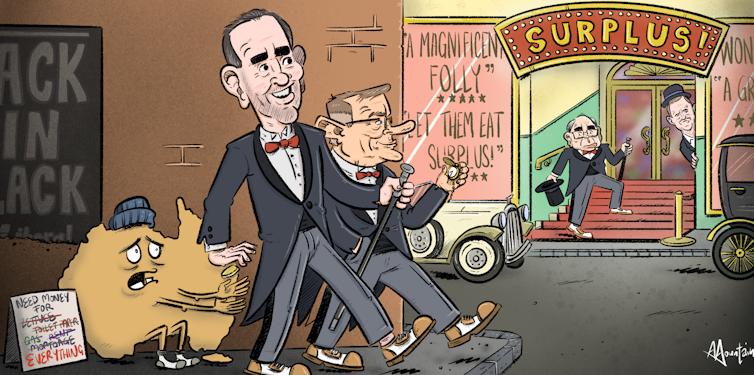
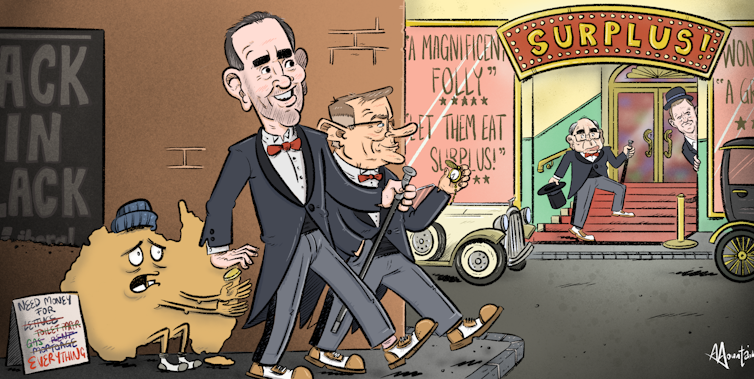
Surplus or not, the budget papers show us living through pretty awful times.

Living standards measured by the buying power of wages are set to go backwards again in 2023-24 as wages grow by 3.75% while prices rise by 6%.

Separate figures released by the Bureau of Statistics as Treasurer Jim Chalmers was preparing to deliver his speech show the volume of goods and services bought from Australian retailers has shrunk for the past six months.


Living standards measured by gross domestic product are set to go backwards in 2023-24 as total GDP grows by an unusually low 1.5% while Australia’s population grows by 1.7%, producing a so-called “per capita recession”.

The good news on the government’s finances is largely historical.

The good news is old news

The budget positions for 2022-23 and 2023-24 have been improved by $42 billion each because of measures largely outside the government’s control (so-called “parameter and other variations”).

Chief among these has been an unexpectedly big increase in the number of Australians in work and subject to income tax (as the unemployment rate has fallen to a half-century low), and much higher prices for exports than expected (roughly twice as high for case of iron ore), producing more profits to tax.

The government has chosen to spend just $1 billion of the $42 billion bounty in 2022-23 and just $12 billion in 2023-24, which has allowed the rest of the bounty to produce a small budget surplus of $4.2 billion in 2022-23 and a much smaller than expected deficit of $13.9 billion in 2023-24.


Beyond 2022-23, it will be deficits again for at least a decade on the budget’s projections, as the unusual circumstances that delivered the boost fall away.

The unemployment rate is set to climb from its long-term low of 3.5% to 4.25% by mid next year and to 4.5% by mid-2025. The number of Australians in work and in the income tax system is expected to grow by just 1% in 2023-24 and 2024-25 after growing by 2.5% in 2022-23. The iron ore price is expected to halve within a year.

Government income is set to grow 8.8% in 2022-23 and 5.1% in 2023-24. After that, it is scheduled to barely grow in 2024-25, climbing just 0.5%, before returning to growth of 4.4% and 4.9 in 2025-26 and 2026-27.

Given that the costs of some government programs are expected to grow by a lot (the cost of National Disability Insurance Scheme is expected to grow by an average of 10.4% per year and the cost of funding hospitals by 6.5% per year), it looks as if the government is going to have to find more money.

Spending on defence is set to climb 22% over the next four years, and doubtless by more beyond, as spending on building and buying the nuclear-powered submarines under the AUKUS agreement ramps up.


Chalmers has sensibly abandoned the Coalition’s quaint commitment to keep the tax to GDP ratio to 23.9%, which is just as well because the influx of revenue scheduled for 2023-24 will to take it to 23.9% (25.9% including non-tax revenue) before it falls back.


Longer term, Chalmers will have to raise more tax or cut government services. The increases in the tax on large superannuation balances, tobacco excise and the petroleum resource rent tax are a sign of what’s to come.

The ultra-expensive Stage 3 income tax cuts deliver a hard-to-defend $2,000 per year to high earners on $120,000 per year. Although legislated back before COVID, they are not due to take effect until mid next year, meaning there’s still time (and another budget) in which to wind them back and reorientate them to Australians who need them more.

Where Chalmers has supported Australians hit by ultra-high inflation in this budget, he has tried to do it cheaply.

Boosting JobSeeker and related payments by the $128 per week Chalmers’ economic inclusion advisory committee wanted would have cost $5.7 billion per year. Instead, Chalmers will lift it by $20 per week (and slightly more for most Australians on it aged 55 and over) at a cost of $1.3 billion per year.

As important as extending parenting payments to single parents with children up to 14 years of age will be those who need it. The measure is budgeted to cost just half a billion per year.

Boosting Commonwealth rent assistance by up to $16 per week (the “largest increase in more than 30 years”, Chalmers says) will cost a tad more, around $700 million per year.

Boosting Medicare, primarily by boosting payments to general practitioners who bulk bill children and patients on low incomes will cost $1.3 billion per year.

The cost of the energy package (which the treasurer says will take $500 per year off some power bills and three-quarters of a percentage point off inflation) is marked in the budget as “not for publication”, presumably in deference to negotiations with the states which will co-fund it.

Chalmers’ budgets will get harder

Chalmers said during his press conference this budget had been much harder to put together than his first. What he could have added is that his next budget is shaping up to be even harder.

Economic growth has been revised down. So convinced are financial markets the economy is weakening, that ahead of the budget they were pricing in no further Reserve Bank interest rate increases in this year and one interest rate cut, by December.

The economic forecasts in the budget suggest the coming per-capital recession won’t turn into an actual recession. Economic growth is expected to climb from an ultra-low 1.5% in 2023-24 to a still-low 2.25% in 2024-25 and then to 2.75%.


Inflation, which was 7% in the year to March, is forecast to fall to 6% in the year to June, and then to a less-worrying 3.25% by June 2024.

Although the forecasts move in the right direction, they are not good. Chalmers said getting things right this time required a “fine balance”. Future budgets are shaping up to require just as much.


The Conversation

This article is republished from The Conversation under a Creative Commons license. Read the original article.

Read more >>

Tuesday, May 02, 2023

Presented with a JobSeeker finding too clear to ignore, he changed the subject: how Jim Chalmers is shaping the budget

What was Treasurer Jim Chalmers thinking?

Late last year he set up a committee he specifically asked to tell him how bad JobSeeker was.

The exact words in its terms of reference required it to advise him on the “adequacy, effectiveness and sustainability of income support payments”.

It is true that he was sort of forced to. Independent Senator David Pocock made the committee a condition of supporting an unrelated industrial relations bill in the Senate. Its findings had to be published a fortnight before each budget.

Yet Chalmers chose to set a group whose findings would be hard to ignore. He put on it one of Australia’s pre-eminent experts in the adequacy of payments, Professor Peter Whiteford; one of Australia’s pre-eminent experts in labour markets, Professor Jeff Borland; and one of Australia’s pre-eminent experts in calculating disadvantage, Associate Professor Ben Phillips.

To give the “interim economic inclusion advisory committee” extra heft, he added the head of the trade union movement, the head of the Businesses Council, the head of the Council of Social Service and the head of the Treasury.

In short, Chalmers set up a committee he couldn’t ignore. So why is he now so keen to talk about everything but its number one recommendation?

Impossible to ignore

Sometimes committees like these end up making so many recommendations that a minister can pick and choose from them.

And this committee did make 37 recommendations, as Finance Minister Katy Gallagher noted this week saying she was “not going to be able to do everything”.

But, unusually, this committee went out of its way to make sure one recommendation stood out above all others.

It reported that, given its short timeframe, it had:

decided to concentrate on the needs of the largest number of Australians experiencing poverty and disadvantage today, namely people on JobSeeker, Youth Allowance and related working-age payments.

It found every available indicator showed the current rates of JobSeeker and related payments were seriously inadequate, whether measured against payments overseas, against the minimum wage, against pensions, or against poverty lines.

Measured against other members of the Organisation for Economic Co-operation and Development, Australia’s JobSeeker payment for a newly-unemployed single was the third worst.

When the higher rates of rent assistance available overseas were taken into account, it became the absolute worst.

Whereas a quarter of a century ago Australia’s unemployment payment was roughly in line with the pension, decades of lifting one in line with prices and the other in line with wages have left us with a base JobSeeker rate of $347 a week ($49.50 per day), compared to a base age pension of $485 a week ($69 per day).

Too little to get medicines or work

Job seekers told the committee that $347 per week is so low, they kept looking around their homes for things to sell. Some had to choose between medicines and electricity. Some could fill only some of their prescriptions. Others could barely afford the petrol to get to medical appointments.

The committee’s findings echoed those of the OECD, which found 12 years ago Australia’s unemployment payment had fallen so low compared to costs as to raise “issues about its effectiveness” in helping the unemployed find jobs.

The committee’s number one recommendation – more important than any other – was that the government

as a first priority, commit to a substantial increase in the base rates of the JobSeeker Payment and related working-age payments

It didn’t ask for JobSeeker and associated payments to be lifted to the pension rate straight away, although it did suggest that the ultimate goal should be 90% of the pension. Ben Phillips has calculated that would cost $5.7 billion per year, which is less than 1% of total government spending.

What the committee didn’t want was a tiny increase along the lines of the $25 a week ($3.60 per day) the Coalition delivered when the coronavirus payments ended in 2021, without a commitment to build to something substantial.

So what is the government now doing in response? Chalmers and Gallagher appear to have decided it’s best to talk about something else.

Changing the subject

Seven News has reported that, while it won’t touch the base rate of JobSeeker and associated payments, the Albanese government will increase the rate for Australians aged 55 and over who have been out of work for some time.

That’s even less of a commitment than it seems.

There are 920,640 Australians on JobSeeker and Youth Allowance (which is a lower rate of JobSeeker for young Australians and is also paid to apprentices and students). Only 236,280 of them are aged 55 and over.

Many of those 236,280 are aged 60 and over, and already get a boosted JobSeeker payment; an extra $26 per week ($3.70 per day) after they have been out of work for nine months.

If all Chalmers is planning is to extend the extra for the long-term unemployed aged 60 and over to the long-term unemployed aged 55 and over, it will cost little, and deny the vast bulk of those on $49.51 per day hope that things will improve.

Chalmers appeared to verbal his committee on Tuesday by saying it had found women over 55 are the most vulnerable group amongst unemployed Australians.

While the committee did say that (and while 56% of the Australians on JobSeeker in that age group are women), it could not have been clearer in recommending that the base rate of JobSeeker and associated payments be lifted for all Australians.

Chalmers says we ought to wait to see what is in the budget, which is fair enough. But if a commitment to do what his personally-selected expert committee has recommended isn’t in this budget, that committee is likely to recommend it again two weeks before the next budget, and again two weeks before the next.

The treasurer has put himself on notice.The Conversation

This article is republished from The Conversation under a Creative Commons license. Read the original article.

Read more >>