Showing posts with label deeming. Show all posts

Sunday, July 14, 2019

They've cut deeming rates, but what are they?

Treasurer Josh Frydenberg has cut the deeming rate for large investments from 3.25% to 3%, and for smaller ones from 1.75% all the way down to 1%.

The cuts are backdated, to the start of July.

But what exactly is a deeming rate, and why does it matter so much to about one million Australians on benefits, among them around about 630,000 age pensioners?

It’s a topic I covered in The Conversation mid last week in an explainer that went all the way back to the beginning, or at least the most recent beginning, when treasurer Paul Keating brought deeming rates back to Australia’s benefits system in 1991.


Read more: Deeming rates explained. What is deeming, how does it cut pensions, and why do we have it?


Before that, applicants for the pension were able to pass income tests by ensuring that their assets didn’t earn much income, a service banks and other institutions were happy to provide for them.

From 1991, on applicants for the age pension (and later other benefits) were “deemed” to have earned from their financial assets amounts set by the government, whatever they actually earned.

Of late, deeming rates haven’t kept up

For most of the past two decades both the high deeming rate (which at the moment applies to financial assets in excess of A$51,800 for singles and $86,200 for couples) and also the low deeming rate (for lesser assets) have been below the Reserve Bank’s cash rate, benefiting applicants who could earn more than those low rates while continuing to get benefits.


Deeming rates versus RBA cash rate, July 1996 - July 2019, per cent
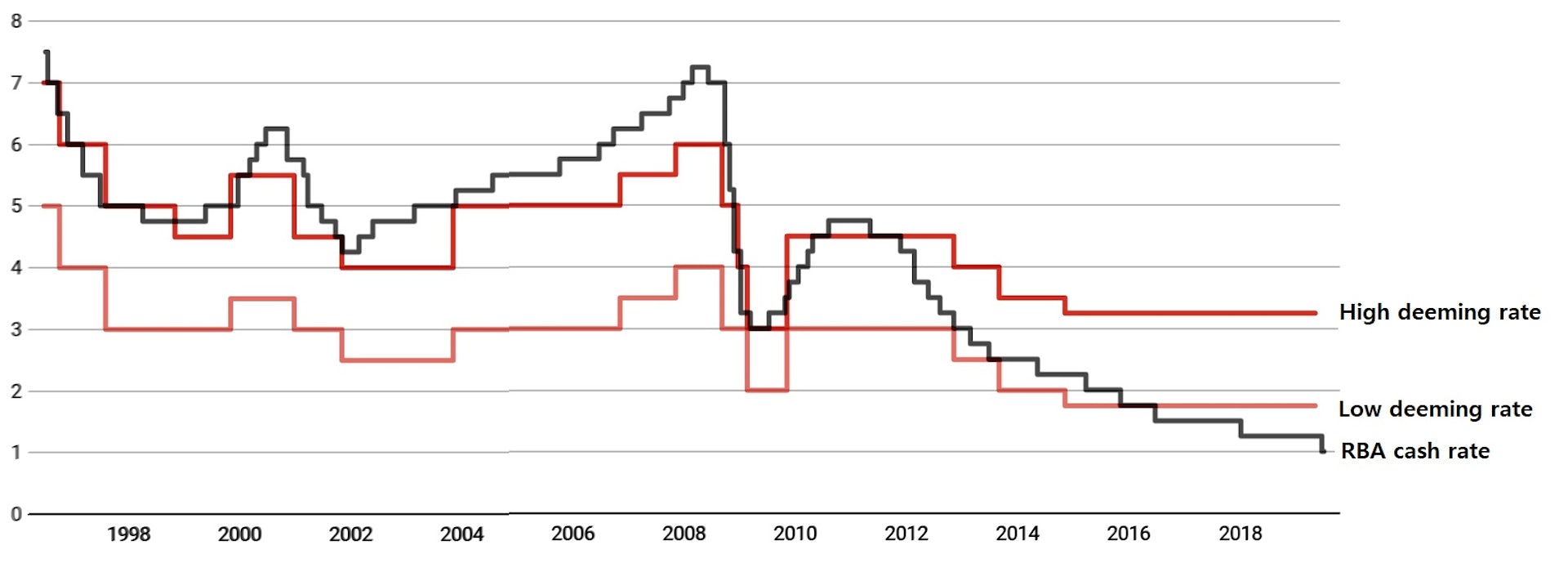

Then, beginning with prime minister Kevin Rudd (who, to be fair to him, in 2009 delivered the biggest ever increase in the pension – $100 a fortnight for singles and $76 for couples) and continuing under his successors Gillard, Abbott, Turnbull and Morrision, the government adjusted the deeming rate more slowly, meaning that as the Reserve Bank’s cash rate fell, both the high and low deeming rates ended up above it.
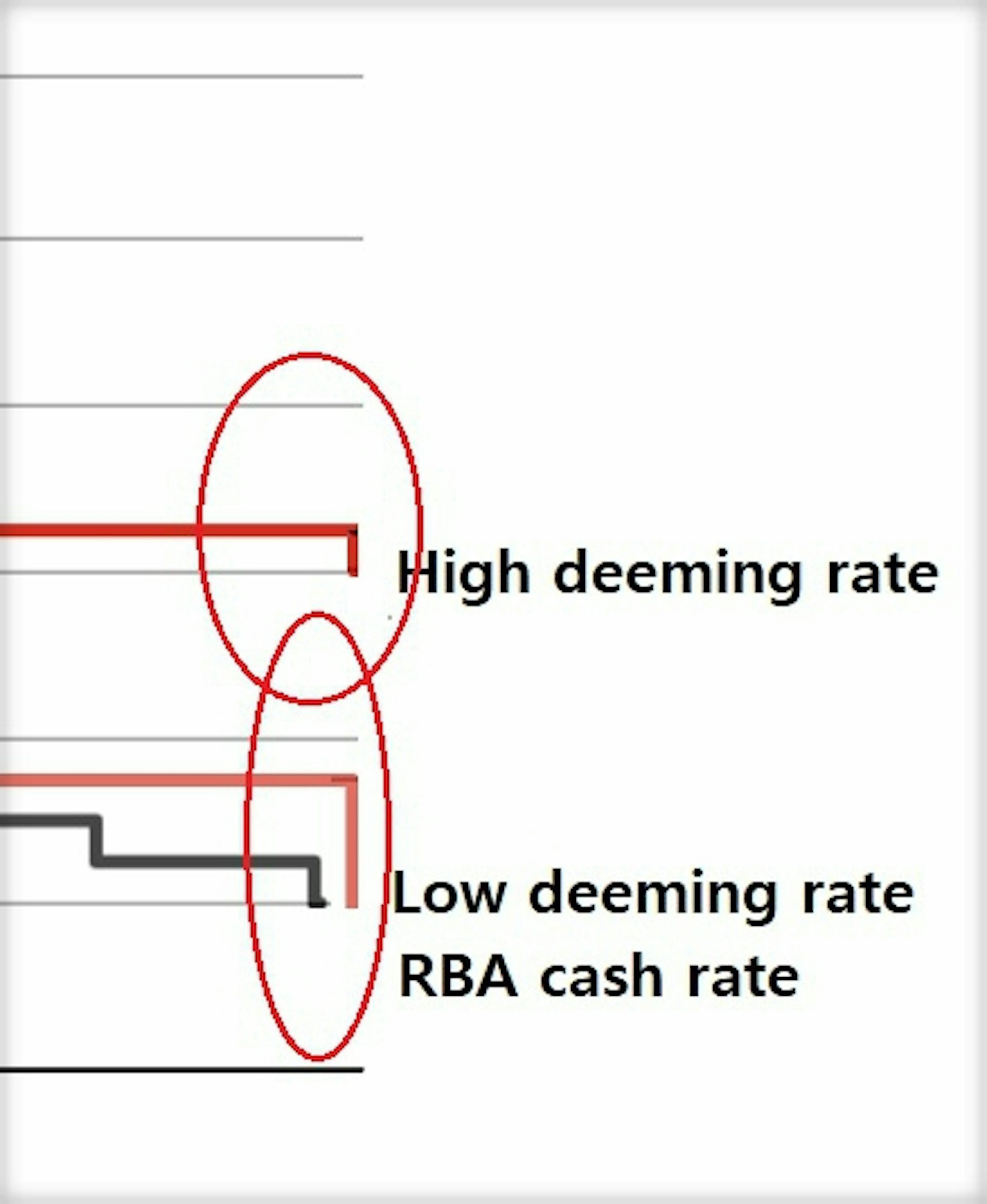
The decisions announced by Frydenberg on Sunday go a long way to putting things right.

The lower deeming rate will once more be close to the cash rate (exactly at the cash rate, for as long as the cash rate stays at 1%). The higher deeming rate will not be, but then it probably shouldn’t be.

The higher rate applies to the return on financial assets (including shares) worth more than $51,800.

As Frydenberg pointed out on Sunday, many of those assets return much more, not much less, than the deeming rate:

It could apply to superannuation returns, and that’s averaging around 5.5%. Or to yields on ASX 200 stocks, which are averaging about 4.5%

The low deeming rate is on the face of it unfair, because few bank deposits pay 1%. The special retirees accounts offered by ANZ and the Commonwealth pay 0.25%. Many deposit accounts pay nothing.

But the low rate applies to financial assets all the way up to $51,800 ($86,200 for couples), and to all types of assets. Many pension applicants are likely to earn a total return on those assets well above 1%.

Deeming is by design, rough and ready. There will always be complaints, and of late those complaints had force. They are now back broadly where they should be.


The Conversation

Peter Martin, Visiting Fellow, Crawford School of Public Policy, Australian National University

This article is republished from The Conversation under a Creative Commons license. Read the original article.


Read more >>

Thursday, July 11, 2019

Deeming rates explained. What is deeming, how does it cut pensions, and why do we have it?

Now it’s the Coalition that’s being accused of a “retiree tax”.

As interest rates have come down over the past four years, the rate that retirees are “deemed” to have earned for the purpose of the pension income test hasn’t budged, meaning that although retirees have been earning less (in some cases a good deal less), they haven’t been getting more access to the pension.

Depending on how you look at it, it’s either been making a mockery of the idea of an income test, or making the test more restrictive.

So how did it happen? Why is income “deemed” rather than actually measured when determining eligibility for government benefits, and is the system hopelessly compromised?

It’s important to understand what deeming is and where it came from if we are to understand the debate that will ensue when the government completes its review of the deeming rate in the next few weeks.

Where did deeming come from?

Modern day deeming was introduced by former prime minister Paul Keating in his final budget as treasurer in 1990.

As he explained in that budget speech:

many pensioners still disadvantage themselves by holding their savings in accounts that pay little or no interest

He was being diplomatic. It was widely believed that many retirees deliberately earned low rates on their savings in order to qualify for the pension or get a bigger pension. It cost the government money (while making the banks money) and it cost many of the pensioners money, because they lost more in interest than they gained in pension – although for those that used low earnings to ensure they at least got some pension, the associated benefits cards made it worth it.

From March 1991 cash and deposits were to assumed to be earning at least 10%, whatever they actually earned. If they earned more than 10% they were treated as earning more.

Except for the first A$2000. That was treated as earning only what it did, because many pensioners held small savings in low interest accounts for day to day purchases.

How has it changed?

Deeming is different today. It applies to more assets, including gold,
managed investments, superannuation account-based income streams and listed shares; and it is used to assess eligibility for more benefits, including veterans and disability pensions.

And it’s no longer a win-win for the government. If someone earns more than the deeming rate, their income is assessed at only the deeming rate.

In the words of the department of human services:

if your investment return is higher than the deemed rates, the extra amount doesn’t count as your income

There are two rates: one for the first $51,800 of financial assets (for a couple, the first $86,200) which is currently 1.75%, and the other for those assets in excess of that amount, which is currently 3.25%.

The threshold climbs in line with the consumer price index each July.

(In its first budget in 2014 the Abbott government tried to cut the threshold to $30,000 for singles and $50,000 for couples but was thwarted by the Senate.)

We deem by whim…

But there’s nothing automatic about setting the rates. It’s up to the government (specifically the minister for families and social services) to adjust them, or not, as it sees fit.

Both the high and low deeming rate used to be below the Reserve Bank’s cash rate (with the low rate typically 1.5 to 2 percentage points below the high rate), but after the cash rate dived in 2016 they have been left above it, in the case of the low rate, for the first time ever.

The high deeming rates mean many applicants are being means tested on income they haven’t received.


Deeming rates versus RBA cash rate, 1996 - 2019, per cent


…leaving rates curiously out of whack

Back when the deeming rates were lower relative to deposit rates, each of the big four banks offered “deeming accounts” that paid the deeming rates.

Today none of them do. They are not allowed to call accounts deeming accounts unless they pay the deeming rate, so instead they have retitled them “retirement accounts”.

The National Australia Bank’s retirement account (closed to new customers) pays just 0.20% for the first $10,000, well below the lowest deeming rate of 1.75%. The ANZ and the Commonwealth pay 0.25%. Westpac pays 0.3%. If you have more than $250,000 on deposit it pays 1.5% on the part above $250,000, which is still lower than the lowest of the two deeming rates.


Read more: Why pensioners are cruising their way around budget changes


Labor believes that not cutting deeming rates since 2015 has saved the government more than $1 billion per year in pension payments. It’s a significant portion of the $7.1 billion surplus it has forecast for 2019-20.

That is probably why the government has said it will take its decision about rates to its expenditure review committee, in what amounts to an admission that those decisions have as much to do with government finances as they do with treating applicants for pensions fairly.

There’s actually a case for extending deeming

As unrealistic as deeming rates have become, there’s a case for extending their use.

At the moment applicants for the pension face two means tests: one for assets and one for income.

Both the Henry Tax Review and the Abbott government’s National Commission of Audit recommended replacing them with a “merged means test” of the kind Australia had up until the 1970s.

Instead of an assets test, all assets would be deemed to earn a prudent rate of return; among them cars, holiday homes, investment properties, and high-value family homes.

The Commission put the case this way:

Exempting the principal residence from the means test is inequitable as it allows for high levels of wealth to be sheltered from means testing. For example, under current rules a single person who owns a $400,000 house and has $750,000 in shares ($1.15 million in total assets) would not be eligible for the pension, while a similar person with a principal residence worth $2 million and $100,000 in shares ($2.1 million in total assets) would be able to claim a pension at the full rate.

It’s a worthwhile idea whose time might come, but it is unlikely to come while deeming rates are seen to be unfair and capriciously set.

The government has an opportunity to restore confidence in deeming and pensions. The decisions it is about to make will show how important it thinks that is.


Read more: Words that matter. What’s a franking credit? What’s dividend imputation? And what's 'retiree tax'? The Conversation


Peter Martin, Visiting Fellow, Crawford School of Public Policy, Australian National University

This article is republished from The Conversation under a Creative Commons license. Read the original article.

Read more >>

Thursday, June 30, 2016

Pensioners and unemployed pay for election giveaways

Elections are where we get given things, right?

That's true, for the voters who matter. The rest are treated appallingly. A spreadsheet of Coalition promises maintained by Fairfax Media includes picnic tables, boardwalks, fire trails, skate parks, car parks, netball courts, tennis courts, disabled toilets and lighting for sports ovals.

None are even remotely the responsibility of the Commonwealth, and at any other time the Turnbull government and his ministers would rightly handball responsibility for them to the states, along with schools. But they are in electorates they need to hold. I am told they have set an unofficial limit of $20 million per electorate they believe is in play. It's bribery done cheaply.

Out of sight, they're funding those promises by taking money from people whose votes matter less.

The Newstart unemployment benefit hasn't changed since its inception. Indexed in line with prices rather than wages, it's just $264 a week ($13,700 a year), which is way below the pension at $397 per week. Except for once. On March 20, 2013, under the Gillard government, Newstart recipients got a bonus, an extra $4.20 per week added permanently to their benefit in the form of a clean energy supplement. It was made up of what the carbon tax would do to the cost of living (0.7 per cent) plus an extra 1 per cent.

It stayed when the carbon tax went, leaving Newstart recipients for the first time slightly better off. Wage earners got their own compensation in the form of income tax cuts, which they also kept, something Treasurer Scott Morrison was keen to remind us in the aftermath of this year's budget, telling the press club: "When you get rid of a carbon tax and then you keep the tax relief, that turns from being compensation to a tax cut".

Yet quietly, in the same budget, he removed the clean energy supplement. From September while wage earners keep their tax cut, and existing Newstart recipients keep their Clean Energy Supplement, new recipients will lose it. Morrison is taking away the only proper pay rise they had ever had.

But it's worse than that. Because of the way the clean energy supplement was introduced, removing it will actually leave them worse off. When it came in, their base payment was boosted by 0.7 per cent less than it should have been, because 0.7 per cent of the increase was due to the carbon tax. Then they were given the supplement of 1.7 per cent. Removing the supplement will leave incoming Newstart recipients worse off than if the whole thing had never happened. A calculation by a former department of social security analyst provided to the Australian National University suggests they will be $3.60 per week worse off. Morrison has not only taken away a benefit, he's also given Australia's most desperate citizens a pay cut.

The budget says removing the supplement will save $1.4 billion over five years, which is a fair chunk of the $2.3 billion Morrison and Prime Minister Malcolm Turnbull plan to spend on picnic tables, boardwalks and the like. Australia's least well-off are funding giveaways in marginal, predominantly Coalition, electorates. As are pensioners. The income test for the pension works though something called the deeming rate. Instead of finding out what pensioners' bank deposits and investments actually earn, the government "deems" the rate of interest they earn and then uses the deemed income to restrict access to the pension. The lower the deeming rate, the more access part-pensioners get.

Last March after the Reserve Bank cut its cash rate, the government cut the deeming rate for small investments from 2 to 1.75 per cent and for big investments from 3.5 to 3.25 per cent. "More than 770,000 Australian part-pensioners and allowance recipients will be given a $200 million boost to their payments," the then social services minister crowed. "The current generation of aged pensioners had a deal with the government over their lifetime that if they worked hard there would be an aged pension at the other end. This government is keeping that deal and seeking to make the aged pension sustainable for future generations who will need it." The Social Services Minister was Morrison.

The Reserve Bank has cut its cash rate two more times since then and the private banks have followed. But neither Morrison as Treasurer nor his successor as Social Services Minister have cut the deeming rate. The Commonwealth Bank's pensioner security account is now offering just 0.25 on the first $2000 and 1.25 per cent beyond that. After $48,600 it's offering 2.5 per cent where the deeming rate is 3.25 per cent. Pensioners who bank with the Commonwealth or any of the other major banks are losing income because the government is delaying adjusting the deeming rate in accordance with reality.

They've something in common with the unemployed: they are not particularly visible and they are not good at complaining, which makes them good victims. Along with welfare recipients who'll face greater checks to see they haven't been overpaid, they're helping to bring the deficit down so the rest of us don't have to.

In The Age and Sydney Morning Herald
Read more >>